



Services on Demand
Journal

Article
 English (pdf)
 Article in xml format
 Article references
 Automatic translation
 Send this article by e-mail
Indicators
Related links
-
 Cited by Google
 -
 Similars in Google
Share

 Permalink
African Biodiversity & Conservation
On-line version ISSN 3078-8056Print version ISSN 0006-8241
Bothalia (Online) vol.55 n.1 Pretoria 2025
https://doi.org/10.38201/abc.v55.2
SHORT COMMUNICATION
Anthospermum, an unusual name for an African genus of Rubiaceae
Elmar Robbrecht; Brecht Verstraete
Meise Botanic Garden, Nieuwelaan 38, 1860 Meise, Belgium
ABSTRACT
The mainly African genus Anthospermum L. has an enigmatic name, meaning 'floral seed.' Recent dictionaries of plant names relate the name to the complex reproductive biology of the genus, i.e., male flowers sometimes having ovaries capable of ripening seeds. However, Linnaeus himself mentioned how he coined the name, and he explained it differently. The Italian botanist Giulio Pontedera, who made earlier observations on the genus, confused flower buds with fruits and seeds with anthers. Hence, Linnaeus coined the name by combining the words flower (Greek anthos) and seed (Greek spermum) and herewith wanted to emphasise this error. Anthospermum seems to be another example of an insulting name given by Linnaeus.
Introduction
Ordinarily, researchers make use of scientific names of plants in Latin without ever considering their meaning. This is even more true for members of the general public for whom such names usually make little sense (Jiménez-Mejías et al. 2024). The name Anthospermum L. is enigmatic and can be translated as 'flower-seed' or 'floral seed' (Greek anthos = flower and spermum = seed). While working on a project investigating several aspects of all generic names in Rubiaceae (Verstraete et al. in press), we were struck by contradictions in the etymological interpretation of this name. Dictionaries of plant names relate the odd name with the complex reproductive biology of the genus, but Linnaeus himself gave a totally different explanation. In this paper, we compare the conflicting interpretations with the available literature.
The genus Anthospermum
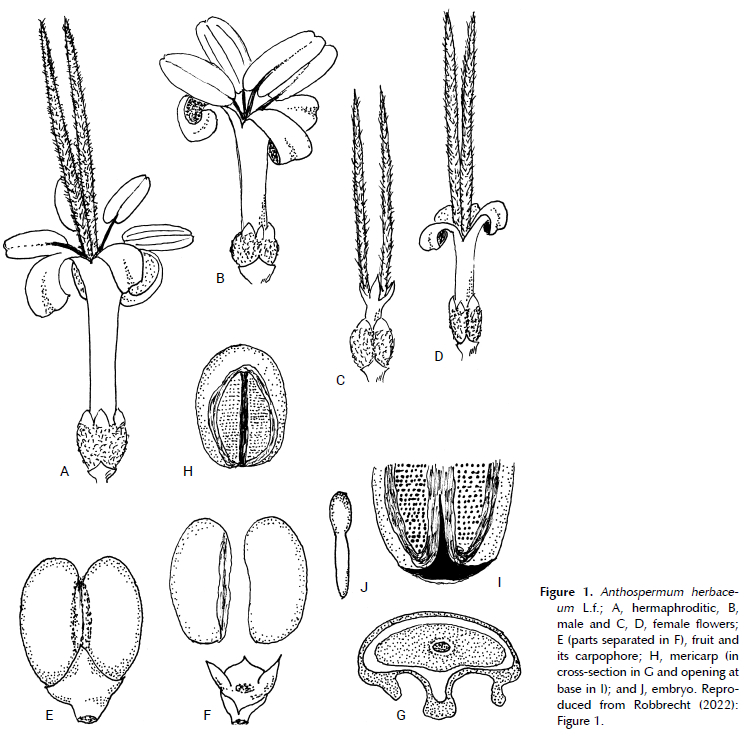
Anthospermum L. is a genus of 39 species in the Rubiaceae family, occurring in Tropical and southern Africa and the Arabian Peninsula (POWO 2024). The southwestern Cape Floristic Region (13 species) and Madagascar (8 species) are notable centres of its diversity (Puff 1986). The genus belongs to the tribe Anthospermeae and is closely related to the southern African genera Galopina Thunb. and Nenax Gaertn. and the Macronesian genus Phyllis L., with which it forms the subtribe Anthosperminae (Thureborn et al. 2019). The South African endemic Carpacoce Sond. is in the monogeneric subtribe Carpacocinae. The other genera in the tribe (placed in subtribes Coprosminae and Operculariinae) do not occur on the African continent, except for Nertera granaden-sis (Mutis ex L.f.) Druce, which is also found in Madagascar (POWO 2024). The tribe Anthospermeae is unique in Rubiaceae because it only comprises wind-pollinated taxa; anemophily is otherwise absent from Rubiaceae (Puff 1982). Anthospermum plants have a reduced habit (subshrubby and often heather-like, or herbaceous) and are dioecious or polygamous. The genus is further characterised by unisexual or sometimes hermaphroditic flowers, long and feathery stigmata (in the female flowers), 2-locular ovaries with 1 ascendent ovule in each locule, and dry fruits subtended by a bracteolar carpophore, separating in two mericarps, tardively opening with three basal slits (Figure 1; Puff 1986; Robbrecht 2022).
The taxonomic history of the genus begins with the starting point of the nomenclature of angiosperms, i.e., Species Plantarum (Linnaeus 1753). In this publication, only Anthospermum aethiopicum L. from the Cape, South Africa was included (Linnaeus 1753: 1058), hence making it the type species. In the second edition, A. ciliare L. was added (Linnaeus 1763: 1512), while in the Supplement, Linnaeus' son added a third species, A. herbaceum L.f. (Linnaeus 1782: 440). A first survey of the genus was already done at the beginning of the 19th century (Cruse 1825), recognising eight species. Additional species were published especially at the end of the 19th and beginning of the 20th century. The genus was subject to a modern taxonomic revision based on extensive field work, adding 14 species to the genus (Puff 1986 and references therein). Recent molecular phylogenetic research demonstrated that the monophyly of Anthospermum was not proven, instead it was included in a highly supported Anthospermum-Nenax clade (Thureborn et al. 2019).
In contrast, the sister genera Galopina and Phyllis were found to be monophyletic. A subsequent phylogenomic study of the tribe Anthospermeae corroborated the close relationship of Anthospermum and Nenax, but it could not confirm or reject the monophyly of the genera since only one species of either genus was included (Thureborn et al. 2024).
Materials and methods
The relevant literature, mostly historical, was found available on the internet and consulted. All Anthospermum specimens in the Linnean herbarium at the Linnean Society of London were consulted online in September 2024 (https://linnean-online.org/view/type/specimen/Anthospermum.html).
Results and discussion
The etymology of the name
The name Anthospermum is enigmatic and means 'flower-seed' or 'floral seed' (Greek anthos = flower and spermum = seed). The CRC World Dictionary of Plant Names (Quattrocchi 2000: 161) explained the name as follows: 'the male flowers may produce seeds', while the Dictionary of southern African Plant Names (Clarke & Charters 2016: 23) explained it as: 'Although the flowers are usually dioecious - unisexual male and female - 'male' flowers sometimes have ovaries capable of ripening seeds.' Except for the fact that the plants, rather than the flowers, are dioecious, the latter etymology seems plausible. Puff (1986: 134) discussed in great detail the large morphological plasticity of Anthospermum species, showing phenomena such as reversion of male flowers to hermaphroditic ones.
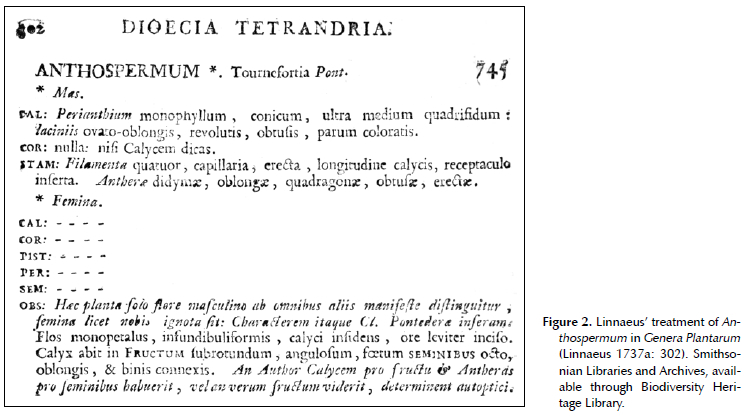
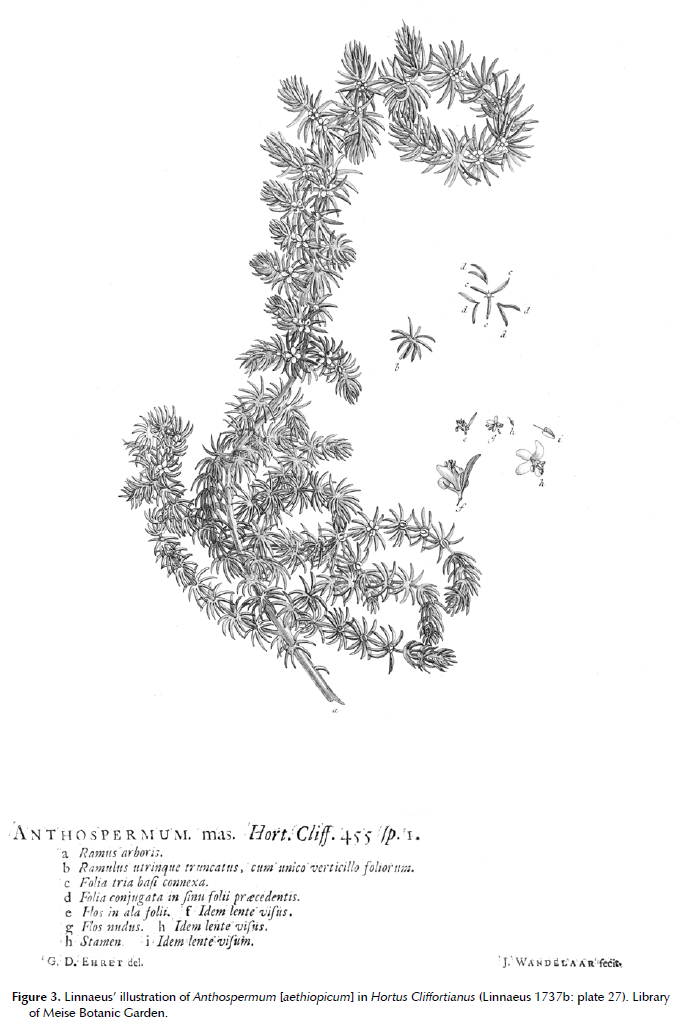
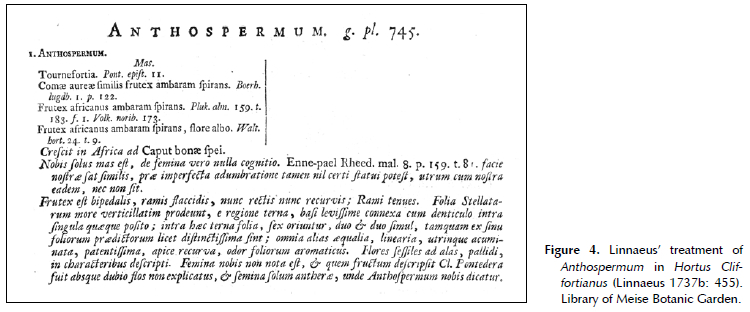
However, Linnaeus, who described the genus, explained the etymology in a different way. He already coined the name before publishing his Species Plantarum (Linnaeus 1753); he previously used the name in Genera Plantarum (Linnaeus 1737a: 302) and Hortus Cliffortianus (Linnaeus 1737b: 455, plate 27). In Genera Plantarum (Figure 2), he expressed doubt about the earlier work of Giulio Pontedera, who described the plant as Tournefortia: 'An Author [Pontedera] Calycem pro fructu & Antheras pro seminibus habuerit, vel an verum fructum viderit, determinent autoptici' [if the Author (Pontedera) took the calyx for a fruit and the anthers for seeds, or observed a genuine fruit, will be ascertained by dissections.] In the Hortus Cliffortianus, Linnaeus published a detailed plate (Figure 3), for which the announced dissections were made. He was now certain (Figure 4): 'Femina nobis non nota est, & quem fructum descripsit Cl Pontedera fuit absque dubio flos non explicatus, & semina solum antherae, unde Anthospermum nobis dicatur' [The female is not known to us, and the fruit, which the Honorable Pontedera described, was without doubt an unfolded flower, and the seeds only anthers, whence we call it Anthospermum']. Linnaeus' name thus means 'floral seed' and alludes to Pontedera's wrong interpretation of a flower bud.
Pontedera's error
Pontedera (1718) published his genus Tournefortia in a letter to William Sherard, appended to his Compendium Tabularum Botanicum: 'Tournefortia est genus Plantae producens Florem Monopetalum, Infundibuliformem, calyci insidentem, & leviter per oras incisum, cujus calyx abit in fructum subrotundum, angulosum, octo seminibus foetum, oblongis, binis & binis dispositis' [Tournefortia is a genus of plants producing a flower with a single petal, funnel-shaped, seated in a calyx, and slightly incised at the edges, whose calyx leads to a sub-rounded, angular fruit, bearing eight oblong seeds, arranged in pairs.]. Especially the eight 'seeds' (anthers) arranged in pairs are difficult to interpret. Note that the Anthospermum species studied by Pontedera and Linnaeus (nowadays Anthospermum aethiopicum) has tetramerous flowers (with a single whorl of anthers, as is standard in Rubiaceae). Do the eight seeds in fact correspond to the four anthers with two thecae each? Pontedera should not be ridiculed for his mistake because detailed observations of a small flower [the corollas (tube + lobes) of the male flowers are only ± 3 mm long] must have been challenging in the early 18th century, without powerful optical equipment.
Linnaeus' interpretation
It is difficult to imagine how Linnaeus linked the vague and confusing description published by Pontedera to his concept of Anthospermum. Pontedera and Linnaeus were probably never in direct contact, and, in any case, the Italian botanist was not an adept of Linnaeus' revolutionary approach (Jönsson 2011). It is more likely that Linnaeus had more than only published evidence to establish the identity of Pontedera's Tournefortia. We assume that he also saw specimens used by Pontedera. We consulted Linnaeus' herbarium on the internet for possible specimens with annotations pointing to Ponted-era. Puff (1986: 227) cited syntypes labelled 'Habitat in Aethiopiae' and 'Caput bonae spei'. He designated Linn 1233.1 [(BM; herb. Clifford (in herb. Banks)] as lectotype of A. aethiopicum. The Linnaean Collections at the Lin-nean Society of London only have one other identified A. aethiopicum, viz. Linn 1233.2, consequently the only other syntype. Three other specimens are only identified to genus level, while Linn 1233.4 and Linn 1233.5 are identified as A. ciliare and A. herbaceum, respectively. None of these bear traces of ever having been seen or studied by Pontedera. His Italian collections are in OXF (Vegter 1983). Unfortunately, we were unsuccessful in locating South African specimens seen by him.
Linnaeus' attitude towards the work of Pontedera cannot be known for certain. His son reported that he loved a joke (Blunt 1971: 167), and his sense of humour was reflected in his writing as well as in his teaching (Jönsson 2002). Is there a degree of sarcasm in coining the rather improper name 'floral seed'? Did he perhaps not hold the Italian botanist in high regard? At any rate, Linnaeus refused to pick up Tournefortia, the name Pontedera used for this genus of Rubiaceae of the Cape, and he even re-used that name for a totally unrelated and different plant currently in Boraginaceae (Tournefortia L.). The young Linnaeus was confronted with heavy criticism on his revolutionary reform of botany by a generation of well-established scientists (Jönsson 2011). As a response, he was not afraid of reacting strongly, among others by giving plant names insulting his opponents (Humar 2024). He named Dorstenia L. (Moraceae) after the German botanist Theodor Dorsten, stating that its flowers are insignificant, as if withered and past their time, like the outdated work of Dorsten (1492-1552) (Jönsson 2002). Another German botanist, Johann Georg Siegesbeck (1686-1755), was ridiculed by being 'commemorated' in the name of a smelly little weed Siegesbeckia L. (Jönsson 2011; Heard & Mlynarek 2023). Hence, Linnaeus' Anthospermum might represent a similar case. Should Linnaeus' insulting names be interpreted in the context of the new regulation on derogatory names in the future Code (Turland et al. 2024)? The Code only envisages names derogatory to a group of people, published on or after 1 January 2026, so the names Anthospermum, Dorstenia or Siegesbeckia are not in danger of future rejection.
Composition of generic names in Rubiaceae
The peculiar etymology of the name Anthospermum came to our attention while working on a project considering generic names in the family (Verstraete et al. in press). In Rubiaceae (and likely in most other angiosperm families), the most common way of naming a genus is by looking for a distinctive feature. To continue with African examples, Carpacoce refers to the shape of the fruit. Eponyms are the second largest category of generic names in Rubiaceae; Alberta E.Mey. is named after Albertus Magnus, a 13th century 'doctor universalis'. Names may also refer to other names of taxa (e.g., Paraknoxia Bremek. refers to a relationship with Knoxia L.)., or to a cultural aspect (Canthium Lam. is based on a Malayalam name). Other names refer to a geographical origin (Natalanthe Sond., a synonym of Tricalysia A.Rich., referring to its discovery in Natal). None of these five categories apply to the name Anthospermum, which is unique in referring to a wrong observation. In Rubiaceae, we only know one slightly similar case. Achille Richard (in De Candolle 1830; Richard 1834) used the name Nescidia A.Rich. for a Mauritian species of Coffea L., which he knew only from flowering material. His name refers to the fact that the fruits were unknown to him (Latin nescire = not to know).
Conclusion
Quattrocchi (2000) as well as Clarke and Charters (2016) - and maybe other authors - made a wrong assumption when linking the etymology of the strange name Anthospermum with the complex reproductive biology of the genus. Instead, Linnaeus was inspired by an erroneous morphological observation made by Pontedera and hence composed this apparently insulting name in a way not paralleled in other generic names of Rubiaceae.
Acknowledgements
We are grateful to Charlotte Taylor (Missouri Botanical Garden) and Alejandro Quintanar Sanchez (Real Jardín Botánico, Madrid) for help with Latin translations. Nicole Hanquart, librarian at Meise Botanic Garden, is thanked for her help in the preparation of the illustrations. Research for this paper was facilitated by the Biodiversity Heritage Library.
References
Blunt, W., 1971, The compleat naturalist: a life of Linnaeus, pp. 1-256, Collins, London. [ Links ]
Clarke, H., & Charters, M., 2016, The illustrated dictionary of southern African plant names, pp. 1-482, Jacana, Johannesburg. [ Links ]
Cruse, W., 1825, De rubiaceis capensibus praecipue de genere anthospermo, pp. 1-22. Formis Brüschckianis, Berolini [Berlin], https://doi.org/10.5962/bhl.title.53550. [ Links ]
De Candolle, A.P., 1830, 'Ordo XCVIII Rubiaceae', in A.P. de Candolle (ed.), Prodromus systematis naturalis regni vegetabilis, Volume 4, pp. 341-622, Treuttel et Würtz, Paris, https://www.biodiversitylibrary.org/page/152487. [ Links ]
Heard, S.B., & Mlynarek, J.J., 2023, 'Naming the menagerie: creativity, culture and consequences in the formation of scientific names', Proceedings of the Royal Society B 290, 20231970, https://doi.org/10.1098/rspb.2023.1970. [ Links ]
Humar, M., 2024, 'Scientific nomenclature of species and naming practices in (ancient) biology', in M. Asper (ed.), Coming to terms. Approaches to (ancient) terminologies, pp. 183-204, De Gruyter, Berlin/Boston, https://doi.org/10.1515/9783111314532-008Links ] Arial, Helvetica, sans-serif" size="2">.
Jiménez-Mejías, P., et al., 2024, 'Protecting stable biological nomenclatural systems enables universal communication: a collective international appeal', BioScience 74,7, 467472, https://doi.org/10.1093/biosci/biae043. [ Links ]
Jönsson. A.-M., 2002, 'Ingenting ár allvarligare an skämtet -Carl von Linné och humorn', Svensk Botanisk Tidskrift 96, 171-176. [ Links ]
Jönsson, A.-M., 2011, 'Linnaeus's international correspondence. The spread of a revolution', in B.-L.Gunnarsson (ed.) Languages of Science in the Eighteenth Century, pp. 171-192, De Gruyter Mouton, Berlin, Boston, https://doi.org/10.1515/9783110255065.171. [ Links ]
Linnaeus, C., 1737a, Genera plantarum, 1st edition, C. Wishoff, Lugduni Batavorum, https://doi.org/10.5962/bhl.title.70902. [ Links ]
Linnaeus, C., 1737b, Hortus Cliffortianus, Amstelaedami [Amsterdam], https://doi.org/10.5962/bhl.title.690. [ Links ]
Linnaeus, C., 1753, Species plantarum, 1st edition, Laurentius Salvius, Holmiae [Stockholm], https://doi.org/10.5962/bhl.title.37656. [ Links ]
Linnaeus, C., 1763, Species plantarum, 2nd edition, Laurentius Salvius, Holmiae [Stockholm], https://doi.org/10.5962/bhl.title.11179. [ Links ]
Linnaeus, C. [filius], 1782, Supplementum plantarum, Orphanotropheum, Brunsvigae [Brunswick], https://doi.org/10.5962/bhl.title.555. [ Links ]
Pontedera, G., 1718, Compendium tabularum botanicarum, Giovanni Manfrè, Padua, https://bibdigital.rjb.csic.es/idurl/1/13652. [ Links ]
POWO, 2024, Plants of the World Online, Facilitated by the Royal Botanic Gardens, Kew, Published on the Internet, http://www.plantsoftheworldonline.org [accessed 23 September 2024]. [ Links ]
Puff, C., 1982, 'The delimitation of the tribe Anthospermeae and its affinities to the Paederieae (Rubiaceae)', Botanical Journal of the Linnean Society 84, 355-377, https://doi.org/10.1111/j.1095-8339.1982.tb00369.x. [ Links ]
Puff, C., 1986, 'A biosystematic study of the African and Madagascan Rubiaceae-Anthospermeae', in Plant Systematics and Evolution, Supplementa, Vol. 3, Springer, Vienna, https://doi.org/10.1007/978-3-7091-8851-4. [ Links ]
Quattrocchi, U., 2000, CRC World Dictionary of Plant Names, pp. 1-2896, CRC Press, Boca Raton, London, New York, Washington, D.C. [ Links ]
Richard, A., 1834, 'Mémoire sur la familie des Rubiacées, contenant la description générale de cette familie et les caracteres des genres qui la composent', Mémoires de la Société d'Histoire naturelle de Paris 5, 81-304, https://www.biodiversitylibrary.org/page/4196710. [ Links ]
Robbrecht, E., 2022, 'Rubiaceae, Tribu XXVI. Anthospermeae et XXVII. Rubieae', in M.S.M. Sosef (ed.), Flore d'Afrique centrale, nouvelle série, Spermatophyta, pp. 1-44, Jardin botanique de Meise, Meise. [ Links ]
Thureborn, O., Razafimandimbison, S.G., Wikström, N., Khodabandeh, A. & Rydin, C., 2019, 'Phylogeny of Anthospermeae of the coffee family inferred using clock and nonclock models', International Journal of Plant Sciences 180, 386-402, https://doi.org/10.1086/703353. [ Links ]
Thureborn, O., Wikström, N., Razafimandimbison, S.G. & Rydin, C., 2024, 'Phylogenomics and topological conflicts in the tribe Anthospermeae (Rubiaceae)', Ecology and Evolution 14, e10868, https://doi.org/10.1002/ece3.10868. [ Links ]
Turland, N.J., Alvarez, I., Knapp, S., Monro, A.M. & Wiersema, J.H. 2024, 'XX International Botanical Congress, Madrid 2024: Report of Congress action on nomenclature proposals', Taxon 73, 1308-1323. https://doi.org/10.1002/tax.13258. [ Links ]
Vegter, I.H., 1983, Index Herbariorum, Part II (5), Collectors N-R, Regnum Vegetabile 109, https://www.biodiversitylibrary.org/page/62527379. [ Links ]
Verstraete, B., De Block, P. & Robbrecht, E. (in press), 'A survey of generic names in Rubiaceae (Gentianales) with notes on context and patterns in naming', Taxon. [ Links ]
 Correspondence:
Brecht Verstraete
e-mail: brecht.verstraete@plantentuinmeise.be
Submitted: 23 September 2024
Accepted: 13 January 2025
Published: 30 April 2025