



Services on Demand
Journal

Article
 English (pdf)
 Article in xml format
 Article references
 Automatic translation
 Send this article by e-mail
Indicators
Related links
-
 Cited by Google
 -
 Similars in Google
Share

 Permalink
South African Journal of Agricultural Extension
On-line version ISSN 2413-3221Print version ISSN 0301-603X
S Afr. Jnl. Agric. Ext. vol.53 n.2 Pretoria 2025
https://doi.org/10.17159/2413-3221/2025/v53n2a16232
ARTICLES
Determinants of the Market Channel Choice by Smallholder Maize Farmers in Zimbabwe: A Case of the Mazowe District
Munyati V.T.I; Mudhara M.II; Sikhulumile S.III
IPhD Student at University of KwaZulu-Natal, Private Bag X01, Scottsville 3209, Pietermaritzburg, South Africa. vtmunyati@gmail.com. https://orcid.org/0000-0003-1931-6753
IIProfessor of Agricultural Economics at University of KwaZulu-Natal, Private Bag X01, Scottsville 3209, Pietermaritzburg, South Africa. Mudhara@ukzn.ac.za https://orcid.org/0000-0001-8739-0811
IIIResearch Specialist (Economic Performance and Development) at Human Sciences Research Council, 134 Pretorius Street, Pretoria, 0001, South Africa. SSinyolo@hsrc.ac.za: -0 https://orcid.org/0000-0001-9324-081X
ABSTRACT
Marketing is crucial in alleviating poverty and achieving food security and sustainable agriculture goals, especially among smallholder maize farmers. Household demographics and transactional costs are critical in understanding the smallholder farmers' choice of specific market channels. This paper aimed to determine which marketing alternatives are being used by the smallholder maize farmers in the Mazowe District, the relative extent of their use and what personal characteristics of the respondents may affect their choice of a market outlet. Data were collected from 382 smallholder maize farmers in the Mazowe District, one of Zimbabwe's main maize-producing districts. The study used a structured questionnaire for data collection. The Multinomial Logit Model was used as the analytical tool. Three distinct maize marketing channel options were identified: the farm gate, the local market and the Grain Marketing Board. The results indicated that the factors that significantly influenced the market choice by the smallholder farmers are the age of the household head, extension contacts, market information, the distance to the market and the maize market price. An increase in the number of visits by extension workers significantly increased the likelihood that a maize producer will choose the local market when selling the maize produce. The distance to the market significantly influenced the probability of selecting the local market to the farm gate. As the distance to the local market increases, the smallholder farmers in Mazowe will prefer the farm gate for selling their produce. The producer's price was also statistically significant in determining the smallholder farmers' channel choice. In this study, the farm gate was the popular marketing channel for smallholder farmers. However, the price offered is often not competitive; the farmers opt for it due to a lack of storage facilities and low transaction costs.
Keywords: Multinomial Logistic Regression Model, Smallholder, Market Choice, Farm Gate.
1. INTRODUCTION
Commercialising smallholder agriculture through the increased participation of smallholder farmers in the formal markets is a critical requirement for the economic growth and development of most developing countries that rely on agriculture for their economic growth (Saha et al., 2021). There is strong empirical evidence that promoting the market access of smallholder producers improves their welfare and economic development. Access to efficient markets is considered an essential tool for lifting smallholder farmers out of poverty and enhancing food security in developing countries. Studies have shown that the increased market access of smallholder farmers in Zimbabwe has improved their comparative advantage in their farming activities and specialisation, increasing their household incomes.
Most sub-Saharan African countries have recognised maize market access as one of the key components for development. Markets play an important role in rural development, employment creation, income generation, food security, technology diffusion, enhancing resource-use efficiency and developing rural-market linkages. The availability of markets and improving the ability of smallholder and resource-poor rural farmers to access these market opportunities and diversify their links with the markets is, therefore, a prerequisite for enhancing agriculture-based economic growth and increasing their rural incomes. Therefore, access to different markets by smallholder farmers is a crucial development matter related to addressing poverty and fairness because markets are not only an economic issue but embedded in socio-economic and political institutions.
Despite numerous studies that have empirically investigated the factors farmers consider when choosing a particular commodity market in developing countries, only a few have assessed their market outlet. However, none of these studies have incorporated the market choice's selection bias and the observable and unobservable characteristics of this selection. This study methodologically addresses the biases noted in the literature by applying the MNL model, which accounts for selection bias (Musara et al., 2018). Furthermore, previous studies (e.g. Mossie et al., 2020) conducted on the choice of the market selection decision used the Multinomial Probit Model, which assumes that the specified variables are all normally distributed. The Multinomial Logit Model can be estimated using continuous, dichotomous and ordinal explanatory variables (Mmbando et al., 2017). This is a much less restrictive assumption than the Multinomial Probit Model. The Multinomial Logit Model results are also relatively easy to interpret, the empirical results are satisfactory, and it reduces autocorrelation problems compared to the Multinomial Probit Model. Hence, this study intends to extend the literature on the smallholder maize farmers' choice of markets using the Multinomial Logit Model. The findings of this study will inform policy formulation that intervenes in agricultural marketing. This will go a long way in improving the livelihoods of smallholder maize farmers in Zimbabwe's communal areas.
2. STUDY AREA
The study was conducted in the Mashonaland Central Province, in Natural Region II of Zimbabwe. Given the agroecological diversity of Zimbabwe, maize production performs better in Natural Region II, and it is common in the Mashonaland provinces, where production and productivity are relatively higher compared to the other regions. Natural Region II has a rainfall ranging between 750 mm and 1,000 mm per year and includes a significant proportion of the three Mashonaland Provinces, at 58,600 km2, or 15% of Zimbabwe's land area (Musemwa et al., 2013). The region is appropriate for intensive farming, typically maize, tobacco, cotton and livestock. The province was purposively sampled because it is the second leading province in maize production, and the area is farmed by smallholder farmers (ZIMVAC, 2020; Ministry of Agriculture, 2021).
Mashonaland Central is mainly a farming province, and the 2022 census data indicates that 64% of those employed work within the agricultural sector (ZIMSTAT, 2022b). Mazowe is one of the seven administrative districts in the province and is located about 60 kilometres from Harare, the capital city of Zimbabwe. Mazowe District covers a total of 453,892,000 hectares of land. About 1330 square kilometres are within the district's communal area. Mazowe District has a total of 35 wards and three administrative centres: Glendale, Concession and Mvurwi. The major crops grown include burley and Virginia tobacco, wheat, soya beans, and maize. One of the largest Grain Marketing Board's silos in Zimbabwe is located in the Mazowe District. This reinforces the notion that Mazowe is indeed a farming district. According to Chiweshe (2011), the major crops grown for sale in the area are tobacco and soya beans, while maize remains the staple food. The district is also rich in minerals such as gold, chrome, and limestone, which has prompted mining activities on a smaller scale than agriculture. While there are some tourist attraction centres in the district, they have not been fully developed.
3. SAMPLING PROCEDURES
A multistage sampling procedure was adopted, which involved selecting respondents in multiple stages. The researchers opted for the multistage sampling technique to reduce selection bias. Multistage sampling introduced randomness at each stage, reducing the likelihood that the sample will be skewed by factors related to the population's structure. The researchers first selected the province for the study owing to its numerous smallholder farmers. Secondly, Mazowe district was purposively sampled due to the higher productivity of maize within the district. Within the Mazowe District, five wards were randomly selected for the survey.
A formula that Slovin (1960) developed was used to calculate the sample size requirement of the study. Slovin's computations revealed that the sample size must be 382 smallholder farmers (a margin of error of 0.05)
4. RESEARCH PHILOSOPHY
In exploring the channel selection choices of maize smallholder farmers, the research used the mixed-methods research philosophy grounded in pragmatism. Pragmatism prioritises the research question and seeks to use both qualitative and quantitative approaches. This approach is particularly relevant in understanding the complex decision-making processes of maize smallholder farmers, who often consider various economic, social, and environmental factors when selecting the best channel to market their maize. Positivism also underpins the quantitative aspect of this research, where empirical data was gathered on factors like maize market prices, distance to the maize market, and number of extension visits that influence channel choice by the maize smallholder farmers. This data was analysed statistically to identify patterns and correlations, providing a broad, objective view of the determinants affecting farmers' decisions in selecting a specific market.
5. DATA COLLECTION
This study used cross-sectional household-level data on smallholder maize farmers and maize traders in Zimbabwe. Given the significance of the maize sector in the economy, Zimbabwe presents an interesting case study for maize marketing research. Maize is thus considered a strategic commodity in the Zimbabwean economy, as it is a food security crop and an agro-industrial processing raw material. A questionnaire was used to collect primary data. Before the main survey, the questionnaire was pre-tested to improve the structure and wording of the questions. Five trained enumerators administered it to 382 households, and 27 maize traders were randomly selected from five wards in the Mazowe District of Zimbabwe, with a minimum of 70 respondents in each ward. The questionnaire captured the smallholder farmers' household demographics, farm production and marketing activities.
6. ANALYTICAL TOOLS
6.1. The Multinomial Logit Model
Given that the sampled farmers in the study areas have more than two alternative channel choices, the Multinomial Logit (MNL) Model was applied to estimate the factors affecting their choice of marketing channel. This model is the best approach for choices based on the decision-maker's attributes. The model is widely used in studies involving multiple choices that define the dependent variable (Gujarati & Porter, 2009). The independent variables can be either dichotomous (i.e. binary) or continuous (i.e. interval or ratio in scale). MNL regression uses maximum likelihood estimation to evaluate the probability of categorical membership (Schwab, 2002).
The MNL estimates the probability of a maize farmer having a set of socio-economic characteristics so that:

βi is a vector of coefficients on each of the explanatory variables Xj (equation 1). Equation 1 can be normalised to remove indeterminacy from the model by assuming that the probabilities can be estimated as:

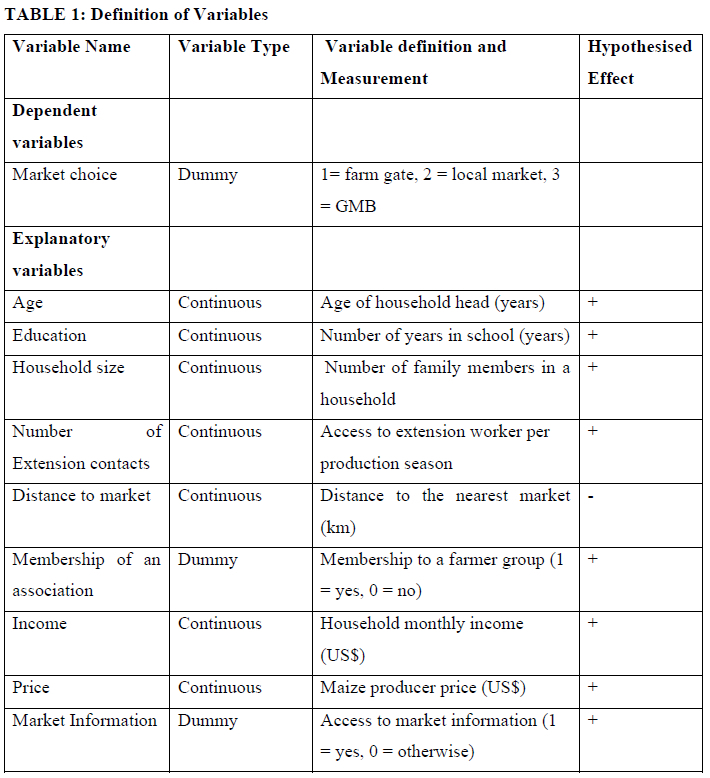
A set of socio-economic, institutional, and market characteristics conditioned on the smallholder maize farmer are presented in Table 1. The following explanatory variables were included in the model: the age of the household head, extension contacts, membership of an association, household income, household size, market information, the distance to the market, membership of an association and the maize producer price.
Education was captured as a continuous variable indicating the number of years of schooling of the household head. According to Mmbando et al. (2015), the educational level of the household head is used as a proxy for the farmers' ability to acquire and use information effectively. Investment in education and training is important, as it is widely believed that the educational level of farmers will improve their information-seeking behaviour and their adoption of agricultural innovations (Nxumalo et al., 2019). Musara et al. (2018) and Ndoro et al. (2015) explained that educational levels affect the interpretation of market information and choice, thus influencing the market channel's choice.
Extension contacts were captured as a continuous variable that indicated the number of visits by the extension officers to the household during the production year. It is hypothesised that the frequency of contact with extension workers is expected to facilitate smallholder farmer's linkages with input and output markets. Mukarambwa et al. (2018) and Mmbando et al. (2015) noted that farmers interacting more with the extension agents have a higher chance of selling to more formal markets.
Membership of an association was captured as a dummy variable. Musara et al. (2018) noted that belonging to a farmers' organisation improves the capability of farmers to participate in the market because they have increased bargaining power for better prices and increased access to farming and market information. The age of the household head is a latent characteristic in the marketing outlet choice, and it was captured as a continuous variable. In a study in Tanzania, Mmbando et al. (2015) found that older farmers are likelier to sell through closer markets.
Maize experience was captured as a continuous variable. A farmer's experience can generate confidence; with more experience, a farmer can become more efficient in production and produce more for the market. Mukarumbwa et al. (2018) noted that maize farming experience is a key factor in improving farmers' negotiation skills in the output market.
Distance to the market was measured as a continuous variable in kilometres. Farmers who travel long distances to the market experience high transaction costs, thus constraining them from buying at the farm gate or taking only a small amount to the market because of the bulky nature of maize. Megerssa et al. (2020), Ndoro et al. (2015), Musara et al. (2018), Kangile et al. (2020), and Hlatshwayo et al. (2021) noted that farmers located far from the markets are less likely to participate in the markets, probably because of the restrictive market access costs.
Total household income is a continuous variable measured in US$. Smallholder farmers with a high total income are likely to participate in lucrative markets because they can meet transaction costs, such as the transportation of produce to the market. Access to market information was measured by the farmer's ability and aptitude to interpret it correctly. The source of information the farmer receives is an important factor when farmers choose where to sell. According to Mukarumbwa et al. (2018), Nyaga et al. (2016), Ndoro et al. (2015) and Musara et al. (2018), access to market information influences their market channel decisions positively.
Maize producer price denoted the lagged price offered by a particular maize marketing channel in the district. Farmers spend considerable resources and time searching for markets that offer lucrative prices. A marketing channel offering a higher price is likely to incentivise farmers to participate in that particular marketing channel (Mukarambwa et al., 2018; Mmbando et al., 2017).
7. RESULTS AND DISCUSSION
7.1. Household Characteristics
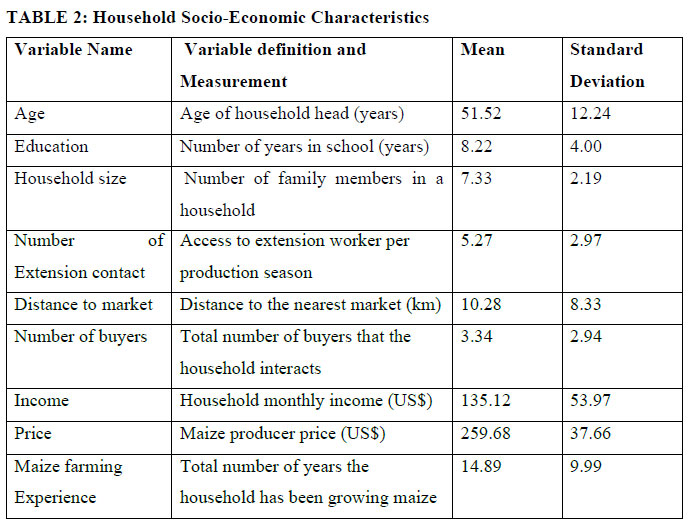
The farmers' household characteristics and transaction costs are very important in their market channel selection. Table 2 shows that the mean age of the household head was 51.52 years. The average age of the farming household was noted to be a productive age, and this concurred with the findings of Tauer (2017), who noted that the mean age of smallholder farmers is around the most productive age. The age of an individual influences productivity and food consumption. Age can partly explain the level of production and efficiency. The head of the household's age also indicates the smallholder farmer's managerial capital (Ndoro et al., 2015). In middle age, people are very active, aggressive and motivated by the needs of their families. Therefore, the respondents' age composition was considered an important factor in this study. The average household size for the market participants was approximately seven people, which, according to the ZIMSTATS Report (2022), is slightly above the national mean figure of five members per household.
The mean number of years that the household head spent at school was 8.22. Education increases the farmers' knowledge, which can be used to collect information, interpret the information received and make informed marketing decisions (Mossie et al., 2020). As the smallholder farmer's level of education increases, the farmers' productivity increases and linkage to lucrative markets strengthens.
The mean number of visits by extension officers to maize producers was 5.27 visits per production cycle. The general trend was that smallholder farmers are not accessing adequate extension services in the district, negatively affecting their productivity. The ZIMVAC Report (2021) confirmed that extension service delivery to smallholder farmers is generally limited; hence, there is a need for the capacity-building of government extension service providers to increase their coverage of extension services to smallholder maize farmers. The ZIMVAC Report (2021) also indicated that one of the greatest challenges has been the limited mobility of the ward-based extension workers, which limits the number of extension visits by the extension workers to the interaction of smallholder maize farmers.
In any value chain, the number of buyers plays an important role in determining the prices of a commodity. The mean number of maize buyers in the study area was 3.34. A higher number of buyers usually implies a lower chance of risk and exploitation for the farmers. The trend has been such that, over the years, when surplus production is realised, the private sector has offered farmers lower prices than those quoted by the state agency. Still, they have managed to lure the farmers into selling their grain to them by using incentives, such as immediate cash payments and transport provisions. The private traders then re-sell their grain stocks to the state agency at higher prices. In years where there are maize shortages, the private sector tends to offer higher prices than the formal market, and they re-sell the maize directly to millers and other companies that use the grain as an input in manufacturing and processing activities. The lower number of maize buyers in the study area has been attributed to the reintroduction of the monopoly status.
7.2. Preferred Maize Markets
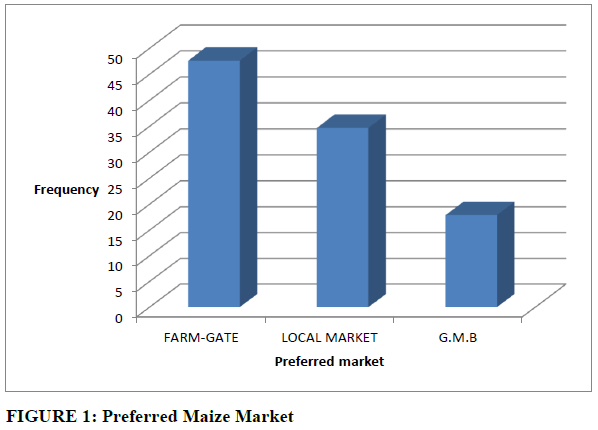
In any value chain, the number of buyers determines the prices of a commodity. If the number of buyers is very high, then the commodity's price is not expected to be very high. Figure 1 shows the maize markets preferred by smallholder farmers in the Mazowe District.
Smallholder farmers have three basic decisions to make regarding selling their surplus maize: they can either sell it at the farm gate at a low price or travel to the local market, where higher prices are offered. This incurs transaction costs or selling to the GMB, which offers better prices but with delayed payments. It can be noted in Figure 1 that the popular marketing channel for the smallholder farmers was the farm gate (47.43%), followed by the local market (34.69%), and the GMB (17.89%) was the least popular marketing channel amongst the smallholder farmers. These findings concur with those of Mmbando et al. (2017), Arinloye et al. (2020), Thangarasu et al. (2021) and Olutonis et al. (2019), who noted that the marketing channel preferred by most smallholder farmers was to sell their produce at the farm gate. Although the price offered is often not competitive, the farmers opt for this due to the lack of storage facilities and the low transaction costs. Lee et al. (2019) also noted that traditional marketing channels, such as the farm gate, are attractive to farmers because they offer low marketing costs and higher sales at the expense of lower prices. The results also concur with the findings of Mgale and Yunxian (2020), who noted that most rural farmers still sell their produce to local collectors because of farmers' failure, fear or inability to venture out of the farm gate into the markets.
7.3. Econometric Results
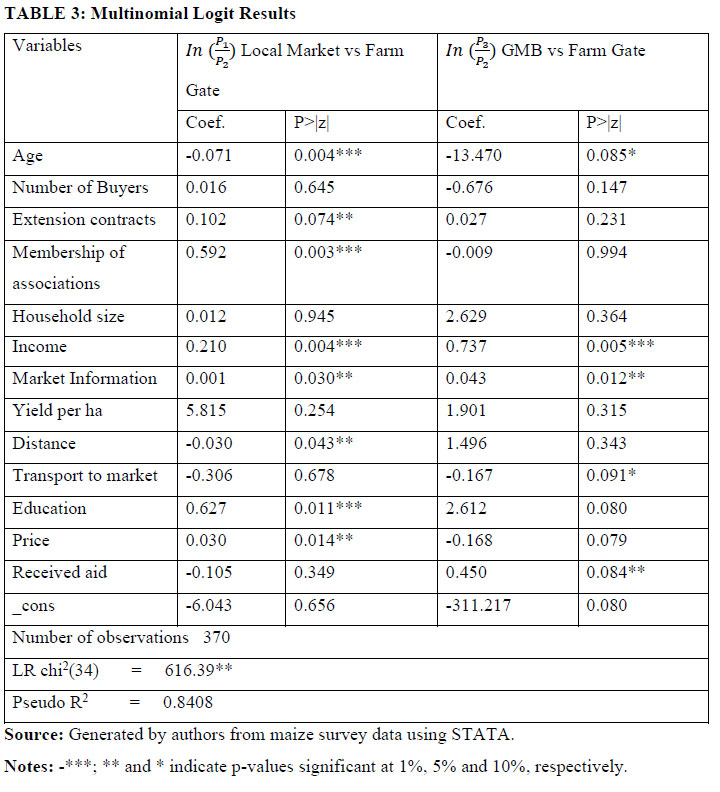
Due to the narrowness of the maize marketing channel options in the country, three distinct alternatives were isolated: the farm gate, the local market and the Grain Marketing Board (GMB). The farm gate was used as the referent category because this channel was chosen by most of the farmers for trading their maize, and the results were interpreted relative to the farm gate. The positive sign of the coefficient indicates an increase in the likelihood that a farmer will change to the alternative option. On the other hand, a negative value shows that a farmer is less likely to consider the alternative option.
The estimated LR chi2 is 616.39 and shows a statistical significance well above the 5% level, suggesting that the Multinomial Logit Model adequately fits the data. The Pseudo R2 of 84% shows the proportionate improvement in the model fit relative to the null model.
The age of the household head significantly reduced the likelihood that a maize producer would sell to the local market. It also significantly reduced the likelihood that a maize producer would sell to the GMB. Most old farmers cannot transport their maize to the local market and the GMB, so they prefer the farm gate. It can be concluded from the research findings that, as the farmers get older, they prefer to sell their produce at the farm gate because they may be better connected and have developed social capital with the traders there. These producers also have more established relationship networks within the community, which enhances their ability to market to the locals (Lee et al., 2019). These findings concur with those of Mmbando et al. (2017), Kgomugisha et al. (2019) and Akrong et al. (2021), who noted that older farmers will most likely sell through closer markets because they are likely to have established relationships with the buyers who purchase from them at the farm gate.
The number of visits by extension workers significantly increased the likelihood that a maize producer would sell at the local market. Access to extension services is expected to increase the ability of farmers to acquire relevant market-price information and related production information, which, in turn, increases a farmer's ability to choose a distant market. The findings concur with those of Ochieng et al. (2018), Mukarumbwa et al. (2018), Musara et al. (2018) and Mgale et al. (2020), who noted that access to extension services significantly increased the likelihood of a small-scale farmer choosing the district market.
Being a group member was associated with the increased likelihood of a farmer selling to the local market instead of the farm gate. Farmers in groups have the advantage of bulking, gaining economies of scale. It is also easier and cheaper for traders to enforce the quality and grade requirements by reaching farmers in groups rather than individually. This is consistent with the findings of Boughton et al. (2007), who noted that being a member of an association also allows farmers to access the information needed to increase their returns on crop production and marketing activities. Mukarumbwa et al. (2018) also noted that group participation enables smallholder farmers to access markets they might find difficult to penetrate individually.
Road infrastructure and transport availability influence market choice, especially if the farmer is located some distance from the market. The distance to the market significantly influenced the probability of choosing the farm gate, which was consistent with the a priori expectations. As the distance to the local market increases, the smallholder farmers in Mazowe will prefer to sell their maize at the farm gate. Farmers located further away from markets face higher transaction costs and may opt to sell their maize surplus at the farm gate rather than selling to the local market, increasing their transaction costs. Ndoro et al. (2015), Adugna et al. (2019), Muthini et al. (2017), Mmbando et al. (2017), Pingali et al. (2019) and Mgale and Yunxion (2020) also noted that the longer the distance, the higher the transportation costs and the higher the cost of marketing, which farmers always like to reduce, to enhance their profit. This is also consistent with the findings of Jari and Fraser (2009), who noted that as distance to the market increases, the transport costs also follow the same pattern, thereby increasing the costs associated with marketing and reducing the net benefits in the process.
Formal education is predicted to increase a household's understanding of the market dynamics and, therefore, improve the household head's decision regarding the market choice. The results revealed that more educated farmers were likelier to choose the local markets over the farm gate. Highly educated farmers have a better understanding of the production processes, market dynamics, and supply requirements, which can enhance their access to the local market. When farmers are more educated, they become aware of the value of their produce, reducing the likelihood of them selling their maize at the farm gate. This is in line with the findings of Bobojonov et al. (2016), Nxumalo et al. (2019), Mmbando et al. (2017), Mossie et al. (2020), Akrong et al. (2021), Cheelo and van der Merwe (2021) and Maspaitella et al. (2018), who noted that highly-educated farmers are more likely to shift from the farm gate to more organised markets if they are educated. The educated farmers know how to build contracts in different market channels and can meet the often-stringent requirements of lucrative markets.
The household's income was predicted to increase the probability of selling to the local market. Wealthy farmers are more capable of owning vehicles that can be used to transport their produce to more distant markets instead of selling at the farm gate. This finding is consistent with the findings of Mmbando et al. (2017) and Cheelo and van de Merwe (2021), who established a positive relationship between income and market choice. According to Mmbando et al. (2017) and Cheelo and van de Merwe (2021), wealthier farmers are less likely to sell at the farm gate as the quantity sold increases and more likely to travel to the market to sell. As the wealth of the farmers' increases, the farmers tend to prefer more formalised markets like the GMB.
Access to market information is a positive sign for both the local market and the GMB. The significance values of 0.003 for choosing the local market and 0.043 for choosing the GMB imply that there is enough evidence to support that an increase in the availability of market information results in an increase in the probability of smallholder farmers' choosing either the local market or the GMB, when selling their maize produce. The larger coefficient values show that households with the available market information will likely increase their participation in local and the GMB markets. Households unable to obtain pricing information are less likely to travel to the local market and the GMB and will sell their produce at the farm gate. These findings concur with those of Mmbando et al. (2017), Pham et al. (2019) and Cheelo and van der Merwe (2021), who noted that timely access to marketing information helps smallholder farmers to make informed decisions and increases the likelihood of the farmer choosing the most lucrative markets for their produce. Access to reliable market information helps to reduce transaction costs.
Price was also statistically significant in determining the factors influencing the channel choice decision of smallholder maize farmers in the Mazowe District, with a p-value of 0.006. A positive sign on its coefficient indicates that an increase in the price of maize increases the probability of the farmer selling the maize at the local market vis a vis the farm gate. The sign is consistent with the priori expectation that when the price of a product increases, the farmers will supply their produce to the local market rather than sell it at the farm gate. The research findings show that if smallholder farmers are assured of a good producer price, they are willing to travel long distances to access lucrative markets rather than settling for the farm gate. This concurs with Arega et al. (2007), who noted that as the price of a commodity increases, the farmer will prefer better and more formalised markets and forego selling their produce at the farm gate.
8. CONCLUSION
The household demographics and transaction costs offer valuable contributions through which the smallholder maize farmers' relationship to different marketing channels can be understood. This article has provided empirical evidence of the influence of household demographics and transaction costs on the market choices of smallholder maize farmers in the Mazowe District. The factors influencing their choices were defined and tested using the Multinomial Logistic Regression model. Three distinct marketing decisions were observed in the study area: the farm gate, the local market and the GMB. The marketing channel preferred by more than half of the smallholder farmers was selling their produce at the farm gate. Although the price offered is often not competitive, the farmers opt for it because of the lack of storage facilities and low transaction costs. There are several significant household-and market-specific factors related to the choice of marketing channel. Their age, extension visits, membership in an association, income, market information, distance to the market, education, and price are the most robust determinants of marketing channel selection by smallholder farmers in the Mazowe District.
9. POLICY RECOMMENDATIONS
This study provides several recommendations. Firstly, there is a need to develop the capacity of farmers to access marketing information so that they can make informed decisions regarding their choice of marketing channel to increase their income from maize marketing. Governments need to think about how to help farmers engage better with the existing profitable market channels for smallholder maize farmers.
Being a member of an association increases the probability of a farmer selling to more lucrative markets. Farmers in groups have the advantage of bulking, reducing market costs. There is also a need for farmers to invest more in collective action. It is easier and cheaper for traders to enforce the quality and grade requirements by reaching farmers in groups rather than individually.
Farmers located further away from the markets face higher transaction costs and may, therefore, opt to sell their maize surplus at the farm gate rather than at the local market, with its increased transaction costs. Farmers must invest specifically in transportation vehicles and storage facilities to overcome the transaction costs associated with long distances and market their produce as a group. The study also recommends that the local authorities improve the rural infrastructure, such as roads, and decentralise the GMB depots.
Access to extension services increases the ability of farmers to acquire relevant market price information and related production information, which, in turn, increases their ability to choose a more organised market. Increasing the frequency of extension visit contact will provide timely and updated information on the market conditions, especially the costs and net benefits associated with each transaction and marketing channel.
REFERENCES
ABU, B.M., ISSAHAKU, H. & NKEGBE, P.K., 2016. Farm gate versus market centre sales: A multi-crop approach. Agric Econ., 4(21): 1-16. [ Links ]
ADUGNA, M., KETEMA, M., GOSHU, D. & DEBEBE, S., 2019. Market outlet choice decision and its effect on income and productivity of smallholder vegetable producers in the Lake Tana Basin, Ethiopia. Rev. Agric. Appl. Econ., 22 (1340-2019-785): 8390. [ Links ]
ARINLOYE, D.D.A.A., PASCUCCI, G., LINNEMANN, S., COULIBALY, O., HAGELAAR, A.R. & OMTA, O.S.F.W., 2014. Marketing channel selection by smallholder farmers. J. Food Prod., 21(4): 337-357. [ Links ]
BOUGHTON, D., 2007. Market participation by rural households in a low-income country. Faith and Economics., 50: 64-101. [ Links ]
CALOGERO, C., CORRAL, P. & GUELF A., 2017. Agricultural commercilisation and nutrition revisited: Empirical evidence from three African countries. Food Policy., 67: 106-118. [ Links ]
CHEELO, T. & VAN DER MERWE, M., 2021. What factors influence smallholder farmers' decision to select a milk marketing channel in Zambia? Agrekon., 60(3): 243-252. [ Links ]
KASSAW, H.M., BIRHANE, Z. & ALEMAYEHU, G., 2019. Determinants of market outlet choice decision of tomato producers in Fogera Woreda, South Gonder Zone, Ethiopia. Cogent Food Agric., 5(1): 1709394. [ Links ]
KIM, M., CURTIS, K. & YEAGER, I., 2014. An assessment of market strategies for small-scale produce growers. Int. FoodAgribus. Manag. Rev., 17(3): 187-204. [ Links ]
KYOMUGISHA, H., NUPPENAU, E. & MUGISHA, J., 2019. Market channel options for smallholders in dual markets: A case of organic pineapple farmers in Uganda. J. Dev. Agric. Econ., 11(8): 186-196. [ Links ]
LEE, B., LIU, J.Y. & CHANG, H.H., 2019. The choice of marketing channel and farm profitability: Empirical evidence from smallholder farmers. Agribusiness Wiley., 36: 402-421. [ Links ]
MAGESA, M.M., MICHAEL, K. & KO, J., 2014. Access to agricultural market information by rural farmers in Tanzania. Int. J. Inf. Commun. Technol., 4: 264-273. [ Links ]
MMBANDO, F.E., WALE, E.Z. & BAIYEGUNHI, L., 2017. The welfare impacts of market channel by smallholder farmers in Tanzania. Dev. Pract., 27(7): 981-993. [ Links ]
MOSSIE, H., BERHANJE, Z. & ALEMAYEHU, G., 2020. Factors affecting outlet choice of onion producers in North-west Ethiopia in the Multivariate Probit Approach. Cogent FoodAgric., 6(1): 1722351. [ Links ]
MURICHO, G., MANDA, D., SULE, F. & MENALE, K., 2017. Smallholder agricultural commercialisation and poverty: Empirical evidence of panel data from Kenya. Paper presented at the 91st Annual Conference, April 24-26, Royal Dublin Society, Dublin, Ireland. [ Links ]
MUSARA, J.P., MUSEMWA, L., MUTENJE, M., MUSHUNJE, A. & PFUKWA, C., 2018. Market participation and marketing channel preferences by small-scale sorghum farmers in semi-arid Zimbabwe. Agrekon., 57(1): 64-77. [ Links ]
MUTHINI, D.N., NYIKAL, R.A. & OTIENO, D.J., 2017. Determinants of small-scale mango farmers' market channel choices in Kenya: An application of the two-step Cragg's Estimation Procedure. J. Dev. Agric. Econ., 9: 111-120. [ Links ]
NDORO, J.T., MUDHARA, M. & CHIMONYO, M., 2015. Farmers' choice of cattle marketing channels under transaction cost in rural South Africa: A Multinomial Logit Model. Afr. J. Range Forage Sci., 32(4): 243-252. [ Links ]
OCHIENG, J., KNERR, B., OWUOR, G. & OUMA, E., 2018. Strengthening collective action to improve marketing perfomance: Evidence from farmer groups in Central Africa. J. Agric. Educ. Ext., 24: 169-189. [ Links ]
OGUNLEYE, K.Y. & OLADEJI, J.O., 2007. Choice of cocoa market channels among cocoa farmers in the Osun State, Nigeria. Middle East J. Sci. Res., 2(1): 14-20. [ Links ]
OSMANI, A.G. & HOSSAIN, E., 2015. Market participation decision of smallholder farmers and its determinants in Bangladesh. Agric. Econ., 62(1): 163-179. [ Links ]
PHAM, T.T., THEUVSEN, L. & OTTER, V., 2019. Determinants of smallholder farmers marketing channel choice: Evidence from the Vietnamese rice sector. Asian Econ. J., 33: 281-300. [ Links ]
PINGALI, P., AIYAR, A., ABRAHAM, M. & RAHMAN, A., 2019. Linking farms to markets: Reducing transaction costs and enhancing bargaining power. In C. Barret (ed.), Transforming Food Systems for a Rising India, Springer Nature, pp. 193-214. [ Links ]
TAUER, L.W., 2017. Farmer Productivity by Age over eight U.S census years. New York: Dyson School of Applied Economics and Management. [ Links ]
ZIMBABWE VULNERABILITY ASSESSMENT COMMITTEE., 2020. National Livelihoods and Nutrition Assessment Report. Harare. [ Links ]
ZIMBABWE VULNERABILITY ASSESSMENT COMMITTEE., 2021. National Livelihoods and Nutrition Assessment Report. Harare. [ Links ]
 Correspondence:
V.T. Munyati
Email: vtmunyati@gmail.com