




Services on Demand
Journal

Article
 English (pdf)
 Article in xml format
 Article references
 Automatic translation
 Send this article by e-mail
Indicators
Related links
-
 Cited by Google
 -
 Similars in Google
Share

 Permalink
Lexikos
On-line version ISSN 2224-0039Print version ISSN 1684-4904
Lexikos vol.35 Stellenbosch 2025
https://doi.org/10.5788/35-1-1981
BOOK REVIEWS
Du Ruiqing and Jiang Yajun: New Century Chinese-English Dictionary
Du Ruiqing and Jiang Yajun. New Century Chinese-English Dictionary. Third Edition. 2025, XXXVIII + 2490 pp. ISBN 978-7-5213-5418-8 (Hardback). Beijing: Foreign Language Teaching and Research Press. Price $54.43.
The New Century Chinese-English Dictionary (NCCED) was first published by Foreign Language Teaching and Research Press in 2003. Adopting the guiding principle of "Readers first, practicality foremost" advocated by the late Professor Hui Yu, its editor-in-chief, the dictionary aimed to include words and expressions that could reflect the present times while paying special attention to the recording of neologisms that had emerged in the previous decade. With a coverage of 140,000 entries and a heavy focus on the use of phrasal illustrative examples, the dictionary gradually established itself as one of the most popular C-E dictionaries in China. Du Ruiqing took over as editor-in-chief of the second edition which was published in 2016, and the dictionary had 8,100 additional entries and 74,000 revisions, boasting a total of 150,000 entries. The inclusion of neologisms in the dictionary was rather praiseworthy as its compilers had made extra effort to record new words and expressions created because of economic and social development. The word 网络 (online or network) had 98 sub-entries, which is evidence enough of its comprehensiveness in the coverage of neologisms. Thanks to its wide coverage, excellent translation quality and successful app launch, NCCED2 has so far stood out as one of the best C-E dictionaries now available. In consequence, it has been widely reviewed or written about. A keyword search in CNKI, a database of Chinese academic papers, came up with over 50 reviews and papers.
The publication of NCCED3 has been long expected and desired as the past few years have witnessed the creation of hundreds or even thousands of neologisms in the Chinese language. The second edition, though still popular among its wide readership, has failed in many ways to meet their needs. The third edition, co-edited by the late Professor Du and Jiang Yajun, came out after a seven-year revision. As is mentioned in the introduction written by Jiang, the revision mainly revolved around the collection of new words and new meanings, and the improvement upon deficiencies related to the coverage, translation, and illustrative examples in the previous edition. The newness of the dictionary can be illustrated by the following two examples. The first example is related to the addition of the new medical term 新冠 (COVID-19) and many examples containing the term. In the entry for 新冠, three sub-entries have been furnished, namely 新冠肺炎 (old term for 新冠感染), 新冠感染 (COVID-19; coronavirus disease 2019), and 新冠疫苗 (COVID-19 vaccine). Besides, dozens of related examples have been provided throughout the dictionary text, such as 注射新冠疫苗 (vaccinate sb. against COVID-19), 新冠病毒感染疫 (COVID-19-affected area), 新冠病毒奥密克戎变异株 (the Omicron variant of SARS-CoV-2), 保持社交距离 (enforce/practice social distancing), and 他新冠核酸检测呈阳性 (His COVID-19 nucleic acid test came back positive). The second example is related to one of the most popular buzz-words - 人工智能 (artificial intelligence; AI). The editors not only revised the entry through the addition of two examples (namely "人工智能技术 artificial intelligence technology" and ""人工智能算法 artificial intelligence algorithm") and the provision of related entries such as 生成式人工智能 (generative artificial intelligence; generative AI) and 大语言模型 (large language model; LLM), but also provided three more related examples in other entries, namely 人工智能的创始人 (founding father of artificial intelligence), 人工智能产业方兴未艾 (The AI industry is on the upswing), and 人工智能是一种赋能技术 (Artificial intelligence is an empowering technology).
NCCED3 has included about 4,000 new entries, many of which were selected with the help of existing Chinese dictionaries, corpus data, and online search. These new words are used in various aspects of human life, as can be exemplified by the entries shown in Table 1:
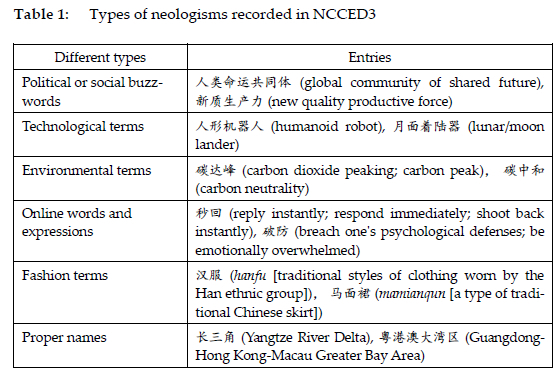
Besides, NCCED3 has also recorded the new uses of many existing words.
数字, for instance, had three senses in the second edition, namely "characters that denote amounts", "numeral; figure; digit", and "quantity; amount", and the new edition has recorded its adjective use - "digital". Other new meanings that have found their way into NCCED3 are shown in Table 2:
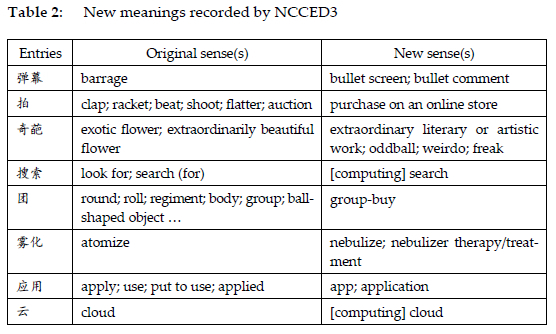
Thirdly, the editors of NCCED3 have provided many existing entries with illustrative examples which not only encompass phrases and short sentences, but also include compound words or terminology formed with the entry word, as is exemplified by the entries in Table 3:
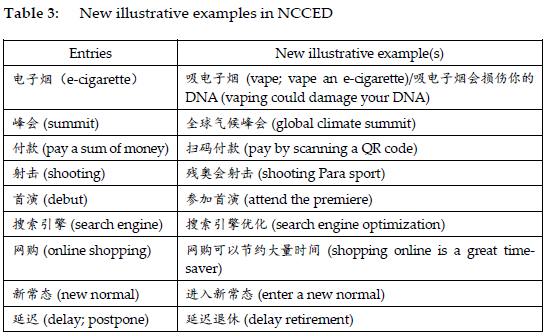
Moreover, considerable improvement has been made to the new edition, which is manifested in the following two aspects: the improvement of the translations for headwords and the replacement of existing illustrative examples. The editors made special efforts to amend the translations of many entries. for instance, was translated as "fragrant mushroom; wood mushroom" which has been changed into "Chinese (black) mushroom", apparently a much better equivalent. Other entries whose translations have been amended are shown in Table 4:
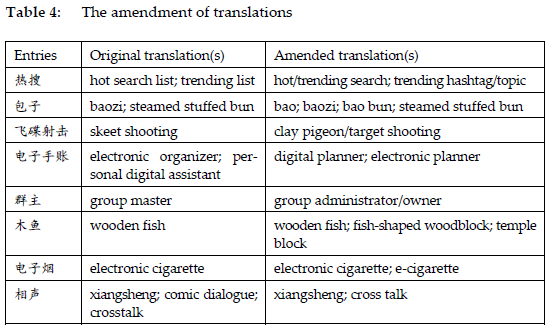
Translation-wise, the adoption of the pinyin system for culture-specific words in NCCED3 is rather commendable. As a matter of fact, such practice has long been adopted by C-E dictionary-makers. In NCCED1, the editors translated 粽子 through a combination of transliteration and explanation, namely zongzi - pyramid-shaped dumpling made of glutinous rice wrapped in bamboo or reed leaves [usu. eaten during the Dragon Boat Festival]". In the third edition, the editors have adopted transliteration in the translation of more culture-specific terms, such as fensi for 粉丝 (cellophane noodles), Huagu for 花鼓 (flower drum), meihuazhuang for 梅花桩 (plum-blossom stake), tangbao for 汤包 (steamed dumplings filled with juicy meat and gravy), tangyuan for 汤圆 (stuffed dumplings made of glutinous rice flour served in soup), and tanghulu for 糖葫芦 (skewered fruit coated in hardened sugar syrup). Besides, they have also made some changes to the existing body of illustrative examples, the purpose of which is to make them keep pace with the changes of the times or to improve the wording. In the entry for 邮件 (email), for instance, one of the original examples - 备份邮件到 CD (backup [sic] emails to CD) - has been replaced by 备份电子邮件到云存储账户 (backup emails to one's cloud storage account). Similar changes have been made to the entries shown in Table 5:
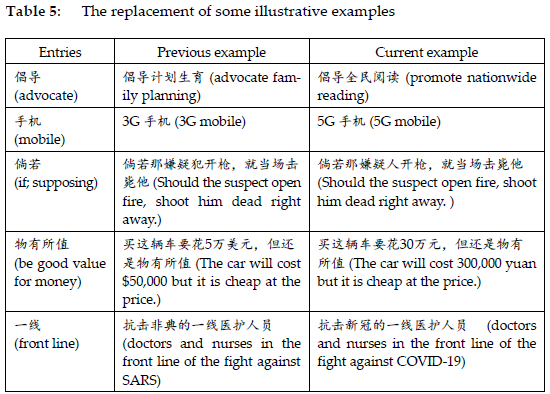
NCCED3 is also praiseworthy for its provision of some new features that include 翻译点津 (Translation suggestions), 翻译速查 (Translations for related terms), and 话题词汇 (Related words and expressions). There are altogether 132 boxes containing very useful information that is conducive to improving one's translation skills and enlarging one's vocabulary as well.
However, NCCED3 still leaves room for improvement when it comes to the selection of headwords, the coverage of neologisms, the translations of the entries and illustrative examples, and the provision of examples. Some of the words in the dictionary, neologisms in particular, are chosen purely for the fact that their English equivalents are neologisms in the first place even though these Chinese counterparts are not being frequently used in Chinese. This deficiency can be illustrated by its inclusion of 网购踩点 (literally "examination before online shopping"). The term can be considered a nonword as there is virtually no result when searched in search engines like Google, and it is a farfetched equivalent for the English neologism showrooming which is defined by Oxford Dictionary of English as "the practice of visiting a store or stores in order to examine a product before buying it online at a lower price". Other terms in NCCED3 that have been selected not in accordance with its usual criteria include 不首先使用 (no first use), 池浮游生物 (heleoplankton, known more as 沼泽浮游生物), 臭氧消耗物质 (ozone-depleting substances, known more as 消耗臭氧层物质), 数字基础设施 (digital infrastructure), 网站人流量 (web traffic), etc.
The failure to record some of the latest Chinese neologisms has plagued C-E dictionaries for years as it was quite difficult for Chinese dictionary-makers to fully record the new lexicon due to various reasons. NCCED3 is not immune to this failure. As the second volume of The Chinese English Dictionary (Unabridged) (CEDU) was published in June 2024, we can make a comparison of the new entries recorded in the two dictionaries (as is indicated in Table 6).
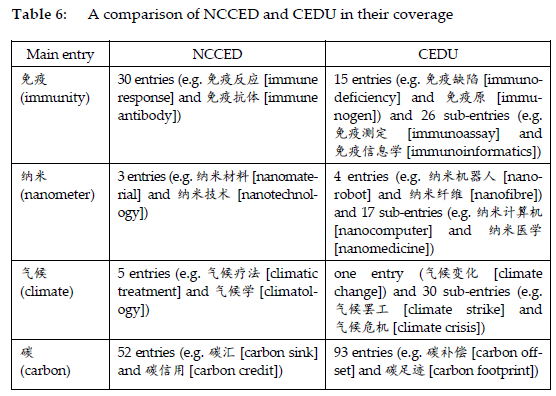
Some newly emerged Chinese words have been conspicuously missing from NCCED3. The character 脑 (brain) has formed many compounds in the past couple of years, such as 脑洞 (avenue to the brain; brain crease), 脑补 (figure out the picture or actual meaning), 脑雾 (brain fog), and 脑腐 (brain rot). However, these words have failed to make their way into NCCED3. Also missing from NCCED3 are some widely known Chinese food items or culinary terms like 韭菜盒子 (fried Chinese leek dumpling), 麻辣烫 (hot, spicy soup of meat and vegetables), 螺蛳粉 (luosifen), (spicy numbing stir-fry pot), etc. As far as the recording of new scientific terminology is concerned, NCCED3 has also done a poor job. China National Committee for Terms in Sciences and Technologies (CNCTST), a governmental agency in charge of regulating the use of terminology, has recently released the top ten scientific and technological terms of the year 2024, namely 人工智能+ (artificial intelligence plus), 低空经济 (low-altitude economy), 月背采样 (take samples from the far side of the moon), 量子科技 (quantum technology), 具身智能 (embodied intelligence), 混合现实 (mixed reality), 生物制造 (biomanufacturing), 近零碳 (nearly zero-carbon), 实景三维 (real-scene 3D), 微核糖核酸 (microRNA, miRNA). Unfortunately, NCCED3 has recorded none of them. In the same vein, some new meanings of existing words have been not recorded by NCCED3, such as 钓鱼 (entrap somebody; originally "angle; fish"), 队友 (mate, one's husband or wife; originally "teammate; fellow player"), 落地 (implement, put into effect; originally "fall to the ground"), 赛道 (track; originally "racetrack"), 虚拟 (virtual; originally "suppositional; hypothetical; invent"), 野蛮 (unrestrainedly; originally "uncivilized; savage"), and 移动 (its adjective use "mobile"; originally "move; shift").
Moreover, NCCED3, though generally viewed as the go-to dictionary for translators, has a mountain to climb as regards the quality of translations for some of its headwords and illustrative examples. The translations for many words beginning with the character 网 are rather problematic. 网红店 (Instagrammable store), for instance, has been translated into "trending shop" and "trending store", but these two translations are not idiomatic in the English language: there is no record of trending shop and one occurrence of trending store (appeared in an Indian media outlet) in the NOW corpus. Other entries whose translations need improvement are listed in Table 7:
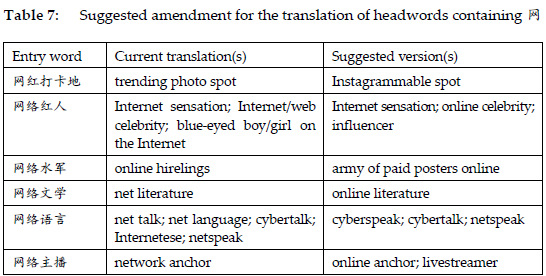
Similar problems can be identified in the translations of other categories of words. A case in point is 肉包子 which was translated into "steamed bun with stuffing of minced meat" in NCCED1, and in the second edition, two more equivalents - bakpan and bah-pau - were put before the previous translation. These two additions, however, are not English words. According to Wiktionary, bakpan, a variant spelling of bakpao, originated from Xiamen Hokkien and is an Indonesian word while bah-pau seems to be its variant form. What caused the confusion may be attributed to the fact there is indeed a kind of Hokkien snack popular in Singapore and Malaysia that is known as kong bak pau (扣肉包). Therefore, it is suggested that deletion should be made of these two equivalents. Improvement of translations can also be suggested for the entries in Table 8:
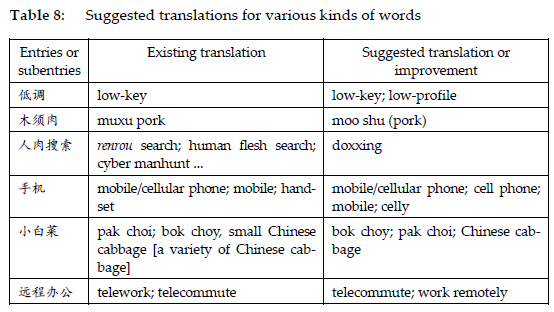
Finally, the excessive use of transliteration may sometimes backfire. 龙, for instance, has been widely accepted as the Chinese equivalent for dragon. But as 龙 conveys a positive meaning in the Chinese culture and dragon a negative one in the Western culture, many people believe the use of dragon as the equivalent of 龙 to be inappropriate. As a result, there has been some clamor for the use of loong to replace dragon in academia, and the editors of NCCED3 have obviously sided with this view by adopting loong (as opposed to long which unfortunately is a homonym of the English word long). As loong is by no means in accordance with the pinyin system, we believe Chinese dragon which has been recorded by the OED will do in this case. Other entries in which the use of pin-yin is unnecessary include 国潮 (guochao; Chinese trend; China chic), 摔碗酒 (shuaiwanjiu; shuaiwan wining [drink-and-smash-wining]), 唐装 (tangzhuang; tang suit [a type of traditional Chinese garment]), 网红 (wanghong; Internet/online celebrity ... influencer), etc.
Meanwhile, the translations for some illustrative examples in NCCED3 are unidiomatic or may contain grammatical errors. Let's look at one example for 构建 (construct; establish; constitute) - 构建中国话语和中国叙事体系 which was translated into "establish our own discourse and narrative". This translation apparently sounds unidiomatic and even smacks of Chinglish, therefore it should be replaced by "develop China's discourse and narrative system". Similarly, the translations for the following examples should be improved upon, such as "营造清朗的网络空间 ensure a clean and healthy cyberspace" (the article a should be deleted), "国产片又甩出了王炸 Domestic cinema has thrown out another ace." (it might be replaced by "There is a new blockbuster in the domestic box office."), 春节相互拜年是中国的传统习俗 It is a traditional Chinese custom to exchange visits at the Spring Festival" (the latter part might be changed into "pay each other visits during the Spring Festival"), and "党内斗争不久就公开了 The struggles within the party soon came/broke into the open" ("infighting" is a much better choice than "struggles").
NCCED3 would have been better if more examples were provided for some frequently used terms. 社交媒体 (social media), for example, has been a popular term for years, but no examples have been furnished for the entry. In contrast, there are three illustrative examples for this entry in CEDU. There are many other entries that would prove more useful if illustrative examples were furnished, such as 炒热 (boost the popularity through repeated media coverage/exposure), 房奴 (mortgage slave), 各行各业(all trades and professions; all walks of life), 路怒 (road rage), 始作俑者 (the originator of an evil), and 网申 (apply online).
It has been more than 200 years since the first Chinese-English dictionary (namely Robert Morrison's A Dictionary of the Chinese Language) was compiled. Traditional lexicography has been facilitated by technological advances. In this era of generative AI, dictionary-makers should make good use of what AI can offer when making and revising dictionaries. The editors of NCCED3 did indeed resort to the use of AI chatbots in proofreading part of the dictionary text, but AI should have played a bigger role throughout the whole revision process. Should they have made full use of AI, the quality of the dictionary, especially that of the translations, would have been greatly improved. Despite its inadequacies, NCCED3 will continue to prove to be one of the most sought-after C-E dictionaries in China.
Yongwei Gao
College of Foreign Languages and Literature, Fudan University China, (ywgao@fudan.edu.cn); (https://orcid.org/0009-0008-1532-8742)
References
Du, R. 2016. New Century Chinese-English Dictionary. Second Edition. Beijing: Foreign Language Teaching and Research Press. [ Links ]
Hui, Y. 2003. New Century Chinese-English Dictionary. Beijing: Foreign Language Teaching and Research Press. [ Links ]
Lu, G. 2024. The Chinese-English Dictionary (Unabridged). Volume II. Shanghai: Fudan University Press. [ Links ]
Oxford Dictionary of English. Oxford: OUP. Available at: http://www.oed.com
Oxford English Dictionary. Oxford: OUP. Available at: http://premium.oxforddictionaries.com
