



Services on Demand
Journal

Article
 English (pdf)
 Article in xml format
 Article references
 Automatic translation
 Send this article by e-mail
Indicators
Related links
-
 Cited by Google
 -
 Similars in Google
Share

 Permalink
African Biodiversity & Conservation
On-line version ISSN 3078-8056Print version ISSN 0006-8241
Bothalia (Online) vol.55 n.1 Pretoria 2025
https://doi.org/10.38201/abc.v55.7
ORIGINAL RESEARCH
Collaborating for conservation: the first five years of implementation of the Biodiversity Management Plan for Pickersgill's Reed Frog, Hyperolius pickersgilli
Adrian J. ArmstrongI, II; Ian du PlessisIII; Piet Lesiba MalepaIII; Antoinette KotzeIV, V; Felicity Elliott 'Sharon L. LouwI; Cherise Acker-CooperVI; Lauren WallerVI, VII, VIII; Jeanne TarrantVI, IX, X
IScientific Services, Ezemvelo KZN Wildlife, P.O. Box 13053, Cascades 3202, Pietermaritzburg, South Africa
IICentre for Functional Biodiversity, School of Life Sciences, University of KwaZulu-Natal, Private Bag X01, Scottsville, Pietermaritzburg 3209, South Africa
IIIJohannesburg City Parks and Zoo, Johannesburg Zoo, Jan Smuts Ave, Parkview, Randburg, Johannesburg 2122, South Africa
IVDepartment of Genetics, University of the Free State, P.O. Box 339, Bloemfontein 9300, South Africa
VSouth African National Biodiversity Institute, P.O. Box 754, Pretoria 0001, South Africa
VIEndangered Wildlife Trust, 27 & 28 Austin Road, Glen Austin AH, Midrand, 1685, South Africa
VIIDepartment of Biodiversity & Conservation Biology, University of the Western Cape
VIIIIUCN SSC Conservation Planning Specialist Group, c/o Auckland Zoo, 12101 Johnny Cake Ridge Road, Apple Valley, MN 55124, USA
IXAnura Africa NPC, 34 Springside Road, Hillcrest, 3610, Durban, South Africa
XUnit for Environmental Sciences and Management, North-West University, Potchefstroom, South Africa
ABSTRACT
A Biodiversity Management Plan for Species (BMP-S) is a legislated plan provided for by the South African National Environmental Management: Biodiversity Act, 2004 (Act no. 10 of 2004). The aim of such plans is the long-term survival of a species in the wild through co-ordinated implementation of actions by entities and organisations to meet the objectives and goals of the plan. This paper reports on the strengths and weaknesses of the BMP for Pickersgill's reed frog, Hyperolius pickersgilli, as ascertained by implementers of the plan at the end of the first five-year period. The plan must be revised after that period, and the Opportunities and Threats potentially facing the next iteration are also presented. The first five years of implementation has resulted in many achievements, which would not be possible without the strong collaboration between organisations that was afforded by the plan, as well as the dedication of individuals within those organisations. The development and implementation of this plan is an example of how species conservation planning can assist to focus and co-ordinate contributions of a variety of stakeholders to successfully guide conservation action for a threatened species, in turn benefitting the habitat of the species and co-occurring species. By this paper, we hope to encourage stakeholders working to improve the conservation status of other threatened species to consider the development and implementation of BMPs to achieve co-ordinated actions.
Keywords: threatened amphibian, SWOT analysis, conservation planning, species recovery, inclusive participation.
Introduction
Preventing species extinctions and ensuring the recovery and conservation of species is included in Target 4 of The Biodiversity Plan for Life of the Earth (now known as the Kunming-Montreal Global Biodiversity Framework) of the Convention on Biological Diversity (2022). Achieving this is difficult, with increasing proportions of threatened species and future extinctions likely, especially with respect to Class Amphibia (González-del-Pliego et al. 2019; Grant, Miller & Muths 2020; Luedtke et al. 2023). Forty-one per cent of amphibian species are currently considered at risk of extinction according to the second Global Amphibian Assessment (GAA2; Luedtke et al. 2023), with an even higher proportion experiencing significant population declines. The main factor causing amphibian declines globally is habitat modification (Green et al. 2020; Harfoot et al. 2021; Luedtke et al. 2023), which exacerbates the impact of other threats including pollution (Hayes et al. 2010; Boyero et al. 2020), disease (Fisher & Garner 2020), climate change (Li, Cohen & Rohr 2013), invasive species (Falaschi et al. 2020) and exploitation through trade (Warkentin et al. 2009; Hughes, Marshall & Strine 2021). Many amphibian species have limited distribution ranges and high habitat specificity, making them particularly prone to extinction risks (Sodhi et al. 2008).
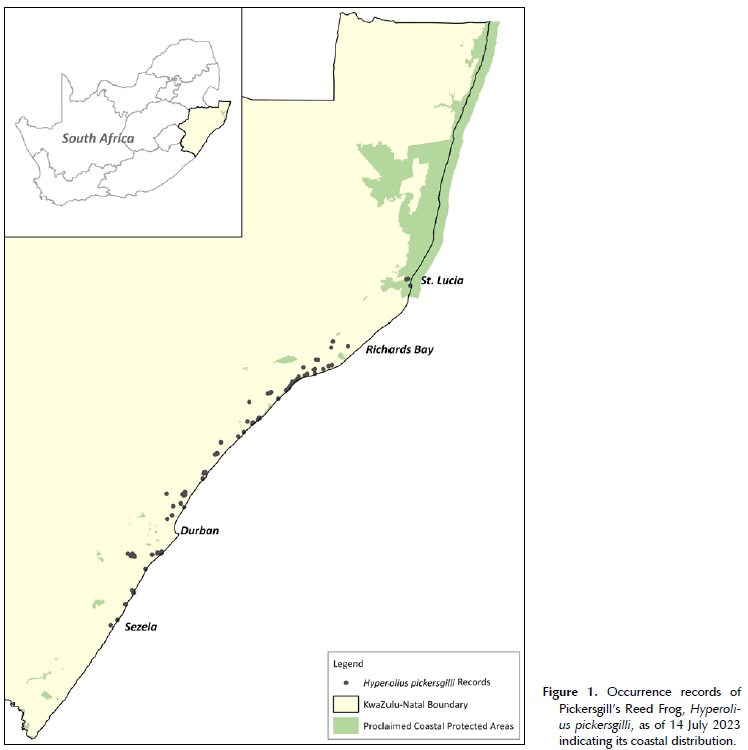
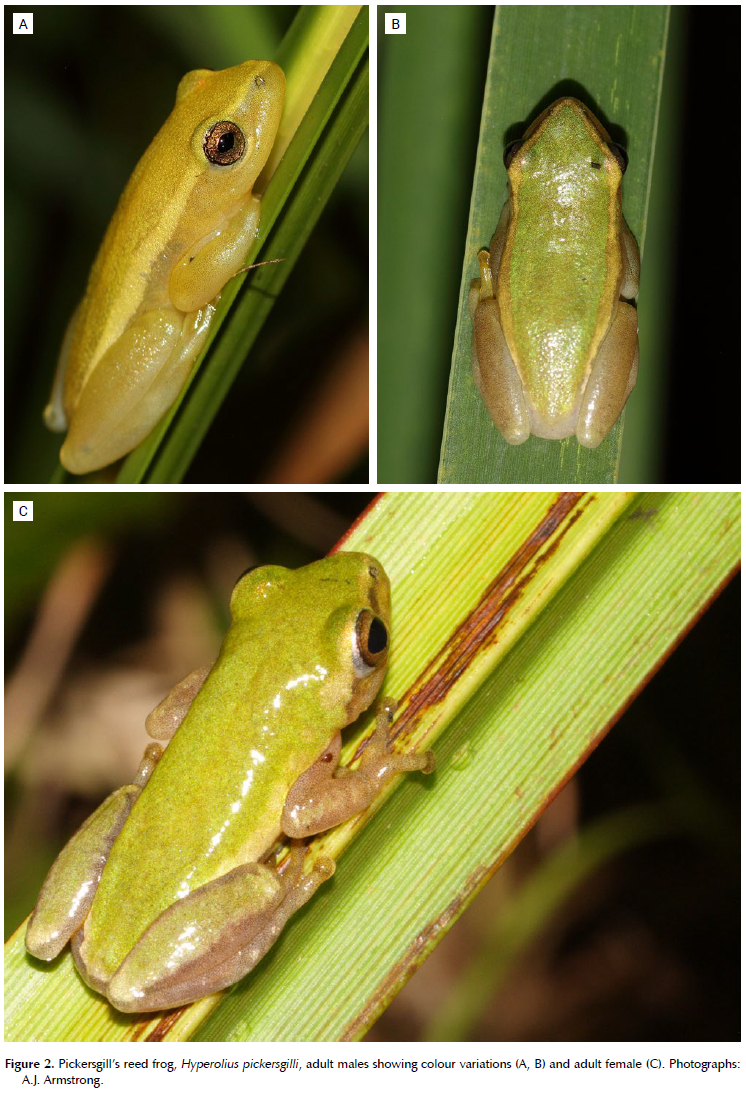
Pickersgill's reed frog, Hyperolius pickersgilli Raw (1982), is a habitat specialist endemic to a narrow coastal strip in KwaZulu-Natal, South Africa (Figure 1). It is a small (body length < 29 mm) hyperoliid reed frog with variable colouration (Raw 1982; Figure 2). The behaviour and call of this species are cryptic, and it is often overlooked in the presence of other larger-bodied and louder hyperoliids. The Red List status of H. pickersgilli is Endangered (IUCN SSC Amphibian Specialist Group & SA-FRoG 2016), having previously been listed as Critically Endangered in 2010, because of its limited extent of occurrence (4768 km2), small area of occupancy (12 km2), the severe fragmentation of its habitat, the continuing decline in its area of occupancy, and the extent and quality of its habitat. The main threats to the survival of this species are habitat loss due to urbanisation, sylviculture, dune mining, large-scale industrial development, drainage of wetlands for agricultural and urban development, and degradation of habitat by alien invasive plants (Minter et al. 2004). Large extents of natural habitat in the species' range have been transformed (Jewitt 2018), and the species no longer occurs at its type locality (Avoca; Raw 1982; Tarrant & Armstrong 2017). A study by Tarrant and Armstrong (2013) indicated that at least four wetland sites known to have hosted H. pickersgilli previously no longer had extant populations, and 44.6% of the wetlands visited where the species was predicted to occur had been either degraded (14.1 %) or transformed (29.5%). While population estimates have been conducted for two subpopulations using audio transects (Bowman 2011; Trenor 2015), the overall population size of H. pickersgilli remains unknown. Given these threats and the perceived declining population, a conservation action plan for the species was recommended following the 2010 assessment of H. pickersgilli as Critically Endangered (Measey 2011). The species was prioritised for conservation research, including monitoring, and was the first threatened frog species in South Africa to be used in a captive breeding programme (Measey 2011).
Strategic conservation planning is critical for ensuring positive outcomes for species. Participatory planning guides effective, collaborative conservation actions, and is supported through the IUCN Species Survival Commission's (IUCN SSC) Conservation Planning Specialist Group (CPSG). A review of conservation action plans from 23 countries found that for the 35 species assessed, threatened species declines gradually slowed, and then reversed, with an upward trend of recovery within 15 years (Lees et al. 2021). No species became extinct and projected outcomes would have been worse without the planning intervention. ln South Africa, Biodiversity Management Plans for Species (BMP-S) are formal mechanisms supported by government recognition and approval, normally targeted at threatened species where threat mitigation requires commitment by multiple stakeholders. Twenty-six of these BMP-S exist under the auspices of the Department of Forestry, Fisheries and the Environment (DFFE; Humbu Mafumo, pers. comm. 14 September 2023). A BMP-S was initially identified as a useful means of coordinating conservation efforts for the then Critically Endangered H. pickersgilli in 2009 (Tarrant 2012), with the first official stakeholder meeting held in October 2013. This BMP-S was gazetted in 2017 (Tarrant & Armstrong 2017), with multiple coordinated actions initiated in the interim. With H. pickersgilli being a species of conservation importance in KwaZulu-Natal (Armstrong 2001), only two populations were known from formally protected areas at the commencement of the implementation of the BMP. The need to identify, manage and protect remaining breeding H. pickersgilli sites was crucial, particularly considering the immense development pressure on the KwaZulu-Natal coast (Jewitt et al. 2015b; Jewitt 2018).
The first iteration of the BMP (2017-2022) for Pickers-gill's reed frog (PRF) (Hyperolius pickersgilli) has been completed. A BMP-S should be revised every five years, and in preparation for this first revision, our aim here is to consider the strengths and weaknesses and report on progress made against the 16 actions identified for the 2017-2022 iteration of the BMP for H. pickersgilli, and to consolidate the achievements of the BMP to date. The Pickersgill's Reed Frog Forum meets annually to track and evaluate BMP actions and report progress and challenges to the Department of Forestry, Fisheries and the Environment. Before meeting to discuss the BMP revision, the Forum, through the chairs, requested that the IUCN SSC Conservation Planning Specialist Group (CPSG) assist in running a workshop with Forum members to complete a Strengths, Weaknesses, Opportunities and Threats (SWOT) Analysis for the Biodiversity Management Plan for Pickersgill's reed frog (BMP-PRF) and to review the revised threats table, which had been circulated via email previously to Forum members for their input. The outcomes are reported below.
Methods
A virtual workshop was held with 36 representatives of Pickersgill's Reed Frog Forum (PRFF) members (see Acknowledgements) on 27 October 2023 to conduct the SWOT analysis. Participants were asked to consider matters internal to the Pickersgill's Reed Frog Biodiversity Management Plan, or projects within their control, when determining the strengths of the BMP-PRF. For the weaknesses, the participants were asked to consider internal factors within their control; these might be obstacles, barriers, etc., that obstruct their ability to meet their goals. Regarding opportunities, participants were asked to consider the systemic human and environmental factors that could influence the revised BMP-PRF. These are external factors that the BMP-PRF should (or could) consider, including the: political, economic, social, technological, legislative and environmental domains. Finally, in terms of threats, participants were asked to consider external factors that may negatively impact the next iteration of the BMP-PRF. These are beyond participants' control but are good to be aware of because of the potential risk to successful BMP implementation. These are aspects related to, but not limited to, political, economic, social, technological, legislative and environmental issues. The methods used to produce the various outputs of the implementation of the BMP mentioned below that have not been published in peer-reviewed scientific journals are presented in Supplementary Material 1.
Results and discussion
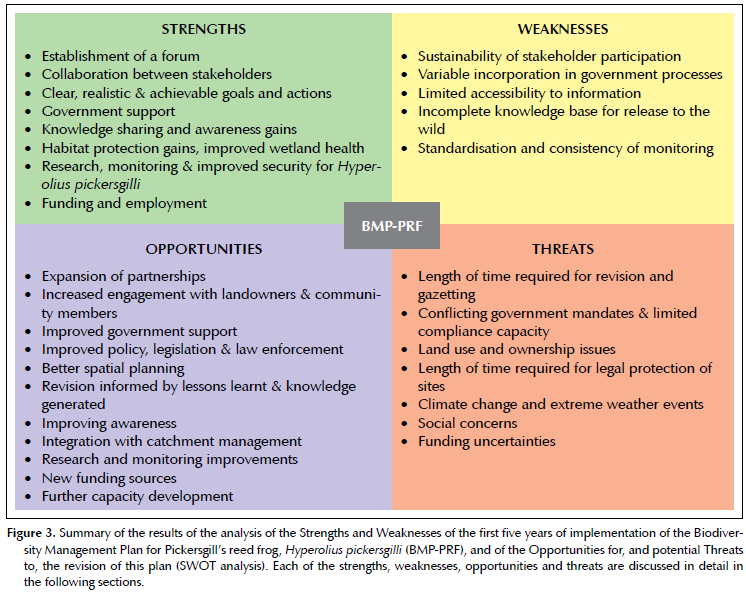
Figure 3 summarises the results of the SWOT analysis.
Strengths identified for the 2017-2022 BMP-PRF
Establishment of a forum
The Pickersgill's Reed Frog Forum (PRFF) was constituted on 20 April 2018 at Twinstreams Environmental Education Centre, Mtunzini, KwaZulu-Natal. Seventeen organisations were represented and each of these member organisations had one or sometimes two representatives. By 2022, the institutional membership had increased to twenty-four, with most members having representatives present at each annual forum meeting (see Acknowledgements).
Collaboration between stakeholders
This was the first and, to date, only example of a BMP for an amphibian species in South Africa. The four-year process to identify and include stakeholders and the collaboration and sharing of resources was identified as being critical to the success of the implementation of the BMP. Strong collaboration was forged between local, provincial and national government entities, land managers, a zoo, private organisations, NGOs, research institutions, universities, as well as with the public. Having consistent organisational champions behind the BMP throughout the 13+ years since the BMP process was proposed has been key to its success. The level of executive support from many organisations made participation in the implementation of the BMP easier. Effective implementation of actions resulted from enthusiastic communication, interaction and collaboration between stakeholders that brought together the required skills and capacity.
Process of developing and implementing the BMP-PRF
The process followed to develop the BMP ensured that the goals and objectives were clear, realistic and achievable. Documentation drafted as annual reports in the implementation of the BMP allowed the progress made to be collated and presented clearly. All identified actions were connected and implemented in relation to five objectives, and led to downstream benefits, e.g., the management of habitat of H. pickersgilli and local employment needs. Also, many of the actions identified in the BMP are ongoing (and indeed some commenced before the BMP was gazetted). Actions resulting from the BMP were also implemented by landowners in the context of a variety of land use types and using a diversity of approaches.
Government support
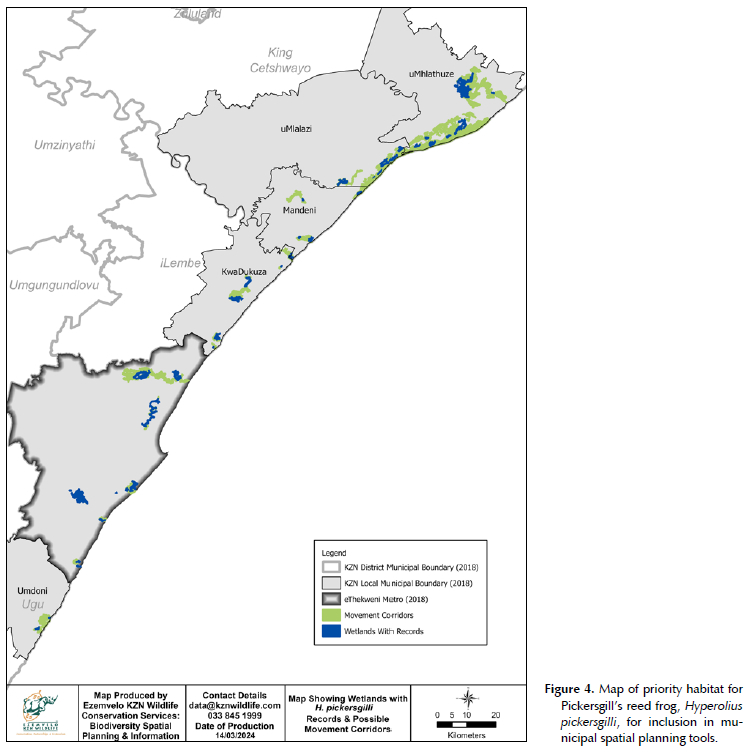
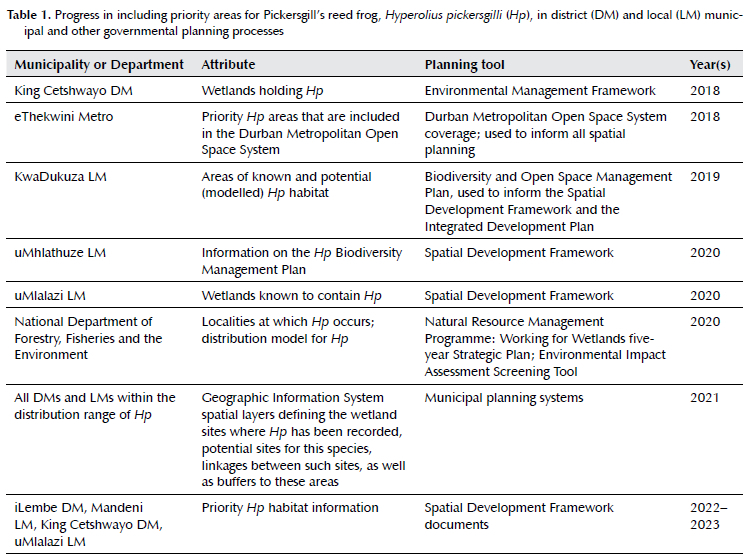
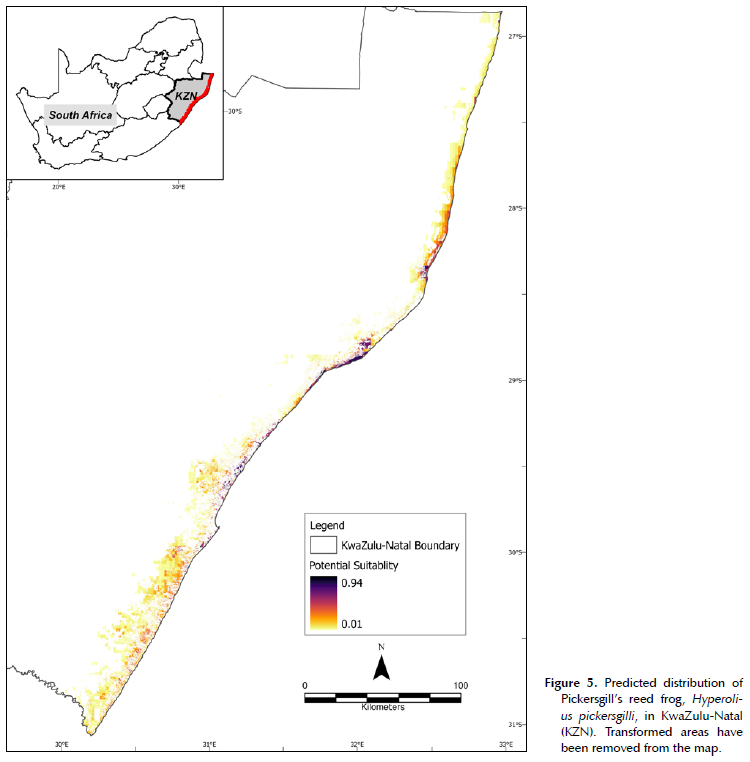
The BMP was gazetted by the then Minster of Environmental Affairs and thus had government support. The BMP enabled government departments (at local, provincial and national levels) that otherwise would not have worked together, to be involved with the implementation of actions. The inclusion of H. pickers-gilli data into municipal and national spatial planning processes (e.g., municipal spatial development frameworks and the DFFE's Environmental Impact Assessment (EIA) species tracking tool [Department of Forestry, Fisheries and the Environment 2021]) has assisted with protecting H. pickersgilli habitat. Municipalities have started to manage or purchase land specifically to protect H. pickersgilli. The priority habitat for H. pick-ersgilli falls within one metropolitan area, four district municipalities and four local municipalities (with priorities for inclusion in planning processes shown in Figure 4). Table 1 indicates progress in including priority areas for H. pickersgilli in district and local municipal and other governmental planning processes. Potential corridors between wetlands for H. pickersgilli were mapped, totalling 17 140 hectares (Figure 4). The updated predicted distribution map, which includes wetlands and linkages between them that may be suitable for H. pickersgilli, is indicated in Figure 5.
Knowledge sharing and awareness gains
Collaboration between PRFF members and stakeholders allowed information gathered to benefit both H. pickersgilli habitat management and the broader community. This knowledge sharing contributed to a greater general awareness of the plight of the species and its habitat, and of methods to counter the decline of its population. Increased engagement and exposure through articles, newspapers, televised and social media, etc., has reached people both inside and outside of the conservation sector. Media articles reached local people directly, so land managers were more easily convinced that they needed to protect H. pickersgilli. Each year more than 400 000 people visit the Johannesburg Zoo and the public were made aware of the Johannesburg Zoo ARP's biosecure breeding facility and the captive-breeding programme.
Research emanating from the 2017-2023 BMP-PRF has enabled collaborative research, including with local and international universities. Three publications in peer-reviewed scientific literature (Kotze et al. 2019; Measey et al. 2019, Du Plessis et al. 2022b) made information accessible to the scientific community. Other scientific outputs and human capacity development included four Honours projects and two MSc studies. Research findings have been presented at 12 conferences, university lectures and other forums. Four data collection apps were developed and research collaborations with Nature Metrics and EdgeAcoustics were initiated. The Zimbali Estate Management Association supported the development of an in-house frog field guide that includes H. pickersgilli.
The Biodiversity Database of Ezemvelo KZN Wildlife holds records for H. pickersgilli (increasing from 120 records from 30 localities as of 1 June 2017 to 239 records from 46 localities as of 31 December 2022). Recordings from passive acoustic monitoring (PAM) are maintained in the Endangered Wildlife Trust's Biodiversity Databank. Data on the social aspects of the project and ecological data are also stored by the Endangered Wildlife Trust (EWT) in its Conservation Science Unit. Forty-one H. pickersgilli tissue samples and many DNA samples have been banked at the South African National Biodiversity Institute's (SANBI) biobank at the National Zoological Garden, Pretoria.
Habitat protection gains
Three sites qualified for the Protected Environment category through the Biodiversity Stewardship process, potentially increasing the area under formal protection by 633 hectares, should all these sites be declared. A Protected Area Management Plan (PAMP) was drafted for one of these sites (Umgavusa) and approved by landowners and was subsequently declared a Protected Environment. A metropolitan municipality wetland has been rezoned to 'Conservation Reserve' and its rehabilitation agreed to by the municipality. Habitat loss caused by development was mitigated through commenting on development applications at five sites. One site under threat has been bought for conservation.
Improved wetland health
Invasive alien clearing and wetland health monitoring were implemented at four sites in the eThekwini area and three in the iLembe District (Supplementary Material, Table S6). Wetland health assessments conducted over periods of five years indicate that some wetland systems, e.g., at Mt Moreland, have been relatively stable despite flooding events and pollution runoff into the system. Continuous management and monitoring are, however, critical. For example, invasive alien plant (lAP) clearing was discontinued, and this should be consistently implemented. There are positive gains through lAP clearing, e.g., improved hydrology and decreased invasion by lAPs due to increased inundation. Clearing of lAPs is important for maintaining buffer zones and protection of the core of a given wetland. Monitoring is key to gauging effectiveness of interventions and determining wetland health over time. Gains in wetland health at Adams Rural, Widen-ham and Gingindlovu through IAP clearing, monitoring and adaptive monitoring are important indicators of the success of the BMP.
Solid waste surveys showed that disposable diapers are a significant waste problem in watercourses at Adam's Rural (Supplementary Material, Table S6). The Adams Rural site is regularly patrolled by EWT's Biodiversity Protection and Environmental Control Officers (BPOs and ECOs), and environmental transgressions are reported. A purpose-developed Environmental Legislation Audit ECO application is used to collect data on transgressions. A workshop was held with 98 traditional leaders from eighteen traditional authorities in KwaZulu-Natal to highlight and explain the importance of environmental legislation and compliance with it.
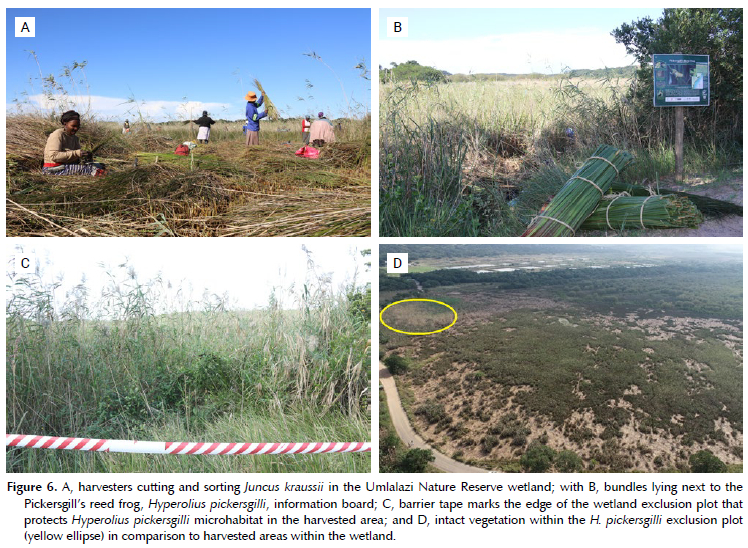
Controlled harvesting of wetland plants such as Juncus kraussii Hochst., Cyperus latifolius Poir. and Phragmites australis (Cav.) Steud. in the wetlands next to the Mlalazi Estuary at Umlalazi Nature Reserve, Mtunzini, by large numbers of harvesters (approximately 2 000) from various regions of KwaZulu-Natal has occurred 26 times in the period 1988 to 2022 (Supplementary Material, Table S6). The harvesting is managed by controlling access to various sections of the wetlands where J. kraussii stands dominate. The monitoring of wetland plant stocks through fixed point photography, resource stock assessment and harvesting off-take records has detected a vegetation shift, with P. australis dominating previous monospecific J. kraussii stands. This has contributed to the expansion of suitable H. pickersgilli habitat in Umlalazi Nature Reserve. The implementation of appropriate management to secure the habitat of H. pickersgilli during wetland plant harvesting was successful during the 2022 harvesting event and will continue in the future (Figure 6).
Both Simbithi Eco-Estate and Zimbali Estate have H. pickersgilli as a specific management target for the estates' environmental management teams and are good examples of conservation management of H. pickersgilli and its habitat within golf and residential estates (Supplementary Material, Table S6). These actions serve not only to benefit H. pickersgilli, but also other co-occurring species.
Research, monitoring and improved security for H. pickersgilli
Molecular genetic analysis indicated that H. pickersgilli has a single genetic population owing to sufficient gene flow in the past between localities (Kotze et al. 2019). Genetic markers revealed moderate to high levels of genetic diversity throughout the remnant sites and absence of specific phylogeographic structure among individuals sampled across twelve localities throughout the range of the species (Kotze et al. 2019). Where suitable habitat exists, H. pickersgilli in neighbouring areas might connect and spread through dispersal between sites.
Climate change resilience was considered in the conservation importance ranking of existing sites for H. pickersgilli in 2019 (Supplementary Table S1). According to the downscaled HadMC2 model and the vulnerability framework, 2.6% of the localities are classified as 'Susceptible' and 97.4% are classified as 'Vulnerable'. This indicates that H. pickersgilli may be affected severely by climate change. Management responses, which have already been initiated, should include ex situ conservation, conservation translocations, monitoring of populations, and reduction of other threats to the species (Jewitt et al. 2015a). The scores for variables and the final ranking for each of the 38 wetlands known to have H. pickersgilli as of 25 April 2019 are indicated in the Supplementary Table S3. This ranking allows for informed decision-making in terms of where resources should be allocated to ensure the long-term survival of H. pickersgilli but does not mean that wetlands known to have H. pickersgilli and that are low ranked are unimportant. The provincial ecosystem status of Indian Ocean Coastal Belt Wetland habitat in which H. pickersgilli occurs is Critically Endangered (Jewitt 2018). All remaining habitat for this species should be protected in perpetuity to achieve the goal of having the species downlisted to Least Concern in accordance with the IUCN Red List process.
The use of acoustic technology for monitoring and research improved BMP action implementation. Monitoring was important for informing adaptive management. During the five-year period, a total of 870 hectares of habitat for H. pickersgilli was under observation through various project activities. Monitoring and surveillance of H. pickersgilli has been implemented at 17 sites using PAM (Supplementary Table S6) and Visual Encounter Surveys (VES) including of released captive-bred frogs marked using Visual Implant Elastomers (VIE). Previously unknown H. pickersgilli subpopulations were discovered at various protected or secure sites.
The Johannesburg Zoo managed the only breeding programme for the reintroduction of captive-bred individuals of the species to secure rehabilitated or created sites and to maintain a captive insurance population (Supplementary Material). This is a novel approach for a threatened amphibian species in South Africa. The ex-situ life cycle of H. pickersgilli has been elucidated, the captive-breeding of the species to F2 generation accomplished, and a captive assurance population established (Du Plessis et al. 2022a, 2022b). A detailed husbandry manual has been compiled (Du Plessis et al. 2022a). A study that forms part of the implementation of the BMP found that the H. pickersgilli skin microbial community includes various anti-chytrid fungus bacterial lineages (Mnisi et al. 2024) which may have played an important role in ensuring that all tests of the captured breeders, and the offspring prior to release to the wild, were negative for chytrid fungus.
Funding and employment
Long-term and short-term access to funding, including for collaborative work, was facilitated by the BMP. Funding grants were secured for specific objectives and activities outlined in the BMP (Supplementary Table S6). More than 140 local people were employed and upskilled for the removal of invasive alien plants. The EWT employed 12 people in positions related to implementation of BMP activities, e.g., Biodiversity Protection Officers. Four community youths from Adam's Rural were trained as local Nature Site Guides.
Weaknesses identified for the 2017-2022 BMP-PRF
Sustainability of stakeholder participation
Some inefficiencies with regards to stakeholder collaboration were experienced. The setting up of a working group might have assisted role players to harness opportunities more efficiently, and through this to assist PRFF members to be more active in the implementation of the BMP and to maximize opportunities (Supplementary Material, Table S6).
Insufficient outreach and landowner involvement
There was inadequate outreach to the commercial sector. The limited involvement in the implementation of the BMP of some PRFF members representing commercial stakeholders tapered off and their direct involvement with the BMP was not sustained or meaningful. The causes of this need to be ascertained and addressed in the next iteration of the BMP.
Variable incorporation of the BMP-PRF in government processes
The success of the BMP-PRF in land use decision-making and conservation processes in the three tiers of government (local, provincial and national) varied, thus affecting overall government buy-in. The annual reporting to the Minister of the Department of Forestry, Fisheries and the Environment was reliant on the report passing through the office of the Member of the Executive Committee (MEC) responsible for Environmental Affairs in KwaZulu-Natal. The high turnover of MECs during the first five years of the implementation of the BMP may have contributed to the reports not reaching the Minister's office during the first three years. It is not clear if this channel must be maintained by protocol.
Limited accessibility to information
A lack of communication in terms of access to information was raised by some members. Greater accessibility to data and educational information, especially for rural areas, was required. Strategic planning and communication with respect to site prioritisation should be strengthened, with a focus on the conservation and management of higher priority sites.
Incomplete knowledge base for release of H. pickersgilli to the wild
Potential climate change impacts and other threats were not sufficiently addressed during the selection of the first rehabilitated site for the release of captive-bred H. pickersgilli. Flooding and other factors prevented the successful establishment of captive-bred H. pickersgilli at the River Horse Valley release site, situated less than 5 km downstream of the (no longer existent) Type Locality of the species. A total of 516 captive H. pickersgilli were released at River Horse Valley (Supplementary Material), the results of the monitoring are presented in Supplementary Table S5. Monitoring shows that the H. pickersgilli have not successfully bred at the site where they were released. This indicates that the criteria used to choose the release site, the process to prepare the captive-bred H. pickersgilli for release, and the number of captive-bred frogs required for release to in situ sites need refining (Supplementary Table S6). An experimental release of a small number of captive-bred H. pickersgilli at a wetland in the Buffelsdraai Landfill Site buffer zone did not lead to a sustained population at the site (Armstrong et al., unpublished data).
Standardisation and consistency of monitoring
Standardisation of monitoring techniques and monitoring effort across sites is required. Monitoring of H. pick-ersgilli at some localities was neglected where it may have been necessary (e.g., at wetland sites with sewage inflow), while in other areas monitoring was inconsistent because the availability of the required resources varied over time. PAM devices should be positioned and configured using standardised methods for specific monitoring objectives to optimise data collection.
Similarly, the labelling and management of acoustic data needs to be standardised. The use of the current systems and technology in wetland monitoring is time consuming. Improved data storage, analysis skills and funding are needed.
Opportunities identified for the revision of the BMP-PRF
Partnership development
Expansion of partnerships to include additional stakeholders based on lessons learnt will be important. Partnerships can develop into alliances, e.g., forming an alliance with residential estates to tackle environmental concerns that are broader than specifically H. pickers-gilli and its habitat. Stakeholder champions are critical for the successful implementation of the revised BMP. Opportunities for expanding the captive breeding programme to facilities in the geographic range of H. pickersgilli should assist with adaptation of the captive-bred offspring to the wild environment.
Increased engagement with landowners and community members
Access to land ownership information, particularly for state, municipal and communal land, and to information on where wetlands are situated, would assist considerably toward facilitating conservation actions on the ground and in packaging information and messaging when approaching specific landowners. Continued engagement with landowners and occupants of land with priority H. pickersgilli wetland sites would assist with opportunities for further implementation of the BMP.
Improved government support
The BMP was gazetted in 2017 and therefore has indirect government endorsement. However, the BMP needs to be adopted and supported across the three tiers of government. Opportunities exist and need to be taken to inform key people within various government departments of the BMP to facilitate the further incorporation of the BMP and outputs from it into local conservation and land-use planning.
Improved policy, legislation and law enforcement
Wherever possible, the inclusion of measures to conserve H. pickersgilli and its habitat in policy or legislation should be effected. An example is in the Department of Water and Sanitation's ecological state of water systems analysis, where information relating to H. pickersgilli could be used. Opportunity to improve legislation should be harnessed. For example, protocols to prevent the transmission of zoonotic diseases through import or movement of amphibians do not exist. The inclusion of other effective conservation measures (OECMs) should be considered as part of habitat protection approaches. Stewardship benefits and incentives should be investigated to encourage landowners to formally protect H. pickersgilli habitat. Non-compliance reporting to municipalities and other government agencies responsible for enforcement of laws should continue to be supported at a local level to assist with local environmental improvement for the benefit of people and wildlife, including H. pickersgilli.
Better spatial planning
Opportunity exists to have additional information about H. pickersgilli incorporated into spatial planning as part of the next iteration of the BMP. Since risks to H. pickersgilli remain significant and are cumulative, mitigating impacts are crucial to the species survival. A regional priority wetland map may assist with identification of habitat for biodiversity offsets. Some government departments (e.g., eThekwini Municipality) have a land acquisition programme, which would be valuable in terms of expansion of habitat for the species.
Revision informed by lessons learnt and knowledge
Lessons learnt from implementation of the first iteration of the BMP can inform the next five years of implementation. Knowledge generated from different projects and initiatives can help with improving the conservation of H. pickersgilli and other amphibians. The revision of the BMP provides opportunities for it to be aligned with other new conservation initiatives, to try to increase synergistically its impact in conservation planning and implementation.
Improving awareness
Opportunities to build awareness about H. pickersgilli and its habitat requirements and management include: erection of signage at secure wetlands with H. pickersgilli; more effective use of social media to spread information and garner support for action on the ground; getting more youth involved in implementation of the BMP; development of a website for the BMP; focusing awareness around the ecosystem benefits of the wetlands where H. pickersgilli occurs; introducing H. pickersgilli into local schools through curricula such as EWT's 'Frogs in the Classroom' programme; make institutions aware of regional wetland priorities; continuation of education programmes in and outside of the Johannesburg Zoo; encouraging and advertising the adoption of wetlands and sponsoring of projects by schools and societies; the establishment of a communications subcommittee; embracing the keenness of people in the general public; and creating awareness of the soft call of H. pickersgilli and its distinction from noisy frogs such as the Painted reed frog, so that H. pickersgilli is not lumped together with other frog species by residents unhappy about the noise of frog choruses.
Integration with catchment management
Wetlands are complex and are part of broader catchments that play an integral role in maintaining the integrity of wetlands. A catchment management approach rather than a site-specific approach should be pursued where possible. This approach is not being implemented widely in South Africa, and new information on how to implement such an approach would be useful. Integration with other catchment management initiatives would be beneficial, as would integration with projects such as the Transformative River Management Programme of the eThekwini Municipality. Lee et al. (2022) developed an urban amphibian conservation framework approach and applied it to the city of Calgary in Canada. This type of approach could be applied to catchments in which H. pickersgilli occurs, and a fairly similar approach was implemented at a larger scale as part of the BMP-PRF (Figure 4; Table 1). Although wetlands have been lost, it is possible to restore or create wetlands in large flat areas, particularly in terms of offsetting developments, which would provide opportunities to expand H. pickersgilli reintroduction efforts and achieve H. pickersgilli population stabilisation. Protection of input water sources and prioritising wetlands where H. pickersgilli occurs needs to be addressed through formal and informal engagement with stakeholders.
Research and monitoring improvements
The impacts of climate change, particularly extreme weather events that result in flooding, and the role that wetlands play in ameliorating floods should be considered in the implementation of actions of the next iteration of the BMP.
The availability of relatively low-cost acoustic monitoring devices allows for monitoring on a larger scale, especially where there are budget constraints or where the use of expensive equipment is not required. Short-term spot surveys on a wide geographic scale could assess potential locations for long-term acoustic monitoring with hi-end equipment. The acoustic data already collected from H. pickersgilli sites contains large amounts of data for other species, which could be studied by students. Collection of environmental acoustic data is an opportunity to share resources and costs with other projects. A new method or tool to monitor captivebred H. pickersgilli released to the wild would assist in more efficiently determining the success of colonisation. A population viability analysis should be conducted to guide the captive breeding and re-introduction of H. pickersgilli to the wild. The continued development of a generic framework of habitat requirements of H. pickersgilli is recommended to inform habitat management and rehabilitation. The development of defined conservation evidence objectives, e.g., monitoring to better understand H. pickersgilli population fluctuations or density, and the use of artificial intelligence for detection of calls in the soundscape would strengthen the outcomes of this BMP. A combined database will assist in improving data access for all stakeholders.
New funding sources
Access to sustainable long-term funding is vital and so traditional and new sources of funding should be explored, particularly to support new objectives. Some potential sources include credit funding systems (carbon/biodiversity) and funding to protect endangered species from extinction. Efficient management of funding should be a priority. Partnerships between people with ideas and those with funding should be developed. Incentives to encourage the protection of H. pickersgilli habitat should be explored and pursued. Building ownership models and adopt-a-spot-type initiatives could be considered. An investigation into opportunities afforded by offsetting and mitigation banking might be fruitful, considering the very transformed nature of the landscape in the species' range.
Further capacity development
Local community members have been trained to implement environmental management on the ground at several sites, and this capacitation needs to continue and be expanded if possible. Opportunities for clearing invasive alien vegetation in urban areas where communities live adjacent to H. pickersgilli habitat need to be investigated and where possible developed into employment opportunities.
Threats to the successful implementation of the revised BMP-PRF
Matters relating to the BMP process
Some participants were uncertain whether the BMP is the most appropriate tool for species conservation. BMPs may not feed effectively into the Environmental Impact Assessment process, particularly in relation to protecting H. pickersgilli habitat, and some decision makers were not aware of the BMP-PRF. Once the BMP process commences, the time taken to complete the draft BMP and the timeframe for the approval process and gazetting of the BMP can take several years. This could impact the timeous implementation of conservation actions on the ground.
Matters relating to government
Opportunities exist for political agendas to be positive for frogs as this BMP was the first for a frog species, but uncertainty exists as to the government's view of amphibian conservation and associated environmental concerns. Securing habitat in the face of government-driven development is a concern. Barriers at the provincial government level to the annual reporting on progress in the implementation of the BMP to national government were encountered, and although these barriers were removed during the latter years of the five-year cycle, political instability can disrupt continuation of established reporting channels. Change of ward counsellors can affect the progress of individual projects. The slow rate of formalisation of outputs of the BMP in local government administrative systems and the lack of formal implementation of spatial plans in some local government areas and in traditional areas hampered the effectiveness of the implementation of the BMP. Corruption and decisions that are not made in the interest of H. pickersgilli were also seen as threats. Complexities in navigating the local administrative process to protect or rehabilitate land and get access to resources to secure H. pickersgilli sites, e.g., the Isipingo Wetland site, were encountered.
Conflicting mandates within local municipal departments, e.g., social, environmental and economic, need to be navigated; the status of the BMP needs to be known and accepted by a variety of departments to leverage support for initiatives relating to H. pickersgilli conservation on municipal land. Five municipalities still didn't explicitly reference priority H. pickersgilli habitat in their Spatial Development Framework documents by the end of 2022. Response to climate and other emergencies by government is usually reactive. These issues undermined the implementation of some aspects of the BMP. Certain rural communities supported the BMP on the ground (e.g., at Adams Rural, 497 households agreed to Protected Environment status for the wetland system where H. pickersgilli occurs) but there were difficulties working with the Ingonyama Trust Board, who effectively own this land.
Government compliance and enforcement capacity is limited, and the relative lack of enforcement of environmental legislation, including the BMP, weakens the impact of the implementation of the BMP. Incomplete understanding of municipal bylaws can make implementation of some of the BMP difficult.
Land use and ownership issues
Land claims are currently not an issue at sites where H. pickersgilli occurs, but land grabs have had some impact, and conflict around development initiatives has been and may be experienced. Expropriation of land is a potential threat to securing sites with H. pickersgilli. Attempts to formally protect certain areas of H. pickersgilli habitat, especially within traditional authority areas, e.g., Adams Rural, were prolonged and did not come to full fruition. The question of how processes can be streamlined to protect land in rural and residential areas is still open. Ongoing management challenges were experienced at some protected sites caused by illegal cattle grazing and concomitant burning of vegetation. Proper town planning was not implemented in some areas where developments took place within environmentally sensitive areas, including H. pickersgilli habitat. Approval of some developments took place without thorough consideration of the environmental impacts on H. pickersgilli. Also, some areas with H. pickersgilli were compromised through lack of awareness and of appropriate habitat management or through a lack of compliance and law enforcement.
The cumulative effects of unregulated and unlawful development within wetlands and their buffer areas where H. pickersgilli occurs, within both the formal and informal sectors, threaten the overall effectiveness of implementation of the BMP. These include the selling of communal land within wetland areas and development without environmental authorisation. Rapid urban expansion and human settlement and concomitant change in land use from agriculture to residential will likely cause the loss of habitat for H. pickersgilli. Opportunities have been missed with the conversion of sugar cane lands to residential land. Land on which sugar cane is grown is perceived as having no value as a biodiversity asset, although some of this land could be rehabilitated to a natural system including potential habitat for H. pickersgilli. Inappropriate management of catchments also threatens the long-term sustainability of habitat for H. pickersgilli through siltation of wetlands, etc. Poor upper catchment management negatively impacts the integrity of wetlands over time, especially in relation to climate change and extreme weather events that damage wetlands in poor condition, which leads to further degradation of social-ecological resilience.
Time delays
Long and extensive formal protection processes can lead to time delays before formal gazetting of protection for sites. The length of time taken is influenced by several factors (e.g., political issues) that are outside the control of parties implementing the BMP, and progress may be stymied. Time delays in securing sites with H. pickersgilli for conservation may have consequences such as degradation of sites through alien plant invasion, pollution, drainage, etc., leading to the unsustainability of the sites for H. pickersgilli so that formal protection of the site is no longer pursued. A quicker turnaround timeframe is required for the implementation of conservation management actions to ensure the long-term sustainability of sites for H. pickersgilli. Accessing funding can be a long process. Delays caused by government procurement processes affect the implementation of wetland projects aimed at conserving H. pickersgilli.
Climate change and extreme weather events
Climate change needs to be considered in the next iteration of the BMP, and actions that enhance resilience to climate change included. Such actions may include searching for habitat expansion and offset opportunities. Climate change is likely to impact coastal wetlands and knowing what these changes might be is necessary to ensure that resources to manage wetlands accordingly are available. Potential flooding of areas currently occupied by H. pickersgilli, with resultant erosion and/ or sedimentation, is a risk. Flood risk increases with the drainage of wetlands, and mitigation of human impact on wetland habitat will indirectly impact the success of the implementation of the BMP.
Social concerns
These include environmental lawlessness and the inability of municipalities to service the growing human population, leading people to find their own solutions, which can negatively impact H. pickersgilli wetland habitat, e.g., waste disposal into wetland areas, erection of informal housing in wetlands, harvesting of wetland plant materials for domestic use and grey water discharge into wetlands. Poor sewage and domestic waste management is apparent in various parts of the range of H. pickersgilli. This, as well as agricultural pollution, impacts H. pickersgilli and its habitat directly and indirectly. As an example, 30 H. pickersgilli adult individuals collected at Adams Rural south of Durban in 2021 to form part of the captive-breeding and insurance population were found during quarantine to be infested with endoparasites and ectoparasites. Although treated, half the number of collected adults succumbed to the severity of the infection, perhaps exacerbated by the stress of being captured and transported hundreds of kilometres to the Johannesburg Zoo. Water sample analysis indicated greatly elevated levels of Escherichia coli, manganese, arsenic, iron and lead in the wetland water compared to levels that are safe for drinking water. The other cations analysed (calcium, magnesium, copper and mercury) were in safe concentrations and no elevated levels of pesticides were recorded.
The impact of unpredictable social dynamics, e.g., riots, and how these influence the environment, and H. pickersgilli habitat in particular, is a concern. Security issues prevent stakeholders from getting involved in the management of certain areas. In some areas there is the risk of theft of acoustic monitoring equipment, particularly in publicly accessible locations and where the devices are clearly visible. Getting community ownership of, and participation in, projects implemented within some areas may be difficult where there is lack of support from the community or where there are misconceptions and superstitions about frogs (Tarrant et al. 2016). Socio-cultural breakdown, socio-ecological and economic decline, and lack of understanding of the importance of appropriate management of the environment are threats to the implementation of a revised BMP-PRF. Stakeholders need to be cognisant of all these difficulties moving forward.
Uncertainty of sustainable funding
The initial development of the BMP was novel for funders and received support from the Mohamed Bin Zayed Species Conservation Fund, Disney Conservation Fund and Rand Merchant Bank, but sustaining support for development of future iterations, and the implementation of actions therein may prove more difficult. Global and local issues influence access to funding. For the Umgavusa Protected Environment, proclaimed in May 2023, additional funding is needed for the long-term maintenance and protection of the site. Protection may be better afforded by using OECMs in certain cases.
Conclusion
The BMP for H. pickersgilli was the first of its kind to be gazetted for an Endangered frog species in South Africa. The first five years of implementation of this BMP has resulted in many achievements, which would not be possible without strong collaboration between organisations, taking place over more than a decade, as well as the dedication of individuals within those organisations. This collaborative implementation is a good example of how species conservation planning can assist to focus and co-ordinate contributions of a variety of stakeholders to successfully guide conservation action for threatened species, which may also act as flagships for co-occurring species. The importance of having a BMP to guide stakeholders who are involved with the conservation of H. pickersgilli to improve its threat status is evident by what is reported in this article. The number of localities at which the species had been documented increased from 30 to 46 between 1 June 2017 and 31 December 2022. The area of habitat that has been legally protected because of work conducted during this five-year period is 127 ha, and other sites totalling 506 ha were in the process that leads to legal proclamation. Other areas of habitat are being better managed (e.g., at housing estates) because of the BMP.
The first trial re-introductions of a threatened amphibian species in South Africa were conducted. Many thousands of people have been directly influenced by BMP-related project activities. We hope that this paper will encourage stakeholders working to improve the conservation status of other threatened species to consider development and implementation of BMPs for their taxa to achieve co-ordinated action in this regard. As work starts on the next iteration of this BMP, it was valuable for the PRF Forum members to come together and critically evaluate the successes and failures of the first iteration of the BMP-PRF, and to consider the future opportunities and threats. This evaluation will be useful in the compilation of the next iteration.
Acknowledgements
We thank the Pickersgill's Reed Frog Forum members for their valuable discussions and support in implementing the BMP-PRF. The Forum consisted initially of members of the following organisations in alphabetical order: Airports Company South Africa (ACSA), Conservation KZN, the National Department of Forestry, Fisheries and the Environment (DFFE), Dube Trade-port, Eco-Pulse Consulting, the Endangered Wildlife Trust, eThekwini Municipality, Ezemvelo KZN Wildlife, Johannesburg City Parks and Zoo, Mondi, Mount Moreland Conservancy, North-West University, Richards Bay Minerals, the South African National Biodiversity Institute (incl. the National Zoological Garden), the Pan-African Association of Zoos and Aquaria, Simbithi Eco-Estate, the South African Association for Marine Biological Research, Transnet Group Capital and Tronox. Newer members are African Ecological and Conservation Projects, Croc World, Durban Natural Science Museum, GroundTruth, Indi-Flora, University of KwaZulu-Natal, Zimbali Estate Management Association. We are grateful to the following PRFF members' representatives who participated in the SWOT analysis: Ian du Plessis, Wade Killian, Jeanne Tarrant, Cherise Acker, Adrian Armstrong, Piet Malepa, Candice Ward, Yvette Ehlers Smith, Nelisiwe Mvuni, Monica Ndlovu, Arnold Kanengoni, Ayanda Duma, Jiba Magwaza, Nontombi Dubazana, Tebogo Mashua, Zama Dlamini, Greg Mullins, Nonsikelelo Khanyi, Johan Bodenstein, Renira Boodhraj, Mashudu Mahada, Mabora Thupana, Tim Furness, Ayrelia Randera, Nontokozo Mthethwa, Ryan Edwards, Nolwazi Ngcobo, Mfanelo Tenza, Pablo Dovico, Sam Maphumulo, Richard Mckibbin, Winile Mchunu, Richard Winn, Gary de Winnaar, Lara Fuller and Lauren Waller (CPSG facilitator). We thank the WESSA Twinstreams Environmental Education Centre, Mtunzini, the South African Association for Marine Biological Research, Durban (particularly Judy Mann and her staff), the Johannesburg Zoo (particularly Oscar van Heerden and staff), Zimbali Estate, Ballito (particularly Brendan Smith and Simangaliso Mthombeni), and Simbithi Eco-Estate, Ballito (particularly Ayanda Duma and Rowina Kanniappen) for generously hosting Pickersgill's Reed Frog Forum meetings. Field staff from the EWT Threatened Amphibian Programme based in KwaZulu-Natal, Ntombenhle Cele, Brave-man Mnyandu, Balungile Mvuna, Simangele Thango, Sandile Mthethwa, Arlene Mkhize, Nomonde Ngidi and Nonkululeko Nzama, have supported implementation of critical aspects of BMP objectives pertaining to community outreach, improved habitat management and threat reduction at sites, particularly in traditional authority areas. Jiba Magwaza assisted with monitoring of H. pickersgilli, and Lizanne Roxborough and Oliver Cowan assisted with mapping requirements. Dudley Wang, Mike O'Donoghue and Tim Furness have all assisted with voluntary species monitoring and acoustic analyses. Ryan Edwards has been instrumental in conducting wetland health assessments since 2016, as well as development of wetland rehabilitation plans. Simbithi Eco-Estate and Zimbali Estate, the Airports Company of South Africa and the Mount Moreland Conservancy (with special thanks to Peter Coulon, Ayanda Duma, Brendan Smith and Angie Wilken) have actively managed wetland and surrounding habitat on their properties with H. pickersgilli as a management target. We thank the Johannesburg Zoo's ARP team for their dedication to the H. pickersgilli captive assurance population and breeding project, namely Cassandra Becker, Arnold Kanengoni, Candice Ward, Philemon Magoba, Ayrelia Moodley, Timothy Netsianda (deceased), Kresen Pillay, Erica Welgemoed, Peter Baloi, Bongeka Ngubana, Cherene Williams, Calvin Smith, Akhira Singh and Donovan Marais. Financial and technical support and/or encouragement were provided by Bryne Maduka, Tshepang Makganye, Themba Mtshali, Lombard Shirindzi, Colleen Downs and Cormac Price. The River Horse Valley Management, Errol Douwes of the eThekwini Municipality and Richard Winn are thanked for access to the River Horse Valley and Buffelsdraai landfill site buffer zone re-introduction sites. Richard Winn is thanked for his assistance in the field and with rehabilitation of H. pickersgilli habitat. Louis du Preez is thanked for his assistance and advice concerning frog parasites. Sonia Kropff from SANBI assisted with the DNA barcoding and storage of samples collected as part of the Pickersgill's reed frog BioBlitz, and we thank Vere Ross-Gillespie of NatureMetrics for the free metabarcoding analysis of two water samples from River Horse Valley. Mncedisi Cindi assisted with administration of the BMP at the Department of Forestry, Fisheries and the Environment. Bimall Naidoo assisted with the production of Figures 3 and 4. Ezemvelo KZN Wildlife is a recipient of a generous Esri Conservation Program (ECP) grant from Esri US and Esri South Africa. ArcGIS Pro, one of software packages provided in the grant, was a key tool in the development of datasets, in the analysis of data and in the creation of maps for this paper.
We thank Jessica da Silva for her insightful comments regarding a previous version of the manuscript. We are also hugely grateful to the numerous donors who have supported the development and implementation of this BMP over the years, including Mohammed Bin Zayed Species Conservation Fund (grant #12254928 and #152510519), Rand Merchant Bank, Disney Conservation Fund, Rainforest Trust, Department of Forestry, Fisheries and the Environment (DFFE, previously Department of Environmental Affairs) for Natural Resources Management funding, ICLEI - Local Governments for Sustainability, Whitley Fund for Nature and Syn-chronicity Earth. Finally, we thank all participants in the implementation of any aspect of the BMP, even if not specifically mentioned here. Two anonymous reviewers provided useful comments on the manuscript.
Competing interests
The authors declare no competing interests.
Authors' contributions
JT and AJA conceived the draft Biodiversity Management Plan. All authors contributed to the finalisation of the plan and/or to the writing of the paper and/or to the outcomes of the plan. AJA, AK, CA, IduP, PM, SLL and JT carried out field and/or laboratory and/or ex situ work. LW ran the SWOT analysis workshop.
Ethical considerations
Ethical clearance was received from the Endangered Wildlife Trust Ethics Committee (EWT_EC) for monitoring released captive-bred H. pickersgilli using Visual Implant Elastomers (VIE) (clearance number: EWTEC2018_006), as well as by the South African National Biodiversity Institute (SANBI) for the BioBlitz project in 2022: Species composition and microhabitat of Pickersgill's reed frog (Hyperolius pickersgilli) (ethics clearance number: P2022/05). The Johannesburg City Parks and Zoo ethics committee granted permission for the Conservation Project for Pickersgill's Reed Frog in a Captive Environment to carry out breeding and release (Clearance number: JHBZOOESC - 21/017).
References
(includes references for Supplementary Material)
Acker, C., 2022, 'A case study for wetland restoration towards socio-ecological appreciation of natural resources in KwaZulu-Natal (South Africa)', MSc thesis, University of South Africa, Pretoria, https://uir.unisa.ac.za/handle/10500/30492. [ Links ]
Acker-Cooper, C. & Roxburgh, L., 2022, 'Waste monitoring system', Endangered Wildlife Trust, Johannesburg. [ Links ]
Acker-Cooper, C. & Tarrant, J., 2022, 'Simbithi Eco-Estate Pickersgill's reed frog custodian project: monitoring report 2021-2022', Endangered Wildlife Trust, Johannesburg. [ Links ]
Acker-Cooper, C., Little, I. & Roxburgh, L., 2021, 'Environmental compliance management system', Endangered Wildlife Trust, Johannesburg. [ Links ]
Acker-Cooper, C., Musgrave, A., Louw, J., Saville, J. & Arde, B., 2022, 'Umgavusa protected environment management plan', Endangered Wildlife Trust, Johannesburg. [ Links ]
Acker-Cooper, C., Schenck, C., Jordon, L., Van Wyk, L., Nell, C., Tinka-Uys, M., Rose, C., Koen, C., Matandela, F. & Roxburgh, L., 2023, 'A comparative provincial assessment of disposable nappies or diaper system dynamics', in One Health Forum, viewed 15 April 2024, from https://www.researchgate.net/publication/371834461. [ Links ]
Acker-Cooper, C., Tarrant, J. & Mbuyisa, S., 2022, 'A comparative study: Amphibian species richness and habitat condition at four wetland sites in eThekwini where the Endangered Pickersgill's Reed Frog occurs', Endangered Wildlife Trust, Johannesburg. [ Links ]
Acker-Cooper, C., Theron, C., Smith, T. & Roxburgh, L., 2019, 'Ecological goods and services toolkit: A participatory approach to environmental management', Endangered Wildlife Trust, Johannesburg. [ Links ]
Armstrong, A.J., 2001, 'Conservation status of herpetofauna endemic to KwaZulu-Natal', African Journal of Herpetology, 50(2), 79-96, https://journals.co.za/doi/abs/10.10520/EJC19123. [ Links ]
Berger-Tal, O., Blumstein, D.T. & Swaisgood, R.R., 2020, 'Conservation translocations: a review of common difficulties and promising directions', Animal Conservation 23(2), 121-131, https://doi.org/10.1111/acv.12534. [ Links ]
Bowman, R.M., 2011, 'Distribution, Ecology and Biomonitoring Management of Pickersgill's Reed Frog (Hyperolius pickersgilli)', Honours Dissertation, North-West University, Potchefstroom. [ Links ]
Boyero, L., López-Rojo, N., Bosch, J., Alonso, A., Correa-Araneda, F. & Pérez, J., 2020, 'Microplastics impair amphibian survival, body condition and function', Chemosphere 244, 125500, https://doi.org/10.1016/j.chemosphere.2019.125500. [ Links ]
Browning, E., Gibb, R., Glover-Kapfer, PP & Jones, K., 2017, Passive acoustic monitoring in ecology and conservation, WWF Conservation Technology Series 1(2), United Kingdom, viewed on 22 April 2024, from https://repository.oceanbestpractices.org/handle/11329/1370. [ Links ]
CBD, 2022, Monitoring framework for the Kunming-Montreal global biodiversity framework, CBD/COP/15/L.26, Montréal, viewed on 16 May 2025, from: https://www.cbd.int/doc/c/179e/aecb/592f67904bf07dca7d0971da/cop-15-l-26-en.pdf. [ Links ]
Davis, J.M. & Stamps, J.A., 2004, 'The effect of natal experience on habitat preferences', Trends in Ecology & Evolution 19(8), 411-416, https://doi.org/10.1016/j.tree.2004.04.006. [ Links ]
Department of Forestry, Fisheries and the Environment, 2021, National web based environmental screening tool and data used in the national web based environmental screening tool, viewed 22 March 2024, from https://screening.environment.gov.za/screeningtool/#/pages/welcome. [ Links ]
Drews, C., 2002, 'Attitudes, knowledge and wild animals as pets in Costa Rica', Anthrozoös, 119-138, http://dx.doi.org/10.2752/089279302786992630. [ Links ]
Du Plessis, I., Armstrong, A., Becker, C., Malepa, P.L., Grobben, D., Kanengoni, A.T. & Grey, C., 2022a, Husbandry Guidelines: Pickersgill's Reed Frog - (Hyperolius pickersgilli), viewed 16 May 2025, from https://www.amphibianark.org/fileadmin/uploads/aark/Husbandry_Library/2017_Hyperolius-pickergilli-Husbandry-manual-2022.pdf. [ Links ]
Du Plessis, I., Armstrong, A., Malepa, P.L., Kanengoni, A.T., Price, C. & Downs, C.T., 2022b, 'Developmental life stages of the Pickersgill's reed frog (Hyperolius pickersgilli) in an ex-situ environment at Johannesburg Zoo's captive breeding facility, South Africa', Zoo Biology 41, 533-543, https://doi.org/10.1002/zoo.21688. [ Links ]
Du Preez, L. & Carruthers, V., 2009, A complete guide to the frogs of southern Africa, Struik Nature, Cape Town. [ Links ]
Du Toit, R., 2020, 'Unique acoustic identifiers in frog calls and how they can be used to distinguish species', Honours dissertation, School of Life Science, University of KwaZulu-Natal, Durban. [ Links ]
Eastman, J.R., 2020, TerrSet2020 Geospatial Monitoring and Modeling System Manual, Clark Labs, Worcester, MA, viewed 16 May 2025, from https://s45055.pcdn.co/centers/geospatial-analytics/www-content/blogs.dir/7/files/sites/354/2024/11/Terrset-2020-Manual.pdf. [ Links ]
Edwards, R., Pike, T. & Mncwabe, K., 2023, 'The Widenham Wetland in eThekwini Municipality, KwaZulu-Natal: Wetland Rehabilitation Plan', Version 2, Report VE22-27-02, Verdant Environmental, Pietermaritzburg. [ Links ]
Elith, J., Phillips, S.J., Hastie, T., Dudík, M., Chee, Y.E. & Yates, C.J., 2011, 'A statistical explanation of MaxEnt for ecologists', Diversity and Distributions 17, 43-57, https://doi.org/10.1111/j.1472-4642.2010.00725.x. [ Links ]
Ezemvelo KZN Wildlife, 2014a, KZN Average Summer Monthly Means of Daily Maximum Temperature (W31) [Derived from South African Atlas of Climatology and Agrohydrology 2006], Resampled to E KZN W 2008v2 Land Cover Parameters - 2014 Modelling Suite, Unpublished GIS Coverage [AV-SUM_MNDMAXTEMP_06_20M_W31_9999.zip], Conservation Services, Ezemvelo KZN Wildlife, Pietermaritzburg. [ Links ]
Ezemvelo KZN Wildlife, 2014b, KZN Average Summer Monthly Means of Daily Average Relative Humidity (W31) [Derived from South African Atlas of Climatology and Agrohydrology 2006], Resampled to E KZN W 2008v2 Land Cover Parameters - 2014 Modelling Suite, Unpublished GIS Coverage [AVSUM_MNDAVRH_06_20M_W31_9999.zip], Conservation Services, Ezemvelo KZN Wildlife, Pietermaritzburg. [ Links ]
Ezemvelo KZN Wildlife, 2014c, KZN Average Winter Monthly Means of Daily Average Relative Humidity (W31) [Derived from South African Atlas of Climatology and Agrohydrology 2006], Resampled to E KZN W 2008v2 Land Cover Parameters - 2014 Modelling Suite, Unpublished GIS Coverage [AVWIN_MNDAVRH_06_20M_W31_9999.zip], Conservation Services, Ezemvelo KZN Wildlife, Pietermaritzburg. [ Links ]
Ezemvelo KZN Wildlife, 2014d, KZN Average Winter Monthly Means of Daily Maximum Temperature (W31) [Derived from South African Atlas of Climatology and Agrohydrology 2006], Resampled to E KZN W 2008v2 Land Cover Parameters - 2014 Modelling Suite, Unpublished GIS Coverage [avwin_mndmaxtemp_06_20m_w31_9999.zip], Conservation Services, Ezemvelo KZN Wildlife, Pietermaritzburg. [ Links ]
Ezemvelo KZN Wildlife, 2014e, KZN Mean Annual Precipitation (W31) [Derived from South African Atlas of Climatology and Agrohydrology 2006], Resampled to E KZN W 2008v2 Land Cover Parameters - 2014 Modelling Suite, Unpublished GIS Coverage [kznmap_06_20m_ w31_9999.zip], Conservation Services, Ezemvelo KZN Wildlife, Pietermaritzburg. [ Links ]
Ezemvelo KZN Wildlife, 2014f, KZN Summer Months Average Monthly Means of Daily Minimum Temperature (W31) [Derived from South African Atlas of Climatology and Agrohydrology 2006], Resampled to E KZN W 2008v2 Land Cover Parameters - 2014 Modelling Suite, Unpublished GIS Coverage [AVSUM_KZNMNDMINTEMP_06_20M_W31_9999.zip], Conservation Services, Ezemvelo KZN Wildlife, Pietermaritzburg. [ Links ]
Ezemvelo KZN Wildlife, 2014g, KZN Total Annual Rain Days Greater than or equal to 10mm (W31) [Derived from South African Atlas of Climatology and Agrohydrology 2006], Re-sampled to E KZN W 2008v2 Land Cover Parameters -2014 Modelling Suite, Unpublished GIS Coverage [kznan-nrandayge10mm06_20m_w31_9999.zip], Conservation Services, Ezemvelo KZN Wildlife, Pietermaritzburg. [ Links ]
Ezemvelo KZN Wildlife, 2014h, KZN Winter Months Average Monthly Means of Daily Minimum Temperature (W31) [Derived from South African Atlas of Climatology and Agrohy-drology 2006], Resampled to E KZN W 2008v2 Land Cover Parameters - 2014 Modelling Suite, Unpublished GIS Coverage [avwin_kznmndmintemp_06_20m_w31_9999. zip], Conservation Services, Ezemvelo KZN Wildlife, Pietermaritzburg. [ Links ]
Ezemvelo KZN Wildlife, 2020, KZN 2017 Landcover - Equivalent (W31) [Derived from Ezemvelo KZN Wildlife & GEOTERRA Image (2018) KZN Land-Cover 2017 v1 (Equivalent)], Windowed to E KZN W 2008v2 Land Cover Parameters - 2020 Modelling Suite, Unpublished GIS Coverage [KZN_EQVLC17V1_W31_BF20M_9999], Conservation Services, Ezemvelo KZN Wildlife, Pietermaritzburg. [ Links ]
Falaschi, M., Melotto, A., Manenti, R., Ficetola, G.F., 2020, 'Invasive species and amphibian conservation', Herpetologica 76(2), 216-227, https://doi.org/10.1655/0018-0831-76.2.216. [ Links ]
Fisher, M.C. & Garner, T.W.J., 2020, 'Chytrid fungi and global amphibian declines', Nature Reviews Microbiology 18(6), 332-343, https://doi.org/10.1038/s41579-020-0335-x. [ Links ]
Germano, J.M. & Bishop, P.J., 2009, 'Suitability of amphibians and reptiles for translocation', Conservation Biology 23(1), 7-15, https://doi.org/10.1111/j.1523-1739.2008.01123.x. [ Links ]
González-del-Pliego, P., Freckleton, R.P., Edwards, D.P., Koo, M.S., Scheffers, B.R., Pyron, R.A. & Jetz, W., 2019, 'Phylogenetic and trait-based prediction of extinction risk for data-deficient amphibians', Current Biology 29, 1557-1563, https://doi.org/10.1016/j.cub.2019.04.005. [ Links ]
Grant, E.H.C., Miller, D.A.W. & Muths, E., 2020, 'A Synthesis of evidence of drivers of amphibian declines', Herpetologica 76(2), 101-107, https://doi.org/10.1655/0018-0831-76.2.101. [ Links ]
Green, D.M., Lanoo, M.J., Lesbarrères, D. & Muths, E., 2020, 'Amphibian population declines: 30 years of progress in confronting a complex problem', Herpetologica 76(2), 97-100, https://doi.org/10.1655/0018-0831-76.2.97. [ Links ]
Harfoot, M.B.J., Johnston, A., Balmford, A., Burgess, N.D., Butchart, S.H.M., Dias, M. P., . . . & Geldmann, J., 2021, 'Using the IUCN Red List to map threats to terrestrial vertebrates at global scale', Nature Ecology and Evolution 5(11), 1510-1519, https://doi.org/10.1038/s41559-021-01542-9. [ Links ]
Hayes, T.B., Khoury, V., Narayan, A. Nazir, M., Park, A., Brown, T., . . . & Gallipeau, S., 2010, 'Atrazine induces complete feminization and chemical castration in male African clawed frogs (Xenopus laevis)', Proceedings of the National Academy of Sciences of the United States of America, 107(10), 4612-4617, https://doi.org/10.1073/pnas.0909519107. [ Links ]
Hughes, A.C., Marshall, B.M. & Strine, C.T., 2021, 'Gaps in global wildlife trade monitoring leave amphibians vulnerable', eLife 10, e70086, https://doi.org/10.7554/eLife.70086. [ Links ]
IUCN SSC Amphibian Specialist Group & South African Frog Re-assessment Group (SA-FRoG), 2016, 'Hyperolius pickersgilli', The IUCN Red List of Threatened Species 2016: e.T10644A77165927, viewed 8 June 2023, from https://dx.doi.org/10.2305/IUCN.UK.2016-3.RLTS.T10644A77165927.en. [ Links ]
Jewitt, D., 2018, 'Vegetation type conservation targets, status and level of protection in KwaZulu-Natal in 2016', Bothalia 48(1), 1-10, https://doi.org/10.4102/abc.v48i1.2294. [ Links ]
Jewitt, D., Erasmus, B.F.N., Goodman, P.S., O'Connor, T.G., Hargrove, W.W. & Maddalena, D.M., 2015, 'Climate induced change of environmentally defined floristic domains: A conservation based vulnerability framework', Applied Geography 63, 33-42, https://doi.org/10.1016/j.apgeog.2015.06.004. [ Links ]
Jewitt, D., Goodman, P.S., Erasmus, B.F.N., O'Connor, T.G. & Witkowski, E.T.F., 2015b, 'Systematic land-cover change in KwaZulu-Natal, South Africa: Implications for biodiversity', South African Journal of Science 111 (9/10), 9, http://dx.doi.org/10.17159/sajs.2015/20150019. [ Links ]
Kotze, A., Ralph, T.M.C., Barrow, L.N., Tarrant, J., Du Preez, L.H., Thabang, M. & Dalton, D.L., 2019, 'Lack of phylo-geographic structure in the endangered Pickersgill's Reed Frog; Hyperolius pickersgilli (Raw, 1982)', African Journal of Herpetology 68(1), 1-17, https://doi.org/10.1080/21564574.2018.1462064. [ Links ]
Lee, T.S, Randall, L.A., Kahal, N.L., Kinas, H.L., Carney, V.A., Rudd, H., . . . & Duke, D., 2022, 'A framework to identify priority wetland habitats and movement corridors for urban amphibian conservation', Ecological Solutions and Evidence 3, e12139, https://doi.org/10.1002/2688-8319.12139. [ Links ]
Lees, C.M., Rutschmann, A., Santure, A.W. & Beggs, J.R., 2021, 'Science-based, stakeholder-inclusive, and participatory conservation planning helps reverse the decline of threatened species', Biological Conservation 260, 109194, https://doi.org/10.1016/j.biocon.2021.109194. [ Links ]
Li, Y., Cohen, J. M. & Rohr, J.R., 2013, 'Review and synthesis of the effects of climate change on amphibians', Integrative Zoology 8(2), 145-161, https://doi.org/10.1111/1749-4877.12001. [ Links ]
Luedtke, J.A., Chanson, J., Neam, K., Hobin, L., Maciel, A.O., Catenazzi, A., . . . Stuart, S.N., 2023, 'Ongoing declines for the world's amphibians in the face of emerging threats', Nature 622, 308-314, https://doi.org/10.1038/s41586-023-06578-4. [ Links ]
Macfarlane, D.M, Kotze, D.C., Ellery, W.N., Walters, D., Koopman, V., Goodman, P. & Goge, C., 2009, WET-Health: A technique for rapidly assessing wetland health, Wetland Management Series, Water Research Commission, Report TT 340/09, viewed 22 April 2024, from https://www.wrc.org.za/wp-content/uploads/mdocs/TT%20340-09.pdf. [ Links ]
Measey, G.J. (ed.), 2011, Ensuring a future for South Africa's frogs: a strategy for conservation research, SANBI Biodiversity Series 19, South African National Biodiversity Institute, Pretoria. [ Links ]
Measey, J., Tarrant, J., Rebelo, A., Turner, A., Du Preez, L., Mokhatla, M. & Conradie, W., 2019, 'Has strategic planning made a difference to amphibian conservation research in South Africa?', Bothalia 49(1), a2428, https://doi.org/10.4102/abc.v49i1.2428. [ Links ]
Minter, L.R., Burger, M., Harrison, J.A., Braack, H.H., Bishop, F.J. & Knoepfer, D., 2004, Atlas and red data book of the frogs of South Africa, Lesotho and Swaziland, SI/MAB Series No. 9, Smithsonian Institute, Washington, DC, https://www.researchgate.net/publication/48378776_Atlas_and_Red_Data_Book_of_the_Frogs_of_South_Africa_Lesotho_and_Swaziland. [ Links ]
Mnisi, M.C., Taioe, M.O., Mokgokong, F., Dalton, D.L., Du Plessis, I., Armstrong, A., Tarrant, J., Kotze, A. & Du Plessis, M., 2024, 'The bacteriome of the Endangered South African endemic Pickersgill's Reed Frog (Hyperolius pickersgilli)', African Journal of Herpetology, 74, 1-8, https://doi.org/10.1080/21564574.2024.2422429. [ Links ]
Padayachee, T., 2020, 'Passive Acoustic Monitoring as a tool to assess the presence/absence of the Endangered frog species, Hyperolius pickersgilli', Honours dissertation, School of Life Science, University of KwaZulu-Natal, Durban. [ Links ]
Phillips, S.J. & Dudik, M., 2008, 'Modelling of species distributions with MaxEnt: New extensions and a comprehensive evaluation', Ecography 31, 161-175, https://doi.org/10.1111/j.0906-7590.2008.5203.x. [ Links ]
Phillips, S.J., Anderson, R.F. & Schapire, R.E., 2006, 'Maximum entropy modeling of species geographic distributions', Ecological Modelling, 190, 231-259, https://doi.org/10.1016/j.ecolmodel.2005.03.026. [ Links ]
Raw, L.R.G., 1982, 'A new species of reed frog (Amphibia: Hyperoliidae) from the coastal lowlands of Natal, South Africa', Durban Museum Novitates 13(9), 117-126, https://journals.co.za/doi/abs/10.10520/AJA0012723X_2275. [ Links ]
Schulze, R.E., 2007, South African Atlas of Climatology and Agrohydrology, Water Research Commission, Pretoria. [ Links ]
Scott-Shaw, C.R. & Escott, B.J. (eds), 2011, KwaZulu-Natal Provincial Pre-Transformation Vegetation Type Map, rasterized to E KZN W 2008v2 Land Cover Parameters - 2020 Modelling Suite. Unpublished GIS Coverage [kzn-veg05v2_4_11_inhouse_w31_03022020_20m_9999. zip], Biodiversity Conservation Planning Division, Ezemvelo KZN Wildlife, Pietermaritzburg. [ Links ]
Semlitsch, R.D. & Bodie, J.R., 2003, 'Biological criteria for buffer zones around wetlands and riparian habitats for amphibians and reptiles', Conservation Biology, 17(5), 1219-1228. [ Links ]
Silver, T., 2020, 'Testing the acoustic resource partitioning hypothesis: Do South African frogs partition the acoustic space?', Honours dissertation, School of Life Science, University of KwaZulu-Natal, Durban. [ Links ]
Sodhi, N.S., Bickford, D., Diesmos, A.C., Lee, T.M., Koh, L.P., Brook, B.W., Sekercioglu, C.H. & Bradshaw, C.J.A., 2008, 'Measuring the meltdown: Drivers of global amphibian extinction and decline, PLoS ONE 3(2), e1636, https://doi.org/10.1371/journal.pone.0001636. [ Links ]
Stamps, J.A. & Swaisgood, R.R., 2007, 'Someplace like home: Experience, habitat selection and conservation biology', Applied Animal Behaviour Science 102(3-4), 392-409, https://doi.org/10.1016/j.applanim.2006.05.038. [ Links ]
Stolton, S., Dudley, N. & Hockings, M., 2021, METT Handbook: A guide to using the Management Effectiveness Tracking Tool (METT). Second edition guidance for using METT-4, WWF, Gland, Switzerland, viewed 22 April 2024, from https://wdpa.s3.eu-west-1.amazonaws.com/PAME/METT/METT_4_Handbook.pdf. [ Links ]
Tarrant, J., 2012, 'Conservation assessment of threatened amphibians in KwaZulu-Natal, and a national assessment of chytrid infection in South African threatened species', PhD thesis, North-West University, Potchefstroom, https://repository.nwu.ac.za/handle/10394/8490. [ Links ]
Tarrant, J. & Armstrong, A.J., 2013, 'Using predictive modelling to guide the conservation of a critically endangered coastal wetland amphibian', Journal for Nature Conservation, 21, 369-381, https://doi.org/10.1016/j.jnc.2013.03.006. [ Links ]
Tarrant, J. & Armstrong, A.J., 2017, Biodiversity management plan for Pickersgill's reed frog (Hyperolius pickersgilli), Government Gazette, 624 (No. 40883), 184-222, viewed 22 April 2024, from https://www.gov.za/sites/default/files/gcis_document/01706/40883gen423.pdf. [ Links ]
Tarrant, J., Kruger, D. & Du Preez, L. H., 2016, 'Do public attitudes affect conservation effort? Using a questionnaire-based survey to assess perceptions, beliefs and superstitions associated with frogs in South Africa,' African Zoology, 51(1), 13-20, https://doi.org/10.1080/15627020.2015.1122554. [ Links ]
Tarrant, T., 2021, 'Report 1: Specialist amphibian surveys at the Mount Moreland wetlands on behalf of King Shaka International Airport, Durban KwaZulu-Natal', Endangered Wildlife Trust, Midrand. [ Links ]
Trenor, M., 2015, 'Using spatially explicit call data of Anhydrophryne ngongoniensis to guide conservation actions', Msc thesis, North-West University, Potchefstroom, https://repository.nwu.ac.za/handle/10394/31302. [ Links ]
Warkentin, I.G., Bickford, D., Sodhi, N.S. & Bradshaw, C.J., 2009, 'Eating frogs to extinction', Conservation Biology 23(4), 1056-1059, https://doi.org/10.1111/j.1523-1739.2008.01165.x. [ Links ]
 Correspondence:
Adrian J. Armstrong
Adrian.Armstrong@kznwildlife.com
Submitted: 23 April 2024
Accepted: 15 April 2025
Published: 24 July 2025
Supplementary Data
The supplementary data is available in pdf: [Supplementary data]