



Services on Demand
Journal

Article
 English (pdf)
 Article in xml format
 Article references

 Automatic translation
 Send this article by e-mail
Indicators
Related links
-
 Cited by Google
-
 Similars in Google
Share

 Permalink

African Biodiversity & Conservation
On-line version ISSN 3078-8056Print version ISSN 0006-8241
Bothalia (Online) vol.55 n.1 Pretoria 2025
https://doi.org/10.38201/abc.v55.11
ORIGINAL RESEARCH
Year-to-year changes in population density and site fidelity of psittaciform, coraciiform and piciform species in an acacia savanna, north-central Namibia
Grzegorz KopijI, II
IDepartment of Vertebrate Ecology, Wroclaw University of Environmental & Life Sciences, ul. Kozuchowska 5b, 51-631 Wroclaw, Poland
IIDepartment of Integrated Environmental Science, University of Namibia, Ogongo Campus, Private Bag 5520 Oshakati, Namibia
ABSTRACT
BACKGROUND: Bird species belonging to the orders of Coraciiformes, Psittaciformes and Piciformes may be regarded as good indicators of environmental quality. Since most species are fairly large and have distinctive plumage colouration, they attract human attention. Most of them are also strongly territorial and vocally conspicuous. However, not much is known about their population densities and virtually nothing about interannual population changes
OBJECTIVES: The aims of this study were to: 1) estimate population densities; 2) assess interannual variations in population densities; 3) study site fidelity; 4) find preferences (or their lack) for natural or man-modified savanna of all coraciiform, piciform and psittaciform species breeding in a mosaic of natural and man-modified savanna; and 5) compare population densities of all these species recorded in the study area with those obtained in other regions of southern Africa
METHODS: Population densities of coraciiform, psittaciform and piciform species were assessed by means of the territory mapping method in an acacia savanna in the Cuvelai Drainage System, north-central Namibia. Studies were carried out in three separate years: 2012, 2017 and 2020
RESULTS: In total, 15 species representing these orders were recorded as breeding in the study plot (400 ha). In 2020, all three parrot species, namely Meyer's Parrot (Poicephalus meyeri), Rüppell's Parrot (P. rueppellii), and Rosy-faced Lovebird (Agapornis roseicollis), nested in a similar density of 0.50-0.75 pairs per 100 ha. The African Hoopoe (Upupa epops) was the most abundant coraciiform species reaching a density of 3.3 pairs per 100 ha in 2017. The second most abundant coraciiform species was the Lilac-breasted Roller (Coracias caudatus), which population increased from 0.5 pairs per 100 ha in 2012 to 1.4 pairs per 100 ha in 2020. Among the other coraciiform species, only the Common Scimitar-bill (Rhinopomastus cyanomelas) reached a density higher than one pair per 100 ha, in 2017. Among piciform species the most abundant was the Acacia Pied Barbet (Tricholaema leucomelas; up to 2.5 pairs per 100 ha
CONCLUSION: Contrary to expectation, for most species and species groups studied, their population densities were negatively related to the precipitation. No other species of this order reached a density higher than 1 pair per 100 ha in any year. These population densities are compared with those obtained in 10 sites in Namibia and the South African Highveld. Lilac-breasted Roller, Common Scimitarbill, parrots and hornbills showed high, while barbets showed low site fidelity
Keywords: Agapornis roseicollis, Coracias caudatus, Upupa epops, Rhinopomastus cyanomelas, Poicephalus meyeri, Poicephalus rueppellii, Tricholaema leucomelas population density, philopatry, population trends, urban ecology, acacia savanna.
Introduction
Bird species belonging to the orders of Coraciiformes, Psittaciformes and Piciformes may be regarded as good indicators of environmental quality (Mekonen 2017; Mariyappan et al. 2023), as they rely on tree holes for nesting sites, which are normally available in mature and well-preserved habitats. The order Coraciiformes is well-represented in southern Africa, where five roller (Coraciidae), nine bee-eater (Meropidae), and four hoopoe species (Upupidae, Phoeniculidae) occur. Also, the order Piciformes have numerous representatives in this region, among such families as woodpeckers (Picidae, 10 spp.), honeyguides (Indicatoridae, 6 spp.), barbets (Lybidae, 10 spp.) and hornbills (Bucerotidae, 10 spp.). The order Psittaciformes is represented by one family Psittaculidae in southern Africa, which includes three lovebird (Agapornis) and five parrot (Poicephalus) species (Hockey et al. 2005).
Members of these orders usually thrive in well-preserved savanna or forest biomes, but disappear from fragmented, disturbed or transformed environment (Juniper & Parr 2003; Hockey et al. 2005). Since most species are fairly large and have distinctive plumage colouration, they attract human attention. Most of them are also strongly territorial and vocally conspicuous (Del Hoyo et al. 1997, 2001, 2002; Hockey et al. 2005). Most of these species can be classified as fairly widespread and common in southern Africa. All these make them good objects for population studies. Martin et al. (2014) and Dueker et al. (2023) have summarised data on the distribution, population and range trends, and threats of larger parrot species and all African Agapornis species. Accurate estimation of population size is a starting point and a major theme of population studies. Despite this, not much is known about their population densities and virtually nothing about interannual population changes (Rowan 1983; Urban et al. 1986; Frey et al. 1988; Del Hoyo 1997, 2001, 2002; Hockey et al. 2005).
The aim of the study was to: 1) estimate population densities; 2) assess interannual variations in population densities; 3) study site fidelity; 4) find preferences or their lack to natural or man-modified savanna of all coraciiform, piciform and psittaciform species breeding in a mosaic of natural and man-modified savanna; and 5) compare population densities of all these species recorded in the study area with those obtained in other regions of southern Africa.
Methods
Study area
The study area was located on the University of Namibia (UNAM) Ogongo campus, Omusati Region, northern Namibia. It is situated in the Biodiversity Monitoring Transect Analysis in Africa (BIOTA) Observatory (in this project treated as a study area) called 'Ogongo', within the Cuvelai Drainage System, c. 50 km northwest of Oshakati, Outapi District, Omusati Region (17°42'00.0"S 15°18'36.0"E). It constitutes the final observatory of the BIOTA Transect (Hoffman et al. 2010; Jurgens et al. 2010; Schmiedel & Jurgens 2010).
The Cuvelai Drainage System, where the study area is situated, is a unique ecosystem comprising a network of water canals (oshanas), mopane and acacia savannas (Mendelsohn et al. 2000, 2009; Mendelsohn & Weber 2011). The study area is, however, devoid of these canals, and the natural vegetation comprises acacia savanna composed mainly of Albizia anthelmintica, Boscia albitrunca, Colophospermum mopane, Combretum spp., Commiphora spp., Dichrostachys cinerea, Ficus sycomorus, Grewia spp., Hyphaene petersiana, Kigelia africana, Sclerocarya birrea, Senegalia fleckii, S. mellifera, Terminalia sericea, Vachellia erioloba, V. nilotica and Ziziphus mucronata (Kangombe 2007). There is only small part of mopane savanna (composed almost entirely of young Colophospermum mopane shrubs) in the northeastern corner of study area. Both savannas are utilised as a pasture for cattle, sheep and goats.
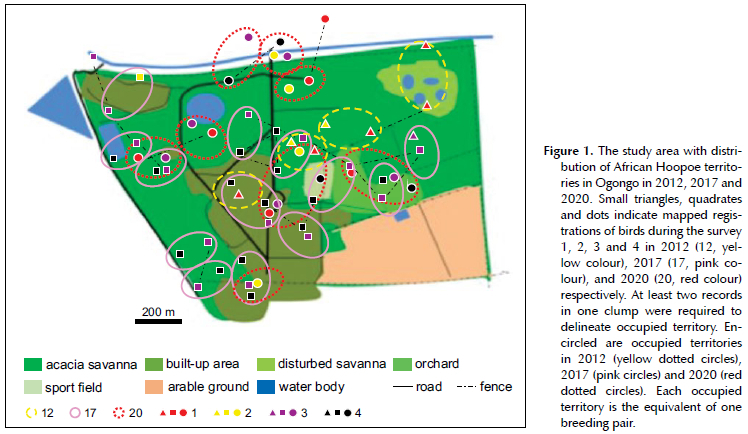
The total surface of the study area was 400 ha. Most of it (70%) constitutes natural acacia savanna. The remaining 30% was man-modified acacia savanna, which includes built-up areas (yards with buildings and small gardens, 17.5%), arable fields (7.5%), orchards (2.5%), disturbed savanna (2.5%) and sport fields (0.5%) (Figure 1).
There are also numerous exotic trees planted in and around human settlements, such as Moringa oleifera, Melia azedarach, Dodonaea viscosa and Eucalyptus camaldulensis. There are several permanent water bodies with standing water, and the area borders with an artificial water canal to the north and an extensive oshana (natural grassy depressions filled with water in the rainy season) to the east.
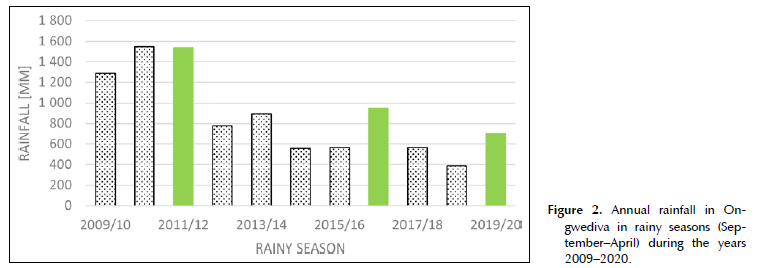
Ogongo has a semi-arid climate. The summers are sweltering and partly cloudy; the winters are short, comfortable and clear (Mendelsohn et al. 2000; Mendelsohn & Weber 2011). In the 2019/2020 rainy season (September-April), the total amount of rain in nearby Ongwediva was 702 mm, in the previous rainy season it was 388 mm; and the long-term annual average is 724 mm (Figure 2) (https://weatherandclimate.com/namibia/oshana/ongwediva). The amount of rainfall in a given breeding season was correlated with the population density of particular bird species.
Data collection
Studies were conducted in three different years: 2012, 2017 and 2020. A territory mapping method (Sutherland 1996; Bibby et al. 2012) has been applied to assess the population densities of all coraci-iform, piciform and psittaciform species breeding in the study plot. Field observations were conducted by the same observer throughout the years. Observations were aided with 10x50 binoculars. Surveys were conducted in early mornings by walking slowly, in all habitats, with a similar speed of about 1 km per 20-30 minutes.
During each survey all seen and heard birds (showing breeding or territorial behaviour) were mapped using GPS. The study area was traversed longitudinally or latitudinally on transects separated from one another by a space of about 70-100 m (GPS helped to keep the proper direction and distance). During each survey, the transects were differently set up in the field. Caution was taken to not register the same individuals by noting all movements in the field and by paying special attention to simultaneously calling birds.
Four surveys of the whole area were conducted in each year during the wet season (October-April). To cover the whole study area, each survey consisted of 4-5 counts conducted on different days in a fragment of the study area. In 2012 and 2020, the first surveys were conducted in the first half of November, second surveys in the second half of November, third surveys in the first half of December and fourth surveys in the second half of December. In 2017, the first survey in the first half of February, second survey in the second half of February, third survey in the first half of March, fourth survey in the second half of March. Slightly different seasons within a given year (stage of breeding) for counting birds in three different years may have resulted in some bias and inaccuracy in the comparison.
Data analysis
Only calling/singing birds, and those showing other territorial or breeding behaviour, were plotted on the map 1:1000. Caution was taken to not register the same individuals by noting movements of counted birds in the field and by paying special attention to simultaneously calling birds. At least two records out of four in a clump were required to confirm an occupied territory (Bibby et al. 2012). However, if nest with eggs or chicks were found, one record was sufficient. The number of nests found may bias the sample, as species with easily detected nesting sites (parrots, rollers) had better detection rates than species with nests that are difficult to find (e.g., woodpeckers and wood hoopoes).
Population density was expressed as the number of breeding pairs per 100 ha. Nomenclature of species follow Chittenden et al. (2016). General habitat preference (natural vs partly transformed savanna) was measured by relating the number of territories established in natural savanna to the number established in partly transformed savanna in all studied years. The difference was tested with the ch2-test. Site fidelity was assessed by relating the number of territories established exactly or partly in the same site in two or three studied years (2012, 2017 and 2020) to the number of territories established in different sites in each studied year. The x2-test was also used to test the year-to-year differences in the number of breeding pairs of more common species and species groups.
Results
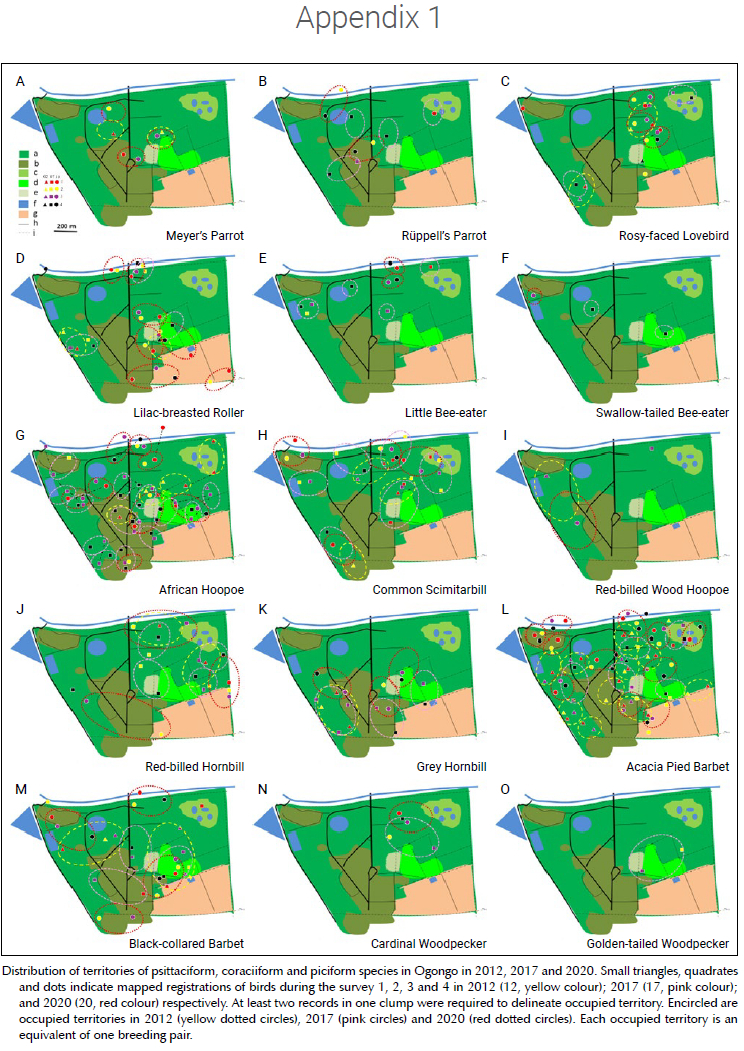
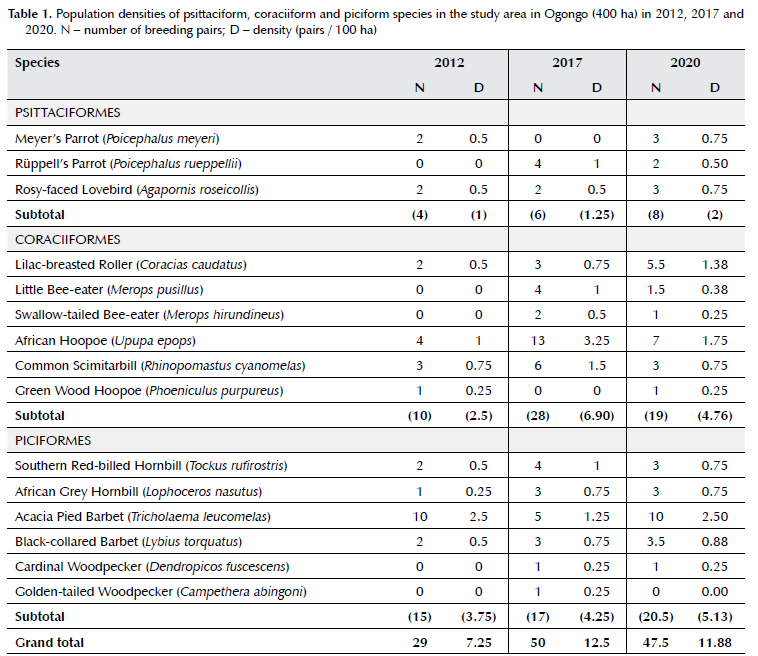
In total 3 psittaciform, 6 coraciiform and 6 piciform species were recorded as breeding residents in the study plot (Table 1; Appendix Figure 1A-O). The overall population density of parrots has increased from 1 to 2 pairs per 100 ha (Appendix Figure 1A-C). In 2020, Meyer's Parrot, Rüppell's Parrot and Rosy-faced Lovebird, nested in similar densities of 0.50-0.75 pairs per 100 ha (Appendix Figure 1A-C). All Rosy-faced Lovebirds nested in abandoned Red-billed Buffalo Weaver (Bubalornis niger) nests.
The order Coraciiformes was represented by 1 species of roller (Coraciidae) (Appendix Figure 1D), 2 species of bee-eaters (Meropidae) (Appendix Figure 1E-F), 1 species of hoopoes (Upupidae) (Appendix Figure 1G) and 2 species of wood hoopoes (Phoeniculidae) (Appendix Figure 1H-I). The African Hoopoe was the most abundant coraciiform species reaching a density of 3.3 pairs per 100 ha in 2017 in the whole study area (Appendix Figure 1G). This constituted almost half of all breeding coraciiform pairs (Table 1). Its density, however, fluctuates considerably from year to year. The number of Green Wood Hoopoe (Phoeniculus purpureus) territories refers to the territories of co-operatively breeding groups, where there is a reproducing pair and a number of non-reproducing helpers (Appendix Figure The second most abundant coraciiform species was the Lilac-breasted Roller, which population increased from 0.5 pair per 100 ha in 2012 to 1.4 pairs per 100 ha in 2020 (Appendix Figure 1D, Table 1). Among the other coraciiform species, only the Common Scimitarbill reached a density higher than 1 pair per 100 ha in 2017 (Appendix Figure 1H, Table 1).
The order Piciformes was represented by species belonging to three families: hornbills (Bucerotidae, 2 spp.), bar-bets (Lybidae, 2 spp.) and woodpeckers (Picidae, 2 spp.). Among the piciform species the most abundant was the Acacia Pied Barbet (up to 2.5 pairs per 100 ha). In 2012 and 2020 the Acacia Pied Barbet comprised more than half of all piciform breeding pairs (Appendix Figure 1L, Table 1). No other species of this order reached a density higher than 1 pair per 100 ha in any year.
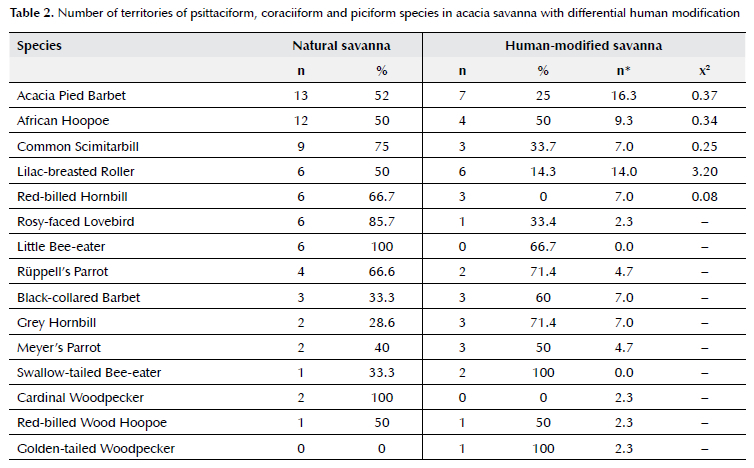
All three parrot species and the Common Scimitarbill have shown preference for natural acacia savanna (Appendix Figure 1H). A preference for natural vegetation was also shown by woodpeckers (Appendix Figure 1N-O) and the Acacia Pied Barbet (Appendix Figure 1L). The Lilac-breasted Roller and Little Bee-eater (Merops pusillus) were equal in their choice of natural and man-modified savanna (Appendix Figure 1D, E). The Black-collared Barbet (Lybius torquatus) do not show any preferences (Appendix Figure 1M, Table 2). It should, however, be emphasised that all these differences are not statistically significant (Table 2).
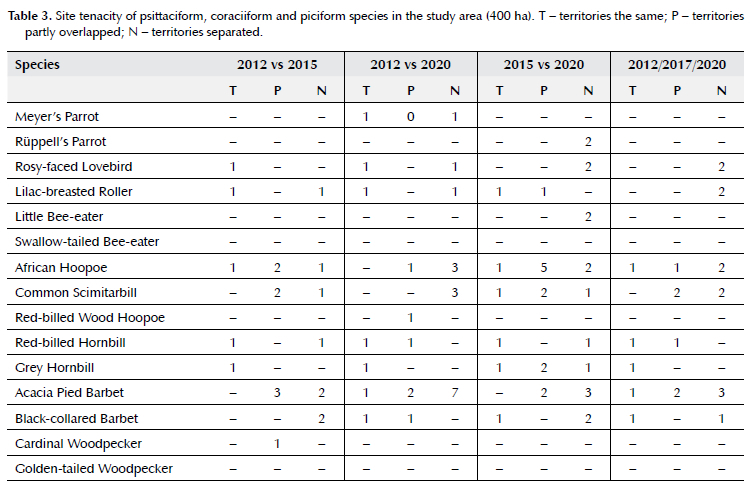
Parrots and hornbills showed high site fidelity (most territories were held at the same site over years), while about half of Lilac-breasted Roller and Common Scimitarbill territories were at the same site year after year (Appendix Figure 1H). Barbets, however, appear to show low site fidelity (most territories were in different sites over years) (Appendix Figure 1L-M, Table 3). These results not necessary indicate site fidelity, as territories could have been held by different pairs in consecutive years. Birds were not colour-ringed or marked in any other way.
Discussion
The territory mapping method enables the estimation of population density of territorial bird species with a high accuracy (Sutherland 1996; Bibby et al. 2012). For strongly territorial and vocal species, the estimated densities are close to the absolute values. In this study, such species were represented by the Lilac-breasted Roller, Common Scimitarbill, African Hoopoe and barbets. On the other hand, parrots are not strongly territorial (Meyer's and Rüppell's parrots) and may breed in small colonies (Rosy-faced Lovebird), posing problems in counting. The density of the Green Wood Hoopoe refers to the number of cooperatively reproducing groups rather than breeding pairs as such. The cooperative group is normally composed of the reproductive pair and 1-10 helpers (usually offspring from the previous breeding attempt of the actual reproducing pair), which although sexually mature, do not reproduce but help to rear offspring to the reproducing pair (Hockey et al. 2005).
Contrary to expectation, for most species and species groups studied, their population densities were negatively related to the precipitation. The interannual difference in population densities were, however, statistically significant only in the case of the African Hoopoe (x2 = 5.25, p<0.05), coraciiform (x2 = 8.53, p<0.01) and all the species taken together (x2 = 6.24, p<0.05). Drier weather conditions appear to be especially conducive for coraciiform species (including the African Hoopoe). Possibly it is caused by migrating of these species from dry to more humid habitats in years with low precipitation. This phenomenon has been well-documented for the Lilac-breasted Roller and the Purple Roller (Coracias naevius) in Botswana (Herremans & Herremans-Tonnoeyr 1994). In the study area of Ogongo, coraciifoms nested in significantly lower densities in the year with high precipitation (2012) than in the years with much lower precipitation (2017 and 2020; Figure 2).
Site fidelity or philopatry can be proved with certainty only if birds are colour-ringed, marked with picric acid, also known as trinitrophenol or 2,4,6-trinitrophenol (used as a dye for textiles and other materials due to its bright yellow colour) or with other markers. In this study, birds were not marked, and site fidelity cannot be proved. However, high numbers of territories established in exactly the same site in three different years (2012, 2017 and 2020) suggest that the site fidelity may prevail in those species. This merits further investigation with marked birds.
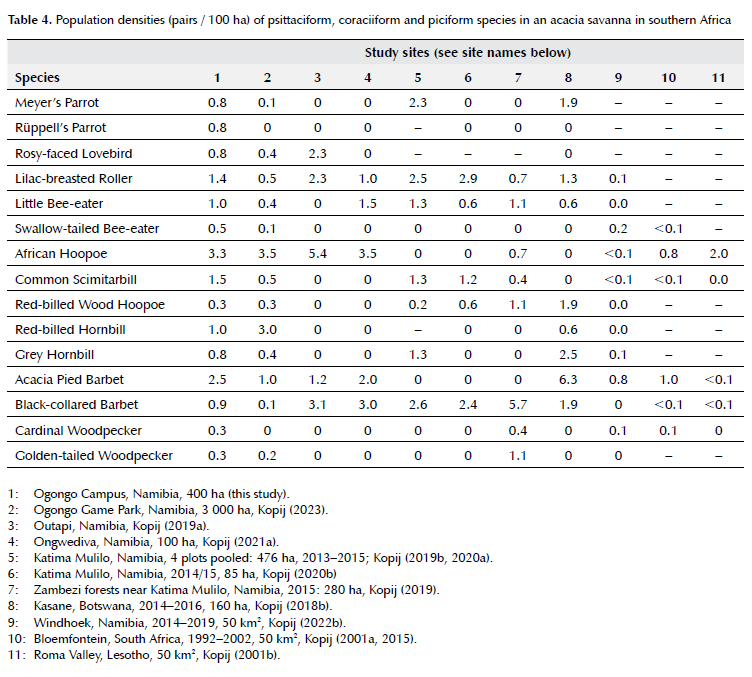
Even in regard to such common and conspicuous species as those selected for this study, data on their population densities are scarce in literature (Frey et al. 1988, Del Hoyo et al. 2001, Hockey et al. 2005). The Lilac-breasted Roller bred at a density of 4 pairs / 100 ha in eastern Kenya (Brown & Brown 1973). The Little Bee-eater nested at a density of 2 pairs / 100 ha in a broad-leaved woodland in Limpopo, South Africa (Tarboton et al. 1987), being close to that in Ogongo. The Southern Red-billed Hornbill with 2 pairs / 100 ha in Limpopo, South Africa (Kemp 1976, Tarboton et al. 1987) and 2.3 pairs / 100 ha in Botswana (Herremans 1997) were twice higher than in Ogongo. The Black-collared Barbet nested in exceptionally high density of 9 pairs / 100 ha in a mixed woodland around Great Zimbabwe Ruins (Vernon 1985). Most of the values are higher than recorded in this study. Some of these figures may reflect local concentrations known in these species. This is a widespread error/bias in population studies often committed by researchers all over the world. However, it is also plausible that these habitats in the Limpopo province of South Africa and in Zimbabwe are more continuous, more compact (higher tree density) and natural than the fragmented and transformed more open (lower tree density) acacia savanna in the Ogongo area. Lower densities recorded in Ogongo might also be a result of interspecific competition. For the particular species, the densities were relatively low, but for all members of the order to which they belonged the overall density could have been higher, and the habitat could have been saturated with their territories, as coraciiform species often show interspecific competition (both for food resources and for nesting sites) and territoriality (Del Hoyo et al. 1997).
Parrots, especially the Rosy-faced Lovebird, are dependent on water, and when the precipitation is low they may migrate to other places (Ndithia & Perrin 2006; Ndithia et al. 2007). The Ogongo study had permanent water bodies in few sites and a water canal always filled with fresh water (Figure 1), which probably explains their constant presence irrespective of rainfall level.
Hoopoe population density appears to be much higher in the Cuvelai Drainage System than in other sites in Namibia. Possibly, it is one of the highest in southern Africa at large. Exceptionally high population density of the Black-collared Barbet has been recorded in Katima Mulilo (5.7 pairs / 100 ha), while that of the Acacia Pied Barbet is higher in Kasane (6.3 pairs / 100 ha). Both sites represent suburban areas with large numbers of fruit trees such as mangoes, papayas and figs, which may constitute a reservoir of food resources of these species. Green Wood Hoopoe, Common Scimitarbill and woodpecker species appear to breed in low population densities both in Namibia and in South African Highveld (grassland). Nowhere their densities were higher than 2 pairs / 100 ha (Table 4).
The above-mentioned bird species should be regarded as convenient objects of studies on environmental health and quality. Monitoring their numbers shall constitute integral parts of conservation projects. Some of them (hornbills, wood-hoopoes, honeyguides and woodpeckers) appear to be prone to habitat modifications, others, like the Rosy-faced Parrot, Lilac-breasted Roller, African Hoopoe or Swallow-tailed Bee-eater appear to be well adapted to human-modified environments. The Rosy-faced Lovebird may even reach high population densities in some Namibian towns and cities (Kopij 2021b, 2022a, 2022b).
The population densities, with their year-to-year variations recorded for 15 bird species in acacia savanna may constitute a basis for assessing population size of these species on larger areas through an extrapolation. Such assessments are especially valuable for species included in the Red Data Books and Red Lists. Information of site tenacity may also be used to assess the status of environmental quality, as declining site tenacity may indicate declining environmental quality.
References
Bibby, C.J., Burgess, N.D. & Hill D.A., 2012, Bird censuses techniques. Academic Press, London. [ Links ]
Brown, L.H. & Brown, B.E., 1973. 'The relative numbers of migrant and resident rollers in eastern Keyna', Bulletin of the British Ornithologists' Club, 93: 126-130. [ Links ]
Chittenden, H., Davis, G. & Weiersbye, I., 2016, Roberts Bird Guide, Cape Town: John Voelcker Bird Book Fund. [ Links ]
Del Hoyo, J., Elliott, A. & Sergatal, J. (eds), 1997, Handbook of the birds of the World, vol. 4: sandgrouse to cuckoos, Barcelona: Lynx Edicions. [ Links ]
Del Hoyo, J., Elliott, A. & Sergatal, J. (eds), 2001, Handbook of the birds of the World. vol. 6: mousebirds to hornbills, Barcelona: Lynx Edicions. [ Links ]
Del Hoyo, J., Elliott, A. & Sergatal, J. (eds), 2002, Handbook of the birds of the World. vol. 7: jacamars to woodpeckers, Barcelona: Lynx Edicions. [ Links ]
Dueker, S., Willows-Munro, S., Perrin, M.R., Abebe, Y.D., Annorbah N.N., Mwangi E.W., Madindou, I.R., Tekalign, W., Mori, E., Mzumara, T.I., Brown, C., Bryson, U., Ndithia, H., Dodman, T., Van der Zwan, H., Van der Sluis, R., Phiri, C.R., Karimanzira, A. & Martin, R.O., 2023, 'Conservation status and threats to lovebirds: knowledge gaps and research priorities', Ostrich 94(1), 1-27, https://doi.org/10.2989/00306525.2023.2206674. [ Links ]
Frey, C.H., Keith, S. & Urban E.K., 1988, Birds of Africa. Vol. 3. London: Academic Press. [ Links ]
Herremans, M., 1997, 'Red-billed Hornbill', in: J.A. Harrison et al. (eds). The atlas of southern African birds, vol. 1: 698699, BirdLife South Africa, Johannesburg. [ Links ]
Herremans, M. & Herremans-Tonnoeyr, D., 1994, 'Seasonal patterns in abundance of Lilac-breasted Rollers Coracias caudata and Purple Rollers Coracias naevia inferred from roadside counts in eastern and northern Botswana, Ostrich 65(2), 66-73. [ Links ]
Hockey, P.A.R., Dean, W.R.J., Ryan P.G. & Maree, S. (eds), 2005, Roberts' birds of southern Africa, John Voelcker Bird Book Fund, Cape Town. [ Links ]
Hoffman, M.T., Schmiedel, U. & Jurgens, N. (eds), 2010, Biodiversity in southern Africa, volume 3: Implications for land use and management, Klaus Hess Publishers, Gottingen & Windhoek. [ Links ]
Juniper, T. & Parr, M., 2003, Parrots. A guide to parrots of the World, Chritopher Helm, London. [ Links ]
Jurgens, N., Haarmeyer, D.H., Luther-Mosebach, J., Dengler J., Finck, H.M. & Schmiedel, U. (eds), 2010, Biodiversity in southern Africa, volume 1: Patterns at local scale the BIOTA observatories, Klaus Hess Publishers, Gottingen & Windhoek. [ Links ]
Kangombe, F.N., 2007, Vegetation description and mapping of Ogongo Agricultural College and the surrounds with the aid of satellite imagery, BSc thesis, University of Pretoria, Pretoria. [ Links ]
Kemp, A.C., 1976, 'A study of ecology, behaviour and sys-tematics of Tockus hornbills', Transvaal Museum Memoirs, 20, 1-125. [ Links ]
Kopij, G., 2001a, Atlas of Birds of Bloemfontein, Department of Biology, National University of Lesotho & Free State Bird Club, Roma, Lesotho & Bloemfontein, South Africa. [ Links ]
Kopij, G., 2001b, Birds of Roma Valley, Lesotho, Department of Biology, National University of Lesotho, Roma (Lesotho). [ Links ]
Kopij, G., 2015, 'Avian diversity in an urbanized South African grassland', Zoology & Ecology, 25(2), 87-100. [ Links ]
Kopij, G., 2018a, 'Provisional atlas of breeding birds of Swa-kopmund in the coastal Namib Desert', Lanioturdus 51(2), 2-12. [ Links ]
Kopij, G., 2018b, 'Atlas of breeding birds of Kasane', Babbler, 64, 3-15. [ Links ]
Kopij, G., 2019a, 'Population density and structure of birds breeding in an urban habitat dominated by large baobabs (Adansonia digitata), northern Namibia', Biosystem Diversity 27(4), 354-360. [ Links ]
Kopij, G., 2019b., 'Structure of avian communities in a mosaic of built-up and semi-natural urbanised habitats in Katima Mulilo town, Namibia', Welwitschia International Journal of Agricultural Sciences 1, 68-75. [ Links ]
Kopij, G., 2020a, 'Structure of breeding bird community along the urban gradient in a town on Zambezi River, northeastern Namibia', Biologija 66(1), 1-9. [ Links ]
Kopij, G., 2020b, 'Changes in the structure of avian community along a moisture gradient in an urbanized tropical riparian forest', Polish Journal of Ecology 68(3), 251-262. [ Links ]
Kopij, G., 2021a, 'Population density and structure of a breeding bird community in a suburban habitat in the Cu-velai drainage system, northern Namibia', Arxius de Mis-cel-lánia Zoológica, 19, 313-320. [ Links ]
Kopij, G., 2021b, 'Structure of avian communities of suburbs of Rundu and Grootfontein, NE Namibia', Berkut 30(1), 20-24. [ Links ]
Kopij, G., 2021c, 'Seasonal changes in the structure of an avian community in an urban habitat in northern Namibia', Biologija 67(4), 197-204. [ Links ]
Kopij, G., 2022a, 'Provisional atlas of breeding birds of Henties Bay in the coastal Namib Desert', Namibian Journal of Environment, 6C, 1-6. [ Links ]
Kopij, G., 2022b, 'Population densities of selected bird species in the city of Windhoek, Namibia', Berkut 31(1/2), 40-47. [ Links ]
Kopij, G., 2023, 'Status, distribution and numbers of birds in the Ogongo Game Park, north-central Namibia', Namibian Journal of Environment, 7B, 9-20, https://nje.org.na/index.php/nje/article/view/volume7-kopij. [ Links ]
Mariyappan, M., Rajendran,M., Velu, S., Johnson, A.D., Dinesh, G.K., Solaimuthu, K., Kaliyappan, M. & Sankar, M., 2023, 'Ecological role and ecosystem services of birds: a review', International Journal of Environment and Climate Change13,6: 76-87, https://www.doi.org/10.9734/ijecc/2023/v13i61800. [ Links ]
Martin, R.O., Perrin, M.R., Boyes, R.S., Abebe, Y.D., Annorbah, N.D. & Asamoah, A., 2014, 'Research and conservation of the larger parrots of Africa and Madagascar: a review of knowledge gaps and opportunities', Ostrich, 85(3), 205233, https://doi.org/10.2989/00306525.2014.948943. [ Links ]
Mekonen, S., 2017, 'Birds as biodiversity and environmental indicator', Indicator, 2017, 7.21. [ Links ]
Mendelsohn, J., el Obeid, S. & Roberts, C., 2000, A profile of north-central Namibia, Gamsberg Macmillan Publishers, Windhoek. [ Links ]
Mendelsohn, J. & Weber, B., 2011, 'The Cuvelai Basin, its water and people in Angola and Namibia', Occasional Paper no. 8. Development Workshop, Luanda. [ Links ]
Mendelsohn, J., Jarvis, A., Roberts, C. & Robertson, T., 2009, Atlas of Namibia. A portrait of the land and its people, Sun-bird Publishers, Cape Town. [ Links ]
Ndithia, H. & Perrin, M.R., 2006, 'The spatial ecology of the Rosy-faced Lovebird Agapornis roseicollis in Namibia', Ostrich 77, 52-57. [ Links ]
Ndithia, H., Perrin, M.R. & Walter, M., 2007, 'Breeding biology and nest site characteristics of the Rosy-faced Lovebird Agapornis roseicollis in Namibia', Ostrich, 78, 13-20. [ Links ]
Rowan, M.K., 1983, The doves, parrots & cuckoos of southern Africa, David Philip, Cape Town & Johannesburg. [ Links ]
Schmiedel, U. & Jurgens, N. (eds), 2010, Biodiversity in southern Africa. Volume 2: Patterns and processes at regional scale, Klaus Hess Publishers, Gottingen & Windhoek. [ Links ]
Sutherland, W.J., 1996, Ecological census techniques: a handbook, Cambridge University Press, Cambridge (UK). [ Links ]
Tarboton, W.R., Kemp, M.I. & Kemp, A.C., 1987, Birds of Transvaal, Transvaal Museum, Pretoria. [ Links ]
Urban, E.K., Fry, C.H. & Keith, S., 1986, The birds of Africa. Vol. 2, Academic Press, London. [ Links ]
Vernon, C.J., 1985, 'Bird populations in two woodlands near Lake Kyale', Honeyguide 31, 148-161. [ Links ]
 Correspondence:
Grzegorz Kopij
E-mail: grzegorz.kopij@upwr.edu.pl
Submitted: 27 September 2024
Accepted: 7 July 2025
Published: 6 November 2025