Services on Demand
Journal

Article
 English (pdf)
 Article in xml format
 Article references
 Automatic translation
 Send this article by e-mail
Indicators
Related links
-
 Cited by Google
 -
 Similars in Google
Share

 Permalink
African Biodiversity & Conservation
On-line version ISSN 3078-8056Print version ISSN 0006-8241
Bothalia (Online) vol.55 n.1 Pretoria 2025
https://doi.org/10.38201/abc.v55.14
ORIGINAL RESEARCH
Rust fungi (Pucciniales) of southern Africa
A.R. WoodI, II
IARC-Plant Health Protection, Private Bag X5017, Stellenbosch 7599, South Africa
IIDiscipline of Plant Pathology, School of Agriculture, Earth and Environmental Sciences, University of KwaZulu-Natal, P.O. Box XI, Pietermaritzburg 3209, South Africa
ABSTRACT
The last comprehensive checklist of rust fungi (Pucciniales; Basidiomycota) of southern Africa was published in 1950 by Ethel Mary Doidge, and included 468 species. An updated listing is provided here, including all published records of rust fungi from Angola, Botswana, Eswatini (formerly Swaziland), Lesotho, Mozambique, Namibia, South Africa and Zimbabwe, and their recorded hosts. A total of 631 taxa of rust fungi are recorded, on 1 355 host plant taxa. Sphaerophragmium senegaliae A.R.Wood, Maravalia neomimusops A.R.Wood and Aecidium afrocanthii A.R.Wood are newly described. New combinations made are Milesina silvae-knysnae (R.Berndt) A.R.Wood and Elateraecium celastrineae (Cooke & Massee) A.R.Wood. Endophyllum austroafricanum (Henn.) A.R.Wood represents a new combination and has been raised to species level. Endophyllum rhamni-prinoides (Thüm.) A.R.Wood (currently known as Endophyllum macow-anii Pole-Evans) and Endophyllum conyzae-scabridae A.R.Wood (currently known as Endophyllum macowanianum (Thüm.) A.R.Wood) are new names provided for species with illegitimate names.
Keywords: southern Africa, biodiversity, Basidiomycota, Pucciniomycetes, neo-mycetes, biotrophic fungi, indigenous fungi.
Introduction
The rust fungi (Basidiomycota, Pucciniomycetes, Pucciniales) are a diverse group of environmentally and economically important biotrophic plant pathogenic fungi (Aime et al. 2018). The last comprehensive checklist of rust fungi of southern Africa, which included all known records from southern Angola, Botswana, Eswatini (formerly Swaziland) Lesotho, Mozambique, Namibia, South Africa and Zimbabwe, and all recorded host plants, was by Ethel Mary Doidge (Doidge 1950) in Bothalia. Since then, Berndt (2008a) provided a checklist of the rust fungi from South Africa, Botswana and Namibia (but without host records). Doidge (1950) listed 468 species of rust fungi, while Berndt (2008a) recorded 546, and McTaggart et al. (2017) recorded 572. Both these latter lists included various species names that are considered to be synonyms according to Species Fungorum (http://www.speciesfungorum.org), and they did not include all species recorded from the region. In the list provided here, there are 631 taxa of rust fungi recorded from southern Africa, from 1 355 host plant taxa. The list includes 78 species considered to be alien (neomycetes), either as naturalised pathogens of introduced plants (crops and weeds), or invasive pathogens and attacking plants indigenous to the region. Also included are four species that have been deliberately introduced for the biological control of alien invasive plants. The current list aims to provide a comprehensive record of all rust fungi recorded in southern Africa up to the end of 2023, providing the first comprehensive updated listing since Doidge (1950), together with a comprehensive host list and a guide to the literature concerning the rust fungi included.
In compiling her list, Doidge drew on many sources (including literature and herbarium specimens), as well as her own comprehensive taxonomic investigations (Doidge 1927, 1928, 1939, 1941, 1948a, 1948b) of southern African rust fungi. One of the sources she drew on was Hopkins (1938), a similar checklist for Zimbabwe. Since Doidge (1950), many changes in nomenclature, as well as to generic and family concepts of the rust fungi, have occurred. In addition, there are a substantial number of new distribution records and new species recorded from the region. This checklist was compiled from published records as a means of summarising current knowledge on the taxonomy and biodiversity of the region's rust fungi. No attempt has been made to verify the published identity of the rust fungi or host plant species, however, all publications cited do list specimens examined, allowing for subsequent corrections to be included. Angola was included because Doidge (1950) included species recorded by Hennings (1903). All records found for Angola were also included here for completeness.
Of all the countries included in this checklist, only the rust funga in South Africa and Zimbabwe are relatively well known, with 526 and 169 species, respectively. Only one rust fungus is recorded from Lesotho, 6 each from Botswana and Eswatini, 39 from Angola, 36 from Mozambique and 68 from Namibia. South Africa's and Zimbabwe's fungal flora are the best known because there is a history of active mycologists and plant pathologists in these countries. Both countries also have a long history of producing plant disease lists, namely those of Doidge (1924), Doidge and Bottom-ley (1931), Doidge et al. (1953), Gorter (1977, 1981, 1982) and Crous et al. (2000) in South Africa; and Hopkins (1938, 1950), Whiteside (1966), Rothwell (1983) and Masuka et al. (1998) in Zimbabwe. These lists were consulted but are not cited unless they are the sole record of a species occurring in the region. Because these lists do not provide details of the specimens used to make the record, any changes in taxonomy can't be followed. Literature that provides taxonomic and specimen details was preferred as the source for species recorded here. Another shortfall of these lists of South African plant diseases, is that they do not give a comprehensive listing of pathogens of indigenous plants. This results from decisions made about which host plants to include in Doidge and Bottomley (1931), only indigenous plants considered at that time to be of economic importance (timber, fodder, medicinal, poisonous or ornamental) were included, and therefore many pathogens recorded from other plant species were excluded. These excluded records mostly continued to be excluded in all publications up to and including Crous et al. (2000).
Doidge (1950) gives a comprehensive historical account of the mycological exploration of the region, including the rust fungi. Halvor Gjærum has since then made a notable contribution to the knowledge of rust fungi indigenous to the region (see the various publications under his name), with the description of 15 new species and a further 27 previously unrecorded species from southern Africa. Mechthilde Mennicken (Mennicken & Oberwinkler 2004, Mennicken et al. 2003, 2005a, 2005b, 2005c) and Reinhard Berndt (Berndt 2007, 2008a, 2008b, 2009, 2010, 2020, Berndt & Uhlman 2006, Berndt & Wood 2012, Berndt et al. 2008, Ritschel et al. 2007) and their co-workers, significantly increased the knowledge of rust fungi in the west of the region. Together they described 51 new species and recorded an additional 33 from Namibia and South Africa. As a result, the number of rust fungi known from Namibia increased from 16 to 68. More distribution records and new species remain to be found as many areas remain poorly collected. In particular, Mozambique and Angola should yield many more records.
The circumscription of rust families and genera have a convoluted history; however, a degree of order was brought to rust taxonomy by Cummins and Hiratsuka (1983, 2003) whose taxonomic scheme was based on the morphology of teliospores and spermogonia. Subsequently, it has been shown that various of their families and genera are polyphyletic (Aime 2006, Aime et al. 2017, 2018), and a new taxonomic scheme has been proposed (Aime & McTaggart 2021) based on phylogenetic data and morphology. This latest taxonomy has been followed in the current list.
Methods
Old and new literature was searched for records of rust fungi occurring in southern Africa. Farr and Rossman (2024) (initially http://nt.ars-grin.gov/fungaldatabases/, now https://fungi.ars.usda.gov/) was a useful source of distribution data about various species included. Old literature was sourced from the CyberLiber web page in CyberTruffle (http://www.cybertruffle.org.uk/eng/index.htm), the Biodiversity Heritage Library (http://www.biodiversitylibrary.org/), and JSTOR (https://www.jstor.org).
This checklist consists of two parts (Supplement 1 and 2). The first is a list of all rust fungi recorded from southern Africa, and the second a list of all their host plants, recorded in alphabetical order according to family, genus and species. The entries in Supplement 1 are presented in the order: rust species and authority, [synonyms published after Doidge (1950), refer to this publication for older synonyms], family of host plant(s), genus/genera of host plant(s), references, distribution and spore stages recorded (based on their morphology). Rust species occurring on plants not indigenous to southern Africa (alien, including crop plants and naturalised alien plants) are indicated by 'A' appearing at the beginning of the entries, and are in purple. The authorities are according to Index Fungo-rum (http://www.speciesfungorum.org), which is also a useful resource to check the current status of many species.
Doidge (1950) served as the starting point of this checklist, her list was copied and then all changes to nomenclature and new records published subsequent to that work are listed, with the page number of the specific record. Spore stages present for each species were determined from the references listed. Additionally, for widespread species, details were obtained from Arthur (1962) and Wilson and Henderson (1966). Where available, literature on various aspects of the biology of the species is included. For listings of earlier literature and synonyms, Doidge (1950) should be consulted, however, for completeness an attempt was made to include all published names with type specimens collected in southern Africa. Abbreviations indicating distribution are: A = Angola, B = Botswana, L = Lesotho, M = Mozambique, N = Namibia, SA = South Africa, SZ = Eswatini (formerly Swaziland), and Z = Zimbabwe. The type of pustule (spore) morphology is indicated with the notation of O, I, II, III and X for spermogonia, aecia (aeciospores), uredinia (urediniospores), telia (teliospores) and mesospores (this last in Puccinia only), respectively. In a few cases where uredinia associated with spermogonia differ to those not associated, this is denoted by III, IIII. Endocyclic species are denoted with IIII. Autoecious species are indicated with all known spore types within one set of parentheses e.g., (O, I, II, III), and heteroecious species are indicated by using two sets of parentheses e.g., (O, I) (II, III). For heteroecious species, the name of the aecial stage (gametothallus) is given in brackets, as well as an entry similar to the above, after the end of the entry on the telial stage (sporothallus). Additional notes are given after the species entry.
In Supplement 2, the host entries are listed in the order: plant family, plant species and authority, rust species, reference(s). Host plants not indigenous (alien) to southern Africa are indicated by '*' at the beginning of the entry. The taxonomy of the host plants was initially according to Germishuizen and Meyer (2003), though where possible more recent synonyms have been applied. The Plant List (http://www.theplantlist.org/) and more recently WorldFloraOnline (http://www.world-floraonline.org/) were useful resources to verify plant names and authorities, as well as to find current names for some of those used in the older literature. Note that the plant taxonomy used follows that according to WorldFloraOnline and not the names as used in Plants of southern Africa (https://posa.sanbi.org/san-bi/Explore). Some host names may therefore differ to the name commonly used currently in South African literature. Only one resource of those available was chosen to ensure consistency. Host plant family names are according to the Angiosperm Phylogeny Group (APG IV) (2016), Stevens (2001 onwards) and World-FloraOnline (http://www.worldfloraonline.org/).
Results
A total of 631 rust taxa occur in southern Africa, including 550 species indigenous to the region, and a further 78 that have been accidentally or deliberately introduced (Figure 1-3). Three unidentified species (in Puccinia and Uredo) have also been listed, possibly representing new taxa. These represent a total of 47 genera, with representatives in 5 suborders and 10 families recognised in Aime and McTaggart (2021).
The generic limits for various rust genera are still not certain as phylogenetic data from their type species are not yet available, therefore species have only been reasigned where DNA sequence data is available to confirm their generic placement. As far as possible, various species of Uredo and Aecidium have been assigned to suborders based on morphology or DNA sequence data. It is likely that new genera will be described in the future to accommodate various species that are currently of uncertain placement.
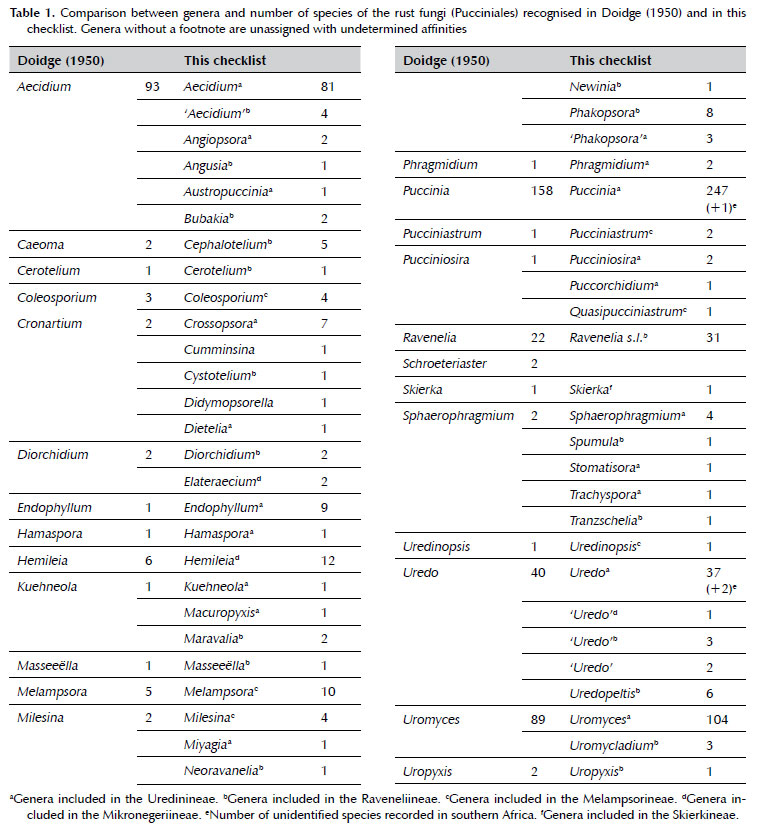
Compared to Doidge (1950), many more genera are recognised and the number of species recognised within many genera has increased (Table 1), particularly in Hemileia, Phakopsora sensu lato, Ravenelia sensu lato, Endophyllum, Puccinia and Uromyces. Despite many species of Uredo being assigned to teleomorph species, the total number recognised (35) is similar to that in Doidge (1950) (40) due to more species being recorded. The only genus with a reduction in species recognised is Aecidium (93 to 76), mainly due to a number being recognised as endocyclic (a total of 9 species in this list compared to one in Doidge, 1950), as well as a few that have been linked to their sporothallus.
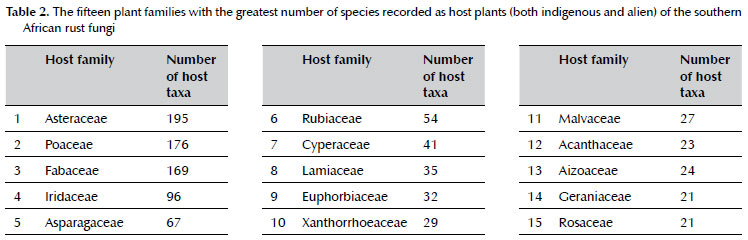
The rust fungi of southern Africa have been recorded on a total of 1 355 host plant taxa in 84 families, including both indigenous and alien plants. The host families with the greatest number of host species are the Asteraceae, Poaceae and Fabaceae accounting for almost 40% (Table 2) as is common for rust funga elsewhere. More unusually, the Iridaceae and Rubia-ceae include many host species (Table 2). Many host species have only been identified to genus level, and occasionally some only to a family, due to generic limit changes in plant taxonomy. Recollecting these rust fungi and identifying their host plants is required.
Taxonomy
New species
1. Sphaerophragmlum senegaliae
A.R. Wood, sp. nov.
HOLOTYPE: SOUTH AFRICA, KwaZulu-Natal: Hluhluwe-iMfolozi Park, Hilltop camp, on Senegalia brevispica (Harms) Seigler & Ebinger (Fa-baceae), 25 Jul. 2018, A.R. Wood 988 (PREM 63114); GenBank: 28S = OQ215083
MycoBank: MB 836557.
Description
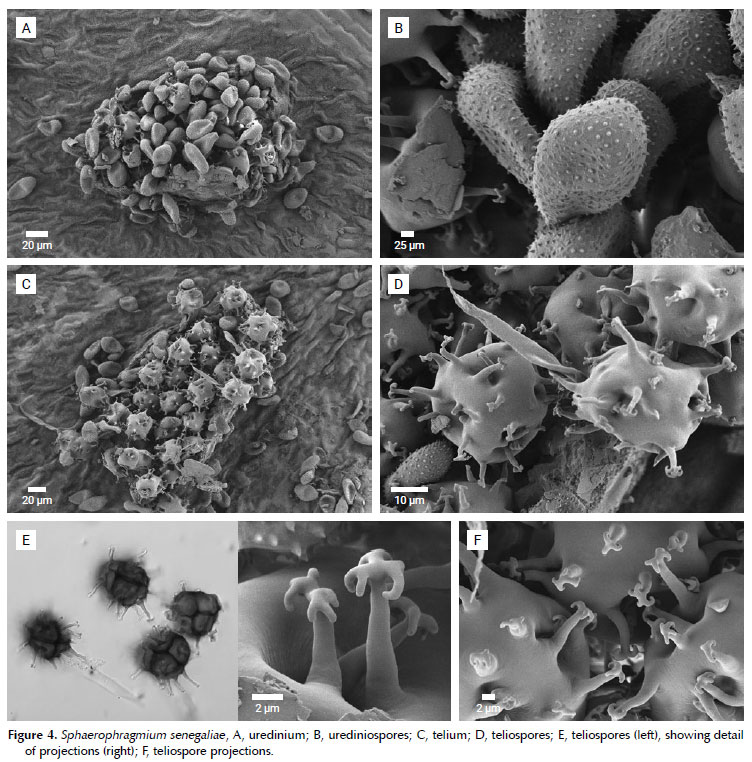
Spermogonia and aecia not observed. Uredinia scattered on pinnules, tiny, 0.1-0.2 mm, erumpent, surrounded by paraphyses which barely extend beyond torn epidermis. Urediniospores produced on pedicels, ellipsoid, oval, obovoid to pyriform, 28-45 x 1520 µm (mean 36.3 x 17.4 µm), light brown, 2 equatorial germ pores (often 1 distinct and 1 indistinct), wall sparsely echinulate, spines 1-3 µm (mean 2.6 µm) apart, walls 1-2 µm thick, apex slightly thickened 3-5 µm thick. Paraphyses more or less curved, cylindrical or slightly clavate, 1 septate, united basally, 3565 x 10-15 µm, walls 4-6 µm thick but frequently no lumen present as entire width thickened. Teliospores produced in uredinia, becoming dominant; spherical, dark brown, 6-9 cells, typically 8 cells, 37-52 x 3348 µm (mean 45.8 x 40.8 µm), walls on outer cell surfaces 2-3 µm, internal cell walls 1-2 µm, 24-42 tri- to sexfurcate projections per spore (with 2 or 3 primary branches each with 1, 2 or 3 hooks on these branches), 5-16(-20) µm long (mean 11.4 µm), pedicel persistent, up to 80 long, 6-8 wide, wall 1 µm thick. Figure 4A-4F.
Etymology
Named for the genus of the host plant, Senegalia.
Diagnosis
Similar to Sphaerophragmium dalbergiae but distinguished by different host, larger urediniospores and longer teliospore projections.
Notes
Using the morphological key to species in Monoson (1974), this specimen keys to S. dalbergiae Dietel, and to S. fimbriatum Mains in Lohsomboon et al. (1994). It differs from the former species by larger urediniospores with thickened apices and distinct germ pores, and longer teliospore projections, and from the latter by larger and more thickened paraphyses, urediniospores with less thickened apices and only 2 distinct germ pores, and the teliospores with longer projections. The combination of urediniospores and teliospores present in the same paraphysate pustules, urediniospores with 2 germ pores and thickened apices, teliospores with ~8 cells and projections up to 16 long and 3- to 6-furcate, is unique in the genus (Monoson 1974, Lohsomboon et al. 1994). A sequence (OQ215083) of the nuclear large subunit (28S) region of the ribosomal DNA repeat has been published (Wood & Aime 2024).
2. Maravalla neomlmusops
A.R.Wood, sp. nov.
= Uromyces mimusops Cooke fide Doidge (1927), Bothalia 2(1a): 15, pro parte.
HOLOTYPE: SOUTH AFRICA, North West: Paaskraal, Magaliesberg, on Mimusops zeyheri Sond. (Sapotaceae), 31 Oct. 1998, S. Neser (PREM 56225, II + III);
MycoBank: MB 836558.
Description
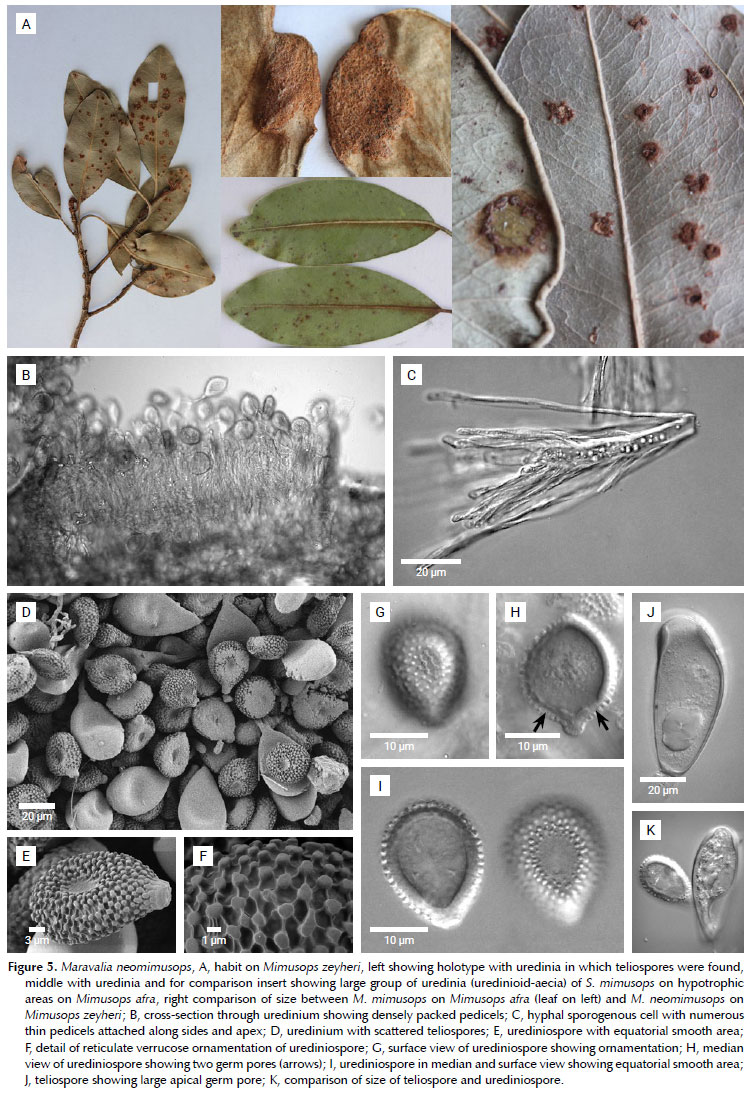
Spermogonia and aecia not observed. Uredinia hypophyllous, single 0.25-1.0 mm or several forming a ring to 2 mm diam., dark brown, subepidermal, erumpent, aparaphysate, densely packed with hyphal elements that are interpreted as spore initials and pedicels originating from columnar sporogenous cells each with many initials. Urediniospores globose to ellipsoid, usually flattened on opposite sides so that they are bilaterally symmetrical, apex rounded, base rounded or attenuate, 27-45 x 20-28 µm; wall bilaminate, inner wall golden-brown, smooth, 2-3(-5) µm, outer wall hyaline, reticulate verrucose, with smooth area (or verrucae reduced in size) in centre of flattened sides, 1-2 µm; germ pores 1 or 2, consistent in number for individual collections, indistinguishable if not in median view. Teliospores produced in uredinia apparently from same spore initials as urediniospores, leptosporic, clavate, apex rounded, base gradually attenuate, light yellow-brown, (45-)50-65(-83) x 1730 µm, large apical germ pore, wall 1.0-1.5 µm thickening to 2-3 µm around the germ pore. Figure 5A-K.
Etymology
Previously confused with Maravalia mimusops, hence the 'new species of Maravalia on Mimusops'.
Diagnosis
Similar to Maravalia mimusops but differs in smaller pustules and urediniospores with 2 basal germ pores.
Specimens examined
SOUTH AFRICA, North West: De Kroon, Brits, on Mimusops zeyheri, 12 Feb. 1926, Malherbe (PREM 12807, II only); Kloof, Rustenburg, on Mimusops zeyheri, 27 Oct. 1928, L. Kresfedder (PREM 23629, II + few III); Kromrivier, 9 miles [14 km] from Buffelspoort, on Mimusops zeyheri, 14 Dec. 1938, E.M. Doidge & A.M. Bottomley (PREM 32740, II only); Zilkatsnek, Magaliesberg, on Mimusops zeyheri, 18 Nov. 1953, A. Meeuse (PREM 40673, II only); Easter Kloof, Magaliesberg, on Mimusops zeyheri, 30 Aug. 2010, A.R. Wood 786 (PREM 63121, II + few III). Gauteng: Klein Wonderboom, Magaliesberg, Pretoria, on Mimusops zeyheri, 20 Apr. 1932, H.O.D. Mogg 12425 (PREM 26367, II only). Limpopo: University of Limpopo, Ga-Mankoeng, E of Polokwane, on Mimusops zeyheri, 7 Mar. 2019, M. Shadrack (PREM 63201, II only); University of Limpopo, Ga-Mankoeng, E of Polokwane, on Mimusops zeyheri, 8 Jun. 2019, M. Shadrack (PREM 63203, II only).
Notes
Maravalia mimusops (Cooke) Y.Ono (from Africa) and M. aulica (Syd.) Y.Ono (from India), both on species of Mimusops (Sapotaceae), are the only species currently recognised within Maravalia to have urediniospores with a bilaminate wall and verrucose ornamentation (Cummins 1950, Ono 1984). They are distinguished by the urediniospores being verrucose with one germ pore in the former, and striately verrucose with two germ pores in the latter (Cummins 1950). All collections made in southern Africa have been considered until now to be M. mimusops (Doidge 1927, 1950, Cummins 1950, Ono 1984). Although morphologically very similar, there are consistent differences between collections from South Africa made on Mimusops afra E.Mey. ex A.DC. (note corrected orthography of the name following Art. 61.6, Turland et al. 2025) and those on Mimusops zeyheri Sond. On Mimusops afra, spermogonia are present with amphiphyllous uredinia (uredinoid aecia) of which many occur on slightly hypotrophic areas up to 2 cm wide, other hypophyllous pustules occur on round discoloured spots with the pustules forming one to several rings 2-6 mm wide. These latter pustules may have either both urediniospores and teliospores, or exclusively teliospores. The urediniospores have only one germ pore and no smooth area (though Ono, 1984, states there is one near the hilum). On Mimusops zeyheri, no spermogonia have been observed, all uredinia are hypophyllous and smaller (up to 2 mm wide), and teliospores infrequently produced (none were found in most specimens observed). The urediniospores had either 1 or 2 germ pores, more commonly the latter, and two equatorial smooth areas. The urediniospore dimensions are similar on both host species, but those on Mimusops zeyheri tend to be shorter and rounder (27-45 X 20-28 (n = 40) vs. 35-46 X 20-26 (n = 20) (30-43 X 16-25 in Cummins 1950) on Mimusops afra; average length 34.0 ± standard error (s.e). 0.63 vs. 40.4 ± s.e. 0.64; average length: width ratio 1:1.42 ± s.e. 0.034 vs. 1:1.78 ± s.e. 0.044). Because these differences are consistent, those on Mimusops zeyheri are here described as a new species, Maravalia neomimusops. The holotype (PREM 56225) was selected as it is the only specimen with teliospores in any number.
Maravalia aulica is similar to this new species, both having small uredinia and specimens are frequently without telia. Both have two germ pores in the urediniospores (Cummins 1950, Ono 1984). However, this species has spermogonia and the urediniospores (uredinoid aecio-spores) are striately verrucose with a single bald patch towards the base (Ono 1984) (no spermogonia and two equatorial bald patches in M. neomimusops). All three species have teliospores that are morphologically almost identical and can't be readily distinguished.
Doidge (1927) stated there are 2 or 3 germ pores per urediniospore in M. mimusops, whereas Cummins (1950) and Ono (1984) stated there is only one. This discrepancy may be explained by the fact that Doidge used specimens from both Mimusops afra and Mimusops zeyheri for her description. Thus, her description of urediniospores may have been influenced by those from Mimusops zeyheri (PREM12807), which is here recognised as a distinct species usually having two germ pores though in some specimens only one occurs. It was observed that germ pores were easily distinguishable only when they were in cross-section in median view on the sides of the spores, thus it would be hard to distinguish whether a spore had one or three germ pores. It is possible that those collections, such as the holotype, which were observed to have only one distinct germ pore, may have had three. Alternatively, Doidge (1927) may have come to the wrong conclusion. Specimens of M. mimusops (on Mimusops afra) examined were found to have only one germ pore, confirming the observations of Cummins (1950) and Ono (1984).
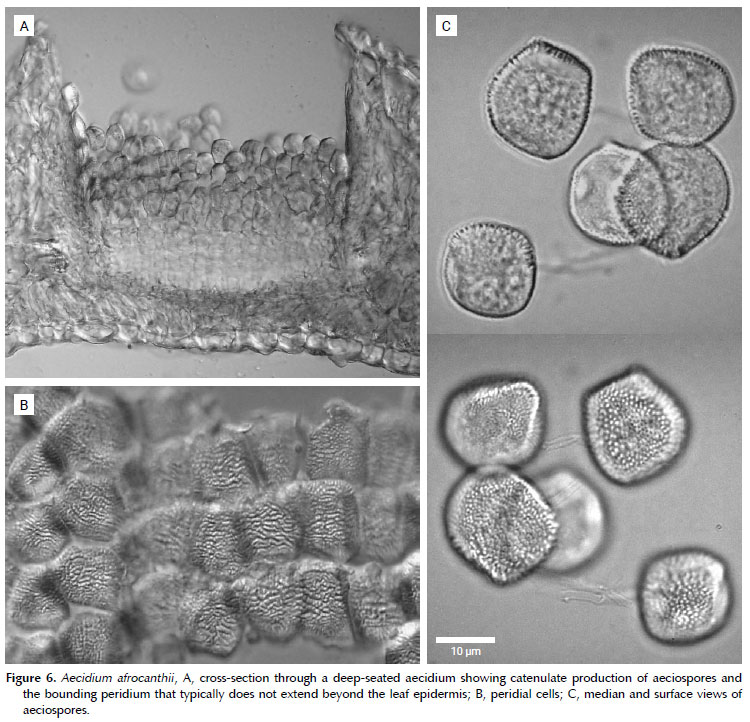
3. Aecidium afrocanthii
A.R.Wood, sp. nov.
HOLOTYPE: SOUTH AFRICA, Eastern Cape: Grahamstown Municipal Nature Reserve, S of Grahamstown, on Afrocanthium mundianum (Cham. & Schltdl.) Lantz (Rubiaceae), 27 Jan. 2000, A.R. Wood 166A (PREM 63113).
MycoBank: MB 836559.
Description
Spermogonia, uredinia and telia not observed. Aecia aecidium-like, yellow, single to small groups (1-4), occasionally groups coalesce to form larger groups, not on leaf spots, usually on abaxial leaf surface occasionally on adaxial surface, subepidermal, often deep-seated within leaf mesophyll, cupulate, peridium not extending beyond leaf epidermis, 150-280 diam. Peridial cells irregular angulate rhomboid, 16-29 X 14-26 µm, side wall 2-4 µm thick, inner wall coarsely verrucose to ridged, 3-5 µm thick, outer wall smooth to weakly verrucose, 1-2 µm thick. Aeciospores angular globose, 16-20(-28) X 14-20 µm, wall verrucose on upper portion grading to finely verrucose on lower portion, the verrucae not evenly sized, wall uniformly 1 thick. Figure 6A-C.
Etymology
Named for the genus of the host plant, Afrocanthium.
Diagnosis
Differs from other African species on Rubiaceae by no spermogonia, aecia single to small groups (1-4) and not protruding beyond leaf epidermis so that infections are inconspicuous, aeciospore wall uniformly 1 µm thick.
Specimens examined
SOUTH AFRICA, Western Cape: Garden Route National Park, Goudveld Forest Station, Knysna, on A. mundianum, 6 Jul. 2000, A.R. Wood 195 (PREM 63142); Garden Route National Park, Wilderness, on A. mundianum, 20 Feb. 2002, A.R. Wood 364 (PREM 63145); Newlands Forest, Cape Town, on A. mundianum, 23 Jul. 2009, A.R. Wood 757 (PREM 63155); Fynbos Retreat, Gansbaai, on A. mundianum, 20 Feb. 2016, A.R. Wood 967 (PREM 63165, GenBank: 28S = OQ214983, 18S = OQ215127, CO3 = OR789143).
Notes
This species differs from Aecidium plectroniae Cooke (considered to be the aecial stage of Puccinia versicolor Dietel & Holw.), which occurs on the same host, by the lack of spermogonia, aeciospore apex not thickened and its inconspicuous habit (A. plectroniae produces circles of aecia surrounding spermogonia, on leaf spots up to 1 cm diam., and aeciospore apices thickened to 5 µm). Aecidium baumianum Henn., also occurring on the same host, is largely identical to A. plectroniae except spermogonia are not recorded, and therefore also differs from this new species by thickened aeciospore apices and habit. A total of 13 Aecidium species have been described from Africa on hosts in the Rubiaceae, but none have the combination of characters given in the diagnosis. A sequence of the nuclear large subunit (28S) region (OQ214983) and small subunit (18S) region (OQ215127) of the ribosomal DNA repeat, and the cytochrome c oxidase subunit 3 (CO3) (OR789143) of the mitochondrial DNA have been published (Wood & Aime 2024).
New combinations
1. Elateraeclum celastrineae (Cooke & Massee) A.R.Wood, comb. nov., Uredo celastrineae Cooke & Massee, Grevillea 17 (no. 83): 70 (1889).
TYPES: SOUTH AFRICA, KwaZulu-Natal, Durban, on Salacia kraussii (Harv.) Harv. (Celastraceae), Oct. 1888, J.M. Wood 4028 [K (M) 147679, holo.; PREM 359 and 991, iso.].
MycoBank: MB 836560.
Description
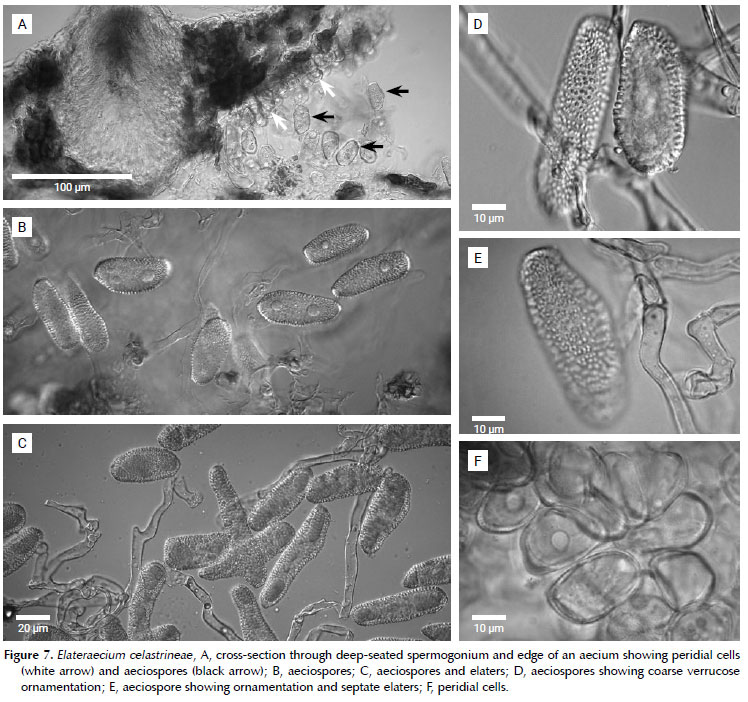
Spermogonia scattered or forming concentric circles in large chlorotic spots up to 3 cm diam., subepidermal, flask-shaped, deep seated within leaf cortex, 100175 µm wide, 200-274 µm high. Aecia erumpent, hypophyllous, blistering most of the leaf surface, epidermis remaining intact for long periods, contents appearing as a bright orange (when fresh) to light yellow (old specimens) fluffy mass due to presence of elaters. Peridial cells loosely connected, globose, 19-25 x 1521 µm; wall 2 thick, very finely verruculose, veruculae ± 1 apart. Elaters modified persistent hyphae, thin walled, hyaline, irregularly branched, with simple septa, varying in width 4-8 µm. Aeciospores fusiform, 40-66 x 14-20 µm; wall granular-verrucose, 2 µm thick. Figure 7A-7E.
Specimens examined
SOUTH AFRICA, KwaZulu-Natal: Durban, on Salacia kraussii (Harv.) Harv. (Celastraceae), Oct. 1888, J.M. Wood 4028 (holotype K(M) 147679, isotypes PREM 359 and 991); St Lucia, on S. kraussii, 19 Mar. 2020, A.R. Wood 1073 (PREM 63115).
Notes
Sydow and Sydow (1924) considered that the urediniospores as originally described in Cooke (1889) were in fact peridial cells, and described in addition structures they interpreted as aeciospores. They were thus correct in interpreting the life stage of this rust as aecial not uredinial, but otherwise their interpretation is incorrect, the structures they thought were peridial cells are the aeciospores, and what they assumed were aeciospores are in fact the peridial cells. Doidge (1927) regarded this species as 'insufficiently known', noting that the material in PREM was 'practically destroyed by insects and is quite unfit for study'. She, like the Sydows before her, did not recognise the nature of this rust fungus. The old material is in fact in very good condition, with aeciospores and elaters present in large quantities. This species has been recently collected again, the first new record in 132 years.
This is the second species of Elateraecium known from South Africa, the other being E. natalense Gjærum & D.A.Reid (Gjærum and Reid 1983), on Salacia lepto-clada Tul., distinguished by smaller aecia. Elateraecium callianthum (Syd.) Gjærum & D.A.Reid is described from Salacia senegalensis (Lam.) DC. in Sierra Leone.
So far, the telial stage (Hiratsukamyces-like) has not been found for any of the African species.
2. Endophyllum austroafricanum
(Henn.) A.R.Wood stat. & comb. nov., Aecidium mikaniae Henn. f. austroafricanum Henn., Bot. Jahrb. 38: 105 (1907) (as 'austroafricana').
TYPE: TANZANIA, Amani: East Usambara Mountains, Sept. 1903, Eichelbaum 104, (B, holo., not seen, likely destroyed in World War II). MycoBank: MB 836561.
Description
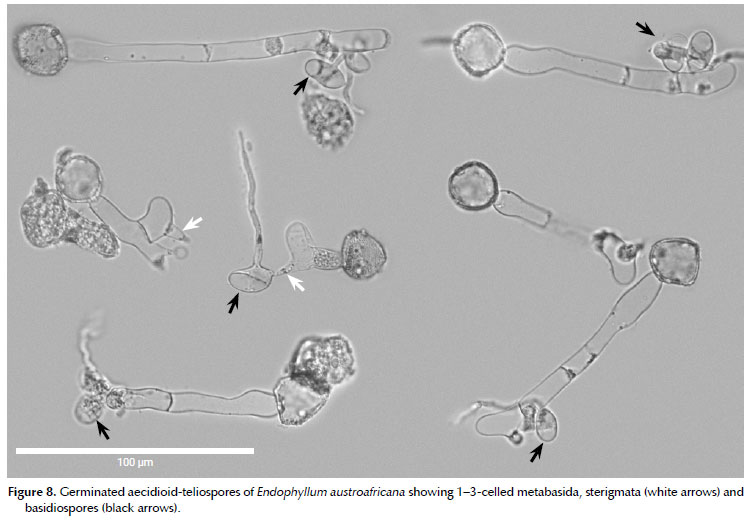
Spermogonia not produced, aecia and uredinia not observed. Telia aecidium-like, numerous on small swellings on stems or petioles, or few in a cluster on lower leaf surfaces without any hypertrophy. Teliospores aecidioid, catenulate, ellipsoid, ovoid or angular-spherical, 17-24 X 14-20 µm; wall finely and densely verruculose, with several refractive granules 2-4 µm diam., wall 1 thick; germinating to form a thin-walled 3-celled meta-basidium with two basidiospores produced on sterigmata from the two distal cells, basidiospores thin walled, ovoid, 13-17 X 8-10 µm. Otherwise as for Aecidium mikaniae Henn. Figure 8.
Specimen examined
SOUTH AFRICA, KwaZulu-Natal: Hilton, on Mikania capensis DC. (Asteraceae), 16 Jun. 2009, A.R. Wood 756 (PREM 62322).
Notes
Hennings (1907) stated that this form of Aecidium mikaniae differed from the nominal form, which occurs in South America, only in having slightly larger spores. The nominal form is now considered to be the gametothallus of Puccinia mikaniae H.S.Jacks. & Holw. (Hennen et al. 2005). This appears to be the first collection of this rust fungus since the type was collected in the East Usambara Mountains, Tanzania, in 1903. However, it may be more common than this suggests - Whiteside (1966) reported Dietelia portoricensis (Whetzel & Olive) Buriticá & J.F.Hennen (as Endophylloides protoricensis Whetzel & Olive) from Zimbabwe, but this species is otherwise only known from South America and the Caribbean, and this record may rather represent E. austroafricana. Aecidioid-teliospores germinating on water agar (2% w;v) in Petri dishes produced sterigmata and basidiospores, proving that this is an endocyclic form (Figure 8), and therefore it is raised to species rank and transferred.
3. Milesina silvae-knysnae
(R.Berndt) A.R.Wood, comb. nov., Milesia silvae-knysnae R.Berndt, in Mycol. Prog. 7: 14, 2008.
TYPE: SOUTH AFRICA, Western Cape, N of Wilderness, Seven Passes Rd., Woodville Big Tree, 27 Oct. 2004, R. Berndt & E. Uhlmann, (PREM 59737, holo., not examined).
MycoBank: MB856041.
Morphology as described by Berndt (2008b). Use of Milesina is recommended over Milesia (Aime et al. 2018).
Newly recorded species for South Africa
1. Aecidium jasminicola Henn., in Engler, Die Pflanzenwelt Ost-Afrikas und der Nachbargebiete, Teil C: 53 (1895).
Description
Spermogonia not produced, uredinia and telia not observed. Aecia hypophyllous or on stems, hypotrophic, cupulate, few to many, not arranged in rings, crowded, peridium not or only slightly exerted, yellow. Aeciospores globular to ellipsoid, 14-26 x 10-18 (1824 x 15-18 in Hennings 1895), hyaline, wall 1 thick, closely verruculose.
Specimen examined
SOUTH AFRICA, KwaZulu-Natal: Pigeon Valley Nature Reserve, Durban, on Jasminum breviflorum Harv. (Oleaceae), 26 Jun. 2019, A.R. Wood 1051 (PREM 63119).
Notes
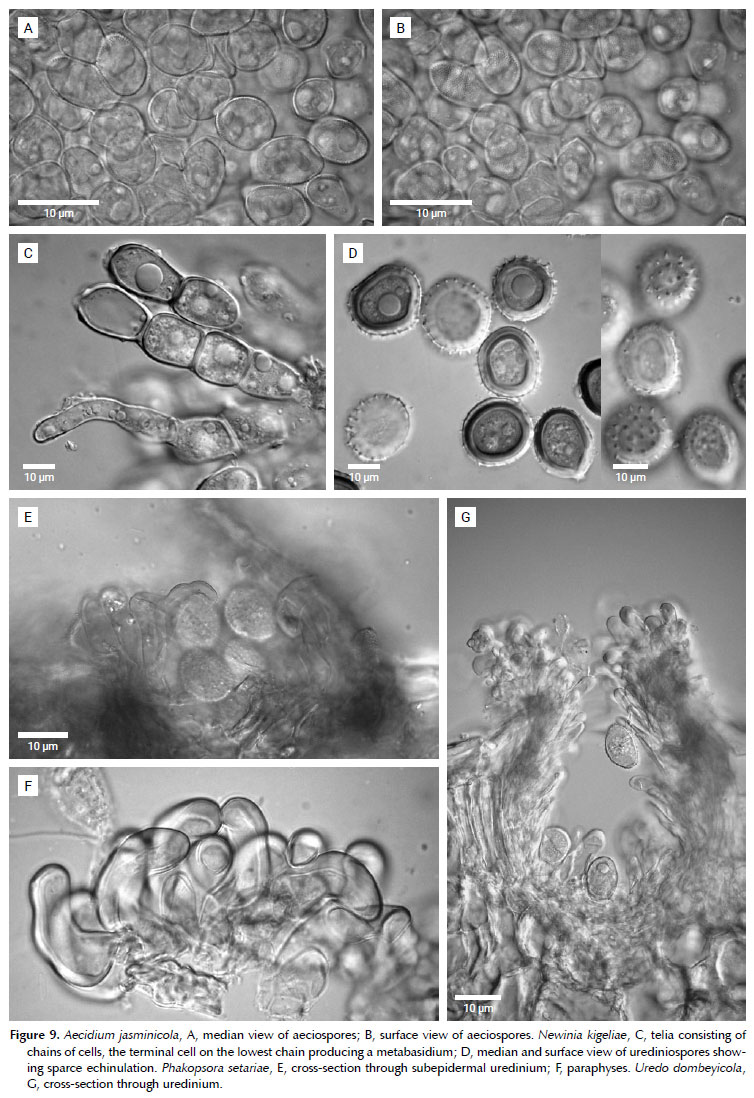
Aecidium longaense Henn., also on Jasminum in Africa, differs from A. jasminicola by presence of spermogonia, aecia opposite spermogonia, hypophyllous, arranged in circles, peridium emerging from leaf, lacerated; aecio-spores yellow, smooth walled and smaller (15-18 x 1317 µm, vs. 18-24 x 15-18 in A. jasminicola) (Hennings 1895, 1903). The aeciospores of the specimen from South Africa included aeciospores that spanned the range of both species [14-21(-26) x 10-18 µm], but in other respects matched the description for A. jasminicola rather than A. longaensis. Figure 9A, 9B.
2. Coleosporium plumeriae
Pat. [as 'plumierae'], Bulletin de la Société Mycologique de France 18(2): 178 (1902).
Description
Uredinia only present, hypophyllous. Urediniospores subglobose, ellipsoid or angular, 25-37 x 19-25 µm, wall coarsely verrucose, 1 µm thick, with large to small verruculae and bald patches so that the wall is 2-3 in total.
Specimen examined
SOUTH AFRICA, Eastern Cape: Qolora River Mouth, Kei Mouth, E of East London, on Plumería sp. (Apocynaceae), 2 Feb. 2021, A.R. Wood 1123 (PREM 63271).
Notes
This species was first recorded from South Africa by a sequence of the large subunit (28S) of the ribosomal DNA repeat deposited in GenBank (KR110056) by W. Maier. Its presence is here confirmed. Elsewhere in Africa this fungus has been recorded in Nigeria (Hernández et al. 2005) and has spread through much of the world where its host plant is a commonly grown garden plant (Kakishima et al. 2017).
3. Newinia kigeliae Eboh, Mycologia 75(2): 316 (1983).
Description
Spermogonia, uredinia and telia on lesions 2-5 mm in diameter, amphiphyllous, brown. Spermogonia type 7. Uredinia subcuticular or subepidermal, with few long and thin-walled paraphyses scattered through the pustule. Telia subepidermal, no paraphyses. Urediniospores globose to ovoid, 19-25 x 17-20 µm, sparsely echinu-late, 3-4 thick. Teliospores consisting of 4-12 cells in chains, cells separated by transverse septa, each cell globose to ovoid, 17-30 x 13-17 µm, wall 1 thick. Figure 9C, 9D.
Specimens examined
SOUTH AFRICA, Limpopo: Skukuza nursery, Skukuza, Kruger National Park, on Kigelia africana (Lam.) Benth. (Fabaceae), 8 Feb. 2022, A.R. Wood 1200 (PREM 63384); KwaZulu-Natal: Twinstreams nursery, Mtinzi-ni, on Kigelia africana (Lam.) Benth. (Fabaceae), 3 Mar. 2022, A.R. Wood 1206 (PREM 63385).
4. Phakopsora setariae Cummins, Bulletin of the Torrey Botanical Club 83: 223 (1956).
Description
Uredinia small, erumpent, often covered by remnants of leaf epidermis, surrounded by paraphyses. Paraphyses curved, thick walled. Urediniospores ellipsoid, echinulate, spines 1-3 apart, 20-32 x 16-21 µm, wall 1 thick, germ pores indistinct. Telia not observed. Figure 9E, 9F.
Specimen examined
SOUTH AFRICA, KwaZulu-Natal: Palmiet Nature Reserve, Durban, on Setaria megaphylla (Steud.) T.Durand & Schinz (Poaceae), 27 Jun. 2019, A.R. Wood 1058 (PREM 63116).
5. Puccinia aframomi Hansf., Proceedings of the Linnean Society London 161: 176 (1949).
Description
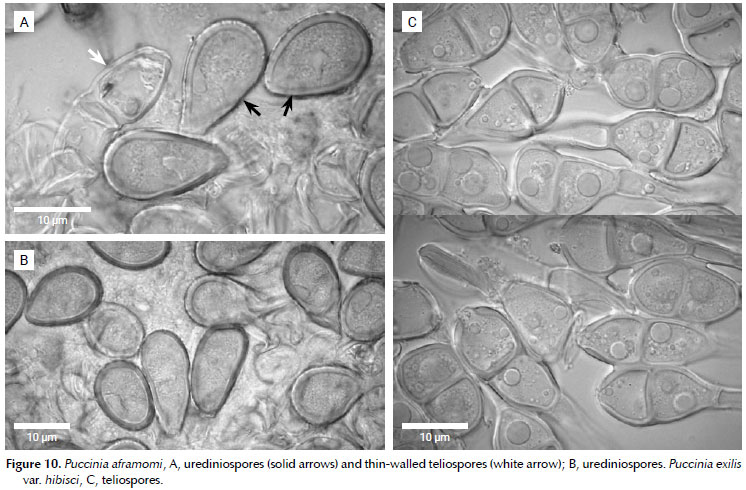
Urediniospores 21-32 x 14-17 µm, light brown to honey-coloured, wall 1.5-2 µm thick, 2 equatorial germ pores, sparsely echinulate. Teliospores 23-33 x 1318 µm, constricted at septum, wall 1 thick, hyaline, apex occasionally thickened 2-3 µm. Pedicels not persistent. Figure 10A, 10B.
Specimen examined
SOUTH AFRICA, Mpumalanga: Lowveld National Botanical Garden, Nelspruit, on Aframomum alboviolaceum (Ridl.) K.Schum. (Zingiberaceae), 13 Dec. 2010, A.R. Wood 810 (PREM 63118).
Notes
The host plant does not occur naturally in South Africa, but does so in Mozambique, Zambia and elsewhere in tropical Africa. The specimen collected was on cultivated plants, and it is likely to be found on this species where it grows naturally. This species has been recorded on other species of Aframomum in Malawi, Uganda and Nigeria (Farr & Rossman 2024).
6. Puccinia arechavaletae Speg., Anales de la Sociedad Científica Argentina 12(1): 67 (1881).
Description
Spermogonia, aecia and uredinia not present. Microcyclic, leptosporic. Telia amphigenous or on stems, not on leaf spots, expanding with age, forming circles of small dark brown pustules up to 10 mm diameter, turning light grey after spores germinate, neighbouring telia coalescing, may be slightly hypotrophic. Teliospores mostly two-celled, one-celled spores in low to moderate quantities, the proportions differing between collections, two-celled spores globoid, ellipsoid or oblong, 20-31 x 14-24 µm, not constricted at septum, lateral walls 1.5-3 µm, apex slightly thickened 2.5-4 µm, honey-brown, one-celled spores similar 20-24 x 1520 µm, pedicels persistent, thin walled up to 60 µm, often obliquely inserted, some diorchidioid.
Specimens examined
SOUTH AFRICA, KwaZulu-Natal: Durban, University of KwaZulu-Natal, Westville campus, on Cardiospermum grandiflorum Sw. (Sapindaceae), 25 Jun. 2019, A.R. Wood 1044 (PREM 63171); Hayfields, Pietermaritzburg, on Cardiospermum grandiflorum, 16 Feb. 2021, A.R. Wood 1130 (PREM 63273). Mpumalanga: E of Nelspruit along N4, on Cardiospermum grandiflorum, 28 Feb. 2020, A.R. Wood 1069 (PREM 63191).
Limpopo: Letsitele, on Cardiospermum grandiflorum, 13 Mar. 2019, A.R. Wood 1062 (PREM 63184); Louis Trichardt, on Cardiospermum grandiflorum, 25 Feb. 2020, A.R. Wood 1068 (PREM 63190); Tzaneen, on Cardiospermum halicacabum L., 13 Mar. 2019, A.R. Wood 1077 (PREM 63189). Eastern Cape: Port St John's, on Cardiospermum grandiflorum, 8 Oct. 2018, I. Patterson (PREM 63202).
Notes
Puccinia arechavaletae has been investigated for possible release as a biological control agent against the alien invasive plant Cardiospermum grandiflorum (Fourie & Wood 2018, 2019). However, an indigenous congeneric plant was found to be susceptible (C. corindum L.), and therefore the culture being studied within the plant pathogen quarantine facilities in Stellenbosch was destroyed in 2012. This rust fungus was first observed in 2018 in the field in KwaZulu-Natal. The pathway of introduction of this rust is unknown, it is one of a number of rust fungi recorded as introduced accidentally in the last few decades, a reminder that microbes are constantly being unintentionally carried across international borders.
7. Puccinia exilis P.Syd. & Syd. var. hibisci Grove, Bulletin of Miscellaneous Information, Kew: 270 (1916).
Description
Spermogonia, aecia and uredinia not present. Microcy-clic, leptosporic. Telia erumpent, in groups up to 5 mm diam. Teliospores 27-41 x 15-18 µm, walls tinged with light yellow, thin, 1 thick at sides, apex 1-2 µm, germ pore at apex, distinct. Pedicels > 100 µm, thin walled, hyaline, persistent. Figure 10C.
Specimens examined
SOUTH AFRICA, KwaZulu-Natal: Pigeon Valley Nature Reserve, Durban, on Hibiscus surattensis L. (Malvaceae), 26 Jun. 2019, A.R. Wood 1052 (PREM 63117).
8. Uredo dombeyicola Cummins, Bulletin of the Torrey Botanical Club 87(1): 41 (1960).
Description
Spermogonia, aecia and telia not observed. Uredinia small, subepidermal in origin, erumpent, surrounded by paraphyses that form an emergent palisade around the uredinia. Urediniospores ellipsoid, echinulate, spines 1-3 apart, (17-)22-33 x 16-21 µm, wall 1.0-1.5 thick, germ pores indistinct. Figure 9G.
Specimens examined
SOUTH AFRICA, KwaZulu-Natal: University of KwaZulu-Natal, Westville campus, Durban, on Dombeya tiliacea (Endl.) Planch. (Malvaceae), 27 Jun. 2019, A.R. Wood 1059 (PREM 63185).
Notes
Uredo dombeyae, on the same host, is readily distinguished by the heavily thickened urediniospore walls.
Taxonomic notes
1. Pucclnla kalchbrenneriana De Toni, Syll. fung. (Abellini) 7(2): 661 (1888).
= Puccinia ornithogali Kalchbr., in Kalchbrenner & Cooke, Grevillea 9, 49: 21 (1880). nom. illegit., Art. 53.1 (later homonym of Puccinia ornithogali Hazsl.).
= Puccinia drimiae Van der Bijl, South African Journal of Science 23: 284 (1926), stat. nov.
Specimens examined
SOUTH AFRICA, Western Cape: De Hoop Nature Reserve, E of Bredasdorp, on Drimia altissima (L.f.) Ker Gawl (Asparagaceae), 18 Aug. 2001, A.R. Wood 349 (PREM 62319); Die Plaas farm, Ouplaas, E of Bredas-dorp, on Drimia altissima, 14 Oct. 2009, A.R. Wood 759 (PREM 62318).
Doidge (1927) provides the most complete descriptions for P. kalchbrenneriana and P. drimiae. The descriptions are almost identical, though P. drimiae apparently differed by having occasional mesospores and slightly thicker teliospore walls (3-4 µm, compared to 2.02.5 µm in P. kalchbrenneriana). At that time, rust fungi on different host plant genera were considered as distinct even if morphologically very similar, P. drimiae was known on Drimia and P. kalchbrenneriana on Urginea. However, currently the latter plant genus is considered a synonym of the former. Collections of a rust fungus on Drimia altissima, the type host of P. kalchbrenneriana had teliospores that fitted the descriptions of both species. Teliospores 40-58 x 22-34 µm, wall 2-4 µm thick, occasional mesospores present (31-38 x 2228 µm, wall 2 thick). Therefore, P'. drimiae is best considered a synonym of P. kalchbrenneriana.
2. Endophyllum rhamnl-prlnoldes
(Thüm.) A.R.Wood, stat. & comb. nov.
Aecidium rhamni J.F.Gmel. f. rhamni-prinoides Thüm., Flora 60: 411 (1877) (as Aecidium rhamni Pers. f. rhamni prinoides Thümen); Types: SOUTH AFRICA, Eastern Cape, 'Boschberg' [Bosberg], Somerset East, on Rhamnus prinoides L'Hér. (Rhamnaceae), Oct. 1876, MacOwan 933 (PREM20761, lecto.); Western Cape, Saasveld College, George, on Rhamnus prinoides L'Hér. (Rhamnaceae), 6 May 2003, A.R. Wood 517 (PREM57835 holo-epitype; K(M)122449, BPI871504 iso-epitypes); GenBank: 28S = OQ215013.
= Aecidium elegans Dietel, Hedwigia 28: 180 (1889) (nom. illegit., Art. 53.1, a later homonym of Aecidium elegans Berk. & M.A. Curtis), currently recognised as Uromyces elegans (Berk. & M.A. Curtis) Lagerh.).
= Endophyllum macowanianum Pole-Evans, Report of the Transvaal Department of Agriculture 19061907: 165 (1908) (nomen nudum) (non Endo-phyllum macowanianum (Thüm.) A.R. Wood).
= Endophyllum macowanii Pole-Evans [as 'macowani'], Report of the South African Association for the Advancement of Science 6(6): 252 (1909) (Nom. illegit., Art. 36 of Vienna rules then valid).
= Endophyllum elegans (Dietel) Pole-Evans, Annals of the Bolus Herbarium 2(4): 188 (1918).
MycoBank: MB 856043.
Etymology
Named for its host plant, Rhamnus prinoides.
Diagnosis
Telia aecidium-like, aecidioid-teliospores endocyclic, on Rhamnus prinoides. As described by Pole-Evans (1918).
Notes
Pole-Evans (1909) showed that the species collected by Peter MacOwan, first recorded by Thümen then described by Dietel as Aecidium elegans, should be transferred to Endophyllum and renamed it in honour of its collector as Endophyllum macowanii. However, the Vienna rules of Botanical Nomenclature had come into effect from 1 Jan. 1908, and therefore this name was invalidly published as it did not have a Latin diagnosis accompanying this new name [Art. 36]. Because of this, Pole-Evans (1918) published the name Endophyllum elegans providing a Latin description. This combination has been ignored since. Unfortunately, the basionym of this name is invalid as it is a later homonym of an existing name, making this combination also invalid. Therefore, a new name is provided, using the first name given for this species. A full description is provided by Pole-Evans (1918), and further details of spore germination in Wood (2004). The lectotype is MacOwan's collection listed in Dietel (1889), and an epitype is provided.
Pole-Evans first gave notice of his intention to make the above name change, but in doing so unintentionally published the name Endophyllum macowanianum, a nomen nudum ('I propose to describe and name this fungus as Endophyllum MacOwanianum, n.sp.' Pole-Evans 1908, p. 165). This fungus is different to the species currently known as Endophyllum macowanianum (Thüm.) A.R.Wood, as it was clearly identified as occurring on Rhamnus prinoides L'Hér. (Rhamnaceae) and was thought to possibly be the alternate stage of crown rust (Pole-Evans 1908). However, despite this name simply being a manuscript name invalidly published, it still renders the later name an invalid homonym, and a new name is provided. Endophyllum macowanianum Pole-Evans was not considered to be a published name by earlier workers and therefore was ignored in all subsequent publications (e.g. Pole-Evans 1909, 1918, Doidge 1950) and remained obscure.
3 Endophyllum conyzae-scabridae A.R.Wood, sp. nov.
Type: SOUTH AFRICA, Eastern Cape, 'Boschberg' [Bosberg], Somerset East, on Conyza scabrida DC. (Asteraceae) [incorrectly identified as Erigeron ivifolius Sch.Bip. (= Conyza ivifolia (L.) Less., as 'Conyza ivaefolia Less.')], 1874, P. MacOwan 1037 (PREM20753, lecto.).
= Aecidium macowanianum Thüm., Flora, Regensburg 58: 380 (1875).
= Endophyllum macowanianum (Thüm.) A.R.Wood, South African Journal of Botany 70(4): 667 (2004) (nom. illegit., Art. 53.1, a later homonym of Endophyllum macowanianum Pole-Evans, a nomen nudum).
MycoBank: MB 856044.
Diagnosis
Telia aecidium-like, aecidioid-teliospores endocyclic, spore wall uniformly thin, on Conyza species.
Etymology
Named for one of its host species, Conyza scabrida (Asteraceae).
Notes
Doidge (1927) and Wood (2004) listed P. MacOwan 1037 (PREM20753) as the type.
Aecidium macowanianum f. conyzae-pinnatilobatae Thüm. was raised to species rank in Sydow and Sydow (1924), differing from the above species in having a thickened apical wall.
4 Puccinia satyrii P.Syd. & Syd., Monographia Uredinearum (Lipsiae) 1(4): 594 (1903) [1904]
= Puccinia aurea G.Winter, Flora, Regensburg 67(14): 260 (1884), nom. illegit., Art. 53.1, a later homonym of Puccinia aurea Spreng. [now known as Allodus podophylli (Schwein.) Arthur].
Jørstad (1956) recognised that these described species were conspecific and used the older name. However, this is an illegitimate name, and therefore P. satyrii should be used as the first legitimate name available for this species.
5 Ravenelia peglerae Pole-Evans, in Doidge & Pole-Evans, The Annals of the Bolus Herbarium 2(3): 111 (1917).
= Ravenelia peglerae Doidge, Bothalia 2(1a): 146 (1927) Nom. illegit., Art. 53.1.
It is uncertain why Doidge described this species after Pole-Evans had done so, and using the same specimens as he had used, but the correct authority was given in Doidge (1950). The original description seems to have been lost since.
Corrected identifications
Several rust fungi were listed as occurring in southern Africa by Doidge (1950), but subsequently were found to be based on incorrectly identified specimens. These, and their correct identifications, are:
Phragmidium violaceum (R. Schultz) G.Winter now correctly identified as Kuehneola uredinis (Link) Arthur (Van Reenen 1995).
Puccinia kuehnii (Krüg.) Butler now correctly identified as Puccinia melanocephala Syd. & P.Syd. (Gorter 1982).
Puccinia luxuriosa Syd. now correctly identified as Puccinia vilfae Arthur. & Holw. (Cummins & Greene 1961).
Puccinia tosta Arthur now correctly identified as Puccinia kakamariensis Wakef. & Hansf. (Cummins & Greene 1961).
Uromyces bidentis Lagerh. now correctly identified as Uromyces bidenticola (Henn.) Arthur (see note under Uromyces bidenticola in Supplement 1).
Excluded species
Melampsora puccinioides G.Winter, Hedwigia 24: 22 (1885).
Sydow and Sydow (1915) listed M. puccinioides as an excluded species from Melampsora. They stated that the 'teliospores' described were not observed, only urediniospores were found and they did not belong to Melampsora. It is possible that this species may actually be Phakopsora nyasalandica, as Phakopsora species were frequently assigned to Melampsora or Schroeteriaster in the early literature. Unfortunately, no specimen of this species has so far been traced, to determine if this supposition is correct. It is best to consider M. puccinioides as a doubtful species.
Aecidium flustra Berk., Grevillea 20 (no. 96): 110 (1892).
This name was published with no description, the only information given was that the host was an Aster species, and that there were specimens from Valparaiso (Chile) and Natal (now KwaZulu-Natal, South Africa) (Anon. 1892). Sydow and Sydow (1924) give a description, presumably based on the Chilean specimen. This differs substantially from the South African specimen, which Doidge (1927) described as A. woodianum. Aecidium flustra therefore does not occur in South Africa.
Puccinia vernoniae Cooke, Grevillea 10 (no. 56): 126 (1882).
This name is a later homonym of P. vernoniae Schwein. from N. America and is therefore illegitimate. Sydow and Sydow (1904) state that it is not possible to correctly determine the identity of this species as the sori are too immature. It is best regarded as a doubtful species.
Puccinia torosa Thüm., Mycothecia Universalis, cent. 18: no. 1725 (1880).
Described from South African material where the host (Arundo donax L.) is an introduced alien weed, this rust species is not known in the host's native range. This species is likely only a variant of Puccinia phragmitis, which is one of several rust fungi occurring on this host in its native range. Cummins (1971) notes that it differs from P. phragmitis only in having slightly broader spores. It is best regarded as a doubtful species.
Puccinia salviae Unger, Über den Einfluss des Bodens auf die Vertheilung der Gewachse: 218 (1836).
This species is known from South Africa from a single specimen identified by Kalchbrenner (1882). Urediniospores occurred in this specimen, yet P. salviae is microcyclic (Baxter 1955), and the specimen probably represents Puccinia salviae-runcinatae. Therefore, this species is regarded as not occurring in South Africa.
The following two species have structures which appear to be type 4 spermogonia, this type of spermogo-nium is not associated with Caeoma-type aecia (Sato & Sato 1985). Both are best regarded as doubtful species:
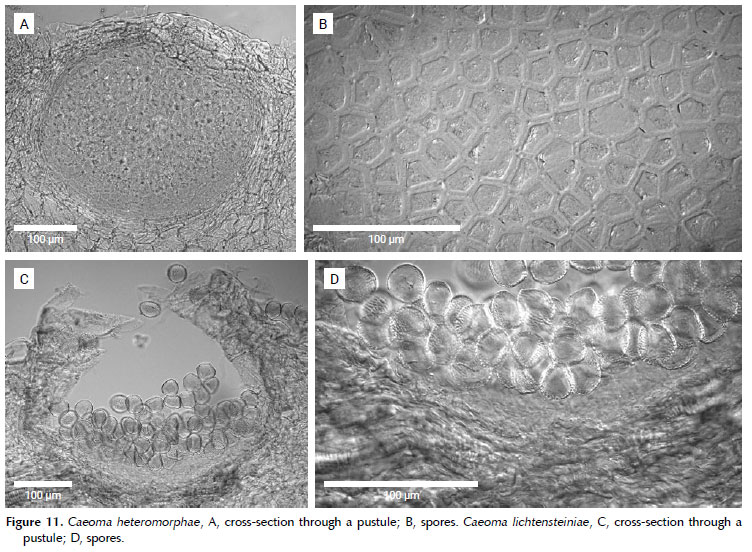
Caeoma heteromorphae Doidge, Bothalia 2: 190 (1927). Figure 11A, 11B.
Specimens examined
SOUTH AFRICA, Free State, Braamhoek, Gumtree, Ficksburg District, on Heteromorpha arborescens (Spreng.) Cham. & Schltdl. (Apiaceae), 1935, M. Vels (PREM 28509); KwaZulu-Natal, Drakensberg, on Heteromorpha arborescens, 1940, Mrs Gore Brown (PREM 32780).
Two specimens of this fungus are listed in Doidge (1927). PREM 28509 is morphologically as described by Doidge (1927) from the type specimen. However, the spores in the supposed aecia are not catenulate nor verrucose as expected for Caeoma, all spores are of the same age throughout the structure, the spores are closely bound to one another, no spore producing layer of fungal cells (hymenium) is discernible, and no hyphae are visible in the surrounding plant tissue. It appears that all spores originate by division of a common matrix throughout the pustule, with wall deposition of all spores occurring simultaneously. This species appears to belong to a chytrid-like fungus rather than the Pucciniales. It is uncertain whether the spermogonia-like structures belong to this chytrid-like fungus. In contrast, PREM 32780 is different, having only phakopsoroid uredinia and is therefore not the same fungus as PREM 28509.
Caeoma lichtensteiniae Doidge, Bothalia 4(1): 229 (1941). Figure 11C, 11D.
Specimens examined
ZIMBABWE, Salisbury, host not determined (Apiaceae?), Dec. 1919, F. Eyles 1966 (PREM 14009, holotype).
Doidge (1941) described structures that were interpreted as spermogonia and aecia without peridia for this fungus. The spores present have large, smooth, rounded verrucae. However, no spore producing hymenium is apparent and what appears to be a layer of fungal cells surrounding the spores has disintegrated. This species may not belong to the Pucciniales. It is uncertain whether the spermogonia-like structures belong to this fungus, though they are sometimes adjacent. The identity of the host plant is not certain. Originally identified as Lichtensteinia sp. (Doidge 1941), no species in this genus of the Apiaceae are known from Zimbabwe (Mapaura & Timberlake 2004). Additional material is required to determine the true identity and host of this fungus.
Discussion
This checklist brings together the dispersed literature on a diverse and ecologically important group of pathogenic fungi, to provide baseline information on the biodiversity of these fungi in southern Africa. By summarising what is known, several areas of study for future work are indicated. Future taxonomic studies are needed of various species described in the 1800's and early 1900's to bring them in line with changed concepts of what constitutes a species. Botswana, Lesotho, Mozambique and Eswatini need to be explored, as well as continued exploration of northern and western South Africa and Namibia, to improve knowledge on biodiversity, distribution and host plants of the indigenous rust fungi.
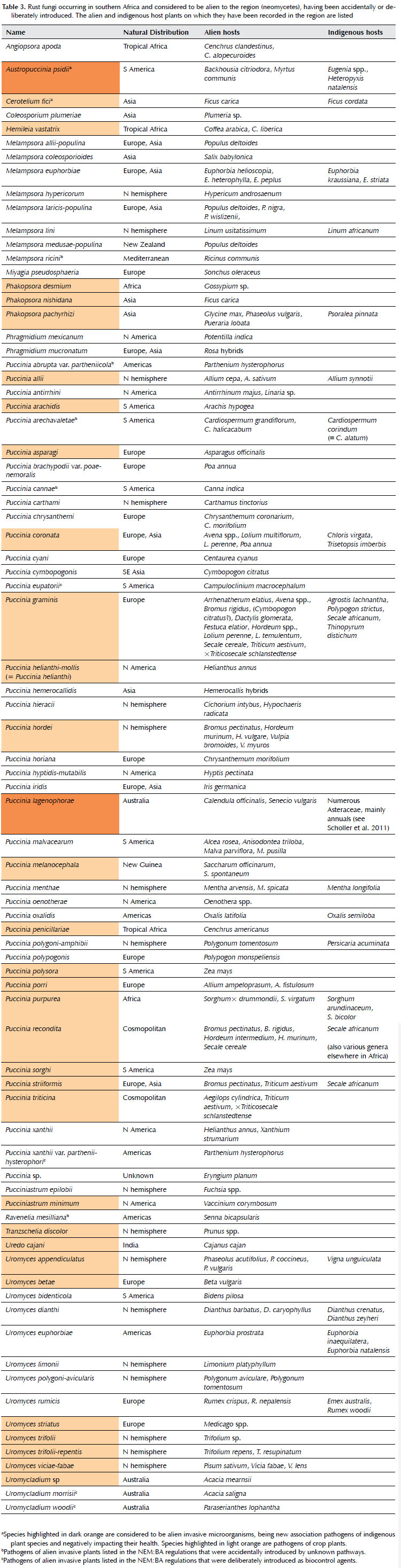
The species recorded from southern Africa were evaluated as to whether they are indigenous or alien (neomycetes), with 78 considered alien (Table 3). Berndt (2008a) considered only 32 as alien. Most of these species are widespread crop pathogens, or pathogens of alien host plant species grown as horticultural subjects or which have become weeds in the region. However, some occur on both alien and indigenous plant species, and therefore a subjective decision was made as to whether these were widespread species (cosmopolitan) or had been introduced from elsewhere in the world and then spread to indigenous plants. Two are considered to be invasive and alien, in that they are new-association parasites of indigenous plant species, namely Puccinia lagenophorae (Scholler et al. 2011) and Austropuccinia psidii (Roux et al. 2013, 2016), and likely are impacting on their new host's population dynamics. Several cereal rust fungi are a threat to one highly localised indigenous grass (Pretorius et al. 2015). The rate at which rust fungi are invading southern Africa appears to be accelerating, a total of 13 were first recorded between 1946 and 1990 (average 0.382 species per year), whereas 20 have been first recorded from 1991 until the present (average 0.625 species per year). Of interest is that there are a few rust fungi that have been described from alien plants in southern Africa and which are not known from any indigenous plant, e.g. Phakopsora myrtacearum (Maier et al. 2016), Dietelia cardiospermi (Berndt & Wood 2012) and Uromyces capensis (Doidge 1927). The status of these is uncertain but are herein considered indigenous until proven otherwise. One species was first described from Australia, where it was introduced, before being discovered in its native range in South Africa (Puccinia ursiniae, Shivas 1991).
Four species have been deliberately introduced as biological control agents of alien invasive plants: Puccinia eupatorii (on Eupatorium macrocephalum), Puccinia xanthii var. parthenii-hysterophori (on Parthenium hysterophorus), Uromycladium morrisii (on Acacia saligna), and Uromycladium woodii (on Paraserianthes lophantha). Attempts were made to establish another species, Prospodium transformans, on Tecoma stans, but it did not successfully establish and therefore is not present in the region (Wood 2014). A number of species were accidentally introduced over time and may contribute to the biological control of their alien hosts: Melampsora ricini (on Ricinus communis), Puccinia abrupta var. partheniicola (on Parthenium hysterophorus), Puccinia arechavaletae (on Cardiospermum grandiflora), Puccinia malvacearum (on Malva parviflora, Malva pusilla), Puccinia cannae (on Canna indica), Puccinia xanthii (on Xanthium strumarium) and Uromyces bidenticola (on Bidens pilosa). One indigenous rust has been recorded as occasionally impacting on an alien invasive weed - Kuehneola uredinis is an outbreak species on Rubus sect. Cuneifolii (Wager 1947).
Several rust fungi from South Africa have been introduced to other parts of the world, becoming problem pathogens of some widely grown ornamental plants. These include Puccinia pelargonii-zonalis (on Pelargonium hybrids, which include P. zonale in their parentage), Uromyces aloes (on Aloe spp.), and U. transversalis (on Gladiolus spp. and hybrids) (Farr & Rossman 2024).
Of concern is that other than traditional morphological taxonomy, almost no research has been carried out on indigenous rust fungi despite plant pathogens being important components of ecosystems. Very little work has been done on proving the life cycles of the species by cultural studies, most of which was done approximately a century ago (Pole-Evans 1909, 1923a, 1923b, Putterill 1918). After the first Endophyllum species was recorded (Pole-Evans 1909), a century passed before eight more species of Endophyllum were added (Berndt & Wood 2012, Wood 1997, 2004, Wood & Crous 2005a, this publication). Cultural and microscopic studies were done to determine the life cycle of the microcyclic Uromyces aloes (Putterill 1918), and later the heteroecious life cycle of Puccinia tristachyae (Pole-Evans 1923b). After almost a century had passed, the second indigenous heteroecious species was identified by cultural and molecular studies, Boshoff et al. (2022a) demonstrated the full life cycle of Puccinia digitariae on Digitaria eriantha the gametothallus of which occurs on Solanum species. Recently, Aecidium oxalidis was identified by molecular data as the gametothallus of Uromyces ixiae (Wood & Aime 2024). All other heteroecious species known to occur in southern Africa are either alien or widespread throughout Africa and Europe or Asia. Other than these few above-mentioned species, the assumed life cycles of southern Africa's indigenous rust fungi have been based solely on association of various spore stages on the same leaves or plants. Where life cycles have been determined by cultural studies, these have been undertaken by workers in Asia, Europe or the Americas.
Biological and epidemiological studies have only been undertaken on Uromyces rumicis (Morris 1982a), Endophyllum osteospermi (Morris 1982b, Wood 2002a, Wood et al. 2004, Wood & Crous 2005b) and Puccinia digitariae (Rey & Garnett 1985, 1988). Ultrastructural studies have been undertaken on Puccinia digitariae (Rey & Garnett 1983) and Uromyces transversalis (Ferreira & Rijkenberg 1989, 1990, 1991, Ferreira et al. 1990).
Thus, studies have been conducted by South African mycologists on some aspect of the biology of a total of only eight out of the ± 460 (1.7%) rust fungi indigenous to South Africa. As far as the author is aware, no study on the biology of any of the species indigenous to the other southern African countries has been conducted in these countries. In contrast, numerous studies have been undertaken on alien rust fungi pathogenic on crops.
Berndt (2008a) provided an analysis of the floristic and distribution relationships of southern African rust fungi. A high proportion of the rust fungi recorded from southern Africa are either endemic to the region (± 44%) or are more widespread in Africa (± 20%). The remainder are 'subcosmopolitan' (particularly some species of Puccinia and Uromyces), pantropical or paleotropical (Berndt 2008a). One of the four genera of rust fungi endemic to Africa is restricted to the area covered by this list, Cumminsina, which is currently known only from a single specimen collected in Angola (Von Petrak 1955). Two species of Stomatisora are known, one from South Africa (S. psychotriicola), and the other from West Africa (Wood et al. 2014). The other African endemic genera are known only from West Africa, Sphenorchidium (Beenken & Wood 2015), and East Africa, Joerstadia (Gjærum & Cummins 1982). Interestingly a number of small genera have a disjunct distribution between southern Africa (or Africa) and southeast Asia or India, including Didymopsorella, Elateraecium, Newinia and Puccorchidium.
The Pucciniaceae (in the sense of Aime 2006, Aime et al. 2018, Aime & McTaggart 2021) form the largest proportion of the rust flora (76 %). Most of the remainder of the diversity is made up of a tropical element, consisting of the Mikronegeriinieae (2.4 %) and the families other than Pucciniaceae of the Uredinineae (13.2 %) (Berndt 2008a). With the addition of Endo-phyllum austroafricana, South Africa currently has a total of nine species of Endophyllum, representing 21 % of the total number of species known within this genus.
The northern temperate Melampsorineae make up only 3.6 % of the flora, half of which are alien in southern Africa (10 of 21 species). Only urediniospores have been recorded in southern Africa for the majority of these species, both indigenous and alien. This is true of the four species endemic to South Africa, Coleosporium hedyotidis, C. hewittiae, Milesina nervisequa and M. silvae-knysnae, and several species with a temperate Northern Hemisphere and South African disjunct distribution including Coleosporium clematidis (autoecious), Milesina blechni (heteroecious), M. nervisequa (heteroecious), Pucciniastrum agrimoniae (autoecious) and Uredinopsis pteridis (heteroecious).
The conservation status of the majority of species cannot presently be determined due to a lack of distribution data for them. Currently only some species, which have been found to be widespread and/or common, could be listed as being 'of Least Concern'. For instance, Cephalotelium macowanianum is likely the most common and widespread species in the country, as its host plant Vachellia karoo is one of the most widespread trees in the region. For many, they have only been collected once or a few times, but whether this is an artefact of a lack of collecting effort, or whether they actually are rare and should be on a red list, is not yet known. These biotrophic pathogens are commonly ephemeral in patches of their host plants, their populations increasing or decreasing due to fluctuations in rainfall and other climatic factors. Therefore, the fragmentation of the natural environment is likely to lead to at least some becoming rarer or extinct, as their host populations decline and occur only in small discrete conserved areas. Rust fungi, as well as other groups of biotrophic pathogenic fungi, may therefore be another group of organisms that can function as indicator species of the integrity and sustainability of conserved areas or landscapes. These fungi can be collected, preserved using standard herbarium specimen techniques (i.e., low cost and simple technology), and generally identified rapidly if their host is correctly identified and using basic microscopy. This checklist will assist in the identification of these species.
The rust fungi of southern Africa are a diverse and important component of the local ecosystems. Further collecting and taxonomic studies are needed to determine the complete diversity and species distributions. However, much more research is required to confirm their life histories, their full host range, and to elucidate the impacts on their host plant's population dynamics and influence on ecosystem functioning.
Acknowledgements
Competing interests
The author declares that he had no financial or personal relationship(s) that may have inappropriately influenced him in writing this article.
Ethical considerations
This article followed all ethical standards for research without direct contact with human or animal subjects.
Funding
The author received no funding for the work presented here.
References
Includes references for Supplement 1 and 2.
Adendorff, R. & Rijkenberg, F.H.J., 1995, 'New report on rust of kikuyu grass in South Africa caused by Phakopsora apoda', Plant Disease 79, 1187. [ Links ]
Adendorff, R. & Rijkenberg, F.H.J., 2000, 'Scanning electron microscopy of direct host leaf penetration by urediospores-derived infection structures of Phakopsora apoda', Mycological Research 104, 317-324. [ Links ]
Aime, M.C., 2006, 'Towards resolving family-level relationships in rust fungi (Uredinales)', Mycoscience 47, 112122, https://doi.org/10.1007/s10267-006-0281-0. [ Links ]
Aime, M.C., McTaggart, A.R., Mondo, S.J. & Du Plessis, S., 2017, 'Phylogenetics and phylogenomics of rust fungi', Advances in Genetics 100, 267-307, https://doi.org/10.1016/bs.adgen.2017.09.011. [ Links ]
Aime, M.C., Bell, C.D. & Wilson, A.W., 2018, 'Deconstructing the evolutionary complexity between rust fungi (Pucciniales) and their plant hosts', Studies in Mycology 89, 143-152, https://doi.org/10.1016/j.simyco.2018.02.002. [ Links ]
Aime, M.C. & McTaggart, A.R., 2021, 'A higher-rank classification for rust fungi, with notes on genera', Fungal Systematics and Evolution 7, 21-47, https://doi.org/10.3114/fuse.2021.07.02. [ Links ]
Angiosperm Phylogeny Croup (APC IV), 2016, 'An update of the Angiosperm Phylogeny Croup classification for the orders and families of flowering plants: APC IV', Botanical Journal of the Linnean Society 181, 1-20. [ Links ]
Anonymous, 1892, 'Omitted diagnoses', Grevillea 20, 108110. [ Links ]
Arthur, J.C., 1917, 'Uredinales of Porto Rico based on collections by H. H. Whetzel and E. W. Olive', Mycologia 9, 55-103. [ Links ]
Arthur, J.C., 1962, Manual of the rusts in United States and Canada, Hafner Publishing co., New York (2nd ed.) (with a supplement by C.B. Cummins). [ Links ]
Bagyanarayana, C. & Ravinder, E.J., 1988, 'Notes on two Indian species of Ravenelia', Transactions of the British Mycological Society 90, 477-478. [ Links ]
Barreto, R.W., Evans, H.C. & Ellison, C.A., 1995, 'The mycobiota of the weed Lantana camara in Brazil, with particular reference to biological control', Mycological Research 99, 769-782. [ Links ]
Baxter, J.W., 1955, 'Species of Puccinia on Salvia in Europe, Asia and Africa', Mycologia 47, 225-232. [ Links ]
Baxter, J.W., 1959, 'A monograph of the genus Uropyxis', Mycologia 51, 210-226. [ Links ]
Baxter, J.W., 1962, 'The status of the genus Haplopyxis (Uredinales)', Mycologia 54, 437-439. [ Links ]
Baxter, J.W., 1980, 'A study of three African species of Ravenelia on Cassia', Mycologia 72, 840-842. [ Links ]
Beenken, L. & Berndt, R., 2010, 'Rust fungi on Annonaceae: the genus Sphaerophragmium', Mycologia 102, 650-663, https://doi.org/10.3852/09-173. [ Links ]
Beenken, L. & Wood, A.R., 2015, 'Puccorchidium and Sphenorchidium, two new genera of Pucciniales on Annonaceae related to Puccinia psidii and the genus Dasyspora', Mycological Progess 14, article 14, https://doi.org/10.1007/s11557-015-1073-8. [ Links ]
Beilharz, V., Parberry, D.C. & Pascoe, I.C., 2001, 'Gladiolus rust (caused by Uromyces transversalis) in eastern Australia', Australasian Plant Pathology 30, 267-270. [ Links ]
Berndt, R., 2007, 'A global survey of Puccinia-rust on Cucurbitaceae', Mycological Progress 6, 151-178, https://doi.org/10.1007/s11557-007-0535-z. [ Links ]
Berndt, R., 2008a, 'The rust mycobiota of southern Africa: species richness, composition, and affinities', Mycological Research 112, 463-471, https://doi.org/10.1016/j.my-cres.2007.05.005. [ Links ]
Berndt, R., 2008b, 'The rust fungi (Uredinales) on ferns in South Africa', Mycological Progress 7, 7-19, https://doi.org/10.1007/s11557-007-0548-7. [ Links ]
Berndt, R., 2009, 'New species of rust fungi (Uredinales) from South Africa and new observations on known species', Mycological Progress 8, 99-114, https://doi.org/10.1007/s11557-008-0582-0. [ Links ]
Berndt, R., 2010, 'The Puccinia species of Berkheya (Asteraceae) with description of four new species from South Africa', Mycologia 102, 1437-1449, https://doi.org/10.3852/09-295. [ Links ]
Berndt, R., 2020, 'Additions to the southern African rust fungi: four new species and two new host genera from South Africa and Angola', Mycological Progress 19, 247-257, https://doi.org/10.1007/s11557-019-01555-6. [ Links ]
Berndt, R., Freire, F., Piatek, M. & Wood A.R., 2008, 'New species of Phakopsora (Basidiomycota, Uredinales) from Cameroon, South Africa and Brazil', Sydowia 60, 15-24. [ Links ]
Berndt, R. & Uhlman, E., 2006, New species, reports, observations and taxonomical changes of southern African rust fungi (Uredinales)', Mycological Progress 5, 154-177, https://doi.org/10.1007/s11557-006-0510-0. [ Links ]
Berndt, R. & Wood, A.R., 2012, 'Additions to the rust fungi of South Africa', Mycological Progress 11, 483-497, https://doi.org/10.1007/s11557-011-0764-z. [ Links ]
Boshoff, W.H.F:, Pretorius, Z.A. & Van Niekerk, B.D., 2002, 'Establishment, distribution, and pathogenicity of Puccinia striiformis f.sp. tritici in South Africa', Plant Disease 86, 485-492. [ Links ]
Boshoff, W.H.F:, Visser, B., Terefe, T. & Pretorius, Z.A., 2019a, 'Diversity in Puccinia graminis f.sp. avenae and its impact on oat cultivar response in South Africa', European Journal of Plant Pathology 155, 1165-1177, https://doi.org/10.1007/s10658-019-01845-5. [ Links ]
Boshoff, W.H.F:, Visser, B., Lewis, C., Adams, T.A., Saunders, D., Terefe, T., Soko, T., Chuiraise, N. & Pretorius, Z.A., 2019b, 'First report of Puccinia striiformis f. sp. tritici, causing Stripe Rust of Wheat, in Zimbabwe', Plant Disease 104, 284, https://doi.org/10.1094/PDIS-07-19-1395-PDN. [ Links ]
Boshoff, W.H.F:, Bender, C.M. & Pretorius, Z.A., 2019c, 'Reaction of South African rye, triticale and barley forage cultivars to stem and leaf rust', South African Journal of Plant and Soil 36, 77-82, https://doi.org/10.1080/02571862.2018.1522381. [ Links ]
Boshoff, W.H.P., Pretorius, Z.A., Terefe, T. & Visser, B., 2020, 'Occurrence and pathogenicity of Puccinia corona-ta var. avenae f.sp. avenae on oat in South Africa', Crop Protection 133, 105144, https://doi.org/10.1016/j.cro-pro.2020.105144. [ Links ]
Boshoff, W.H.P., Wood, A.R., Visser, B., Bender, C.M., Joubert, L., Richter, J., Aime, M.C. & Pretorius, Z.A., 2022a, 'The life cycle of Puccinia digitariae on Digitaria eriantha and Solanum species in South Africa', Mycologia 114, 319-336, https://doi.org/10.1080/00275514.2022.2031493. [ Links ]
Boshoff, W.H.P., Visser, B., Bender, C.M., Wood, A.R., Roth-mann, L., Wilson, K., Hamilton-Attwell, V.L. & Pretorius, Z.A., 2022b, 'Fig rust caused by Phakopsora nishidana in South Africa', Phytopathologia Mediterranea 61, 283-298, https://doi.org/10.36253/phyto-13034. [ Links ]
Boshoff, W.H.P., Visser, B., Bender, C.M. & Pretorius, Z.A., 2024, 'Pathogenicity of Puccinia porri on Allium in South Africa', Australasian Plant Pathology 53, 15-30, https://doi.org/10.1007/s13313-023-00960-6. [ Links ]
Buriticá, P., 1999, 'La familia Phakopsoraceae en el neotrópico III, géneros: Batistospora y Phakopsora', Revista de la Academia Colombiana de Ciencias Exactas 23(87), 271-305. [ Links ]
Buriticá, P. & Hennen, J.F., 1980, 'Pucciniosireae (Uredinales, Pucciniaceae)', Flora Neotropica monograph no. 24, The New York Botanical Carden, New York. [ Links ]
Buriticá, P. & Hennen, J.F., 1994, 'Familia Phakopsoraceae (Uredinales). 1. Céneros anamórficos y teliomórgicos', Revista de la Academia Colombiana de Ciencias Exactas 19(72), 47-62. [ Links ]
Combrink, M. & Truter, J.A., 1964, 'Oordraagbaarheid van roes (Puccinia graminis) van Agropyron distichum na koring in die Winterreënstreek', Suid Afrikaanse Tydskrif vir Landbouwetenskap 7, 577-580. [ Links ]
Cooke, M.C., 1882, Exotic fungi - Natal, Grevillea 10, 123130. [ Links ]
Cooke, M.C., 1889, Three Natal fungi, Grevillea 17, 70. [ Links ]
Coutinho, T.A., Rijkenberg, F.H.J. & Van Asch, M., 1995, 'Teliospores of Hemileia vastatrix', Mycological Research 99, 932-934. [ Links ]
Crous, P.W., Denman, S. & Scott, M., 1999, 'Puccinia mesembryanthemi causing a new disease inhibiting the growth of Sceletium tortuosum in South Africa', Mycotaxon 72, 231-236. [ Links ]
Crous, PW., Phillips, A.J.L. & Baxter, A.P, 2000, 'Phytopathogenic fungi from South Africa', University of Stellenbosch, Stellenbosch, pp. 1-358. [ Links ]
Cummins, G.B., 1945, 'Descriptions of tropical rusts - VII', Bulletin of the Torrey Botanical Club 72, 205-222. [ Links ]
Cummins, G.B., 1950, 'The genus Scopella of the Uredinales', Bulletin of the Torrey Botanical Club 77, 204-213. [ Links ]
Cummins, G.B., 1952, 'Uredinales from various regions', Bulletin of the Torrey Botanical Club 79, 212-234. [ Links ]
Cummins, G.B., 1953, 'The species of Puccinia parasitic on the Andropogoneae', Uredineana 4, 5-89. [ Links ]
Cummins, G.B., 1956, 'Descriptions of Tropical Rusts-VIII', Bulletin of the Torrey Botanical Club, 83, 221-233. [ Links ]
Cummins, G.B., 1960, 'Descriptions of tropical rusts - IX', Bulletin of the Torrey Botanical Club 87, 31-45. [ Links ]
Cummins, G.B., 1963, 'Life cycles of southwestern rust fungi', Mycologia 55, 73-78. [ Links ]
Cummins, G.B., 1971, The rust fungi of Cereals, Grasses and Bamboos, Springer-Verlag, New York. [ Links ]
Cummins, G.B., 1978, Rust fungi on legumes and composites in North America, University of Arizona Press, Tuscon. [ Links ]
Cummins, G.B. & Greene, H.C., 1961, 'The rust fungi of Muhlenbergia, Sporobolus and related genera', Brittonia 13, 271-285. [ Links ]
Cummins, G.B. & Greene, H.C., 1966, 'A review of the grass rust fungi that have uredial paraphyses and aecia on Berberis-Mahonia', Mycologia 58, 702-721. [ Links ]
Cummins, G.B. & Hiratsuka, Y., 1983, Illustrated genera of rust fungi, Revised edn., American Phytopathological Society, St. Paul, USA. [ Links ]
Cummins, G.B. & Hiratsuka, Y., 2003, Illustrated genera of rust fungi, 3rd edn., American Phytopathological Society, St. Paul, USA. [ Links ]
Cummins, G.B. & Husain, S.M., 1966, 'The rust fungi on the genus Aristida', Bulletin of the Torrey Botanical Club 93, 56-67. [ Links ]
De Carvalho, A. de O., Soares, D.J., De Carmo M.G.F., Da Costa, A.C.T. & Pimentel, C., 2006, 'Description of the life-cycle of the pearl millet rust fungus - Puccina substriata var. penicillariae with a proposal of reducing var. indica to a synonym', Mycopathologia 161, 331-336. [ Links ]
De Toni, J.B., 1888, 'Sylloge Ustilaginearum et Uredinearum', Sylloge Fungorum 7(2), 450-882. [ Links ]
Dietel, P., 1889, 'Kurze notizen über einige Rostpilze', Hedwigia 28, 177-187. [ Links ]
Doidge, E.M., 1924, 'A preliminary check list of plant diseases occurring in South Africa', Botanical Survey of South Africa Memoir no. 6, pp. 1-56. [ Links ]
Doidge, E.M., 1927, 'A preliminary study of the South African rust fungi', Bothalia 2, 1-228. [ Links ]
Doidge, E.M., 1928, 'South African rust fungi II', Bothalia 2, 473-474. [ Links ]
Doidge, E.M., 1939, 'South African rust fungi. III', Bothalia 3, 487-512. [ Links ]
Doidge, E.M., 1941, 'South African rust fungi. IV', Bothalia 4, 229-236. [ Links ]
Doidge, E.M., 1948a, 'South African rust fungi. V', Bothalia 4, 895-918. [ Links ]
Doidge, E.M., 1948b, 'South African rust fungi. VI. The species of Uromyces on Iridaceae', Bothalia 4, 918-937. [ Links ]
Doidge, E.M., 1950, 'The South African fungi and lichens to the end of 1945', Bothalia 5, 1-1094. [ Links ]
Doidge, E.M. & Bottomley, A.M., 1931, 'A revised list of plant diseases occurring in South Africa', Botanical Survey of South Africa Memoir no. 11, pp. 1-78. [ Links ]
Doidge, E.M., Bottomley, A.M., Van der Plank, J.E. & Pauer, G.D., 1953, 'A revised list of plant diseases in South Africa', Science Bulletin no. 346, Department of Agriculture, Pretoria, pp 1-122. [ Links ]
Doidge, E.M. & Pole Evans, I.B., 1917, 'Novitates Africanae: Fungi', The Annals of the Bolus Herbarium 2, 109-111. [ Links ]
Doungsa-Ard, D., McTaggart, A.R., Geering, A.D.W. & Shivas, R.G., 2018, 'Diversity of gall-forming rusts (Uromycladium, Pucciniales) on Acacia in Australia', Persoonia 40, 221-238, https://doi.org/10.3767/persoonia.2018.40.09. [ Links ]
Dunhin, B.J., Pretorius, Z.A., Bender, C.M., Kloppers, F.J. & Flett, B.C., 2004, 'Description of spore stages of Puccinia sorghi in South Africa', South African Journal of Plant and Soil 21, 48-52. [ Links ]
Du Preez, E.D., Van Rij, N.C., Lawrence, K.F., Miles, M.R. & Frederick, R.D., 2005, 'First report of Soybean rust caused by Phakopsora pachyrhizi on dry beans in South Africa', Plant Disease 89, 206, https://doi.org/10.1094/PDIS-89-0206C. [ Links ]
Ebinghaus, M., Maier, W., Wingfield, M.J. & Begerow, D., 2018, 'New host associations and a novel species for the gall-inducing acacia rust genus Ravenelia in South Africa', Mycokeys 43, 1-21, https://doi.org/10.3897/mycokeys.43.25090. [ Links ]
Ebinghaus, M., Wingfield, M.J., Begerow, D. & Maier, W., 2020, 'The genus Ravenelia in South Africa', Mycological Progress 19, 259-290, https://doi.org/10.1007/s11557-020-01556-w. [ Links ]
Eboh, D.O., 1977, 'Aecidium mitricarpi Syd., a synonym of Puccinia bakoyana Pat. & Har.', Transactions of the British Mycological Society 69, 136-137. [ Links ]
Eboh, D.O., 1983, 'A new species of Newinia from Nigeria', Mycologia 75, 316-318. [ Links ]
Eboh, D.O., 1989, 'A taxonomic study of Puccinia species on Smilax (Smilacaceae)', Sydowia 41, 136-143. [ Links ]
Evans, H.C., 1987, 'Life-cycle of Puccinia abrupta var. partheniicola, a potential biological control agent of Parthenium hysterophorus', Transactions of the British Mycological Society 88, 105-111. [ Links ]
Farr, D.F. & Rossman, A.Y., 2024, Fungal Databases, U.S. National Fungus Collection, ARS, USDA, Retrieved from http://nt.ars-grin.gov/fungaldatabases/ (now https://fungi.ars.usda.gov/) [ Links ]
Ferreira, J.F. & Rijkenberg, F.H.J., 1989, 'Development of infection structures of Uromyces transversalis in leaves of the host and a nonhost', Canadian Journal of Botany 67, 429-433. [ Links ]
Ferreira, J.F. & Rijkenberg, F.H.J., 1990, 'Ultrastructural morphology of the uredium and collar formation during urediosporogenesis of Uromyces transversalis on gladiolus', Canadian Journal of Botany 68, 605-612. [ Links ]
Ferreira, J.F. & Rijkenberg, F.H.J., 1991, 'Ultrastructural morphology of Uromyces transversalis infection of resistant and susceptible gladiolus hosts and a nonhost, Zea mays', Phytopathology 81, 596-602. [ Links ]
Ferreira, J.F, Verryn, S. & Rijkenberg, F.H.J., 1990, 'The phenotypical responses of gladiolus germplasm with different degrees of resistance to Uromyces transversalis', Euphytipica 49, 215-221. [ Links ]
Fourie, A. & Wood, A.R., 2018, 'The rust fungus Puccinia arechavaletae, a potential biological control agent of balloon vine (Cardiospermum grandiflorum) in South Africa. I: Biology', Australasian Plant Pathology 47, 379-387, https://doi.org/10.1007/s13313-018-0569-5. [ Links ]
Fourie, A. & Wood, A.R., 2019, 'The rust fungus Puccinia arechavaletae, a potential biological control agent of balloon vine (Cardiospermum grandiflorum) in South Africa. II: Host range', Tropical Plant Pathology 44, 318-325, https://doi.org/10.1007/s40858-019-00297-w. [ Links ]
Germishuizen, G. & Meyer, N.L., 2003, Plants of southern Africa: an annotated checklist, Strelitzia 14, 1-1231. [ Links ]
Gjærum, H.B., 1985, 'East African rusts (Uredinales), mainly from Uganda 4. On families belonging to Apetalae and Polypetalae', Mycotaxon 24, 237-273. [ Links ]
Gjærum, H.B., 1986, 'East African rusts (Uredinales), mainly from Uganda 5. On families belonging to Gamopetalae', Mycotaxon 27, 507-550. [ Links ]
Gjærum, H.B., 1988a, 'Rust fungi (Uredinales) on Poaceae, mainly from Africa', Mycotaxon 31, 351-378. [ Links ]
Gjærum, H.B., 1988b, 'Rust fungi (Uredinales) on the genus Hyparrhenia (Poaceae)', Mycotaxon 32, 143-160. [ Links ]
Gjærum, H.B., 1990a, 'African host species of Puccinia cy-peri-tegetiformis (Uredinales)', Lidia 3, 3-12. [ Links ]
Gjærum, H.B., 1990b, 'On some interesting Sudanese rust species (Uredinales)', Lidia 3, 31-36. [ Links ]
Gjærum, H.B., 1995, 'Rust fungi from various countries', Lidia 3, 145-170. [ Links ]
Gjærum, H.B., 1998, 'Rust fungi from various countries - II', Agarica 15, 149-153. [ Links ]
Gjærum, H.B., 1999, 'New African Carex rust species', Lidia 4, 133-137. [ Links ]
Gjærum, H.B., 2002, 'Rust fungi from various countries', Lidia 5, 177-184. [ Links ]
Gjærum, H.B. & Cummins, G.B., 1982, 'Rust fungi (Uredinales) on East African Alchemilla', Mycotaxon 15, 420-424. [ Links ]
Gjærum, H.B. & Reid, D.A., 1983, 'Three new species and a new combination in Uredinales', Transactions of the British Mycological Society 81, 650-654. [ Links ]
Gjærum, H.B. & Reid, D.A., 1986, 'Two new African rust species, Aecidium isolonae n. sp. and Uredo newtoniae n. sp.' Acta Mycologica Sinica Supplement 1, 102-106. [ Links ]
Gjærum, H.B. & Reid, D.A., 1998, 'Pycnia and aecia of Uromyces hypoëstis (Uredinales) described from South Africa', South African Journal of Botany 64, 290-292. [ Links ]
Gorter, G.J.M.A., 1977, 'Index of plant pathogens and the diseases they cause in cultivated plants in South Africa', Science Bulletin no. 392, Department of Agricultural Technical Services, Pretoria, pp. 1-177. [ Links ]
Gorter, G.J.M.A., 1981, 'Index of plant pathogens (II) and the diseases they cause in wild growing plants in South Africa', Science Bulletin no. 398, Department of Agriculture and Fisheries, Pretoria, pp. 1-84. [ Links ]
Gorter, G.J.M.A., 1982, 'Supplement to index of plant pathogens (I) and the diseases they cause in cultivated plants in South Africa', Supplement to Science Bulletin no. 392, Department of Agricultural Technical Services, Pretoria, pp. 1-14. [ Links ]
Grove, W.B., 1916, 'Fungi Exotici: XXI. New Uredinales from East Africa', Bulletin of Miscellaneous Information, Kew 1916 XLVIII, 269-272. [ Links ]
Hall, A.S. & Rijkenberg, F.H.J., 1990, 'Puccinia stenotaphri on Kikuyu pastures in Natal: a new record', Phytophylactica 22, 151. [ Links ]
Hawke, G.F., 2001, Aspects of management of poplar rust in South Africa, Unpublished M.Sc. Thesis, University of Natal, Pietermaritzburg. [ Links ]
Hawke, G.F. & Laing, M.D., 2001, 'A preliminary survey of Melampsora spp. on poplar in South Africa', South African Journal of Science 97(Jan./Feb.): xxv. [ Links ]
Henderson, D.M., 1969, 'Rust fungi from various sources', Notes of the Royal Botanical Gardens Edinburgh 29, 377387. [ Links ]
Henderson, D.M., 1972, 'Rust fungi from East Africa: II', Notes from the Royal Botanic Garden Edinburgh 31, 441-446. [ Links ]
Hennen, J.F, 1965, The species of Uromyces parasitic on the grass tribe Andropogoneae, Mycologia 57, 104-113. [ Links ]
Hennen, J.F. & Cummins, G.B., 1956, 'Uredinales parasitizing grasses of the tribe Chlorideae', Mycologia 48, 126-162. [ Links ]
Hennen, J.F., Figueiredo, M.B., De Carvaldo, A.A., Hennen, P.G., 2005. Catalogue of the species of plant rust fungi (Uredinales) of Brazil. Published online by Instituto de Pesquisas Jardim Botânico do Rio de Janeiro, from http://www.jbrj.gov.br. [ Links ]
Hennings, P, 1895, 'Fungi', in A. Engler, Die Pflanzenwelt Ost-Afrikas und der Nachbargebiete, Theil C, pp. 30-61. [ Links ]
Hennings, P., 1903, Fungi, in H. Baum, Botanische ergebnisse der Kunene-Sambesi expedition, Auftrag des Kolonial-Wirt-schaftlichen Komitees, pp. 155-169. [ Links ]
Hennings, P., 1907, 'Fungi Africae orientalis IV', Botanische Jahrbücher fur Systematik, Pflanzengeschichte und Pflanzengeographie 38, 102-118. [ Links ]
Hernández, J.R. & Hennen, J.F., 2002, 'The genus Ravenelia in Argentina', Mycological Research 106, 954-974. [ Links ]
Hernández, J.R., Eboh, D.O. & Rossman, A.Y., 2005, 'New reports of rust fungi (Uredinales) from Nigeria', Caldasia 27, 213-221. [ Links ]
Hopkins, J.C.F., 1938, 'A preliminary list of Rhodesian fungi', Transactions of the Rhodesia Scientific Association 35, 97-127. [ Links ]
Hopkins, J.C.F., 1950, 'A descriptive list of plant diseases in Southern Rhodesia and list of bacteria and fungi', Memoirs of the Department of Agriculture no. 2, Government Stationery Office, Salisbury, pp. 1-106. [ Links ]
Ireland, K.B., Hunter, G.C., Wood, A.R., Delaisse, C. & Morin, L., 2019, 'Evaluation of the rust fungus Puccinia rapipes for biological control of Lycium ferocissimum (African boxthorn) in Australia: life cycle, taxonomy and pathogenicity', Fungal Biology 123, 811-823, https://doi.org/10.1016/j.funbio.2019.08.007. [ Links ]
Jørstad, I., 1956, Reliquiae Lagerheimianae: African Uredinales. Arkiv for Botanik Ser. 2B, 3 No. 17, 563-598. [ Links ]
Kakishima, M., Ji, J.-X., Zhao, P., Wang, Q., Li, Y. & McKenzie, E.H.C., 2017, 'Geographic expansion of a rust fungus on Plumeria in Pacific and Asian countries', New Zealand Journal of Botany 55, 178-186, https://doi.org/10.1080/0028825X.2017.1281316. [ Links ]
Kalchbrenner, C., 1882, Fungi Macowaniani, Grevillea 11, 18-27. [ Links ]
Kalchbrenner, C. & Cooke, M.C., 1880, 'South African fungi', Grevillea 9, 17-34. [ Links ]
Kleinjan, C.A., Morin, L., Edwards, PPB. & Wood, A.R., 2004, 'Distribution, host range and phenology of the rust fungus Puccinia myrsiphylli in South Africa', Australasian Plant Pathology 33, 263-271. [ Links ]
Lagerheim, G., 1889, 'Revision des Ustilaginées et des Urédinées continues l'herbier de Welwitsch', Boletim da Sociedade Broteriana 7, 126-135. [ Links ]
Lamprecht, S.C. & Knox-Davies, P.S., 1984, 'Preliminary survey of foliage diseases of annual Medicago spp. in South Africa', Phytophylactica 16, 177-183. [ Links ]
Laundon, G.F., 1963a, 'Rust fungi I: on Acanthaceae', Mycological Papers No. 89, pp. 1-89. [ Links ]
Laundon, G.F., 1963b, 'Rust fungi II: on Aceraceae, Actinidiaceae, Adoxaceae and Aizoaceae', Mycological Papers No. 91, pp. 1-18. [ Links ]
Laundon, G.F., 1964, 'Angusia (Uredinales)', Transactions of the British Mycological Society 47, 327-329, [ Links ]
Laundon, G.F., 1965, 'Rust fungi III: on Alangiaceae, Amaranthaceae and Amaryllidaceae', Mycological Papers No. 102, pp. 1-52. [ Links ]
Le Roux, PPM. & Dickson, J.G., 1957, 'Physiology, specialization and genetics of Puccinia sorghi on corn and of Puccinia purpurea on sorghum', Phytopathology 47, 101-107. [ Links ]
Liu, M., Szabo, L.J., Hambleton, S., Anikster, Y. & Kolmer, J.A., 2013, 'Molecular phylogenetic relationships of the brown leaf rust fungi on wheat, rye, and other grasses', Plant Disease 97, 1408-1417, https://doi.org/10.1094/PDIS-02-13-0152-RE. [ Links ]
Lohsomboon, P., Kakishima, M. & Ono, Y., 1994, 'A monograph of Sphaerophragmium (Uredinales)', Mycological Research 98, 907-918. [ Links ]
Lloyd, H.L., 1971, 'New records of Rhodesian fungi - I: Melampsora larici-populina Klebahn', Kirkia 8, 1-2. [ Links ]
Maier, W., McTaggart, A.R., Roux, J. & Wingfield, M.J., 2016, 'Phakopsora myrtacearum sp. nov., a newly described rust (Pucciniales) on eucalypts in eastern and southern Africa', Plant Pathology 65, 189-195, https://doi.org/10.1111/ppa.12406. [ Links ]
Mains, E.B., 1939, 'The genera, Skierka and Ctenoderma', Mycologia 31, 175-189. [ Links ]
Mapaura, A. & Timberlake, J. (eds.), 2004, 'A checklist of Zimbabwean vascular plants', Southern African Botanical Diversity Network Report No. 33, SABONET, Pretoria and Harare. [ Links ]
Martin, L.A., Evans, D.L., Castlebury, L.A., Sifundza, J.T., Comstock, J.C., Rutherford, R.S. & McFarlane, S.A., 2017, 'Macruropyxis fulva sp. nov., a new rust (Pucciniales) infecting sugarcane in southern Africa', Australasian Plant Pathology 46, 63-74, https://doi.org/10.1007/s13313-016-0460-1. [ Links ]
Masuka, A.J., Cole, D.L. & Mguni, C., 1998, 'List of plant diseases in Zimbabwe', Department of Research and Specialist Services, Harare. [ Links ]
McCain, J.W. & Hennen, J., 1990, 'Taxonomic notes on From-meëlla (Uredinales) - 1', Mycotaxon 39, 249-256. [ Links ]
McTaggart, A.R., Doungsa-Ard, C., Wingfield, M.J. & Roux, J., 2015, 'Uromycladium acaciae, the cause of a sudden, severe disease epidemic on Acacia mearnsii in South Africa', Australasian Plant Pathology 44, 637-645, https://doi.org/10.1007/s13313-015-0381-4. [ Links ]
McTaggart, A.R., Beasley, D.R., Wingfield, M.J., Wood, A.R., Pretorius, Z.A., Drenth, A., Shivas, R.G & Roux, J., 2017, 'A dynamic, web-based resource to identify rust fungi (Pucciniales) in southern Africa', MycoKeys 26, 77-83, https://doi.org/10.3897/mycokeys.26.14602 (Accessed at https://collections.daf.qld.gov.au/web/key/africarust/Media/Html/index.html). [ Links ]
Mennicken, M., Berndt, R. & Oberwinkler, F., 2003, 'A new rust fungus (Uredinales) on Penaeaceae: Uredo sarcocollae on Saltera sarcocolla', Mycotaxon 85, 147-151. [ Links ]
Mennicken, M., Maier, W., Crous P.W. & Oberwinkler, F., 2005c, 'A contribution to the rust flora (Uredinales) on Aizoaceae in southern Africa', Mycological Progress 4, 215-224. [ Links ]
Mennicken, M., Maier, W. & Oberwinkler, F., 2005a, 'A contribution to the rust flora (Uredinales) of southern Africa, with an emphasis on Namibia', Mycological Progress 4, 55-75. [ Links ]
Mennicken, M., Maier, W. & Oberwinkler, F., 2005b, 'A contribution to the rust flora (Uredinales) on Zygophylloideae (Zygophyllaceae) in Africa', Mycotaxon 91, 39-48. [ Links ]
Mennicken, M. & Oberwinkler, F., 2004, 'A contribution to the rust flora (Uredinales) of southern Africa, with an emphasis on South Africa', Mycotaxon 90, 1-28. [ Links ]
Mills, L.J., 1986, 'Uromyces trifolii-repentis var. trifolii-repentis on white clover in South Africa', Phytophylactica 18, 27-29. [ Links ]
Monoson, H.L., 1968, 'The species of Hamaspora', Mycopathology and Mycology Applications 37, 263-272. [ Links ]
Monoson, H.L., 1974, 'The genus Sphaerophragmium', Mycologia 66, 791-802. [ Links ]
Morin, L., Van der Merwe, M., Hartley, D. & Müller, P., 2009, 'Putative natural hybrid between Puccinia lagenophorae and an unknown rust fungus on Senecio madagascariensis in KwaZulu-Natal, South Africa', Mycological Research 113, 725-736, https://doi.org/10.1016/j.mycres.2009.02.008. [ Links ]
Morris, M.J., 1982a, 'Uromyces rumicis on Emex australis in South Africa', Phytophylactica 14, 13-16. [ Links ]
Morris, M.J., 1982b, 'A systemic rust fungus infecting Chrysanthemoides molilifera subsp. monilifera in South Africa', Phytophylactica 14, 31-34. [ Links ]
Morris, M.J., 1991, 'The use of plant pathogens for biological weed control in South Africa', Agriculture, Ecosystems and Environment 37, 239-255. [ Links ]
Morris, M.J., Wingfield, M.J. & Walker, J., 1988, 'First record of a rust on Acacia mearnsii in Southern Africa', Transactions of the British Mycological Society 90, 324-327. [ Links ]
Mostert, L., Bester, W., Coertze, S. & Wood. A.R., 2008, 'First report of daylily rust caused by Puccinia hemerocallidis in the Western Cape in South Africa', Plant Disease 92, 1133, https://doi.org/10.1094/PDIS-92-7-1133A. [ Links ]
Mostert, L., Bester, W., Jensen, T., Coertze, S., Van Hoorn, A., Le Roux, J., Retief, E., Wood, A.R. & Aime, M.C., 2010, 'First report of leaf rust of Blueberry caused by Thekopsora minima on Vaccinium corymbosum in the Western Cape, South Africa', Plant Disease 94, 478, https://doi.org/10.1094/PDIS-94-4-0478C. [ Links ]
Mundkur, B.B. & Thirumalachar, M.J., 1946, 'Revisions of and additions to Indian fungi', Mycological Papers no. 16, pp. 1-27. [ Links ]
Narasimhan, M.J., 1965, 'Study of heteroecious life-cycles of rusts in India', Indian Phytopathology 18, 107-115. [ Links ]
Narasimhan, M.J. & Thirumalachar, M.J., 1964, 'Heteroecism in Uromyces setariae-italicae, the rust on italian millet', Mycologia 56, 555-560. [ Links ]
Narasimhan, M.J. & Thirumalachar, M.J., 1966, Alteration of generations and heteroecism in Uromyces clignyi', Mycologia 58, 456-459. [ Links ]
Ono, Y., 1984, 'A monograph of Maravalia', Mycologia 76, 892-911. [ Links ]
Ono, Y., Buriticá, P. & Hennen, J.F., 1992, 'Delimitation of Phakopsora, Physopella and Cerotelium and their species on Leguminosae', Mycological Research 96, 825-850. [ Links ]
Otálora, M.A.G. & Berndt, R., 2018, 'A taxonomic revision of the genus Puccinia on Lycieae, a tribe of Solanaceae', Mycologia 110, 692-709, https://doi.org/10.1080/00275514.2018.1478538. [ Links ]
Parmelee, J.A., 1963, 'Puccinia phragmitis in Canada', Mycologia 55, 133-141. [ Links ]
Patil, B.V. & Thirumalachar, M.J., 1968, 'Life history and heteroecism of Uromyces commelinae Cke', Indian Phytopathology 21, 324-330. [ Links ]
Patil, B.V. & Thirumalachar, M.J., 1969, 'Life history and relationship of Uromyces clignyi', Indian Phytopathology 22, 225-228. [ Links ]
Patil, B.V. & Thirumalachar, M.J., 1972, 'Morphology of spore forms and heteroecism in Puccinia agrophila', Indian Phytopathology 25, 205-209. [ Links ]
Patouillard, N., 1902, Champigons de la Guadeloupe, Bulletin de la Société mycologique de France 18, 171-186. [ Links ]
Peterson, G.L. & Berner, D.K., 2009, 'Effects of temperature and humidity on the survival of urediniospores of gladiolus rust (Uromyces transversalis)', European Journal of Plant Pathology 125, 509-513, http://doi.org/10.1007/s10658-009-9492-5. [ Links ]
Pole-Evans, I.B., 1908, 'Report of the acting Botanist and Plant Pathologist', Report of the Transvaal Department of Agriculture, 1st July, 1906 to 30th June, 1907, Government Printer, Pretoria, pp. 155-172. [ Links ]
Pole-Evans, I.B., 1909, 'On the systemic position of Aecidium elegans Diet', Report of South African Association for the Advancement of Science, 1908, 252-253. [ Links ]
Pole-Evans, I.B., 1918, An enumeration of the fungi collected at Kentani in the Cape Province by Miss Alice Pegler, A.L.S., from 1911-1914, The Annals of the Bolus Herbarium 2, 185-193. [ Links ]
Pole-Evans, M., 1923a, 'Rusts in South Africa, I. A sketch of the life cycle of the rust on Besem Gras and Wild Sweet Pea', Union of South Africa, Department of Agriculture Science Bulletin no. 23, pp. 1-8. [ Links ]
Pole-Evans, M., 1923b, 'Rusts in South Africa, II. A sketch of the life cycle of the rust on Mielie and Oxalis', Union of South Africa, Department of Agriculture Science Bulletin no. 24, pp.1-8. [ Links ]
Pretorius, Z.A., Bender, C.M. & Visser, B., 2015, 'The rusts of wild rye in South Africa', South African Journal of Botany 96, 94-98, http://dx.doi.org/10.1016/j.sajb.2014.10.005. [ Links ]
Pretorius, Z.A., Boschoff, W.H.P. & Kema, G.H.J., 1997, 'First report of Puccinia striiformis f. sp. tritici on wheat in South Africa', Plant Disease 81, 424. [ Links ]
Pretorius, Z.A., Kloppers, F.J. & Frederick, R.D., 2000a, 'First report of soybean rust in South Africa', Plant Disease 85, 1288. [ Links ]
Pretorius, Z.A., Van Wyk, P.S. & Kriel, W.M., 2000b, 'Occurrence of Puccinia xanthii on sunflower in South Africa', Plant Disease 84, 924. [ Links ]
Pretorius, Z.A., Visser, B. & Du Preez, PIJ., 2007, 'First report of Asian soybean rust caused by Phakopsora pachyrhizi on Kudzu in South Africa', Plant Disease 91, 1364, https://doi.org/10.1094/PDIS-91-10-1364C. [ Links ]
Pretorius, Z.A., Visser, B., Terefe, T., Herselman, L., Prins, R., Soko, T., Siwale, J., Selinga, T.I. & Hodson, D.P:, 2015, 'Races of Puccinia triticina detected on wheat in Zimbabwe, Zambia and Malawi and regional germplasm responses', Australasian Plant Pathology 44, 217-224, https://doi.org/10.1007/s13313-014-0339-y. [ Links ]
Putterill, V.A., 1918, 'Notes on the morphology and life history of Uromyces aloes Cooke', South African Journal of Science 15, 656-662. [ Links ]
Ramachar, P. & Cummins, G.B., 1962, 'The species of Uromyces on the Paniceae', Mycopathology and Mycology Applications 19, 49-61. [ Links ]
Ramachar, P. & Cummins, G.B., 1965, 'The species of Puccinia on the Paniceae', Mycopathology and Mycology Applications 25, 7-60. [ Links ]
Retief, E., Ntushelo, K. & Wood A.R., 2013, 'Host-specificity testing of Puccinia xanthii var. parthenii-hysterophorae, a potential biocontrol agent for Parthenium hysterophorus in South Africa', South African Journal of Plant and Soil 30, 7-12, https://doi.org/10.1080/02571862.2013.767388. [ Links ]
Retief, E., Van Rooi, C. & Den Breeyen, A., 2016, 'Environmental requirements and host-specificity of Puccinia eupatorii, a potential biocontrol agent of Campuloclinium macrocephalum in South Africa', Australasian Plant Pathology 45, 135-144, https://doi.org/10.1007/s13313-016-0401-z. [ Links ]
Rey, M.E.C. & Garnett, H.M., 1983, 'Sporogenesis in the uredinial stage of Puccinia digitariae', Transactions of the British Mycological Society 80, 521-526. [ Links ]
Rey, M.E.C. & Garnett, H.M., 1985, 'Transfer of label from 3H-Glucose in Digitaria eriantha leaves to the rust fungus Puccinia digitariae Pole-Evans', The Journal of Histochemistry and Cytochemistry 33, 809-812. [ Links ]
Rey, M.E.C. & Garnett, H.M., 1988, 'Epidemiological studies of Puccinia digitariae and Phyllachora paspalicola on grasses at Nylsvley Nature Reserve', South African Journal of Botany 54, 551-557. [ Links ]
Ritschel, A., 2005, 'Monograph of the genus Hemileia (Uredinales)', Bibliotheca Mycologica 200, 1-132. [ Links ]
Ritschel, A., Berndt, R. & Oberwinkler, F., 2007, 'New observations of rust fungi (Uredinales) from Northern Namibia', Mycological Progress 6, 137-150, http://doi.10.1007/s11557-007-0533-1. [ Links ]
Rothwell, A., 1983, 'A revised list of plant diseases occurring in Zimbabwe', Kirkia 12, 233-351. [ Links ]
Roux, J., Greyling, I., Coutinho, T.A., Verleur, M. & Wingfield, M.J., 2013, 'The myrtle rust pathogen, Puccinia psidii, discovered in Africa', IMA Fungus 4, 155-159, https://doi.org/10.5598/imafungus.2013.04.01.14. [ Links ]
Roux, J., Granados, G.M., Shuey, L., Barnes, I., Wingfield, M.J. & McTaggart, A., 2016, 'A unique genotype of the rust pathogen, Puccinia psidii, on Myrtaceae in South Africa', Australasian Plant Pathology 45, 645-652, https://doi.org/10.1007/s13313-016-0447-y. [ Links ]
Sato, T., Katsuya, K. & Sato, S., 1980, 'Host range, teliospore germination and infection process of Uromyces aloes', Transactions of the Mycological Society of Japan 21, 273-282. [ Links ]
Sato, T. & Sato, S., 1985, 'Morphology of aecia of the rust fungi', Transactions of the British Mycological Society 85, 223-238. [ Links ]
Scholler, M., Braun, U., Buchheit, R., Schulte, T., & Bubner, B., 2022, 'Studies on European rust fungi, Pucciniales: molecular phylogeny, taxonomy, and nomenclature of miscellaneous genera and species in Pucciniastraceae and Coleosporiaceae', Mycological Progress 21: 64, https://doi.org/10.1007/s11557-022-01810-3. [ Links ]
Scholler, M., Lutz, M., Wood, A.R., Hagendorn, G. & Mennicken, M., 2011, 'Taxonomy and phylogeny of Puccinia lagenophorae: a study using rDNA sequence data, morphological and host range features', Mycological Progress 10, 175-187, https://doi.org/10.1007/s11557-010-0687-0. [ Links ]
Shivas, R.G., 1991, 'Puccinia ursiniae sp. nov. on Ursinia anthemoides', Mycological Research 95, 379-381. [ Links ]
Shivas, R.G. & Sivasithamparam, K., 1994, 'Pathogens of Emex australis Steinheil and their potential for biological control', Biocontrol News and Information 15, 31N-36N. [ Links ]
Singh, H., 1962, 'A new aecial host of Puccinia aristidae Tracy', Current Science 12, 521-522. [ Links ]
Spegazzini, C., 1881, 'Fungi Argentini', Anales de la Sociedad Científica Argentina 12, 63-82. [ Links ]
Stevens, fPF., 2001 onwards, Angiosperm Phylogeny Website. Version 14, July 2017 [and more or less continuously updated since] http://www.mobot.org/MOBOT/research/APweb/. [ Links ]
Sundaram, N.V., 1956, 'New and complete life history of Puccinia rufipes Diet', Indian Phytopathology 9, 133-137. [ Links ]
Swart, W.J., Mathews, C. & Saxena, K.B., 2000, 'First report of leaf rust caused by Uredo cajani on Pigeonpea in South Africa', Plant Disease 84, 1344. [ Links ]
Sydow, P. & Sydow, H., 1904, 'Puccinia', Monographia Uredinearum, vol. 1, Borntraeger, Leipzig. [ Links ]
Sydow, P. & Sydow, H., 1915, 'Pucciniaceae (excl. Puccinia et Uromyces) - Melampsoraceae - Zaghouaniaceae - Coleosporiaceae', Monographia Uredinearum, vol. 3, Borntraeger, Leipzig. [ Links ]
Sydow, P. & Sydow, H., 1924, 'Uredineae Imperfectae', Monographia Uredinearum, vol. 4, Borntraeger, Leipzig. [ Links ]
Tabé, A., Aime, M.C., Yorou, N.S. & Piepenbring, M., 2022, 'New records and data on rust fungi (Pucciniales, Basidiomycota) in Benin', Phytotaxa 548, 127-145, https://doi.org/10.11646/phytotaxa.548.2.1. [ Links ]
Tadesse, N., Pretorius, Z.A. & Bender, C.M., 2004, 'Urediniospore germination, germ tube growth and infection of lentil by Uromyces viciae-fabae', South African Journal of Science 100(May/June), xi. [ Links ]
Tesfaendrias, M.T. & Swart, W.J., 2005, 'New diseases of Kernaf (Hibiscus cannabinus) in South Africa', South African Journal of Botany 71, 277. [ Links ]
Thirumalachar, M.J., 1939, 'Rust on Jasminum grandiflorum', Phytopathology 29, 783-792. [ Links ]
Thirumalachar, M.J., 1945, 'Some noteworthy rusts - I', Mycologia 37, 295-310. [ Links ]
Thirumalachar, M.J., 1946, 'Notes on three South African rusts', Bulletin of the Torrey Botanical Club 73, 346-350. [ Links ]
Thirumalachar, M.J., 1946b, 'A cytological study of Uromyces aloes', Botanical Gazette 108, 245-254. [ Links ]
Thirumalachar, M.J., 1947, 'Some noteworthy rusts - II', Mycologia 39, 231-248. [ Links ]
Thirumalachar, M.J. & Narasimhan, M.J., 1947, 'Studies on the morphology and parasitism of Hemileia species on Rubiaceae in Mysore', Annals of Botany 11, 77-89. [ Links ]
Thirumalachar, M.J. & Narasimhan, M.J., 1950, 'Alteration of generations and heteroecism in Puccinia versicolor', Annals of Botany 14, 341-345. [ Links ]
Thirumalachar, M.J. & Narasimhan, M.J., 1954, 'Morphology of spore forms and heteroecism in Puccinia cacao', Mycologia 46, 222-228. [ Links ]
Thümen, F., 1875, 'Fungi Austro-Africani. I', Flora 58, 378380. [ Links ]
Thümen, F., 1877, 'Fungi Austro-Africani. V', Flora 60, 407413. [ Links ]
Thümen, F., 1880, 'Puccinia torosa', Mycotheca Universalis cent. 18, no. 1725, available at https://www.myco-portal.org/portal/collections/exsiccati/index.php?omenid=1876#. [ Links ]
Trench, T.N., Baxter, A.P. & Churchill, H., 1988, 'First report of Melampsora medusae on Populus deltoides in Africa', South African Forestry Journal 144, 6-9. [ Links ]
Truter, S.J. & Martin, M.M., 1971, 'Occurrence of spermogonia and aecia on Antirrhinum majus', Phytophylactica 3, 149. [ Links ]
Turland, N.J., Wiersema, J.H., Barrie, F.R., Gandhi, K.N., Gravendyck, J., Greuter, W., Hawksworth, D.L., Herendeen, P.S., Klopper, R.R., Knapp, S., Kusber, W.-H., Li, D.-Z., May, T.W., Monro, A.M., Prado, J., Price, M.J., Smith, G.F. & Zamora Señoret, J.C., 2025, 'International Code of Nomenclature for algae, fungi, and plants (Madrid Code)', Regnum Vegetabile 162, University of Chicago Press, Chicago. [ Links ]
Unger, F., 1836, Über den Einfluss des Bodens auf die Vertheilung der Gerwãchse, Rohrmann und Schweigerd, Vienna, pp. 1-367. [ Links ]
Van der Bijl, P.A., 1926, 'Descriptions of some previously unnamed South African fungi - II', South African Journal of Science 23, 283-284. [ Links ]
Van der Westhuizen, G.C.A. & Van Warmelo, K.T., 1969, 'New and interesting records of South African fungi, part VI', Bothalia 10, 83-88. [ Links ]
Van Jaarsveld, L.C., Kriel, W.-M. & Minnaar, A., 2006, 'First report of Puccinia thaliae on Canna lily in South Africa', Plant Disease 90, 113. [ Links ]
Van Niekerk, B.D., Pretorius, Z.A. & Boshoff, W.H.P., 2001a, 'Pathogenic variability of Puccinia coronata f.sp. avenae and P. graminis f.sp. avenae on oat in South Africa', Plant Disease 85, 1085-1090. [ Links ]
Van Niekerk, B.D., Pretorius, Z.A. & Boshoff, W.H.P., 2001b, 'Occurrence and pathogenicity of Puccinia hordei on barley in South Africa', Plant Disease 85, 713-717. [ Links ]
Van Reenen, M., 1995, 'An annotated list of Urediniomycetes (rust fungi) from South Africa 1: Melampsoraceae and Pucciniaceae, excluding Puccinia and Uromyces', Bothalia 25, 173-181. [ Links ]
Visser, B., Herselman, L., Bender, C.M. & Pretorius, Z.A., 2012, Microsatellite analysis of selected Puccinia triticina races in South Africa', Australasian Plant Pathology 41, 165-171, https://doi.org/10.1007/s13313-011-0104-4. [ Links ]
Von Petrak, F., 1955, 'Cumminsina n. gen., eine neue Gattung der Uredineen', Sydowia 9, 474-477. [ Links ]
Wager, V.A., 1947, 'Can rust kill the bramble?', Farming in South Africa October 1947. [ Links ]
Wager, V.A., 1972, 'Records of diseases of ornamental plants not previously recorded in South Africa', Department of Agricultural Technical Services, Technical Communication no. 100, pp. 1-14. [ Links ]
Wakefield, E.M. & Hansford, C.G., 1949, 'Contributions towards the fungus flora of Uganda - IX. the Uredinales of Uganda', Proceedings of the Linnean Society of London, session 161, part 2, pp. 162-198. [ Links ]
Walker, J., 1978, 'The case for Uromyces trifolii', Mycotaxon 7, 423-435. [ Links ]
Walker, J., 1988, Puccinia stenotaphricola, a new name for Puccinia stenotaphri Cummins and its occurrence in Australia', Mycotaxon 32, 115-120. [ Links ]
Walker, J. & Shivas, R.G., 2004, 'Uredopeltis chevalieri sp. nov., the rust of Grewia (Tiliaceae) formerly known as Phakopsora (or Dasturella) grewiae, its first record in Australia and a summary of the known rusts of Grewia', Australasian Plant Pathology 33, 41-47. [ Links ]
Whiteside, J.O., 1966, 'A revised list of plant diseases in Rhodesia', Kirkia 5, 87-196. [ Links ]
Wilson, M. & Henderson, D.M., 1966, British rust fungi, Cambridge University Press, Cambridge. [ Links ]
Wilson, I.M., Walshaw, D.F. & Walker, J., 1965, 'The new groundsel rust in Britain and its relationship to certain Australasian rusts', Transactions of the British Mycological Society 48, 501-511. [ Links ]
Winter, G., 1884, 'Exotische Pilze', Flora 67, 259-267. [ Links ]
Winter, G., 1885, 'Exotosche Pilze II', Hedwigia 24, 21-35. [ Links ]
Wood, A.R., 1997, 'Endophyllum osteospermi, a new combination for Aecidium osteospermi (Basidiomycetes - Uredinales - Pucciniaceae)', South African Journal of Botany 64, 146. [ Links ]
Wood, A.R., 2002a, 'A new species of rust fungus, Uromyces strumariae (Uredinales: Pucciniaceae), on Strumaria gemmata (Amaryllidaceae) from the Western Cape, South Africa', South African Journal of Botany 68, 217-219. [ Links ]
Wood, A.R., 2002b, 'Infection of Chrysanthemoides monilifera ssp. monilifera by the rust Endophyllum osteospermi is associated with a reduction in vegetative growth and reproduction', Australasian Plant Pathology 31, 409-415. [ Links ]
Wood, A.R., 2004, 'Endophyllum macowanianum, a new combination for Aecidium macowanianum (Uredinales -Pucciniaceae), and a note on E. macowanii', South African Journal of Botany 70, 667-670. [ Links ]
Wood, A.R., 2006, 'New and interesting records of South African rust fungi (Uredinales)', South African Journal of Botany 72, 534-543. [ Links ]
Wood, A.R., 2007, 'Rust fungi (Uredinales) on Grewia species (Tilliaceae) in southern Africa, with Uredopeltis atrides comb. nov. the new name for Ravenelia atrides', Mycological Progress 6, 93-99, https://doi.org/101007/s11557-007-0528-y. [ Links ]
Wood, A.R., 2012, 'Uromycladium tepperianum (a gall-forming rust fungus) causes a sustained epidemic on the weed Acacia saligna in South Africa', Australasian Plant Pathology 41, 255-261, https://doi.org/10.1007/s13313-012-0126-6. [ Links ]
Wood, A.R., 2014, 'Observations on the gall rust fungus Prospodium transformans, a potential biocontrol agent of Tecoma stans var. stans (Bignoniaceae) in South Africa', Tropical Plant Pathology 39, 284-293. [ Links ]
Wood, A.R. & Aime, M.C., 2024, 'Phylogenetics of the rust fungi (Pucciniales) of South Africa, with notes on their life histories and possible origins', Mycologia 116, 509-535. [ Links ]
Wood, A.R. & Crous, P.W., 2005a, 'Morphological and molecular characterization of Endophyllum species on perennial asteraceous plants in South Africa', Mycological Research 109, 387-400, https://doi.org/10.1017/S0953756204002175. [ Links ]
Wood, A.R. & Crous, P.W., 2005b, 'Epidemic increase of Endophyllum osteospermi (Uredinales, Pucciniaceae) on Chrysanthemoides monilifera', Biocontrol Science and Technology 15, 117-125, https://doi.org/10.1080/09583150400015953. [ Links ]
Wood, A.R., Crous, P.W. & Lennox, C.L., 2004, 'Predicting the distribution of Endophyllum osteospermi (Uredinales, Pucciniaceae) in Australia based on its climatic requirements and distribution in South Africa', Australasian Plant Pathology 33, 549-558. [ Links ]
Wood, A.R., Lutz, M., Bauer, R. & Oberwinkler, F., 2014, 'Morphology and phylogenetics of Stomatisora, including Stomatisora psychotriicola sp. nov.', Mycological Progress 13, 1097-1104, https://doi.org/10.1007/s11557-014-0997-8. [ Links ]
Wood, A.R. & Morris, M.J., 2007, 'Impact of the gall-forming rust fungus Uromycladium tepperianum on the invasive tree Acacia saligna in South Africa: 15 years of monitoring', Biological Control 41, 68-77. [ Links ]
Wood, A.R. & Scholler, M., 2002, 'Puccinia abrupta var. partheniicola on Parthenium hysterophorus in southern Africa', Plant Disease 86, 327. [ Links ]
Wood, A.R. & Scholler, M., 2005, 'Uromyces euryopsidicola sp. nov., a rust species that forms witches' brooms on Euryops (Asteraceae) in South Africa', Sydowia 57, 137-143. [ Links ]
Young, B.W., Blamey, F.P.C. & Chapmans, J., 1980, 'Studies on the occurrence, epidemiology and control of leaf and stem diseases of groundnuts', Department of Agricultural Technical Services, Technical Communication no. 166, pp. 1-22. [ Links ]
Yun, H.Y., Minnis, A.M., Kim, Y.H., Castlebury, L.A. & Aime, M.C., 2011, 'The rust genus Frommeëlla revisited: a later synonym of Phragmidium after all', Mycologia 103, 14511463, https://doi.org/10.3852/11-120. [ Links ]
Zazzerini, A., Tosi, L. & Mondiana, A.M., 2005, 'Occurrence of Puccinia helianthi races on sunflower in Mozambique', Journal of Phytopathology 153, 733-735. [ Links ]
 Correspondence:
A.R. Wood
E-mail: WoodA@arc.agric.za
Submitted: 27 May 2024
Accepted: 7 October 2024
Published: 11 November 2025
Supplementary Material
Supplementary material has not been edited, designed or proofread by SANBI Graphics & Editing as approved by the two Editors-in-Chief.
Supplement 1
Checklist of rust fungi (Pucciniales, Basidiomycota) recorded as occurring in southern Africa, including South Africa, Angola, Botswana, eSwatini (formerly Swaziland), Lesotho, Mozambique, Namibia and Zimbabwe.
http://dx.doi.org/10.38201/abc.v55.14
Supplement 2
Checklist of host plants of the rust fungi (Pucciniales, Basidiomycota) recorded as occurring in southern Africa, including South Africa, Angola, Botswana, eSwatini (formerly Swaziland), Lesotho, Mozambique, Namibia and Zimbabwe.