




Services on Demand
Journal

Article
 English (pdf)
 Article in xml format
 Article references
 Automatic translation
 Send this article by e-mail
Indicators
Related links
-
 Cited by Google
 -
 Similars in Google
Share

 Permalink
Historia
On-line version ISSN 2309-8392Print version ISSN 0018-229X
Historia vol.70 n.1 Durban May. 2025
https://doi.org/10.17159/2309-8392/2025/v70n1a3
ARTICLES
Rediscovering the South African Games: A Neglected Chapter in South African Sports History
Duncan Lotter
PhD candidate and Assistant Lecturer at the University of Pretoria (https://orcid.org/0009-0004-S044-99R9)
ABSTRACT
By the early 1960s, South Africa faced increasing international pressure due to its policy of apartheid. This pressure took many forms, among them a sports boycott of racially segregated sports during the apartheid era. The International Olympic Committee (IOC) was one sporting body that issued an ultimatum to the South African National Olympic Committee (SANOC) to abandon racial discrimination in sport or face possible exclusion from the 1964 Tokyo Olympics. This set in motion a 'counter-offensive' by the South African government to stage the first in a number of organised sports meetings they called the 'SA Games'; a model of the Olympic Games presented in South Africa. Although the international sports boycott on South Africa has received adequate attention from academics - some of whom have traced and analysed its origins and, in certain instances, focused on its impact on specific sporting codes - the response to these boycotts at home, and in particular, the staging of an apartheid version of the Olympics, has not been researched adequately. This paper addresses that lacuna and studies the staging of various sports meetings known as the SA Games, a largely forgotten episode of South African sports history.
Keywords: South African Games; South African sports historiography; International Sports Boycott, Olympic Games.
OPSOMMING
Teen die vroeë 1960's was Suid-Afrika onder toenemende internasionale druk weens die land se apartheidsbeleid. Hierdie druk het op verskillende maniere gemanifesteer, onder meer deur 'n sportboikot teen rasgesegregeerde sport gedurende die apartheidsjare. Die Internasionale Olimpiese Komitee (IOK) was een van die sportliggame wat 'n ultimatum aan die Suid-Afrikaanse Nasionale Olimpiese Komitee (SANOK) gestel het om rassediskriminasie in sport te beëindig; anders sou Suid-Afrika moontlik van die 1964 Olimpiese Spele in Tokio uitgesluit word. As 'n "teenoffensief" het die Suid-Afrikaanse regering die eerste in 'n reeks georganiseerde sportbyeenkomste - die sogenaamde "SA Spele" - geïnisieer; 'n Suid-Afrikaanse weergawe van die Olimpiese Spele. Alhoewel die internasionale sportboikot teen Suid-Afrika reeds aansienlike akademiese aandag geniet het - met sommige navorsers wat die oorsprong daarvan nagegaan en ontleed het, en in sekere gevalle op die impak daarvan op spesifieke sportkodes gefokus het - is die reaksie teen hierdie boikotte op die tuisfront, en veral die aanbieding van 'n apartheidweergawe van die Olimpiese Spele, nog nie voldoende ondersoek nie. Hierdie artikel vul daardie leemte en ondersoek die aanbieding van die verskeie sportbyeenkomste wat as die SA Spele bekendgestaan het - 'n grotendeels vergete episode in die Suid-Afrikaanse sportgeskiedenis.
Sleutelwoorde: SA Spele; Suid-Afrikaanse sporthistoriografie; Internasionale sportboikot; Olimpiese Spele
Introduction
Being largely overlooked in South African sports historiography, there is a significant scholarly lacuna regarding the South African Games (SA Games) and their significance in relation to the international sports boycott on South Africa. Specific references to the SA Games are provided by John Nauright, Douglas Booth, and Peter Hain and André Odendaal in their books that grapple with the issues of sport during the apartheid era. While the SA Games are not the central focus of their respective studies, their accounts tend to be insufficient and frame the SA Games as irrelevant to the broader context of South African sporting isolation and the eventual expulsion of South Africa from the Olympic movement.
Nauright only refers to the SA Games held in 1969 and claims that they were organised to compensate white athletes for South Africa's exclusion from the 1968 Mexico City Olympics.1 In his book, Booth claims that the 1969 SA Games were simply a means of appeasing white South African athletes for the country's exclusion from the 1968 Olympics and refers to similar games held in Soweto for black athletes in 1970. In addition, he makes brief mention of the 1973 SA Games in a discussion of New Zealand's maintenance of sporting ties with South Africa despite international boycotts. He uses the New Zealand women's hockey team's participation in the 1973 Games as an example of these sporting ties.2 As for the publication by Hain and Odendaal, this refers to the hosting of the 1973 Games in the wake of the government's multi-national sports policy as a propaganda effort to deflect international observers away from the persistence of segregated sport in South Africa.3 As such, these scholars' engagement with the SA Games tend to be superficial and call for greater depth of historical enquiry.
When one considers South Africa's exclusion from the Olympic Games and how the South African National Olympic Committee (SANOC), with assistance from the National Party (NP) government, responded, the SA Games are the only local sporting competitions held in response to South Africa's exclusion from the Olympics. This article aims to shed light on the Games and analyse their significance as a local response to the ever-intensifying sports boycott on South Africa.
The SA Games were representations of shifting political agendas necessitated by the broader domestic and international situation. This article attempts to demonstrate the contradictions between government claims of separation between sports and politics and the manner in which the SA Games can be seen as a form of political expression. By consulting existing literature which focuses more broadly on the international sports boycott on South Africa,4 the article draws primarily on newspaper reports on the SA Games; archival film material and archival documentation, reconstructing the SA Games as a local response to South Africa's exclusion from the Olympic Games. While a number of other local and international newspapers also reported on specific aspects of the SA Games, the Rand Daily Mail and Sunday Times provided extensive coverage of them and this accounts for the prominence of these two newspapers and their voices in this article. In addition to newspaper reports, two officially commissioned government films5 and certain relevant government correspondence on the SA Games provide the bulk of the primary sources used and are important primary sources of historical information on the SA Games.
This article is divided into nine main parts. The SA Games are addressed in six separate sections, each devoted to an analysis of a respective sports meeting that was staged. In addition, the paper includes a section on the origin of the SA Games, which provides the rationale for the arrangement of the first of these sports meetings in 1964; a section on the government's attempt to reform sporting policy while upholding its apartheid stance with a 'multinational sports policy'; and a section highlighting the significance of the Soweto Uprising in intensifying the anti-apartheid movement and the international sports boycott against South Africa. Finally, the paper concludes with a section that underscores the importance of the SA Games as a valuable case study in understanding local responses to South Africa's sporting isolation.
The origin of the SA Games
The South African Sports Association (SASA) was formed in 1958 to promote non-racial sport in South Africa.6 Its establishment was an important precursor to the eventual withdrawal of South Africa's invitation to the 1964 Olympic Games in Tokyo. Dennis Brutus, a 'Coloured'7 schoolteacher and anti-apartheid activist from Port Elizabeth, formed the Committee for International Relations in Sport.8 By the 1950s, sport in South Africa was already segregated by custom and tradition and this stance was further compounded by the government's implementation of apartheid and the enforcement of separate development.9
Because of these political developments, white sporting federations and bodies represented the national interests of South Africa in international sports arenas, while black sporting bodies were pushed to the periphery. Through the Committee for International Relations in Sport, Brutus's idea was to lobby international sports federations to recognise black sporting federations in South Africa in opposition to the established status quo which only recognised white sporting federations and associations. The most prominent of these attempts to lobby support arose when a collection of black weightlifting and body-building federations invited other black federations to a conference to discuss the segregated nature of sport in South Africa. The result was the formation of a unified black weightlifting and body-building federation called the South African Amateur Weightlifting and Bodybuilding Federation in 1956.10 This federation duly applied to the IOC requesting that it be allowed to participate in the Melbourne Olympics which was due to take place later in November of the same year. However, the response was that the IOC instructed the federation to affiliate to the white weightlifting union (the South African Amateur Weightlifting Association). It appears that the black South African Soccer Federation's (SASF) application for membership to the Federation of International Football Association (FIFA), four years prior, had set this precedent. They too had been instructed to affiliate to the white South African Football Association (SAFA) in March 1952.11
Due to the lack of consideration by governing bodies in South Africa as well as abroad, Brutus, assisted by the white liberal author, Alan Paton, called for a conference of black sporting federations which resulted in the formation of SASA, the first non-racial sporting organisation in South Africa.12 In 1959, with the 1960 Rome Olympics looming, SASA issued a memorandum to the IOC indicating that black athletes, because of the colour of their skin, would not be included in South Africa's Olympic team. In addition, the memorandum, in elaborate detail, described the all-encompassing racist structure of sport in South Africa. Despite South Africa being in clear contravention of the Olympic Charter which states categorically that 'no discrimination is allowed against any country or person on grounds of race, religion or political affiliation',13 the IOC was reluctant to act, citing that it could not interfere in a member country's domestic and political affairs.14 However, despite the IOC's reluctance, significant attention was drawn to the clearly racist sporting landscape in South Africa which prompted the South African National Olympic Committee (SANOC) to take action. It appears that SANOC felt that giving a vague illusion of the potential inclusion of black athletes as part of the South African Olympic team would deter the IOC from taking any serious action.
Reginald Honey, a member of the IOC and former president of SANOC, spoke at SASA's first biennial conference in 1960. He indicated that SANOC would be willing to select black athletes to represent South Africa at the Olympics, provided they were good enough and were not currently affiliated to any black sporting organisation.15 It was apparent that SANOC, by giving vague promises of 'opportunities' to black athletes, was attempting to undermine SASA's activity in the international sporting sphere. The fact that black athletes who qualified for Olympic consideration had to take part in racially segregated trials, and none of them were selected for inclusion in the 1960 Rome Olympics, suggests that the promises SANOC made were false and were a mere precautionary 'window-dressing effort' to thwart potential sanctions from the IOC.
The Sharpeville Massacre of 21 March 1960 drew even more international attention to South Africa and its policy of apartheid.16 To counteract the bad publicity that the unrest at Sharpeville generated, the NP government resorted to intimidation tactics to quell resistance to apartheid, even in the sporting sphere. In the wake of the Sharpeville events, SASA's offices were raided by security police in April 1960.17 A year later SASA's secretary, Dennis Brutus, was banned under the Suppression of Communism Act of 1950 which made it 'illegal for Brutus to belong to any organisation, teach, write or attend meetings of more than two people [and furthermore] others could not quote him in public.'18 This was evidence of the draconian tactics of the NP government and sent out a stern warning to anyone who attempted to challenge apartheid laws, even in a sporting context.
These intimidation tactics proved unsuccessful and following Brutus' banning, the remaining SASA officials established the South African Non-Racial Olympic Committee (SANROC) in 1963. It had one major objective, namely to expel SANOC from the Olympic games.19 Dennis Brutus, in complete violation of his banning order, wrote to the IOC on behalf of SANROC in 1963 asking for support in their effort to challenge the government's racist policy in sport. Arthur Porritt, an IOC representative from New Zealand, dismissed Brutus's claims and labelled him a 'well-known trouble maker'.20 This displayed the traditional sporting links SANOC had with many member states within the IOC and by this time SANOC had also become well-connected within the IOC. SANROC's attempts to infiltrate these connections posed a serious challenge.
Meanwhile, a wave of independence was spreading throughout the African continent in the late-1950s and early-1960s and many newly-independent African states were forming their own national Olympic committees that began affiliating themselves to the IOC.21 Nigeria set the tone and formed an IOC-recognised national Olympic committee as early as 1951, with a number of other countries following suit, such as Ghana (1952); Ethiopia (1954); Kenya (1955) and Sudan (1959).22 This had the effect of making South Africa's white minority government and the policy of apartheid a very clear deviation from the rest of the African continent.
Even having some support within the IOC, including the American delegate, Avery Brundage, who insisted that 'it was not the IOC's task to judge apartheid -rather it was to ensure that SANOC complied with Olympic regulations',23 SANOC soon faced pressure from the IOC for its compliance with the government's apartheid policy that was clearly a direct violation of the Olympic Charter. The IOC issued an ultimatum to SANOC which demanded that the committee abide by the rules as laid down in the Olympic Charter. Rule 1 and Rule 24 stipulate the following:
Rule 1: No discrimination is allowed against any country or person on grounds of race, religion or politics.24
Rule 24: Only National Olympic Committees recognized and approved by the International Olympic Committee can enter competitors in the Olympic Games. Therefore, in order that contestants from a country can participate in the Olympic Games, a National Olympic Committee, conducting its activities in accordance with these Olympic Regulations and the high ideals of the Olympic Movement, must have been organized and accepted by the International Olympic Committee.25
By mid-1964, SANOC declared its loyalty to the Olympic Charter.26 However, this was similar to its window-dressing attempt in 1960 when SANOC hosted separate Olympic trials for both white and black athletes. On this occasion, SANOC nominated seven black athletes based on their athletic prowess to be considered for selection to the South African Olympic Team. Despite this, the IOC declared that taking such action was insufficient and demanded that SANOC's officials 'publicly dissociate themselves from the government policy [of apartheid].'27 In response, Reginald Honey, still a member of SANOC declared:
It is quite obvious that the latest IOC demand is ... insincere. They will continue to make the most outrageous demands, no matter to what lengths we go to show the world that we are sincerely trying to adhere to the fundamental principles of the spirit of the Olympics.28
Based on the adherence to the government's policy of apartheid which ensured strict segregation in sporting competition, the Minister of the Interior, Jan de Klerk emphasised to the IOC that 'participation in internationaL.competitions by mixed teams representative of South Africa as a whole could under no circumstances be approved',29 South Africa's invitation to the 1964 Tokyo Olympics was subsequently withdrawn.
The 1964 SA Games: A temporary solution
The IOC had given SANOC until 31 December 1963 to abandon the policy of apartheid in sport or face exclusion from the 1964 Tokyo Olympics.30 SANOC was aware that they would be unable to deviate from the government's policy of apartheid in sport and as such, would be unable to meet the IOC's demands. Fearing their inevitable exclusion from the Olympics, SANOC, with assistance from the NP government, hosted the first of a series of sports meetings called the SA Games, at the beginning of 1964. Though there was a very slim chance that the IOC would allow South Africa to compete at the Tokyo Olympics, SANOC needed to act in order to appease its athletes who had been training for the Olympics.
In 1952, the South African government hosted a national sports event, the first of the SA Games. They were held concurrently with the Van Riebeeck Festival.31 Prior to the 1960 Olympic Games, the South African government organised the first official South African Festival Games held on 11 March 1960.32 These initial sporting events were held in 1952 and 1960 respectively, and appeared to be an attempt by the government to promote unity among the white factions of the South African population, namely English-speakers and Afrikaners. Willie le Roux, the Public Relations Officer of the Johannesburg Festival Committee stated: 'We have a job to do, and that is to get our people to stand together on common ground so that we can get on with the task of building a nation.'33 As such, these national SA Games were cultural gatherings which included sporting events. Interestingly, at the 1960 SA Festival Games the Sports Festival Flag included an image of the Olympic rings and torch. However, because the event did not capture much of the nation's attention and, by extension, attracted little of the IOC's attention, it appears that the organisers were blatantly plagiarising these Olympic symbols. This same issue would only become a point of contention at later SA Games in 1969 where the use of the Olympic symbols at the 1960 SA Games was used by the South African government to rationalise and combat the uproar caused by its use of the Olympic insignias.34 Nevertheless, the far less elaborate 1952 national games and the 1960 SA Festival Games hosted at the Wanderers stadium in Johannesburg provided SANOC with the bedrock upon which it could attempt to host a far more substantial attempt to 'copy' the Olympic Games.
The 1964 SA Games was officially opened on 29 February with a mass procession through the streets of Johannesburg.35 The parade included thirteen bands, more than 8 000 sportsmen and ten decorated floats. Past Springboks36 rode in a motorcade at the head of the procession which was followed by flag-bearers and sportsmen representing each of the nineteen sports set to feature at the Games.37State President C.R. Swart gave a speech at the opening and specifically thanked the foreign competitors who had agreed to compete in the SA Games. In addition, Swart made a point of referring to the international pressure being placed on South Africa in the international sporting community:
The true interests, particularly [those] of athletics and allied branches of sport, have unfortunately and regrettably been subjected in certain quarters outside our country to uninformed and misinformed critical attacks and subordinated to various forms of political manoeuvring and even malice.38
The Sunday Times responded to Swart's declaration rather sarcastically, remarking:
And here was I thinking that South Africa had been barred from the Olympic Games because of its official policy of apartheid in sport.39
It became apparent that the South African public were aware of the government's attempts to deflect blame away from apartheid for potential exclusion from the Olympic Games. Nevertheless, droves of South African athletes competed in the SA Games which featured many of the sports one would find in the Olympics. The sports showcased included:
Archery, athletics, baseball, badminton, basketball, bowls, boxing, canoe racing, clay-pigeon shooting, cycling, fencing, folk dancing, gliding, gymnastics, hockey, judo, netball, paraplegic sports, pentathlon, pistol shooting, polo, power boat racing, rowing, show jumping, small bore shooting, softball, swimming, table tennis, trampoline, water-skiing, weightlifting, women's cricket, wrestling [and] yachting.40
However, even though many South African athletes embraced the prospect of setting South African Games records and capturing national titles, the NP government's flagrant attempts to copy elements of the Olympic Games were met with great scepticism by the South African public. In an arbitrary attempt to blatantly copy the Olympic torch tradition, the SA Games featured an Olympic torch relay that also began on 29 February 1964 outside the Van Riebeeck monument in Cape Town.41 The Sunday Times commented on the relay with great cynicism:
Forgive my ignorance, but can anybody tell me why people were dashing about in South Africa carrying torches from various centres to the South African Games? Is this based on an old Greek custom connected with the original Olympic Games? And if so, what has it got to do with the South African Games?42
As such, the government's staging of the SA Games as a substitute for the Olympic Games was largely rejected by both the local public and the athletes themselves. On an international front, many foreign athletes decided not to participate in the SA Games. Only two athletes from nations with traditional sporting ties to South Africa chose to compete. The most popular of these two foreign competitors was the acclaimed New Zealand long distance runner, Peter Snell, who was a triple world record holder in the 800 meters, 880 yards and the one-mile events respectively.43 Snell's status drew a respectable crowd to the Wanderers Stadium to witness him compete in the half-mile event. Although he won the event, his performance left much to be desired as he only narrowly defeated South African competitors, Hennie Meintjies from the South African Defence Force (SADF) and Vaughn Jacklin from Natal.44
Because South African sport was segregated, provision was made for black athletes to compete at separate Non-white South African Games hosted at the Orlando Stadium in Soweto. Mindful of the IOC's ultimatum, the staging of the Non-white Games presented an opportunity for SANOC and the NP government to quell internal sporting tensions. The SANOC chairman, Frank Braun, stated: '...we are doing all we possibly can to cater for all sportsmen in South Africa.'45 Braun also highlighted the fact that black athletes who managed to set better times than white athletes set in the White Games would be officially recognised as South African Games record holders. Humphrey Khosi became the first black athlete to hold a South African Games record, a South African national record and a South African non-white record simultaneously when he won the 880 yards event at the Non-white SA Games.46 Even though there were instances where black athletes like Khosi thrived, the 1964 Non-white SA Games did not yield much change in terms of the policy of apartheid in sport. Barriers remained for black athletes.
Based on its Olympic-style format, the mimicking of Olympic traditions and the use of the Olympic insignias at the 1964 SA Games,47 it seemed that the 1964 Games hosted by SANOC and the NP government was the first attempt to stage a near replica of the Olympic Games in South Africa. Bearing in mind that the IOC had not officially withdrawn South Africa's invitation from the Olympics by the time of the SA Games, and the government went to such extreme lengths to copy the Olympics, one could speculate that SANOC and the government had no intention of succumbing to the IOC's requests. Enclosed in the official brochure of the 1964 SA Games was a message from State President Swart:
The value of athletics and associated games lies in the fact that it is the individual who must on own merit prove his worth. The athlete is not submerged in the exhibition by the masses and cannot edge himself into the achievements of others... This is a stimulating and ennobling factor for the individual and it must naturally leave its ennobling influence on the nation itself.48
It can perhaps be speculated that the message was a carefully worded one to South African athletes asking them to accept the SA Games as a worthy substitute for the Olympic Games. Frank Braun, who had led the discussions with the IOC in Europe, did not even mention the Olympic Games when he spoke at the opening of the 1964 SA Games.49 This being so, there is a strong possibility that by the time of the 1964 SA Games, SANOC and the NP government were fairly certain that they would be excluded from the Tokyo Olympics later in the year. Thus, the 1964 SA Games were deployed as a temporary solution to this exclusion which postponed SANOC and the NP government's need to address the issue of racialism in sport until it became an issue again in 1967 with the 1968 Mexico City Olympics on the horizon.
The 1969 SA Games: A spark of controversy
It is evident that the government remained unwilling to change its position concerning racialism in sport when Prime Minister John Vorster, reaffirmed the NP government's stance in April 1967:
The position is simply that the whites practise and administer their sport separately and that the other colour groups, the Coloureds, the Indians and the [Africans], practise their sport separately.50
Therefore, any prospect of racially-mixed sport in the Republic seemed beyond the realms of possibility which meant that any hope of South Africa being invited to the 1968 Olympics were slim. However, in a last-ditch attempt to sway the IOC in their favour, Frank Braun, still the chairman of SANOC, presented a number of concessions to the IOC for South Africa to be invited to the 1968 Olympics. These concessions included the following:
One team would represent the Republic, and all members would travel together, live together, wear the same uniform and march together under one flag, Whites and blacks could compete against each other at the games, and a committee comprising of blacks and whites would select the team.51
It was a rather audacious attempt by SANOC and the NP government to dictate the terms upon which South Africa would compete in the Olympics to the governing body of the Olympics. Nevertheless, a strong white cohort within the IOC accepted SANOC's concessions and voted in favour of South Africa being invited to the 1968 Mexico City Olympics.
This decision sparked international outrage, particularly among the newly liberated Third World states. South Africa had become no stranger to international opposition within the Olympic movement. The first example had already taken place in 1959 when the Soviet Union, aligned with the anti-colonial struggles in Africa, emphasised the issue of racial discrimination at the IOC's 1959 Munich session.52Even though this was likely dismissed as a Soviet attempt to gain favour with the Third World, the late 1960s proved to be an entirely different context. By the late 1960s Pan-Africanism was on the rise and was buoyed by the subsequent liberation of many African states and the formation of the Organisation of African Unity (OAU) in 1963.53 In this context, government administrations around the world were far more likely to take notice of the affairs of these African states and listen to their views on segregated sport.
Jean-Claude Ganga, the secretary general for the Supreme Council for Sport in Africa, famously stated:
What happens after the games? ...We do not wish that the blacks of Africa appear like costumed apes presented at a fair and then, when the fair is over, sent back to their cages.54
Ganga's sentiments would later earn himself the consideration by many Africans as being the 'father of the sports boycott'.55 His views set the precedent that many African states would adopt in opposition to South Africa's international sporting status. Algeria and Ethiopia were at the forefront of strong opposition against South Africa's inclusion at the 1968 Mexico City Olympics. With support from 50 nations and black members of America's Olympic team, they threatened to boycott the 1968 Olympics in protest of South Africa's inclusion.56 Given the global context at the time and the principles that the Olympic Charter embodied, the IOC took these threats very seriously. In April 1968, a year after Vorster reaffirmed that racially mixed sport in South Africa was beyond the realms of possibility, the IOC held a re-vote which led to the subsequent withdrawal of South Africa's invitation to the 1968 Mexico City Olympics.
In a move to display sporting strength despite international condemnation, the NP government deployed a similar response to their exclusion in 1964.57 In 1969 SANOC and the NP government decided to stage the second of the SA Games sports meetings in a culturally significant hub of Afrikaner nationalism, Bloemfontein. As the 1969 SA Games took place in the year after the Olympic Games, the IOC could devote more of its attention to SANOC's activities in response to South Africa's exclusion from the 1968 Olympics. As such, the 1969 SA Games would become one of the most controversial SA Games in history.
The SA Festival Games in 1960 had adopted an emblem that included an image of the Olympic rings and an Olympic torch. The 1964 SA Games displayed the same emblem. Because the 1964 SA Games took place prior to the 1964 Olympics, it is likely that the IOC overlooked the need to take note of SANOC's activities in South Africa.58 The 1969 SA Games, however, were held after the 1968 Olympics and in light of the act that South Africa had just been excluded from the Olympics a year earlier, the IOC seemed to make a point of keeping a close eye on SANOC's activities.
The 1969 SA Games began with an opening ceremony at the Free State Stadium on 15 March 1969. Much like the 1964 SA Games, the 1969 SA Games also flagrantly copied traditional elements from the Olympic Games. An Olympic torch relay was held with five separate torches, one representing each province in the Republic and these were used to light a single ceremonial torch which in turn was used to ignite a SA Games flame at the Free State Stadium.59 SANOC selected the athlete Paul Nash to light the SA Games flame. He was a notable South African sprinter who had equalled the world record for the 100-metre event in 1968.60However, this was perhaps a questionable publicity stunt because he would certainly not have been a contender for the gold medal at Mexico City a year earlier.
Despite an extravagant procession which included the release of hundreds of white doves, thousands of balloons and an official fly-past by the South African Air Force's Mirage aircraft, it seemed that the Games failed to capture the imagination of the South African public in Bloemfontein. The Rand Daily Mail's coverage of the opening ceremony carried the headline, 'Lots of pomp, but stadium wasn't filled'.61The newspaper claimed that even though the SA Games had opened, a festival spirit and atmosphere had not materialised in Bloemfontein. The majority of seats in the Free State Stadium were filled by the athletes who were participating in the Games. Over 750 seats were provisioned for the public but no more than about 100 were in attendance.62 Even the pro-government newspaper, Die Hoofstad, highlighted the very thin support for the Games in an article with the headline, 'The Games Are Just Dead'.63 The article suggested that the public were apathetic and attendance was low:
The big flood of people should have [arrived] . yesterday, but last night there were few signs in the city that the Games were in full swing. There were few cars with different number plates on the streets and everywhere it was just the usual dreary Bloemfontein Friday night.64
Unlike the Rand Daily Mail, the article in Die Hoofstad indicated that rain had potentially dampened the expected turnout and emphasised that Bloemfontein's traffic department had anticipated having to cope with more than 20 000 vehicles.65The lacklustre support was disappointing at the official opening ceremony and the impression was that the programme of the SA Games would only be of interest to 'devotees of particular sports and [was] unlikely to capture the attention of the masses.'66
Despite the lack of enthusiasm amongst the South African public, a common theme emerged from these games; the NP government deployed a narrative which discredited notions that international sporting success should set sporting standards in South Africa. State President, Jim Fouché, stated at the opening ceremony that,
it was perhaps unfortunate that tremendous importance was being placed on international sporting achievements to the extent that they were being used as a yardstick to determine the prestige of a country...The fact that the Games could be presented on such a scale showed that South Africa had at its disposal organisational talent of the highest order.67
It was apparent that the government, through the staging of the 1969 SA Games, was attempting to win opinion with the South African public. The almost sanctimonious tone from the government implied that South Africa did not really need sporting ties with the rest of the world. Perhaps the government was preparing the public for the idea of sporting isolation. Based on the above, the propaganda intent is clearly evident; this propaganda was aimed at a local and international audience.
The government was aware that sporting isolation was quickly becoming a reality. When the IOC became aware of that Olympic insignia had been used at the SA Games, it regarded the SA Games as an official act against the IOC itself.68 South Africa's refusal to comply with IOC rules and it's hosting of the SA Games were considered ineffectual and were promptly boycotted by numerous world sporting bodies.69 Regardless of the intensification of global anti-apartheid sentiment in the wake of the Sharpeville Massacre, most of these sporting bodies were already affiliated to the IOC which meant that participation in the SA Games was untenable. These international sporting bodies took the decision to boycott the SA Games as a combination of anti-apartheid sentiment and the avoidance of friction with the Olympic governing body. The government's rationalisation leant towards the latter as referenced by a letter addressed to the Secretary for Sport and Recreation, J. F. Botha, from the Minister of Sport, Frank Waring:
It would appear that the problem facing German authorities is that our critics are now maintaining that the Olympic Symbol used in connection with organising our SA Games...resulted in protest from the IOC. The IOC have also adopted the decision that participation in these Games by individual members of countries belonging to the IOC would be against the spirt of the Olympics. If this is the position then the Germans will have no alternative but to withdraw from its South African tour or exclude the Bloemfontein Games specifically.70
Despite a widespread boycott of the SA Games, the sports meeting went ahead and managed to feature 106 foreign athletes, which was considered a major success by Frank Waring. He emphasised that the number of foreign athletes would have been far greater had it not been for what he called 'political influence.'71 This was also an important element which the NP government emphasised in addition to the propaganda expressions aired during the games. The NP government insisted that sport was 'not a political matter'. The irony of the government's position, however, was palpable, given that South Africa had an entire government administration devoted to sport. At the conclusion of the 1969 Games, it was apparent that interpretations of its success were mixed. Remaining true to the media's sceptical tone, The Sunday Times reported:
It is expected that SANROC will raise the all-White SA Games, held in Bloemfontein recently, as an example of 'racialism' in South African sport. The wisdom of holding these Games has been questioned by some of South Africa's sport friends overseas...All in all, therefore, South Africa goes to the IOC meeting in Warsaw with the cards stacked heavily against it.72
On the contrary, the government maintained a propagandistic position and insisted that despite the criticism from the IOC, which in turn placed limitations on the holding of the Games, the 1969 event was an 'undoubted success.'73
The black SA Games which were held a year later (1970) in Soweto, were also 'boycotted by most black sportspeople and spectators.'74 This meant that the government's attempt to disconnect sports and politics became even more untenable. However, this was the least of SANOC and the NP government's worries as the use of the Olympic insignias would have serious repercussions for South Africa's Olympic future.
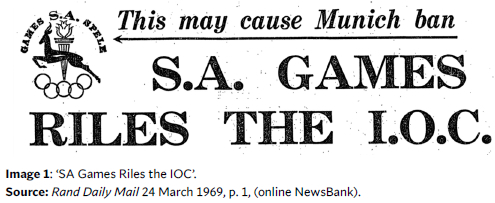
The 1969 SA Games emblem had caused outrage within the IOC to the point that the staging of the games was considered contrary to the Olympic principles. This was despite efforts by the Minister of Sport, Frank Waring, who declared categorically that the allegations against the 1969 SA Games being a 'mini-Olympics' were 'totally unfounded'.75 The use of the Olympic rings and the torch had also cost South Africa significant support from its sympathisers, most of whom backed the NP government's proclamation that sport was 'an apolitical matter'.76 Lord Killanin, the senior vice president of the IOC, initially indicated that West Germany would have been more amenable towards South Africa's participation in the 1972 Munich Games compared to the opposition from Mexico in 1968. However, the use of the Olympic insignias had altered his stance entirely.
I feel that the West Germans, in contrast to the Mexicans, would welcome the Springboks.But these South African Games have put a different complexion on matters and it is obvious that the South African Olympic Committee does not realise how foolish it was to use the five-ring symbol.77
In response to the IOC's disgruntlement, Frank Braun, clearly unaware of the severity of possible action against SANOC and the NP government, responded with an attitude of nonchalance:
South Africa has used the Olympic rings since 1960, when our first Games were held, and our Olympic Association used them again in 1964. There has never been a word of complaint. South Africa had registered the Olympic rings as a symbol of sporting excellence and was entitled to use them.78
This self-proclaimed entitlement and refusal to admit any trace of guilt did not bode well for SANOC and the NP government. The IOC met in Warsaw in 1970 where South Africa's Olympic future would be decided. Many suspected that South Africa would only be suspended, but Braun's abrasive statements steered the IOC towards adopting an aggressive approach and it spared no caution in reprimanding SANOC and the NP government for their transgressions.79 A motion to expel South Africa from the Olympic movement was raised and in a relatively close vote of 35 to 28 with 3 abstentions, South Africa was officially expelled from the Olympic movement.80
Multinationalism: A watershed moment for South African sport
South Africa's expulsion from the Olympic movement in 1970 proved to be a watershed moment in terms of government policy and South African sport. Prime Minister John Vorster soon realised that he needed to act quickly to avoid South Africa becoming a pariah in the international sporting community. However, his suggestion and implementation of the multinational sports policy would not be met without opposition within NP ranks.
Opposition to racially mixed sport in South Africa by members of the National Party and the apartheid government was unmistakable. To contextualise this, one should consider that Vorster requested a mandate to implement reform in South Africa at the NP congress held in the Transvaal in 1969. Vorster received unanimous support for reform, except on the issue of racially mixed sport within the Republic.81 It was an expression of what became known in South African politics as the 'verkrampte' faction within National Party ranks. Furthermore, there was a powerful group of ultra-conservative Members of Parliament, right-wing politicians who vehemently opposed any deviation from the principles of apartheid and its policy of separate development.
To overcome the significant opposition to reform on a sporting front, Vorster sought assistance from the Broederbond, a male-dominated Afrikaner organisation which upheld the principles of Afrikaner culture within the Republic.82 Vorster gave the Broederbond an almost impossible task, that of developing a sports policy that would ease international sporting pressure but at the same time appease the verkrampte (right-wing, ultra-conservative) faction of the NP.83 The Broederbond subsequently established a sports committee in an attempt to forge a 'new way forward' in South African sport. The committee acknowledged that the only way to reconcile the verkrampte faction within the NP government was to ensure that apartheid was upheld.84 What transpired was a sports policy which was convoluted and contradictory, a policy which supported merit-based selection but simultaneously upheld separate development.
Vorster outlined this 'multinational sports policy' in April 1971 but it failed to find international acceptance. However, the policy had significance for staging the next Games in 1973. 'Multinationalism' typified the NP's 'grand apartheid', with South Africa as a confederation of independent tribal nations (the 'homelands'). As such, the policy of multinationalism entailed that these 'independent' nations could compete against one another. However, this only applied to international competition; all sport at club level was to remain racially segregated.85 Despite its contradictory nature, the multinationalism policy ensured that the next SA Games sporting event would be the first multi-racial Games in South Africa's history.
The 1973 SA Games: 'The great Games breakthrough'86
The 1973 SA Games was the first to be held in South Africa since the country's expulsion from the Olympic movement and was officially titled the 'South African Open International Games.'87 It featured a new emblem with no Olympic symbols, suggesting that the NP government was keen to display to the IOC and international visitors that South African sport had been 'transformed' through its new policy of multinationalism and was ready to be readmitted into the Olympic movement.
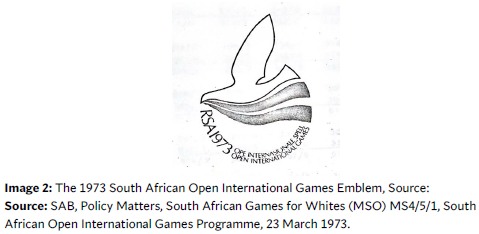
The NP government clearly had a point to prove. The acquisition of the Shell Motor Oil Company as the sponsor of the 1973 Games, assisted the NP government with the staging of the most elaborate and successful SA Games in the country's history.88The Games began on 23 March 1973 in the nation's capital city, and the stalwart of Afrikaner nationalism, Pretoria.
The government's multinational sports policy appeared to muster significant support for the multi-racial 1973 SA Games. This was underpinned by the support from all factions of the South African public who responded enthusiastically to the opening of the 1973 Games in Pretoria. It enjoyed a resounding reception in marked contrast to the subdued reaction to the 1969 Games in Bloemfontein. The Sunday Times reported:
Huge crowds attending the opening events left no doubt about their appreciation at being able to watch Olympic-style competition for the first time in South Africa. Their enthusiasm was tremendous, and the deafening applause for all and sundry was a fine example of their fair-minded attitude.89
The Sunday Times explained that the first attempt the NP government made to window-dress the shortcomings of its sports policy at the first SA Games in 1964 had been a dismal failure. The Games had not captured the public's imagination in the same way that the Olympic Games did. However, the introduction of multi-racial sport in 1973 brought new enthusiasm, a festive Olympic-style atmosphere to the nation's capital.
Although limited, before the 1973 SA Games, non-contact and distanced sports such as golf and tennis had enjoyed limited racial integration, but the prospect of contact sports such as boxing and soccer being racially integrated was virtually non-existent. As such, the SA Games was an important opportunity to display to the international sporting community that South African sport was taking necessary steps towards an eventual return to the international sporting fold. With reference to this new emergent enthusiasm for integrated sport, the popular magazine aimed at a black readership, Drum, reported: 'those who feared body-contact sport watch[ed] in wonder as bloody boxing bouts ended in smiles and friendship.'90
Soccer was (and still is) widely popular in South Africa and, as such, was a sport of particular interest during the SA Games. FIFA initially permitted foreign amateur teams to take part in the SA Games but had rescinded this decision when the association understood that there would be four separate representative South African teams (one from each racial classification) as opposed to a single, racially mixed South African team.91 Nevertheless, the Football Association of South Africa (FASA) organised an internal tournament between four representative teams, a white representative XI, an African representative XI, an Indian representative XI and a Coloured representative XI.
Most South African football enthusiasts predicted that the African representative team would win the tournament, but in an unexpected turn of events, the white representative team pulled off an upset, defeating the black team 4-0 in the final.92 Drum, emphasised this in their reportage of the Games' soccer tournament:
If the SA Games did nothing else, they destroyed two big sport myths. The first was that racial contact meant racial friction and second, that African soccer talent, spectacular and brilliant as it is, is enough to make football kings.93
However, the result was not the main talking point which emerged from the racially mixed competition. The verdict from the racially mixed crowd at a near-capacity Rand Stadium was that onlookers would have assumed that multi-racial soccer was part and parcel of South African society.94 Dave Marais, the President of FASA, said: 'I hope this leads somewhere..Where we go now and how fast we move is up to the government.'95
Similar events transpired in the boxing ring where a victory was awarded to Chris Opperman, a white boxer from the Free State. A crowd of over 1 000 supporters was in attendance when Opperman claimed victory over his black opponent, Livingstone Luphondo. The decision was met with dismay by the predominately white crowd who booed the decision in support of Luphondo who they believed to be the true victor.96 The same crowd rallied in support of an African middleweight fighter, Daniel Mapanya when he met and duly defeated West Germany's Horst Heinel.97 The Sunday Times highlighted the significance of these events with an appropriate contextualisation:
That white South Africans can accept the sight of their sons engaging in a body contact sport like boxing might, in the light of historical prejudices, be remarkable. That this happened in one of the most Nationalist-orientated of cities - Pretoria - might be even more remarkable.98
Initial fears of verkrampte protest and opposition to the SA Games never materialised. The Sunday Times described verkrampte opposition to a multi-racial sports policy and the SA Games as 'so ineffectual as to be almost laughable.'99 With the eyes of representatives from various Olympic committees around the world on them, the SA Games seemed to deliver and South Africa was praised for the 'multi-racial nature' and 'spirit of sportsmanship' which the Games had shown.100 Max Schmeling, a former world heavyweight boxing champion from West Germany, professed his allegiance to South Africa and its efforts to be readmitted to the Olympic movement, citing that South Africa 'deserve[d] to be readmitted to the Olympics.' 101
Ultimately, the 1973 SA Games were widely viewed as ushering in a new era in South African sport, an era where athletes and supporters alike hoped that the removal of racial barriers would stimulate a return to the global sporting stage.102 The Minister of Sport, Dr Piet Koornhof, received particular praise for the role he played in staging of the SA Games and for promoting the idea of multiracialism in sport.103The Games were considered a national triumph for South Africa but also a 'personal triumph'104 for Dr Koornhof. The Minister of Sport himself added to the national euphoria stemming from 1973 SA Games, stating at the conclusion:
What I have always hoped is that in my own lifetime I would experience a new era in South Africa.J believe, hope, and trust that this era will be hailed with the words: Rejoice the Beloved Country!105
Koornhof had already emphasised at the opening of the 1973 SA Games that the Games were 'one of the most significant steps [that South Africa had] ever taken to improve relationships across the colour line.'106 At their conclusion it was announced that there were 993 South Africans (black and white) and 523 overseas competitors, from 36 different countries, taking part.107 It was for these reasons that the Games were hailed as 'the most important sporting event held in South Africa.'108
However, beyond the plaudits and euphoria that the 1973 SA Games had received and generated, one should examine them in the context of the great international sporting boycott on South Africa at the time. The reality was that the NP government, with a significant verkrampte faction, was still vehemently opposed to the idea of racially mixed sport in South Africa.
The multinational policy was framed around the specific intention of ensuring that racially mixed sport could never be held in South Africa. The SA Games were just an exception and arguably served to buttress the idea of 'independent' black 'homelands'. Based on this premise, the South African government provided the SA Games with a mantle of respectability by framing it as an international competition.
In addition, the 1973 Games also functioned as a public relations event for the benefit of the international sporting world which had turned its back on South Africa.
To ensure US participation, the NP government sponsored many US athletes.109 Many foreign athletes also took part under strict instruction that they were in South Africa as individuals and not representing their respective national sporting bodies.110 The NP government, however, ignored this instruction and exhibited these athletes at the SA Games as representing their respective nations. Therefore, considering the efforts made with foreign athletes and the standing of the multinational sports policy which still discredited racially mixed sport, the 1973 SA Games had a covert element. This covertness allowed the NP government to win favour both at home and abroad through a 'sportswashing' mission. The lack of reform in sport after the 1973 SA Games also suggests that the government merely used the 1973 SA Games as a deterrence to encouraging fully integrated sport. At the conclusion of the Games and based on their success, many believed that further reform in sport was inevitable, but this reform would not appear until it could be used as a political bargaining chip.
1976: Soweto's Sporting Significance
The notorious Soweto riots of 1976 eventually had a significant bearing on political reform in South Africa and had a role to play in the eventual implementation of reform in the South African sporting sphere. The success of the multiracial 1973 SA Games showed great potential for further sporting reforms but once the euphoria of the Games had subsided no further reform had been implemented.
The South African Council of Sport (SACOS) emerged as another thorn in the side of the NP government. SACOS took up the mantle of opposing apartheid in sport in the early 1970s.111 The outbreak of the Soweto riots in June 1976 compounded global condemnation against apartheid. On a sporting front the OAU facilitated a boycott by 26 African nations of the 1976 Montreal Olympics. This was based on New Zealand's inclusion in the 1976 Olympics despite the New Zealand rugby team touring South Africa after the Soweto Uprising.112 With high tensions and anti-apartheid sentiment escalating locally and globally, the government had to act. Further sporting reform was the NP government's political bargaining chip that it had held since the 1973 SA Games and Pretoria felt it appropriate to use sporting reform in an attempt to quell these tensions. A mere three months after the Soweto riots, the NP government announced the extension of the multinationalism policy to club level, and racially mixed trials could select South African teams on merit. Black sportsmen who qualified to do so, would be permitted to wear the Springbok emblem.113 In a staggering turn of events the NP government that had long argued for a disconnect between sport and politics, began to argue for the converse. Dr Koornhof indicated that 'play and sport [were] strong enough to cause political and economic relations to flourish or collapse.'114
The minor political successes that the 1973 SA Games had generated prompted the NP government to view sport as a political weapon. The NP government hoped that these sporting reforms would quell tensions both at home and abroad.115 Unfortunately for the government, even though they were affording greater sporting opportunities to black athletes, most of these athletes had aligned themselves to the broader anti-apartheid movement and the international sporting boycott on South Africa.116 The South African government had hoped to host another instalment of the SA Games in 1977, but the Soweto riots had damaged South Africa's global image significantly and the government opted to postpone any plans for the next SA Games 'for the foreseeable future'.117
In June 1977, the Presidents and Prime Ministers of the Commonwealth Nations met at Gleneagles in Scotland. Commonwealth Nations pledged support to the anti-apartheid movement by discouraging sporting contact with South Africa.118 South African sport faced fierce opposition from within and beyond its borders by the 1970s. This had a severe effect on the staging of the next SA Games in 1981.
The 1981 SA Games: A cultural affair or a sporting spectacle?
The 1981 SA Festival Games were held to commemorate 20 years of republicanism.119 The Games began on 2 May and were opened by the State President, P.W. Botha who promised that they would add 'another historic chapter to South African sport.'120 Though the 1981 SA Games were presented by the government as being consistent with the preceding SA Games, the 1981 Games were noticeably different. The dubbing of the 1981 Games as the 'Festival Games' was a reference to the 1960 SA Festival Games. This suggests that the 1981 SA Games had reverted to the initial conceptualisation of SA Games in 1960 which sought to encourage the building of relations between white English-speakers and Afrikaners. The proposition of a 'Festival Games', therefore, encouraged the building of relationships among competitors of all racial classifications. This was made apparent by the adoption of the 1981 SA Festival Games motto, 'unity in diversity.'121
However, a widespread Games boycott by black athletes affiliated to SACOS, who had become an important voice against apartheid,122 ensured that the true diversity of the Games was only experienced in the scope of the sports that were included. Due to the widespread boycott, the scope of the Games had been widened to include an array of unorthodox sports. These unorthodox sports included, hang gliding, acrobatic flying, deep sea angling, surfing, go-karting and jukskei.123 This meant that he 1981 SA Games embodied the atmosphere of a cultural affair rather than a sporting spectacle. The media coverage of the 1981 SA Games also paled in comparison to the admiration that the 1973 SA Games had received.
It was evident that the NP government was facing several challenges which contributed to the 1981 SA Games' lack of success. The government had spent a great deal on the 1973 Games in assurance of success. However, following the 1976 Soweto riots and the rise in global sanctions against South Africa, the government was short on funds.124 Despite securing a sponsorship from the Sigma Corporation who put up R600 000 for the SA Games, the government had to raise another R900 000.125 In the context of the international sanctions and boycotts which were compounded by internal boycotts, it is not surprising that the 1981 Games were less elaborate than the 1973 Games and were more akin to a cultural event.
However, despite the apparent lack of success, the government maintained a propagandistic narrative. This was shown at the 1981 Games' closing ceremony when P.W. Botha, made bold claims on the staging of the Games. He emphasised that the 1981 SA Festival Games were the largest that the Republic had ever hosted. Botha accounted for this on the basis of the wide scope of the sporting codes which were included in the Games. In addition, his account noted that the Games were hosted across the country in the major metros of Johannesburg, Pretoria, Cape Town and Durban.126 Irrespective of the fact that the Games were meant to be a sporting contest, sporting recognition was completely absent. This only adds to the stigmatisation of the 1981 SA Games as a cultural affair.
The staging of the 1981 SA Festival Games pushed the need for the building of relations across the colour-line in the Republic. However, with the increasing waves of violence during the 1980s this seemed unlikely and relations across the colour-line were deteriorating. Nevertheless, the official line that came out the presidency was that the 1981 SA Festival Games had contributed to 'a spontaneous and flourishing patriotism in South Africa.'127
The 1986 SA Games: 'An untouchable for a number of elite sports'128
By 1986, P.W. Botha's proclamation of a 'spontaneous and flourishing patriotism' at the closing of the 1981 SA Festival Games had not aged well. Botha's attempt to stem the tide of tensions inside and outside South Africa's borders through his 'total strategy', was dwindling. The implementation of the tri-cameral parliament in 1983 was a particular cause for uproar which had resulted in violent protests in South African townships.129 The subsequent declaration of a state of emergency and deployment of the South African Defence Force (SADF) in townships meant that South Africa found itself on the brink of fully-fledged civil war. Given this context, it was highly unlikely that the 1986 SA Games had any chance of success.
The 1986 SA Games was hosted in Johannesburg to commemorate the city's centenary.130 Despite internal political turmoil and increased spending on militarisation, the NP government pulled out all the stops at the opening of the SA Games at Ellis Park Stadium. The government enlisted 12 000 participants, including eight helicopters, a 70-piece band, a 2 000-voice choir, 40 solo artists, 500 Zulu warriors, 8 000 students, 1 000 gymnasts, a 100-piece symphony orchestra and a 400-piece rock band.131 The lavish procession which looked more like theatrical production than the opening ceremony of a sporting competition, nevertheless included some traditional elements from SA Games from the past. The procession concluded with the ceremonial lighting of the SA Games flame.132 The implications of this ostentatious opening ceremony appeared to be a ploy to pry attention away from the sporting element of the Games.
A major hallmark of the 1986 SA Games was a widespread internal boycott of the Games by numerous sporting bodies within South Africa.133 No less than 25 sports had been earmarked for participation in the Games, but only sixteen were included, and the Games were without a number of 'elite' sports.134 Among these were tennis, golf, basketball, soccer and boxing.135 The boycott by the professional soccer leagues, the National Soccer League (NSL) and the National Professional Soccer League (NPSL) were particularly significant because soccer still held the fascination of a large portion of the South African population. In addition, the professional soccer leagues were affiliated to the multi-racial South African Boxing Union which followed suit and also boycotted the Games.136 To compensate for the absence of professional soccer the government ensured that two amateur teams selected from the Southern Transvaal Football Association (STFA) would compete at the Rand Stadium.137 The government's solution, however, did not captivate the attention of the keenest football enthusiasts in South Africa.
Surprisingly, despite the ongoing international sports boycott on South Africa, the Montreal Gazette reported that 200 foreign athletes from sixteen different nations would compete in the Games. South Africa had managed to maintain some international sporting ties during the 1980s with a South African rugby tour of New Zealand in 1981 and numerous rebel cricket tours taking place in South Africa during the 1980s.138 As such, the government was able to muster some foreign participation in the games although this was limited.
Ultimately, the absence of significant sporting codes and sportsmen in the 1986 SA Games meant that they failed to captivate the attention of the South African public. This, combined with immense internal political strife, meant that the media coverage of the 1986 SA Games was the worst since the hosting of the initial Games in 1964. With the tide turning in South African politics, the 1986 SA Games were the last attempt made by the NP government to influence sporting bodies in an Olympic context. South Africa's next encounter with the Olympics was only made possible when F.W. de Klerk dismantled the legislative foundations of apartheid which earned South Africa an invitation to 1992 Barcelona Olympics albeit under certain conditions which dictated that South African athletes had to compete under the Olympic flag, anthem and emblem.139
Conclusion
Given the context of the international sports boycott on South Africa and how the boycott had intensified after the IOC withdrew South Africa's invitation to the 1964 Tokyo Olympics, one must consider the SA Games an important response to the increasing sporting isolation of South Africa. What was initially utilised by the NP government as a measure of appeasement in the mid-1960s had transformed into a full-scale propaganda effort by the 1970s to prop-up petty political reform in the form of sporting permittance. This petty reform ultimately prefaced greater political reforms which were implemented in line with the Botha administration's 'total strategy'. However, although the government's propaganda attempt was able to generate respectable recognition by the early to mid-1970s, this ultimately came undone by the late-1970s and early-1980s because of the intensified anti-apartheid movement and international sports boycott which formed part of the movement. Existing scholarly literature does well to rationalise how the intensification of the anti-apartheid movement and the international sports boycott impacted South Africa in the global sporting sphere which was characterised by widespread sporting isolation. However, the existing literature does not give an adequate explanation of how this sporting isolation was addressed locally.
The SA Games provide valuable insight into SANOC and the NP government's domestic strategy in response to the international sports boycott. What was initially a temporary solution to a perceived singular boycott in 1964, soon became a central lynchpin in the government's sporting policy by the late 1960s and early 1970s. This article argues that each SA Games was staged with a consistently evolving NP government agenda in mind.
REFERENCES
Alegi, P. African Soccerscapes: How the Continent Changed the World's Game. Athens, Ohio University Press. 2010. [ Links ]
Archer, R. and Bouillon, A. The South African Game: Sport and Racism. London: Zed Press, 1982. [ Links ]
Blackman, D. 'African Americans, Pan-Africanism, and the Anti-Apartheid Campaign to Expel South Africa from the 1968 Olympics'. Journal of Pan African Studies, 5, 3 (2012), 1-25. [ Links ]
Bolsmann, C. 'White Football in South Africa: Empire, Apartheid and Change, 1892-1977', in South Africa and the Global Game: Football, Apartheid and Beyond, edited by P. Alegi and C. Bolsmann, 29-45. New York: Routledge. 2010. [ Links ]
Booth, D. 'The South African Council on Sport and the Political Antinomies of the Sports Boycott'. Journal of Southern African Studies, 23, 1 (1997), 51-66. [ Links ]
Booth, D. The Race Game: Sports and Politics in South Africa. London: Frank Cass Publishers. 1998 [ Links ]
British Pathé. 'South Africa: Sprinter Nash Still in Form After Olympics Ban'. Accessed 21 November 2024, https://www.britishpathe.com/asset/106661/ [ Links ]
Charitas, P. 'Anglophone Africa in the Olympic Movement: The Confirmation of a British Wager? (1948-1962)'. African Research & Documentation, 116 (2011), 35-52. [ Links ]
Chetty, S. 'Walking the Tightrope: The President's Council, P.W. Botha and the Rhetoric of Reform'.. Historia, 68, 1, (2023). 137-? [ Links ]
Davis, R (Daily Maverick). 'Cable ties: Wikileaks and South Africa'. Accessed 19 November, 2024. https://www.dailymaverick.co.za/article/2013-04-16-cable-ties-wikileaks-and-south-africa/ [ Links ]
Espy, R. The Politics of the Olympic Games: With an Epilogue, 1976-1980. Los Angeles: University of California Press, 1981. [ Links ]
Hain, P. and Odendaal, A. Pitch Battles: Sport, Racism and Resistance. London: Rowman & Littlefield, 2021 [ Links ]
International Olympic Committee, Olympic Charter. Campagne Mon Repos Lausanne, Switzerland. 1956. [ Links ]
Ivey, J.A. 'From Montreal to Moscow: The Legacy of the Anti-Apartheid Olympics on the Boycott of the Cold War Games (1976-1980)'. PhD thesis, University of California San Diego, 2024. [ Links ]
Lapchick, R.E. The Politics of Race and International Sport: The Case of South Africa. London: Greenwood Press, 1975. [ Links ]
Macintosh, D and Hawes, M. Sport and Canadian Diplomacy. Montreal: McGill-Queens University Press. 1994. [ Links ]
Nauright, J. Sport, Cultures and Identities in South Africa. London: Leicester University Press. 1997. [ Links ]
Rademeyer, C. 'Sports Isolation and the Struggle Against Apartheid in South African Sport: The Sports Policy of the National Party During the 1980s'. Southern Journal for Contemporary History, 38, 3 (2013), 70-90. [ Links ]
Skinner, R. 'Antidiscrimination: Racism and the Case of South Africa', in The Ideals of Global Sport, edited by B.J. Keys, 47-67. Philadelphia: University of Pennsylvania Press, 2019. [ Links ]
South African History Online. 'Football in South Africa Timeline 1862-2012'. Accessed 21 November 2024. https://www.sahistory.org.za/article/football-south-africa-timeline-1862-2012 [ Links ]
South African State Department of Information, South Africa: Official Yearbook of the Republic of South Africa 1988-1989, 661. [ Links ]
Sperber, T. 'Sport Diplomacy during the Apartheid Era in South Africa with the Olympic Movement in the Centre of the Web: Three Sport Political Approaches of the IOC Presidents Brundage, Lord Killanin and Samaranch towards the Apartheid Politics in South Africa'. Diagoras: International Academic Journal on Olympic Studies, 4 (2020), 276-297. [ Links ]
Weisbord, R.G. Racism and the Olympics. New York: Routledge, 2017. [ Links ]
Wilkins, I. and Strydom, H. The Super-Afrikaners. Johannesburg: Jonathan Ball Publishers. 1978. [ Links ]
Witherspoon, K.B. 'Inclusion, Exclusion, and Segregation', in A Cultural History of Sport in the Modern Age, edited by S.A. Riess, 51-68. London: Bloomsbury, 2022. [ Links ]
* His PhD thesis focuses on masculinity in South African sports media from the 1950s to the 1990s.
1 J. Nauright, Sport, Cultures and Identities in South Africa (London: Leicester University Press, 1997), 137, 143.
2 D. Booth, The Race Game: Sports and Politics in South Africa (London: Frank Cass Publishers, 1998), 99, 112.
3 P. Hain and A. Odendaal, Pitch Battles: Sport, Racism and Resistance (London: Rowman & Littlefield, 2021), 188.
4 R.E. Lapchick, The Politics of Race and International Sport: The Case of South Africa (London: Greenwood Press, 1975); R. Espy, The Politics of the Olympic Games: With an Epilogue, 1976-1980 (Los Angeles: University of California Press, 1981); R. Archer and A. Bouillon, The South African Game: Sport and Racism (London: Zed Press, 1982); Nauright, Sport, Cultures and Identities; Booth, The Race Game; D. Blackman, 'African Americans, Pan-Africanism, and the Anti-Apartheid Campaign to Expel South Africa From the 1968 Olympics', Journal of Pan African Studies, 5, 3 (2012); R.G. Weisbord, Racism and the Olympics (New York: Routledge, 2017); R. Skinner, 'Antidiscrimination: Racism and the Case of South Africa', in The Ideals of Global Sport, ed. B.J. Keys (Philadelphia: University of Pennsylvania Press, 2019); Hain and Odendaal, Pitch Battles; K.B. Witherspoon, 'Inclusion, Exclusion and Segregation', in A Cultural History of Sport in the Modern Age, ed. S.A. Riess (London: Bloomsbury, 2022).
5 National Film Video and Sound Archives (NFVSA), Pretoria, FA 14881, The South African Games 1973; NFVSA, FA 17556, The South African Festival Games 1981.
6 Nauright, Sport, Cultures and Identities, 37.
7 When the term 'black' is used in this article it refers to the broad categorisation of all non-white peoples within South Africa. In more specific cases the terms African, Coloured and Indian are utilised.
8 Booth, The Race Game, 75.
9 Booth, The Race Game, 58.
10 Booth, The Race Game, 75.
11 C. Bolsmann, 'White Football in South Africa: Empire, Apartheid and Change, 1892-1977', in South Africa and the Global Game: Football, Apartheid and Beyond, ed P. Alegi and C. Bolsmann (New York: Routledge, 2010), 36.
12 Booth, The Race Game, 75.
13 International Olympic Committee, Olympic Charter, 1956 (Campagne Mon Repos, Lausanne, Switzerland, 1956), 9.
14 Booth, The Race Game, 78.
15 Booth, The Race Game, 78.
16 The Sharpeville Massacre took place on 21 March 1960, when police opened fire on a peaceful anti-pass law protest organised by the PAC, killing 69 people and injuring over 180. The incident marked a turning point in the anti-apartheid struggle.
17 Archer and Bouillon, The South African Game, 193.
18 Booth, The Race Game, 78.
19 Booth, The Race Game, 78.
20 Booth, The Race Game, 86.
21 Blackman, 'African Americans, Pan-Africanism, and the Anti-Apartheid Campaign', 6.
22 P. Charitas, 'Anglophone Africa in the Olympic Movement: The Confirmation of a British Wager? (1948-1962)', African Research & Documentation, 116, (2011), 44.
23 Booth, The Race Game, 86.
24 International Olympic Committee, Olympic Charter.
25 International Olympic Committee, Olympic Charter, 16.
26 Booth, The Race Game, 88.
27 Booth, The Race Game, 88.
28 Rand Daily Mail, 20 June 1964, 2.
29 Booth, The Race Game, 88.
30 Espy, The Politics of the Olympic Games, 87.
31 National Archives Repository, Pretoria (hereafter SAB), Policy Matters South African Games for Whites (MSO) MS4/5/1, Memorandum of Information, Department of Sport and Recreation, March 1969; The Van Riebeeck Festival, held in Cape Town in 1952, marked the 300th anniversary of Jan van Riebeeck's arrival at the Cape. Celebrated primarily by the white population, the festival promoted Afrikaner nationalism and colonial heritage.
32 Rand Daily Mail, 11 March 1960, 3.
33 Rand Daily Mail, 11 March 1960, 3.
34 SAB, MSO, MS4/5/1, Memorandum of Information, Department of Sport and Recreation, March 1969.
35 Rand Daily Mail, 29 February 1960, 2.
36 Although used primarily in the post-apartheid era, the name 'Springboks' refers to the South African national rugby team. The government awarded Springbok colours to athletes from various sporting codes.
37 Rand Daily Mail, 29 February 1960, 2.
38 Sunday Times, 8 March 1964, 1.
39 Sunday Times, 15 March 1964, 35.
40 SAB, Policy Matters South African Games For Whites (MSO) MS4/5/1, 1964; South African Games Official Brochure, March 1964; Rand Daily Mail, 15 January 1964, 24.
41 Sunday Times, 1 March 1964, 5.
42 Sunday Times, 15 March 1964, 35.
43 Sunday Times, 15 March 1964, 20.
44 Sunday Times, 15 March 1964, 20.
45 Rand Daily Mail, 15 January 1964, 24.
46 Sunday Times, 26 April 1964, 21.
47 SAB, MSO, MS4/5/1, 1964, South African Games Official Brochure, March 1964.
48 SAB, MSO, MS4/5/1, 1964 South African Games Official Brochure, March 1964.
49 Sunday Times, 8 March 1964, 1.
50 Booth, The Race Game, 96.
51 Booth, The Race Game, 96.
52 Nauright, Sport, Cultures and Identities, 136.
53 Blackman, 'African Americans, Pan-Africanism, and the Anti-Apartheid Campaign, 6.
54 Lapchick, The Politics of Race and International Sport, 112.
55 Booth, The Race Game, 97.
56 Booth, The Race Game, 97; T. Sperber, 'Sport Diplomacy during the Apartheid Era in South Africa with the Olympic Movement in the Centre of the Web: Three Sport Political Approaches of the IOC Presidents Brundage, Lord Killanin and Samaranch towards the Apartheid Politics in South Africa', Diagoras: International Academic Journal on Olympic Studies, 4, (2020), 281.
57 Sperber, 'Sport Diplomacy during the Apartheid Era in South Africa with the Olympic Movement in the Centre of the Web, 281-282.
58 SAB, Policy Matters South African Games for Whites (MSO) MS4/5/1, Letter from Secretary for Sport and Recreation to Minister of Sport, 13 April 1969.
59 Rand Daily Mail, 17 March 1969, 5.
60 'South Africa: Sprinter Nash Still in Form After Olympics Ban', British Pathé, accessed 21 November 2024, https://www.britishpathe.com/asset/106661/
61 Rand Daily Mail, 17 March 1969, 5.
62 Rand Daily Mail, 17 March 1969, 5.
63 SAB, Policy Matters, South African Games for Whites (MSO) MS4/5/1, Newspaper Article from Die Hoofstad, 'Die Spele is Maar Dood', 15 March 1969. Translated from the original Afrikaans, to English.
64 SAB, MSO, MS4/5/1, Newspaper Article from Die Hoofstad, 'Die Spele is Maar Dood', 15 March 1969. Translated from Afrikaans to English.
65 SAB, MSO, MS4/5/1, Newspaper Article from Die Hoofstad, 'Die Spele is Maar Dood', 15 March 1969. Translated from Afrikaans to English.
66 Rand Daily Mail, 17 March 1969, 5.
67 Rand Daily Mail, 17 March 1969, 5.
68 Rand Daily Mail, 17 March 1969, 5.
69 SAB, Policy Matters, South African Games for Whites (MSO) MS4/5/1, Memorandum of Information, the South African Games, 28 March 1969; SAB, Policy Matters South African Games For Whites (MSO) MS4/5/1, Letter from Minister of Sport and Recreation to Secretary of Sport and Recreation, 13 March 1969.
70 SAB, MSO, MS4/5/1, Letter from Minister of Sport and Recreation to Secretary of Sport and Recreation, 13 March 1969.
71 Rand Daily Mail, 7 May 1969, 4.
72 Sunday Times, 1 June 1969, 2.
73 SAB, MSO, MS4/5/1, Memorandum of Information, Department of Sport and Recreation, March 1969.
74 Nau right, Sport Cultures and Identities, 138.
75 SAB, MSO, MS4/5/1, Memorandum of Information, Department of Sport and Recreation, March 1969.
76 SAB, Policy Matters South African Games or Whites (MSO) MS4/5/1, Department of Indian Affairs Memorandum, 25 March 1969.
77 Rand Daily Mail, 24 March 1969, 1.
78 Rand Daily Mail, 24 March 1969, 1; SAB, MSO, MS4/5/1, Letter from Secretary for Sport and Recreation to Minister of Sport, 13 April 1969.
79 Lapchick, The Politics of Race, 169.
80 Booth, The Race Game, 99.
81 Booth, The Race Game, 99.
82 I. Wilkins and H. Strydom, The Super-Afrikaners (Johannesburg: Jonathan Ball), 35.
83 Booth, The Race Game, 100.
84 Wilkins and Strydom, The Super-Afrikaners, 241.
85 Booth, The Race Game, 101.
86 Sunday Times, 25 March 1973, 1.
87 SAB, Policy Matters SA Games for Whites (MSO) MS4/5/1, 23 March 1973.
88 P. Alegi, African Soccerscapes: How the Continent Changed the World's Game (Athens: Ohio University Press), 75.
89 Sunday Times, 25 March 1973, 1.
90 Drum, 8 May 1973, 11.
91 'Football in South Africa, Timeline 1862-2012', South African History Online, accessed 21 November 2024, https://www.sahistory.org.za/article/football-south-africa-timeline-1862-2012
92 Sunday Times, 1 April 1973, 125.
93 Drum, 8 May 1973, 5.
94 Sunday Times, 1 April 1973, 1.
95 Sunday Times, 1 April 1973, 1.
96 Sunday Times, 1 April 1973, 1.
97 Sunday Times, 1 April 1973, 1.
98 Sunday Times, 1 April 1973, 1.
99 Sunday Times, 8 April 1973, 19.
100 Sunday Times, 25 March 1973, 1.
101 Sunday Times, 1 April 1973, 1.
102 Hain and Odendaal, Pitch Battles, 188.
103 SAB, Policy Matters South African Games for Whites (MSO) MS4/5/1, Letter from University of West Florida to Piet Koornhof, 7 May 1973; SAB, Policy Matters (MSO) MS4/5/1, Letter, SA Cricket Association to Minister of Sport, 9 April 1973.
104 Sunday Times, 8 April 1973, 1.
105 Sunday Times, 8 April 1973, 1.
106 Sunday Times, 1 April 1973, 1.
107 SAB, Policy Matters SA Games for Whites (MSO) MS4/5/1, Talk on Implications of the SA Games, 24 July 1973, Pretoria.
108 N FVSA, FA 14881, The South African Games 1973.
109 'Cable ties: Wikileaks and South Africa', R. Davis (Daily Maverick), accessed 19 November, 2024, https://www.dailymave.rick.co.7a/article/2013-04-16-cable-tie.s-wikileaks-and-south-africa/
110 D. Macintosh and M. Hawes, Sport and Canadian Diplomacy (Montreal: McGill-Queens University Press, 1994), 63.
111 D. Booth, 'The South African Council on Sport and the Political Antinomies of the Sports Boycott', Journal of Southern African Studies, 23, 1 (1997), 54.
112 J.A. Ivey, 'From Montreal to Moscow: The Legacy of the Anti-Apartheid Olympics on the Boycott of the Cold War Games (1976-1980)' (PhD thesis, University of California San Diego, 2024), 65.
113 Booth, The Race Game, 104.
114 Booth, The Race Game, 104.
115 C. Rademeyer, 'Sports Isolation and the Struggle against Apartheid in South African Sport: The Sports Policy of the National Party During the 1980s', Southern Journal for Contemporary History, 38, 3, (2013), 71.
116 Booth, The Race Game, 105-106.
117 SAB, Policy Matters SA Games for Whites (MSO) MS4/5/1, Letter from P.G.J. Koornhof, to M. Lane, 29 November 1976.
118 Nauright, Sport Cultures and Identities ,149.
119 SA State Department of Information, South Africa: Official Yearbook of the Republic of South Africa 1988-1989, 661.
120 NFVSA, FA 17556, The South African Festival Games 1981.
121 N FVSA, FA 17556, The South African Festival Games 1981.
122 Nauright, Sport Cultures and Identities, 140.
123 NFVSA, FA 17556, The South African Festival Games 1981.
124 Rand Daily Mail, 18 February 1981, 27.
125 Rand Daily Mail, 18 February 1981, 27.
126 NFVSA, FA 17556, The South African Festival Games 1981.
127 NFVSA, FA 17556, The South African Festival Games 1981.
128 Sunday Times, 9 February 1986, 25.
129 S. Chetty, 'Walking the Tightrope: The President's Council, P.W. Botha and the Rhetoric of Reform', Historia, 68, 1 (2023), 137.
130 Montreal Gazette, 4 April 1986, 37.
131 Sunday Times, 5 January 1986, 29.
132 Sunday Times, 30 March 1986, 3.
133 Sunday Times, 9 February 1986, 25.
134 Sunday Times, 9 February 1986, 25.
135 Sunday Times, 9 February 1986, 25.
136 Sunday Times, 6 April 1986, 26.
137 Sunday Times, 6 April 1986, 26.
138 Nauright, Sport Cultures and Identities, 150.
139 Booth, The Race Game, 1; Nauright, Sport Cultures and Identities, 176.
