




Services on Demand
Journal

Article
 English (pdf)
 Article in xml format
 Article references
 Automatic translation
 Send this article by e-mail
Indicators
Related links
-
 Cited by Google
 -
 Similars in Google
Share

 Permalink
South African Journal of Science
On-line version ISSN 1996-7489Print version ISSN 0038-2353
S. Afr. j. sci. vol.120 spe Pretoria Nov. 2024
https://doi.org/10.17159/sajs.2024/20252
PERSPECTIVE
A perspective on South African engineering
David J.N. Limebeer
School of Electrical and Information Engineering. University of the Witwatersrand, Johannesburg. South Africa
ABSTRACT
SIGNIFICANCE: As part of the 120th anniversary celebrations of the South African Journal of Science, this paper highlights some of the engineering contributions to the Journal, and celebrates some of the achievements of one of South Africa's most outstanding engineers - Hendrik Johannes van der BijI. By briefly retracing his developmental history and motivation, we can better understand his path to prominence, and his contributions to the industrialisation of South Africa. This Perspective also reflects on what his work and career might teach future generations of South African engineers and engineering educators
Keywords: South African engineering, Industrialisation, central Infrastructure, electronic amplification, telephonic communication, engineering Infrastructure
The first issue of the South African Journal of Science (SAJS) was published in Albert Einstein's annus mirabilis -1905. In that year, Einstein published five papers of groundbreaking importance that in many ways marked the beginning of modern physics.1 In his first paper, Einstein combined the techniques of classical hydrodynamics with those of diffusion theory to create a new method for determining the size of molecules. His second paper was a study of Brownian motion and constitutes one of the high points in the long tradition of research on the kinetic theory of heat. This work contributed to the acknowledgement of the physical reality of 'atoms' by the then still numerous sceptics. His third paper introduced the special theory of relativity that links time and distance. This paper showed that the concept of absolute time, on which Newtonian kinematics is based, had to be abandoned (or at least modified). The fourth paper, which is a consequence of the special theory of relativity develops the principle of mass-energy equivalence as embodied in his famous equation, E = mc2.The fifth paper is an examination of the photoelectric effect, which analyses the energy of light quanta; work for which he received the 1921 Nobel Prize for Physics. In the same year (1905), the SAJS published a wide range of papers on education, mathematics, astronomy chemistry mining and geology lightning, electric power distribution, wireless telegraphy and vehicular transport.
In more recent times, the SAJS has provided coverage of several topics of current engineering significance. In response to its rapidly increasing importance, South African researchers and institutions have increased their efforts in nanotechnology.2 'Big data' and artificial intelligence (Al) in health science research in sub-Saharan Africa are examined in a special issue.3 The articles in this special issue explore the benefits of data science; the importance of data management; and the ethical and legal issues raised by the gathering and use of mobile phone data. The Fourth Industrial Revolution speaks to a confluence of technologies and the synergy of computing, data, and communications technology with Ai.4 The results of an effort to identify the performance of energy and fuels research in South Africa during the period 2003-2013 is reported in Rudman et al.5 Emergency medical services (EMS) are a vital component of the health system, and provide pre-hospital emergency care, and specialised transport for patients requiring access to healthcare facilities. Evidence regarding the current state of EMS within South Africa to fulfil this role is lacking and motivated a recent review.6 A review of CO2 emissions in the South African power generation sector is given in Osman et al.7, with potential process engineering solutions to reduce them suggested.
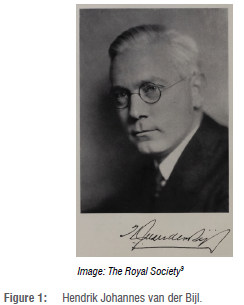
I will now develop the hypothesis that the industrialisation of South Africa began on 23 November 1887, when Hendrik Johannes van der BijI (Figure 1) was born in Pretoria. At the time, the WItwatersrand Goldfields had recently been discovered - an event that contributed to the outbreak of the Anglo-Boer War. In 1902, his parents moved to the Cape, where van der BijI was able to complete his schooling away from the rancour of war. After matriculating at Franschhoek High School (in 1904), he spent three years at Victoria College (now Stellenbosch University). He received a BA degree, winning prizes for mathematics and physics.8
In 1908, Van der BijI was unable to resist a call to move to Germany and study physics. At the time, outstanding questions included the determination of the structure of the atom, the verification of Einstein's theory on the photoelectric effect, and the determination of the mass and charge of the electron (the charge-mass ratio had already been determined by J.J. Thompson in 1897). In 1912, he completed his PhD thesis on the behaviour of ions in liquid dielectrics.9
After obtaining his PhD, Van der BijI was appointed assistant in physics at the Royal School of Technology in Dresden under the supervision of Wilhelm Hallwachs, who, in 1888, hypothesised that a conductive plate would emit electrons when subjected to ultraviolet light. In 1900, Max Planck proposed a quantum theory that explained the absorption and emission of electromagnetic waves (light quanta). In 1905, Einstein applied quantum theory to the photoelectric effect and proposed the relationship Kmax = h(v - v0), with each quantum of light carrying energy hv, where ν is the light's frequency and h is Planck's constant. Because the kinetic energy Kmax must be positive, v > v0 is required for photoelectric emissions to occur. The frequency is the threshold emission frequency associated with the material being considered. To satisfy Einstein's equation, the maximum electron stopping voltage had to be in the region of a few volts, but several workers found figures more than ten times greater. Van der BijI suspected that the field, due to the relatively high anode voltage, penetrated the grid as a corrupting 'stray field'. This quandary led to a fortuitous meeting with R.A. Millikan, who arranged for the American Telephone and Telegraph Company to offer him an appointment in their then embryonic research organisation, which in 1925 became the famous Bell Telephone Laboratories. Arguably Van der BijI's move to America in 1913 marks his metamorphosis from physicist to electrical engineer.
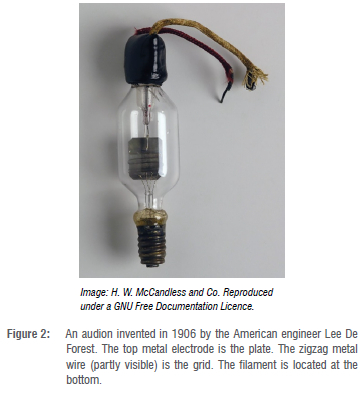
The American Telephone and Telegraph Company had recently acquired the patent rights to Lee de Forest's 'audion', which is a three-electrode amplifying device (Figure 2). The reason for acquiring these rights was its possible use in long-distance telephony However, before the audion could be used for this purpose, research had to be done to study its performance characteristics, and to arrive at a vacuum tube design that was suitable for commercial production. Van der BijI's background was ideally suited to this task. Although it was used for a very different purpose, the audion was essentially a replica of the photoelectric tubes he used in Germany in his work on the photoelectric effect; the illuminated zinc plate was replaced with a hot filament as the electron emitter.
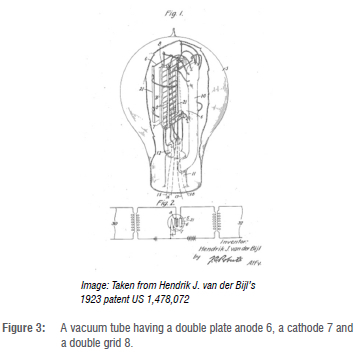
In 1914, a three-electrode valve amplifier was used in a commercial telephone system that connected New York and San Francisco. Inventions related to amplifying devices (Figure 3), feedback, and circuit theory provided a sound basis for the design of feedback systems that arise in many fields of engineering including chemical processing, electric power generation, and ship and aircraft autopilots. These applications led to a then new engineering discipline known as 'control theory'. Most importantly Van der BijI's stay in the USA exposed him to the methods of modern industry.
His work on the design and theory of the vacuum tube, and the mathematical characterisation of its operation, led to a treatise on the thermionic valve which he published in 1920.10 This was the first book on the subject and remained a standard work for many years to come. The development of the audion was accompanied by other groundbreaking developments that all contributed to the long-distance telephone system. These included the development of the feedback amplifier by Harold Black" and the work of Hendrik Bode12 and Harry Nyquist13 on feedback system design and stability There was also the network synthesis work of the famous South African researcher Otto Walter Brune.14
By 1936, it was decided that the vacuum tube was not going to be the ultimate answer to electronic amplification. Their reliability size and power consumption were such that simply making them smaller, and more efficient, was not going to suffice. In 1925, J.E. Lilienfeld filed a patent for the field-effect transistor. The field-effect transistor is another three-terminal amplifying device, similar in some ways to the vacuum tube developed by Van der BijI and his colleagues. This Bell Telephone Laboratory work culminated in what we now know as the 'transistor', for which John Bardeen, Walter Brattain and William Shockley received the 1956 Nobel Prize for Physics.
In 1919, Field Marshal Jan Smuts became Prime Minister of the then Union of South Africa and decided that his cabinet needed a Scientific Advisor. Having heard of Van der BijI's achievements in America, he decided Van der BijI was 'the man for the job'. In 1920, Van der BijI returned to South Africa to take up this new post. Not long after returning to South Africa, Smuts persuaded Van der BijI to form a national electricity supply company; Van der BijI was made Chair of the newly established Electricity Supply Commission (Escom). Van der BijI saw that the two pillars on which South African industry could be built were electric power and steel. In 1925, the Iron and Steel Corporation (Iscor) was formed.
At the onset of World War II, Van der BijI was made Director General of War Supplies and, in a short period of time, was able to mobilise the country's limited industrial resources. As a senior civil servant. Van der BijI was expected to join the cabinet, but he declined to do so, explaining that8:
At present I have no enemies that I know of, but if I join the Cabinet I shall immediately have 40% of the population against me and I shall have to waste my time making conciliatory and tactful speeches. (p.9)
In the years to come, Escom maintained its ambition, and in 1976 the construction of the Koeberg Nuclear Power Station began. As with any new venture of this type, teething problems occurred. One such problem was the possible onset of subsynchronous resonance, which is a potentially damaging electro-mechanical instability caused by the compensation capacitors required in long transmission lines (>1000 km in this case). At the time, Escom conducted its own research16 and also funded and conducted research with South African universities17. Escom was then a healthy enterprise that was presented with the Power Company of the Year Award at the Global Energy Awards ceremony held in New York in 2001.
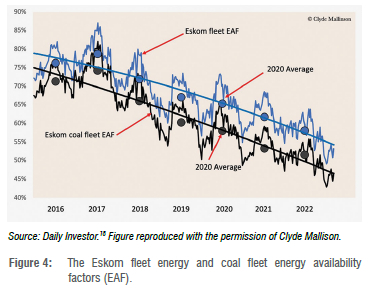
In more recent times, Eskom's fortunes have declined (Escom became Eskom in 1987). Figure 4 shows the degradation of the energy availability factor of the Eskom fleet over a recent 7-year period; the cyclic variations were a result of seasonal maintenance schedules. This downward trend in availability was due to a combination of deferred maintenance and equipment ageing, which does not bode well for the future of the country's heavy industries, businesses and private consumers.
This problem was masked to some extent by the introduction of renewable energy supplies, with some recent estimates given in Table 1.
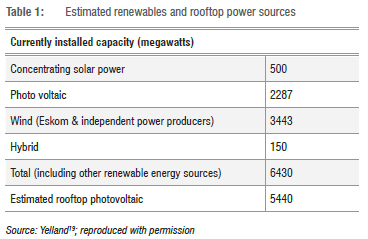
While renewables and residential rooftop photovoltaic (PV) Installations represent a helpful contribution to the country's energy mix, one must be careful in interpreting these figures. In the case of solar, assuming that the sun is available only half the time results in an energy availability factor (without battery storage) of approximately 50%. In the case of wind, the energy availability factor could be as low as 20%. Another issue is that the increase in installed rooftop PV represents a significant investment that must be borne by the broader economy - somewhat akin to replacing the Department of Water and Sanitation with JoJo tanks. In other words, private citizens, many of whom have limited resources, are being required to subsidise the country's central infrastructure.
In 2019, BizNews published an open letter from an Eskom engineer of 30 years' standing20, which is another cause for concern. Alex Ham held the position of Chief Engineer: Power Station Design. During this period, he was responsible for the overall design of Eskom's Lethabo, Majuba, Matimba and Kendal Power Stations. His expertise was in the design of pulverised coal boilers. Prior design experience at Kriel Power Station motivated his in-depth study of the combustion properties of South African coal.21 This work showed that boiler designers have to make allowances for slow-burning South African coal that must be ground much finer than is required elsewhere. In the case of the boilers for Lethabo, Majuba, Matimba and Kendal Power Stations, increased furnace dimensions were specified, together with tube mills in place of previously used vertical-spindle rotating table mills. Tube mills produce finer ground coal, as was proven at Lethabo Power Station. The prior experience of the boiler contractor for Medupi and Kusile was with Australian and Japanese coal. On the basis of the limited information available to him, Ham concluded that the Medupi and Kusile boilers were undersized for slow-burning South African coals, and that the flue gas velocities were too high, causing excessive erosion of the burners and furnace tubing. This episode raises two important questions: (1) Does Eskom still have the expertise to monitor and advise outside contractors in order to avoid mistakes of this kind? And (2) why did Eskom and its contractors not apparently take advantage of the knowledge and experience of its own engineers?
Another troubling coal-related incident that occurred at Eskom relates to Dr Mark van der Riet who was Eskom's coal combustion expert. His case is dealt with in the Zondo Commission report22 (see paragraphs 2017 to 2045), while a summary account can be found in Hogg23. In August 2015, Dr van der Riet was Informed by his Quality Assurance staff that the quality of the coal from Brakfontein colliery had deteriorated -an independent laboratory had recently failed 50% of the samples provided. The samples were retested by a SABS laboratory and 97% of the coal was deemed too poor for Eskom's utility Following a period of fractious disagreement over testing protocols and alleged transgressions of Eskom's Coal Quality Management Procedure, Dr van der Riet and his team were served with a notice of intended suspension.
When contemplating the way forward, there are a number of fundamentals that are worth reviewing. Engineers are like oak trees -there are too few of them and It takes many years to grow new ones. No matter how loud the howls of protest might be, physical law is indifferent to the whims of politics. It would be folly to try and pass legislation that changes, for example, the laws of thermodynamics. Engineers are trained to understand these laws, work with them, and avoid their many and varied snares. The most talented engineers are also the most mobile - if, for whatever reason, they dislike their working environment, they can relocate to other employment. South Africa's pool of engineers must be expanded and properiy balanced between the private and public sectors. As was the case with Hendrik van der BijI, and many others like him14 our promising young engineers should be routinely encouraged to gain experience in worid-class engineering environments.
There is an obvious and urgent need for more engineers to rehabilitate South Africa's failing Infrastructure. To that end, non-extractive external investment must be encouraged, and barriers that impede the attraction and recruitment of the very best engineers to the public sector should be removed.
Engineering educators must be mindful of at least three responsibilities. Firstly there is a responsibility to the reputation of their home institution. Secondly, they have a responsibility towards the country and future employers to ensure that their graduates are adequately trained. Thirdly and most importantly there is a responsibility towards their students. I am routinely asked by students about the development of their careers, with possible employment in South Africa's state-owned enterprises a standard topic. My hope is that soon it will become easier to encourage students to move into our state-owned enterprises, where they will have an opportunity to contribute to South Africa's infrastructure, taking inspiration from the legacy of one of our country's greatest engineers, Hendrik van der BijI.
Acknowledgements
I am grateful for the Input received from several South African engineers, including Keith Brackenbury Professor Ian Craig, Stan Reynolds, Desmond Sham, Professor Kit Vaughan, Chris Yelland, and John Yuill.
Declarations
I have no competing interests to declare. I have no Al or LLM use to declare.
References
1. Penrose R. Einstein's miraculous year: Five papers that changed the face of physics. In: Stachel J, editor. Princeton, NJ: Princeton University Press; 2005. [ Links ]
2. Makhoba X, Pouris A. Bibliometric analysis of the development of nanoscience research in South Africa. S Afr J Sci. 2017;113(11/12), Art. #2016-0381. https://doi.org/10.17159/sajs.2017/20160381 [ Links ]
3. Moodley K, Rennie S, editors. Special issue: Big data and AI in health sciences research in sub-Saharan Africa. S Afr J Sci. 2023;119(5/6). Available from: https://sajs.co.za/issue/view/1058 [ Links ]
4. Mbiza M, Sinha S. The Fourth Industrial Revolution: Conceptual paradox or catalyst for achieving the Sustainable Development Goals? S Afr J Sci. 2023;119(7/8), Art. #16090. https://doi.org/10.17159/sajs.2023/16090 [ Links ]
5. Rudman J, Gauché P, Esler KJ. Direct environmental impacts of solar power in two arid biomes: An initial investigation. S Afr J Sci. 2017;113(11/12), Art. #2017-0113. https://doi.org/10.17159/sajs.2017/20170113 [ Links ]
6. Govender S, Khaliq OP, Naidoo R, Moodley J. The current state of emergency medical services in South Africa: A review. S Afr J Sci. 2024;120(7/8), Art. #16138. https://doi.org/10.17159/sajs.2024/16138 [ Links ]
7. Osman K, Coquelet C, Ramjugernath D. Review of carbon dioxide capture and storage with relevance to the South African power sector. S Afr J Sci. 2014;110(5/6), Art. #2013-0188. https://doi.org/10.1590/sajs.2014/20130188 [ Links ]
8. Vermeulen DJ. The remarkable Dr. Hendrik van der Bijl. Proc IEEE. 1998; 86(12):2445-2454. https://doi.org/10.1109/5.735450 [ Links ]
9. Schonland BFJ. Hendrik Johannes Van Der Bijl 1887-1948. Obit Not Fell R Soc. 1950;7(19):26-34. https://doi.org/10.1098/rsbm.1950.0003 [ Links ]
10. Van der Bijl HJ. The thermionic vacuum tube and its applications. New York: McGraw Hill; 1920. [ Links ]
11. Black HS. Inventing the negative feedback amplifier. IEEE Spectrum. 1977; 14(12):55-60. https://doi.org/10.1109/MSPEC.1977.6501721 [ Links ]
12. Bode HW. Network analysis and feedback amplifier design. New York: D. Van Nostrand Company, Inc.; 1945. [ Links ]
13. Nyquist H. Regeneration theory. Bell Syst Tech J. 1932;11(1):126-147. https://doi.org/10.1002/j.1538-7305.1932.tb02344.x [ Links ]
14. Limebeer DJN, Dwolatzky B. Some significant South African contributions to engineering. S Afr J Sci. 2022;118(7/8), Art. #13900. https://doi.org/10.17159/sajs.2022/13900 [ Links ]
15. Brinkman WF, Haggan DE, Troutman WW. A history of the invention of the transistor and where it will lead us. IEEE J Solid-State Circuits. 1997; 32(12):1858-1865. https://doi.org/10.1109/4.643644 [ Links ]
16. Hadingham MF. Subsynchronous resonance with reference to Koeberg and the series-compensated transmission system. IFAC Proc. 1980;13(8):319-326. https://doi.org/10.1016/S1474-6670(17)64674-3 [ Links ]
17. Limebeer DJN, Harley RG, Schuck SM. Subsynchronous resonance of the Koeberg turbo-generators and of a laboratory micro-alternator system. Trans SA Inst Electr Eng. 1979;70(11):278-297. [ Links ]
18. Eskom's coal-fired power stations in deep trouble [webpage on the Internet]. Daily Investor. 2023 March 19 [cited 2024 Aug 01]. Available from: https://dailyinvestor.com/business/11674/eskoms-coal-fired-power-stations-in-deep-trouble/ [ Links ]
19. Yelland C. Developments in addressing the energy crisis [video on the Internet]. National Science and Technology Forum. c2024 [cited 2024 Aug 01]. Available from: https://www.youtube.com/watch?v=J8mhh6EgCG0 [ Links ]
20. Hogg A. Eskom design-veteran pinpoints Medupi, Kusile faults [webpage on the Internet]. c2019 [cited 2024 Aug 01]. Available from: https://www.biznews.com/thought-leaders/2019/05/13/eskom-medupi-kusile [ Links ]
21. Falcon R, Ham AJ. The characteristics of southern African coals. J S Afr Inst Min Metal. 1988;88(5):145-161. [ Links ]
22. Chief Justice of the Republic of South Africa (Chairperson: Zondo JRMM). Judicial Commission of Inquiry into Allegations of State Capture, Corruption and Fraud in the Public Sector Including Organs of State. Report: Part IV. Vol. 4: The Capture of Eskom [document on the Internet]. c2022 [cited 2024 Aug 01]. Available from: https://www.statecapture.org.za/site/files/announcements/683/OCR_version_-_State_Capture_Commission_Report_Part_IV_Vol_IV_-_Eskom.pdf [ Links ]
23. Hogg A. Late Eskom exec Mark van der Riet: How state capture turned murderous [webpage on the Internet]. c2019 [cited 2024 Aug 01]. Available from: https://www.biznews.com/undictated/2019/01/08/late-eskom-exec-mark-van-der-riet-state-capture-turned-murderous [ Links ]
 Correspondence:
David Limebeer
Email: davld.limebeer@wits.ac.za
Published:07 November 2024
