




Services on Demand
Journal

Article
 English (pdf)
 Article in xml format
 Article references
 Automatic translation
 Send this article by e-mail
Indicators
Related links
-
 Cited by Google
 -
 Similars in Google
Share

 Permalink
South African Journal of Science
On-line version ISSN 1996-7489Print version ISSN 0038-2353
S. Afr. j. sci. vol.120 n.11-12 Pretoria Nov./Dec. 2024
https://doi.org/10.17159/sajs.2024/19010
NEWS
David J.N. Limebeer
School of Electrical and Information Engineering, University of the Witwatersrand, Johannesburg, South Africa
ABSTRACT
SIGNIFICANCE:
On Monday 27 May 2024, the outstanding South African control theorist and systems engineer David Quinn Mayne left us - he was 94 years of age, and a graduate of the University of the Witwatersrand. We celebrate his life and accomplishments, as well as links to two of his academic descendants - both of whom are South African engineers, both of whom are Wits graduates, and both go by the name of 'David'.
Keywords: David Mayne, control theory, systems engineering, historical perspective, University of the Witwatersrand
In late May 2024, the international engineering community was saddened to hear of the passing of Professor David Quinn Mayne. While the writing of this article was triggered by David's recent death, my intention is not to write an obituary - several obituaries have been written.1 What I aim to do instead, is celebrate the life of a famous South African engineer, together with links to two of his academic descendants, both of whom are South African engineers that go by the name of 'David'.
David Mayne (David M) was born in Germiston, South Africa, in 1930. He received BSc and MSc degrees in electrical engineering from the University of the Witwatersrand. In 1954, then aged 24, he left South Africa to work as an electrical engineer at the British Thomson Houston Company in England. In 1957 he was offered an academic position at Imperial College London, where he earned both his PhD and DSc degrees and subsequently attained the rank of 'professor'. He also held visiting positions at Harvard (1971) and was a professor in the Department of Electrical and Computer Engineering at the University of California, Davis between 1989 and 1996. He remained associated with Imperial College as an emeritus professor until his retirement.
Soon after joining Imperial College, Pontryagin's Maximum Principle and Bellman's dynamic programming made their appearance. This was accompanied by the popularisation of state-space theory, the widespread availability of computers, and the advent of linear-quadratic optimal control. In an academic sense, David M was born in an interesting time. Modern control theory was still in its infancy and David M found himself in the middle of an intellectual tussle between the British and American control systems research communities. The American school, headed up primarily by researchers at MIT, believed that state-space theory and optimal control were the answer to everything. This enthusiasm was received with circumspection on the other side of the pond, because, while mathematically elegant, these methods often did not work on real engineering problems. David M, probably wisely, had a foot in both camps. On the American side of the equation, he studied estimation, nonlinear filtering, and optimal control, while on the British side he had an interest in generalising classical frequency-response-based control system design methods (for systems with multiple inputs and outputs). As history would have it, both schools turned out to be right, but this was only appreciated after several cross-links were established and fully understood. This is often the way in research.
A little over a decade after David M's birth, David Jacobson (David J) was born in Johannesburg in 1943. He also received a BSc degree in electrical engineering from the University of the Witwatersrand, in 1963, and then, under the supervision of David M, was awarded his PhD degree from Imperial College London in 1967. David M described David J as "the most original thinking PhD candidate of the many I have supervised". One of David M's oft repeated stories is how David J proposed the non-conventional use of strong variations by making large variations in control over short intervals of time rather than the other way around. David M did not initially recognise the value of this suggestion and discouraged David J from pursuing it. But like all good research students, David J recognised the limitations of his supervisor and pressed on with it anyway. This work subsequently culminated in a new and then revolutionary theory known as Differential Dynamic Programming.
On deciding that the conventional quadratic optimal control had become prosaic and overworked, David J introduced the theory of risk-sensitive optimal control. In 2013, Lars Peter Hansen, with Eugene Fama and Robert Shiller, won the Nobel Prize in Economics. In his Nobel lecture, Hansen2 referred to David J's work on risk-sensitive optimal control and robustness as being relevant to risk analysis in economics3. Years later, David J's work on risk-sensitive optimal control was linked to game theory and the then new robust optimal control theory - a topic I know intimately.
David J made numerous contributions to the governance of science and business in South Africa. Between 1975 and 1985 he served at the Council for Scientific and Industrial Research (CSIR) and became its deputy president in 1980. David was also Chair of the South African Mathematical Society, and President of the South African Institute of Electrical Engineers (SAIEE).
Approximately a decade after David J's birth, I was born in Johannesburg in 1952. Like the other two Davids I received a BSc degree in electrical engineering from the University of the Witwatersrand. I then received MSc and PhD degrees from the then University of Natal before moving to the University of Cambridge to study the robust optimal control theory that is closely related to David J's work on risk sensitivity.
In 1985, I met David M for the first time at a conference at the University of California, Berkeley. Following a talk I gave on some of the prevailing ideas, David M, probably after recognising my South African accent, came over and introduced himself. I was immediately struck by his warm and friendly personality. He was already a well-known figure and had every right to be a little 'superior' towards the then young whippersnapper, but he never was. Shortly after our initial meeting in Berkeley, there was an opening for a temporary lecturer in David M's control group at Imperial College. I remember him explaining that they needed somebody who knew about the recent developments in robust control, which he said he found difficult to follow. This was typical of David M's modest demeanour; I knew full well that he could get on top of this material within days if he put his mind to it.
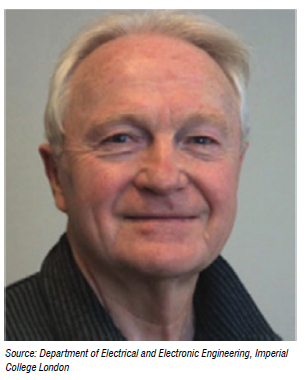
David Quinn Mayne
David M did not appear to be particularly interested in 'managing' the control group, or the people in it. On my first day at Imperial College, he said to me that there was an empty office at the other end of the passage where I could work, and that he would meet me for lunch -this was the sum total of my induction into the Department of Electrical Engineering at Imperial College! This apparent managerial indifference was subsequently inherited by David M's successor Mark Davis, but nothing ever seemed to go terribly wrong. When I eventually took over from Mark Davis, I was by then fully acquainted with the Group's hands-off managerial style. We all did our research and occasionally grumbled about too much teaching work. The group climate might have been intimidating to some, with the conversation frequently punctuated with 'Martingales', 'sequential quadratic programming', 'particle filters', 'non-smooth analysis', Nevanlinna-Pick theory and the 'Black-Scholes equation'. That said, it is hard to imagine a better place to work than in David M's control group.
David M served as the Head of Department at Imperial College from 1984 to 1988. This is another job I inherited from David M and was very proud to do so. At the end of my term, I moved to a professorship in Oxford where I stayed until my official retirement.
It is an interesting fact that David M was well known in the control systems community for decades, but he only became 'famous' after his retirement. Over the entirety of his career, he worked on numerous topics including multivariable control, optimisation, optimal control, adaptive control and nonlinear filtering. He authored over 350 papers and co-authored seminal books on differential dynamic programming and Model Predictive Control: Theory, Computation, and Design, which has been cited many thousands of times.4 In 1997, he began a collaboration with Jim Rawlings (from University of California, Santa Barbara) on a survey of model predictive control. Their work, which was published in 2000, became the most highly cited paper on model predictive control.5
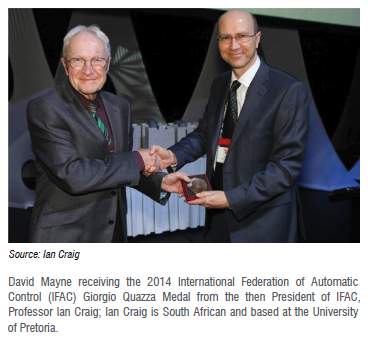
It was recognised in 2011 with the first International Federation of Automatic Control (IFAC) High Impact Paper Award.
David M's long career was littered with accomplishments that attracted a string of high honours. These include the Sir Harold Hartley Medal from the Institute of Measurement and Control; the Heaviside Premium from the Institution of Electrical Engineers that he received twice; the prestigious 2009 IEEE Control Systems Award; the 2014 Giorgio Quazza Medal (for a lifetime of contributions to control systems); and the International Federation of Automatic Control High Impact Paper Award. He was a fellow of the Royal Society, the Royal Academy of Engineering, the IEEE, and IFAC. In 1995, he received the degree of Doctor of Technology (honoris causa) from the University of Lund, Sweden.
David M's dedication to research has left an indelible mark on the academic and engineering communities around the world.
Declarations
I have no competing interests to declare. I have no AI or LLM use to declare.
References
1. Parisini T, Astolfi A. David Quinn Mayne, 1930-2024. IEEE Control Syst Mag. 2024;42(4):142-153. [ Links ]
2. Hansen LP. Nobel lecture: Uncertainty outside and inside economic models. J Polit Econ. 2014;122(5):945-987. https://doi.org/10.1086/678456 [ Links ]
3. Jacobson D. Optimal stochastic linear systems with exponential performance criteria and their relation to deterministic differential games. IEEE Trans Autom Control. 1973;18(2):124-131. https://doi.org/10.1109/TAC.1973.1100265 [ Links ]
4. Rawlings JB, Mayne DQ, Diehl MM. Model predictive control: Theory, computation, and design. 2nd ed. Madison, WI: Nob Hill Publishing; 2020. [ Links ]
5. Mayne DQ, Rawlings JB, Rao CV, Scokaert POM. Constrained model predictive control: Stability and optimality. Automatica. 2000;36(6):789-814. https://doi.org/10.1016/S0005-1098(99)00214-9 [ Links ]
 Correspondence:
David Limebeer
Email: David.limebeer@wits.ac.za
Published: 04 December 2024
