



Services on Demand
Journal

Article
 English (pdf)
 Article in xml format
 Article references
 Automatic translation
 Send this article by e-mail
Indicators
Related links
-
 Cited by Google
 -
 Similars in Google
Share

 Permalink
South African Journal of Science
On-line version ISSN 1996-7489Print version ISSN 0038-2353
S. Afr. j. sci. vol.121 n.5-6 Pretoria May./Jun. 2025
https://doi.org/10.17159/sajs.2025/21846
SCIENTIFIC CORRESPONDENCE
The Taung Child [Australopithecus africanus), the Plio-Pleistocene boundary and a supernova hypothesis
Francis Thackeray
Evolutionary Studies Institute, University of the Witwatersrand, Johannesburg, South Africa
ABSTRACT
SIGNIFICANCE:
The Taung Child is a fossilised hominin skull and jaw from the North West Province in South Africa. One hundred years ago it was described by Raymond Dart as the type specimen of Australopithecus africanus, a distant human relative. On the basis of biochronology, it has recently been estimated to be 2.58 million years old. This date coincides with the Plio-Pleistocene boundary. In terms of a supernova hypothesis, it is proposed that global cooling between about 3 and 2.6 million years ago is related to factors associated with a supernova less than 100 parsecs from the solar system.
Keywords: Taung Child, Australopithecus africanus, Plio-Pleistocene, South Africa, supernova
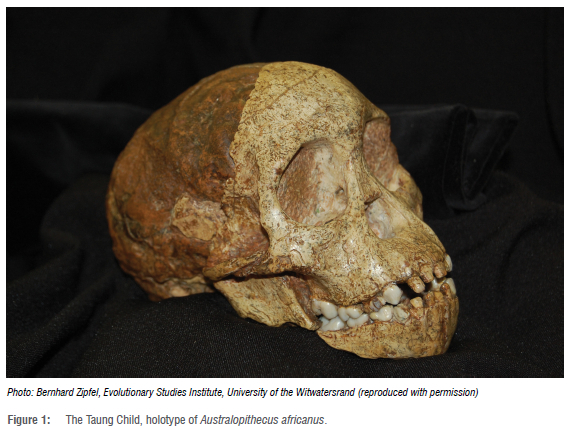
The Taung Child (Figure 1) is the nickname of the holotype of Australopithecus africanus, a Plio-Pleistocene hominin described by Raymond Dart in the pages of Nature 100 years ago.1 It has been dated at 2.58 Ma on the basis of ratios of dental dimensions, using lower first molars.2-4 Coincidentally, this is the date for the Plio-Pleistocene boundary5 at the time of a change in the earth's magnetic field from normal (Gauss Chron) to reversed (Matuyama Chron). The date of 2.58 Ma for the Taung Child2-4 is consistent with the lower age estimate of 2.6 Ma given by McKee6 based on a biochronological study of non-hominin fauna from the site of Taung.
Biologically, the magnetic reversal coincided with the extinction of certain species of Discoaster, star-shaped marine algae (nanoplankton) with calcareous exoskeletons, in particular the extinction of D. pentaradiatus and D. surculus. On the basis of such biological signals, the Plio-Pleistocene boundary is defined as the base of the Gelasian as represented in Sicily, corresponding to Marine Isotope Stage 103, astronomically tuned to an age of 2.58 Ma.7
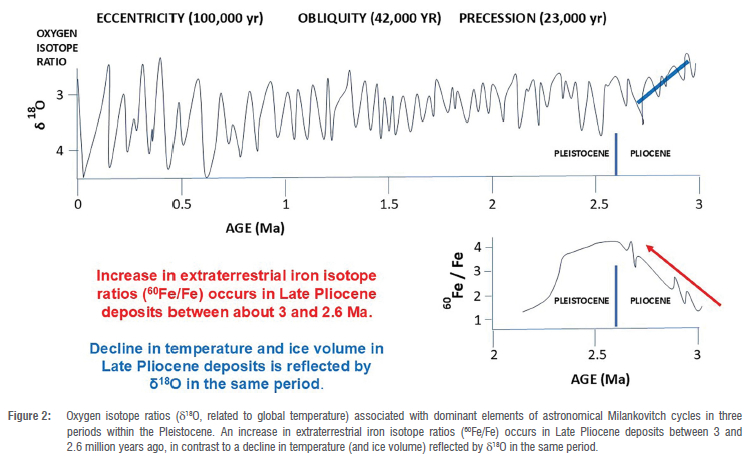
The boundary between the Pliocene and Pleistocene is shown in Figure 2 in relation to δ18O oxygen isotope ratios determined from marine calcareous foraminifera within a period of 3 Ma, showing dominant elements of astronomical Milankovitch cycles (eccentricity, obliquity and precession) in three intervals within the Pleistocene, associated with periodicities of 100 ka, 42 ka and 23 ka, respectively.8
Knie et al.9, Compagnucci et al.10, Deschamps and Mottez11 as well as Melott and Thomas12 explored a scenario of palaeoclimatic change and other events in the context of an isotope of iron (60Fe) in marine core deposits13 linked to a supernova14,15 less than 100 parsecs (pc) from the solar system. This scenario is related to an increase in high-energy galactic cosmic rays and a weakening of the shielding effect of the earth's magnetic field, associated with an increase in ionisation of the earth's atmosphere at least 1000 years in duration. 60Fe is a radioisotope (unlike δ18O) with a half-life of 2.6 Ma and therefore does not normally occur on earth. It is extraterrestrial in origin.
Excluding samples with 60Fe detector events of only 1 or 2, I have calculated a three-sample running mean for 60Fe/Fe ratios from east Indian Ocean cores published by Wallner et al.13 (their Table S4). There is a regular increase in the 60Fe/Fe ratio from about 3 to 2.6 Ma, followed by a decline (Figure 2).
It is evident from Figure 2 that an inverse relationship exists between 60Fe/Fe from Late Pliocene deep-sea sediments and δ18O from marine foraminifera. A decline in global temperature spanning at least 300 ka is reflected by oxygen isotope ratios preceding the Plio-Pleistocene boundary at 2.58 Ma. In terms of a supernova hypothesis, I attribute this decline in temperature, between about 3 and 2.6 Ma, to factors associated with a supernova in the same period.
It cannot be concluded that the death of the Taung Child circa 2.58 Ma was directly caused by the effects of a supernova remnant. This would be far-fetched. There is in fact evidence from talon marks on the skull that this individual, about 3 years old, was killed by an eagle.16 In my opinion, it is also too far-fetched to consider that the origin of bipedalism in Plio-Pleistocene hominins relates to the effects of a supernova event, including increased lightning and a subsequent increase of terrestrial fire associated with a change in African habitats from forest to woodland savanna.11 However, it is plausible at least to hypothesise that populations of A. africanus (at around the time of the Plio-Pleistocene boundary) were indirectly affected by factors associated with a supernova, including increased cloud cover (caused by an increase in cosmic-ray induced atmospheric radiation)17 contributing to global changes in temperature before and after 2.58 million years ago. Korschinek and Faestermann18 recognise that palaeoclimatic change may have contributed to the appearance of the genus Homo.
This note serves as a contribution to the celebration of the centenary of Raymond Dart's description of the Taung Child.1
Acknowledgements
I thank Robin Catchpole and two anonymous readers who helped to improve the manuscript.
Declarations
I have no competing interests to declare. I have no AI or LLM use to declare.
References
1. Dart R. Australopithecus africanus: The man-ape of South Africa. Nature. 1925;115:195-199. https://doi.org/10.1038/115195a0 [ Links ]
2. Thackeray F, Dykes S. Biochronological ages for South African Australopithecus and a Plio-Pleistocene African hominin lineage (1,5-3,5 Ma)? The Digging Stick. 2023;40(1):11-12. [ Links ]
3. Thackeray JF. A tribute to Yves Coppens: Age estimation of australopithecines in South Africa. Bull Mus Anthropol Préhist Monaco. 2023;10:23-27. [ Links ]
4. Thackeray F. How old are South African fossils like the Taung Child? New study offers an answer. The Conversation. 2024 July 15. Available from: https://theconversation.com/how-old-are-south-african-fossils-like-thetaung-child-new-study-offers-an-answer-234088 [ Links ]
5. Suc J-P Bertini A, Leroy SAG, Suballyova D. Towards the lowering of the Plio-Pleistocene boundary to the Gauss-Matuyama reversal. Quat Int. 1997;40, Art. #37. https://doi.org/10.1016/S1040-6182(96)00059-6 [ Links ]
6. McKee JK. Faunal dating of the Taung hominid fossil deposit. J Hum Evol. 1993;25(5):363-376. https://doi.org/10.1006/jhev.1993.1055 [ Links ]
7. Gibbard PL, Head MJ, Walker MJC, Subcommission on Quaternary Stratigraphy. Formal ratification of the Quaternary System/Period and the Pleistocene Series/Epoch with a base at 2.58 Ma. J Quat Sci. 2010;25:96-102. https://doi.org/10.1002/jqs.1338 [ Links ]
8. Hays JD, Imbrie J, Shackleton NJ. Variations in the Earth's orbit: Pacemaker of the Ice Ages. Science. 1976;194:1121-1132. https://doi.org/10.1126/science.194.4270.1121 [ Links ]
9. Knie K, Korschinek G, Faestermann T, Dorfi EA, Rugel G, Wallner A. 60Fe anomaly in a deep-sea manganese crust and implications for a nearby supernova source. Phys Rev Lett. 2004;93(17), Art. #171103. https://doi.org/10.1103/PhysRevLett.93.171103 [ Links ]
10. Compagnucci RH, Orgeira MJ, Sinito AM, Cappellotto L, Plastani S. Relationship among a supernova, a transition of polarity of the geomagnetic field and the Pliocene-Pleistocene boundary. In: Collantes M, Perucca L, Niz A, Rabassa J, editors. Advances in geomorphology and quaternary studies in Argentina. Springer Earth System Sciences. Cham: Springer; 2020. p. 1-39. https://doi.org/10.1007/978-3-030-22621-3_1 [ Links ]
11. Deschamps F, Mottez F. From cosmic explosions to terrestrial fires? A discussion. J Geol. 2020;128(4):389-391. https://doi.org/10.1086/709750 [ Links ]
12. Melott AL, Thomas BC. From cosmic explosions to terrestrial fires? J Geol. 2019;127(4):475-481. https://doi.org/10.1086/703418 [ Links ]
13. Wallner A, Feige J, Kinoshita N. Recent near-Earth supernovae probed by global deposition of interstellar radioactive 60Fe. Nature. 2016;532:69-72. https://doi.org/10.1038/nature17196 [ Links ]
14. Fields BD, Ellis JR, Binns WR, Breitschwerdt D, de Nolfo GA, Diehl R, et al. Near-Earth supernova explosions: Evidence, implications, and opportunities [preprint]. arXiv:1903.04589v1 [astro-ph.SR]. 2019. https://arxiv.org/abs/1903.04589 [ Links ]
15. Ertel AF, Fry BJ, Fields BD, Ellis J. Supernova dust evolution probed by deep-sea 60Fe time history. Astrophys J. 2023;947(2), Art. #58. https://doi.org/10.3847/1538-4357/acb699 [ Links ]
16. Berger LR, Clarke RJ. Eagle involvement in accumulation of the Taung Child fauna. J Hum Evol. 1995;29:275-299. https://doi.org/10.1006/jhev.1995.1060 [ Links ]
17. Christoudias T, Kirkby J, Stolzenburg D, Pozzer A, Sommer E, Brasseur GP, et al. Earth's atmosphere protects the biosphere from nearby supernovae. Commun Earth Environ. 2024;5, Art. #326. https://doi.org/10.1038/s43247-024-01490-9 [ Links ]
18. Korschinek G, Faestermann T. Recent nucleosynthesis in the solar neighbourhood, detected with live radionuclides. Eur Phys J A. 2023;59, Art. #52. https://doi.org/10.1140/epja/s10050-023-00956-2 [ Links ]
 Correspondence:
Francis Thackeray
Email: francis.thackeray@wits.ac.za
Published: 29 May 2025