



Services on Demand
Journal

Article
 English (pdf)
 Article in xml format
 Article references
 Automatic translation
 Send this article by e-mail
Indicators
Related links
-
 Cited by Google
 -
 Similars in Google
Share

 Permalink
South African Journal of Science
On-line version ISSN 1996-7489Print version ISSN 0038-2353
S. Afr. j. sci. vol.121 n.5-6 Pretoria May./Jun. 2025
https://doi.org/10.17159/sajs.2025/21600
COMMENTARY
A first report on the Nqweba bolide and meteorite fall event in the Eastern Cape Province, South Africa, on 25 August 2024
Roger L. GibsonI; Timothy CooperII; Leonidas C. VonopartisI; Carla DoddIII; Peter HersIV; Lewis D. AshwalI; Robyn SymonsI
ISchool of Geosciences, University of the Witwatersrand, Johannesburg, South Africa
IIComet Asteroid and Meteor Section Director, Astronomical Society of Southern Africa, Johannesburg, South Africa
IIIDepartment of Geosciences and Institute for Coastal and Marine Research, Nelson Mandela University, Gqeberha, South Africa
IVGarden Route Centre of the Astronomical Society of Southern Africa, Sedgefield, South Africa
ABSTRACT
SIGNIFICANCE:
Meteorite fragments, linked to a bolide sighted over the Eastern Cape Province on 25 August 2024, were retrieved by 9-year-old Eli-zé du Toit near Nqweba (formerly Kirkwood). The bolide was visible at 08:50:45 local time and was seen by observers over 500 km away. The sonic boom(s) from its high-speed transit and disintegration arrived at ground level minutes later and were reported by witnesses within ~100 km of its trajectory. The observer reports and the delay between the visual sighting and the arrival of the sound wave support data from NASA's Center for Near-Earth Object Studies that the bolide was a high-altitude phenomenon that disintegrated at an altitude of ~38 km over mountains west-northwest of Gqeberha.
Keywords: bolide, citizen science, heritage, meteorite, Nqweba
Introduction
Several million micrometeoroids enter Earth's upper atmosphere daily.1 Most are dust-to-pea-sized particles liberated from comets that have made at least one passage around the Sun; some are remnants of the protoplanetary disc of our solar system, while others are rock fragments from other planets, moons or asteroids that were blasted off their surfaces by meteorite impacts sometime in the past. Irrespective of their size, these meteoroids enter the atmosphere at exceptional velocities, which causes intense frictional heating that melts their surfaces and ionises the surrounding air molecules.2 The resultant streaks of light are termed meteors, colloquially called 'shooting stars'. It is estimated that more than 100 t of this cosmic debris enters Earth's atmosphere every day.1
The greater masses of meteoroids in the decimetre-to-metre size range allow them to penetrate deeper into Earth's atmosphere and 'burn' longer and brighter than a typical meteor. If a meteoroid's brightness equals or exceeds that of Venus (magnitude -4), it is classified as a fireball, and if the fireball disintegrates catastrophically in a bright flare it may be referred to as a bolide.2 Because fireball/bolide phenomena occur at extreme altitudes (of several tens of kilometres), ground-based observers in the vicinity only hear audible sounds from the atmospheric shock wave caused by the hypersonic passage several minutes after the fireball disappears.
The Nqweba bolide
Shortly before 09:00 on Sunday, 25 August 2024, residents of the coastal belt between Mossel Bay and Gqeberha, and as far north as the southern Karoo (Figure 1), were startled by a noise like rolling thunder (Van Wyk D 2024, oral communication, 28 August). The noise was unusual, both in terms of its duration, reported by some as lasting >30 seconds4, and because of the absence of thunderclouds. Locally, the sound was accompanied by ground tremors (Du Cellier B 2024, oral communication, 2 October).
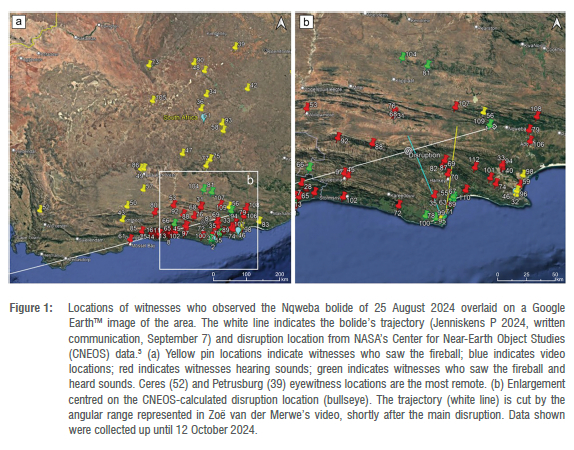
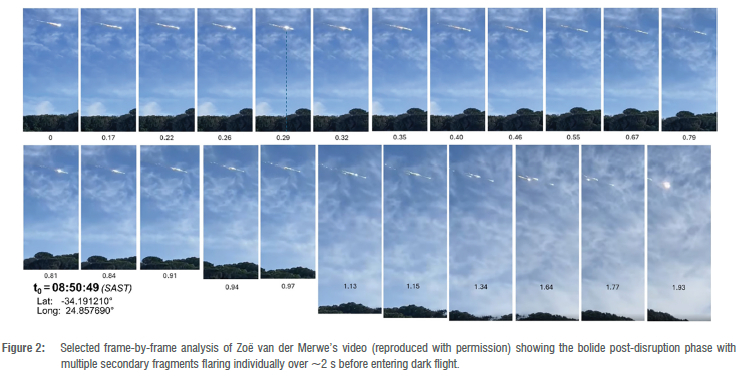
Concerned enquiries on social media platforms speculated on possible causes, such as an earthquake, explosive electrical or gas infrastructure failure, landslide or rockfall, or a large vehicle or aircraft crash in the vicinity. However, at 09:02, Zoë van der Merwe posted a video recorded near Cape St Francis (Figure 2) showing a cluster of rapidly moving, bright, silver-white fireballs in the sky that extinguished within seconds in the general vicinity of Gqeberha. Zoë and her friends, Stephen Sharp and MC Fereira, are part of a restricted group who both observed the bolide and experienced the ensuing sonic boom. Crucially, the metadata from Zoë's cell phone helped resolve the initial confusion about the bolide's location and trajectory (see below).
Activation of research networks
The Astronomical Society of Southern Africa (ASSA) collects, investigates and maintains a database of reports on fireballs as part of a global initiative to study atmospheric phenomena. Its website hosts a dedicated page5 where people can submit questions and record observations about astronomical or atmospheric events. The site also provides a definition of terms and a short document explaining what a meteorite is.6
The ASSA also collects fireball reports from social media pages. Approximately an hour after Zoë's post, Peter Hers of the ASSA Garden Route Centre noted several posts on various social media platforms (particularly Facebook) about the unfolding events. He immediately distributed the ASSA reporting guidelines on various Facebook groups along the Garden Route.
Simultaneously, Tim Cooper received a WhatsApp alert from ASSA member Paul Ludick about a report from a local Gqeberha radio station, Luister FM, that stated: "According to reports, a meteorite crashed somewhere at sea in the Eastern Cape area around 08:55 this morning." Tim's standard operating procedure in such cases is to verify whether the cause was a meteoroid or spacecraft debris. Spacecraft debris typically re-enters Earth's atmosphere at a very low angle and a slower velocity than meteoroids; therefore, re-entry events are characterised by a long-lasting fireball that commonly consists of many smaller pieces.7 In the absence of any satellite decays corresponding to the stated location and time, Tim concluded that a meteoroid was the more likely cause. By 13:56, Willie Koorts had posted on the Hennie Maas en sy Ruimtespan Facebook page, requesting any videos of the fireball, and tagging Tim Cooper.
Carla Dodd was the only one of our team to personally experience the sonic boom from the bolide, which happened while she was cycling in the Elands River valley (Pin 112, Figure 1). She initiated her investigation on her return at approximately 09:30 and received a copy of Zoë's video via WhatsApp at 12:59. In Johannesburg, Roger Gibson was alerted by a WhatsApp post at 10:03 from Sarah Wurz, a University of the Witwatersrand (Wits) archaeologist who heard the noise near Klasies River Mouth, and who shared Zoë's video. At this stage, as indicated by the Luister FM bulletin, anecdotal reports on social media considered the bolide to be moving out to sea, with possible splashdowns in Jeffreys Bay, west of Gqeberha (Figure 1).
As observer reports of the fireball phenomenon were submitted over the next few days, it emerged that the bolide had been seen from numerous sites in the Karoo, and as far afield as Petrusburg to the north and Ceres to the west, over 500 km from what was to prove the epicentre of the event (Figure 1a). Three additional confirmatory videos were found which established that Zoë's video recorded only the terminal phase of the bolide, which flared to its brightest intensity and disrupted into several smaller pieces seconds before she started recording.
The meteorite
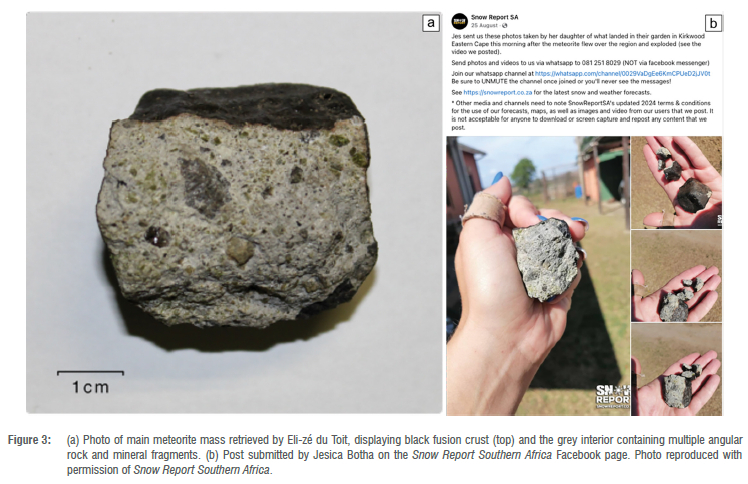
On the outskirts of Nqweba (formerly Kirkwood), ~100 km north of Cape St Francis (Figure 1), Eli-zé du Toit was sitting with her family on the porch of her grandparents' house shortly before 09:00 when they heard what sounded like a loud thunderclap, followed by a long rumbling noise. Soon thereafter, Eli-zé heard something falling through the large wild fig tree in the garden and, looking towards the tree, noticed a small object falling to the ground beneath it. She immediately went over to see what it was and found a rock smaller than her fist, with a shiny black crust that had partially broken open to reveal a light grey interior that "looked like concrete" (Du Toit E 2024, oral communication, 30 August; Figure 3a). When she picked it up, she noticed that "[the outside] was very hot, like a cup of tea when it's finished, [but] the inside was like ice" (Du Toit E 2024, oral communication, 30 August).
After seeing the unusual sample, Eli-zé's mother, Jesica Botha, started investigating online whether the stone might be a meteorite, and came across Zoë's video on the Snow Report Southern Africa Facebook group. She posted photos of the sample and several smaller fragments that they had found under the tree on the group at 12:01 (Figure 3b). The post was seen by Carla at 14:44, who established contact via Facebook.
Peter Hers contacted Jesica via WhatsApp at 15:39 after she posted her cell phone number online during her discussion with Carla. Discovering Carla's involvement, Peter contacted Carla at 16:14, after which he deferred to her regarding securing the meteorite. After finding the Snow Report images at 17:00, Roger Gibson notified Sityhilelo Ngcatsha of the South African Heritage Resources Agency via email of the need to institute a meteorite recovery protocol in terms of the National Heritage Resources Act (No. 25 of 1999). He also alerted fellow Wits meteorite researchers Lewis Ashwal and Leonidas Vonopartis, who joined the online search for further information. His attempts to reach Jesica were unsuccessful as she had turned off her phone owing to the unprecedented number of calls she received from across the world (by 17:00 the Facebook post had received more than 1.9 million views), but he managed to contact Carla at 18:39 via email and set up communication lines to secure and curate the fragments. The following morning, he reached out to Tim Cooper to coordinate the collection of the observational data on the bolide.
Consolidation of research networks
By Monday morning, 26 August 2024, Carla was able to arrange for the delivery of the rock fragments to Nelson Mandela University for proper storage and safekeeping. Upon receipt that evening, they were weighed and photographed and placed in a desiccator. The preliminary assessment was that they appeared to belong to a relatively rare class of stony meteorite called an HED achondrite breccia.8
Meanwhile, following a similar concern about the need to correctly preserve the meteorite and comply with the National Heritage Resources Act, Deon van Niekerk from Rhodes University submitted a permit request to the Eastern Cape Provincial Heritage Resources Agency. With the Wits researchers arriving in Gqeberha on 28 August, the Eastern Cape Provincial Heritage Resources Agency convened a meeting to co-ordinate efforts between the three universities. This was followed by a first inspection and macroscopic description of the meteorite by the team at Nelson Mandela University.
For the remainder of the week, while the astronomers continued collating observer reports on the bolide, the geosciences team traversed the area between Nqweba and Cape St Francis to understand the ground conditions for a search mission and met key witnesses to conduct more in-depth interviews. At the same time, contact was made with various specialists to cross-check instrumental data on the bolide from, inter alia, NASA's global fireball monitoring network, the Comprehensive Nuclear Test Ban Treaty Organisation's infrasound station network, and the Council for Geoscience's local seismometer network.
Engaging citizen science: Connecting the dots through social media noise
The bolide event received a brief mention on the Sunday evening national TV news programmes on 25 August, which reported that objects had fallen into the sea.9 No mention was made of Eli-zé's find and no expert opinion was solicited. To address this, a joint press statement was drafted and released on Monday, 26 August.10 This prompted numerous calls for print and audiovisual media interviews that extended into the evening and the following morning. As part of the science engagement process, the team was clear in interviews that information was still being gathered that would further clarify various aspects of the event, but the recovery of suspected meteorite fragments was not broadcast at that stage. This was only revealed at a joint live-streamed press conference on 3 September.11
From the outset, multiple social media comments and media reports suggested that the bolide had travelled out to sea, and this was reinforced by the Sunday evening SABC News interview that reported an eyewitness seeing fragments splashdown in Jeffreys Bay.9 With Eli-zé's testimony inextricably linking the Nqweba stone to the bolide, the challenge was to reconcile fall sites ~100 km apart along a seaward (north to south) trajectory with the emerging observer reports and NASA computational data (Jenniskens P 2024, written communication, 7 September).
Bolides are rare, fleeting phenomena, with seemingly disconnected audio and visual effects that can disorientate witnesses. As a result, reports from witnesses of their proximity and duration are typically highly variable, making it difficult to extract quality data. However, as the body of observer reports grew over the first week, a pattern emerged that indicated that ground-level sound effects followed a path stretching in an east-northeast direction from Mossel Bay, inland towards Nqweba (Figure 1), rather than out to sea. A broadly west-to-east trend was also corroborated by several excellent remote-observer reports from near Ceres and the Karoo, and from coastal observers who reported the bolide passing to their north (Figure 1).
The confirmation of an east-northeast trajectory was obtained when Zoë van der Merwe and her friends were interviewed on site on 29 August, and it was revealed, first, that her video arc commenced facing northwest and ended slightly east of due north (Figure 1b). Second, metadata from Zoë's phone established a gap between her video of the bolide and a second video that she began recording shortly after the group started experiencing ground vibrations and sounds from the sonic boom, which commenced 261 s after her first recording. With sound taking ~3 s to travel 1 km in air, this was consistent with the energy source having been located up to 80-90 km from their location. The cumulative evidence from these investigations thus indicated that the bolide was moving inland and not out to sea, and marked the Nqweba area as the focal point in the search for further meteorites.
The Nqweba bolide in context
Quantitative global data on bolides have been available in the public domain since 19883, although not all significant events are captured by satellite and ground sensor networks. (An example of the latter is the 27 July 2002 daytime bolide over the Thuathe region of Lesotho, which dispersed more than 1600 meteorite fragments over an 8 x 4 km strewn field.12)
Despite its high international social and news media coverage, the Nqweba bolide was actually the 20th bolide recorded globally in 2024 and one of the smallest of 2024, with a total energy release equivalent to 92 t of TNT.3 Such an energy release is consistent with the original meteoroid having had a diameter in the 1 m size range.13
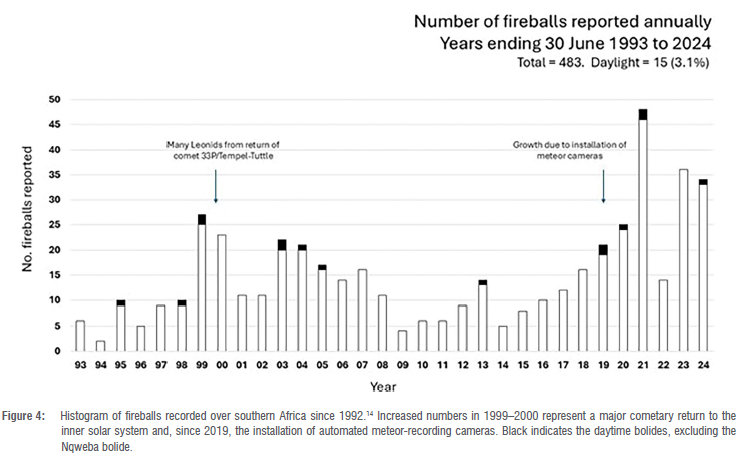
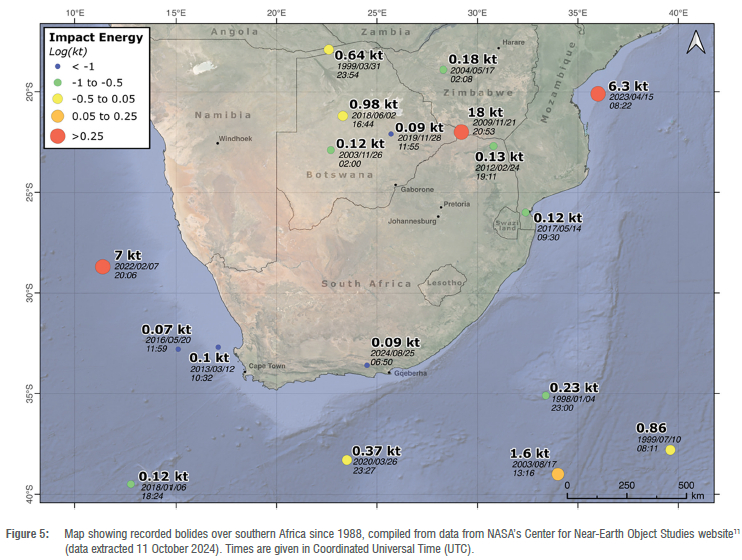
Since 1992, Tim Cooper has documented 493 reports of fireballs from South African based astronomers and members of the public, of which only 3% are daytime sightings (Figure 4). The reports are numbered (the Thuathe fireball is #116)14 and published in the Monthly Notes of the ASSA. However, NASA's Center for Near-Earth Object Studies (CNEOS) recorded only two noteworthy fireballs over South Africa prior to the Nqweba event3 (Figure 5). The largest southern African bolide recorded by CNEOS occurred shortly before 22:55 local time on 21 November 2009 (Figure 5). It was captured by numerous CCTV cameras in Gauteng and Limpopo provinces before it disintegrated over the Limpopo River region.15 Despite an intensive search in the rugged Tuli region of southeastern Botswana, no meteorites were recovered. At an estimated 18 kt TNT equivalent3, its energy release was 200 times larger than the Nqweba bolide.
Meteorite recoveries in South Africa are disproportionately linked to fireball events, with 21 out of 51 known South African meteorites being classified as falls.16 Khiri et al.17 reported 75% of all observed African meteorite falls as occurring during the day. The last South African fall recovered after a fireball was in Lichtenburg in 197316, but no details of the fireball survived. The combination of technological advances and the timing of the Nqweba event makes it South Africa's most completely documented event and an opportunity to demonstrate the potential of citizen science to collect critical data and recover meteorites.
Looking forward, South Africa is steadily increasing its fireball data collection capabilities. Currently, it has 16 cameras running under the auspices of the NASA SETI Institute Cameras for Allsky Meteor Surveillance network (CAMS) and a further 10 cameras that operate as part of the Global Meteor Network (4 of which have been installed in Western Cape schools to promote STEM activities). These are already greatly enhancing nighttime fireball detection rates (Figure 4); however, these low-light cameras function best at night and are, thus, disabled during daylight hours. Unless a meteorite stone is actually observed falling, as was the case with Eli-zé, finding meteorites linked to a fireball is not easy. Ground search parameters are better constrained by using data from multiple fixed cameras that are used to triangulate the bolide's exact trajectory.18 These cameras will typically be located hundreds of kilometres from the bolide site. For nighttime bolides, the changing position of shadows caused by the moving bolide can also be used where no direct footage of the sky is available.18 Thereafter, wind and other atmospheric factors need to be considered in predicting the strewn field for subsequent ground searches, which still may have to extend over many tens of square kilometres.
Meteorites and South African Law
Meteorites are the most primitive solid objects in our solar system and are, thus, time capsules that allow scientists to study the processes of planetary birth and development.19 Therefore, they constitute the most ancient objects of our common heritage. In promulgating the National Heritage Resources Act (No. 25 of 1999), the South African government included meteorites found within the country's borders as a protected heritage resource, to be treated similarly to fossils and archaeological and cultural sites and objects. They cannot thus be collected without a permit, nor can they be traded or owned. Similar protected meteorite heritage laws exist in Namibia and Botswana and several countries worldwide. This approach is increasingly being adopted in other countries to protect natural heritage and prevent the drain of significant meteorites into private or large institutional collections overseas.20 A useful synopsis and copy of the Act can be found on the ASSA website.21
The multi-institutional geosciences team has received a permit to collect, temporarily store, and conduct scientific research on the Nqweba meteorite for a maximum period of 3 years. Owing to the reported arrival of several international meteorite hunters in the area following the bolide event, the team is withholding reporting any further developments on the search for more meteorite fragments. This protects the strewn field from unpermitted collection and allows the team to try to record its extent, from which additional scientific data can be extracted.12
Concluding remarks
The Nqweba bolide is an example of a regularly occurring natural phenomenon involving rock fragments in the metre-size range that enter Earth's atmosphere at hypervelocity. Interaction with the upper atmosphere caused frictional heating of the meteoroid's surface sufficient to melt its exterior, producing a bright fireball lasting several seconds. The extreme velocity (20.1 km/s4) of the Nqweba bolide also created an atmospheric shock wave which spread downwards and outwards and was intense enough to be heard and felt at ground level, although no reports of damage were received. Ultimately, the meteoroid remnant disintegrated into multiple smaller pieces.
The timing of the Nqweba bolide on a Sunday morning in a largely cloudless sky meant that it was witnessed by hundreds of people who were outside enjoying the pleasant weather. Thousands more heard or felt the subsequent sonic boom. Social media were instrumental in facilitating the mass dissemination of information that allowed scientists to rapidly respond to the event, collect valuable observer reports and identify the potential strewn field. The scientific team intends to maintain communication channels to update the public on further progress on the project.
Acknowledgements
Dr Daniel Cunnama (Science Engagement Astronomer at the South African Astronomical Observatory) fielded numerous initial requests for astronomers to give TV interviews and Dr Peter Jenniskens (NASA Ames Research Center and SETI Institute) continually updated the bolide team on NASA data and calculations. The AEON-ESSRI Research Group at Nelson Mandela University provided logistical and personnel support for the initial fieldwork. The Eastern Cape Provincial Heritage Resources Agency is thanked for expediting the permit requests and facilitating the establishment of the meteorite team. Much of this work would not have been possible without the enthusiastic response to our calls for witness accounts from the public.
Funding
We thank Nelson Mandela University, Rhodes University and the University of the Witwatersrand for providing ad hoc funding support to undertake the initial responder activities, and for the support of the Public Relations and Media departments in assisting with the public science engagement aspects. R.L.G. receives funding from the South African National Research Foundation (NRF; grant no. SRUG200503519568) and C.D. is funded through an NRF Postdoctoral Grant (grant no. PSTD2304129508).
Declarations
We have no competing interests to declare. We have no AI or LLM use to declare. All authors read and approved the final manuscript.
References
1. Plane JMC. Cosmic dust and the Earth's atmosphere (Vilhelm Bjerknes Medal Lecture) [webpage on the Internet]. c2017 [cited 2024 Nov 01]. Available from: https://ui.adsabs.harvard.edu/abs/2017EGUGA..1919242P/abstract [ Links ]
2. Koschny D, Borovicka J. Definitions of terms in meteor astronomy. WGN. 2017;45(5):91-92. [ Links ]
3. NASA Center for Near Earth Object Studies (CNEOS). Fireballs [webpage on the Internet]. No date [cited 2024 Oct 22]. Available from: https://cneos.jpl.nasa.gov/fireballs/ [ Links ]
4. Koekemoer F. Post on Hennie Maas se Ruimtespan (Sterre en Planete) [private Facebook group]. 2024 August 25. Available from: https://www.facebook.com/groups/sterreenplanete/posts/3413059562171820/?comment_id=3413065688837874&_cft_[0]=AZX-MhrxaMD3IVkzsv5elidZ2hLGdXfPZ8S8Zu2-Wm4dg0oL3DdRTsvgYyi6CD2vtOsdZdGFd_aAqBpr0n4ihNhVFVuu0-uB3nzzcI6xNjAlrluzbOjm8mcA5ni0HBqomisKa95-8L9G0jYDg-06IS2W&__tn_=R]-R [ Links ]
5. Astronomical Society of Southern Africa. Report a sighting [webpage on the Internet]. No date [cited 2024 Oct 29]. Available from: https://assa.saao.ac.za/contact-us/report-a-sighting/ [ Links ]
6. Astronomical Society of Southern Africa. ASSA policy - If you find something which looks like a meteorite [document on the Internet]. No date [cited 2024 Oct 29]. Available from: https://assa.saao.ac.za/wp-content/uploads/sites/23/2021/02/Meteorites-ASSA.pdf [ Links ]
7. Aerospace. Did I see a meteor or a reentry? [webpage on the Internet] No date [cited 2024 Oct 29]. Available from: https://aerospace.org/article/what-does-reentry-look-like [ Links ]
8. Mittlefehldt DW. Asteroid (4) Vesta: I. The howardite-eucrite-diogenite (HED) clan of meteorites. Geochemistry. 2015;75(2):155-183. https://doi.org/10.1016/j.chemer.2014.08.002 [ Links ]
9. SABC News. Meteorite spotted in E Cape: Tim Christy weighs in [YouTube video]. c2024 [cited 2024 Nov 01]. Available from: https://www.youtube.com/watch?v=FV1cPADKSWc [ Links ]
10. University of the Witwatersrand. "Space junk" that fell in Eastern Cape was a car-size meteorite [webpage on the Internet]. c2024 [cited 2024 Nov 01]. Available from: https://www.wits.ac.za/news/latest-news/research-news/2024/2024-08/space-junk-that-fell-in-eastern-cape-was-a-car-size-meteorite.html [ Links ]
11. Nelson Mandela University. Meteorite press conference [YouTube video]. c2024 [cited 2024 Nov 01]. Available from: https://www.youtube.com/watch?v=wC8oXegqvSg [ Links ]
12. Reimold WU, Buchanan PC, Ambrose D, Koeberl C, Franchi I, Lalkhan C, et al. Thuathe, a new H4.5 chondrite from Lesotho: History of the fall, petrography and geochemistry. Met Planet Sci. 2004;39:1321-1341. https://doi.org/10.1111/j.1945-5100.2004.tb00949.x [ Links ]
13. Marcus R, Melosh HJ, Collins G. Earth Impact Effects Program [webpage on the Internet]. c2024 [cited 2024 Nov 01]. Available from: https://impact.ese.ic.ac.uk/ImpactEarth/ImpactEffects/ [ Links ]
14. Cooper T. The Thuathe fireball of 21 July 2002 is Event 116 in the Southern African Fireball Catalogue. Mon Not Astron Soc South Africa. 2003;62:156. [ Links ]
15. Roelofse F, Saunders I. A first report on meteor-generated seismic signals as detected by the SANSN. S Afr J Sci. 2013;109(5/6), Art. #2012-0022. https://doi.org/10.1590/sajs.2013/20120022 [ Links ]
16. The Meteoritical Society. The Meteoritical Bulletin Database [webpage on the Internet]. No date [cited 2024 Oct 29]. Available from: https://www.lpi.usra.edu/meteor/ [ Links ]
17. Khiri F, Ibhi A, Saint-Gerant T, Medjkane M, Ouknine L. Meteorite falls in Africa. J Afr Earth Sci. 2017;134:644-657. https://doi.org/10.1016/j.jafrearsci.2017.07.022 [ Links ]
18. Jenniskens P Gabadirwe M, Yin Q-Z, Proyer A, Moses O, Kohout T, et al. The impact and recovery of asteroid 2018 LA. Met Planet Sci. 2021;56(4):844-893. https://doi.org/10.1111/maps.13653 [ Links ]
19. Jones RH. Meteorites and planet formation. Rev Mineral Geochem. 2024; 90(1):113-140. https://doi.org/10.2138/rmg.2024.90.04 [ Links ]
20. Schmitt DG. The law of ownership and control of meteorites. MetPlanet Sci. 2002;37(S12):B5-B11. https://doi.org/10.1111/j.1945-5100.2002.tb00897.x [ Links ]
21. Astronomical Society of Southern Africa. About meteors [webpage on the Internet]. No date [cited 2024 Nov 01]. Available from: https://assa.saao.ac.za/how-to-observe/meteors/ [ Links ]
 Correspondence:
Roger Gibson
Email: roger.gibson@wits.ac.za
Published: 29 May 2025
Funding: Nelson Mandela University, Rhodes University, University of the Witwatersrand, South African National Research Foundation (SRUG200503519568, PSTD2304129508)