




Services on Demand
Journal

Article
 English (pdf)
 Article in xml format
 Article references
 Automatic translation
 Send this article by e-mail
Indicators
Related links
-
 Cited by Google
 -
 Similars in Google
Share

 Permalink
South African Journal of Science
On-line version ISSN 1996-7489Print version ISSN 0038-2353
S. Afr. j. sci. vol.121 n.5-6 Pretoria May./Jun. 2025
https://doi.org/10.17159/sajs.2025/18416
RESEARCH ARTICLE
The state of artificial intelligence research in South Africa
Anastasslos Pouris
Institute for Technological Innovation, University of Pretoria, Pretoria, South Africa
ABSTRACT
This article presents the results of a scientometric investigation of the field of artificial intelligence (AI) in South Africa over the period 2013-2022. Such investigations inform policy and research management development and assist researchers to identify topics for investigation, collaborating organisations, etc. The Liu et al. methodology (Scientometrics 2021;126:3153-3192) was used for the identification of AI documents. The approach is appropriate for a growing discipline with constantly expanding terminology. The activity index was estimated to reveal the contribution of South African researchers in the field of AI, taking into account the country's scientific size and the world's involvement in the field. Finally, a content analysis of the titles of South African publications was employed to reveal the domains of emphasis and weakness within South African research in the field.
SIGNIFICANCE:
The field of AI is growing in South Africa. During 2022, South Africa produced over 1000 relevant publications in the field of AI. The activity index revealed that South Africa should substantially increase this contribution in order to make a contribution proportional to its scientific size and the world's average productivity in the field. The majority of the AI publications were produced by South African universities, and spread among several universities. Comparisons with prolific organisations internationally show that South Africa produces only a fraction of the research produced worldwide. international funders have been found to be important in the field but may not be appropriate for a research field close to commercialisation. The content analysis revealed the lack of investigations related to coordination and alignment of AI research and national policy.
Keywords: South Africa, artificial intelligence, policy, scientometrics
Introduction
Artificial intelligence (AI) has attracted national and international attention, promising to revolutionise the workplace, the economy and even our personal lives. it has its roots in philosophy, mathematics, computation, psychology and neuroscience1 and is becoming the 'new normal' in both manufacturing and service industries2.
There is no acceptable definition for AI. Probably the broader one is by Nilsson3 who maintains that "artificial intelligence _ is concerned with intelligent behaviour in artefacts".
Currently, high-profile AI applications fall within a variety of domains, i.e. manufacturing robots; advanced web search engines such as Google Search; autonomous cars like Tesla; recommendation systems that analyse user data to provide personalised recommendations (used by YouTube, Amazon and Netflix); understanding human speech and performing services for individuals (such as Siri and Alexa); generative or creative tools (ChatGPT Ernie bot and AI art); automated decision-making; and competing at the highest level in strategic game systems (such as chess and Go).
According to Fortune Business insight4, the global AI market size was valued at USD428 billion in 2022 and was projected to grow from USD515.31 billion in 2023 to USD2025.12 billion by 2030 - a compound annual growth rate of 21.6%.
This article aims to provide information related to the state of AI research in South Africa. Scientometrics is usually the approach used in the effort to identify the state of a scientific topic or discipline in a particular context (e.g. in a country or in a research organisation). Scientometrics has been used widely in the context of South Africa and internationally.5-7
It is emphasised that scientometrics is a scientific field and bibliometrics a sub-field within the main field of scientometrics. In this article, the two words are used interchangeably.
Analyses were undertaken for the period 2013-2022 (2022 is the most recent year for which complete data were available). in this approach, more than 100 keywords were used as search terms to search the Web of Science (WoS) database (Appendix 1 in the supplementary material), which also includes 19 journals that specialise in AI (Appendix 2 in the supplementary material). The search words were chosen to qualify in terms of recall and precision - the necessary preconditions for the validity of a scientometric investigation.
Literature review
AI has attracted the attention of researchers and multilateral organisations like the Organisation for Economic Co-operation and Development (OECD), which have investigated the field scientometrically.
OECD8 has identified and measured AI-related developments in science, algorithms and technologies using information from scientific publications, open source software and patents. The major findings were: (1) since 2015, AI-related publications have increased by 23% per year; (2) from 2014 to 2018, AI-related open source software contributions grew at a rate three times greater than other open source software contributions; and (3) AI-related inventions comprised, on average, more than 2.3% of iP5 patent families in 2017. China's growing role in the AI space was also identified.
Njei et al.9 investigated AI for health care in Africa. They identified 26 relevant articles published by 178 authors from 31 countries. The most prolific African countries were South Africa, Nigeria and Ghana.
Liu et al.10 developed a scientometric approach in order to resolve the issue of searching for AI using only the term 'artificial intelligence'. Their approach started with benchmark records of AI captured by using a core keyword and specialised journal search. Subsequently, they extracted candidate terms from high-frequency keywords of benchmark records, refined keywords and complemented their methodology with the journal subject category 'artificial intelligence'.
Vasquez et al.11 presented a scientometric analysis to answer the question: what is the academic overview of the application of AI in agriculture? They covered the period 2000-2019 using data from the WoS and Scopus databases. They identified that the countries with the highest number of publications were China, the USA, India and Australia.
Pereira et al.12 reviewed 60 papers exploring the relationship between AI and workplace outcomes and examined the interface between AI and workplace outcomes, drawing on different levels of analysis, disciplines and organisational functions.
A scientometric analysis of scientific productivity of AI research in India13 included a scientometric analysis of publications related to AI research in India during 2009-2018. It evaluated the scientific productivity, collaboration, citation impact and research focus of Indian AI researchers and compared them with those of other countries.
A variety of other investigations have been published focusing on particular topics. Chatterjee et al.14 investigated wind-turbines; Pliego-Marugán et al.15 Reviewed 190 papers in the last five years under investigation, presenting the challenges and technological gaps in utilising artificial neural networks in time-series forecasting of certain parameters (i.e. wind speed and turbine power), with a perspective on fault diagnosis and prognosis. Maldonado-Correa et al.16 reviewed 37 articles on applying AI techniques for short-term energy forecasting and others.
Approach
Undertaking a scientometric investigation requires two decisions: the first is to identify which database should be utilised for the investigation, and the second is which approach should be used to identify the relevant documents.
The WoS databases (Science Citation Index Expanded, Social Sciences Citation Index and Arts and Humanities Citation Index) are the most often used for these types of investigations.
The combined databases cover the most prestigious journals in the world in all fields of research endeavours comprehensively, and constitute a unique information platform for the objectives of this effort.
The most important advantage of the usage of WoS-indexed journals is that they constitute the most important (in terms of impact) journals in the world. Furthermore, an important advantage is that the database includes the particulars of all authors and co-authors and that the methodology to be used was applied to the same database.
South Africa's Department of Higher Education and Training has identified the WoS-indexed journals for subsidy purposes and some universities give incentives to their researchers to publish in WoS-indexed journals. Consequently, it is expected that the databases selected will cover not only the most important South African AI-related research but the majority of it as well.
A literature review1 was undertaken, and it was identified that different approaches are used for scientometric analysis of the discipline of AI. The approaches range from the use of the term 'artificial intelligence' to searching journals specialising in AI, to the utilisation of a variety of related keywords. In the last approach, the challenge is that, in order to fully evaluate the effectiveness of a model, one must examine both precision and recall. Unfortunately, precision and recall are often in tension, in that improving precision typically reduces recall and vice versa.
Recall refers to the proportion of actual positives that were identified correctly, whilst precision is used to answer the question: what proportion of positive identifications was actually correct? To state it differently, precision is of critical importance. If it is ignored, then the search engine will include terms that are only partially (if at all) relevant to the subject matter of the investigation and will over-inflate the identified population.
Liu et al.10 developed a particular methodology for the bibliometric analysis of AI and compared it with the methodologies of other researchers whose approach appeared to better cover the field of AI. There were four key steps in the procedure used to build the search strategy. In the words of the authors:
First, we generate a benchmark set of artificial intelligence publications. We use the core lexical query 'artificial intelligence' as a topic search as well as a query of specialised artificial intelligence journals as a source search. Second, from these benchmark records, we extract 'Author Keywords' and 'Keywords Plus' and derive the frequencies of these keywords. We confirm the precise meanings of high-frequency keywords from descriptions found in online sources. This process leads to a retained list of high-frequency 'candidate keywords' related to artificial intelligence. Third, to maintain a balance between recall and precision, we test and refine this set of terms through co-occurrence analysis and manual checking identification. Fourth, we augment our strategy by combining the final term set with the use of a subject category search.1
Liu et al.10 compared their results with those of Gao et al.17, Zhou et al.18 and WIPO19. Liu et al. identified all articles by Gao et al.17 and just over 78% of the records captured by Zhou et al.18, whilst the WIPO19 approach delivered a larger number of outputs. Liu et al.10 Suggested that more than half (54%) of the WIPO's search results comprised records not included in Liu's definition of 'artificial intelligence'. They argued that several generic statistical and mathematical terms such as 'logistic regression', 'hidden Markov model' and 'fuzzy logic' are included by WIPO but excluded in Liu et al.'s approach. These three terms returned 195 477 article records in the search period.
Liu et al.'s10 approach was used in this study. Hence, the findings are compatible with those of Liu et al. and all other studies that adopted the same approach. Moreover, the approach does not need to test issues of recall and precision. The list of search terms utilised and the names of the included journals appear in Appendices 1 and 2, respectively, in the supplementary material. It is emphasised that the included journals were covered in their totality and specialise in AI, and hence, their editors make sure that all articles published are relevant to AI.
As content analysis is a well-established technique utilised in the areas of intelligence, marketing, document analysis and others, this methodology was used to analyse the titles of the published research in order to identify the main focus of the AI research by South African researchers.
A global bibliometric view of artificial intelligence (2013-2022)
According to the WoS, 1 536 741 documents on the subject of AI were published in the past 10 years. Table 1 shows the top scientific disciplines that attract research documents related to AI. The various branches of computer science dominate the domain, followed by engineering and mathematics. It should be mentioned that articles may be categorised into more than one scientific discipline.
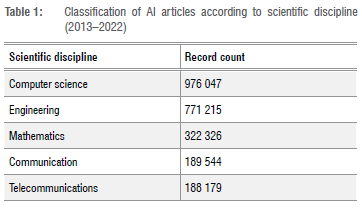
Table 2 shows the most productive nations in the field of AI research, as well as South Africa's AI research output. The People's Republic of China dominates with 311 712 documents, with the United States of America ranking second with 229 911 documents and India third with 77 530 documents. South Africa published 4610 papers during this period.
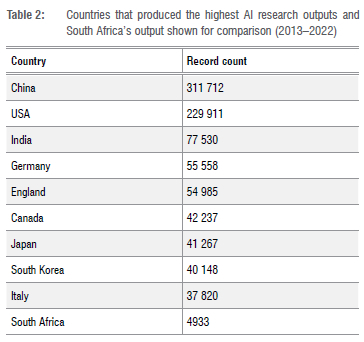
Table 3 shows the main funders of AI internationally.
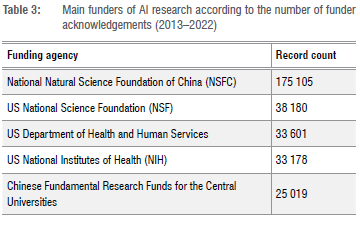
With over 175 000 acknowledgements, the National Natural Science Foundation of China tops the list of funders, with the US National Science Foundation (NSF) ranking second at approximately 38 000 acknowledgements.
Artificial intelligence in South Africa's academic domain (2013-2022)
Table 4 shows the number of South African publications related to AI during the period under consideration. This production placed the country 46th in the world. The field grew 7.8-fold during this period -from 137 publications in 2013 to 1071 publications in 2022.
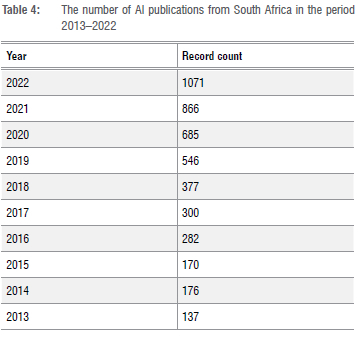
Table 5 highlights the scientific disciplines that have been prioritised in the field of AI in South Africa. The first two fields are nearly identical to those on the worldwide list (Table 1). It should be noted that the field 'Energy fuels' appears in the fifth position in South Africa, while internationally the position is occupied by the field of 'Telecommunications'. Similarly, 'Environmental sciences and ecology' occupies the third position in South Africa, while in the international list the position is occupied by the field of 'Mathematics'.
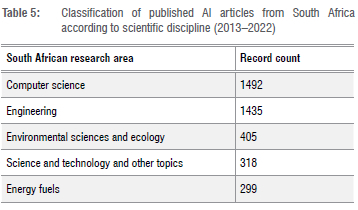
Table 6 shows the main producers of AI-related publications in South Africa. The University of Johannesburg is at the top of the list with 856 publications, followed by the University of KwaZulu-Natal with almost the same number of publications. It is noticeable that the annual number of publications by the various universities is relatively small, with the top universities in the field in the world (e.g. Harvard) producing twice as many publications as all the South African universities together. It can be argued that this is the result of the pluralistic management approach used in the national system of innovation.
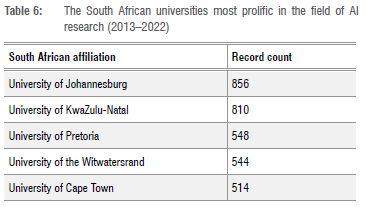
Table 7 shows the main funders of AI research in South Africa, with the National Research Foundation (NRF) of South Africa topping the list with 366 acknowledgements. It is noteworthy that all other funders mentioned by the authors from South Africa are international organisations in the UK, China and the USA.
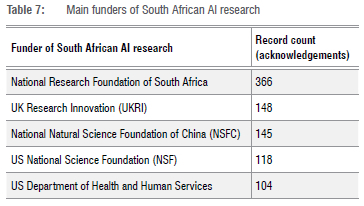
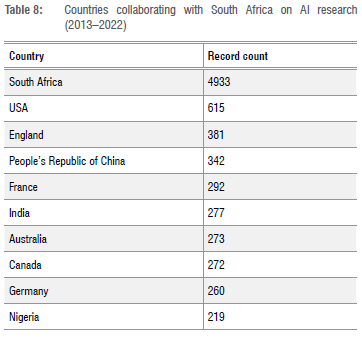
Table 8 shows the countries that collaborated with South Africa in the field of AI research, with the USA, England and China being the main collaborating countries.
The activity index was estimated in order to assess the South African production of AI research outputs compared with the worldwide production. The activity index is the country's share in the world's publication output in the given field divided by the country's share in the world's publication output in all science fields. Hence, the index takes cognisance of the country's scientific size vis-à-vis the rest of the world.
An activity index of 1 indicates that the country's research effort in the investigated field corresponds precisely to the world average. An activity index greater than 1 reflects a higher than average effort dedicated to the field under investigation, and an activity index lower than 1 reflects a lower than average effort in the field.
The relevant numbers for the estimation of the activity index are : South African AI documents = 4933; South African total documents = 238 973; world AI documents = 1 536 741; and world total documents = 30 861 543.
Using the above numbers, the activity index for AI research in South Africa for the period 2013-2022 is 0.42, meaning that South Africa is producing well below the world average for AI research.
A content analysis of the titles of AI articles by South African authors was undertaken for the period 2020-2023 in order to provide indicators of the main topics, trends and challenges in AI research in the country.
Table 9 lists the most often appearing words in the titles of publications on AI research from South Africa.
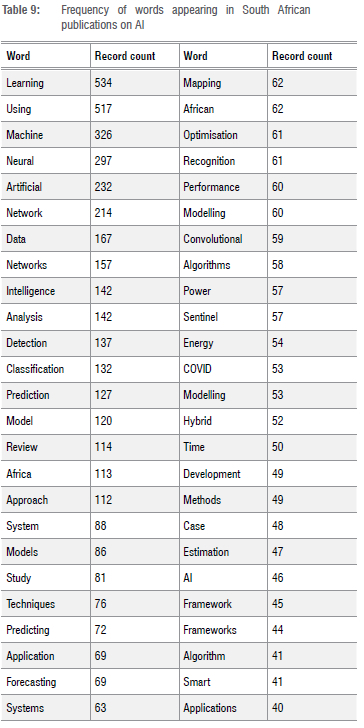
The most frequently used terms ('learning', 'using', 'machine', 'neural', 'artificial' and 'network') suggest that machine learning and neural networks are the dominant methods and techniques of AI research in the country. These methods are used internationally for issues of detection, classification, prediction, forecasting, recognition and optimisation.
Similarly, the terms 'data', 'model', 'models', 'modeling' and 'modelling' indicate that data-driven and model-based approaches are also prevalent in AI research in South Africa.
The terms 'education', 'health', 'agriculture', 'security', 'power', 'energy', 'smart' and 'development' indicate the main domains and sectors to which AI research applies in South Africa. Similarly, the terms 'Africa', 'African', 'COVID' and 'sentinel' reflect the specific contexts (regional and continental perspectives) and challenges (e.g. COVID) that AI research in South Africa addresses.
The identified focus on the above terms also reveals the lack of investigations into topics such as natural language processing and computer vision and on issues related to coordination and alignment of AI research and national policy (with a scarcity of terms such as regulation, standardisation and certification).
Discussion and main findings
These findings on the state of AI research in South Africa are important for policymaking and management of the support and funding of the field in the country and for research planning by the relevant researchers.
The investigation identified the number of documents produced during the 2013-2020 period and calculated the activity index (which shows the extent to which South Africa produces the number of AI documents expected by the total number of research documents in the country in relation to the international production of AI documents). Furthermore, the main funders of AI research and the main productive organisations in the field were identified. Finally, a content analysis identified the focus areas of AI research in the country.
The field expanded substantially, in terms of the number of relevant documents, during the 10 years under investigation, from 137 publications in 2013 to 1071 publications in 2022. it is interesting to note that the South African government has not advertised any support for the field, nor made any announcements about AI. The growth in the field of AI is the result of the recognition of the importance of the field by individual researchers in the country. However, an estimation of the field's activity index reveals that the field produced only 40% of what was expected during this period, according to the country's scientific size and the international performance of the field.
It was identified that South African research in the field is funded substantially by international funders. While this may be indicative of the quality and recognition of the South African researchers, it is important to note that foreign funders will not support the national interest, particularly on a topic which appears to be close to commercialisation. The government is expected to also be aware of the socio-economic benefits of the emerging technologies and support them appropriately.
It should also be noted that the top universities in the world (e.g. Harvard) produced as many publications in the field as all South African universities produced together. it can be asserted that this is the result of the pluralistic management approach used in the national system of innovation.
It can also be argued that the followed approach creates diseconomies of scale. Universities could resolve the issue through collaboration (nationally and internationally), although the best approach for the local system could be through central coordination.
Content analysis of the titles of the South African articles on AI identified that machine learning and neural networks are the dominant methods and techniques of AI research in the country.
The scarcity of terms such as regulation, standardisation and certification reveals the lack of investigations related to coordination and alignment of AI research and national policy.
AI has the potential to boost economic growth and productivity, but at the same time, it creates equally serious risks, rising inequality, unemployment and the emergence of new undesirable industrial structures. This investigation has revealed a distributed approach in the development of AI in South Africa as well as a lack of support or coordination by the government. South Africa's policies need to create the necessary conditions for nurturing the potential of AI, while considering carefully how to address the risks involved.
Conclusion
This investigation into the state of AI research in South Africa reveals a dynamic field with substantial growth and untapped potential. Despite a significant increase in the number of publications from 2013 to 2022, the country produced only 40% of the expected AI research based on scientific capacity and international benchmarks. This finding underscores the need for strategic support and investment.
international funding plays a crucial role in sustaining AI research in South Africa, highlighting both the global recognition of the quality of local researchers and the gaps in national funding. The disparity between the output of South African institutions and top global universities points to the need for improved coordination and collaboration within the national innovation system.
Machine learning and neural networks dominate the research landscape, yet there is a notable lack of focus on regulation, standardisation and policy alignment. This gap presents both a challenge and an opportunity for South Africa to shape a regulatory framework that balances innovation with socio-economic benefits.
AI holds promise for boosting economic growth and productivity, but it also poses risks, including rising inequality and unemployment. The government must recognise the socio-economic implications of AI and create policies that foster its potential while mitigating adverse effects. Central coordination and increased local funding are essential in harnessing the full benefits of AI for national development.
By addressing these challenges, South Africa can leverage AI to drive inclusive and sustainable growth, positioning itself as a leader in the global digital economy.
Acknowledgements
I acknowledge the constructive comments made by the reviewers of this article.
Declarations
I have no competing interests to declare. I have no AI or LLM use to declare.
References
1. Kumar G, Thakur GSM. Advanced applications of neural networks and artificial intelligence: A review. int J inf Technol. 2012;4(6):57-68. https://doi.org/10.5815/ijitcs.2012.06.08 [ Links ]
2. Müller JM, Buliga O, Voigt K-I. The role of absorptive capacity and innovation strategy in the design of industry 4.0 business models - A comparison between SMEs and large enterprises. Eur Manag J. 2021;39(3):333-343. https://doi.org/10.1016/j.emj.2020.01.002 [ Links ]
3. Nilsson NJ. Artificial intelligence: A new synthesis. San Francisco, CA: Morgan Kauffman Publishers; 1998. https://doi.org/10.1016/C2009-0-27773-7 [ Links ]
4. Technology - Artificial intelligence market [webpage on the internet]. Fortune Business insights. 2024 November 11. Available from: https://www.fortunebusinessinsights.com/industry-reports/artificial-intelligence-market-100114 [ Links ]
5. Bambo LT, Pouris A. Bibliometric analysis of bioeconomy research in South Africa. Scientometrics. 2020;125:29-51. https://doi.org/10.1007/s11192-020-03626-y [ Links ]
6. Sooryamoorthy R. Scientific knowledge in South Africa: information trends, patterns and collaboration. Scientometrics. 2019;119(3):1365-1386. https://doi.org/10.1007/s11192-019-03096-x [ Links ]
7. Pouris A. A bibliometric assessment of energy research in South Africa. S Afr J Sci. 2016;112(11-12), Art. #2016-0054. https://doi.org/10.17159/sajs.2016/20160054 [ Links ]
8. Baruffaldi S, van Beuzekom B, Dernis H, Harhoff D, Rao N, Rosenfeld D, et al. identifying and measuring developments in AI: Making the impossible possible. Paris: OECD; 2020. https://doi.org/10.1787/5f65ff7e-en [ Links ]
9. Njei B, Kanmounye US, Mohamed MF, Forindam A, Ndemazie NB, Adenusi A, et al. Artificial intelligence for healthcare in Africa: A scientometric analysis. Health Technol. 2023;13:947-955. https://doi.org/10.1007/s12553-023-00786-8 [ Links ]
10. Liu N, Shapira P, Yue X. Tracking development in AI research: Constructing and applying a new search strategy. Scientometrics. 2021;126:3153-3192. https://doi.org/10.1007/s11192-021-03868-4 [ Links ]
11. Vazquez JPG, Torres RS, Perez Perez DB. Scientometric analysis of the application of artificial intelligence in agriculture. J Scientometr Res. 2021;10(1):55-62. https://doi.org/10.5530/jscires.10.1.7 [ Links ]
12. Pereira V Hadjielias E, Christofi M, Vrontis D. A systematic literature review on the impact of artificial intelligence on workplace outcomes: A multi-process perspective. Hum Resour Manag Rev. 2023;33(1), Art. #100857. https://doi.org/10.1016/j.hrmr.2021.100857 [ Links ]
13. Pandey S, Verma MK, Shukla R. A scientometric analysis of scientific productivity of artificial intelligence research in india. J Scientometr Res. 2020;10(2):245-250. https://doi.org/10.5530/jscires.10.2.38 [ Links ]
14. Chatterjee J, Dethlefs N. Scientometric review of artificial intelligence for operations & maintenance of wind turbines: The past, present and future. Renew Sust Energy Rev. 2021;144, Art. #111051. https://doi.org/10.1016/j.rser.2021.111051 [ Links ]
15. Marugán AP, Márquez FPG, Perez JMP Ruiz-Hernández D. A survey of artificial neural network in wind energy systems. Appl Energy. 2018;228:1822-1836. https://doi.org/10.1016/j.apenergy.2018.07.084 [ Links ]
16. Maldonado-Correa J, Solano J, Rojas-Moncayo M. Wind power forecasting: A systematic literature review. Wind Eng. 2021;45(2):413-426. https://doi.org/10.1177/0309524X19891672 [ Links ]
17. Gao J, Huang X, Zhang L. Comparative analysis between international research hotspots and national-level policy keywords on artificial intelligence in China from 2009 to 2018. Sustainability. 2019;11(23), Art. #6574. https://doi.org/10.3390/su11236574 [ Links ]
18. Zhou X, Huang L, Zhang Yu M. A hybrid approach to detecting technological recombination based on text mining and patent network analysis. Scientometrics. 2019;121(2):699-737. https://doi.org/10.1007/s11192-019-03218-5 [ Links ]
19. WIPO. WIPO technology trends 2019: Artificial intelligence. Data collection method and clustering scheme. Geneva: World intellectual Property Organization; 2019. Available from: https://www.wipo.int/web/technology-trends [ Links ]
 Correspondence:
Anastassios Pouris
Email: anastassios.pouris@up.ac.za
Received: 10 Apr. 2024
Revised: 29 Nov. 2024
Accepted: 16 Feb. 2025
Published: 29 May 2025
Editors: Chrissie Boughey, Nkosinathi Madondo
Funding: None
Supplementary Data
The supplementary data is available in pdf: [Supplementary data]
