Services on Demand
Journal

Article
 English (pdf)
 Article in xml format
 Article references
 Automatic translation
 Send this article by e-mail
Indicators
Related links
-
 Cited by Google
 -
 Similars in Google
Share

 Permalink
South African Journal of Science
On-line version ISSN 1996-7489Print version ISSN 0038-2353
S. Afr. j. sci. vol.121 n.9-10 Pretoria Sep./Oct. 2025
https://doi.org/10.17159/sajs.2025/21836
COMMENTARY
Supporting innovation to address South Africa's socio-economic challenges: A strategic framework
Moloko G. Mathipa-MdakaneI, II
IKnowledge Management and Information Services, Council for Scientific and Industrial Research, Pretoria, South Africa
IIStrategic Investments, Innovation and Impact, National Research Foundation, Pretoria, South Africa
ABSTRACT
SIGNIFICANCE:
Innovation drives economic growth and societal progress, yet South Africa struggles to translate research into impact. Despite significant R&D investments, there remains a gap between knowledge generation and commercialisation. Many discoveries remain within academia because of weak support structures. To unlock its potential, South Africa must build a structured innovation pipeline by leveraging existing capabilities, adopting global best practices, and fostering stronger collaboration between academia, industry and government. Strengthening commercialisation pathways and addressing systemic challenges will ensure that scientific advancements lead to tangible solutions, positioning South Africa as a leader in research-driven innovation and enhancing economic competitiveness.
Keywords: innovation ecosystem, commercialisation, industry-academia collaboration, technology transfer
The current landscape
South Africa's research and innovation ecosystem is supported by institutions, policies and funding mechanisms designed to support scientific advances and technological development. Key stakeholders include the Department of Science, Technology and Innovation (DSTI), the Technology Innovation Agency (TIA), public research funding agencies such as the National Research Foundation (NRF), the South African Medical Research Council (SAMRC) and the Water Research Commission, the Innovation Hub, research councils, and universities. Collectively, these entities advance research, facilitate knowledge transfer, and promote its commercial application. While these structures provide a solid foundation, challenges such as fragmented funding mechanisms, weak industry collaboration and barriers in intellectual property management continue to hinder the seamless transition of research into market-ready solutions.1 These gaps limit the full integration of research and commercialisation efforts, ultimately constraining South Africa's ability to drive innovation-led economic growth and job creation.
The DSTI drives national policy and funding priorities in research and innovation. For example, the Decadal Plan for Science, Technology and Innovation (STI), aligned with the National Development Plan (NDP 2030), highlights the need for research-led economic growth. The department oversees various programmes aimed at improving South Africa's innovation performance, including strategic funding for emerging technologies and sector-specific R&D initiatives. The public research funding agencies primarily fund early-stage and applied research (technology readiness levels [TRL] 1-3), supporting fundamental scientific advancements. Through initiatives such as the South African Research Chairs Initiative (SARChI) and Centres of Excellence (CoEs), the NRF has contributed significantly to developing high-level research capacity. However, many of its funded projects remain confined to academic outputs without structured mechanisms to transition them towards commercial application. TIA plays a complementary role by funding innovation and commercialisation in the later stages (TRL 4-7), with seed funding, prototype development support, and commercialisation assistance. However, there is a critical gap at the proof of concept stage, creating a 'valley of death' where promising innovations struggle to progress due to lack of support.
The Innovation Hub, South Africa's leading science and technology park, offers incubation and business support to startups and entrepreneurs. Although it has successfully fostered several high-impact innovations, its effectiveness in integrating university-led research into industry applications remains limited. This challenge reflects broader systemic issues within South Africa's innovation landscape. For example, a previous study revealed that most of the academics in clothing-related programmes had not participated in university-industry-government research and development collaborations, indicating underdeveloped partnerships that could hinder the translation of academic research into practical industry solutions.2 A different study identified factors such as limited institutional support and awareness of commercialisation processes as barriers to effective technology transfer within South African universities.1 These findings highlight the need for improved collaboration mechanisms to bridge the gap between academic research and industry application.
Universities and research councils, such as the Council for Scientific and Industrial Research (CSIR), the SAMRC and the Agricultural Research Council, are at the core of South Africa's knowledge production. However, these councils are not solely accountable to the DSTI, but also report to other respective line ministries, such as the Department of Health and the Department of Agriculture, Land Reform, and Rural Development. These science councils equally fulfil an important role in funding directed research which can turn into commercialisable products. This influences their strategic priorities and funding allocations, which can impact coordination within the national innovation ecosystem. They conduct cutting-edge research in various fields, contributing to the country's global research output.
Technology Transfer Offices (TTOs) have been set up to manage intellectual property (IP), licence research outputs and support spin-off, but their effectiveness varies across institutions due to capacity constraints and inconsistent funding.1 Several initiatives for research commercialisation in South Africa, such as the Intellectual Property Rights from Publicly Financed Research and Development Act (IPR Act), the Technology Development Fund and the TIA Seed Fund, aim to bridge the gap between research and application. Private sector involvement from venture capital firms and industry partners supports university spin-outs, enhancing the commercialisation ecosystem. Efforts such as the University Technology Fund and the South African SME Fund are starting to show results, with universities like Cape Town and Stellenbosch benefitting from funding. Yet, the National System of Innovation remains fragmented with minimal coordination. Progress should be made by building on existing strengths and expanding support to more public research institutions.
While these efforts mark significant progress, challenges still persist to ensure seamless research commercialisation.3 In the 2022 HESTIIL review report, it was noted that, with a few exceptions, the National System of Innovation remains largely fragmented and operates in isolated silos. There has been minimal coordination and alignment in strategic planning, not only between the DSTI and the Department of Higher Education and Training, but also throughout the broader government landscape.
The intention for this Commentary is thus to build upon the progress that is already there, ensuring that existing strengths are expanded and adopted more broadly, to ensure a more inclusive and nationally representative innovation ecosystem.
Challenges in South Africa's innovation ecosystem
Despite significant strides in R&D, South Africa continues to face critical barriers to translating research into commercial success. Several systemic challenges hinder the country's ability to leverage its knowledge production for economic and societal impact.
Weak commercialisation pathways
Although South Africa produces a substantial number of scientific publications, only a few of them progress into patents, startups, or market-ready solutions.4,5 The National Advisory Council on Innovation6 highlights that fragmented funding mechanisms prioritise early-stage research but provide insufficient support for later-stage development and commercialisation. As a result, low commercialisation rates persist, preventing the country from fully capitalising on its research potential.7
Misalignment between research and industry needs
Collaboration between researchers and industry remains limited, and research priorities are often disconnected from market demands. Many researchers lack the resources, networks and incentives to engage with industry partners, leading to a shortage of demand-driven innovation.8 This misalignment is further reinforced by incentive structures within academia that prioritise global scientific competitiveness and high-impact publication output over national industrial relevance. Funding agency requirements, institutional strategies and performance metrics tend to reward research visibility over local applicability, inadvertently discouraging researchers from aligning their work with the country's socio-economic needs. Compared to global counterparts such as the UK and Germany, South African research institutions operate largely in silos, further constraining knowledge transfer. The Transformation of Research in the South report highlights that internal fragmentation and insufficient coordination within public research institutions exacerbate this disconnect, limiting opportunities for industry collaboration.9
Inadequate innovation infrastructure
The absence of well-resourced technology transfer hubs, incubators and accelerators tailored to high-potential research poses a significant barrier to commercialisation. Although some institutions have established TTOs, their effectiveness varies due to capacity constraints, inconsistent funding and weak industry links. Without a dedicated infrastructure to support prototype development, mentorship and early-stage funding, many promising innovations struggle to advance beyond the research phase.
Gaps in commercialisation support
Although later-stage funding initiatives such as those provided by TIA exist, structured support throughout the commercialisation process remains limited. Researchers face challenges in accessing risk capital for product development and market entry, as well as a lack of industry-driven incubation programmes.8 Without targeted mentorship and strategic funding mechanisms, many innovative ideas fail to scale, weakening South Africa's global competitiveness in innovation.
Learning from global best practices
Countries with strong innovation ecosystems have placed universities as key players in the development of applied research that leads to market-ready solutions. Leading research and innovation ecosystems such as Imperial College London's White City Innovation District, Cambridge University's Impulse programme and Oxford University Innovation have successfully bridged research and commercialisation by integrating academia, industry and government support. A major success factor in these models is the deliberate creation of environments in which collaboration between researchers, startups and industry partners is seamless. In South Africa, Stellenbosch University's Innovus platform supports technology transfer and entrepreneurship. Innovus has played a central role in establishing and managing a growing portfolio of university spin-out companies, contributing to the institution's commercialisation success and offering a model that could be replicated across the country. One way to achieve this is by cultivating transdisciplinary research through shared innovation spaces where startups, corporate partners and academic researchers co-develop solutions. This approach ensures that research results align with industry needs and market demand, ultimately increasing commercialisation rates. South Africa can benefit from establishing similar innovation districts within its research institutions and national facilities, creating an ecosystem that nurtures early-stage ideas and supports their progression towards commercialisation.
The strategic role of TTOs is vital in bridging academia and industry. A robust model supporting researchers from ideation through to commercialisation - by providing patenting, licensing and venture creation support - is crucial. Although South Africa has TTOs embedded within universities, their effectiveness in other institutions is often constrained by limited funding and insufficient industry participation.10 Strengthening and capacitating these offices with national innovation priorities can significantly enhance the commercialisation success rate of locally developed research.
Furthermore, the global success of research-driven startups and spin-out companies highlights the importance of access to risk capital and commercialisation support. Countries with strong innovation ecosystems ensure that funding mechanisms extend beyond early-stage research and innovation, incorporating venture capital, industry co-investment and innovation-driven grants.11 University-affiliated innovation enterprises play a pivotal role in scaling up university-born innovations by investing in high-impact projects and providing structured business development support.12 In South Africa, fragmented funding for later stage research calls for models linking research grants to commercialisation support for long-term innovation success. By implementing these best practices, South Africa can refine its approach to innovation by developing a well-integrated ecosystem that transitions research from laboratories to commercial applications. Key investments in collaborative spaces, strengthening technology transfer mechanisms and improving access to risk capital will be essential in ensuring that research delivers tangible socio-economic benefits. To achieve this, South Africa must develop a more integrated innovation ecosystem that aligns funding with the full research-to-market pathway. By nurturing an environment in which innovation is not only incentivised but also actively supported through strategic partnerships and commercialisation pathways, the country can unlock its research potential and drive sustainable economic development.13
Positioning South Africa's innovation ecosystem for success
South Africa has progressed in research and development, but challenges remain in translating this research into impactful innovations for economic growth and to address pressing national social needs. This presents a unique opportunity to position South Africa as a leader in research-driven innovation by aligning funding mechanisms, promoting industry collaboration and supporting commercialisation pathways. The development of a structured innovation pipeline, spanning from early-stage research to market-ready solutions, requires a collaborative effort among key institutions to ensure a seamless transition from research to commercialisation. For example, public research funding agencies can support research up to the proof-of-concept stage, while the TIA can provide funding for prototyping, and innovation hubs can facilitate experimentation and market validation. Aligning these efforts will strengthen the funding structures to ensure seamless support across the TRLs. This coordinated funding approach, where funding agencies collaborate to ensure continuity across TRLs, will be instrumental in positioning South Africa as an innovation leader.
Furthermore, encouraging transdisciplinary and industry-linked research will be key to driving innovation success. Global examples emphasise the importance of integrating academic research with industry needs and encouraging research models that facilitate collaboration between researchers, startups and established industry players. One approach to achieving this is by incentivising industry-academia partnerships, strengthening technology transfer, and ensuring that research is aligned with real-world challenges. Establishing dedicated innovation hubs within national facilities and universities could provide the infrastructure necessary to scale research beyond the laboratory. Current incentives for publications may lead to research being published but not commercialised, so similar incentives for commercialisation could enhance practical applications. A previous study found that a combination of monetary and non-monetary incentives is necessary to encourage academic researchers' involvement in technology commercialisation, suggesting that targeted incentives could improve the translation of research into market-ready solutions.1
Policy and regulatory alignment is essential for fostering innovation. South Africa has several strategies, like the Decadal Plan for STI and the NDP 2030, but better integration of policies, funding and incentives is needed. Government-backed venture capital and commercialisation support can be beneficial through public-private partnerships. Furthermore, positioning South Africa's innovation strategy for success requires a change in mindset, ensuring that innovation is measured not only through academic output but also through commercial impact, technology transfer and societal transformation. This can be achieved by refining key performance indicators that track the commercialisation rate, industry collaborations and socio-economic contributions of funded research. By embedding impact-driven metrics into funding calls, South Africa can ensure that innovation is purpose-driven and contributes meaningfully to national and global development priorities.
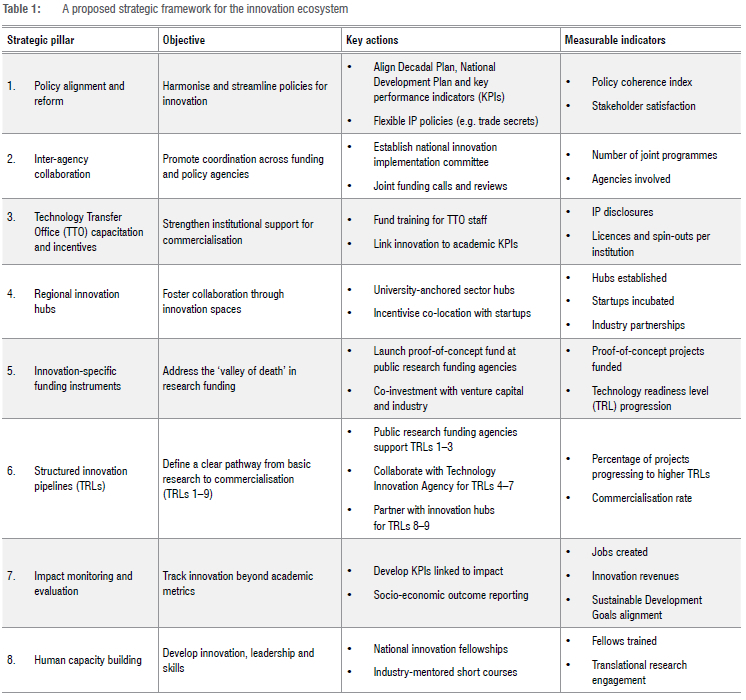
The proposed framework in Table 1 presents a set of targeted, actionable and contextually grounded steps that can help address key systemic gaps. It is a suggested tool to strengthen the current work, offering a structured pathway toward a more seamless and responsive innovation ecosystem. Recognising that some elements may already be operational in certain spaces, this framework aims to provide a cohesive model that, if adopted widely, would accelerate progress, reduce duplication and enhance measurable impact. Importantly, the recommendations align with existing funding mechanisms across TRLs and can be implemented in partnership with key stakeholders such as public research funding agencies, TIA and the Innovation Hub.
The success of South Africa's innovation strategy depends on collaboration, strategic funding and policy cohesion. By uniting funders, government and industry around a shared agenda, and adapting global best practices to local realities, we can unlock a thriving innovation ecosystem - one that moves ideas from the lab to the marketplace and delivers real impact for society.
Conclusions and recommendations
South Africa is at a pivotal moment to utilise its research foundation for socio-economic benefits. Despite progress in research and development, there is a gap in turning these efforts into market-ready solutions. A coordinated innovation strategy is crucial to align research funding, industry collaboration, and policy support for commercialisation. Enhancing the innovation ecosystem requires addressing structural and financial hurdles. Funding should support research from early stages to market entry. Regional innovation centres, linked to universities and industry, will provide infrastructure and networks. Streamlining intellectual property policies will ease research commercialisation. By integrating strategies, South Africa can shift to an innovation-driven economy, enhancing global competitiveness and driving sustainable development, economic growth and social progress.
Declarations
I have no competing interests to declare. I have no AI or LLM use to declare.
References
1. Razwinani M, Tshikovhi N, Motaung KS. Benefits and challenges of research commercialisation in South Africa: A systemic review. Afr J Innov Manag. 2024;6:1-10. https://doi.org/10.51415/ajims.v6i1.1210 [ Links ]
2. Sun SL, Zhang Cao Y, Dong J, Cantwell J. Enriching innovation ecosystems: The role of government in a university science park. Glob Transit. 2019;1: 104-119. https://doi.org/10.1016/j.glt.2019.05.002 [ Links ]
3. Mafu M. Technology transfer as a catalyst for effective university-industry collaboration in Botswana. Afr J Sci Technol Innov Dev. 2023;15:606-623. https://doi.org/10.1080/20421338.2023.2173403 [ Links ]
4. Archibugi D, Filippetti A. The retreat of public research and its adverse consequences on innovation. Technol Forecast Soc Change. 2018;127:97-111. https://doi.org/10.1016/j.techfore.2017.05.022 [ Links ]
5. Lehmann EE, Menter M, Wirsching K. University spillovers, absorptive capacities, and firm performance. Eurasian Bus Rev. 2022;12:125-150. https://doi.org/10.1007/s40821-021-00199-5 [ Links ]
6. National Advisory Council on Innovation (NACI). South African science, technology and innovation indicators. Pretoria: NACI; 2020. Available from: https://www.naci.org.za/wp-content/uploads/2020/08/NACI_2020-STI-Indicators-Report.pdf [ Links ]
7. Owen R, Vedanthachari LN, Hussain J. The role of the university entrepreneurial ecosystem in entrepreneurial finance: Case studies of UK innovation knowledge centres. Vent Cap. 2024;26:351-375. https://doi.org/10.1080/13691066.2023.2205606 [ Links ]
8. Sihlobo S, Mbatha S. University-industry-government research and development collaborations in public higher education institutions in South Africa. Afr J Sci Technol Innov Dev. 2023;15:69-78. https://doi.org/10.1080/20421338.2021.2016559 [ Links ]
9. Gachie W, Govender DW. Commercialization of higher education institutions' research within the National System of Innovation. Afr J Sci Technol Innov Dev. 2017;9:387-397. https://doi.org/10.1080/20421338.2017.1338387 [ Links ]
10. Frenkel A, Maital S, Leck E, Israel E. Demand-driven innovation: An integrative systems-based review of the literature. Int J Innov Technol Manag. 2015;12, Art. #1550008. https://doi.org/10.1142/S021987701550008X [ Links ]
11. Tile S. Technology drivers of innovation: Competitiveness in biotechnology entrepreneurship in Gauteng, South Africa [master's thesis]. Johannesburg: University of the Witwatersrand; 2024. https://hdl.handle.net/10539/43867 [ Links ]
12. Cullen MD, Calitz AP Chetty MA. Factors affecting researcher participation in technology commercialisation: A South African university case study. South Afr J Entrep Small Bus Manag. 2020;12(1), Art. #329. https://doi.org/10.4102/sajesbm.v12i1.329 [ Links ]
13. Kruss G. Strengthening the interactive capabilities of public research institutes in South Africa. In: OBrien D, Arvanitis R, editors. The transformation of research in the South: Policies and outcomes. Paris: Archives Contemporaines & IRD; 2019. p. 65-70. http://hdl.handle.net/20.500.11910/15141 [ Links ]
 Correspondence:
Moloko Mathipa-Mdakane
Email:molokog.mathipa@gmail.com
Published: 29 September 2025