



Services on Demand
Journal

Article
 English (pdf)
 Article in xml format
 Article references

 Automatic translation
 Send this article by e-mail
Indicators
Related links
-
 Cited by Google
-
 Similars in Google
Share

 Permalink

South African Journal of Science
On-line version ISSN 1996-7489Print version ISSN 0038-2353
S. Afr. j. sci. vol.121 n.11-12 Pretoria Nov./Dec. 2025
https://doi.org/10.17159/sajs.2025/19260
RESEARCH ARTICLE
An innovation measurement framework for the South African cultural and creative industries
Gerard RalphsI, II
ICollege of Business and Economics, University of Johannesburg, Johannesburg, South Africa
IICurrent: Centre for Science, Technology and Innovation Indicators, Human Sciences Research Council, Cape Town, South Africa
ABSTRACT
There is increased scrutiny on the directionality of innovation systems in advancing critical global sustainability and development objectives. Equally, innovation policy mixes require complimentary measurement agendas to track activity and outcomes and inform public investment decisions. South Africa has a clear innovation policy mix for its arts, culture and heritage (ACH) dispensation. However, innovation indicators are not yet integrated within the monitoring and evaluation framework of the ACH dispensation. In this paper, a directionality-sensitive innovation measurement framework for the cultural and creative industries (CCI) is proposed with indicator categories addressing a fuller variety of system actors than are typically assessed in innovation surveys. The framework was piloted in South Africa's Western Cape Province and yielded several methodological insights and data. Key among these is the value of survey interviews for data enumeration that bridges respondent understanding of the concept of innovation, as well as combining object- and subject-based approaches to mitigate against measurement error. By adopting this framework, data comprising a richer cross-sectional view of innovation in the CCI can be compared and analysed, in-country and across countries, enabling several potential research and policy monitoring use cases.
SIGNIFICANCE:
This article makes a methodological and an empirical contribution to the innovation measurement literature, reporting results from survey piloting of a framework based on Gault's theoretical concept measuring innovation everywhere. It also makes a policy-oriented contribution, specifically at the nexus of ACH and innovation policy in South Africa, by proposing a directionality-sensitive innovation indicator framework for the CCI that has been tested in one province, and that can be used and adapted for future policy monitoring efforts.
Keywords: innovation, measurement, directionality, policy monitoring, cultural and creative industries, South Africa
Introduction
Cultural and creative industry in South Africa, whether for-profit or not-for-profit, occurs within and across various organisational, social, physical and digital locations. It also occurs within and across discrete industrial domains, value chains and types of occupation. The agglomerative term, the 'cultural and creative industries' (CCI), has been adopted in South African arts, culture and heritage (ACH) policy, planning and monitoring documents to capture this productive cross-sectoral environment.1-3 It is widely acknowledged that the CCI yield an assortment of commercial, social and other benefits and, as such, should be enabled through public policy investment decisions. In turn, creation of evidence in contextually relevant ways to inform decision-making is critical.4 This paper reports on the methodological design and results of a policy-oriented study to develop and pilot an innovation measurement framework for the South African CCI.
Framework policy and empirical rationales
The concept of an innovation policy mix reflects a confluence of policy intent toward a desired future, and a confluence in which any innovation measurement framework must locate itself.5,6 Critical, too, is the concept of directionality: to the extent innovation systems have contributed to generating and reproducing key societal and environmental problems, directionality is explicitly about governance of innovation to reverse these problems systemically.7 The innovation policy mix for the South African CCI as well as the specific directionality statements that informed the framework's design is this section's focus.
Beyond the economic value of arts, culture and heritage
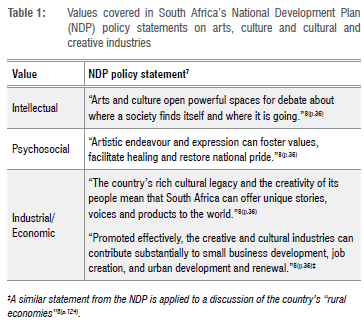
The National Development Plan provides policy direction for South Africa until 2030, aiming to overcome high levels of unemployment, poverty and inequality.8 These problems have a particular trajectory in relation to the country's colonial and apartheid histories, resulting in a persistent vicious cycle. The National Development Plan is explicit about the overlapping intellectual-psychosocial and economic-industrial values of arts and culture, as well as their broad innovation potential, to contribute to the desired economic and societal futures (Table 1).
Equally, South African ACH policy and planning, as expressed in a White Paper1 and accompanying plan for the CCI2, contain clear innovation and directionality statements: the White Paper positions "sustainable development and cultural inclusion" as key outcomes of a "creative and innovative society in which the full range of artistic forms, diverse cultural practices, and heritage and knowledge traditions and technologies are harnessed" (p.8; emphasis added); the plan's vision statement foresees a qualitative relationship between "prosperity for creatives, entrepreneurs and broader society" and a CCI that is "globally competitive, innovative, sustainable, vibrant and transformed" (p.42; emphasis added)1,2. These innovation and directionality postures in ACH policy and planning reinforce, and are reinforced by, the main policy intent of the 2019 White Paper on Science, Technology and Innovation, encapsulated in its tagline: "science, technology and innovation enabling inclusive and sustainable South African development in a changing world" (emphasis added).9(p.1) Regionally, a revision to the African Union's 2008 CCI action plan, "envisions an innovative, integrated, peaceful and prosperous Africa, where cultural and creative industries are the cornerstone of inclusive and sustainable development driven by its people and rich heritage"10(p.5). Internationally, the UN's Sustainable Development Goals provide broad impetus for the creative economy's role in global development. This paper is primarily concerned with the creation of innovation data that can contribute toward monitoring progress against South African, regional and global goals.
Measuring innovation everywhere
Innovation measurement thinking has advanced since the first edition of the Organisation for Economic Co-operation and Development's (OECD) Oslo Manual (1992), which codified methodological principles and practices. Whereas early measurement efforts focused on developed economy manufacturing firms, recent work across the world has emphasised measuring innovation at household level11, in the public sector12, and within informal businesses13. Gault has aptly termed this shift measuring innovation everywhere.14
The introduction of a general definition of innovation in the 2018 Oslo Manual15 makes it methodologically possible to measure innovation everywhere. In innovation surveys addressing the formal business sector, the definition is:
A business innovation is a new or improved product or business process (or combination thereof) that differs significantly from the firm's previous products or business processes and that has been introduced on the market or brought into use by the firm.15(p-20)
Whereas, the general definition of innovation that applies to all institutional sectors is:
An innovation is a new or improved product [good/service] or process (or combination thereof) that differs significantly from the unit's previous products or processes and that has been made available to potential users (product) or brought into use by the unit (process).15(p.20)'
Following Gault, in a systems approach to innovation measurement, data are collected from statistical units in multiple institutional sectors from within one or more economic sectors.16 This could be more accurately termed measuring innovation everywhere, at once. A precedent for this refinement of Gault's proposition is R&D measurement adhering to the OECD's Frascati Manual.
Scholars have identified, researched and debated several shortcomings of innovation measurement.17,18 These include the potential for structural bias, measurement error and an undue focus toward R&D-led or technological forms of innovation, eliding, for example, services-sector innovation, incremental innovation, or innovation in informal sectors. From the perspective of the Global South, scholars have also highlighted the gap between what is measured and what should be measured, calling for more contextualised approaches suited to the realities of developing countries, as well as the need for stronger policy uptake of innovation indicators.19-21 In turn, OECD guidance has been updated regularly, and in the South African context measurement gaps have been addressed through, for example, recent surveys on commercial agriculture22 and informal businesses23.
Directionality and CCI innovation measurement
In South African state-sanctioned innovation measurement through the 2000s24,25, sampling choices foregrounded the larger economic sectors in value-added terms, bypassing the CCI. In 2015, Manzini argued for studying innovation in "arts and other creative industries"26(p.4). Around this time, small-scale CCI-specific innovation studies were pioneered by Booyens and several collaborators, including a study with Molotja on innovation in new media businesses in Cape Town that found innovation to be localised and incremental.27 In their study of innovation within creative tourism in the Western Cape28, Booyens and Rogerson found economic competitiveness and urban development to be key rationales. However, they also found innovation to be critical in deepening creative tourism's engagement with local arts and culture spaces, practices and dynamics. This finding echoes cultural policy scholarship that has questioned heritage, design, tourism and urban development discourse practices that, out of narrow commercial or governance instrumentalism, have elided, appropriated or distorted local histories, memory and knowledge.29-34 Most recently, research by Snowball et al.35, drawing on the UK's Brighton Fuse study36, was a first larger-scale attempt to deploy OECD-defined measures in the Cape Town creative cluster, with a strong directionality lens on workforce diversity specifically. Examining the fuse in production of digital technology and creative design capabilities in a realised sample of 72 formal businesses, the authors found that fused businesses were more likely to be process innovators, as well as to employ a more diverse workforce, than non-fused firms.35
Accounting for the above policy context and empirical studies, missing from the CCI-specific innovation studies to date has been a focus on a broader set of actors comprising the CCI - from government programmes, non-profit organisations and informal businesses - as well as a finer-grained emphasis on the social and environmental benefits of CCI innovation. Thus, the research question addressed in this study is: given the innovation policy mix for South African arts, culture and heritage, to include the CCI, to what extent is innovation measurement suitable as a tool for monitoring the innovation performance across the CCI?
Framework development
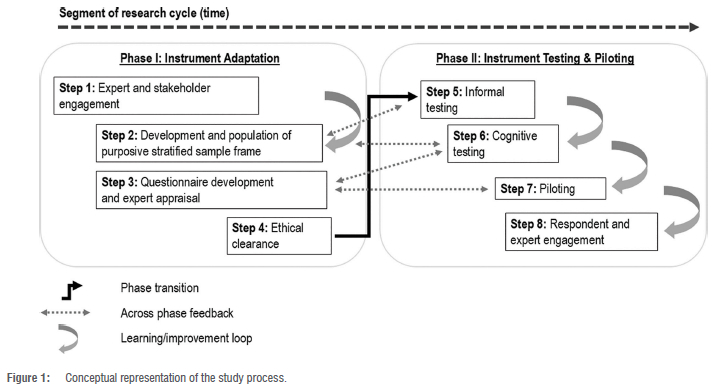
The study reported on here was exploratory by design, following a consultative-collegiate approach emphasising knowledge co-production.37,38 Its focus lay in a discrete segment of the survey research cycle, notably sampling and instrument development, and testing. This is conceptualised in Figure 1 as two consecutive phases, with iterative learning feedback loops and a scaffolding of research results. These are reported and discussed below.
Activating the study's co-creative design, a public research seminar was hosted by the Human Sciences Research Council (HSRC) in June 2020 to discuss the framework's initial conceptualisation as elaborated by the author.39 Present were public officials from the National Advisory Council on Innovation and line departments for innovation and arts and culture, as well as sector policy and innovation measurement experts. Further appraisal from four innovation measurement experts, two of whom attended the seminar, was solicited during instrument development and after piloting. These interactions were reinforced post-data collection, through a workshop and study presentation with survey respondents and sector experts in February 2024.
Sampling
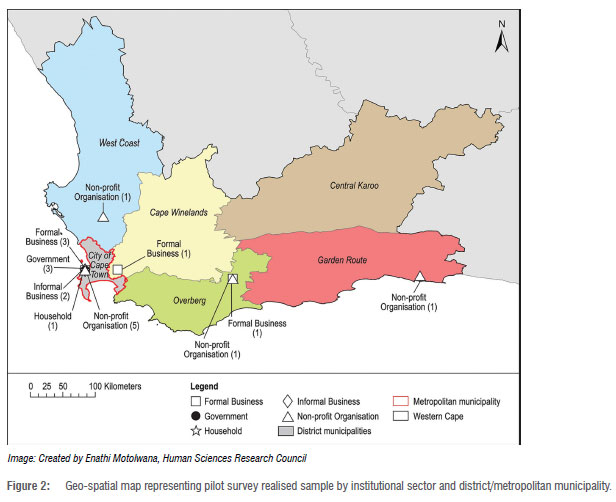
As a pilot study, non-probability purposive stratified sampling based on convenience was employed (detailed in the Supplementary material and Supplementary tables 1-4).40 Stratification was based on three key criteria: economic sector classification as given by the 2009 UNESCO Framework for Cultural Statistics combined with Statistics South Africa's 2012 standard industrial classifications to the five-digit level; institutional sector classification as given by the System of National Accounts 2008; and geographic location within the six main municipalities of the Western Cape Province of South Africa. The application of these criteria was consistent with the Oslo Manual's (Chapter 2) requirements for an innovation measurement framework. Snowballing was used to ensure that potential respondent individuals or organisations fell within the correct strata.
Instrument adaptation
Harmonisation at the construct level was critical to give effect to the measurement framework's intent and sampling strategy. This required uniformity and differentiation across survey instruments administered within different institutional sectors, to account for the distinct nature of goals and activity (public, private, third sector). To this end, several key decisions were taken with expert input, described below.
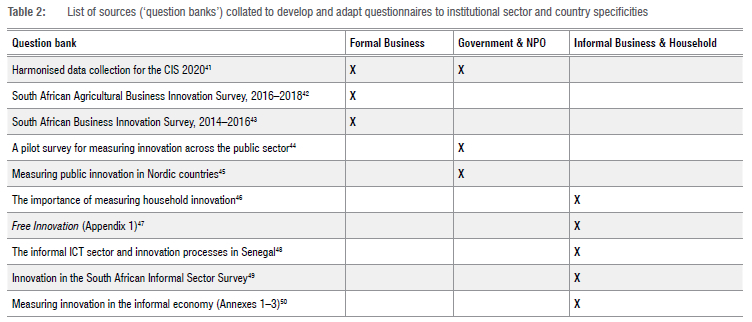
The first key decision, discussed with Expert A, was to create three questionnaires (1 =Formal Business, 2=Informal Business & Household, 3=Government & NPO) drawing on established questionnaire models and question banks to minimise the need for validity testing (Table 2).
The second decision taken was to orient all instruments to sector-specific conditions, including mandates, funding sources and technologies, as workshopped extensively with Expert B. The third key decision was to explicitly address directionality by adding a new question on innovation with social benefits. This question mirrored the Eurostat Community Innovation Survey (CIS) 2020 question on innovation with environmental benefits, which was also included. The new question, developed by the author, similarly tests the idea that innovation may result in social benefits inside and beyond the business/organisation. A draft of this question was workshopped and modified with Expert C, while Expert D separately cautioned that answers to this question may be subject to social desirability bias. Expert A suggested it was a useful question to add but that it should be tested.
The fourth key decision concerned customisation for general South African geographical and governance specificities such as the District Development Model's district municipalities, as well as appropriate professional and colloquial language for the South African context (e.g. use of "business" rather than "firm"). The fifth key decision was to include a focal innovation question using the Oslo Manual's object-based approach to surface innovation examples and, following Cirera and Muzi, to mitigate measurement error.17,51
After initial instrument development, the study was reviewed by the University of Johannesburg College of Business and Economics' Research Ethics Committee, receiving clearance on 21 December 2021 valid until 26 February 2024 (code: 21SECO040). Research permits from the one municipal government and one national entity were also granted. All data reported were anonymised unless otherwise agreed.
Instrument testing and piloting
Testing and piloting of questionnaires early on is vital to detect problems, whether structural or non-structural.52 Informal testing was initiated as a pre-cursor to a more formal cognitive testing step. During the latter, a combination of comprehension, paraphrasing, confidence judgement, recall, and specific and general probes was developed and administered. Further development of the survey instruments was undertaken after informal testing and cognitive testing, in preparation for the piloting step. In sum, a total of 26 completions were realised: informal testing (n = 2), cognitive testing (n = 3) and piloting (n = 21) (detailed in Supplementary tables 5-7).
Discussion of testing feedback data: Structural and non-structural problems
Several problems of a structural and non-structural nature emerged: with the concept of innovation, the relatability of the questionnaires to organisation and sector circumstances or conditions, and respondent burden (structural problems); and stylistic and technical inconsistencies (non-structural problem). These are discussed briefly in turn with reference to research-potential respondent correspondence metadata.
In the case of one Overberg-based non-profit organisation (NPO), for example, after review of the questionnaire, the potential respondent was unable to conclude that there was a link between their organisation's activities and innovation. They wrote:
I shared it with the members of [anon] and I must say we are not sure how we could be of help to you. Ours is mainly a group of older people interested in SA history. We try to be inclusive and look at the broader picture and record, publish and archive our talks and interviews. I don't know how this could be considered innovative and help towards policy change. (Potential Respondent: Heritage Society)
A follow-up email, with the intention of further explaining and persuading the respondent on this point, yielded no result. Similarly, the owner of a Cape Town manufacturing-based export and tourism business, which has a public viewing point onto its plant and machinery (suggesting at least the potential for the presence of innovation activity), declined to participate. They wrote:
Having read through part of your questionnaire I realise that there is not much I can contribute to your research. (Potential Respondent: Polished Gemstones Manufacturer)
For a Cape Town based informal business, the potential respondent indicated that they "did browse through some of the questions" but "felt most of them did not relate to my type of business" which was "still in start-up phase, and pretty informal at the moment" (LP Retailer). By contrast, two in-situ testing interviews with informal business owners were highly data generative, pointing to a potential problem with the email and form mode of survey administration. From this evidence, it appears likely that non-response bias arose out of a lack of conceptual understanding and relatability to innovation.
Apart from conceptual and relatability challenges, various practical circumstances also prevented responses. The owner of a home-based pottery studio on the Garden Route, for instance, could not participate due to a recent injury. "We don't have the resources to respond to academic research questions", was one auto-response from a well-established Cape Town based local newspaper. To the extent that respondent burden of any type prohibited completion, it is identified here as a structural problem.
Cognitive testing feedback (i.e. feedback given after enumerating the test questionnaire) echoed that received from informal testing interactions. For a Cape Town based craft NPO:
Creativity, design & innovation as terms are interchangeable. Our overall thought is that [anon] was not a fit with the questionnaire and the answers you are seeking. We provide an enabling environment for others to create, innovate and design. We do not do this ourselves. You will see that there are mostly 'No' answers! (Craft Business Park, NPO_CT001)
A bestselling Cape Town based non-fiction author with various writing projects at any given time - from books and journalism to bespoke newsletters - participated in cognitive testing, providing rigorous feedback. They expressed some confusion about which aspects of their writing work could be considered innovation, as defined:
I'm not entirely sure I understood the concept of innovation as you intended me to. In my line of work I feel that writing a book or a creative article comprises innovation. But creating a newsletter is not innovation. But perhaps I have totally missed the point. (Bestselling Non-fiction Author, H_CT001)
Constructively, the author suggested conducting an interview to collect data, rather than doing so via self-completion. They also recommended provisioning substantially more time for self-completion than what was indicated on the test questionnaire (Bestselling Non-fiction Author, H_CT001).
Non-structural problems included stylistic and technical issues that were identified in cognitive testing; these included language error and questionnaire length (Bestselling Non-fiction Author, H_cT001). Form code bugs were also reported (Commercial Wildlife Visitors Centre, BUS_CT001).
Questionnaire improvement and piloting
Addressing the structural and non-structural problems, key decisions were taken to re-shape the instruments for the piloting step. These included removing a cumbersome question requiring disaggregated expenditure data, shortening the documents, refining wording, correcting stylistic errors, and improving signposting of skip patterns. Even with the amended instruments, analysis of reasons given by a selected number of piloting respondents surfaced some of the same challenges, as well as new ones. These were coded as three higher-level categories of structural problem: respondent burden, respondent misinterpretation and respondent paralysis. Put differently, in addition to finding a survey request burdensome, other reasons for non-response included a lack of capacity or mandate to participate on the spot (paralysis) or poorly scaffolded conceptual understanding of the survey content (misinterpretation).
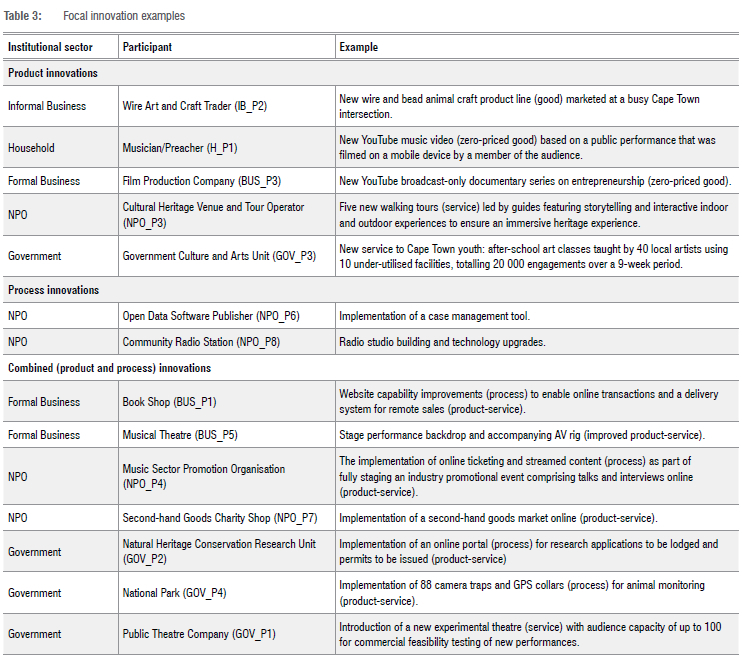
In all, during piloting, 10 questionnaires were completed via semi-structured interview and 11 were self-completed. While self-completion elicited useful and accurate data, a key insight from piloting was that generating understanding of innovation with respondents through semi-structured interview dialogue was highly effective in eliciting potential focal innovation examples (Table 3), as well as validating these in terms of the definition of innovation. Such discussions also aided respondents in answering dependent survey questions with reference to the focal innovation examples, in surfacing insights on organisational and sectoral conditions, as well as in mitigating the potential for response and non-response bias, and measurement error.
Framework indicator proposition
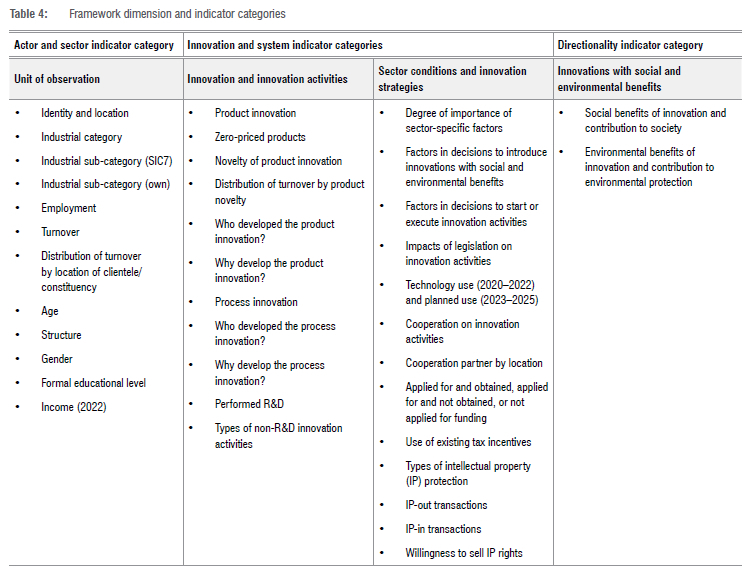
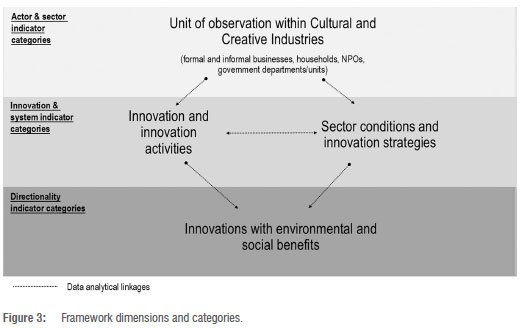
In Figure 3, the framework is conceptualised as systemic with its focus on multiple transactors within the same economic sector. The proposed framework is also multidimensional: the three dimensions are actor and sector indicator variables; innovation and sectoral system indicator variables; and directionality indicator variables (Table 4). Although not statistically representative, piloting nevertheless yielded meaningful survey data and metadata that could be analysed to explore and substantiate an argument for a systems approach to measurement, and point to possible utilities of variables for research and policy purposes.
Data use cases for 'traditional' innovation indicators
South African innovation data have given rise to varied empirical analyses covering employment, productivity and technological effects.53-56 These analyses complement a broader empirical and theoretical research agenda focused on innovation in Africa and globally, exemplified in research and training networks such as the Open African Innovation Research Partnership (Open AIR) and Global Network for Economics of Learning, Innovation, and Competence Building Systems (Globelics), which increasingly include the informal sector.23 Such studies principally rely on nominal turnover and employment data, as well as measures of product and/or process innovation (Supplementary tables 8-11). These data provide a valuable potential use case for empirical analysis at the sectoral level, as well as for distinguishing services-sector innovation patterns in the CCI from those found, for example, in manufacturing or agriculture. From a policy use case perspective, data on the introduction of zero-priced products, as well as the relative importance of a local funder/customer base, provide important clues about innovation diffusion and resource mobilisation strategies, which in turn can be used to inform design of policy support or investment programmes. Piloting also yielded rich data on, inter alia, innovation and innovation activities (Supplementary tables 12 and 13).
Focal innovation questions yielded rich descriptive data that can be analysed for insight into actual innovation projects. Given that the survey reference period of 2020-2022 coincided with COVID-19 lockdowns, it is unsurprising that some of the innovations reported are characterised by digital transitions - to online sales, delivery models and content provisioning - pointing to a reinvigoration of organisational value propositions during the pandemic's challenging public health, regulatory and socio-economic environment.57 Equally, data on technology use and planned use (Supplementary tables 14 and 15) provide an important potential evidence base for policy actors promoting technological adoption, as well as for technology adoption studies. Identifying a distinct benefit of adoption to their business, one informal business owner said:
When you have a Yoco machine you earn more. (Traditional Head Dress and Jewellery Trader, IB_P1)
Survey data also yielded important information on the types of linkages there are between actors within a sector, and their geographic proximity, providing valuable potential opportunities for spatial analysis at different scales, including on the relative frequency of territorial collaboration.
New directionality indicators
Given South Africa's historical context and policy priorities for ACH outlined earlier, social benefits of innovation are especially important indicators to construct in a survey of CCI. For instance, in the case of one provincial government department, their arts programmatic innovation using available public space and local expertise enabled multiple social challenges to be addressed. "We solved three problems with one idea", the respondent said (Government Culture and Arts Unit, Gov_P3). For another, innovating with digital meeting tools brought about cost savings, but also a fall in stress levels as a function of reduced travelling time (Government Archive Unit, GOV_P5; emphasis added). In piloting a shortened version of the question with informal business owners, two social benefits included teaching others and the acquisition of knowledge of design (Traditional Head Dress and Jewellery Trader, IB_P1). Employment creation on an ad hoc basis was another social benefit, according to one informal business owner. "When I am not here, they [friends] sell for me and I give a per cent", the Wire Art and Craft Trader (ib_P2) stated.
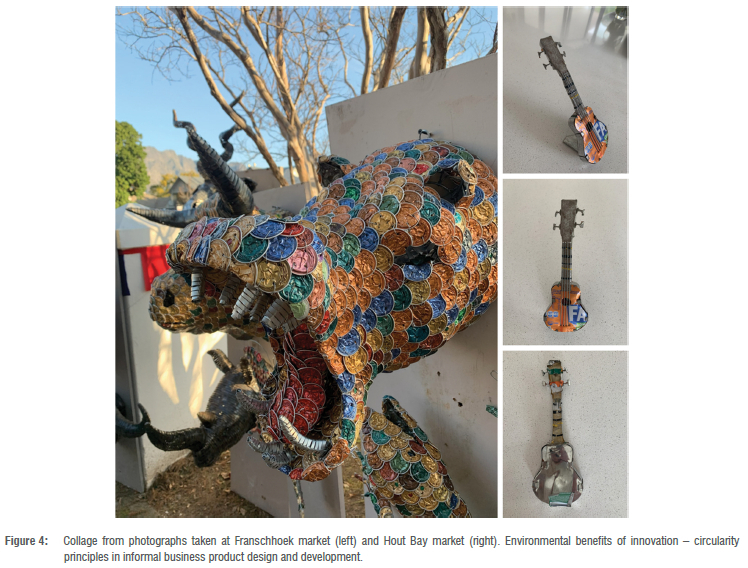
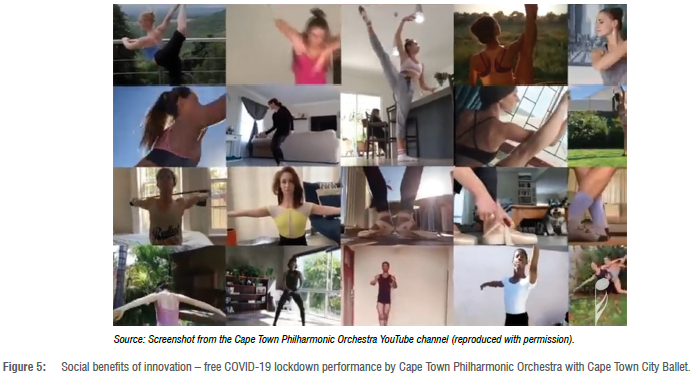
Figure 4 visualises a combined process and product innovation introduced on YouTube during the COVID-19 lockdown by the Cape Town Philharmonic Orchestra in collaboration with the Cape Town City Ballet. Potential social benefits of this innovation, made available to the public at zero price, included both performer and user (audience) well-being. An example of the environmental benefits of innovation is evidenced for instance in the re-purposing of aluminium tin can waste or Nespresso pods in craft product design (Figure 5).
Next to the environmental benefits of innovation, this study presents a new potential set of measures of social benefits of innovation as a basis for critical discussion and improvement (Supplementary table 16). Reinforcing policy, these data provide a critical directionality lens, and potential data use cases that include both policy monitoring and evaluation, as well as a governance of innovation research agenda in the context of uneven global development trajectories58 in which persistent, intractable or wicked societal and environmental challenges are reproduced.
Critical reflections on the framework
A key limitation of the framework concerns what it does not or cannot purport to measure rather than what it does. While the framework is multidimensional (Figure 3), it does not reflect the depth or breadth of CCI value chains, which span creativity, production and dissemination, and may extend beyond the FCS domains and concomitant SIC7 criteria. Additionally, 2012 standardised industrial classifications, while still useful in large part, are also somewhat outdated, given the rapid pace of digital technological development and, consequently, industrial change. Updates to standardised classifications, coupled with the use of alternative data sources, may contribute to fill these gaps, which will warrant further adaptations to this framework. Additionally, deliberate inclusion of the household, informal business, government and NPO sectors within the framework can directly contribute to shining a spotlight on innovation barriers and outcomes, which can inform public policy investment decisions toward addressing critical goals.
Methodologically, this article also demonstrates the complexities of operationalising the systems approach to measurement in terms of construct validity, encapsulated in the question "are we measuring what we say we are measuring?". The concept of innovation was not self-evident to several respondents and potential respondents. Next to other factors, this resulted in non-completion. By contrast, where author and respondents were able to establish dialogue on a focal innovation through a semi-structured interview, an interpretive frame for answering questions that relied on the concept of innovation as a scaffold was created. Using interviews contributed to clearer respondent understanding of innovation and, as such, enabled accurate data collection. This is not a challenge unique to innovation surveys, but is one faced by survey practitioners across the sciences who employ standardised constructs.
Practically, a census of innovation in CCI government entities and nonprofit organisations is possible, as is representative surveying of formal businesses within the CCI. However, it is more onerous to collect such representative data at the level of informal businesses and households, although this was recently attempted at a national level in South Africa59 and has been achieved in China60.
Conclusion
Innovation surveys traditionally target one institutional sector at a time, whether formal or informal businesses, public sector entities, not-for-profit institutions serving households, or households. Despite several stumbling blocks, this paper demonstrates that measurement of innovation in multiple institutional sectors within the same economic sector can provide a richer picture of the nature of innovation at a systemic level. This systems approach to measurement is called measuring innovation everywhere, at once. National innovation indicators aim to provide a basis in evidence for monitoring and evaluation of South Africa's national system of innovation. Sectoral innovation measurement in the South African CCI, following the systems approach, can contribute similarly to this agenda. Setting out an innovation measurement agenda within a sector in which measurement has only occurred on a limited basis requires experimentation to ensure what is measured should be measured. Using standardised measures also means that the framework can be adapted in contextually relevant ways across national contexts. The challenge ahead is to articulate meaningful pathways toward the creation of these data to contribute to effect the desired policy visions.
Acknowledgements
The comments of two anonymous peer reviewers are appreciatively acknowledged. Thank you to all survey respondents, and participants at the respondent feedback workshop of 16 February 2024. Thank you to all experts who willingly shared knowledge and insights during the study on which this article is based, including and especially Fred Gault and posthumously Edward Lorenz. The insights of research symposium participants in Parallel Session 2 "Capturing innovation in 'unseen' places" at the University of Johannesburg's 'Transforming Africa: Innovating our way towards sustainability' conference (26-29 February 2024) are also kindly acknowledged. Enathi Motolwana of the South African Human Sciences Research Council is acknowledged for the geo-spatial map and the Cape Town Philharmonic Orchestra for the use of an image. The usual disclaimers apply.
Funding
This work is based on research supported in part by the National Research Foundation of South Africa (grant numbers: 118873). I extend my appreciation to the DSI/NRF/Newton Fund Trilateral Chair in Transformative Innovation, the 4IR and Sustainable Development for its support. The University of Johannesburg and the Human Sciences Research Council also provided funding in support of this research. All funding is kindly acknowledged.
Data availability
The entire data set supporting the results of this study has been deposited in a recognised repository and is openly accessible via the link: https://repository.uj.ac.za/articles/dataset/Data_Set_for_Pilot_Study_of_Innovation_in_the_Western_Cape_Cultural_and_Creative_Industries_2020-2022/26348446
Declarations
I have no competing interests to declare. I have no AI or LLM use to declare. After initial instrument development, the study was reviewed by the University of Johannesburg College of Business and Economics' Research Ethics Committee, receiving clearance on 21 December 2021 valid until 26 February 2024 (code: 21SECO040). Research permits from one municipality and one national entity were also granted. All data reported were anonymised unless otherwise agreed. The research reported in this paper forms part of the author's doctoral thesis at the University of Johannesburg.
References
1. National Department of Arts and Culture (DAC). Revision of the Department of Arts and Culture 1996 White Paper: Fourth draft. Pretoria: DAC; 2017. [ Links ]
2. National Department of Trade, Industry and Competition (DTIC). Cultural and creative industries (CCI) masterplan. Pretoria: DTIC; 2022. [ Links ]
3. South African Cultural Observatory (SACO). The economic mapping of the cultural and creative industries in South Africa 2020: Capstone report, results and policy. Gqeberha: SACO; 2020. [ Links ]
4. Strydom W, Funke N, Nienaber S, Nortje K, Steyn M. Evidence-based policymaking: A review. S Afr J Sci. 2010;106(5/6), Art. #249. https://doi.org/10.4102/sajs.v106i5/6.249 [ Links ]
5. Walwyn DR, Naidoo S. Policy mixes and overcoming challenges to innovation in developing countries: Insights from a mixed methods study of South Africa's manufacturing sector. Afr J Sci Technol Innov Dev. 2020;12(1):33-46. https://doi.org/10.1080/20421338.2019.1610250 [ Links ]
6. Howoldt D. Characterising innovation policy mixes in innovation systems. Res Policy. 2024;53(2), Art. #104902. https://doi.org/10.1016/j.respol.2023.104902 [ Links ]
7. Schot J, Steinmueller WE. Three frames for innovation policy: R&D, systems of innovation and transformative change. Res Policy. 2018;47(9):1554-1567. https://doi.org/10.1016/j.respol.2018.08.011 [ Links ]
8. South African National Planning Commission (NPC). National Development Plan 2030: Our future, make it work. Pretoria: NPC; 2012. [ Links ]
9. South African Department of Science and Technology (DST). White Paper on Science, Technology and Innovation. Pretoria: DST; 2019. [ Links ]
10. African Union. Revision African Union plan of action on cultural and creative industries (7th draft). Addis Ababa: AU; 2021. [ Links ]
11. de Jong JP Ben-Menahem SM, Franke N, Fuller J, von Krogh G. Treading new ground in household sector innovation research: Scope, emergence, business implications, and diffusion. Res Policy. 2021;50(8), Art. #104270. https://doi.org/10.1016/j.respol.2021.104270 [ Links ]
12. Arundel A, Bloch C, Ferguson B. Advancing innovation in the public sector: Aligning innovation measurement with policy goals. Res Policy. 2019; 48(3):789-798. https://doi.org/10.1016/j.respol.2018.12.001 [ Links ]
13. Kraemer-Mbula E. Measuring innovation in the informal economy: Current knowledge and open issues. In: Gault F, Arundel A, Kraemer-Mbula E, editors. Handbook of innovation indicators and measurement. 2nd ed. Cheltenham: Edward Elgar; 2023. p. 363-374. https://doi.org/10.4337/9781800883024.00030 [ Links ]
14. Gault F. Measuring innovation everywhere: The challenge of better policy, learning, evaluation and monitoring. Cheltenham: Edward Elgar; 2020. https://doi.org/10.4337/9781789904567 [ Links ]
15. Organisation for Economic Co-operation and Development (OECD), Eurostat. Oslo manual 2018: Guidelines for collecting, reporting and using data on innovation. Paris: OECD; 2018. [ Links ]
16. Gault F. Defining and measuring innovation in all sectors of the economy. Res Policy. 2018;47(3):617-622. https://doi.org/10.1016/j.respol.2018.01.007 [ Links ]
17. Cirera X, Muzi S. Measuring innovation using firm-level surveys: Evidence from developing countries. Res Policy. 2020;49(3), Art. #103912. https://doi.org/10.1016/j.respol.2019.103912 [ Links ]
18. Salazar M, Holbrook M. A debate on innovation surveys. Sci Publ Policy. 2004;31(4):254-266. https://doi.org/10.3152/147154304781779976 [ Links ]
19. Kruss G. Towards an agenda for measuring innovation in emerging African economies: What can we learn from the case of South Africa? Int J Technol Learn Innov Dev. 2018;10(3/4):347-365. https://doi.org/10.1504/UTLID.2018.093722 [ Links ]
20. Kruss G, Petersen I, Sanni M, Adedeye D, Egbetokun A. Do we measure what should be measured? Towards a research and theoretical agenda for STI measurement in Africa. Innov Dev. 2025:1-25. https://doi.org/10.1080/2157930X.2025.2481749 [ Links ]
21. Manyuchi AE. Conceptualizing and institutions facilitating 'use' of innovation indicators in South Africa's science, technology and innovation policymaking. Afr J Sci Technol Innov Dev. 2018;10(4):483-492. https://doi.org/10.1080/20421338.2018.1475542 [ Links ]
22. Buchana Sithole MM. Towards a conceptual framework for measuring innovation in the agricultural sector in sub-Saharan developing countries. Afr J Sci Technol Innov Dev. 2023;15(2):272-282. https://doi.org/10.1080/20421338.2022.2072794 [ Links ]
23. Mustapha N, Kruss G, Petersen I, Jegede O, van Rheede N. Towards and inclusive measurement programme for innovation in the informal sector of South Africa. In: Hongoro C, Adonis C, Sobane K, editors. Innovation for inclusive development and transformation in South Africa. Cape Town: AOSIS Publishing; 2022. [ Links ]
24. Blankley W, Moses C. How innovative is South Africa? S Afr J Sci. 2009; 105(1/2):15-18. https://doi.org/10.1590/S0038-23532009000100010 [ Links ]
25. Moses C, Sithole MM, Blankley W, Labadarios D, Makelane H, Nkobole N. The state of innovation in South Africa: Findings from the South African National Innovation Survey. S Afr J Sci. 2012;108(7/8), Art. #1320. https://doi.org/10.4102/sajs.v108i7/8.1320 [ Links ]
26. Manzini ST. Measurement of innovation in South Africa: An analysis of survey metrics and recommendations. S Afr J Sci. 2015;111(11/12), Art. #20140163. https://doi.org/10.17159/sajs.2015/20140163 [ Links ]
27. Booyens I, Molotja N, Phiri MZ. Innovation in high-technology SMMEs: The case of the new media sector in Cape Town. Urban Forum. 2013;24(2):289-306. https://doi.org/10.1007/s12132-012-9168-7 [ Links ]
28. Booyens I, Rogerson CM. Creative tourism in Cape Town: An innovation perspective. Urban Forum. 2015;26(4):405-424. https://doi.org/10.1007/s12132-015-9251-y [ Links ]
29. Shepherd N. Archaeology dreaming: Post-apartheid urban imaginaries and the case of the Prestwich Street dead. J Soc Archaeol. 2007;71(1):3-21. https://doi.org/10.1177/1469605307067842 [ Links ]
30. Ernsten C. The "bigger picture": How the 2010 FIFA World Cup and the 2014 World Design Capital events conditioned Cape Town's urban transformation. Urban Forum. 2018;29(1):63-81. https://doi.org/10.1007/s12132-017-9325-0 [ Links ]
31. Mbembe A. The aesthetics of superfluity. Public Cult. 2004;16(3):373-405. https://doi.org/10.1215/08992363-16-3-373 [ Links ]
32. Garuba H. Museums, mimesis, the narratives of the tour guides of Robben Island. In: Murra N, Shepherd N, Hall M, editors. Desire lines: Space, memory and identity in the post-apartheid city. London & New York: Routledge; 2008. [ Links ]
33. Minty Z, Nkula-Wenz L. Effecting cultural change from below? A comparison of Cape Town and Bandung's pathways to urban cultural governance. Cult Trends. 2019;28(4):281-293. https://doi.org/10.1080/09548963.2019.1644785 [ Links ]
34. Robins S, Baumgardt L. Opening the black box of urban development. Theoria. 2024;71(178):24-27. https://doi.org/10.3167/th.2024.7117802 [ Links ]
35. Snowball J, Tarentaal D, Sapsed J. Innovation and diversity in the digital cultural and creative industries. J Cult Econ. 2021;45(4):705-733. https://doi.org/10.1007/s10824-021-09420-9 [ Links ]
36. Sapsed J, Nightingale P Mateos-Garcia J, Voss G, Camerani R, Coad A, et al. The Brighton fuse. Brighton: Arts & Humanities Research Council, National Centre for Universities and Business, University of Brighton, University of Sussex and Wired Sussex; 2013. [ Links ]
37. Babbie E, Mouton J. The practice of social research. Cape Town: Oxford University Press Southern Africa; 2006. [ Links ]
38. Swilling M. Rethinking the science-policy interface in South Africa: Experiments in knowledge co-production. S Afr J Sci. 2014;110(5/6), Art. #2013-0265. https://doi.org/10.1590/sajs.2014/20130265 [ Links ]
39. Human Sciences Research Council (HSRC). Measurement of innovation in the cultural & creative industries: A methodological challenge? [audiogram]. Seminar presented in: HSRC Seminar Series. 2020 March 26. [ Links ]
40. Patton M. Qualitative research and evaluation methods. 3rd ed. Thousand Oaks, CA: Sage; 2002. [ Links ]
41. Eurostat. Harmonised data collection for the CIS 2020. Brussels: European Commission; 2019. p. 1-27. [ Links ]
42. Centre for Science, Technology and Innovation Indicators (CeSTII). South African agricultural business innovation survey, 2016-2018 [questionnaire]. Pretoria: Human Sciences Research Council; 2018. [ Links ]
43. Centre for Science, Technology and Innovation Indicators (CeSTII). South African business innovation survey, 2014-2016 [questionnaire]. Pretoria: Human Sciences Research Council; 2017. p. 1-28. [ Links ]
44. Hughes A, Moore K, Kataria N. Innovation in public sector organisations: A pilot survey for measuring innovation across the public sector. London: NESTA; 2011. [ Links ]
45. Bloch C. Measuring public innovation in Nordic countries. Oslo: Nordic Institute for Studies in Innovation, Research and Education (NIFU); 2011. [ Links ]
46. de Jong JP. The importance of measuring household sector innovation. Utrecht: Utrecht School of Economics Utrecht University; 2016. [ Links ]
47. von Hippel E. Free innovation. Cambridge, MA: The MIT Press; 2017. https://doi.org/10.7551/mitpress/9382.001.0001 [ Links ]
48. Konté A, Ndong M. The informal ICT sector and innovation processes in Senegal. Maastricht: Maastricht Economic and Social Research Institute on Innovation and Technology, United Nations University; 2012. [ Links ]
49. Centre for Science, Technology and Innovation Indicators (CeSTII). Innovation in the South African informal sector survey [questionnaire]. Pretoria: Human Sciences Research Council; 2021. p. 1-27. [ Links ]
50. Charmes J, Gault F, Wunsch-Vincent S. Measuring innovation in the informal economy: Formulating an agenda. Geneva: World Intellectual Property Organization (WIPO); 2016. [ Links ]
51. Arundel A. Hybrid innovation surveys: Combining subject and object approaches to innovation measurement. In: Gault F, Arundel A, Kraemer-Mbula E, editors. Handbook of innovation indicators and measurement. 2nd ed. Cheltenham: Edward Elgar; 2023. p. 323-341. https://doi.org/10.4337/9781800883024.00028 [ Links ]
52. Collins D. Pretesting survey instruments: An overview of cognitive methods. Qual Life Res. 2003;12(3):229-238. https://doi.org/10.1023/A:1023254226592 [ Links ]
53. Naidoo K, Bengoa M, Kraemer-Mbula E, Tregenna F. Firm innovation and employment in South Africa: Examining the role of export participation and innovation novelty. Emerg Mark Finance Trade. 2022;59(2):589-604. https://doi.org/10.1080/1540496X.2022.2098012 [ Links ]
54. Sithole MM, Buchana Effects of innovation activities on employment growth in upper-middle-income countries with high unemployment rates. Dev South Afr. 2021;38(3):371-390. https://doi.org/10.1080/0376835X.2020.1796595 [ Links ]
55. Kahn A, Sithole M, Buchana Y. An analysis of the impact of technological innovation on productivity in South African manufacturing firms using direct measures of innovation. S Afr J Econ. 2022;90(1):37-56. https://doi.org/10.1111/saje.12310 [ Links ]
56. Avenyo EK, Konte M, Mohnen P. The employment impact of product innovations in sub-Saharan Africa: Firm-level evidence. Res Policy. 2019; 48(9), Art. #103806. https://doi.org/10.1016/j.respol.2019.103806 [ Links ]
57. Joffe A. Covid-19 and the African cultural economy: An opportunity to reimagine and reinvigorate? Cult Trends. 2021;30(1):28-39. https://doi.org/10.1080/09548963.2020.1857211 [ Links ]
58. Kaplinsky R, Kraemer-Mbula E. Innovation and uneven development: The challenge for low- and middle-income economies. Res Policy. 2022;51(2), Art. #104394. https://doi.org/10.1016/j.respol.2021.104394 [ Links ]
59. de Jong JPJ, Mulhuijzen M, Cowen DR, Kraemer-Mbula E, Onyango L, von Hippel EA. Making the invisible visible: Informal innovation in South Africa [preprint]. SSRN; 2023 [revised 2024 Mar 08; cited 2024 Oct 22]. https://doi.org/10.2139/ssrn.4515890 [ Links ]
60. Chen J, Su YS, de Jong JP, von Hippel E. Household sector innovation in China: Impacts of income and motivation. Res Policy. 2020;49(4), Art. #103931. https://doi.org/10.1016/j.respol.2020.103931 [ Links ]
 Correspondence:
Gerard Ralphs
Email: gralphs@hsrc.ac.za
Received: 22 Oct. 2024
Revised: 30 June 2025
Accepted: 16 Sep. 2025
Published: 26 Nov. 2025
Editors: Floretta Boonzaier, Leslie Swartz
Funding: South African National Research Foundation (118873), University of Johannesburg, South African Human Sciences Research Council
Supplementary Data
The supplementary data is available in pdf: [Supplementary data]