



Services on Demand
Journal

Article
 English (pdf)
 Article in xml format
 Article references
 Automatic translation
 Send this article by e-mail
Indicators
Related links
-
 Cited by Google
 -
 Similars in Google
Share

 Permalink
South African Journal of Education
On-line version ISSN 2076-3433Print version ISSN 0256-0100
S. Afr. j. educ. vol.41 n.4 Pretoria Nov. 2021
https://doi.org/10.15700/saje.v41n4a1954
ARTICLES
Changing literacy outcomes in South Africa: Are home-school partnerships the missing link?
Sarlina G le Roux
Department of Early Childhood Education, College of Education, University of South Africa, Pretoria, South Africa lerougs@unisa.ac.za
ABSTRACT
After many educational reforms over the past 2 decades, South Africa is still 1 of the lowest performing countries in terms of literacy outcomes. Despite an increased access to early childhood education programmes, more than half of Grade R learners will enter Grade 1 without the required skills to master reading. Clearly, systemic interventions are not working. Against this background, a family literacy programme was launched with the aim to improve home-school partnerships, build capacity for teachers to work with parents and to provide parents with the information and support they need to strengthen literacy learning in the home. The study reported on here was based on the theoretical framework of Bronfenbrenner's ecological theory as well as Fullan's theory of action as a theory of change. An action research design and qualitative techniques of data collection were used for programme implementation, but the study was planned and evaluated against Fullan's theory of change. The Wordworks Home-School Partnerships programme was selected for implementation and a children's component was designed to accommodate the young children of participating families. A multicultural, independent primary school situated in Pretoria, South Africa, was selected through a combination of purposeful and convenience sampling. Data were gathered from parents, children and teacher-facilitators during parallel sessions using multiple techniques and were analysed according to qualitative principles. The article concludes with a critical engagement between the anticipated findings of the study and the literature on theories of educational change to indicate how family literacy programmes can bring about improved literacy outcomes.
Keywords: ecological theories; emergent literacy; family literacy programmes; home-school partnerships; theories of change
Introduction
Over the past two decades, many educational reforms and improvement strategies have been implemented to improve the literacy outcomes of learners in South African schools. In the PIRLS of 2016 (Progress in International Reading Literacy Study) (Howie, Combrinck, Roux, Tshele, Mokoena & McLeod Palane, 2017), South Africa still achieved the lowest scores of all the participating countries, despite having older learners participating in the PIRLS.
Increasingly, access to Early Childhood Development (ECD) programmes and Grade R (a non-compulsory reception year before Grade 1) is seen as a means to improve achievement. Although South Africa is one of seven African countries to achieve 80% or more learners in pre-primary education, Van der Berg, Girdwood, Shepherd, Van Wyk, Kruger, Viljoen, Ezeobi and Ntaka (2013) found that the impact of Grade R in South Africa is negligibly small because of poor quality offerings. Lenyai and De Witt (2008) found that 65% of Grade R learners do not meet the minimum criteria for early literacy development and will enter Grade 1 without the skills to master reading. Research has also shown that, when learners start behind, they stay behind. By the time that many South African learners reach Grade 4, they are already 2 or more years behind, particularly with numeracy and literacy (Howie et al., 2017; Pretorius, 2014:61).
The reality is that Grade R programmes alone are not sufficient to overcome deeply rooted economic and social problems. The erosion of the family environment has left many South African children vulnerable to all types of abuse and neglect (University of South Africa, 2008:41). Programmes aimed at strengthening learning in the home environment deserve some attention, especially since South African parents (and guardians) demonstrate relatively low levels of involvement with schools and participation in the education of their children. Machet and Pretorius (2004:39) found that many disadvantaged children have never encountered a book before and have no knowledge of how books work. Their early literacy experiences are likely to occur only in the context of child-care centres (Pretorius & Machet, 2008:286). According to the General Household Survey 2017 (Statistics South Africa, 2017:18), an alarming 36.8% of households indicated that they never tell stories to their children, 47.6% of households never read books with their children, and 44% never draw or colour-in with their children. Vasilyeva, Waterfall and Huttenlocher (2008:85) argue that factors like these explain the large individual differences in the level of language mastery and literacy skills of children at the start of formal schooling.
In many countries, family literacy programmes are used to strengthen the early literacy learning of young children. These programmes are grounded on the emergent literacy approach, which proposes that literacy learning is rooted in the home experience (Crawford & Zygouris-Coe, 2006:261; Parcel, Dufur & Zito, 2010:828), and are designed to support the literacy learning of children across home and school environments (Crawford & Zygouris-Coe, 2006:261). The purpose of these programmes is to create awareness of the purpose of literacy, awareness of stories, knowledge of letters and phonemic awareness.
With this study we aimed to expand our knowledge on what we are trying to achieve through family literacy programmes and what needs to be achieved in future. I briefly sketch the background on family literacy offerings in South Africa after which I present a study that explored how parents and teachers can strengthen home-school partnerships to support the literacy learning of young children. The aim of the study was to explore how the implementation of a family literacy programme within the framework of a theory of change could create conditions that would lead to improved literacy outcomes. To this end, a brief review of literature on theories of educational change are presented, followed by a brief exposition of the theoretical framework underpinning this study. The article concludes with a critical engagement between findings of the implementation of the Wordworks Home-School Partnership programme and the literature on theories of educational change to indicate how family literacy programmes can bring about improved literacy outcomes.
Background on Family Literacy Programme Offerings in South Africa
From an emergent literacy and an ecological perspective, the assumption is that programmes that promote and enhance emergent literacy learning in the home can set the trajectory for achievement and success, and in doing so, lessen the demand for the already limited resources available in South African schools. Since the 1980s, family literacy increasingly became an educational focus across the world (Wasik & Hermann, 2004). Unfortunately, families as a resource to strengthen learning in the early years are largely underestimated and overlooked in South Africa. As family literacy programmes target children and adults, they fall between sectors and for this reason family literacy is not yet on policy agendas in South Africa.
Le Roux's study (2020) of family literacy programmes currently operating in South Africa, revealed a handful of initiatives that include a family literacy component, although many do not define themselves as family literacy programmes. A few high-intensity programmes were identified, such as: READ'si Parent Education course, The Family Literacy Project in rural KwaZulu-Natal (Family Literacy Project, n.d.), the Wordworks Home-School Partnership programme (Wordworks, n.d.), Project Literacy's Run Home to Read Family Literacy programme (Project Literacy, 2021) and the Early Learning Resource Unit's Family and Community Motivators programme (2017). Low-intensity, resource-based programmes include videos by the Discipline of Adult Education of the University of KwaZulu-Natal (n.d.) and The Project for the Study of Alternative Education in South Africa ([PRAESA], 2021), which explore literacy learning opportunities in the home environment, as well as the reading-for-enjoyment and storytelling campaigns offered by Nal'ibali (n.d.). Unfortunately, none of these literacy programme offerings have been researched well enough to provide data to demonstrate clear implications for literacy outcomes. This may be attributed to funding restrictions, as all the identified programmes are independent and driven by non-profit nongovernmental organisations, and are regarded as a nice-to-have rather than a powerful tool to break the cycle of poor performance, drop-out and poverty.
Review of Literature
Understanding South Africa's literacy problem and identifying the changes needed to correct them, are entirely separate steps from knowing how to bring these changes about (Fullan, 1998). Educational theories of change are helpful in identifying what changes to implement as well as how to implement them. Fullan (2000), Hargreaves (2000) and Hopkins (2000) caution that authentic change is a complex process that happens within an organisational ecology and is difficult to achieve. Fullan (2006) is of the view that the ultimate goal of change is when individuals visualise themselves as shareholders with a stake in the success of the system as a whole, with the pursuit of meaning as the key.
Therefore, standards-based, district-wide reform initiatives are often bound to fail because they unfold as political symbolism and lack personal or internal commitment (Fullan, 2006). It is based on what Fullan describes as the false or incomplete premise that good things will happen on a large scale when key components are identified and drove forward with lots of pressure. What is missing is any notion about school or community culture and a motivation to change at school level. The reality is that current reading interventions in the South African schooling system are all aimed at the learner without taking any other factors that impact on achievement into account. In general, teachers' flawed reading methodologies are blamed as the dominant cause of poor performance and intervention is aimed at capacitating teachers through the provision of scripted lessons (National Education Evaluation & Development Unit, 2013). Schools, on the other hand, with almost 75% of learners coming from disadvantaged backgrounds (Howie et al., 2017:94), have a strong tendency to blame parents for not reading to their children. While schools and teachers are key to improvements in education, a supportive environment where teachers, school leadership, policymakers, parents and the learners each play their part and take responsibility for it, can no longer be overlooked (Howie et al., 2017). Therefore, change is most successful when it is school-driven, and teachers take ownership of the reform they want to see.
Elmore (2004) urges that teachers and schools must learn to do new things in the setting in which they work. Fullan's theory of action (2006:7) agrees that any strategy of change must simultaneously focus on changing individuals and the culture within which they work. To this end, Fullan (2006) identified seven core premises, which are, motivation, capacity building, learning in context and changing context, a bias for reflective action, tri-level engagement and finally persistence and flexibility in staying on course. Hopkins, Stringfield, Harris, Stoll and Mackay (2014) organised their five phases of reform efforts at a school and at a systemic level along the same premises, with the five phases being:
Phase 1 - to understand the organisational culture of the school
Phase 2 - conducting action research and research initiatives at school level
Phase 3 - managing change and taking comprehensive approaches to school reform
Phase 4 - give importance in capacity building for learning at the local level and continuing emphasis on leadership
Phase 5 - systemic improvement. Theoretical Framework
This study is based on the theoretical framework of developmental psychologist Urie Bronfenbrenner's (Berns, 2016:19) ecological theory as well as Michael Fullan's (2006) theory of change or as he refers to it as a theory of action. Bronfenbrenner posits that the school and home cannot be separated and that they influence each other reciprocally (Berns, 2016:20-31; Bronfenbrenner, 1986:723; Van Wyk, 2010:204). Bronfenbrenner views the family itself as a more appropriate focus of intervention than the child, arguing that "the family seems to be the most effective and economic system for fostering and sustaining the child's development" (Bronfenbrenner, 1986:723; Doyle, 2012:89; Wasik & Hermann, 2004:10). Although the family is the principal context in which human development takes place, he believes it to be but one of several settings in which development occur. Bronfenbrenner likens the complex setting in which children live to an ecosystem with five levels or subsystems: the micro, meso, macro, exo and chronosystem. What happens in the one level, affects the other levels. The microsystem refers to interaction between the child and his immediate environment. It includes the family and the school. The mesosystem represents the interaction between two or more immediate settings, such as the interaction between home and school. The exosystem refers to settings beyond the child, such as a parent's workplace. Parent's job situations, such as regular working hours, a stable income or unemployment, impacts on the family and eventually spills over to affect the child's learning in school. Available networks, such as the parents' circle of friends and other influences in the community, such as the church, are regarded as a form of social capital. The macrosystem refers to social forces and cultural values. Race, ethnicity, religion, economics and political ideologies all affect school-family interactions. The chronosystem refers to the influence of change on the other systems that takes place over time (Bronfenbrenner, 1986). This interconnectedness stresses the powerful influences of family processes on a child's literacy learning. Family literacy programmes, therefore, should take into account the contexts in which families operate. Family literacy programmes have the potential to assist parents in identifying and developing caring and loving microsystems, as well as to empower parents to draw on funds of knowledge in their exosystemic relationships in the workplace and broader society.
Drawing on the interconnectedness of all the spheres, a theory of change is required to plan actions that will bring all these spheres together in a structured, yet flexible programme. Connolly and Seymour (2015) define theory of change as a predictive assumption about the relationship between desired changes and the actions that my produce those changes. Brest (2010) explains that it defines long-term goals and then maps backward to identify changes that need to happen earlier. The anticipated goals of this study were: the improvement of home-school partnerships to build the bridge between home literacy and school literacy; capacitating teachers to work with parents and to provide them with the information they need to support literacy learning at home; supporting parents to create environments at home that will support early literacy learning. The implementation of a family literacy programme has been identified as the required action to achieve these outcomes.
Method
For this study, an existing family literacy programme from the list provided earlier, was chosen for implementation. Michael Fullan's theory of action was used as the framework to plan, implement, and finally evaluate the implementation of the family literacy programme.
Selection of a Family Literacy Programme
After a thorough study of the range of family literacy programmes available in South Africa, the Wordworks Home-School Partnership Programme (Comrie, 2012) was chosen for implementation because it presented a thorough but flexible design that could be implemented in a range of school and family contexts. The Wordworks Home-School Partnership Programme was designed by Comrie (2012) to empower and equip parents of children aged between 4 and 7 years to support informal literacy learning in the home. The recommended course structure entails seven weekly training sessions for parents: one session per week, supported by handouts and take-home literacy activities for implementation with children at home (Comrie, 2012). The recommended seven-session course outline for parents is as follows:
Session 1: Getting to know each other, talking about parents as first educators, exploring learning events at home, thinking and talking about how children learn best.
Session 2: Exploring how children learn language, the importance of mother tongue, school language, good talking time and how to stimulate language development.
Session 3: Modelling interactive story reading, drawing pictures and talking about the importance of drawing to communicate, the link between drawing, writing and reading, what we learn from children's drawing and first writing. Session 4: Games that support language development, reading and writing, making little fold-up books, talking about print in the environment, talking about how children copy adults' literacy behaviours.
Session 5: Talking about games, how children learn through play, small and large muscle development, the importance of good listening skills.
Session 6: Talk about maths and concrete learning of maths concepts through games.
Session 7: Feedback session, hand out of certificates and celebration.
In view of the time commitment required by families, the programme was adapted by reducing the sessions to only six. Permission from Wordworks was obtained to use the Home-School Partnership Programme.
Having to organise a caretaker for their children while parents attended the session was a formidable barrier to participation. Providing a constructive parallel programme for the children would not only overcome this barrier but would also present an opportunity to observe the young children's literacy behaviour. An additional benefit was that data collected through observing the children during literacy activities could also support other forms of evidence collected. As the Wordworks Home-School Partnership Programme is aimed at supporting parents, it does not have a specific component for children. For this study, six sessions for the children were specifically designed around the upcoming birthday party for a life-size puppet. Activities included opportunities to discuss, draw, read environmental print, design invitations to the party, make birthday cards and draw up shopping lists to buy ingredients for the birthday cake and gifts. The children's programme ran parallel to the parent training and the six sessions were facilitated by the participating teachers. We ensured that the children were not subjected to experimentation.
Selection of Site and Participants
E-mails were sent to a number of pre-schools offering Grade R. Convenience and access for the researcher, as well as how much could be learned from the site was taken into consideration when invitations were sent. As recruiting often starts with schools that have populations demonstrating a need to learn interactive literacy skills, I followed up only on the schools that reacted to my invitation. The principal of Sungarden was the only school that responded to and accepted the invitation. This confirmed Fullan's first premise that schools will only volunteer to implement changes if there is a strong motivation to do so. I met with the principal to learn about the school's motivation to participate and to familiarise myself with the context of the school. Sungarden is an independent, English medium, multicultural school situated in an affluent suburb in Pretoria, Gauteng. The school offers pre-primary and primary education, Grade R to Grade 2. English, that is used as the schools' language of learning and teaching, is not the home language for many parents. Because the school community is so diverse, the principal and the school governing body regarded the implementation of the family literacy programme as an opportunity to foster positive change in the school, to empower interested parents with the skills to foster family literacy and to equip teacher-facilitators with the knowledge and skills to work with families.
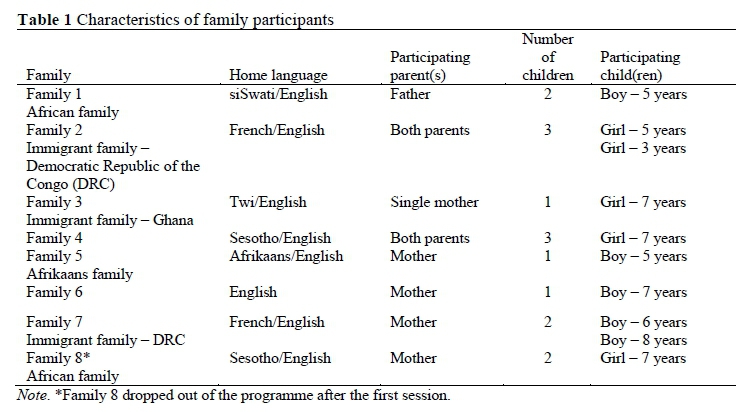
Criteria for family inclusion in the programme were that the participating families should have a child enrolled in Grade R and that at least one parent should be able to attend the full 6-week duration of the modified Wordworks School-Family Partnership programme. These criteria were later modified to include the participation of families with young children ranging from age 3 to age 8 (pre-school to Grade 2) in order not to exclude any family which voluntarily accepted the invitation to participate. After the initial meeting with the principal, a meeting was set up with the parents and teachers to explain the purpose and design of the programme, to answer parents' questions and to discuss a convenient time for the sessions. The school principal, five teachers and seven families and their children (n = 7) participated in the study. As can be seen from Table 1, the families were diverse in terms of race, culture, ethnic groupings and language. Apart from two stay-at-home mothers, all participating parents had professional jobs and earned comfortable salaries. The participating teachers were all female, white and English speaking.
Ethical requirements were fulfilled by obtaining written permission from the school's governing body and all participating teachers and families. All guarantees of privacy, confidentiality and anonymity were honoured. Pseudonyms were used to protect the identity of the school and all participants.
Implementation of the Programme Gabriele (2002) and Hopkins et al. (2014) propose that conditions should be goal-driven, holistic, continuing, participatory, user-friendly, easy to adjust/improve and emancipatory for effective change to occur. To this end, an action research approach was deemed suitable for implementation of the Wordworks Home-School Partnership programme, as action research is aimed at fostering positive social change and geared at the empowerment of participants (Anderson, Herr & Nihlen, 2007; Fullan, 2006; Hopkins et al., 2014). In action research, theories are not validated independently and then applied to practice, but they are validated through practice. The plan-act-observe-reflect cycles of the action research design enabled parents and teachers to support literacy learning in a specific context and allowed for immediate changes. The action research design also allowed for equal participation and shared value of contributions for both the participating parents and teachers. Neither were passive participants but were involved in on-going reflection about the practices they have engaged in as proposed by Fullan's fifth premise. It provided participants with a mechanism for transformation in their thinking and understanding of the concepts of literacy and parent involvement. It also provided each with a better understanding and appreciation of the other's role and responsibilities with the process of learning.
According to Fullan's second premise, nothing will change unless people develop new capacities (Fullan, 2006:9). This is true for the parents and the teachers. He is also of the opinion that improvement is a function of learning to do the right things in the setting where you work. For this reason, volunteer teachers of the school, including the principal, were trained to facilitate. This component of the programme reflects Fullan's premise of learning in context. The six sessions were implemented at the school over a period of 6 weeks Throughout implementation the researcher's position was that of an observer-participant.
Data Gathering and Analysis During the 6 weeks, data were gathered from parents, children and teacher-facilitators through multiple techniques. Before the programme started, audio recorded semi-structured interviews were held with the parents to learn more about their families and their motivation to participate. Audio-recordings were also made of both parents' and children's sessions. Parents were encouraged to use a family journal to record their thoughts and observations and to reflect on their learning. The researcher journal, field notes and artefacts produced during implementation guided observation. Analysis was part of an on-going cycle that continued while the programme was being implemented. Each session was used as a cycle of the action research. Reflective feedback sessions with parents and teacher-facilitators, as well as the researcher's own reflections, allowed responsiveness and changes could be built into the programme immediately. This component of the programme reflects Fullan's fifth premise, namely a bias for reflective action. The programme was concluded by having final interviews with all participants. Transcripts and summaries of field notes, journal entries and observation notes were coded using action codes. Thereafter, focused coding was done, where each coded incident, such as event, issue, process or relationship was compared with similar coded incidents in order to develop categories, sub-categories and links from the raw data.
Results
The findings are organised around the anticipated outcomes and include a critical reflection on the components of the programme that worked well and those that did not work well.
Improvement of Home-School Partnerships Although the South African Schools Act (SASA) No.84 of 1996 (Republic of South Africa, 1996) makes provision for parent involvement through school governing bodies, there are no written policies that specify areas for parent involvement in curricular activities. The preference for many parents is not for involvement through school governing bodies, but for involvement in their own children's learning. Although parents want to be involved in their children's learning, most parents disclosed in their initial interviews that they were not confident to support their children with schoolwork. Parent's fears were all similar to the one below:
My one challenge with the syllabi, I mean, it changes and everything. For instance, I know nothing of that, so you know, so the confidence on our side as parents is a bit suspect, because now I am gonna contradict him. Even though I think I correct him, I am in fact contradicting what is being taught at school. It's a bit of a fear that I've got.
In both informal conversations and during the individual interviews after the programme's conclusion, all parents indicated that they now had a better understanding of the curriculum and felt equipped to support their children's learning. Five months later, the researcher had an unplanned, informal meeting with the principal. During this meeting the principal highlighted a greater sense of community among the parents. She also reported that the interaction between the teachers and the parents was more open and positive.
Building Capacity for Teachers to Work with Parents
Facilitation of the programme at the school provided teachers with an opportunity for professional development. Although teachers were trained before the programme started, it soon became clear that only the principal had the level of experience to facilitate the parents' sessions. Even the teachers facilitating the children's sessions were unable to provide the kind of feedback I was interested in. We had to let the inexperienced teachers co-facilitate with the experienced principal. This study had indicated that although teachers may be well qualified and have some years of teaching experience, it should not be assumed that their professional knowledge is adequate to facilitate with parents. During the unplanned meeting with the principal 5 months later, she reported that staff showed a greater sensitivity to parental background and needs. Teaching staff no longer took parents' knowledge on reading and literacy for granted. They no longer assumed that the parents knew what the teachers were talking about and were much more explicit when giving homework instructions. During parent interviews, teachers were able to ask much more specific questions to elicit information about children and the kind of support parents required. Although the teachers' facilitation skills were lacking, they still developed other skills to support parents.
Supporting Parents to Create Environments at Home that will Support Early Literacy Learning Parents all shared perceptions of improved parent-child interactions. Parent responses indicated that they now had much more patience with their children and were surprised how much they enjoyed the two-way conversations at home. The children were now actually looking forward to doing homework as there was less criticism and more encouragement and support. Parents were alerted to literacy learning moments as they occurred spontaneously in the family and were able to maximise these. Several families reported the changes they had made in their routines at home which were benefiting their children, such as changes in television viewing and physical activity. Furthermore, the families were able to transfer their new knowledge and skills to younger siblings who had not attended the course. Through their new knowledge and improved confidence, parents felt that they were ready to assume their roles as primary educators of their children with confidence. In the informal meeting with the principal 5 months later, she reported that children who had participated in the programme showed much more confidence in the classroom and felt less intimidated by reading and learning.
Components that Worked Well
The parallel children's sessions: The family literacy programmes currently operating in South Africa all focus on working with parents only. The children's component designed for this programme worked extremely well as it provided authentic opportunities to model interactive reading to the parents, demonstrate to parents how to play educational games and provide parents with a unique opportunity to observe their own children's behaviour during the interactive modelling sessions. An unexpected benefit of the children's sessions was one boy validating his mother's value as the primary educator, as she shared in her own words.
I think, maybe subconsciously I almost taught Victor (her son) that teaching happens at school. You know, he'd come back and say: 'My teacher said. ' So, you know, everything is the teacher is right, and the teacher knows, and I don't necessarily know. Whereas this programme maybe gave me some credibility because he was there with me and he saw that I am learning about reading, and I now also know a bit about reading. Maybe now he is more open to me reading.
Furthermore, the children thoroughly enjoyed the sessions, and this may have contributed to the high attendance and low drop-out from the programme.
Principal buy-in and participation: The active participation and leadership of the school principal in the programme was a striking feature and made a major contribution to the successful implementation of the programme. Her participation sent out a powerful message to her staff, the parents and also to the children of how much she valued the programme as well as their participation.
Teachers as facilitators: Using the teachers as facilitators provided an opportunity for the parents to witness and appreciate the teachers' knowledge and skills as well as their commitment to and affection for their children. It provided a platform where parents could ask about aspects of the curriculum they did not understand. The bond that had developed between the teachers and the staff created a relationship of trust and a new level of confidence to approach the school whenever they needed to seek clarity on certain issues. As parents' understanding of the curriculum and the school system improved, so did their confidence to provide the support that their children needed most.
What did not Work Well
Low participation rate: As was expected, family participation was a challenge. According to the literature, low participation may be due to the fact that parents do not perceive family literacy as a need, or participation is hampered by time constraints. A lack of knowledge and misperceptions may also discourage participation. Another reason may also be the lengthy and comprehensive nature of the programme. This meant that family routines had to be adjusted to make time.
Finding the best time to meet: Timing of the programme can be a major hurdle. The parents indicated that it was very difficult to meet during the week but realised that it would be even more inconvenient during the weekend. As the sessions were from 18:00 to 20:30, parents felt that it got too late. As most parents worked, it was also not possible to hold the sessions in the afternoon.
Discussion and Conclusion
Just like Sungarden, many independent and public schools now have increasing number of learners from diverse cultures, and the demands for a community of teachers who can communicate with parents from different cultural backgrounds and languages has increased. Unlike public schools, independent schools are not used to wait on top-down interventions being forced on them from outside. As an independent school, Sungarden had the freedom to initiate action to foster positive change in the school. This internal motivation was probably the most important factor in the successful implementation of the family literacy programme at the school.
At the writing of this article, the world was in the grip of the Coronavirus disease (COVID-19) pandemic. Schools across the globe were closed and parents and teachers had to find ways to work together so that children could continue their learning. The pandemic highlighted that school-parent partnerships were in fact badly needed.
Theories of change, or a theory of action, as Fullan calls it, have the capacity to change the larger context. But large-scale instructional improvement would require a change in the prevailing culture of administration and teaching in schools, and cultures do not change by mandate. They need a strong motivation. For teachers and schools to become agents of change, action should be based on Fullan' s seven premises.
Motivation: Just because you have a promising programme, does not mean that schools will be willing and able to adapt and implement. Change theories caution against this kind of assumptions. Advocacy needs to address the reasons why family literacy programmes are needed, as well as the potential benefits for the learners, the family, the school and the larger community. If one's theory or programme does not motivate people to put in the extra individual and collective effort that is needed to get the results, improvement is not possible. Fullan cautions that motivation cannot be achieved in the short run. The beginning of all eventual successes is unavoidably bumpy. For any strategy to be successful, it must gain on the motivation question over time.
Capacity building: Family literacy requires a sophisticated understanding of how literacy develops and how learning happens. Teachers should be able to provide parents with information on how best to create an environment that will support emergent literacy learning at home. Our study has shown that we must not assume that all teachers can work with parents and families. Undergraduate and in-service teacher training programmes should make provision for a core module covering directed guidelines for working with families and parents and how to provide them with the kinds of information they need to support learning at home.
Learning in context and changing context: There is almost no opportunity for teachers to engage in continuous and sustained learning about their practice in the settings in which they work. Inexperienced teachers co-facilitating with experienced teachers can learn much of how to work with families in their specific context. Established programmes can and should be used to establish lateral capacity building in which schools learn from one another.
A bias for reflective action: Reflection is part of teaching and learning. This implies that all teachers are action researchers. People learn best through doing, reflection, inquiry, evidence of performance, changing the way one does things, reflection, and the cycle continues. We do not only learn by doing but we also learn by thinking about what we are doing.
Tri-level engagement: Tri-level engagement is essential for system reform. Tri-level refers to the school, the district and the state. This basically means that if enough schools implement successfully and achieve success, more schools will be motivated to follow suit. This leads to lateral capacity building in which schools and districts learn from each other. School reform will lead to district-wide reform and eventually to national reform.
Persistence and flexibility in staying the course: Right from the start, parents and teachers must understand the demands that the participation in the programme will have on their time. As the seven premises are complex to manage and must be cultivated over time, a strong resolve is necessary to stay the course. It requires resilience, persistence and flexibility.
Large-scale successful reform occurs in a thousand small ways. I conclude with the words of Michael Fullan (2006:14): "As always the route to achieving such a critical mass is not to wait for it to happen but to be among those promoting its use, even if those around us seem disinterested or against it."
Acknowledgement
I wish to acknowledge Wordworks for giving me permission to use and adapt the Home-School Partnership Programme. I also wish to acknowledge Professor Eleanor Lemmer, my supervisor at the time of the study, for her invaluable guidance and support.
Notes
ii . This article is based on the doctoral thesis of Sarlina G le Roux.
iii . Published under a Creative Commons Attribution Licence.
References
Anderson GL, Herr K & Nihlen AS 2007. Studying your own school: An educator's guide to practitioner action research (2nd ed). Thousand Oaks, CA: Corwin Press. [ Links ]
Berns RM 2016. Child, family, school, community: Socialization and support (10th ed). Stamford, CT: Cengage Learning. [ Links ]
Brest P 2010. The power of theories of change. Stanford Social Innovation Review, 8(2):47-51. Available athttp://sc4ccm.jsi.com/wp-content/uploads/2016/07/The-Power-Of-Theories-Of-Change.pdf. Accessed 15 September 2021. [ Links ]
Bronfenbrenner U 1986. Ecology of the family as a context for human development: Research perspectives. Developmental Psychology, 22(6):723-742. [ Links ]
Comrie B 2012. Home-school partnerships: Supporting informal learning at home in the early years. A guide for facilitators. Cape Town, South Africa: Wordworks. Available at http://wordworks.org.za/downloads/Supporting-Informal-Learning-at-Home-web.pdf. Accessed 15 September 2021. [ Links ]
Connolly MR & Seymour E 2015. Why theories of change matter (WCER Working Paper No. 20152). Madison, WI: Wisconsin Center for Education Research, University of Wisconsin-Madison. Available at https://files.eric.ed.gov/fulltext/ED577054.pdf. Accessed 15 September 2021. [ Links ]
Crawford PA & Zygouris-Coe V 2006. All in the family: Connecting home and school with family literacy. Early Childhood Education Journal, 33(4):261- 267. https://doi.org/10.1007/s10643-005-0047-x [ Links ]
Discipline of Adult Education, University of KwaZulu- Natal n.d. Family literacy. Available at http://cae.ukzn.ac.za/Resources/FamLit.aspx. Accessed 18 September 2021. [ Links ]
Doyle A 2012. Family literacy programmes: Where have they come from and where are they going? Frontiers of Education in China, 7(1):85-102. https://doi.org/10.3868/s110-001-012-0005-9 [ Links ]
Early Learning Resource Unit 2017. Available at https://www.elru.co.za/. Accessed 18 September 2021. [ Links ]
Elmore RF 2004. School reform from the inside out: Policy, practice, and performance. Cambridge, MA: Harvard Education Press. [ Links ]
Family Literacy Project n.d. Available at http://www.familyliteracyproject.co.za/. Accessed 17 September 2021. [ Links ]
Fullan M 1998. The meaning of educational change: A quarter of a century of learning. In A Hargreaves, A Lieberman M Fullan & D Hopkins (eds). International handbook of educational change (Vol 5). Dordrecht, The Netherlands: Kluwer Academic. [ Links ]
Fullan M 2000. The return of large-scale reform. Journal of Educational Change, 1:5-28. https://doi.org/10.1023/A:1010068703786 [ Links ]
Fullan M 2006. Change theory: A force for school improvement. Melbourne, Australia: Centre for Strategic Education. [ Links ]
Gabriele SF 2002. The "roundtable" for school learning and planning groups: Planting a seed for systemic renewal. Kybernetes, 31(9/10):1361-1368. https://doi.org/10.1108/03684920210443563 [ Links ]
Hargreaves A 2000. Editor-in-chief's introduction representing educational change. Journal of Educational Change, 1(1):1-3. https://doi.org/10.1023/A:1010008518807 [ Links ]
Hopkins D 2000. Tensions in and prospects for school improvement. In A Hargreaves, A Lieberman, M Fullan & D Hopkins (eds). International handbook of educational change. Dordrecht, The Netherlands: Kluwer Academic. [ Links ]
Hopkins D, Stringfield S, Harris A, Stoll L & Mackay T 2014. School and system improvement: A narrative state-of-the-art review. School Effectiveness and School Improvement, 25(2):257-281. https://doi.org/10.1080/09243453.2014.885452 [ Links ]
Howie SJ, Combrinck C, Roux K, Tshele M, Mokoena G & McLeod Palane N 2017. Progress in International Reading Literacy Study (PIRLS) literacy 2016: South African children 's reading literacy achievement. Pretoria, South Africa: Centre for Evaluation and Assessment (CEA), Faculty of Education, University of Pretoria. Available at https://www.up.ac.za/media/shared/164/ZP_Files/p irls-literacy-2016_grade-4_15-dec-2017_low-quality.zp137684.pdf. Accessed 16 September 2021. [ Links ]
Lenyai E & De Witt M 2008. Language practices in school-based Grade R classrooms. Journal for Language Teaching, 42(2):78-88. [ Links ]
Le Roux SG 2020. Family literacy programmes in South Africa: Should we take note. South African Journal of Childhood Education, 10(1):a819. https://doi.org/104102/sajce.v10i1.819 [ Links ]
Machet M & Pretorius EJ 2004. Family literacy: A project to get parents involved. South African Journal of Libraries and Information Science, 70(1):39-46. Available at https://journals.co.za/doi/pdf/10.10520/EJC61155. Accessed 13 September 2021. [ Links ]
Nal'ibali n.d. Available at https://www.nalibali.org/#. Accessed 18 September 2021. [ Links ]
National Education Evaluation & Development Unit 2013. National report 2012: The state of literacy teaching and learning in the Foundation Phase. Pretoria, South Africa: Author. Available at https://www.gov.za/sites/default/files/gcis_document/201409/national-report-2012-state-literacy-teaching-and-learning-foundation-phasea.pdf. Accessed 16 September 2021. [ Links ]
Parcel TL, Dufur MJ & Zito RC 2010. Capital at home and school: A review and synthesis. Journal of Marriage and Family, 72(4):828-846. [ Links ]
Pretorius EJ 2014. Supporting transition or playing catch-up in Grade 4? Implications for standards in education and training. Perspectives in Education, 32(1):47-72. [ Links ]
Pretorius EJ & Machet MP 2008. The impact of storybook reading on emergent literacy: Evidence from poor rural areas in KwaZulu-Natal, South Africa [Special issue]. Mousaion, 26:261-289. [ Links ]
Project for the Study of Alternative Education in South Africa 2021. Available at http://www.praesa.org.za/videos/. Accessed 18 September 2021. [ Links ]
Project Literacy 2021. Available at https://projectliteracy.org.za/. Accessed 18 September 2021. [ Links ]
Republic of South Africa 1996. Act No. 84, 1996: South African Schools Act, 1996. Government Gazette, 377(17579), November 15. [ Links ]
Statistics South Africa 2017. General Household Survey 2017. Statistical release P0318. Pretoria: Author. Available at https://www.statssa.gov.za/publications/P0318/P03182017.pdf. Accessed 16 September 2021. [ Links ]
University of South Africa 2008. A situational analysis of child-headed households in South Africa (A report on research conducted by the University of South Africa). Pretoria, South Africa: Author. [ Links ]
Van der Berg S, Girdwood E, Shepherd D, Van Wyk C, Kruger J, Viljoen J, Ezeobi O & Ntaka P 2013. The impact of the introduction of Grade R on learning outcomes. Stellenbosch, South Africa: Research on Socio-Economic Policy (ReSEP), Department of Economics, Stellenbosch University. Available at https://resep.sun.ac.za/wp-content/uploads/2014/06/Grade-R-Evaluation-1-3-25-Final-Unpublished-Report-13-06-17.pdf. Accessed 16 September 2021. [ Links ]
Van Wyk N 2010. Theories, policies and practices of parent involvement in education. In E Lemmer & N Van Wyk (eds). Themes in South African education. Cape Town, South Africa: Heinemann. [ Links ]
Vasilyeva M, Waterfall H & Huttenlocher J 2008. Emergence of syntax: Commonalities and differences across children. Developmental Science, 11(1):84-97. https://doi.org/10.1111/j.1467-7687.2007.00656.x [ Links ]
Wasik BH & Hermann S 2004. Family literacy: History, concepts, services. In BH Wasik (ed). Handbook of family literacy. Mahwah, NJ: Lawrence Erlbaum Associates. [ Links ]
Wordworks n.d. Available at https://www.wordworks.org.za/. Accessed 17 September 2021. [ Links ]
Received: 12 November 2019
Revised: 21 July 2020
Accepted: 1 September 2020
Published: 30 November 2021.