



Services on Demand
Journal

Article
 English (pdf)
 Article in xml format
 Article references
 Automatic translation
 Send this article by e-mail
Indicators
Related links
-
 Cited by Google
 -
 Similars in Google
Share

 Permalink
South African Journal of Education
On-line version ISSN 2076-3433Print version ISSN 0256-0100
S. Afr. j. educ. vol.42 suppl.1 Pretoria Dec. 2022
https://doi.org/10.15700/saje.v42ns1a2262
Zamira Gashi ShatriI; Naser ZabeliII
IFaculty of Education, University "Fehmi Agani", Gjakovë, Kosovo
IIFaculty of Education, University of Prishtina, Pristina, Kosovo. naser.zabeli@uni-pr.edu
ABSTRACT
Teachers use feedback to modify student thinking or behaviour to improve their learning. In order for students to achieve better, teachers must use different strategies and ways of teaching. In this article we reflect on the practical application and impact that written and verbal feedback have on learners. Through the research reported on here we aimed to contribute to reflection about different concrete feedback models that are helpful to teachers and students. Seventy-four teachers of the curriculum area, society and environment (civic education, geography and history), in urban schools (n = 39) and rural schools (n = 35) from 10 lower secondary schools answered the questionnaire. The results show that teachers provide students with written and oral feedback and that there is no significant difference in the application by teachers in urban and rural schools, nor among teachers who teach subjects in the curriculum area, society and environment. We recommend that teachers receive continuous training on how to use formative assessment techniques.
Keywords: curriculum area society and environment; formative assessment; urban and rural schools; verbal feedback; written feedback
Introduction
Formative assessment is considered among the key elements that teachers should focus on through the entire school year. The results of formative assessment motivate and encourage teachers and students alike. When students see that they have achieved successful results in lessons, their achievements should be reinforced. On the other hand, when students see that they did not achieve that well, they have the opportunity to make improvements suggested by the teacher and they are more likely to achieve better in future.
Thus, among the formative assessment techniques that can help students are when teachers provide students with feedback. Feedback from the teacher is very important to the student because it ensures that the student takes action to improve his/her work and achieve better results. The two feedback techniques necessary for formative assessment are verbal and written feedback. Verbal feedback is a very powerful and effective tool as it can easily be provided at the right time and in the right way. Meanwhile, written feedback can be stored and used as a student file or to show the student's achievement, student progress or regression (Irons, 2008).
Kosovo, as a new and developing country, is located in South-east Europe and is part of the Balkan countries. Therefore, since the Balkan and European countries have similar education systems, the verbal and written feedback practices of teachers in Kosovo presented here, may be compared to those in other countries. In Kosovo, conditions in urban schools are more favourable for learning compared to rural schools. Our research is of particular importance because we explored the attitudes of teachers working in urban and rural schools, as well as the differences between subjects in the curriculum area, society and the environment. Using the results of our research further enriches science by contributing to the development of necessary manuals for teachers and students, thus enabling stakeholders in this field of research to have a reference point and access to the use of this material.
The purpose of our research was to determine how teachers in practice apply verbal and written feedback in the curriculum area, society and environment, in urban and rural schools. Our research was guided by two research questions, namely:
a) Is there a significant difference in the application of verbal feedback and written feedback in the curriculum area, society and the environment (civic education, history and geography)?
b) Is there any significant difference between school teachers in urban and rural areas in the application of verbal and written feedback?
Literature Review
Feedback is an essential feature of improving student learning and achievement. The feedback given to students by the teacher helps to obtain the necessary information, helping them to take appropriate measures to improve what they have understood or their skills (Harlen, 2013); feedback also instructs students on the necessary actions to achieve results in learning (Sadler, 1989). According to Harlen, feedback to students improves and avoids comparisons with other students. Wiggins (2013) says that feedback should not be an intensive task, but a natural extension of our interactions with students. Gorman (2020) says that tell your students what things might change and which aren't going to change, express gratitude and appreciation, and move forward into action - close that loop. According to Koenig (2021), students want more concrete examples so that they can better understand what is being explained, they can understand how the assessment relates to the educational concepts they are learning, or they feel more prepared for exams (Koenig, 2021).
Hattie and Timperley (2007) point out that an important goal of feedback is the deep involvement of students in meta-cognitive strategies: in planning, monitoring and personal reflection. Feedback is considered more effective when it aims to move students from assignment to elaboration and then from elaboration to adjustment. Hattie and Timperley's study shows that a lot of feedback within a level can reduce performance. Therefore, a lot of feedback at the task level alone can encourage students to focus on the immediate goal rather than on strategies to achieve the goal (Hattie & Timperley, 2007).
In order for feedback to have positive effects, the feedback must be in time, motivating, well managed and directly linked to the assessment criteria and learning outcomes (Irons, 2008; Juwah, Macfarlane-Dick, Matthew, Nicol, Ross & Smith, 2004; Race, 2020; Shute, 2008). Students with a positive mindset may perceive feedback as an opportunity for further development, while students who lack motivation may become discouraged (Hatziapostolou & Paraskakis, 2010).
According to Hattie (2009, cited by Xu, 2020) and Stronge and Xu (2016, cited by Xu, 2020), feedback helps students confirm what is right or wrong about learning, addressing misconceptions that students have in different areas about content or their abilities. It also helps students learn about alternative strategies, identify additional information to take new directions, and advance their learning (Xu, 2020).
How to give feedback to your students
According to a website called "Not So Wimpy Teacher", there are some rules that every teacher can practice to give feedback as fairly and concisely as possible:
"Keep comments 1:1: Always give positive feedback when you have negative feedback. In order for the students to be encouraged, it is very important that when the feedback is given, it should first start with positive comments and also end with positive comments.
Be specific: Give specific examples to help them understand better and more easily how they need to improve their work. Don' t make it difficult or confusing, but guide the students in the right direction.
Ask lots of questions: Teaching by posing questions to students encourages students to reflect on their writing and come up with their own original ideas. This helps students learn by solving different problems.
Respond as a reader: Do not rewrite sentences or paragraphs written by students and do not try to make everything perfect, but instead ask questions that will guide the student to research more about the topic. In this case, the student will be encouraged to do the rewriting himself.
Focus on the skill you are currently working on: You don't need to give a list of things that can be done to improve the writing. Staying focused on one or two skills will help students learn how to apply each strategy. It's easier to save this information" (Not So Wimpy Teacher, 2021:para. 15-19).
Teacher feedback is a combination of gestural, written, verbal, formative and summative feedback (Javed, Asghar & Nazak, 2020). Therefore, when giving feedback on students' projects, classwork or homework, one can encourage them to write more about the project they are developing by connecting the theoretical part with the application of the practical part. In this way they have the opportunity to demonstrate the skills and abilities they have acquired from receiving feedback.
Verbal feedback
Verbal feedback is favoured by students as it facilitates dialogue and is faster. Verbal feedback provides faster, immediate interaction between student and teacher. It allows students to seek clarification, and increases the effectiveness of feedback in creative work. Verbal feedback is usually given during the lesson, and is very effective as it can be easily provided at the right time and in the right way. The teacher can ask questions that stimulate students' thinking about their learning. Verbal feedback is quick and easy for students and teachers because it takes less time to say something than to present it in writing (Jardine, 2019; NSW Government, 2021).
This is also the reason why Kylie Budge (2011, in Jardine, 2019) recommends that teachers may need to use verbal forms of feedback more often in creative disciplines as a means to communicate more easily. However, on some of the weaknesses of verbal feedback we can mention the research of Kluger and DeNisi, who recommend that teachers avoid verbal feedback because their research shows that the more someone avoids commenting, the more impartial feedback will be displayed to students. Kluger and DeNisi (1996, in Jardine, 2019) also found that students trusted written or computer-generated comments more.
Some advantages of verbal communication are quick feedback, legality of the content, quick exchange of ideas, effective persuasion, while, some disadvantages of verbal communication are language barriers that are inconvenient for long messages and no rectification (Nearby Me 2, 2019).
Written feedback
Written feedback presents students' performance in lessons, reflects and stores students' oral or written test results, submitting homework, checking essays, et cetera, all of which help the teacher determine the outcome final for student assessment (Jolly & Boud, 2012). This makes the job even easier for the teacher, especially when the student needs further improvement. Together teacher and student can manage to achieve satisfactory results in lessons. Feedback can be given in traditional and electronic forms (Irons, 2008). Methods of written feedback include handwritten comments, individual face-to-face feedback, group feedback in the classroom, printed word-processed feedback, feedback via e-mail, or other means of communication.
Written feedback is valuable because it has unique features. Firstly, written feedback is or can be done easily and is more private. The pause given by written feedback can also be helpful to the student, because if students receive verbal responses or receive immediate written feedback, they may, at that time, be overwhelmed by strong emotions and may be negatively influenced by the feedback. It is important to make clear that written comments to the students are addressed to a specific student or group of students, e.g. a student project group. This avoids or reduces the possibility that feedback in a social situation will be manipulated, confused, or diverted from others. As Hattie and Timperley (2007:92) say:
When delivered in groups, feedback messages can be confused by perceptions of importance to oneself or other group members. For example, a student may interpret feedback pertaining to him or her, or he or she may interpret it in relation to the group as a whole or to other individuals in the group. In the last two situations, it is likely to be perceived as irrelevant to the student's individual performance.
Moreover, these authors further point out that publicly held praise can be perceived negatively by some students if given in the presence of a group of friends who do not appreciate achievement or even when issues in the group may hinder individual praise (Hattie & Timperley, 2007). According to Jolly and Boud (2012), written feedback should be understandable, selective, specific, timely, contextual, non-judgmental, balanced, previewed, transferable or even personal (Jolly & Boud, 2012).
There are ways in which verbal feedback can function as written feedback. For example, feedback through video or audio recording is the right and fastest way to save feedback. If it were given directly, it would then be lost and it would be a waste of time and resources. It' s better to save it through recording (Kneebone, Bello, Nestel, Mooney, Codling, Yadollahi, Tierney, Wilcockson & Darzi, 2008). This shows that oral feedback can be used alongside written feedback, although it may not carry as much weight as written feedback because it is more difficult to scan, identify and modify key features from audio than from text (Lunt & Curran, 2010).
Methodology
With our research we identified the random/stratified sample in urban and rural schools. Standardised questionnaires for teachers were adapted from FAB - Formative Assessment Benchmarking (Erasmus +), including 12 lower secondary schools in the municipalities of the Republic of Kosovo, of which six were urban schools and six rural schools. Twelve lower secondary schools participated in our research: in Prishtina (two schools in the city and one school in the village), in Gjakova (one school in the village), in Peja (one school in the village), in Istog (one school in the city and one school in the village), in Mitrovica (one school in the city), in Klina (two schools in the village and one school in the city) and in Rahovec (one school in the city). These schools were randomly selected for participation.
Seventy-four teachers teaching in the curriculum area, society and environment (civic education, history, and geography), answered the questionnaire, of which 42 teachers were from urban and 32 teachers from rural schools (cf. Table 1).

We used the questionnaire to determine and evaluate the frequency of practices of formative assessment techniques during the lesson with options always, usually, sometimes, rarely, never. The questions relate to the encouragement of students by teachers so that students can participate and be supported in all activities offered in the classroom. The teacher questionnaire contains elements like setting assessment criteria by the teacher and the students, various learning activities that help students achieve learning outcomes, the possibility to reflect on the tasks performed by students during the lesson, providing timely written and oral feedback on their work, asking questions from the teacher during the lesson to assess students' individual progress, encouraging students to discuss learning outcomes at the end of the lesson. Quantitative data analysis was done using statistical tests like the Pearson's correlation test, chi-squared test, mean and standard deviation.
Results
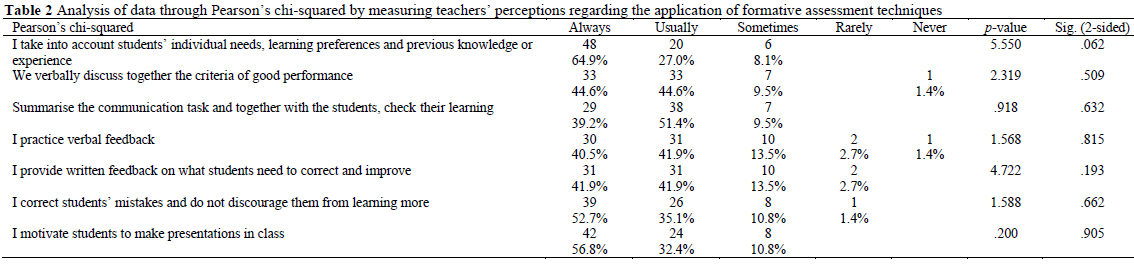
The results of this research indicate the formative assessment process by teachers including verbal and written feedback to students in lower secondary schools. The results of our research show that there was no statistically significant relationship between the practice of verbal and written feedback by teachers (cf. Table 2).
Do teachers take into account students' individual needs, learning preferences, and previous knowledge or experience? The teachers responded as follows: 64.9% said Always, 27% Usually and 8.1% Sometimes (significance [sig] = .062).
Teachers verbally discuss with students the criteria for good performance: Always (44.6%), Usually (44.6%), Sometimes (9.5%), Never (1.4%), (sig = .509).
Teachers summarise the communication task and together with the students, check if the learning objectives are met: Always (39.2%), Usually (51.4%), Sometimes (9.5%), (sig = .632).
Teachers practiced oral feedback: Always (40.5%), Usually (41.9%), Sometimes (13.5%), Rarely (2.7%), Never (1.4%), (sig = .815).
Teachers give written feedback to students on what they need to correct and improve: Always (41.9%), Usually (41.9%) Sometimes (13.5%) Rarely (2.7%) (sig = .193).
Teachers correct students' mistakes and do not discourage them from learning more: Always (52.7%), Usually (35.1%), Sometimes (10.8%), Rarely (1.4%), (sig = .662).
Teachers motivate students to make presentations in class: Always (56.8%), Usually (32.4%), Sometimes (10.8%) (sig = .905) (cf. Table 2).
Also, there was no significant difference in the practice of verbal feedback and written feedback, p < 0.05 by teachers in urban and rural schools (cf. Table 3), and between teachers of different subjects (civic education, history and geography) p < 0.05 (cf. Table 4).
Discussion
Méndez and Cruz (2012, in Alkhammash & Gulnaz, 2019) point out that some studies have shown that many teachers have positive perceptions of verbal feedback because it has the potential for correction, while some studies perceive verbal feedback practices that have negative impacts on students' feelings and emotions (Alkhammash & Gulnaz, 2019; Sisquiarco, Sánchez Rojas & Abad, 2018). On the other hand, Brown (2009) conducted a study comparing the perceptions and beliefs of teachers (n = 49) and students (n = 1,600) regarding verbal feedback and how it can be corrected. His study presents major differences between the way that teachers and students view feedback, where teachers in his study discouraged clear instructions given to students because, in their view, such instructions reduced communication between students and teachers. On the other hand, students strongly favoured teachers giving verbal feedback. It is suggested that teachers should adapt their methods to students' perceptions if they want to improve things that they do or have done wrong (Brown, 2009). Research shows that students prefer verbal and face-to-face feedback (Jardine, 2019).
The result from our research (n = 74) show that teachers preferred to use verbal feedback and written feedback. Furthermore, there was no significant difference between rural (n = 32) and urban teachers (n = 42) of the curriculum area, society and environment, in the subjects civic education, history and geography.
In the models described above, we recognised a number of features of feedback research. Firstly, research on feedback is not as voluminous as might be expected given its central role in learning (see Sadler, 2010). Despite extensive estimates, for example, by Hattie and Timperley (2007), and Shute (2008), it is assumed that writing should be ordinary and that no one needs to develop specific submission styles when giving written feedback. Some research suggests that, even if students receive praise, they prefer to do so by not telling others and keeping it to themselves (Sharp, 1985). Written information is also clear and tangible and, as distinguished from verbal, provides information, and can be made consistent. Unlike real-time verbal feedback, written feedback is traceable and more complex or time consuming. Kroll (2001, cited by Tom, Morni, Metom & Joe, 2013) argues that students need to be trained on how to use feedback because this will improve their learning. Students appreciate both positive and negative comments as a form of motivation and challenges that prompt them to improve in the future. Furthermore, teachers must give students constructive feedback to show their weaknesses, from which students can avoid repeating mistakes (Tom et al., 2013).
Our research supports the findings by the authors mentioned above in that combined written and verbal feedback students will have even more success in learning and more opportunities for correction and improvement.
Conclusion
The development of formative assessment practices is an essential part of the development of the education process. There are some differences in student assessment decision-making by teachers, as professional teacher training provides different alternatives and perspectives on how it can convey verbal input or written feedback to students. The results of our research, which are based on data analysis, show that there is no significant difference between teachers in the curriculum area, society and environment (civic education, history and geography), about the application of verbal and written feedback.
Also, there is no significant difference between teachers of urban and rural schools in implementing verbal and written feedback. Although there is no significant difference between teachers in the field of society and the environment and between place of residence, our research also highlights the following: of the 74 teachers involved in the research, 30 or 40.5% always used verbal feedback, 31 or 41.9% usually, 10 or 13.5% sometimes, 2 or 2.7% rarely and 1 or 1.4% never. Meanwhile, 31 or 41.9% of the teachers always used written feedback, 31 or 41.9% usually, 10 or 13.5% sometimes, and 2 or 2.7% rarely.
It is disturbing that a percentage of teachers indicated that they sometimes, rarely or never used verbal and written feedback. Therefore, we recommend ongoing training in formative assessment practices. At the same time, that curricular documents describe in more detail how formative assessment techniques should be used.
Authors' Contributions
ZGS wrote the manuscript and performed the statistical data analysis. NZ wrote the discussion section and reviewed the data. Both authors revised the final manuscript.
Notes
i. Published under a Creative Commons Attribution Licence.
References
Alkhammash R & Gulnaz F 2019. Oral corrective feedback techniques: An investigation of the EFL teachers' beliefs and practices at Taif University. Arab World English Journal, 10(2):40-54. https://doi.org/10.24093/awej/vol10no2.4 [ Links ]
Brown AV 2009. Students' and teachers' perceptions of effective foreign language teaching: A comparison of ideals. The Modern Language Journal, 93(1):46-60. https://doi.org/10.540-4781.2009.00827.x [ Links ]
Gorman C 2020. Giving and receiving difficult feedback. Available at https://ceciliagorman.com/blog/difficult-feedback. Accessed 3 April 2020. [ Links ]
Harlen W 2013. Assessment and inquiry-based science education: Issues in policy and practice. Trieste, Italy: Global Network of Science Academies (IAP) Science Education Programme (SEP). Available at https://www.interacademies.org/sites/default/files/publication/ibse_assessment_guide_iap_sep.pdf. Accessed 31 December 2022. [ Links ]
Hattie J & Timperley H 2007. The power of feedback. Review of Educational Research, 77(1):81 -112. https://doi.org/10.3102/003465430298487 [ Links ]
Hatziapostolou T & Paraskakis I 2010. Enhancing the impact of formative feedback on student learning through an online feedback system. Electronic Journal of e-Learning, 8(2):111 -122. Available at https://files.eric.ed.gov/fulltext/EJ895699.pdf. Accessed 31 December 2022. [ Links ]
Irons A 2008. Enhancing learning through formative assessment and feedback. New York, NY: Routledge. [ Links ]
Jardine C 2019. How to give effective feedback to your students. 24 June. Go react. Available at https://blog.goreact.com/2019/06/24/effective-feedback-to-students-ebook/. Accessed 24 June 2019. [ Links ]
Javed T, Asghar MA & Nazak N 2020. Association of teacher feedback with scholastic attainment at secondary level in Pakistan. South African Journal of Education, 40(Suppl. 2):Art. #1679, 9 pages. https://doi.org/10.15700/saje.v40ns2a1679 [ Links ]
Jolly B & Boud D 2012. Written feedback: What is it good for and how can we do it well? In D Boud & E Molloy (eds). Feedback in higher and professional education: Understanding it and doing it well. London, England: Routledge. [ Links ]
Juwah C, Macfarlane-Dick D, Matthew B, Nicol D, Ross D & Smith B 2004. Enhancing student learning through effective formative feedback. York, England: The Higher Education Academy (Generic Centre). Available at https://www.web.uwa.edu.au/__data/assets/pdf_file/0010/1867132/Juwah.pdf. Accessed 1 June 2004. [ Links ]
Kneebone R, Bello F, Nestel D, Mooney N, Codling A, Yadollahi F, Tierney T, Wilcockson D & Darzi A 2008. Learner-centred feedback using remote assessment of clinical procedures. Medical Teacher, 30(8):795-801. https://doi.org/10.1080/01421590801949941 [ Links ]
Koenig R 2021. Why professors should ask students for feedback long before the semester is over. Available at https://www.edsurge.com/news/2021-06-10-why-professors-should-ask-students-for-feedback-long-before-the-semester-is-over. Accessed 10 June 2021. [ Links ]
Lunt T & Curran J 2010. 'Are you listening please?' The advantages of electronic audio feedback compared to written feedback. Assessment & Evaluation in Higher Education, 35(7):75 9-769. https://doi.org/10.1080/02602930902977772 [ Links ]
Nearby Me 2 2019. Advantages and disadvantages of verbal communication. Available at https://www.nearbyme2.com/what-are-the-advantages-and-disadvantages-of-verbal-communication/. Accessed 16 November 2019. [ Links ]
Not So Wimpy Teacher 2021. Giving students feedback about their writing. Available at https://notsowimpyteacher.com/2021/02/giving-students-feedback-about-their-writing.html. Accessed 19 August 2021. [ Links ]
NSW Government 2021. Types of feedback. Available at https://www.education.nsw.gov.au/teaching-and-learning/professional-learning/teacher-quality-and-accreditation/strong-start-great-teachers/refining-practice/feedback-to-students/types-of-feedback#:~:text=Oral%20feedback%20is%20usually%20given%20during%20a%20lesson,the%20%E2%80%98teachable%20moment%E2%80%99%20and%20in%20a%20timely%20way. Accessed 21 January 2021. [ Links ]
Race P 2020. The lecturer's toolkit: A practical guide to assessment, learning and teaching (5th ed). London, England: Routledge. [ Links ]
Sadler DR 1989. Formative assessment and the design of instructional systems. Instructional Science, 18(2):119-144. https://doi.org/10.1007/BF00117714 [ Links ]
Sadler DR 2010. Beyond feedback: Developing student capability in complex appraisal. Assessment & Evaluation in Higher Education, 35(5):535-550. https://doi.org/10.1080/02602930903541015 [ Links ]
Sharp P 1985. Behavior modification in the secondary school: A survey of students' attitudes to rewards and praise. Behavioral Approaches with Children, 9:109-112. [ Links ]
Shute VJ 2008. Focus on formative feedback. Review of Educational Research, 78(1):153-189. https://doi.org/10.3102/0034654307313795 [ Links ]
Sisquiarco A, Sánchez Rojas S & Abad JV 2018. Influence of strategies-based feedback strategies. Fonthill, Canada: Regier Educational Resources. [ Links ]
Tom AT, Morni A, Metom L & Joe S 2013. Students' perception and preferences of written feedback in academic writing. Mediterranean Journal of Social Sciences, 4(11):72-80. https://doi.org/10.5901/mjss.2013.v4n11p72 [ Links ]
Wiggins G 2013. Seven keys to effective feedback. Alexandria, VA: ASCD. Available at https://pdo.ascd.org/lmscourses/PD13OC005/media/FormativeAssessmentandCCSwithELALiteracyMod_3-Reading2.pdf. Accessed 31 December 2022. [ Links ]
Xu X 2020. How to provide effective verbal feedback in the classroom. Available at https://www.tieonline.com/article/2678/how-to-provide-effective-verbal-feedback-in-the-classroom. Accessed 5 March 2020. [ Links ]
Received: 18 August 2021
Accepted: 13 December 2022
Published: 31 December 2022