



Services on Demand
Journal

Article
 Article in xml format
 Article references

 Automatic translation
 Send this article by e-mail
Indicators
Related links
-
 Cited by Google
-
 Similars in Google
Share

 Permalink

South African Journal of Education
On-line version ISSN 2076-3433Print version ISSN 0256-0100
S. Afr. j. educ. vol.43 suppl.1 Pretoria Dec. 2023
https://doi.org/10.15700/saje.v43ns1a2435
Psychosocial experiences of Foundation Phase teachers in South Africa during the COVID-19 pandemic
Jayshree Thilakdhari; Visvaranie Jairam
Department of Educational Psychology, School of Education, College of Humanities, University of KwaZulu-Natal, Durban, South Africa. arusha12@gmail.com
ABSTRACT
In this article we present an exploration and understanding of the lived psychosocial experiences of Foundation Phase teachers (FPTs) in South Africa during the COVID-19 pandemic. This phenomenological research was conducted with a specific group of 6 FPTs from 3 provinces in South Africa, namely, KwaZulu-Natal (KZN), Gauteng (GP) and the Western Cape (WC). Purposive sampling was selected alongside availability and convenience of the research participants. Multiple methods of generating data were selected: semi-structured interviews, collage inquiry and metaphor drawing. The Psychosocial Development Theory was used as a theoretical framework to offer lenses in exploring and understanding the psychosocial experiences of FPTs who were working during the COVID-19 pandemic in South Africa. Throughout data interpretation and analysis, vignettes were presented through themes and sub-themes and collage portraiture was used as an analysis tool to support and enliven the analysis. The research findings reveal that FPTs in South Africa had knowledge and understandings of the COVID-19 pandemic, experienced a variety of challenges during the COVID-19 pandemic, and needed intervention strategies to support them during the COVID-19 pandemic. A psychosocial development research intervention model has been created for FPTs to work during the COVID-19 pandemic or in similar emergencies.
Keywords: COVID-19 pandemic; experiences; foundation phase; foundation phase teacher; psychosocial
Introduction
The entire world, South Africa (SA) included, was faced with a 21st century global pandemic, and has been "fighting" this on-going global pandemic since 2020. The coronavirus disease (COVID-19) pandemic has manifested as a multifaceted crisis, affecting every critical sector of the world, including education. These unprecedented times brought about various challenges and radical changes to normality in the lives of humans all over the world. Education is an extremely significant aspect which involves a continuous process of teaching and learning in which development occurs. Teachers, including Foundation Phase teachers (FPTs), play a crucial role in enhancing the development of young children and working during a global pandemic has made this development process different. The initial stages of a child's academic life are considered to be crucial to their growth and development. At the Foundation Phase, a child's first formal learning occurs. Therefore, it is crucial for FPTs to prepare a child academically and support a child emotionally. FPTs' involvement in a child's life ultimately impacts their psychosocial development. An important question arose of how teaching and learning took place in SA during the global pandemic or even in similar emergencies. It would appear as if there was a lack of knowledge regarding this new phenomenon. Unfortunately, the available literature still does not offer enough in-depth analyses of the psychosocial experiences of FPTs who worked in SA during the COVID-19 pandemic. Therefore, the purpose of this research study was to fill this gap by exploring and understanding the lived psychosocial experiences of FPTs who worked in SA schools during the COVID-19 pandemic. The main objective of this research study was to explore and understand the lived psychosocial experiences of FPTs in SA during the COVID-19 pandemic. Underlying this objective, the sub-objectives were as follows: to ascertain the knowledge and understandings that FPTs in SA had on the COVID-19 pandemic; to identify the challenges, if any, of FPTs in SA during the COVID-19 pandemic; and to provide intervention strategies that are needed to support FPTs in SA during pandemics. This research study is significant as the existing global knowledge about the psychosocial experiences of FPTs in SA during this ongoing crisis will expand and add to the existing body of knowledge. Information obtained in this research study as well as the research findings should be beneficial to all educational stakeholders.
Literature Review
The COVID-19 global pandemic
Coronavirus disease 2019 or COVID-19 was the latest contagious disease affecting people throughout the world. It was a global pandemic that drastically affected SA and other parts of the world in economic, political and social aspects, including education. Although this disease rapidly escalated from just an outbreak in 2019 to a global pandemic in 2020, it was evident that the COVID-19 pandemic remained a new phenomenon and is currently being researched extensively throughout the world. The COVID-19 disease has not previously been identified in humans and unceasingly affected people throughout the world. Admittedly, COVID-19 was a new pandemic; consequently, limited information and research studies that describe the psychosocial experiences of FPTs during the COVID-19 pandemic or similar emergencies in SA is currently available.
Definition of Covid-19
COVID-19 is defined as a new family of viruses that "causes illnesses ranging from the common cold to more severe diseases" in human beings (Al Jazeera, 2020:para. 3). It has been assumed to spread mainly when an infected individual comes into close contact with another, and is transmitted through respiratory droplets produced when an infected individual breathes, coughs, sneezes, sings or speaks (World Health Organization [WHO], 2021). The uninfected individual becomes infected when the virus gets into their eyes, mouth or nose (WHO, 2023). The current symptoms of COVID-19 include "mild to severe respiratory illness with cough, sore throat, shortness of breath", fever, breathing difficulties, fatigue, loss of smell and loss of taste, muscle aches, chills, headaches, chest pains and runny nose (WHO, 2021:para. 2). Reported cases indicated that the illness of an infected individual ranges from "little to no symptoms to people being severely ill and dying" (WHO, 2021:para. 2). Medical research has shown that some individuals that are infected with the virus remain asymptomatic and do not develop noticeable symptoms at any point in time. However, the disease is contagious and these people can rapidly spread it without knowing (Oran & Topol, 2020). During the first few days after exposure of the virus, symptoms may or may not show (WHO, 2023). It was noted that many individuals who were infected with the virus tended to experience a range of effects that lasted for months after recovery (WHO, 2023). From February 2020, various methods have been developed to detect this dreadful disease (such as a nasal swab or throat swab), however, there is no specific cure to date (WHO, 2023). Nevertheless, individuals are encouraged to prevent infection (Mayoclinic, 2020).
The Covid-19 global pandemic international time line
On 31 December 2019, the WHO reported a cluster of pneumonia cases in Wuhan, a city on the Yangtze River in the central Hubei province, People's Republic of China. Since then, there have been several cases which spread rapidly throughout numerous countries across the globe which led to an ongoing coronavirus outbreak. On 7 January 2020, Severe Acute Respiratory Syndrome Coronavirus 2 (SARS-CoV-2) was confirmed as the causative agent of the coronavirus disease 2019 or COVID-19 which first developed in Wuhan, China (Department of Health, Republic of South Africa, n.d.). On 30 January 2020, the WHO declared this new ongoing coronavirus outbreak a global public health emergency (WHO, 2023). Two months later, on 11 March 2020, the WHO declared the coronavirus outbreak a global pandemic due to the "alarming levels of spread and severity" throughout various countries of the world (Westman, 2020:para. 2).
According to global statistics, on 13 February 2021, there were more than 100,000 000 positive cases of coronavirus that resulted in over 2,000,000 deaths across the globe (Worldmeter, 2021). The economic, social and political aspects of the world have drastically changed, some of which are still uncertain and have left deep underlying scars for the future (Tabish, 2020). This "invisible virus" that came within the blink of an eye is confirmed to have many lasting effects for all the people in this fast-changing world (Peña, 2020:para. 3). The impact of the COVID-19 global pandemic has resulted in extensive unemployment, homelessness, starvation, a rise in gender-based violence, alcoholism and millions of people falling into poverty throughout the world (Tabish, 2020).
Since the emergence of this deadly virus in December 2019, it has spread to every single continent throughout the world within a few months (Machhi, Herskovitz, Senan, Dutta, Nath, Oleynikov, Blomberg, Meigs, Hasan, Patel, Kline, Chang, Chang, Gendelman & Kevadiya, 2020). The WHO describes it as the first pandemic of the 21st century (Dong, Du & Gardner, 2020). The countries that have been hit aggressively with the greatest number of cases (13 February 2021), were: the United States of America (USA) with 27.5 million cases; India with 10.9 million cases; Brazil with 9.77 million cases, Russia with 4 million cases and the United Kingdom (UK) with 4 million cases. These countries also had significant death rates: USA with 471,000 deaths; India with 156,000 deaths; Brazil with 237,000 deaths, Russia with 79,000 deaths and the UK with 116,000 deaths. Mexico also had a high death rate of 171,000 deaths. Many countries around the globe have employed different measures to deal with the ongoing virus. Some of which included national lockdowns, trade restrictions, shelters for people without homes, banning of large gatherings, confinement measures, travel bans, late-night travel restrictions, and border closures.
A changing life throughout the world
11 March 2021 marked 1 year after the official declaration of the global pandemic. It was evident that it had not faded after a year, rather increased with even greater severity (De le Vingne, 2021). Many developments have been made since then. In Figure 1 we present a timeline adapted from the American Society for Microbiology (2021) showing developments during 1 year of the COVID-19 pandemic.
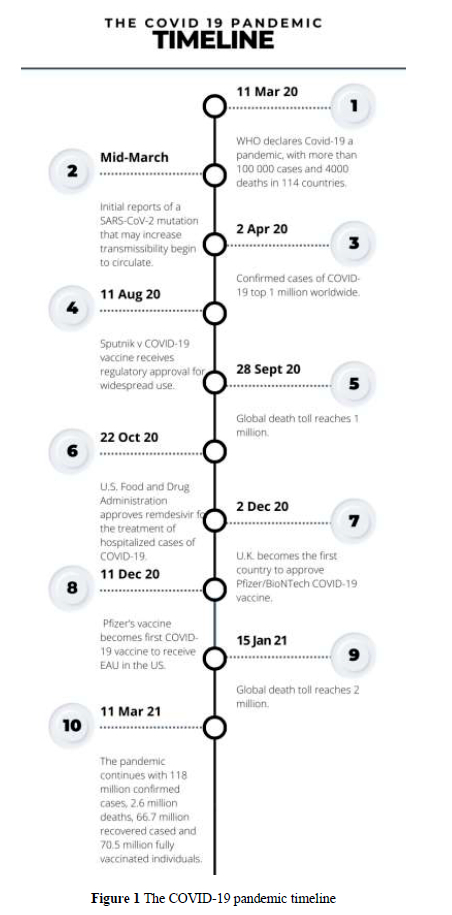
A year later, the global pandemic was still ongoing with 118 million positive cases, 26 million deaths and 66.7 million recoveries worldwide. On 11 March 2021 there were effective and safe vaccines available, however, it was not available to the vast majority of people (De le Vingne, 2021). The travel restrictions, restrictions on meeting people, wearing of face coverings in public, job insecurities, reopening of non-essential stores (such as gyms, museums, art galleries, cinemas and places of worship) continued. Living in a 21st century global pandemic was still uncertain.
A South African timeline of the Covid-19 pandemic
The first wave of the coronavirus pandemic in SA began on 1 March 2020. It emerged from a South African traveller who had returned home from Italy and was tested positive for the virus. On 15 March 2020, South African president, Cyril Ramaphosa, declared a national state of disaster and announced a few measures to lower the number of transmissions. On 23 March 2020, Ramaphosa announced a national 21-day lockdown that was to begin on 27 March 2020 until 16 April 2020. However, on 9 April 2020, the lockdown was extended until the end of April 2020 in order to lower the number of transmissions. During this time, only healthcare workers, pharmacy and laboratory personnel, emergency personnel, security services, individuals regarded as necessary to the basic functioning of the economy and those working in industries that could not be economically shut down went to work. The remainder of South Africans were restricted to their homes. Other measures included the following: all gatherings (except funerals) were prohibited; restaurants, taverns and liquor stores were closed; schools that had been already closed a week before the lockdown period were now only to be reopened after the lockdown; people were allowed to leave their homes only to access health services and social grants, shop for essential goods and attend funerals with no more than 50 individuals. By 24 March 2020, all nine SA provinces had confirmed cases of the coronavirus. It took until 27 March 2020 to confirm the first death resulting from COVID-19 in SA. On 21 April 2020, a R500 billion stimulus package was announced in response to the pandemic. By the end of the first wave, November 2020, the number of positive cases was 1,353 with five deaths (Abdool Karrim, 2020).
The number of positive coronavirus cases continued to increase rapidly over a few months that led to the start of the second wave which began in December 2020. On 3 December 2020, Ramaphosa noted a resurgence of COVID-19 in some provinces and tightened restrictions in those areas with other measures in place to reduce transmissions, such as introducing a curfew from 9 am to 6 pm, banning the sale and transport of alcohol, closure of public amenities, and the compulsory wearing of face masks in public. On 27 December 2020, the number of confirmed cases was 1 million.
On 13 February 2021, there were 1.49 million positive cases and 47,670 deaths in SA. Ten June 2021 marked the start of the third wave in SA as the number of positive COVID-19 cases amounted to 9,149. The fourth wave began in December 2021 as there was again a rise in the number of positive COVID-19 cases. At the end of December 2021 SA had an accumulated amount of 3,446,532 positive cases. As the pandemic continued so did the mutation of the virus as people were infected. The several variants included Alpha, Beta, Gamma, Delta, Omicron, Lambda and Mu.
The statistics of this deadly disease in South Africa
The impact of the COVID-19 pandemic transcends categories of social class, race, gender, age, cast, creed or any other thing that may be used to define an individual, and as Peña (2020:para. 3) asserts, "COVID-19 has once again put Darwin's hypothesis of 'survival of the fittest' in style, which does not necessarily have to correspond to the strongest." The daily lives and livelihoods of people throughout the world, including SA, have been adversely affected by the pandemic (Tabish, 2020). Common issues that have increased during this time include stress, panic, anxiety and depression. The physical, emotional, social, spiritual, financial, occupational, and environmental wellness of individuals has to be redefined with time (Tabish, 2020).
On 11 March 2021 the cumulative number of positive COVID-19 cases in SA was 1,525,648. Table 1, adapted from the National Institute for Communicable Diseases ([NICD], 2021) shows statistics of 1 year of the COVID-19 pandemic in SA. The number of positive cases and percentages per province were as follows:
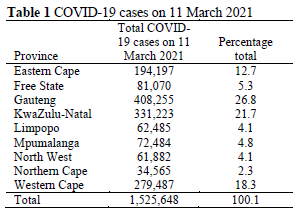
This table shows that the greatest number of positive COVID-19 cases were in Gauteng, KwaZulu-Natal and the Western Cape.
The implications of the COVID-19 global pandemic on education internationally
The COVID-19 global pandemic was first and foremost a health crisis; however, it "manifested as a multifaceted crisis" (Le Grange, 2021:425). It impacted largely on the lives and livelihoods of people and more specifically, on education worldwide. At the onset of the crisis in early 2020, it led to the near total closure of educational institutions, including schools, colleges and universities worldwide in order to prevent the spread of the virus by limiting physical contact with others. Evidence has shown that there have been many unexpected challenges along the way (Le Grange, 2021). Some of which included the sudden transition from physical face-to-face interaction to remote, digital teaching and learning; no or limited access to resources such as radios, televisions, computers, laptops, cell phones, internet and data; mental health issues and feelings of stress, anxiety, fear, worry, loneliness and depression; illiterate parents and guardians that had greater difficulty in supporting their children with academics at home (Tabish, 2020). Tabish (2020:5) indicates that "the education of many children for whom long distance learning is unavailable stands at great risk." These challenges have long-term consequences for those that have been adversely affected and is, therefore, likely to increase educational inequalities (Sievertsen & Burgess, 2020). Throughout the world, the effects of COVID-19 forced educational institutions to revise and readjust their education systems, as well as the ways of working on a daily basis. Tabish (2020) advocated for nations to protect children from the dire consequences of this unforeseen COVID-19 global pandemic. Teachers across the globe have been experiencing their own challenges while dealing with a global pandemic, and their ways of working has changed overnight (Tabish, 2020).
The implication of the Covid-19 global pandemic on education in South Africa
The COVID-19 pandemic has rapidly and radically affected South African society in general and more specifically, its education system. According to Le Grange (2021:425), the pandemic revealed "the gross inequalities that are the legacies of apartheid and the consequences of neoliberal capitalism." Reddy, Soudien and Winnaar (2020: 12) indicate that the longer the implementation of social distancing, the greater the learning losses of learners, especially those that are disadvantaged, therefore, "deepening inequalities." For SA, "schools are more than places where knowledge is exchanged between teacher and learner" (Le Grange, 2021:427). Schools have become "places of safety and security" for children who come from vulnerable communities (Le Grange, 2021:427).
Education authorities in SA realised that due to social distancing, time to complete the schooling curriculum was being lost and, therefore, the academic year desperately needed to be saved. However, Jansen (2020:para. 6) indicated in July 2020 that the academic year of 2020 was already lost and "in education, the virus will greatly exacerbate the inequality of learning outcomes between the minority privileged and the majority poor." Jansen (2020) argues that those learners that did not have privileges such as internet access and access to digital learning platforms would be left further behind in their academic careers. He further articulated that "COVID-19 did not cause inequality - it will reveal it ..." (Jansen, 2020:para. 5).
Ten weeks after the initial lockdown schools began to reopen across the country. There were many opposing views from different stakeholders. Teacher unions argued that too much would be at stake if schools had to reopen; many parents and teachers viewed school "as a potential flash point for the spread of the virus" and researchers argued that schools were more than a place of knowledge exchange, therefore, schools needed to reopen with minimal risk (Robinson, 2020:para. 4). Various school policies have been put in place to deal with the new disease at school. Washing of hands with soap and water, sanitising, social distancing and wearing of masks were the new norm in 2020. Those teachers with comorbidities were allowed to stay at home for a short period. In many SA schools suffering from poor conditions water was unavailable and social distancing was not possible since classrooms were too small and overcrowded. These challenges contributed to exacerbating the stark inequalities in the South African education system (Hart, 2020).
The significant role of the Foundation Phase and Foundation Phase teachers in South Africa
A Foundation Phase teacher in SA is defined as a teacher who is qualified to teach the Foundation Phase which includes grades R, 1, 2 and 3 or children between the ages of 5 and 9 years old. They usually teach all subjects in the curriculum, which includes mathematics, home language, first additional language and life skills. FPTs play an important role in the South African education system. They are responsible for helping children to develop a solid base of educational knowledge and thinking skills in order for learners to become independent and can work on their own as they progress to upper primary education. Apart from building the foundations of reading, writing, literacy and mathematics, FPTs promote the social, emotional, intellectual and physical development of children (Smart-Kids, n.d.).
The impact of COVID-19 on teachers in South Africa
Hlungwane and Steytler (2021:para. 1) recognise that "teachers have always held the future of children in their hands, but never has this been more true than in 2020" when teachers had to adapt to a new way of teaching and learning. Prior to the COVID-19 pandemic, teachers in SA had no to little technology training and during the lockdown period, they had to find innovative ways of supporting learners, parents and caregivers, despite the turmoil caused by the virus. It was noted that some teachers worked outside their normal teaching hours and were going over and above their duties (Hlungwane & Steytler, 2021). Those teachers who could not attend to learners digitally, physically dropped documents and checked on learners at their homes or in convenient spaces. This global pandemic highlighted the "tenacity, leadership and agility" of some teachers. However, SA is faced with complex realities in everyday schooling contexts.
During the COVID-19 pandemic, it was evident that teachers' job descriptions had changed suddenly, and their teaching loads, duties and responsibilities had increased. Teachers now used personal protective equipment (PPE) daily, sanitised learners, checked learners' health and body temperature, ensured social distancing taking place in the school, ensured that learners were washing their hands with soap and water regularly, ensured that learners were wearing face coverings, and ensured effective teaching and learning taking place. Hlungwane and Steytler (2021) recognise that teachers have always been frontline workers with regard to teaching and learning. During the pandemic and similar emergencies, teachers should be supported and valued and included in shaping and reshaping the South African education system. In order to strengthen and rebuild the South African education system, educational, provincial departments of education, district managers, senior management teams at schools, school governing bodies, teachers, parents and communities must unite.
Foundation Phase teachers building a foundation during the COVID-19 pandemic
As a result of the ongoing COVID-19 pandemic, FPTs, among others, felt overwhelmed and pressured in building a foundation for learners (Robinson, 2020). Teaching time lost as well as the stop and start learning with long gaps in between had adversely impacted the South African education system. Bangani (2021) notes that young learners in the Foundation Phase have learnt very little of the schooling curriculum in 2020 and needed to develop a firm foundation in reading and understanding of mathematical concepts. The lost teaching time delayed efforts in addressing the prevalent crises with literacy and mathematics in SA. Trying to "catch up" puts pressure and stress on FPTs. It was evident that the disruption to teaching and learning at school was likely to wipe out any learning gains, therefore, teachers were responsible to ensure that all learning material was covered (Bangani, 2021). Although the 2021 schooling year remained uncertain, teacher support needed to be fast-tracked, and there was opportunity for growth and development (Bangani, 2021). Hlungwane and Steytler (2021) believe that due to COVID-19 underlining the value of teachers in society, it was best to put teachers' needs at heart and reimagine their role in order to build better education for the benefit of every child and their future.
Theoretical Framework
A theoretical framework provides a foundation for conducting research and exploring a research study. Landsberg, Krüger and Nel (2005:9) define a theoretical framework as "a set of ideas, assumptions and concepts that explain the world, ourselves, or an aspect of reality." In addition, Grant and Osanloo (2014:12) assert that it functions as a "blueprint" to support a research study.
The Psychosocial Development Theory (PDT) founded by Erik Erikson in the 1950's was used as a frame to guide and support this research. This theory elucidates that an individual is shaped by and reacts to their social experiences within their social contexts throughout their entire lifespan (Newman & Newman, 2020). Erikson emphasised that an individual's personality development occurred through a series of crises which are known to be a "radical change in perspective" (Erikson, 1968:96) and develops through socialisation throughout eight stages of psychosocial development from the cradle to the grave (Erikson, 1958). During each stage, an individual may experience a psychosocial crisis and based on their experiences within their social context, they have a positive or negative outcome which affects their personal development. As maintained in the theory, successful completion of each stage will result in a healthy personality and the acquisition of basic virtues (McLeod, 2021). Basic virtues are defined as "characteristic strengths that the ego can use to resolve subsequent crises" (McLeod, 2021:para. 3). Failure to successfully complete a stage will result in reduced ability to complete further stages and, therefore, an unhealthier personality and sense of self (McLeod, 2021). However, crises may be resolved successfully at later stages of development.
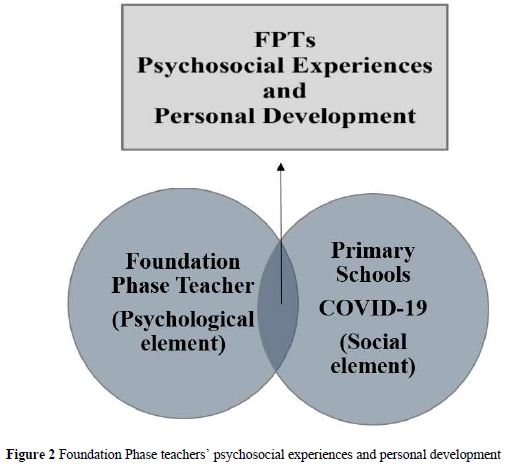
PDT advocates an inextricable link between individuals' psychological and social elements. These elements, when combined, contribute to individuals' psychosocial experiences. The psychological element refers to an individual's mental or emotional state, and the social element refers to the social environment in which an individual develops. Erikson believed that psychological and social factors influenced each stage of psychosocial development (Erikson, 1963). According to Vizzotto, De Oliveira, Elkis, Cordeiro and Buchain (2013), psychosocial may be defined as the influence of social factors on an individual's mind or behaviour, and the interrelation of both psychological and social aspects.
In this research, the PDT as a theoretical framework offered lenses in exploring and understanding how FPTs negotiated their psychosocial experiences of working within their social contexts during the COVID-19 pandemic in SA. It was extremely useful as it highlighted and identified the importance of individuals' social interactions and the significance of their personal development. During each stage of development an individual experiences a psychosocial crisis which leads to basic virtue that develops into a positive psychosocial outcome.
We developed the Venn diagram in Figure 2 to show the relationship between the FPTs' experiences in relation to their social contexts that lead to personal development. A Venn diagram is suitable in this research as it is used "to indicate shared or overlapping aspects of a concept, a category or a process" (Verdinelli & Scagnoli, 2013:364). By using the PDT, we explored and understood the FPTs' psychosocial experiences during the COVID-19 pandemic in SA.
The Research Methodology and Design
Interpretivist Paradigm
We used an interpretivist research paradigm in the study reported on here. The interpretivist paradigm emphasises that reality is not objectively determined, but is rather "socially constructed", multi-layered, complex and, therefore, the experiences of individuals occur within their social contexts (Cohen, Manion & Morrison, 2018:52). Individuals view and interpret social reality from their own perspectives. Hennink, Hutter and Bailey (2020) further note that the interpretivist paradigm emphasises the importance of understanding experiences which are meaningful and subjective, therefore, multiple realities and interpretations can exist.
Qualitative Research Approach
We used a qualitative research approach in this study. It involved generating and analysing non-numerical data in order to understand how individuals or groups of individuals explore and understand meanings of their experiences of the world they live in (Bhandari, 2020). Moreover, Maree (2007:50) explains that, from the research participants' point of view, qualitative research "attempts to collect rich, descriptive data in respect of a particular phenomenon or context with the intention of developing an understanding of what is being observed or studied" (Hennink et al., 2020).
Research Methodology
We employed phenomenology as a qualitative methodology in this research study. Phenomenology is defined as the study of lived experiences (Teherani, Martinmianakis, Stenfors-Hayes, Wadhwa & Varpio, 2015). It is further defined as a research technique that has been used extensively in qualitative research for decades, and is concerned with the study of the essence of phenomena that arises from lived experiences of being in the world (Teherani et al., 2015). In addition, Van Manen (2014) expresses that phenomenology focuses on understanding how individuals experience a particular situation or phenomenon from their own perspectives, and make meaning as they live through those experiences. Furthermore, Heinonem (2015) emphasises that an individual's lived experiences ultimately shape their own behaviour.
Significantly, phenomenology is a unique qualitative form of inquiry that is intended to arrive at phenomenal understanding and insight of lived experiences (Van Manen, 2017). Therefore, when used in this research study, it brought out the unique perceptions, perspectives and deepened the understanding of the research participants and the essences of their lived experiences. Phenomenology was exceptionally suited to this research study as we were able to get glimpses of the unique and multifaceted psychosocial experiences of FPTs in SA. This methodology focused on distinctive human experiences, as well as the detailed and nuanced examining of the analysis and interpretation of the lived experiences of a small number of participants (Van Manen, 2017).
The Research Location
This qualitative research study was conducted in six different schools across three different provinces in SA, namely: KwaZulu-Natal (KZN), Gauteng (GP) and the Western Cape (WC). These schools had Foundation Phase departments, were either primary or combined schools, mainstream schools, co-educational schools and either public or private schools. The educational institutions in KZN, GP and the WC were selected purposively, as we had sufficient knowledge of the challenges, changes and difficulties experienced by the FPTs who worked at these schools during the COVID-19 pandemic. The motivation for selecting six schools was that we aimed to generate rich and detailed information in order to capture the essences of FPTs' lived psychosocial experiences. This research could also be used to launch further research and development interests. Due to the COVID-19 pandemic and the need to safeguard the researchers and the research participants, data were generated online.
Sampling Techniques
For the purpose of this research, purposive sampling, alongside availability and convenience were selected.
Research Participants
With this small-scale research study we focused on the essences of lived psychosocial experiences. As indicated before, six FPTs from three provinces in SA were selected as the research participants for this research study.
The selection of the research participants was defined by the following criteria for inclusion/exclusion:
• The research participants had to be FPTs.
• The research participants had to reside and work in SA, specifically in KwaZulu-Natal, Gauteng and the Western Cape.
• The research participants had to be working during the COVID-19 pandemic.
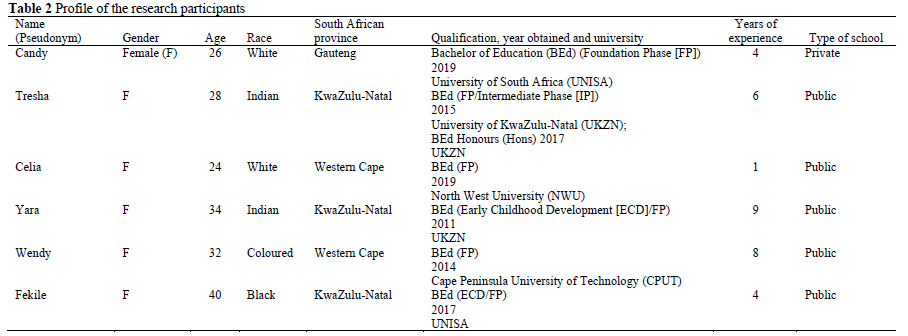
Table 2 provides a profile of the research participants at the time of the study (September/October 2021). Pseudonyms were used in order to safeguard the participants' anonymity and confidentiality.
Profile of the Research Participants
Data Generation Methods
Phenomenological research allows a researcher to gain an in-depth understanding of the research participants' lived psychosocial experiences through their perceptions, beliefs and feelings. The data generation methods were in the form of semi-structured interviews, collage inquiry and metaphor drawings. These multiple data generation methods were suitable for exploring and understanding the lived psychosocial experiences of FPTs in SA during the COVID-19 pandemic.
Qualitative Data/Thematic Interpretation and Analysis
Data analysis in qualitative research is described as a systematic process of making sense of the data in order to increase an understanding of the phenomenon under study (Bogdan & Biklen, 1982). The purpose of data analysis in this research study allowed for "the process of breaking up or segmenting the data into parts and reassembling the parts again into a coherent whole" (Boeije, 2010:76) in order to answer the research questions. Data analysis involved generating data, reviewing it, extracting selected data based on analytical and logical reasoning, analysing it into themes in order to extract findings, and ultimately draw conclusions (Terre Blanche, Durrheim & Painter, 2006). In this research study, the process of qualitative data/thematic analysis was adapted from Lochmiller and Lester (2017). It involved the following seven phases which may overlap: preparing and organising the data, transcribing the data, becoming familiar with the data, memoing the data, coding the data, moving from codes to categories and categories to themes, making the analytical process transparent.
Research Ethics
This research study was approved by the Human and Social Sciences Research Ethics Committee (HSSREC) of the University of KwaZulu-Natal, Protocol reference number: HSSREC/00002974/2021, and the South African Department of Education. We ensured that all ethical procedures were followed transparently and truthfully and that all COVID-19 rules and protocols were followed thoroughly throughout the study. No participants were harmed directly or indirectly during the study.
The research participants' anonymity and confidentiality were protected and their human dignity, privacy and rights were protected. The identities and information about the research participants were withheld from public knowledge and pseudonyms replaced their actual names and the names of the schools (Hennink et al., 2020). We protected all transcriptions and generated data through electronic measures secured with a password.
Research Findings
South African Foundation Phase Teachers' Knowledge and Understanding of the COVID-19 Pandemic
The COVID-19 pandemic was the latest, on-going, infectious disease faced globally (WHO, 2023). The impact of this virus was significant, and had drastically affected the South African education system. It has brought about many more challenges for FPTs in SA, many of which were unprecedented. Based on this research study, it was evident that all research participants had reasonable to sound understanding of the COVID-19 pandemic. The research participants indicated that the COVID-19 pandemic was experienced worldwide and they described it as a deadly virus. They further indicated that it should be taken seriously as no cure existed for the virus at the time of the study. In addition, the research participants indicated that the COVID-19 pandemic had positive and negative implications. Although most were negative, the FPTs in SA used this as an opportunity to adapt to their social contexts and embrace a new normal.
South African Foundation Phase Teachers' Challenges of Working During the COVID-19 Pandemic
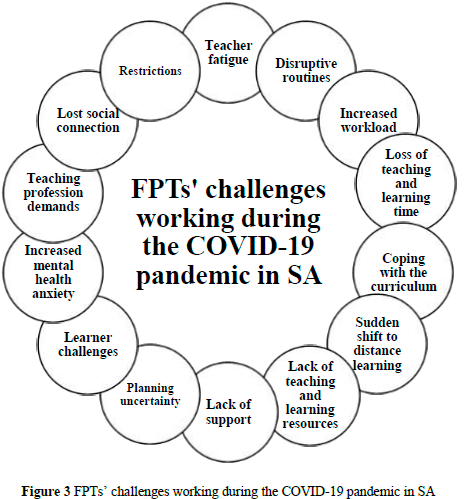
We confirmed that the six research participants experienced a variety of challenges during the COVID-19 pandemic. The unprecedented impact of the pandemic contributed greatly to the well-being of FPTs, and in particular added to the challenges faced by teachers in SA. The challenges experienced by Candy, Tresha, Celia, Yara, Wendy and Fekile while working as FPTs during the COVID-19 pandemic in SA are shown in Figure 3.
Intervention Strategies Needed to Support Foundation Phase Teachers in South Africa
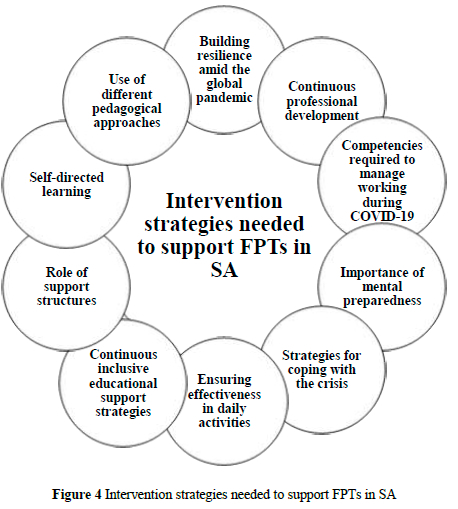
Due to the unstable nature of the global pandemic, FPTs in SA needed support while working during this unprecedented time. The intervention strategies needed by the research participants to support them while working as FPTs during the COVID-19 pandemic in SA are presented in Figure 4.
Lived Psychosocial Experiences of Foundation Phase Teachers in South Africa during the COVID-19 Pandemic
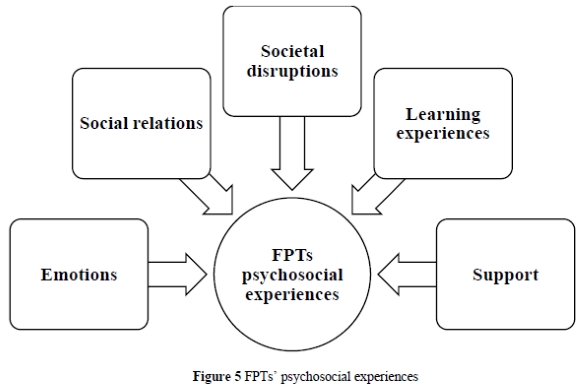
This research study revealed that particular emotions, social relations, societal disruptions, learning experiences, support and lack of thereof contributed to South African FPTs' psychosocial experiences of working during the COVID-19 pandemic. The psychosocial experiences of FPTs in SA who worked during the COVID-19 pandemic are presented in Figure 5.
Negotiating Psychosocial Experiences of Foundation Phase Teachers in South Africa during the COVID-19 Pandemic
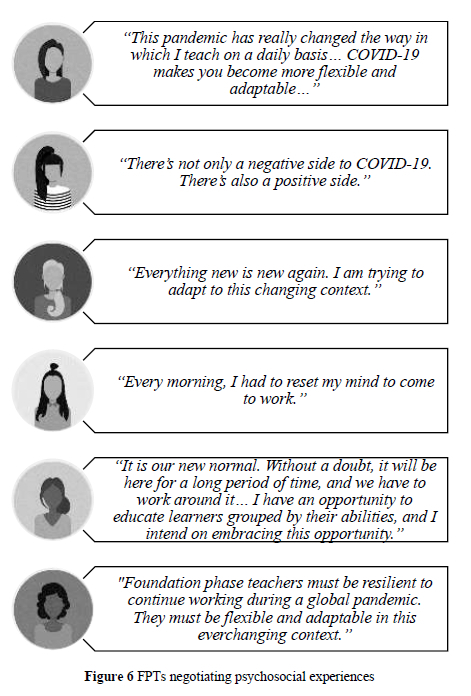
Some of the FPTs' negotiations of their psychosocial experiences of working during the COVID-19 pandemic are presented in Figure 6.
Negotiating Psychosocial Experiences of Foundation Phase Teachers in South Africa during the COVID-19 Pandemic Leads to Psychosocial Development
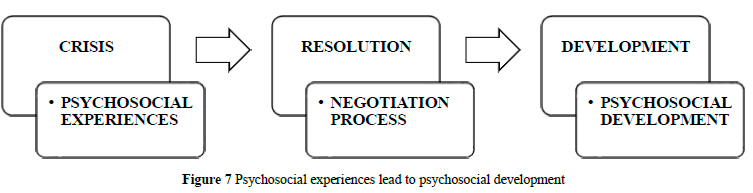
Drawing from the PDT, we were able to explore and understand the multifaceted lives of the six FPT research participants as they negotiated their experiences in relation to their social contexts. The six FPTs negotiated their psychosocial experiences which led to psychosocial development (cf. Figure 7).
Psychosocial Development Research Intervention Model
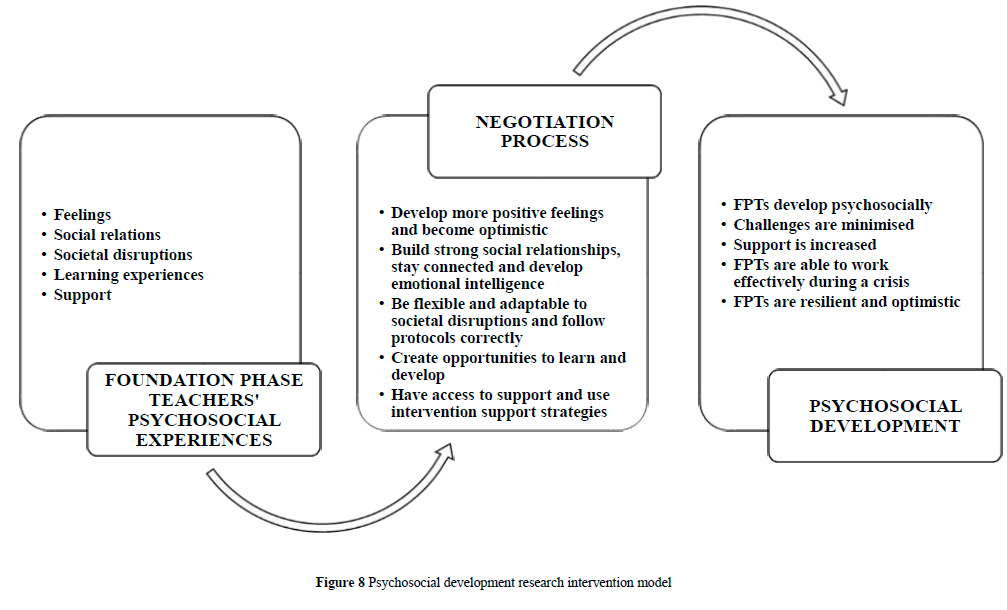
Evidently, FPTs in SA who worked during the COVID-19 pandemic negotiated their psychosocial experiences within their social contexts, in order for development to occur. The psychosocial development research intervention model assisted FPTs in SA who worked during the COVID-19 pandemic to negotiate their psychosocial experiences, leading to psychosocial development. This model has been created to assist FPTs in SA to work effectively during crises, minimize challenges, increase support, become resilient and ultimately develop psychosocially.
Conclusion
In this research article we highlight the lived psychosocial experiences of six FPTs in SA who worked during the COVID-19 global pandemic. In researching the lives of the FPTs in SA, we have come to understand the value of their lived experiences, as these experiences shaped their psychological and social development. In this research study, data were generated through collage inquiry, semi-structured interviews and metaphor drawings. Data were presented, interpreted and analysed. We adopted Lochmiller and Lester's (2017) data/thematic analysis process, as well as collage portraiture as an analysis tool. The findings of this research study presented through vignettes highlight FPTs' knowledge and understanding of the COVID-19 pandemic; the FPTs' challenges of working during the COVID-19 pandemic; intervention strategies that were needed to support FPTs in SA who worked during the COVID-19 pandemic; as well as FPTs' lived psychosocial experiences while working during the COVID-19 pandemic. We noted that FPTs in SA had complex, multiple and unique psychosocial experiences of working during the COVID-19 pandemic. However, they negotiated their psychosocial experiences which led to psychosocial development. A psychosocial development research intervention model has been created for FPTs in SA so that they may develop psychosocially, work effectively during crises, minimize challenges, increase support and become resilient.
Acknowledgements
I would like to express my sincere appreciation and gratitude to my supervisor, Dr Visvaranie Jairam. I also thank the South African provincial Departments of Education for allowing me to conduct the research, the research participants for agreeing to participate in this research study, and the Educational Psychology Department at the University of KwaZulu-Natal.
Author's Contributions
This manuscript was written by Jayshree Thilakdhari, supported by Visvaranie Jairam. Both authors collaborated in the review of the final article.
Notes
i. This article is based on the doctoral dissertation of Jayshree Thilakdhari, entitled: "Psychosocial experiences of Foundation Phase teachers in South Africa during the COVID-19 pandemic."
ii. Published under a Creative Commons Attribution Licence.
References
Abdool Karrim SS 2020. The South African response to the pandemic. New England Journal of Medicine, 382(24):e95(1)-e95(3). https://doi.org/10.1056/NEJMc2014960 [ Links ]
Al Jazeera 2020. Coronavirus: All you need to know in under 500 words, 20 September. Available at https://www.aljazeera.com/news/2020/9/20/coronavirus-all-you-need-to-know-in-under-500-words. Accessed 1 April 2021. [ Links ]
American Society for Microbiology 2021. Resources - COVID-19 resources (SARS-CoV-2 Coronavirus). Available at https://asm.org/Resource-Pages/COVID-19-Resources. Accessed 31 December 2021. [ Links ]
Bangani Z 2021. COVID-19 school closures pose a threat to learning gains. TimesLIVE, 21 April. Available at https://www.timeslive.co.za/news/south-africa/2021-04-21-COVID-19-school-closures-pose-a-big-threat-to-learning-gains/. Accessed 1 April 2021. [ Links ]
Bhandari P 2020. What is qualitative research? Methods and examples. Available at https://www.scribbr.com/methodology/qualitative-research/. Accessed 1 April 2021. [ Links ]
Boeije H 2010. Analysis in qualitative research. London, England: Sage. [ Links ]
Bogdan RC & Biklen SK 1982. Qualitative research for education: An introduction to theory and methods. Boston, MA: Allyn and Bacon. [ Links ]
Cohen L, Manion L & Morrison K 2018. Research methods in education (8th ed). London, England: Routledge. [ Links ]
De le Vingne B 2021. One year of a pandemic. Available at https://www.msf.org/one-year-covid-19-pandemic. Accessed 1 April 2021. [ Links ]
Department of Health, Republic of South Africa n.d. About COVID-19 (Coronavirus). Available at https://sacoronavirus.co.za/information-about-the-virus-2/. Accessed 1 April 2021. [ Links ]
Dong E, Du H & Gardner L 2020. An interactive web-based dashboard to track COVID-19 in real time. Lancet Infectious Diseases, 20(5):533-534. https://doi.org/10.1016/s1473-3099(20)30120-1 [ Links ]
Erikson EH 1958. Young Man Luther: A study in psychoanalysis and history. New York, NY: Norton. [ Links ]
Erikson EH 1963. Childhood and society (2nd ed). New York, NY: W.W. Norton. [ Links ]
Erikson EH 1968. Identity: Youth and crisis. New York, NY: W. W. Norton. [ Links ]
Grant C & Osanloo A 2014. Understanding, selecting, and integrating a theoretical framework in dissertation research: Creating the blueprint for your "house". Administrative Issues Journal, 4(2):12-26. https://doi.org/10.5929/2014.4.2.9 [ Links ]
Hart C 2020. Educators are learners, too. Available at https://www.ednc.org/perspective-educators-are-learners-too/. Accessed 18 May 2021. [ Links ]
Heinonem K 2015. Van Manen's method and reduction in a phenomenological hermeneutic study. Nurse Researcher, 22(4):35-11. https://doi.org/10.7748/nr.22A35.e1326 [ Links ]
Hennink M, Hutter I & Bailey A 2020. Qualitative research methods (2nd ed). Los Angeles, CA: Sage. [ Links ]
Hlungwane A & Steytler M 2021. Teachers are key to reimagining and rebuilding education in South Africa. Daily Maverick, 14 February. Available at http://www.dailymaverick.co.za/article/2021-02-14-teachers-are-key-to-reimagining-and-rebuilding-education-in-south-africa/. Accessed 14 February 2021. [ Links ]
Jansen J 2020. Let's face facts, the 2020 school year is lost. So what to do? TimesLIVE, 9 April. Available at https://www.timeslive.co.za/ideas/2020-04-09-lets-face-facts-the-2020-school-year-is-lost-so-what-to-do/. Accessed 9 April 2021. [ Links ]
Landsberg E, Krüger D & Nel N (eds.) 2005. Addressing barriers to learning: A South African perspective. Pretoria, South Africa: Van Schaik. [ Links ]
Le Grange L 2021. Covid-19 pandemic and the prospects of education in South Africa. Prospects, 51:425-436. https://doi.org/10.1007/s11125-020-09514-w [ Links ]
Lochmiller CR & Lester JN 2017. An introduction to educational research: Connecting methods to practice. Los Angeles, CA: Sage. [ Links ]
Machhi J, Herskovitz J, Senan AM, Dutta D, Nath B, Oleynikov MD, Blomberg WR, Meigs DD, Hasan M, Patel M, Kline P, Chang RCC, Chang L, Gendelman HE & Kevadiya BD 2020. The natural history, pathobiology, and clinical manifestations of SARS-CoV-2 infections. Journal of Neuroimmune Pharmacology, 15:359-386. https://doi.org/10.1007/s11481-020-09944-5 [ Links ]
Maree K (ed.) 2007. First steps in research. Pretoria, South Africa: Van Schaik. [ Links ]
Mayoclinic 2020. Coronavirus disease 2019 (COVID-19). Available at https://www.mayo.edu/research/clinical-trials/diseases-conditions/coronavirus-disease-2019-(covid-19). Accessed 1 April 2021. [ Links ]
McLeod S 2021. Erik Erikson's stages of psychosocial development. Available at https://www.simplypsychology.org/Erik-Erikson.html. Accessed 1 April 2021. [ Links ]
National Institute for Communicable Diseases 2021. Latest confirmed cases of Covid-19 in South Africa (11 Mar 2021), media statement, 11 March. Available at https://www.nicd.ac.za/latest-confirmed-cases-of-covid-19-in-south-africa-11-mar-2021/. Accessed 1 April 2021. [ Links ]
Newman BM & Newman PR 2020. Theories of adolescent development. London, England: Academic Press. [ Links ]
Oran DP & Topol EJ 2020. Getting a handle on asymptomatic SARS-CoV-2 infection. Scripps Research, 22 September. Available at https://www.scripps.edu/science-and-medicine/translational-institute/about/news/sarc-cov-2-infection/. Accessed 31 December 2023. [ Links ]
Peña RM 2020. A changing world: Life after COVID-19. Available at https://www.bbvaopenmind.com/en/humanities/beliefs/a-changing-world-life-after-covid-19/. Accessed 1 April 2021. [ Links ]
Reddy V, Soudien C & Winaar L 2020. Disrupted learning during COVID-19: The impact of school closures on education outcomes in South Africa. HSRC Review, 18(3):10-13. Available at https://repository.hsrc.ac.za/bitstream/handle/20.500.11910/15402/11508.pdf?sequence=1&isAllowed=y. Accessed 1 April 2021. [ Links ]
Robinson M 2020. The multifaceted challenges for South Africa's educators and student teachers during the pandemic. Available at https://globaledleadership.org/2020/08/04/the-multifaceted-challenges-for-south-africas-educators-and-student-teachers-during-the-pandemic/. Accessed 1 April 2021. [ Links ]
Sievertsen HH & Burgess S 2020. Schools, skills, and learning: The impact of COVID-19 on education. Available at http://voxeu.org/article/impact-covid-19-education. Accessed 1 April 2021. [ Links ]
Smart-Kids n.d. Your role in your child's education: Foundation Phase. Available at https://smart-kids.pearson.com/homework-help/parenting-tips/your-role-your-childs-education-foundation-phase. Accessed 1 April 2021. [ Links ]
Tabish SA 2020. Life and livelihood during the COVID 19 pandemic. Journal of Clinical Immunology & Immunotherapy, 6:035. https://doi.org/10.24966/CIIT-8844/1000035 [ Links ]
Teherani A, Martinmianakis T, Stenfors-Hayes T, Wadhwa A & Varpio L 2015. Choosing a qualitative research approach. Journal of Graduate Medical Education, 7(4):669-670. https://doi.org/10.4300/JGME-D-15-00414.1 [ Links ]
Terre Blanche M, Durrheim K & Painter D (eds.) 2006. Research in practice: Applied methods for the social sciences (2nd ed). Cape Town, South Africa: University of Cape Town Press (Pty) Ltd. [ Links ]
Van Manen M 2014. Phenomenology of practice: Meaning-giving methods in phenomenological research and writing. London, England: Routledge. [ Links ]
Van Manen M 2017. But is it phenomenology? Qualitative Health Research, 27(6):775-779. https://doi.org/10.1177/1049732317699570 [ Links ]
Verdinelli S & Scagnoli NI 2013. Data display in qualitative research. International Journal of Qualitative Methods, 12(1):359-381. https://doi.org/10.1177/160940691301200117 [ Links ]
Vizzotto ADB, De Oliveira AM, Elkis H, Cordeiro Q & Buchain PC 2013. Psychosocial characteristics. In MD Gellman & JR Turner (eds). Encyclopedia of behavioral medicine. New York, NY: Springer. https://doi.org/10.1007/978-1-4419-1005-9_918 [ Links ]
Westman N 2020. WHO declares the outbreak of the new coronavirus is a pandemic. Available at https://www.theverge.com/2020/3/11/21156325/coronavirus-pandemic-who-declares-covid-19-outbreak-global-h1n1. Accessed 1 April 2021. [ Links ]
World Health Organization 2021. Health topics - Coronavirus Disease (COVID-19). Available at https://www.who.int/health-topics/coronavirus#tab=tab_1. Accessed 31 December 2021. [ Links ]
World Health Organization 2023. Fact sheets - Coronavirus disease (COVID-19). Available at https://www.who.int/news-room/fact-sheets/detail/coronavirus-disease-(covid-19). Accessed 31 December 2023. [ Links ]
Worldmeter 2021. COVID-19 coronavirus pandemic. Available at https://www.worldometers.info/coronavirus/?utm_campaign=homeAdvegas1?%22. Accessed 1 April 2021. [ Links ]
Received: 28 February 2023
Revised: 25 October 2023
Accepted: 12 December 2023
Published: 31 December 2023