



Services on Demand
Journal

Article
 English (pdf)
 Article in xml format
 Article references

 Automatic translation
 Send this article by e-mail
Indicators
Related links
-
 Cited by Google
-
 Similars in Google
Share

 Permalink

South African Journal of Education
On-line version ISSN 2076-3433Print version ISSN 0256-0100
S. Afr. j. educ. vol.43 suppl.2 Pretoria 2023
https://doi.org/10.15700/saje.v43ns2a2235
Sertel Altun; Banu Yucel-Toy
Department of Educational Sciences, Faculty of Education, Yildiz Technical University, Istanbul, Turkey. byuceltoy@gmail.com
ABSTRACT
With this study we aimed to evaluate the effectiveness of a collaborative and reflective school-based training model on the teachers' professional transformation in a middle school in Turkey. This study emerged as a result of a need for this school to transform its instructional approach to the understanding by design (UbD) approach. Considering the needs of teachers for instructional design, a 1-year training programme was planned. Thirteen teachers from different subject fields in the school participated in this case study. The teachers prepared 4 UbD plans collaboratively under the coaching of the researchers, implemented them in the class, and participated in the reflection meetings after each implementation. While evaluation of plans showed their progress, focus-group interviews revealed that this training had changed the teachers' instructional approach and developed their design skills. Additionally, even though there were some challenging issues such as intense workloads, time constraints, coordination problems, the teachers generally emphasised the contributions of studying UbD to their peer collaboration, classroom practices, and their students' understanding and learning. We concluded that not only this collaborative and reflective training model but also the UbD itself had positive effects on teachers' professional transformation.
Keywords: instructional design; professional development; teacher training; understanding by design (UbD)
Introduction
Education has to be continuously improved because student's expectations and needs constantly change, knowledge continuously develops as a result of the information age and society's expectations and needs differ because of social change. Every element in the education system is affected by these changes and undoubtedly teachers are the main locomotives of this change. As Robinson (TED Talks, 2013) states, "teachers are the lifeblood of the success of schools" and the quality of schools, the effectiveness of instruction, and the competence of students depend on the fact that this lifeblood is at the desired quality and quantity. In this respect, all stakeholders who consider the quality of teachers concur that teachers cannot continue their professional life with the knowledge, skills, attitudes, and values they have at the time of graduation. As a result, this necessitates the continuous professional development (PD) of teachers. Darling-Hammond, Hyler and Gardner (2017:2) define PD for teacher as "professional learning as a product of both externally provided and job-embedded activities that increase teachers' knowledge and help them change their instructional practice in ways that support student learning." Díaz-Maggioli (2004) states that PD is a process where teachers have an opportunity to review their professional knowledge and skills and learn how to meet the needs of the students.
Traditional ways of PD include pre-service training, orientation for new staff, in-service training, work-based training, seminars, and mentoring programmes. However, traditional PD practices do not address the needs and interests of the learners, teachers, and society (Darling-Hammond et al., 2017). PD is important, not only for schools but also for the development and economy of countries. Governments and schools allocate budgets for the development of teachers and ineffective traditional practices cause a loss of money and time. On the other hand, PD practices turn into an effective investment as long as it increases the quality of education and serves to train qualified students. Therefore, educational authorities in various countries have been continuously seeking and endeavouring to find effective and efficient PD interventions. Among a number of initiatives, school-based professional development (SBPD) is accepted as one of the most effective interventions (Bertram, 2011; De Clercq & Phiri, 2013).
In order to ensure that any PD activities achieve their intended goals, Darling-Hammond et al. (2017) propose seven important principles: 1) concentrating on content-focused teaching strategies, 2) incorporating active learning based on adult learning theory, 3) supporting collaboration in job-embedded contexts, 4) using models of effective practice, 5) providing coaching and expert support, 6) giving feedback and reflection and 7) ensuring sustained duration. Moreover, Hunzicker (2010) emphasises PD activities to be context-based, instruction-focused, collaborative and sustainable. Among others, collaboration and reflection come into prominence among features of any effective PD models such as lesson studies, professional learning communities, and school-based professional development (Easton, 2008; Hord & Tobia, 2012; Lewis, 2002; Vescio, Ross & Adams, 2008). Collaborative and reflective PD activities enhance the growth and effectiveness of teachers, foster a supportive learning community, and raise a collective wisdom and self-awareness because these activities encourage teachers to engage in meaningful dialogue, curriculum development, problem-solving, share knowledge and experiences with their peers, collaborate on lesson planning, and analyse their own practices to identify areas for improvement (Hord & Tobia, 2012; Lewis, 2002; Sutherland, Markauskaite & Cruickshank, 2023; Vescio et al., 2008).
This study emerged as a result of efforts to find an SBPD model best suited to a middle school's demand to transform its instructional approach. This SBPD process started with identifying the needs of teachers prior to the training. It has been determined that teachers lack knowledge and skills about instructional design. Actually, as Bertram (2011) argues, any PD initiatives should mainly focus on the development of teachers' competence on organising systematic learning; in other words, the design of instruction. School administration and teachers stated that they wanted to improve their instructional competencies through training on the understanding by design (UbD) instructional design model, which is backward instructional design.
This instructional design model was preferred by this school because of its advantageous features. Firstly, different from conventional instruction design models, UbD provides an established framework for teachers. As a backward instructional design model, it has a distinctive feature in which the desired results are considered first and then the evidence of learning, assessment, is determined accordingly (McTighe & Wiggins, 1999). Understanding, which is the essence of UbD, is seen as the primary target of learning activities and these activities are planned as final stage of the model. Secondly, this model approaches instruction as an act of ensuring understanding, which is defined as the ability to transfer knowledge to new contexts, to use what is known effectively in various contexts, to apply knowledge and skills in real life, to connect ideas, to see the big picture, and to grasp the basic concepts (McTighe & Wiggins, 1999; Wiggins & McTighe, 2011). Thirdly, planning lessons through UbD does not focus on short-term success that can be reached at the end of a lesson; rather, it provides a learning environment that makes it easier for students to acquire the ability to transfer knowledge to all new environments that they will encounter in their future lives (Wiggins & McTighe, 2011). Fourthly, the most prominent feature of modern-day classrooms is that they consist of students who have a wide range of interests, abilities, and motivation types. The way to maintain this richness and achieve harmony is to create meaningful learning taking into consideration all these differences in the classroom. In this vein, designing instruction according to the UbD model minimises random learning in the classroom as a result of unplanned instruction or learner abilities by allowing teachers to consider all learners and their learning preferences. Finally, preparing UbD lesson plans fosters collaborative work by teachers in line with the needs of the students. In this way, teachers can benefit from each other's experiences, and at the same time, have a chance to succeed in the attainment of the desired results (Wiggins & McTighe, 2005).
Purpose and Significance of the Study
In light of this information, an SBPD process regarding the transformation journey of this school was structured by considering the specific features of UbD and the above-mentioned seven teacher training principles stated by Darling-Hammond et al. (2017). A 1-year reflective and collaborative UbD training programme had been planned. As for this study, the aim was to reveal the effectiveness of the collaborative and reflective school-based training model implemented in the middle school in Turkey, on the professional transformation of teachers. The main research question guiding the study was: "What are the effects of the training model on the teachers' professional development?"
It was expected that the results would shed light on schools seeking for the effective and sustainable PD model - not only in Turkey but also in other developing countries like South Africa. Both countries have some basic similarities. Like in Turkey in 2006, a reform in the compulsory education curriculum was made with a transition from behaviourist to constructivist and from teacher-centred to a learner-centred approach in South Africa in 2005 (Ono & Ferreira, 2010; Wilmot, 2004). Although this reform made training of teachers more important, a number of studies have addressed problems of teacher training in South Africa (Ajani, 2020; Makwara, 2022; Ngema & Lekhetho, 2019). PD training activities for teachers are criticised because of it being ineffective in developing teachers' teaching practices in classroom, considered inadequate in meeting their professional needs, and irregular frequency of PD activities (Ajani, 2020). It is emphasised that training should be based on teachers' needs, collaboration, reflection, classroom practice, and context (Ajani, 2020; Makwara, 2022; Ngema & Lekhetho, 2019; Ono & Ferreira, 2010). In this study, training was carried out with a SBPD model based on the needs of the teachers in the school. In this year-long SBPD model, after training on UbD, participating teachers, in the role of instructional designers, made, implemented and evaluated instructional designs (lesson plans) in a collaborative and reflective manner. Within the scope of the research, the development of the teachers' designs during the training and the gains at the end of the training were evaluated. In this context, it was thought that the PD model applied in the school would shed light on teacher trainers, principals or authorities. For these reasons, this study would contribute to research and practice in the South African context as well. With new research on the effectiveness of the model, it can contribute to the literature in providing principles and generalisations about SBPD.
Literature Review
School-based professional development
Hurd and Licciardo-Musso (2005) state that SBPD studies provide a safe environment for teachers, giving them the opportunity to strengthen and demonstrate their skills, and develop a common language and productivity among colleagues with the atmosphere of trust it creates. Moreover, McFarland (2014) reveals that the SBPD programme, which was prepared by taking the needs of teachers and students into account, deepened teachers' subject knowledge and improved teaching practices. The PD process carried out for cooperation enabled teachers to learn new information from their colleagues. In
Diemert's (2014) study based on the SBPD process, it was revealed that teachers contributed to each other' s learning and had positive effects on their PD. As important determinants in evaluating SBPD opportunities, HS Lee (2014) uncovered in his research that the motivation of the teacher and the context of the school were very important. In this regard, Scherrod (2014) revealed that teachers needed the support of administrators and decision-makers in SBPD studies and that it was important to value their own ideas in the content of PD programmes.
Backward instructional design: UbD Several studies on UbD have shown the effectiveness of UbD on teachers' PD, on students' learning and their motivation (Kuntari, Rondonuwu & Sudjito, 2019; Yurtseven & Altun, 2016, 2017, 2018). Based on comprehensive surveys, interviews and focus groups about the teachers' UbD practices and experiences, Brown (2004) presents a number of improvements not only on students but also on teachers and even schools. He states that UbD unifies teachers who prioritise students' understanding instead of transmitting knowledge and expecting recall. Moreover, there are studies focusing on its use in curriculum design, development, and assessment (Dack & Merlin-Knoblich, 2019; Roth, 2017) and its use by teacher educators (Johnson, Peterson, Spears & Vest, 2017).
Theoretical Framework
School-based professional development (SBPD)
PD, which every teacher should be involved in during their professional life, is important not only for improving their own professional lives but also for learning the necessary knowledge, skills and teaching practices to meet the changing needs and expectations of teachers and students (Benedict, 2014; Ingvarson, Meiers & Beavis, 2005). In this respect Easton (2008) emphasises the importance of professional learning instead of PD. The effective professional learning plan he proposes starts with focusing on school-level (including teachers' ) needs, mission and goals and continues with activities in school context. Actually, due to its effective results SBPD stands out among other PD models (Bertram, 2011; De Clercq & Phiri, 2013).
SBPD includes continuing education activities that specifically focus on problems related to a school' s and teachers' interests, needs, roles and responsibilities (Altun & Vural, 2012). It contributes to the wholistic development of teachers' skills, knowledge, values and attitudes related to the teaching profession (Seferoglu, 2004). In SBPD applications, since the determination of the content and the planning of the operation are determined by the teachers at the school, the level of effectiveness is higher than the central applications nationwide (Bümen, Ates., Cakar, Ural & Acar, 2012). Moreover, it is alleged that since SBPD practices directly address the needs of teachers and students, resistance to change is less than to changes directed by the authorities from above (Altun & Vural, 2012). Within the SBPD context, it is also possible to think of mutual interaction between PD and teacher agency. On the one hand, Calvert (2016:52) emphasises promoting teacher agency in schools for supporting professional learning as a response to a conundrum that "[i]f we know what good professional learning looks like, why aren't teachers experiencing it?" and on the other hand, Gutierez (2019) reveals that SBPD improves teacher agency.
SBPD not only contributes to teachers' own professional and personal development, but also directly or indirectly affects the learning skills of their students and thus their success (Özdemir, 2013) and school institutional development (Darling-Hammond et al., 2017). In many countries SBPD has been found to be effective because it allows harmony between the PD of teachers and the development of the school (Lewis, 2002). In Canada, a structure that supports SBPD in their education system has been developed. In this structure teacher PD is shaped according to the needs of the teacher and this highlights peer sharing and peer mentoring (Bakioglu & Pekince, 2013). Finland, Singapore, Hong Kong, Japan and China also adopted the SBPD approach to teacher PD in which schools, in a sense, have an autonomous administration and school administrations are responsible for the teachers' PD (Gopinathan & Deng, 2006; Lee, JFK 2008). The underlying reason for this result is that whether SBPD activities are carried out individually or as a group, teachers work together in a collaborative environment to achieve results, share information, find common solutions to problems, communicate or solve other school problems and, in this way, transform the school into a learning organisation (Kösterelioglu & Kösterelioglu, 2008). Among the qualities of powerful professional learning leading to school improvement, Easton (2008) proposes that professional learning activities should take its source in the real world of teaching and learning and direct teachers to practice in real classrooms. By its very nature, SBPD provides these qualities.
Peer collaboration, together with reflection, has been emphasised as fundamental principles of the powerful PD process (Avalos, 2011; Clarke & Hollingsworth, 2002; Darling-Hammond et al., 2017; Easton, 2008; Horn & Little, 2010; Whitcomb, Borko & Liston, 2009) and has been addressed in many studies (Benedict, 2014; Orlovsky, 2014; Spollen-LaRaia, 2011). In this respect, Benedict (2014) states that in situations that support the collaboration of teachers, teachers benefit from each other's experiences and reflections in lesson planning, classroom practice, assessment and teaching methodology. Furthermore, classroom management showed accelerated development with feedback from peers, and teachers became more motivated as they saw their colleagues' good examples. Darling-Hammond et al. (2017) show that if feedback is given clearly and on time, teachers could reflect on their practice and in that way gain the knowledge and skills to be qualified in practice. Villegas-Reimers (2003), who compiled several PD models, asserts that whichever PD model is applied, support and feedback must be ensured. Because of these reasons, teacher networks, teacher communities or teacher clusters have been implemented as a powerful vehicle for teachers' PD (Jita & Mokhele, 2014; Jita & Ndlalane, 2009).
Backward instructional design: UbD
UbD, which was developed by Wiggins and McTighe (1998), is a backward design model including three stages. In the stage for identifying desired results, learning outputs are determined, including transfer, understanding, knowledge and skill goals. The initial big idea driving students and the course is defined and essential questions leading students' questioning and thinking are set. Transfer of objectives includes outcomes for the independent transfer of knowledge by the student to new environments and different disciplines. Understanding objectives is the section that specifies the comprehension of permanent and transferable knowledge by the student and the essential questions that encourage the student to seek information throughout the unit. In the knowledge and skills objectives, the knowledge and skills that students will acquire at the end of the unit are expressed.
Secondly, in the stage for identifying assessment evidence, which involves the assessment of evidence, performance tasks and other process evaluations, evidence is amassed for process and product evaluation which demonstrates whether the desired learning outcomes are attained. In preparing performance task, teachers should take the six principles, GRASPS, into account: "(1) a real-world goal, (2) a meaningful role for the student, (3) authentic (or simulated) real-world audience(s), (4) a contextualised situation that involves real-world application, (5) student-generated culminating products and performances, and (6) consensus-driven performance standards (criteria) for judging success" (Tomlinson & McTighe, 2006:70).
Finally, in the stage for learning activities and instruction, the methods, techniques, activities and materials are determined, and teaching activities are planned for the students to achieve the desired results. WHERETO principles are considered in the planning of teaching activities (McTighe & Wiggins 1999). WHERETO constitutes the following principles: Where is being sure that students understand the intension with the lesson unit, Hook is attracting students' attention at the beginning of the lesson and holding their attention during the lesson, Explore and Equip is to activate students with methods, techniques, materials and activities to encourage them to discover and gain the experience, knowledge and skills required to complete the performance tasks. Rethink and Revise is providing many opportunities for students to rethink big ideas, reflect on the process, receive feedback and organise their work accordingly. Exhibit and Evaluate is to provide opportunities to assess students' progress and to ask students to assess themselves. Tailored to differentiation is the use of methods and techniques that consider the differentiation in the class. Lastly, Organised is to organise teaching in a way that optimises deep understanding rather than covering too much subject content (Wiggins & McTighe, 2005).
Methods
Research Design
This study was a case study in which mixed methods (both qualitative and quantitative) were used. A case study is defined as an inquiry that researches a phenomenon within its real-life context (Yin, 2014). In order to evaluate the impact of the training on their instructional design skills, the UbD lesson plans that the teachers prepared during the training were analysed quantitatively using a rubric. In order to evaluate the effectiveness of the training from the teachers' perspectives in depth, interviews (qualitative methods) were held with teachers. Through interviews participants have a chance to voice their opinions, give details about their experiences and any phenomenon so that researchers can gain detailed understanding and insight (Creswell, 2013; Creswell & Guetterman, 2019).
The Training Model
In this case study, the training model presented in Figure 1 was developed based on the seven important principles of Darling-Hammond et al. (2017): (1) throughout the training, the teachers from the same subject field prepared plans for the course they taught in order to be content-focused; (2) collaborative group work and station techniques were used in workshops to actively involve all the teachers; (3) the teachers from the same subject field were asked to prepare UbD plans together to encourage peer collaboration; (4) the teachers were asked to implement the UbD plans in their classrooms; (5) the researchers provided coaching and expert support during the preparation of the UbD plans; (6) during the preparation and implementation of the plans, the teachers reflected on their planning and implementation and both the researchers and teachers gave feedbacks; (7) the proposed model consisting of six steps was implemented over a period of 1 year. These steps are shown in Figure 1.
1) Needs Analysis: A meeting with principal, heads of department and teachers was held in order to get information about the school curriculum, the teachers' characteristics and the school's goals. Moreover, lesson plans developed by teachers were examined in order to get information about teachers' instructional design knowledge and skills, and to determine their needs.
2) Seminar: Get to know UbD: This seminar was presented to principal and teachers to introduce the principles of UbD and explain how to design instruction through the UbD model.
3) Workshops: Get to do UbD: Two workshops were conducted with teachers to have them practice how to prepare lesson plans in accordance with UbD principles. Lesson plans were developed by teachers who were grouped according to their subject areas. Then, these plans were presented, reviewed, and revised.
4) Reflective and collaborative instructional design process: During the fall and spring semesters, the teachers collaboratively prepared four UbD plans. All these plans were implemented and before each implementation we reviewed the plans to ensure sustained coaching. Reflection meetings with each teacher group were held separately after each implementation. Teachers reflected on their plans and the implementation thereof.
5) Formative evaluation: During the reflection meetings, teachers evaluated whether the plan was implemented as intended, how it affected the effectiveness of the instruction and students' learning, and whether any problems were encountered. Taking their reflections and evaluations into consideration, the next lesson plans were prepared.
6) Summative evaluation: The training ended with a summative evaluation meeting with the principal and the teachers. At the end of the year, focus-group interviews were held with each group of teachers.
Data Sources: Teachers and UbD Plans
This SBPD study was conducted at a private middle school in Istanbul, Turkey. The school was one of a few schools where the medium of instruction was German. Therefore, the school administration was eager to follow innovations and be supportive of the development of their teachers based on their needs through SBPD. Since this was also a SBPD study, all teachers working in this school were involved in the training and in the study. In total, 13 teachers participated; five mathematics teachers, three Turkish language teachers, two social studies teachers and three science and technology teachers. During training, except for the social studies teachers, the groups of teachers prepared four UbD plans. Because the two social studies teachers were overloaded with course hours and had limited time, they prepared three UbD plans. In total, 15 UbD plans were evaluated.
Data Collection Tools
UbD plan evaluation rubric
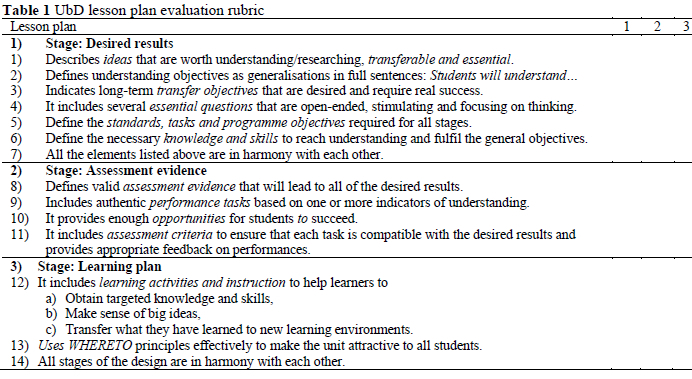
A rubric adapted from the UbD unit design standards (Wiggins & McTighe, 2011) by Yurtseven (2016) was used to evaluate the lesson plans. As is clear from Table 1, the grading using the rubric was based on three points (1: Beginner; 2: Moderate; 3: High). It consisted of three parts and 14 criteria in accordance with UbD stages: desired results (seven items relating to defining and indicating understanding, knowledge, skill, and transfer objectives and essential questions), assessment evidence (four items relating to including performance tasks and validity and adequacy of assessment tools for measuring understanding) and learning plans (three items relating to the use of the WHERETO principle and the adequacy of learning activities and instruction to ensure the attainment of objectives).
Focus group interviews
In addition, data were gathered from teachers through in-depth focus-group interviews after training. Compared to individual interviews, focus-group interviews stimulate participants to participate and explain their views (Fontana & Frey, 2005; Marshall & Rossman, 1999). Since teachers developed UbD plans collaboratively and reflectively, they experienced the training process together and they got used to sharing their views within the group. Because of these reasons, semi-structured focus-group interviews were preferred instead of individual interviews. The only difficulty experienced during these interviews was that it was hard to get the participants to speak in turn. There were times when one teacher was speaking that others added their own views by interrupting even though it was not their turn. They were allowed to speak in order not to cause any stress and not to disturb the comfortable environment. However, this caused problems while transcribing the records. Since we could not recognise the speakers, we could only include quotations in the findings without giving any information about who the speakers were.
We developed six interview questions relating to what they had learned about UbD, what the contributions of the training process were, what their reflections on their implementation of lesson plans were and what difficulties they experienced. From time to time probing questions were asked to clarify and obtain more detailed responses. Before interviewing began, informed consent and permission for tape recording was obtained from each of the teachers. Teachers were treated according to the American Educational Research Association' s (AERA) code of ethics (AERA, 2011). In order not to interfere with the execution of their duties, teachers were interviewed during their free hours. In order to avoid feeling pressured by the school administration, principals were not included in the focus-group discussions despite being very open-minded. Working with the teachers for 1 year created an atmosphere of mutual respect, and this situation was preserved in the interviews. We tried to make teachers aware that their opinions were very valuable for the improvement of their teaching and their students' learning. They were informed about the purpose of the study, the use of the results, time of the interviews, their anonymity, their right to ask questions or to withdraw from the study at any time, the use of a tape recorder for recording and their right to see the interview notes if they felt uncomfortable in any instances.
Data Analysis
Quantitative data were obtained from the rubric. Rubric scores of each group of teachers on each lesson plan are given by criteria and in total. Data gathered from focus-group interviews were analysed by qualitative content analysis in order to uncover the underlying meanings of qualitative data and because of it being a systematic, and at the same time, a flexible data analysis method (Schreier, 2012). Keeping the research questions in mind, the transcribed teacher responses were carefully read and coded by each researcher. All expressions accounting for or revealing the effectiveness of the training were coded. We then convened to review the initial codes. After the codes were determined, the related codes were used to form themes. Codes and themes were checked by the teachers. Finally, for member checking, an interview was held with one of each group of teachers to review and validate the codes, themes and relevant excerpts. According to the feedback of the interviewees, the codes and themes were finalised. An example of coding is presented in Table 2. While interview results yielded the perceived effectiveness of the training, lesson plans prepared during the training showed teachers' progress as a concrete indicator of the effectiveness of the training.
Trustworthiness of the Research
To ensure credibility of the study, peer debriefing was applied. We interacted with each other and discussed all training and research processes. Two experts from the field of educational sciences and qualified on qualitative research reviewed the interview questions, codes and themes. For the purpose of transferability, a detailed description of the training model, and the training and research process is provided in the methodology section. A thick description is provided to make it possible for researchers to carry out similar studies or for readers to decide whether to transfer findings to a similar context (Creswell, 2013). As explained under the data analysis, codes and themes yielded by content analysis were also checked by the teachers for member checking.
Findings
The Changes in the Teachers' Instructional (UbD) Designs
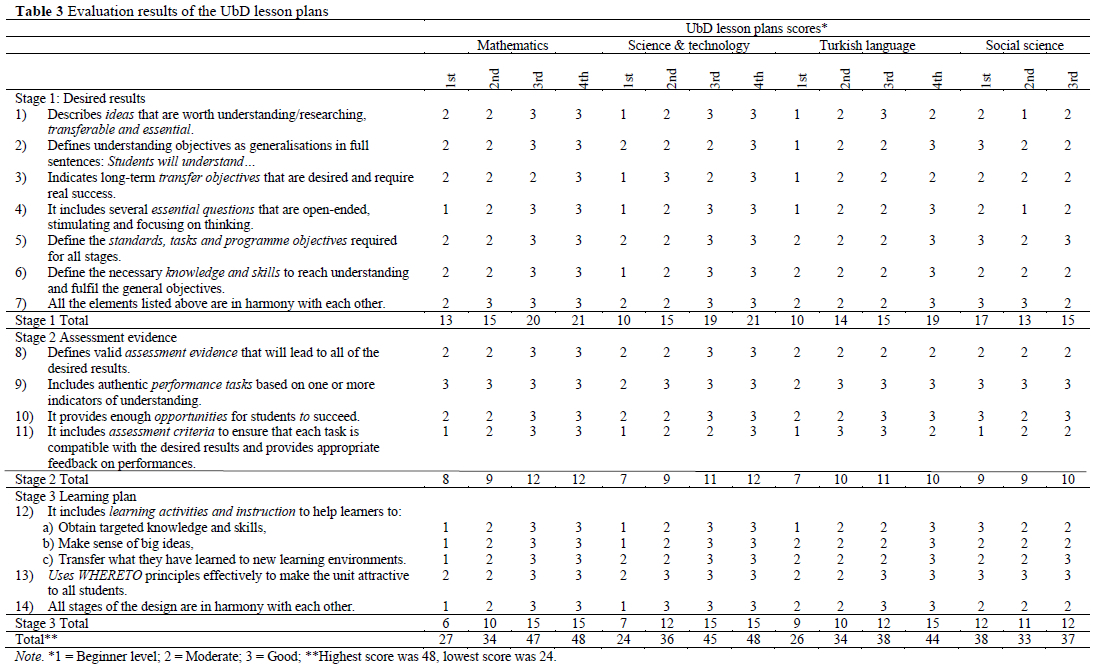
The plans prepared by the teachers were evaluated using the UbD plan evaluation rubric and the results are presented in Table 3. When the scores were examined item by item, it was found that mathematics, science-technology and Turkish language teachers had difficulties in writing big ideas, transfer objectives and essential questions in the first plans. Yet, these items showed improvement in the next plans.
Most teachers became competent at writing all items in the desired results stage of the plan by the end of the training. In terms of defining valid assessment evidence, all groups showed high performance in preparing authentic performance tasks. In the beginning the teachers struggled most with identifying assessment criteria, however, in time, all groups showed improved progress. Another noteworthy finding is that, from the start, social sciences teachers were good at developing authentic performance tasks and providing enough opportunities.
Mathematics and science-technology teachers were less competent in developing learning activities and instruction to help learners obtain targeted knowledge and skills, make sense of big ideas and in ensuring harmony among the different stages of the plan. However, in the subsequent plans, they showed progress. The teachers' use of WHERETO principles to make units attractive to all students was generally good. By the end of the training, except for social science teachers, all other teachers became competent in preparing learning plans.
Teachers' Evaluations about the Impact of the UbD Training Model
Content analysis of data obtained from the focus-group interviews yielded five themes: change in teaching approach, design of knowledge and skills, peer collaboration, effectiveness of the implementation of UbD plans, and difficulties. The themes are discussed next.
Theme 1: Change in teaching approach
According to teachers' opinions, this training provided awareness among teachers in terms of different aspects of instruction. The teachers indicated that they tried to find different instructional methods and to integrate technologies into their instruction. They stated that the UbD training forced them to renew and refresh their ideas and to bring the course up to date and relevant to life. In doing so, they gained a different perspective on their teaching. In this respect, it was indicated that the enrichment of the course with different methods and activities made them excited about doing teaching differently. Additionally, the findings show that the teachers were able to put themselves in their students' places while designing the plans. A few also indicated that as plans were implemented, they realised their students' potential.
You transfer the current life to the lesson so, it becomes a plan changing every year by updating. It can allow teachers to refresh their ideas. So after a long time, I put myself in the place of the student for the first time, and from this point of view, I thought about how I could find questions and where this topic could take me. The biggest difference here was that I put myself in the student's shoes.
It is important to understand the whole picture, to form big ideas and to approach the topic with the essential questions.... We saw that we could reach that in different ways, and we could actively evaluate the students in reaching it. It is a plan having a defined framework. The big idea really makes me think a lot when preparing the plan. When you think about it, you look at the children from a different perspective and shape all the other stages accordingly....
Theme 2: Design of knowledge and skills UbD training also contributed to the teachers' instructional design of knowledge and skills. The teachers stated that due to the training, they discovered the essence of the subject and realised the importance of better planning. Moreover, it was revealed that the training forced teachers to consider the curriculum vertically and made them understand to what extent the subject should be taught to students in a specific grade. The teachers also indicated that they learned the importance of taking students' readiness levels into account while planning. Additionally, they stated that the training challenged them to prepare better plans, taught them how to prepare performance tasks, enabled them to imagine how the lesson would be by reading a plan, and forced them to think about activities encouraging students to transfer the subject to life.
The basic question forces us to discover what is behind the rule and principle taught in the lesson . We claim that it [mathematics] comes from life, but we do not know how. We memorise and know the formulas and I can solve whatever questions you ask me, but where did it come from? But when I do this on a few basic topics while preparing UbD plans, it actually turns into a way of thinking. As the head of the department, when I see the plan, I know what would happen in the classroom clearly as if I saw it before.
Theme 3: Peer collaboration
During the interviews, it was most frequently indicated by teachers that they had experienced collaboration and cooperation during the training, and, in this way, they prepared better plans. They indicated that they had collectively worked on plans and had also shared responsibilities and results. Several teachers also highlighted that the training not only supported collaboration among teachers from the same field but also encouraged collaboration among teachers from different disciplines.
When we went through UbD, we created a common language. At that point, I saw a benefit. Since we prepared the programme together, we made mistakes together, we became efficient or inefficient together. We were able to teach lessons at the same level of quality.
The four of us can talk very comfortably. We really revised again and again, thus, we were able to visualise. We spent a lot of time, so if all plans come out like this, all the plans would be great.
Theme 4: Effectiveness of the implementation of UbD plans
The teachers emphasised that preparing a UbD lesson plan was so detailed that it could enlighten them in scaffolding learning and facilitated the teaching: "When we think about it in detail, it makes it easier to process the lesson without leaving out any questions. There is such planning in UbD."
The teachers indicted that, especially during the implementation, they observed positive effects on their students' cognitive and affective development. Concerning cognitive development, they indicated that students learned by doing, experiencing, and thinking and related the topics to real life. They believed that for these reasons, meaningful and permanent learning took place and they brought every student to an improved level. According to the teachers, performance tasks were also effective because students submitted a product, their thinking skills had developed and their potential for creativity had emerged.
We generally take good students to a better point. But here, I realised that we could advance all students to a good point with this planning. It [UbD] would certainly be good work for winning weak students.
I think students explored various ways when doing performance tasks. Students cannot understand by writing alone, but when they make a product by using the method and information learned, they will remember.
In terms of students' affective development, it was stated that the students had fun, enjoyed the planned lessons, became more interested in the course, developed a positive attitude towards the course and were satisfied with the course planned by using UbD.
It is nice that the children are so pleased. The interaction between the children was good. They helped each other. We connected mathematics with German, a different foreign language. It [interdisciplinary approach] was always on paper, not in class.
The teachers also highlighted the changing role of students. They indicated that the students became more active, participated in all stages of the course, improved in fulfilling their role in performance tasks and even took the initiative.
The following points that I have not seen before caught my attention: they understood their roles very clearly and the performance results were effective, clear and fun.
I saw that the student was more active when I prepared a UbD plan. In terms of the students, I think learning was permanent. Idioms were a subject they didn't like, but when I looked at the products they brought, I noticed that they could have found idioms from daily life and their perspectives on idioms changed in the following lessons. They did very good work.
Theme 5: Difficulties
In addition to the above-mentioned benefits, some difficulties were also emphasised. In terms of the design format of the UbD, a few teachers mentioned that they had difficulty in finding the big idea and essential questions in developing performance tasks and in implementing the design: "At first, we had a hard time finding the big idea. What is the big idea? There were times that we confused it with the essential questions. But then, we solved the differences."
Teachers stated that the collaboration and cooperation among teachers was necessary - not just for the training but also for all UbD planning. However, it was indicated that they had experienced difficulties in working together because of intense workloads, time constraints and administrative difficulties. In Turkey, there is a national exam for entrance to secondary education. Therefore, it was stated that this exam was so important to the parents that they put pressure on teachers to focus on preparing their children for the exams instead of enriching courses with active learning methods.
There must be teamwork. If one missed something important, she/he could get information from team members. Moreover, all must be set aside for time. On the one hand, we have to prepare students for the exam (national exam for entrance to secondary school) This is our reality. We have promised the parents in this respect.
Discussion
In this study, in-service teacher training on UbD was provided based on the teachers' needs. The impact thereof on teachers' instructional designs and their PD was examined. The rubric evaluation results reveal that for all four subject fields, the teachers displayed a visible improvement in their lesson plans, especially after the first lesson plans. Moreover, the interview results show that the training process contributed to the teachers' planning skills, positively affecting their teaching perspective and philosophy.
The teachers often stated that the most important factor affecting the development of their design skills was collaborating with their colleagues. Within the scope of ensuring teachers' PD, peer collaboration has been discussed in many studies (Benedict, 2014; Darling-Hammond et al., 2017; Gökmen, 2014; Grado; 2014; Orlovsky, 2014; Spollen-LaRaia, 2011). These studies signify that professional cooperation provides professional awareness, increases planning skills, and improves teaching understanding in a positive way. According to Díaz-Maggioli (2004), peer collaboration creates added value for PD.
The teachers emphasised that prior to the training they used to work individually in planning the learning process and continued with their old habits while preparing the first UbD plans. However, they later discussed each stage of the plan with their colleagues, evaluated each other's classroom practices, and prepared their subsequent plans together. As a result, the findings demonstrate that this training process supported the development of the teachers' design skills. Benedict (2014) revealed that when PD activities supported teachers' sharing, teachers benefited from each other' s experiences, they made quicker progress with feedback on their work, and their colleagues' good examples motivated them to do better. Only social science teachers showed less improvement in their plans. Actually, the reason behind this was that only two social science teachers participated in the study. This resulted in them having less time to be part of in-depth discussions and the sharing of experiences. Similar findings were revealed by Murray (2015) who conducted a PD project based on reflective teaching cycles in which teachers planned lesson collaboratively, implemented, and reflected on teaching for a year. The fundamental feature of an effective PD model is a structure conducive to receiving feedback, reflection, and collaboration (Darling-Hammond & McLaughlin, 1995). The importance of active teaching, assessment, monitoring and reflection, which Darling-Hammond et al. (2017) underline for effective PD, is supported by the findings from our study. Moreover, Edmunds (2011) examined the UbD experiences of six English teachers and analysed their lesson plans, notes, researcher journals and photographs. It was observed that the teachers who were successful in UbD design were those who benefited from the plans and thoughts of other teachers, developed more designs, and were more willing to prepare additional designs. Actually, studies conducted by Wiggins and McTighe (2005, 2011) show that due to frequent feedback given to the teachers, they developed awareness in UbD knowledge and skills - especially in the second and third designs; their designs became more student-centred and included elements for transferring knowledge and emphasised questioning.
The teachers also indicated that the implementation of the UbD designs in the classroom had positive effects on the students as well. According to the teachers, UbD provided permanent learning, encouraged active participation, ensured that students were evaluated in different ways, allowed students at all levels to express themselves, positively affected creativity, supported individual differences, improved students' affective characteristics, increased student attendance, and improved student responsibility. Teachers mentioned that UbD practices promoted higher-level thinking as the essential questions involved in the UbD plans allowed students to think more deeply about a topic. According to the teachers, a number of opportunities for students' feedback and reflection was given through different activities during lessons and this allowed for students' feelings and thoughts to be incorporated into the teaching-learning process. Such effects of the implementation of UbD plans have been put forward in studies related to UbD, and it has been revealed that the courses designed with UbD have a positive effect on students' success, attitudes, motivations and thoughts, regardless of the subject or grade level (Agar, Ercan & Altun, 2019; Gul, Altun & Yücel Toy, 2021; Gürbüz, Kahya Kogak & Yurtseven, 2022). Schoellhorn (2012) examined the application of UbD in a history course and revealed that the implementation of UbD contributed positively to the development of students' research and inquiry skills and the acquisition of history course content. Agar et al. (2019) studied the effects of UbD on teaching a mathematics probability unit and it was observed that the students made sense of the importance of probability in the decision-making process and understood the meaning of the concepts and calculations.
Aside from the positive contributions of UbD training, the teachers highlighted the challenges that they encountered during the UbD training process. They stated that the UbD lesson plan template and its elements were different from the usual lesson plan templates. Therefore, it was not easy for teachers to give up their previous habits and internalise new ones. Similarly, Gulsvig (2009) conducted a study on the UbD design process which focused on 10 teachers. The results show that the teachers experienced cognitive discrepancies in UbD design practices and had conflict between previous and new experiences in terms of their cognition and beliefs. Aside from those difficulties, intense workloads, time constraints, coordination problems due to the teachers' workload, parents' expectations, and stress about the central exam were other challenging issues that teachers had to contend with. In the same vein, Aldridge (2010) highlights that to create the desired impact on teachers' attitudes, UbD must overlap with the school vision, be implemented at school as a whole and be supported at an institutional level. Actually, international reports have put forward that an intensive workload is an essential obstacle in PD (Organisation for Economic Co-operation and Development [OECD], 2014, 2019). James and McCormick (2007) found that teachers' professional learning was strongly correlated with a school policy supporting their PD and having clear insight and commitment of staff to that vision. McFarland (2014), in a study to determine the effectiveness of PD studies, revealed that a school structure that supported teachers' individual needs, learning styles and cooperation was important. Clarke and Hollingsworth (2002) exemplified a good example of how a supportive and encouraging school environment can develop a traditional teacher. Darling-Hammond et al. (2017) draw attention to the fact that the studies carried out for PD should be planned over time in a sustainable way, and they also state that the expectations of teachers in the PD process should be planned by taking their needs and responsibilities into account. Richards and Farrell (2005) state that PD can be built on two pillars: the goals of the institution and the teachers' personal goals.
Conclusion and Implications
The effectiveness of a PD programme is determined based on the extent to which the behaviour of teachers and the learning of students improves. In this respect, the findings of this study reveal that a 1-year SBPD model was influential as opposed to traditional models that are criticised because of being brief, fragmented, incoherent, decontextualised and ineffective (Ono & Ferreira, 2010). In addition, the study supports the importance of the principles of Darling-Hammond et al. (2017) regarding in-service training. According to the findings, being content-focused through lesson plans and implementing these plans in their own classes resulted in the teachers having deeper insight in the subject field and teaching approach. Working on lesson plans together with teachers from the same field supported their collective collaboration and reflections. Having coaching and expert support throughout a year assisted the teachers in preparing better lesson plans and instruction, resulting in their students' improved achievement. Two main factors supported in the relevant literature should not be overlooked in the effectiveness of this practice: collaboration and reflection (De Clercq & Phiri, 2013).
As a result of a paradigm shift in the understanding of learning and teaching in the world, the search for effective PD models that can respond to this change has gained momentum since the 1990s. Especially in developing countries like Turkey and South Africa, in order to use human and financial resources efficiently, the existence of an effective and sustainable model is much more important. In this respect, the model applied in this study can be recommended as it showed positive results.
However, some measures should be applied in order to have a more substantial impact on both teachers' and students' development. In the context of schools, a supportive and encouraging environment should be ensured. Teachers' knowledge and beliefs are important if their actions are to change. Teachers' beliefs and knowledge change as a result of reflection on classroom practices (Clarke & Hollingsworth, 2002). For this reason, schools should take measures to facilitate teachers' implementation of UbD, and these applications should not be a single trial at a time, classroom practices should be increased and expanded.
Limitation of the Study
This study was limited to one school and one group of teachers. Therefore, the results cannot be generalised but in order for its transferability, this PD training model can be applied in a different type of school and the results could be compared. The impact of this training on students was concluded from interviews with the teachers, thus, in future studies, we suggest that classroom practices should be observed, and data should be obtained from students through surveys, interviews, and/or tests or scales. The impact of the PD training on the students' cognitive, social and affective development can be researched with cross-sectional or longitudinal studies.
Authors' Contributions
SA and BYT collected and analysed data and wrote the manuscript together.
Notes
i. Published under a Creative Commons Attribution Licence.
References
Ajar A, Ercan B & Altun S 2019. Olasilik konusunun anlamaya dayali tasarim ile ögretimi: Ögrencilerin basari, tutum ve görüsleri üzerine bir inceleme [Teaching probability through Understanding by Design: An examination on students' achievement, attitude and views]. Egitim ve Bilim, 44(198):115- 147. [ Links ]
Ajani OA 2020. Teachers' professional development in South African high schools: How well does it suit their professional needs? African Journal of Development Studies, 10(3):59-78. https://doi.org/10.31920/2634-3649/2020/10n3a4 [ Links ]
Aldridge AMJ 2010. Investigating efforts to change educator attitudes and teaching strategies through professional development focused on the use of backward design curriculum and the principles of efficacy: Educator beliefs and attitudes. PhD dissertation. Saint Charles, MO: Lindenwood University. Available at https://digitalcommons.lindenwood.edu/cgi/viewcontent.cgi?article=1523&context=dissertations. Accessed 31 December 2023. [ Links ]
Altun T & Vural S 2012. Bilim ve Sanat Merkezinde (BiLSEM) görev yapan ögretmen ve yöneticilerin mesleki gelisim ve okul gelisjmine yönelik görüslerinin degerlendirilmesi [Evaluation of the views of teachers and administrators of a Science and Art Center (SAC) about professional development and school improvement]. Electronic Journal of Social Sciences, 11 (42): 152-177. Available at https://dergipark.org.tr/tr/download/article-file/70406. Accessed 31 December 2023. [ Links ]
American Educational Research Association 2011. AERA code of ethics: American Educational Research Association approved by the AERA Council February 2011. Educational Researcher, 40(3):145-156. https://doi.org/10.3102/0013189X11410403 [ Links ]
Avalos B 2011. Teacher professional development in Teaching and Teacher Education over ten years. Teaching and Teacher Education, 27(1):10-20. https://doi.org/10.1016/j.tate.2010.08.007 [ Links ]
Bakioglu A & Pekince D 2013. Kanada egitim sistemi [Canadian education system]. In A Bakioglu (ed). Karstlasttrmalt egitim yönetimi: PISA 'da basanlt Ulkelerin egitim sistemleri. Ankara, Turkey: Nobel Akademik Yayincilik. [ Links ]
Benedict CM 2014. Professional learning community: Increasing efficacy for student success. PhD dissertation. New Brunswick, NJ: The State University of New Jersey. Available at https://www.proquest.com/docview/1561353092?porigsite=gscholar&fromopenview=true&sourcetype=Dissertations%20&%20Theses. Accessed 31 December 2023. [ Links ]
Bertram C 2011. What does research say about teacher learning and teacher knowledge?: Implications for professional development in South Africa. Journal of Education, 52:3-26. Available at https://www.researchgate.net/profile/Carol-Bertram/publication/234127995_What_does_research_say_about_teacher_learning_and_teacher_knowledge_Implications_for_professional_development_in_South_Africa/links/09e4150f6b6147051a000000/What-does-research-say-about-teacher-learning-and-teacher-knowledge-Implications-for-professional-development-in-South-Africa.pdf. Accessed 31 December 2023. [ Links ]
Brown JL 2004. Making the most of understanding by design. Alexandria, VA: Association for Supervision and Curriculum Development (ASCD). [ Links ]
Bümen NT, Ates A, Çakar E, Ural G & Acar V 2012. Türkiye baglaminda ögretmenlerin mesleki gelisimi: Sorunlar ve öneriler [Teachers' professional development in Turkish context: Issues and suggestions]. Milli Egitim, 41(194):31 -50. [ Links ]
Calvert L 2016. The power of teacher agency. The Learning Professional, 37(2):51-56. Available at https://learningforward.org/wp-content/uploads/2016/04/the-power-of-teacher-agency-april16.pdf. Accessed 31 December 2023. [ Links ]
Clarke D & Hollingsworth H 2002. Elaborating a model of teacher professional growth. Teaching and Teacher Education, 18(8):947-967. https://doi.org/10.1016/S0742-051X(02)00053-7 [ Links ]
Creswell JW 2013. Qualitative inquiry and research design: Choosing among five approaches (3rd ed). Los Angeles, CA: Sage. [ Links ]
Creswell JW & Guetterman TC 2019. Educational research: Planning, conducting, and evaluating quantitative and qualitative research (6th ed). New York, NY: Pearson. [ Links ]
Dack H & Merlin-Knoblich C 2019. Improving classroom guidance curriculum with Understanding by Design. The Professional Counselor, 9(2):80-99. https://doi.org/10.15241/hd.9.2.80 [ Links ]
Darling-Hammond L, Hyler ME & Gardner M 2017. Effective teacher professional development. Palo Alto, CA: Learning Policy Institute. Available at https://bibliotecadigital.mineduc.cl/bitstream/handle/20.500.12365/17357/46%20Effective_Teacher_Professional_Development_REPORT.pdf?sequence=1. Accessed 31 December 2023. [ Links ]
Darling-Hammond L & McLaughlin MW 1995. Policies that support professional development in an era of reform. Phi Delta Kappan, 76(8):597-604. [ Links ]
De Clercq F & Phiri R 2013. The challenges of school-based teacher development initiatives in South Africa and the potential of cluster. Perspectives in Education, 31(1):77-86. Available at https://www.ajol.info/index.php/pie/article/view/87997. Accessed 31 December 2023. [ Links ]
Díaz-Maggioli G 2004. Teacher-centered professional development. Alexandria, VA: Association for Supervision and Curriculum Development (ASCD). [ Links ]
Diemert KM 2014. Putting professional development into practice: How teachers process, implement, and disseminate specialized knowledge of standards. PhD dissertation. Bozeman, MT: Montana State University. Available at https://www.proquest.com/docview/1564037263?pq-origsite=gscholar&fromopenview=true&sourcetype=Dissertations%20&%20Theses. Accessed 31 December 2023. [ Links ]
Easton LB 2008. From professional development to professional learning. Phi Delta Kappan, 89(10):755-761. https://doi.org/10.1177/003172170808901014 [ Links ]
Edmunds LK 2011. The planning processes of teachers in high-achieving schools: Case studies of six tenth grade English teachers. PhD dissertation. Azusa, CA: Azusa Pacific University. Available at https://www.proquest.com/docview/890247581?pqorigsite=gscholar&fromopenview=true&sourcetype=Dissertations%20&%20Theses. Accessed 31 December 2023. [ Links ]
Fontana A & Frey JH 2005. The interview: From neutral stance to political involvement. In NK Denzin & YS Lincoln (eds). The Sage handbook of qualitative research (3rd ed). Thousand Oaks, CA: Sage. [ Links ]
Gökmen M 2014. Developing EFL instructors' reflective teaching through collaborative action research and peer observation. MA thesis. Mersin, Turkey: Çag University. [ Links ]
Gopinathan S & Deng ZY 2006. Fostering school-based curriculum development in the context of new educational initiatives in Singapore. Planning and Changing 37(1-2):93-110. Available at https://discovery.ucl.ac.uk/id/eprint/10089339/1/Gopi%20&%20Deng%202006.pdf. Accessed 31 December 2023. [ Links ]
Grado C 2014. Key strategies for designing professional development for teachers of blended high school courses as perceived by California high school principals. PhD dissertation. La Verne, CA: University of La Verne. Available at https://www.proquest.com/docview/1553454976?pq-origsite=gscholar&fromopenview=true&sourcetype=Dissertations%20&%20Theses. Accessed 31 December 2023. [ Links ]
Gul M, Altun S & Yücel Toy B 2021. Anlamaya dayali tasarim uygulamasinin (UbD) ögrencilerin bilissel ve duyussal gelisimlerine etkisi: T.C. Ínkilap Tarihi ve Atatürkfülük Dersi üzerine bir jalisma [Impact of Understanding by Design (UbD) on the students cognitive and affective development: A study on the History of Revolution and Kemalism course]. Yüzüncü Yil Üniversitesi Sosyal Bilimler Enstitüsü Dergisi, 51:123-152. Available at https://dergipark.org.tr/en/download/article-file/1678196. Accessed 31 December 2023. [ Links ]
Gulsvig PK 2009. Teacher candidates' experience of UbD in a social studies methods course. PhD dissertation. Grand Forks, ND: University of North Dakota. [ Links ]
Gürbüz Ö, Kahya Koçak F & Yurtseven N 2022. Ubd temelli gelisimsel yaklasim uygulamalarinin matematik dersi ögrenci basarisina etkisinin incelenmesi [The investigation of the effect of the effect of UbD-based developmental design on students' mathematics achievement. Milli Egitim, 51(233):581-601. https://doi.org/10.37669/milliegitim.791938 [ Links ]
Gutierez SB 2019. Learning from teaching: Teacher sense-making on their research and school-based professional development. Issues in Educational Research, 29(4):1181-1200. [ Links ]
Hord SM & Tobia EF 2012. Reclaiming our teaching profession: The power of educators learning in community. New York, NY: Teachers College Press. [ Links ]
Horn IS & Little JW 2010. Attending to problems of practice: Routines and resources for professional learning in teachers' workplace interactions. American Educational Research Journal, 47(1):181-217. https://doi.org/10.3102/0002831209345158 [ Links ]
Hunzicker J 2010. Characteristics of effective professional development: A checklist. Available at https://files.eric.ed.gov/fulltext/ED510366.pdf. Accessed 26 April 2021. [ Links ]
Hurd J & Licciardo-Musso L 2005. Lesson study: Teacher-led professional development in literacy instruction. Language Arts, 82(5):388-395. [ Links ]
Ingvarson L, Meiers M & Beavis A 2005. Factors affecting the impact of professional development programs on teachers' knowledge, practice, student outcomes & efficacy. Educational Policy Analysis Archives, 13(10):1-26. https://doi.org/10.14507/epaa.v13n10.2005 [ Links ]
James M & McCormick R 2007. Teachers learning to learn. Paper presented at Symposium on Learning to Learn at the European Conference on Educational Research, Ghent, Belgium, 19-21 September. [ Links ]
Jita LC & Mokhele ML 2014. When teacher clusters work: Selected experiences of South African teachers with the cluster approach to professional development. South African Journal of Education, 34(2):Art. # 790, 15 pages. https://doi.org/10.15700/201412071132 [ Links ]
Jita LC & Ndlalane TC 2009. Teacher clusters in South Africa: Opportunities and constraints for teacher development and change. Perspectives in Education, 27(1):58-68. [ Links ]
Johnson DC, Peterson AD, Spears A & Vest J 2017. Investigating Understanding by Design in the national music education standards: Perspectives and practices of music teachers and music teacher educators. Visions of Research in Music Education, 30. Available at https://libres.uncg.edu/ir/uncw/f/johnsond2017-1.pdf. Accessed 17 May 2021. [ Links ]
Kuntari FR, Rondonuwu FS & Sudjito DN 2019. Understanding by Design (UbD) for the Physics learning about Parabolic Motion. Jurnal Penelitian Fisika dan Aplikasinya, 9(1):32-13. https://doi.org/10.26740/jpfa.v9n1.p32-43 [ Links ]
Kösterelioglu I & Kösterelioglu MA 2008. Stajyer ögretmenlerin mesleki yeterliklerini kazanma düzeylerine iliskin algilari [Perceptions of trainee teachers about the level of gaining their professional competencies]. Sakarya Üniversitesi Fen Edebiyat Dergisi, 10(2):257-275. [ Links ]
Lee HS 2014. The intersection between professional development and professional learning communities: Working towards improving the educational experiences of English learners. PhD dissertation. College Park, MD: University of Maryland. Available at https://www.proquest.com/docview/1617518694?porigsite=gscholar&fromopenview=true&sourcetype=Dissertations%20&%20Theses. Accessed 31 December 2023. [ Links ]
Lee JFK 2008. A Hong Kong case of lesson study- Benefits and concerns. Teaching and Teacher Education, 24(5): 1115-1124. https://doi.org/10.1016/j.tate.2007.10.007 [ Links ]
Lewis CC 2002. Lesson study: A handbook of teacher-led instructional change. Philadelphia, PA: Research for Better Schools. [ Links ]
Makwara V 2022. Foundation Phase teacher professional learning outside the formal programmes and its influence on classroom practice in KwaZulu-Natal Province. PhD dissertation. Durban, South Africa: Durban University of Technology. Available at https://openscholar.dut.ac.za/bitstream/10321/4544/3/Mawkara_V_2022_Redacted.pdf. Accessed 31 December 2023. [ Links ]
Marshall C & Rossman GB 1999. Designing qualitative research (3rd ed). Thousand Oaks, CA: Sage. [ Links ]
McFarland ES 2014. Teachers' perceptions of professional development: What do teachers really want that makes them willing to change professional practice? PhD dissertation. Raleigh, NC: North Carolina State University. Available at https://www.proquest.com/docview/1642719334?pq-origsite=gscholar&fromopenview=true&sourcetype=Dissertations%20&%20Theses. Accessed 31 December 2023. [ Links ]
McTighe J & Wiggins G 1999. The understanding by design handbook. Alexandria, VA: Association for Supervision and Curriculum Development (ASCD). [ Links ]
Murray E 2015. Improving teaching through collaborative reflective teaching cycles. Investigations in Mathematics Learning, 7(3):23-29. https://doi.org/10.1080/24727466.2015.11790343 [ Links ]
Ngema M & Lekhetho M 2019. Principals' role in managing teacher professional development through a training needs analysis. Problems of Education in the 21st Century, 77(6):758-773. [ Links ]
Ono Y & Ferreira J 2010. A case study of continuing teacher professional development through lesson study in South Africa. South African Journal of Education, 30(1):59-74. Available at https://www.sajournalofeducation.co.za/index.php/saje/article/view/320/192. Accessed 31 December 2023. [ Links ]
Organisation for Economic Co-operation and Development 2014. A teachers' guide to TALIS 2013: Teaching and learning international survey. Paris, France: OECD Publishing. https://doi.org/10.1787/9789264216075-en [ Links ]
Organisation for Economic Co-operation and Development 2019. TALIS 2018 results: Teachers and school leaders as lifelong learners (Vol. I). Paris, France: OECD Publishing. https://doi.org/10.1787/1d0bc92a-en [ Links ]
Orlovsky CB 2014. Effects of professional development on the mathematical instructional practices of elementary school teachers: An action research study. PhD dissertation. Minneapolis, MN: Capella University. Available at https://www.proquest.com/docview/1626021357?%20Theses&fromopenview=true&pq-origsite=gscholar&sourcetype=Dissertations%20. Accessed 31 December 2023. [ Links ]
Özdemir SM 2013. Exploring the Turkish teachers' professional development experiences and their needs for professional development. Mevlana International Journal of Education, 3(4):250-264. Available at https://files.eric.ed.gov/fulltext/ED555605.pdf. Accessed 31 December 2023. [ Links ]
Richards JC & Farrell TSC 2005. Professional development for language teachers: Strategies for teacher learning. Cambridge, England: Cambridge University Press. [ Links ]
Roth D 2017. Understanding by design: A framework for effecting curricular development and assessment. CBE-Life Sciences Education, 6(2):95-97. https://doi.org/10.1187/cbe.07-03-0012 [ Links ]
Scherrod G 2014. Perceptions of secondary school teachers and administrators on effective professional development programs. PhD dissertation. Minneapolis, MN: Walden University. Available at https://www.proquest.com/docview/1526510813?pq-origsite=gscholar&fromopenview=true&sourcetype=Dissertations%20&%20Theses. Accessed 31 December 2023. [ Links ]
Schoellhorn L 2012. "Bringing history to life" exploring the historic cemetery as a primary classroom resource. MA thesis. Webster Groves, MO: Webster University. Available at https://www.proquest.com/docview/1370327529?pq-origsite=gscholar&fromopenview=true&sourcetype=Dissertations%20&%20Theses. Accessed 31 December 2023. [ Links ]
Schreier M 2012. Qualitative content analysis in practice. London, England: Sage. [ Links ]
Seferoglu SS 2004. Ögretmen yeterlikleri ve mesleki gelisim [Teacher competencies and professional development]. Bilim ve Akltn Aydtnltgtnda Egitim, 58:40-45. [ Links ]
Spollen-LaRaia D 2011. Literacy coaching: Is it a link to transforming teacher collaboration, school culture, and student achievement? PhD dissertation. Morristown, NJ: College of Saint Elizabeth. Available at https://www.proquest.com/docview/907260469?pqorigsite=gscholar&fromopenview=true&sourcetype=Dissertations%20&%20Theses. Accessed 31 December 2023. [ Links ]
Sutherland L, Markauskaite L & Cruickshank K 2023. A complex systems framework for examining the impact of school-based professional learning initiatives: Emerging agentic practices in a collaborative curriculum redesign. Professional Development in Education, 49(6):1087-1102. https://doi.org/10.1080/19415257.2023.2217432 [ Links ]
TED Talks 2013. Ken Robinson: How to escape education's death valley, 15 May, viewed 31 December 2023, https://www.openculture.com/2013/05/ken_robinson_explains_how_to_escape_the_death_valley_of_american_education.html. [ Links ]
Tomlinson CA & McTighe J 2006. Integrating differentiated instruction and understanding by design: Connecting content and kids. Alexandria, VA: Association for Supervision and Curriculum Development (ASCD). [ Links ]
Vescio V, Ross D & Adams A 2008. A review of research on the impact of professional learning communities on teaching practice and student learning. Teaching and Teacher Education, 24(1):80-91. https://doi.org/10.1016/j.tate.2007.01.004 [ Links ]
Villegas-Reimers E 2003. Teacher professional development: An international review of literature. Paris, France: UNESCO International Institute for Educational Planning. Available at https://unesdoc.unesco.org/ark:/48223/pf0000133010. Accessed 31 December 2023. [ Links ]
Whitcomb J, Borko H & Liston D 2009. Growing talent: Promising professional development models and practices. Journal of Teacher Education, 60(3):207-212. https://doi.org/10.1177/0022487109337280 [ Links ]
Wiggins G & McTighe J 1998. Understanding by design. Alexandria, VA: Association for Supervision and Curriculum Development (ASCD). [ Links ]
Wiggins G & McTighe J 2005. Understanding by design (2nd ed). Alexandria, VA: Association for Supervision and Curriculum Development (ASCD). [ Links ]
Wiggins G & McTighe J 2011. The understanding by design guide to creating high-quality units. Alexandria, VA: ASCD. [ Links ]
Wilmot D 2004. Emerging models of teacher training: The case of South Africa. International Research in Geographical and Environmental Education, 13(2):153-158. https://doi.org/10.1080/09669580408668507 [ Links ]
Yin RK 2014. Case study research: Design and methods (5th ed). Thousand Oaks, CA: Sage. [ Links ]
Yurtseven N 2016. The investigation of the reflections of action research based UbD implementations in EFL teaching on teachers and students. PhD dissertation. Istanbul, Turkey: Yildiz Technical University. [ Links ]
Yurtseven N & Altun S 2016. Understanding by Design (UbD) in EFL teaching: The investigation of students' foreign language learning motivation and views. Journal of Education and Training Studies, 4(3):51-62. https://doi.org/10.11114/jets.v4i3.1204 [ Links ]
Yurtseven N & Altun S 2017. Understanding by design (UbD) in EFL teaching: Teachers' professional development and students' achievement. Educational Sciences: Theory & Practice, 17(2):437-461. https://doi.org/10.12738/estp.2017.2O226 [ Links ]
Yurtseven N & Altun S 2018. The role of self-reflection and peer review in curriculum-focused professional development for teachers. Hacettepe Üniversitesi Egitim Fakültesi Dergisi, 33(1):207-228. https://doi.org/10.16986/HUJE.2017030461 [ Links ]
Received: 12 July 2021
Revised: 29 June 2023
Accepted: 4 October 2023
Published: 31 December 2023