



Services on Demand
Journal

Article
 English (pdf)
 Article in xml format
 Article references
 Automatic translation
 Send this article by e-mail
Indicators
Related links
-
 Cited by Google
 -
 Similars in Google
Share

 Permalink
South African Journal of Education
On-line version ISSN 2076-3433Print version ISSN 0256-0100
S. Afr. j. educ. vol.44 n.1 Pretoria Feb. 2024
https://doi.org/10.15700/saje.v44n1a2317
ARTICLES
Listening to foreign language student teachers: The use of transcripts to study classroom interactions
Majid N. Al-Amri
Department of Curriculum and Instruction, College of Education, Taibah University, Madinah, Saudi Arabia. majid_yic@yahoo.com
ABSTRACT
Although many issues about the use of transcripts for studying classroom interactions have been addressed in other studies, little attention has been given to the use of transcripts to study student teachers' classroom interactions. To achieve a deeper understanding of student teachers' perspectives and permit the formulation of a more appropriate framework, it is crucial to hear from student teachers and investigate their experiences about the use of transcripts. Therefore, in the study reported on here we used 7 focus-group interviews of approximately 6 Saudi EFL (English as a foreign language) student teachers in each group to investigate their perceptions on the use of transcripts for studying their classroom interactions. The data were thematically analysed. Three themes that represented the participants' experiences of using transcripts to study their classroom interactions emerged: using the transcript analysis, learning from the transcript analysis, and committing to using the transcript analysis. The findings reveal that most participants felt they had autonomy in using transcripts to study their classroom interactions, but experienced some challenges. Most students were determined to change their classroom interaction based on their analyses of classroom interactions but only a few demonstrated the determination to continue using the transcript analysis approach.
Keywords: classroom interactions; English as a foreign language; foreign language teacher education; teacher education; transcription
Introduction
Despite the growing international emphasis on grounding teacher education in practice, student teachers' opportunities to learn are rarely grounded in practice (Jenset, Klette & Hammerness, 2018). Although there is some recognition of the social and cultural role of language in English language teacher education programmes, this recognition is not used as the basis for further action. In the context of my study, for example, there was some overt acknowledgement of the pragmatic linguistic, social, and cultural aspects of teaching and learning EFL in teacher education (TE) programmes but "this acknowledgement is not [yet] used as the basis for further action, as it has been neither translated into tangible learning targets, nor reflected in the proficiency and assessment" (Huth, Betz & Taleghani-Nikazm, 2019:106). Therefore, taking action to help EFL teachers to study norms and discursive resources they bring to real-time interactions would help them learn to teach in practice and ground their education in the work of classroom instruction. Besides learning to teach, this would also have many future benefits for student teachers beyond the scope of my study, such as increasing teacher retention and enhancing student teachers' future practical competence in the classroom (Jenset et al., 2018; Wolhuter, Van der Walt, Potgieter, Meyer & Mamiala, 2012). Such benefits would also be aligned with the strategic objectives of the Saudi National Transformation Program (Ministry of Education, 2019) as one of the various executive programmes that work towards serving Saudi Arabia's Vision 2030 initiative (Ministry of Education, 2019). The strategic objectives include improving the recruitment, training, and development of teachers, improving the learning environment to stimulate creativity and innovation, improving curricula and teaching methods, and improving students' values and core skills (Ministry of Education, 2019).
The study reported on in this article was designed to understand the experiences of EFL student teachers about their use of transcripts to study their own classroom interactions. This might help to highlight pedagogical practices regarding the use of transcripts among this group of participants. The article is structured as follows: Firstly, I discuss interactions in the classroom, using transcripts to investigate interactions in the classroom, and foreign language TE programmes in Saudi Arabia. The study is then presented, including information on the data gathering, analysis, and research methodology. The key findings are presented and discussed. Finally, implications, limitations and directions for future research are presented as well as the most relevant conclusion.
Studying Classroom Interactions
The nature of classroom interaction, a process of live person-to-person interaction involving a collaborative exchange of thoughts or negotiation of meaning (Lightbown & Spada, 2013) is an important element in education and one of the most discussed topics in both classroom research and TE studies. As argued by Ellis and Shintani (2014:223), "teachers need to realize that ultimately all teaching is interaction." For example, "a particular pedagogical focus (e.g., repeat whatever the teacher says) is reflexively related to a particular speech-exchange system" (Seedhouse, 2019:10). According to this view, which opposes reducing competenc(i)es to a single competence (Kasper, 2006:86), an individual teacher's interactional competence has the advantage of emphasising the domain and socially distributed nature of the capacities in question, which determines the nature of classroom interactions as "a joint action" for achieving a particular pedagogical purpose (Cromdal, 2001; Gee, 2004; Markee, 2004; Young & Miller, 2004).
Such arguments highlight the importance of the teachers developing an understanding of and higher levels of performance in engaging students in productive instructional talk. Based on this principle, investigating the "social organization of natural language-in-use" (Button & Lee, 1987:2) in the data of a teacher's classroom interactions has received increasing attention in recent literature on the matter, as "teacher educators around the world have undertaken a variety of efforts to make teacher education more 'practice-based'" (Jenset et al., 2018:184). Studying one's own classroom interactions also engages teachers in reflective practice, which is "an indispensable trait in contemporary teacher education and development programs" (Harding, Hbaci, Hamilton & Loyd, 2021:226). This is particularly beneficial for student teachers, who usually face the challenge of "establishing] a pedagogical focus and L2 [second language] classroom context" (Seedhouse, 2019:10).
The Use of Transcripts for Studying Classroom Interactions
Transcription has attracted the attention of educational researchers within the contexts of postgraduate programmes (e.g., transcription as an important methodology to study online educational discourse) (see Garrison, Cleveland-Innes, Koole & Kappelman, 2006); pre-service and in-service TE programmes (e.g., transcription as a tool for reflecting about teaching, translating and transferring research on spoken classroom interaction into pedagogical practice, engaging in inquiry on classroom practices, developing understanding and use of discourse strategies that support instructional conversation, and adopting as a metalanguage and framework for interpretation) (see Harding et al., 2021; Huth et al., 2019; Kucan, 2007; Roskos, Boehlen & Walker, 2000; Sableski, Kinnucan-Welsch & Rosemary, 2019), undergraduate college programmes (e.g., transcription training appears to be an effective method of improving editing task performances and adults' explicit phonemic awareness (see Means, 2014; Werfel, 2017), and commercial and non-commercial courses and programmes that focus on transcription training (see the course Transcription Skills, offered by the Wits Language School at the University of the Witwatersrand, Johannesburg, the Teaching Transcript Program offered by the McGraw Center for Teaching and Learning at Princeton University, the American Association of Electronic Reporters and Transcribers (AAERT), Transcription Certification Institute, Udemy, reed.co.uk, and Skillshare).
However, in the field of TE, "transcription [is] a process that is theoretical, selective, interpretive, and representational" (Davidson, 2009:37). In other words, "transcription is not solely a research methodology for understanding discourse but also, and just as importantly, a sociocultural practice of representing discourse" (Bucholtz, 2007:785). Transcription and the development of transcripts is now central to the systematic examination of classroom interactions as the main method used by "teachers as researchers" in the context of self-study, compared to other qualitative self-study methods such as reflective portfolios, narrative inquiry, journal task analysis, analysis of dialogue, and interview and questionnaire analysis. The vision of using transcripts would be aligned with the call for "enabling teachers to adopt, try out, and develop a teacher identity throughout their learning-to-teach experiences or in their current instructional contexts" (Johnson & Golombek, 2020:121). This can be reflected in, for example, the purpose for analysing transcripts, the format, the means of sharing findings, and the degree of obligation one may feel to analyse the transcript.
The use of transcripts to study classroom interactions in TE can play a vital role in attaining the goals of a TE programme within a broader national or international context. According to self-determination theory (SDT), a motivating and stimulating learning environment can be established for students when there are choices available to them and they can determine what to do themselves (autonomy), experience a sense of belonging with other people (connection/relatedness), and have the necessary skills to achieve the task (competence) (Ryan & Deci, 2000). The use of transcripts has the potential to help student teachers reflect on their understanding and use of the resources they bring to their classroom interactions, and to treat their classroom discourse as "an object of knowledge" (Roskos et al., 2000:229). Such inquiries and interpretations may help students become visible learners who can create their own inquiries and interpretations, see meaningful links between classroom interactions and pedagogical purposes, consider their students' interactions as valuable and use them as input to develop their classroom interactions, and identify the political and moral factors that may influence their classroom contexts. "Such thoughtfulness and awareness, or metacognition, is very difficult to support with general reflections or impressions recorded after the fact, or even with videotapes that simply replay interactions in real time. It's all too fast or too late" (Kucan, 2007:235). However, research has shown that transcript analysis might be a challenge for researchers because of the theoretical and practical selective nature of transcription (Brandenburg & Davidson, 2011; Cook, 1990; Duranti, 2006), time constraints (Tilley, 2003), power (Bucholtz, 2000), and management skills (Harding et al., 2021). Also, it has been reported that student teachers may feel disoriented during the process of comparing two transcripts, which requires explicit training, takes time, and is difficult to update (Kunath & Weinberger, 2009).
Although many issues of the use of transcripts for studying classroom interactions have been addressed in previous studies, it is noteworthy that there has been little attention to student teachers regarding the use of transcripts to study their classroom interactions. To achieve a deeper understanding of the student teacher perspective and permit the formulation of a more appropriate framework, it is crucial to hear from student teachers and investigate their experiences about the use of transcripts. Accordingly, with this study I aimed to (a) explore participants' perceptions of the use of transcripts, in order to (b) identify what are considered to be the most effective practices concerning the use of transcripts for studying classroom interactions among this group.
Saudi Foreign Language Teacher Education Programmes
Those who aspire to become an EFL school teacher should hold a bachelor' s degree in English as the minimum requirement for gaining admission into a TE programme. TE programmes mainly emphasise preparing student teachers to become efficient teachers in public/private schools. Therefore, the programmes mainly focus on the quality of students' use of teaching approaches. Language teacher training programmes usually consist of courses in second language learning and teaching and a teaching practicum affording students opportunities to apply what they have learned in the teaching methodology textbooks in the classroom setting. Considering communication to consist of the negotiation of the meaning involved using the linguistic system effectively and appropriately (Richards, JC 2006), some textbooks include social elements of language interaction for English teachers to articulate when planning their English classes. However, on the question of facilitating English communication and speaking abilities in the classroom, teaching methodology textbooks still mainly deal with social interactions inside the classroom as an area for developing new linguistic forms and discovering rules underlining the functional expression. In other words, learning about classroom communications and interactions usually emphasises the perceived importance of learning particular vocabulary items, phonetic features, or grammatical rules instead of addressing "structural systematicities of real-time communication/interaction and the highly context dependent intricacies of communication" (Huth et al., 2019:104).
Method
Context of the Study
Forty Saudi male participants between 24 and 34 years old participated in the study. They all held bachelor's degrees in English and aspired to teach EFL. Therefore, they were enrolled in a 1-year, 36-credit-hour programme offered by a Saudi public university, located in the country's western region. The programme is designed to prepare students to become efficient EFL schoolteachers. It focuses on developing practical and professional skills based on theoretical and conceptual understandings of teaching. In the first semester of the programme student teachers spend 1 day a week at schools while taking classes in the evening throughout the programme. In the second semester, student teachers spend 4 days a week at schools while taking classes in the evening throughout the programme. Students are supervised by different teacher educators during their practicum teaching. Of the 14 subjects offered, all students must complete a foundation course entitled English language teaching methods, which I was teaching to the participants in two sections (n = 40) during the study. This is a two-credit course offered in the first semester of the programme that introduces students to different English language teaching approaches and methods, with an emphasis on the communicative approach and its application in the EFL classroom.
Procedures
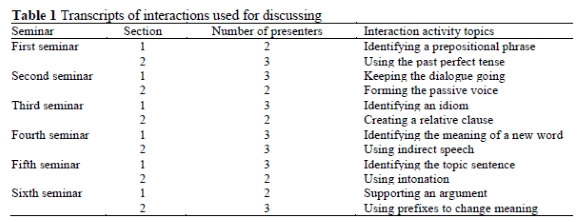
To ensure that participants had adequate experience in using transcripts to study their own classroom interactions, transcription as a learning approach was introduced to 40 students affiliated with the College of Education in two sections of TE classes, 21 participants in one section and 19 participants in the other. The course in which the participants were enrolled was English language teaching methods. All the participants reported that they had followed a course in discourse during their bachelor's degree programme and had some experience with transcribing. However, I encouraged students to contact me or peers for help and support where necessary. Two or three students reported that they taught practicum at the same school. Therefore, I asked them to work together (in pairs or groups of three) to videotape a goal-driven classroom interaction activity for the seminar discussions (cf. Table 1). The use of video recordings allows direct evidence of classroom interaction, provides highly valid information, and gives room for analytic and varied reflection (Admiraal & Berry, 2016). However, students were guided to use the transcription approach (Barron & Engle, 2007) to develop representations of video data. To do so, student teachers were asked to use the following steps: 1) videotape a 45-minute class interaction; 2) identify which social interaction to analyse; 3) produce a video clip of the interaction using a video editing program; 4) create a transcript focusing on discursive resources that participants drew upon in their classroom interactions (e.g., knowledge of rhetorical scripts, knowledge of register - that is, certain lexis and syntactic patterns specific to the practice, knowledge of how to take turns-at-talk, knowledge of topical organisation, knowledge of the appropriate participation framework, and knowledge of the means for signalling boundaries between practices and transitions within the practice itself) (Young, 2013:18); and 5), iteratively revise the transcript until the transcripts eventually provide a reliable record of what the students viewed as the most relevant aspects of the recording for the social interaction activity. During this stage, several students thought that it was intriguing to transcribe body language as an interactive resource.
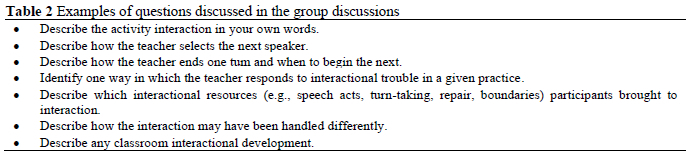
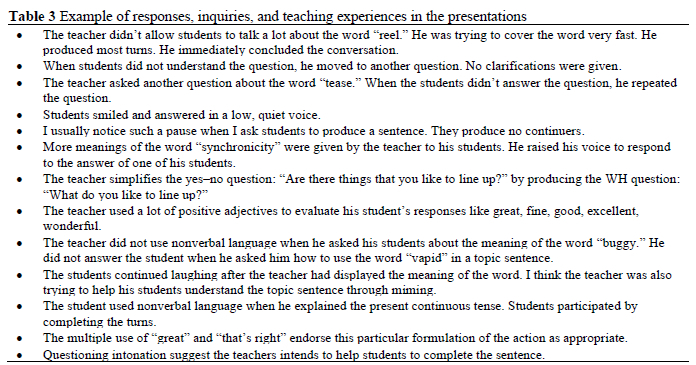
Prior to the first seminar, students were told that they were responsible for running the class and that the teacher would be facilitating but not participating in the discussion. I usually started the seminar by writing several questions about the interaction on the board (cf. Table 2). Taking advantage of mobile technology, the assigned group exchanged the video clip and transcript files with other students via Bluetooth and Wi-Fi. Students worked in four groups of approximately five each to discuss the transcript, watch the video clip on their smart phones, and discuss the questions on the board. They were assigned 30 minutes to finish their discussions and prepare notes and responses for class presentations. When they finished their group discussions, they presented their observations and responses to the questions. It was also suggested that presenters shared any inquiries or teaching experiences related to the video clip they had watched. They used the blackboard for their presentation. The time assigned for the presentations was 15 to 20 minutes from introduction to conclusion. Table 3 provides an example of the responses, inquiries, and teaching experiences that students included in their group presentations.
At the end of each seminar, some concepts of the classroom interaction in the video recording were taught explicitly (25-30 minutes). For reasons of space, I introduce only selected explanations and clarifications in this paragraph. In one seminar, I clarified that one of the teacher's questions was identifiable as a source of trouble for two reasons. Firstly, there was a relatively long pause on the part of students following their teacher's question; and secondly, one student's delayed response was a repetition of the last two words from the teacher's question rather than an answer (Van Compernolle, 2010). In another seminar, I felt that I had to explicitly clarify for students how teachers' "continued orientation to, and co-participation in the talk in progress" (Goodwin & Goodwin, 1986:54) can achieve an affiliative interpersonal function in the EFL classroom interactions. At the end of another seminar, I had to explain to students that laughter was not always an expression of amusement. For example, the speaker might laugh to display trouble-resistance while the recipient refrains from laughing to display trouble-receptiveness (Jefferson, 1984). Furthermore, in one seminar, I felt that I had to help students increase their understanding of particular discourse markers, such as "you know", "actually", "basically", and "in fact", as "a plane of talk" (Schiffrin, 1987:202), and how they were influenced by the relations of the teacher/student to the ideas presented in the talk, and cognitive capacities of the teacher/student - the organisation and management of knowledge and meta-knowledge.
Data Collection and Analysis
I followed ethical principles and instructions for conducting research with human subjects and received approval from the Scientific Committee at the institution. Focus-group interviews were used to collect data. After the two sessions, the 40 students were invited to attend focus-group interviews. The volunteers taking part in the study all signed documents affirming their informed consent. Seven 1-hour meetings were held. The size of the groups was limited to more or less six students to create the opportunity for all students to participate in the discussion. Focus-group interviews were chosen because of the advantages they offer, such as facilitating an in-depth understanding of the phenomenon (Krueger & Casey, 2014) and creating an interactive and less tense environment for all participants to take control of discussions (Morgan, 1998). The interviews were conducted in the participants' native language, Arabic, and I played the role of a moderator for all interviews because of my experience with conducting focus-group interviews and the details of the workshop. I followed a focus-group questioning route as described by Krueger and Casey (2014) to gather relevant and in-depth information about the research subjects within the expected period of time. As a moderator, I also attempted to stimulate discussion while saying as little as possible, so that the rich experiences of using transcripts could be properly narrated by participants. The group discussions focused on the following issues: attitudes towards transcriptions, conception of the transcriber's role, learning experiences that occurred while carrying out transcription, hesitations or anxieties connected to transcription, the relationship between transcription and duties at school, and reasons for undertaking or not undertaking transcription in the future. However, a focus-group interview (as a social event that includes performances by different participants) is not without its challenges (Smithson, 2000:105). One of the most serious problems that I experienced was how to allow less vocal students' voices be heard. In response to such challenges, I, as moderator, facilitated the discussion by using different techniques such as asking probing follow-up questions; making notes to assist in getting back to ask about an earlier argument for more details; asking for comments or different responses from others; briefing students on the discussion and asking silent, shy, or hesitant participants questions to elicit their opinions; referring to students' personal experiences; clarifying the wording of the questions; and using body language and intonation to enhance communication with students.
Prior to the study, potential participants were provided with details about the study and the strict use of information about their identities. I assured the participants that their responses would be confidential, only be used for the purpose of the study, and never considered in grading or any other purposes. I also explained to the students that they had the right to refuse to participate and could withdraw at any time during the interview. The students fully understood what was involved and agreed to participate in the study. Moreover, they were assured that they could refrain from taking part in the study at any time, determine when and where to participate in meetings, and proofread the meeting transcripts and results to ensure their accuracy (Krueger & Casey, 2014). The meetings were taped while I also took down notes which were dealt with confidentially.
However, in acknowledging my positionality in relation to the research, my role as an instructor not only provided me with the opportunity to implement the study with my own students but potentially put me in a position of power in relation to the students who participated in the research. Students may have felt influenced to engage in the study, although they were given the option to participate in the study and the right to withdraw from the research study without penalty for any reason. My own moral framework has an impact on my understanding of ethical responsibility in qualitative research as an ongoing process, as this also has an impact on my perceptions of the appropriateness of the exploratory research design of the study and the focus group as a method for collecting the data.
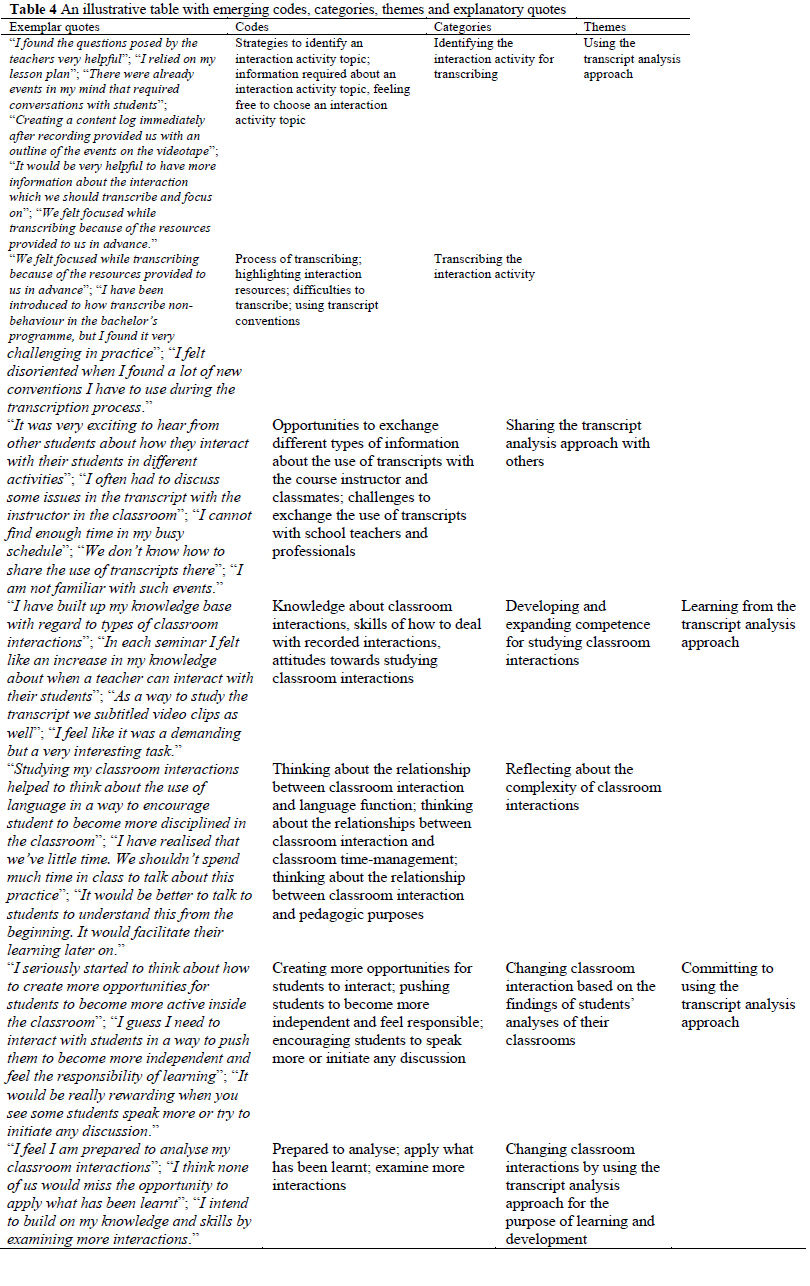
Verbatim transcripts were prepared in English after a thorough process of translation and back-translation which was performed to compare the English transcripts with the Arabic ones for accuracy and quality. The constant comparative method (Glaser & Strauss, 1967) was used for categorising comparing data at each level of analysis. The NVivo 8.0 program was used to help me manage data, find categories easily, and save time and energy in data classification (Richards, T & Richards 2003). The first step involved reading and re-reading the transcripts to identify initial categories. Secondly, I removed irrelevant and repetitious text from the transcripts. Thirdly, I highlighted distinctive expression(s) or statement(s) that carried concepts relevant to tensions experienced by participants. Themes and categories were then generated. As I dealt with the transcripts, I attempted to limit these developing codes as much as possible. Subsequently, I used template analysis as a data analysis technique to develop a coding template based on a subset of the interview data (Brooks, McCluskey, Turley & King, 2015). This was then applied to examine and clarify further data. Finally, a series of extracts from the transcripts were used to provide a detailed account of the students' perceptions of the use of transcripts (cf. Table 4).
For the sake of credibility, I invited an expert in qualitative educational research to study the transcripts for codes, categories, and themes to confirm my interpretations. Furthermore, member checking or the participant/respondent validation technique was used. I checked the data analyses and interpretations with the participant groups in order to minimise the possibility of introducing misinformation by distortion (Bilmes, 1975) and the chances of inadequate interpretations of the data, with participants invited to verify how well the themes and categories concurred with the designated extracts from the transcripts (Strauss & Corbin, 1990).
Results
Three themes and seven associated categories emerged to represent the participants' experiences of using transcripts to study their classroom interactions. The themes were using the transcript analysis, learning from the transcript analysis, and commitment to using the transcript analysis. The themes reveal that most participants felt that they had autonomy in the process of using transcripts and admired the guidance from the instructor and the work with others, but they were faced with different challenges. Participants also showed a determination to change their classroom interactions but did not promise to carry out classroom analysis.
Using the Transcript Analysis
The first theme was a process through which student teachers closely inspected constitutive norms or interpretive resources that they and their students relied on in their classroom interactions through guided data analyses, which included videotaping classroom interactions, using different strategies and techniques to identify the interaction activity, transcribing recordings for classroom presentation and discussion, and finally uploading a transcript of the social interaction event online. The theme, "using the transcript analysis approach" described an essential part of this approach from which three categories emerged: identifying the interaction activity, transcribing the interaction activity, and sharing the transcript analysis approach with others.
The majority of students acknowledged the role of reflective questions posted online and the collaboration with partners to identify the interaction activity on the videotapes. One student said: "The discussion questions in the course website established a base of knowledge, source of motivation, and framework for analysing and reflecting upon the classroom interactions." Another added: "Working with the partners was a great source of support to identify interactions on the videotape." The findings also reveal that student teachers took two distinct approaches to identify interaction activities. Some students reported that they prepared the type of activity interactions they were going to be involved in with their students in advance. They followed their lesson plans as a guide for getting involved in interactions related to lesson activities, created a list of scenarios for possible activity interactions, or mentally prepared themselves for possible interactions. One student said: "I used my lesson plans as a guide to locate interactions related to different classroom activities", and another added that they and their partner "sat and prepared different events for interactions with [their] students'" Yet another student added that "[w]hen I started the class there were already events in my mind that required conversations with students." Other students used strategies such time-indexed field notes and content logs to identify the social interaction activities in the classroom. One student said: "Notes I jotted down during recording helped me to see my classroom as a place of interactions for different purposes", while another stated: "watching the videotape and creating a content log immediately after recording provided us with an outline of the events on the videotape."
Most participants recognised an ability to identify their own type of social interaction activity. One student, for example, said that it was very easy for them to focus on creating a transcript for one classroom interaction. Students also felt free to transcribe the interaction activity according to their own criteria such as length of time, number of interactional resources, the type or goal of the interaction activity, or the perceived importance of the activity. One student said: "We decided to create a transcript for the longest interaction." Another added: "Among the interactions, we selected the interactions with more interactional resources", while another added that they and their partner "decided to prepare a transcript for the interaction of the most common classroom activity." However, there were some participants who asserted that definite criteria from the instructor with respect to the selection of social interaction events for creating a transcript would be beneficial. One student said: "We have identified a number of interactions. It would be very helpful to have more information about the interaction which we should transcribe and focus on."
Most participants acknowledged the list of resources and transcript conventions that I provided to focus on during the process of transcribing the interaction activity. One student, for example, said: "We felt focused while transcribing because of the resources provided to us in advance." Another participant added: "The way recommended for transcribing classroom interactions saved a lot of our time." However, some respondents reported that they experienced difficulties that made them feel disoriented during the process of transcribing the interaction activity. They made comments such as:
I felt disoriented when I found a lot of new conventions I have to use during the transcription process;
It was like a challenge to represent voice in a transcript;
Revising the transcript was a demanding and time-consuming task that made me feel anxious.
Most participants acknowledged the importance of sharing information about the transcript analysis approach with others in different ways. One participant said: "I found it very helpful to exchange classroom interactions with other students in the classroom." Another stated: "I often had to discuss some issues in the transcript with the instructor inside the classroom." One respondent also commented: "Sometimes I felt it very essential to take advantage of technology to keep in touch with the instructor and other students [regarding the transcript analysis]." However, only four students shared the transcript analysis approach with schoolteachers. This usually occurred in short and casual conversations, but most indicated that they experienced challenges when exchanging information about the use of transcripts with schoolteachers due to a lack of awareness, time constraints, or problems related to the social context of schools. Examples of students' responses are: "I cannot find enough time in my busy schedule"; "I did not think about if; "It is not going my way." Also, only three respondents indicated that they shared their experiences with the use of the transcript in seminars and conferences outside school. Inside school, they argued that "[t]here were hardly any meetings" and that they were either implemented "for a short period of time" or "for a particular agenda." Outside of school, most respondents admitted that they "lack[ed] information" on the meetings, or that they did not "know how to share the use of transcripts there."
Most students felt relative autonomy in exchanging different kinds of information about their use of transcripts for studying their classroom interactions such as types of interaction activities, editing software, video clips, transcript conventions for conversation analysis, and interactional resources. One respondent said that it was "very exciting to hear from other students about how they interact with their students in different activities." Another said: "I think I was not able to achieve acceptable transcripts without exchanging interactional resources with other student teachers." Another participant added that they "found it very helpful to share the clips with other students along with the transcripts." One student also stated that "other students introduced me to different editing programs" to which another added: "My discussion with the instructor and other students helped me realise how to transcribe interactions in different ways. " However, some participants asserted that more direction from the instructor concerning what should be exchanged in working groups and online would be beneficial. As one student argued, they "had a lot of things to share. It would be very helpful if there were a guidance [sic] from the instructor."
Learning from the Transcript Analysis
The second theme involved learning through the transcript analysis, which was classified into three categories: developing and expanding the competences needed for studying classroom interactions, and reflecting on the complexity of classroom interactions. Most students expressed competence, which is the skills, knowledge and feelings/emotions needed for studying classroom interactions. They admitted that working with transcripts to study their classroom interactions helped them develop a repertoire of different types of interaction activity topics, resources for participants to bring to classroom interactions, strategies for studying transcribed classroom interactions, and to feel more independent as learners. They offered comments such as: "I was able to inquire about how a classroom interaction is initiated and ended"; "I happened to find out about the way I could interpret silence in interactions in different ways"; "Sometimes, I and partners have the opportunity to study the functions of gaze and gesture in interactions"; "As a way to study the transcript we subtitled video clips as well"; "I started to see the benefits of studying my classroom interaction." To further build competence in studying classroom interactions, most students expressed their interest in different sources of real-time interactions. Some of them asked for real-time interactions of experienced teachers at schools. As one student said: "I feel I need to study more recorded interactions of other English teachers with their students at school." However, other students seemed to go further in their interest in studying recorded real-time interactions. One student said: "It would be very helpful if it were possible to study interactions in different EFL contexts." Another added: "I started to think about how my students would interact if I were a native English speak[ing] teacher." Another commented: "I think we need to study how English is used among native speakers [using transcript analysis to study their classroom interactions]."
The majority of participants acknowledged the space that the transcript analysis approach opened up for them to reflect on the complexity of the classroom context, expressing differing, often contradictory, views of the relationship between language used in interaction and learning, and to negotiate shared understanding of the function of interactional agenda appropriate for their pedagogic goals in the process of interaction. One student stated: "Studying my classroom interactions helped me to think about the use of language in a way to encourage student to become more disciplined in the classroom." Another student said: "I have realised that we've little time. We shouldn't spend much time in class to talk about this practice." Another student commented: "It would be better to talk to students to understand this from the beginning. It would facilitate their learning later on."
Committing to Using the Transcript Analysis The third theme revealed the determination that students had to use with transcript analysis to change their classroom interaction in the future. It comprised two categories: changing classroom interactions based on the findings of students' analyses of their classrooms, and changing classroom interactions using the transcript analysis approach. The results show that most participants expressed the determination to change their classroom interactions based on the findings discussed in the seminars. They indicated the reflective practices, efforts, and rewards involved in the process. One student said: "I seriously started to think about how to create more opportunities for students to participate and take part in classroom interaction." Another student added: "I guess I need to interact with students in a way to push them to become more independent and feel the responsibility of learning." Another commented: "It would be really rewarding when you see some students speak more or try to initiate any discussion about the issue." When asked about their intentions to use the approach in the future, they made comments such as: "I feel it would be almost impossible to do it alone"; "I don't need to analyse all classroom interactions"; "I think findings in the course would [be] sufficient." However, during the group discussions a few students demonstrated that they felt ready to continue analysing their classroom interactions. These participants felt more secure in their skills, knowledge, and feelings. Examples of these students' responses are: "I feel I am ready to analyse my classroom interactions"; "I think none of us would miss the opportunity to apply what has been learned"; "I intend to build on my knowledge and skills by examining more interactions [using transcript analysis]."
Discussion
The transcript analysis approach was highly appreciated by the student teachers. They acknowledged the space that the use of transcript analysis opened up for them to build relevant knowledge and reflect on the complexity of the classroom context. They felt that they could start to express differing, often contradictory, views of the relationship between language used in interaction and learning, and to negotiate shared understanding of the function of interactional agenda appropriate for their pedagogic goals in the process of interaction. Such findings support arguments that the use of transcripts may promote the skill of self-assessment as a means of organising and regulating instructional talk so that it moves from recitative tendencies towards more responsive tendencies that promote instructional conversation (Roskos et al., 2000).
Participants might be uncertain or anxious because of difficulties with the use of transcripts as a social activity (Vigouroux, 2007). Such findings might also be relevant to the argument that students may feel vulnerable during their journey as transcribers (Bird, 2005). This is especially true in contexts where innovative ideas such as the use of transcripts, which are grounded in Western cultural principles and values (Jones, 1995), might be viewed as unsuitable within certain traditional contexts of teaching and learning. Hence, it can be argued that competence in using transcripts is not merely a group of skills and knowledge, but also includes the feelings and emotions required to perform responsibilities, such as identifying an interaction activity, managing information, and sharing findings with others with respect to effectiveness, efficiency, and ethics. Also, this could create opportunities for students to recognise that the context of their programme "is not limited to specific geopolitical boundaries but includes sociopolitical, sociohistorical, and/or socioeconomic contexts that shape and are shaped by local and global events" (Johnson & Golombek, 2020:120).
The majority of participants appreciated the autonomy that they experienced concerning the means they followed to identify a particular activity interaction of their own choice. They acknowledged the opportunity afforded them to decide criteria for their interaction activities for transcribing, and strategies to identify them. However, they reported challenges regarding using the transcript analysis approach, including appropriate use of transcript conventions, making texts more grammatically correct, avoiding sensitive or personal discussions, dealing with their first impression of seeing their talk written down, and the way to share the transcript analysis at school and in professional meetings. This is in agreement with what has been reported in other studies indicating that the use of transcripts may require explicit training (Kunath & Weinberger, 2009) highlighting the importance of the role that the teacher educator can play in the process of student teachers' learning. They may reflect on their own practices, debrief the student teachers after seminars, and carry out dialogue with colleagues for improving and developing the use of transcriptions with student teachers (Rossouw, 2009). As argued by Dinkelman (2003:14), "when teacher educators study their own practice, they make changes in their pedagogy and can suggest changes through conversation and collaboration with peers." This is particularly true when there is no clear guidance for implementing the use of transcripts for studying classroom interactions with student teachers in the literature other than some relevant pedagogical practices and general suggestions.
The notion that students had to be determined to use transcript analysis to change their classroom interaction in the future based on the findings of the study rather than the use of the transcript analysis approach itself seemed to be predominant among participants. Student teachers' perceptions of how one conducts an inquiry might be moulded by perceived levels of competence and challenge in dealing with the use of transcript analysis to study their classroom interactions (Wang, Coleman, Coley & Phelps, 2003). Their sense of competence and experience enabled them to form a self-image of having the potential to deal with requirements of the use of transcript analysis in the future (McClelland, 1998). Student teachers may have different assessments of their competence in using transcript analysis to study their classroom interactions in the future. The emphasis on "the student as a conscientious consumer" might be essential to deal with the requirements of the use of transcript analysis (Higgins, Hartley & Skelton, 2002:59). Effective reflection may help them realise the insight, competence, and inquiry requirements (Henning, Petker & Petersen, 2015; Kotsopoulos, Mueller & Buzza, 2012). This may also open "history to contingency, to the potential to act or to be otherwise" (Clarke & Phelan, 2015:266).
Although my study contributes to the literature of the application of SDT to research and practice and TE on implementing innovative ideas in TE programmes, a number of limitations should be admitted. Firstly, student teachers' inquiries were restricted to those related to their classroom interactions. Thus, in future studies one might introduce students to different sources of classroom interactions. Secondly, this study may encourage TE programmes to offer seminars and training for more experienced teachers to study their classroom interactions. Even more experienced teachers who can intentionally "flout the normal organization of the L2 classroom in order to create particular effects" (Seedhouse, 2019:20) can take advantage of analysing classroom interactions using transcripts "to achieve more subtle educational effects or ways to motivate specific groups or individuals" (Seedhouse, 2019:24). Thirdly, as the participants' subject of specialisation and teaching was English, future studies may be conducted of participants specialising in and being prepared to teach other subjects. In the fourth instance, I followed particular procedures for introducing the use of transcripts in my study. Therefore, further research with additional innovative procedures and ideas is encouraged. In the fifth place, I investigated the use of transcripts with EFL classroom interactions, and it is not clear whether the findings are relevant to other subject classroom interactions. Thus, it is suggested that similar research regarding classroom interactions in other subject areas and different educational contexts should be conducted. Such cross-validation studies would assist in determining the overall usefulness of the findings in my study. Finally, the participants in this study were student teachers. More extensive studies are required to fully comprehend the advantages of the use of transcripts for studying classroom interactions from other concerned people's perspectives, including teacher educators, superintendents, school heads, and teachers.
Conclusion
The use of transcript analysis was initiated as an innovative idea within the context of the practitioner research genre of self-study. It is pertinent to both national and global TE contexts. The inquiry shows the pertinence of inquiring into the participants' experiences of the use of transcripts to study their own classroom interactions during teaching practicum. The procedure in my study can be implemented by other researchers. Moreover, it provides insight into how teacher educators can deal with their expectations while inquiring into student teachers' experiences of the use of transcripts for studying their own classroom interactions during teaching practicum in the post-method era. One specific concept, selectivity, might be given special attention in implementing the transcript analysis approach to enhance self-determination and autonomous learning within a context of self-study as a practitioner research genre (Al-Amri, 2021, Brandenburg & Davidson, 2011; Cook, 1990; Duranti, 2006). Such issues may encourage individual, professional reflection and scholarly debate among teacher educators. This can promote the role of the use of transcripts in TE programmes.
Acknowledgement
I would like to express my gratitude to all the anonymous reviewers whose comments helped improve this article.
Notes
i. Published under a Creative Commons Attribution Licence.
References
Admiraal W & Berry A 2016. Video narratives to assess student teachers' competence as new teachers. Teachers and Teaching, 22(1):21-34. https://doi.org/10.1080/13540602.2015.1023026 [ Links ]
Al-Amri M 2021. Investigating EFL student teachers' perceptions of self-study in the Saudi Arabian context. Journal of Education for Teaching, 47(1):75-88. https://doi.org/10.1080/02607476.2020.1841552 [ Links ]
Barron B & Engle RA 2007. Analyzing data derived from video records. In SJ Deny (ed). Guidelines for video research in education: Recommendations from an expert panel. Chicago, IL: Data Research and Development Center. Available at https://cpb-us-e2.wpmucdn.com/faculty.sites.uci.edu/dist/2/425/files/2011/03/video-research-guidelines.pdf. Accessed 12 December 2021. [ Links ]
Bilmes J 1975. Misinformation and ambiguity in verbal interaction: A Northern Thai example. International Journal of the Sociology of Language, 1975(5):63-76. https://doi.org/10.1515/ijsl.1975.5.63 [ Links ]
Bird CM 2005. How I stopped dreading and learned to love transcription. Qualitative Inquiry, 11(2):226-248. https://doi.org/10.1177/1077800404273413 [ Links ]
Brandenburg RT & Davidson C 2011. Transcribing the unsaid: Finding silence in a self-study. Reflective Practice, 12(6):703-715. https://doi.org/10.1080/14623943.2011.601557 [ Links ]
Brooks J, McCluskey S, Turley E & King N 2015. The utility of template analysis in qualitative psychology research. Qualitative Research in Psychology, 12(2):202-222. https://doi.org/10.1080/14780887.2014.955224 [ Links ]
Bucholtz M 2000. The politics of transcription. Journal of Pragmatics, 32(10):1439-1465. https://doi.org/10.1016/S0378-2166(99)00094-6 [ Links ]
Bucholtz M 2007. Variation in transcription. Discourse Studies, 9(6):784-808. https://doi.org/10.1177/1461445607082580 [ Links ]
Button G & Lee JRE (eds.) 1987. Talk and social organization. Clevedon, England: Multilingual Matters. [ Links ]
Clarke M & Phelan A 2015. The power of negative thinking in and for teacher education. Power and Education, 7(3):257-271. https://doi.org/10.1177/1757743815607025 [ Links ]
Cook G 1990. Transcribing infinity: Problems of context interpretation. Journal of Pragmatics, 14(1):1-24. https://doi.org/10.1016/0378-2166(90)90061-H [ Links ]
Cromdal J 2001. Can I be with?: Negotiating play entry in a bilingual school. Journal of Pragmatics, 33(4):515-543. https://doi.org/10.1016/S0378-2166(99)00131-9 [ Links ]
Davidson C 2009. Transcription: Imperatives for qualitative research. International Journal of Qualitative Methods, 8(2):35-52. https://doi.org/10.1177/160940690900800206 [ Links ]
Dinkelman T 2003. Self-study in teacher education: A means and ends tool for promoting reflective teaching. Journal of Teacher Education, 54(1):6- 18. https://doi.org/10.1177/0022487102238654 [ Links ]
Duranti A 2006. Transcripts, like shadows on a wall. Mind, Culture, and Activity, 13(4):301 -310. https://doi.org/10.1207/s15327884mca1304_3 [ Links ]
Ellis R & Shintani N 2014. Exploring language pedagogy through second language acquisition research. London, England: Routledge. https://doi.org/10.4324/9780203796580 [ Links ]
Garrison DR, Cleveland-Innes M, Koole M & Kappelman J 2006. Revisiting methodological issues in transcript analysis: Negotiated coding and reliability. The Internet and Higher Education, 9(1):1-8. https://doi.org/10.1016/j.iheduc.2005.11.001 [ Links ]
Gee JP 2004. Situated language and learning: A critique of traditional schooling. London, England: Routledge. [ Links ]
Glaser B & Strauss A 1967. The discovery of grounded theory: Strategies for qualitative research. Mill Valley, CA: Sociology Press. [ Links ]
Goodwin MH & Goodwin C 1986. Gesture and coparticipation in the activity of searching for a word. Semiotica, 62(1-2):51-76. https://doi.org/10.1515/semi.1986.62.1-2.51 [ Links ]
Harding J, Hbaci I, Hamilton B & Loyd S 2021. Transcribing: A tool for mathematics pre-service teachers to reflect on their own teaching. Journal of Education, 201(3):225-235. https://doi.org/10.1177/0022057420914904 [ Links ]
Henning E, Petker G & Petersen N 2015. University-affiliated schools as sites for research learning in pre-service teacher education. South African Journal of Education, 35(1):Art. # 1006, 8 pages. https://doi.org/10.15700/201503070014 [ Links ]
Higgins R, Hartley P & Skelton A 2002. The conscientious consumer: Reconsidering the role of assessment feedback in student learning. Studies in Higher Education, 27(1): 53-64. https://doi.org/10.1080/03075070120099368 [ Links ]
Huth T, Betz E & Taleghani-Nikazm C 2019. Rethinking language teacher training: Steps for making talk-in-interaction research accessible to practitioners. Classroom Discourse, 10(1):99-122. https://doi.org/10.1080/19463014.2019.1570529 [ Links ]
Jefferson G 1984. On the organization of laughter in talk about troubles. In JM Atkinson & J Heritage (eds). Structures of social action: Studies in conversation analysis. Cambridge, England: Cambridge University Press. [ Links ]
Jenset IS, Klette K & Hammerness K 2018. Grounding teacher education in practice around the world: An examination of teacher education coursework in teacher education programs in Finland, Norway, and the United States. Journal of Teacher Education, 69(2):184-197. https://doi.org/10.1177/0022487117728248 [ Links ]
Johnson KE & Golombek PR 2020. Informing and transforming language teacher education pedagogy. Language Teaching Research, 24(1): 116-127. https://doi.org/10.1177/1362168818777539 [ Links ]
Jones JF 1995. Self-access and culture: Retreating from autonomy. ELT Journal, 49(3):228-234. https://doi.org/10.1093/elt/49.3.228 [ Links ]
Kasper G 2006. Beyond repair: Conversation analysis as an approach to SLA. AILA Review, 19(1):83-99. https://doi.org/10.1075/aila.19.07kas [ Links ]
Kotsopoulos D, Mueller J & Buzza S 2012. Pre-service teacher research: An early acculturation into a research disposition. Journal of Education for Teaching, 38(1):21-36. https://doi.org/10.1080/02607476.2012.643653 [ Links ]
Krueger RA & Casey MA 2014. Focus groups: A practical guide for applied research (5th ed). Thousand Oaks, CA: Sage. [ Links ]
Kucan L 2007. Insights from teachers who analyzed transcripts of their own classroom discussions. The Reading Teacher, 61(3):228-236. https://doi.org/10.1598/RT.61.3.3 [ Links ]
Kunath SA & Weinberger SH 2009. STAT: Speech transcription analysis tool. In F Popowich and M Johnston (demo chairs). Proceedings of NAACL HLT 2009: Demonstrations. Madison, WI: Omnipress. Available at https://aclanthology.org/N09-5003.pdf. Accessed 7 January 2022. [ Links ]
Lightbown PM & Spada N 2013. How languages are learned (4th ed). Oxford, England: Oxford University Press. [ Links ]
Markee N 2004. Zones of interactional transition in ESL classes. The Modern Language Journal, 88(4):583-596. https://doi.org/10.1111/j.0026-7902.2004.t01-20-.x [ Links ]
McClelland DC 1998. Identifying competencies with behavioral-event interviews. Psychological Science, 9(5):331-339. https://doi.org/10.1111/1467-9280.00065 [ Links ]
Means T 2014. Students learning through recording, transcribing and editing their task performances in second-semester Italian. Italica, 91(1):29-42. [ Links ]
Ministry of Education 2019. Education and vision 2030. [ Links ]
Morgan DL 1998. The focus group guidebook. Thousand Oaks, CA: Sage. [ Links ]
Richards JC 2006. Communicative language teaching today. Cambridge, MA: Cambridge University Press. [ Links ]
Richards T & Richards L 2003. The way ahead in qualitative computing. Journal of Modern Applied Statistical Methods, 2(1):16-26. https://doi.org/10.22237/jmasm/1051747440 [ Links ]
Roskos K, Boehlen S & Walker BJ 2000. Learning the art of instructional conversation: The influence of self-assessment on teachers' instructional discourse in a reading clinic. The Elementary School Journal, 100(3):229-252. https://doi.org/10.1086/499641 [ Links ]
Rossouw D 2009. Educators as action researchers: Some key considerations. South African Journal of Education, 29(1):1 -16. https://doi.org/10.15700/saje.v29n1a228 [ Links ]
Ryan RM & Deci EL 2000. Self-determination theory and the facilitation of intrinsic motivation, social development, and well-being. American Psychologist, 55(1):68-78. https://doi.org/10.1037/0003-066X.55.1.68 [ Links ]
Sableski MK, Kinnucan-Welsch K & Rosemary C 2019. Facilitating teacher reflection using a metacognitive tool. Mid-Western Educational Researcher, 31(3):312-332. Available at https://scholarworks.bgsu.edu/cgi/viewcontent.cgi?article=1075&context=mwer. Accessed 7 December 2021. [ Links ]
Schiffrin D 1987. Discourse markers. Cambridge, NY: Cambridge University Press. [ Links ]
Seedhouse P 2019. L2 classroom contexts: Deviance, confusion, grappling and flouting. Classroom Discourse, 10(1):10-28. https://doi.org/10.1080/19463014.2018.1555768 [ Links ]
Smithson J 2000. Using and analysing focus groups: Limitations and possibilities. International Journal of Social Research Methodology, 3(2): 103-119. https://doi.org/10.1080/136455700405172 [ Links ]
Strauss A & Corbin JM 1990. Basics of qualitative research: Grounded theory procedures and techniques. Newbury Park, CA: Sage. [ Links ]
Tilley SA 2003. "Challenging" research practices: Turning a critical lens on the work of transcription. Qualitative Inquiry, 9(5):750-773. https://doi.org/10.1177/1077800403255296 [ Links ]
Van Compernolle RA 2010. Incidental microgenetic development in second-language teacher-learner talk-in-interaction. Classroom Discourse, 1(1):66-81. https://doi.org/10.1080/19463011003750608 [ Links ]
Vigouroux CB 2007. Trans-scription as a social activity: An ethnographic approach. Ethnography, 8(1):61-97. https://doi.org/10.1177/1466138107076137 [ Links ]
Wang AH, Coleman AB, Coley RJ & Phelps RP 2003. Preparing teachers around the world. Princeton, NJ: Educational Testing Service. Available at https://files.eric.ed.gov/fulltext/ED479903.pdf. Accessed 29 February 2024. [ Links ]
Werfel KL 2017. Phonetic transcription training improves adults' explicit phonemic awareness: Evidence from undergraduate students. Communication Disorders Quarterly, 39(1):281-287. https://doi.org/10.1177/1525740117702456 [ Links ]
Wolhuter C, Van der Walt H, Potgieter F, Meyer L & Mamiala T 2012. What inspires South African student teachers for their future profession? South African Journal of Education, 32(2):178-190. https://doi.org/10.15700/saje.v32n2a570 [ Links ]
Young RF 2013. Learning to talk the talk and walk the walk: Interactional competence in academic spoken English. Ibérica, 25:15-38. Available at https://www.redalyc.org/pdf/2870/287026237002.pdf. Accessed 16 December 2021. [ Links ]
Young RF & Miller ER 2004. Learning as changing participation: Discourse roles in ESL writing conferences. The Modern Language Journal, 88(4):519-535. https://doi.org/10.1111/j.0026-7902.2004.t01-16-.x [ Links ]
Received: 20 February 2022
Revised: 15 June 2023
Accepted: 20 January 2024
Published: 29 February 2024