




Services on Demand
Journal

Article
 English (pdf)
 Article in xml format
 Article references
 Automatic translation
 Send this article by e-mail
Indicators
Related links
-
 Cited by Google
 -
 Similars in Google
Share

 Permalink
South African Journal of Education
On-line version ISSN 2076-3433Print version ISSN 0256-0100
S. Afr. j. educ. vol.44 n.4 Pretoria Nov. 2024
https://doi.org/10.15700/saje.v44n4a2541
ARTICLES
Evaluation of students' attitudes towards blended learning
Zharkynay YesmakhanovaI; Yerepbayev NurlanII; Aktolkyn BoranbayevaIII; Alimbayev MedeuIV; Galiya RysbayevaV; Nurlybek OmarovVI
IDepartment of Biology, South Kazakhstan State Pedagogical University, Shymkent, Kazakhstan. zharkynay.yesmakhanova@gmail.com
IIDepartment of Theory and Methodology of Physical Cultures, Auezov University, Shymkent, Kazakhstan
IIIDepartment of Preschool and Special Pedagogy, South Kazakhstan State Pedagogical University, Shymkent, Kazakhstan
IVDepartment of Kazakh Language and Literature, Mukhtar Auezov South Kazakhstan University, Shymkent, Kazakhstan
VDepartment of Biology, South Kazakhstan State Pedagogical University, Shymkent, Kazakhstan
VIDepartment of Kazakh Language and Literature, Mukhtar Auezov South Kazakhstan University, Shymkent, Kazakhstan
ABSTRACT
Educational environments created by combining traditional learning environments and technology have grown, especially in recent years and have become an indispensable part of education. Therefore, with this research we aimed to evaluate students' attitudes towards blended learning. To gather university students' opinions on the effectiveness of blended learning, a descriptive survey method was used. Two hundred and eighty-seven students enrolled for information technologies courses in the spring semester of the 2022-2023 academic year in the computer engineering department at various universities in Kazakhstan participated in the research. Research data were collected using the blended learning attitude scale developed by the researchers. This scale was used to gain information from students participating in the research. The scale was used twice, with an interval of 5 weeks, before and after the information technologies course was presented in the blended learning environment. University students' attitudes towards blended learning were partially positive before the presentation of information technology education in the blended learning environment, and after the presentation a positive increase was observed. The attitudes of students with experience in the blended learning environment were found to be higher than those of students without experience.
Keywords: blended learning; information technologies; learning environment; student attitudes
Introduction
We live in an age where technological developments have spread to all areas of life, including education. With the integration of technology, educational environments have completely changed and a different understanding of education has emerged (Bicen, Ozdamli & Uzunboylu, 2014; Johnson, Veletsianos, Reitzik & VanLeeuwen, 2022; Yang, Cai, Yang & Wang, 2023). Education in the classroom environment has been replaced by educational opportunities that provide flexibility regarding time and place (Bedebayeva, Grinshkun, Kadirbayeva, Zhamalova & Suleimenova, 2022; Müller, Mildenberger & Steingruber, 2023). This change has caused education methods and techniques to develop and change. One of the new structures that emerged with the change in educational environments with technology is blended learning, where both face-to-face and online teaching are used together (Hafeez, 2021).
Theoretical and Conceptual Framework
The development of computer-based learning in the 2000s, especially when the use of technology in educational environments began to become widespread, laid the foundations for blended learning (Swan & Ice, 2010). According to Evenhouse, Lee, Berger, Rhoads and DeBoer (2023) and Sethy (2008), blended learning is a learning model that combines formal and informal learning, offers face-to-face and online experiences together, and incorporates and combines opposing approaches such as guided paths, self-direction and trust. According to Allan, Campbell and Crough (2019) and Thorne (2003), blended learning is a type of learning that aims to maximise students' participation and interaction. This is achieved by integrating technological innovations used in education and electronic learning (e-learning) environments with face-to-face education environments, where students can meet their own needs with their own efforts. According to Ranjan (2020), blended learning is an effective and balanced integration of online and face-to-face instruction, recognised as a successful teaching approach.
An examination of blended learning definitions in the field reveals a common theme: they typically describe a combination of various educational approaches, specifically integrating distance web-based learning with face-to-face instruction (Benghalem, 2023; De George-Walker & Keeffe, 2010; Kerres & De Witt, 2003; Khodabandelou, Ahmad & Mohseni, 2023; Sanders & Mukhari, 2024; Smith & Hill, 2019). Effective training, easy access, and cost are listed as the most obvious positive aspects of blended education (Al Zumor, Al Refaai, Eddin & Al-Rahman, 2013; Konayuma, 2024).
In addition, blended education is seen as a qualified learning model because it helps students to manage their learning processes, speed, learning activities, and use of time (Aji, Ardin & Arifin, 2020; AlKhaleel, 2019; Martín-García, 2020; Saltan, 2017). Blended learning, as an integration of both physical and online approaches, enables teachers and students to engage in activities that support the achievement of educational goals (Hadiyanto, Sulistiyo, Mukminin, Haryanto & Syaiful, 2022). Istenič (2024) conducted a comprehensive evaluation of the integration of blended learning into higher education. The research assessed existing studies in the field and provided an in-depth analysis of the areas where blended learning has proven to be effective in higher education settings.
Creating and implementing a blended learning environment, however, pose certain difficulties, such as students' difficulty in adapting, difficulty in using technology, avoidance of individual learning responsibility, and difficulty with time management (Mukhtaramkhon & Jakhongirovich, 2022; Szadziewska & Kujawski, 2017). In addition, Rovai (2003) states that a lack of evaluation in blended learning environments can be challenging at times.
In today's educational landscape, relying solely on traditional or technology-based methods may not achieve the desired results in the teaching process. Consequently, it can be posited that blended learning was developed to mitigate the adverse effects associated with both online and face-to-face learning environments (Kristanto, Mustaji & Mariono, 2017). Blended learning at university level offers students an educational environment that integrates technology while retaining the advantages of face-to-face instruction and investigating its impact is therefore essential. Examining the effects of blended learning on students in computer engineering departments is crucial, particularly in the context of technology-driven courses such as information technologies.
Related research
Rovai and Jordan (2004) aimed to determine the learning levels of graduate students in face-to-face, online, and blended learning environments. As a result of the research, it was determined that the highest learning level of graduate students occurred in the blended learning environment. Klein, Noe and Wang (2006) found that learning in a blended learning environment had a positive effect on university students' academic success, cognitive awareness, and motivation. Yushau (2006) evaluated university students' attitudes towards mathematics and computer courses in a blended learning environment. As a result of the research, it was determined that a blended learning environment significantly decreased students' anxiety to use a computer.
Delfino and Persico (2007) discussed the attitudes of prospective teachers towards computers in the blended learning environment and evaluated the problems encountered during the process. As a result of the research, it was emphasised that online techniques should be included more in teacher training programmes. Kistow (2011) conducted a research study involving 150 students to obtain their opinions about blended learning. The results show that students' opinions about blended learning were positive and most students supported online learning. Cabrera, Villalon and Chavez (2017) concluded that a research community and team-based learning approaches in blended learning environments have a positive impact on students' success. Setyaningrum (2018) examined the effectiveness of mathematics education provided by way of the blended learning method. It was concluded that students who received education through the blended learning method were more successful than those who received education through the traditional learning method.
Kholifah, Sudira, Rachmadtullah, Nurtanto and Suyitno (2020) examined the effect of vocational education on learners' motivation when the blended learning mode was followed. It was found that the blended learning environment had a positive effect on motivation.
Khan, Erasmus, Jali, Mthiyane and Ronne (2021) reported that despite challenges related to computer literacy, systems, and technical issues, students perceived blended learning as an enhancement of their learning experience, promoting a more student-centred approach to teaching and learning.
Zhu, Berri and Zhang (2021) investigated effective teaching strategies and technology use in blended learning in a graduate course in the United States of America. Using a mixed-methods approach, the study revealed that students valued face-to-face interactions with both peers and the instructor. Additionally, the findings highlight the critical role of learning technologies, emphasising that their implementation should be simplified for optimal effectiveness.
Banihashem, Noroozi, Den Brok, Biemans and Kerman (2023) examined the attitudes, feelings, and perceptions of teachers and students regarding blended education in the aftermath of the COVID-19 pandemic. The results of the research indicate that both teachers and students experienced a high workload and low well-being, despite high motivation in the context of blended education. In a related study, Yudt, Sawyer and Shera (2024) employed a quasi-experimental mixed-methods approach to investigate the effectiveness of blended education compared to traditional face-to-face instruction in enhancing the mathematical achievement and attitudes of pre-service primary school teachers. While the findings indicated no significant change in the participants' mathematical achievement levels, they did show a notable improvement in their attitudes towards learning.
In the study, it was emphasised that the problems that students experienced regarding technological tool requirements negatively affected satisfaction, and that designs appropriate to student skills and attitudes should be made available to increase success and satisfaction.
Purpose of the Research
The purpose of this study was to determine students' attitudes towards blended learning. For this purpose, the following research questions were formulated:
1) What are the attitudes of university students participating in the research towards the efficiency of blended education?
2) Do the attitudes of university students participating in the research towards the efficiency of blended education differ according to the gender variable?
3) Do the attitudes of university students participating in the research towards the efficiency of blended education differ according to the course success variable?
4) Do the attitudes of university students participating in the research towards the efficiency of blended education differ depending on whether they received education in a blended learning environment in the past?
Methods and Materials
In this section of the research, the research method and data collection tools are explained. The stages and ethical principles regarding the data evaluation process are also detailed.
Research Method
In this research we used a single-group pre-test-post-test design in which the effect of the experimental procedure was tested by applying the procedure to a single group. The dependent variable was measured using the same subjects and identical tools, both before the intervention (pre-test) and after the intervention (post-test). There was non-selectivity in this study, and no matching of participants was applied. Additionally, the descriptive survey method, a common quantitative research model, was used to collect data. According to Kuechler (1998) the survey method involves using a structured procedure or instrument to ask a predetermined group of people specific questions to gather data for research. This approach typically facilitates easier communication between participants and the researchers.
For this reason, in this study, the descriptive survey method was used to determine the attitudes of university students participating in the research towards the efficiency of blended education.
Participants
Two hundred and eighty-seven students studying information technologies courses in the spring semester of the 2022-2023 academic years in the computer engineering department at various universities in Kazakhstan participated in the research. Demographic information about the computer engineering students participating in the research is given in Table 1.
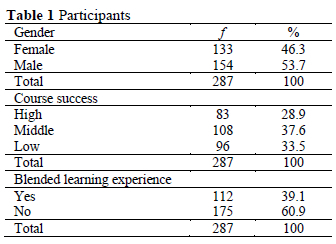
Table 1 shows the distribution of university students participating in the study regarding gender, course success, and blended education background. About 46.3% of university students were female and 53.7% male. About 28.9% of the students had high success in information technology courses, 37.6% had medium, and 33.5% had low success. While 39.1% of the students stated that they had received training in a blended education environment before, 60.9% stated that they had not.
Data Collection Tools
Research data were collected using the blended learning attitude scale developed by the researchers. The scale was applied twice, once before and once after the information technologies course using the blended model for which the university students were enrolled.
Blended learning attitude scale
By examining the research in the field, items were created for the blended learning attitude scale. The 38 items created were checked by a linguist for their suitability regarding grammar and language structure. It was then presented to six experts who were asked to determine the items that they found most suitable for the scope of the research. Based
on their feedback, a 19-item scale was developed and prepared for pilot testing. The pilot application was carried out with 239 students studying at various universities in Kazakhstan. The pilot application group was not included in the sample group of the research. After the application, the Kaiser-Meyer-Olkin (KMO) coefficient and Bartlett's sphericity test were calculated for the data set obtained. The KMO value was found to be 0.821, the Bartlett test was found to be below p < 0.05 (p = 0.000), and it was determined that the data set was suitable for factor analysis. Exploratory factor analysis (EFA) was conducted with the Social Statistical Package for the Social Sciences (SPSS) 20.0. At this stage, the eigenvalue and variance ratios of the data set were examined and a single factor with an eigenvalue greater than 1 was found. The variance ratio explained by the factors was found to be 91.2%. In line with the scree plot, four items with item factor loadings below 30 were removed from the scale. After the EFA was completed, confirmatory factor analysis (CFA) was performed with the SPSS Amos program. In this process, the goodness of fit index of the data set was examined. Acceptability value of the model CMIN/df- (X2/df < 5) = 2.629, GFI (goodness-of-fit index), (> 0.90) = 1.120, CFI (comparative fit index) (> 0.90) = 1.665, NFI-TLI (normed fit index - Tucker-Lewis index) (> 0.80) = 1.114-0.930, and RMSEA (root-mean-square error of approximation) (< 0.07) = 0.055 was found, which revealed that the data set had a good degree of fit. After EFA and CFA were performed, the reliability analysis of the data set was performed. Cronbach alpha internal consistency coefficient was calculated for the unidimensional structure of the scale. The Cronbach alpha coefficient of the blended learning attitude scale was calculated as 0.81. As a result of the analyses, it was determined that the blended learning attitude scale was reliable. The scale was created as a 5-point Likert-type scale. As scores decrease from 5 to 1, students' attitudes towards blended learning changed from very positive to very negative. When item score ranges are taken equally; 5.00-4.20 very positive attitude, 4.19-3.40 positive attitude, 3.39-2.60 partially positive attitude, 2.59-1.80 negative attitude, and 1.79-1.00 very negative attitude, it was rated as a negative attitude.
The blended learning attitude scale was administered to computer engineering students taking information technologies courses. Then, the information technologies course was taught in a blended learning model within the scope of the curriculum for 4 weeks. After the information technologies course was thus taught, the blended learning attitude scale was again administered to the students. Students' blended learning attitudes were compared after teaching the information technologies course in the classroom and the blended learning environment.
Data Collection Process
The application of the blended learning attitude scale with the students was carried out in the classroom environment where each student received education. The scale was administered during the information technologies course. Five weeks passed between the two scale applications. The application time of the scale was approximately 10-15 minutes. It took an average of 6 weeks to collect all data.
Compliance with Ethics
After obtaining the necessary permissions from the universities and course instructors involved in the research, collaboration was established to develop the information technologies course in a blended learning environment. Ethical principles regarding the personal information of the university students participating in the research were complied with. All students declared in writing that they participated in the research voluntarily. This research was approved by the South Kazakhstan State Pedagogical University Scientific Research Ethics Committee.
Data Analysis
The SPSS 20.0 program was used to analyse the research data. The blended learning attitude scale was applied to the study group twice, before and after the information technologies course presented in a blended learning environment for 4 weeks. According to the results of the Kolmogorov-Smirnov normality test, it was determined that the data showed a normal distribution since p >.05 was found. For this reason, it was deemed appropriate to apply parametric tests. For this reason, independent sample t-test and one-way analysis of variance (ANOVA) tests were applied to the data set.
Results
Pre-course Attitudes of University Students Towards Blended Learning
In Table 2, the weighted averages and standard deviations of the university students participating in the research regarding the blended learning attitude scale are given in two stages, before and after the information technology training presented in the blended learning environment.
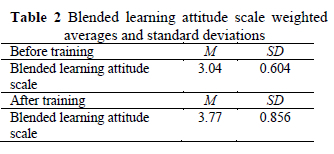
After examining Table 2, it was determined that the participating university students' attitudes towards blended learning were partially positive (M = 3.04, SD = 0.604) before the information technology education was presented in the blended learning environment. After information technology training was presented in a blended learning environment, it was determined that the students' attitudes towards blended learning were positive (M = 3.77, SD = 0.856).
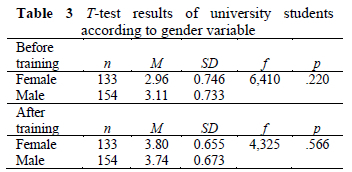
In Table 3, the distribution of the attitudes of the participating university students towards blended learning according to the gender variable before and after the presentation of the information technologies training in the blended learning environment is given along with the independent sample t-test results.
Post-course Attitudes of University Students towards Blended Learning
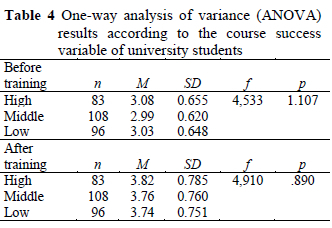
In Table 4, the distribution of the attitudes of the participating university students towards blended learning according to the course success variable in the pre- and post-test together with the ANOVA results are displayed.
When Table 3 is examined, no significant difference was found in the attitudes of the participating university students according to the gender variable (f = 6,410, p > .05) before information technology was presented in the blended learning environment. No significant difference was detected in the participating students' attitudes towards blended learning (f = 4,325, p > .05) according to the gender variable in the post-test.
The data in Table 4 show no significant difference in the attitudes of the participating university students towards blended learning (f = 4,533, p > .05) according to the course success variable in the pre-test. No significant difference was detected in the students' attitudes towards blended learning (f = 4,910, p > .05) according to the course success variable in the post-test.
Comparison of Attitudes of University Students Based on Experience
In Table 5, the distribution of the attitudes of the university students participating in the research towards blended learning according to the blended learning experience variable in both the pre- and post-tests is given along with the independent sample t-test results.
After examining Table 5, a significant difference was found in the participating students' attitudes towards blended learning (f = 16,894, p < .05) according to the blended learning experience variable in the pre-test in favour of students with blended learning experiences. No significant difference was detected in university students' attitudes towards blended learning (f = 4,565, p > .05) according to the blended learning experience variable in the post-test.
Discussion
It was determined that the attitudes of the participating university students towards blended learning were partially positive before information technology was presented in the blended learning environment. After having received information technology training in a blended learning environment, the students' attitudes towards blended learning changed from partially positive to positive. There was no significant difference in the students' attitudes towards blended learning according to the gender and the course success variables in the pre- and post-tests.
A significant difference was found in the students' attitudes towards blended learning according to the blended learning experience variable before information technology education in the blended learning environment, and it was determined that the significant difference was in favour of the students who had prior blended learning experience. No significant difference was detected regarding the students' attitudes towards blended learning according to the blended learning experience variable after information technology education in the blended learning environment.
An examination of the existing literature reveals that a significant number of studies have identified a positive relationship between blended learning environments and enhanced course success for students (Ayob, Daleure, Solovieva, Minhas & White, 2023; Can, Zorba & Işim, 2024; Grgurović, 2011; Rovai & Jordan, 2004; So & Brush, 2008). In addition, some studies in the field have concluded that student participation in courses presented in a blended learning environment was higher (Chen, Lambert & Guidry, 2010; Holley & Oliver, 2010; Tang, Zhang & Jiang, 2023; Tune, Sturek & Basile, 2013; Vavasseur, Muscari, Meyrignac, Nodot, Dedouit, Revel-Mouroz, Dercle, Rozenblum, Wang, Maulat, Rousseau, Otal, Dercle & Mokrane, 2020). Acelajado (2011) conducted a study comparing the course success of students who studied in a blended learning environment to those who did not. They concluded that the course success of university students who studied in a blended learning environment was higher. Gebara (2010) compared students' attitudes towards blended learning before and after the application in terms of various variables. As a result of the research, it was determined that variables such as gender and course success did not affect students' attitudes towards blended learning.
Conclusion
Developments in technology and education have led to the emergence of new learning models that are thought to benefit students more when compared to traditional learning methods. The blended learning model emerged as a learning model that combines face-to-face learning with technology and is suitable for the learning needs of students in the new age. Therefore, this research aimed to determine the blended education levels of university students and to reveal the factors that play a role. For this purpose, university students' technology education in the blended learning environment was used. A significant difference was found in students' attitudes towards blended learning according to the blended learning experience variable before information technology education in the blended learning environment, and it was determined that the significant difference was in favour of students who had blended learning experience. No significant difference was observed in student attitudes after information technology training in the blended learning environment. The research was conducted with 287 students enrolled in information technologies courses during the spring semester of the 2022-2023 academic year. This sample group and the specific academic year represent the limitations of the study. While the findings can be generalised to similar sample groups and students within that academic year, it is important to note that educational practices evolve continuously, and student demographics are constantly changing.
Recommendations
The results obtained from the research reveal that student attitudes are positive. To determine students' attitudes towards blended learning, it is thought that conducting research in different subject areas with students studying in different departments at different education levels and universities will contribute to the field. In addition, it is important to obtain the opinions of other education stakeholders such as teachers, parents, and school administrators regarding blended learning to minimise the disadvantages of the blended learning environment.
In the study it was observed that students who had prior blended learning experience initially had higher attitudes towards blended learning than students without such experience. Based on this, it is thought that it is important to create blended learning course content for every level of education and every type of student, and in this way students will gain experience in the blended learning environment.
The blended learning experience scale was administered to the students twice, before and after taking the information technologies course in the blended learning model. The findings of the research shows that university students' attitudes towards blended learning were partially positive in the pre-test and a positive increase was observed in the post-test.
Authors' Contributions
The authors all contributed in the preparation of the article at different stages. All authors have read and agreed to the published version of the manuscript.
Notes
i. Published under a Creative Commons Attribution Licence.
References
Acelajado MJ 2011. Blended learning: A strategy for improving the mathematics achievement of students in a Bridging Program. Electronic Journal of Mathematics and Technology, 5(3):342-351. Available at https://ejmt.mathandtech.org/Contents/eIMT_v5n3n2.pdf. Accessed 6 May 2024. [ Links ]
Aji WK, Ardin H & Arifin MA 2020. Blended learning during pandemic corona virus: Teachers' and students' perceptions. IDEAS: Journal of English Language Teaching and Learning, Linguistics and Literature, 8(2):632-646. https://doi.org/10.24256/ideas.v8i2.1696 [ Links ]
AlKhaleel A 2019. The advantages of using blended learning in studying English as a foreign language at the University of Tabuk. Modern Journal of Language Teaching Methods (MJLTM), 9(2):1-7. [ Links ]
Allan CN, Campbell C & Crough J (eds.) 2019. Blended learning designs in STEM higher education: Putting learning first. Singapore: Springer. https://doi.org/10.1007/978-981-13-6982-7 [ Links ]
Al Zumor AWQ, Al Refaai IK, Eddin EAB & Al-Rahman FHA 2013. EFL students' perceptions of a blended learning environment: Advantages, limitations and suggestions for improvement. English Language Teaching, 6(10):95-110. https://doi.org/10.5539/elt.v6n10p95 [ Links ]
Ayob HH, Daleure G, Solovieva N, Minhas W & White T 2023. The effectiveness of using blended learning teaching and learning strategy to develop students' performance at higher education. Journal of Applied Research in Higher Education, 15(3):650-662. https://doi.org/10.1108/JARHE-09-2020-0288 [ Links ]
Banihashem SK, Noroozi O, Den Brok P, Biemans HJA & Kerman NT 2023. Modeling teachers' and students' attitudes, emotions, and perceptions in blended education: Towards post-pandemic education. The International Journal of Management Education, 21(2):100803. https://doi.org/10.1016/j.ijme.2023.100803 [ Links ]
Bedebayeva M, Grinshkun V, Kadirbayeva R, Zhamalova K & Suleimenova L 2022. A blended learning approach for teaching computer science in high schools Cypriot Journal of Educational Sciences, 17(7):2235-2246. https://doi.org/10.18844/cjes.v17i7.7693 [ Links ]
Benghalem B 2023. Investigating the effectiveness of blended learning in English foreign language classroom. Contemporary Educational Research Journal, 13(2):183-192. https://doi.org/10.18844/cerj.v13i3.9062 [ Links ]
Bicen H, Ozdamli F & Uzunboylu H 2014. Online and blended learning approach on instructional multimedia development courses in teacher education. Interactive Learning Environments, 22(4):529-548. https://doi.org/10.1080/10494820.2012.682586 [ Links ]
Cabrera I, Villalon J & Chavez J 2017. Blending communities and team-based learning in a programming course. IEEE Transactions on Education, 60(4):288-295. https://doi.org/10.1109/TE.2017.2698467 [ Links ]
Can HC, Zorba E & Işim AT 2024. The effect of blended learning on 21st-Century skills and academic success in education of physical education teachers: A mixed method research. Teaching and Teacher Education, 145:104614. https://doi.org/10.1016/j.tate.2024.104614 [ Links ]
Chen PSD, Lambert AD & Guidry KR 2010. Engaging online learners: The impact of Web-based learning technology on college student engagement. Computers & Education, 54(4): 1222-1232. https://doi.org/10.1016/j.compedu.2009.11.008 [ Links ]
De George-Walker L & Keeffe M 2010. Self-determined blended learning: A case study of blended learning design. Higher Education Research & Development, 29(1):1-13. https://doi.org/10.1080/07294360903277380 [ Links ]
Delfino M & Persico D 2007. Online or face-to-face? Experimenting with different techniques in teacher training. Journal of Computer Assisted Learning, 23(5):351-365. https://doi.org/10.1111/j.1365-2729.2007.00220.x [ Links ]
Evenhouse D, Lee Y, Berger E, Rhoads IF & DeBoer J 2023. Engineering student experience and self-direction in implementations of blended learning: A cross-institutional analysis. International Journal of STEM Education, 10:19. https://doi.org/10.1186/s40594-023-00406-x [ Links ]
Gebara T 2010. Comparing a blended learning environment to a distance learning environment for teaching a learning and motivation strategies course. PhD dissertation. Columbus, OH: The Ohio State University. Available at https://rave.ohiolink.edu/etdc/view?acc_num=osu1274276353. Accessed 6 May 2024. [ Links ]
Grgurović M 2011. Blended learning in an ESL class: A case study. Calico Journal, 29(1):100-117. [ Links ]
Hadiyanto H, Sulistiyo U, Mukminin A, Haryanto E & Syaiful S 2022. The effect of blended learning on EFL students' performance in research methodology and practice of 21st century skills. Journal of Educators Online, 19(3). Available at https://eric.ed.gov/?id=EJ1363788. Accessed 20 November 2024. [ Links ]
Hafeez M 2021. A critical review on blended learning versus traditional lecture method. International Journal of Learning and Teaching, 13(2):54-68. https://doi.org/10.18844/ijlt.v13i2.5668 [ Links ]
Holley D & Oliver M 2010. Student engagement and blended learning: Portraits of risk. Computers & Education, 54(3):693-700. https://doi.org/10.1016/j.compedu.2009.08.035 [ Links ]
Istenič A 2024. Blended learning in higher education: The integrated and distributed model and a thematic analysis. Discover Education, 3(1):165. https://doi.org/10.1007/s44217-024-00239-y [ Links ]
Johnson N, Veletsianos G, Reitzik O & VanLeeuwen C 2022. Faculty perceptions of online education and technology use over time: A secondary analysis of the annual survey of faculty attitudes on technology from 2013 to 2019. Online Learning, 26(3):293-310. Available at https://eric.ed.gov/?id=EJ1374286. Accessed 6 May 2024. [ Links ]
Kerres M & De Witt C 2003. A didactic framework for the design of blended learning arrangements. Journal of Education Media, 28(2-3):101-113. https://doi.org/10.1080/1358165032000165653 [ Links ]
Khan NB, Erasmus T, Jali N, Mthiyane P & Ronne S 2021. Is blended learning the way forward? Students' perceptions and attitudes at a South African university. African Journal of Health Professions Education, 13(4):218-221. https://doi.org/10.7196/AJHPE.2021.v13i4.1424 [ Links ]
Khodabandelou R, Ahmad M & Mohseni HS 2023. A comparative study of social presence in different blended learning environments. World Journal on Education Technology: Current Issues, 15(2):235-246. https://doi.org/10.18844/wjet.v15i2.8649 [ Links ]
Kholifah N, Sudira P, Rachmadtullah R, Nurtanto M & Suyitno S 2020. The effectiveness of using blended learning models against vocational education student learning motivation. International Journal of Advanced Trends in Computer Science and Engineering, 9(5):7964-7968. https://doi.org/10.30534/ijatcse/2020/151952020 [ Links ]
Kistow B 2011. Blended learning in higher education: A study of a graduate school of business, Trinidad and Tobago. Caribbean Teaching Scholar, 1(2):115-128. Available at https://journals.sta.uwi.edu/ojs/index.php/cts/article/view/12. Accessed 6 May 2024. [ Links ]
Klein HJ, Noe RA & Wang C 2006. Motivation to learn and course outcomes: The impact of delivery mode, learning goal orientation, and perceived barriers and enablers. Personnel Psychology, 59(3):665-702. https://doi.org/10.1111/j.1744-6570.2006.00050.x [ Links ]
Konayuma G 2024. The missing link in modern teaching? A review of co-teaching and co-research in contexts of inequality. South African Journal of Science, 120(1/2):16216. https://doi.org/10.17159/sajs.2024/16216 [ Links ]
Kristanto A, Mustaji & Mariono A 2017. The development of instructional materials e-learning based on blended learning. International Education Studies, 10(7):10-17. https://doi.org/10.5539/ies.v10n7p10 [ Links ]
Kuechler M 1998. The survey method: An indispensable tool for social science research everywhere? American Behavioral Scientist, 42(2):178-200. https://doi.org/10.1177/0002764298042002005 [ Links ]
Martín-García AV (ed.) 2020. Blended learning: Convergence between technology and pedagogy. Cham, Switzerland: Springer. https://doi.org/10.1007/978-3-030-45781-5 [ Links ]
Mukhtaramkhon K & Jakhongirovich EJ 2022. Advantages and disadvantages of blended learning in higher education. Journal of Pedagogical Inventions and Practices, 9:14-18. Available at https://www.zienjoumals.com/index.php/jpip/article/view/1859. Accessed 7 May 2024. [ Links ]
Müller C, Mildenberger T & Steingruber D 2023. Learning effectiveness of a flexible learning study programme in a blended learning design: Why are some courses more effective than others? International Journal of Educational Technology in Higher Education, 20:10. https://doi.org/10.1186/s41239-022-00379-x [ Links ]
Ranjan P 2020. Is blended learning better than online learning for B.Ed students? Journal of Learning for Development, 7(3):349-366. Available at https://eric.ed.gov/?id=EJ1280660. Accessed 20 November 2024. [ Links ]
Rovai AP 2003. Of search of higher persistence rates in distance education online programs. The Internet and Higher Education, 6(1):1 -16. https://doi.org/10.1016/S1096-7516(02)00158-6 [ Links ]
Rovai AP & Jordan HM 2004. Blended learning and sense of community: A comparative analysis with traditional and fully online graduate courses. International Review of Research in Open and Distance Learning, 5(2): 1-13. https://doi.org/10.19173/irrodl.v5i2.192 [ Links ]
Saltan F 2017. Blended learning experience of students participating pedagogical formation program: Advantages and limitation of blended education. International Journal of Higher Education, 6(1):63-73. https://doi.org/10.5430/ijhe.v6n1p63 [ Links ]
Sanders DA & Mukhari SS 2024. Lecturers' perceptions of the influence of AI on a blended learning approach in a South African higher education institution. Discover Education, 3(1):135. https://doi.org/10.1007/s44217-024-00235-2 [ Links ]
Sethy SS 2008. Distance education in the age of globalization: An overwhelming desire towards blended learning. Turkish Online Journal of Distance Education, 9(3):29-44. Available at https://dergipark.org.tr/en/pub/tojde/issue/16917/176517. Accessed 7 May 2024. [ Links ]
Setyaningrum W 2018. Blended learning: Does it help students in understanding mathematical concepts? Journal Riset Pendidikan Mathematica, 5(2):244-253. https://doi.org/10.21831/jrpm.v5i2.21428 [ Links ]
Smith K & Hill J 2019. Defining the nature of blended learning through its description in current research. Higher Education Research & Development, 38(2):383-397. https://doi.org/10.1080/07294360.2018.1517732 [ Links ]
So HJ & Brush TA 2008. Student perceptions of collaboration learning, social presence and satisfaction in a blended learning environment: Relationships and critical factors. Computers & Education, 51(1):318-336. https://doi.org/10.1016/j.compedu.2007.05.009 [ Links ]
Swan K & Ice P 2010. The community of inquiry framework ten years later: Introduction to the special issue. The Internet and Higher Education, 13(1 -2):1 -4. https://doi.org/10.1016/j.iheduc.2009.11.003 [ Links ]
Szadziewska A & Kujawski J 2017. Advantages and disadvantages of the blended-learning method used in the educational process at the faculty of management at the University of Gdansk, in the opinion of undergraduate students. In ICERI2017 Proceedings. Seville, Spain: IATED Academy Press. https://doi.org/10.21125/iceri.2017.1051 [ Links ]
Tang Q, Zhang T & Jiang L 2023. Influence of blended instruction on students' learning effectiveness: The role of Flow. Education and Information Technologies, 28(2):1891-1909. https://doi.org/10.1007/s10639-022-11224-z [ Links ]
Thorne K 2003. Blended learning: How to integrate online & traditional learning. London, England: Kogan Page. [ Links ]
Tune JD, Sturek M & Basile DP 2013. Flipped classroom model improves graduate students' performance in cardiovascular, respiratory, and renal physiology. Advances in Physiology Education, 37(4):316-320. https://doi.org/10.1152/advan.00091.2013 [ Links ]
Vavasseur A, Muscari F, Meyrignac O, Nodot M, Dedouit F, Revel-Mouroz P, Dercle L, Rozenblum L, Wang L, Maulat C, Rousseau H, Otal P, Dercle L & Mokrane FZ 2020. Blended learning of radiology improves medical students' performance, satisfaction, and engagement. Insights into Imaging, 11:61. https://doi.org/10.1186/sl3244-020-00865-8 [ Links ]
Yang H, Cai J, Yang HH & Wang X 2023. Examining key factors of beginner's continuance intention in blended learning in higher education. Journal of Computing in Higher Education, 35:126-143. https://doi.org/10.1007/s12528-022-09322-5 [ Links ]
Yudt KE, Sawyer BE & Shera SB 2024. Preservice elementary teachers' mathematical achievement and attitudes: A study of blended learning. Journal of Mathematics Teacher Education, 27(3):355-377. https://doi.org/10.1007/s10857-022-09565-0 [ Links ]
Yushau B 2006. The effects of blended e-learning on mathematics and computer attitudes in pre-calculus algebra. The Mathematics Enthusiasts, 3(2):176-183. https://doi.org/10.54870/1551-3440.1048 [ Links ]
Zhu M, Berri S & Zhang K 2021. Effective instructional strategies and technology use in blended learning: A case study. Education and Information Technologies, 26(5):6143-6161. https://doi.org/10.1007/s10639-021-10544-w [ Links ]
Received: 4 March 2024
Revised: 18 August 2024
Accepted: 25 November 2024
Published: 30 November 2024

