



Services on Demand
Journal

Article
 English (pdf)
 Article in xml format
 Article references
 Automatic translation
 Send this article by e-mail
Indicators
Related links
-
 Cited by Google
 -
 Similars in Google
Share

 Permalink
South African Journal of Education
On-line version ISSN 2076-3433Print version ISSN 0256-0100
S. Afr. j. educ. vol.44 suppl.1 Pretoria Dec. 2024
https://doi.org/10.15700/saje.v44ns1a2429
ARTICLES
Bring your own device to school for mathematics learning: Namibian students' behavioural intentions
Cloneria Nyambali Jatileni; Sari Havu-Nuutinen; Susanna Pöntinen
School of Applied Educational Science and Teacher Education, Philosophical Faculty, University of Eastern Finland, Joensuu, Finland. cloneria.jatileni@uef.fi
ABSTRACT
The bring-your-own-device policy (BYOD) in schools has recently attracted considerable research interest. BYOD allows students to learn subjects like mathematics using personal mobile devices. Accordingly, BYOD can increase students' desire to learn mathematics in school. In the study we report on here, we assessed 9th grade students' (n = 500) behavioural intentions to learn mathematics using personal mobile devices in school. Data were collected from 12 urban and rural Namibian public schools through a paper survey. Drawing on the theory of reasoned action with an added facilitating condition component, we predicted students' behavioural intentions to learn mathematics based on BYOD. The descriptive results show that most students own personal mobile devices and are eager to use them as part of their learning in school. Principal component and confirmatory factor analyses validated the 4-component model. The results indicate satisfactory construct validity. Structural equation modelling was used to examine the influence of the factors on the students' behavioural intentions. The structural equation modelling results show that the theory of reasoned action and facilitating condition factors predicted students' behavioural intentions toward BYOD for mathematics learning in school. The findings suggest that educational policymakers should amend existing policies to allow students to learn mathematics using personal mobile devices in school.
Keywords: attitude; behavioural intention; BYOD; facilitating condition; mathematics; Namibia; subjective norm
Introduction and Background
The use of students' tablets, computers, and smartphones as personal mobile devices in classroom settings is a subject of considerable debate. The arguments about students' use of personal mobile devices have led to an explosion in research on how they may be appropriately integrated into subject learning (Bartholomew & Reeve, 2018). In this study, bring your own device (BYOD) refers to a trend allowing students to bring their personal mobile devices to school for mathematics learning (Bin Yeop, Othman, Abdullah, Mokhtar & Fauzi, 2018). Setting up online safety measures to protect students while using their personal mobile devices for learning in school is called BYOD policy implementation (Bin Yeop et al., 2018). Such a policy can be designed to facilitate and improve students' mathematics learning. The BYOD policy aims to ensure that every student has access to a mobile device with an internet connection to enhance learning (Ruxwana & Msibi, 2018). BYOD policy dictates how and when students can bring their personal mobile devices to school and use them as learning tools (Tinmaz & Lee, 2019). Furthermore, the BYOD policy allows students to supplement the schools' personal mobile devices with theirs to ensure that every student has a mobile device for learning (Bin Yeop et al., 2018). Every country has different mechanisms for implementing the BYOD policy in schools. "For example, in Estonia, the focus is more on the application factor as compared to other countries" (Bin Yeop et al., 2018:311). Other countries such as Norway, Portugal, the United Kingdom, Austria, Finland, and Switzerland do not specify the BYOD applications for student learning (Bin Yeop et al., 2018). Several studies have shown that personal mobile devices may be used in varied educational and learning activities (Howlett & Waemusa, 2019). Personal mobile devices may provide students with opportunities to interact with mathematical concepts, allowing them to explore and make discoveries through mathematics games, websites, and other applications on their devices (Moyer-Packenham, Lommatsch, Litster, Ashby, Bullock, Roxburgh, Shumway, Speed, Covington, Hartmann, Clarke-Midura, Skaria, Westenskow, MacDonald, Symanzik & Jordan, 2019). In this study, learning with personal mobile devices refers to students using personal and/or school-owned mobile devices to learn mathematics in school.
Although no such study has been conducted in Namibia, there has been research on information communication technology (ICT) integration in Namibian schools. The findings show a lack of mobile devices in schools (Boer, 2021; Waiganjo, 2021) but that most students in Namibia are literate in mobile ICT and own mobile devices that could be useful for learning. However, students are not permitted to use personal mobile devices in school (Osakwe, Dlodlo & Jere, 2017b). This decision is attributed to the belief that students' use of personal mobile devices could be a distraction in school (Mwilima & Hangula, 2017). As policy decisions on students' ability to learn with personal mobile devices in schools are based on beliefs, more research is needed on this issue. Namibia needs a guiding approach to the implementation of emerging technologies in basic education, but research on how mobile devices can be adopted and implemented in schools as learning tools is lacking (Osakwe et al., 2017b). Hence, assessing students' intentions to learn mathematics using personal mobile devices in school could help to inform the implementation of BYOD policy.
Studies report that Namibian students perform poorly in mathematics (Hamukwaya & Haser, 2021; Mateya, Utete & Ilukena, 2016). However, no studies have explored the notion of students learning mathematics using personal mobile devices in school through BYOD. Further, none have assessed BYOD as a way of supplementing the few available mobile devices in school for mathematics learning. Allowing students to use personal mobile devices in school could improve the way that Namibian students learn and thus their mathematics performance. This policy has been studied outside of Namibia, and the experiences have been supportive of the use of BYOD. Students perceive mathematics learning more positively when using mobile devices, which leads to improved performance (Fabian, Topping & Barron, 2018). Based on the diverse use of mobile devices in education, it is likely that personal mobile devices can help students reach their educational targets and develop new mathematical skills (Fabian et al., 2018). Thus, there is need to broadly explore students' intention toward BYOD for mathematics learning.
Drawing on core aspects of the theory of reasoned action, attitude, subjective norms, and behavioural intentions along with an added facilitating condition component, we assessed students' intentions toward BYOD for mathematics learning in school. We used the theory of reasoned action because it is helpful for predicting behaviour that is crucial for educational planning and implementation of new policies like BYOD. Therefore, studying students' behaviour related to BYOD through the theory of reasoned action can lead to a better understanding of what students themselves think about learning mathematics with personal mobile devices in school. Facilitating condition was added to this study to help identify conditions that might hinder students' mathematics learning with personal mobile devices at school. We explored 500 ninth grade Namibian students' behavioural intention towards learning mathematics with personal mobile devices at school through the implementation of BYOD policy.
Literature Review and Theoretical Framework
The availability of students' mobile devices and the ability of such devices to bridge classroom learning to the real world has added new ways of learning mathematics (Fabian et al., 2018). As learning tools in mathematics classrooms, personal mobile devices promote collaboration, enhance students' cognitive and affective processes through the interactive capacities of devices and applications (Roberts, Spencer-Smith, Vânskâ & Eskelinen, 2015; Skillen, 2015). Students use personal mobile devices as calculators to perform mathematical calculations (Osakwe et al., 2017b). Nearly all mobile devices include a combination of a clock and a calendar, which are part of the time theme in school mathematics (Mwilima & Hangula, 2017). Personal mobile devices can also be used to access digital platforms on which online mathematics lessons are conducted. Mathematical applications and games can be installed on mobile devices to increase students' desire to learn mathematics. Research shows that digital games can significantly enhance students' mathematics learning compared with non-game approaches (Moyer-Packenham et al., 2019). Drigas and Pappas (2015) identified mobile applications that could be used to improve geometrical object construction, arithmetic skills, algebra problem-solving, and graph learning in a mathematics class. They described learning with mobile devices as a rapidly developing area, which is considered the future of mathematics learning. Studies show that learning with mobile devices can motivate students to learn, thus making mathematics lessons more enjoyable and interactive than ordinary teaching practices (Drigas & Pappas, 2015; Skillen, 2015). Moreover, the use of mobile devices allows students to collaboratively work on tasks such as homework through platforms like class WhatsApp groups when they are away from each other (Muhassanah & Lukman, 2021). Moreover, "mobile mathematics services had a positive effect on school attainment in mathematics" (Roberts et al., 2015:9). Generally, the use of computer technology can improve mathematics classroom activities because it deals with real-life situations (Tachie, 2019).
Several studies describe the use of mobile devices as potentially viable tools to address various challenges of teaching and learning (Chaka & Govender, 2017). However, government legislation with negative connotations associated with the use of personal mobile devices by students can impede the use of personal mobile devices in schools (Isaacs, Roberts & Spencer-Smith, 2019). This can lead to the formulation of policies that are against students learning with personal mobile devices in school. Cyber security and the cost of personal mobile devices have also been identified in numerous studies as challenges of implementing BYOD in schools (Bin Yeop et al., 2018). Parents may fear that children will be unsafe online. In cases where parents cannot afford to buy personal mobile devices for their children, the availability of mobile devices can be a challenge in mathematics classrooms if schools are also unable to provide such devices to students. Furthermore, training on the use of devices represents an individual learning challenge that may hinder students from learning mathematics with personal mobile devices in school. Implementing a BYOD policy while allowing students to learn mathematics with personal mobile devices at school can be a solution to online security issues (Tinmaz & Lee, 2019).
The challenges of implementing BYOD policy in schools cover different dimensions of education, including policy challenges, attitudes, as well as subjective norms and behaviour. Based on previous studies, we can study students' behaviour toward BYOD for mathematics learning in school by assessing their attitudes, subjective norms and behavioural intention. In this study, BYOD for the purpose of mathematics learning in school represents a behaviour component of the theory of reasoned action, while the students' attitudes, subjective norms, and facilitating conditions are predictors of their behavioural intention. In addition to the theory of reasoned action components, we added the facilitating condition component from the unified theory of acceptance and use of technology. The theory of reasoned action suggests that students' behavioural intention depends on their attitudes and subjective norms about behaviour (Üzdoğan, Başoğlu & Erçetin, 2012). The theory of reasoned action has been used in studies that predict students' behavioural intention toward certain behaviour using attitude and subjective norms as predictors. The facilitating condition component in the unified theory of acceptance and use of technology component has also been used in studies as a direct determinant of behavioural intention (Venkatesh, Morris, Davis & Davis, 2003). While the theory of reasoned action has been widely ranked among the most influential cognitive and mathematical theoretical models, doubts still exist regarding its capability to explain individuals' behavioural intention. The theory of reasoned action models explains on average only 40 to 50% of the variance in intention (Sutton, 1998). Sporadically, external factors, such as a facilitating condition, can be incorporated into the model to improve its predictive validity (Unal & Uzun, 2021). Thus, increasing the number of independent variables as with facilitating condition in this study, increases the percentage of explained variance in intentions.
The four components have proved to be an appropriate theoretical framework for investigating behavioural intention (Ajzen & Fishbein, 1973; Venkatesh et al., 2003). Together, these components have been used in studies that follow the unified theory of acceptance and use of technology or the technology acceptance model to predict behavioural intention (Madu, Fauzi & Ayub, 2020). Therefore, we added the facilitating condition to the theory of reasoned action components to predict students' behavioural intention toward learning mathematics with personal mobile devices at school. Adding facilitating condition to the theory of reasoned action components enabled us to examine the degree to which students believed that the existing organisational and technical infrastructure may have supported mathematics learning through the implementation of BYOD policy (Ambarwati, Harja & Thamrin, 2020). Based on the theory of reasoned action and facilitating condition, people have a strong behavioural intention to perform a given behaviour if their evaluation of that behaviour is positive, they believe that important others would want them to perform it, and if they think that they have the necessary resources (Ajzen & Fishbein, 1973; Venkatesh et al., 2003). According to the theoretical component of this study, students' attitudes, subjective norms, and facilitating conditions influence their behavioural intention to learn mathematics with their own mobile devices at school. If students evaluate BYOD adaptation for mathematics learning positively (positive attitude), if they think that important people in their lives support this idea (positive subjective norm), and if they think that they have the needed services (positive facilitating condition), they will have a higher behavioural intention to adapt BYOD for mathematics (Hopkins, Tate, Sylvester & Johnstone, 2017).
Attitude refers to students' positive/negative viewpoints about performing a behaviour, which in this case is learning mathematics with their own mobile devices through BYOD in school (Hopkins et al., 2017). Subjective norm is the perceived social pressure on a user to engage in specific behaviour (Unal & Uzun, 2021). In this study, subjective norm refers to students' perceived social pressures from important people in their lives to learn mathematics through BYOD in school. Meanwhile, facilitating condition is the degree to which individuals think that organisational and technical infrastructures are available to support the use of a system (Venkatesh et al., 2003). Here, facilitating condition is related to the availability of sufficient resources and support services for students to learn mathematics using their personal mobile devices in school. Limited resources and support services may reduce people's behavioural intention to perform a behaviour (Venkatesh et al., 2003). Facilitating conditions are direct antecedents and make the adoption behaviour less difficult by removing any obstacles to the adoption process (Ambarwati et al., 2020).
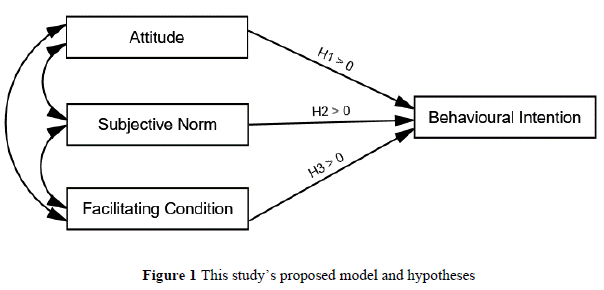
With this study we aimed to better understand how the attitude, subjective norm, and facilitating condition components affect students' behavioural intention to learn mathematics with personal mobile devices in school. Based on previous studies on students' learning with personal mobile devices in school (Hoi, 2020; Hopkins et al., 2017), our study was guided by two research questions and three hypotheses:
Research question 1: What are the students' perceptions of using personal mobile devices to learn mathematics through BYOD in school? Research question 2: How are attitude, subjective norm, and facilitating condition related to students' behavioural intention to use BYOD in school?
Attitude has a positive effect on students' behavioural intention to learn mathematics through BYOD in school.
H2: Subjective norm has a positive effect on students' behavioural intention to learn mathematics through BYOD in school.
H3:. Facilitating condition has a positive effect on students' behavioural intention to learn mathematics through BYOD in school.
Methodology
Instruments
In this study we used a survey as the research instrument. The survey was developed through a compilation of previous research items (Pramana, 2018). We adapted, modified, and constructed items from studies that previously measured attitude, subjective norm, and facilitating condition to depict students' intention to use different ICT devices for learning. We used the ideas of Hoi (2020), Hopkins et al. (2017), and Pramana (2018) to restructure the attitude, subjective norm, facilitating condition, and behavioural intention item constructs to fit the objectives of this study. Where necessary, we used unchanged existing items in the survey to improve the validity and reliability of the measures (Pramana, 2018). Each survey statement was rated on a 5-point Likert scale, with 1 indicating "strongly disagree" and 5 indicating "strongly agree." The first four questions on the survey are about participants' personal information, including gender, age, region, and the type of personal mobile devices they owned, if any. Questions 5 to 17 consist of 13 components, four of which (attitude, subjective norm, facilitating condition, behavioural intention) are used in this study's theoretical model. The rest of the components are not considered in this article.
Data Collection
To validate the survey tool, a pilot study was conducted with 50 students to test the components before the final data collection. A pilot study was carried out among participants who were not included in the sample "to identify the possible errors of a questionnaire so as to improve the reliability" (Shrestha, 2021:5). Survey papers were distributed to ninth grade students from seven public schools in Omusati and five public schools in the Khomas region of Namibia. The two regions were selected based on geographical location and national population representation. The Khomas region includes Namibia's capital city, Windhoek, and has the country's highest population (about 18%). Omusati is the third largest region, accounting for about 10% of the total Namibian population. Data from the Khomas region represent schools in urban areas, while data from the Omusati region represent schools in rural areas. Purposeful sampling was used to select the 12 participating government schools. Student selection was based on volunteer or self-selected sampling from full-class groups. A total of 508 questionnaires were distributed in mathematics classrooms by mathematics teachers during school hours. Students responded to the survey using the paper-and-pencil method. The teachers collected the completed survey results and handed them to the researchers for recording through Zoom meetings. We then entered the survey on the Webropol survey system. A total of 500 questionnaires were usable. Half the students were from five schools in the Khomas region (121 boys and 129 girls), while the other half (100 boys and 150 girls) were from seven schools in the Omusati region. Data were collected between January and March 2022.
Data Analysis
Data were exported from the Webropol survey system to the Statistical Package for the Social Sciences (SPSS.27) and IBM Amos.27 for analyses. Students' behavioural intention toward BYOD for mathematics was determined through descriptive statistics and structural equation modelling analyses. Principal component analysis, confirmatory factor analysis, and structural equation modelling analyses were used to test the hypotheses. Principal component analysis was used to determine the optimal number of components for inclusion in our research model. The findings were subsequently validated through confirmatory factor analysis. Through structural equation modelling we determined the extent to which the components and descriptive information could predict students' behavioural intention. The measurement and structural model assessment were done through IBM SPSS.27 and confirmed with IBM Amos.27.
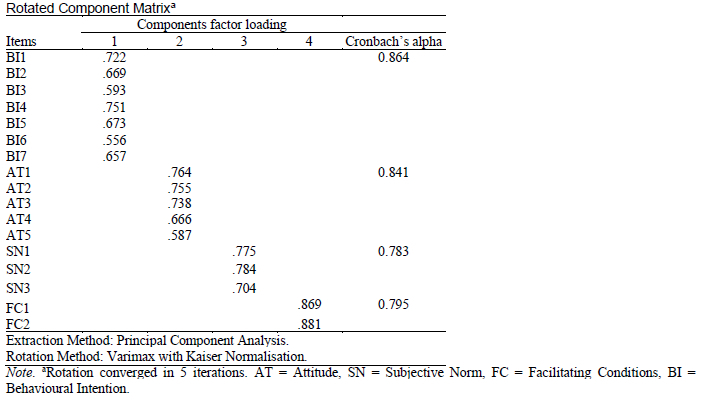
Principal component analysis extraction with varimax rotation was applied to the proposed constructs. Four components with an eigenvalue > 1 were retained, and the rest were deleted based on the Kaiser criterion. The four components explained 69% of the variance in students' behavioural intention to learn mathematics in school through BYOD (see Figure 2). The rotated component matrix displayed four distinct components: behavioural intention, attitude, subjective norm, and facilitating condition (see Appendix A). However, during the principal component analysis, two of the four survey items that were intended to measure the facilitating conditions component loaded onto the behavioural intention component. Additionally, one of the four survey items that were intended to assess the subjective norm component also loaded onto the behavioural intention component. Despite the two facilitating condition items having factor loadings above 0.50 on the behavioural intention factor, one was deleted because of its commonalities extraction of 0.49 < 0.50 (Shrestha, 2021). The other facilitating condition item was added to the behavioural intention factor because of its good component loading 0.65 > 0.50, commonalities extraction of 0.54 > 0.50, and its strong contribution to the component Cronbach's alpha. The third item, subjective norm, which loaded on behavioural intention, was deleted due to commonalities extractions and component loading of < 0.50. No item was added or deleted from the attitude component.
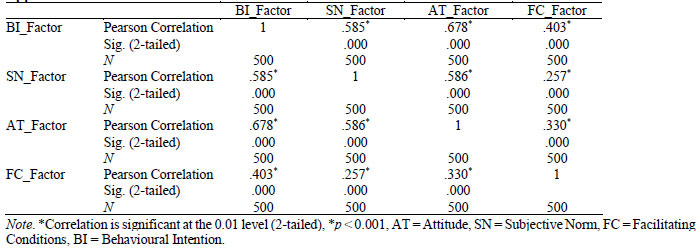
The reliability and internal consistency of the measures were tested using Cronbach's alpha. Cronbach's alpha ensures that the measurement items within the four scales are reliable and consistently measure the same underlying construct. All components had acceptable reliability, with Cronbach's alpha above the threshold of 0.70 (Shrestha, 2021). Thus, the proposed model shown in Figure 1 included 17 items describing four latent constructs. The Bartlett's test of sphericity was significant (p < 0.00) with a Kaiser-Meyer-Olkin value of 0.93 > 0.80 above the threshold, indicating that our sample was adequate (Shrestha, 2021). The inter-construct correlation matrix was also assessed, and it showed significant positive correlations among the components, indicating meaningful linear relationships between our constructs. The highest correlation coefficient was 0.68 < 0.80, providing the evidence that there is no significant multicollinearity in the data (see Appendix B). Therefore, the independent variables exhibit ideal independence from each other, enabling us to accurately interpret each individual coefficient.
Results
Demographic Statistics and Personal Mobile Devices in Use
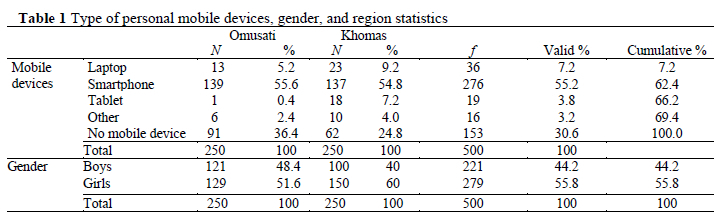
A total of 500 ninth grade students completed a paper-and-pencil survey. Half of the participants were from seven schools in the Omusati region, and the other half were from five schools in the Khomas region (Table 1). The Omusati region represents schools in rural areas, while the Khomas region represents schools in urban areas. Regarding demographics, most of the participants (56%) were girls and 44% were boys. Most students (69%) reported owning personal mobile devices, including smartphones (55%), laptops (7%), tablets (4%), and other types of personal mobile devices (3%). Thirty one per cent of the participants reported that they did not own personal mobile devices. Only 25% of the participants from the Khomas region reported not owning personal mobile devices, compared to 36% of the participant from the Omusati region.
Students' Perceptions of Learning Mathematics Using Personal Mobile Devices in School
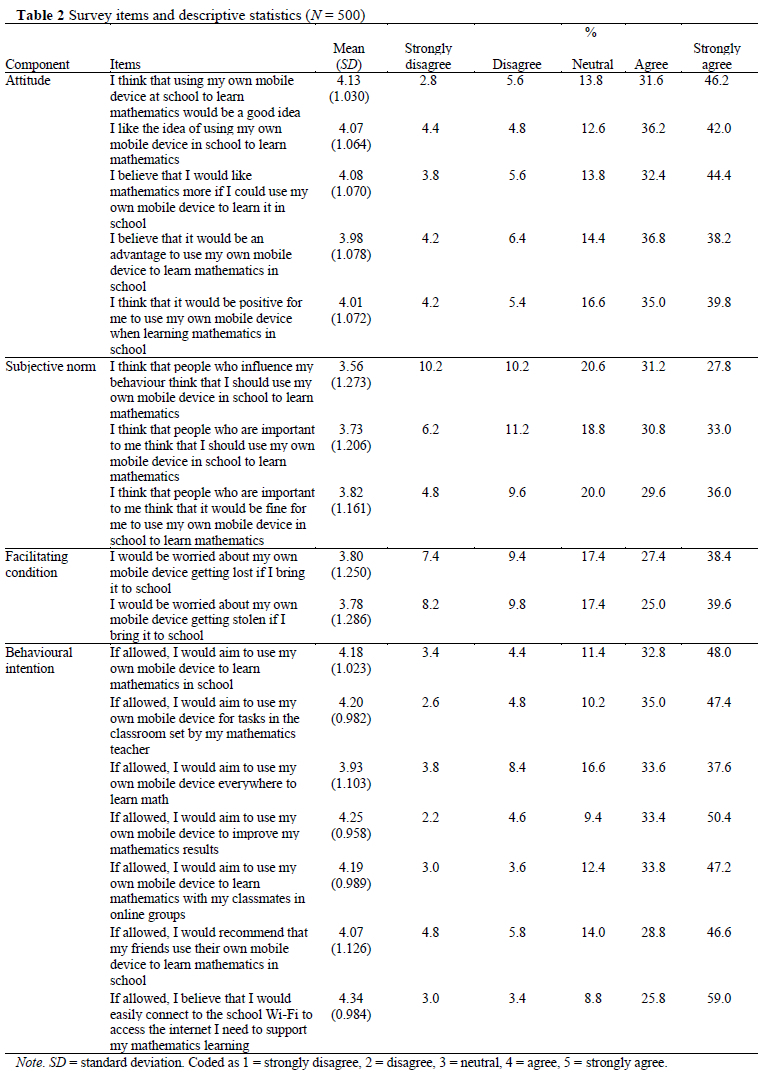
Regarding research question 1, Table 2 presents a summary of the students' responses for individual items. Behavioural intention had the highest mean score (M = 4.16, SD = 0.761), and all its items had a mean score above 4, except for item B3, which had a mean score narrowly below 4. For instance, 85% of the students believed that they would easily connect to the school's Wi-Fi to access the internet they needed to support their mathematics learning, 84% would aim to use their personal mobile devices to improve their mathematics results. While 81% of students would aim to use their personal mobile devices to learn mathematics in school, the same percentage of students would aim to use their personal mobile devices to learn mathematics with their classmates in online groups. Similarly, 82% of students would aim to use their personal mobile devices for tasks given by their mathematics teacher in the classroom. Finally, 75% of students would recommend that their friends use mobile devices to learn mathematics in school, and 71% of students would aim to use their personal mobile devices everywhere to learn mathematics.
The second highest mean score (M = 4.05, SD = 0.831) was for attitude. More than 81% of the participants had positive responses to all items measuring attitude towards learning mathematics with personal mobile devices in school. More than 77% of the students supported BYOD for mathematics learning and said that it was a good idea, and more than 76% reported that using their own devices to learn mathematics in school would make them like the subject more. Only 8% of the participants did not think that using mobile devices in school was a good idea, and 9% indicated that BYOD would not increase their desire to learn mathematics. These results show that students had a positive attitude and were willing to learn mathematics with personal mobile devices in school.
The facilitating condition had the third highest mean score (M = 3.79, SD = 1.156) among the components. In this study, more than 75% of the students' behavioural intention is attributed to facilitating condition toward BYOD for mathematics learning in school. A total of 66% of the students would be worried about their mobile devices getting lost if brought to school. Only 17% of the students would not be worried. Likewise, 65% of students would be worried about their mobile devices being stolen if brought to school. Only 18% of the participants indicated no worries. Overall, students' highest scores for the facilitating condition items indicated negativity and fear related to bringing their personal mobile devices to school.
The lowest least mean score was for subjective norm (M = 3.71, SD = 1.014). In this study, over 74% of the students showed positive subjective norm toward BYOD for mathematics learning at school. The majority (66%) of the students felt that people who are important to them would be fine with them using mobile devices to learn mathematics at school. Only 14% thought that this would not be the case. Generally, the students had positive responses to all items measuring subjective norm to learn mathematics with their personal mobile devices in school. The results show strong positive effects of the students' subjective norm on learning mathematics with personal devices in school. Furthermore, students' decisions to learn mathematics in school with their personal mobile devices was highly influenced by what they thought their subjective norms thought about the idea.
The visible observation from the descriptive results shown in Table 2 is that all items with which students strongly agreed had the least disagreements. This could be attributed to the students' strong desire for BYOD for mathematics learning in school. Despite students having positive attitudes, showing positive support from their subjective norm, and having high intentions to learn mathematics with personal mobile devices in school, the results regarding facilitating condition indicate that students were worried about the safety of their mobile devices, which could be lost or stolen in school.
Students' Attitude, Subjective Norm, and Facilitating Condition in Relation to Their Intentions to Use BYOD in School
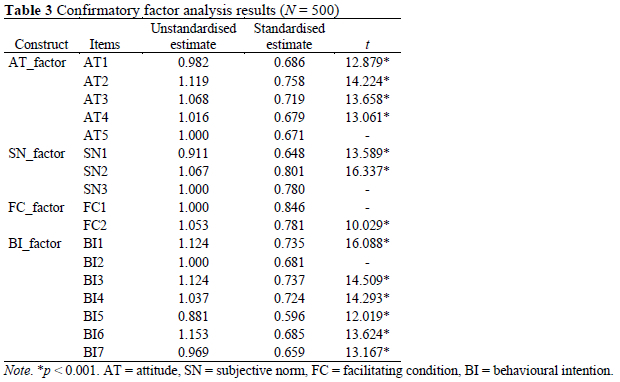
Regarding research question 2, we initially employed confirmatory factor analysis to verify the measurement quality of latent constructs used in our structural equation modelling. Confirmatory factor analysis serves as the initial step, prior to the structural equation modelling, ensuring that the latent constructs are valid and reliable. The measurement model of the confirmatory factor analysis had a good fit x2/df = 1.604 (< 5.0), p < 0.001, RMSEA = 0.035 (< 0.08), SRMR = 0.0281(< 0.05), GFI = 0.961 (> 0.90), TLI = 0.978 (> 0.90), and CFI = 0.982 (> 0.90), indicating that the survey items confirmed in Table 3 had good construct validity (Pramana, 2018).
Attitude, Subjective Norm, and Facilitating Condition Predict Students' Behavioural Intention to Learn Mathematics with Personal Mobile Devices in School
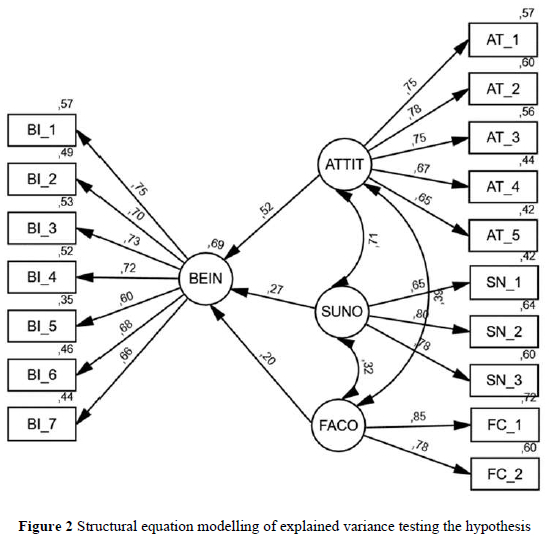
Structural equation modelling was used to test the hypotheses in this study. The structural equation modelling path model showed good fit indices: x2/df = 1.911 (< 5.0), p < 0.001, RMSEA = 0.043 (< 0.08), SRMR = 0.0317 (< 0.05), GFI = 0.952 (> 0.90), TLI = 0.966 (> 0.90), CFI = 0.972 (> 0.90), within the thresholds (Mustafa, Nordin & Razzaq, 2020). Since the structural equation modelling exhibits good model fit, it proves that the hypothesised model aligns well with the observed data (Xia & Yang, 2019). Table 4 shows the model's estimates of the path coefficients. Figure 2 shows the amount of variance explained per item and per construct and the model's squared multiple correlation (R2) of 0.69. The predictor variables explained 69% of the variance in students' behavioural intention to learn mathematics with personal mobile devices in school. The behavioural intention and attitude components had an R2 of 0.69 and 0.52, respectively, while the predictor variables subjective norm and facilitating condition had an R2 of 0.27 and 0.20, respectively. The structural equation modelling results indicate the following:
H1, that attitude has a positive effect on students' behavioural intention to learn mathematics through BYOD in school, is accepted. Attitude was the strongest significant predictor of students' behavioural intention to learn mathematics through BYOD in school (P = 0.52, t = 7.432, p = < 0.001). H2, that subjective norm has a positive effect on students' behavioural intention to learn mathematics through BYOD in school, is accepted. Subjective norm was the second highest predictor of students' behavioural intention to learn mathematics through BYOD in school (P = 0.27, t = 4.198, p = < 0.001). H3, that facilitating condition has a positive effect on students' behavioural intention to learn mathematics through BYOD in school, is accepted. The facilitating condition was the lowest significant predictor of students' behavioural intention to learn mathematics through BYOD in school (β = 0.20, t = 4.491, p = < 0.001).
According to the results, all three hypotheses were confirmed (Table 4 and Figure 2).
Figure 2 shows the theoretical model of this study with standardised estimates of the components. The value of 69 above BEIN indicates that attitude, subjective norm, and facilitating condition account for 69% of the variance in behavioural intention. Since the p-values of the predictors are less than the level of significance, this model adds to the assumptions of the theory of reasoned action and unified theory of acceptance and use of technology that attitude, subjective norm, and facilitating condition predict behavioural intention.
Discussion and Conclusion
In this study we examined 500 ninth grade students' behavioural intentions towards BYOD for mathematics learning in rural and urban schools in Namibia. Two research questions were addressed, using the theory of reasoned action-based components and the facilitating condition construct to examine the structural relationships between attitude, subjective norm, facilitating condition in predicting students' behavioural intention towards BYOD for mathematics learning in school. The results confirm that the majority of Namibian students owned personal mobile devices, which they used for educational purposes outside of school premises (Osakwe, Dlodlo & Jere, 2017a; Osakwe et al., 2017b). If allowed, the students could use such devices to learn mathematics and supplement the few available mobile devices in schools.
The results reveal that students' behavioural intention to learn mathematics with personal mobile devices in school had the highest mean score and R2, indicating that students have a strong intention to bring their personal mobile devices to school for mathematics learning. These findings differ from those of Hopkins et al. (2017), who report that students' behavioural intention had the third highest mean score after subjective norm and facilitating condition and the second highest R2 after attitude. The difference in these findings could be linked to the fact that the participants in Hopkins et al.'s (2017) study experienced BYOD in school unlike in our study.
Regarding the descriptive results, attitude had the second-highest mean score, indicating students' positive attitude toward BYOD for mathematics learning. Meanwhile, the structural equation modelling results show that attitude had the second highest R2, and it was the strongest statistically significant predictor of students' behavioural intention. These results are consistent with previous research evaluating students' attitudes toward using their personal mobile devices for learning mathematics and other subjects (Hopkins et al., 2017). Moreover, the results highlight the role of attitude as the strongest predictor of behavioural intention to use BYOD for mathematics learning in school. In practice, this means that it is not enough to focus on subjective norm or facilitating condition if students' attitude is not positive. People are likely to perform behaviour if their attitude towards that behaviour is positive (Ajzen & Fishbein,1973). In this study, students showed a positive and strong attitude towards BYOD for mathematics learning in school, which resulted in their high intention to learn mathematics with their personal mobile devices in school. Accordingly, allowing students to learn mathematics in school through BYOD could improve their mathematics performance (Drigas & Pappas, 2015).
Although the descriptive results show that subjective norm had the lowest mean score among other constructs, the results still indicate that students had positive subjective norm. This finding signifies that students believed that important people in their lives positively influenced their decisions regarding BYOD for mathematics learning in school. Similarly, the result from the structural equation modelling shows that subjective norm had the third highest R2 and was the second highest significant predictor of students' intentions behind facilitating condition. These findings add to those of Zhonggen and Xiaozhi (2019), who report that subjective norm had an important influence on students' behavioural intention to learn subjects using a mobile learning technology application called Rain Classroom. Similarly, Al-Emran, Al-Nuaimi, Arpaci, Al-Sharafi and Anthony (2022) found that subjective norm positively and significantly impacted students' behavioural intention to use personal mobile devices, such as smartwatches, for educational purposes. Our findings suggest that students are eager to learn mathematics through BYOD in school because they believe that important people in their lives, who influence their decisions, support this idea. Moreover, most students owned personal mobile devices, which they used to access the internet. If important people in the students' lives support the use of such devices for learning at home, it could cause students to perceive a supportive subjective norm. Although the best predictor is students' attitude, it seems that the students' social community, teachers, parents, and other students play significant roles in their intentions to use their personal mobile devices for learning. Such knowledge is essential when making decisions regarding BYOD approaches at school level.
The result of the descriptive and structural equation modelling imply similar meanings of the facilitating condition construct in this study. While facilitating condition had the second lowest mean score, its results point out an issue of concern: the school environment, in terms of providing safety for students' devices on school premises. Many students worried about their personal mobile devices being lost or stolen at school for which several possible reasons exist. If students previously lost or had their belongings stolen at school, they may perceive a school as unsafe for their personal mobile devices (Tinmaz & Lee, 2019). These findings correspond with those of Tinmaz and Lee (2019) who found that students showed a moderate level of caution regarding BYOD because they did not seem to completely trust the school to protect their personal mobile devices. Conversely, Hopkins et al. (2017) found that students were less worried about their devices getting lost or stolen at school. The disparity in results may be due to cultural differences, and more research is needed to establish the reasons for the distinction. The facilitating condition had the lowest R2 in our model, and it was the lowest, yet statistically significant predictor of students' intentions to learn mathematics with personal mobile devices in school. This finding is consistent with other studies showing that facilitating condition significantly predicted students' behavioural intention to use technology-mediated processes to support their learning (Madu et al., 2020).
Students had a positive behavioural intention towards BYOD for mathematics learning at school, as shown by the results of the theory of reasoned action constructs in this study. However, the facilitating condition component raised safety concerns as a possible reason why students might be hesitant to bring their mobile devices to school for mathematics learning. Consequently, "an individual may not be able to perform a given behaviour, despite his intention to do so, if he lacks the required ability or if he is prevented from doing so by circumstances or by other people" (Ajzen & Fishbein, 1973:44). To increase students' behavioural intention toward BYOD for mathematics learning in school, it is crucial to remove perceived barriers. Based on our findings, schools aiming to implement BYOD for mathematics learning should first deal with possible facilitating conditions, such as ensuring the safety of students' personal mobile devices. In future, implementers of BYOD should not only consider ways to improve the physical safety of personal mobile devices but also seek to increase students' awareness of the safety of their personal mobile devices in school and emphasise students' shared responsibility to do so (Tinmaz & Lee, 2019).
Demographically, this research was limited to ninth grade students in Namibia's Omusati and Khomas regions. Of 14 education regions, only two participated in the study. Of 31 schools offering ninth grade classes in Khomas and 148 in Omusati, only 12 schools from both regions took part. Thus, the study results may not be generalised to represent all Namibian ninth grade students' behavioural intention toward BYOD for mathematics learning in school. Furthermore, behavioural intention was specifically addressed for BYOD for mathematics learning. Future studies should assess and compare the behavioural intention of students from different grades, regions, and countries on subjects other than mathematics to provide a more general understanding of the topic. Theoretically, the research strictly employed attitude, subjective norm, and facilitating condition components using a quantitative research method to assess their influence on students' behavioural intention. The specific reasons for the influence of these components on behavioural intention was not determined. Thus, future research should use qualitative or mixed methods to complement quantitative theory of reasoned action and facilitating condition results to identify specific reasons for their influence on behavioural intention. In addition, we did not specifically identify the students' subjective norm. Future research should investigate subjective norm in a more specific manner, such as the subjective norm of parents/teachers and their effects on students' behavioural intention. In schools where BYOD is implemented, future research may assess the actual use of BYOD for mathematics learning rather than behavioural intention. Apart from the students' behavioural intention toward BYOD for mathematics learning in school, the behavioural intention of other educational stakeholders (e.g. teachers, parents, and educational policymakers) needs to be explored to support the implementation of BYOD in schools.
Acknowledgements
This research was supported by the Finnish National Agency for Education through the Finnish Government Scholarship Pool as well as the Global Innovation Network for Teaching and Learning at the University of Eastern Finland.
Authors' Contributions
CNJ conducted all statistical analyses and drafted the manuscript. SHN reviewed the statistical analyses and supervised the writing process. SP reviewed the content and context of the article and supervised the writing stages. All authors reviewed the final draft of the manuscript.
Notes
i. Published under a Creative Commons Attribution Licence.
References
Ajzen I & Fishbein M 1973. Attitudinal and normative variables as predictors of specific behaviour. Journal of Personality and Social Psychology, 27(1):41-57. https://doi.org/10.1037/h0034440 [ Links ]
Al-Emran M, Al-Nuaimi MN, Arpaci I, Al-Sharafi MA & Anthony B, Jnr 2022. Towards a wearable education: Understanding the determinants affecting students' adoption of wearable technologies using machine learning algorithms. Education and Information Technologies, 28:2727-2746. https://doi.org/10.1007/s10639-022-11294-z [ Links ]
Ambarwati R, Harja YD & Thamrin S 2020. The role of facilitating conditions and user habits: A case of Indonesian online learning platform. Journal of Asian Finance, Economics and Business, 7(10):481-489. https://doi.org/10.13106/jafeb.2020.vol7.no10.481 [ Links ]
Bartholomew SR & Reeve E 2018. Middle school student perceptions and actual use of mobile devices: Highlighting disconnects in student planned and actual usage of mobile devices in class. Educational Technology and Society, 21(1):48-58. [ Links ]
Bin Yeop YH, Othman ZA, Abdullah SNHS, Mokhtar UA & Fauzi WFP 2018. BYOD implementation factors in schools: A case study in Malaysia. International Journal of Advanced Computer Science and Applications, 9(12):311-317. https://doi.org/10.14569/lJACSA.2018.091245 [ Links ]
Boer PJ 2021. Considering local context in expanding ICT integration at primary education: Lessons learnt from Namibian case study. International Journal of Smart Technology and Learning, 2(4):272-286. https://doi.org/10.1504/IJSMARTTL.2021.118903 [ Links ]
Chaka JG & Govender I 2017. Students' perceptions and readiness towards mobile learning in colleges of education: A Nigerian perspective. South African Journal of Education, 37(1):Art. # 1282, 12 pages. https://doi.org/10.15700/saje.v37n1a1282 [ Links ]
Drigas AS & Pappas MA 2015. A review of mobile learning applications for mathematics. International Journal of Interactive Mobile Technologies, 9(3):18-23. https://doi.org/10.3991/ijim.v9i3.4420 [ Links ]
Fabian K, Topping KJ & Barron IG 2018. Using mobile technologies for mathematics: Effects on student attitudes and achievement. Educational Technology Research and Development, 66(5):1119-1139. https://doi.org/10.1007/S11423-018-9580-3 [ Links ]
Hamukwaya ST & Haser Ç 2021. "It does not mean that they cannot do mathematics": Beliefs about mathematics learning difficulties. International Electronic Journal of Mathematics Education, 16(1):em0622. https://doi.org/10.29333/iejme/9569 [ Links ]
Hoi VN 2020. Understanding higher education learners' acceptance and use of mobile devices for language learning: A Rasch-based path modeling approach. Computers & Education, 146:103761. https://doi.org/10.1016/j.compedu.2019.103761 [ Links ]
Hopkins N, Tate M, Sylvester A & Johnstone D 2017. Motivations for 21st century school children to bring their own device to school. Information Systems Frontiers, 19(5):1191-1203. https://doi.org/10.1007/s10796-016-9644-z [ Links ]
Howlett G & Waemusa Z 2019. 21st century learning skills and autonomy: Students' perceptions of mobile devices in the Thai EFL context. Teaching English with Technology, 19(1):72-85. Available at https://files.eric.ed.gov/fulltext/EJ1204626.pdf. Accessed 14 October 2024. [ Links ]
Isaacs S, Roberts N & Spencer-Smith G 2019. Learning with mobile devices: A comparison of four mobile learning pilots in Africa. South African Journal of Education, 39(3):Art. #1656, 13 pages. https://doi.org/10.15700/saje.v39n3a1656 [ Links ]
Madu K, Fauzi A & Ayub BM 2020. Predicting the intention to utilize e-learning system: Perceived usefulness, perceived ease of use, perceived enjoyment, facilitating conditions, subjective norm and attitude towards use based on technology acceptance model: Perspective of university lecturers in the Northeastern Nigeria. International Journal of Academia and Educational Research, 6(2):44-53. Available at http://www.arcnjournals.org/images/NIRA-IAJER-6-2-5.pdf. Accessed 14 October 2024. [ Links ]
Mateya M, Utete C & Ilukena A 2016. Factors that cause poor performance in mathematics at National School Secondary Certificate level compared to Junior Secondary Certificate level in four selected schools in the two Kavango Educational regions. Journal for Studies in Humanities and Social Sciences, 5(2):158-168. Available at http://journals.unam.edu.na/index.php/JSHSS/article/view/1044. Accessed 17 March 2023. [ Links ]
Moyer-Packenham PS, Lommatsch CW, Litster K, Ashby J, Bullock EK, Roxburgh AL, Shumway JF, Speed E, Covington B, Hartmann C, Clarke-Midura J, Skaria J, Westenskow A, MacDonald B, Symanzik J & Jordan K 2019. How design features in digital math games support learning and mathematics connections. Computers in Human Behavior, 91:316-332. https://doi.org/10.1016/J.CHB.2018.09.036 [ Links ]
Muhassanah N & Lukman HS 2021. An analysis of affective assessments of online learning through WhatsApp group on the mathematics students. Hipotenusa: Journal of Mathematical Society, 3(2):200-219. https://doi.org/10.18326/hipotenusa.v3i2.6320 [ Links ]
Mustafa MZB, Nordin MNB & Razzaq ARBA 2020. Structural Equation Modelling using AMOS: Confirmatory factor analysis for taskload of Special Education Integration Program teachers. Universal Journal of Educational Research, 8(1):127-133. https://doi.org/10.13189/ujer.2020.080115 [ Links ]
Mwilima F & Hangula V 2017. The effects of cell phone use on academic performance in tertiary education. International Journal of Law, Humanities & Social Science, 1(5):33-38. Available at https://www.ijlhss.com/wp-content/uploads/2017/10/The-Effects-of-Cell-Phone-Use-on-Academic-Performance-in-Tertiary-Education.pdf. Accessed 14 October 2024. [ Links ]
Osakwe J, Dlodlo N & Jere N 2017b. Where learners' and teachers' perceptions on mobile learning meet: A case of Namibian secondary schools in the Khomas region. Technology in Society, 49:16-30. https://doi.org/10.1016/j.techsoc.2016.12.004 [ Links ]
Osakwe JO, Dlodlo N & Jere N 2017a. The use of mobile devices for collaborative learning in high schools: Is it possible in Namibia? Africa Education Evaluation, 1(1):40-53. https://doi.org/10.26762/aee.201700004 [ Links ]
Pramana E 2018. Determinants of the adoption of mobile learning systems among university students in Indonesia. Journal of Information Technology Education: Research, 17:365-398. https://doi.org/10.28945/4119 [ Links ]
Roberts N, Spencer-Smith G, Vänskä R & Eskelinen S 2015. From challenging assumptions to measuring effect: Researching the Nokia Mobile Mathematics Service in South Africa. South African Journal of Education, 35(2):Art. # 1045, 13 pages. https://doi.org/10.15700/saje.v35n2a1045 [ Links ]
Ruxwana N & Msibi M 2018. A South African university's readiness assessment for bringing your own device for teaching and learning. South African Journal of Information Management, 20(1):a926. https://doi.org/10.4102/SAJIM.V2011.926 [ Links ]
Shrestha N 2021. Factor analysis as a tool for survey analysis. American Journal of Applied Mathematics and Statistics, 9(1):4-11. https://doi.org/10.12691/ajams-9-1-2 [ Links ]
Skillen MA 2015. Mobile learning: Impacts on mathematics education. In Proceedings of the 20th Asian Technology Conference in Mathematics (Vol. 1(2)). Mathematics and Technology, LLC. [ Links ]
Sutton S 1998. Predicting and explaining intentions and behavior: How well are we doing? Journal of Applied Social Psychology, 28(15):1317-1338. https://doi.org/10.1111/J.1559-1816.1998.TB01679.X [ Links ]
Tachie SA 2019. Challenges and opportunities regarding usage of computers in the teaching and learning of Mathematics. South African Journal of Education, 39(Suppl. 2):Art. #1690, 10 pages. https://doi.org/10.15700/saje.v39ns2a1690 [ Links ]
Tinmaz H & Lee JH 2019. A perceptional analysis of BYOD (Bring Your Own Device) for educational or workplace implementations in a South Korean case. Participatory Educational Research, 6(2):51-64. https://doi.org/10.17275/per.19.12.6.2 [ Links ]
Unal E & Uzun AM 2021. Understanding university students' behavioral intention to use Edmodo through the lens of an extended technology acceptance model. British Journal of Educational Technology, 52(2):619-637. https://doi.org/10.1111/bjet.13046 [ Links ]
Uzdoğan KM, Başoğlu N & Erçetin G 2012. Exploring major determinants of mobile learning adoption. In 2012 Proceedings of PICMET'12: Technology management for emerging technologies. IEEE. [ Links ]
Venkatesh V, Morris MG, Davis GB & Davis FD 2003. User acceptance of information technology: Toward a unified view. MIS Quarterly, 27(3):425-478. https://doi.org/10.2307/30036540 [ Links ]
Waiganjo IN 2021. Teachers' perceptions and use of Information and Communication Technology in teaching and learning: Kadjimi Circuit, Kavango West, Namibia. Open Access Library Journal, 8:e7236. https://doi.org/10.4236/oalib.1107236 [ Links ]
Xia Y & Yang Y 2019. RMSEA, CFI, and TLI in structural equation modeling with ordered categorical data: The story they tell depends on the estimation methods. Behavior Research Methods, 51(1):409-428. https://doi.org/10.3758/s13428-018-1055-2 [ Links ]
Zhonggen Y & Xiaozhi Y 2019. An extended technology acceptance model of a mobile learning technology. Computer Applications in Engineering Education, 27(3):721-732. https://doi.org/10.1002/cae.22111 [ Links ]
Received: 1 December 2022
Revised: 10 April 2024
Accepted: 14 August 2024
Published: 31 December 2024
Appendix A: Principal Component Analysis Results
Appendix B: Correlations between Constructs in the Measured Model