Services on Demand
Journal

Article
 English (pdf)
 Article in xml format
 Article references
 Automatic translation
 Send this article by e-mail
Indicators
Related links
-
 Cited by Google
 -
 Similars in Google
Share

 Permalink
South African Journal of Education
On-line version ISSN 2076-3433Print version ISSN 0256-0100
S. Afr. j. educ. vol.45 n.2 Pretoria May. 2025
https://doi.org/10.15700/saje.v45n2a2547
ARTICLES
Understanding rural teachers' experiences of instructional difficulties and factors affecting their feelings of self-efficacy during COVID-19
Mirgul Enterieva
Independent researcher menterieva@gmail.com
ABSTRACT
As COV[D-19 presented many challenges for teachers in maintaining emergency remote learning, I used semi-structured interviews to explore the challenges faced by 10 secondary school teachers working in the Acha-Kayyngdy region, a rural area in Kyrgyzstan, during the pandemic. I also explored the factors influencing their sense of self-efficacy. Analysing content collected during interviews, I found that emergency remote teaching resulted in teachers experiencing difficulties such as accessing the internet, keeping up with new technology and methods, and attracting students' attention. Some factors also influenced teachers' sense of self-efficacy. The study provided insight into the demands of emergency remote teaching for teachers in disadvantaged areas, families, policymakers, school principals, and educators.
Keywords: COVID-19; remote teaching; rural; self-efficacy
Introduction
The coronavirus disease (COVID-19) has deeply impacted the world. The pandemic significantly affected education systems throughout the world, including in Kyrgyzstan. The crisis, which was not planned or designed, suddenly changed the social order and teachers' work in many ways (Laster Pirtle, 2020). Educational institutions were closed and forced to switch to distance learning (Commonwealth of Learning [COL], 2020). Educational, vocational and academic challenges that had already existed in educational institutions were further complicated by the pandemic. In this context, the importance of technology has become even more prominent.
With the pandemic, technological self-efficacy of teachers has become important. It was about integrating modern technological applications into education. Schools and teachers need to keep up with technological developments (Prensky, 2007). Smart boards, Microsoft (MS) PowerPoint, computer slides, and other similar tools are the most commonly used technological tools in schools. From the point of view of distance education, various web-based applications or tools are distinguished.
Remote learning used to be widely implemented in higher educational institutions, whereas basic education has predominantly relied on face-to-face instruction. This is particularly evident in schools located in rural areas (Irvin, Hannum, De la Varre & Farmer, 2010).
A substantial body of research has examined related themes. However, as in Kyrgyzstan, more research is needed on the experiences of teachers working in rural schools located in disadvantaged regions of developing countries and their sense of self-efficacy in terms of educational and national sustainability during the pandemic. Identifying the challenges in rural areas is crucial for better preparation and for taking preventive measures to provide better education in the future. Disadvantaged regions in developing countries are the most disadvantaged in terms of education. According to UNESCO's International Task Force on Teachers (ITFT), 2020 was a difficult year for teachers due to reasons such as a lack of information and communications technology (ICT), limited internet access in rural areas, increasing inequalities in opportunity and differences in grades and grade levels among students. People or groups who do not have access to the internet or technology typically include women, children, groups with socio-economic disadvantages, people with disabilities, the most vulnerable groups, and indigenous and marginalised groups (United Nations Educational, Scientific and Cultural
Organization [UNESCO], 2020).
This study was conducted in the Acha-Kayyngdy region in rural Kyrgyzstan. The aim of this study was to explore the challenges faced by rural teachers during the COVID-19 pandemic and to identify the factors influencing their sense of self-efficacy. The focus was on two key issues: understanding teachers' experiences and challenges during the COVID-19 pandemic, and identifying the factors that influenced their sense of self-efficacy. To address these aims, participants were asked about (1) the challenges they encountered during the pandemic and (2) the factors that affected their perceptions of self-efficacy.
Identifying the challenges faced by secondary school teachers working in rural areas during the pandemic and their perceptions of self-efficacy is important for understanding the experiences of teachers and school stakeholders in disadvantaged regions of developing countries during this period. The research findings are significant in supporting schools and stakeholders in rural areas to better prepare for similar future crises, address and improve areas of weakness, and contribute to the sustainability of both education and national development. The results may provide valuable insight into and information for schools and stakeholders in rural areas, education policymakers, economic planners, and researchers and readers interested in the topic, contributing to the existing literature.
Literature Review
Many studies have been conducted on the topic of this study. However, more research is needed on the experiences of teachers working in rural schools located in disadvantaged regions of developing countries and their sense of self-efficacy in terms of educational and national sustainability during the pandemic. Southerland (2023) indicates that teachers' perception of self-efficacy increased as a result of the pandemic and primarily attributed to their personal efforts and prior personal and professional experiences. Meisner and McKenzie (2023) found that during COVID-19 teachers had less control over parental support and involvement, student motivation, and student access to adequate technology. Cardullo, Wang, Burton and Dong (2021) identified several disadvantages associated with online teaching, including teachers' low levels of self-efficacy in using technology, poor internet connectivity, insufficient support and resources, and difficulties in motivating and engaging students. According to Robinson, Valido, Drescher, Woolweaver, Espelage, LoMurray, Long, Wright and Dailey (2023), teachers experienced stressors related to their personal and professional roles, and frustrations with administration and other institutional entities around COVID-19 safety measures. Novice teachers' lack of support and experience, and poverty can be listed as factors that influenced teacher's self-efficacy during COVID-19 in a rural school in South Africa (Masondo, 2023). According to Makhalemele and Jama (2023), inadequate handling of the referral processes, and insufficient capacitation for support services restricted the efficiency of support services in rendering learner support during COVID-19 in South African schools.
Theoretical Framework
Digital divide (digital disability)
The term "digital divide" is used to refer to the gap that exists in most countries between those who have ready access to information and communication technology tools and the information they provide and those who do not have such access and skills (Cullen, 2001). The digital divide is the gap that exists between people who benefit from the internet and people who are relatively disadvantaged by it. The access discrimination that has received the most attention to date is access inequality (Rogers, 2001). Access inequality may be due to socio-economic factors (income level), geographic factors, educational, behavioural and generational (age) factors, as well as physical disabilities (Cullen, 2001; Huffman, 2018).
Many students did not have adequate access to online learning technologies, including access to the internet and devices, to successfully transition to remote learning. Students in rural areas were specifically at a disadvantage in terms of benefits due to limited access. Rural schools are more prone to deficiencies in digital infrastructure compared to their urban counterparts (Organisation for Economic Co-operation and Development [OECD], 2023). In rural regions, the functionality of many digital tools, such as mobile devices and computers, is limited. These issues significantly hinder students' learning experiences and academic performance. Notably, 22.3% of rural Americans face inadequate broadband coverage, highlighting a significant disparity compared to only 1.5% of urban Americans lacking internet access (Federal Communications Commission [FCC], 2020). This digital divide underscores the necessity for targeted interventions to enhance connectivity in underserved regions, thereby ensuring equitable educational opportunities for all students. The challenges associated with internet access were markedly greater in developing countries (Mpungose, 2020). In developing countries such as Chile, the onset of the pandemic illuminated substantial disparities in technological access, with 65% of the population not having computers. Furthermore, nearly half of the individuals did not possess either a computer or an internet connection (Gelber, Castillo, Alarcón, Treviño & Escribano, 2021). This lack of resources underscores significant barriers to remote learning and emphasises the urgent need for comprehensive policy interventions aimed at enhancing digital access and equity. Addressing these disparities is essential for fostering equitable educational opportunities and promoting social inclusion.
The situation in Kyrgyzstan reflects similar challenges regarding technological access. Only 66% of the population had access to mobile internet, highlighting significant disparities in digital connectivity. In rural areas, 23% of students lacked access to a computer or tablet with internet capability. Compounding these challenges, only three out of every five households had reliable electricity. While every child has the fundamental right to education, these barriers prevented equitable access for all children in the country, underscoring the urgent need for targeted interventions to improve infrastructure and resources.
In rural areas of Kyrgyzstan, most families did not have a computer at home. Additionally, most families were of low socio-economic status, and either the mother or father was often elderly or lacked technological proficiency. This automatically impacts students' access to the internet for remote learning, their knowledge and skills in using technology, and what causes financial difficulties.
This lack of access exacerbates existing educational inequalities and highlights the urgent need for targeted interventions to improve digital infrastructure and resources. Addressing these disparities is essential for fostering equitable educational opportunities in Kyrgyzstan.
World Bank: Key components for effective distance learning
The World Bank identifies three key components for the implementation and effectiveness of remote learning; 1) access to technology suitable for distance learning needs, 2) teachers' knowledge and skills for distance learning, and 3) student participation (Muñoz-Najar, Gilberto, Hasan, Cobo, Azevedo & Akmal, 2021).
Self-efficacy
With this study I attempted to explain the experiences of rural teachers during COVID-19 and the factors influencing their sense of self-efficacy using Bandura' s self-efficacy theory. Self-efficacy is defined as people' s beliefs in their ability to organise and successfully carry out the activities necessary to demonstrate certain results (Bandura, 1994). Bandura (1994) places beliefs and concepts about self-efficacy at the centre of many factors influencing human functioning.
Self-efficacy beliefs, which play an important role in human behaviour, arise from four sources (Bandura, 1994): 1) personal experiences of similar behaviour (direct experiences), 2) observation of the same type of behaviour in others (social models or vicarious experience), 3) verbal persuasive messages from the environment to a person (verbal persuasion), and 4) perceptions of a person's own physiological and the emotional state (physiological and emotional states).
According to Schunk (1991), initial feelings of work effectiveness are largely dependent on general abilities and previous experience. Research shows that the most important source of information predicting beliefs of self-efficacy is people's successful performance based on their own personal experiences (Bandura, 1994). In this study I discuss direct or immediate experience of such behaviour. The goal was to understand the factors that influence teachers' sense of self-efficacy through direct experiences.
Teachers' beliefs on self-efficacy are associated with, among many other factors, effective barriers to teaching (Tschannen-Moran, Woolfolk Hoy & Hoy, 1998). The teaching profession is complex and challenging and teacher's self-efficacy may negatively impact educational process and quality, as well as teacher's mental health, professional commitment, self-esteem, and school outcomes.
Method
A phenomenological design was adopted in the study. Semi-structured interviews, supported by open-ended questions were conducted at different times with 10 secondary school teachers in Acha-Kayyngdy. In the preparation of the interview form, a question pool was created based on the relevant literature and interviews with rural teachers. Before the interview form was used, the opinions of three teachers regarding the clarity and comprehensibility of the questions were sought, ensuring its validity in terms of content. In the final version of the interview form, in addition to the specified questions, open-ended questions were used to clarify or make the main questions more understandable. To ensure external validity, the data are categorised and presented clearly, and the participants' views are presented through direct quotations. To increase the external validity of the study, data were collected from people with similar characteristics, similar social environments, and similar life processes. Participants were asked about the challenges that they faced while teaching remotely during COVID-19 and the factors influencing their sense of self-efficacy.
Content analysis was used to conceptualise the data and extract codes and themes that described the phenomenon. To create codes the transcribed interviews were summarised into categories or expressions. In this article, the abbreviation "T" is used to refer to teachers. Opinions were classified by assigning code names, and direct quotations are presented accordingly.
In this study I designed the research, conducted the literature review, collected data, analysed the data, drew conclusions, facilitated discussions, and presented the results.
Findings
The study results are presented below under two main headings and subheadings.
Challenges that Rural Teachers Faced in Remote Learning and Teaching
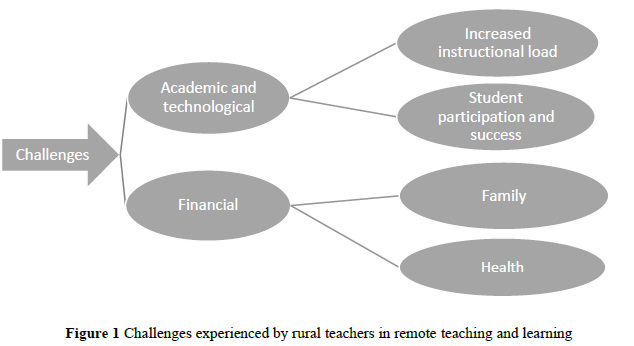
Identified from the interviews, the challenges that the participating teachers faced with remote teaching are presented in Figure 1.
Academic and technological context
During COVID-19, the digital platform has become an important tool in education and training. Rural teachers faced difficulties with the technology available to them. Teachers stated that they usually used video creation and editing programs (e.g. InShot, CapCut) prescribed by the school, and also conducted lessons through WhatsApp and regular mobile video calls. Teachers stated that they had tried new instructional methods and tools for the first time and that they had difficulty creating and using videos (even if they were easy to use). Access to the internet was another difficulty experienced by teachers. Almost all participants stated that they had difficulty accessing the internet. Accordingly, they stated that they sometimes experienced problems with additional costs of purchasing internet connection and internet reception capacity. It was stated that this difficulty was also observed among students. The participants stated that this affected students' participation in lessons as most families found it difficult to provide this opportunity.
Nearly all teachers reported that they did not use electronic mail (email) for teaching purposes. Instead, they printed course materials and delivered them to students' homes, as most families and students were unfamiliar with how to send or print emails. Furthermore, their geographical location made it challenging for teachers and families to do so. One of the participants stated the following:
... I've never taught a lesson by making a video before. I used to only use WhatsApp for school as a message when communicating with some parents. But during the pandemic, a decision was made to implement remote learning. During this process, I learned video creation programs that I had never heard of. On the one hand, it was interesting. On the other hand, it required a lot of time and effort on my part. I also had difficulties accessing the internet and with students and families in this regard.... (T1)
Concern for student participation and academic achievement in class
Teachers found it difficult to get students to participate in the online lessons. Teachers faced challenges in motivating students to participate in class and to eliminate technological, economic, and family context barriers that prevented participation.
Students' inability to participate and succeed caused internal anxiety for teachers. Whether parents had the knowledge and financial resources to comply with the new teaching methods also caused concerns among teachers. The teachers stated that as some families were unable to provide internet access, some students were unable to attend classes. As a result, student absenteeism had increased which resulted in poor performance. Participant T3 said the following: "During this period, student absenteeism, participation and academic performance decreased. The majority of students and families did not attend classes."
Increased instructional load
Teachers said they had difficulty preparing both remote teaching and new supplemental course materials. Accordingly, they faced challenges such as preparing new instructional materials and extracting content that could be used to create videos. They also stated that delivering study materials to a student' s home required time and energy. Therefore, they stated that they needed to devote more time and effort to work. One participant (T7) stated as follows: "We spent more time during this period because we taught different courses and also visited student homes.'"
Financial context
During the pandemic, teachers needed more internet access than was allowed by their daily and monthly internet budget. Accordingly, allocating additional money for internet access created further financial difficulties. Additionally, teachers occasionally printed instructional materials and delivered them to schools or homes as needed, which not only required additional printouts but also incurred financial costs. They reported that these additional expenses created challenges for both the teachers and the students' families. Participant T6 stated: "During the pandemic, we spent extra money on education. Whether it's the internet or photocopying, student families have to budget for the internet.'"
Family context
Participants stated that students had issues with their families regarding adequate internet access and the necessary technology at home. They said that some families were indifferent to online education. One participant's (T5) opinion on this matter was:
Some parents are indifferent to their children's participation in remote learning. When I see that the student is not online, I call the parent. Some parents said that they sent the child to the market or that the child was busy doing chores in the house, garden and with livestock, and that I should excuse the child.
A small number of participants (n = 2) reported that prolonged time at home during the pandemic led to marital tensions and increased household responsibilities, with female teachers particularly affected due to difficulties working from home caused by their children. However, other participants (n = 2) stated that they had the opportunity to spend more time with their families.
Health care
In addition to difficulties adapting to new instructional methods, teachers also faced health and economic impacts. They said that since they were in rural areas where the virus did not spread that much, they were more comfortable in this sense. However, they felt insecurity, anxiety, and concerns about hygiene and masks. They stated that they could not always afford to purchase protective equipment such as antiseptics and masks, and that when necessary they resorted to hand-made cloth masks. One participant (T6) expressed the following: "I was worried about my health when preparing and delivering course materials to homes, using public transport and going to school from time to time, and could not always provide virus protection."
Factors Affecting Teachers' Sense of Self-efficacy
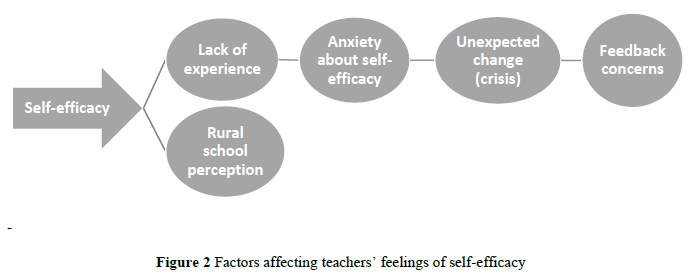
The factors identified in the interviews that influenced teachers' self-efficacy during online teaching are shown in Figure 2.
Lack of experience
Teachers reported lacking the necessary skills and knowledge related to instructional technologies, which made the transition to remote teaching challenging. They indicated that lessons were conducted using video creation software, WhatsApp video calls, and group chats. For many, this was their first experience with these digital tools.
The different teaching methods that teachers were suddenly forced to adopt during the
pandemic, their lack of prior experience with different teaching materials, or their lack of preparedness led teachers to question their self-efficacy. Teachers reported experiencing stress due to the need to quickly adapt to a new teaching environment and implement it effectively. Some also questioned their self-efficacy, feeling overwhelmed by the belief that they should have already possessed the necessary skills. Participant T3 indicated the following:
We have never encountered such a situation before. Suddenly, we started learning video production programs and developing materials, and we became stressed. On the one hand, of course, we were worried about how things would turn out. My lack of preparation knocked my confidence a little. We dealt with the situation by asking each other. The world is constantly evolving, perhaps we need to explore and learn ourselves, but how we do it here is how we learn. Sometimes I come across videos and information online and look at them and find them interesting, but don't know how to apply them.
Concern for academic self-efficacy
The teachers felt that they were academically and professionally inadequate in the face of the new situation in which they found themselves. Situations such as the responsibility to learn and use new methods, the responsibility for the students' academic achievements, concerns about preparing new learning material that is appropriate to the content, and concerns about whether the students would succeed or not raised teachers' concerns about their own academic self-efficacy. However, the teachers reported that the more they learned, the more they liked the course, the more they enjoyed new experiments, and the more they wanted to learn and apply new teaching and learning methods and technologies. One of the participants (T1) stated the following:
In this process, I had to learn and implement a new type of teaching. This made me worry about my self-efficacy. I was also concerned about whether the students would accept the education or not, how I would talk to families, and how the process would move forward. We experienced difficulties, but it was also pleasant. We learned new things. We' d like to know more. For example, there are completely new methods of education and training. We would like to learn from them.
Unexpected change (crisis)
Unplanned changes or the situation itself created problems or minor crises in various aspects for teachers, for instance, family issues, personal worries, rush, stress, and other similar factors. All the new obligations, responsibilities and new lifestyle had a negative impact on the ability of teachers to do their jobs. Teachers noted that they faced personal and professional shortcomings. One of the participants (T2) stated: "It has been a difficult year. I have experienced difficulties both vocational and personally, I do not want to face such problems again, nobody wants to.'"
Feedback concerns
Teachers were anxious about the kind of feedback that they would receive, whether families, school principals, and district administrators would like their instruction, and whether their instruction would be successful. Teachers also reported making efforts to improve their practice. Following positive feedback, they expressed feelings of happiness, renewed motivation, and a desire to further learn and expand their experience. In this regard, one participant (T8) stated:
We were also worried about how families, school administrators, and district administrators would react to the education we provided. You report. You also think about whether the manager will speak out negatively or the manager will get a warning from regional management, because then it will reflect directly on you.
Perception of rural schools
Participants generally stated that the schools they worked at were not regarded as important as urban schools. This situation forced teachers to travel to cities to attend seminars, and meetings. They noted that, during such events, they experienced feelings of inadequacy or incompetence in comparison to their urban colleagues. They noted that rural schools did not have the same opportunities as urban schools, and that such situations caused teachers to question their sense of self-worth and self-efficacy. In this sense, the matter of teachers questioning their sense of self-worth and self-efficacy comes in the form of questions about the region they live in, the school they work at, and the opportunities they have. One of the participants (T4) stated the following:
Because of the region in which I live, I feel that I am behind my colleagues at school, who are located more centrally, both in terms of language (Russian) and knowledge and experience. On the other hand, little attention is paid to rural schools and teachers. It bothers me from time to time.
Results and Discussion
According to the results of the study, academic and technological incompetency and insufficiency, financial resources and family factors were the main factors challenging teachers during COVID-19. The main factors that influenced teachers' sense of self-efficacy were academic self-efficacy and lack of experience.
Technological inadequacies experienced by teachers may be addressed primarily at the national level, and subsequently at the levels of schools, teachers, and students. When evaluating the country as a whole, it can be stated that the education system in the region has not yet reached the desired level of digital development in comparison to global standards. The gap between developed and underdeveloped countries in terms of the adoption of technology is evident in the global community, and this gap may be even larger than originally thought (Cullen, 2001; Huffman, 2018). Digital inequalities and inadequacies between countries around the world clearly affect urban and rural schools within a particular country. The challenges and innovations brought about by COVID-19 have highlighted this situation even more clearly. In this sense, equity in education and minimising this disparity and inequality to produce globally competent teachers and individuals has become an important issue that needs to be addressed.
The digital deficit in the country is naturally reflected in schools' infrastructure. In addition, teacher training programmes need to include technology education and educational integration. The same ought to be implemented for in-service teacher training programmes. The digital divide within the country also had a significant impact on the education system. The study shows that teachers and families in rural areas experienced problems with internet access. A review by Scheerder, Van Deursen and Van Dijk (2017) shows that the main determinants of the second-level digital divide are socio-demographic (e.g. gender, urban/rural dimension, location), economic (e.g. socio-economic status, educational level, parental education), and material factors (access to ICT at home, quality of access).
The digital divide refers to the gap between individuals who have access to the internet and digital technologies and those who do not, highlighting significant inequalities in access (Rogers, 2001). This may be due to socio-economic (income level), geographic, educational, behavioural and generational (age) factors, as well as physical disabilities. The rural region in which this study was conducted experienced inadequate manpower and technology for continuing education. Rural schools tend to have more limited technology, science, and human resources infrastructure than urban schools. The situation in Acha-Kayyngdy is similar. Schools in this and similar regions and teachers in these schools are more disadvantaged than others in terms of technological infrastructure and professional competence.
Families' socio-economic status continues to pose a significant barrier to students' access to education (OECD, 2012). Participants reported challenges with remote teaching, particularly limited internet access, which they attributed to the families' social and economic circumstances. This situation has also created inequalities in remote learning among students in the region under study. Andrew, Cattan, Costa-Dias, Farquharson, Kraftman, Krutikova, Phimister and Sevilla (2020) report similar findings, highlighting disparities in access to and participation in virtual learning based on parental socio-economic status. This issue has also been shown to affect families and students in rural areas (Schleicher, 2020).
Parents were not all able to equally support their children's remote learning during COVID-19 (Muñoz-Najar et al., 2021). Students from disadvantaged backgrounds have less support from parents (Schleicher, 2020). Despite teachers' efforts to provide effective online learning, many students, especially from low-income and minority families, could not benefited due to limited access (Reddick, Enriques, Harris & Sharma, 2020).
While schools play a significant role in influencing student achievement, it is important to recognise that external factors such as geographic location, poverty, and health also have a substantial impact. Masondo (2023) indicates that poverty influenced teacher's self-efficacy during COVID-19 in a rural school in South Africa. Schools can have a powerful influence on their students, however parents' educational attainment cannot be improved overnight due to the well-being of the average family being heavily influenced by a country's long-term economic development, poverty reduction efforts, and other social policies (OECD, 2012). A country's economic situation may have the greatest influence on the economic status and academic and technological literacy of rural teachers and families.
The participants in this study reported spending increased time on content creation and lesson preparation, and that they faced challenges in implementing new technological tools. Similar findings have been reported in related research by Kaden (2020) where educators faced challenges in the process due to issues with educational technology, the time required for preparation, the limited amount of content that could be taught, and difficulties in engaging and assessing students online.
According to the World Bank, access to technology suitable for distance learning needs is the most important component of the effective implementation of distance learning. Learning technologies not only need to be available for students, but also need to be appropriate for the context in which they are used. For example, in regions with low internet penetration, strategies other than online methods are needed to provide students with access to learning (e.g., paper-based materials, television, radio lessons) (Muñoz-Najar et al., 2021). Relevant research shows that technology used in developed countries and the types of technological tools used in schools in developing and disadvantaged regions vary greatly. Teachers participating in this study reported that they experienced a lack of technology, media literacy and competence. They implemented instruction using simple video programs (InShot, Wordweb) and by delivering learning materials to students' homes, as well as teaching via WhatsApp group chats and video calls. While this is the case, other countries have used advanced instructional programs such as Microsoft Teams, Zoom, Schoology, Google Classroom, Seesaw, and ClassDojo (Arch, 2022). Thus, it is evident that significant digital inequalities exist globally in relation to the technological programs and tools used in education.
The second key component is teachers' knowledge and competencies related to remote teaching. The teachers need not only have the deep content knowledge and strong instructional skills, but also the ability to use and integrate technology into their instructional practices. The COVID-19 period was a reminder of the technological deficit in rural schools and teachers' lack of technological self-efficacy. The results of this study indicate gaps in teachers' knowledge and skills. Relevant studies also confirm this situation and highlight teachers' insufficient digital skills (Klusmann, Trippenzee, Fokkens-Bruinsma, Sanderman & Schroevers 2022; Reimers, Schleicher, Saavedra & Tuominen, 2020). In this sense, some researchers use self-efficacy skills as a proxy variable to study the second-level digital divide in addition to actual skills (Zhong, 2011). Thus, it can be argued that the digital divide is also reflected in teachers' technological self-efficacy. Addressing teachers' digital deficiencies as well as their professional self-efficacy will help urban and rural teachers become globally competent, reduce stress levels, and eliminate self-efficacy deficits. In this context, digitalisation needs to be increased throughout the country. Digital inadequacies and inequalities may be addressed through professional training and continuous professional development of teachers.
Teachers in this study faced challenges stemming from a lack of prior experience with remote teaching, consistent with the findings of Arch (2022). Accordingly, due to the unexpected transition to remote teaching, teachers were unprepared for the new requirements. Many participants agreed, describing the challenges and concerns related to the internet and technology as "extremely frustrating" and "unpredictable." Similar findings were reported in Masondo's (2023) study, which indicated that teachers' self-efficacy in a rural South African school during COVID-19 was affected by novice teachers' lack of experience and by insufficient support.
The third component is student participation. Engaging students in learning requires interesting and engaging content, as well as frequent interaction with teachers (for instance, through feedback on work) (Muñoz-Najar et al., 2021). The participants in the study reported that they had difficulties engaging with students in class and getting their attention. Some students discontinued the course due to a lack of internet access, various family matters and household chores. It is argued that many limitations and constraints are encountered, such as the integration of technology in classrooms, teachers' presentation of instruction, and communication with students (Schleicher, 2020). As indicated in Arch's (2022) study, student interaction declined during this period. Kaden (2020) also states that educators faced challenges due to difficulty in getting students' attention. In a study by Kennedy, Mejía-Rodríguez and Strello (2022), disparities in access to technology and confidence in using technology were found among students from low socio-economic communities, girls, and those living in rural areas with lower scores on these dimensions. It is also noted that there is some evidence of inequality in student participation among socio-economic groups.
The main or prominent factors that influenced participating teachers' sense of self-efficacy may be summarised as academic self-efficacy and a lack of experience. Teachers stated that more effective remote teaching of high quality was being conducted in the cities. In this sense, they felt inadequate and distant. Teacher's lack of skills in a particular subject can affect feelings of self-efficacy. Teachers' perceived self-efficacy in remote teaching is a critical determinant of their professional effectiveness, as it influences their likelihood of initiating coping strategies under stress, the amount of effort they invest in tasks, and the persistence of that effort over time (Bandura, 1977). Teachers who fail at remote teaching are likely to feel inadequate. Once self-efficacy is established, it tends to generalise to similar situations; this includes not only teaching, but also effective communication and working with families, which are critical for student achievement (D'Haem & Griswold, 2017).
Bandura (1977, 1994) argues that individuals with strong self-efficacy beliefs do not avoid challenging experiences but remain determined to successfully complete their tasks. He also notes that emotional arousal in stressful situations can influence outcome expectations. These concepts are reflected in the feelings expressed by the participants in this study (Bandura, 1994). Participants expressed an interest in new remote teaching methods and a desire to further explore and experiment with additional approaches. In other words, the participants in this study were willing to improve despite being in disadvantaged areas, and receiving low salaries and little support. The participants' reflections on their self-efficacy, along with their desire to improve after receiving positive feedback on their remote teaching, suggest that they possess strong self-efficacy beliefs and the potential to succeed in the academic domain. Thus, teachers need and expect more comprehensive pre-service and in-service academic and technological training of high quality.
Conclusion
Advances in technology have reduced barriers to learning, including access to information. Pettersson (2018) identified four key aspects of pedagogical digital competency (PDC): policy, organisational infrastructure, strategic leadership, and teaching practices. These elements underscore the complexity of developing digital competence - not only among teachers, school leaders, and students but also within school organisations that support digitalisation.
Projects such as the Twinning Project, supported by the European Union and launched in Kyrgyzstan in 2021, aimed to address the digital technology deficit and support the country's agenda of digitalisation. However, achieving widespread digitalisation, particularly in rural areas, remains a long-term challenge. Technology adoption requires an informed society, and officials must prioritise developing digital competency across all education stakeholders through teacher training, strategic educational planning, and modernised school practices. Strong school leadership, particularly in technology, is key to reducing educational inequalities and improving national welfare.
The UNESCO ICT competency framework for teachers includes six skill sets: ICT in education policy, curriculum and assessment, pedagogy, application of digital skills, organisation and management, and professional training for teachers. Effective ICT integration depends on both teacher training and adapting pedagogical practices to the digital context (Schleicher, 2020). Systemic support is essential, as underperformance in schools often results from insufficient resources, inadequate staff support, and poor management (OECD, 2012). Disadvantaged schools, especially in rural areas, face particular challenges but can still provide quality education with appropriate support.
To improve educational outcomes in low-performing schools, systemic reforms should focus on creating a positive school climate, attracting and retaining qualified teachers, and ensuring access to technology. School leaders play a central role in this transformation, with training for school leaders critical to achieving intended outcomes.
The digital divide is not only about access to technology but also about the ability to use and benefit from it. Closing this divide requires fundamental societal changes beyond technology alone (Fuchs & Horak, 2008). Rural teachers, although facing challenges such as limited support and poor salaries, demonstrate high motivation to improve their skills. Addressing barriers to professional development and ensuring continuous training, access to technology, and reliable internet are essential for empowering these teachers.
To address the issue of low-income parents' limited involvement in education, schools need to strengthen connections with families and communities. Parental engagement can positively influence children' s educational outcomes (OECD, 2012). Schools should work to involve parents more actively in their children' s education, with teachers taking the initiative to engage with families and support students' learning pathways.
The Limitations of the Study The research only focussed on a specific rural area in Kyrgyzstan. Studies with different scopes, examples and methods may be conducted.
Notes
i. Published under a Creative Commons Attribution Licence.
References
Andrew A, Cattan S, Costa-Dias M, Farquharson C, Kraftman L, Krutikova S, Phimister A & Sevilla A 2020. Learning during the lockdown: Real-time data on children's experiences during home learning. London, England: The Institute for Fiscal Studies. Available at https://ifs.org.uk/sites/default/files/output_url_files/Edited_Final-BN288%252520Leaming%252520during%252520the%252520lockdown.pdf. Accessed 16 April 2024. [ Links ]
Arch CE 2022. Experiences in remote learning: Perceptions of West Virginia educators during the Covid-19 pandemic. PhD dissertation. Huntington, WV: Marshall University. Available at https://www.proquest.com/docview/2649533477?pq-origsite=gscholar&fromopenview=true&sourcetype=Dissertations%20&%20Theses. Accessed 15 May 2025. [ Links ]
Bandura A 1977. Self-efficacy: Toward a unifying theory of behavioral change. Psychologial Review, 84(2):191-215. https://doi.org/10.1037/0033-295X.84.2.191 [ Links ]
Bandura A 1994. Self-efficacy. In VS Ramachaudran (ed). Encyclopedia of human behavior (Vol. 4). New York, NY: Academic Press. [ Links ]
Cardullo V, Wang CH, Burton M & Dong J 2021. K-12 teachers' remote teaching self-efficacy during the pandemic. Journal of Research in Innovative Teaching & Learning, 14(1):32-45. https://doi.org/10.1108/JRIT-10-2020-0055 [ Links ]
Commonwealth of Learning 2020. Guidelines on distance education during COVID-19. Burnaby, Canada: Author. Available at https://iite.unesco.org/wp-content/uploads/2020/05/Guidelines-on-DE_COVID-19.pdf. Accessed 16 May 2025. [ Links ]
Cullen R 2001. Addressing the digital divide. Online Information Review, 25(5):311-320. https://doi.org/10.1108/14684520110410517 [ Links ]
D'Haem J & Griswold P 2017. Teacher educators' and student teachers' beliefs about preparation for working with families including those from diverse socioeconomic and cultural backgrounds. Education and Urban Society, 49(1):81-109. https://doi.org/10.1177/0013124516630602 [ Links ]
Federal Communications Commission 2020. Sixteenth broadband deployment report notice of inquiry. Available at https://docs.fcc.gov/public/attachments/FCC-20-112A1.pdf. Accessed 13 May 2025. [ Links ]
Fuchs C & Horak E 2008. Africa and the digital divide. Telematics and Informatics, 25(2):99-116. https://doi.org/10.1016/j.tele.2006.06.004 [ Links ]
Gelber D, Castillo C, Alarcón L, Treviño E & Escribano R 2021. COVID-19 and the right to education in Chile: An opportunity to revisit our social contract. International Review of Education, 67(1-2):79-101. https://doi.org/10.1007/s11159-021-09881-2 [ Links ]
Huffman S 2018. The digital divide revisited: What is next? Education, 138(3):239-246. [ Links ]
Irvin MJ, Hannum WH, De la Varre C & Farmer TW 2010. Barriers to distance education in rural schools. The Quarterly Review of Distance Education, 11(2):73-90. [ Links ]
Kaden U 2020. COVID-19 school closure-related changes to the professional life of a K-12 teacher [Special issue]. Education Sciences, 10(6):165. https://doi.org/10.3390/educsci10060165 [ Links ]
Kennedy AI, Mejía-Rodríguez AM & Strello A 2022. Inequality in remote learning quality during COVID-19: Student perspectives and mitigating factors. Large-scale Assessments in Education, 10:29. https://doi.org/10.1186/s40536-022-00143-7 [ Links ]
Klusmann B, Trippenzee M, Fokkens-Bruinsma M, Sanderman R & Schroevers MJ 2022. Providing emergency remote teaching: What are teachers' needs and what could have helped them to deal with the impact of the COVlD-19 pandemic? Teaching and Teacher Education, 118:103815. https://doi.org/10.1016/j.tate.2022.103815 [ Links ]
Laster Pirtle WN 2020. Racial capitalism: A fundamental cause of novel coronavirus (COVlD-19) pandemic inequities in the United States. Health Education & Behavior, 47(4):504-508. https://doi.org/10.1177/1090198120922942 [ Links ]
Makhalemele T & Jama PP 2023. COVlD-19 impact on support services in South African full-service schools: Views of support structures [Special issue]. South African Journal of Education, 43(Suppl. 1):Art. #2383, 12 pages. https://doi.org/10.15700/saje.v43ns1a2383 [ Links ]
Masondo K 2023. Factors influencing teachers' self-efficacy at a rural school during the COVlD-19 era. International Journal of Studies in Psychology, 3(2):24-29. https://doi.org/10.38140/ijspsy.v3i2.926 [ Links ]
Meisner JR & McKenzie JM 2023. Teacher perceptions of self-efficacy in teaching online during the COVlD-19 pandemic. Athens Journal of Education, 10(1):49-66. https://doi.org/10.30958/aje.10-1-3 [ Links ]
Mpungose CB 2020. Emergent transition from face-to-face to online learning in a South African University in the context of the Coronavirus pandemic. Humanities and Social Sciences Communications, 7:113. https://doi.org/10.1057/s41599-020-00603-x [ Links ]
Muñoz-Najar A, Gilberto A, Hasan A, Cobo C, Azevedo JP & Akmal M 2021. Remote learning during COVID-19: Lessons from today, principles for tomorrow. Washington, DC: World Bank. Available at https://files.eric.ed.gov/fulltext/ED619430.pdf. Accessed 16 May 2025. [ Links ]
Organisation for Economic Co-operation and Development 2012. Equity and quality in education: Supporting disadvantaged students and schools. Paris, France: OECD Publishing. https://doi.org/10.1787/9789264130852-en [ Links ]
Organisation for Economic Co-operation and Development 2023. PISA 2022 results (Vol. II): Learning during - and from - disruption. Paris, France: OECD Publishing. https://doi.org/10.1787/a97db61c-en [ Links ]
Pettersson F 2018. On the issues of digital competence in educational contexts - a review of literature. Education and Information Technologies, 23(3):1005-1021. https://doi.org/10.1007/s10639-017-9649-3 [ Links ]
Prensky M 2007. How to teach with technology: Keeping both teachers and students comfortable in an era of exponential change. Emerging Technologies for Learning, 2(4):40-46. Available at http://lableaming.eu/documents/doc_inspiration/prensky/how_to_teach_with_technology.pdf. Accessed 8 May 2025. [ Links ]
Reddick CG, Enriquez R, Harris RJ & Sharma B 2020. Determinants of broadband access and affordability: An analysis of a community survey on the digital divide. Cities, 106:102-904. https://doi.org/10.1016/j.cities.2020.102904 [ Links ]
Reimers F, Schleicher A, Saavedra J & Tuominen S 2020. Supporting the continuation of teaching and learning during the COVID-19 pandemic. Paris, France: OECD. Available at https://globaled.gse.harvard.edu/files/geii/files/supporting_the_continuation_of_teaching.pdf. Accessed 20 June 2023. [ Links ]
Robinson LE, Valido A, Drescher A, Woolweaver AB, Espelage DL, LoMurray S, Long AJC, Wright AA & Dailey MM 2023. Teachers, stress, and the COVlD-19 pandemic: A qualitative analysis. School Mental Health, 15(1):78-89. https://doi.org/10.1007/s12310-022-09533-2 [ Links ]
Rogers EM 2001. The digital divide. Convergence, 7(4):96-111. https://doi.org/10.1177/1354856501007004 [ Links ]
Scheerder A, Van Deursen A & Van Dijk J 2017. Determinants of Internet skills, uses and outcomes. A systematic review of the second- and third-level digital divide. Telematics and Informatics, 34(8):1607-1624. https://doi.org/10.1016/j.tele.2017.07.007 [ Links ]
Schleicher A 2020. The impact of COVID-19 on education: Insights from Education at a Glance 2020. Paris, France: OECD Publishing. [ Links ]
Schunk DH 1991. Self-efficacy and academic motivation. Educational Psychologist, 26(3-4):207-231. https://doi.org/10.1080/00461520.1991.9653133 [ Links ]
Southerland SL 2023. The influence of the COVlD-19 pandemic on rural Virginia secondary teachers' self-efficacy. PhD dissertation. Richmond, VA: Virginia Commonwealth University. https://doi.org/10.25772/AEEE-YX83 [ Links ]
Tschannen-Moran M, Woolfolk Hoy A & Hoy WK 1998. Teacher efficacy: lts meaning and measure. Review of Educational Research, 68(2):202-248. https://doi.org/10.3102/00346543068002202 [ Links ]
United Nations Educational, Scientific and Cultural Organization 2020. Education in apost-COVID world: Nine ideas for public action. Paris, France: Author. Available at https://unesdoc.unesco.org/ark:/48223/pf0000373717. Accessed 16 May 2025. [ Links ]
Zhong ZJ 2011. From access to usage: The divide of self-reported digital skills among adolescents. Computers & Education, 56(3):736-746. https://doi.org/10.1016/j.compedu.2010.10.016 [ Links ]
Received: 31 October 2023
Revised: 14 November 2024
Accepted: 14 April 2025
Published: 31 May 2025