




Services on Demand
Journal

Article
 English (pdf)
 Article in xml format
 Article references
 Automatic translation
 Send this article by e-mail
Indicators
Related links
-
 Cited by Google
 -
 Similars in Google
Share

 Permalink
Missionalia
On-line version ISSN 2312-878XPrint version ISSN 0256-9507
Missionalia (Online) vol.53 Pretoria 2025
https://doi.org/10.7832/53-0-556
ARTICLES
Exploring Transformative Encounters: Developing a praxis-based missiological framework
JNJ (Klippies) Kritzinger
Professor Emeritus, Department of Christian Spirituality, Church History and Missiology, University of South Africa. Pretoria, South Africa
ABSTRACT
This article is a revised version of an address presented to the inaugural conference of IAMS Africa in August 2024. It argued that the formulation "Mission in vulnerability" created a more fruitful platform to engage missiologically with vulnerability than the conference theme "Mission as vulnerability". To justify this view, the address developed a missiological framework to clarify the difference between "Mission as" and "Mission in" statements. It then proceeded to suggest some ways to understand "Mission in vulnerability". This paper is an expanded version of the first part of the address, which sets out an encompassing missiological framework based on a praxis approach and having five aspects. These are an ontology (to affirm the reality of missio Dei), an epistemology (to recognise and distinguish five elements of God's mission), a praxeology (to identify seven dimensions of each mission praxis), an encounterology (to explore the nature of the interactions between praxes) and an axiology (to describe the ethos of a mission praxis). These five aspects are presented as essential aspects of a well-rounded and well-grounded missiology.
Keywords: Vulnerability; missiology; praxis; ontology; epistemology; praxeology; encounterology; axiology; IAMS Africa
1. INTRODUCTION
1.1 Background
This article is a revised and expanded version of the first half of the keynote address presented in August 2024 to the inaugural conference of IAMS Africa in Stellenbosch. It argued that the formulation "Mission in vulnerability" created a more fruitful platform to engage missiologically with vulnerability than the conference theme "Mission as vulnerability". To justify that view, the address developed a missiological framework that posited a category difference between "Mission as" and "Mission in" statements. The second half of that address proceeded to illustrate some ways to understand "Mission in vulnerability".1 This paper is a revised and expanded version of the first half of the address, which sets out an encompassing framework for missiology. It is based on a praxis approach and has five aspects: An ontology (2.1), an epistemology (2.2), a praxeology (2.3), an encounterology (2.4) and an axiology (2.5).
1.2 Purpose
The missiological framework developed here is intended to enhance integrity, at three different levels. Firstly, it helps to mobilise and shape transformative mission praxis "on the ground", at grassroots (or pavement) level.2 it generates rounded and grounded encounters between Christians and others that have moral and spiritual integrity, avoiding "shortcuts" that produce one-sided, reductionist forms of praxis.3
Secondly, the framework provides a structure that gives integrity to missiological research on encounters between praxes. Integrity in this regard refers to a wholeness that examines the seven dimensions of each praxis and explores how they interact at each of these dimensions, giving recognition to the power relations between the praxes.
Thirdly, in the realm of missiological debates, the framework provides a platform for interaction among missiologists about their research. It creates a space for interactional integrity to help colleagues "talk past each other" as little as possible, by acknowledging the roles of all the different dimensions of their own research praxis and becoming attentive to those same dimensions in the praxes of the colleagues with whom they are engaging.
As the rest of the paper unpacks the five aspects of the missiological framework, its potential to explore and enhance these three types (or levels) of encounter will become clear.
2. A MISSIOLOGICAL FRAMEWORK
Since the theme of the IAMS Africa conference in August 2024 was "Mission as vulnerability", this paper starts by looking at the expression "Mission as ...". It is common in missiological literature, strongly influenced by David Bosch (1991:368-510), who identified thirteen "elements" of a postmodern paradigm of mission theology, naming all thirteen of them mission in this way: Mission as evangelism (Bosch:409-420), Mission as contextualisation (Bosch:420-432), and so on. But how do those "Mission as" statements relate to the "Mission in..." statements that Bosch also made in his book, such as Mission "in creative tension" (Bosch:32, 129, 381) or "in bold humility" (Bosch:420, 489)? My missiological framework suggests that these statements represent different descriptive categories, which are at home in different aspects of the framework. To connect these two ways of describing mission in a meaningful way requires the following framework:4
Mission is ... Affirming the reality of God at work in creation and recreation (ontology)
Mission as ... Recognising various elements (types) of mission (epistemology)
Mission through Identifying interlinked dimensions of mission praxis (praxeology)
Mission with ... Exploring the dynamics of interactions in mission (encounterology)
Mission in ... Describing the ethos or values of mission (axiology)
2.1 Mission is: (Mission ontology)
The starting point (and basis) of a missiological framework has to be an affirmation of the missio Dei: that God is real and is at work to heal and restore a broken creation. This relational ontology of Christian mission affirms the reality of God and of the universe, with the proviso that God does not "exist" as an object of observation or study, and that God's reality can therefore not be proven. Adopting an approach of critical realism, a Christian missiology affirms the reality of the living, triune God as God-in-action, knowable but beyond human comprehension. It thereby avoids both positivism (or objectivism) and relativism (or constructivism).5 Critical realism fits within a poststructuralist or postfoundationalist paradigm, which "avoids the extremes of a modernist nostalgia for one, unified form of knowledge, as well as the relativism of extreme forms of postmodernism" (Van Huyssteen 1999:139).
The affirmation that mission is God-at-work does not mean, however, that God works alone. On the contrary, the unique feature of mission is that the Holy Spirit calls, guides and empowers believers to participate faithfully in God's mission, to become "co-workers with God" (1 Cor. 3:9).6 This notion of human participation in God's mission is developed in 2.4 below.
The central concern of the missio Dei has been expressed in various ways by different theological traditions and missiologies with concepts such salvation, new creation, liberation, reign of God, eternal life, the new heaven and the new earth, life in fulness or theosis. All these notions have good theological credentials, but I prefer liberation, life-in-fulness and reign of God as complementary central features of missio Dei. However, to prevent such missio Dei metanarratives from becoming abstract notions, they need to be grounded and concretised, so that missio Dei may become an inspiring and mobilising vision.7 We need to observe much more attentively and concretely to discern where and how salvation, eternal life or theosis is taking bodily shape, becoming visible and tangible. We need a lens to help us identify and recognise the variety of ways in which God is at work and to recognise the depth and width of God's involvement in this broken created reality. In other words, we need an epistemology to guide us in recognising liberation, life-in-fulness and reign of God: to know where God is standing, so that we can go and stand there; to get to know how God is moving, so that we can move like that with God. We need an approach that helps us see and know the variety of elements within God's one liberating, life-giving mission.
2.2 Mission as (Mission epistemology)
Bosch (1991:512) described God's mission as a "multifaceted ministry, in respect of witness, service, justice, healing, reconciliation, liberation, peace, evangelism, fellowship, church planting, contextualization, and much more". As mentioned, he identified thirteen "elements" of a postmodern paradigm for mission theology, but Flett (2021:106) has rightly commented that Bosch's choice of thirteen elements is uneven, a-cultural and without a clear rationale. Bosch wanted to break open the restricting confines of the reductionist mission theologies of modernity, and we honour him for that. But there is some truth in the much-quoted saying of Stephen Neill (1959:81): "If everything is mission, nothing is mission". For the sake of conceptual clarity and mutual understanding among missiologists, I believe it wise to narrow down the focus of our field of study to a limited number of mission elements.
A number of proposals have been made in this regard: The Anglican Communion and the Church of Scotland identify five "marks" of mission8, while Bevans and Schroeder (2004:64ff) 9 and Dorr (2000)10 identify six key elements. The five key mission elements that I find helpful as an epistemological "lens" to recognise where and how God is at work in our globalised world today are:
Mission as sharing the good news of life in fulness (evangelising praxis)
Mission as building up just and caring faith communities (church "planting" praxis)
Mission as dismantling oppressive structures to broaden social justice (liberating praxis)
Mission as coming together as estranged parties to learn social belonging (reconciling praxis)
Mission as caring for the environment to preserve God's earth (earthkeeping11 praxis)
This set of mission "elements" was chosen in dialogue with the proposals mentioned above and by assessing the situation of our continent today, but other configurations are possible. These five elements should not be seen as isolated compartments, but as overlapping and interacting fields of praxis. By excluding "Mission as vulnerability" from the list, I imply that vulnerability does not fit in well at this level of a missiological framework, as one of the key elements of God's mission. It seems advisable to limit the elements that are categorised with the tag "Mission as..." to the main elements of activity within God's one mission.12 In another paper flowing from my address at the IAMS Africa conference, I develop the view that it is advisable to speak of "Mission in vulnerability" (Kritzinger 2025).
To have a workable missiological epistemology it is not sufficient merely to list five key elements of God's mission. Firstly, it should be explained that these elements do not represent separate silos that compete for the attention of Christians engaging in mission. They are closely related to each other as integral parts of God's one life-giving mission. In terms of intent and content these five ways of doing mission overlap and mutually shape each other. To grow in wholeness (integrity), Christian communities in mission should affirm the seamless connectedness of these elements and counteract all tendencies to create polarisation or competition between them. It is not wise, however, to suggest that they should be held "in balance". It is better to use the metaphor of creative tension, to affirm that all five these elements belong intrinsically together, even if there is difference of emphasis among them.13
Secondly, it must be said that specialisation and differentiation is necessary. Every congregation or action group cannot be expected to carry out all five these elements simultaneously with the same attention in every situation. It is necessary that priority be assigned to some element(s) in a particular context at a specific time, since mission praxis is embodied in each particular situation through an integrated process of contextual investigation, theological reflection and spiritual discernment. There is no universal approach that applies equally to every mission context. Since a Christian understanding of truth is dynamic and relational,14particular congregations and groups need to attentively read the signs of their times and immerse themselves in Scripture to discern their priorities among these five mission elements. They should do so in the light of the specific challenges facing them, but without rejecting or sidelining any of the five mission elements. The dynamic process of discerning mission priorities in a particular context is best described with the concept of praxis, which takes us to the next aspect of the framework.
2.3 Mission through ... (Mission praxeology)
Having affirmed a dynamic mission ontology (mission is ... God at work) and a mission epistemology (mission as ... earthkeeping, liberation, and so on), we now need to put in place a mission praxeology (mission through . different dimensions of praxis) to show how each element of mission is embodied and acted out. I do not use praxis as a synonym ofpractice or as a "trendy alternative" to it (Bevans 2009:71), but to describe a communal, transformative performance15of the gospel, in which there is ongoing interaction between practice and theory, planning and praying, thinking and acting.16 Praxis as transformative performance therefore comprises a number of constantly interacting dimensions. It "has many moving parts", as the saying goes.
A faith community embodying any of the five "mission as" elements identified above is intentional about achieving some kind of change - bringing about some form of transformation - out of a Christian faith motivation, participating in God's transformative work towards life-in-fulness in their society. Every faith community - regardless of the specific element of mission they are performing or within which spiritual/theological tradition they are operating - employs a praxeology, an approach that guides them to integrate the different interacting dimensions of praxis, through which they are doing mission. This can be portrayed in the following diagram
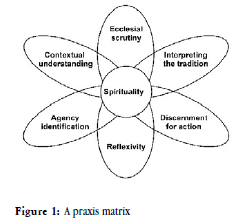
This design, which developed out of a "pastoral circle" or "praxis cycle", can be used both to mobilise a community for a specific mission and to analyse another community's mission17. I prefer to call it a praxis matrix rather than a cycle, since there is no implicit sequence among the seven dimensions, as there is in a praxis circle. These seven dimensions represent a dynamic, interacting grid or system of dimensions that influence each other all the time. Additionally, one of the meanings of the Latin word matrix is "womb", which aptly describes the purpose of this praxeology: to give birth to new forms of transformative praxis. The dynamic process through which the mission praxis of a community unfolds at a particular place and time - when the matrix is used as a mobilising instrument - is shaped by (at least) these seven factors in the diagram, which are posed here as questions facing that community:
• Agency: Who are we? How are we positioned (or inserted) in relation to this community? Who are our prime interlocutors?
• Contextual understanding: How do we view the prevailing economic, political, cultural, and social circumstances in which we hope to make a difference? How do we read the signs of the times?
• Ecclesial scrutiny: How do view the church(es) to which we belong? What image does the church and other religions have in this community? What have churches done in the past?
• Interpreting the tradition: How do we interpret the Bible and our theological tradition(s)? How do we understand the good news of God in this situation, faced by the challenges identified above? What is the source of authority that gives us direction and wisdom?
• Discernment for action: What attitudes, actions and projects should we plan and pursue, shaped cumulatively by the foregoing factors?
• Reflexivity: Are we learning from experience? Do we need to change direction and adopt new approaches?
• Spirituality: How do we experience God's compelling presence and guidance? How do we seek God's will? How does the Holy Spirit motivate, guide and sustain our activities?
When a Christian community plans an engagement in some element of God's mission, they need to ask themselves at least these seven questions to develop a rounded-and-grounded praxis. The placing of spirituality at the heart of the matrix indicates that praxis is not autonomous human activism but actions planned and carried out coram Deo, believers seeking God's will as they participate in (some element of) God's mission. Since there are different forms of spirituality and theology, however, the praxes of different faith communities will not only differ in the way they prioritise among the five "mission as" elements, but also in the way they respond to these seven "mission through" questions, due to the shaping effect of culture, gender, race and class on their praxis. As mentioned before, there is also a possibility of taking "short cuts", by downplaying or even ignoring some of the seven dimensions, which weakens the roundedness and groundedness of the praxis (see 1.2 above).
Bevans (2009:79-87) points out that praxis is a technical term that "has its roots in Marxism, the Frankfurt school [...] and in the educational philosophy of Paulo Freire" and that it is closely connected to liberation theology. Consequently, praxis is not primarily about "faith seeking understanding", but about "faith seeking intelligent action" (Bevans:73), in which committed action is often conceived as "the first step" of theology (Bevans:76). As a result, his praxis model focuses on liberating and justice-seeking forms of contextual theology, even though he acknowledges that it has a wider reach than liberation theology, which is evident (among others) from the theologians he cites as examples of his praxis model (Bevans:79-87).
By using the term praxis to characterise the inner workings of all five the mission elements in my framework, not only of Mission as liberation, my approach differs in its emphasis from that of Bevans. In the first place I am not distinguishing models of contextual theology, but elements of mission. Not every approach to contextual theology has a mission intention, but every form of mission is inherently contextual, communal and intentionally transformative in nature -and it is in that sense a form of praxis - even though the intended transformation, the understanding of the context, the interpretation of Scripture and the nature of the methods employed may differ widely among mission practitioners.
There are three main reasons why I regard it as fruitful to use praxis for all the elements of mission that I have identified. Firstly, to help all mission practitioners - in whatever element of mission they are engaging - and who are not shaped by liberation theology: a) to realise that the seven dimensions of the matrix are in fact present in their praxis, b) to become creatively aware of how each of the seven dimensions plays a role in shaping their performance of the gospel, and c) to start using the matrix to enhance their praxis, as they continue with their work.
Secondly, to enable better interaction between different mission practitioners. If conversation partners are aware of how all seven the dimensions of the matrix shape the "roundedness and groundedness" of their own praxis, and if they learn the skill to see how those dimensions also shape the roundedness and groundedness of the praxis of others, there is a greater chance of mutual understanding and fruitful conversation between them. It could help them avoid fruitless debates on issues of doctrine or context, for example, which occur in isolation from the other dimensions of the matrix that also play a role in the lack of understanding or cooperation between them. If the whole rounded-and-grounded praxis of each participant in a conversation is consciously brought into view, more appreciative and fruitful dialogues could result.
Thirdly, it could generate better missiological research if the matrix is used as an exploratory instrument (or lens) to examine the praxis of another community-in-mission. It will result in "thicker" descriptions of the mission praxes that are being researched, if all seven the dimensions are investigated and the dynamic relationships between them come into view.
2.4 Mission with ... (Mission encounterology)
The next aspect of a well-rounded missiological framework flows from the realisation that no mission praxis takes place in a vacuum or moves into empty space. To imagine that is to succumb to a dangerous illusion or a triumphalist temptation. Mission is always about encounters between Christians and others - sometimes other Christians - and aimed at (some form of) transformation towards liberation, the Reign of God and life-in-fulness. But if one studies only the Christian side of an encounter, it makes the "others" (at best) into passive receivers or (at worst) into "targets". Christians do not "write on blank slates;" they encounter communities with their own faith, culture, history and tradition - often with their own forms of mission. For this reason, I have suggested that missiology should develop an aspect of "encounterology"18 (Kritzinger 2008), which is critical reflection on the dynamics of encounters between forms of Christian praxis and other forms of praxis.
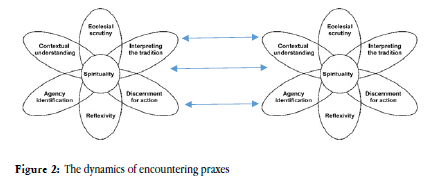
The types of interaction that take place in meaningful encounters are highly complex, since all seven praxis dimensions (on both sides) are involved, but also since power relations between the two praxes and the broader political, economic environment in which the encounter takes place plays a critical role. A chance interaction has little effect but an impactful encounter transforms both partners, not necessarily for the better. They could emerge from the encounter more estranged than before, but they could also be drawn closer together.
Some typologies have been developed to describe the nature of such encounters: Lochhead (1988) suggested five "ideologies" of encounter: hostility, isolation, competition, partnership and dialogue, while Overdiep (1985) has developed a scale of "emotional distance", consisting of "enemies, opponents, strangers, colleagues and friends". The interpersonal approach of "transactional analysis" (Berne 1986 [1964]) could also be used as a model of communal interaction. That would produce a set of interactions such as Parent-Child, Child-Parent or Adult-Adult, thus revealing some of the power differentials in an encounter. In a recent paper (Kritzinger 2022), I used these sources to develop a nine-fold typology of encounters, arranged from most negative to most positive:
Indifference (to strangers)
Hostility (against enemies)
Competition (against opponents)
Condescension (for disadvantaged inferiors)
Relief (for suffering fellow human beings)
Collaboration (with colleagues)
Reconciliation (with previously estranged brothers and sisters)
Partnership (with fellow workers for a new society)
Vulnerable dialogue (with fellow believers before the face of God)19
An important resource to deepen this reflection is Incarnational mission by Samuel Wells (2018), in which he develops a challenging encounterology of "being with", aimed at overcoming the stranglehold of "working for" in Christian mission. He identifies eight dimensions of being with: presence, attention, mystery, delight, participation, partnership, enjoyment and glory. He shows how these ways of being with are rooted in the life of the Trinity and how they could function in different real life encounters.
Encounters that cross borders, break barriers and overcome obstacles in the name of Jesus - to create and discover community and belonging, justice and peace, healing and reconciliation - are what mission praxis, in all its various forms, is all about. Every self-enclosed, comfortable and isolated praxis is a denial, perhaps even a betrayal, of the Jesus movement:
No Christian practice done inside segregationist ways of living and thinking will draw us into our true strength in God. This was the fundamental flaw born of colonial Christian practice, a vision of Christian life comfortably separated along lines of gender, race, land ownership and land dispossession, national affiliation, neo-tribal designation, and money (Jennings 2018:5).
The apostle Paul prayed that believers may begin to fathom the height, depth and length of God's love "together with all the saints" (Eph. 3:14-20; cf. Kritzinger 2002:159f). Mission is the journey to find and embrace those other saints, without whom we will always have a small, limited Lord, who merely blesses our narrow-minded racial, tribal or class projects. Jesus himself gradually discovered God's will as it unfolded before him in the course of his ministry, and it was through transformative encounters with the faith praxis of the centurion (Mt 8:5-13), the Canaanite woman (Mt 15:21-28), Moses and Elijah (Mt 17:1-13) and his Father in Gethsemane (Mt 26:36-46) that he gradually discerned that God's mission through him was not just for the "fallen hut of Israel" but for all the nations. In the same way, the early church gradually discovered the full extent of the gospel was through encountering ever new people and challenges: Ananias through encountering Saul (the enemy) in Acts 9:10-19, Peter through his encounter with Cornelius (the unclean gentile) in Acts 10-11; Paul through multiple encounters across Asia Minor, and so on (cf. von Allmen 1975). They were agents of transformation as they were being transformed, as the title Transforming Mission (Bosch 1991) expresses so admirably.
Does this mean that the gospel is changing all the time? Is there an "unchanging essence" - a "supracultural kernel" - to the Christian gospel, which remains the same but only gets a new "husk" when boundaries are crossed - a new dress to wear, or new soil in which the unchanging seed of the gospel can take root? I believe we need more dynamic metaphors than these to describe what happens in transformative encounters. I agree with Schreiter (1985:8) that we should think of an "onion", rather than of a "kernel-and-husk" metaphor: An onion has no kernel or core; similarly, every mission praxis is thoroughly cultural, from the outside and all the way in. The gospel is always embodied and performed, and mission is always contextual, communal and transformative, which means that it should be viewed as praxis - with its seven-dimensions. It is inevitably expressed in a specific language and worldview, as a particular "form of life". In order to make any kind of transformative impact, the fire of the gospel needs to "jump across" barriers of language, culture, gender, race, politics or economics, depending on the specific mission element (or combination of elements) involved (see 2.2 above).
The image of a spreading fire can be misunderstood as destructive, and Christian mission did often have a negative impact in history when it allied itself with oppressive and exploitative forms of power.20 But the gospel is not inherently destructive or alienating. In fact, it is a message of life, love and justice. When mission praxis succeeds in having a transformative impact towards life-in-fulness, musical metaphors are most appropriate to express both the integrity (continuity) and translatability of the Jesus movement, its ability to travel and create community. When that happens, it means that the gospel melody - played with specific instruments by performers shaped by a particular culture - has attracted members of another community to start "jamming" with them, using their own "instruments." Once the praxis of a community starts resonating with the melody of an arriving (embodied) praxis, that melody gets improvised or remixed in surprising ways.21 The assumption inherent to these musical metaphors is that the gospel is always performed, in other words, always embodied as (seven-dimensional) praxis (Hauerwas 2004:75-109).
Thus far a key feature of all mission encounters has been left out: How can such encounters be called participation in God's mission if encounter with God is not an integral part of the design? Does the placing of spirituality at the centre of each interacting (human) praxis matrix give adequate recognition to God's active presence in an encounter? An encounterology that focuses only on the interaction between human praxes runs the risk of being a typically modernist, activist approach of "we must change the world." In such an approach we could fail to reckon with God's active presence, even while confessing it with our lips. Whether we express this as evangelising the lost, building the church, liberating the oppressed, reconciling enemies or saving the planet, if we focus only on the encounter between human praxes, it could represent a form of self-sufficient activism.
Since my model affirms that God is at work in and through our praxes, and that we are participating in God's mission as co-workers, it should explicitly acknowledge that God too "has a praxis". To make God's praxis part of the model means to use the seven dimensions of the matrix as a set of criteria to discern where and how God is at work, in relation to our encountering praxes. If God's praxis is included in the model, the first implication is that the full picture of transformative mission encounters becomes tripolar:
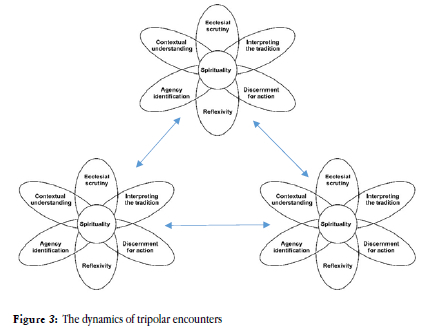
Every mission encounter should be therefore be explored as a three-way encounter between the praxis of God, the praxis of a gospel-shaped Christian community, and the praxis of a community in relation to whom (and among whom) they are working for transformation towards life-in-fulness.
A second implication is that spirituality, as human experience of God, is not to be identified with God's presence or activity. We must affirm God's transcendence, upholding an ontological distinction between Creator and creation, along with an eschatological proviso that we humans do not "build" the reign of God in history but receive it as God's gift. At the same time, we must affirm God's immanence in creation, that God as Holy Spirit accomplishes God's own work in nature and history, but also through the agency of believers, who pray and work for life-in-fulness and the coming of God's liberating reign. God's active presence cannot be adequately accounted for by merely placing spirituality at the heart of a praxis matrix. In fact, such a placing of spirituality emphasises precisely that mission praxis is not self-sufficient or self-propelled, but dependent on, and open to, God's presence and ongoing initiative. God's praxis and our human praxes remain distinct, while being intimately connected and interacting continuously, as indicated in 2.1 with reference to 1 Corinthians 3:9.
Another implication is to affirm the primacy of God's praxis in this three-way interaction. The foundational encounter in mission praxis is with God.22 God is "in control of the mission" through the initiating, guiding and empowering work of the Holy Spirit (Bosch 1991:114). God is actively at work in history by calling and mobilising human co-workers. Mission spirituality, at the heart of the matrix, is shaped by the "call narratives" in Scripture that describe defining encounters with God that have set in motion the participation of believers in God's mission.23This mobilising encounter with God is not limited to prophets and apostles; the whole faith community is called to be servants and witnesses, and to be accountable to God for what they do in God's name.24 The divine primacy is also evident in the two other aspects of the foundational encounter with God that were identified by Bosch (1991:114), namely the guiding and equipping work of the Holy Spirit. Likewise, Kim (2012:256) stresses that mission spirituality is about "the experience of God that initiates, the reading of Scripture that guides, and the prayer life that sustains ... movement in mission".
A mission spirituality that affirms both God's primacy and human participation requires a pneumatology that holds together the Spirit's freedom to "blow where it chooses" (Jn. 3:8) - beyond all human calculation and expectation - and the Spirit's indwelling in the hearts of believers to sanctify and mobilise them for courageous witness (Acts 1:8), loving service John 13:12-17; 34-35), liberating compassion (Lk. 4:16-20), life in fulness John 10:10) and persistent hope (Rom. 8:18-27). The Dutch theologian A.A. van Ruler coined the phrase "theonomous reciprocity" to describe the "secret" of the divine-human collaboration in a Christian pneumatology: it affirms the fully human agency of believers, who learn to will God's will and do God's work, while stressing that God always retains the initiative.25 In other words, believers do God's work "theonomously", not autonomously. My tripolar model extends this God-normed reciprocity between believers and God to the encounters among believers (and with others). By recognising the diversity among believers and the specific contexts in which they are situated, such a pneumatology opens up space for all five elements of God's mission - and any others that may be identified - to come into full view.
Conceiving mission encounters as tripolar has another implication. Since God's Spirit is at work outside the church, in the praxes of all human communities, Christians need to reckon with the fact that God has long been present in the lives of the people they meet and to carefully discern the evidence of those responses to God's presence. A mature mission spirituality, characterised by sensitivity to God's preceding and ongoing encounter with "others", produces both the humility and the boldness required to be instruments of God's mission.
This has another implication: In our encounter with God in every mission praxis, we not only have God "behind" us, as our motivating and sustaining energy, the "wind beneath our wings." There is an element of truth in this notion, but when affirmed in isolation from other modes of encountering God, it can easily lead to triumphalist and colonialising mission. We also have God beside us, to lift us up when we falter. We have God before us, to go ahead and guide us. But we also have God before us, confronting us with probing and inescapable questions, such as: Adam, what have you done? Cain, where is your brother? Who do you say that I am? Simon, son of Jonah, do you love me? Is Christ divided? Peter, quo vadis?
On the question whether it is helpful to apply the matrix to God's praxis, I should stress that it is not intended to limit God or submit God to human criteria. In other words, the seven dimensions of the matrix can only be applied mutatis mutandis to God's praxis. However, when used with respect, it is not unlike the Orthodox practice of "writing" an icon: producing a representation that, in some respect and with all humility, expresses the creating, blessing and liberating praxis of God as it has been revealed in Scripture.
That leads directly to another implication of a tripolar encounterology, namely a new approach to mission hermeneutics. Believers do not have direct, unmediated access to God's revelation, but only to the message of (and about) God, as mediated by the witnesses whose words are recorded in Scripture. Scripture contains the communicative praxis of God, mediated through the people of God, expressing compassion (Lk. 4:16-20), life in fulness John 10:10) and persistent hope (Rom. 8:18-27). The Dutch theologian A.A. van Ruler coined the phrase "theonomous reciprocity" to describe the "secret" of the divine-human collaboration in a Christian pneumatology: it affirms the fully human agency of believers, who learn to will God's will and do God's work, while stressing that God always retains the initiative.25 In other words, believers do God's work "theonomously", not autonomously. My tripolar model extends this God-normed reciprocity between believers and God to the encounters among believers (and with others). By recognising the diversity among believers and the specific contexts in which they are situated, such a pneumatology opens up space for all five elements of God's mission - and any others that may be identified - to come into full view.
xThe art of mission hermeneutics amounts to a search for resonance between the persuasive praxis of a Christian community today and the persuasive praxis of a specific biblical author (and of their community).26 Mission spirituality is the experience of hearing the living God speak through the persuasive praxes of the poets, story-tellers, lawmakers, sages, evangelists and apostles who crafted the books of Scripture. It is the Holy Spirit who creates resonance between believers today and those persuasive biblical praxes, thereby nurturing a deeper resonance between them and the praxis of the triune God. God's living word is heard through the biblical documents, transforming those who hear it into participants in God's ongoing mission. This is not the place to deal in detail with all the complications inherent in biblical hermeneutics, such as relationship between the Old and New Testaments, the "texts of terror" used to normalise the oppression and exploitation of women, slaves and black people, or Old Testament prophecies used to support Israeli nationalism and an apartheid state that has been practising brutal forced removal and ethnic cleansing of Palestinians since 1947. It has to be admitted, though, that the Bible contains violent and exclusivist passages that have done harm and have alienated people from the grace of God.
In response to all these hermeneutical challenges, the use of the praxis matrix to discern God's mission praxis will give special attention to creation, incarnation and recreation as the metanarrative that frames God's healing, saving, liberating praxis revealed in/as the praxis of Jesus. If we search the Gospels to explore the mission praxis of Jesus of Nazareth by means of the seven dimensions of the matrix, it could produce a "praxial"27 Christology that opens new insights into how the praxis of God encounters our human praxes. It will proceed from the starting point that the praxis of Jesus, the Spirit-anointed Messiah, resonated with that of the Father, and that his life, death and resurrection gave birth to an ongoing Spirit-anointed movement of believers whose praxes resonate in some significant way with the praxis of God - and thereby manage to draw others into that liberating and life-giving divine melody, in spite of their imperfect performance of it.
2.5 Mission in ... (Mission axiology)
The "Mission in ..." (or axiology) aspect of a missiological framework represents the ethos of mission praxis, in other words, the quality of Christian engagement with others. An axiology is the set of intrinsic values, dispositions and aspirations that characterise a community or movement. When we as Unisa colleagues chose titles for the two festschrifts dedicated to David Bosch, the phrases "Mission in creative tension"28 and "Mission in bold humility"29 immediately came to mind. Bevans and Schroeder (2004; 2011) developed the notion of "Mission as prophetic dialogue", but I have argued (Kritzinger 2008) that "prophetic dialogue" in their approach does not function as a major element of mission. It is a statement in a different category, different from the six key elements that they identified (Witness and proclamation; liturgy, prayer and contemplation; justice, peace and the integrity of creation; dialogue with women and men of other faiths and ideologies; inculturation; reconciliation) or the "big five" mission elements I have identified in 2.2. Instead, it expresses the ethos of their approach to mission. To my mind, both "Mission in bold humility" (Bosch) and "Mission in prophetic dialogue" (Bevans and Schroeder) are clear expressions of a mission axiology.
In the light of all this, I believe that one place where the notion of vulnerability fits into a missiological framework, is here, as a characterisation of the ethos of a mission praxis. Vulnerability, like prophetic dialogue and bold humility, does not belong among the five elements of mission (2.2), nor does it fit in with the seven dimensions of the praxis matrix (2.3). Instead, one way to deal missiologically with vulnerability is to frame it as "Mission in vulnerability", in other words, as a characterisation of the ethos of a mission praxis, an idea that I have developed in another paper (Kritzinger 2025).
3. CONCLUSION
Since this paper is based on the first (methodological) part of my address to the 2024 IAMS Africa conference, it does not contain direct information on the nature and commitments of my own scholarly praxis. I did not clarify where I am writing from or what my personal missiological commitments are. I have done that in other publications and specifically in the paper based on the second half of my address at IAMS Africa (Kritzinger 2025).
Finally, it may seem an exercise in semantic hair-splitting to make such an issue of the seemingly tiny difference between missiological statements that contain "as" and "in". Much does ride on the careful use of prepositions, as is clear from the criticism of Flett (2021) against the "Mission as" approach as such. This paper was written in response to that criticism, to contribute to the debate on the nature of missiology as a scholarly discipline.
References
Barrett, C.K., 1968, A commentary on the first epistle to the Corinthians, Adam & Charles Black, London. [ Links ]
Berne, Eric, 2016 [1964], Games people play: The psychology of human relationships, Penguin Life, London. [ Links ]
Bevans, Stephen, 2009, Models in contextual theology, Second and expanded edition, Orbis Press, Maryknoll. [ Links ]
Bevans, Stephen, & Schroeder, Roger, 2004, Constants in context: A theology of mission for today, Orbis Press, Maryknoll. [ Links ]
Bevans, Stephen & Schroeder, Roger, 2011, Prophetic dialogue: Reflections on mission today, Orbis Press, Maryknoll. [ Links ]
Bosch, David J., 1991, Transforming mission: Paradigm shifts in theology of mission, Orbis press, Maryknoll. https://doi.org/10.1177/009182969101900203 [ Links ]
Bruner, Frederick Dale, 2012, The Gospel of John: A commentary, Eerdmans, Grand Rapids. https://doi.org/10.5040/bci-0k34 [ Links ]
Church of Scotland, 2020, https://www.churchoiscotland.oig.uk/data/assets/pdf_file/0008/69749/Church-of-Scotland-Theological-Forum-Five-Marks-of-Mission.pdf. [ Links ]
Ciampa, Roy E. & Rosner, Brian S., 2010, The first letter to the Corinthians, Eerdmans, Grand Rapids. https://doi.org/10.5040/bci-000h [ Links ]
Collins, Raymond F., 1999, First Corinthians, Sacra Pagina Series Volume 7, The Liturgical Press, Collegeville. [ Links ]
Conzelmann, Hans, 1969, Der erste Brief an die Korinther, Vandenhoeck & Ruprecht, Göttingen. [ Links ]
Daneel, M.L., 1998, African earthkeepers, Volume 1, Unisa Press, Pretoria. [ Links ]
Dorr, Donal, 2000, Mission in today's world, Columba Press, Dublin. [ Links ]
Fascher, Erich, 1975, Der erste Brief des Paulus an die Korinther. Erster Teil, Einführung und Auslegung der Kapitel 1-7, Evangelische Verlagsanstalt, Berlin. [ Links ]
Fitzmyer, Joseph A., SJ , 2008, First Corinthians: A new translation with introduction and commentary, The Anchor Yale Bible, Yale University Press, New Haven. [ Links ]
Flett, John, 2021, '(Any) New Approaches in The Theology of Mission?', Verkündigung und Forschung 66, 104-19. https://doi.org/10.14315/vf-2021-660205 [ Links ]
Gadamer, Hans-Georg, 1975, Truth and method, Translated by William Glen-Doepel, Sheed and Ward, London. [ Links ]
Groenewald, E.P., 1967, Die eerste brief aan die Korinthiërs, Kaapstad: N.G. Kerk-uitgewers. [ Links ] Hauerwas, Stanley, 2004, Performing the faith: Bonhoeffer and the practice of non-violence, SPCK, London. [ Links ]
Hiebert, Paul G., 1999, Missiological implications of epistemological shifts: Affirming truth in a modern/postmodern world, Trinity Press International, Harrisburg, PA. [ Links ]
Jennings, Willie James, 2018, Foreword, in Kim, Grace Ji-Sun & Hill, Graham, Healing our broken humanity: Practices for revitalizing the church and renewing the world, pp. 1-6, InterVarsity Press, Downers Grove, [ Links ]
Kim, Kirsteen, 2012, Joining in with the Spirit: Connecting World Church and Local Mission, SCM Press, London. [ Links ]
King, Fergus, 2014, 'More than a vapid sound: The case for a hermeneutic of resonance', Journal of Theology for Southern Africa, No. 148, 83-98. [ Links ]
Koyama, Kosuke, 1974, Waterbuffalo theology, SCM Press, London. [ Links ]
Kritzinger, J.N.J., 2002, A question of mission - a mission of questions', Missionalia 30(1), 144-173. [ Links ]
Kritzinger, J.N.J., 2008, 'Faith to faith: Missiology as encounterology', Verbum et Ecclesia 29(3), 764-790. https://doi.org/10.4102/ve.v29i3.31 [ Links ]
Kritzinger, J.N.J., 2011, '"Mission as..." Must we choose?' Missionalia 39(1/2), 32-59. [ Links ]
Kritzinger, J.N.J., 2017, 'Mission IN prophetic dialogue. Exploring the ethos of mission encounters in Africa', Acta Missiologiae 6, 81-99. [ Links ]
Kritzinger, J.N.J., 2022, 'White responses to Black Theology: Revisiting a typology', HTS Teologiese Studies/Theological Studies, 78(3), 1-9 https://doi.org/10.4102/hts.v78i3.6945 [ Links ]
Kritzinger, J.N.J., 2025, 'Mission in vulnerability', HTS Teologiese Studies/ Theological Studies 81(1), a10679. https://doi.org/10.4102/hts.v81i1.10679 [ Links ]
Kritzinger, J.N.J. & Saayman, W.A. (eds), 1990, Mission in Creative Tension: A dialogue with David Bosch, Southern African Missiological Society, Menlo Park, South Africa. [ Links ]
Kritzinger, J.N.J. & Saayman, W.A. (eds), 1996, Mission in bold humility: David Bosch's work considered, Orbis Press, Maryknoll. [ Links ]
Kritzinger, J.N.J. & Saayman, W.A., 2011, David Bosch: Prophetic integrity, cruciform praxis, Cluster Publications, Pietermaritzburg. [ Links ]
Kumalo, Simangaliso, 2013, 'The Bible in and through Mission and Mission in the Bible: Doing Mission through Contextual Bible Study in Postcolonial Africa', in Emma Wild-Wood & Peniel Rajkumar (eds.), Foundations for mission, pp. 96-110, Regnum Edinburgh Centenary Series, Volume 13, Regnum Books International, Oxford. https://doi.org/10.2307/j.ctv1ddcr57.10 [ Links ]
Lochhead, David, 1988, The dialogical imperative, Orbis Press, Maryknoll. [ Links ]
Mashau, T.D. & Kritzinger, J.N.J. (eds.), 2014, Pavement encounters for Justice: Doing transformative missiology with homeless people in the city of Tshwane, ACADSA, Pretoria. [ Links ]
Neill, Stephen, 1959, Creative tension, Edinburgh House Press, Edinburgh. [ Links ]
Overdiep, Wim, 1985, Het gevecht om de vijand: Bijbels omgaan met een onwelkome onbekende, Ten Have, Baarn. [ Links ]
Pop, F.J., 1971, De eerste brief van Paulus aan de Corinthiërs, G.F. Callenbach, Nijkerk. [ Links ]
Richards, Anne, 2017, The five marks of mission, https://www.churchofengland.org/sites/default/files/2017-11/MTAG%20The%205%20Marks%20Of%20Mission.pdf, 2017 (accessed on 20 May 2023) [ Links ]
Schrag, Calvin O., 1994, 'Transversal rationality', in T.J. Stapleton (ed.), The question of hermeneutics, pp. 61-78, Kluwer Academic, Dordrecht, Boston. https://doi.org/10.1007/978-94-011-1160-7_4 [ Links ]
Schreiter, Robert J., 1985, Constructing local theologies, Orbis Press, Maryknoll. [ Links ]
Schreiter, Robert J., 2013, 'The Emergence of Reconciliation as a Paradigm of Mission: Dimensions, Levels and Characteristics', in R.J. Schreiter & K J0rgensen (eds.), Mission as ministry of reconciliation, pp. 9-29, Regnum Books International, Oxford. https://doi.org/10.2307/j.ctv1ddcpgx.5 [ Links ]
Thiselton, Anthony C., 2000, The first epistle to the Corinthians: A commentary on the Greek text, The New International Greek Testament Commentary, Eerdmans, Grand Rapids. [ Links ]
Van Huysteen, J. Wentzel, 1999, The shaping of rationality: Toward interdisciplinarity in theology and science, Eerdmans, Grand Rapids. [ Links ]
Van Ruler, A.A., 1969, 'Structuurverschillen tusssen het christologische en het pneumatologische gezichtspunt', Verzameld Werk, Deel 4, G.F. Callenbach, Nijkerk. [ Links ]
Von Allmen, Daniel, 1975, 'The birth of theology: Contextualization as the dynamic element in the formation of New Testament theology', International Review of Mission 64, 37-55. https://doi.org/10.1111/j.1758-6631.1975.tb01155.x [ Links ]
Walsh, Brian J. & Keesmaat, Sylvia C., 2004, Colossians remixed: Subverting the empire, IVP Academic, Downers Grove, IL. [ Links ]
Wells, Samuel, 2004, Improvisation: The drama of Christian ethics, SPCK, London. [ Links ]
Wells, Samuel, 2018, Incarnational mission: Being with the world, Canterbury Press, Norwich. [ Links ]
Wendland, Heinz-Dietrich, 1972, Die Briefe an die Korinther, Vandenhoeck & Ruprecht, Göttingen. [ Links ]
Wickeri, Philip L., 2011, 'The end of Missio Dei - Secularization, religions and the theology of mission', in Volker Küster (ed.), Mission revisited: Between mission history and intercultural theology, pp. 27-43, LIT Verlag, Münster. [ Links ]
Witherington, Ben, 1995, Conflict and community in Corinth: A socio-rhetorical commentary on 1 and 2 Corinthians, Eerdmans, Grand Rapids. [ Links ]
Wright, N.T., 1992, The New Testament and the People of God, Fortress Press, Minneapolis. [ Links ]
1 The second half of the keynote address has likewise been revised. It has been submitted separately for publication, with the title "Mission in vulnerability" (Kritzinger 2025).
2 A group of colleagues at Unisa published their research on interaction with homeless people under the title Pavement encounters for justice (Mashau & Kritzinger 2014). They opted for pavement, instead of the traditional grassroots, to express the concrete inner-city reality of the encounters.
3 For some reflection on "shortcuts" in mission praxis, see Kritzinger (2002:150-152) and 2.3 below.
4 This missiological framework draws on a number of earlier publications, particularly Kritzinger (2002; 2008; 2011; 2017), but it has been expanded and refined for this paper in a number of significant ways.
5 Wright (1992:32-46) and Hiebert (1999:68-116) provide helpful explanations of a critical realist approach to theology. Hiebert (1999:69) summarises: "Ontologically it is a form of realism, for it assumes a real world that exists independently from human perceptions or opinions of it. It is critical, for it examines the processes by which humans acquire knowledge and finds that this knowledge does not have a one-to-one correspondence to reality".
6 There are two ways of interpreting the genitive construction in the phrase "God's co-workers" (èåïß) óõíåñãïß) in 1 Cor 3:9: a) "We work with God" (Pop 1971:73; Wendland 1972:33; Fitzmyer 2008:195-6); and b) "We work with one another in the service of God" (Barrett 1968:86; Fascher 1975:133; Collins 1999:146-7; Thiselton 2000:306). In the
context of 1 Cor. 3 the emphasis seems to be on the second option, but in the larger New Testament context this is a false alternative: We are to collaborate as colleagues in ministry (belonging to and accountable to God) but also as co-workers with God (cf. Groenewald 1967:50; Conzelmann 1969:93; Witherington 1995:133), since the term óõíåñãïß is also used in the first sense by the apostle Paul in 2 Cor. 6:1. The NIV translation "We are God's co-workers" is discredited by Ciampa & Rosner (2010:149) as ambiguous but I view it positively as integrating the two interpretations.
7 Philip Wickeri's (2011) critique of missio Dei as an abstract, elitist concept, the "last grand narrative of the missionary movement" (:41), but his critique does not apply to a missio Dei ontology that is embedded in a praxis framework, like the one proposed here.
8 The five "marks" are: a) To proclaim the Good News of the Kingdom; b) To teach, baptise and nurture new believers; c) To respond to human need by loving service; d) To seek to transform unjust structures of society, to challenge violence of every kind and to pursue peace and reconciliation; e) To strive to safeguard the integrity of creation and sustain and renew the life of the earth (Richards 2017; Church of Scotland 2020).
9 These six elements are: 1) Witness and proclamation; 2) liturgy, prayer and contemplation; 3) justice, peace and the integrity of creation; 4) dialogue with women and men of other faiths and ideologies; 5) inculturation; and 6) reconciliation (Bevans and Schroeder 2004:64ff).
10 Dorr (2000:76-183) selects: Mission as a) evangelization; b) inculturation; c) struggle for liberation; d) reconciliation; e) option for the poor; f) power from the Spirit.
11 I have taken this term from my late Unisa colleague, Marthinus (Inus) Daneel (1998).
12 I am not suggesting that my selection of five mission elements is exhaustive of Christian mission, but the proposals that I have surveyed show that there is some measure of an ecumenical consensus in this regard.
13 The wisdom of choosing "creative tension" over "careful balance" comes from David Bosch. He used the former term repeatedly in Transforming Mission (Bosch 1991). He used it repeatedly in missiology lectures at Unisa and in academic conversations. In many ways it describes the underlying ethos of his whole personal life and public ministry (see Kritzinger & Saayman 2011).
14 This understanding of truth does not amount to cultural or theological relativism. It expresses a critical realist and dynamic understanding of truth as relational, based on encountering the living Christ, who said: "Iam the way, the truth and the life" (John 14:6) and the life-giving Spirit of truth who leads believers "into all the truth" (John 16:13). See also the discussion in 2.4 below.
15 Hauerwas (2004) and Wells (2004) have made significant contributions to an understanding of the gospel as intrinsically a performance.
16 For this understanding of praxis, see Kritzinger (2002:149-150).
17 The mobilising role corresponds with the first purpose of the framework and the analytical role with its second purpose (see 1.2).
18 I have modelled this term on "neighbourology" (Koyama 1974:89-94).
19 The progression of the prepositions from "against" to "for" and then to various types of "with" is significant, signalling the changing profiles in emotional distance, power differentials, ethical values and intended outcomes shaping each of these forms of encounter.
20 The metaphor of a spreading fire is not inherently unacceptable; it has been used to describe the worldwide growth of Pentecostalism, due to the connection with "tongues of fire" in Acts 2 but also its impressive growth rate. However, when Christianity started spreading in alliance with state power, since Emperor Constantine, and particularly with colonialism since the 15 century, it has (like an out-of-control veld fire) caused enormous damage to the credibility of the gospel, as was analysed by Bosch (1991:298-313) and many others.
21 Hauerwas (2004), Wells (2004) and Walsh & Keesmaat (2006) have used the metaphors of improvisation and remixing in missiologically relevant ways.
22 I acknowledge the role of colleagues, Professor Johannes Reimer and Dr Peter Watt, who told me over the years that they missed the encounter with God in my praxis approach. At the time I thought that it was adequately expressed by placing spirituality at the centre of a praxis cycle (or matrix), but I have now found a way to express it that is more attuned to the missio Dei.
23 The most prominent call narratives tell of the life-changing encounters between God and leaders such as Abraham (Gen. 12:1-3), Moses (Ex. 3:1-22), Isaiah (Is. 6:1-13), Jeremiah (Jer. 1:1-10), the disciples ofJesus (Mt. 4:17-22; Mk 1:16-20; Lk. 5:1-11) and Saul of Tarsus (Acts 9:1-19; 22:6-16; 26:12-18). These narratives are paradigmatic in shaping mission spirituality.
24 The calling of a whole Christian community to "radiate" the gospel is found in passages such as Mt 5:14-16, John 13:34-35, Phil 2:12-16 and 1 Peter 2:9-10. This reality is expressed by the notion of the "priesthood of all believers."
25 The Dutch theologian A.A. van Ruler (1969) wrote an influential paper on the structural differences between God's action in Christ (incarnation, substitution, justification) and through the Holy Spirit (inhabitation, reciprocity, sanctification).
26 This is similar to the understanding of hermeneutics as a "fusion of horizons" (Gadamer 1975:273), but the focus here is less on individuals who interpret tradition and more on the dynamic fusion of the praxes of faith communities across time.
27 The term "praxial", as an adjective of the noun praxis, is used by Schrag (1994:69) and van Huyssteen (1999:136-140) and seems appropriate to describe a Christology based on the praxis matrix.
28 The first festschrift dedicated to David Bosch was entitled Mission in creative tension (Kritzinger & Saayman 1990).
29 The second festschrift, which appeared after his tragic death in 1992, was Mission in bold humility (Kritzinger & Saayman 1996).
