



Services on Demand
Journal

Article
 English (pdf)
 Article in xml format
 Article references
 Automatic translation
 Send this article by e-mail
Indicators
Related links
-
 Cited by Google
 -
 Similars in Google
Share

 Permalink
SAMJ: South African Medical Journal
On-line version ISSN 2078-5135Print version ISSN 0256-9574
SAMJ, S. Afr. med. j. vol.114 n.6b Pretoria Jun. 2024
https://doi.org/10.7196/SAMJ.2024.v114i6b.1399
RESEARCH
Trends and factors associated with adverse pregnancy outcomes in Zimbabwe, 2005 - 2015
T ChiburaI; H S TwabiII; K MalulekeIII; A MusekiwaIII
IMPH; School of Health Systems and Public Health, Faculty of Health Sciences, University of Pretoria, South Africa
IIPhD; Department of Mathematical Sciences, Faculty of Science, University of Malawi, Zomba, Malawi
IIIPhD; School of Health Systems and Public Health, Faculty of Health Sciences, University of Pretoria, South Africa
ABSTRACT
BACKGROUND. Adverse pregnancy outcomes, including abortions, miscarriages and stillbirths, are common in developing countries such as Zimbabwe.
OBJECTIVE. To determine the trends and factors associated with adverse pregnancy outcomes.
METHODS. This article is a secondary data analysis of three repeated cross-sectional Zimbabwe Demographic and Health Surveys to assess adverse pregnancy outcomes among women of reproductive age (15 - 49 years old) who fell pregnant during the study period. Bivariate and multivariable logistic regression models were applied to the 2015 dataset to determine factors associated with adverse pregnancy outcomes.
RESULTS. There was an overall increase in reported adverse pregnancy outcomes (stillbirths, miscarriages and abortions) from 2005 to 2015. The percentage of women who experienced adverse pregnancy outcomes among those who fell pregnant in the 5 years preceding each survey rose from 13.4% in 2005 to 13.8% in 2010, followed by a sharp increase to 16.3% in 2015. The multivariable model, belonging to the 35 - 49-year age group, was associated with almost a twofold increased odds of experiencing an adverse pregnancy outcome (adjusted odds ratio (aOR) 2.11, 95% confidence interval (CI) 1.35 - 3.31, p=0.001). Women currently married/in a union (aOR 4.69, 95% CI 2.64 - 8.34, p<0.001) or formerly married/in a union (aOR 3.56, 95% CI 1.89 - 6.69, p=0.001) had higher odds of experiencing an adverse pregnancy outcome. Not belonging to any religion or being a traditionalist or Muslim decreased the odds of experiencing an adverse pregnancy outcome (aOR 0.58, 95% CI 0.42 - 0.80, p=0.001). Women from Harare (aOR 1.56, 95% CI 1.05 - 2.32, p=0.027), Mashonaland West (aOR 1.59, 95% CI 1.08 - 2.36, p=0.027) and Mashonaland Central (aOR 1.76, 95% CI 1.15 - 2.69, p=0.009) provinces had higher odds of experiencing adverse pregnancy outcomes than those from Bulawayo Province. Women who gave birth for the first time at >25 years of age (aOR 3.08, 95% CI 2.27 - 4.16, p<0.001) had higher odds of experiencing adverse pregnancy outcomes. Women who delivered 2 - 4 children (aOR 0.75, 95% CI 0.59 - 0.95, p=0.018) or >5 children (aOR 0.51, 95% CI 0.36 - 0.72, p<0.001) were less likely to experience adverse pregnancy outcomes.
CONCLUSION. Trends showed an increase in the proportion of women experiencing adverse pregnancy outcomes in Zimbabwe from 2005 to 2015. Advanced maternal age, marriage, lack of religion and living in Harare, Mashonaland Central or Mashonaland West were associated with adverse pregnancy outcomes. There is a need to reduce these outcomes through integration of social issues into maternal health programmes, as well as ensuring accessibility and availability of comprehensive reproductive health services that target high-risk groups such as women aged 35 - 49 years.
Pregnancy or gestation is defined as a period in which an embryo or fetus develops within the body of a female.[1] In 2012, it was estimated that 213 million pregnancies occur globally each year, of which 25% in Africa.[2] Unfortunately, not all of these pregnancies result in live births ? a considerable number of pregnancies have adverse outcomes. Major adverse pregnancy outcomes include abortions, miscarriages, stillbirths, perinatal death, neonatal death and maternal death.[1,3,4] These adverse outcomes are a significant public health concern, with a considerable burden in both developed and developing countries.[5] Of an estimated 210 million pregnancies globally, ~73 million end in abortion or stillbirth.[6] According to World Bank reports, perinatal deaths accounted for roughly 7% of the global burden of disease, surpassing the burden due to malaria and vaccine-preventable diseases combined.[7] Maternal mortality remains one of the leading causes of death among women in the reproductive age group of 15 - 49 years. In 2017, ~295 000 maternal deaths were recorded globally.[8]
Adverse pregnancy outcomes are a topical health and development issue, attracting significant global and local investments. Ensuring healthy pregnancies and positive pregnancy outcomes is key to the achievement of Sustainable Development Goal 3 (SDG 3) targets 3.1 and 3.2, which aim to significantly reduce maternal and newborn mortality by 2030.[9,10] Identifying and addressing factors associated with adverse pregnancy outcomes are key in ensuring healthy lives aspired by all Africans, as planned and stated in the African Union (AU) 2063 agenda Aspiration 1, goals 1 and 3. Even though the SDG 3 targets exclude fetal deaths and stillbirths, the United Nations Inter-Agency Group for Child Mortality (UN-IAGCM) aims to ensure that every country is on track to meet the Every Newborn Action Plan (ENAP), targeting the reduction of stillbirths, and neonatal, child and maternal mortality from preventable causes.[11-13]
Zimbabwe is one of the African countries that is disproportionately affected by adverse pregnancy outcomes.[4,5,14] In response to the high burden of maternal and neonatal health, the Government of Zimbabwe, guided by the National Maternal and Neonatal Health Road Map 2000 - 2015, adopted the results-based financing programme, which was backed by the Health Development Fund from a pool of multiple international organisations. Its aim is to improve access to quality services for mothers and babies in Zimbabwe.[15] Despite these improvements, the country is still grappling with poor maternal health outcomes.[16,17] Of the estimated 530 000 babies born in Zimbabwe in 2015, ~12 800 died during the neonatal period 0 a neonatal mortality rate of 24 per 1 000 live births. In the same year, nearly 11 500 stillbirths occurred, and 2 800 women lost their lives due to pregnancy-related and delivery-related complications, resulting in a stillbirth rate of 21 per 1 000 births and a maternal mortality ratio of 443 per 100 000 live births.[18]
An article published in the Lancet on trends of stillbirths, revealed stagnancy in the annual global estimates of stillbirths despite huge efforts and investments that are being put into maternal and newborn health.[12] A study on trends and factors associated with adverse pregnancy outcomes (abortion and stillbirths) in Uganda found no consistent trends in abortion rates, but reported that stillbirth rates doubled during 1996 - 2013. Such findings are typical in an African setting due to the criminalisation and cultural connotations ascribed to abortion.[6] To our knowledge, there has not been a study on trends in adverse pregnancy outcomes in Zimbabwe and little is known of the trends of such outcomes at country level. Factors associated with adverse pregnancy outcomes have been studied and documented in the literature. Previous researchers found significant associations between certain sociodemographic, economic, cultural, environmental and maternal factors.[1,19] Study results varied, as the studies were context specific; these factors are known to be variably distributed across populations, even in the same geographical areas.[201 It is therefore imperative not to assume that trends and factors associated with adverse pregnancy outcomes observed in previous studies are similar to those that might be observed in Zimbabwe. Additionally, most of these studies are hospital based and performed in contexts of poor hospital service utilisation, and are also based on unreliable medical record data.[5,6] The current study employed a population-level approach, using the most recent multiple Demographic and Health Survey (DHS) data from 2005 to 2015, to determine the Zimbabwean context-specific trends and factors associated with adverse pregnancy outcomes.
Methods
Data source and study population
This study used three datasets from three Zimbabwe Demographic and Health Surveys (ZDHSs), i.e. for 2005/2006, 2010/2011 and 2015/2016. The ZDHS is a nationally representative population-based survey conducted by the Central Statistics Office (CSO) as part of the country's household surveys. The survey makes use of a stratified two-stage cluster sampling method and collects data on levels and trends of demographic and health indicators with the use of four standard questionnaires (household, men, women and biomarker), of which the data for this study were collected using the women questionnaire only. In the three rounds of the ZDHSs, 28 033 women aged 15 - 49 years were interviewed. The study population comprised all women aged 15 - 49 years who fell pregnant within the 5-year period preceding each of the three survey rounds (2005/2006, 2010/2011 and 2015/2016).
Outcome variable
The composite outcome in this study was an experience of either miscarriage/spontaneous abortion or stillbirth in the 5-year period preceding each survey, as self-reported by the reproductive-aged women respondents.
Predictor variables
The selection of the predictor variable was based on the Mosley and Chen analytical framework for studying child survival and also informed by a review of the literature.[21] The variables are grouped under three categories: (i) sociodemographic and economic factors such as age, educational level, employment status, marital status, religion, place of residence, region/province; (i) maternal factors such as age at first delivery (<19 years, 20 - 24 years, >25 years), total number of children born to the woman (0 - 1, 2 - 4, >5); and (iii) environmental factors such as type of drinking water source, grouped as improved (piped water, boreholes or tube wells, protected dug wells, protected springs, rainwater, and bottled or delivered (tanker) water) and unimproved (unprotected dug well, unprotected spring, river, dam, lake, pond, stream, canal and irrigation canal).
Data management and analysis
All three datasets were accessed via the DHS Program website (https:// dhsprogram.com/data/available-datasets.cfm) after permission was granted by the relevant programme authorities. Statistical analysis was conducted using Stata version 17 (StataCorp., USA), while adjusting analyses made use of sampling weights to account for stratification and clustering in the survey design (svyset command). Data analysis was restricted to 5 years preceding each survey. Descriptive statistics were performed on the data to elicit the distributions of both predictors and outcomes across the study population. Data from each survey were used to calculate each year's corresponding percentage of adverse pregnancy outcomes with 95% confidence intervals (CIs), and the results were plotted in a line graph to show the trends in adverse pregnancy outcomes from 2005 to 2015.
The multivariable logistic regression model was applied to determine factors associated with the outcome (any experience of adverse pregnancy outcomes of interest). Only the latest data from the 2015 ZDHS was used in determining the factors associated with adverse pregnancy outcomes. A bivariate analysis of each predictor variable against the outcome was done and only variables with p<0.25 were considered in the multivariable model. Only variables with p<0.05 in the final multivariable logistic regression model were considered as significantly associated with adverse pregnancy outcome.
Ethical considerations
Permission to use DHS statistical and geographical data was requested from the DHS Program website (https://dhsprogram.com/data/available-datasets.cfm). The data used in this study had no personal identifiers. Ethical clearance was sought from the Health Sciences Research Ethics Committee, University of Pretoria, South Africa (ref. no. 588/2021).
Results
Trends in adverse pregnancy outcomes
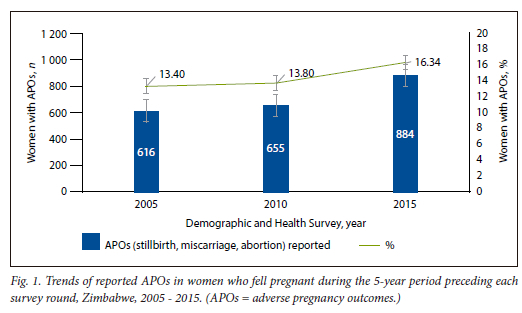
Overall, of the 14 848 women who fell pregnant during the 5 years preceding each survey, 2 155 reported experiencing >1 adverse pregnancy outcome 0 either an abortion, a miscarriage or a stillbirth. The results showed an overall increase in reported adverse pregnancy outcomes from 2005 to 2015. The percentage of women who fell pregnant in the 5 years preceding each survey and who experienced adverse pregnancy outcomes rose from 13.4% in 2005 to 13.8% in 2010, followed by a sharp increase to 16.3% in 2015 (Fig. 1).
Participant characteristics
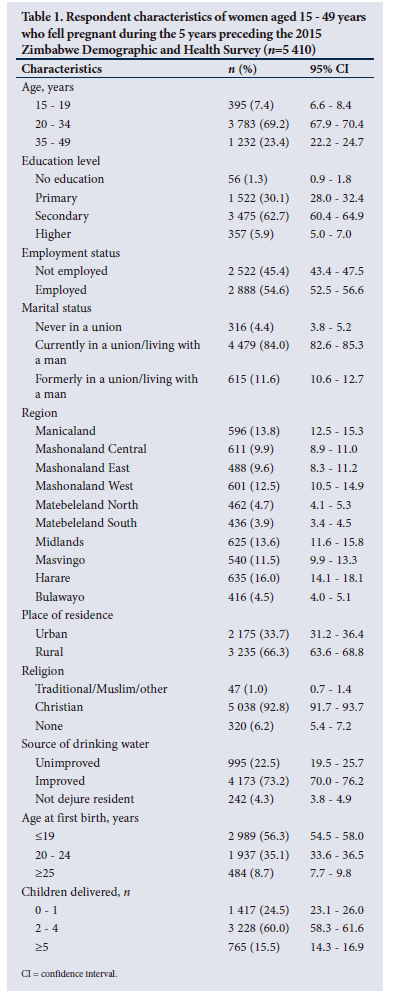
A total of 9 955 women aged 15 - 49 years participated in the 2015/2016 ZDHS. Only 5 410 fell pregnant in the 5-year period preceding the survey. Of the 5 410 who remained in the analysis group, the majority (69.2%) were in the 20 - 34-year age group. The analysis group mainly consisted of women from rural areas (66.3%). More than 85% of these women had either lived with a man or were currently living with a man, while only 4.4% reported that they had never been in a union. More than 90% of the women had a religion compared with those who had no religion (6.2%). More than half of the women had their first birth at 19 years of age and 60% of them had delivered 2 - 4 children (Table 1).
Factors associated with adverse pregnancy outcomes
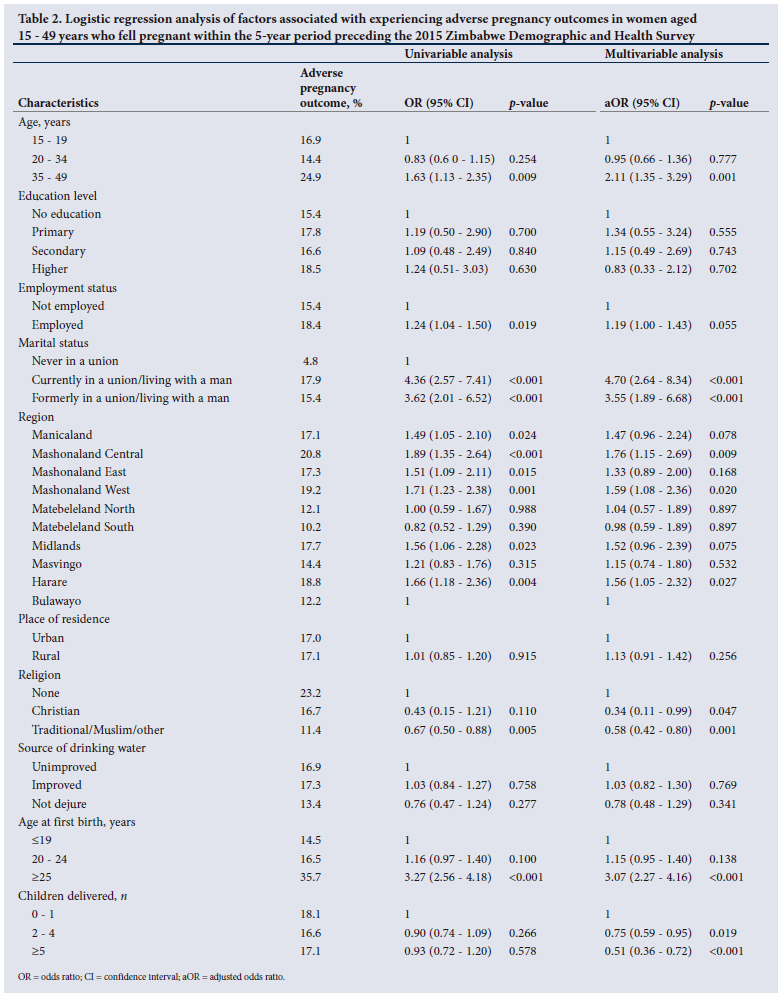
The multivariable model, belonging to the 35 - 49-year age group, was associated with almost a twofold increased odds of experiencing an adverse pregnancy outcome (adjusted odds ratio (aOR) 2.11, 95% CI 1.35 - 3.31, p=0.001). Marital status was also found to be associated with adverse pregnancy outcomes, with women currently living with a man (aOR 4.69, 95% CI 2.64 - 8.34, p<0.001) or formerly living with a man (aOR 3.56, 95% CI 1.89 - 6.69, p=0.001) having higher odds of experiencing an adverse pregnancy outcome. Not belonging to a religion or belonging to a traditional or Muslim religion decreased the odds of experiencing an adverse pregnancy outcome (aOR 0.58, 95% CI 0.42 - 0.80, p=0.001). The study also found an association between region and adverse pregnancy outcomes: women from Harare Province (aOR 1.56, 95% CI 1.05 - 2.32, p=0.027), Mashonaland West Province (aOR 1.59, 95% CI 1.08 -2.36, p=0.027) and Mashonaland Central Province (aOR 1.76, 95% CI 1.15 - 2.69, p=0.009) had higher odds of experiencing adverse pregnancy outcomes than those from Bulawayo Province. Women who first gave birth at >25 years of age had higher odds of adverse pregnancy outcomes (aOR 3.08, 95% CI 2.27 - 4.16, p<0.001). Women who delivered 2 - 4 children (aOR 0.75, 95% CI 0.59 - 0.95, p=0.018) or delivered >5 children (aOR 0.51, 95% CI 0.36 - 0.72, p<0.001) had lower odds of experiencing adverse pregnancy outcomes. The study found no statistically significant association between environmental factors such as type of cooking fuel and type of sanitation facility. Furthermore, no association was found between maternal factors, including age at first birth, total number of children born to a woman and smoking status, and any of the adverse pregnancy outcomes. Residing in a rural or urban setting was also not associated with experiencing adverse pregnancy outcomes (Tables 1 and 2).
Discussion
This study aimed to identify the trends and factors associated with adverse pregnancy outcomes among women aged 15 - 49 years in Zimbabwe from 2005 to 2015. Overall, an increase in the percentage of women experiencing adverse pregnancy outcomes (abortions, miscarriages, stillbirths) was observed between 2005 and 2015. As trends in adverse pregnancy outcomes from the three most recent DHSs have not been fully described in Zimbabwe, no local comparison can be made. However, the resulting trend is comparable to the findings of a study on trends for abortions in Ghana from 1998 to 2014, and a study on trends in adverse pregnancy outcomes in Uganda from 1996 to 2013, which both used DHS data. Both studies identified an increasing trend in adverse pregnancy outcomes, with stillbirth rates doubling in Uganda between 1996 and 2013 and abortion rates increasing by 2.1% in Ghana between 1998 and 2014. [6,22] However, the results of the current study contradict the estimates of a decline in the stillbirth rate of 14% globally and 8% in Africa between 1995 and 2009.[23] These rates may be attributed to poor maternal healthcare access in rural Zimbabwe,[24] which has implications for the SDG and AU 2063 agenda.
Our study found that advanced maternal age (35 - 49 years) doubled the odds of experiencing adverse pregnancy outcomes compared with being 15 - 19 years of age. This finding is consistent with a meta-analysis on the association between advanced maternal age and risk of stillbirth, which found an increase in the latter among women aged >35 years.[25] It has also been established in other studies that advanced maternal age is independently associated with adverse pregnancy outcomes, including stillbirths and miscarriages. Patterns of age in relation to unsafe abortions in the African region show a considerable rate among women aged 35 - 39 years (19 per 1 000 women).[26]
The study also showed that the women who were currently in a union/living with a man and those who were formerly in a union/living with a man had higher odds of experiencing adverse pregnancy outcomes than those who had never been in a union/ living with a man. A ZDHS data-based study on trends in intimate partner violence, 2005 - 2015, showed an average prevalence of >40%.[27] This, and the fact that several studies have identified significant associations between forms of domestic violence and adverse pregnancy outcomes among pregnant women, can be a probable explanation for this finding.[28-30] However, further research is needed to confirm this hypothesis.
Our study showed that women with no religious affiliation had higher odds of experiencing adverse pregnancy outcomes than those affiliated to a religion. Three studies provided evidence of the association between religion and adverse pregnancy outcomes.[31-33] Similar to the findings in this study, research conducted in Nigeria showed higher odds of unsafe abortions among non-religious women.[32] As all religions except the undeclared ones in Zimbabwe and those listed in the ZDHS questionnaires view abortion as an immoral practice is a probable explanation for the finding.[34]
Women who were >35 years of age were more likely to experience adverse pregnancy outcomes than those aged 15 - 24 years. Similar to our findings, a study done on 20 randomised controlled trials across several countries in sub-Saharan Africa and Asia showed that mothers aged >40 years were more likely to experience adverse pregnancy outcomes; however, the study also found an increase in adverse pregnancy outcomes among younger women (15 - 19 years).[35] This finding has mostly been attributed to unidentified biological and behavioural factors that could be at play.[36] The study also indicated that women who had delivered >2 children had lower odds of having adverse pregnancy outcomes. A study done in several sub-Saharan African countries found that women who had 3 - 4 children had lower odds of having adverse pregnancy outcomes.[5] This is in contrast to a study done in Tanzania, which showed that having >4 live births is associated with adverse pregnancy outcomes.[37] The findings on parity could be attributed to this study having included more women who are educated, who despite experiencing more live births, ensure that they seek antenatal and postnatal care timely so that any possible adverse pregnancy outcomes can be detected early.[4,38]
Lastly, the current study found that women from provinces that included Harare, Mashonaland Central and Mashonaland West had higher odds of experiencing adverse pregnancy outcomes than women from Bulawayo. Rates of adverse pregnancy outcomes have been known to differ between countries and between regions within the same country.[20] Harare Province hosts the capital city of Zimbabwe, with a highly diverse population from all corners of the country. Any social risk factor associated with adverse pregnancy outcomes is likely to be amplified in this context. Furthermore, there has been an increased outcry regarding access to health care services in Harare, with residents complaining of the dilapidated state of municipality-run clinics and maternity homes, which led to an increase in home deliveries.[39] Further research might be required to explain why women from Mashonaland West and Mashonaland Central are at higher risk of adverse pregnancy outcomes.
Study strengths and limitations
The current study benefited from the use of survey data, offering an economically feasible approach to investigating population factors associated with adverse pregnancy outcomes, thereby providing a comprehensive analysis over a 10-year period, which sheds light on temporal trends and associated factors, enhancing our understanding of maternal health dynamics in Zimbabwe. However, the reliance on self-reported data introduces potential recall bias and reporting inaccuracies, especially for sensitive outcomes such as abortions, which are taboo and illegal in Zimbabwe, potentially leading to underreporting and biased estimates. Additionally, group imbalances observed in marital status and religion categories within the study sample, with very few participants in certain categories, may impact the stability of estimates and affect the interpretation of results, necessitating caution in generalising findings and emphasising the importance of considering sample characteristics for future research validity.
Conclusion
During 2005 - 2015, abortions, miscarriages and stillbirths increased. Factors associated with these adverse pregnancy outcomes included being in the 35 - 49-year age category, having no affiliation to any religion and being formerly or currently in a union with a man. Also, women in Harare, Mashonaland Central and Mashonaland West provinces had higher odds of experiencing these adverse pregnancy outcomes than those from Bulawayo Province. There is a need to increase awareness of advanced maternal age risks among women of >35 years and ensure availability and access to contraceptive methods among this age group. To our knowledge, this is the first study on factors associated with adverse pregnancy outcomes in Zimbabwe, conducted using data from the three most recent countrywide population-level DHSs.
Declaration. Permission to use DHS data was sought from the DHS Program via their website and included the agreement to all standards and laws applicable in accessing and using the data.
Acknowledgements. We acknowledge the DHS Program for availing data for analysis.
Author contributions. TC developed the research protocol, carried out the data analysis and prepared the manuscript. AM provided important technical guidance and evaluated the manuscript. HT re-analysed and enhanced the manuscript. KM also assessed and enhanced the manuscript. All authors critically appraised, read and approved the final manuscript.
Funding. None.
Conflicts of interest. None.
References
1. Yeshialem E, Abera M, Tesfay A. Determinants of adverse pregnancy outcomes among mothers who gave birth from Jan 1 - Dec 31/2015 in Jimma University Specialised Hospital: A case control study Ethiopian J Reprod Health 2019;11(1):10-10. https://doi.org/10.21767/2471-299X.1000063 [ Links ]
2. Sedgh G, Singh S, Hussain R. Intended and unintended pregnancies worldwide in 2012 and recent trends. Stud Fam Plan 2014;45(3):301-314. https://doi.org/10.1111/j.1728-4465.2014.00393.x [ Links ]
3. Mungoba TN, Mitonga K, David SA, Musekiwa A, Nakale T. Factors associated with adverse pregnancy outcomes among women who delivered at Intermediate Hospital Oshakati, Namibia. Int J Med 2016;5:6939. https://doi.org/10.14419/ijm.v5i1.6939 [ Links ]
4. Chaibva BV, Olorunju S, Nyadundu S, Beke A. Adverse pregnancy outcomes, stillbirths and early neonatal deaths in Mutare district, Zimbabwe (2014): A descriptive study. BMC Pregnancy Childbirth 2019;19(1):1-7. https://doi.org/10.1186/s12884-019-2229-3 [ Links ]
5. Tamirat KS, Sisay MM, Tesema GA, Tessema ZT. Determinants of adverse birth outcome in sub-Saharan Africa: Analysis of recent demographic and health surveys. BMC Public Health 2021;21(1):1-10. https://doi.org/10.1186/s12889-021-11113-z [ Links ]
6. Asiki G, Baisley K, Newton R, et al. Adverse pregnancy outcomes in rural Uganda (1996 - 2013): Trends and associated factors from serial cross-sectional surveys. BMC Pregnancy Childbirth 2015;15(1):1-12. https://doi.org/10.1186/s12884-015-0708-8 [ Links ]
7. Moss W, Darmstadt GL, Marsh DR, Black RE, Santosham M. Research priorities for the reduction of perinatal and neonatal morbidity and mortality in developing country communities. J Perinatol 2002;22(6):484-495. https://doi.org/10.1038/sj.jp.7210743 [ Links ]
8. World Health Organization. Trends in maternal mortality 2000 to 2017: Estimates by WHO, UNICEF, UNFPA, World Bank Group and the United Nations Population Division. 2019. https://apps.who.int/iris/handle/10665/327596 (accessed 23 May 2023). [ Links ]
9. Grove J, Claeson M, Bryce J, et al. Maternal, newborn, and child health and the Sustainable Development Goals 0 a call for sustained and improved measurement. Lancet 2015;386(10003):1511-1514. https://doi.org/10.1016/S0140-6736(15)00517-6 [ Links ]
10. World Health Organization. Maternal health: Fact sheet on Sustainable Development Goals (SDGs): Health targets. Geneva: WHO, 2017. [ Links ]
11. Hug L, Mishra A, Lee S, et al A neglected tragedy: The global burden of stillbirths. Report of the UN inter-agency group for child mortality estimation. Geneva: United Nations Children's Fund, 2020. https://data.unicef.org/resources/a-neglected-tragedy-stillbirth-estimates-report (accessed on 23 May 2023). [ Links ]
12. De Bernis L, Kinney MV, Stones W, et al Stillbirths: Ending preventable deaths by 2030. Lancet 2016;387(10019):703-716. https://doi.org/10.1016/S0140-6736(15)00954-X [ Links ]
13. World Health Organization. Every newborn: An action plan to end preventable deaths. 2014. https://www.who.int/publications/i/item/9789241507448 (accessed 23 May 2023). [ Links ]
14. Koblinsky MA. Reducing maternal mortality: Learning from Bolivia, China, Egypt, Honduras, Indonesia, Jamaica, and Zimbabwe. World Bank Group eLibrary, 2003. https://doi.org/10.1596/0-8213-5392-6 [ Links ]
15. Witter S, Chirwa Y, Chandiwana P, et al Results-based financing as a strategic purchasing intervention: Some progress but much further to go in Zimbabwe? BMC Health Serv Res 2020;20(1):1-18. https://doi.org/10.1186/s12913-020-5037-6 [ Links ]
16. Shava E, Mutangabende S. Assessing progress and pitfalls of the Millennium Development Goals in Zimbabwe: A critical analysis. Africa's Public Service Delivery Perform Rev 2016;4(4):573-605. https://doi.org/10.4102/apsdpr.v4i4.141 [ Links ]
17. Ministry of Health and Child Welfare (MoHaCW). The Zimbabwe National Maternal and Neonatal Health Road Map 2007 - 2015. Harare: MoHaCW, 2007. https://extranet.who.int/countryplanningcycles/sites/default/files/planning_cycle_repository/zimbabwe/zimbabwe_mnh_roadmap_2007-2015_0.pdf (accessed 16 June 2023). [ Links ]
18. United nations Children's Fund. Maternal and Newborn Health Disparities: Country Profiles. 2022. https://data.unicef.org/resources/maternal-newborn-health-disparities-country-profiles (accessed on 18 June 2023). [ Links ]
19. Amjad S, MacDonald I, Chambers T, et al. Social determinants of health and adverse maternal and birth outcomes in adolescent pregnancies: A systematic review and meta-analysis. Paed Perinatal Epidem 2019;33(1):88-99. https://doi.org/10.1111/ppe.12529 [ Links ]
20. Kramer MS. The epidemiology of adverse pregnancy outcomes: An overview. J Nutr 2003;133(5):1592S-1596S. https://doi.org/10.1093/jn/133.5.1592s [ Links ]
21. Mosley WH, Chen LC. An analytical framework for the study of child survival in developing countries. Popul Develop Rev 1984;10:25-45. https://doi.org/10.2307/2807954 [ Links ]
22. Baruwa O. Understanding the trends and variations of abortion in regions of Ghana from 1998 - 2014. https://uaps2019.popconf.org/uploads/190048 (accessed 23 May 2023). [ Links ]
23. Cousens S, Blencowe H, Stanton C, et al. National, regional, and worldwide estimates of stillbirth rates in 2009 with trends since 1995: A systematic analysis. Lancet 2011;377(9774):1319-1330. https://doi.org/10.1016/s0140-6736(10)62310-0 [ Links ]
24. Murewanhema G, Makurumidze R. Essential health services delivery in Zimbabwe during the COVID-19 pandemic: Perspectives and recommendations. Pan Afr Med J 2020;35(Suppl 2). https://doi.org/10.11604%2Fpamj.supp.2020.35.143.25367 [ Links ]
25. Lean SC, Derricott H, Jones RL, Heazell AE. Advanced maternal age and adverse pregnancy outcomes: A systematic review and meta-analysis. PLoS ONE 2017;12(10):e0186287. https://doi.org/10.1371/journal.pone.0186287 [ Links ]
26. Frick AP. Advanced maternal age and adverse pregnancy outcomes. Best Practice Res Clin Obstet Gynaecol 2021;70:92-100. https://doi.org/10.1016/j.bpobgyn.2020.07.005 [ Links ]
27. Mukamana JI, Machakanja P, Adjei NK. Trends in prevalence and correlates of intimate partner violence against women in Zimbabwe, 2005 - 2015. BMC Internat Health Human Rights 2020;20(1):1-11. https://doi.org/10.1186/s12914-019-0220-8 [ Links ]
28. Yost NP, Bloom SL, McIntire DD, Leveno KJ. A prospective observational study ofdomestic violence during pregnancy. Obstet Gynecol 2005;106(1):61-65. https://doi.org/10.1097/01.aog.0000164468.06070.2a [ Links ]
29. Mezey GC, Bewley S. Domestic violence and pregnancy: Risk is greatest after delivery. BMJ 1997;314(7090):1295. https://doi.org/10.1136/bmj.314.7090.1295 [ Links ]
30. Bohn DK. Domestic violence and pregnancy: Implications for practice. J Nurse Midwifery 1990;35(2):86-98. https://doi.org/10.1016/0091-2182(90)90064-c [ Links ]
31. Hardoff D, Tamir A, Weizman T, Peretz AB. The adolescent parturient: A study of an Israeli population. J Adolescent Health 1996;19(5):362-365. https://doi.org/10.1016/s1054-139x(96)00057-2 [ Links ]
32. Ujah I, Aisien O, Mutihir J, Vanderjagt D, Glew R, Uguru V. Maternal mortality among adolescent women in Jos, North-Central, Nigeria. J Obstet Gynaecol 2005;25(1):3-6. https://doi.org/10.1080/01443610400023395 [ Links ]
33. Hamal M, Dieleman M, de Brouwere V, de Cock Buning T. Social determinants of maternal health: A scoping review of factors influencing maternal mortality and maternal health service use in India. Public Health Rev 2020;41(1):13. https://doi.org/10.1186/s40985-020-00125-6 [ Links ]
34. Nyathi SS, Ndhlovu MP. Zimbabwean news media discourses on the intersection of abortion, religion, health and the law. Media Culture Soc 2021:01634437211029885. https://doi.org/10.1177/01634437211029885 [ Links ]
35. Akseer N, Keats EC, Thurairajah P, et al. Characteristics and birth outcomes of pregnant adolescents compared to older women: An analysis of individual level data from 140 000 mothers from 20 RCTs. EClinMed 2022;45. https://doi.org/10.1016/j.eclinm.2022.101309 [ Links ]
36. Saloojee H, Coovadia H. Maternal age matters: For a lifetime, or longer. Lancet Global Health 2015;3(7):e342-e343. https://doi.org/10.1016/s2214-109x(15)00034-0 [ Links ]
37. Muniro Z, Tarimo CS, Mahande MJ, Maro E, Mchome B. Grand multiparity as a predictor of adverse pregnancy outcome among women who delivered at a tertiary hospital in northern Tanzania. BMC Pregnancy Childbirth 2019;19:1-8. https://doi.org/10.1186/s12884-019-2377-5 [ Links ]
38. Zimbabwe National Statistics Agency, ICF International. Zimbabwe Demographic and Health Survey 2015: Final Report. Rockville: Zimbabwe National Statistics Agency (ZIMSTAT) and ICF International, 2016. https://dhsprogram.com/pubs/pdf/FR322/FR322.pdf (accessed 16 June 2023). [ Links ]
39. Choguya NZ. On The margins of health care provision: Delivering at home in Harare, Zimbabwe. https://www.paperpublications.org/upload/book/On%20The%20Margins%20of%20Health%20Care%20Provision%20Final-231.pdf (accessed 23 May 2023). [ Links ]
 Correspondence:
K Maluleke
kuhlula.maluleke@up.ac.za
Accepted 29 April 2024.