



Services on Demand
Journal

Article
 English (pdf)
 Article in xml format
 Article references
 Automatic translation
 Send this article by e-mail
Indicators
Related links
-
 Cited by Google
 -
 Similars in Google
Share

 Permalink
SAMJ: South African Medical Journal
On-line version ISSN 2078-5135Print version ISSN 0256-9574
SAMJ, S. Afr. med. j. vol.116 n.1 Pretoria Feb. 2026
https://doi.org/10.7196/SAMJ.2026.v116i1.3253
RESEARCH
Gender-affirming care in South Africa: A cross-sectional survey of transgender and gender-diverse people in the Eastern and Western Cape provinces, South Africa
L BustI, II; S A MatyilaIII; O WelteIV; N XabaV; Z ZintwanaVI; A GeorgeVII, VIII; M de JongIX; R KaplanX
IMPH; Desmond Tutu HIV Centre, University of Cape Town, South Africa
IIMPH; School of Public Health Faculty of Community and Health Sciences, University of the Western Cape, Cape Town, South Africa
IIIBih Hons; Desmond Tutu HIV Centre, University of Cape Town, South Africa
IVBSocSci Hons; Desmond Tutu HIV Centre, University of Cape Town, South Africa
VMA; Desmond Tutu HIV Centre, University of Cape Town, South Africa
VIBSocSci; Desmond Tutu HIV Centre, University of Cape Town, South Africa
VIIDPhil; School of Public Health Faculty of Community and Health Sciences, University of the Western Cape, Cape Town, South Africa
VIIIDPhil; South African Medical Research Council, Cape Town, South Africa
IXPhD; School of Public Health Faculty of Community and Health Sciences, University of the Western Cape, Cape Town, South Africa
XMD; Desmond Tutu HIV Centre, University of Cape Town, South Africa
ABSTRACT
BACKGROUND: Transgender and gender-diverse (TGD) people face significant discrimination in the South African (SA) health system, limiting their access to HIV services and gender-affirming care, which supports an individual's gender identity when it does not align with their sex assigned at birth. Despite the critical role of these services for TGD people, access to care remains understudied in SA
OBJECTIVES: To describe TGD people and their access to and need for social, legal and medical transition, including psychosocial care, hormone therapy and surgery, as well as HIV services, in the Eastern Cape and Western Cape provinces, South Africa
METHODS: A cross-sectional quantitative survey design was utilised, with 150 TGD individuals recruited via convenience sampling in the Western and Eastern Cape provinces. Interviews were conducted using structured questionnaires, with data captured on REDCap. Descriptive analysis was conducted using Stata 18
RESULTS: Of the 150 respondents, 74.0% were people assigned male at birth (AMAB) and 26.0% were people assigned female at birth (AFAB). Reported gender identities showed that 68.5% of AMAB respondents identified as transgender women/female, 56.4% of AFAB respondents identified as transgender men/male and 34.0% of all respondents identified as gender diverse or non-binary. Demographics showed a vulnerable population, with 18.7% with housing insecurity and 66.0% unemployed. While social transition was common (98.7%), access to legal transition (4.0%) was very low, as was access to all forms of medical gender-affirming care, with 44.7% of TGD people accessing psychosocial care, 32.0% accessing hormone therapy and 2.7% surgery. Of the respondents who had not legally transitioned, 71.4% wanted to. Most respondents who had not accessed medical gender-affirming care services expressed a need for psychosocial care (77.1%) and hormone therapy (68.6%). Gender-affirming surgery was more variable, with 33.3% of AFAB respondents wanting bottom surgery compared with top surgery (63.9%), and 49.5% of AMAB respondents wanting bottom surgery compared with top surgery (55.9%). Almost all (99.3%) respondents had had an HIV test in their lifetime, with reported HIV prevalence differing between AMAB (34.2%) and AFAB (7.9%) respondents. PrEP uptake among HIV-negative AMAB respondents was 30.4%, and 5.7% among AFAB respondents, while 78.0% of TGD people living with HIV were on antiretroviral treatment
CONCLUSION: Findings demonstrate a critical gap between needed and actual access to legal and medical gender-affirming care services. There is an urgent need for the provision of integrated and accessible gender-affirming care and HIV services as part of comprehensive care for TGD populations within inclusive health systems nationally
Keywords: transgender health, gender-affirming care, LGBTQI+ health, transgender and gender-diverse people, South Africa, HIV services, access to healthcare
Transgender and gender-diverse (TGD) people are a marginalised community who face discrimination and stigma in South Africa (SA).[1,2] TGD people are those whose gender identity differs from their sex assigned at birth. They include transgender women, who are people assigned male at birth (AMAB) who identify as women, transgender men, who are people assigned female at birth (AFAB) who identify as men, and gender-diverse or non-binary individuals, who are people whose gender identity does not conform to socially defined male or female gender norms. It is estimated that there are 179 327 TGD people in SA, ~0.3% of the total population.[3]
TGD people have a high prevalence of adverse health outcomes compared with the general population in SA, including high rates of HIV, sexually transmitted infections, tuberculosis, mental health disorders and substance abuse.[4-7] These are exacerbated by the disproportionate rates of violence and discrimination they face.[2] To overcome these health disparities, TGD people need access to appropriate and affirming healthcare that validates their identities and addresses their specific health concerns.[8] However, TGD people often face difficulties in accessing care, due both to discrimination within the SA health system, and to limitations in the provision of gender-affirming care.[9-11]
Gender-affirming care refers to a range of interventions to support an individual's gender identity when it differs from the sex they were assigned at birth.[12] It encompasses social transition, which includes changing names, pronouns and gender expression; legal transition, which includes official changes to names or sex description in identity documents; non-medical gender-affirming practices, such as packing and breast binding for AFAB people, or tucking and breast padding for AMAB people; psychosocial care, which includes support for mental wellbeing related to one's gender identity; and medical transition, including hormone therapy and gender-affirming surgeries. Despite evidence-based global and local guidelines on gender-affirming care that recognise it as a clinical necessity,[12,13] the availability of gender-affirming care is very limited in SA.[9,14,15]
This article describes a sample of TGD people, and their access to and need for gender-affirming care and HIV services in the Western Cape and Eastern Cape provinces of SA. Historically, transgender health research in SA has focused mainly on transgender women, particularly in HIV research, where they are deemed a high-risk population.[7,14,16,17] This research marks a significant contribution by specifically including transgender men and gender-diverse individuals.
Methods
Design
A cross-sectional quantitative survey was conducted to understand profiles of TGD people and their access to and need for social transition, legal transition, non-medical gender-affirming practices, psychosocial care, hormone therapy and gender-affirming surgery, as well as HIV prevention, testing and treatment services.
Setting and population
The study population comprised 150 self-identified transgender men, transgender women and non-binary or gender-diverse people aged >18 years and living in the Western Cape and Eastern Cape provinces. This study also included intersex people, who are typically assigned male or female at birth and identify with a range of gender identities.
Data collection
Data collection took place from January to June 2024. A convenience sampling strategy was used, with recruitment through social media, word of mouth and sharing with local LGBTQI+ organisations and networks. Respondents were invited to complete a 1-hour structured quantitative questionnaire. The questionnaire was developed based on a review of global literature.[18-21] Questions focused on the following areas: demographics; gender identity; access to and need for social transition, legal transition, non-medical gender-affirming practices, psychosocial care, hormone therapy and gender-affirming surgery; sources of access to gender-affirming care services; and access to and need for HIV testing, prevention and treatment. The questionnaire was adapted to two versions: (i) AFAB and (ii) AMAB (Appendix 1 and 2), recognising that non-medical gender-affirming practices, hormone therapy and gender-affirming surgery are different based on the sex a person is assigned at birth. The terms AMAB and AFAB are used throughout the study with the intention to be inclusive and to recognise diverse gender identities. The questionnaire was piloted with four TGD people prior to conducting the study.
Questionnaires were administered one-on-one in person with trained LGBTQI+ health researchers in private, safe locations in Cape Town, Western Cape Province, and East London, Eastern Cape Province. Written informed consent was obtained prior to participation in the study. The questionnaires were completed in English, but all respondents were offered an interviewer proficient in isiXhosa or Afrikaans if needed. Data were recorded on paper questionnaires that were transcribed to a Research Electronic Data Capture (REDCap) database immediately after the interview by the interviewer.[22,23] A second researcher quality-checked data entry in REDCap. All data were stored in locked cabinets and password-protected computers, with access available only to the research team.
Data were de-identified before analysis, and identifying information was stored in a separate location.
Data analysis
Once all questionnaires were completed, the data were downloaded and imported to Stata 18 (StataCorp, USA), where descriptive analyses were conducted. Categorical variables are presented as frequencies (n) and proportions (%) of the total study sample (N). Age was the only continuous variable. The age of respondents was converted to a categorical variable, while age at which respondents realised that they were TGD was reported using median and range. Sections reporting on demographics, gender identity, non-medical gender-affirming practices, hormone therapy, gender-affirming surgery and HIV services are presented stratified by assigned sex at birth. For the 'access to and need for gender-affirming care' section, the number of respondents who had accessed each service was reported. Of those who had not accessed the service, the proportion who wanted to access it was then calculated, with the denominator being the total who had not accessed the service. For sections that had more than one type of gender-affirming care (social transition, non-medical gender-affirming practices, hormone therapy and gender-affirming surgery), the total number of respondents was reported who either had accessed or wanted to access at least one service on the list for each category. For the 'sources of access to gender-affirming care services' section, the denominator was calculated as the total number of respondents who answered that question.
Ethical approval
Ethics approval for the study was granted by the University of Cape Town Faculty of Health Sciences Human Research Ethics Committee (ref. no. 505/2023).
Results
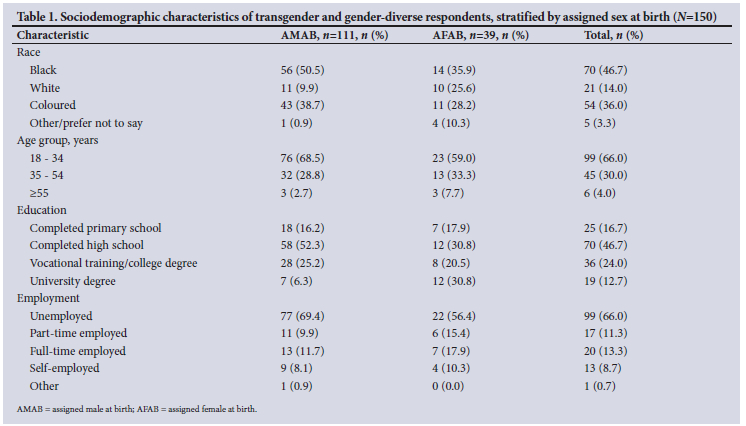
A total of 155 respondents were interviewed. Five were excluded as it was determined that they were not TGD during the course of the interview. Of the total sample of 150 respondents, 111 (74.0%) respondents were AMAB, and 39 (26.0%) were AFAB. Ten (6.7%) of the respondents were intersex, of whom 9 were AMAB and 1 was AFAB. The largest proportion of respondents resided in Cape Town city bowl (n=45, 30.0%), followed by Paarl (n=37, 24.7%) and East London (n=20, 13.3%). Table 1 shows respondent sociodemographic characteristics.
The majority (n=99, 66.0%) of respondents were between 18 and 34 years old. Most (n=125, 83.3%) respondents had completed high school, and over one-third (n=55, 36.7%) had completed a tertiary degree. Two-thirds (n=99, 66.0%) of respondents were unemployed. In terms of living arrangements, 28 (18.7%) had housing insecurity (lived in shelters, moved around or lived on the street), while 67 (44.7%) lived with family and very few (n=5, 3.3%) lived with a partner. The majority of respondents' relationship status was single (n=108, 72.4%), with 24 (16.1%) in a monogamous relationship and 17 (11.4%) in a non-monogamous or polyamorous relationship.
Gender identity
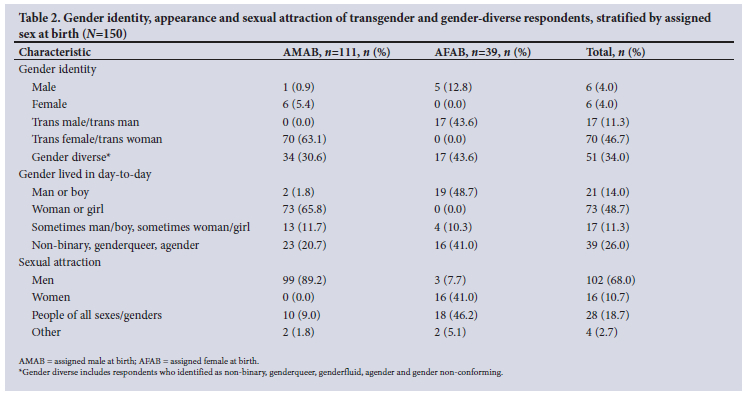
Seventy-six (68.5%) AMAB respondents identified as transgender women or female, and 22 (56.4%) AFAB respondents identified as transgender men or male. Just over one-third (n=51, 34.0%) of all respondents identified as gender-diverse individuals, which includes respondents who identified as non-binary, genderqueer, genderfluid, agender, or gender non-conforming. Table 2 shows respondents' gender identities and their diverse sexual attractions stratified by assigned sex at birth. The median age at which respondents realised that they were TGD was 14 (range 0 - 31) years. The majority (n=88, 61.1%) of respondents were very comfortable with the word transgender being used to describe them. Nearly two-thirds (n=98, 65.3%) were satisfied or very satisfied with their current physical appearance.
Access to and need for gender-affirming care
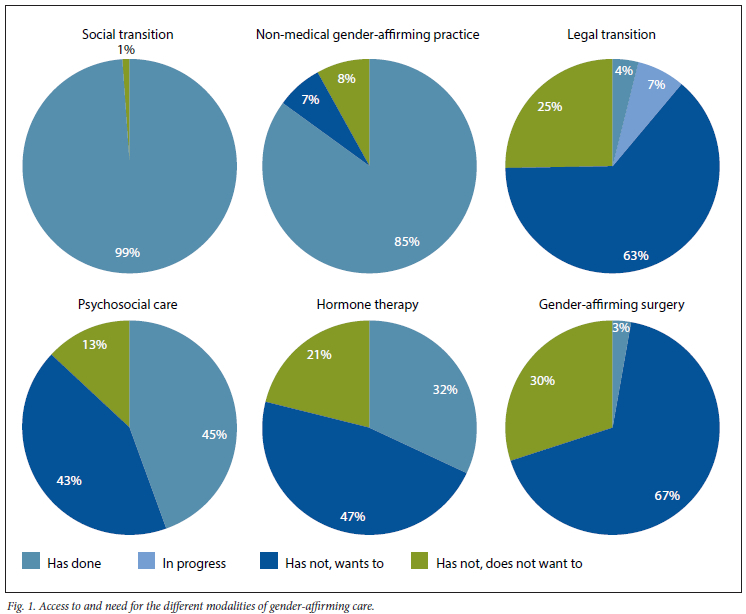
Almost all (n=148, 98.7%) respondents had completed at least one form of social transition. The majority (n=127, 84.67%) had accessed a non-medical gender-affirming practice such as binding or padding breasts, packing or tucking a penis. Only 6 (4.0%) respondents had legally changed their sex description or name on their identity documents. Less than half (n=67, 44.7%) of respondents had received psychosocial care. Of those who had not legally transitioned, 95 (71.4%) respondents wanted to in future, and of those who had not accessed psychosocial care, 64 (77.1%) wanted to in future. Fig. 1 shows a breakdown of access to and need for the different modalities of gender-affirming care for all respondents.
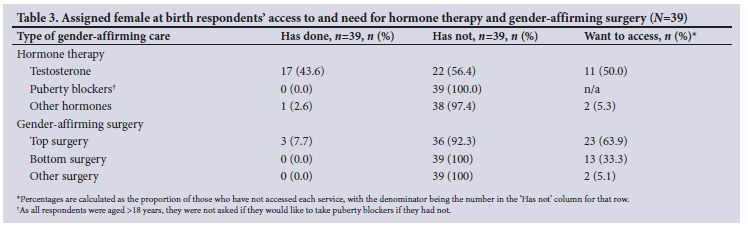
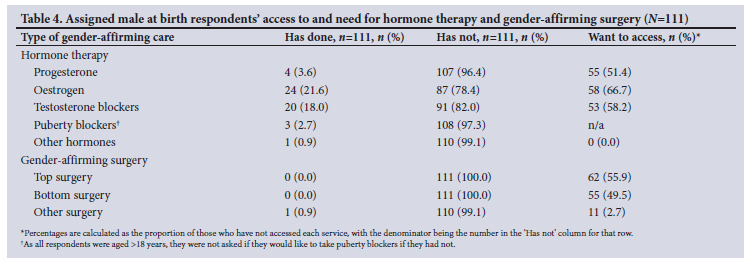
Tables 3 and 4 show access to and need for hormone therapy and gender-affirming surgery for AFAB and AMAB respondents, respectively. Access to hormone therapy was low: 17 (43.6%) AFAB respondents had accessed testosterone and 24 (21.6%) AMAB respondents had accessed oestrogen. Of those who had not accessed hormone therapy, 11 (52.4%) AFAB and 59 (72.8%) AMAB respondents wanted to access hormone therapy in future. Thirteen (8.7%) respondents had resorted to using unapproved treatments, someone else's prescription or black-market procedures to transition.
With regard to surgery, only 3 (7.7%) AFAB and 1 (0.9%) AMAB respondent had accessed gender-affirming surgery. All surgeries for AFAB respondents were top surgeries, with facial surgery for the AMAB respondent. Of those who had not accessed gender-affirming surgery, 25 (69.4%) AFAB and 76 (69.0%) AMAB respondents wanted to access gender-affirming surgery in the future.
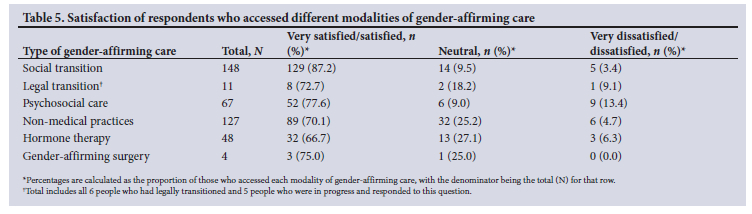
Table 5 shows levels of satisfaction for respondents who had managed to access different forms of gender-affirming care. High levels of satisfaction were reported across all gender-affirming care modalities, with the highest satisfaction observed for social transition (n=129, 87.2%) and the lowest for hormone therapy (n=32, 66.7%). Dissatisfaction rates were consistently low, ranging from none (0.0%) for gender-affirming surgery to 9 (13.4%) for psychosocial care.
Sources of access to gender-affirming care services
Most respondents had accessed medical gender-affirming care services at the Wits Reproductive Health and HIV Institute clinics (n=34, 22.7%), followed by Groote Schuur Hospital Transgender Clinic (n=14, 9.3%), the private sector (n=12, 8.0%), Ivan Toms Centre for Men's Health (n=9, 6.0%), other non-governmental organisations (NGOs; n=3, 2.0%), other public sector facilities (n=2, 1.3%) and UCT Student Wellness (n=1, 0.7%).
Information on medical transition was accessed by respondents through family and friends (n=61, 49.6%), social media (n=59, 48.0%), search engines (n=57, 46.3%), NGOs (n=50, 40.7%) and healthcare providers (n=45, 36.6%,). Only 19 (12.8%) respondents had funds to access private healthcare. Among those who had funds, 9 (47.4%) respondents had cash or out-of-pocket funds, 7 (36.8%) had medical aid, 1 (5.3%) had both cash and medical aid, 1 (5.3%) had funds from a partner and 1 (5.3%) respondent did not answer this question.
Need for and access to HIV services
Almost all (n=149, 99.3%) respondents had had an HIV test in their lifetime, and 96 (64.4%) had been tested within the last 6 months. Just over one-third (n=38, 34.2%) of AMAB and 3 (7.9%) AFAB respondents reported living with HIV. Four (2.7%) respondents preferred not to answer or were unsure of their HIV status.
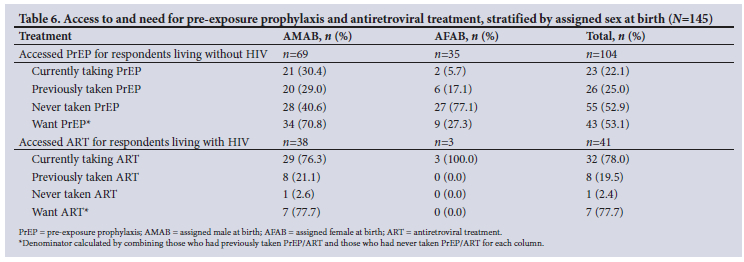
Of those living with HIV, 29 (76.3%) AMAB and 3 (100.0%) AFAB respondents were taking antiretroviral treatment. Of those who did not have HIV, 21 (30.4%) AMAB and 2 (5.7%) AFAB respondents were currently taking pre-exposure prophylaxis (PrEP). Of all respondents not currently taking PrEP, 43 (53.1%) wanted to. Table 6 shows further details of access to and need for PrEP and antiretroviral treatment for respondents.
Discussion
The study recruited a diverse sample ofTGD people across races, ages and locations. The results revealed a vulnerable population, with substantial levels of housing insecurity and unemployment. This aligns with other research in SA that has found significant socioeconomic disparities for TGD people, often caused by social and political environments that marginalise TGD people and affect their access to healthcare.[2,14,24]
Notably, more AMAB people were recruited to the study than AFAB people, potentially reflecting population estimates in SA that report 48.1% of the total transgender population to be transgender women, and 15.5% to be transgender men.[3] This disparity may also be due to sampling biases, or may reflect broader societal dynamics in SA, where AFAB people may face additional barriers to visibility and participation in research due to intersecting forms of marginalisation in a patriarchal society.[25-27]
A large proportion of both AMAB (30.6%) and AFAB (43.6%) respondents identified as gender diverse. This is similar to national population estimates, which show that 36.4% of the TGD population in SA is gender non-conforming.[3] In addition, intersex individuals, estimated to comprise ~1.7% of the global population,[28] represented 6.7% of respondents. The substantial number of gender-diverse and intersex people in this study highlights the need for further investigation into diverse gender identities and sex characteristics that exist beyond the binary of men and women, and their health needs.
The study findings illustrated a notable gap in terms of those who wanted to access gender-affirming care services but had not. Most respondents who had not accessed the service expressed a desire for legal transition, psychosocial care and gender-affirming hormone therapy. These findings are similar to those of an SA study that found that 49.0% of transgender women in SA would like hormone therapy and 44.1% would like counselling, but had not yet pursued these options.[14] The desire for surgical transition was more nuanced. AFAB respondents showed greater preference for top surgery over bottom surgery, while about half of AMAB respondents showed similar levels of interest for both surgeries. A study conducted in the USA found similar results: more transgender women (54.5%) than transgender men (25.3%) would like bottom surgery in future.[29]
The unmet need for gender-affirming care services identified in this study has substantial implications for mental health outcomes for TGD people. International research consistently demonstrates that access to gender-affirming care, particularly hormone therapy and surgery, substantially improves mental health and reduces suicidality among TGD individuals.[30-32] While SA data remain limited, available evidence suggests high rates of mental health concerns among TGD people,[2,33] making the low accessibility of medical gender-affirming care and psychosocial services documented in this study particularly concerning.
Sources of access to medical gender-affirming care are limited primarily to tertiary health institutions in the public sector in SA, with many services no longer provided by primary care clinics run by NGOs dependent on unpredictable international donor funding. Of particular concern is the limited availability of gender-affirming surgery, with a 15 - 20-year waiting list in the public sector.[34] In the private sector, medical aid does not generally fund gender-affirming care.[35] This leaves TGD individuals with very limited access to gender-affirming surgery unless it is paid for out-of-pocket in the private sector, which is unaffordable for most people, especially TGD populations, who have a very high reported level of unemployment.[36] Further barriers to accessing healthcare for TGD people in SA have been described in research, and include discrimination by health facility staff, lack of knowledge of healthcare providers, lack of availability and denial of services, financial barriers, internalised stigma and anxiety from TGD people about accessing services, as well as broader social inequalities that impact access to health services.[2,10,11,15,17,37,38]
Some (8.7%) respondents reported resorting to using unapproved treatments, someone else's prescription or black-market procedures. This is supported by other research in SA showing that TGD people reportedly use dangerous methods to access care when there is limited access to medical gender-affirming care.[9,17] The current limitations in access to gender-affirming care services raise important questions about the state's obligations under section 27 of the SA Constitution, which affirms the right to healthcare services within available resources.[39] However, despite these limitations, addressing the identified service gaps is not only essential for evidence-based and ethical healthcare provision, but is also a constitutional obligation toward SA citizens who are TGD.
HIV services for TGD respondents appeared to be more accessible, with almost all respondents (99.3%) having had an HIV test in their lifetime. The reported HIV prevalence for AMAB respondents in the present study was 34.2%, compared with national statistics for transgender women found to be between 44.6% and 63.3% in urban areas,[6,7] with both much higher than the general adult population rate of 19.5%.[40] Currently, national data on the HIV prevalence of transgender men and gender diverse people are unavailable. Global research shows that the HIV prevalence of transgender men is 10 times that of the general population.[41] Our study findings show the critical need for further studies to determine accurate HIV prevalence in AFAB and gender-diverse people in SA, and to provide testing, prevention and treatment services in line with the identified need.
In terms of HIV prevention and treatment services, of respondents who were not on PrEP or ART, the majority wanted to access them. The study findings show the difference in prevention and treatment needs between AMAB and AFAB respondents, with a lower percentage of AFAB respondents wanting PrEP. The desire to access PrEP is not necessarily due to lower risk for AFAB people, but may rather be due to the promotion of PrEP targeting AMAB populations.[16,42] Research in SA has shown that providing HIV services combined with hormone therapy at the primary healthcare level can improve HIV clinical outcomes for TGD people.[43]
This study shows that currently a minority of TGD people in SA are receiving gender-affirming care and HIV prevention services, and are mostly satisfied with the care they are receiving. However, the SA health system and health service provider education systems still fail to comprehensively recognise TGD people and their health needs.[39,44] This limits healthcare providers' ability to provide care for TGD people.[39,45] Combined with internal, interpersonal and structural stigma for TGD people in SA, this results in the marginalisation and silencing of voices and representation of TGD people in healthcare, limiting their access and exacerbating poor health outcomes. There is an urgent need for research and policy in the SA health system to better include and be responsive to TGD people.
Study limitations
This study utilised a convenience sample and surveyed 150 TGD people, with a small sample size in the Eastern Cape Province (n=20). The lack of statistical power limits the generalisability of these results to the broader population. Respondents were not randomly selected, which may have introduced selection bias. The questionnaire was derived from a literature review of global surveys on access to care for TGD people, but was not validated in this setting, and was only piloted for clarity and understanding prior to implementation. Respondents were asked to self-report and recall answers to questions, which may introduce recall bias and social desirability bias.
Recommendations
This study provides an initial snapshot of access to and need for gender-affirming care and HIV services in SA. Larger, statistically powered, longitudinal studies are needed to understand ways to enhance access to gender-affirming care and HIV services and improve health outcomes for TGD people in SA. Studies should specifically investigate differences between AMAB, AFAB and intersex people, as well as seek to understand how and why healthcare needs and access patterns differ between binary, transgender and gender-diverse people.
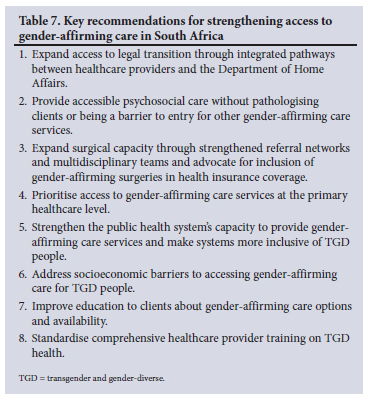
To improve access to comprehensive gender-affirming care services and create health systems inclusive of TGD people, partnerships between healthcare providers, health departments, legal institutions and TGD communities are essential. The public health sector is best suited to provide this care in an affordable and sustainable manner. Table 7 provides key recommendations to improve gender-affirming care services in SA.
Conclusion
Our findings support broader research that shows that TGD people are not uniform in their treatment needs and goals. This research demonstrates a critical gap between access to and need for legal and medical gender-affirming care services for TGD people. There is an urgent need for the provision of affordable, integrated and accessible gender-affirming care and HIV services as part of comprehensive care for TGD populations within an inclusive health system nationally. The expressed need for comprehensive support for gender-affirming care, including legal transition, psychosocial support, hormone therapy and gender-affirming surgery, along with the reported difficulties in accessing care, highlight the necessity for multidisciplinary teams to collaborate to provide better access to these essential services.
Data availability. The dataset generated during this study is not publicly available due to the sensitive and potentially identifiable nature of information about transgender and gender-diverse participants, a vulnerable and marginalised population. The study questionnaires are available in the supplementary materials.
Declaration. None.
Acknowledgements. The authors would like to thank all participants who generously shared their time and lived experience, and all individuals and organisations who assisted in recruitment for this study, including Zonwabele LGBTIQ+ Organisation, Triangle Project, Gender DynamiX and RainbowUCT. We also gratefully acknowledge Saskia Fredericks and Zamokuhle Zulu, who assisted with data collection, and Keitumetse Lebelo, who assisted with data analysis.
Author contributions. LB and RK conceptualised the project. LB led data collection, data analysis and write-up of manuscript. SAM, OW, NX and ZZ assisted with data collection and data analysis. AG and MDJ reviewed and gave input on data analysis and write-up of the manuscript. RK provided oversight of data collection, data analysis and write-up. All authors reviewed and commented on the manuscript and approved the final manuscript.
Funding. AG is supported by the South African Research Chair's Initiative of the Department of Science and Technology and National Research Foundation (NRF) of South Africa (grant no. 82769) and the South African Medical Research Council. Any opinion, finding and conclusion or recommendation expressed in this material is that of the author, and the NRF does not accept any liability in this regard.
Conflicts of interest. None.
References
1. Sutherland C, Roberts B, Gabriel N, Struwig J, Gordon S. Progressive prudes: A survey of attitudes towards homosexuality and gender non-conformity in South Africa. Pretoria: The Other Foundation, Human Sciences Research Council, 2016. [ Links ]
2. Müller A, Daskilewicz K. Are we doing alright? Realities of violence, mental health and access to healthcare related to sexual orientation and gender identity and expression in South Africa: Research report based on a community-led study in nine countries. Amsterdam: COC Netherlands, 2019. [ Links ]
3. Tshuma N, Mtapuri O, Ndagurwa P, et al. Populations size estimates for transgender persons in South Africa 2021. East London: BeyondZero, 2021. [ Links ]
4. Cloete A, Lynch 1. Access to gender-affirming HIV, STl and TB services for transgender women in South Africa. Pretoria: Technical Advisory Committee for the Development of the National HIV, STls and TB Policy Brief for Transgender Women in South Africa, 2021. [ Links ]
5. Metheny N, Mkhize SP, Scott D, Hatcher A. Violence victimisation and depressive symptoms among a sub-sample of sexual and gender minority adults in a population-based South African study. J Interpers Violence 2024;39(23-24):4699-4721. https://doi.org/10.1177/08862605241243348 [ Links ]
6. Stevens O, Anderson RL, Sabin K, et al. HIV prevalence in transgender populations and cisgender men who have sex with men in sub-Saharan Africa 2010 - 2022: A meta-analysis. medRxiv 2023. https://doi.org/10.1101/2023.11.09.23298289 [ Links ]
7. Cloete A, Mabaso M, Savva H, et al. The HIV care continuum for sexually active transgender women in three metropolitan municipalities in South Africa: Findings from a biobehavioural survey. Lancet HIV 2023;10(6):e375-e384. https://doi.org/10.1016/S2352-3018(23)00059-0 [ Links ]
8. Winter S, Diamond M, Green J, et al. Transgender people: Health at the margins of society. Lancet 2016;388(10042):390-400. https://doi.org/10.1016/s0140-6736(16)00683-8 [ Links ]
9. Spencer S, Meer T, Müller A. 'The care is the best you can give at the time': Health care professionals' experiences in providing gender affirming care in South Africa. PLoS ONE 2017;12(7):e0181132. https://doi.org/10.1371/journal.pone.0181132 [ Links ]
10. Ritshidze. State of Healthcare for Key Populations. 3rd ed. Johannesburg: Ritshidze, 2024. [ Links ]
11. De Vries E, McLachlan C. Access to gender-affirming care in South Africa - a landscape in transition. In: Appenroth MN, Varela MdMC, eds. Trans Health International Perspectives on Care for Trans Communities. Bielefeld: Transcript Publishing, 2022. [ Links ]
12. Coleman E, Radix AE, Bouman WP, et al. Standards of care for the health of transgender and gender diverse people, version 8. Int J Transgend Health 2022;23(Suppl 1):S1-S259. https://doi.org/10.1080/26895269.2022.2100644 [ Links ]
13. Tomson A, McLachlan C, Wattrus C, et al. Southern African HIV Clinicians' Society gender-affirming healthcare guideline for South Africa. South Afr J HIV Med 2021;22(1):1-27. https://doi.org/10.4102/sajhivmed.v22i1.1299 [ Links ]
14. Van der Merwe LA, Nikodem C, Ewing D. The socio-economic determinants of health for transgender women in South Africa: Findings from a mixed-methods study. Agenda 2020;34(2):41-55. https://doi.org/10.1080/10130950.2019.1706985 [ Links ]
15. Müller A. Scrambling for access: Availability, accessibility, acceptability and quality of healthcare for lesbian, gay, bisexual and transgender people in South Africa. BMC Int Health Hum Rights 2017;17:16. https://doi.org/10.1186/s12914-017-0124-4 [ Links ]
16. Poteat T, Malik M, van der Merwe LLA, et al. PrEP awareness and engagement among transgender women in South Africa: A cross-sectional, mixed methods study. Lancet HIV 2020;7(12):e825-e834. https://doi.org/10.1016/S2352-3018(20)30119-3 [ Links ]
17. Jessani A, Berry-Moreau T, Parmar R, Athanasakos A, Prodger JL, Mujugira A. Healthcare access and barriers to utilisation among transgender and gender diverse people in Africa: A systematic review. BMC Glob Public Health 2024;2(1):44. https://doi.org/10.1186/s44263-024-00073-2 [ Links ]
18. Scheim Al, Coleman T, Lachowsky N, Bauer GR. Health care access among transgender and nonbinary people in Canada, 2019: A cross-sectional survey. CMAJ Open 2021;9(4):E1213-E1222. https://doi.org/10.9778/cmajo.20210061 [ Links ]
19. Carosella EA, Huerta L, Galea JT, et al. A cross-sectional analysis of self-reported needs and health service utilisation among transgender women in Lima, Peru. LGBT Health 2023;10(7):535-543. https://doi.org/10.1101/2022.02.01.22270281 [ Links ]
20. Bretherton l, Thrower E, Zwickl S, et al. The health and well-being of transgender Australians: A national community survey. LGBT Health 2021;8(1):42-49. https://doi.org/10.1089/lgbt.2020.0178 [ Links ]
21. Liu Y, Xin Y, Qi J, et al. The desire and status of gender-affirming hormone therapy and surgery in transgender men and women in China: A national population study. J Sex Med 2020;17(11):2291-2298. https://doi.org/10.1016/j.jsxm.2020.07.081 [ Links ]
22. Harris PA, Taylor R, Minor BL, et al. The REDCap consortium: Building an international community of software platform partners. J Biomed Inform 2019;95:103208. https://doi.org/10.1016/j.jbi.2019.103208 [ Links ]
23. Harris PA, Taylor R, Thielke R, Payne J, Gonzalez N, Conde JG. Research electronic data capture (REDCap) - a metadata-driven methodology and workflow process for providing translational research informatics support. J Biomed Inform 2009;42(2):377-381. https://doi.org/10.1016/j.jbi.2008.08.010 [ Links ]
24. Shabalala SB, Campbell M. The high price of gender noncompliance: Exploring the economic marginality of trans women in South Africa. J Soc Incl 2025;13:8455. https://doi.org/10.17645/si.8455 [ Links ]
25. Norris M, Borneskog C. The cisnormative blindspot explained: Healthcare experiences of trans men and non-binary persons and the accessibility to inclusive sexual and reproductive healthcare, an integrative review. Sex Reprod Healthcare 2022;32:100733. https://doi.org/10.1016/j.srhc.2022.100733 [ Links ]
26. Moolman B. Rethinking 'masculinities in transition' in South Africa considering the 'intersectionality' of race, class, and sexuality with gender. Afr Identities 2013;11(1):93-105. https://doi.org/10.1080/14725843.2013.775843 [ Links ]
27. Schilt K. Just One of the Guys: Transgender Men and the Persistence of Gender Inequality. Chicago: University of Chicago Press, 2010. [ Links ]
28. Intersex Human Rights Australia. On the number of intersex people. Australia: IHRA, 2013. https://web.archive.org/web/20180717183724/https://ihra.org.au/16601/intersex-numbers/ (accessed 3 March 2025). [ Links ]
29. Puckett JA, Cleary P, Rossman K, Newcomb ME, Mustanski B. Barriers to gender-affirming care for transgender and gender nonconforming individuals. Sex Res Social Policy 2018;15(1):48-59. https://doi.org/10.1007/s13178-017-0295-8 [ Links ]
30. Almazan AN, Keuroghlian AS. Association between gender-affirming surgeries and mental health outcomes. JAMA Surg 2021;156(7):611-618. https://doi.org/10.1001/jamasurg.2021.0952 [ Links ]
31. Doyle DM, Lewis TO, Barreto M. A systematic review of psychosocial functioning changes after gender-affirming hormone therapy among transgender people. Nat Hum Behav 2023;7(8):1320-1331. https://doi.org/10.1038/s41562-023-01605-w [ Links ]
32. Turban JL, King D, Kobe J, Reisner SL, Keuroghlian AS. Access to gender-affirming hormones during adolescence and mental health outcomes among transgender adults. PLoS ONE 2022;17(1):e0261039. https://doi.org/10.1371/journal.pone.0261039 [ Links ]
33. Campbell MM, Fresan A, Addinall RM, et al. Experiences of gender incongruence and the relationship between social exclusion, psychological distress, and dysfunction among South African transgender adults: A field-study for ICD-11. Ann Clin Psychiatry 2018;30(3):168-174. https://doi.org/10.1177/104012371803000301 [ Links ]
34. Wilson D, Marais A, de Villiers A, Addinall R, Campbell MM. Transgender issues in South Africa, with particular reference to the Groote Schuur Hospital Transgender Unit. S Afr Med J 2014;104(6):448-449. https://doi.org/10.7196/samj.8392 [ Links ]
35. Bateman C. Transgender patients sidelined by attitudes and labelling: Izindaba. S Afr Med J 2011;101(2):91-93. https://doi.org/10.7196/samj.4735 [ Links ]
36. Koch JM, McLachlan Ct, Victor CJ, Westcott J, Yager C. The cost of being transgender: Where socioeconomic status, global health care systems, and gender identity intersect. Psychol Sex 2020;11(1-2):103-119. https://doi.org/10.1080/19419899.2019.1660705 [ Links ]
37. Luvuno ZP, Ncama B, Mchunu G. Transgender population's experiences with regard to accessing reproductive health care in Kwazulu-Natal, South Africa: A qualitative study. Afr J Prim Health Care Fam Med 2019;11(1):1-9. https://doi.org/10.4102/phcfm.v11i1.1933 [ Links ]
38. Shabalala SB, Campbell MM. The complexities of trans women's access to healthcare in South Africa: Moving health systems beyond the gender binary towards gender equity. Int J Equity Health2023;22(1):231. https://doi.org/10.1186/s12939-023-02039-6 [ Links ]
39. Constitution of the Republic of South Africa, 1996. [ Links ]
40. Statistics South Africa. Mid-year population estimates. Pretoria: Stats SA, 2021. [ Links ]
41. Stutterheim SE, van Dijk M, Wang H, Jonas KJ. The worldwide burden of HIV in transgender individuals: An updated systematic review and meta-analysis. PloS ONE 2021;16(12):e0260063. https://doi.org/10.1371/journal.pone.0260063 [ Links ]
42. Sevelius JM, Deutsch MB, Grant R. The future of PrEP among transgender women: The critical role of gender affirmation in research and clinical practices. J Int AIDS Soc 2016;19:21105. https://doi.org/10.7448/ias.19.7.21105 [ Links ]
43. Bothma R, O'Connor C, Nkusi J, et al. Differentiated HIV services for transgender people in four South African districts: Population characteristics and HIV care cascade. J Int AIDS Soc 2022;25(Suppl 5):e25987. https://doi.org/10.1002/jia2.25987 [ Links ]
44. Müller A. Teaching lesbian, gay, bisexual and transgender health in a South African health sciences faculty: Addressing the gap. BMC Med Ed 2013;13:1-7. https://doi.org/10.1186/1472-6920-13-174 [ Links ]
45. Lynch I. Justice, abundance, and possibility for all: Countering anti-gender movements in South Africa. Cape Town: Afrikagrupperna, 2024. [ Links ]
 Correspondence:
L Bust
lynn.bust@hiv-research.org.za
Received 16 May 2025
Accepted 19 August 2025