



Services on Demand
Journal

Article
 English (pdf)
 Article in xml format
 Article references

 Automatic translation
 Send this article by e-mail
Indicators
Related links
-
 Cited by Google
-
 Similars in Google
Share

 Permalink

South African Journal of Agricultural Extension
On-line version ISSN 2413-3221Print version ISSN 0301-603X
S Afr. Jnl. Agric. Ext. vol.53 n.2 Pretoria 2025
https://doi.org/10.17159/2413-3221/2025/v53n2a13487
ARTICLES
The Perceptions of Interns Towards Government Agricultural Internship (Graduates' Programme) in Mpumalanga Province
Mathebula R.I; Zwane E.M.II; Letsoalo E.MIII
IMaster's student at the Centre for Rural Community Empowerment (CRCE), Department of Agricultural Economics and Animal Production. School of Agriculture and Environment Sciences, Faculty of Science and Agriculture, University of Limpopo. Email: mathebulareward@gmail.com
IIProfessor of Agricultural Extension at the Centre for Rural Community Empowerment (CRCE), Department of Agricultural Economics and Animal Production. School of Agriculture and Environment Sciences, Faculty of Science and Agriculture, University of Limpopo. Email: zwanefrank@gmail.com. Orcid: 0000-0002-5933-2910
IIILecturer in the Centre for Rural Community Empowerment, (CRCE), Department of Agricultural Economics and Animal Production. School of Agriculture and Environment Sciences, Faculty of Science and Agriculture, University of Limpopo. Email: emest.letsoalo@ul.ac.za. Orcid: 0000-0001-5083-1054
ABSTRACT
This paper aims to present the perceptions of interns who have been participating in a postgraduate government internship programme of the Department of Agriculture in Mpumalanga province. Internships have become a prevalent phenomenon among graduates of institutions of higher learning. Internships are the knowledge centre and network platform that offers practical experience to graduates or interns. Moreover, internships are pivotal in improving interns' employability and employment. The problem tackled in the study is that graduates are not appointed due to a lack of practical experience. This study analysed the internship-graduate programme of 73 interns out of 104 from three districts (Ehlanzeni, Gert Sibande and Nkangala). Self-administered questionnaires were posted to the interns (due to COVID-19) who were still in the internship programme. The findings are that out of 35 statements given, 19 were negative, and 16 were positive about internships. The study concluded that the internships were related to the government agricultural internship programme (graduates' programme). The paper recommended improvement in the activities of four stakeholders that play a part in the internship programme, namely the project manager, the human resource office, the extension officers and the farmers.
Keywords: Internship, Perception, Government.
1. INTRODUCTION
Internships have become the cornerstones of many companies in South Africa seeking to provide graduates with an opportunity to be "hands-on". Various companies offer internship positions for new graduates to gain experience and acclimatise themselves to the working environment while acquiring the needed skills in their respective areas of speciality. Previous research has generally endorsed the value of graduate students' internships. For example, Brooks et al. (1995) believe that internships can be pivotal in helping graduates make good career choices. The unemployment rate in the labour force in Mpumalanga was reported to be high; unemployed males were 32% and 40.2% for women, while for youth, it was 48.4%. It is assumed that graduates in Mpumalanga fall within this range of 48.4% (Economic Analysis, 2023). Data about unemployed graduates was not available to compare the employed interns with those with job opportunities. However, the problem of graduates in South Africa in general is that for youth aged 15-24 years and 25-34 years, the highest unemployment rates of 62.1% and 40.7%, respectively, were recorded (Stat SA, 2023). Internships are a vast activity in all government and non-government sectors, including the private sector; hence, all nine provinces developed internship policies to guide the process of internships. The study consulted only three provinces: the Mpumalanga Department of Agriculture, the KwaZulu-Natal Department of Treasury, and the Limpopo Department of Agriculture. All were found to have internship policies; according to Richards (1984) and Gault et al. (2000), graduates who participate in an internship have greater job stability and higher job satisfaction.
2. THEORETICAL BACKGROUND
Various companies provide internship positions for new graduates as pre-service training for graduates to gain experience on the job. Complementary to this sentiment, RecruitAgri is one of the companies in the Lowveld of Mpumalanga province that provides a platform for graduates with agricultural qualifications to gain practical work experience. The Department of Agriculture allocates the budget to the line discipline (Extension, Animal Health, Crop Science Resource conservation and administration /Human Resources). It identifies the number of interns to be placed per section for internship. The budget to service the different sections is coordinated at the central level primarily by the Human Resource /Human Resources and Development; unfortunately, such information was not readily available. The Department of Agriculture in Mpumalanga province also provides an internship programme. It becomes important to clarify a few terms used in this article. Intern: An intern is a graduate with no or little practical working experience in a specific discipline seeking to enter the corporate world or organisation through a structured bridging programme (Koyana et al., 2013). Different authors have defined the term Internship (Koyana et al., 2013; Brooks et al., 1995). An internship is a temporary position emphasising on-the-job training rather than merely employment, which can be paid or unpaid.
An internship programme refers to bridging graduates who have completed a tertiary qualification from an institution into a workplace (Koyana et al., 2013). Internships are seen as a prerequisite among graduates of higher learning in pursuit of employment and employability. Moreover, internships help graduates build work-relevant skills, gain specific knowledge of their future occupations, develop a more explicit self-concept, and confirm or redirect individual career goals.
While most of the skills acquired during internships are general and transferable, Busby (2003) reckons that these attributes may then translate into various favourable outcomes for the transition into the labour market and early career success, for example, shorter job search duration, lower probability of unemployment, better job match, greater job satisfaction, and increased earnings. In addition, Busby (2003) highlights that internships also produce costs due to the investment of time, effort and sometimes even money. Interns must accept educational opportunity costs and often enter the labour market later than non-interns.
2.1. Barriers to Internship
According to Hora et al. (2020), three types of barriers were identified in the following categories: scheduling conflicts (with paid work and coursework), a lack of internships in their discipline or region, and the fact that unpaid internships were simply not a realistic option for students to pursue given other expenses and obligations. A study in the USA among Historically Black Colleges and Universities (HBCU) reported that one mother questioned her daughter who volunteered to intern without payment (Thompson et al., 2021). This situation was similar to the experience in South Africa, when the internship began, based on volunteerism without payment. This has changed, and a budget and a policy accompany it.
2.2. Value of Internship
The value of an internship was always seen positively compared to those who did not attend any internship. The positivity of an internship is derived from the fact that it is an opportunity to learn new skills, build networks, and clarify future goals (Thompson et al., 2021). In the past, interns were prepared to undertake internships without payment, demonstrating the internship programme's value among interns.
2.3. Type of Intern to Hire
There are various ways to understand the type of intern to hire. The obvious case is that management must lower their expectations when hiring interns. The argument is that one cannot base recruitment on experience because the intern has no experience. Awindra (2023) reported that one intern was hired despite lacking experience and skills, but the company still gave her a chance because she had a positive attitude and willingness to learn. She was honest during her interview, and the company finally hired her. It has been argued that an intern with the right attitude and discipline must be given a chance while training and the company should take care of development (Awindra, 2023).
2.4. Characteristic of Interns
The question might arise: What is the characteristic of a student who deserves an internship? There are no straight answers to learn from them. Different authors have expressed various opinions; for example, Knouse, Tanner and Harris (1999) concluded that selection should be based on the higher-achieving students and discouraged low achievers. Other scholars have found that internship participation varies by student characteristics such as gender, race/ethnicity, socioeconomic status, and achievement levels (Binder, Baguley, Crook, & Miller, 2015). The objective of the article is to test the perceptions of interns based in the Department of Agriculture towards the government internship programme, focusing mainly on the following areas:
• Employability and employment.
• Career development and job security.
• Needed knowledge and skills.
• Benefits gained through participation in an internship program.
• A place to work after undergoing an internship.
3. RESEARCH METHODOLOGY
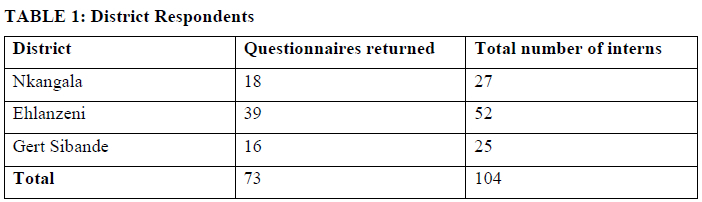
The study used both quantitative and qualitative paradigms to collect the needed data. Semi-structured questionnaires were targeted at 108 interns due to the restrictions of COVID-19. Only 73 interns returned the questionnaires administered via email and messaging mobile applications. The respondents were derived from three districts presented in Table 1.
Nkangala district had 27 interns, and only 18 returned the questionnaires. Ehlanzeni district (incorporating Bohlabela district) had 52 interns, and only 39 returned the questionnaires. Gert Sibande had 25 interns, and only 16 returned the questionnaires. From the total number of questionnaires returned, the majority (63%) of the interns opted to return the questionnaires using messaging mobile applications, whereas 37% used emails. Therefore, 46 interns returned the questionnaires concisely using messaging mobile applications, and 27 interns used emails.
4. FINDINGS AND DISCUSSION
4.1. Demographic Characteristics
The demographic characteristics of the interns analysed for this study were based on age, gender, place/district of birth and the home or residential area. These variables have innuendos on the interns' perceptions towards the government agricultural internship program (graduates' programme).
4.2. Age of respondents
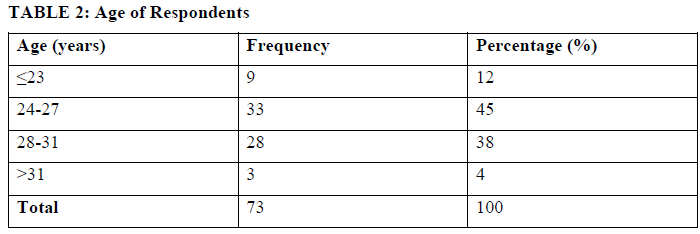
The distribution of the interns according to their age group is presented in Table 2.
A total of 73 interns were placed within the directorates and on the farms. The study results show that 45% of the interns were between the ages of 24 and 27 years old, whereas 38% were in the age group of 28 and 31 years old. Interns aged 23 years or less were 12%; lastly, interns aged 31 years or older made the lowest percentage (4%). The results suggest that graduates between 24 and 27 years old will most likely engage in internship programs after their studies. Moreover, one could attribute this age group to those interns who have completed their 4-year qualification and postgraduate qualifications. This age group seems above the expected age level of 23 years after their first qualification. Nevertheless, it helps to bridge the gap between theory and practice and to make succession plans for ageing professionals. These results are consistent with the literature, which indicates that improving youth capacities and increasing their involvement in agriculture will help change the negative perception of agriculture (Preethi, 2015).
4.3. Gender of Respondents
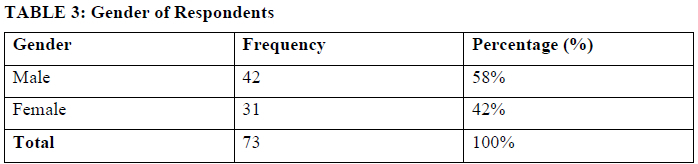
Gender is believed to mean the range of characteristics about, and differentiating between, masculinity and femininity. However, the truth of the matter is that gender means the task ascribed to either man or woman. The gender of respondents is indicated in Table 3.
The study's findings in Table 3 suggest that most (58%) interns are males, while 42% are females. The results indicate that males continue to dominate the agricultural sector, taking agriculture as their career path and participating in large numbers in the sector. The results continue to highlight and reinforce concern for the lack of women professionals in agriculture. However, male domination is by a slight margin, as indicated in Table 3. The reason could be that since South Africa entered the new dispensation, all citizens have had equal opportunity. The practice can overturn the notion or perception that agriculture is for males. On the other hand, women who provide food security to their families dominate most agricultural projects in South Africa. An increase in female interns will become desirable because it will create capable women agricultural scientists and extension professionals.
4.4. Perceptions of Interns Towards Government Agricultural Internship (Graduates' Programme).
The interns' perceptions of the government agricultural internship were measured using a five-point Likert scale. The scale ranged from 1 = Strongly Agree to 5 = Strongly Disagree. For positive statements, the Likert scale ranged from 1 = Strongly Disagree to 5 Strongly Agree; for Negative statements, the Likert scale was reversed from 5 = Strongly Disagree to 1 = Strongly Agree. In the end, the results of the five-point Likert Scale were reduced to three points: Agree, Uncertain and Disagree. Both "Strongly Agree" and "Agree" were fused to form "Agree", and both "Strongly Disagree" and "Disagree" formed "Disagree". Thirty-five statements were used, and the interns were to reflect on the extent to which they agreed or disagreed with the contents of the statements. Of the 35 statements, 19 were negative statements, whereas the remaining 16 were positive.
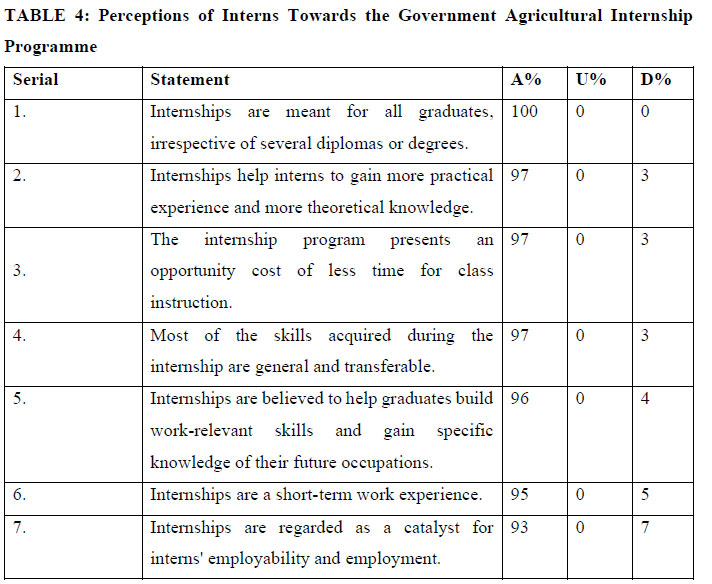
Respondents were subjected to several statements, and the results of the first statement are presented in Table 4.
The results of the study show that most of the interns agreed with the following statements:
"Internships are meant for all graduates irrespective of several diplomas or degrees" (100%). The reason for all interns to agree with this statement might be that during their internship period, they realised that there is a lot that they did not know because they were not covered in their formal training. Interns also agreed with the following statement:
"Internships help interns to gain more practical experience and more theoretical knowledge" (97%). Most interns who agreed with this statement might have first-hand experience in their specialised subject matter areas, where they gained a lot of real-life experience, knowledge, and skills in farming and agriculture. Interns highlighted that "the internship program presents an opportunity cost of less time for instruction in class" (97%). Interns who agree with this statement might be those interns who believe that if one participates in an internship, they are likely to attend and spend less of their time in class, as the internship requires a lot of effort and time.
Interns believe " most of the skills acquired during internship are general and transferable" (97%). Interns who were positive about this statement might be those who realised that they had gained a lot of interpersonal and communication skills in the field of work. On the other hand, interns highlighted that "internships are believed to help graduates build work-relevant skills, and gain specific knowledge of their future occupations" (96%). The interns who agreed with this statement might have realised that the internship helped them to know how to work as part of a team and have a teamwork spirit, which is a work-related skill, even in the future.
Interns believe "internships are a short-term work experience" (95%). Most of the interns who agreed with this statement might have realised that they did not grasp or acquire some of the skills and experience needed in their respective areas of speciality. Conversely, interns believe that ""internships are regarded as a catalyst for interns' employability and employment" (93%). Interns who endorse this statement might have realised that most agricultural professions require a traceable experience; hence, the internship, in this case, becomes more relevant and decisive to employability and employment.
4.5. Perceptions of Employability and Employment
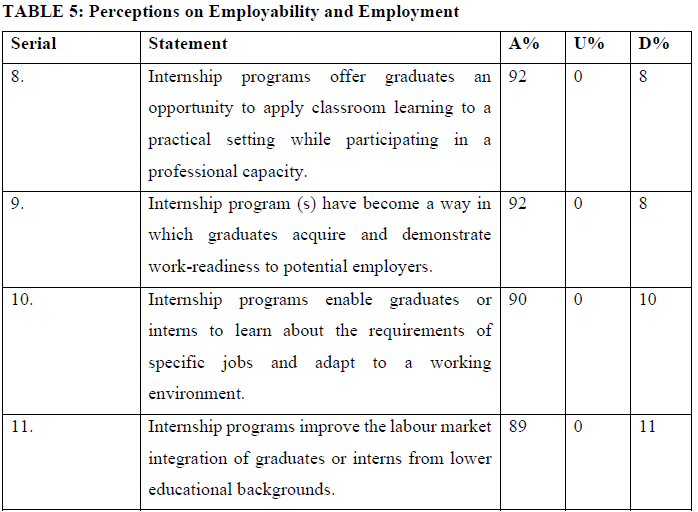
Respondents were asked to indicate their perceptions of employability and employment, and their responses are presented in Table 5.
The results in Table 5 show that interns also agreed with the following statement about the internship program. Interns agreed with the statement that:
"Internship program offers graduates an opportunity to apply classroom learning to a practical setting while participating in a professional capacity" (92%). Most of the interns agreed with this statement because they put into practice what they were taught (theoretical lessons) in class during their internship period. Interns also believe that "Internship program(s) have become a way in which graduates acquire and demonstrate work-readiness to potential employers" (92%). Interns who agreed with this statement might have realised that the skills, i.e., self-confidence, creativity, and innovative ideas, still lack in convincing potential employers that they are ready for the "real world".
Interns learnt that " internship program enables graduates or interns to learn about the requirements of specific jobs and adopt to a working environment" (90%). Interns who agreed with this statement quickly realised the skills they needed for their future occupations. Meanwhile, interns agreed with the statement, " internship programs improve the labour market integration of graduates or interns from lower educational background" (89%). Interns who agree with this statement might be those interns who, in their educational system, practicals have not been incorporated well or at all.
4.6. Perceptions of Career Development and Job Security
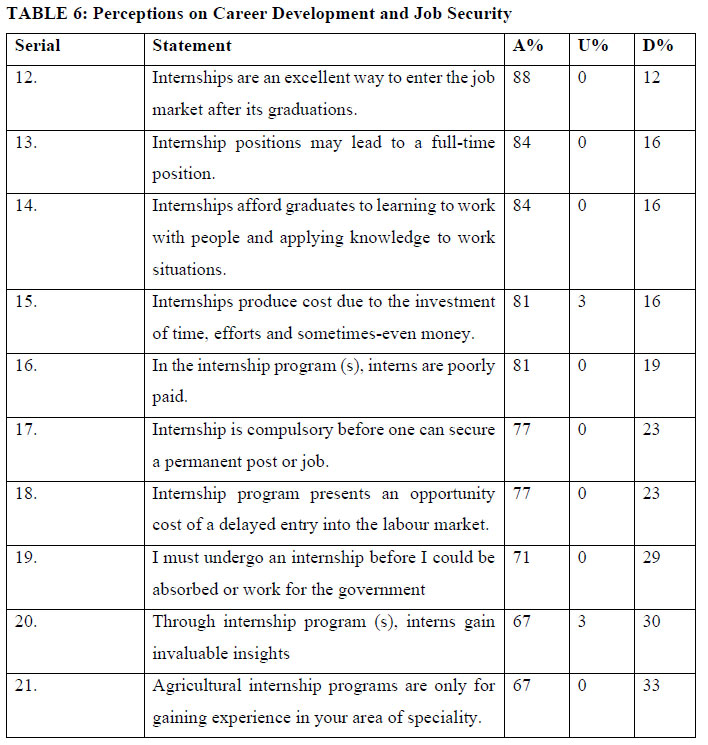
Respondents were asked to indicate their perceptions of career development and job security; their responses are noted in Table 6.
The results in Table 6 showed that interns agreed with statements which relate the internship to career development and job security. Interns agreed with the statement that:
"Internships are excellent way to enter the job market after its graduations" (88%). Interns who concurred with this statement are those interns who believe that the skills acquired make someone else's life a whole lot easier to enter the job market.
Moreover, interns believe that "internship positions may lead to a full-time position" (84%). Interns who agree with this statement believe that with practical job experience, it is advantageous to get a job as opposed to an individual without practical job experience. For most interns, "internships allow graduates to learn to work with people and apply knowledge to work in different situations" (84%). Interns who agree with this statement might have relished the opportunity to work with different people, speak different languages, and come from diverse backgrounds. At the same time, the level of professionalism remained intact.
Interns also highlight the importance of time invested in learning on the job by agreeing that " internships produce cost due to the investment of time, efforts and sometimes even money" (81%). Interns who endorsed this statement might be those who struggled to keep up with the daily tasks given to them, while they may have also felt that they were being treated as hard labourers. Due to this investment of time in learning on the job, interns feel like they are "poorly paid" (81%). Another reason most of the interns agreed with this statement could be that the stipend could not meet all their needs to live up to their expectations and not worry about expenses. However, due to government employment regulations, "internship is compulsory before one can secure a permanent post or job" (77%). Interns who concurred with this statement might have realised the importance of going through an internship to acquire practical knowledge and practical experience to get a permanent position since most agricultural field posts require practical experience.
The results also indicate that students agreed with the statement, "internship program presents an opportunity cost of a delayed entry into the labour market" (77%). The majority of the interns who agreed with this statement might be those interns who believe that an internship may be a prerequisite to employment but, at the same time, are used as a decoy to enter the labour market because not everyone would get straight into a permanent post or mere contract employment after their graduation. Interns also learned that " they must undergo an internship before they could be absorbed or work for the government" (71%). Most of the interns who agreed with this statement might be those who believe that for someone to work for the government, they must have participated in a government internship(s).
The results of the study revealed that interns agreed with the following statements " Through internship program (s), they gain invaluable insights" (67%). Interns who endorsed this statement might be those who took full advantage of the internship opportunity, acquainted themselves with the working environment, and benefited from it. Interns further indicated that "agricultural internship programs are only for gaining experience in their area of speciality" (67%). Most interns who agreed with this statement gained knowledge, skills and experience needed in their respective areas of speciality. These interns confirmed the knowledge and skills they learned in class throughout their internship program.
4.7. Perceptions of Needed Knowledge and Skills
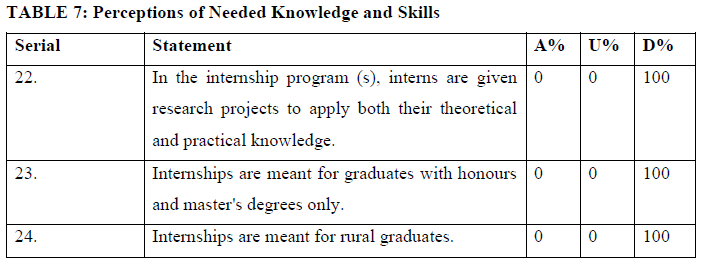
Respondents were asked to state their perceptions of needed knowledge and skills. See Table 7
The results of the study, reflected in Table 7, further revealed that most of the interns disagreed with the following statements:
"In the internship program, interns are given research projects to apply both their theoretical and practical knowledge" (100%). All the interns disagreed with this statement because they were not given any research task or project relating to their area of speciality or the commodities they were working with, which somehow, they fell short in acquiring further knowledge in their respective areas. Interns also disagreed with the statement that "internships are meant for graduates with honours and master's degrees only" (100%).
All the interns disagreed with this statement because the qualification requirements for the internship ranged from a diploma to a PhD degree, and if an individual is not older than 35 years. Interns disagreed with this statement because it is now a regulation that all new graduates must go through the internship process to adjust to the work environment, no matter their qualifications. Interns also disagreed with the statement that "internships are meant for rural graduates" (100%). All the interns disagreed with this statement because there was never an indication on the internship position requirements that the Department only needed interns from rural areas.
4.8. Perception of Benefiting Through Participation in Internship Program
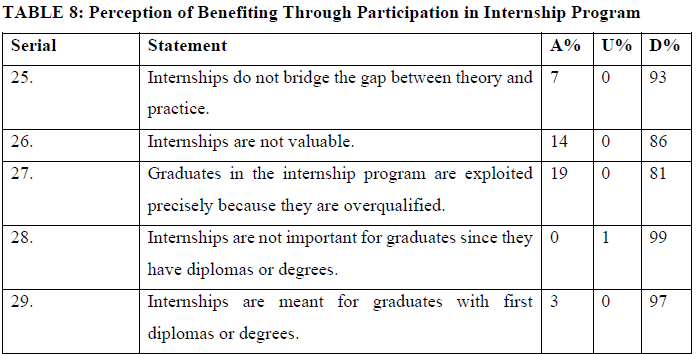
Respondents were asked to indicate their perceptions of the benefits of participating in the internship programme, and their responses are in Table 8.
The results in Table 8 revealed that interns have gained much knowledge and experience to realise that internships are important. They disagreed with the following negative statements, which state that:
"Internships are not important for graduates since they have diplomas or degrees" (99%). "Internships are meant for graduates with first diplomas or degrees" (97%). "Internships do not bridge the gap between theory and practice" (93%). "Internships are not valuable" (86%). "Graduates in the internship program are exploited precisely because they are overqualified" (81%).
Most of the interns believe that a qualification alone is not enough. However, the qualification becomes pivotal if one has experience from an internship. The experience becomes even more decisive and distinguished than an individual with only a qualification. Interns also believe that an internship is an important requirement for anyone wanting to gain knowledge and experience. Furthermore, the interns have realised they needed to participate in an internship to discover the technical skills required in their speciality area. Interns who felt the program exploited them were office bearers involved in "effortless tasks" such as record/bookkeeping, managing and supervising farm workers, and contributing to managerial experiences.
4.9. Perceptions of Place to Work After Undergoing an Internship
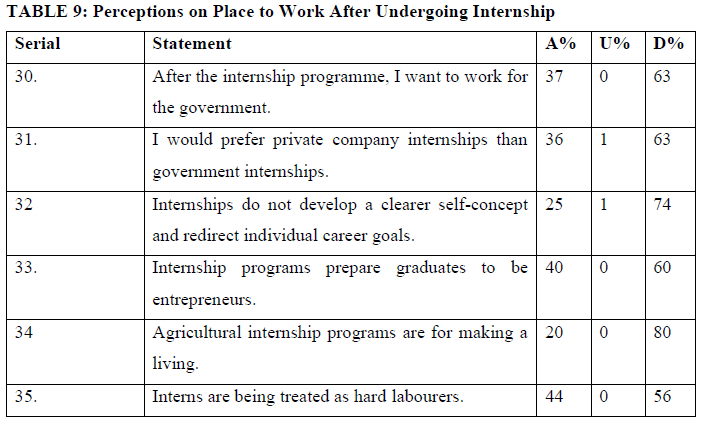
Respondents were asked to indicate where they would want to work after finishing the programme; their responses are in Table 9.
On the other hand, interns disagreed with the statements that relate internship programs to making a living, failure to direct career development goals, and securing jobs in government as hard labour. The interns disagreed with the following statements.
"Agricultural internship programs are for making a living" (80%). Interns who disagreed with this statement realised that while caring for themselves and their families, they were also gaining skills, experience and knowledge needed in their respective fields or areas of speciality.
"Internships do not develop a clearer self-concept and redirect individual career goals" (74%). Interns who disagreed with this statement might be those who quickly realised and supersedes to gauge whether they made the right or wrong choice regarding their future occupations, courtesy of the exposure from the internship.
"After the internship program, I want to work for the government" (63%). Most of the interns who disagreed with this statement might be those who believe that the nature in which the internship program operated and how the interns felt treated in their respective farms is how the government operates and how its employees are treated, which, as a result, the interns do not foresee themselves working for the government.
"I would prefer private company internships than government internships" (63%). Most of the interns who disagreed with this statement might be those who got their first-hand internship experience from the graduates' program and relished the opportunity to discover the needed skills and experience in their areas of speciality.
" Internship programs prepare graduates to be entrepreneurs" (60%). Most interns who disagree with this statement might believe that after an internship graduation, one is more marketable and sought after to be employed by the government and various companies since all the needed skills, knowledge, and experience have been discovered.
"Interns are being treated as hard labourers" (56%). Most of the interns who disagreed with this statement might be those who were not involved or were never involved in activities that required more effort and a very short time to complete.
5. CONCLUSION AND RECOMMENDATIONS
According to the results of this study, it can be firmly confirmed that this research or study achieved its objectives, courtesy of the data analysis parameters and methodology deployed in the study.
5.1. Achievements of Study Objectives
Nineteen were negative statements, whereas the remaining 16 were positive, out of 35. From the 19 negative statements, interns disagreed with 11 negative statements, which, in turn, those 11 statements became a positive perception. On the other hand, interns agreed with 12 positive statements, which remains a positive perception. Therefore, the researcher concludes that interns positively view or perceive the government agricultural internship program (graduates' program).
Even though some respondents were unaware of the internship program's objectives, most of the interns were aware of the objectives; hence, a higher percentage indicated that they supported this program. Despite the different challenges interns face in the internship and not acquiring all the skills, most interns have acquired the skills required in their technical subject matter area.
5.2. Recommendations
Based on the study's findings, the recommendation is based on the three stakeholders: the Mpumalanga Department of Agriculture, the Human Resource Office and the extension officers.
• It is recommended that the Department of Agriculture request bi-monthly reports from project managers, extension officers, farmers, and interns.
• Both interns and farmers should be assigned an official from the Department of Agriculture to whom they are to report every two months basis - where possible, the Department of Agriculture (Mpumalanga) should hold quarterly meetings with all the stakeholders (the project managers, HR office, extension officer, farmers, and interns) to check if everything is going well and also to allow the stakeholders to voice out their concerns regarding the program.
• The Department should provide the interns with work suits.
• Interns should be given small monthly or quarterly research projects and assessments based on the crops or animals they would be farming with them. The research projects or assessments can entail topics like animal production management, irrigation and water management, farm establishment, and farm maintenance and management.
• Before starting the program or placement to farms, projects, or enterprises, the HR office should have proper planning and clearly outline the objectives of the graduates' program to the incoming interns to make them aware of the program's intentions.
• Extension officers should provide the interns with coaching and mentorship to guide and practically demonstrate the technical skills they require in their respective speciality areas.
REFERENCES
AWINDRA, Y., 2023. Internship. Engineer Software. Available from: https://www.linkedin.com/in/yash-awidra/yash-awidra-63a4b21a6/overlay/about-this-profile/ [ Links ]
BINDER, J.F., BAGULEY, T., CROOK, C. & MILLER, F., 2015. The academic value of internships: Benefits across disciplines and student backgrounds. Contemp. Educ. Psychol., 41: 73-82. [ Links ]
BROOKS, L., CORNELIUS, A., GREENfiELD, E. & JOSEPH, R., 1995. The relation of career-related work or internship experiences to the career development of college seniors. J. Vocat. Behav., 46(3): 332-349. [ Links ]
BUSBY, G., 2003. Tourism degree internships: A longitudinal study. J. Voc. Educ. & Train., 55(3): 319-334. [ Links ]
GAULT, J., REDINGTON, J. & SCHLAGER, T., 2000. The benefits of undergraduate business internships: Implications for the student, university, and business community. J. Mark. Educ., 22(1): 45-53. [ Links ]
HORA, M., CHEN, Z., PARROTT, E. & HER, PA., 2020. Problematising college internships: Exploring issues with access, program design and developmental outcomes. Available from: https://files.eric.ed.gov/fulltext/EJ1254749.pdf [ Links ]
KOYANA, S., SUNDLANE, R., SUNDHLANE K., MAHWASANE, M., ZWANE, B. & GQOLANA, P., 2013. Report on the internship baseline study. South African Graduates Development Association. [ Links ]
PREETHI, A., 2015. A study on perception, aspiration, and participation of farm youth in Agriculture. Soc. Sci., 11(5): 215. [ Links ]
RICHARDS, E, W., 1984. Undergraduate preparation and early career outcomes: A study of recent college graduates. Journal of Vocational Behaviour., 24(3): 279 - 304. [ Links ]
STATS SA., 2023. Quarterly Labour Force Survey (QLFS) Q1:2023. Graduate Unemployment. Available from: chrome-extension://efaidnbmnnnibpcajpcglclefindmkaj/https://www.statssa.gov.za/publications/P0211/Presentation%20QLFS%20Q1%202023.pdf [ Links ]
THOMPSON, M.N., PEREZ-CHAVEZ, J. & FETTER, A., 2021. Internship experience among college students attending an HBC: A longitudinal grounded theory exploration. J. Career Assess., 29(4): 1-19. [ Links ]
 Correspondence:
R.L. Mathebula
Email: mathebulareward@gmail.com