




Services on Demand
Journal

Article
 English (pdf)
 Article in xml format
 Article references
 Automatic translation
 Send this article by e-mail
Indicators
Related links
-
 Cited by Google
 -
 Similars in Google
Share

 Permalink
South African Journal of Agricultural Extension
On-line version ISSN 2413-3221Print version ISSN 0301-603X
S Afr. Jnl. Agric. Ext. vol.53 n.4 Pretoria 2025
https://doi.org/10.17159/2413-3221/2025/v53n4a17560
ARTICLES
Understanding Media Perception and Usage for Soygari Nutritional Information Dissemination in Southwestern Nigeria
Fadairo A.O.I; Akinbile L.A.II
IInstitute of Agricultural Research and Training (IAR & T), Ibadan. PMB 5029, Moor plantation, Ibadan. aniolaorefadairo@gmail.com, ORCID ID 0000-0002-8059-7323
IIDepartment of Agricultural Extension and Rural Development, Faculty of Agriculture, University of Ibadan. lakinbile@yahoo.com, ORCID ID 0000-0001-9630-038X
ABSTRACT
This study determined perceptions of conventional media (CM) and non-conventional media (NCM) use for soygari nutrition information (SNI) in Southwestern Nigeria. In an ex-postfacto research design, this study sampled 224 households using multi-stage sampling procedures. Data on socioeconomic characteristics, perceived constraints to understanding of messages and the perception of respondents were collected during interviews and analysed using percentages and linear regression. The mean age of respondents was 44 years. The majority (66%) of the women indicated an inability to read or write in the Yoruba language. External distractions (x=0.53) and noise (x=0.66) were major hindrances to information exposure for CM. Major determinants of CM perception were constraints faced (Σ - 0.27; T- 2.69) and the educational level of participants. Constraints (Σ - 0.32; T- 2.92) and radio/television use (Σ -0.32; T- 2.92) influenced the retention of information disseminated through the NCM. A higher mean response was recorded for the NCM than the CM (x=48.89). The NCM was perceived to be more useful if the intention is to understand and utilise the nutritional message. At the same time, the CM can only aid the abstract knowledge of the information, as in SNI. Nutrition information campaigns should improve interactivity with the audience to foster easy understanding of the information, while careful attention must be ensured to reduce noise and other distractions when using the NCM among rural audiences.
Keywords: Media Perception, Usage, Soygari Nutrition, and Information Dissemination.
1. INTRODUCTION
Household food availability means ample food access through domestic production, food reserves or year-round access to varieties through purchases (Galhena, Freed & Maredia, 2013; Zhou et al., 2019). The need to increase food accessibility and poverty reduction among rural households calls for greater attention from all agriculture sector stakeholders.
Studies of Ede et al. (2019), Oyewole and Atinmo (2015), and Davidoff (2012) have shown the increasing need for better strategies to reduce malnutrition in rural Nigeria. According to Ede et al. (2019), collaboration among multiple interventions and disciplines in guidance and psych education is an effective management strategy for malnutrition. In line with this, soygari is a validated technology from the Institute of Agricultural Research and Training (IAR&T) targeted at the problem of micronutrient malnutrition of the low-income population that relies mainly on whole cassava (Manihot Esculenta) consumption for the daily diet. Soygari is a combination of cassava and soybean pastes in a ratio of 3:1. Traditionally, cassava paste is usually roasted into gari. In contrast, the milk in soybean paste is extracted, and the remaining part (regarded as the shaft) is discarded. The roasted cassava paste (Gari) is a staple diet in almost every region of Nigeria and in some parts of Africa (Ebah-Djedji et al., 2021). This makes gari the major cassava product in the region. However, gari is very high in starch content (Taiwo, 2006) while soybean is an excellent source of major nutrients such as protein (37-41g), fat (18-21g), carbohydrate (30-40g), fibre (4-6g), ash (4-5g) and minerals like calcium (Ugwu & Nwoke, 2011, Fasoyiro et al., 2011). Soybeans and cassava are produced on small and large scales by arable farmers in all regions of Nigeria; thus, they are readily available in the open market.
According to Olawuyi et al. (2024), soygari contains all the essential nutrients needed for the body to combat malnutrition. This makes it capable of serving as an alternative to/substitute for animal protein. The quality of soybeans also makes them an alternative source of protein, especially for low-income families that cannot afford animal protein in their diets. At inception, dissemination of Soygari Nutrition Information (SNI) was mainly done on field days. The soybean product was well embraced but was discontinued shortly after. This was attributed to the ineffective media use for information dissemination (Ogunsumi, 2008). According to research (Quaidoo, Ohemeng & Amakwah-Poku, 2018; Ede et al., 2019; Fadairo et al., 2020), effective media use increases access to nutrition education and the counselling process in any development intervention for nutrition improvement among rural households. Improvement in media use for SNI in available tools of conventional media (CM) and the non-conventional media (NCM) is expected to translate directly to improved knowledge and utilisation among the recipients.
Improvement in communication for SNI dissemination was made in 2018 by incorporating different media tools of CM and NCM types to diffuse the SNI and ascertain an effective media type for further dissemination. This was done considering the media information's unique role in creating demand and building consciousness about the importance of nutrition at all levels and among all the key stakeholders in nutrition development (Gavaravarapu, 2019). In the case of Nigeria, like in the modern world, considerable attention appears to focus on using the CM above the NCM despite its availability and familiarity. Quaidoo et al. (2018) concluded that highly patronised sources of information in a society can effectively disseminate accurate nutrition information to the masses. According to Campbell (2017) and Jaya, Lakshmi, and Kumar (2021), an individual tends to favour and retain information that reinforces their pre-existing views, while avoiding contradictory information in selective exposure and retention. This study recognised the contributions of media use to access and internalise disseminated information. However, can different media use influence disparate perception of CM's use for nutrition information? To what extent can the difference in perception constitute a constraint to media use? The study hypothesised a significant influence of women's perception of communication media use for SNI.
1.1. Research Questions
The following questions guided this research:
1. What is the possibility of disparate perception of using CM and NCM for SNI?
2. What factors could contribute to the disparate perception of media used for SNI?
3. What constraints are perceived to limit effective communication to the media used?
LITERATURE REVIEW
2.1. Perception of Communication Media Use
Effective communication is more than just exchanging information; it aims to understand the emotions behind the message. The perception of communication media use connects with emotions and the intention of the use for any dissemination effort. This perception indicates how the information disseminated through the medium is regarded, appreciated, understood or interpreted. Media perception is determined by the type of tools used to convey the message. Generally, Jaya, Lakshmi, and Kumar (2021) opine that farmers perceive new media as a tool that can quickly disseminate technological information.
Ochepa and Chidozie (2022) conclude that non-conventional media (Traditional media) inform communication in the rural setting and carry a lot of regard. Nwabueze (2024) encourages the combination of both conventional and non-conventional media tools for rural communication. Nwabueze (2014) found that familiarity with content in the local media encourages positive perception and serves as an information channel and a driver for concrete change in the attitude of content. He further noted that the mass media (conventional) helps the rural audience in decision-making and technical know-how of the content. Jaya et al. (2021) found that conventional media can be used for learning where perception is positive. From the study, perception is very positive for information seeking.
Thus, CM and the NCM carry considerable potential when used purposively for their intended purpose. Many factors influence the use of nutritional information disseminated through any communication. These factors range from the perception of the correctness of the tool, uncertainty, the usefulness of the disseminated content and the cultural acceptability of the content (Denniss, Lindberg &McNaughton, 2024).
2.2. Barriers to Effective Communication
Communication is effective when the receiver gets all the information as it is intended and expressed by the sender. However, forces not factored into the process usually truncate the simple arrangement. Regarding this as a communication error is oversimplifying the complex phenomenon (Guttmanet al., 2021). According to Laura-Schenck (2011), effective communication is crucial in effective emergency management and should assume a central role from the start. Communication for positive perception in nutritional information also nullifies the chances of misunderstandings, conflicts, and errors that might crop up when the message is unclear. Some barriers to effective communication in nutrition and health include ambiguous language, verbal abuse, and sender-centred communication (Kwame & Petrucka, 2021). Furthermore, the study identified knowledge of communication content, cultural competence, humility, and interpersonal communication skills as important. Hasan, Khan and Ziberi (2021) identified educational incompatibilities, economic limitations, and lack of structure for feedback as barriers to effective communication.
3. MATERIALS AND METHODS
3.1. Research Design
An ex post facto research design was used for the study. This is because the study assessed the different treatments applied in an intervention that used a quasi-experimental design to disseminate SNI to women in a mutually exclusive method. The study examined the perception of communication media use among rural women in southwestern Nigeria. The dissemination of soygari had occurred 12 months before the commencement of this research. Data on the perception of media used for SNI in rural communities were collected.
3.2. Population of the Study and Sampling Procedure
This study focused on women who benefited directly from SNI disseminated by IAR&T in 2017 and 2018. The objective of the dissemination was to replace the consumption of pure cassava gari with a more nutritious soygari in rural households of southwestern Nigeria. Two of the six states (Lagos, Oyo, Osun, Ondo, Ogun, and Ekiti) in the study area were randomly selected, and they are Ondo and Oyo states. The total Local Government Areas (LGAs) in Ondo and Oyo states is 18 and 33, respectively. Twenty percent (20%) of the total LGAs in each state were sampled to arrive at nine LGAs from the two states. Purposefully, two villages with close characteristics were selected from each of the selected LGAs, and systematic random sampling of households was conducted using a 40% rate to determine the interval ratio. A representative proportion was selected to give 224 (93 Conventional and 131 Non-conventional) women sampled for the study. This study on the influence of women's perception of media used for SNI was conducted after information was supposedly entrenched in the communities.
3.3. Instrument for Data Collection
The study collected primary data using a semi-structured questionnaire. The variables considered were the personal characteristics of respondents, their perception of media used for SNI, and the constraints to media selection and information retention. Thirteen issue statements were listed to elicit respondents' perceptions. Scores of 5, 4, 3, 2, and 1 were assigned to responses on Strongly Agree (SA), Agree (A), Undecided (U), Disagree (D), and Strongly Disagree (SD) for positively worded statements, respectively. The reverse was awarded to negative statements.
3.4. Method of Data Analysis
Data were summarised using tools such as frequencies, percentages and means. Analysis of variance and linear regression were used to test the influence of significant variables on the perception of conventional and non-conventional media used at 010.05
3.5. Ethical Issues
Ethical approval was obtained from the Research and Advisory Office of the Institute of Research and Training, Obafemi Awolowo University, Moor Plantation, Ibadan, Nigeria. Likewise, respondents' consent to be interviewed was sought before the study.
4. RESULTS
4.1. Personal Characteristics of Respondents
The socioeconomic analysis of respondents indicated that for the Conventional Media (CM) group, the average age of women was 44 years, while 41.9% fell between 26 and 40 years of age (Table 1). The majority (64.5%) had between one and six household members, and about 24% had more than a primary school certificate. Less than half of the respondents (45.2%) had above-average fluency in reading and writing the Yoruba language used for SNI dissemination, and 77.4% had experimented with and continued applying the information in their household. Meanwhile, there was no case of discontinued use, while 22.6% had never attempted utilisation of the SNI in households.
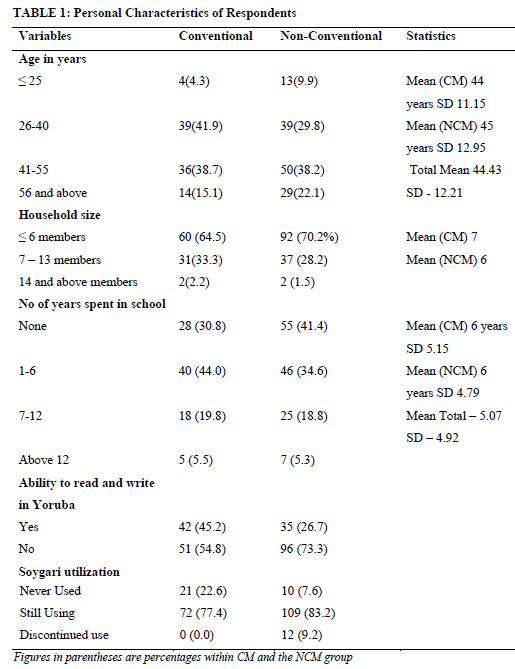
On the other hand, the mean age of women in the NCM group was 45 years, and only 9.9% were below 25 years of age (Table 1). About 70% had between one and six members in their households. Nearly 23% had more than six years of formal schooling, while 73.3% could neither read nor write the language of dissemination. Fewer respondents (7.6%) compared to the CM group of 22.6% had not attempted use of the information, while a handsome percentage (83.2%) still utilised disseminated information when data was collected. There were 9.2% cases of discontinued use of SNI among the women. Considering the mean age, the minimal household size, and the years of schooling experience of the women from the two groups, there is the possibility of achieving information clarity and media appreciation faster and longer. Schooling experience has a way of training an individual's mind to accommodate new information. It is therefore expected that the schooling experience of the women would enhance their analytical mind and acceptance of SNI through either conventional or non-conventional media.
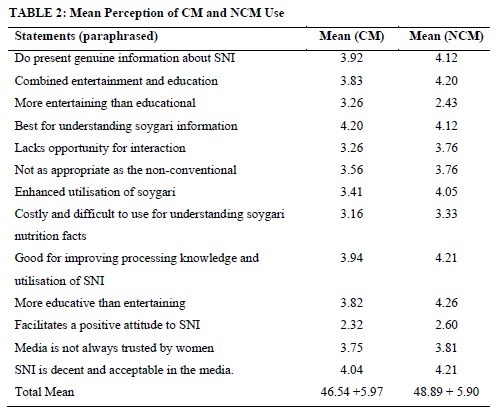
4.2. Perception of Media Used for SNI
Table 2 presents the respondents' selective perception of conventional media uses related to the retention of SNI disseminated. The table reveals that the highest level of agreement was that the audio and video information best understood SNI ( =4.20) and presents soygari information in a decent and acceptable way (
 =4.04). More responses agreed that the media facilitates knowledge of processing and utilisation (
 =3.94). The least mean aggregate was that the conventional media facilitated a positive attitude to SNI (
 =2.32) among most respondents. Likewise, mean responses to analytical issues that culminated in retention of SNI for the NCM are shown in Table 2. Women opined that the practical demonstrations decently present SNI (
 =4.21) and enhanced knowledge of processing and utilisation of information (
 =4.21). This result implies that non-conventional media is better for knowledge gain and encourages internalisation of nutrition information. However, respondents least agreed that non-conventional media is more entertaining than educational for SNI (
 =2.43). These issues were rated in mean values and put together to inform the women's level of perception of the media.
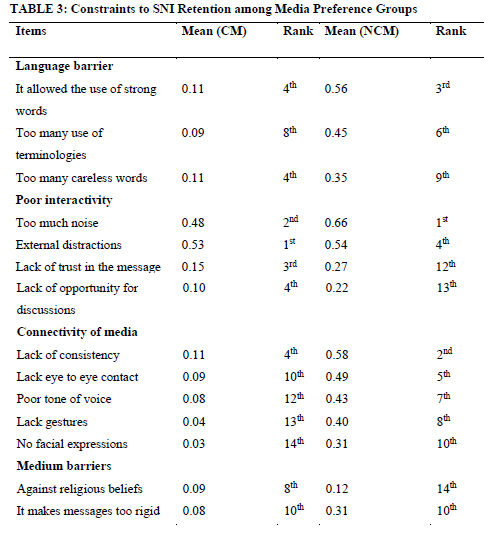
4.3. Constraints to Media Selection and Information Retention
Table 3 presents the constraints identified by respondents from the media used to disseminate SNI. Respondents exposed to conventional media (audio and video) ranked external distractions highest ( = 0.53) among other constraints. Other constraints ranked high by respondents in the conventional group include too much noise (
 = 0.48) and lack of trust in the message (
 = 0.14). On the other hand, respondents from the non-conventional media group ranked too much noise (
 = 0.66) and lack of consistency in message (
 = 0.58) as the first and second highest constraints.
4.4. Determinants of the Perception of CM and NCM Used for SNI
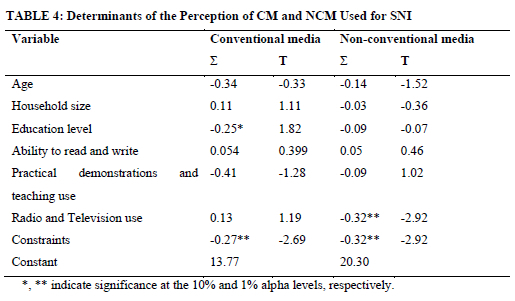
The regression model (Table 4) is significant at the 5.00 percent level. It shows variables on the perception of conventional and non-conventional methods utilised for soygari dissemination. Educational level (Σ = -0.25) and constraints (Σ= - 0.27) influenced the perception of conventional methods utilised while only constraints faced (Σ =-0.32) influenced the perception of non-conventional media use. The influence of constraints and educational level was negative on the perception of conventional methods utilised, and the presence of identified constraints was negative on the analytical perception of non-conventional media use. Audio and television use (Σ =-0.32) influenced the perception of non-conventional media use. The influence of educational level was negative on the perception of conventional methods utilised, and exposure to television and radio was negative on the analytical perception of non-conventional media use. The higher the education level of respondents, the more negative the perception of the conventional methods. The audio and video dissemination methods might not be comprehensive enough for the audience with a higher education level, as they appeal more to the non-educated. The trust, regard, and confidence reposed in the community/women elder as a source of valid information could discourage using mediated information, especially on vital issues such as diet. Television and audio's negative but significant influence on the perception of non-conventional methods suggests an analytical conflict between the television messages and unmediated practical demonstrations. The presentation, the expressions, and possible distractions are some unique factors that differentiate the two mediums of information.
5. DISCUSSION
Household size has implications for rural household welfare and nutrition, as families with more members are less likely to be nutritionally secure due to high competition for available resources (Olayemi, 2012). Likewise, Ede et al. (2019) affirmed that a household tends to be poor as the younger ones increases. Reducing rural household nutritional deficiency problems in the face of the culture of multiple births lends credence to the various strategies to fortify local staples with essential nutrients, among which is the soygari innovation.
Likewise, an average large household size suggests a higher level of responsibility for the women in their homes. This position is in tandem with the assertion of Akinbile and Ikwuakam (2004) and Fadairo et al. (2020) that married women are more responsible as they show more commitment to developing their homes and community. Thus, such commitment to their homes should increase their interest in seeking more knowledge to enhance household nutrition status. This was corroborated by Soltani and Feali (2011), who posited a positive association between a woman's household size and participation in extension teaching.
A high level of literacy among most respondents is expected to positively influence their ability to understand and internalise nutritional messages, boosting the chances of achieving positive outcomes. On the other hand, a considerable proportion of the respondents with no formal education suggest that a lot is still required to achieve the fourth Sustainable Development Goal (SDG) of achieving universal quality education. This, however, could suggest low confidence in using the skill or poor quality of the basic education received.
This study further reveals that the average number of years spent in formal school by women was about five years, which could imply a low literacy level. The findings of Ocheni and Nwankwo (2012) posited that information in modern communication tools remains inaccessible due to the low literacy categories of rural targets. This implies that conventional media tools were not popular among the women and might not effectively disseminate vital information, such as nutrition information, targeting the rural populace.
The expression of perception of any opinion is mainly influenced by communal factors such as culture, norms and values, and an individual's education, knowledge and other socioeconomic factors (Giffor& Nilson, 2014). The unfavourable disposition of women to audio tapes and video used for SNI might be connected with the belief that the information is urban and only useful as entertainment for rural dwellers. On the other hand, a favourable perception of rural women of SNI disseminated through practical demonstration of preparation could be linked to familiarity with these mediums and the relative ease of access to the media types, as affirmed by Rahnavard (2016).
Comparing the mean perception to the two types of media, more women in the study had a positive perception of non-conventional media use for soygari intervention than conventional media. Access to some conventional tools in most African homes is limited because of different cultural or religious beliefs. In such homes, women are not regarded as having control over assets such as television and radio compared to their male counterparts. This demeanour dissuades women from using such tools and influences the negative disposition of the rural women to conventional media use for soygari.
As it influences perception, the level of literacy of women is reflected in this study. The relationship between educational level and perception of conventional media justifies the position of Campbell (2017) that a population will always consciously or unconsciously construe a message to support their original principle. The ability to read and write helps bring the knowledge of information received to bear on expressing ideas and interpreting concepts (Olanrewaju & Babalola, 2016). Rural women who can read and write would find internalising soygari nutrition information from either CM or NCM better than non-literate ones. Thus, the media type was utilised with little significance among the educationally exposed respondents. Olanrewaju and Babalola (2016) noted that literacy goes beyond the ability to read and write; it is a skill achieved through discourse and experience. Demonstrations and testimonies from users of soygari helped engage the non-users' minds to understand the content of the information, despite the media preference. Interactivity with participants was more displayed during demonstrations and teachings of SNI. This helps both literate and non-literate audiences retain the information. However, the discontinued use of information in NCM could be attributed to the inability to perfectly record and archive the information when needed, thus making the effect of information transient among recipients.
There were certain similarities in the constraints identified by both conventional and non-conventional groups. Items relating to poor interactivity of the media used were mainly indicated by respondents from the conventional group as more severe constraints. This is because these items are attracted first to the fourth ranks. This implies that poor interactivity in conventional media is a major barrier to message clarity and information retention. On the contrary, major constraints identified by respondents in the non-conventional media group were not centred around poor interactivity. Still, they ranged from poor interactivity to poor media quality and then to a language barrier. This finding suggests that non-conventional media is constrained by factors more concerned with the person(s) handling it and not with the media than conventional media. This position is corroborated by Kamba (2009), who states that several drawbacks, evident in how rural information services are coordinated, affect access to information in rural communities of Africa.
Exposure to the NCM was thus perfect for the immediate application of processing and utilisation of the SNI. Frequent exposure to the same information allowed further analysis of the information and appreciation of the CM used. Lwoga, Stilwel and Ngulube (2011) posited that frequent treatment of a regular dose of information reinforces people's knowledge on any development issue. Thus, sustained retention of information is possible with the use of CM.
6. SUMMARY OF FINDINGS
The study found a disparate perception of the potency of Conventional media (CM) and Non-conventional media (NCM) tools for use in Soygari Nutrition Information (SNI). The arrays of challenges were perceived to influence the understanding and the use of SNI disseminated from both media tools. These constraints for CM are centred on the poor interactivity of the tools with the participants. At the same time, arrays of challenges were perceived to influence effective communication for NCM, ranging from poor interactivity and poor connectivity to a language barrier. These factors, including the type of tools used for both Conventional and Non-conventional Media, contributed significantly to the perception of the media used for SNI among the women.
7. CONCLUSION
The study concludes that each NCM and CM carried a weight that influenced understanding at different levels. The respondents perceived the NCM to present more genuine information, although it combines entertainment with education, and is more educative for disseminating practical knowledge and understanding of the processing of SNI. The CM was perceived to have the potential to improve the abstraction knowledge of SNI, but not the practical. Furthermore, the study found that the challenges to NCM ranged from poor interactivity (too much noise), a lack of consistency in dissemination procedures and the possibility of a language barrier. For CM, all the perceived constraints were centred on poor interactivity. The women in the non-conventional group perceived that the option of audio and video played a significant but negative role in understanding SNI. The constraints identified were also perceived to positively influence understanding of information for both media types.
8. RECOMMENDATIONS
The study recommends the following:
• Nutrition information campaigns should emphasise the use of NCM or the traditional tools for dissemination to ensure better utilisation and understanding.
• In using NCM, arrays of distractions such as proper connectivity with the participants, language connectivity with the participants, language barriers and inconsistencies/repetitions should be reduced.
REFERENCES
AKINBILE, L.A. & IKWUAKAM, O.T., 2004. Contributions of women to rural development in Orlu Local Government Area of Imo State and Nigeria's Democratic Experience. Nigeria J. Rural Sociol., 4(1 & 2): 34-40. [ Links ]
CAMPBELL, R., MARTIN, C.R. & FABOS, B., 2017. Media & culture: Mass communication in a digital age (11th Edition). Boston and New York: Bedford/St. Martin's. [ Links ]
EBAH-DJEDJI, C., KOUADIO, C., MARIA, K., YAPI, Y. AND GRODJI, G., 2021. Nutritional and Antioxidant Potential of «ATTIÉKÉ» (Cassava semolina): Enriched with Soybean. Int. J. Food Sci. and Nutr., 6(6): 1-9. [ Links ]
EDE, M.O., UGWOEZUONU, A.U., ANOWAI, C.C., NWOSU, N., EGENTI, N., UZOAGBA, N.C., EDE, K.R., AGU, M.A., IFELUNNI, C. & OKENYI, E.C., 2019. Sustainable health counselling strategies for reducing the impact of malnutrition among rural children in Nigeria. Glob. J. Health Sci., 11(8): 8-16. [ Links ]
FADAIRO, A.O., OYEBODE, L.A. & AMUSAT, A., 2020. Access to nutrition information: a key to improving nutrition status among under-five children in farming households of Oyo State, Nigeria. Agric. Trop. Subtrop., 53(1): 29-37. [ Links ]
FASOYIRO, S., WIDODO, Y. & KEHINDE, T., 2011. Processing and utilisation of legumes in the tropics. In A.H.A. Eissa (ed.), Trends in vitalfood and control engineering. Croatia: InTechOpen, pp. 71-84. [ Links ]
GALHENA, D.H., FREED, R. & MAREDIA, K.M., 2013. Home gardens: A promising approach to enhance household food security and wellbeing. Agric. Food Secur., 2(8). [ Links ]
GAVARAVARAPU, S.M., 2019). Nutrition communication - Rhetoric and reality. Indian J. Med. Res., 149(3): 333-344. [ Links ]
GIFFORD, R. & NILSON, A., 2014. Personal and social factors that influence pro-environmental concern and behavior: A review. Int. J. Psychol., 10: 1- 17. [ Links ]
GUTTMAN, O.T., LAZZARA, E.H., KEEBLER, J.R., WEBSTER, K.L., GISICK, L.M. & BAKER, A.L., 2021. Dissecting communication barriers in healthcare: A path to enhancing communication resiliency, reliability, and patient safety. J Patient Saf., 17(8): e1465-e1471. [ Links ]
HASSAN, A., KHAN, M.H. & ZIBERI, D., 2021. Communication barriers and processes of feedback in social interventions. Int. J. Media Inf. Lit., 6(1): 100-110. [ Links ]
JAYA, G., LAKSHMI, S.B. & DILEEP KUMAR, G., 2021. An analysis of students' perception and usage of social media in agriculture. Guj. J. Ext. Educ., 32(1): 58 - 62. [ Links ]
KAMBA, M.A., 2009. Access to information: The dilemma for rural community development in Africa or rural community development in Africa. Available from http://smartech.gatech.edu/jspui/bitstream/1853/36694/1/1238296264_MA.pdf [ Links ]
KWAME, A. & PETRUCKA, P.M., 2021. A literature-based study of patient-centered care and communication in nurse-patient interactions: Barriers, facilitators, and the way forward. BMC Nurs., 20: 158. [ Links ]
LAURA-SCHENCK, M.A., 2011. Improve communication with emotional awareness. Available from www.mindfulnessmuse.com [ Links ]
LWOGA, E.D., STILWELL, C. & NGULUBE, P., 2011. Access and use of agricultural information and knowledge in Tanzania. Libr. Rev., 60(5): 383-395. [ Links ]
NWABUEZE, Q.I., 2024. Applying community mass media for the promotion of agribusiness in Nigeria. Mdooter J. Commun. Dig. Technol., 1(1): 13 - 23. [ Links ]
OGUNSUMI, L.O., 2008. Analysis of extension activities on farmers' productivity in Southwest, Nigeria. Afr. J. Agric. Res., 3(6): 469-476. [ Links ]
OLANREWAJU, E.O. & BABALOLA, E.T., 2016. Gendered English Usage in the Nigerian Newspapers. Br. J. Engl. Lang. Linguist., 4(1): 1 - 18. [ Links ]
OLAWUYI, I.F., OLAPADE, G.M., KARIM, O.R., ABIODUN, O.A., SALAMI, K.O. & AKINTAYO, O.A., 2024. Nutritional, anti-nutritional, and sensory properties of Cowpea Hull-Enriched Gari. Ceylon J. Sci., 53(1): 51-67. [ Links ]
OYEWOLE, O.E. & ATINMO, T., 2015. Nutrition transition and chronic diseases in Nigeria. ProcNutr Soc., 74(4): 460-465. [ Links ]
QUAIDOO, E.Y., OHEMENG, A. & AMAKWAH-POKU, M., 2018. Sources of nutrition information and level of nutrition knowledge among young adults in the Accra Metropolis. BMC Public Health, 18: 1323. [ Links ]
RAHNAVARD, B., 2016. Identifying the main factors influencing the audience satisfaction by new media technologies. Online J. Commun. Media Technol., 6(1): 64-76. [ Links ]
SOLTANI, A.A. & FEALI, S., 2011. Factors influencing rural women participation in agricultural extension programs, case study Mazandaran, Iran. Int. J. Agric. Sci., 2(4): 17-24. [ Links ]
UGWU, D.S. & NWOKE, U.M., 2011. Assessment of soybean products acceptability and consumption in Orumba South Local Government Area of Anambra State Nigeria. Int. Res. J. Agric. Sci. Soil Sci., 1(8): 314-325. [ Links ]
ZHOU, A.D., SHAH, T., ALI, S., AHMAD, W., UD DIN, I. & ILYAS, A., 2019. Factors affecting household food security in rural northern Hinterland of Pakistan. J. Saudi Soc. Agric. Sci., 18(2): 201-210. [ Links ]
 Correspondence:
A.O. Fadairo
Correspondence Email: anjolaorefadairo@gmail.com
