



Services on Demand
Journal

Article
 English (pdf)
 Article in xml format
 Article references
 Automatic translation
 Send this article by e-mail
Indicators
Related links
-
 Cited by Google
 -
 Similars in Google
Share

 Permalink
South African Journal of Animal Science
On-line version ISSN 2221-4062Print version ISSN 0375-1589
S. Afr. j. anim. sci. vol.54 n.5 Pretoria 2024
https://doi.org/10.4314/sajas.v54i5.02
Effects of Broussonetia papyrifera leaf extract on the immunity and gut microflora of cyclophosphamide-induced immunosuppressed mice
Ping Jiang; Guangpei Xu; Yanfei He; Ruihua Zuo; Chuanbo Sun
College of Biological and Pharmaceutical Engineering, West Anhui University, Lu'an 237012, PR China
ABSTRACT
This experiment was conducted to determine the effects of Broussonetia papyrifera leaf water extract on the immunity and gut microflora of cyclophosphamide-induced immunosuppressed mice. Forty female ICR mice were randomly divided into five groups (n = 8) as follows: the blank control (BC) group, the cyclophosphamide-induced immunosuppression model (CTX) group, and the low (BPL), medium (BPM), and high (BPH) dose B. papyrifera extract treatment groups. B. papyrifera leaf water extract was administered intragastrically to the BPL, BPM, and BPH groups at 2, 4, and 8 g/kg body weight, respectively, once a day for 14 days. From day 12, all except the BC group mice were injected with 50 mg/kg cyclophosphamide once a day for three days. Results showed that administering B. papyrifera leaf extract significantly enhanced the levels of white blood cells, lymphocytes, monocytes, neutrophils, IgG, and IgM, compared with the CTX group. The B. papyrifera leaf extract also restored the gut microbiota composition by decreasing the relative abundances of Lactobacillus, Lachnospiraceae NK4A136 group, Roseburia, Lachnospiraceae uncultured, Lachnoclostridium, and Anaerotruncus, and increasing the relative abundances of Bacteroidales S24-7 group norank, Desulfovibrio, Akkermansia, Enterorhabdus, Blautia, and Romboutsia in the cyclophosphamide-induced immunosuppressed mice. These findings suggest that B. papyrifera leaf extract can be used as an immunomodulator of the gut microbiota, with the potential to promote animal health.
Keywords: Broussonetia papyrifera, cyclophosphamide, gut microbiota, immunological function
Introduction
Broussonetia papyrifera, the Moraceae plant, is a Chinese medicinal herb valued for its leaves, fruits, seeds, roots, and bark; it can also be used as drug and fodder crop, and is recorded in the Mingyi Bielu. In traditional Chinese medicine, the leaves of B. papyrifera have the functions of clearing heat, cooling blood, and removing dampness, among others (Zhu et al., 2011). Additionally, B. papyrifera leaves are rich in terpenoids, volatile oils, lignins, flavonoids, alkaloids, fatty acids, and amino acids, among other naturally occurring active compounds (Feng et al., 2008; Wang et al., 2012). In terms of pharmacological activity, Malaník et al. (2020) found that B. papyrifera relieved the inflammatory response in LPS-stimulated THP-1 cells and exhibited the greatest antioxidant effect, as measured using the cellular antioxidant activity assay. Furthermore, B. papyrifera polyphenols efficiently inhibited the catalytic activity of SARS CoV-2 (Ghosh et al., 2021). Zhou et al. (2020) found that B. papyrifera leaves regulated the dominant fungal communities of Ascomycota and Basidiomycota in the gut microbiome of grass carp. This research indicates that the B. papyrifera has some officinal value.
Cyclophosphamide is an immunosuppressive drug that causes multiple immunosuppressive diseases and organ damage in humans and animals (Miller, 1997; Voelcker, 2020). Ying et al. (2021) found that cyclophosphamide can significantly reduce the immunological factor levels of IFN-γ, TNF-α, and IL-6, and increase the abundance of Firmicutes and Proteobacteria and decrease the abundance of Bacteroidetes in cyclophosphamide-treated mice. Therefore, it is possible for the animal immunosuppressive model that is established by cyclophosphamide to be used to investigate the pesticide effect of an immunopotentiator. Thus, B. papyrifera leaf extract was fed to cyclophosphamide-induced immunosuppressed mice, and the immune response and gut microbiome were analysed to provide a theoretical basis for the clinical application of this extract in animal production.
Materials and Methods
The experimental protocol of this study was approved by the Animal Ethics Committee of West Anhui University, and the experimental procedures complied with the relevant provisions of the Chinese Guidelines for the Welfare and Ethics of Laboratory Animals. All mice were kept in an environment maintained at 22 ± 2 °C, with the humidity maintained at 50% and 12 hours of light per day. All mice had ad libitum access to feed and water.
B. papyrifera leaves were collected from the plantations of the Anhui Baochu Eco-Agriculture Technology Co., Ltd. The leaves were dried in an electrically heated drying cabinet at 60 °C, after which 500 g of leaves were first soaked in 9 L of distilled water and then extracted twice by reflux condensation (60 min at 100 °C). The filtrate was then concentrated to 1 g/mL using a rotary evaporator (RE52AA, Shanghai Yarong) at 60 °C and stored at -20 °C.
Forty female ICR strain mice were divided into the following five groups (n = 8) according to the random number table method: (1) the blank control group (BC), (2) the cyclophosphamide-induced immunosuppressed model group (CTX), (3) the low dose B. papyrifera treatment group (BPL), (4) the medium dose B. papyrifera treatment group (BPM), and (5) the high dose B. papyrifera treatment group (BPH). The BPL, BPM, and BPH treatment groups were administered B. papyrifera leaf water extract intragastrically at 2, 4, and 8 g/kg body weight, respectively, and the BC and CTX groups were administered equal amounts of saline intragastrically, once a day, continuously, for 14 days. From day 12, all except the BC group mice were intraperitoneally injected with 50 mg/kg cyclophosphamide once a day, continuously, for three days, and the BC group received equivalent normal saline until all the mice were sacrificed. At the end of the trial period, blood samples were collected in anticoagulant vials to calculate the white blood cell (WBC) count using a Mindray Hematology Analyzer (BC-2600vet, Shenzhen, China), and in non-anticoagulant vials for the immediate separation and collection of the serum. Caecal faeces samples were also collected for 16S rDNA sequencing.
The serum IgG and IgM antibodies were measured using enzyme-linked immunosorbent assay (ELISA) kits according to the operating instructions (Lu et al., 2019), purchased from the MultiSciences (Lianke) Biotech, Co., Ltd (Hangzhou, China).
Total faecal DNA was extracted using the CTAB method (Yu et al., 2022). The DNA was then diluted uniformly to 100 ng^L for PCR to detect the targeted genes. PCR was performed using a commercial protocol amplification kit (TransGen, China), with the 50 μL reaction mixture containing 100 ng DNA extract, 1x TransStart FastPfu buffer, 20 pmol primers, 2.5 μM dNTP, and 2.5 units of TransStart FastPfu DNA polymerase. A sequence library was generated by purifying, quantifying, and homogenizing the PCR product (Maughan et al., 2012). The finished library was checked using a library quality test and sequenced using the Illumina PE250. The original 16S rDNA sequencing data underwent splicing, followed by mass filtering of the spliced sequences and removal of chimeras to obtain high-quality tag sequences. The sequences were clustered at a 97% similarity level, and a threshold of 0.005% of all sequences was used to filter operational taxonomic units. The bacterial community was annotated using the RDP Classifier software based on information from the Silva database (Maidak et al., 1996; Quast et al., 2013).
All data are expressed as the mean ± standard deviation (SD), and SPSS 19.0 was used for data analysis. Differences between groups were compared using one-way ANOVA, and the Duncan method was used for multiple comparisons. A P-value of less than 0.05 was considered statistically significant.
Results
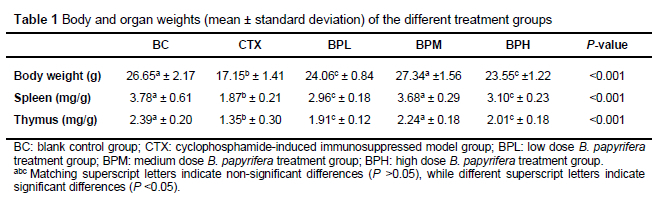
The body weights and spleen and thymus indices were significantly lower in the CTX group than in the BC group. Following treatment with B. papyrifera leaf extract, the body weights and spleen and thymus indices in the BPL, BPM, and BPH groups were significantly higher than in the CTX group (Table 1). These results show that B. papyrifera leaf extract could significantly improve the body weight and the spleen and thymus index of cyclophosphamide-induced immunosuppressed mice.
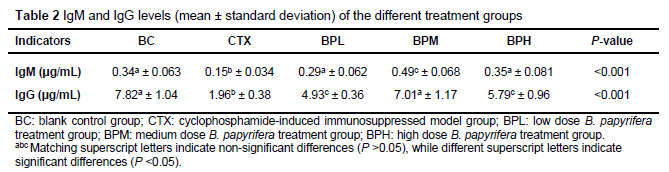
Cyclophosphamide can cause severe immunosuppression in humans and animals, and the results demonstrated that the serum IgM and IgG levels in the CTX group were significantly lower than in the BC group, indicating that immunosuppressed mice were successfully produced. B. papyrifera leaf extract was used to treat the CTX mice, and the results showed that the serum IgM and IgG levels in the BPL, BPM, and BPH groups were significantly higher than in the CTX group, as shown in Table 2.
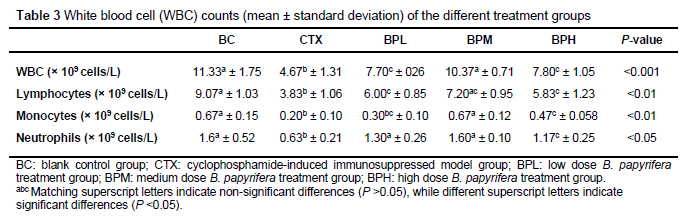
WBC mainly consist of lymphocytes (Lymph#), monocytes (Mon#), and neutrophils (Gran#), and their counts are often used as an important haematological indicator of immunity. The results showed that the counts of WBC, Lymph#, Mon#, and Gran# in the CTX group were significantly lower than in the BC group, whereas the counts of WBC, Lymph#, Mon#, and Gran# in the BPM and BPH groups were significantly higher than in the CTX group, and the counts of WBC, Lymph#, and Gran# in the BPL group were significantly higher than in the CTX group, as shown in Table 3.
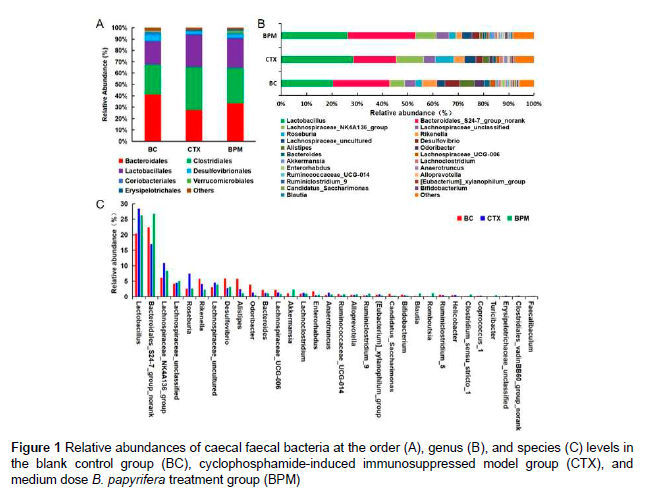
As shown in Figure 1, the bacterial community was similar between the treatment groups at the order level, with all five groups containing Bacteroidales, Clostridiales, Lactobacillales, Desulfovibrionales, Coriobacteriales, Verrucomicrobiales, and Erysipelotrichales. However, the relative abundance of Bacteroidales in the CTX group (27.61%) was lower than in the BC (41.31%) and BPM (33.32%) groups, and the relative abundance of Clostridiales in the CTX group (37.94%) was higher than in the BC (26.37%) and BPM (31.36%) groups. Lactobacillales was higher in the CTX group (28.50%) than in the BC (20.44%) and BPM (26.27%) groups. These data indicate that Bacteroidales, Clostridiales, and Lactobacillales were the most abundant bacteria in all groups, and that B. papyrifera leaf extract administration can increase the relative abundance of Bacteroidales, and decrease the relative abundances of Clostridiales and Lactobacillales at the order level.
Regarding genera, Lactobacillus, Bacteroidales, Lachnospiraceae (NK4A136 group, unclassified, uncultured and UCG-006), Roseburia, Rikenella, Desulfovibrio, Alistipes, Odoribacter, and Bacteroides were identified as the nine most prevalent genera in the samples. After analysing the relative abundances of the bacterial community, the Bacteroidales S24-7 group norank, Rikenella, Desulfovibrio, Alistipes, Odoribacter, Bacteroides, Lachnospiraceae UCG-006, Akkermansia, Enterorhabdus, Blautia, and Romboutsia were found to be lower in the CTX group than in the BC group, and the Bacteroidales S24-7 group norank, Desulfovibrio, Akkermansia, Enterorhabdus, Blautia, and Romboutsia were found to be higher in the BPM group than in the CTX group. The relative abundances of Lactobacillus, Lachnospiraceae (NK4A136 group, uncultured, and unclassified), Roseburia, Lachnoclostridium, Anaerotruncus, and Ruminiclostridium 9 were higher in the CTX group than in the BC group, and Lactobacillus, Lachnospiraceae (NK4A136 group and uncultured), Roseburia, Lachnoclostridium, and Anaerotruncus were lower in the BPM group than in the CTX group. These results demonstrated that B. papyrifera leaf extract administration can improve the structure of the gut bacterial community in cyclophosphamide-induced immunosuppressed mice.
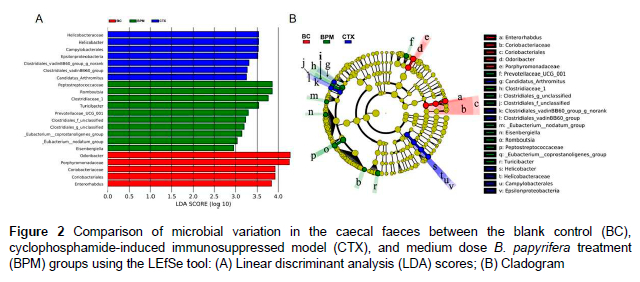
As shown in Figure 2, the overall bacterial community was significantly affected by B. papyrifera leaf extract administration. Coriobacteriales, Enterorhabdus, Porphyromonadaceae, and Odoribacter, which were most abundant in the BC group, and Epsilonproteobacteria, Helicobacter, Candidatus Arthromitus, Campylobacterales, and Clostridiales, which were most abundant in the CTX group, and Prevotellaceae, Eisenbergiella, Peptostreptococcaceae, Eubacterium, Romboutsia, Turicibacter, and Clostridiales, which were most abundant in the BPM group, were the dominant microflora that contributed to the differences between the groups.
Discussion and Conclusions
Traditionally, B. papyrifera leaves were known as herbs for clearing heat, cooling the blood, and removing dampness, and are they are recorded in Mingyi Bielu as being used to treat the diseases of enteritis and dysentery, as well as severe nosebleeds. Furthermore, B. papyrifera has been shown to effectively enhance the immunity of carp and mice (Chen et al., 2020; Xu et al., 2023). The composition and homeostasis of the gut microbiota also influences the human and animal immune system, especially in cases of immunosuppressive diseases. Recent research has produced evidence that herbal medicine can regulate and control immunological function in immunosuppressed humans and animals, and, in particular, has shown a positive therapeutic effect in patients with systemic lupus erythematosus and intestinal dysbacteriosis (Dhanisha et al., 2020; Wei et al., 2021; Chen et al., 2021). This study therefore aimed to evaluate the immunopotentiation potential of B. papyrifera leaf extract, as well as its effects on the regulation of gut microorganisms. The effects of administering the extract on immune cells, immunoglobulins, and the gut microbiota were also investigated to explore the mechanisms of immunoenhancement. The results suggest that B. papyrifera leaf extract is a promising immunomodulating and microbial community regulating agent.
Cyclophosphamide can cause severe immunosuppression in humans and animals, resulting in the inhibition of haematological immune-related factors, such as immune cells and immunoglobulins (Legrand et al., 2013; Qi et al., 2018). To verify the success of the immunosuppressive model, the WBC count in the blood and the IgG and IgM antibody levels in the serum were determined. The results showed that the counts of WBC, Lymph#, Mon#, Gran#, IgG, and IgM in the CTX mice were significantly lower than in the BC mice, indicating that immunosuppressed mice were successfully produced.
The homeostasis of the gut microbiome is involved in a number of life activities, including the immune response, nutrient uptake, and biological rhythm (Leser et al., 2009; Pickard et al., 2017; Kuang et al., 2019; Matenchuk et al., 2020; Bishehsari et al., 2020). Furthermore, gut microorganisms are closely related to disease onset and development (Gomaa, 2020; Lee et al., 2021). Conversely, the pathogenic factor of immune diseases such as lupus erythematosus, Behçet's disease, and Hashimoto's thyroiditis can destroy the homeostasis of gut microbiome (Ye et al., 2018; Virili et al., 2018; Chen et al., 2021). The homeostasis of the gut microbiota therefore has a strong correlation with immunity.
In this research, the relative abundances of some microbes, including Bacteroidales S24-7 group norank, Rikenella, Desulfovibrio, Alistipes, Odoribacter, Bacteroides, Lachnospiraceae UCG-006, Akkermansia, Enterorhabdus, Blautia, and Romboutsia were lower, and Lactobacillus, Lachnospiraceae NK4A136 group, Lachnospiraceae unclassified, Roseburia, Lachnospiraceae uncultured, Lachnoclostridium, Anaerotruncus, and Ruminiclostridium 9 were higher in the CTX group, demonstrating that cyclophosphamide disrupted the homeostasis of the gut microbiota. Maintaining the homeostasis of the gut microbiome is particularly important for human and animal health. Fortunately, several studies have shown that herbs can effectively regulate and control the balance of the human and animal gut microbiota. Wang et al. (2019) found that essential oil, limonene, linalool, and citral improved the prevalence of Lactobacillus in the caeca and colons of mice, and polysaccharides from Auricularia auricula restored the composition of the gut microbiome to close to normal levels by decreasing the ratio of Firmicutes/Bacteroidetes in cyclophosphamide-induced immunosuppressed mice (Kong et al., 2020).
Our study similarly found that B. papyrifera leaf extract had positive effects on immunity, increasing the WBC, Lymph#, Mon#, Gran#, IgG, and IgM counts in immunosuppressed mice. In mice treated with B. papyrifera leaf extract, the relative abundances of Bacteroidales S24-7 group norank, Desulfovibrio, Akkermansia, Enterorhabdus, Blautia, and Romboutsia were higher, and the relative abundances of Lactobacillus, Lachnospiraceae NK4A136 group, Roseburia, Lachnospiraceae uncultured, Lachnoclostridium, and Anaerotruncus were lower. These results demonstrate that the B. papyrifera leaf extract can improve the structure of the caecum's bacterial community in cyclophosphamide-induced immunosuppressed mice.
In this study, B. papyrifera leaf extract administration had immune-protective effects in cyclophosphamide-induced immunosuppressed mice by significantly increasing the counts of WBC, Lymph#, Mon#, Gran#, IgG, and IgM. Furthermore, the results suggested that this extract could help regulate the homeostasis of the gut microecological system in immunosuppressed mice. These findings suggest that B. papyrifera leaf extract can be used as an immunomodulator of the gut microbiota, with the potential to promote animal health.
Acknowledgements
This research was supported by the Key R & D Projects in Anhui Province in China (201904f06020008).
Authors' Contributions
Conceptualization, P.J.; methodology, P.J. and G.P.X.; validation, C.B.S.; formal analysis, P.J.; investigation, G.P.X.; resources, P.J.; data curation, P.J. and G.P.X.; writing-original draft preparation, P.J.; writing-review and editing, P.J.; supervision, C.B.S. and Y.F.H.; funding acquisition, R. H. Z. and P.J., All authors have read and agreed to the published version of the manuscript.
Conflict of Interest Declaration
The authors declare that they have no conflicts of interest relevant to the content of this paper.
References
Bishehsari, F., Voigt, R.M. & Keshavarzian, A., 2020. Circadian rhythms and the gut microbiota: from the metabolic syndrome to cancer. Nat. Rev. Endocrinol. 16(12), 731-739. doi: 10.1038/s41574-020-00427-4 [ Links ]
Chen, B.D., Jia, X.M., Xu, J.Y., Zhao, L.D., Ji, J.Y., Wu, B.X., Ma, Y., Li, H., Zuo, X.X., Pan, W.Y., Wang, X.H., Ye, S., Tsokos, G.C., Wang, J. & Zhang, X., 2021. An autoimmunogenic and proinflammatory profile defined by the gut microbiota of patients with untreated systemic lupus erythematosus. Arthritis Rheumatol. 73(2), 232-243. doi: 10.1002/art.41511 [ Links ]
Chen, X., Sun, W., Xu, B., Wu, E., Cui, Y., Hao, K., Zhang, G., Zhou, C., Xu, Y., Li, J. & Si, H., 2021. Polysaccharides from the roots of Millettia speciosa champ modulate gut health and ameliorate cyclophosphamide-induced intestinal injury and immunosuppression. Front. Immunol. 12, 766296. doi: 10.3389/fimmu.2021.766296 [ Links ]
Chen, J.J., Zhang, H.J. & Liu, N.N., 2020. Effects of wormwood leaf complex on growth and immune performance of carp before and after fermentation. J. Gansu Agr. Univ. 55(4), 7-13. doi:10.13432/j.cnki.jgsau.2020.04.002 [ Links ]
Dhanisha, S.S., Drishya, S. & Guruvayoorappan, C., 2020. Pithecellobium dulce fruit extract mitigates cyclophosphamide-mediated toxicity by regulating proinflammatory cytokines. J. Food Biochem. 44(1), e13083. doi: 10.1111/jfbc.13083 [ Links ]
Feng, W.S., Li, H.W., Zheng, X.K., Kuang, H.X., Chen, S.Q., Wang, Y.Z. & Zang, X.Y., 2008. Chemical constituents from the leaves of Broussonetia papyrifera. Acta Pharmaceutica Sinica. 43(2), 173-180. doi: 10.3321/j.issn:0513-4870.2008.02.012 [ Links ]
Ghosh, R., Chakraborty, A., Biswas, A. & Chowdhuri, S., 2021. Identification of polyphenols from Broussonetia papyrifera as SARS CoV-2 main protease inhibitors using in silico docking and molecular dynamics simulation approaches. J. Biomol. Struct. Dyn. 39(17), 6747-6760. doi: 10.1080/07391102.2020.1802347 [ Links ]
Gomaa, E.Z., 2020. Human gut microbiota/microbiome in health and diseases: a review. Antonie Van Leeuwenhoek. 113(12), 2019-2040. doi: 10.1007/s10482-020-01474-7 [ Links ]
Kong, X., Duan, W., Li, D., Tang, X. & Duan, Z., 2020. Effects of polysaccharides from Auricularia auricula on the immuno-stimulatory activity and gut microbiota in immunosuppressed mice induced by cyclophosphamide. Front. Immunol. 11, 595700. doi: 10.3389/fimmu.2020.595700 [ Links ]
Kuang, Z., Wang, Y.H., Li, Y., Ye, C.Q., Ruhn, K.A., Behrendt, C.L., Olson, E.N. & Hooper, L.V., 2019. The intestinal microbiota programs diurnal rhythms in host metabolism through histone deacetylase 3. Science. 6460, 1428-1434. doi: 10.1126/science.aaw3134 [ Links ]
Lee, M. & Chang, E.B., 2021. Inflammatory bowel diseases (IBD) and the microbiome-searching the crime scene for clues. Gastroenterology. 160(2), 524-537. doi: 10.1053/j.gastro.2020.09.056 [ Links ]
Legrand, J.J., Bouchez, C., Mimouni, C., N'Guyen, A., Bouchard, J., Ameller, T. & Descotes, J., 2013. Immunotoxic effects of cyclophosphamide and cyclosporine in the dog. J. Immunotoxicol. 10(1), 90-95. doi: 10.3109/1547691X.2012.723766 [ Links ]
Leser, T.D. & Mølbak, L., 2009. Better living through microbial action: the benefits of the mammalian gastrointestinal microbiota on the host. Environ. Microbiol. 11(9), 2194-2206. doi: 10.1111/j.1462-2920.2009.01941 .x [ Links ]
Lu, J., Wu, J., Xie, F., Tian, J., Tang, X., Guo, H., Ma, J., Xu, P., Mao, L., Xu, H. & Wang, S., 2019. CD4+ T cell-released extracellular vesicles potentiate the efficacy of the hbsag vaccine by enhancing b cell responses. Adv. Sci. 6(23), 1802219. doi:10.1002/advs.201802219 [ Links ]
Maidak, B.L., Olsen, G.J., Larsen, N., Overbeek, R., McCaughey, M.J. & Woese, C.R., 1996. The ribosomal database project (RDP). Nucleic Acids Res. 24(1), 82-85. doi: 10.1093/nar/24.1.82 [ Links ]
Malaník, M., Treml, J., Leláková, V., Nykodýmová, D., Oravec, M., Marek, J. & Smejkal, K., 2020. Anti-inflammatory and antioxidant properties of chemical constituents of Broussonetia papyrifera. Bioorg. Chem. 104, 104298. doi: 10.1016/j.bioorg.2020.104298 [ Links ]
Matenchuk, B.A., Mandhane, P.J. & Kozyrskyj, A.L., 2020. Sleep, circadian rhythm, and gut microbiota. Sleep Med. Rev. 53, 101340. doi: 10.1016/j.smrv.2020.101340 [ Links ]
Maughan, H., Wang, P. W., Diaz Caballero, J., Fung, P., Gong, Y., Donaldson, S.L., Yuan, L., Keshavjee, S., Zhang, Y., Yau, Y.C., Waters, V.J., Tullis, D.E., Hwang, D.M. & Guttman, D.S., 2012. Analysis of the cystic fibrosis lung microbiota via serial Illumina sequencing of bacterial 16S rRNA hypervariable regions. PloS One. 7(10), e45791. doi: 10.1371/journal.pone.0045791 [ Links ]
Miller, E., 1997. Immunosuppression--an overview. Semin. Vet. Med. Surg. Small Anim. 12(3), 144-149. doi: 10.1016/s1096-2867(97)80025-4 [ Links ]
Pickard, J.M., Zeng, M.Y., Caruso, R. & Núñez, G., 2017. Gut microbiota: Role in pathogen colonization, immune responses, and inflammatory disease. Immunol. Rev. 279(1), 70-89. doi: 10.1111/imr.12567 [ Links ]
Qi, Q.C., Dong Z.H., Sun, Y.Y., Li, S.Y. & Zhao, Z.X., 2018. Protective effect of bergenin against cyclophosphamide-induced immunosuppression by immunomodulatory effect and antioxidation in BALB/c mice. Molecules. 23(10), 2668. doi: 10.3390/molecules23102668 [ Links ]
Quast, C., Pruesse, E., Yilmaz, P., Gerken, J., Schweer, T., Yarza, P., Peplies, J. & Glöckner, F.O., 2013. The SILVA ribosomal RNA gene database project: improved data processing and web-based tools. Nucleic Acids Res. 41, D590-D596. dok 10.1093/nar/gks1219 [ Links ]
Virili, C., Fallahi, P., Antonelli, A., Benvenga, S. & Centanni, M., 2018. Gut microbiota and Hashimoto's thyroiditis. Rev. Endocr. Metab. Disord. 19(4), 293-300. doi: 10.1007/s11154-018-9467-y [ Links ]
Voelcker, G., 2020. Causes and possibilities to circumvent cyclophosphamide toxicity. Anticancer Drugs. 31(6), 617-622. doi: 10.1097/CAD.0000000000000912 [ Links ]
Wang, G.W., Huang, B.K. & Qin, L.P., 2012. The genus Broussonetia: a review of its phytochemistry and pharmacology. Phytother. Res. 26(1), 1-10. doi: 10.1002/ptr.3575 [ Links ]
Wang, L., Zhang, Y., Fan, G., Ren, J.N., Zhang, L.L. & Pan, S.Y., 2019. Effects of orange essential oil on intestinal microflora in mice. J. Sci. Food Agric. 99(8), 4019-4028. doi: 10.1002/jsfa.9629 [ Links ]
Wei, R., Liu, X., Wang, Y., Dong, J., Wu, F., Mackenzie, G.G. & Su, Z., 2021. (-)-Epigallocatechin-3-gallate mitigates cyclophosphamide-induced intestinal injury by modulating the tight junctions, inflammation and dysbiosis in mice. Food Funct. 12(22), 11671-11685. doi: 10.1039/d1fo01848e [ Links ]
Xu, G.P., Li, H.T., Deng, Q.Y., Liu, C.L., Jiang, P. & He, Y.F., 2023. Effects of cyclophosphamide on routine blood and blood biochemical indices in mice and interventional effects of Broussonetia papyrifera polysaccharides. Journal of Anhui Science and Technology University. 37(3), 76-82. doi: 10.19608/j.cnki.1673-8772.2022.0035 [ Links ]
Ye, Z., Zhang, N., Wu, C., Zhang, X., Wang, Q., Huang, X., Du, L., Cao, Q., Tang, J., Zhou, C., Hou, S., He, Y., Xu, Q., Xiong, X., Kijlstra, A., Qin, N. & Yang, P., 2018. A metagenomic study of the gut microbiome in Behcet's disease. Microbiome. 6(1),135. doi: 10.1186/s40168-018-0520-6 [ Links ]
Ying, M., Yu, Q., Zheng, B., Wang, H., Wang, J., Chen, S., Nie, S. & Xie, M., 2020. Cultured Cordyceps sinensis polysaccharides modulate intestinal mucosal immunity and gut microbiota in cyclophosphamide-treated mice. Carbohydr. Polym. 235, 115957. doi: 10.1016/j.carbpol.2020.115957 [ Links ]
Yu, C., Guo, C., Geng, X., Yao, Y., Guo, J., Zhang, Y., Zhang, J. & Mi, S., 2020. Effects of fruits and vegetables on gut microbiota in a mouse model of metabolic syndrome induced by high-fat diet. Food Sci. Nutr. 11(2), 794-805. doi: 10.1002/fsn3.3114 [ Links ]
Zhou, B.X., Zhao, L.J. & Peng, X.L., 2020. Study on the diversity of intestinal fungal community of grass carps fed with Broussonetia papyrifera leaves. Genomics and Applied Biology. 39(8), 3453-3460. doi: 10.13417/j.gab.039.003453 [ Links ]
Zhu, K.M., Liu, J., Gu, S.J. & Zhao, L., 2011. Progress on chemical constituents, pharmacological effects and clinical applications from Broussonetia papyrifera. Chin. J. Exp. Tradit. Med. Formulae. 17(1), 198-201+204. doi: 10.13422/j.cnki.syfjx.2011.01.060 [ Links ]
Submitted 29 March 2024
Accepted 9 September 2024
Published December 2024
# Corresponding author: Ping Jiang, e-mail address: jiangping0550@126.com