



Services on Demand
Journal

Article
 English (pdf)
 Article in xml format
 Article references
 Automatic translation
 Send this article by e-mail
Indicators
Related links
-
 Cited by Google
 -
 Similars in Google
Share

 Permalink
South African Journal of Animal Science
On-line version ISSN 2221-4062Print version ISSN 0375-1589
S. Afr. j. anim. sci. vol.55 n.4 Pretoria 2025
https://doi.org/10.4314/sajas.v55i4.02
Effects of propylene glycol and organic chromium on milk production and blood parameters in early lactation dairy cows
C. UyarlarI; A. RahmanII, III, #; I.S. CetingülI; E.E. GültepeI; M. KabuIV; M.Z. AnwarV; I. BayramI
IDepartment of Animal Nutrition, Faculty of Veterinary Medicine, Afyon Kocatepe University, ANS Campus, Afyonkarahisarar, Türkiye
IIDepartment of Animal Sciences, University of Veterinary and Animal Sciences, Jhang Campus, Pakistan
IIIKey Laboratory of Biochemistry and Molecular Biology, Weifang Key laboratory of Coho Salmon Culturing Facility Engineering, Weifang University, Weifang 261061, China
IVDepartment of Internal Diseases, Faculty of Veterinary Medicine, Afyon Kocatepe University, ANS Campus, Afyonkarahisarar, Türkiye
VDepartment of Livestock Management, PMAS Arid Agriculture University, Rawalpindi, Pakistan
ABSTRACT
This study assessed the effects of supplementing organic chromium (Cr), alone and in combination with propylene glycol (PG), on milk yield and blood chemistry in early lactation dairy cows. Thirty multiparous Holstein cows were randomly assigned to three treatments: control (CONT), Cr (1 g Cr/day), and Cr with PG (CrPG, 1 g Cr/day plus 125 mL liquid PG/day). The study started at calving and continued for three weeks postpartum. Drenching dairy cows with Cr and PG significantly improved fertility, with a decrease in the number of days to fall pregnant and a shorter calving interval. Cows administered CrPG had lower serum concentrations of urea, non-esterified fatty acids, beta-hydroxybutyric acid, alanine aminotransferase, and aspartate aminotransferase. Serum triglyceride and very-low-density lipoprotein levels were higher in the CrPG and Cr groups from day 12 after calving onwards, whereas high-density lipoprotein concentrations were higher in the CrPG and Cr groups from day nine onwards. Insulin levels were significantly higher in the CrPG and Cr groups than in the CONT group from the day of parturition to the ninth day postpartum, whereas from the 12th day onwards, insulin levels were significantly lower in the CrPG group. Gamma-glutamyl transferase levels only showed significant variation between the treatment groups on the third day after calving. Dietary supplementation with CrPG during early lactation improved fertility parameters and positively influenced energy metabolism by reducing non-esterified fatty acid and beta-hydroxybutyric acid concentrations and increasing insulin concentrations, thus protecting the dairy cows from subclinical metabolic disorders.
Keywords: cattle, Holstein, immunity, serum, transition period
Introduction
The transition period in dairy cows spans the last three weeks of gestation (the close-up dry period) and the first three weeks of lactation (Drackley, 1999; Atkinson, 2016). This period is challenging for cows and frequently leads to metabolic diseases and economic losses. Reduced feed intake, shrinkage of the rumen, and an increase in nutrient demand owing to milk production and stress factors during the transition period are intriguing issues to address. This heightened demand, coupled with reduced ruminal capacity, can result in rapid nutrient depletion. To maintain maximum milk yield and avoid metabolic diseases, cows must navigate these nutritional changes without complications (Overton & Waldron, 2004; Zebeli et al., 2015). When comparing the nutritional needs of a cow on the 250th day of pregnancy with those of a cow on the fourth day of lactation, the requirement for glucose increases approximately threefold, that for amino acids doubles, and that for fatty acids increases fivefold (Caton et al., 2019). The negative energy balance that develops after calving therefore results in the rapid depletion of body reserves. The body initiates several homeostatic reactions to counteract this depletion, the most important of which is gluconeogenesis (Mekuriaw, 2023). However, gluconeogenesis is insufficient to compensate for a significant energy deficit, leading to the rapid mobilisation of body fat, which enters the bloodstream as non-esterified fatty acids (NEFA) (Overton & Waldron, 2004).
The addition of glucose precursors to prepartum rations can protect cows from excessive adipose tissue mobilisation and subclinical ketosis. Propylene glycol (PG), a glucose precursor, is used to treat ketosis and reduce NEFA and beta-hydroxybutyric acid (BHBA) levels in the plasma. Administering PG during the dry period, along with feed restriction, or adding it to concentrated feed, is more effective than adding it to a total mixed ration (Overton & Waldron, 2004). Supplementation of PG at 150, 300, and 100 mL per day before parturition, on the day of parturition, and after parturition, respectively, effectively reduced the NEFA concentration in the blood before parturition and the BHBA concentrations both before and after parturition (Hoedemaker et al., 2004).
In addition to energy, trace minerals are also vital for metabolic activities and must be obtained from external sources (Spears 1996; Spears, 2008). Trace minerals can improve performance and have been shown to protect animal's vital organs against toxicity (Sozen et al., 2024; Al-Gheffari et al., 2024; Satti et al., 2024). For instance, chromium (Cr) is a component of the chromodulin protein, which aids in the transport of glucose to insulin-sensitive cells and plays a role in the activation of insulin receptors to improve cellular glucose uptake (Vincent, 2004). It has been postulated that Cr increases the number of insulin receptors and insulin binding at the site of action (Wang & Cefalu, 2010), and may influence glucose supply by modulating the effects of hepatic cellular respiration (García-Roche et al., 2019). Providing cows with more Cr than is required during early lactation can therefore protect them from ketosis. Organic Cr is utilised more effectively than inorganic Cr, with Cr-methionine chelates reducing NEFA levels and increasing milk yield (Hayirli et al., 2001; Bryan et al., 2004; Wu et al., 2021; Malik et al., 2023). Several studies on cattle have indicated that Cr supplementation can increase the glucose clearance rate (Sumner et al., 2007) or reduce insulin release (Stahlhut et al., 2006) following intravenous glucose administration. Chromium supplementation in cattle diets has also been shown to increase the immune response (Spears 1996; Spears, 2008) and increase feed intake and milk production in lactating dairy cows (Smith et al., 2005).
We hypothesised that supplementation with PG and organic Cr may improve milk production, metabolic state, and blood parameters in early lactation dairy cows by boosting energy metabolism and insulin sensitivity. Our second hypothesis was that a combination of PG and Cr may work synergistically to promote energy metabolism in early lactation dairy cattle. Therefore, the present study examined the effects of organic Cr and PG on milk yield and serum parameters by supplementing dairy cows with these substances during the transition period.
Materials and methods
The animal study protocol was approved by the Institutional Review Board of the Animal Ethics Committee of Afyon Kocatepe University (case no. B.30.2.AKÜ.0.A2.00.00/255), and the trial was designed to maintain the welfare of the animal subjects.
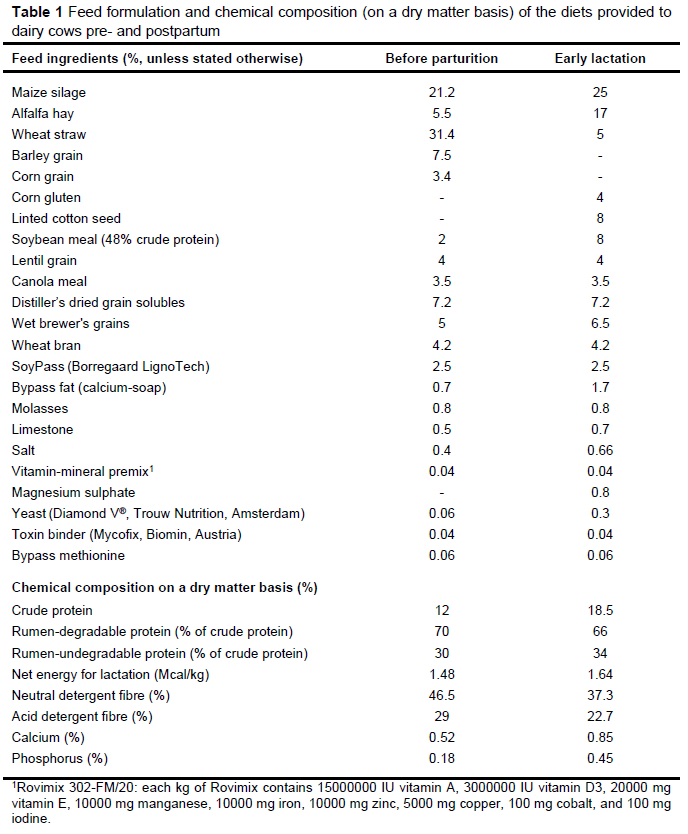
The research was conducted at a dairy farm in the Niğde Province, located at 34°42' E and 37°59' N, with a capacity of approximately 2000 dairy cows. Healthy, pregnant Holstein dairy cows in their third lactation were used. A total of 30 cows were selected and assigned to three groups based on their milk yield (27.67 ± 0.65 L/day), live weight (694.76 ± 11.27 kg), and body condition score (BCS: 3.29 ± 0.13), to ensure homogeneity within each group. The BCS was determined as previously described (Edmonson et al., 1989), and the cows were provided with standard pre- and postpartum diets (Table 1).
Three treatments were applied: the control (CONT), the Cr treatment, and the Cr plus PG treatment (CrPG). The cows in the CONT group were given only water to drink; the cows in the Cr group received 5 mg of elemental Cr per day, in the organic form (5 g Co-Factor III, 0.1%, Alltech, Ireland); and the cows in the CrPG group received 5 mg of elemental Cr per day, in the organic form (5 g Co-Factor III, 0.1%, Alltech, Ireland), along with 125 mL of pure liquid PG per day (95% purity, Synergy Tarım, İzmir, Turkey). Treatments were administered from the day of calving to 21 days postpartum, with the cows being provided with specific preparations according to their respective treatments throughout the study period. These preparations were administered via a 500 mL plastic bottle following morning feeding.
Samples of all the raw materials used in the ration were collected and analysed (Table 1). Analyses were conducted using proximate analysis methods for crude protein (no: 32.1.22, 920.87), crude fat (no: 32.2.01, F.4.5.01.920.39C), crude fibre (no: 920.86, 32.1.15), crude ash (no: 32.1.05, 923.03), and dry matter (no: 32.1.03, 925.10), as described by the Association of Official Analytical Collaboration (1990). Acid detergent fibre and neutral detergent fibre analyses were performed as reported by Georing & Van Soest (1970). Using the obtained data, net energy levels were calculated as described by Tse (1991) and Grummer (1993).
The daily milk yield per milking was recorded using a computer-controlled system (DairyPlan, GEA, Westfalia, Germany). Body condition score was calculated at 21 days of lactation, as described by Edmonson et al. (1989). Fertility parameters were determined using data from a computerised herd management system (DairyPlan, GEA), after an experimental period of 21 days.
Blood samples were collected from the coccygeal veins of all animals on days 0, 3, 6, 9, 12, 15, 18, and 21 of lactation, immediately before morning milking (06:50). Blood samples were collected in plain tubes (Venosafe, Terumo) without anticoagulant and were centrifuged for 15 minutes at 3000 rpm at room temperature to obtain serum. The serum samples were stored at -20 °C until analysis. Urea and glucose levels were measured using commercial kits (Roche Diagnostics, Germany) and a Roche Cobas c111 automatic analyser, while BHBA and NEFA levels were measured using a Chemwell 2910 automatic analyser (Chemwell, Florida, USA), with relevant kits from Randox Laboratories Ltd, UK. The levels of aspartate aminotransferase (AST), alanine aminotransferase (ALT), gamma-glutamyl transferase (GGT), high-density lipoprotein (HDL), low-density lipoprotein (LDL), very-low-density lipoprotein (VLDL), cholesterol (CHO), triglycerides (TG), Cr, and insulin were measured using commercial kits and an automatic analyser (Chemwell 2910).
Statistical analysis
The Kolmogorov-Smirnov test was used to test for adherence to a normal distribution, and, in the case of a non-normal distribution, the data were transformed to attain a normal distribution. Considering the sample size, the Kruskal-Wallis H test was used for comparisons between groups for each parameter in each period. To determine which specific periods exhibited differences between the groups, the Mann-Whitney U test was applied. The Friedman test was applied for dependent variables, to examine changes over time, and the Wilcoxon test was used to identify periods in which differences occurred within groups. The significance level was set at P <0.05. Data analyses were conducted using PASW Statistics software (version 18.0).
Results
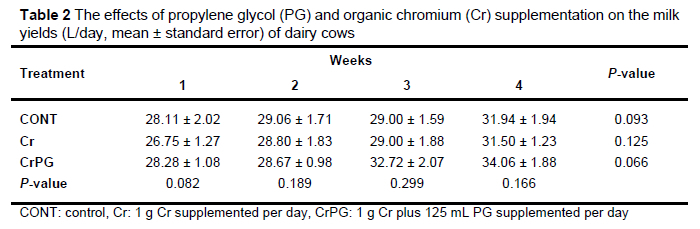
The milk yield was similar (P >0.05) for the three treatments, and did not differ between the weeks within each treatment (Table 2).
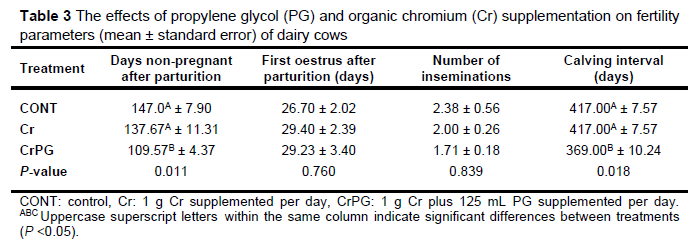
The number of days non-pregnant after parturition was significantly lower in the CrPG-supplemented cows than in the Cr and CONT cows. However, the number of days between parturition and first oestrus and the number of inseminations until pregnant were not affected (P >0.05) by the dietary treatments. The calving interval was shorter (P <0.05) in the CrPG cows than in the Cr and CONT cows (Table 3).
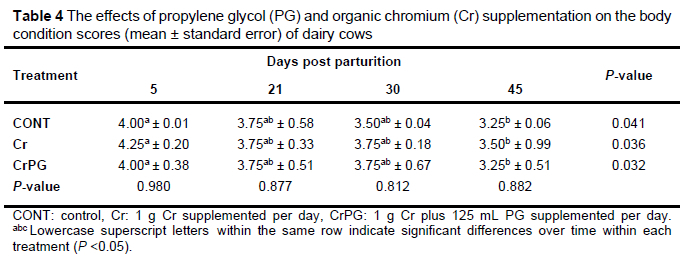
The effects of organic Cr and PG supplementation on the BCS of lactating dairy cows were measured after calving. No significant differences were observed between the treatments; however, significant differences within treatments were noted, indicating a decrease in the BCS as lactation progressed, owing to the increase in milk production (Table 4).
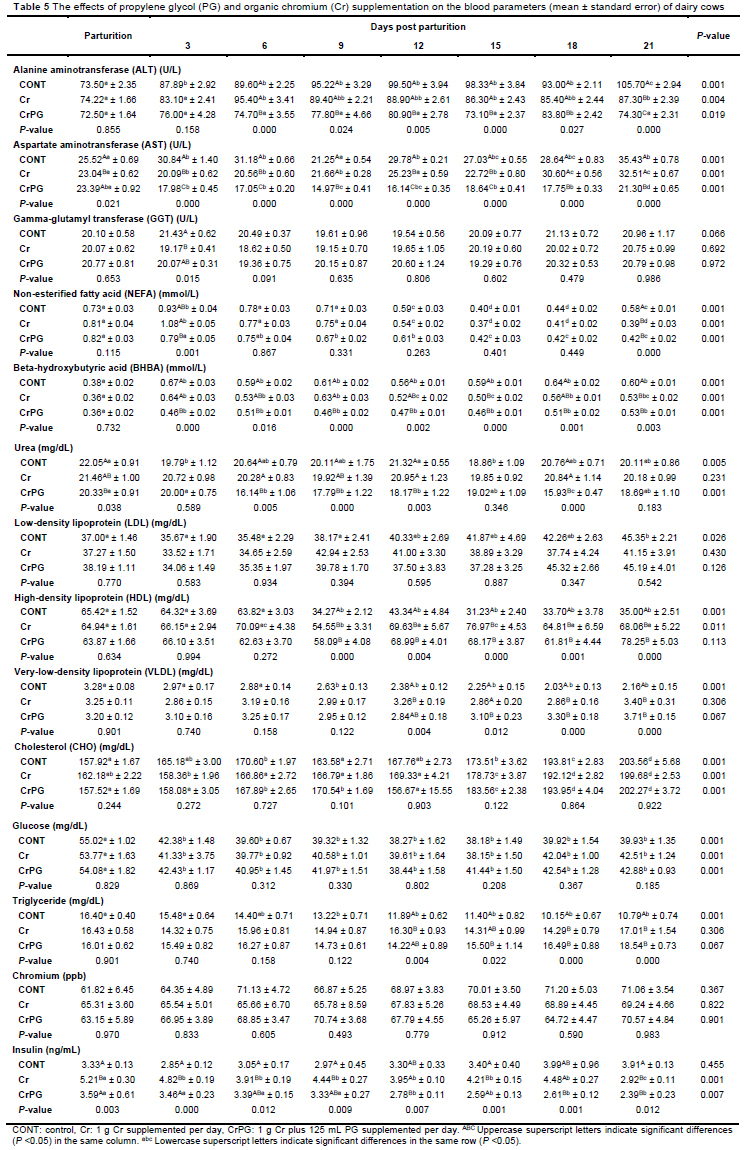
Some blood biochemical parameters exhibited significant time-dependent changes, both between and within treatments, including the AST, ALT, NEFA, BHBA, urea, HDL, VLDL, triglycerides, and insulin. When comparing the AST and ALT levels in the blood, significant differences between the treatments were observed from the sixth day onward and from the day of parturition onward, respectively. The AST and ALT levels were lower in the CrPG and Cr groups than in the CONT group. Within-group comparisons also revealed significant differences over time in the CONT, Cr, and CrPG groups (Table 5).
Serum NEFA concentrations were compared between the treatments on the different days, and significant differences were observed on the third and 21st days. The NEFA concentration in the CrPG group was lower than that in the Cr group on the third day (P <0.01), whereas on the 21st day, the two treatment groups had similar NEFA levels, and these were lower than those of the CONT (P <0.001). Within-treatment comparisons revealed significant differences over time in the CONT, Cr, and CrPG groups (Table 5).
Significant differences in serum BHBA concentrations were observed between the treatments on all measurement days, except for on the day of parturition. The lowest level was observed on the day of parturition (0.36 ± 0.02 mmol/L) in both the Cr and CrPG treatments, while the highest level was observed on the third day after parturition in the CONT group (0.67 ± 0.03 mmol/L). Within-treatment comparisons showed differences over time in the CONT, Cr, and CrPG groups (P <0.001) (Table 5).
When comparing serum urea levels between the treatment groups on different days, significant differences were observed on the day of parturition and on the sixth, ninth, 12th, and 18th days after parturition. Within-treatment comparisons showed time-dependent differences in the CONT and CrPG groups (P <0.01 and P <0.001, respectively); however, no difference (P >0.231) was observed over time in the Cr group (Table 5).
When comparing the serum HDL and VLDL concentrations between the treatment groups on different days, differences were observed from the ninth day onwards for HDL (P <0.05) and from the 12th day onwards for VLDL (P <0.05). Furthermore, HDL and VLDL concentrations were higher (P <0.05) in the CrPG and Cr groups than in the CONT group. Within-treatment comparisons showed differences over time in the CONT and Cr groups (P <0.001) for HDL and only in the CONT group (P <0.001) for VLDL (Table 5).
Serum triglyceride levels were also compared between the treatment groups on different days, and notable differences were observed on the 12th (P <0.05), 15th (P <0.05), 18th (P <0.001), and 21st days (P <0.001) after parturition. Triglyceride levels were significantly higher in the CrPG and Cr groups than in the CONT group. Within-treatment comparisons over time showed a decrease in the triglyceride concentration only in the CONT group (P <0.001) (Table 5).
Notable differences (P <0.05) in blood insulin concentrations were observed between and within the CrPG and Cr groups (P <0.01). Insulin levels were higher in both the CrPG and Cr groups than in the CONT group from the day of parturition to the ninth day after parturition. However, from the 12th day onwards, the insulin levels were lower in the CrPG group than in the CONT group (Table 5).
When comparing serum glucose and cholesterol concentrations between the treatment groups on different days, no differences were observed. However, within-treatment comparisons showed notable changes in the CONT, Cr, and CrPG groups (P <0.001). In all groups, glucose levels decreased, and cholesterol levels increased over time (Table 5).
Other blood biochemical parameters, such as the GGT, LDL, and Cr levels, were affected differently; however, GGT only showed a significant effect of the dietary treatments on the third day, with no significant effects found for the within-group comparisons. No differences (P >0.05) in the LDL or Cr levels were observed between the treatment groups, and the within-treatment comparisons only showed a significant change over time in the LDL levels in the CONT group (Table 5).
Discussion
In this study, the effects of supplementation with Cr and Cr in combination with PG on various blood and milk parameters in early lactation dairy cows were examined. Dairy cattle face significant metabolic challenges during early lactation (Overton & Waldron, 2004). The prepartum period can be considered the preparatory phase for the development of metabolic diseases, whereas the postpartum period is when these diseases manifest clinically or sub-clinically (Grummer, 1993; Grum et al., 1996). Additionally, as milk yield increases, the severity of the negative energy balance also increases, leading to a higher incidence of these diseases (Drackley, 1999; Overton & Waldron, 2004). All the cows used in this study reached an average daily milk yield of 30 L/day within the first four weeks postpartum. Therefore, these animals were considered appropriate subjects for evaluating the results of the study, based on milk yield.
There are contrasting opinions and findings regarding the effects of supplementing dairy cow rations with Cr on milk yield. Ribeiro et al. (2020) and Wu et al. (2021) reported that Cr supplementation affected glucose metabolism, increasing both insulin efficiency and gluconeogenesis in the liver, and thus indirectly enhancing milk yield. However, their studies found that Cr increased the milk yield only in primiparous cows, with no change in multiparous cows. Similarly, Kafilzadeh et al. (2012) and Leiva et al. (2015) reported that dietary Cr supplementation did not affect milk production in early lactation multiparous dairy cows. These results are consistent with those of the current study, which indicated that the addition of Cr or combined Cr and PG had no effect on milk yield during the first three weeks of lactation.
Blood urea levels provide information about both the liver's urea metabolism and the diet's energy-protein balance (Andjelic et al., 2022). As all the cows consumed the same dietary urea ratio in this study, the results can be linked to rumen and liver urea metabolism. Serum urea levels were lower in the CrPG group than in the CONT and Cr groups on the sixth, ninth, 12th, and 18th days of the study, with the CONT and Cr groups having similar levels. Sevınc et al. (2001) reported that as blood urea levels increased, the incidence of fatty liver also increased. Additionally, Semacan & Sevınc (2005) noted a higher incidence of retained placenta in cows with elevated blood urea nitrogen levels. An increase in blood urea levels also negatively affects fertility, and a meta-analysis of 21 studies stated that the threshold for the effects of blood urea nitrogen on reproductive performance in cows was 19.3 mg/dL (Raboisson et al., 2017). Our findings suggest that supplementation with combined organic Cr and PG can reduce blood urea levels, potentially having positive effects on liver metabolism and fertility, which is consistent with the results of the previous study. Additionally, fertility parameters improved with supplementation, showing significantly fewer days non-pregnant and shorter calving intervals in the CrPG and Cr groups. Although the number of inseminations required for pregnancy also decreased numerically, this change was not statistically significant. Similar findings were reported by Mikuta et al., (2020) on improving the fertility parameters of cows. Moreover, in the current study, a reduction in the days to first ovulation and the number of services required per conception, along with a higher first-service conception rate, may be associated with better uterine involution. The combined Cr and PG supplementation may have influenced the postpartum influx of neutrophils into the uterus and reduced the incidence of endometritis, suggesting a positive effect on uterine health (Yasui et al., 2014).
Non-esterified fatty acids and BHBA provide important information regarding metabolic diseases, particularly fatty liver disease and ketosis, during the transition period. High levels of these parameters indicate a high susceptibility to metabolic diseases (Cooke et al., 2007). In the present study, blood NEFA levels decreased over time, whereas BHBA levels increased in all groups. However, by the 21st and final blood samples of the study, serum NEFA levels were found to be lower in the Cr and CrPG groups than in the CONT group. The BHBA level in the CrPG group also remained lower than that in the other two groups from the third day of the study onwards, and was similar to that in the Cr group only on the 21st day after parturition. The NEFA and BHBA results of this study align with the results of previous research, in which NEFA levels of 0.60 mmol/L were found immediately after parturition, with a decrease to 0.42 mmol/L as the weeks progressed in the early lactation period (Piccione et al., 2012). The BHBA levels were reported as being 0.43 mmol/L, on average, both at parturition and during early lactation (Piccione et al., 2012). While the NEFA levels decreased over time in all the treatment groups, this decrease occurred considerably faster in the Cr and CrPG groups than in the CONT group, and the NEFA concentrations were significantly lower in these two groups than in the CONT group in the final blood sample. Similarly, the BHBA levels increased over time in all the treatment groups; however, this increase was much slower in the CrPG group than in the CONT and Cr groups. Our findings suggest that the combined supplementation of organic Cr and PG may effectively protect animals from metabolic diseases, particularly ketosis and fatty liver, by helping reduce blood NEFA and BHBA levels in dairy cows during early lactation.
A decrease in blood glucose levels in dairy cows after parturition may occur because of their high milk yield and the suppression of feed consumption, which results in a negative energy balance (Herdt, 2000; Seifi et al., 2007; Pérez-Báez et al., 2021). However, the blood glucose level is affected by many factors and, on its own, is not a robust parameter for indicating the homeostatic balance and energy status of the cow, because it may exhibit sudden changes (Herdt, 2000; Seifi et al., 2007). Chromium-supplemented dairy cows have decreased blood glucose levels because of the indirect increase in the absorption of glucose into tissues (Spears et al., 2010). Additionally, when Cr is provided in conjunction with a glucose precursor, blood glucose levels decrease over time. Our findings suggest that blood glucose levels did not change in response to either Cr or CrPG supplementation, but were relatively low in the CON group.
Chromium is an essential trace mineral that is involved in the metabolism of carbohydrates, lipids, and proteins. Dietary Cr supplementation improves insulin sensitivity in dairy cows, indirectly affecting lipid metabolism and serum cholesterol levels (McNamara & Valdez, 2005). Triglyceride concentrations were higher in the Cr and CrPG groups, with the increased triglyceride concentration in late pregnant cows occurring as a result of the reduced responsiveness of the target tissues to insulin. This, coupled with the enhanced mobilisation of fatty acids from adipose tissue, provides additional resources for foetal growth (Adamski et al., 2011). Supplementation with PG has been previously found to cause a significant reduction in the triglyceride concentration after calving (Rukkwamsuk et al., 2005).
Supplementation with Cr and PG significantly influences insulin concentration and sensitivity. Chromium enhances insulin signalling pathways, promotes improved glucose uptake by tissues, and enhances glucose homeostasis. This reduces the requirement for insulin secretion, which aids in the management of insulin resistance and metabolic disorders. Chirivi et al. (2025) reported that Cr supplementation can elevate insulin levels during the immediate postpartum period, thereby assisting in managing the negative energy balance typically present during this period and facilitating lactation. When Cr is supplemented in conjunction with PG, insulin levels stabilise or decrease as glucose utilisation improves over time. In the current study, the insulin concentration significantly increased in response to Cr supplementation, both alone and in combination with PG. In contrast, Cr was not found to have any notable effects on blood glucose, insulin, cortisol, or serum total protein concentrations in a previous study (Malik et al., 2024). However, Cr supplementation did result in elevated blood glucagon levels and reduced NEFA concentrations in transitional cows (Malik et al., 2024).
A negative energy balance commonly occurs during late pregnancy, in the first weeks of lactation, and as a result of disease (Kaniamuthan et al., 2023). Consequently, the prevention of metabolic diseases and other disorders is crucial for high milk production. The metabolic profile test developed by Payne & Payne (1987) significantly contributes to veterinary medicine by analysing biochemical parameters in the blood of dairy cows. This test confirmed that elevated AST and ALT levels indicate liver damage or stress. A reduction in hepatic fat can alleviate liver stress, consequently lowering the AST and ALT levels (Yang et al., 1996). These findings are consistent with the findings of this study, as AST and ALT levels were lower in the treatment groups than in the CONT group, suggesting that Cr and PG supplementation protected the cows against fatty liver syndrome. Chromium improves insulin sensitivity, aids in more efficient glucose utilisation, and decreases the liver's need to generate glucose from non-carbohydrate sources, thereby reducing liver stress. Furthermore, PG serves as a glucose precursor, providing extra energy and alleviating the metabolic load on the liver (Krogh et al., 2011).
In this study, HDL and VLDL levels were higher in the groups supplemented with Cr and combined Cr and PG than in the CONT group. These supplements also significantly affected lipid metabolism. High-density lipoproteins play a crucial role in reverse cholesterol transport, and Cr supplementation has been shown to increase HDL levels, thereby benefiting cardiovascular health. McNamara & Valdez (2005) reported that Cr supplementation enhanced HDL production, improving the removal of excess cholesterol from tissues and its transport to the liver for excretion. Furthermore, VLDL is responsible for transporting triglycerides from the liver to the peripheral tissues. The improved insulin sensitivity caused by Cr supplementation can lower VLDL synthesis by enhancing lipid utilisation and reducing triglyceride production in the liver. Vincent (2000) also reported that supplementation with Cr and PG can help regulate VLDL levels, thereby enhancing overall lipid metabolism.
Conclusions
Dietary supplementation of Cr and PG to early lactation multiparous dairy cows did not significantly affect milk yield or blood glucose, cholesterol, LDL, GGT, or Cr levels during the transition period after calving. However, Cr and PG were found to improve fertility parameters, lower NEFA and BHBA levels, and reduce AST and ALT levels. The combination of PG and Cr increased insulin, triglyceride, HDL, and VLDL levels on different days, thereby protecting the cows from subclinical metabolic diseases and improving glucose metabolism. Hence, it can be concluded that the supplementation of PG and Cr to dairy cattle in early lactation improves energy metabolism, and should consequently reduce the occurrence of metabolic disorders. Further comprehensive studies are necessary to examine the effects of glucose precursors administered with Cr to validate these findings. Nonetheless, the addition of Cr and PG to the diets of post-calving dairy cows appears to support overall energy metabolism.
Acknowledgements
This research received funding under the AKÜ-BABPK, project number 15. Hız. Des. The authors also thank NİĞTAŞ farm for providing farm facilities and the cows used in the study.
Author contributions
Conceptualisation: I.S. Cetingul and I. Bayram. Data curation: A. Rahman, E.E. Gultepe, and M. Kabu. Formal analysis: A. Rahman and E.E. Gultepe. Investigation: C. Uyarlar and A. Rahman. Methodology: C. Uyarlar, I.S. Cetingul, E.E. Gultepe, and M. Kabu. Project administration: I. Bayram. Resources: C. Uyarlar, M. Kabu, and I. Bayram. Software: E.E. Gultepe and M.Z. Anwar. Supervision: I.S. Cetingul and I. Bayram. Validation: C. Uyarlar, E.E. Gultepe, and M.Z. Anwar. Visualisation: I.S. Cetingul. Writing (original draft): M. Kabu. Writing (review and editing): A. Rahman and M.Z. Anwar. All the authors have read and agreed to the published version of the manuscript.
Conflicts of interest
The authors declare no conflicts of interest.
Data availability statement
All data obtained during this study are included in the article. No new data other than those presented in this article were obtained.
References
Association of Official Analytical Collaboration (AOAC), 1990. Official Methods of Analysis (15th edition). AOAC, Arlington, VA, USA. [ Links ]
Andjelić, B., Djoković, R., Cincović, M., Bogosavljević-Bosković, S., Petrović, M., Mladenović, J., & Čukić, A., 2022. Relationships between milk and blood biochemical parameters and metabolic status in dairy cows during lactation. Metabolites, 12(8):733. DOI: 10.3390/metabo12080733 [ Links ]
Atkinson O., 2016. Management of transition cows in dairy practice. In Practice, 38(5):229-240. DOI: 10.1136/inp.i1829 [ Links ]
Adamski, M., Kupczyński, R., Chladek, G., & Falta D., 2011. Influence of propylene glycol and glycerin in Simmental cows in periparturient period on milk yield and metabolic changes. Archives Animal Breeding, 3:238-248. DOI: 10.5194/aab-54-238-2011 [ Links ]
Al-Gheffari, H.K., Aljahdali, S.M., Albalawi, M., Obidan, A., Binothman, N., Aljadani, M., Aldawood, N., Alahmady, N.F., Alqahtani, S.S., Alkahtani, A.M., Allohibi, A., Abu-al-Khair, W., Wahdan, K.M., & Bouqellah, N.A., 2024. Mycogenic zinc nanoparticles with antimicrobial, antioxidant, antiviral, anticancer, and anti-alzheimer activities mitigate the aluminium toxicity in mice: effects on liver, kidney, and brain health and growth performance. Pakistan Veterinary Journal, 44(3):763-775. DOI: 10.29261/pakvetj/2024.252 [ Links ]
Bryan, M.A., Socha, M.T., & Tomlinson, D.J. 2004. Supplementing intensively grazed late-gestation and early-lactation dairy cattle with chromium. Journal of Dairy Science, 87:4269-4277. DOI: 10.3168/jds.S0022-0302(04)73571-7 [ Links ]
Besong, S., Jackson, J., Trammell, S., & Amaral-Phillips, D., 1996. Effect of supplemental chromium picolinate on liver triglycerides, blood metabolites, milk yield and milk composition in early lactation cows. Journal of Dairy Science, 79(1):196-208. DOI: 10.3168/jds.S0022-0302(01)74603-6 [ Links ]
Butler, W.R., Calaman, J.J., & Beam, S.W., 1996. Plasma and milk urea nitrogen in relation to pregnancy rate in lactating dairy cattle. Journal of Animal Science, 74:858-865. DOI: 10.2527/1996.744858x [ Links ]
Cebra, C.K., Gerry, FB., Getzy, D.M., & Fettman, M.J., 1997. Hepatic lipidosis in anorectic, lactating Holstein cattle: A retrospective study of serum biochemical abnormalities. Journal of Veterinary Internal Medicine, 4:231-237. DOI: 10.1111/j.1939-1676.1997.tb00096.x [ Links ]
Caton, J.S., Crouse, M.S., Reynolds, L.P., Neville, T.L., Dahlen, C.R., Ward, A.K., & Swanson, K.C., 2019. Maternal nutrition and programming of offspring energy requirements. Translational Animal Science, 3(3):976-990. DOI: 10.1093/tas/txy127 [ Links ]
Chirivi, M., Abou-Rjeileh, U., Gandy, J., Parales-Giron, J., Panda, V., Terrian, L., Bhattacharya, S., Lock, A.L., & Contreras, G.A., 2025. Chromium and palmitic acid supplementation modulate adipose tissue insulin sensitivity in postpartum dairy cows. Journal of Dairy Science, 108(1):1078-1091. DOI: 10.3168/jds.2024-24972 [ Links ]
Cooke, R.F., Silva Del Rio, N., Caravıello, D.Z., Bertıcs, S.J., Ramos, M.H., & Grummer, R.R., 2007. Supplemental choline for prevention and alleviation of fatty liver in dairy cattle. Journal of Dairy Science, 90:2413-2418. DOI: 10.3168/jds.2006-028 [ Links ]
Drackley, J.K., 1999. Biology of dairy cows during the transition period: the final frontier? Journal of Dairy Science, 82:2259-2273. DOI: 10.3168/jds.S0022-0302(99)75474-3 [ Links ]
Edmonson, A.J., Lean, I.J., Weaver, L.D., Farver, T., & Webster, G., 1989. A body condition scoring chart for Holstein dairy cows. Journal of Dairy Science, 72:68-78. DOI: 10.3168/jds.S0022-0302(89)79081-0 [ Links ]
Grummer, R.R., 1993. Ethiology of lipid-related metabolic disorders in periparturient dairy cows. Journal of Dairy Science, 76:3882-3896. DOI: 10.3168/jds.S0022-0302(93)77729-2 [ Links ]
Grum, D.E., Drackley, J.K., & Younker, R.S., 1996. Nutrition during the dry period and hepatic lipid metabolism of periparturient dairy cows. Journal of Dairy Science, 79:1850-1864. DOI: 10.3168/jds.S0022-0302(96)76553-0 [ Links ]
Georing, H.K. & Van Soest, P.J., 1970. Forage Fiber Analysis. Agricultural Handbook no. 379. U.S. Department of Agriculture, Washington, D.C., USA. [ Links ]
García-Roche, M., Casal, A., Mattiauda, D.A., Ceriani, M., Jasinsky, A., Mastrogiovanni, M., Trostchansky, A., Carriquiry, M., Cassina, A., & Quijano, C., 2019. Impaired hepatic mitochondrial function during early lactation in dairy cows: Association with protein lysine acetylation. PLoS One, 14(3):e0213780. DOI: 10.1371/journal.pone.0213780 [ Links ]
Hoedemaker, M., Prange, D., Zerbe, H., & Rank, J., 2004. Peripartal propylene glycol supplementation and metabolism, animal health, fertility, and production in dairy cows. Journal of Dairy Science, 87:2136-2145. DOI: 10.3168/jds.S0022-0302(04)70033-8 [ Links ]
Hayirli, A., Bremmer, D.R., Bertics, S.J., Socha, M.T., & Grummer, R.R., 2001. Effect of chromium supplementation on production and metabolic parameters in periparturient dairy cows. Journal of Dairy Science, 84:1218-1230. DOI: 10.3168/jds.S0022-0302(01)74583-3 [ Links ]
Herdt, T.H., 2000. Ruminant adaptation to negative energy balance. Influences on the etiology of ketosis and fatty liver. Veterinary Clinics of North America: Food Animal Practice, 16:215-230. DOI: 10.1016/s0749-0720(15)30102-x [ Links ]
Kafilzadeh, F., Karami Shabankareh, H., & Targhibi, M.R., 2012. Effect of chromium supplementation on productive and reproductive performances and some metabolic parameters in late gestation and early lactation of dairy cows. Biological Trace Element Research, 149:42-49. DOI: 10.1007/s12011-012-9390-0 [ Links ]
Kaniamuthan, S., Manimaran, A., Kumaresan, A., Wankhade, P.R., Karuthadurai, T., Sivaram, M., & Rajendran, D., 2023. Biochemical indicators of energy balance in blood and other secretions of dairy cattle: a review. Agricultural Reviews, 1-9. DOI: 10.18805/ag.R-257 [ Links ]
Kohn, R.A., Dnneen, M.M., & Russek-Cohen, E., 2005. Using blood urea nitrogen to predict nitrogen excretion and efficiency of nitrogen utilization in cattle, sheep, goats, horses, pigs, and rats. Journal of Animal Science, 83:879-889. DOI: 10.2527/2005.834879x [ Links ]
Krogh, U., Oksbjerg, N., Storm, A.C., & Theil, P.K., 2011. Propylene glycol enhances glucose metabolism and lowers plasma triglycerides in sows during late gestation. Journal of Animal Science, 89(7):2117-2126. [ Links ]
Leiva, T., Cooke, R.F., Brandão, A.P., Aboin, A.C., Ranches, J., & Vasconcelos, J.L., 2015. Effects of excessive energy intake and supplementation with chromium propionate on insulin resistance parameters, milk production, and reproductive outcomes of lactating dairy cows. Livestock Science, 180:121 -128. DOI: 10.1016/j.livsci.2015.08.007 [ Links ]
Mikula, R., Pruszynska-Oszmatek, E., Kolodziejski, P.A., & Nowak, W., 2020. Propylene glycol and maize grain supplementation improve fertility parameters in dairy cows. Animals, 10(11):2147. DOI: 10.3390/ani10112147 [ Links ]
Mcnamara, J.P. & Valdez, F., 2005. Adipose tissue metabolism and production responses to calcium propionate and chromium propionate. Journal of Dairy Science, 88(7):2498-2507. DOI: 10.3168/jds.S0022-0302(05)72927-1 [ Links ]
Malik, M.I., Raboisson, D., Zhang, X., & Sun, X., 2023. Effects of dietary chromium supplementation on dry matter intake and milk production and composition in lactating dairy cows: A meta-analysis. Frontiers in Veterinary Science, 10:1076777. DOI: 10.3389/fvets.2023.1076777 [ Links ]
Malik, M.I., Jonker, A., Raboisson, D., Song, B., Rashid, M.A., & Sun, X., 2024. Effects of dietary chromium supplementation on blood biochemical parameters in dairy cows: A multilevel meta-analytical approach. Journal of Dairy Science, 107(1):288-303. DOI: 10.3168/jds.2023-23545 [ Links ]
Mekuriaw, Y., 2023. Negative energy balance and its implication on productive and reproductive performance of early lactating dairy cows. Journal of Applied Animal Research, 51(1):220-228. DOI: 10.1080/09712119.2023.2176859 [ Links ]
Overton, T.R. & Waldron, M.R., 2004. Nutritional management of transition dairy cows: strategies to optimize metabolic health. Journal of Dairy Science, 87:E105-E119. DOI: 10.3168/jds.S0022-0302(04)70066-1 [ Links ]
Payne, J.M. & Payne, S., 1987. Indicators of blood enzymes. In: The Metabolic Profile Test. Eds: Payne, J.M. & Payne, S., Oxford University Press, Oxford, UK. pp. 92-100. [ Links ]
Pérez-Báez, J., Risco, C.A., Chebel, R.C., Gomes, G.C., Greco, L.F., Tao, S., Toledo, I.M., do Amaral, B.C., Zenobi, M.G., Martinez, N., & Dahl, G.E., 2021. Investigating the use of dry matter intake and energy balance prepartum as predictors of digestive disorders postpartum. Frontiers in Veterinary Science, 8:645252. DOI: 10.3389/fvets.2021.645252 [ Links ]
Piccione, G., Messina, V., Marafıotı, S., Gıanetto, C., & Fazio, F., 2012. Changes of some haematochemical parameters in dairy cows during late gestation, post partum, lactation and dry periods. Veterinary Medicine and Zootechnics, 58(80):59-64. [ Links ]
Raboisson, D., Albaaj, A., Nonne, G., & Foucras, G., 2017. High urea and pregnancy or conception in dairy cows: A meta-analysis to define the appropriate urea threshold. Journal of Dairy Science, 100(9):7581-7587. DOI: 10.3168/jds.2016-12009 [ Links ]
Rukkwamsuk, T., Rungruang, S., Choothesa, A., & Wensing, T., 2005. Effect of propylene glycol on fatty liver development and hepatic fructose 1,6 bisphosphatase activity in periparturient dairy cows. Livestock Production Science, 95:95-102. DOI: 10.1016/j.livprodsci.2004.12.006 [ Links ]
Ribeiro, L.D.S., Brandão, F.Z., Carvalheira, L.D.R., Goes, T.J.D.F., Torres Filho, R.D.A., Quintão, C.C.R., Pires, M.D.F.Á., Camargo, L.S.D.A., & de Carvalho, B.C., 2020. Chromium supplementation improves glucose metabolism and vaginal temperature regulation in Girolando cows under heat stress conditions in a climatic chamber. Tropical Animal Health and Production, 52:1661-1668. DOI: 10.1007/s11250-019-02173-w [ Links ]
Schlumbom, C., Sporleder, H.P., Gurtler, H., & Harmeye, J., 1997. The influence of insulin on metabolism of glucose, free fatty acids and glycerol in normo- and hypocalcaemic ewes during different reproductive stages. Dtsch Tierarztl Wochenschr, 104:359-365. [ Links ]
Studer, V.A., Grummer, R.R., Bertics, S.J., & Reynolds, C.K., 1993. Effect of prepartum propylene glycol administration on periparturient fatty liver in dairy cows. Journal of Dairy Science, 76:2931 -2939. DOI: 10.3168/jds.S0022-0302(93)77633-X [ Links ]
Seifi, H.A., Gorji-Dooz, M., Mohri, M., Dalir-Naghadeh, B., & Farzaneh, N., 2007. Variations of energy-related biochemical metabolites during transition period in dairy cows. Comparative Clinical Pathology, 16:253-258. DOI: 10.1007/s00580-007-0682-2 [ Links ]
Spears, J.W., Lloyd, K.E., & Krafka, K., 2010. Chromium and dairy cattle: A review. Indian Journal of Animal Nutrition, 27(2):1 -10. [ Links ]
Spears, J.W., 2008. Trace mineral nutrition - What is important and where do organic trace minerals fit in? In: Proceedings of the 23rd Annual Southwest Nutrition & Management Conference. pp. 27-36. [ Links ]
Spears, J.W., 1996. Organic trace minerals in ruminant nutrition. Animal Feed Science and Technology, 58:151-163. DOI: 10.1016/0377-8401(95)00881-0 [ Links ]
Sumner, J., Valdez, F., & McNamara, J., 2007. Effects of chromium propionate on response to an intravenous glucose tolerance test in growing Holstein heifers. Journal of Dairy Science, 90(7):3467-3474. DOI: 10.3168/jds.2006-623 [ Links ]
Sevınc, M., Basoglu, A., Bırdane, F.M., & Boydak, M., 2001. Liver function in dairy cows with fatty liver. Revue de Médecine Vétérinaire, 152(4):297-300. [ Links ]
Semacan, A. & Sevınc, M., 2005. Liver function in cows with retained placenta. Turkish Journal of Veterinary and Animal Sciences, 29:775-778. [ Links ]
Smith, K., Waldron, M., Drackley, J., Socha, M., & Overton, T., 2005. Performance of dairy cows as affected by prepartum dietary carbohydrate source and supplementation with chromium throughout the transition period. Journal of Dairy Science, 88(1):255-263. DOI: 10.3168/jds.S0022-0302(05)72683-7 [ Links ]
Stahlhut, H., Whisnant, C., Lloyd, K., Lloyd, K., Baird, E., Legleiter, L., Hansen, S., & Spears, J., 2006. Effect of chromium supplementation and copper status on glucose and lipid metabolism in Angus and Simmental beef cows. Animal Feed Science and Technology, 128(3-4):253-265. DOI: 0.1016/j.anifeedsci.2005.11.002 [ Links ]
Sozen, M.E., Savas, H.B., & Cuce, G., 2024. Protective effects of selenium against acrylamideinduced hepatotoxicity in rats. Pakistan Veterinary Journal, 44(2):274-279. DOI: 10.29261/pakvetj/2024.153 [ Links ]
Satti, S., Naz, S., Asad, F., & Ashraf, A., 2024. Comparative effects of selenium sources and concentrations on growth, nutrient absorption, and biochemistry in Japanese quails. Pakistan Veterinary Journal, 44(4):1013-1022. DOI: 10.29261/pakvetj/2024.272 [ Links ]
Tse, 1991. Hayvan yemleri-metabolik (çevrilebilir) enerji tayini (kimyasal metot). Türk standartları enstitüsü. Ankara, Turkey. TSE No: 9610. [ Links ]
Vincent, J.B., 2004. Recent advances in the nutritional biochemistry of trivalent chromium. Proceedings of the Nutrition Society, 63(1):41-47. [ Links ]
Vincent, J.B., 2000. The biochemistry of chromium. The Journal of Nutrition, 130(4):715-718. DOI: 10.1093/jn/130.4.715 [ Links ]
Wang, Z.Q. & Cefalu, W.T., 2010. Current concepts about chromium supplementation in type 2 diabetes and insulin resistance. Current Diabetes Reports, 10(2):145-151. DOI: 10.1007/s11892-010-0097-3 [ Links ]
Wu, Z., Peng, W., Liu, J., Xu, G., & Wang, D., 2021. Effect of chromium methionine supplementation on lactation performance, hepatic respiratory rate and anti-oxidative capacity in early-lactating dairy cows. Animal, 15:100326. DOI: 10.1016/j.animal.2021.100326 [ Links ]
Yang, W.Z., Mowat, D.N., Subiyatno, A., & Liptrap, R.M., 1996. Effects of chromium supplementation on early lactation performance of Holstein cows. Canadian Journal of Animal Science, 76:221-230. DOI: 10.4141/cjas96-034 [ Links ]
Yasui, T., McArt, J.A., Ryan, C.M., Gilbert, R.O., Nydam, D.V., Valdez, F., Griswold, K.E., & Overton, T.R., 2014. Effects of chromium propionate supplementation during the periparturient period and early lactation on metabolism, performance, and cytological endometritis in dairy cows. Journal of Dairy Science, 97:6400-6410. DOI: 10.3168/jds.2013-7796 [ Links ]
Zebeli, Q., Ghareeb, K., Humer, E., Metzler-Zebeli, B., & Besenfelder, U., 2015. Nutrition, rumen health and inflammation in the transition period and their role on overall health and fertility in dairy cows. Research in Veterinary Science, 103:126-136. DOI: 10.1016/j.rvsc.2015.09.020 [ Links ]
Submitted 14 October 2024
Accepted 26 March 2025
Published April 2025
# Corresponding author: abdurrehman@uvas.edu.pk