



Services on Demand
Journal

Article
 English (pdf)
 Article in xml format
 Article references
 Automatic translation
 Send this article by e-mail
Indicators
Related links
-
 Cited by Google
 -
 Similars in Google
Share

 Permalink
South African Journal of Animal Science
On-line version ISSN 2221-4062Print version ISSN 0375-1589
S. Afr. j. anim. sci. vol.55 n.9 Pretoria 2025
https://doi.org/10.17159/sajas.v55i9.01
RESEARCH ARTICLES
Nutrient composition of swill fed to peri-urban free-roaming pigs in Gert Sibande, South Africa
P. MakungoI, II,; F.O. FasinaIII, IV; C.A. MbajiorguII; J.W. OguttuII
IDepartment of Agriculture, Rural Development, Land and Environmental Affairs, Nooitgedacht Research Farm, Animal Research, Non-Ruminant sub-directorate, Ermelo, 2350, South Africa
IIDepartment of Agriculture and Animal Health, College of Agriculture and Environmental Science, University of South Africa
IIIFood and Agriculture Organization of the United Nations, 00153 Rome, Italy
IVDepartment of Veterinary Tropical Diseases, Faculty of Veterinary Science, University of Pretoria, Onderstepoort, 0110, South Africa
ABSTRACT
Pigs need a balanced diet for optimum physiology. We therefore investigated the nutritional composition of variably sourced swill fed to free-roaming pigs in Gert Sibande District Municipality, South Africa. Fourteen swill samples, originating from households, schools, restaurants, and wholesalers, were collected from pig producers in peri-urban areas. The samples were analysed for standard nutritional profiles, and mean outputs (descriptive and analytical statistics) were generated using the Statistical Package for Social Sciences. Overall, swill feeding strategies did not vary according to pigs' age or physiological condition. The swill samples were high in moisture (household: 80.14%, school: 80.27%, restaurant: 54.36%, wholesaler: 56.63%), and low in dry matter (household: 19.86%, school: 19.73%, restaurant: 45.64%, wholesaler: 43.37%), compared to standard feeds. Excess crude protein and fibre contents and imbalanced macro-mineral compositions (calcium, phosphorus, and sodium contents) were observed. The moisture, dry matter, and crude fibre contents fell outside the recommended range. The crude protein, calcium, sodium, phosphorus, and ash contents were within the recommended range, but variances were wide, preventing standardisation. The significant variation in the composition of the swill samples has implications for pigs' physiology, well-being, and general health. Swill feeding exposes pigs to vitamin and mineral deficiencies, hyperproteinaemia, increased vulnerability to infectious diseases, possible foreign bodies, and an inability to eat enough to meet the body's nutritional requirements. Farmers should thus consider parboiling and dehydrating swill before feeding it to pigs as partial feed replacers, and pigs of <40 kg body mass should be fed a balanced ration, rather than swill.
Keywords: diet, feed formulation, nutrient composition, pig nutrition, proximate analysis
Introduction
Pig nutrition is a significant component of pig farming because feed expenses may account for up to 70% to 80% of overall production costs. This is particularly evident when pigs are fed commercial feeds. The primary feed ingredients are expensive and competed for by both other animals and humans (Wadhwa & Bakshi, 2013; Kanengoni et al., 2015). Climate change has exacerbated the situation by causing lower grain growth rates, which has led to a 15% loss in grain production and disruptions in food supply chains (Kim & Lee, 2023). Likewise, wars and conflicts, especially in low- and middle-income countries, contribute to rising food prices for both humans and animals (World Economic Forum, 2024). The above scenarios have forced pig producers to consider alternative sources of feed, such as leftover human food. However, the nutrient content and associated health risks of such alternative feeds are often unknown.
A number of studies have reported that the practice of swill feeding in pigs is prevalent (Chae et al., 2000; Petrus et al., 2011; Mokoele et al., 2014; Matabane et al., 2015; Birungi et al., 2015; Munzhelele et al., 2016; Lule et al., 2017; Muthui et al., 2019). Other alternative feed sources used to lower feed costs may include spoiled maize, hominy chops, coarse maize meal, maize husks, green maize, vegetables, pumpkins, watermelons, fruits, grasses, and brewer's waste (Madzimure, 2011; Ncobela et al., 2017).
The bulk of the swill used by pig producers originates from leftover food from households, restaurants, hotels, bakeries, food processing facilities, fruit and vegetable markets, and other locally accessible sources (Katongole et al., 2012; Tekle et al., 2013; Munzhelele, 2015; Chauhan et al., 2016; Lule et al., 2017; Munzhelele et al., 2017). In South Africa, the availability of swill is not in doubt. Statistics South Africa has previously reported that up to 1.6 billion tonnes of food go to waste or remain uneaten every day across the country (Statistics South Africa, 2023). Food waste levels have been driven up by changes in lifestyle, particularly in urban and peri-urban areas. Food leftovers are foods produced in full compliance with food laws for human consumption but no longer intended for human consumption because of overproduction, manufacturing issues, packaging errors, or other defects. These foods do not pose a health risk when used as feed following standard recommendations (Gustavsson, 2011; European Commission, 2013; De Jong et al., 2019). However, according to the European Commission (2013), food leftovers that have deteriorated or are contaminated should not be added to the animal feed chain. In addition, these products must contain adequate nutrient profiles to qualify as animal feed.
Pigs, like all other animals, require feed to extract the nutrients necessary to support their health, production, and productivity, including growth, lactation, and reproduction. Pigs require differently formulated feeds based on their age-dependent nutrient requirements. As pigs gain weight, for instance, their protein and fat requirements decrease. These different nutritional needs are also influenced by physiological status, performance potential, and environmental factors (National Research Council, 1998). However, when swill is used as feed for pigs, a homogeneous swill is provided to all age groups, without taking into consideration their varying nutritional needs (Lemke et al., 2007). Swill typically contains high proportions of carbohydrates, with or without protein, and is inconsistent in its nutritional qualities (Kagira et al., 2010; Katongole et al., 2012; Mutua et al., 2012; Beyihayo et al., 2015). Nonetheless, a balanced diet that meets their nutritional requirements is needed if pigs are to grow to their optimum capacity.
Using swill to feed pigs in peri-urban free-roaming farming systems can reduce food waste, lower rearing costs, enhance profitability, and promote pig growth. However, little information has been published on the nutritional value and chemical composition of various types of food waste in different parts of South Africa, as well as on how these food wastes could potentially be used to feed pigs. To address this limitation, we evaluated the nutritional compositions of variably sourced swill samples. The study was conducted on free-roaming pig farms in peri-urban areas of Gert Sibande District Municipality in Mpumalanga Province, South Africa, with the hypothesis that swill feed is as nutritious as standard pig rations.
Materials and methods
Study site and ethical approval
This work received ethical approval from the University of South Africa's College of Agriculture and Environmental Science ethics committee, with reference number: 2019/CAES_HREC/108. The study also received Section 20 approval from the Department of Agriculture, Land Reform and Rural Development (reference number 12/11/1(1237)).
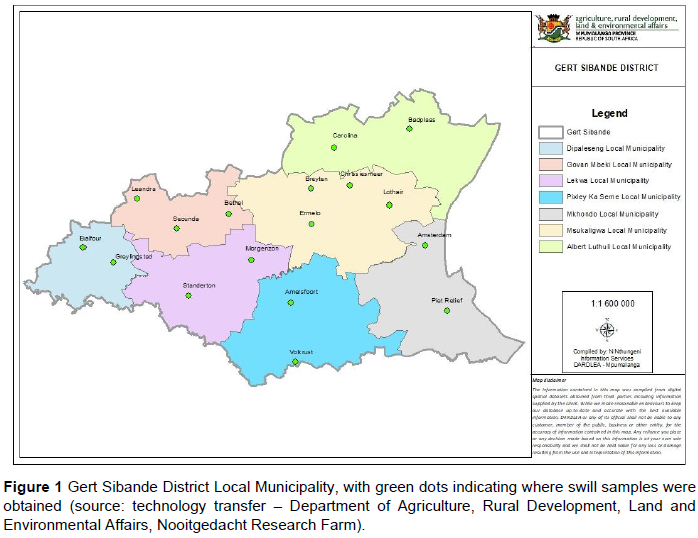
The study was carried out in seven municipalities within Gert Sibande District Municipality of Mpumalanga Province (Figure 1). As of 2017, all seven municipalities in the district had significant rates of poverty (Department of Cooperative Governance and Traditional Affairs, 2020): Govan Mbeki (34.6%), Lekwa (39.7%), Dipaliseng (42.4%), Msukaligwa (42.9%), Chief Albert Luthuli (50.0%), Pixley ka Seme (56.1%), and Mkhondo (59.9%). Gert Sibande District Municipality was chosen because of its significant number of peri-urban areas and substantial free-roaming pig farming activities. The study sites were located in peri-urban areas close to towns, enabling farmers to obtain swill from a variety of sources, including marketplaces, restaurants and hotels, and wholesalers.
Data collection
The systematic random sampling procedure initially intended for this investigation could not be carried out because of the similarities between the swill or sources used by several participants. As a result, representative samples of different swill types were collected using a purposive sampling method. Swill samples were collected directly from the barrels used by the pig producers for swill storage. A total of 14 swill samples were collected from the storage bins of free-roaming pig producers in the peri-urban areas of Gert Sibande District Municipality.
Four types of swill were collected: swill produced using food waste from households (n = 3), schools (n = 4), restaurants (n = 3), and wholesalers (n = 4). Each swill sample was thoroughly mixed in the storage barrel prior to sample collection, then stored in a cooler bag with ice packs and transported to the Nooitgedacht Research Farm on the day of collection. Observations regarding the handling of swill were also documented. In addition, during swill collection, a brief questionnaire was administered to obtain information on the type of swill, the method of swill treatment employed by the participants, the duration of swill storage prior to usage, and whether the pig producer weighed the swill before feeding.
Proximate composition analysis
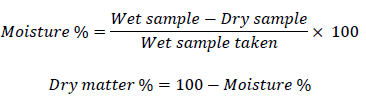
Wet swill samples were weighed and labelled, then dried for 36 hours at 65 °C in a convection oven and cooled in desiccators, before having their dry weights recorded, as prescribed by the Association of Analytical Chemists (AOAC International, 1995). The dried samples were ground and weighed, and their weights were recorded. The ground dried samples were sent for proximate analysis at the University of Free State, Department of Animal, Wildlife and Grassland Sciences. The samples were analysed for their crude protein (Kirmse, 1983), acid-detergent fibre (ADF) (Goering & van Soest, 1970), crude fat (AOAC International, 1995), calcium (Price, 1973), sodium (Poluektov, 1961), phosphorus (Cavell, 1955), and ash (AOAC International, 1995) contents using standard protocols, and their pH was measured (Skoog et al., 2013). The percentages of moisture and dry matter (DM) in the samples were computed using the formula below (Federal University of Agriculture, Abeokuta, Nigeria, 2024). The moisture percentage was calculated as the change in weight that occurs when a sample is dried in an oven to a consistent end weight:
Statistical analysis
The laboratory results were entered into a Microsoft Excel version 2016 (Microsoft Corporation, Redmond, Washington, USA) spreadsheet. The data were then filtered and analysed using the Statistical Package for Social Sciences (IBM®, 2022). In order to compare the proximate compositions of the different types of swill collected in the study area, a mean comparison was conducted, with results reported as the mean ± the standard deviation. Furthermore, the proportions of the categorical variables were compared, with the significance value set at P <0.05. Median, lower, and upper quartiles, and lower and upper extremes of the proximate analysis results are presented using box and whisker plots.
Results
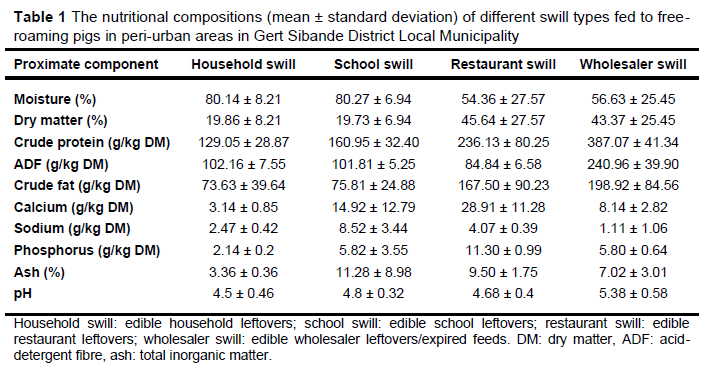
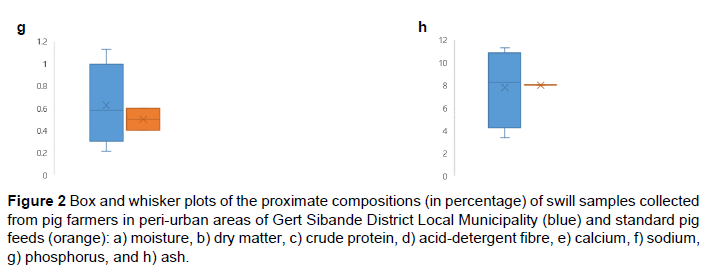
Overall, the swill feeds were not adjusted to account for the age or physiological conditions and thus specific nutritional needs of the categories of pigs fed. The moisture contents of the swill samples were high (household: 80.14%, school: 80.27%, restaurant: 54.36%, wholesaler: 56.63%), and the DM contents were low (household: 19.86%, school: 19.73%, restaurant: 45.64%, wholesaler: 43.37%), compared to the proportions in standard feeds (Table 1). We also observed excess crude protein and fibre contents, and an imbalanced macro-mineral composition (calcium, phosphorus, and sodium contents) in the swill feeds. The determined moisture, DM, and ADF contents fell widely outside the recommended standard range (Figure 2). The determined crude protein, calcium, sodium, phosphorus, and total inorganic matter (ash) contents fell within the recommended standard range; however, the variances were too high to engender reliability or standardisation (Figure 2). The full details of the proximate compositions of the different swills are shown in Table 1 and Figure 2. The household (80.14%) and school (80.27%) swills had the highest moisture contents, followed by the wholesaler (56.63%) and restaurant (54.36%) swills.
At 129.05 ± 28.87 g/kg DM, household swill had the lowest crude protein content, while wholesaler swill had the highest crude protein content (387.07 ± 41.34 g/kg DM) (Table 1). Restaurant swill had the lowest ADF content (84.84 ± 6.58 g/kg DM), while wholesaler swill had the highest (240.96 ± 39.90 g/kg DM). Restaurant swill also had the highest calcium content (28.91 ± 11.28 g/kg DM) and phosphorus content (11.30 ± 0.99 g/kg DM), while school swill contained the highest concentration of sodium (8.52 ± 3.44 g/kg DM). School swill contained the highest concentration of ash, and wholesaler swill had the highest pH.
As can be seen in Figure 2a, the average swill fed to pigs in Mpumalanga had a far higher moisture content than the 11% to 12% recommended for conventional pig feeds.
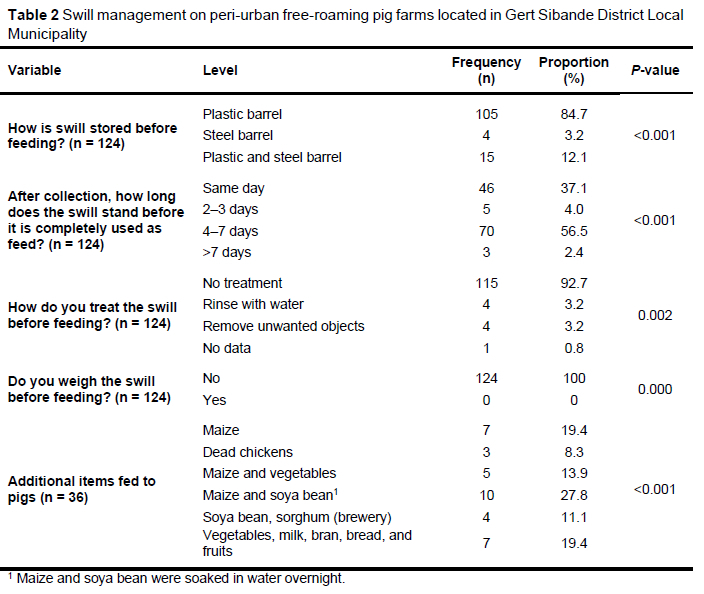
Swill was mostly kept in plastic barrels (84.7%; n = 105/124), with farmers using both plastic and steel barrels accounting for 12.1% of those interviewed (n = 15/124, P <0.001). Of the pig producers surveyed, the majority (56.6%; n = 70/124) stated that the swill was fed within four to seven days of collection, with an additional 2.4% feeding after seven days. Very few participants fed the swill within two to three days (4.0%; n = 5/124) or on the same day as the swill was collected (37.1%; n = 46/100) (Table 2). The majority of the respondents (92.7%; n = 115/124), stated that they fed the swill in the form that it was collected (i.e. they did not process or treat the swill in any way). Few of the respondents indicated that they first rinsed the swill with water or removed any objects. All the pig producers interviewed in this study indicated that they did not weigh the swill before feeding (P <0.00) (Table 2).
Thirty-six (29.03%) of the farmers indicated that they provided other items, in addition to swill, as feed to their pigs. Some of these additional items included maize that had been soaked in water overnight before being fed to the pigs (19.4%; n = 7/36), and dead chickens (8.3%; n = 3/36). This contrasts with the higher proportion of farmers (27.8%; n = 10/36) who indicated that they fed their pigs soya bean and maize that had been soaked in water overnight. Only 13.9% (n = 5/36) of the farmers indicated that they fed their pigs vegetables and maize. In addition, 11.1% (n = 4/36) of the farmers mentioned that they fed their pigs soya bean and sorghum, and 19.4% (n = 7/36) fed vegetables, milk, brans, bread, and fruits.
Discussion
The nutritional values of the four swill types from different sources were investigated, with key outcomes. The variation in nutrient contents was expected as swill is not a standardised ration, and its nutritional value varies depending on several parameters, such as the presence or absence of desirable elements. The composition of swill is determined by: 1) the original purpose for which the swill was produced for human consumption (for instance, human food intended for long-term storage may contain high levels of salt or other materials for preservation); and 2) from where swill was sourced (for instance, swill collected from the refuse dump may contain fragments of glass and foreign materials). Swill may sometimes inadvertently contain unwanted or even toxic materials (Bartel et al., 1942).
While concentrated dried swill may contain higher levels of protein than commercial rations, wet swill may provide low levels of crude protein to pigs, because they are monogastric animals whose stomachs can only accommodate small quantities of high-quality diets (Ncobela et al., 2017; Cherian, 2019). A pig that depends entirely on swill may need to eat three to four times the recommended daily quantity to obtain adequate energy and protein intake, and this may be linked to the non-weighing of swill given to pigs in this study (National Research Council, 1998; Department of Agriculture, Forestry and Fisheries, 2024). Other studies (Castrica et al., 2018; Asar et al., 2018) have reported that wet swill has a lower crude protein content than dried swill. This is worth noting, because in the present study, all the participants used wet swill. Mousa et al. (2018) reported crude protein concentrations of 24.0% and 17.4% in wet swill, which increased to 27.6% and 31.3%, respectively, following drying.
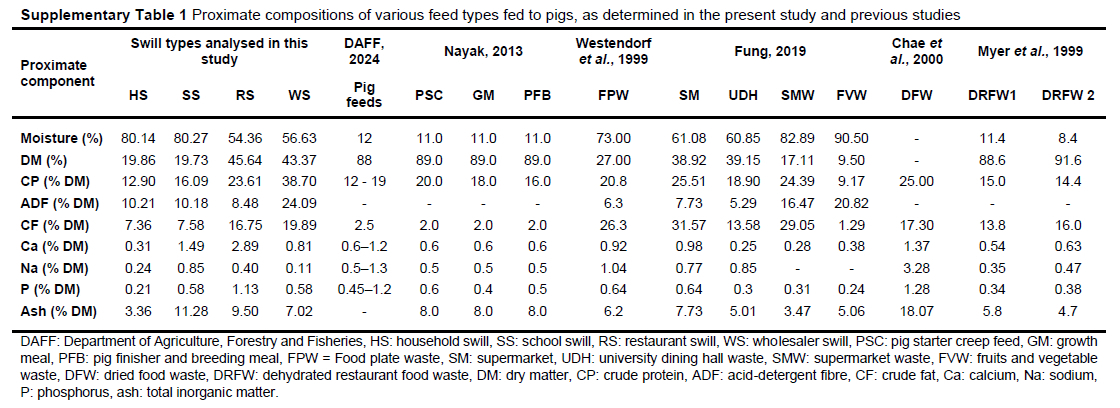
Arguments both for and against swill use have been made; for example, Márquez & Ramos (2007) argued that partial replacement of the diet with swill will not affect growth performance detrimentally, but may slightly affect carcass characteristics and meat quality; whereas Beyihayo et al. (2015) concluded that pigs that consumed less DM from swill experienced decreased growth. However, it has been recommended that the concentration of DM in pig feed should not be less than 200 g/kg, to avoid the production of excessive effluent, with a DM concentration of 250 g/kg or more optimising performance post-weaning (Brooks et al., 2001). Both the household and school swill were short of this target in the present study. Consequently, the swill presented in this analysis would be unsuitable for piglets and weaners, as it could result in undernourishment in these age groups because of their limited stomach capacity (Crawley, 2015). However, in other studies, swill of exceptional quality has been obtained from Indonesian restaurants, hotels, and defence departments (Bartel et al., 1942; Westendorf et al., 1999; Widayati et al., 2019; Supplementary Table 1).
An additional issue caused by the excessively high-moisture content found in our study is that it makes the transportation and storage of swill quite challenging (Westendorf et al., 1999; Fung, 2019). The combination of high-moisture feeds with high ambient temperatures promotes the growth of mould and spoilage bacteria. Thus, the feed spoils faster, depleting energy and other nutrients and making it unpalatable and potentially harmful to livestock (Moritz et al., 2002). For instance, moulds may release toxins harmful to pig health and performance. The current legislation on swill feeding mandates that swill be boiled for at least an hour at 100 °C before being fed to pigs, to eliminate bacteria and pathogens that can cause potentially fatal diseases. However, this requirement for the heat treatment of swill was completely ignored by the farmers responding to the questionnaire.
It has been argued that wet feeds may facilitate better gastrointestinal health, efficient nutrient absorption, and adaptability, and are convenient to administer (De Lange & Zhu, 2012; Cullen et al., 2021). However, despite their popularity, especially among smallholder farmers, the exclusive feeding of pigs on swill may induce gastrointestinal and respiratory complications (Katongole et al., 2012; Tekle et al., 2013; Beyihayo et al., 2015; Munzhelele, 2015; Chauhan et al., 2016; Lule et al., 2017; Munzhelele et al., 2024).
In this study, the protein content of restaurant and wholesaler swill was higher than generally recommended for pigs (Muthui et al., 2019), which contrasts with the results of some previous studies (Westendorf et al., 1999; Nayak, 2013). This may promote gluconeogenesis from the excess protein consumed, with a tendency for resultant fat deposition. Because protein sources are primary contributors to the high costs of animal feeds, such protein-rich swill may actually be inadvertently expensive (Onsongo et al., 2018). Moreover, the unavailability of protein due to high fibre concentrations in swill may lead to poor growth associated with insufficient dietary crude protein or inefficient nutrient utilisation (Beyihayo et al., 2015). Alternatively, pigs fed on high-protein swill may release excessive amounts of nitrogen into the environment (Presto Akerfeldt et al., 2019).
Remarkably, all four swill samples in this study exceeded the allowable limit for fat, with values ranging from 7.3% to 19.8% (73.6 g/kg to 198.92 g/kg DM). A high amount of fat and salt in the feed leads to the production of soft pork, which is considered undesirable and may quickly become rancid (Kornegay et al., 1965; Matlock et al., 1984; Myer et al., 1999; Murto et al., 2004; Kumar, 2020). Furthermore, high fat and salt levels in feed alter the taste characteristics and may introduce adverse flavours into the pork, while excess salt may also cause salt poisoning (Suttle, 2010; Georganas et al. 2020). The calcium concentration in some of the swill samples was significantly low, and pigs fed exclusively on these samples may develop bone-related issues like osteoporosis or osteomalacia (Cromwell, 2015). Excess calcium levels in diets can also be detrimental and reduce growth performance (González-Vega et al., 2016). Our analyses revealed that the swill samples contained either an excess or a deficiency of calcium.
We observed pH levels above 4.5 in the swill samples in this study; pigs fed on such swill are at risk of infections caused by pathogenic bacteria such as Escherichia coli and Salmonella spp. because of insufficient stomach acid production. In contrast, the soya bean and maize fed by some of the farmers in this study were soaked in water overnight. This practice may lead to a significant proliferation of lactic acid bacteria, resulting in a beneficial increase in feed acidity (Brooks et al., 2001). Approximately 19.4% of the farmers utilised brewer's waste as an additional feed source. This feed source is protein rich (crude protein: 27.5%, phosphorus: 0.51%), and can fulfil the nutritional requirements of pigs at every stage of development, although it is particularly beneficial for piglets (Beyihayo et al., 2015). It may therefore be used as a partial feed replacement in the ration.
According to the Animal Diseases Act (35 of 1984), swill must be subjected to heat treatment (boiling at 100 °C for at least one hour) before being fed to pigs, in order to reduce the transmission of animal diseases. The peri-urban outbreaks of African swine fever and other diseases have consequently led the government to recommend boiling swill before it is fed to pigs as a disease-control measure. However, 92.7% of respondents stated that they did not believe it was necessary to treat the swill before feeding. Furthermore, heating swill that has aged for more than four days can be difficult because of fermentation, especially under hot conditions. Heat treatment of feed ingredients also results in the modification of their structure through the Maillard process, rendering a portion of the digestible amino acids inaccessible for protein synthesis (Pahm et al., 2009).
The four swill types included in this investigation had distinct nutritional compositions because they were sourced from different locations or settings (Kornegay et al., 1965; Myer et al., 1999). The nutritional composition of the household swill was determined to be inferior to that of the other swill samples. This may have been caused by variations in the perceived value of swill types, which are influenced by the living conditions of the households from which the swill was gathered. In South Africa, the primary food source is porridge made from ground maize. Consequently, larger quantities of maize porridge are present in household swill. Differences in the nutritional compositions of pig diets between countries are likely caused by variations in environmental conditions, food systems, soil types, geographic locations, and local culinary preferences.
Overall, the poor quality of feed given to pigs significantly reduces their productivity in small-scale settings (Ncobela et al., 2017). When providing swill as feed, it is crucial to ensure that it is safe for consumption, free of pesticide residues or foreign substances, and sourced from a trustworthy supplier. Finally, well-managed swill can generate substantial profits for disadvantaged and emerging pig farmers, enabling them to address food security and hunger challenges linked to increased unemployment.
Conclusion
Swill feeding has the potential to significantly impact pig farming, particularly under small-scale conditions where feed expenses are high. However, this study revealed significant variation in the nutritional compositions of the four swill types tested. Furthermore, all four swill types contained low DM concentrations and high moisture concentrations, which would require pigs to consume large volumes of feed to achieve the required DM intake level. This can be addressed by encouraging farmers to dry or dehydrate the swill prior to feeding. Several nutrients were either above or below the required levels, necessitating both supplementation and measures to ensure that excessive intake of nutrients such as protein and sodium is avoided. To provide an appropriate diet for piglets and weaners, a blend of highand low-nutritional compositions could be produced by combining household swill and wholesaler swill. A combination of school swill and restaurant swill could be used to formulate a potentially acceptable diet for developing pigs, and this should be encouraged. School swill proved to be suitable as feed for finishing and breeding pigs, as its nutrient composition can support their health and production, including growth, lactation, and reproduction requirements. The nutritional composition of household swill was inferior to that of the other swill types.
Future studies should focus on examining the growth performance of pigs fed various types of swill. Further research is also required to evaluate the quality of pork from pigs fed swill under peri-urban free-roaming conditions.
Acknowledgements
We are indebted to all the people who contributed to the success of this research, particularly the peri-urban free-roaming pig producers of Gert Sibande District Local Municipality. We are grateful to the Department of Agriculture, Rural Development, Land and Environmental Affairs and the University of South Africa's M & D bursary for providing financial support for this research. We would also like to thank the University of the Free State for performing the proximate composition analyses, and the Nooitgedacht Research Farm (Veld and pasture section) for allowing us to use an air-dry oven to dry the samples and their grinding equipment.
Authors' contributions
P. Makungo, F.O. Fasina, and J.W. Oguttu established the protocol. P. Makungo collected and analysed data, and drafted the manuscript. The research findings were assessed by F.O. Fasina and J.W. Oguttu. F.O. Fasina, J.W. Oguttu, and C.A. Mbajiorgu all participated in the review process and made final adjustments.
Conflict of interest declaration
The authors declare that there is no conflict of interest.
References
Animal Diseases Act 35 of 1984. Pretoria: Government Printer. Available: https://www.gov.za/documents/animal-diseases-act-0 [18 September 2025]. [ Links ]
Association of Official Analytical Chemists (AOAC) International. 1995. Official methods of analysis of AOAC International. AOAC International, Arlington, VA, USA. [ Links ]
Asar, E., Raheem, H., & Daoud, J., 2018. Using dried leftover food as nontraditional feed for Muscovy duck diet. Assiut Veterinary Medical Journal, 64(158):107-114. DOI: https://doi.org/10.21608/avmj.2018.168965 [ Links ]
Bartel, L.H. & Oosthuizen, S.A., 1942. Swill as pig feed. Farming in South Africa, 17:373-374; 408. [ Links ]
Beyihayo, G., Mwesigwa, R., & Pezo, D., 2015. Pig feeding strategies: Uganda smallholder pig value chain capacity development training manual. International Livestock Research Institute (ILRI) Editorial and Publishing Services, Addis Ababa, Ethiopia. [ Links ]
Birungi, R., Ouma, E., Brandes-van Dorresteijn, D., Kawuma, B., & Smith, J. 2015. Pig marketing and institutional strengthening: Uganda smallholder pig value chain capacity development training manual. ILRI, Nairobi, Kenya. [ Links ]
Brooks, P., Beal, J., & Niven, S., 2001. Liquid feeding of pigs: Potential for reducing environmental impact and for improving productivity and food safety. Recent Advances in Animal Nutrition in Australia, 13:49-63. [ Links ]
Castrica, M., Tedesco, D.E.A., Panseri, S., Ferrazzi, G., Ventura, V., Frisio, D.G., & Balzaretti, C.M., 2018. Pet food as the most concrete strategy for using food waste as feedstuff within the European context: A feasibility study. Sustainability, 10:2035. DOI: https://doi.org/10.3390/su10062035 [ Links ]
Cavell, A.J., 1955. The colorimetric determination of phosphorus in plant materials. Journal of the Science of Food and Agriculture, 6:479-480. DOI: https://doi.org/10.1002/jsfa.2740060814 [ Links ]
Chae, B.J., Choi, S.C., Kim, Y.G., Kim, C.H., & Sohn, K.S., 2000. Effects of feeding dried food waste on growth and nutrient digestibility in growing-finishing pigs. Asian-Australasian Journal of Animal Sciences, 13:1304-1308. [ Links ]
Chauhan, A., Patel, B.H.M., Maurya, R., Kumar, S., Shukla, S., & Kumar, S., 2016. Pig production system as a source of livelihood in Indian scenario: An overview. International Journal of Science, Environment and Technology, 5(4):2089-2096. [ Links ]
Cherian, G., 2019. Chapter I. Introduction to nutrition. In: A Guide to the Principles of Animal Nutrition. Oregon State University, Corvallis, OR, USA. [ Links ]
Crawley, K., 2015. Fulfilling 100% organic poultry diets: Roughage and foraging from the range. In: Improved Contribution of local feed to support 100% Organic feed supply to Pigs and Poultry (ICOPP) Technical Note 2. Organic Research Centre, UK. [ Links ]
Cromwell, G.L., 2015. Nutritional diseases of pigs - management and nutrition. MSD Veterinary Manual, Rahway, NJ, USA. [ Links ]
Cullen, J.T., Lawlor, P.G., Cormican, P., & Gardiner, G.E., 2021. Microbial quality of liquid feed for pigs and its impact on the porcine gut microbiome. Animals, 11:2983. DOI: https://doi.org/10.3390/ani11102983 [ Links ]
De Jong, J., Kleter, G., Banach, J., van Raamsdonk, L., Hoogenboom, R., de Nijs, M., van der Fels-Klerx, I., Kok, E., Slot, M., Bouwmeester, H., & Noordam, M., 2019. Hazards associated with animal feed. FAO, Rome, Italy. [ Links ]
De Lange, C. & Zhu, C., 2012. Liquid feeding corn-based diets to growing pigs: Practical considerations and use of co-products. In: Feed Efficiency in Swine. Ed: Patience, J.F., Wageningen Academic Publishers, Wageningen, Netherlands. pp. 63-80 [ Links ]
Department of Agriculture, Forestry and Fisheries (DAFF), 2024. Farm feeds general guidelines [Online]. Available: https://nda.gov.za/images/Branches/AgricProducHealthFoodSafety/agriculture-inputs-control/guidelines/farm-feeds/farm-feeds-general-guidelines_.pdf [28 May 2024]. [ Links ]
Department of Cooperative Governance and Traditional Affairs (DCGTA), 2020. A profile and analysis of Gert Sibande District [Online]. Available: Final-Edited-Gert-Sibande-DM_26-June-2020-FINAL.pdf (cogta.gov.za) [15 March 2024]. [ Links ]
European Commission, 2013. Commission regulation (EU) no. 68/2013 on the catalogue of feed materials. Official Journal of the European Union, L 29/1. [ Links ]
Federal University of Agriculture, Abeokuta, Nigeria, 2024. Proximate Analysis of Feedstuff [Online]. Available: https://unaab.edu.ng/wp-content/uploads/2009/12/459_ANN509%20Lecture%20Note%20_A_.pdf [23 March 2024]. [ Links ]
Fung, C.F.L., 2019. Nutritional value and benefits of food waste as potential feed ingredients in swine diets. MSc thesis, University of Minnesota, USA. [ Links ]
Georganas, A., Giamouri, E., Pappas, A.C., Papadomichelakis, G., Galliou, F., Manios, T., Tsiplakou, E., Fegeros, K., & Zervas, G., 2020. Bioactive compounds in food waste: A review on the transformation of food waste to animal feed. Foods, 9:291. DOI: https://doi.org/10.3390/foods9030291 [ Links ]
Goering, H.K. & van Soest, P.J., 1970. Forage Fiber Analyses (Apparatus, Reagents, Procedures, and Some Applications). Agriculture Handbook No. 379. Agricultural Research Service, United States Department of Agriculture, USA. [ Links ]
González-Vega, J.C., Walk, C.L., Murphy, M.R., & Stein, H.H., 2016. Requirement for digestible calcium by 25 to 50 kg pigs at different dietary concentrations of phosphorus as indicated by growth performance, bone ash concentration, and calcium and phosphorus balances. Journal of Animal Science, 94:5272-5285. DOI: https://doi.org/10.2527/jas.2016-0751 [ Links ]
Gustavsson, J., 2011. Global food losses and food waste: extent, causes and prevention. Study Conducted for the International Congress 'Save Food!' at Interpack2011, Dusseldorf, Germany. Food and Agriculture Organization of the United Nations (FAO), Rome, Italy. [ Links ]
IBM®, 2022. Statistical Package for Social Sciences [Online]. Available: https://www.ibm.com/support/pages/downloading-ibm-spss-statistics-28 [27 February 2024]. [ Links ]
Kagira, J.M., Kanyari, P.W.N., Maingi, N., Githigia, S.M., Ng'ang'a, J.C., & Karuga, J.W., 2010. Characteristics of the smallholder free-range pig production system in western Kenya. Tropical Animal Health and Production, 42:865-873. DOI: https://doi.org/10.1007/s11250-009-9500-y [ Links ]
Katongole, C.B., Nambi-Kasozi, J., Lumu, R., Bareeba, F., Presto, M., Ivarsson, E., & Lindberg, J.E., 2012. Strategies for coping with feed scarcity among urban and peri-urban livestock farmers in Kampala, Uganda. Journal of Agriculture and Rural Development in the Tropics and Subtropics (JARTS), 113:165-174. [ Links ]
Kim, K.-H. & Lee, B.-M., 2023. Effects of climate change and drought tolerance on maize growth. Plants (Basel), 12:3548. DOI: https://doi.org/10.3390/plants12203548 [ Links ]
Kirmse, W., 1983. Organic Elemental Analysis: Ultramicro, Micro, and Trace Methods. Academic Press, New York, USA. [ Links ]
Kornegay, E.T., Vander Noot, G.W., Barth, K.M., MacGrath, W.S., Welch, J.G., & Purkhiser, E.D., 1965. Nutritive value of garbage as a feed for swine. I. Chemical composition, digestibility and nitrogen utilization of various types of garbage. Journal of Animal Science, 24:319-324. DOI: https://doi.org/10.2527/jas1965.242319x [ Links ]
Kumar, D.K., 2020. Nutrient requirements in Poultry, Swine and Equine [Online]. Available: https://www.basu.org.in/wp-content/uploads/2020/04/Nutrient-requirements-in-Poultry-Swine-Equine.pdf [26 March 2024]. [ Links ]
Lemke, U., Kaufmann, B., Thuy, L.T., Emrich, K., & Zárate, A.V., 2007. Evaluation of biological and economic efficiency of smallholder pig production systems in North Vietnam. Tropical Animal Health and Production, 39:237-254. DOI: https://doi.org/10.1007/s11250-007-9001-9 [ Links ]
Lule, P.M., Ojakol, J.F., Asindu, M., Naziri, D., & Ouma, E.A., 2017. Technical Report: Economic analysis of sweet potato silage based diets for smallholder pig farmers in Uganda. [ Links ]
Madzimure, J., 2011. Climate change adaptation and economic valuation of local pig genetic resources in communal production systems of South Africa. Academia. [ Links ]
Márquez, M.C. & Ramos, P., 2007. Effect of the inclusion of food waste in pig diets on growth performance, carcass and meat quality. Animal, 1:595-599. DOI: https://doi.org/10.1017/S1751731107685000 [ Links ]
Matabane, M.B., Nethenzheni, P., Thomas, R., Netshirovha, T.R., Norris, D., Nephawe, K.A., & Nedambale, T.L., 2015. Status of the smallholder pig farming sector in Gauteng Province of South Africa. Applied Animal Husbandry and Rural Development, 8:19-25. [ Links ]
Matlock, R.G., Terrell, R.N., Savell, J.W., Rhee, K.S., & Dutson, T.R., 1984. Factors affecting properties of raw- frozen pork sausage patties made with various NaCl/phosphate combinations. Journal of Food Science, 49:1363-1366. DOI: https://doi.org/10.1111/j.1365-2621.1984.tb14991.x [ Links ]
Mokoele, J.M., Spencer, B.T., van Leengoed, L.A.M.G., & Fasina, F.O., 2014. Efficiency indices and indicators of poor performance among emerging small-scale pig farmers in the Limpopo Province, South Africa. Onderstepoort Journal of Veterinary Research, 81. DOI: https://doi.org/10.4102/ojvr.v81i1.774 [ Links ]
Moritz, J.S., Wilson, K.J., Cramer, K.R., Beyer, R.S., McKinney, L.J., Cavalcanti, W.B., & Mo, X., 2002. Effect of formulation density, moisture, and surfactant on feed manufacturing, pellet quality, and broiler performance. Journal of Applied Poultry Research, 11:155-163. DOI: https://doi.org/10.1093/japr/11.2.155 [ Links ]
Munzhelele, P., 2015. Evaluation of the production systems and constraints of smallholder pig farming in three agro-ecological zones of Mpumalanga province, South Africa. MSc (Agric) thesis, University of South Africa, South Africa. [ Links ]
Munzhelele, P., Oguttu, J., Fasanmi, O.G., & Fasina, F.O., 2017. Production constraints of smallholder pig farms in agro-ecological zones of Mpumalanga, South Africa. Tropical Animal Health and Production, 49:63-69. DOI: https://doi.org/10.1007/s11250-016-1158-7 [ Links ]
Munzhelele, P., Oguttu, J.W., & Fasina, F.O., 2016. Is a 10-sow unit economically sustainable? A profitability assessment of productivity amongst small-holder pig farmers, Mpumalanga, South Africa: original research. Onderstepoort Journal of Veterinary Research, 83:1-11. DOI: https://doi.org/10.4102/ojvr.v83i1.1011 [ Links ]
Munzhelele, P., Sibeko, N.P.S., Oguttu, J.W., Mbajiorgu, C.A., & Fasina, F.O., 2024. Parasites burden in peri-urban free-roaming pigs in Gert Sibande District Municipality, Mpumalanga Province, South Africa. Journal of the South African Veterinary Association, 95:55-66. [ Links ]
Murto, M., Björnsson, L., & Mattiasson, B., 2004. Impact of food industrial waste on anaerobic co-digestion of sewage sludge and pig manure. Journal of Environmental Management, 70:101-107. DOI: https://doi.org/10.1016/j.jenvman.2003.11.001 [ Links ]
Muthui, N.J., Matofari, J.W., Kingori, A.M., & Hülsebusch, C.G., 2019. Estimation of daily nutrient allowances for pigs fed with alternative feed resources in smallholder enterprises in Kenya. Tropical Animal Health and Production, 51:799-808. DOI: https://doi.org/10.1007/s11250-018-1757-6 [ Links ]
Mutua, F.K., Dewey, C., Arimi, S., Ogara, W., Levy, M., & Schelling, E., 2012. A description of local pig feeding systems in village smallholder farms of Western Kenya. Tropical Animal Health and Production, 44:11571162. DOI: https://doi.org/10.1007/s11250-011-0052-6 [ Links ]
Myer, R.O., Brendemuhl, J.H., & Johnson, D.D., 1999. Evaluation of dehydrated restaurant food waste products as feedstuffs for finishing pigs. Journal of Animal Science, 77:685-692. DOI: https://doi.org/10.2527/1999.773685x [ Links ]
National Research Council, 1998. Nutrient Requirements of Swine, 10th revised edition. National Academy Press, Washington, DC, USA. [ Links ]
Nayak, D.S., 2013. Feeding of Pigs. Department of Animal Nutrition, College of Veterinary Science and Animal Husbandry, Jabalpur (M.P.), India [Online]. Available: https://www.ndvsu.org/images/StudyMaterials/Nutrition/Feeding-of-Pigs.pdf [09 March 2024]. [ Links ]
Ncobela, C.N., Kanengoni, A.T., Hlatini, V.A., Thomas, R.S., & Chimonyo, M., 2017. A review of the utility of potato by-products as a feed resource for smallholder pig production. Animal Feed Science and Technology, 227:107-117. DOI: https://doi.org/10.1016/j.anifeedsci.2017.02.008 [ Links ]
Onsongo, V.O., Osuga, I.M., Gachuiri, C.K., Wachira, A.M., Miano, D.M., Tanga, C.M., Ekesi, S., Nakimbugwe, D., & Fiaboe, K.K.M., 2018. Insects for income generation through animal feed: Effect of dietary replacement of soybean and fish meal with black soldier fly meal on broiler growth and economic performance. Journal of Economic Entomology, 111:1966-1973. DOI: https://doi.org/10.1093/jee/toy118 [ Links ]
Pahm, A.A., Pedersen, C., & Stein, H.H., 2009. Standardized ileal digestibility of reactive lysine in distillers dried grains with solubles fed to growing pigs. Journal of Agricultural and Food Chemistry, 57:535-539. DOI: https://doi.org/10.1021/jf802047d [ Links ]
Petrus, N., Mpofu, I., Schneider, M.B., & Nepembe, M., 2011. The constraints and potentials of pig production among communal farmers in Etayi Constituency of Namibia. Livestock Research for Rural Development, 23. [ Links ]
Poluektov, N.S., 1961. Techniques in Flame Photometric Analysis. Springer, USA. [ Links ]
Presto Akerfeldt, M., Lindberg, J.E., Göransson, L., & Andersson, K., 2019. Effects of reducing dietary content of crude protein and indispensable amino acids on performance and carcass traits of single-phase- and 2-phase-fed growing-finishing pigs. Livestock Science, 224:96-101. DOI: https://doi.org/10.1016/j.livsci.2019.04.014 [ Links ]
Price, W.J., 1973. Analytical Atomic Absorption Spectrometry. Heyden and Son Ltd., London, UK. [ Links ]
Skoog, D.A., West, D.M., Holler, F.J., & Crouch, S.R., 2013. Fundamentals of Analytical Chemistry. Cengage Learning. [ Links ]
Statistics South Africa, 2023. Mbalo Brief, Census 2022 Results [Online]. Department: Statistics South Africa, Pretoria, SA. Available: https://www.statssa.gov.za/wp-content/uploads/2023/11/Mbalo-brief-November.pdf [18 March 2024]. [ Links ]
Suttle, N.F., 2010. Mineral Nutrition of Livestock, 4th edition. CABI, Wallingford, Oxfordshire, UK/Cambridge, MA, USA. [ Links ]
Tekle, T., Genzebu, A.T., & Kifleyohannes, T., 2013. Smallholder pig production and its constraints in Mekelle and southern zone of Tigray region, north Ethiopia. Livestock Research for Rural Development, 25. [ Links ]
Westendorf, M.L., Schuler, T., Zirkle, E.W., Hays, V.W., & Wilson, L.L., 1999. Nutritional quality of recycled food plate waste in diets fed to swine. The Professional Animal Scientist, 15:106-111. DOI: https://doi.org/10.15232/S1080-7446(15)31737-X [ Links ]
Widayati, T., Rahayu, B., Rahardjo, D., & Lekitoo, M., 2019. Feeding effect of different levels of agricultural and food waste on growth performance and economics in pig production. Journal of Agricultural Science and Technology A, 9:240-247. DOI: https://doi.org/10.17265/2161-6256/2019.04.004 [ Links ]
World Economic Forum, 2024. Extreme weather is driving food prices higher. These 5 crops are facing the biggest impacts [Online]. World Economic Forum. Available: https://www.weforum.org/agenda/2024/02/climate-change-food-prices-drought/ [14 March 2024]. [ Links ]
Submitted 18 June 2024
Accepted 8 April 2025
Published 22 September 2025
# Corresponding author: priscilla.munzhelele@gmail.com (P. Makungo, née Munzhelele)