Services on Demand
Journal

Article
 English (pdf)
 Article in xml format
 Article references
 Automatic translation
 Send this article by e-mail
Indicators
Related links
-
 Cited by Google
 -
 Similars in Google
Share

 Permalink
South African Journal of Chemistry
On-line version ISSN 1996-840XPrint version ISSN 0379-4350
S.Afr.j.chem. (Online) vol.70 Durban 2017
https://doi.org/10.17159/0379-4350/2017/v70a17
RESEARCH ARTICLE
Single and Competitive Removal of Sulfachloropyridazine and Sulfadimethoxine onto Natural Kaolinite Clay: Kinetics, Isotherms and Thermodynamics Studies
Victor O. ShikukuI, II; Renato ZanellaII; Chrispin O. KowenjeI, ; Filipe F. DonatoII; Nelson BandeiraII; Osmar D. PrestesII
IMaseno University, P.O. Box 333-40105, Maseno, Kenya
IILaboratory of Pesticide Residue Analysis (LARP), Chemistry Department, Federal University of Santa Maria, 97105-900 Santa Maria-RS, Brazil
ABSTRACT
In this study, local untreated clay was tested for its ability to adsorb sulfonamides, namely, sulfachloropyridazine (SCP) and sulfadimethoxine (SDM) from synthetic wastewater by batch equilibration. The time-dependent adsorption data followed the pseudo-second-order kinetic law while the equilibrium adsorption data were adequately described by the Langmuir model. The monolayer adsorption density (Qo) of the clay was higher for SCP than SDM in single solute system. In binary solute solutions, an antagonistic adsorption process of SDM (RqSCP = 0.453) in the presence of SCP (RqSDM = 0.915) was observed, suggesting replacement adsorption. Additionally, the calculated thermodynamic parameters, namely: enthalpy (∆H), Gibbs free energy (∆G), entropy (∆S), Arrhenius activation energy (∆Ea), and sticking probability (S*) indicated SCP and SDM adsorption to be spontaneous, exothermic and physical in nature. Based on Langmuir isotherm, the mass of clay required for 99 % removal of the tested sulfonamides for a specified volume of effluent in a single batch system was predicted. The results show the tested clay may be used as a low-cost adsorbent for removal of pharmaceutical compounds from wastewater in its untreated form.
Keywords: Kaolinite, adsorption, sulfonamides, water.
1. Introduction
Presently, there are over 3000 pharmaceutically active compounds in use worldwide resulting in environmental concerns due to compromises of quality of various ecosystems. In recent years, following development of robust and sensitive analytical methods, pharmaceutical compounds have been frequently detected in water compartments in concentrations as high as mg L-1 and are presently classified as emergent micro-pollutants.1 Among the widely used and frequently detected pharmaceutical ingredients in surface waters are sulfonamides; bacteriostatic antibiotics2,3 indicating their recalcitrance to conventional water treatment techniques. Exposure of non-target organisms to sulfonamides may result to serious health problems such as stomatitis, haemolysis, hepatotoxicity and renal toxicity, even at low concentrations.4,5 Literature indicates that studies in search of efficient and sustainable adsorbents for removal of sulfonamides and like polar compounds are ongoing.6
For centuries, the adsorptive properties of clays have been harnessed in various applications including filtration in water treatment. Clays are potentially suitable alternative to activated carbons in wastewater treatment due to their availability in nature, low-cost and eco-friendly properties.7,8,9 Though clay minerals have been shown to adsorb various pharmaceutical compounds with stupendous results10 no studies have focused on the affinities of clay for both sulfachloropyridazine and sulfadimethoxide, their adsorption behaviour in binary mixtures and their interactional mechanisms with clay.
The objective of this study was to evaluate the affinity of untreated clay for two pharmaceutical compounds, namely, sulfachloropyridazine (SCP) and sulfadimethoxine (SDM), selected for their wide occurrence and resistance to various wastewater treatment protocols, in single and binary solutions and to characterize the adsorption reactions involved and possible mechanisms. The experimental concentrations used in the present work were relatively higher than those reported in real wastewaters for proper fitting of standard classical adsorption isotherms, viz. Langmuir and Freundlich models, quantification of relative affinities of the compounds to the sorbent material and determination of the underlying driving forces for the adsorption mechanism which are otherwise relatively difficult to elucidate under very low concentration systems.
2. Materials and Methods
2.1. Preparation of Adsorbent and Characterization
The raw clay material, as received from Bungoma town in western region of Kenya, was crunchy hence was crushed then homogenized by sieving through a 220 μm sieve to control the particle size. The adsorbent was then washed in ultrapure water to remove impurities. Finally, the material (grey in colour) was thermally dried to constant weight at 333 K with no chemical modifications. The point of zero charge (pHpzc) determined using the pH drift method was 6.1.11 Elemental composition was determined by XRF analysis and XRD analysis was performed, in duplicate, to determine the crystalline phases of the clay material, in duplicate.
2.2. Sorption Kinetics
The batch tests were carried out in 250 mL Erlenmeyer flasks with 0.1 g of adsorbent dispersed in 50 mL of 2 mg L-1 solution of SCP or SDM, in triplicate. The flasks were agitated at 200 rpm for 6 h in a controlled temperature shaker at 303 ± 1 K. At pre-determined time intervals (10,20,30,40,60,120,180,240,300 and 360 min) the residual analyte in solution was determined. The effect of initial SCP or SDM concentrations (1.0, 1.25, 1.50, 1.75, 2.0 mg L-1) at 303 ± 1 K, and thermodynamic studies (303, 313, 323 K) were evaluated, in triplicate, holding other environmental parameters constant (i.e. initial pH of 5.9 ± 0.2 and adsorbent dosage of 0.1 g 50 mL-1). The supernants were filtered through 0.2 μm syringe filters for analysis of residual SCP and SDM concentrations in the solution using HPLC-DAD Varian (Palo Alto, CA, USA) at 270 nm. The mobile phase was a mixture of water (1 % acetic acid) and acetonitrile (90:10 v/v), with a flow rate of 1.0 mL min-1. The injection volume was 50 μL. The amount of solute adsorbed per unit mass of adsorbent (qe) was calculated using the mass balance equation:

while the percentage removal efficiency was calculated according to the following equation:

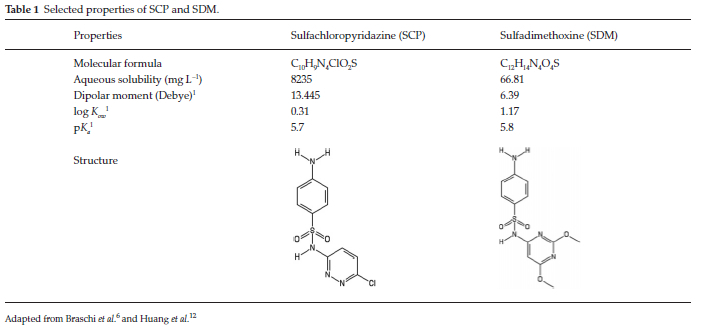
where Cois the initialadsorbate concentration,Cethe equilibrium adsorbate concentration (mgL-1), Vis solution volume (L) and m is adsorbent mass (g). Table 1 lists selected physicochemical properties of the SCP and SDM.
3. Results and Discussion
3.1. Characterization of the Adsorbents
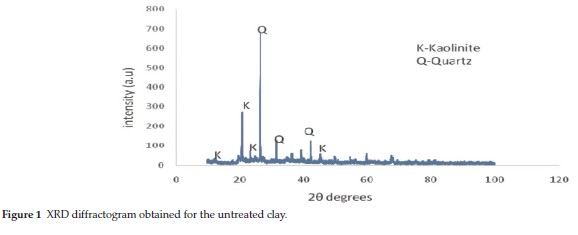
The elemental composition of major oxide form of the raw clay (RC) obtained from XRF analysis was SiO2 (43.8 %), Al2O3 (16.9 %), Fe2O3 (6.67 %), K2O (1.61 %), MgO (0.89 %), TiO2 (0.84 %), Na2O (0.62 %) and CaO (0.55 %) among other oxides. Fig. 1 portrays the XRD patterns of the raw clay. The diminished diffraction peaks at 2θ = 11.98,20.70,21.30 and 45.18correspond to kaolinite while the sharp peaks at 2θ = 26.48,31.52 and 42.28, depict the other crystalline phase of the clay as quartz,10 with an interlayer space of 7.27 A. The Brunauer- Emmett-Teller (BET) specific surface area calculated from the BET liquid nitrogen adsorption-desorption method was 10.30 m2 g-1 with 0.05 cm3 g-1 pore volume.
3.2. Adsorption Kinetics
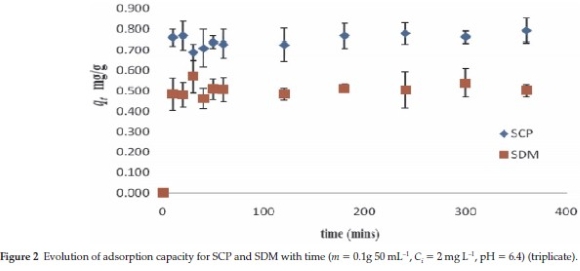
The time-dependent evolution of untreated clay adsorption capacity for SCP and SDM depicted fast adsorption kinetics leading to saturation within 180 min (Fig. 2) followed by an equilibrium phase. The rapid initial adsorption rate is due to availability of completely vacant active adsorption sites followed by the slow equilibrium phase attributed to saturation of the energetically favourable surfaces. Noteworthy, kaolinite clay exhibited higher removal efficiency for SCP (77 %) than SDM (50 %). The adsorption dynamics were analyzed using linearized Lagergren pseudo-first-order14 and pseudo-second-order kinetic models.13 The conformity to the models was evaluated by the linear correlation coefficient (R2) values and comparing the experimental equilibrium adsorption density (q ) with the theoretical values (qca) computed from the kinetic model.
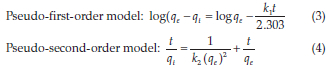
where t (min) and qt (mg g-1) are time and amount adsorbed at each time interval, respectively, while qe (mg g-1) is the equilibrium adsorption capacity. k1, and k2 are rate constants.
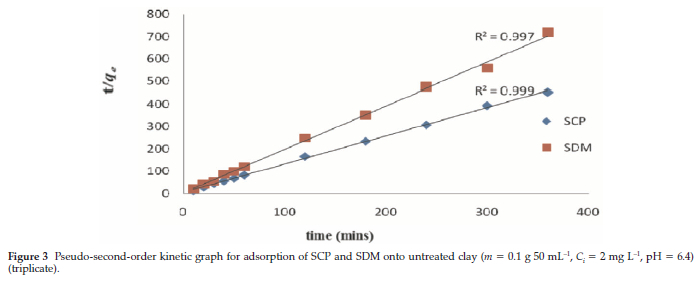
The data poorly fitted the pseudo-first-order model with low R2 values and the calculated parameters are not herein reported. On the contrast, the data perfectly fitted the pseudo-second-order kinetics law with R2(>0.99) closest to unity (Fig. 3) corroborated with exact convergence of the calculated (qca) and experimental (qexp) adsorption capacities (Table 2). The adsorption half lives (ty) and initial adsorption rate (Srate) were computed from the pseudo-second-order regression plot using Equations 5 and 6, respectively:

3.3. Equilibrium Adsorption
3.3.1. Single Component Adsorption Isotherms
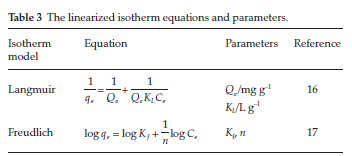
In the present work, equilibrium data modelling for single component system was done using two linearized isotherms, viz. Langmuir and Freundlich (Table 3) and their constants are listed in Table 4. From the Langmuir model, KL is the Langmuir adsorption constant (L mg-1) related to the free energy of adsorption and Qo is the maximum monolayer adsorption density (mg g-1) while for Freundlich model, Kf and n are Freundlich constants depictive of the relative adsorption capacity and adsorption favourability or surface heterogeneity of the adsorbent, respectively. According to Treybal,15 the values of n in the range 2-10 represent good, 1-2 moderately difficult, and less than 1 a poor adsorptive property.
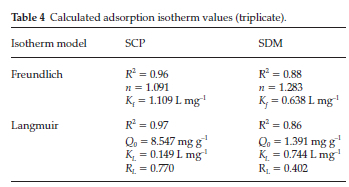
From the R2 values, Langmuir model satisfactorily predicted the adsorption of SCP while not perfectly, though fairly for SDM over the untreated clay. Kaolinite had a higher Langmuir maximum monolayer adsorption density for SCP than SDM (Table 4). The favourability of the adsorption process was inspected in terms of the dimensionless separation constant RL given by Equation 7 and the results are listed in Table 4.

where KL (L mg-1) is the Langmuir constant and Co (mg L-1) denotes the adsorbate initial concentration. Precisely, RL values describe the nature of the adsorption process to be either unfavourable (RL > 1), linear (RL = 0), favourable (0 < RL<1) or irreversible (RL = 1).18 The calculated RL values in the present work (Table 4) indicate the adsorption processes are favourable. On the other hand, the magnitude of Freundlich constant n, lyingbetween 1 and 2, indicate a moderately difficult adsorption process for both adsorbates while 1/n is between 0 and 1, indicating the heterogeneity of the adsorption surfaces of the clay. Therefore, both models fairly represent the adsorption of SCP and SDM onto the clay despite the variances in R2.
3.3.2. Binary Component Adsorption
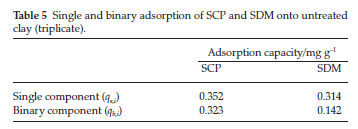
The equilibrium experimental data for the simultaneous adsorption of SCP onto untreated clay in the presence of an equal concentration of SDM (1 mg L-1) are shown in Table 5.
Competitive adsorption of SCP and SDM onto the untreated clay in a binary solute system was evaluated by comparison of the ratio of the equilibrium adsorption capacities (Rq), defined as:

where qbi and qsiare the equilibrium adsorption capacity (qe)of compound i in the binary solute solution and in the single solute solution, respectively. In this context, when Rq i> 1, the presence of another adsorbate in a bi-component system appreciates the adsorption of contaminant i (i.e. synergistic adsorption), if Rq i= 1, there is no effect of the simultaneous presence of the other adsorbate in the binary system on the adsorption of compound i and if Rq i < 1, the abstraction of compound i is significantly diminished by the presence of the competing adsorbate molecules (i.e. antagonistic adsorption).19
Here, the adsorption of SDM was significantly abridged by the presence of SCP in the binary system. The equilibrium adsorption capacity of SDM decreased from 0.314 mg g-1 in the single solute solution to 0.142 mg g-1 in the binary solution (Table 5). The value RqSDM = 0.453 is far less than 1, confirming antagonistic adsorption of SDM in the presence of SCM. By contrast, SCP adsorption was practically unaffected by the presence of SDM in the binary system. The equilibrium adsorption capacity of SCP was 0.353 mg g-1 in single solute solution and 0.323 mg g-1 in binary solution, resulting to the value RqSDM = 0.915, tending to 1.
Consequently, the decrease of SDM adsorption in the presence of SCP (Rq,SCP = 0.625) while SCP adsorption was almost constant (Rq,SCP = 0.915) indicate much stronger interactions between SCP and the untreated clay binding sites than those involved in SDM adsorption. The results also suggest that SCP and SDM do not share some binding sites, suggesting different adsorption mechanisms are somewhat also involved.
3.4. Adsorption Thermodynamics
Generally, temperature changes have two diverse effects on an adsorption process: under pre-equilibrium conditions it alters the rate of adsorption while after the equilibrium attainment, temperature changes alter the position of adsorption equilibrium of the adsorbent for a given adsorbate.
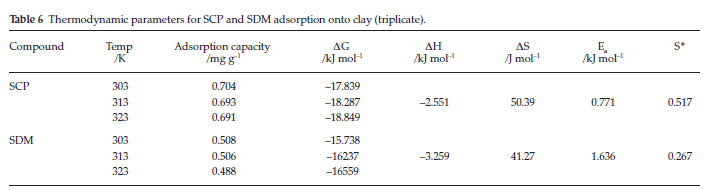
When the temperature was raised from 303 to 323 K, the amount of SCP and SDM adsorbed after equilibrium decreased (Table 6) depicting an exothermic adsorption process. This is attributable to increased molecular solubility with rise in temperature hence decreased affinity for the adsorbent surface with concomitant weakening of the adsorbate-kaolinite forces.20 The thermodynamic parameters, namely, change in free energy (∆G), enthalpy (AH) and entropy (∆S) (Table 6), were derived from the van't Hoff and Henry's law equations given below:
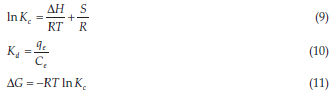
where Kd is the distribution coefficient (L g-1), T is the temperature (in Kelvin), R is the universal gas constant (8.314 J mol K-1) and Kc is the equilibrium constant (dimensionless).
The negative values of enthalpy change (∆H) affirm the exothermic nature of the adsorption reactions. The observed consistent decrease in adsorption capacity (qe), mg g-1, with rise in temperature (Table 6) denotes a shift of the equilibrium position to reverse direction of the reaction. Moreover, magnitudes of ΔΗ below 40 kJ mol-1 depict physisorption mechanisms.21 In this study, the computed ΔΗ values (Table 5) indicate that physi-sorption is the predominant adsorption mechanism of both SCP and SDM onto kaolinite clay. Also, AG values for physisorption range between 0 and 20 kJ mol-1 while those for chemisorptions are between 80 and 400 kJ mol-1.22 Thus, the magnitude of the AG values also attest to the physical nature of the adsorption process of both compounds. The negative ∆G for both SCP and SDM, at all temperatures, indicate the adsorption processes onto kaolinite were thermodynamically spontaneous and favourable. The positive values of entropy change (∆S) correspond to an increase in molecular disorderliness at the solid/liquid interface of the adsorption a testament that the adsorption phenomenon is entropically driven and not enthalpy-governed. To further ascertain that physisorption is the predominant adsorption mechanism, the adsorption activation energy (Ea) and sticking probability (S*) were computed from experimental data following modified Arrhenius type equation connected to surface coverage (θ) by Mahmoud et al.23:

The S* is dependent on the adsorbate/adsorbent system under study, its value lies in the range 0 < S*<1 and is a function of temperature of the system. The value of θ was calculated from the following relation:

The magnitude of activation energy gives further insight on whether the adsorption involves a physical or chemical process. Generally, physisorption processes have energies in the range of 5-1:0 kJ mol-1, while higher activation energies (40-800 kJ mol-1) point to a chemisorption mechanism.23 The Ea values for the adsorption of SCP and SDM onto the clay were below 5 kJ mol-1; strengthening the argument for a physisorption adsorption mechanism. The Ea values also indicate the existence of very low potential energy barrier.
3.5. Adsorption Mechanism
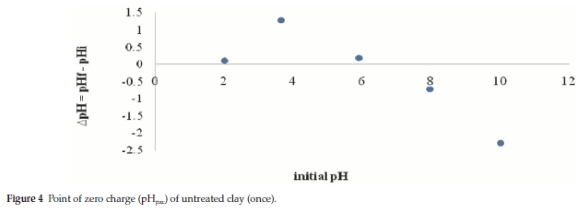
In order to elucidate the adsorbates-clay interactional mechanism, the surface charge of the sorbent material relative to the physico-chemical properties of SCP and SDM were analyzed. Literature report several possible adsorption mechanisms for sulfonamides, namely: (1) hydrophobic partitioning; (2) electrostatic attraction and (3) cation bridging.24 The higher Langmuir maximum monolayer adsorption density (Qo) for SCP (log Kw 0.31) than SDM (log Kow 1.17) clearly affirms that other driving forces besides hydrophobic interaction were involved. Secondly, SCP and SDM molecules (pKa = 5.7) were considered to be in anionic form under the present experimental conditions (pH of 6.4). The pH of point of zero charge (pHpzc) of untreated clay was about 6.0 (Fig. 4) and therefore the clay carried a net negative surface charge at pH above 6.0, as in under experimental conditions. As such, coulombic attractions as possible adsorption mechanism of SCP and SDM onto the untreated clay were ruled out. Adsorption must therefore be attributed to other forces that overcome the effects of electrostatic repulsions.
According to XRF analysis, the clay contained several multi-valent cations (Mn+). These cations may thus promote adsorption of the negatively charged species (SCP- and SDM-)by surface bridging with these anionic adsorbates forming specific bonds. Therefore, it is conceivable that the adsorption of SCP and SDM may be attributed, at least in part, to cation bridging interactions. Such kaolinite-adsorbate interactions may also be linked with the molecular dipole moment (Debye). The most polar molecule (SCP) was adsorbed more (Table 1). This suggests that the difference in Qo for SCP and SDM onto the clay may be correlated to their polarity.
3.6. Batch Adsorption Reaction Design
According to Omri et al.,25 adsorption isotherms can be used predict the design of batch adsorption regimes. The aim of the design is to predict the mass of raw clay, m (g), required to remove sulfonamide solution of volume V (L), from a near real environmental initial concentration of Co to relatively permissible levels of concentration Ce (mg L-1) for a single solute adsorption system.
Since the isothermal studies indicated that the Langmuir isotherm model satisfactorily described the equilibrium adsorption data, the mass of raw clay, m (g), required to achieve a certain percentage removal efficacy (R) from aqueous solution of volume V (L) for a predetermined initial concentration of sulfonamide Co (mgL-1), excluding 100 % removal efficiency was calculated by the relation:

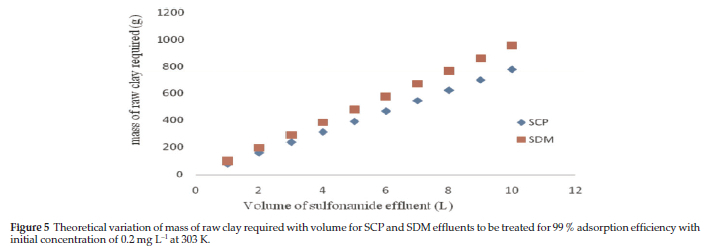
Figure 5 shows a plot of computed mass of raw clay required to remove SCP and SDM from aqueous media simulating real environmental reported initial concentration of 0.2 mg L-1 to achieve 99 % removal efficiency for solutions of varied volumes (1-10 L) at 303 K for a single-component batch reactor. Despite the expected increase in the amount of adsorbent required with increase in the volume of effluent to be cleaned, the fact that approximately 0.8 kg is required to eliminate 99 % of 0.2 mg L-1 both sulfonamides in 10 L solution attest to the sustainability of the clay as a low-cost adsorbent.
4. Conclusion
In this work, naturally occurring kaolinite clay was shown to possess relatively higher adsorption capacity for SCP than SDM. The Langmuir model satisfactorily described the adsorption processes. Adsorption kinetics followed pseudo-second-order kinetics while thermodynamics investigation revealed SCP and SDM adsorption to be spontaneous and favourable. The magnitude of activation energy (Ea) of adsorption for both sulfona-mides indicated that the adsorption mechanism was physical in nature. Cation bridging is proposed as a likely, though not exclusive, adsorption mechanism of SCP and SDM onto the untreated clay material. The tested clay is a potential low cost suitable adsorbent for sequestration of pharmaceutical compounds from wastewater.
ORCID iDs
V.O. Shikuku orcid.org/0000-0002-2295-293X
R. Zanella: orcid.org/0000-0002-5971-1785
F.F. Donato orcid.org/0000-0003-4039-1379
N. Bandeira orcid.org/0000-0002-9636-1606
Acknowledgements
The authors acknowledge www.exceed-swindon.org for the student exchange fellowship awarded to the first author and the collaboration between the institutions involved.
References
1 E. Primel, S. Caldas and A. Escarrone, Multi-residue analytical methods for the determination of pesticides and PPCPs in water by LC-MS/MS: a review, Cent. Eur. J. Chem., 2012, 10, 876-899. [ Links ]
2 S.J. Kimosop, Z.M. Getenga, F. Orata, V.A. Okello and J.K. Cheruiyot, Residue levels and discharge loads of antibiotics in wastewater treatment plants (WWTPs), hospital lagoons, and rivers within Lake Victoria Basin, Kenya, Environ. Monit. Assess., 2016,188: 532. DOI: 10.1007/s10661-016-5534-6 [ Links ]
3 E. Ngumba, A. Gachanja and T. Tuhkanen, Occurrence of selected antibiotics and antiretroviral drugs in Nairobi River Basin, Sci. Total Environ., 2016, 539, 206-213. [ Links ]
4 W. Baran, E. Adamek, Z. Justyna and S. Andrzej, Effects of the presence of sulfonamides in the environment and their influence on human health, J. Hazard. Mater., 2011, 30,1-15. [ Links ]
5 A. Bialk-bielńska, S. Stolte, J. Arning, U. Uebers, A. Böschen, P Stepnowski and M. Matzke, Ecotoxicity evaluation of selected sulfonamides, Chemosphere, 2011, 85, 928-933. [ Links ]
6 I. Braschi, S. Blasioli, L. Gigli, C.E. Gessa, A. Alberto and A. Martucci, Removal of sulfonamide antibiotics from water: evidence of adsorption into an organophilic zeolite Y by its structural modifications, J. Hazard. Mater., 2010, 178, 218-225. [ Links ]
7 L. Cottet, C.A.P. Almeida, N. Naidek, M.F. Viante, M.C. Lopes and N.A. Debacher, Adsorption characteristics of montmorillonite clay modified with iron oxide with respect to methylene blue in aqueous media, Appl. Clay Sci., 2014, 95, 25-31. [ Links ]
8 D. Mehta, S. Mazumdar and S.K. Singh, Magnetic adsorbents for the treatment of water/wastewater - A review, J. Water Process Eng., 2015, 7, 244-265. [ Links ]
9 T. Thiebault, G. Régis and B. Mohammed, Adsorption mechanisms of emerging micro-pollutants with a clay mineral: case of tramadol and doxepine pharmaceutical products, J. Colloid Interface Sci., 2015, 453, 1-8. [ Links ]
10 H. Hassan and B.H. Hameed, Fe-clay as effective heterogeneous Fenton catalyst for the decolorization of Reactive Blue 4, Chem. Eng. J., 2011, 17, 1912-1918. [ Links ]
11 H. Hosseinzadeh and S. Mohammadi, Quince seed mucilage magnetic nanocomposites as novel bioadsorbents for efficient removal of cationic dyes from aqueous solutions. Carbohydr. Polymers, 2015, 134, 213-221. [ Links ]
12 X. Huang, F. Yi, H. Cui, X. Xiaoyu, Y. Daliang and Z. Xiaoming, Mechanistic QSAR models for interpreting degradation rates of sulfonamides in UV-photocatalysis systems, Chemosphere, 2015, 138, 183-189. [ Links ]
13 Y.S. Ho and G. McKay, Sorption of dye from aqueous solution by peat, Chem. Eng. J, 1998, 70, 115-124. [ Links ]
14 Y.S. Ho, Review of second-order models for adsorption systems, J. Hazard. Mater., 2006, 136, 681-689. [ Links ]
15 R.E. Treybal, Mass-transfer Operations, 3rd edn., McGraw-Hill, 1981 [ Links ]
16 I. Langmuir, The constitution and fundamental properties of solids and liquids, J. Am. Chem. Soc., 1916, 38, 2221-2295. [ Links ]
17 H.M.F. Freundlich, Über die adsorption in lösungen, Z. Phys. Chem., 1906, 57, 385-470. [ Links ]
18 K.Y. Foo and B.H. Hameed, Insights into the modeling of adsorption isotherm systems, Chem. Eng. J., 2010, 15, 62-10. [ Links ]
19 R. Istratie, S. Marcela, P. Cornelia and L. Cosmin, Single and simultaneous adsorption of methyl orange and phenol onto magnetic iron oxide/carbon nanocomposites, Arabian. J. Chem., 2016, http://dx.doi.org/10.1016/j.arabjc.2015.12.012 [ Links ]
20 N. Daneshvar, S. Aber, A. Khani and A.R. Khataee, Study of imidacloropide removal from aqueous solution by adsorption ontogranular activated carbon using an on-line spectrophotometric analysis system, J. Hazard. Mater., 144, 47-51. [ Links ]
21 V.O. Shikuku, F.F. Donato, C.O. Kowenje, R. Zanella and D.O. Prestes, A comparison of adsorption equilibrium, kinetics and thermodynamics of aqueous phase Clomazone between Faujasite X and a natural zeolite from Kenya, S. Afr. J. Chem., 2015, 68, 245-252. [ Links ]
22 P.W. Atkin, Physical Chemistry, 4th edn., Oxford University Press, London, 1990. [ Links ]
23 H.R. Mahmoud, S.M. Ibrahim and S.A. El-Molla, Textile dye removal from aqueous solutions using cheap MgO nanomaterials: adsorption kinetics, isotherm studies and thermodynamics, Adv. Powder Technol., 2016, 27, 223-231. [ Links ]
24 F. Lian, B. Sun, Z. Song, L. Zhu, X. Qi and B. Xing, Physicochemical properties of herb-residue biochar and its sorption to ionizable antibiotic sulfamethoxazole, Chem. Eng. J., 2014, 248, 128-134. [ Links ]
25 A. Omri, W. Ahmed and B. Mourad, Adsorption of bentazon on activated carbon prepared from Lawsonia inermis wood: equilibrium, kinetic and thermodynamic studies, Arabian J. Chem., 2016, 9, S1729-S1739. [ Links ]
Received 13 July 2017
Revised 3 September 2017
Accepted 3 September 2017
* To whom correspondence should be addressed. E-mail: odhiambo_shik@yahoo.com