



Services on Demand
Journal

Article
 English (pdf)
 Article in xml format
 Article references
 Automatic translation
 Send this article by e-mail
Indicators
Related links
-
 Cited by Google
 -
 Similars in Google
Share

 Permalink
South African Journal of Chemistry
On-line version ISSN 1996-840XPrint version ISSN 0379-4350
S.Afr.j.chem. (Online) vol.78 Durban 2024
https://doi.org/10.17159/0379-4350/2024/v78a21
RESEARCH ARTICLE
Determination of selected metal concentrations in potatoes with different brands of potato chips in Quetta
Rishteena Wasay KhanI, II; Attiq Ur Rehman KakarII, *; Naqeebullah KhanII; Abdul HakeemI, II; Sami UllahII
ISchool Education Department, Government of Balochistan, Quetta, Pakistan
IIFaculty of Basic Sciences, Department of Chemistry, University of Balochistan, Quetta, Pakistan
ABSTRACT
Potatoes and potato products are used on a large scale, mostly by children. The study was conducted on snack food in Quetta city for the first time. This study collected different brands of potato products from Quetta City, such as Lays, potato chips, Lays wavy, and slanty. This study aimed to determine the concentration of iron, copper, sodium, manganese, and nickel using an atomic absorption spectrometer. The findings indicated significant differences in metal concentrations. Copper concentration was highest in potatoes (0.011 ± 0.001 mg/L), while iron and sodium accumulations were highest in potato chips (0.910 ± 0.02 mg/L and 41.710 ± 0.0076 mg/L, respectively). In contrast, manganese concentration was determined to be higher in Lays wavy (0.024 ± 0.003 mg/L), and nickel level was again assessed highest values in potato chips (0.170 ± 0.02 mg/L). However, nickel was not detected in Lay samples. The overall result was found in the range of FAO/WHO values. However, further research is required to study the impact of snack foods on human health.
Keywords: metals, potatoes, potato chips, atomic absorption spectrometer
INTRODUCTION
The fast changes in our lifestyle and advancements in the food industry have led to an increased intake of ready-to-eat foods like potato chips, especially among children.1 these foods are highly convenient and readily available in stores. However, it is crucial to evaluate the amount of heavy metals present in these foods.2 These heavy metals are unwanted substances that can get into our food during any step of the production process, from farming to manufacturing and packing. Heavy metals can slowly build up in vital body organs, leading to serious health problems.3 Potato chips contain diverse heavy metals including iron, manganese, zinc, cobalt, copper, etc. iron, cobalt, manganese and zinc are the essential metals because these are needed for the body to perform proper functions.4 Lead and cadmium are considered harmful even at very low concentration.5 Iron plays an important role in producing haemoglobin and myoglobin, the type of protein that carries oxygen to various body parts in the human body.6 It also forms certain enzymes and makes red blood cells in the human body.7 Iron deficiency can cause anaemia, a condition in which the body fails to form haemoglobin and myoglobin. As a result, body parts get less oxygen, leading to tiredness and illness.8 Moreover, iron deficiency causes early childbirth or low birth weight in pregnant women.9 Some other studies have also indicated that a deficiency of Iron affects the growth of children and the development of the brain in children.10
Contrarily, iron toxicity is a result of an overdose, manifesting symptoms in progressive stages. Iron often commences with gastrointestinal indicators such as emesis, hematemesis, diarrhoea, and abdominal discomfort.11 Further progression yields intense symptoms, including tachycardia, hypotension, and failure of organ functions, liver cirrhosis, gastric obstruction, coma, and ultimately death in extreme cases.12 Particularly under threat are children due to their heightened sensitivity and severity of iron toxicity. On the other hand, cadmium, which lacks any recognized biological roles and is resistant to degradation, consequently accumulates in food chains.
Heavy metals may pose potential toxicity hazards eve at very low concentration.5 The detrimental impacts of cadmium poisoning affect cardiovascular and immune systems and renal functions. In addition, it hinders calcium and vitamin D metabolism, potentially resulting in disorders like osteoporosis and inducing hemolysis. It is recognized as a carcinogenic agent.13 Given the implications of Iron's essentiality, its extensive application in agricultural and industrial segments, and the risks posed by cadmium, especially to children. This current study aimed to detect the accumulation of selected metals in potatoes and their products, such as Lays, Lays wavy, potato chips, and Slanty, because children use these products on a large scale.
EXPERIMENTAL
Reagents
The reagents employed in the current study were of analytical grade. Ultra-pure distilled water was employed as the solvent for all dilutions. Concentrated nitric acid (NHO3), perchloric Acid (HCLO4), and sulfuric acid (H2SO4) obtained from Merck were of high purity. The plastic and glassware used in the experiments were cleaned thoroughly by soaking them in 20% HCl and then rinsing them with distilled water. For calibration purposes, standard solutions of the metal ions under analysis were prepared by diluting their respective stock solutions of 1000 mg/L, purchased from Merck.
sample collection and Preparation
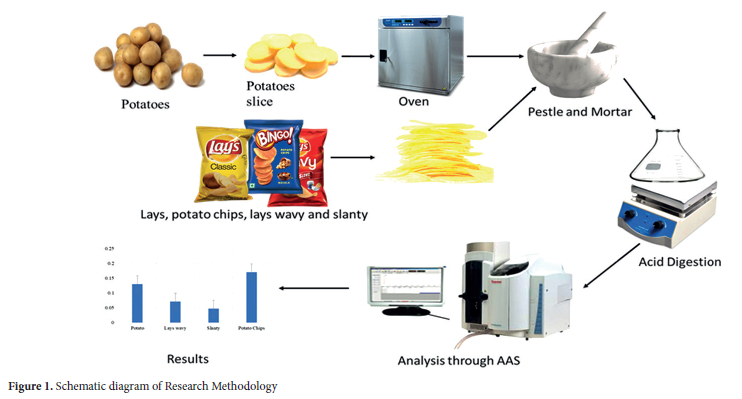
Potatoes and Potato products, including chips (potato chips) and varieties of Lays (Lays, Lays wavy), were obtained randomly from Quetta City. The samples were collected in plastic bags and transported to the lab. The samples were cleaned with ultra-pure deionized water to remove any impurities. Later, the potato samples were dried in an oven at 80 0C until the constant weight was obtained. All the samples were powdered finely using a pestle and mortar and kept for further processing. Figure 1. is the schematic diagram of the research methodology.
Acid digestion
1 g of the dried and finely powdered samples was weighed and transferred into a beaker. It was then treated with a 10ml mixture of concentrated acids (HNO3, HCLO4, and H2SO4) in the ratio of 5: 1:1 for digestion, following a previously reported protocol with slight changes.14 The mixture was heated at 75 0C for roughly 20 minutes, allowed to cool, and then filtered using a Whatman paper No. 42. The filtrate was diluted using extremely ultra-pure deionized water until it reached a 50 ml volume and kept for further study.
Analysis of the Samples
The various elements were analyzed by using an atomic absorption spectrometer (AAS, Thermo-Electron Corporation, S4 AA System, and S. No, GE711544, China) double beam and deuterium background hollow cathode lamps of Fe, Mn, Na, Ni, and Cu were used at specific wavelengths.
Validation of analytical procedure
The suggested methods were validated by calculating the limit of detection (LOD) and the limit of quantification (LOQ) using the calibration curve. For the calculation of LOD and LOQ, the following two equations, 1 and 2, were used previously.15 The solution of 1000 mg/L concentration was used.

"σ" represents the standard deviation of the response or standard deviation of y-intercepts.
RESULTS AND DISCUSSION
Potato and snack food like Lays Lays wavy, slanty and potato chips are used on a large scale by children in Quetta. These snacks may be contaminated in different ways, including cooking methods, manufacturing processes, etc. The current study indicated the presence of the metals of interest in the snack foods collected from Quetta.
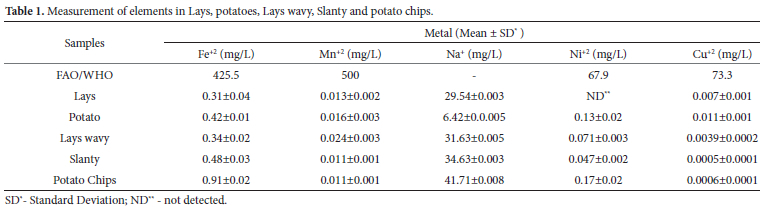
The mean concentration values of the elements (Fe, Mn, Na, Ni, and Cu) obtained by using an atomic absorption spectrometer are displayed with their (±) standard deviation in Table 1. The iron (Fe), manganese (Mn), sodium (Na), nickel (Ni), and copper (Cu) concentration values ranged from 0.31 mg/L to 0.91 mg/L; 0.011 to 0.023 mg/L; 6.42 to 41.71 mg/L; 0.047 to 0.17 mg/L; 0.0005 to 0.011 mg/L respectively in different snack foods like Lays, potatoes, Lays wavy, slanty and potato chips.
The limits of detection (LOD) and Limits of quantification (LOQ) were evaluated for diflerent metals (Fe, Mn, Na, Ni, and Cu) analyzed in the study, which are shown in Table 2. The LOD and LOQ values denoted the least concentrations of the elements that can be reliably detected and quantified, respectively. For instance, the LOD for Fe is 0.2 mg/L, which means that any concentration below this limit cannot be accurately detected. On the other hand, the LOQ is 0.9 mg/L, indicating that accurate quantification is only possible for concentrations above this limit. This pattern is similar for the other metals, with the magnitude of LOD and LOQ varying with each metal.
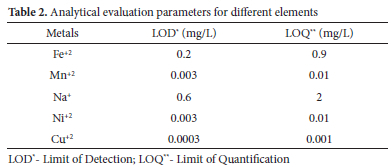
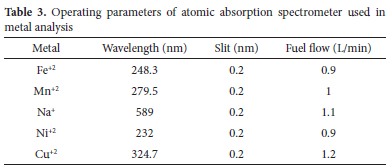
Table 3 shows the wavelength, slit and fuel flow of iron, manganese, sodium, nickel and copper. The wavelength of different metals ranged from 232 nm to 589 nm. A shorter wavelength shows higher energy radiation, while a longer wavelength indicates higher energy radiation. However, a slit of different metals remained constant (0.2 nm) throughout, which showed similarity in experimental conditions. The fuel flow of the detected metals ranges from 0.9 to 1.2 L/min. This indicates that different elements require different temperatures.
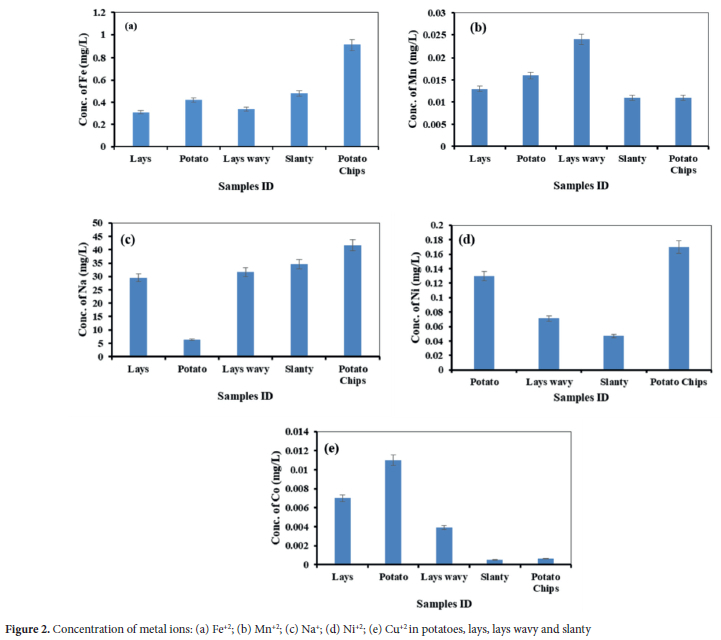
A significant difference was observed in the concentration of manganese among various snack food samples. The Lays chips contained 0.013 ± 0.002 mg/L of manganese, somewhat lower than the potato chips, which contained 0.016 ± 0.003 mg/L. Manganese concentration was significantly highest in the Lays wavy chips, with a value of 0.024 ± 0.003 mg/L. Moreover, slanty and the potato chips were measured with similar concentrations at 0.011±0.001 mg/L. The difference in manganese concentration among the samples may be due to the quality of potatoes used as raw material and encompassing the manufacturing process. Manganese plays a vital role in body functions such as metabolism and bone development.17 However, the excessive intake of Mn may cause a health risk. Therefore, it is vital to be conscious about the snack containing manganese. It was observed that detected level of manganese was within the tolerable range (500 mg/L) in all samples set by FAO/WHO.
The accumulation of iron was found to be the highest in the potato chips sample (0.91 mg/L), followed by the slanty (0.48 mg/L), potato (0.42 mg/L), Lays wavy (0.34 mg/L), and finally, Lays (0.31 mg/L). Diversity in the concentration of iron in different snack foods analyzed may be due to several factors, such as the raw materials used and the manufacturing process. It may also be due to the differences in soil quality where the potatoes are cultivated, which may cause variation in the levels of iron, as iron accumulation in the soil affects its uptake in plants.6 Additionally, the method of cooking and ingredients added during the processing phase can vary the iron concentration in the final product. However, iron level was found in the range of permissible limit (425.5 mg/L) fixed by FAO/WHO.
Lay chips contained a sodium concentration of 29.54 ± 0.0025 mg/L, obviously more significant than the potato sample, containing 6.42 ± 0.0.0045 mg/L. The Lays wavy chips have been detected with a slightly higher Na level of 31.63 ± 0.0045 mg/L, while the Slanty sample exhibited the highest sodium accumulation of all with 34.63 ± 0.0025 mg/L. Finally, the potato chips showed the maximal concentration of Na, at 41.71 ± 0.0076 mg/L. From this observation, it can be derived that the potato chips and slanty samples indicate the highest sodium level, narrowly followed by Lays wavy. The Lays chips comprise a moderately elevated concentration, while the Potato sample shows the most minor Na accumulation. This analysis highlights the diversity in sodium level indexed to diverse samples with a noticeable increase from potato to potato chips.
The nickel content was detected in Lays, potato, Lays wavy, slanty and potato chips. Notably, the nickel concentration was not detected in the Lay sample. The "potato" snack indicated nickel, averaging 0.13 mg/L. it indicated this snack would contribute to dietary nickel intake compared to the "Lays" sample. The "Lays wavy" variety displays an average nickel accumulation of 0.071 mg/L, which is between the "Lays" and "potato," while "slanty" offers slightly less nickel content at 0.047 mg/L. "potato chips" contained the highest nickel concentration among the samples at 0.17 mg/L. Hence, we can conclude that "potato chips" intake contributes the most to dietary nickel intake, while "Lays" would contribute the least. Overall, nickel concentration was detected in permissible limit (67.9 mg/L) set by FAO/WHO.
CONCLUSION
This study showed the presence of all the detected metals in potatoes and its commercial products such Lays, Lays wavy, chips and slanty. Different concentration of the selected metals were found in different brands of the samples examined. The variation among the samples were due to various factors such as agricultural land soil, cooking and processing methods. The results on comparison with permissible limits set by FAO/WHO showed that all the detected metal concentrations were within the standard values. Therefore, it is concluded that consumption of potatoes and its products are safe to intake.
ACKNOWLEDGEMENT
The authors thank the Department of Chemistry University of Balochistan, Quetta, for providing the lab facilities.
AUTHORS' CONTRIBUTIONS
RWK: conducted experiments and prepared initial Draft. ARK: conceived and designed the study. NK: Arranged the chemicals and lab facilities. AH: Interpreted data and prepared Draft. SK: Reviewed and edited the Draft.
ORCID
Abdul Hakeem: https://orcid.org/0000-0001-6550-8559
REFERENCES
1. Jaradat Q, Tarawneh A. Heavy Metal Content and Health Risk of Potato and Corn Chips Being Sold in Jordanian Market. Jordan J Chem. 2014;9(2):69-80. https://doi.org/10.12816/0026471. [ Links ]
2. Ullah I, Khan A, Rahim M, Haris MRHM. Health Risk from Heavy Metals via Consumption of Food Crops in the Vicinity of District Shangla. J Chem Soc Pak. 2016:38(1), 177-185. [ Links ]
3. Hannon AY, Al-Obaidi MJ, Al-Khafaji SS, Jassim lA. Heavy metals content in some chip products in Iraqi markets. Iraqi J Sci. 2016;57 4C:2818-2828. [ Links ]
4. Abdullahi H. Analysis and Evaluation of the Effect ofHeavy Metals in Fruits and Vegetables. IJTSRD. 2019;3(2):236-238. https://doi.org/10.31142/ijtsrd20298. [ Links ]
5. Hakeem A, Khan N, Attiq-ur-Rehman A-R, Khan S. A Comparative Study of the Heavy Metals in the Meat of Chickens in Different Cities of Pakistan. A Review. Al-Nahrain Journal of Science. 2020;23(2):75-79. https://doi.org/10.22401/ANJS.23.2.11. [ Links ]
6. Khan K, Lu Y, Khan H, Ishtiaq M, Khan S, Waqas M, Wei L, Wang T. Heavy metals in agricultural soils and crops and their health risks in Swat District, northern Pakistan. Food Chem Toxicol. 2013;58:449-458. https://doi.org/10.1016/j.fct.2013.05.014. [ Links ]
7. Khan MU, Malik RN, Muhammad S, Ullah F, Qadir A. Health risk assessment of consumption of heavy metals in market food crops from Sialkot and Gujranwala Districts, Pakistan. Hum Ecol Risk Assess. 2015;21(2):327-337. https://doi.org/10.1080/10807039.2014.913445. [ Links ]
8. Ullah Z, Naz A, Saddique U, Khan A, Shah W, Muhammad S. Potentially toxic elements concentrations and human health risk assessment of food crops in Bajaur Agency, Pakistan. Environ Earth Sci. 2017;76(14):482. https://doi.org/10.1007/s12665-017-6824-1. [ Links ]
9. Orisakwe OE, Nduka JK, Amadi CN, Dike DO, Bede O. Heavy metals health risk assessment for population via consumption of food crops and fruits in Owerri, South Eastern, Nigeria. Chem Cent J. 2012;6(1):77-83. https://doi.org/10.1186/1752-153X-6-77. [ Links ]
10. Cheraghi M, Lorestani B, Merrikhpour H, Rouniasi N. Heavy metal risk assessment for potatoes grown in overused phosphate-fertilized soils. Environ Monit Assess. 2013;185(2):1825-1831. https://doi.org/10.1007/s10661-012-2670-5. [ Links ]
11. Stasinos S, Nasopoulou C, Tsikrika C, Zabetakis I. The bioaccumulation and physiological effects of heavy metals in carrots, onions, and potatoes and dietary implications for Cr and Ni: a review. J Food Sci. 2014;79(5):R765-R780. https://doi.org/10.1111/1750-3841.12433. [ Links ]
12. Nzediegwu C, Prasher S, Elsayed E, Dhiman J, Mawof A, Patel R. Effect of biochar on heavy metal accumulation in potatoes from wastewater irrigation. J Environ Manage. 2019;232:153-164. https://doi.org/10.1016/j.jenvman.2018.11.013. [ Links ]
13. Kara EE, Pirlak U, Ozdilek HG. Evaluation of Heavy Metals' (Cd, Cu, Ni, Ph, and Zn) Distribution in Sowing Regions of Potato Fields in the Province of Nigde, Turkey. Water Air Soil Pollut. 2004;153(1-4):173-186. https://doi.org/10.1023/B:WATE.0000019942.37633.31. [ Links ]
14. Un Nisa K, Samiullah S, Khan N, ur-Rehman A. Detection of Heavy metals in Fruits and Vegetables available in the Market of Quetta city. Al-Nahrain Journal of Science. 2020;23(1):47-56. https://doi.org/10.22401/ANJS.23.1.07. [ Links ]
15. Sengül Ü. Comparing determination methods of detection and quantification limits for anatoxin analysis in hazelnut. 2016;24(1):56-62. https://doi.org/10.1016/j.jfda.2015.04.009. [ Links ]
16. Angelova V, Ivanova R, Pevicharova G, Ivanov K. Effect of organic amendments on heavy metals uptake by potato plants. In: 19th World Congress of Soil Science, Soil Solutions for a Changing World, 1-17 August 2010, Brisbane, Australia; pp 84-87. CABI Digital Library; 2010. https://doi.org/10.5555/20113337421. [ Links ]
17. Hariri E, Abboud MI, Demirdjian S, Korfali S, Mroueh M, Taleb RI. Carcinogenic and neurotoxic risks of acrylamide and heavy metals from potato and corn chips consumed by the Lebanese population. J Food Compos Anal. 2015;42:91-97. https://doi.org/10.1016/j.jfca.2015.03.009. [ Links ]
Received 17 December 2023
Revised 25 March 2024
Accepted 26 April 2024
* To whom correspondence should be addressed: Email: arkakar10@gmail.com