




Services on Demand
Journal

Article
 English (pdf)
 Article in xml format
 Article references
 Automatic translation
 Send this article by e-mail
Indicators
Related links
-
 Cited by Google
 -
 Similars in Google
Share

 Permalink
Psychology in Society
On-line version ISSN 2309-8708Print version ISSN 1015-6046
PINS vol.66 n.2 Stellenbosch 2024
https://doi.org/10.17159/pins2024vol66iss2a6331
ARTICLES
You're brought in as a workhorse and there's no real security here! Postdocs, precarity and the neoliberal university in South Africa
Mlamuli Nkosingphile Hlatshwayo
Ali Mazrui Centre for Higher Education Studies, University of Johannesburg, Johannesburg mhlatshwayo@uj.ac.za; 0000-0001-9180-8803
ABSTRACT
The literature on postdoctoral research fellows (hereafter postdocs) is bleak. Largely dominated by the global North scholars in the United Kingdom, the United States and Australia, this literature has provided an important insight into understanding the complex and nuanced experiences of postdocs and the struggles they encounter in navigating the publish or perish imperatives, the absence of a coherent pathway between the postdoc and permanent employment in academia and the constant job hopping that characterises the postdoc journey. In this paper, I share a portion of the findings of a national project focusing on three universities in South Africa, drawing on the experiences of current and former postdocs on the precarity, casualisation and job insecurity that they are facing. This is done through interviews with 23 current and former postdocs, a current university director of research and a former national department of higher education and training senior official. The findings reveal mainly two important aspects of the postdoc journey, 1) the crippling challenges of the employment insecurity and job insecurity on postdocs' wellbeing and livelihood, as well as the 2) the often hidden, un-seen and invisible "motherhood penalty" that women postdoc experience in attempting to balance motherhood and the demands of the postdoc. I end the paper with concluding thoughts on the future of the postdoc system in higher education, and the urgent interventions that are required to support these marginalised and precarious scholars.
Keywords: Postdocs; higher education; neoliberal crisis; transformation
Introduction
The postdoc journey is an important aspect of a novice academic's professional life in that it helps one to learn the art and science of scholarly research publications, teaching and learning in higher education, some postgraduate supervision as well as being involved in grant writing and possible project collaborations (Kerr, 2020). Although there is no consensus in the literature on the definition of the postdoc (Hlatshwayo, 2024a), it is broadly understood that postdocs are a category within early career academics, often referring to novice scholars who have recently obtained their doctoral qualifications and are employed on a fixed term contract, focusing on producing research outputs, under the guidance of a host or supervisor. Postdocs receive an un-taxed monthly stipend and are not considered as employees or staff at university. As such, they do not receive employee pension or medical aid benefits.
What is increasingly becoming clear is that the postdoc journey also has a "dark side", with novice scholars lamenting the crippling challenges of the publish or perish imperatives on their mental health, the lack of adequate mentoring and support, the precarity and employment insecurity as well as the job hopping and its effect on ones' family (Aprile, Ellem, & Lole, 2021; Culpepper, Reed, Enekwe, Carter-Veale, LaCourse, McDermott and Cresiski, 2021; Hollywood, McCarthy, Spencely, & Winstone, 2020; Leenen-Young et al., 2021). The racial question also features prominently in the literature, with Yadav et al. (2020), Chakraverty (2020), Culpepper et al. (2021) and Mendez et al. (2023) flagging the complex challenges that racial minority postdocs face in STEM (science, technology, engineering, and mathematics) fields, as well as their struggles in obtaining tenure in the academy.
In the South African context, there is limited data and literature on the experiences of postdocs in the country, their wellbeing as well as their progression to permanent employment in higher education (see for example, Prozesky & van Schalkwayk, 2024). The little available data on the postdoc experience appears to be characterised by a predominant concern with the career trajectory of postdocs, possibly asking to what extent the postdoc system itself constitutes a viable and coherent pathway into professional growth and permanent employment for the scholars; or whether it socially constructs, maintains and reproduces their marginality (see for example Simmonds & Blitzer, 2018; Kerr, 2022). In this paper, I contribute to this growing body of research that explores and theorises postdocs' experiences as they negotiate their belonging in South African higher education. I particularly see and read the recent emergence of postdocs in South Africa (Kerr, 2022) as a by-product of the neoliberal logics in the global South, leading to the commodification, commercialisation, casualisation, and corporatization of the higher education sector in general. The two appear to be mutually constitutive and dialectical of the other.
I first discuss the rise of neoliberalism in higher education and the colonizing logics that shape and influence the sector in relation to postdocs. I then move to outlining the research methods, indicating how the data was collected and analysed in this project. Then I turn to the heart of the paper, that is, the findings and discussions, revealing the two emerging themes in this paper. In lieu of a conclusion, I end the paper with some parting shots and recommendations on the need for urgent and structural reforms that are required in order to strengthen the postdoc system in South Africa.
Neoliberal turn(s) in higher education
Before I briefly discuss the neoliberal turns in higher education, and their implication(s) for postdocs in the academy, it is important that I provide my conceptual understanding of neoliberalism and why I see this system as inherently anti-education and antidemocratic in nature.1 Neoliberalism broadly refers to the economic and political system that believes in mainly four things - a commitment to rugged forms of individualism, free market economics, a laissez-faire approach by the state, and lastly, a commitment to free trade (Olssen & Peters, 2005; Tight, 2019, Harvey, 2005). Underpinning neoliberalism is the central idea that the free market is best positioned to resolve all social-economic and political challenges in society. For Fukuyama (2022), what sets neoliberalism apart from classical liberalism is its inherent rejection, hostility and denigration of the welfare state, with the state (and government) largely seen as naturally incapable and undesirable to be involved in the private affairs of the citizens.
It should be noted that the distrust and suspicion of the state is firmly rooted in the late British philosopher Hobbes (2016) who theorised and conceptualised the role of the state as the all-powerful and mighty "Leviathan" that needs to be monitored, controlled and contained, least it comes after us and our freedoms (Hobbes, 2016). In the neoliberal tradition, the primary role (and function) of the state is to essentially "back off" and only concern itself with creating the conditions of possibility that will enable and facilitate individuals to flourish in the economy (Tight, 2019). The emergence of neoliberalism is especially signified in the 1980s and early 1990s with the then Thatcher government in the UK and the Reagan administration in the US who promoted deregulation, privatization, financialization and globalisation (Radice, 2013; Tight, 2019; Harvey, 2005; Hlatshwayo, 2022), resulting in Thatcher famously remarking that there is no alternative to neoliberalism (Bello, 2013). What is troubling and needs to be challenged about the neoliberal system is the presupposed and firmly rooted idea that the market is "fair", "just" and an "equal" arbiter of political difference in society. This raises necessary questions about poverty, patriarchy, inequality, and racial justice, probing to what extent, do we counter and respond to these challenges purely on a neoliberal and individualistic framework. Simply put, can wealth and the attainment of money "end" institutional racism? Can the attainment of educational qualifications, what Bourdieu (2011) would call cultural capital, offset institutional racism and possibly counter patriarchy? Can an individual outwork and out-class racism? What about the financial bailouts and large funding that governments sometimes pay to big businesses in an effort at "saving the economy", and helping them to avoid bankruptcies, could this not act as a contradiction to free market capitalism? (see for example Stiglitz, 2024). These and other questions potentially challenge the taken for grantedness of neoliberalism in society, and its contradictions.
It is the above contested context and background that the neoliberal turns in higher education emerge. Shore (2010) argues that neoliberalism in higher education is particularly seen in the 1970s and 1980s with two shifts - that is, the growing massification across higher education institutions in the global North, as well as the decline in state subsidies for higher education (Shore, 2010). These reform measures, meant to respond to the needs of the globalised "knowledge economy" and the "knowledge workers" (Boughey & McKenna, 2021) brought with them corresponding changes in the public discourses. Higher education ceased to be a "public good" necessary for the growth and development of the broader society and gradually seen as an individual investment in one's life. Another corresponding shift was signified through universities no longer being seen as the places of knowledge production, critical thinking and deliberating over democratic questions, with institutions of higher learning increasingly being viewed as transnational and transactional business entities that need to operate in a competitive knowledge economy (see Shore, 2010, Readings, 1996; Hlatshwayo, 2022).
In another paper, I have commented on the role that neoliberalism ties with precarity in reinforcing the structural marginality, oppression and suffering that early career academics in general and postdocs in particular have to navigate (Hlatshwayo, 2024a). Scholars such as Gallas (2018), Makama and Peterrs (2024) and Coultas, Reddy and Lukate (2023) have written about the challenge of precarity and its effects on ones' vulnerability, wellbeing, mental health, and livelihood. It is perhaps the philosopher Giroux (2010) who offers a persuasive critique on precarity, in arguing that we are all now living in what he terms the neoliberal order and its "machine of disposability", symbolised through citizens becoming consumers, data and commodities (Giroux, 2010).
The corporate, commercialisation and commodification of the university, what Badat (2023) sees as the corrupting of the public university in South Africa - manifests itself through the introduction of performance management instruments, quality assurance regimes, ratings, managerialism, rankings, publish or perish and other metrics designed to ensure that the university not only competes internationally but also thrives in this neoliberal climate. Most poignant for us in South Africa, students have become our fee-paying clients who have paid for and bought the curriculum goods of the university. This corporate relationship has a number of implications for us in higher education. Firstly, it reduces the university to the public marketplace, with us as academics being involved in the factory production of knowledge, and intellectual goods and services. Secondly, students, as the fee paying clients, can demand what the late Morrow (1994) calls the epistemic access, that is, access to the curricula, knowledge, disciplinary understandings, and modes of being/ seeing/ thinking simply because they have paid for it and it is therefore their right to have. It is perhaps Hall (2016) who best captures the implications of neoliberal policies on higher education, and what this means for us in practice;
Neoliberalism is a global pedagogical project aimed at the dispossession of free time so that all of life becomes productive, and education is a central institutional means for its realisation. This project aims at marketising all of social life, so that life becomes predicated upon the extraction of value. In part the deployment of technologies, technical services and techniques enables education to be co-opted as an institutional means for production and control. This occurs inside both formal and informal educational institutions and spaces, like universities and Massive Open Online Courses, as one mechanism to offset the tendency for the rate of profit to fall and to re-establish accumulation (emphasis added) (Hall, 2016, p. 1004).
The rise of the neoliberal university coincides with the emergence of the precarious postdoc systems as an extension of the exploitation of academic work in the university. What Hall (2018) calls the proletarianization of academic labour, academics have gradually become an expendable and casualised human capital that could be cheaply accessed, used and discarded when no longer required. With growing concerns over the "over supply" of postdocs in the global higher education who are competing for limited resources and opportunities in the field (see Afonja et al, 2021; Jones, 2023; Ivancheva 2015), it has become brutally clear that postdocs serve the function of assisting higher education institutions to achieve their neoliberal metrics and desires without being offered employment security. Coupled with massive job losses in higher education, this extractivist logic seems to be the prevailing order of the day. In the Australian higher education sector, job losses ranged between 12 000 in October 2020 to about 35 000 by the end of May 2021, with the majority of those job losses being part time and contract staff members (Norton 2022). In one UK university, Staffordshire University, 1/10 academics will be losing their jobs as 100 posts are earmarked to be cut due to what the university describes as the "turbulent student recruitment market at home and abroad" (Bottomley, 2023).
In the South African context, the bulk of the academic workforce continues to be precarious, and temporary (CHE, 2021). In latest publicly available data from the Council on Higher Education (CHE), we had 95 193 temporary staff members in higher education compared to 57 384 who were permanent in 2016 (CHE, 2021, p. 62-63). By 2021, the numbers are still concerning with 86 549 temporary staff members and only 64 882 who are permanently employed (CHE, 2021, p. 62-63). The below tables give the fuller picture of the precarity crisis that we are facing in the public higher education system:
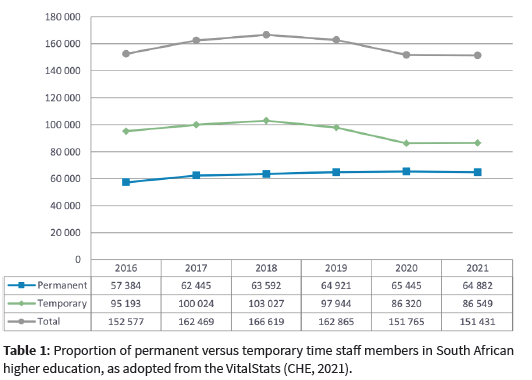
In this paper, I give "voice" to the above precarious and temporary numbers through exploring and theorising the narratives of postdocs as they navigate their belonging in South African higher education. I argue that in thinking through national policies on attracting, retaining and supporting the next generation of academics in South Africa, it is important to focus on the complex narratives/ experiences/ voices of postdocs as they struggle to navigate their place in higher education so as to propose interventions that are targeted and that could make a meaningful difference in the sector.
Research methods
In this paper, I drew on qualitative research, underpinned by the decolonial intellectual tradition (Grosfoguel, Hernández, and Velásquez, 2016; Heleta, 2016, 2018; Le Grange, 2016). The decolonial intellectual tradition was attractive to me as a scholar as it aligns with my ideological and philosophical orientations that the public university in the global South remains an imperial, colonial and apartheid intervention (Ndlovu-Gatsheni, 2012, 2013, 2017, 2018) - thus re-centering those who are Othered remains the central organizing project of our time. The findings shared in this paper are a part of a broader national project focusing on the experiences of postdocs in South African higher education. In the project, I focused on the complex experiences of postdocs in three universities in South Africa - two research-intensive universities based in Gauteng and the third one is a historically Black2 university based in the Eastern Cape. Two research questions informed and shaped the research project - what are the lived experiences of postdocs in South African higher education? And how can postdocs be supported to access, navigate and succeed in higher education? I purposively recruited and interviewed 23 former and current postdocs, a current director of research, and a former senior official of the Department of Higher Education and Training (DHET). I received the necessary ethical clearance for the project (Sem 1-2023-051) as well as the gatekeeper permissions in all three participating universities. I primarily used interviews as the main data generation method, with all interviews conducted ranging between 35 minutes - 1 hour 45 minutes in length. Consent was obtained from all the research participants, together with their written permissions to take part in the study. Their identities have been anonymised, with pseudonyms being used in the paper.
The data was coded and analysed through a thematic analysis (Peel, 2020). Using Peel (2020)'s suggested six stages of thematic coding and analysis for qualitative data, the following stages were adopted: (1) collecting; (2) engaging with the data; (3) coding; (4) generating the code categories; (5) conceptualising the themes; and (6) contextualising and representing the findings. This for me, enabled a deeper understanding and engagement with the data, and allowed the created themes to better reflect the participants' narratives and voices.
To give some insights into the profile of the research participants. Out of a total of 25 research participants who took part in the study, 15 were women, and 10 were men. In terms of racial classifications and categories, 23 are Black, and three are White. Of the 23 current and former postdocs who were interviewed, 14 were Zimbabweans and 9 were South African citizens. Their disciplinary background ranged across the fields of Higher education studies, Education Leadership and Management, Mathematics, Business Management, Sociology, Anthropology, Disability studies, Sexualities, Genders and Queer studies, Political Science, and Psychology, amongst others. While it is largely agreed upon that there is no universal consensus on what constitutes an emerging and novice scholar in higher education (see for example Aprile et al., 2021; Hollywood et al., 2020; Leenen-Young et al., 2021), similar debates abound regarding the different types of postdocs in the system, with some more experienced than others in terms of independent research and publications, others taking on research, teaching and supervision commitments as part of their roles in departments/research centres. Other postdocs appear to have a more restricted role in focusing purely on research outputs. Thus, to speak of the postdoc in higher education as a singular and monolithic conception is misleading and betrays the present realities that we see on the ground.
On precarious scholars
A large number of the research participants who took part in the study commented on the dangers of the employment precarity and causality in their lives. They especially commented on the anxiety, stress and feeling like they are "workhorses" who are metaphorically useful for lifting the rankings of the university, without any permanent employment security. Commenting on these challenges, the research participants narrate below:
You never feel secure... Knowing you have a family, knowing there are people who are looking up to you for sustainability for their livelihood. You will never feel secure ... speaking from my own experience are very insecure while we are doing marvellous work that bring subsidy to the university but in terms of stability, psychologically, it is really really bad because you are worried every now and then and you only relax when you have been renewed (Interview, Cynthia).
I have so much anxiety that my contract is about to end and what will happen next, its always on my mind. I am always thinking of it. (Interview, Fadzai)
The insecurity is bad, you are basically brought in as a carthorse or workhorse, and then there's no real security, you've got no pension, you've got no medical aid, I mean you're going essentially, from month to month...and you don't know whether that in six month you are going to be renewed. (Interview, Jacob).
This part time job has affected me, and it's still affecting me. You know, when you get employed, everybody aspires to get a permanent position. So, when you get a temporary one, it's not easy to only focus on the work. You also need to think of the future. When this ends, what am I going to do? Where will I be? You also think of your finances as well. Will I be able to continue living maybe the lifestyle that I live without this salary? What's going to happen to me? (Interview, Jason).
In the above quotations, the research participants reflect on feeling like they are helpless workhorses who are deprived of any job security. They narrate the self-doubt, self-questioning and constant reflections about whether their contract will get renewed and to what extent they may end up being unemployed. This has implications for them not being able to do and perform their jobs as they are constantly worried, panicking and in tension regarding the possibilities of not getting a contract renewal. The concerns echoed by the above research participants are similar with another research participant, Masi, who reflected on the struggles of working every day without any "security to say the following year you are coming back or not" (Masi) in the university. Spina, Smithers, Harris and Mewburn (2022) suggests that what sustains this precarity and instability in the university is the flawed idea of the postdoc as a "pipeline" that will lead to a permanent academic appointment. Spina et al. (2022) critique the notion of the postdoc system as a "pipeline", as deeply damaging and dangerous for early career academics (ECAs) who are discouraged and disillusioned by the long periods of job insecurity and short-term contracts. This idea of the pipeline is rooted in the flawed idea that the postdoc phase will result in fellows obtaining permanent employment in academia as a result of the training/ mentoring/ support they obtained, which is increasingly being proven to not be the case (see for example Bosanquet, Mantai, & Fredericks, 2020; Woolston, 2020a, 2020b). Furthermore, this logic seeks to erroneously suggest that there is a coherent pathway between postdoc as a short term employment opportunity and permanent employment, ignoring the growing research that shows that the longer a postdoc remains a postdoc the more challenging it is for them to obtain permanent employment (Bosanquet et al., 2020). This emergent (and flawed) discourse of the postdoc as a pipeline, was also seen and articulated by one of our research participants, a current director of research in one of our research sites, who commented on what he called the postdoc system as "halfway house" that is meant to lead to a substantive academic post for postdocs:
Some postdocs do become lecturers even senior lecturers and on rare occasions some do even make it to associate professor level, you must be aware of XXX who is now a professor ...So that fulfils the basic purpose of the postdoctoral program, it is to drive a halfway house to full academic status. (Interview, Mthembu)
The dangers of the conceptual and philosophical understanding of the postdoc systems as a "pipeline" or "halfway house" to a permanent academic post is not necessarily that it is largely not true, but that is invariably seeks to normalise and make palatable the precarious challenges that postdocs are experiencing on the basis that they will eventually obtain permanent employment in the university. Thus, theirs is to persevere and tolerate, it will all be over soon, at least that is the underpinning assumption. This pipeline conception, or what one of the research participants Mthembu calls the "halfway house", is also evident in South Africa's national policies on the attraction, retaining and supporting of emerging scholars in the country. The country's leading policy document that is dedicated to the grooming and developing the next generation of academics in South Africa, the Staffing South Africa's Universities' Framework (SSAUF), speaks about a complex pathway into an academic career in South Africa (DHET, 2024). This academic trajectory and pathway are described in singular and monolithic terms as typically "[including] the following stages: undergraduate, Honours (or the 4th year of a 4-year Bachelor's degree), Master's, Doctorate, and Post-doctorate" (DHET, 2024, p. 1). This fundamental misunderstanding, misreading, and misframing of the postdoc journey has implications for the academic and social wellbeing of the postdocs themselves, who incorrectly see the postdoc as a real and legitimate path to permanent academic employment. For example, we see in our data, what I call postdoc-ism with the emergence of the phenomena were postdocs can stay in the postdoc journey for at least 6 years without transitioning to a permanent academic post. Themba, another research participant, comments on these complex challenges of being postdoc since 2018, and the different types of support he has been offered in the hope that he will obtain a permanent post:
I have been a postdoc since 2018, I will distinguish the different types of support I've received. Firstly, in terms of mentorship, I began with a very good mentor indeed Prof XXX and on that side, I have grown, I cannot complain even my current mentor but that is scholarship mentorship. In terms of funding, grants, there is really nothing much that I have been involved to participate or to be shown how to do these funding applications and so forth. As we speak, the XXX in terms of conferences, I've never attended a conference that has been sponsored by the faculty according to that postdoc funding because according to the breakdown of funding, there is supposed to be conference funding. So in terms of that aspect there isn't much support. (Interview, Themba).
Closely related to the idea of employment precarity and job insecurity for postdocs, is a different type of precarity, what is called the "motherhood penalty" that affects women postdocs in particular. I now turn to this theme more closely.
On the motherhood penalty
In their influential paper, "Getting a job: Is There a Motherhood Penalty?", Correll, Benard and Paik (2007 introduce the term "motherhood penalty" to describe the prevalent and systemic discrimination that mothers tend to experience in the workplace. They closely trace the wage gap between mothers and non-mothers at work. This discrimination also manifests itself in how mothers are often perceived as less competent, less committed and less passionate about their work because of their family responsibilities (Correll et al., 2007). In a report titled "Is there a motherhood penalty in academia? The gendered effect of children on academic publications", Lutter and Schröder (2019) bring this conversation closer to the higher education sector, and reveal that women academics also experience this motherhood penalty as seen through the discrepancy of publication outputs between women and men academics, with their results indicating that having children does lead to significant declines in the number of publication outputs for women academics, with men not being affected that much (Lutter & Schröder, 2019). They also reveal the deeply entrenched and gendered nature of how having children appears to have an effect on women academics' productivity, while men tend to experience no decline in their academic performance. This motherhood penalty reflects Magoqwana, Maqabuka and Tshoaedi (2019)'s suggestion that South African higher education has what they call the "Black nannies" in the university, that is, those Black women academics who take on this invisible, un-seen and unrecognised care work that is often exclusively relegated to women academics. This as a result, tends to delay women's progress and progression in the university system. When we look at the data, we see similar patterns of the prevalent and often un-recognised motherhood penalty with women postdocs balancing motherly responsibilities and their postdoc duties. One research participant, Mutsa, reflects on how she attempts to balance being a single parent, postgraduate supervision, and conference responsibilities all while being expected to be "productive" and to be publish:
I've got a younger child who is 3 and half, it's quite challenging. I don't have a helper so everything depends on me... I've got a child that I have to take care of and am a single parenting on top of that. Yes and I've got two grown up kids. The other one is at university doing his second year and then the other one is at a boarding school ...But the bigger boys are not with me, I have to be in constantly in touch with the school, I have to be in constantly in touch with this one at varsity. When there is an open day at school with this one who is at school I have to be touching ground to say whose free, go with this, this is what I'm sending and everything. And then now as a supervisor again I have, remember when you are a supervisor, my students need me...when am traveling I have to make plans for leaving this little one which I thank God I've got my sister whom I share the house with so in most cases she stay with XXX my son. So sometimes I can travel for maybe 4-5 days. (Interview, Mutsa)
Mutsa above, reflects on the challenges of balancing family, academic responsibilities and precarity in her life. While Lutter and Schröder (2019) suggest that women academics seem to be doing well managing and responding to the "double burden" of career and motherly responsibilities, this is still nonetheless concerning as it seeks to normalize what is broadly agreed to be an insidious form of discrimination and penalty for women in the workplace.
Overall, the employment precarity, job insecurity and the motherhood penalty appear to feature prominently in the data when it comes to the research participants who took part in the study. With words such as "anxiety", "stressed", "workhorses" and "panicking", these scholars in the margins feel the brunt of the higher education through their peripheral status, marginality and insecure working conditions. I now turn to a broader discussion, and its implications for us in the system.
Discussion, and (broader) implications
South African higher education continues to be trapped in this long and enduring quest for institutional transformation and decolonization of the sector (Le Grange, 2016; Matthews, 2019; Zondi, 2018). Since at least the early 1990s, the sector has been grappling with real questions around democratising access, success and the different types of knowledges that ought to be valued, legitimated and privileged in curriculum offerings (Badat, 1994, 2009, 2016). The question(s) around the need for targeted interventions in recruiting, attracting and retaining the next generation of Black academics in the country, is central to that transformation agenda (DHET, 2024; Hlatshwayo, 2022). Announcing the introduction of the SSAUF policy document in 2015 as a targeted and strategic response to recruiting the next generation of academics in the country, the minister of higher education and training Blade Nzimande correctly diagnosed that South Africa is facing a crisis of "slow pace of transformation, regeneration and change, the ageing workforce, developments in higher education worldwide that demand ever greater levels of expertise from staff [and] the relatively under qualified academic staff workforce" (DHET, 2024, p. 1). What is troubling and deeply concerning is that despite the bold and clear articulations of the challenges that are facing the sector, postdocs are only mentioned once in the entire policy document. No description is offered on their roles and functions, their projected or estimated pathways into an academic career, the support offered and what they can expect in their postdoc journey.
Furthermore, despite the SSAUF's policy document serving as the country's premium policy vision and articulation on mentoring, supporting and aiding the next generation of ECAs in South Africa, no policy currently exist so far that is clearly targeted at responding to the specific needs and wellbeing of postdocs in South Africa. The implications are that we are unable to trace the real number of postdocs in the South African higher education system, their needs and support, as well as how many obtain permanent academic employment and how many end up in the private sector (Hlatshwayo, 2024a). The lack of clear policy directives and articulations on the roles and functions of the postdoc leads to what Foucault calls the "conditions of possibilities" that enable and facilitates the precarity, job insecurity and exploitation that postdocs are confronting (Pinkus, 1996). The permanent postdoc-ism where some postdocs spend on average 6-7 years, and as narrated by one of the research participants in the paper, Themba - appears strategic, deliberate, and intentional. Postdocs have become the precarious research mules who are there to serve the needs of the neoliberal university through ratings, rankings, funding, benchmarking, and quality assurance without being offered any job security or adequate working conditions. The motherhood penalty appears to be an unintended consequence of an exploitative system that is designed to extract academic labour at the expense of stability and security.
It should be recognised and acknowledged that the emergent research on the postdoc experience(s) is still largely shaped and influenced by the global North gaze (Aprile et al., 2021; Bosanquet et al., 2020; Hollywood et al., 2020; Leenen-Young et al., 2021; Spina et al., 2022). Those of us in the global South, particularly in South Africa, continue to be at the receiving end of this work that appears to define and conceptualize for us what an ECA looks like or what the "typical" postdoc career trajectory is. This has a number of implications and challenges for us in the global South. Firstly, it perpetuates a colonial assumption of the global South as a place of absence, non-beings and lack of real scholarly interventions. Secondly, it presents the global North postdoc experience as the only "real game in town", with global South experiences being pushed to the periphery. Third, the global North does have policy interventions, national organisation and even trade unions that are there to guide, protect and support precarious postdocs and their interest. In South Africa, and as mentioned earlier, this continues to be a lingering problem for us, were policy interventions, national offices and institutional mechanisms appears to be structurally lacking, and absent. This therefore makes it more critical for postdocs' narratives/ voices/ experiences to be illuminated so that bottom-up interventions could be enacted in South Africa.
In lieu of a conclusion...
In this paper, I shared some findings of a national study that focused on the complex experiences of postdocs in South African higher education. Through focusing on three universities in South Africa - two research intensive universities in the Gauteng province and one historically Black university in the Eastern Cape - I explored the voices/ narratives/ experiences of postdocs as they grapple with employment precarity and the motherhood penalty in their lives. I especially revealed how anxious, nervous, and frustrated postdocs are in the academy, and the existential fears of job insecurity and part time-ism in their lives. I also reflected on the growing motherhood penalty amongst the postdocs, particularly in how women postdocs have to balance work and family responsibilities at the expense of their own academic productivity, and research. Based on the above, I make the following recommendations:
• A national policy and legislative framework on postdocs in South Africa is urgently required. At the moment, different universities have socially constructed varying roles and responsibilities on what constitutes the postdoctoral experience in their own contexts. This results in a casualisation, differentiated and fragmented postdoc experience, with no protection, security, rights and responsibilities being offered to postdocs.
• The literature on the postdoc experience is still relatively new in South Africa (Simmonds & Blitzer, 2018; Kerr, 2022). Further research is still required to make sense of these marginalized scholars, and the different types of support that they require.
• This paper shares the findings of only three universities. A national study is needed that can take stock of the postdoc experience across all 26 public higher education institutions in South Africa. This will help us to begin to map, trace and construct a living database of postdocs in the country.
Acknowledgement
This work is based on the research supported by the National Institute for the Humanities and Social Sciences (NIHSS), grant number CRP22/1105. The opinions, findings, conclusions or recommendations expressed are those of the author and are not to be attributed to the NIHSS.
References
Afonja, S., Salmon, D.G., Quailey, S.I., Lambert, W.M. (2021) Postdocs' advice on pursuing a research career in academia: A qualitative analysis of free-text survey responses. PLoS ONE 16(5): 1-20. [ Links ]
Aprile, K. T., Ellem, P., & Lole, L. (2021). Publish, perish, or pursue? Early career academics' perspectives on demands for research productivity in regional universities. Higher Education Research & Development, 40(6), 1131-1145. [ Links ]
Badat, S. (1994). Differentiation and disadvantage: the historically black universities in South Africa: report, to the Desmond Tutu Educational Trust Education Policy Unit, University of Western Cape. [ Links ]
Badat, S. (2009). Theorising institutional change: post-1994 South African higher education. Studies in higher education, 34(4), 455-467. [ Links ]
Badat, S. (2016). Deciphering the meanings, and explaining the South African higher education student protests of 2015-16. PaxAcademica, 1(1), 71-106. [ Links ]
Badat, S. (2023). Commodification, Corporatization, Complicity and Crisis: The University in Contemporary South Africa. The Nelson Mandela Education Legacy Lecture. SAERA. Rhodes University. [ Links ]
Bello, W. (2013). Short-lived legacy: Margaret Thatcher, neoliberalism and the global south. The Guardian. https://www.theguardian.com/global-development/poverty-matters/2013/apr/16/legacy-margaret-thatcher-neoliberalism [ Links ]
Bosanquet, A., Mantai, L., & Fredericks, V. (2020). Deferred time in the neoliberal university: experiences of doctoral candidates and early career academics. Teaching in Higher Education, 25(6), 736-749. [ Links ]
Bottomley, L. (2023). University set to cut staffing numbers. BBC. https://www.bbc.com/news/articles/cq5p3dee4dzo. [ Links ]
Boughey, C., & McKenna, S. (2021). Understanding higher education: Alternative perspectives. Stellenbosch: African Minds. [ Links ]
Bourdieu, P. (2011). The forms of capital. Cultural theory: An anthology 1(1): 81-93. [ Links ]
Chakraverty, D. (2020). The impostor phenomenon among Black doctoral and postdoctoral scholars in STEM. International Journal of Doctoral Studies, 15, 433. [ Links ]
Coultas, C., Reddy, G., & Lukate, J. (2023). Towards a social psychology of precarity. British Journal of Social Psychology, 62, 1-20. [ Links ]
Council on Higher Education. (2021). VitalStats: Public and private higher education data. Tshwane: CHE. [ Links ]
Correll, S. J., Benard, S., & Paik, I. (2007). Getting a job: Is there a motherhood penalty? American Journal of Sociology, 112(5), 1297-1338. [ Links ]
Culpepper, D., Reed, A. M., Enekwe, B., Carter-Veale, W., LaCourse, W. R., McDermott, P., & Cresiski, R. H. (2021). A new effort to diversify faculty: Postdoc-to-tenure track conversion models. Frontiers in Psychology, 12(1), 1-16. [ Links ]
Department of Higher Education and Training. (2024). Staffing South Africa's Universities Framework. Tshwane: DHET. http://www.ssauf.dhet.gov.za. [ Links ]
Fukuyama, F. (2022). Liberalism and its Discontents. New York: Farrar, Straus and Giroux. [ Links ]
Gallas, A. (2018). Precarious academic labour in Germany: termed contracts and a new Berufsverbot. Global Labour Journal, 9(1). 92-102. [ Links ]
Gannett, L. (2004). The Biological Reification of Race. British Journal for the Philosophy of Science, 55(2), 323-345. [ Links ]
Giroux, H. (2010). Neoliberalism and the machinery of disposability. Philsoophers for a change.https://philosophersforchange.org/2014/04/15/neoliberalism-and-the-machinery-of-disposability/ [ Links ]
Grosfoguel, RM., Hernández, R., and Velásquez, E.R. (2016). Decolonizing the Westernized University: Interventions in Philosophy of Education from Within and Without.. London: Lexington Press. [ Links ]
Hall, R. (2016). Technology-enhanced learning and co-operative practice against the neoliberal university. Interactive Learning Environments, 24(5), 1004-1015. [ Links ]
Hall, R. (2018). On the alienation of academic labour and the possibilities for mass intellectuality. tripleC: Communication, Capitalism & Critique. Open Access Journal for a Global Sustainable Information Society, 16(1), 97-113. [ Links ]
Harvey, D. (2005). A Brief History of Neoliberalism. Oxford: Oxford University Press. [ Links ]
Heleta, S. (2016). Decolonisation of higher education: Dismantling epistemic violence and Eurocentrism in South Africa. Transformation in Higher Education, 1(1), 1-8. [ Links ]
Heleta, S. (2018). Decolonizing Knowledge in South Africa: Dismantling the 'pedagogy of big lies'. Ufahamu: A Journal of African Studies, 40(2), 47-65. [ Links ]
Hlatshwayo, M.N. (2022). The rise of the neoliberal university in South Africa: Some implications for curriculum imagination(s). Education as Change, 26 (1), 1-21. [ Links ]
Hlatshwayo, M.N. (2024a). On pipelines and precarity: Competing narratives on the roles and functions of postdocs in South African higher education. Education as Change 28(16746): 1-19. [ Links ]
Hlatshwayo, MN. (2024b). Beyond the neoliberal university: Problematising the staffing South Africa's universities framework. TD: Journal of Transdisciplinary Research in Southern Africa 20(1): 1-8. [ Links ]
Hobbes, T. (2016). Thomas Hobbes: Leviathan. London: Routledge. [ Links ]
Hollywood, A., McCarthy, D., Spencely, C., & Winstone, N. (2020). 'Overwhelmed at first': the experience of career development in early career academics. Journal of further and higher education, 44(7), 998-1012. [ Links ]
Ivancheva, M.P. (2015). The age of precarity and the new challenges to the academic profession. Studia Ubb. Europaea 1(1), 39-47. [ Links ]
Jones, K. (2023) Precarity of post doctorate career breaks: does gender matter? Studies in Higher Education, 48:10, 1576-1594. [ Links ]
Kerr, P. (2022) Career development or career delay? Postdoctoral fellowships and the de-professionalizing of academic work in South African universities, British Journal of Sociology of Education, 43(4), 550-565. [ Links ]
Le Grange, L. (2016). Decolonising the university curriculum: leading article. South African Journal of Higher Education, 30(2), 1-12. [ Links ]
Leenen-Young, M., Naepi, S., Thomsen, P. S., Fa'avae, D. T. M., Keil, M., & Matapo, J. (2021). 'Pillars of the colonial institution are like a knowledge prison': the significance of decolonizing knowledge and pedagogical practice for Pacific early career academics in higher education. Teaching in Higher Education, 26(7-8), 986-1001. [ Links ]
Lutter, M., & Schröder, M. (2019). Is there a motherhood penalty in academia? The gendered effect of children on academic publications. MPIfG Discussion Paper, 19(2). Cologne: Max Planck Institute for the Study of Societies. [ Links ]
Magoqwana, B., Maqabuka, Q., & Tshoaedi, M. (2019). "Forced to care" at the neoliberal university: Invisible labour as academic labour performed by black women academics in the South African University. South African Review of Sociology, 50(3-4), 6-21. [ Links ]
Makama, R., & Peters, S. (2023). PhDing while panicking in a Pandemic. Psychology in Society, (65), 35-49. [ Links ]
Matthews, S. (2019). Decolonising university curricula. In Quinn, L. (Ed.). Re-imagining Curriculum: Spaces for disruption. Stellenbosch: African Sun. 45-64. [ Links ]
Mendez, S.L., Cooksey, S.E., Watson, K., Haynes, C., McCoy, T.M., Phillips, C., Higgs III F., Hicks, I.V., Arnett, A. (2023). Getting into Academia Can BeTough: The Mentoring Needs of Black and Latinx Engineering Postdoctoral Scholars. Journal of STEM Education: Innovations and Research 24 (1): 17-23. [ Links ]
Monbiot, G. (2016). Neoliberalism - The Ideology at the Root of All Our Problems. The Journal on the Committee on Monetary and Economic Reform, 28(4), 1-4. [ Links ]
Morrow, W. (1994). Entitlement and achievement in education. Studies in Philosophy and Education, 13(1), 33-47. [ Links ]
National Postdoctoral Association. (2024). The NPA. https://www.nationalpostdoc.org. [ Links ]
Ndlovu-Gatsheni, S. (2012). Fiftieth Anniversary of Decolonisation in Africa: a moment of celebration or critical reflection? Third World Quarterly, 33(1), 71-89. [ Links ]
Ndlovu-Gatsheni, S. (2013). Decolonising the university in Africa. The Thinker, 51(1), 46-51. [ Links ]
Ndlovu-Gatsheni, S. (2017). Decolonising research methodology must include undoing its dirty history. Journal of Public Administration, 52(1), 186-188. [ Links ]
Ndlovu-Gatsheni, S. (2018). Epistemic Freedom in Africa: Deprovincialization and Decolonization: London and New York: Routledge. [ Links ]
Norton, A. (2022). Universities had record job losses, but not as many as feared - and the worst may be over. The Conversation. https://theconversation.com/universities-had-record-job-losses-but-not-as-many-as-feared-and-the-worst-may-be-over-176883. [ Links ]
Olssen, M., and M. A Peters. (2005). Neoliberalism, Higher Education and the KnowledgeEconomy: From the Free Market to Knowledge Capitalism. Journal of Education Policy, 20 (3): 313-45. [ Links ]
Pinkus, J. (1996). Foucault. Online publication: http://www.massey.ac.nz/~alock//theory/foucault.htm. [ Links ]
Prozesky, H., & van Schalkwyk, F. (2024). The profile of postdoctoral research fellows in South Africa: Trends over the past two decades. South African Journal of Science, 120(1-2), 1-8. [ Links ]
Radice, H. (2013). How we got here: UK higher education under neoliberalism. ACME, 12(3), 407-418. [ Links ]
Schrecker, T. (2016). Neoliberalism and Health: The Linkages and the Dangers. Sociology Compass 10(10), 952-971. [ Links ]
Shore, C. (2010). Beyond the multiversity: Neoliberalism and the rise of the schizophrenic university. Social Anthropology/Anthropologie Sociale, 18(1), 15-29. [ Links ]
Simmonds S, Bitzer E. (2018). The career trajectories of postdcocs in their journeys of becoming researchers. In: Du Preez P, Simmonds S. (Eds.). A scholarship of doctoral education: On becoming a researcher. Stellenbosch: African Sun Media Press. p. 273-294. [ Links ]
Sims, M. (2017). Neoliberalism and early childhood, Cogent Education, 4:1, 1-10. [ Links ]
Spina, N., Smithers, K., Harris, J., & Mewburn, I. (2022). Back to zero? Precarious employment in academia amongst 'older'early career researchers, a life-course approach. British Journal of Sociology of Education, 43(4), 534-549. [ Links ]
Stiglitz, J. (2024). The Road to Freedom: Economics and the Good Society. New York: W. W. Norton & Company. [ Links ]
Tight, M. (2019). The neoliberal turn in Higher Education. HigherEduc Q. 73(1), 273-284. [ Links ]
Verhaeghe, P. (2014). Neoliberalism has brought out the worst in us. The Guardian. https://biblio.ugent.be/publication/5763361 [ Links ]
Woolston, C. (2020a). Pandemic darkens postdocs' work and career hopes. Nature, 585(7824), 309-312. [ Links ]
Woolston, C. (2020b). Postdoc survey reveals disenchantment with working life. Nature, 587(7834), 505-509. [ Links ]
Yadav, A., Seals, C. D., Sullivan, C. M. S., Lachney, M., Clark, Q., Dixon, K. G., & Smith, M. J. (2020). The forgotten scholar: underrepresented minority postdoc experiences in STEM fields. Educational studies, 56(2), 160-185. [ Links ]
Ysseldyk R., Greenaway, K.H., Hassinger, E., Zutrauen, S., Lintz, J., Bhatia, M.P., Frye, M., Starkenburg, E. and Tai, V. (2019). A Leak in the Academic Pipeline: Identity and Health Among Postdoctoral Women. Front. Psychol. 10(1), 1297. doi: 10.3389/fpsyg.2019.01297 [ Links ]
Zondi, S. (2018). Decolonising International Relations and Its Theory: A Critical Conceptual Meditation. Politikon, 45(1), 16-31. [ Links ]
1 Please note that this is not a new critique. Scholars such as Sims (2017), Schrecker (2016) and Monbiot (2016) have extensively written on the dangers of the neoliberal policies to the early childhood development, healthcare, the economy, self-harm, eating disorders, depression, loneliness, and performance anxiety (see also Verhaeghe, 2014). In another paper, I have critiqued the dangers of the neoliberal logics that permeate the policy thinking in South African higher education when it comes to attracting, recruiting, supporting and mentoring the next generation of academics (see Hlatshwayo, 2022, 2024b).
2 In this paper, Black in understood in the Black consciousness intellectual traditions were it includes Black Africans, Coloured, and Indian populations. While I note both the post-apartheid racial classifications and categories that separate these groups, as well as the body of work that argues that race as a biological category does not exist (see for example Gannett, 2004), I still maintain that race can still be experienced socially, politically, economically and in the university, intellectually.
