




Services on Demand
Journal

Article
 English (pdf)
 Article in xml format
 Article references
 Automatic translation
 Send this article by e-mail
Indicators
Related links
-
 Cited by Google
 -
 Similars in Google
Share

 Permalink
Acta Theologica
On-line version ISSN 2309-9089Print version ISSN 1015-8758
Acta theol. vol.44 suppl.38 Bloemfontein 2024
https://doi.org/10.38140/at.vi.8762
ARTCLES
A travel journal by a preacher during the annual Pentecost prayer meetings in the Dutch Reformed Church: An auto-ethnographic reflection
J.-A. van den Berg
Department of Practical and Missional Theology, Faculty of Theology and Religion, University of the Free State, South Africa. E-mail: vdbergja@ufs.ac.za; ORCID: https://orcid.org/0000-0002-7261-6942
ABSTRACT
A travel journal by a preacher during the annual Pentecost prayer meetings in the Dutch Reformed Church is an auto-ethnographic description of, and reflection on historical, geographical, theological, as well as intimate and personal topics. Of prime importance is an auto-ethnographic description of two experiences by the researcher, namely two series of Pentecost prayer meetings which he conducted in May 2024 in two congregations of the Dutch Reformed Church. These two experiences have, as background, the researcher's personal and collegial relationship with the receiver of the Festschrift, that conveys the academic research they did together over the past few years. Throughout the course of this article, these descriptions are linked to perspectives arising from a collegial relationship with the work of the receiver of the Festschrift. Arising from these reflections, perspectives are provided for the ministry of Pentecost prayer meetings in the Dutch Reformed Church.
Keywords: Pentecostal prayer meetings, Auto-ethnography, Personal, Dutch Reformed Church
Trefwoorde: Pinksterbidure, Outo-etnografie, Persoonlik, Nederduits Gereformeerde Kerk
1. APPRECIATION
Kobus Schoeman, my good friend and colleague of many years' standing, is a world-renowned expert in empirical methodology in practice-oriented research. For the best part of his academic career, he used this expertise in a special way in service to communities of faith, specifically within the Dutch Reformed Church. Kobus will always be remembered for the initial development and use of the well-known Church Mirror surveys in the Dutch Reformed Church. Mindful and in recognition of Kobus' valuable academic contribution and our friendship, I turn, with this contribution for his Festschrift, the mirror towards myself as a preacher during the time of Pentecost. It is hoped that, from these personal and intimate reflections, I describe certain aspects of the rich practice of Pentecost prayer meetings in the Dutch Reformed Church that also resonate with Kobus' wider academic interest.
2. YOU CANNOT SEE THE WIND ... INTRODUCTORY ORIENTATIONS TO HEARING AND SIGHT
You cannot see the wind -
Nobody spots it;
But when we listen,
We hear it (Hymn 443:1).1
You cannot see the wind ... This hymn is recorded as Hymn 443 in the Church's Book of Songs (Liedboek van die Kerk [2001]). I chose the hymn for the first time as Pentecost hymn for a series of Pentecost prayer meetings I conducted in 2002 in the Dutch Reformed congregation of Humansdorp. This hymn appeals to the hearing and sight of the listener, like the words of Henri Nouwen on preaching that were stuck on my study's wall in Humansdorp:
Ministry is the profession of fools and clowns telling everyone who has an ear to hear and an eye to see that life is not a problem to be solved but a mystery to be entered into (Nouwen 1974a:12).
Besides the quest for this essential hearing and sight, the five stanzas of the hymn also anchor the article for further structuring. I start each of the subsections of this article with one of the verses of this hymn, thus embodying the importance of Pentecost prayer meetings in the Dutch Reformed Church and the Spirit blowing through my, Kobus' and other people's lives in the academic and personal descriptions in this article.
Hearing and sight not only apply to the domestic perspectives presented in the article, but also provide a lens to the methodological choices for documenting the wind's sounds in the article.
It is, of course, impossible to document the wind's sounds in an article; this is only a metaphor. Based on this metaphor, it is, however, important to point out, at the beginning of this article, and to clearly emphasise that, true to the nature of auto-ethnographic research, this contribution is not written in classical academic language. Neither is there a concrete research question. Rather, the style is that of a personal mémoire, of writing myself into the research, in which academic reflection is also linked and in conversation with wider academic discourses. In documenting this experimental research, in which I use computer keys to etch black letters onto a white screen, I express my own memories. Mindful of the nature of the contribution for the Fsstschrift for colleague Kobus Schoeman, I am also in conversation with him. As such, the letters, words, and sentences become vivid and the reader can, as it were, hear and see Kobus' reaction when I, as it were, hear from him that he also remembers the fragments as I do. In order to operationalise this innovative auto-ethnographic interview technique (Ellis 2004:64-74), I take the risk of addressing Kobus directly and personally in this contribution. To emphasise the fragments, these moments from my and Kobus' lives are indicated in italics in indented formatted paragraphs.
Similar to a narrative description that comprises various richly integrated layers (Freedman & Combs 1996:48; Morgan 2000:18), this documentation of "memory sounds" is also developed from, among others, reflections that document a highly personal and intimate description of my experience of Pentecost prayer meetings. These are then further anchored by a theoretical reflection. True to the character of auto-ethnographic research (Walton 2014:38; Graham 2017:n.p.; Mouton 2022:78), one's own story then becomes the medium that is reflected upon.
Integral to this description, I also present fragments from my and Kobus' collegial relationship and research work. In exploiting these perspectives, I specifically make use of my and Kobus' published research perspectives as co-authors. This choice lies in the rationale that, and true to the nature of auto-ethnographic research, this joint work expresses a personal and collegial relationship in academic publications. These wider movements in the structuring of the article then reveal the classical practical theological movement of a continuing spiral between practice-theory-practice (Browning 1991:34).
Consequently, I first explore my memories of attending Pentecost prayer meetings in the Dutch Reformed Church as a young boy.
3. BUT WHEN WE LISTEN ... AN AUTOBIOGRAPHICAL REFLECTION ON MY MEMORIES OF PENTECOST PRAYER MEETINGS
Who can see God's Spirit?
Nobody can see Him!
But, when we listen,
He teaches us to serve Him (Hymn 443:2).
"Time is a story: A sequence of events with a beginning, middle, and end" (Sweet & Wilson 2022:n.p.). These words express the narrative character of human existence chronologically. In this section of the article, I present a brief history of the origin and use of Pentecost prayer meetings in the Dutch Reformed Church. As the aim of this contribution is not a church historical perspective, I associate it, true to the auto-ethnographic method, immediately with my own personal memories and experience of Pentecost as a young boy. True to the key moment of reflection - the integrity of auto-ethnographic research - these personal fragments precede theoretical perspectives that, it is hoped, contribute to the establishment of a rich praxis (Ward 2017:68).
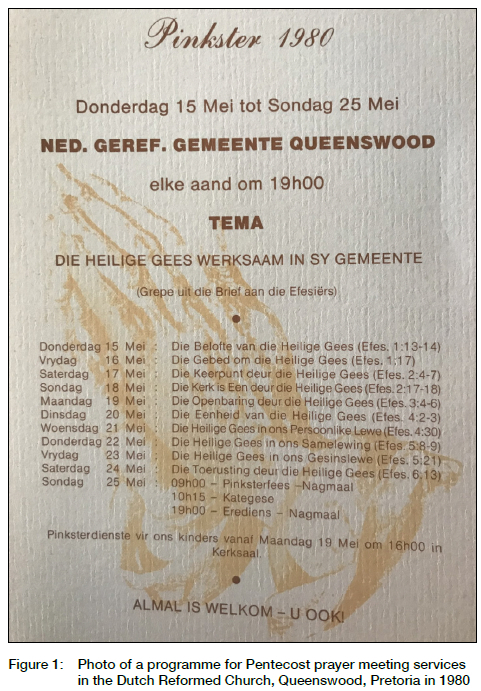
The enclosed photo of a programme for the Pentecost services represents my memory of a series of Pentecost prayer meetings of yesterday. The Pentecost prayer meeting programme dates from 1980, when I was 10 years old, and my dad, who was then preacher in the Dutch Reformed congregation of Queenswood, Pretoria, conducted a series of Pentecost prayer meeting services. At the time, Ascension Day was a public holiday. After the Thursday morning Ascension service, a series of Pentecost services traditionally lasted in various Dutch Reformed congregations for 10 evenings up to and including the Saturday evening before the celebration of the Feast of Pentecost the following Sunday. The chronological calculation and motivation for this custom was that Ascension took place 40 days after Jesus' resurrection and that the Holy Spirit was received 10 days after Ascension, with 50 days the number of Pentecost. I remember this time with nostalgia as a time of excitement and expectation, but also as a time of wonderful soul-enriching experiences, accompanied with warm soup and bread after each of the services, as winter descended on South Africa.
In 1862, Reverend W.G.A. van Lingen organised the first event for spiritual renewal in Paarl (Van der Merwe 2021:n.p.). This event led to a spiritual renewal that flowed over the colony at the time, thus establishing the tradition of annual Pentecost prayer meetings in the Dutch Reformed Church, which has developed and grown over the past decades (Barnard 1954; Barnard 1960). At the turn of the century, and because times have changed, the length of a series of Pentecost services was adjusted to extend from the Sunday after Ascension up to and including the Feast of Pentecost the following Sunday.
Kobus, can you remember that I met you the first time in 2007 at the annual meeting of the Society of Practical Theology in Wellington? You then acted as secretary of this scholarly society. I was immediately impressed by your leadership and considerable ability to establish relations on various levels. At that time, you served as Reverend in the Dutch Reformed congregation of Riviera, Pretoria. Can you remember how you celebrated Pentecost in those days in the congregation? Was there perhaps a question on this in the well-known Church Mirror questionnaire, which you and Jan Bischoff developed and which is still used widely in the Dutch Reformed Church? At the end of 2008, you were appointed as new member in the Department of Practical Theology. Our friendship grew further as we collaborated as colleagues.
The quotation from Sweet and Wilson's book Telos (2022), at the beginning of this subsection, is key to unlocking and structuring the presentation of auto-ethnographic descriptions. I am sensitive to the fact that the choices I made in presenting the description of Kobus' life and work in the above fragment, is indeed highly subjective and only one part of my colleague's much larger life and work. In recognising the power in such a description, its aim is to document the connection between (professional) practice and life/lives and is the core of the article.
The contribution's approach lies therein that we all are "living human documents" (Boisen 1960:48; Gerkin 1997:28), libraries full of stories that are housed in ourselves, and that the interpretation of only some fragments thereof contribute to insight, significance, and orientation. "Stories tell us who we are and bind us to one another. They are the heart of our identity as humans" (Sweet & Wilson 2022:n.p.). With this quotation in mind and with reference to Anton Boisen's coined metaphor of "living human documents", my and Kobus' research emphasises that we will be exegetes not only of texts, but also of life itself. This conviction and orientation led to our 2011 publication that addresses the methodology of "appreciative inquiry", from various joint actions in congregations (Schoeman & Van den Berg 2011). This research examines that which contributes positively to communities of faith and how it can be used more optimally to strengthen the congregation's functioning.
4. WIND CAN DO SO MUCH ... NEW PENTECOSTALS?
Wind can do so much, it
Drives the clouds away.
It moves the seas
And it brings rain (Hymn 443:3).
I can remember well how, in the early 2000s, during my ministry in the Dutch Reformed congregation Humansdorp, a semi-final match of the then Super 12 rugby series was scheduled for the Saturday evening of the series of Pentecost prayer meeting services. Detailed conversations among the Church Council emerged as to whether the evening's Pentecost prayer meeting should begin earlier so that all people could go and watch the rugby match which was broadcast on television. Ultimately, it was decided that the service for the Saturday evening would remain as per the scheduled time.
Conducting and attending a series of Pentecost prayer meeting services was, for some time, a specific ministry model in the Dutch Reformed Church. The spirituality of the series of Pentecost services is represented in the format that developed from an initial prayer meeting-oriented gathering to an event where well-known and popular preachers conducted the preaching. These events were well attended, but, like the past decade's dynamics in communities of faith, they also showed a decline in attendance.
Kobus can you remember... You began to serve from 2010 onwards (eventually until 2019), as Head of the then Department of Practical Theology at the University of the Free State. I can remember well how you and I, at the end of that year, went to the Van Schaik bookshop on the campus of the University of the Free State to buy the recent book by the American practical theologian Rick Osmer for colleagues in the Department as a Christmas gift. This book, entitled An introduction in practical theology (2008), presents a new methodological orientation to our subject field. The book, with the proposed four practical theological movements, guided the development of practical theology research in South Africa for the next few years.
Arising from the development of Osmer's four practical theology movements, the field of practical theology, in the time of Kobus' decade as Head of Department, showed further development. I think especially of the development of practical theology in exploring so-called lived religion or lived spirituality. The works of Ruard Ganzevoort (2009) and Peter Ward (2017) play an important role herein.
This finds expression in my and Kobus' publication, along with colleagues in the Department, on developments in practical theology (Schoeman et al. 2012). This is directly linked to a previous visit by the well-known Dutch practical theologian Ruard Ganzevoort to the Department. On returning to Bloemfontein, after a weekend visit to the southern Free State and the Northern Cape, Ruard conceptualised a project on lived religion that was presented, among others, at various conferences in Durham and Pretoria. Later, the research perspectives resulted in, inter alia, a research paper (Schoeman & Van den Berg 2016) and a chapter in a volume on lived religion (Van den Berg 2018).
I was invited to conduct a series of Pentecost services in the congregations of Senekal, a rural town and community in northeastern Free State, while I was doing research in Princeton in the United States of America. During this time, I also heard that my dad passed away in Pretoria. Despite the big loss in my life, I did experience that I am guided to accept the invitation. At that time, I was already invited and committed myself to conducting Pentecost services in Berg-en-Dal, a congregation of the Dutch Reformed Church. However, I experienced that I was called to conduct both series of services in the two congregations. Senekal requested that I conduct the event leading up to Ascension. This gives another dynamic to the historical placing of Pentecost. This arrangement often also applies to other preachers and one wonders how the character of a series of Pentecost services has changed from prayer meetings to meetings with preaching as the core.
Kobus, do you remember how strongly you articulated your opinion on Ascension Day and explained to me and colleagues the importance of this theological moment in our understanding of the events of Pentecost and the Lord Jesus' presence with us through his Spirit? I can remember well how you pointed out that the theology of Ascension is so important that one must consider honouring the day as a holiday, even when it is no longer a public holiday.
The above two fragments confirm how the experience of yesterday's Pentecost prayer meetings has changed to the celebration of contemporary Pentecost services. Traditionally often viewed as the start of Pentecost, Ascension is no longer a public holiday. Due to the changing nature of Pentecost meetings, it is not strange that congregations shift the dates for a series of Pentecost services to, for example, start prior to Ascension. In order to contextually express the nature of such a new generation of a series of Pentecost services, I took the liberty of providing the following overview of the week's programme, for which I was responsible in the Senekal and Berg-en-Dal congregations in May 2024:
Mindful of the rich theological significance of the Holy Spirit's descent, but concretely bound to people's experience of life, I chose the topic "Alone". In Afrikaans, this not only points to an individual's existential position, in which loneliness is central, but this also has the double meaning that the Spirit is AL[L]-ONE.2 Based on the different sighs described in Romans 8, the different themes of each service explore new aspects on the establishment and work of the Holy Spirit in our lives. Based on this background and orientation, the following programme for the services in the two congregations was developed and distributed among the members.
Pentecost '24
Many of us sigh in a time that abounds in loss, pain, depression, anxiety, and uncertainty. Often, it feels as if these sighs are also signs of how profoundly alone we really are and that my existence can at most be written in small letters. Romans 8 and other parts in the Bible mention that the sigh of the believer is a breath of air for an alternative that is even bigger than a second breath. Perhaps if you, in this time, driven by various experiences in your life, feel lonely, know that the Holy Spirit in Pentecost '24 wants to sigh with you, narrate and confirm that AL[L]-one can now, for always, sigh, write, read, say, and live.
Topic: AL[L]-one - Between sigh and hope: Life through the Spirit
Sunday 12 May: Sighs of hope
Monday 13 May: Sighs of comfort
Tuesday14 May: Sighs of courage
Wednesday 15 May: Sighs of promise
Thursday 16 May: Sighs of happiness
Sunday 19 May: Feast of Pentecost: AL[L]-one - Life through the Spirit between sighing and hope.
After conducting the two Pentecost events in 2024, I was aware of the wealth of these events, but I also realise that, in terms of attendance, the challenge for even the most involved member of a faith community in today's life with full programmes is somewhat different. From an ecumenical perspective, it would appear that believers in other denominations do not always understand the unique tradition of a series of Pentecost services conducted in the Dutch Reformed Church. I cycle with other believers and I have to clearly explain to them the tradition of a series of Pentecost services in the Dutch Reformed Church.
Kobus, your research on congregations and leadership offers supporting perspectives that communities of faith that reach outside the church show a greater vitality. Is this perhaps also true when newly considering the tradition of a series of Pentecost services in the Dutch Reformed Church? What will be the nature of this ministerial practice of a series of Pentecost services in the Dutch Reformed Church in five to ten years' time and how could research contribute to inform it further? A question worthy of inclusion in a forthcoming questionnaire?
In 2011, Julian Müller's important and significant article, "Outobiografiese teologie" (Autobiographical theology), was published in a Festschrift for a colleague. In this contribution, Julian explores the significance of the narrative nature of our existence and the implication for theology. I subscribe to his view, but I attempt to take the personal aspect further in interpreting the auto-ethnographic aspects. The contribution offers room for the intimate and the personal such as, among others, expressed in the use of names of academic colleagues such as Julian and Kobus rather than the usual academic surname of the author as reference.
5. GOD'S SPIRIT DOES SO MUCH MORE -TOMORROW'S PENTECOST
God's Spirit does so much -
Teaches us to trust God.
Teaches us to listen
And to build Him up (Hymn 443:4).
My good friend and colleague, Kobus, was in Pretoria on 11 November 2023, while I was in Princeton, USA, at the time. That Saturday morning, Kobus was with my mother, brother, and sister-in-law in the clinic where my dad passed away a few minutes ago. Kobus send me a WhatsApp and encouraged me in these times in a special way which I shall always remember. Ironically enough, I was once again reminded weeks later, when I was cleaning my dad's library, that he completed his BD thesis on the significance and meaning of Pentecost prayer meetings in the Dutch Reformed Church (Van den Berg 1968). While I was writing the article, I experienced a special moment in my deepest self in those axes of rotation in the contribution. For those who have an eye to see and an ear to hear...
In my exploration of these spiritual contour lines in myself, the significance of auto-ethnographic research is clearer. As Graham (2017:n.p.) clearly put it, it is in the subjective, but also reflective perspectives, in which other people's insights and contribution are trusted, that new horizons of understanding are unlocked. The mystery is explained in a specific way in Nouwen's (1974b:15) character sketch.
There can hardly be a better image of caring than that of the artist who brings new life to people by an honest and fearless self-portrait. Rembrandt painted his sixty-three self-portraits not just as 'a model for studies in expression' but as a 'search for the spiritual through the channel of his innermost personality'. Rembrandt felt that he had to enter into his own self, into his dark cellars as well as into his light rooms if he really wanted to penetrate the mystery of human interiority. Rembrandt realized that what is most personal is most universal. While growing in age he was more and more able to touch the core of human experience, in which individuals in their misery can recognize themselves and find 'courage and new youth'. We will never be able to really care if we are not willing to paint and repaint constantly our self-portrait, not as a morbid self-preoccupation, but as a service to those who are searching for some light in the midst of darkness.
On how to paint and repaint this as preacher during the time of Pentecost, Jesus tells Nicodemus in John 3:8:
The wind blows wherever it pleases. You hear its sound, but you cannot tell where it comes from or where it is going. So it is with everyone born of the Spirit.
In our life's journey, we each reach three stages, namely
departure, initiation, and return ... Each of us begins in a comfortable status quo. An event shakes us out of our stupor and forces us to go on a journey. We go through a trial of initiation and challenge. Then we return, changed (Sweet & Wilson 2022:n.p.).
And so it was with me since my Pentecost memories of May 1980; my November 2023, the month in which my dad passed away, and in 2024, the year when I conducted two series of Pentecost services. As I am writing today, I would be very privileged to conduct a series of Pentecost services once again in 2025 or thereafter, creating another set of memories.
6. ... THAT HE GIVES US HIS SPIRIT ... - THAT HE WILL TEACH US ... CONCLUDING PERSPECTIVES
Let us tell each one of us:
Pray to God, the Lord,
That he gives us his Spirit,
That he will teach us (Hymn 443:5).
In the documented personal travel journal with, as landscape, conducting two series of Pentecost services with a travel companion of more than a decade-long friendship and collegial relationship, there was one constant event: My (and Kobus') link to the Christian belief tradition of which we are part and which determines our destiny.
Kobus, do you remember that you initially told me about the book by the well-known author David Bosch, Spirituality of the road (1979a), and what this book means to you personally and how believers, as people of this way, are connected from the events of Pentecost to churchgoers. Luke, author of the Gospel of Luke, documents in the first two chapters of the Gospel how heaven reaches the earth with Jesus' coming to earth. In Acts, which Luke also wrote, there is a bridge between heaven and earth with the Spirit that comes to live among us, also in the establishment of the church. This is Pentecost: the breakthrough of the distance between heaven and earth.
In conducting two series of Pentecost services in 2024, I used as key, to describe the experience of a concrete context, the words of the Dutch theologian, Oepke Noordmans, who mentions strikingly that we as believers are too late for the earth and too early for heaven (Bosch 1979b:9). However, in the in-transito life, Pentecost confirms that all believers are inspired by the Spirit to do works that bear the stamp of eternity (Spies 2002:13). This was indeed the result of this experimental documented auto-ethnographic travel journey, with the emphasis that, in reading a very personal and intimate living human document(s), one can discover the following life-altering methodology: "To whomever you give authority, you give authorship to write your life story" (Sweet & Wilson 2022:n.p.).
For this reason, and as one infused by the Spirit of Pentecost, I would like to pray: Veni Creator Spiritus ... Come Creator Spirit, come and blow through me (Hymn 430:1). Listening to the wind and seeing what the wind does, creates an expectation of a new reality ... Veni Creator Spiritus ....
BIBLIOGRAPHY
Barnard, A.C. 1954. Die Pinksterfees in die kerklike jaar. Kampen: J.H. Kok. [ Links ]
Barnard, A.C. 1960. Eeufees van die Pinksterbidure 1861-1961. Pretoria: NG Kerk-Uitgewers. [ Links ]
Boisen, A.T. 1960. Out of the depths. An autobiographical study of mental disorder and religious experience. New York: Harper & Brothers Publishers. [ Links ]
Bosch, D. 1979a. A spirituality of the road. New York: Herald Press. [ Links ]
Bosch, D. 1979b. The kingdom of God and the kingdoms of this world. Journal of Theology for Southern Africa 29:3-13. [ Links ]
Browning, D.S. 1991. A fundamental practical theology. Descriptive and strategic proposals. Minneapolis, MN: Fortress Press. [ Links ]
Ellis, C. 2004. The ethnographic I. A methodological novel about ethnography. Walnut Creek, CA: Altamira Press. [ Links ]
Freedman, J. & Combs, G. 1996. Narrative therapy. The social construction of preferred realities. New York: W.W. Norton & Company. [ Links ]
Ganzevoort, R.R.2009. Forks in the road when tracing the sacred: Practical theology as hermeneutics of lived religion. Presidential address to the ninth conference of the International Academy of Practical Theology, Chicago, 3 August 2009. [Online.] Retrieved from: http://www.ruardganzevoort.nl/pdf/2009_Presidential.pdf [24 April 2010]. [ Links ]
Gerkin, C.V. 1997. An introduction to pastoral care. Nashville, TN: Abingdon Press. [ Links ]
Graham, E.l. 2017. On becoming a practical theologian: Past, present and future tenses. HTS Teologiese Studies/Theological Studies 73(4), a4634. https://doi.org/10.4102/hts.v73i4.4634 [ Links ]
Liedboek van die Kerk 2001. Vir gebruik by die Erediens en ander byeenkomste. Wellington: NG Kerk-Uitgewers. [ Links ]
Morgan, A. 2000. What is narrative therapy? An easy-to-read introduction. Adelaide: Dulwich Centre Publications. [ Links ]
Mouton, D.P. 2022. Writing the self in(to) practical theological research. In: J. Cilliers (ed.), Moving methodologies. Doing practical and missional theology in an African context (Wellington: Bybel-Media), pp. 79-98. [ Links ]
Müller, J.C. 2011. (Outo)biografie as teologie. HTS Teologiese Studies/Theological Studies 67(3), Art. #1113, 5 pages. https://doi.org/10.4102/hts.v67i3.1113 [ Links ]
Nouwen, H.J.M. 1974a. From resentment to gratitude. Synthesis series. New York: Franciscan Herald Press. [ Links ]
Nouwen, H.J.M. 1974b. Aging. The fulfilment of life. New York: Doubleday. [ Links ]
Osmer, R. 2008. Practical theology: An introduction. Grand Rapids, MI: Wm B. Eerdmans. [ Links ]
Schoeman, K. & van den Berg, J.-A. 2011. An appreciation for the positive! Appreciative engagement as congregational and pastoral lens. HTS Teologiese Studies/Theological Studies 76(2), Art. #887, 7 pages. http://www.hts.org.za/index.php/HTS/article/view/887 [ Links ]
Schoeman, K. & van den Berg, J.-A. 2016. Practical theology exploring interdisciplinary practices: The quest for engaging with lived religion in the South African context. In: R. Venter (ed.), Theology and the (post-) apartheid condition. Genealogies and future directions (Bloemfontein: SUN Media), pp. 213-231. [ Links ]
Schoeman, Κ., Laubscher, Μ., Pali, J. & Van den Berg, J.-A. 2012. Practical theology at a public university. The road travelled and the road ahead at the University of the Free State. In: R. Venter & F. Tolmie (eds), Transforming theological knowledge. Essays on theology and the university after apartheid (Bloemfontein: SUN Media), pp. 127-143. [ Links ]
Spies, L. 2004. Duskant die einders. Kaapstad: Tafelberg Uitgewers. [ Links ]
Sweet, L. & wilson, L. 2022. Telos. The hope of heaven today. Plano, TX: Invite Academic Press. [ Links ]
Van den Berg J.-A. 1968. Pinkster-bidure in die Ned. Geref. Kerk. Ongepubliseerde BDiv skripsie, Pretoria: Universiteit van Pretoria. [ Links ]
Van den Berg J.-A. 2018. Tweeting God: Redefining future Christian leadership through Twitter? In: R. Bruwer (ed.), The future of (lived) religious leadership (Amsterdam: VU University Press), pp. 83-98. [ Links ]
Van der Merwe, J.M. 2021. Pinkster: Dit is tyd vir 'n nuwe begin. Kerkbode, 7 Mei 2021. [Aanlyn.] Verkry van: https://kerkbode.christians.co.za/2021/05/07/pinkster-dit-is-tyd-vir-n-nuwe-begin/ [27 April 2024]. [ Links ]
Walton, H. 2014. Writing methods in theological reflection. London: SCM Press. [ Links ]
Ward, P. 2017. Introducing practical theology. Mission, ministry, and the life of the church. Grand Rapids, MI: Baker Academic. [ Links ]
Date received: 17 September 2024
Date accepted: 21 October 2024
Date published: 14 November 2024
1 Translated from Die Liedboek van die Kerk (2001).
2 In Afrikaans the theme was typographically indicated as EENsaam to convey multiple levels of possible meanings, but with the emphasis on the theological perspective of the Holy Spirit becoming one with us.
