




Services on Demand
Journal

Article
 English (pdf)
 Article in xml format
 Article references
 Automatic translation
 Send this article by e-mail
Indicators
Related links
-
 Cited by Google
 -
 Similars in Google
Share

 Permalink
Acta Theologica
On-line version ISSN 2309-9089Print version ISSN 1015-8758
Acta theol. vol.44 n.2 Bloemfontein 2024
https://doi.org/10.38140/at.v44i2.8148
ARTICLES
"Like sand through an hourglass, so are the days of our lives": Youth, religion, and social capital in South Africa
J.W. Beukes
Department of Christian Spirituality, Church History and Missiology, University of South Africa (UNISA). E-mail: beukejw@unisa.ac.za; ORCID: https://orcid.org/0000-0003-4319-2439
ABSTRACT
South Africa has experienced significant transformations, including the dismantling of the apartheid system and the transition to a democratic regime. Despite progress, South Africa still struggles with inequality and fostering social cohesion. Social capital refers to networks, relationships, and customs that enable collaboration. Young people's networks and connections shape their social and economic success. Social capital helps young people establish friendships and access to resources. Religion improves social capital in many places. This article analyses the concept of social capital imposed by religious institutions and their practices in various communities, larger societies, and younger generations. It aims to investigate the distinctive role of religion in enhancing social capital in an effort to demarginalise youth. The article examines the correlation between youth, religion, and social capital in South Africa, focusing on how religious practices and beliefs can affect young people's sense of social connectedness and community.
Keywords: Youth, Religion, Social Capital, Marginalisation, NEET
Trefwoorde: Jeug, Religie, Sosiale kapitaal, Marginalisering, NEET
1. INTRODUCTION
The country has undergone significant transformations in recent decades, notably marked by the fall of apartheid and the subsequent transition to a democratic system. Despite these positive changes, South Africa still faces numerous challenges, especially with regard to mitigating social disparities and fostering social cohesion.
The notion of social capital pertains to the interconnected networks, interpersonal relationships, and shared norms that enable collaborative efforts and mutual assistance among various individuals and collectives. These networks and relationships are especially important for youths as they navigate their way through life. Various factors can greatly influence their economic and social outcomes (Koonce 2011). Social capital can help young people build relationships, obtain knowledge and skills, and gain access to resources. Religion has been viewed as a significant contributor of social capital. Moreover, religious institutions provide important opportunities for young people to form networks and build relationships, while also offering support and guidance during difficult times.
The construct of social capital comprises seemingly disparate components. What is the basis for equating the concept of "social" with that of "capital"? Upon initial observation, this may appear perplexing. The term "capital" is an economic notion that pertains to a physical factor of production that may be generated via investment and used as required. In what way does this relate to the term "social", which encompasses a broad and abstract range of concepts such as attitudes, beliefs, and feelings, and is not subject to depletion? The fundamental principle of social capital posits that engaging in social interactions confers benefits. The present discovery appears to lack novelty to an extent that does not warrant the utilisation of the terminology to elucidate or contextualise its importance. The social nature of human beings is an inherent characteristic that has been shaped by evolution and serves as a defining aspect of our species. The benefits of social behaviour (assisting, sharing resources, and demonstrating concern for others) are evident for both individuals and society as a whole. The trait of sociability is a fundamental aspect of human nature, and its significance is closely intertwined with the functioning of our societal and economic systems.
This article investigates the complex relationship between youth, religion, and social capital within the South African setting, by thoroughly analysing the concept of "social capital" imposed by religious institutions and their practices in various communities, larger societies, and younger generations. This article aims to examine the unique function of religion in augmenting social capital, particularly among young people. As a result, the purpose of this study is twofold: to promote a perspective of religion as a unique source of social capital and to provide an academic understanding of the constraints that religion and religious institutions face in addressing the social capital demands of young people. To this end, the study investigates the link between youth, religion, and social capital in South Africa, emphasising how religious practices and beliefs influence young people's feelings of social connectedness and community.
2. "LIKE SAND THROUGH AN HOURGLASS, SO ARE THE DAYS OF OUR LIVES"
The introductory statement of Macdonald Carey, "Like sands through the hourglass, so are the days of our lives", accompanied by the visual depiction of a sizeable hourglass on the television screen, served as a warm and welcoming gesture to the viewers of the soap opera "Days of our lives" (1965). I grew up with this soap opera as a regular feature on our television set. The timing and music of the show remain etched in my memory. My grandmother and I faithfully viewed the episodes together - a shared experience we both cherished. Each episode introduced captivating storylines that revolved around a diverse cast of characters. The literary work in question delves into a range of complex and sensitive topics, including but not limited to interracial relationships, drug addiction, birth and mortality, alcoholism, abuse, betrayal, self-centred motivations, greed and materialism, as well as familial discord. Several romantic relationships were interspersed among the captivating plotlines. The phrase "Like sands through the hourglass, so are the days of our lives." is a metaphorical statement that conveys the transient quality of time and its inescapable progression. Upon observing contemporary society, I have discerned a multitude of situations that could be considered fitting for a fresh instalment of a serialised television drama. For the sake of this article, let me first explore the experiential realities of the youth population in South Africa and how their daily lives unfold.
3. YOUTH, NEET,1 AND YOUTH MARGINALISATION IN SOUTH AFRICA: SUCH ARE THE DAYS OF OUR LIVES
Contemporary society views South African youth as a marginalised and vulnerable demographic (Aziz 2020; Department of Social Development 2013:30; Swart et al. 2022). The phenomenon of marginalisation and vulnerability among young people is shaped by a diverse range of social factors and concerns. These encompass economic adversity; unemployment; a notable rise in academic disengagement; inadequate skill acquisition; suboptimal health outcomes; an increased prevalence of HIV and AIDS; insufficient provision of youth services; criminality and violence; elevated rates of substance misuse, including alcohol and drug addiction; limited access to opportunities for cultural and athletic development; a deflciency in social solidarity and volunteerism, and disability (Beukes & Van der Westhuizen 2016:113-114; Beukes& Van der Westhuizen 2018:1; RSA 2015:10-15).
Various statistical data and research findings highlight the issue of marginalisation and vulnerability among the youth. For instance, a report by the Department of Social Development (2013:30) reveals that many young people are excluded from educational settings, training opportunities, and employment. These findings are echoed in a report by the Department of Higher Education and Training (2017), which sheds light on the same issue. The prevalence of individuals classified as NEET has exhibited a modest increase on the African continent. The present discourse concerns the NEET statistics of African youth, which indicate that approximately 20.8 per cent of the demographic were not engaged in education, employment, or training during the year 2021. In 2012, a proportion of 20.4 per cent of individuals aged between 15 and 24 years were not engaged in school, training, or employment. This percentage increased to 20.8 per cent by the year 2021. By the year 2050, it is projected that those within the age range of 15 to 24 years in sub-Saharan Africa, often referred to as the NEET bracket, will constitute almost 30 per cent of the global youth population (see Cieslik et al. 2022:1131). Owing to the significant incidence of unemployment among the younger generation, a substantial proportion of youths are incapable of providing financial support to their families and households.
In addition, it can be observed that the marginalisation and vulnerability of South African individuals aged between 15 and 24 years, comprising approximately one-third of the South African populace (Statistics South Africa 2017), exhibited the highest rate of youth unemployment globally in 2017, reaching 57.4 per cent. Van Breda and Theron (2018:237) highlight that child poverty is prevalent in South Africa at a rate of 30 per cent, indicating that a significant proportion of young individuals lack access to a basic nutritious diet. They also note that statistics from 2014 revealed that 13 per cent of children in South Africa were classified as single orphans, while an additional 3 per cent were categorised as double orphans (Van Breda & Theron 2018:237). The country's socio-economic characteristics hinder its capacity to effectively tackle these issues.
Furthermore, a considerable number of young females in South Africa are exposed to gender-based violence (GBV), violent criminal activities, and related concerns, including prostitution, rape, and psychological disorders (Nadat & Jacobs 2021:87). In an article titled "Gender-based violence is South Africa's second pandemic, says Ramaphosa" (Ellis 2020), published in the Daily Maverick newspaper, President Cyril Ramaphosa highlighted the pressing concern of femicide and GBV in South Africa. According to Dlamini (2021:588), it was also stated that a woman is killed at a rate of one occurrence every three hours. The outbreak of COVID-19 and the consequent imposition of lockdown measures have been directly linked to the surge in GBV and femicide (Dlamini 2021:588; Nduna & Tshona 2021:347).
Several scholars agree with the susceptibilities that South African youth encounter during their upbringing and daily lives. Van Breda (2017:226) posits that socio-economically deprived communities are particularly vulnerable, due to factors such as poverty, crime, and familial challenges. According to Nadat and Jacobs (2021:87), various factors such as insufficient housing, poverty, violence, inadequate access to electricity and sanitation services, socio-economic exclusion, under-resourced schools, and a high prevalence of infectious diseases such as AIDS and tuberculosis (TB) are responsible for creating high-risk societies and vulnerable groups.
As indicated by StatsSA (2015:7), the youth in South Africa are experiencing growing uncertainty and disillusionment regarding their prospects of gaining satisfactory employment. The prevailing sense of uncertainty and disillusionment holds the potential to yield adverse impacts on individuals, communities, economies, and society as a whole (see Offerdahl et al. 2014:6). Regarding employment, employers often exhibit reluctance to hire young individuals, especially with a lack of experience. This is also the case with employing youth from disadvantaged socio-economic backgrounds, as they encounter supplementary prejudice and discrimination (Kousiakis 2015:2). The RSA (2015:25) acknowledges that adolescents are in a developmental phase where they hold the potential to act as catalysts for transformation. Individuals possess the ability to introduce novel concepts with a unique perspective and are poised to assume leadership roles in their respective communities as they progress into the future. Amidst the current adversity faced by underprivileged youth in their pursuit of employment, the goal extends beyond securing a job; it also encompasses the desire for a more promising future.
It is noteworthy that unemployed young individuals are comparatively less capable of making effective contributions towards the progress of the nation and have limited avenues to exercise their rights as members of society. According to StatsSA (2015:3), individuals within this demographic display reduced consumer spending and savings capacity, coupled with limited agency to bring about changes in both their personal and communal spheres. The aforementioned depiction of the negligible impact of youth unemployment is a cause for concern, given that South Africa is grouped with Spain and Greece as the three nations that exhibit the greatest worldwide rates of unemployment among young people (Kousiakis 2015:1; World Economic Forum 2014:14). The elevated levels of unemployment are attributed to two key factors: socio-economic inequality and insufficient education.
Hitherto I have argued, "so are the days of our lives" of young people residing in South Africa, yet the National Youth Policy (RSA 2015:3) acknowledges the significance of youth as a crucial asset for social development. It recognises the marginalising factors that affect youth and emphasises the need to demarginalise them. The policy highlights the potential of youth to fulfll their role as primary catalysts for societal transformation, economic growth, and innovation. The initial step involves acknowledging the turn by including young individuals without resorting to tokenism and actively listening to their perspectives.
4. DO YOUTH AND RELIGION CONTRIBUTE TO MARGINALISATION?
The present-day scenario in many churches is such that the younger generation is often left to operate independently, segregated from the primary congregation (Beukes & Van der Westhuizen 2016). This implies that they are included in the larger assembly, while the youth ministry remains distinct. As a result, young individuals are compelled to seek and comprehend their religious beliefs independently. Furthermore, individuals are anticipated to manifest their spiritual beliefs in intricate circumstances. Despite the repercussions, numerous religious institutions continue to view the younger generation as the future of tomorrow, the church, and society (Cloete 2015:4).
While the perspective of the youth as the future church may appear insightful, it actually results in the exclusion of the youth from the current community of faith. The aforementioned demographic cohort, consisting of individuals aged between 14 and 35 years, is considered to be a vulnerable population, thereby posing a potential risk. Adolescents are also susceptible to spiritual vulnerability. Echoing Aziz's (2017) assertion, the phenomenon of spirituality manifests itself in the early stages of childhood and undergoes a dynamic process of development, which involves interactions between individuals and society, as well as the acquisition of knowledge and skills. Hence, the inquiry pertains to the kind of young individuals we are dispatching into society, given their preclusion from both ecclesiastical and authoritative capacities.
5. SOCIAL CAPITAL THEORY
The notion of social capital has mostly been shaped by the scholarly contributions of Pierre Bourdieu (1986), Robert Putnam (1993; 2000), and James Coleman (1988; 1990). The concept of "social capital" pertains to the outcomes and repercussions of human social behaviour and interconnectivity, as well as their interplay with both individual and societal frameworks. Despite the long-standing presence of the concept of "social capital", its definition may not always be readily comprehensible. A plethora of definitions and theories have been postulated to comprehend the concept of "social capital" (see Sato 2013).
It has come to my attention that numerous academics have employed the terms "social capital" and "social cohesion" interchangeably. Nevertheless, it is crucial to acknowledge that, while some researchers use these concepts interchangeably, there is a nuanced distinction between them. As emphasised by Janmaat (2011), social cohesion can be defined as the force that binds individuals within a society, often referred to as "the glue" or "the property" that prevents societal disintegration. According to the definition put forth by Chan and Chan (2006:290), social cohesion pertains to the interactions among society members, both vertically and horizontally. It is characterised by a collection of attitudes and norms that encompass trust, a sense of belonging, and a readiness to participate and provide assistance, as well as their corresponding behavioural expressions.
The definitions of social cohesion appear to bear a close resemblance to those of social capital. According to the Organisation for Economic Cooperation and Development (OECD) (2011:53), there is a caution against limiting the definition of social cohesion to social capital. The OECD stresses that social cohesion is a comprehensive concept that encompasses various dimensions simultaneously, such as a feeling of belonging, active engagement, trust, exclusion, and mobility. A cohesive society is defined as one that strives for the betterment of all its members, combats the act of excluding and marginalising individuals, fosters a sense of community, encourages trust, and provides avenues for upward social mobility (OECD 2011).
Oxoby (2009:1136) and Dayton-Johnson (2003) suggest a potential distinction and correlation between social cohesion and social capital, as evidenced by the subsequent definitions. Social capital pertains to the sacrifices made by an individual in terms of time, effort, resources, and consumption to foster cooperation with others. Conversely, social cohesion pertains to a societal attribute that is contingent on the amassed social capital. The distinction between social capital and social cohesion aligns with the preceding characterisation, wherein social capital pertains to a collective of persons, while social cohesion encompasses the entirety of a given community.
The aforementioned distinctions suggest that social cohesion is contingent upon the presence or availability of social capital, thus implying that social capital serves as a necessary condition for social cohesion. Consequently, the absence of a sense of community and shared values could indicate a deficiency in the accumulation of social resources and networks, commonly referred to as social capital.
The following section centres on a conceptual discourse of social capital, aiming to provide a more comprehensive depiction of its role as a fundamental constituent of social cohesion.
In her investigation of the notion of "social capital", Cloete (2014:2) also adopted the definitions of Bourdieu and Coleman, who characterised social capital as "a variety of resources that are accessible to individuals by their involvement in social networks" (see Herreros 2004:6). Bartkus and Davis (2009:2), in their definition, have articulated social capital as the resources derived from relationships and can assist both individuals and the collective in achieving their objectives, all the while striving towards the common good. This definition corresponds with the perspective presented by Cloete (2014:2).
Social capital may be conceptualised and described at various levels, including the individual (micro), community (meso), and societal (macro) levels. When conceptualising social capital, scholars have drawn on the works of Bourdieu (1986), Burt (1992), and Lin (2001) to define it at the individual level. Meanwhile, Coleman (1988; 1990) and Putnam (1993) have been employed to delineate the concept of social capital within the contexts of community and society, correspondingly. Bourdieu (1986:248-249) highlights the role of individuals in acquiring and maintaining social capital. In contrast to Bourdieu's perspective, Coleman (1988:98; 1990) underscores the meso level in his conceptualisation of social capital, defining it based on its functional role.
The literature review posits that the pursuit of social capital is not driven by individualistic motives, but rather a collective effort of individuals who engage in various forms of social networks to establish or enhance social capital, which ultimately benefits the public or common good, including non-participants. The formation of social capital appears to be heavily influenced by trust, norms, social networks (Putnam 1993:163), and reciprocity (Inaba 2007; 2011). The concept of "externality of mind" necessitates trust as a fundamental component, enabling individuals to anticipate positive outcomes from others through reciprocity and to engage in actions that promote collective well-being. The availability of information impacts on the level of participation, as individuals tend to exhibit greater enthusiasm to engage in activities when they possess pertinent information about their counterparts.
I aim to elucidate a minimum of two attributes of social capital. Social capital is commonly regarded as a public good and is not considered the exclusive possession of any individual who derives advantages from it. Social capital exhibits characteristics of a public good, rendering it non-excludable, as per Herreros (2004:19). The absence of reciprocity in the utilisation of social capital can lead to its swift deterioration, which poses a greater challenge for restoration compared to physical capital. Ostrom (2009:21-22) is of the opinion that, while capital is typically defined as a collection of assets that have the potential to generate future benefits, there are at least two shared characteristics of human-made capital that suggest a potential negative impact. Specifically, there is no assurance that any form of capital will yield future benefits, and capital may also have an adverse rather than a favourable impact.
To foster a sense of trust and facilitate mutual exchange, it is vital to create a set of norms and values that can serve as a framework for engaging in network participation. Individuals who possess virtues such as honesty, trustworthiness, integrity, and concern for others are inclined to generate social capital, potentially resulting in the establishment of a common good. This leads to the subsequent discussion on the correlation between religion and social capital.
6. RELIGION AND SOCIAL CAPITAL
Religion provides distinctive indicators for recognition and a feeling of inclusion. Religion promotes a range of values, including but not limited to honesty, trustworthiness, integrity, and care. Social capital pertains to various personal attributes such as duty, service, loyalty, respect, compassion, understanding, tolerance, solidarity, compromise, restraint, patience, self-discipline, responsibility, friendship, perseverance, trust, honesty, faith, and many more, which are associated with goodwill, benevolence, and cooperation.
The aforementioned attributes of individuals who practise religion are not contingent upon the specific deity they worship. Furthermore, these attributes are also applicable to upholding the standards of a virtuous member of society, namely exhibiting moral behaviour. A society that exhibits higher moral standards is predisposed to fostering social capital, whereas a society that lacks such moral values is not conducive to the development of social capital. Morality pertains to the practice of equitable conduct and abstaining from causing harm to others. This practice fosters conducive circumstances for various aspects of social capital, including but not limited to trust, reciprocity, and established standards of generosity, communal sharing, and assistance. In contrast, actions that are deemed unethical or lacking in moral principles can have far-reaching consequences on the overall social fabric, potentially resulting in adverse impacts on multiple dimensions of social capital.
Religious groups nurture trust-based relationships that enable effective communication and coordination of societal activities, thereby enhancing the well-being of their members. Both the individual and the wider society reap advantages from this phenomenon. Religion possesses a fundamental social capital and, in addition to this, it serves as a platform for the marginalised to express their grievances, as stated by Wepener and Cilliers (2010:418). Notwithstanding the purported ability of those lacking influence to express their apprehensions, it is not invariably the reality for juveniles, underprivileged individuals, and indigent populations, owing to the prevailing power dynamics, hierarchical structures, and leadership models within religious establishments. Hence, it is imperative to acknowledge that I possess a comprehensive understanding of the segregating influence of religion, which can also be regarded as the potential dark side of religious institutions.
Putnam (2000) highlights the negative aspect of social capital formation through religious engagement, which he refers to as "sectarian social capital". This type of social capital can result in intolerance, particularly in fundamentalist churches or groups (Putnam 2000:301). The divisive impact of religion on racial and economic lines, particularly in South Africa, is a disheartening reality that highlights the potential for religious social capital to impede social cohesion. For instance, Christianity serves as an example where the hour of Sunday morning worship is considered the most segregated time in society.
However, there is also a light side when it comes to religion. Religion can be perceived as a significant collaborator in matters about societal concerns and public affairs, thereby contributing to the development of social capital and social unity. Preduca (2011:129) indicates that religious moral traditions have demonstrated their effectiveness in promoting community development. The role of religion in maintaining social cohesion and addressing individual needs is significant. Bramadat (2005:209) adds that religious traditions serve as the fundamental basis for the moral, social, and spiritual aspects of both individuals and communities. Consequently, it would be imprudent to disregard the potential contributions of traditions towards public matters and social capital.
Communities of faith, also known as worshipping communities, serve as a noteworthy illustration of the potential value of religion in the formation of social capital. These communities provide a platform for individuals to convene and establish networks within a particular community. Coleman (2003:36) asserts that the church is considered a public institution that explicitly perceives and comprehends itself as a community. Despite the prevalence of virtual reality and a decline in face-to-face interactions in the era of the Fourth Industrial Revolution, a significant number of individuals in South Africa still engage in and attend religious institutions such as churches, temples, and mosques. The act of joining religious institutions not only serves as a means of seeking spiritual significance, but also promotes a communal environment where individuals can establish social connections that facilitate the development of social capital (Cnaan et al. 2003:21). The cohesiveness among members is expected to increase the likelihood of their assimilation of the group's norms and participation in communal activities with fellow members, thereby fostering bonding social capital. In addition, it is common for religious congregations to provide avenues for their members to establish connections with individuals beyond their religious affiliations, promoting bridging social capital (Cnaan et al. 2003:26).
According to Coleman (2003:36-40), it is noteworthy that some constraints pertain to the cultivation of religious social capital within congregational settings. The initial dimension pertains to the horizontal and vertical facets of religious power. The presence of hierarchical leadership in horizontal religious authority may result in a greater tendency towards passivity among members, while vertical religious authority may raise a greater degree of activity among members. Small churches appear to possess a more favourable position for the formation of social capital in comparison to megachurches. The formation of cliques within a congregation may result in the freezing of social capital within specific groups or isolated pockets of cliques within the congregation. The exclusive focus on the congregation as the sole entity for the development of religious social capital may be misleading, as the resources and capabilities of congregations are inherently limited. Collaborative efforts with para-church organisations are necessary to achieve greater public relevance.
Hence, it is imperative to address the inquiry of how religious social capital may be cultivated via worship institutions to augment social cohesion within the community. It is noteworthy to highlight that there are at least two significant factors to consider in this context. The importance of leadership appears to be paramount. I concur with Brown et al.'s (2010:10) assertion regarding the necessity for spiritual leaders of congregations to exhibit greater political awareness, in order to promote racial unity and cultivate interfaith social capital. As outlined by Brown et al. (2010:12), the practice of engaging in political discussions within religious institutions, involving both clergy and laity, has the potential to facilitate the formation of social capital. Subsequently, this can lead to the recognition of shared interests among individuals from diverse racial backgrounds.
Thomas (2001:1) puts forth a proposition for a political spirituality that might initially seem paradoxical but is regarded as crucial within the context of the Christian way of life. This particular spiritual ideology advocates for proactive engagement in public affairs, considering it not only optional, but also essential. This engagement is viewed as the church's integral contribution to the divine mission worldwide. Todd and Allen (2011:234) assert that the cultivation of an environment that promotes openness and collaboration with other congregations is a potential strategy for leadership to encourage the development of religious bridging capital. Congregational partnerships are considered crucial for fostering social cohesion within congregations. The expansion of congregational partnerships could involve the establishment of a broader network that encompasses other organisations and governmental entities. Despite sharing a common vision and facing similar challenges, congregational partnerships have proven to be a difficult undertaking for congregations (Cloete 2009:88).
Nel (2009:3) proposes that the formation of bridging religious social capital can be achieved through the establishment of ecumenical ties with individuals from diverse cultural backgrounds and denominations. In this regard, Nel (2009) presents the challenge posed to leadership as requiring individuals to be taken out of their comfort zones, thereby necessitating special demands from leaders. The establishment of religious social capital has the potential to facilitate the transformation of congregations, as the cultivation of neighbourly hospitality assumes a crucial role in expanding our horizons beyond familiar confines. The act of bridging religious capital through congregations not only holds significance for the betterment of society, but also serves to validate the purpose for which the church was established.
In my subsequent response to the inquiry regarding the methods whereby religious social capital may be cultivated via worship institutions to augment societal cohesion, I intend to emphasise the significance of Christian practices in promoting the development of religious capital. This, in turn, can facilitate the establishment of social cohesion through bonding and bridging. Engaging in Christian practices, as noted by Dykstra (2005:41), does not inherently possess a divine quality. Instead, these practices function as a means for individuals to acknowledge and engage in the manifestation of God's grace in the world. Dykstra (2005:42-43) elucidates that Christian practices such as prayer, confession, and communal worship serve as customary methods through which congregations express their gratitude for the salvific deeds of Jesus Christ.
Meanwhile, Yaconelli (2001:155) characterises Christian practices as the routines, behaviours, and customs that Christians adopt to establish a connection with Christ and foster communal bonds with others. By means of Christian rituals, adherents acknowledge the presence of God among them and, in doing so, they attain an understanding of the exigencies of the world. Yaconelli (2001:162) further notes that Christian practices achieve fulfilment solely through service.
Furthermore, Dykstra (2005:60-61) highlights at least two transformations that arise as a consequence of these practices. The first is that we begin to view one another as fellow beings, while the second is that, through the act of hospitality, strangers are transformed into neighbours. Christian practices ought to prompt adherents to venture beyond their sphere of comfort and engage with the wider world through acts of service. Hence, the implementation of Christian practices has the potential to facilitate the transition of congregations from the accumulation of religious capital based on bonding to that of bridging for the greater good, ultimately contributing to the promotion of social cohesion.
Pieterse (2011:4) posits that religious individuals exhibit characteristics of social capitalism, as evidenced by their active participation in volunteer work within and beyond the confines of their religious institutions. The discourse of actively engaging in the socio-economic needs of individuals, communities, and society at large is a prominent topic on the agenda of various communities of faith. Within religious circles and faith-based communities, there are various modes of engaging with impoverished individuals and communities. Swart and Van der Merwe (2010) suggest that community outreach can take on various forms, ranging from informal efforts by individuals or small groups to more structured and systematic programmes aimed at the broader community. The present location is where the author intends to utilise the three aforementioned concepts derived from the discussion on social capital, namely bonding, bridging, and linking (Pieterse 2011:4). The reinforcement of exclusive identities is a common outcome of bonding social capital. Bridging social capital tends to facilitate the convergence of individuals from different social strata and across diverse social divisions. The notion of linking social capital highlights the significance of establishing connections with individuals beyond the immediate community (Woolcock 1998; 2001). Religious individuals exhibit characteristics of social capitalists due to the possession of three distinct forms of social capital.
Moreover, congregations serve as venues for the creation and interchange of social capital. In their work, Wepener and Cilliers (2010:422-426) enumerate the various forms of social capital that can be created through rituals in the context of worship services. These include fostering a sense of trust and belonging among members; facilitating the acquisition of civil skills; inspiring congregants to dedicate their lives to service and sacrifice; promoting the development of material resources and infrastructure, as well as creating opportunities for further transformation.
Given the temporal limitations, I present my concluding response regarding the potential strategies for cultivating religious social capital within worship institutions to augment social cohesion. In the South African context, it is imperative to consider a more profound perspective on the concept of "linking". This involves understanding it as a space for engaging in confrontational dialogue that questions existing ideologies and power structures, with the aim of driving societal transformation from a state of poverty to one marked by equity and justice. Moving forward, my attention is directed towards the topic of youth agency.
7. YOUTH AND SOCIAL CAPITAL TOWARDS DEMARGINALISATION OR TOWARDS BUILDING A BETTER SOCIETY
As noted by Fagan et al. (2014:9), the issue of youth rights is frequently highlighted, yet young people are seldom included in decision-making processes as valued and engaged members of society. This aspect is explicated through the perspective that adolescents are in the process of developing into mature adults, and this transitional phase constrains their capacity to participate in endeavours aimed at reducing marginalisation. Furthermore, adolescents often encounter stereotypical perceptions within their societies, being unfairly labelled as disorderly, defiant, and unreliable.
It is crucial to involve the youth in all facets of the ministry, rather than overlooking or marginalising them (Nel 2018: 64, 214-215, 228-231). Nel (2000:78-79) emphasises that the church is obliged to assume responsibility for the youth, and this commitment is regarded as non-negotiable (Nel 2018:64). However, a predicament arises when operating under the biased present perspective of the younger generation. The aforementioned perspective regarding youth ministry stems primarily from the notion that young individuals represent the future leaders of the church (Cloete 2015:2; Nel 2000:63). If young individuals are solely recognised for their potential worth in the future, they may not be perceived as esteemed participants of the religious community who possess the ability to provide a significant contribution in the present.
Engaging young individuals in decision-making processes and current affairs is vital, not only for creating and upholding peaceful, unified, reconciled, and just societies, but also for societal transformation. Recognising the importance of the youth's role in the workforce and the economic advancement of our nation is paramount, particularly considering that they make up roughly one-third of our country's workforce. Amidst the current era of transformation and strife, the youth population holds a significant responsibility in preventing and resolving conflicts. As essential stakeholders, they play a pivotal role in facilitating the success of peacekeeping and peacebuilding endeavours.
I contend that young individuals, as they take charge of their education, possess the capacity and ought to assume a pivotal function in fostering public comprehension of transformation, while also engaging others in the process of change. When individuals who are in the process of learning, such as students or young people, transform from being passive recipients of information to active agents of change within their respective institutions such as churches, schools, universities, workplaces, and communities, they can extend this newfound sense of agency and become ambassadors for change.
Meier (2002:4), an educator, introduces a novel and noteworthy concept wherein all children and adolescents have the potential and should participate in formulating their theories, assessing the ideas of others, scrutinising evidence, and making their distinctive contributions to society. The notion of incorporating the primary parties involved in a given task is widely recognised as essential for achieving success across various domains. A case in point is the examination of the efficacy of an institution primarily serving individuals of colour, if its staff is entirely composed of individuals from White backgrounds. Similarly, if an organisation focused on advocating for women's rights was overseen exclusively by men, it would raise questions.
Thus, in a similar vein, ensuring the integrity of the church, education, and other domains of life requires the active involvement of young individuals in their formation. Incorporating the youth into the process of church transformation will guarantee that the decisions made are comprehensible for all parties involved, including the viewpoint of the primary beneficiaries. The affirmation of a young person's status as a responsible and esteemed member of society is evidenced by his/her participation in any platform aimed at driving change. Individuals are presently experiencing democracy as a fundamental human entitlement, rather than merely acquiring knowledge about it as an abstract notion. The ability to influence transformation in our personal life and the lives of others instils a sense of optimism, not only among young individuals, but also among the adults in their vicinity.
Hart's (1992) seminal work, Children's participation from tokenism to citizenship, underscores the importance of involving children and young individuals as equitable stakeholders in decision-making processes and enabling them to exert an influence (see Figure 1 below).
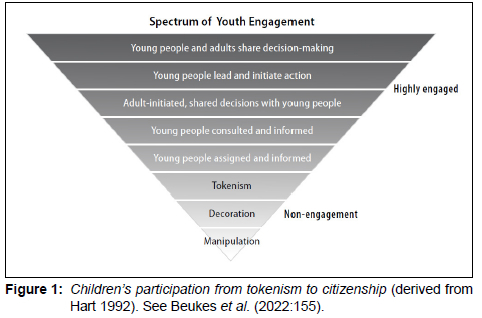
Hart elucidates the process through which minors shift from being perceived as mere entities or tokens to attaining full-fledged citizenship. He devised a model known as the "spectrum for youth engagement", delineating the necessary steps for transitioning from a disengaged youth (located at the lower end of the spectrum) to an actively engaged youth (located at the upper end of the spectrum). The aforementioned theory underwent testing on the youth demographic through both quantitative and qualitative research methods. The feedback gathered from the research and the perspectives shared by the young individuals involved in the study provided affirmative validation of the theory.
I recently co-authored a publication with two fellow students. Our empirical research centred around the expression of youth voices within worship institutions, with a specific focus on themes related to justice, unity, and reconciliation (see Beukes, Thyssen & Jacobs 2022). I would like to present a brief overview of the interview findings from the young individuals. While I will not address every inquiry with regard to determining the most effective platform for youth to voice their opinions and wield an influence within the church, the participants suggested that the focus should not solely be on youth gatherings and services. They emphasised being integral components of the congregations and aspiring to participate in the decision-making processes. The participants proposed recommendations, urging the church to broaden its offerings and create additional opportunities for youth involvement such as electing young individuals to the church council.
The responses from the youth carry importance for both the internal and external structures of the church, as they perceive themselves as valuable contributors and agents of change within both the church and wider society. The cohort of young individuals in this study agreed about their collective potential to bring about transformation within both ecclesiastical and societal contexts. The recent #FeesMustFall movement has demonstrated the potential of collective action among young people to exert influence over decision-making processes and authoritative governmental structures. According to their statement, they possess a considerable amount of energy. If utilised appropriately, positive changes can be achieved.
Regarding the matter of how the church or church leadership ought to engage with the youth, the participants expressed that the leadership should incorporate them into procedures, thereby granting them the liberty to articulate their views. Adolescents possess competencies, qualities, and aptitudes that qualify them for leadership roles. Consequently, they recognise the importance of their involvement in leadership frameworks.
Based on the results, it can be inferred that the youth perceive the church as an organisation with a hierarchical structure. Even when engaging in extracurricular activities such as youth gatherings and meetings, young individuals perceive that they are being subjected to preaching. It is imperative to foster a sense of importance and value in individuals by engaging in meaningful dialogue, actively listening to their perspectives, providing support and encouragement, as well as collaborating with them to implement solutions. Doing so exhibits a demonstration of mutual respect. Trustworthiness, integrity, and authentic connections hold significant value for them.
The study's findings reveal that the youth participants were inclined to embrace change and had a fervent aspiration to bring about change. The analysis suggests that the younger generation may hold distinct, progressive perspectives on addressing societal challenges. This is evident in their resolute attitudes towards their expectations from the government, religion, and society (see Beukes et al. 2002).
8. CONCLUSION
This article explored the correlation between youth, religion, and social capital in South Africa. It was noted that religion can provide young people with a feeling of belonging and community, which can facilitate the development of social capital. However, the connection between social capital and religion is complex, and various religious groups can have divergent effects on social capital. In addition, socio-political realities may limit the development of social capital among certain groups. To promote social cohesion and address social inequality in South Africa, comprehending the interrelationship among youth, religion, and social capital is crucial. It is, therefore, essential to foster the development of positive social networks and norms.
BIBLIOGRAPHY
Aziz, G. 2017. Youth ministry as an agency of youth development for the vulnerable youth of the Cape Flats. Verbum et Ecclesia 38(1), a1745. https://doi.org/10.4102/ve.v38i1.1745 [ Links ]
Aziz, G. 2020. Age does not determine influence: A consideration for children in ministerial service. HTS Teologiese Studies/Theological Studies 76(2), a5848. https://doi.org/10.4102/hts.v76i2.5848 [ Links ]
Bartkus, V.O. & Davis, J.H. 2009. Social capital: Reaching out, reaching in. Northampton, MA: Edward Elgar Publishing. https://doi.org/10.4337/9781848445963 [ Links ]
Beukes, J.W. & Van der Westhuizen, M. 2016. Exploring the voices of children and youth: A plea for renewal in church structures for child and youth ministries. Stellenbosch Theological Journal 2(2):111-130. https://doi.org/10.17570/stj.2016.v2n2.a06 [ Links ]
Beukes, J.W. & Van der Westhuizen, M. 2018. Moving from faith-based concerns to de-marginalising youths through the Circle of Courage. HTS Teologiese Studies/Theological Studies 74(3), 5013, pp.1-9; https://doi.org/10.4102/hts.v74i3.5013. [ Links ]
Beukes, J.W., Thyssen, A.A. & Jacobs, D. 2022. "Here Am I, Send Me!" The youth as co-participants and agents of change. In: N. Bowers du Toit (ed.), Faith, race and inequality among young adults in South Africa: Contested and contesting discourses for a better future. First edition (Stellenbosch: Sun Media Press), pp. 149-163. https://doi.org/10.52779/9781991201775. ISBN: 978-1-991201-76-8 [ Links ]
Bourdieu, P. 1986. The forms of capital. In: J.E. Richardson (ed.), Handbook of theory of research for the sociology of education (New York, NY: Greenwood Press), pp. 241-258. [ Links ]
Bramadat, P. A. 2005. Religion, social capital, and "The day that changed the world". Journal of International Migration and Integration 69(2):201-217. https://doi.org/10.1007/s12134-005-1010-9 [ Links ]
Brown, R.K., Kaiser, A. & Daniels, W. 2010. Religion and the interracial/ethnic common good. Journal of Religion and Society 12:1-17. [ Links ]
Burt, R.S. 1992. Structural holes: The social structure of competition. Cambridge, MA: Harvard University Press. [ Links ]
Chan, J.T.H. & Chan, E. 2006. Reconsidering social cohesion: Developing a definition and analytic framework for empirical research. Social Indicators Research 75:273-302. https://doi.org/10.1007/s11205-005-2118-1 [ Links ]
Cieslik, K., Barford, A. & Vira, B. 2022. Young people not in Employment, Education or Training (NEET) in sub-Saharan Africa: Sustainable Development Target 8.6 missed and reset. Journal of Youth Studies 25:8:1126-1147. https://doi.org/10.1080/13676261.2021.1939287 [ Links ]
Cloete, A. 2009. Exploring unemployment's challenges to the church's mission today. In: H.J.C. Pieterse & C.H. Thesnaar (eds), A faithful witness: Essays in honour of Malan Nel (Wellington: Bible Media), pp. 81-92. [ Links ]
Cloete, A. 2014. Social cohesion and social capital: Possible implications for the common good. Verbum et Ecclesia 35(3), Art. #1331, 6 pages. https://doi.org/10.4102/ve.v35i3.1331 [ Links ]
Cloete, A. 2015. Creative tensions in youth ministry in a congregational context. HTS Theological Studies 71(2):1-7. https://doi.org/10.4102/hts.v71i2.2107 [ Links ]
Cnaan, R.A., Boddie, S.C. & Yancey, G.I. 2003. Bowling alone but serving together: The congregational norm of community involvement. In: C. Smith (ed.), Religion as social capital: Producing the common good. (Waco, TX: Baylor University Press), pp. 19-32. [ Links ]
Coleman, J.S. 1988. Social capital in the creation of human capital. American Journal of Sociology 94:95-120. https://doi.org/10.1086/228943 [ Links ]
Coleman, J.S. 1990. Foundations of social theory. Cambridge, MA: The Belknap Press of Harvard University Press. [ Links ]
Coleman, J.S. 2003. Religious social capital: Its nature, social location and limits. In: C. Smith (ed.), Religion as social capital: Producing the common good (Waco, TX: Baylor University Press), pp. 33-48. [ Links ]
Days of Our Lives. 1965. Corday Productions, Cutter Productions, David E. Kelley Productions. Oak Alley Plantation, United States of America. [ Links ]
Dayton-Johnson, J. 2003. Knitted warmth: The simple analytics of social cohesion. Journal of Socio-Economics 32(6):632-645. https://doi.org/10.1016/j.socec.2003.10.002 [ Links ]
Department of Higher Education and Training 2017. Fact sheet on "NEETS" (Persons who are not in employment, education or training). [Online]. Retrieved from: http://www.dhet.gov.za/Planning%20Monitoring%20and%20Evaluation%20Coordination/Fact-sheet-on-NEETs-Final-Version-27-Jan-2017.pdf [15 March 2017]. [ Links ]
Department of Social Development 2013. Framework for social welfare services. Pretoria: Department of Social Development. [ Links ]
Dlamini, N.J. 2021. Gender-based violence, twin pandemic to COVID-19. Critical Sociology 47(4/5):583-590. https://doi.org/10.1177/0896920520975465 [ Links ]
Dykstra, C. 2005. Growing in the life of faith: Education and Christian practices. Louisville, KY: Westminster John Knox Press. [ Links ]
Ellis, E. 2020. Gender-based violence is South Africa's second pandemic, says Ramaphosa. Daily Maverick 18 June 2020. [Online]. Retrieved from: https://www.dailymaverick.co.za/article/2020-06-18-gender-based-vio-lence-is-south-africas-second-pandemic-says-ramaphosa/ [1 October 2021]. [ Links ]
Fagan, J., Sulzbacher, S., Karkara, R., Castilho, L. & Bah, C. 2014. A rights-based approach to youth inequalities. In: K. Offerdahl, A. Evangelides & M. Powers, Overcoming youth marginalization. Conference report and policy recommendations. Colombia Global Policy Initiative in collaboration with the Office of the United Nations Secretary General's Envoy on Youth. New York, NY: Columbia University, pp. 8-10. [ Links ]
Hart, R. 1992. Children's participation: From tokenism to citizenship. UNICEF Innocenti Essays, No. 4. Florence, Italy: International Child Development Centre of UNICEF. [ Links ]
Herreros, F. 2004. The problem of forming social capital: Why trust? Houndsmill: Palgrave Macmillan. https://doi.org/10.1057/9781403978806 [ Links ]
Inaba, Y. 2007. Social capital: Solving issues in contemporary economy and society by "ties of trust". Tokyo, Japan: Seisansei Shuppan. [ Links ]
Inaba, Y. 2011. Introduction to social capital: From isolation to ties. Tokyo, Japan: Chuo Koron Shinsha. [ Links ]
Janmaat, J.G. 2011. Social cohesion as a real-life phenomenon: Assessing the explanatory power of the universalist and particularist perspectives. Social Indicators Research 100:61-83. https://doi.org/10.1007/s11205-010-9604-9 [ Links ]
Koonce, K.A. 2011. Social cohesion as the goal: Can social cohesion be directly pursued? Peabody Journal of Education 86(2):144-154. https://doi.org/10.1080/0161956X.2011.561176 [ Links ]
Kousiakis, S.A. 2015. Creating sustainable lives. A case study of youth in South Africa. Unpublished MPhil thesis. University of Oslo. [ Links ]
Lin, N. 2001. Social capital: A theory of social structure and action. Cambridge, MA: Cambridge University Press. https://doi.org/10.1017/CBO9780511815447 [ Links ]
Meier, D. 2002. The power of their ideas: Lessons for America from a small school in Harlem. Boston, MA: Beacon Press. [ Links ]
Nadat, Y. & Jacobs, S. 2021. Elements that contribute to resilience in young women from a high-risk community. Social Work/Maatskaplike Werk 57(1):87-100. https://doi.org/10.15270/57-1-908 [ Links ]
Nduna, M. & Tshona, S.O. 2021. Domesticated poly-violence against women during the 2020 COVID-19 lockdown in South Africa. Psychological Studies 66:347-353. https://doi.org/10.1007/s12646-021-00616-9 [ Links ]
Nel, M. 2000. Youth ministry: An inclusive congregational approach. Pretoria: Kitskopie. [ Links ]
Nel, M. 2009. Congregational analysis: A theological and ministerial approach. HTS Teologiese Studies/Theological Studies 65(1):1-17. https://doi.org/10.4102/hts.v65i1.303 [ Links ]
Nel, M. 2018. Youth ministry: An inclusive missional approach. HTS Religion & Society Series 1:xviii-xx. Cape Town: AOSIS. https://doi.org/10.4102/aosis.2018.BK83 [ Links ]
Offerdahl, K., Evangelides, a. & Powers, M. 2014. Overcoming youth marginalization. Conference report and policy recommendations. Colombia Global Policy Initiative in collaboration with the Office of the United Nations Secretary General's Envoy on Youth. New York, NY: Columbia University. [ Links ]
Organisation for Economic Co-operation and development (OECD) 2011. Perspectives on Global Development 2012: Social cohesion in a shifting world. [Online]. Retrieved from: https://www.oecd-ilibrary.org/development/perspectives-on-global-development-2012_persp_glob_dev-2012-en [21 March 2013]. [ Links ]
Ostrom, E. 2009. What is social capital? In: V.O. Bartkus & J.H. Davis (eds), Social capital: Reaching out, reaching In (Northampton, MA: Edward Elgar Publishing), pp. 17-38. https://doi.org/10.4337/9781848445963.00010 [ Links ]
Oxoby, R. 2009. Understanding social inclusion, social cohesion and social capital. International Journal of Social Economics 36(12):1133-1152. https://doi.org/10.1108/03068290910996963 [ Links ]
Pieterse, H.J.C. 2011. A church with character and its social capital for projects amongst the poor. HTS Teologiese Studies/Theological Studies 67(3), Art. #1046, 8 pages. https://doi.org/10.4102/hts.v67i3.1046 [ Links ]
Preduca, G. 2011. Democracy, religious ethics, and human rights. Contemporary Readings in Law and Social Justice 3(1):129-133. [ Links ]
Putnam, R.D. 1993. Making democracy work: Civic traditions in modern Italy. Princeton, NJ: Princeton University Press. https://doi.org/10.1515/9781400820740 [ Links ]
Putnam, R.D. 2000. Bowling alone: The collapse and revival of American community. New York: Simon & Schuster. https://doi.org/10.1145/358916.361990 [ Links ]
Republic of South Africa (RSA) 2015. National Youth Policy 2015-2020: The authors are generation 2020. The authors don't want a hand-out, the authors want a hand up! Pretoria: The Presidency of the Republic of South Africa. [ Links ]
Sato, Y. 2013. Social capital. Sociopedia.isa.:1-10. https://doi.org/10.1177/205684601374 [ Links ]
Statistics South Africa (StatsSA) 2015. National and provincial labour market: Youth. Pretoria: Statistics South Africa. [ Links ]
Statistics South Africa (StatsSA) 2017. Mid-year population estimates (No. P0302). Pretoria: Statistics South Africa. [ Links ]
Swart, I. & Van Der Merwe, W. 2010. Towards conceptualising faith-based organisations in the context of social welfare and development in South Africa. In: I. Swart, S. Green, J. Erasmus & H. Rocher (eds), Religion and social development in post-apartheid South Africa (Stellenbosch: Sun Media), pp. 75-89. [ Links ]
Swart, I., Vàhàkangas, A., Rabe, M. & Leis-peters, A. 2022. Stuck in the margins? Young people and faith-based organisations in South African and Nordic localities. Research in Contemporary Religion 31. Göttingen: Vandenhoeck & Ruprecht. https://doi.org/10.13109/9783666568558 [ Links ]
Thomas, O. 2001. Political spirituality. Journal of Religion and Society 3:1-12. [ Links ]
Todd, N.R. & Allen, N.E. 2011. Religious congregations as mediating structures for social justice: A multilevel examination. American Journal for Community Psychology 48(3/4):222-237. https://doi.org/10.1007/s10464-010-9388-8 [ Links ]
Van Breda, A.D. 2017. A comparison of youth resilience across seven South African sites. Child and Family Social Work 22(1):226-235. https://doi.org/10.1111/cfs.12222 [ Links ]
Van Breda, A.D. & Theron, L.C. 2018. A critical review of South African child and youth resilience studies, 2009-2017. Children and Youth Services Review 91:237-247. https://doi.org/10.1016/j.childyouth.2018.06.022 [ Links ]
Wepener, C. & Cilliers, J. 2010. Ritual and the generation of social capital in contexts of poverty. In: I. Swart, H. Rocher, S. Green & J. Erasmus (eds), Religion and social development in post-apartheid South Africa (Stellenbosch: SUN Press), pp. 417-430. [ Links ]
Woolcock, M. 1998. Social capital and economic development: Toward a theoretical synthesis and policy framework. Theory and Society 27(2):151-208. https://doi.org/10.1023/A:1006884930135 [ Links ]
Woolcock, M. 2001. The place of social capital in understanding social and economic outcomes. ISUMA: Canadian Journal of Policy Research 2(1):11-17. [ Links ]
World Economic Forum. 2014. Global risks report. Geneva: World Economic Forum. [ Links ]
Yaconelli, M. 2001. Focusing youth ministry through Christian practices. In: K.C. Dean, C. Clark & D. Rahn (eds). Starting right: Thinking theological about youth ministry (El Cajon, MI: Zondervan Publishing House), pp. 155-166. [ Links ]
Date received: 23 August 2024
Date accepted: 3 September 2024
Date published: 17 December 2024
1 NEET stands for Not in Education, Employment, or Training.
