




Services on Demand
Journal

Article
 Article in xml format
 Article references
 Automatic translation
 Send this article by e-mail
Indicators
Related links
-
 Cited by Google
 -
 Similars in Google
Share

 Permalink
Acta Theologica
On-line version ISSN 2309-9089Print version ISSN 1015-8758
Acta theol. vol.45 suppl.39 Bloemfontein 2025
https://doi.org/10.38140/at.vi.10161
ARTICLES
Reimagining the self in relation to God and all creation. Practices of silence in an urban context of societal acceleration
T.D. GeyserI; C.A.M. HermansII
IResearcher, Theology and Religious Studies, Radboud University, Nijmegen, The Netherlands; InVIA Gemeente Stellenbosch. E-mail: d.geyser@fr.ru.nl, ORCID: https://orcid.org/0009-0003-5623-8659
IIExtraordinary Professor, Department Practical and Missional Theology, Faculty of Theology and Religion, University of the Free State, Bloemfontein, South Africa; Professor of Practical Theology and the Empirical Study of Religion, Faculty of Philosophy, Theology and Religious Studies, Radboud University, Nijmegen, The Netherlands. E-mail: chris.hermans@ru.nl, ORCID: https://orcid.org/0000-0001-9416-3924
ABSTRACT
What defines the practices of silence of young urban people (25-35 years old) as an experience of the divided self and relationship with God in an urban context of Cape Town characterised by acceleration? The concept of "primordial spirituality" (Waaijman) is used to shed light on the pursuit of spirituality by young urban persons outside formal church structures. This study highlights the dynamic nature of embodied practices of silence for young urban people, offering a counterpoint to societal pressures for constant engagement. In Waaijman's understanding of primordial spirituality, transformation is a divinely initiated process, in which the human person is drawn into a new mode of being through God's self-communication and presence. Based on inductive research, a fourfold structure of stages of transformation of the divided self in the experience of silence is reported: struggle, letting go, union, and transformation. Through these fourfold embodied practices, individuals cultivate a deep connection between the undivided self, God, and all of creation, which both challenges and enriches traditional Christian understandings of spirituality.
Keywords: Silence, Acceleration, Spiritual practices, Self-discovery, Undivided self and resonance
Trefwoorde: Stilte, Versnelling, Geestelike praktyke, Self-ontdekking, Onverdeelde self en resonansie
1. BACKGROUND TO THE STUDY
Contemporary young adults (GenNet)1 navigate a post-secular spiritual landscape, in which institutional religious paradigms are critically questioned, while an underlying existential search for meaningful transcendence persists as a generational characteristic (Hensen 1999; Sheldrake 2014). Their faith is "ifaith" - they create their own playlist with a self-organised spirituality that draws on many different sources. They have more flexible religious and/or spiritual identities. The study examines three interrelated phenomena.
First, there is a growing societal interest in spirituality that extends beyond traditional institutions such as churches, known as SBNR (spiritual but not religious), according to Mercadante (2014). The development of technology and the massive modern process of migration, urbanisation, and mass communication have given rise to pluralistic notions of religious life (Berger 2001). McGrath (2015) argues that the Protestant legacy, as a component of an outdated paradigm, is intertwined with the Enlightenment project, which
has led to a hyper-rationalism that has devalued the importance of experience and intuition. This has resulted in a profound sense of alienation and disconnection from the world and ourselves (McGrath 2015:110).
Secondly, Rosa's theory of social acceleration highlights the emergence of self-alienation or the "divided self" in late modernity (Rosa 2013; Samuels 2009). The constant pressure for growth and innovation forces individuals to adopt an instrumentalised, efficiency-oriented "outer self", in order to navigate a competitive and bureaucratised world. This instrumentalisation, characterised by time pressure and anxiety, undermines the capacity for authentic relationships - the experience of meaningful connection and transformative encounters. This leads to a profound inner split, separating the optimised, performing outer self from an increasingly disconnected and alienated inner self.
Thirdly, practices of silence as a potential mechanism for deceleration. Silence is now understood in scientific discourse as a vital construct that shapes human development and well-being, with effects spanning neurobiological, psychological, physiological, and spiritual domains. Naor and Mayseless (2020) conducted an empirical review of 11 qualitative studies that focused on the use of silence in liminal and wilderness settings. These studies illuminated the intricate relationship between three fundamental components, namely silence, solitude, and liminal space, thereby contributing to individual personal development, self-discovery and, in certain cases, transformative experiences (Naor & Mayseless 2020:12). McGrath (1994) astutely observes the emerging global resonance of contemplative practices among GenNet, signalling a profound epistemic shift in spiritual practices
This article explores the deliberate cultivation of silence among urban youth in Cape Town as a practice that appears to counteract the rapid pace of contemporary life, while facilitating reconnection with an authentic self and the divine realm. Following an outline of the theoretical framework (section 2), the central research questions (section 3.1), the design of the data analyses (section 3.2), the research findings (section 3.3) and key conclusions (section 3.4) are presented. Finally, in the discussion we address three issues that emerge by the change of context of building theory on primordial spirituality in a modern context of acceleration (section 3.5).
2. THEORETICAL FRAMEWORK
This section explores the concept of embodied spirituality through different frameworks, examining how practices of silence can cultivate a renewed understanding of self and the divine within the context of contemporary urban life. We challenge the prevailing intellectual biases inherited from the Enlightenment era, which have often prioritised disembodied conceptions of spirituality, neglecting the crucial role of the body in spiritual experience. This intellectual bias has led to a disembodied spirituality2 that hinders the body's crucial role in spiritual growth and transformation. We explore three key aspects:
• the idea of innate spiritual knowledge as primordial spirituality (section 2.1);
• the impact of a fast-paced world on inner displacement and the potential of ritual to create space for introspection (section 2.2), and
• the experience of silence in addressing the "divided self" - the fragmentation and disconnection between self-awareness and a spiritual or divine reality (section 2.3).
2.1 Primordial spirituality
Spirituality encompasses our relation to the Absolute and extends beyond formal religious settings, subtly shaping our daily lives as a source of inspiration and direction (Waaijman 2002). Spiritual practices comprise a set of practices, habits, and experiential engagements designed to cultivate and refine our relation to the Absolute. These practices operate in a reciprocal manner, reinforcing one's core beliefs while simultaneously deepening one's engagement with faith.
Spiritual practices, understood as a "way of being" rather than merely ritualistic actions (Waaijman 2002), can be conceptualised in several ways. One perspective emphasises the holistic nature of spirituality, requiring engagement across physical, cognitive, emotional, and spiritual dimensions.
Waaijman (2010) argues that terminologies such as "lay spirituality", "post-modern spirituality", and "secular spirituality" serve as interpretive frameworks for understanding biblical primordial spirituality. He advocates for using the term "primordial" instead of "indigenous", drawing on its Latin roots meaning "first" and "to begin". Contrary to popular associations with things existing from the very start, "primordial" is suggested to refer to the earliest stages of growth and primeval development. This term is particularly applied to concepts such as "primordial awareness", signifying the unfolding of innate knowledge through spiritual exercises that lead to the core of existence and ultimately to God.
2.2 Acceleration
This study investigates how such an accelerated context shapes both self-experience in relation to God and engagement with silence. Moreover, it examines whether deceleration functions merely as a palliative response to accelerative forces or serves as a transformative mechanism in reconstituting the self-divine relationship.
Rosa (2010) argues that societal acceleration fosters a state of existential angst, by alienating individuals not only from others and their surroundings, but also from themselves. This "self-alienation" manifests as a fragmentation of the self, characterised by a disconnection between our authentic desires and the demands of an accelerated lifestyle. This disconnection, coupled with the pervasive sense of alienation from space, time, objects, and social interactions, leads to a profound erosion of meaningful human connection and signifies a diminished sense of living fully.
The acceleration of the social means the "contraction of the present" and can be defined as the increase in the rate of decay of action-oriented experiences and expectations and the shortening of the periods of time that are defined as "the present" in the respective spheres of society (Rosa 2013:301). The pace of life is a reaction to the scarcity of (uncommitted) time resources. The experience of feeling overwhelmed by lack of time and stress can be paradoxical. This sense of being overwhelmed, while paradoxically associated with both stagnation and hyperactivity, disconnects individuals from sustainable rhythms of life. Life becomes "time after time". Social interactions increase, rest is interrupted, and family relationships are Facebooked or Instagrammed from afar. Acceleration techniques lead to "the apparent slowing down and collapse of the environment and natural resource base that sustains this process of acceleration" (Rosa 2013:314).
GenNet needs to be prepared for jobs that do not exist, using technologies that have not yet been invented to solve problems that we do not even know are problems yet. The year 30 has become very significant for this generation. Marriage is being delayed into the 30s. Too much information analysis leads to paralysis. Job promotions or career changes take place. It is a period of added pressure and frustration. Digimodernity3has given rise to "flexible bodies", where the appearance and projection of the body is an integral part of self-identity. Technology in modern society is changing perceptions of the body. Cyberspace has added a new dimension and twist to the desire to forget our bodies. After each virtual experience, we have to return to our bodies. The change in embodiment and loss of self is referred to as the "erotic ontology of cyberspace" (Williams & Bendelow 1998).
2.3 The divided self
A framework for understanding contemporary selfhood requires an examination of two related phenomena: the relationship between acceleration and the fragmented experience of self, and the potential of silence to mediate this fragmentation.
The acceleration characteristic of a Techno-era4 has brought about a profound shift in self-understanding, with traditional paradigms of a unified self facing unprecedented challenges (Rosa 2010; Van Huyssteen 2010). The digital world has given rise to a networked self with multiple selves that can perform an edited identity at any time (Papacharissi 2011). This phenomenon, manifested in what scholars call "time sickness",5 fundamentally alters the construction of the self-narrative. The disembedding of temporal and spatial frameworks correlates with the destabilisation of identity, resulting in a pervasive sense of existential displacement (Rosa 2013). This "dividedness" manifests as a pronounced alienation from authentic selfhood.
The concept of the divided self in psychology stems from James' (1903:166) distinction between healthy people and sick souls. Healthy souls report experiences of adversity in life without a complete loss of good (happiness). Sick souls have an emotional life (heart) that is out of balance. Experiences of the good in life are too few and too fleeting to create a positive attitude towards a life of happiness. This leads to an emotional life (heart) in which there is no balance (James 1903:166).
In line with James, Paul Ricoeur, in his book Fallible man (1986), emphasises that brokenness or dividedness is not something outside ourselves but registered as a disproportion between the self as limited and a self as open to the good or unlimitedness (Hermans 2022:21). The experience of dividedness refers to the brokenness of the heart (the "pathos of misery") between
the limitations of existence, failure and deficit and finiteness, on one side, [and] the greatness (grandeur) of the ethical vision, humanity, the perfect and infinity, on the other (Ricoeur 1986:1).
The experience of dividedness should not be viewed as a separation between two selves: a biological self and a spiritual self, or a false self and authentic self. The self is a whole that exists before the dividedness because the whole is more than the sum of its parts (Ricoeur 1986:4). Human beings experience a disproportionality between the self as limited and the self as open to the unlimitedness. The synthesis (whole) between the self as limited and the self as unlimited must be primordial compared to the dividedness. Wholeness cannot be explained by adding the parts but must be prior to any disjunction or separation in God (see Hermans 2020b:61)
This research examines how contemplative silence functions as a potential mechanism for transcending the existential divide between the fragmented self and ultimate meaning, specifically exploring its role in facilitating reconnection with the divine.
3. METHODOLOGY
3.1 Research question
The following question propelled this inquiry: What process of re-imagining the self, God, and world is reported by GenNet persons in their practices of silence in an urban context of Cape Town marked by acceleration?
This research provides insight into the nature of the reimagining process, how these young adults reconceptualise their relationship with themselves, God, and the world through their practice of silence. Do they develop new understandings of their identity, their place in the world, and their relationship with the divine? The question will also shed light on the impact of acceleration and its aftermath on the self in relation to God, and how the accelerated pace of urban life shapes the challenges and opportunities for spiritual exploration. How can the practices of silence help reintegrate the fragmented relationship between self and God in the context of the modern world?
3.2 Research design
Using an inductive approach, this study first collects and examines empirical evidence, and then constructs theories and concepts derived from these observations. Inductive reasoning involves moving from specific observations to more general theories and concepts, rather than starting with a preconceived hypothesis or theory (Hermans 2014). This research prioritises practical exploration over established theory, recognising the lack of a definitive framework for studying silent practices. The researcher adopts a critical, self-reflexive stance, acknowledging her dual role as an observer and leader within the focus group of a new church plant. The research deliberately focuses on lived experience, encompassing fully embodied practices through thoughts, bodily sensations and emotions, rather than solely theoretical perspectives on silence. The aim is to develop a theory from the data itself, rather than to impose preconceived ideas.
This is an explorative research, recognising the lack of a definitive theoretical framework for examining silent practices. The research examines how individuals, amidst the acceleration of modern life, can use these embodied experiences to connect with their undivided selves and cultivate a more enhanced understanding and awareness of the divine.
3.3 Sampling, data collection, and data analysis
The methodology was designed to allow new theoretical insights to emerge directly from the data analysis. A semi-structured questionnaire was developed to explore participants' urban experiences and silence practices (to understand form, space, time, and content), and personal reflections. A sample of 17 participants was selected from our existing database.
The data analysis was done with the help of a computer-aided qualitative data analysis software program called ATLAS.ti. The software is mainly an organising tool. The data was then transcribed and coding was done. The three basic components of the model are noticing things, collecting things, and thinking about things (NCT model). Noticing refers to the process of finding interesting things in the data. Preliminary codes with notes can be made. Codes may be derived inductively or deductively. The level of the codes does not play a role and can be descriptive or conceptual. Collecting things is similar to the noticing concept, but data will also be compared with incidents for similarities and differences (Friese 2014):
• Noticing refers to the process of finding interesting things in the data. Initially, descriptions of the self, as expressed through thoughts, emotions, and the body in relation to God, emerged as a prominent theme during the practice.
• The second stage consists of selective coding where preliminary codes with notes were made, descriptive or conceptual.
• Collecting things is similar to selective coding, but data will also be compared with incidents for similarities and differences. Many different quotations were gathered that help understand the underlying similarities and differences in the data.
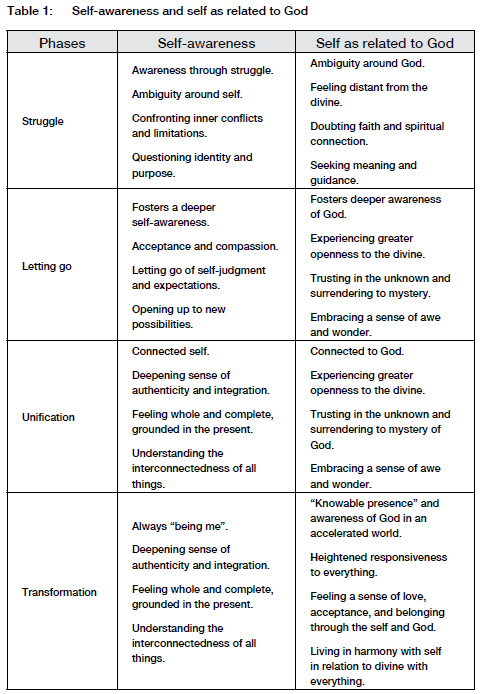
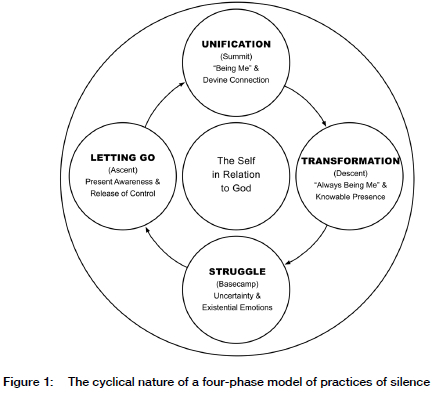
• In the thinking stage, patterns were discovered and relations in the data were investigated and compared. The experience of the self, expressed through thoughts in relation to God, were expressed in phases. The structure of the data was ordered in chronological order that emerged out of the data: The struggle, letting go, unification, and the transformation experienced during and after the practice of silence.
First-level coding and second-level coding were carried out. A well-developed NCT analysis describes what is in the data, but it does not represent a theoretical framework (Friese 2014). The data were also visualised using the network view in Atlas as models and maps to stimulate different ways of thinking and to allow further exploration in different ways. All possible answers to the research question were written down and, slowly, patterns and relationships emerged and were integrated.
This methodological rigour supports the use of Acceleration Theory and the Divided Self framework, while allowing new insights to emerge into the transformative potential of silence practices in the context of primordial spirituality.
3.4 Findings
3.4.1 First phase: Struggle as ambiguity regarding the self in relation to God
At first I struggle to concentrate and I struggle to just be. And then I sort of get to a place where my mind drifts and then I realise ok it's drifting and I'm back again (P4:87).
The respondent articulates an initial difficulty in concentrating and simply existing in the moment, emphasising a struggle to achieve a state of mental focus and presence. The mind drifting indicates a notable challenge in maintaining control over his/her thoughts during the practice of silence. The individual acknowledges this mental wavering, actively recognises the deviation, endeavours to reorient his/her attention, signifying a conscious effort to navigate the cognitive complexities associated with the utilisation of silence as a coping strategy within the urban context.
"It's the untying of knots in the body and in the mind and in the spirit" (P16:643). In the second quote, a metaphorical expression describes the practice of silence as "the untying of knots in the body, mind, and spirit". This imagery suggests a multifaceted impact of the practice, encompassing not only the physical aspects, but also the cognitive and spiritual dimensions. The mention of untying knots proposes a transformative process, wherein the practice of silence is regarded as a method for resolving or alleviating complexities across various facets of the individual's being.
And if I sit long enough in that ... and this is why it happens so scarcely I think, because I still have doubts whether there's something on the other side. Is there a me on the other side, is there a God ...(P9:550).
The hesitancy to engage in this practice more frequently is attributed to lingering doubts regarding the existence of an alternate reality or the presence of a divine entity, raising questions about the nature of self by asking "Is there a me?" and the existence of God by asking "Is there a God?". The respondent conveys a hesitancy to engage in prolonged periods of silence, attributing this reluctance to lingering uncertainties regarding the existence of an alternate state or dimension.
Summary
At the beginning of the practice, the participants' narratives reveal a profound ambiguity concerning the nature of self and the divine within the context of silence practices. This ambiguity, characterised by initial struggles with concentration and the emergence of doubts about the existence of both a "true self" and a divine presence, is not merely an obstacle but rather a crucial catalyst for deeper self-awareness. These struggles, including the confrontation of inner conflicts and limitations, compel individuals to question their existing assumptions about themselves, their purpose, and their relationship with the divine.
3.4.2 Second phase: Letting go as attentive surrender of the self in relation to God
And so, like I said, I actually feel nauseous, because this is not going where I thought it was going. And then that is followed by another moment of ... okay. Okay. And then I know, the time is ... is here. Giving in. Surrender. Saying ... fine. Okay fine. Okay fine. And then ... it's like a nothingness (P9:541).
The respondent still describes a physical response, feeling nauseous, related to the struggle during the practice. The phrase "this is not going where I thought it was going" indicates a sense of surprise or divergence from the respondent's anticipated experience. The practice of silence leads to unexpected realisations, introducing an element of unpredictability.
I'm kind of going into silence and being ... you know reflecting or trying to just think about nothing. So that movement ... it definitely could ... but I'm not exactly sure what it's doing. But just doing something or moving or being slightly occupied with something. Then it's like my mind can actually really switch off (P13:347).
The respondent describes a process of transitioning into silence, suggesting a deliberate shift from external stimuli and mental chatter toward a state of introspection. The respondent acknowledges that the precise impact of this movement on the mind may not be fully understood, but it is recognised as a contributing factor to the overall process. It can be said that the practice of silence is experimental and exploratory by nature. A focus or engagement in a task or activity, even if minimal, serves as a focal point for attention, potentially aiding in the diversion of the mind from extraneous thoughts. The goal is articulated as the mind "actually really switching off". This implies a state of mental stillness or quietude, where the usual mental chatter subsides.
And sometimes I use the word, and I will say the word slowly over and over. And the focus for me of using the word is to keep my focus on clearing out the other stuff. That I do come to that point of silence (P8:564).
A specific word is employed during silent practice. The word is repeated slowly and continuously, indicating a deliberate and repetitive verbal engagement. The purpose behind using the repeated word is clarified. It serves as a focal point, helping the respondent to concentrate on the task of clearing his/her mind from other thoughts or distractions. The end goal of this practice is to reach a state of silence. By consistently repeating the chosen word, the respondent aims to quiet the mind and attain a state of mental stillness or silence.
I didn't even want to voice it out loud. I was just thinking it in my mind. And it was difficult throughout the whole practice, but I kept on saying it. And as I kept on saying it, it was like ... it's almost as if there's this big void that forms inside of me. I just go all empty (P4:471).
The respondent describes the intention to engage in centring prayer, opting not to verbalise the chosen phrase but rather to mentally contemplate it. Despite encountering difficulty during the entire practice, the individual persists in repeating the chosen phrase. As the repetitive mental process continues, a profound sensation is noted - the emergence of what is metaphorically referred to as a "big void" within. This sensation is further elaborated as a feeling of emptiness. I interpret the term "void" as a spacious, tranquil state, and the subsequent feeling of emptiness might imply a release or letting go of mental clutter or tension.
Sometimes if you are doing something, like let's say you are sitting with that beads ... if I'm jogging ... maybe that's another time where I feel that ... you know ... I'm kind of going into silence and being ... you know reflecting or trying to just think about nothing. So that movement ... it definitely could ... but I'm not exactly sure what it's doing. But just doing something or moving or being slightly occupied with something. Then it's like my mind can actually really switch off (P13:431).
The respondent begins by describing the context in which this practice occurs, suggesting that engaging in a specific activity such as sitting with beads serves as a trigger for the contemplative process. The context then extends to include activities such as jogging, highlighting that moments of movement and engagement in a repetitive action also provide an opportunity for entering a state of silence. This involves reflection and an attempt to clear the mind of active thoughts. The respondent acknowledges the effectiveness of movement in facilitating a contemplative state but admits uncertainty about the exact impact or mechanism behind this. The last sentence concludes, by expressing that engaging in activities or movement creates a condition where the mind can effectively switch off, suggesting a release from active, analytical thinking and a transition into a more silent state.
Summary
In the second phase of the practices of silence, we encounter a profound dialectic: the deliberate relinquishment of mental control paradoxically requires active engagement or response. This process illuminates the inherent ambiguity between agency and surrender. Practitioners employ various cognitive strategies - embracing thought patterns, maintaining focused attention, allowing mental flow, engaging in repetitive contemplation, and imagining divine presence - yet the ultimate aim is to transcend these very mental constructs. The underlying philosophical premise suggests that the authentic self becomes obscured by modern urban existence, creating an existential void. Through the practice of intentional surrender, practitioners navigate the apparent contradiction of "trying not to try", allowing the dissolution of constructed identity to reveal what they perceive as a more fundamental self. The pursuit of self-discovery is intimately linked to the mental constructs they hold onto. In relinquishing these attachments, they transition into a more silent and peaceful state.
3.4.3 Third phase: Unification as integration with self and the divine and the world
In that moment ... what I feel is ... is ... as I mentioned, is a oneness with everything and a peace and almost in the same sense not being part of everything, but also being part of everything. And ... and where I lose something of myself and my identity, but not identity, myself ... but also ... in my uniqueness ... is so part of the whole. What happens is, that's also the place where ... where I find things are becoming more clear or things are revealed (P3:221).
This marks a specific moment in the practice of silence, a significant point in time. The respondent describes a profound feeling, an overwhelming sense of unity with everything around him/her. This oneness implies a deep interconnectedness with the world, both tangible and intangible elements. The respondent undergoes a process of losing a part of him-/ herself and his/her conventional identity. The distinction is made between identity and self. Even in this loss, there is a recognition of uniqueness. The self, while losing certain aspects, paradoxically becomes an integral part of the entirety. The described state is not only a moment of unity and peace, but also a space where clarity of thought emerges. The respondent perceives that, in this profound experience of oneness and self-loss, there is a heightened clarity or revelation.
I believe I am connected to God. I believe He is in me. And I believe I'm in Him. So by connecting with me, I'm connecting with Him. There's a oneness, that's how I see it. For me, that's what silence does. I connect to the one, I connect to the other one (P8:949).
The respondent expresses a belief in a close, intimate connection with God. God is perceived not as a distant entity but as a presence within him-/herself and s/he feels reciprocally present within God. I interpret this phrase by connecting with me, I'm connecting with Him" that the act of self-connection is synonymous with connecting to God. The respondent sees a direct link between his/her own inner being and the divine presence. The respondent describes a sense of oneness or unity, suggesting a profound spiritual experience. The reference to silence implies that this oneness is facilitated through the practice of silence. The repetition of "I connect to the one, I connect to the other one" reinforces the idea of a dual connection, both within themselves and with God.
And there is ... something happens in my brain ... I can't ... I can't really put words to it. It is almost as if I go into a simpler state of being. Just being (P7:42).
The respondent describes a cognitive experience during the practice of silence. The inability to articulate it with words conveys the ineffable nature of the encountered phenomenon. It suggests a unique mental state that defies easy description. A transformation in his/her state of being is expressed. The use of "almost as if" indicates the challenge of expressing this transformation. The simplicity mentioned could imply a state of clarity, calmness, or a reduction of mental complexity. The statement concludes with a succinct expression of the desired state - an uncomplicated existence of just being. A departure from the complexities of thought is conveyed and a shift into a more elemental and present state of being.
Summary
The practices of silence reveal a profound shift, where the initially distinct categories of self and divine presence gradually dissolve into a unified experience. Through the practice of letting go, these individuals discover that finding themselves and encountering the divine are not separate pursuits but intimately interconnected dimensions of the same journey. As they release their tightly held constructs of identity and control, they report experiencing a state where self-awareness naturally flows into divine recognition, and divine presence illuminates deeper aspects of selfhood. This mutual unveiling manifests as a profound sense of unity that extends beyond the individual-divine relationship to encompass all of existence. The practitioners describe how their initial struggle with silence and surrender gives way to an experience where personal boundaries become permeable, not in a way that negates individual identity, but rather transforms it through connection with something greater. Their urban anxieties and fragmented sense of self yield to a more integrated experience where self-awareness deepens through the recognition of divine presence. What emerges is not a logical certainty but a lived experience of interconnection. The boundaries between finding ourselves and finding God become fluid and mutually reinforcing - each discovery in one domain enriches the other. This represents a transcendence of the initial struggle through surrender, where letting go paradoxically leads to a deeper form of knowing - one that is felt rather than intellectually grasped, experienced rather than explained.
3.4.4 Last phase: Transformation as knowable presence of self in relation to God and the world
I feel like I'm able to deal with myself and my life much more easily. Like it doesn't stress me out to be what I am or who I am. I'm just able to be. Like I don't have to do a specific thing (P5:199).
The respondent expresses a sense of improved self-management and ease in dealing with his/her own life. This new-found ability to deal with ourselves and our life has reduced the stress associated with self-identity and existence. It implies a greater acceptance and comfort with being authentic. The respondent does not feel compelled to conform to external expectations or to fulfil specific roles. Instead, there is a freedom to simply be him-/herself, leading to a revitalisation of him-/herself.
What happens is, that's also the place where ... where I find things are becoming clearer or things are revealed. Things change in my ... in the deepest parts of me ... where I can forgive and where I can be renewed and where I find new parts (P2:106).
The respondent describes a significant occurrence or realisation, suggesting a specific state of being while practising silence. A heightened clarity in this particular state enhances a deeper understanding. A shift or evolution in the innermost aspects of his/her being takes place. This transformative space allows the respondent to engage in forgiveness and experience a sense of renewal and revitalisation.
I mean I don't understand many things but ... you know that there is this presence that knows everything already and that knows the answer and I don't need to worry about the answer. Or ... I don't know ... it's just like feeling like there's this really powerful and knowable presence that is supporting me (P13:1272).
Although a lack of understanding of many things, the respondent acknowledges the existence of a pervasive and all-knowing presence. This presence possesses complete knowledge and already has the answers, relieving him/her from the need to worry about uncertainties and describing a sense of being supported by a powerful and knowable presence, conveying a feeling of reassurance and guidance.
The awareness of God in basically anything. If you eat now, if you ... even yes, to work, to drive. I think I've just become aware of God much more (P10:499).
The respondent expresses an increased consciousness, indicating a deeper and more pervasive discernment of God's presence in various aspects of his/her life.
I would also have to allow Him to find me then in the silence. Because that's His main pattern. He seeks. He finds. Whereas the emphasis mostly has been on us seeking Him, and us finding Him. And that is the true paradox that silence offers to sound. We need both. But that's the one that lacked emphasis in our upbringing I think within religion (P16:326).
The respondent acknowledges a shift in perspective, suggesting a willingness to allow God to find him/her during moments of silence. God's predominant pattern of seeking and finding emphasises the divine initiative in the relationship. The paradox presented by silence is emphasised, both seeking God and allowing God to find us are essential aspects of the spiritual journey.
Summary
In the final phase of silence, participants experience a profound sense of "coming home" to themselves - a state of inner peace and tranquillity, where they feel genuinely at ease and authentic. This transformative process involves releasing the pressures of conformity, the need for external validation, and the relentless pursuit of external achievements. Through this practice, individuals cultivate a deeper connection with their true selves, shedding the "divided self" to embrace their authentic nature. This journey of self-awareness leads to a more profound understanding of their values, desires, and limitations. A significant aspect of this transformation is the deep sense of connection with the divine, often described as an inner peace, a feeling of being supported and guided, and a sense of oneness with all existence. This divine connection transcends intellectual understanding and manifests as a deep, "knowable presence" or intuitive knowing. The experience of silence catalyses a shift in perspective, enabling individuals to perceive the world with renewed clarity and wonder and increased responsiveness of the self towards the world and God. They begin to appreciate the present moment more fully, recognising the beauty and interconnectedness of all things. This dialectical interplay between the self and God fosters an enriching transformation, where the rediscovery of ourselves opens the possibility of encountering the divine, and vice versa.
The practices of silence are characterised by self-awareness and how the self relates to God.
4. CONCLUSION
The following question propelled this inquiry: What process of re-imagining the self, God, and the world is reported by GenNet persons in their practices of silence in an urban context of Cape Town marked by acceleration?
The research reveals a nuanced, multi-phased process of re-imagining the self-God relationship through a fourfold practice of silence, demonstrating how practitioners progressively transform their understanding and experience of both self in relation to God. This trajectory starts with the initial alienation of self and the divine. Each phase builds upon its predecessor, moving from productive destabilisation through active surrender and unification to stable transformation.
Struggle: The initial phase can be summarised as an awareness of ambiguity about the self and ambiguity about God connected with bodily and emotional discomfort. The respondents grapple with uncertainty and ambiguity about the identity of the self and the purpose of life. They feel distant from the divine and doubt their faith. The uncertainty about connectedness between God and the self is reflected in a repetitive cycle of wandering thoughts, prompting a critical re-evaluation of beliefs, perceptions, and understandings in response to prevailing uncertainties as a quest for self-discovery and rediscovery of God. The emergence of existential emotions, specifically anger and fear, alongside emotions of frustration and sadness deepens the struggle with experiences of vulnerability, self-criticism, and insecurity. These emotions could be related to feeling vulnerable and insecure while practising silence.
Letting go: The process of relinquishment reveals a novel interior domain of awareness that differs substantively from the characteristics of the initial phase. This relinquishment does not entail self-negation; rather, it facilitates the emergence of an expanded self that transcends the constraints of the previously "struggling self". This transformation occurs through the cultivation of self-directed non-judgmental compassion, enabled through receptivity and acceptance. While the self remains decentred, it no longer experiences the distress characteristic of the initial stage.
Unification: This phase marks a qualitative transformation in how practitioners reimagine the self-God relationship in the world. As the familiar sense of self shifts, a paradoxical truth emerges. In this apparent displacement of the self, individuals discover a deeper connection to their authentic nature, to God, and to all of existence. Thoughts flow with remarkable coherence, revealing a deeper truth: the authentic self exists as both a unique entity and an intrinsic part of a greater whole, including the divine. This profound understanding catalyses an experience of transcendent bliss. The practice of silence unveils a profound truth: the paths of self-discovery and divine encounter are not separate trajectories but intimately interwoven aspects of a transformative journey.
Transformation: The final unfolding of the silent practices reveals a comprehensive transformation where personal well-being and spiritual awareness become inseparable. Practitioners find themselves operating from a renewed core identity that naturally expresses authenticity and deepens relationships. This shift brings forth a distinctive "knowable presence" - one that combines present-moment awareness with divine connection - leading to clearer discernment and a fundamentally new way of being in the world. In this final phase, individuals discover a profound shift: the emergence of their authentic self becomes a compass for navigating life's complexities. This transformed sense of "being me" brings not only self-understanding, but also a deeper resonance with life's purpose and an enriched connection to existence itself.
5. DISCUSSION
The findings reported in this article directly address how GenNet individuals in Cape Town's accelerated urban context use silence practices to reimagine their relationship with self, God, and all creation. The research suggests that this reimagining process responds directly to the challenges of urban acceleration, offering practitioners a way to transform fragmentation into integration, anxiety into peace, and isolation into interconnection. Through these phases, GenNet individuals do not merely cope with urban acceleration but fundamentally re-imagine their relationship to it, discovering ways to be authentically oneself in connection to God and the world within their urban context.
In the discussion, we want to go beyond our findings to understand this process of re-imagining the self as related to the world and God. Waaijman (2010) developed his concept of primordial spirituality in his study of different biblical traditions and through the work of anthropologists who study oral traditions of indigenous spiritualities (Waaijman 2007). In this study, we focused on the young urban White generation living in the city of Cape Town as characterised by acceleration. How to conceptualise primordial spirituality in a modern context of acceleration, as the essence of modernisation, which fundamentally changed human relatedness to self, others, nature, and God?
Acceleration leads to alienation. Not only from the self, but also from others, nature, and God. Acceleration refers simply to the speed of life: we consume more per unit of time. We consume more time, but simultaneously experience a contraction of time: we constantly run out of time! Post-2000, the process of acceleration gained momentum through the speed of technological acceleration. A good example is the speed in which AI is changing the world since 2023. Technological acceleration informs the dynamic stabilisation of permanent growth in the capitalist economy. Both processes influence social acceleration, which refers to the transformation of culture, values, and human relationship in the speed of life. Acceleration is affecting the lives of all people living in the growing cities (megapolises) of the world, notably the poor who suffer the lack of basic needs, physical or mental violence, injury or abuse, maltreatment or exploitation (Hermans 2012).
Behind acceleration is modernity's desire to control the world. Making the world controllable means making it:
• visible, that is, making it knowable, expanding our knowledge of what is there;
• physically reachable or accessible;
• manageable in the mode of conquering the world technologically and politically, and
• useful, pressing it into service and making it into an instrument for our own purposes (Rosa 2020:15-17).
What is the problem with making the world controllable? The basic mode of human existence is not exerting control over things but responsivity or our capacity of resonance. Without resonance, there is no possibility that something from outside can reach us or has the possibility to transform us. Without resonance, we are in a state of inner worldlessness and external loss of world (Rosa 2020:27):
We may have any number of relationships to the world - a job, strong family ties, maybe political affiliation, religious faith, volunteer work, hobbies - without necessarily feeling alive or connected to them. None of this means anything to me. It doesn't matter to me, it doesn't affect me, and I'm not having any effect on the outside world.
According to Rosa (2020:31-39), there are four markers of resonance, namely being affected, self-efficacy, uncontrollability, and adaptive transformation. These markers are activated in the practices of silence, as reported earlier.
First, practices of silence start with an awareness of being affected by the world characterised by acceleration. In the first stage of their practice of silence, they feel a bodily discomfort but also emotions of fear, anger, frustration, and sadness. They are inwardly touched by wandering thoughts and ambiguity about God and the self, with bodily and emotional discomfort. "This circumstance of being affected can well be described as a 'call' or 'appeal'" (Rosa 2020:32). The subject feels "addressed" by something experienced bodily and emotionally, from which s/he cannot escape.
Secondly, there is a sense of self-efficacy. The call is followed by an active response: not only listen to your body, emotions, and thoughts, but respond! The second stage, letting go, is an active response to walk a path to ourselves as being in the present, releasing thoughts, letting go of control, navigating out of potentially harmful feelings, and an awareness of God. Letting go signifies the emergence of a broader self, transcending the limitations of the struggle through the development of a nonjudgmental and compassionate attitude toward ourselves.
The third marker is uncontrollability, i.e. an awareness that resonance cannot be manufactured by a mere act of the will or thought (Rosa 2020:36). The practice of silence is not a method that guarantees that the person is able to create a self which resonates with others, God, and nature, nor can we predict what will be the result of this transformation. For example, the phase of unification is defined as a flow of thoughts in which a state of "being me" becomes clear without being grasped, which is at the same time unique and connected with everything else including God, and leads to a blissful and transformative experience.
The fourth marker of resonance is adaptive transformation. Without an awareness of being affected and to respond in a way that makes a connection (see earlier), there is no adaptive transformation. The respondent expresses revitalisation and rejuvenation of "always being me" that deepens relationships and brings ease navigating life's journey and having a knowable presence for "what it is", being "where I am" and engaging in "what is really going on" including God (Geyser 2024:265).
Finaly, we will provide insight into the reception and debate on Rosa's theory on resonance. We will focus on three aspects that are close to the research and theory presented in this article. The first critical issue coming from African Studies is the essentialism of "One World" view and a restriction of the scope of resonance and alienation to modern societies (Beck 2019:108). This approach has Africa continuously as a marginal phenomenon and outside of modernity since the Enlightenment. The critical potential that resonance is supposed to develop remains limited to these modern societies. Rosa's response is that it is necessary to develop the theory of resonance on the basis of experiences of persons in other contexts of power struggles, resistance, and different understanding of community (ubuntu).
I am quite certain, and agree with Rose Marie Beck, that my approach requires (perhaps even radical) transformation through encountering experiences that people make real in colonial, neo- or post-colonial contexts (Rosa 2019b:193)
What forms of being-in-the-world exist, or are possible that cannot be grasped in the theory of resonance? It is necessary to open up this inquiry and engage in further development of the theory of resonance.6
A second issue is: In what sense can resonance be understood as a basic spiritual phenomenon, i.e. as a basic dimension of human existence? Rosa is very critical
on both the postmodern esoteric market and traditionalists that want to make healing and salvation available on the basis of a need for spirituality and an acute 'awareness that something is missing' (Riedenauer 2022-2023:115).
By criticising a separation "between world on the one hand and spirit, God or ground of being on the other", Rosa wants to overcome this "doubling of the world" with the idea of vertical resonance. According to Rosa (2019a:501),
this experience need not be of a religious nature. The vertical axes are also concerned with world relations, not with the supernatural, yet in this dimension, the relationship to the totality of that which confronts us as subjects - that which encompasses us - is at stake.
Valuable for a theory of spirituality is, first, the consequence of Rosa's approach
that a spiritual person can bring his experiences, articulations and practices into a reasonably coherent connection with his entire relationship to the world (Riedenauer 2022-2023:121).
This was also a remarkable finding of the participants in practices of silence. In finding new connections of the self to God, they also found a deep connection to other people and the whole of creation. "Resonance" refers to a relationship event between a person, God, and the whole of creation. The first moment in this event is the unavailability of the call. The second moment of the resonance relationship is the expectation of self-efficacy, i.e. giving a response to this call. For a theory of spirituality, the issue is: How can transcendence be evoked in practices of silence as in rituals and other religious practices (Riedenauer 2022-2023:123)? What can we regard as transcendence in experiences in and of the world and the whole of creation?
A third issue is whether the concept of resonance, as a conception of human being-in-the-world, can lay claim to universal validity or merely describes a specific modern relationship to the world.
Crucial to Rosa's resonance theory is the assumption of an isolated subject, at least partially closed to its environment, yet simultaneously sufficiently open to enter into a specific responsive relationship with a segment of the world that is also conceived as independent. The ontological autonomy of the two entities, subject and world, thus proves to be constitutive for the resonance process (Hübenthal 2019:139).
In this instance, Rosa uses the concept of the buffered self for modernity in contrast to the porous self of pre-modernity. He acknowledges the fact that the "self-understanding and world-understanding of a porous self is difficult to reconcile with the previously developed concept of resonance" (Hübenthal 2019:141). Yet Rosa nevertheless wants to adhere to its universal anthropological validity. Rosa (2019a:653) feels compelled to surmise:
Other socio-cultural formations ... not only possess possibly entirely different resonance sensitivities, resonance practices, and associated resonance axes, but also different forms of relationship.
According to Hübenthal (2019:140), it is conceivable that
conceptual traces of a closed subject also exist in non-modern contexts, perhaps more so than Rosa's dichotomous reading of Taylor's distinction between a porous and a buffered existence suggests.
We need more historical research on resonance and the self in past times (third issue), next to possible forms of being-in-the-world in modern times that cannot be grasped in the theory of resonance (first issue).
BIBLIOGRAPHY
Beck, R.M. 2019. Über Wissenschaftsmacht und konzeptionelle blinde Passagiere. Eine afrikawissenschaftlich-misstrauische Lektüre. In: J.-P. Wils (ed.) Resonanz: Im interdisziplinären Gesprãch mit Hartmut Rosa (Texte & Kontexte der Philosophie 3). Nomos Verlag. Kindle Edition, pp. 98-110. https://doi.org/10.5771/9783845288734-99 [ Links ]
Berger, P.L. 2001. Reflections on the sociology of religion today. Sociology of Religion 62(4):443-454. https://doi.org/10.2307/3712435 [ Links ]
Friese, S. 2014. Qualitative data analysis with ATLAS.ti. London: SAGE Publications. [ Links ]
Geyser, D.T. 2024. City of Carmel: Practices of silence of 25-35-year old persons within a new community of faith in the City of Cape Town. Unpublished doctoral dissertation. Nijmegen: Radbound University. [ Links ]
Mensen, W. 1999. Out of depth. Protestant mysticism. Utrecht: Ten Have. [ Links ]
Hermans, C. A. M. 2012. Towards a "U-turn" by the churches: how (not to) possibilise the future. Religion and Theology. A Journal of Contemporary Religious Discourse, 19, 237-264. [ Links ]
Hermans, C. A. M. 2014. From practical theology to practice-oriented theology. International Journal of Practical Theology 18(1):1-14. https://doi.org/10.1515/ijpt-2014-0006 [ Links ]
Hermans, C. A. M. 2022. Human experiences of heartbreaking adversity. In: C.A.M. Hermans & K. Schoeman (eds), Resilient religion and heartbreaking adversity (Münster: LIT Verlag), pp. 13-30. [ Links ]
Hübenthal, Ch. 2019. Das „poröse Selbst" und die universale Reichweite der Resonanztheorie. In: J.-P. Wils (ed.), Resonanz: Im interdisziplinären Gespräch mit Hartmut Rosa. Nomos Verlag. Kindle edition, pp. 139-149. https://doi.org/10.5771/9783845288734-139 [ Links ]
James, W. 1903. The varieties of religious experience. Boston: Longmans, Green & Co. [ Links ]
James, W. 1961. The varieties of religious experience: A study in human nature. New York: Collier Books. [ Links ]
Kirby, A. 2009. Digimodernism: How new technologies dismantle the postmodern and reconfigure our culture. London: Continuum. [ Links ]
McGrath, A.E. 1994. Spirituality in an age of change: Rediscovering the spirit of the reformers. Grand Rapids, MI: Zondervan. [ Links ]
McGrath, A.E. 2015. The journey of Christian theology. New Jersey: John Wiley & Sons. [ Links ]
Mercadante, L.A. 2014. Belief without borders: Inside the minds of the spiritual but not religious. New York: Oxford University Press. https://doi.org/10.1093/acprof:oso/9780199931002.001.0001 [ Links ]
Naor, L. & Mayseless, O. 2020. The wilderness solo experience: A unique practice of silence and solitude for personal growth. Frontiers in Psychology 11:1-15. https://doi.org/10.3389/fpsyg.2020.547067 [ Links ]
Ndlovu-Gatsheni, S.J. 2015. Decoloniality as the future of Africa: Decoloniality, Africa, power, knowledge, being. History Compass 13(10):485-496. https://doi.org/10.1111/hic3.12264 [ Links ]
Papagharissi, Z. 2011. A networked self. Identity, community, and culture on social network sites. New York: Routledge. [ Links ]
Ricoeur, P. 1986. Fallible man. Revised translation by Charles A. Kelby. New York: Fordham University Press. [ Links ]
Riedenauer, M, 2022-2023. Krise des Unverfügbaren: zur spirituellen Relevanz von Hartmut Rosas Resonanztheorie. Studies in Spirituality 31:11-127. [ Links ]
Robbins, A. & Wilner, A. 2001. Quarterlife crisis. New York: Penguin Putnam. [ Links ]
Rosa, H. 2010. Alienation and acceleration: Towards a critical theory of Late-modern temporality. Michigan: NSU Press. [ Links ]
Rosa, H. 2013. Social acceleration: A new theory of modernity. New York: Columbia University Press. https://doi.org/10.7312/rosa14834 [ Links ]
Rosa, H. 2019a. Resonance. Cambridge: Polity Press. [ Links ]
Rosa, H. 2019b. Zur Kritik und Weiterentwicklung des Resonanzkonzepts. In: J.-P. Wils (ed.), Resonanz: Im interdisziplinären Gespräch mit Hartmut Rosa (Texte & Kontexte der Philosophie 3). Nomos Verlag. Kindle Edition, pp. 190-212. https://doi.org/10.5771/9783845288734-189 [ Links ]
Rosa, H. 2020. The uncontrollability of the world. Cambridge: Polity Press. Kindle edition. [ Links ]
Samuels, R. 2009. New media, cultural studies, and critical theory after postmodernism. New York: Palgrave Macmillan. https://doi.org/10.1057/9780230104181 [ Links ]
Sheldrake, P. 1991. Spirituality and history. London: SCM. [ Links ]
Sheldrake, P. 2014. The spiritual city: Theology, spirituality and the urban. Oxford: Wiley-Blackwell. https://doi.org/10.1002/9781118830475 [ Links ]
Van Huyssteen, J.W. 2010. When were we persons? Why hominid evolution holds the key to embodied personhood. Neue Zeitschrift für systematische Theologie und Religionsphilosophie 52(4):329-349. https://doi.org/10.1515/nzst.2010.021 [ Links ]
Waaijman, K. 2002. Spirituality. Forms, foundations, methods. Leuven: Peeters. [ Links ]
Waaijman, K. 2007. Spirituality - A multifaceted phenomenon. Interdisciplinary explorations. Studies in Spirituality 17:1-113. https://doi.org/10.2143/SIS.17.0.2024643 [ Links ]
Waaijman, K. 2010. Primordial spirituality. Theological Studies, 66:1-5. https://doi.org/10.4102/hts.v66i1.894 [ Links ]
Wessels, W. 2021. (Post)colonial theology in South Africa? A conversation with recent South African theology at the forefront of the decolonial turn. Stellenbosch Theological Journal 7(1):2-26. https://doi.org/10.17570/stj.2021.v7n1.t3 [ Links ]
Williams, S.T. & Bendelow, G. 1998. The lived body. Sociological themes, embodied issues. London: Routledge. [ Links ]
Date received: 31 March 2025
Date accepted: 14 August 2025
Date published: 20 November 2025
1 Also known as Generation Next, ADHD-generation, GenNet, Search-for-identity Generation, Nexters, Millennials, Digital Generation, Boomerang Generation, Peter Pan Generation, and as Prophets, Nomads, Heroes, and Artists. They emerged more or less from 1980 until 2000 depending on the source. Analysing young people's life course transitions through a social generation lens has become increasingly popular. Robbins & Wilner (2001) are of the opinion that these labels are insufficient and do not understand the problem and dilemma of this generation. For the purpose of this study, the term GenNet will be used.
2 Sheldrake (1991) posits that genuine spiritual experience arises from daily, embodied encounters rather than solely from supernatural interventions or abstract theological systems. He introduces the concept of a "secular-dialogic" approach, emphasising the legitimacy of secular, experiential, embodied spirituality. Embodied spirituality encompasses a wide range of human attributes, including thoughts, feelings, emotions, bodily sensations, and sexuality. This article specifically focuses on the role of thoughts within this framework.
3 In his 2009 book Digimodernism: How new technologies dismantle the postmodern and reconfigure our culture (2009), Kirby views digimodernism as a new cultural logic that replaces postmodernism, shaped by digital technologies and characterised by audience participation, endless updating, and the breakdown of traditional authorial control.
4 Consequently, terms such as the "Selfie Generation" and "Generation Me" are not casually chosen; they aptly reflect the transformative influence of this paradigm shift, at times called "Screenagers". The notion of individual autonomy is continually open to negotiation and revision, a phenomenon that characterises the GenNet generation's capacity to "write themselves into being", adjusting and redefining their desired identities (Geyser 2024: 23).
5 Rosa (2013: 54) views "time sickness" as a symptom of what he calls "social acceleration". Even with tools meant to save time (email or time management apps), people feel more pressed for time than ever. "Time sickness" arises when time is treated as money - to be spent, saved, or wasted - rather than as lived experience.
6 Rosa is aware of the need to open up resonance theory from the perspective of people in colonial, neo- or postcolonial contexts. This implies, according to Vuyani (2017:1), to "move beyond rethinking and repeating its tried and tested ways of response to black pain caused by racism and colonialism. Un-thinking the West is not only cognitive but also spiritual. Umoya, the spirit of life, the article argues, to un-think the West, constitutes inter alia, the rejection of Hellenocentric concepts as a starting point of knowledge." Decoloniality implies not only a rejection of Helenocentric concepts, but "involves re-telling of history of humanity and knowledge from the vantage point of those epistemic sites that received the 'darker side' of modernity, including re-telling the story of knowledge generation as involving borrowings, appropriations, epistemicides, and denials of humanity of other people as part of the story of science" (Ndlovu-Gatsheni 2015:492). We agree with Wessels (2021:2) that "the framing, interpretation, and contextual framing of decolonial and postcolonial thought cannot go without serious interrogation from a wide variety of voices for the future of theology in South Africa." A postcolonial development of the theory of resonance will need to show how resonance itself can be framed as a postcolonial struggle for self-determination and the reclaiming of authentic connections to our own heritage.
