




Services on Demand
Journal

Article
 English (pdf)
 Article in xml format
 Article references

 Automatic translation
 Send this article by e-mail
Indicators
Related links
-
 Cited by Google
-
 Similars in Google
Share

 Permalink

Acta Theologica
On-line version ISSN 2309-9089Print version ISSN 1015-8758
Acta theol. vol.45 n.2 Bloemfontein 2025
https://doi.org/10.38140/at.v45i2.8486
ARTICLES
Decolonising theological education in Ghana: Embracing peer teaching and Paulo Freire's critical pedagogy
D. Awuah-Gyawu
Research Fellow, Practical Theology and Misslology, Stellenbosch University, Stellenbosch, South Africa; Lecturer, Theology and Development, Alpha University College, Kumasi, Ghana. E-mail: awuahgyawud@yahoo.co.uk; ORCID: https://orcid.org/0009-0005-9352-4405
ABSTRACT
Theological education In Ghana has faced several challenges in achieving contextually relevant goals, due to the lingering influences of colonial educational paradigms. This article examines the potential of peer teaching, informed by Paulo Freire's critical pedagogy, as a strategy to decolonise theological education in Ghana. By modifying the didactic triangle to include peer tutoring, the article explores how this approach can enhance student engagement, intercultural dialogue, and co-creation of knowledge. Through a literature-based analysis of participatory pedagogy and its application in theological education, the article proposes practical strategies for implementing peer tutoring programmes that enhance collaborative learning and challenge traditional hierarchies within theological institutions in Ghana.
Keywords: Didactic triangle, Didactic pyramid, Decolonisation, Peer tutoring
Trefwoorde: Didaktiese driehoek, Didaktiese piramiede, Dekolonisasie, Ewe-knie tutor
1. INTRODUCTION
Theological education in Africa has been influenced by colonial legacies, impacting its infrastructure, staffing, curriculum, language, and pedagogy, which often perpetuate Eurocentric perspectives and marginalise indigenous African knowledge systems. Decolonising theological education involves transforming pedagogical practices to centre indigenous perspectives, foster inclusive learning environments, and empower students as active participants in their learning. Studies done in Ghanaian theological institutions show that the faculties are indigenous, but that the contents of the curricula are Western (Bediako 2023:1; Quampah & Naidoo 2020:307; Atta-Baffoe 2008:41). This inherited model of theological education has created a disconnect between academic training and practical ministry needs, failing to address the Ghanaians' traditional world view (Akrong 2009:164-165; Williamson 1965:152-175). Although stakeholders' endeavour to reposition theological education in Ghana and traditional paradigms in theological education are gradually losing their dominance, the change is not significant, because traditional or localised curriculum innovations, despite being clearly stated in theological institutes' statutes, are not effectively implemented in the classroom (Sarbah 2022:15; Akrong 2009:165).
Addressing existential, political, and social challenges requires a reformed approach to theological education that resonates with the Ghanaian/African context. Bediako (2006:5) calls for "theological scholarship that engages with cultural issues on indigenous terms". Consequently, scholars have responded, by propounding a theology of African Christianity, African theology, indigenisation of Christianity, and inculturation theology (White 2017:2). Other scholars and institutions have concentrated on developing curricula that focus on the needs of Ghanaian theologians (Bediako 2023:1327; Bediako 2006:312; Akrofi Christaller Institute, Students Handbook 2023:66).
However, there is cause for concern to move beyond documentation in institutional statutes and a modification of the curriculum towards changing the methodological approaches used in teaching and learning. This is in response to Akrong's (2009:165) concern that "even today", pedagogical approaches used in theological institutions reflect the dominance of Western ideas. What makes it a matter of grave concern is that
some of the methods and models of teaching, learning, and assessment that were introduced when universities first developed, like lecturing, are sometimes still used as the only tuition strategy despite the availability of other tools and media that can enhance education practices (Oliver 2019:1).
Meanwhile, theological education stakeholders are expected to create pedagogies of presence to foster a sense of citizenship and the common good of society (Weber 2017:5).
By holding on to colonial pedagogical frameworks at the expense of other approaches, there are challenges in effectively engaging learners, fostering deep understanding, and linking up with everyday practice from an Afrocentric perspective.
This article responds to the call for critical attention to the teaching methods used in African theological education (Knoetze 2023:203; Oliver 2019:1; Weber 2017:5). It is inspired by Paulo Freire's critical pedagogy which emphasises the crucial role learners play in the education process. The article provides an alternative to the lecture method that Oliver (2019:1) observes as "the only tuition strategy" used by some theology lecturers. I discuss how the didactic triangle - a conceptual framework in educational theory that establishes the complex relationships between the teacher/facilitator, the subject matter, and the student/learner (Kansanen & Meri 1999) - could be modified to emphasise Freire's view of the role of students in participatory teaching and learning to decolonise theology education in Ghana. In this modification, I incorporate peer teaching as holding a promise to decolonise theological learning experiences, by promoting student engagement, fostering intercultural dialogue, and challenging hierarchical structures of knowledge production and transmission. The article responds to the question, "How can student-student interactions contribute to the decolonisation of theological education in Ghana?".
A literature-based approach is used to achieve this objective, examining the literature regarding these concepts. The article begins by discussing the colonial legacies of theological education in Ghana.
2. THE INFLUENCE OF COLONIAL LEGACIES ON THEOLOGICAL EDUCATION IN GHANA
Colonial legacies have profoundly shaped theological education in Ghana, affecting infrastructure, staffing, curriculum, language, and pedagogy. These often perpetuate past Eurocentric perspectives while marginalising indigenous African knowledge systems (Bediako 2023:1). This influence is evident in classroom set-ups and instructional procedures, which mimic colonial approaches that reinforce hierarchical structures and undermine classroom democracy. For instance, learners have no say in selecting the content and its presentation. These dynamics create significant inequality between teachers and students and among students themselves, especially privileging those who align more closely with colonial norms. Sarbah (2022:2-3) notes that theological education also mirrors Western institutions with hardly any contextualisation, limiting the relevance and resonance of the content for Ghanaian theology students.
The remnants of colonial influence in theological education impede meaningful dialogue and relationship-building, maintaining traditional banking education models characterised by unidirectional knowledge transfer from teacher to student. This approach centralises power with the lecturer, stifling critical engagement and perpetuating hegemonic practices. In addition, colonial and missionary activities historically distanced Ghanaians from their culture, fostering a sense of inferiority and European superiority (Akrong 2009:169). Consequently, students have limited opportunities to reflect on their present status quo and engage with their cultural and social realities.
Addressing these challenges requires decolonising theological education, by incorporating Afrocentric perspectives and fostering a more participatory and contextualised learning environment. The persistence of Eurocentric curricula, language barriers, hierarchical teaching models, and a disconnect between academic training and practical ministry needs underscore the need for a more inclusive approach (Sarbah 2022:2-3; Quampah & Naidoo 2020:312; Williamson 1965:152-175; Akrong 2009:164-165). By recognising and integrating indigenous knowledge systems and cultural practices, theological education in Ghana can become more relevant, empowering, and reflective of the rich cultural heritage of its people. These are discussed in more detail later in this article.
The next section discusses Freire's critical pedagogy as the study's theoretical framework.
3. PAULO FREIRE'S CRITICAL PEDAGOGY AS A FRAMEWORK
Freire's critical pedagogy views education as inherently political and socially impactful. He advocates for a move from traditional, passive learning to more engaging and participatory approaches (Shor 2002:24-27, 35; Freire 1970).
Critical pedagogy emphasises education as a practice of freedom, with the aim of fostering consciousness and empowering students to participate actively in their learning and societal transformation (Shih 2018:65). Thus, "teaching and learning are human experiences with profound social consequences" (Shor 2002:24), one of which is the transmission of what emerging societies cherish. To Shor (2022:25, 30), learning, in the context of Freire's pedagogy, involves recreating our view of ourselves, education, and society. The curriculum is thus expected to be a derivative of the prevailing conditions of people.
In Freire's critical pedagogy, the teacher is a facilitator and a capacity-builder who aims for emancipation for his students and society. Shor (2002:24) quotes Freire's message to literacy teachers in Chile in 1971:
you need above all to have faith in human beings. You need to love. You must be convinced that the fundamental effort of education is to help with the liberation of people, never their domestication. You must be convinced that when people reflect on their domination they begin a first step in changing their relationship to the world.
Teachers could thus encourage students to reflect on their social contexts. Freire advocates that teachers must stimulate participation, dialogue, and collaboration, resulting in the co-creation of social values. Freire's approach, therefore, opposes the traditional "banking" model of education, in which teachers deposit knowledge into passive students (Shor 2002:25).
Freire's concept of "empowering education" emphasises "a democratic and transformative relationship between students and teacher, students and learning and students and society" (Shor 2002:26). However, a major critique of Freire's pedagogy is the overdependence on dialogue. Leonard (2002:162) notes the challenges in establishing dialogical relationships between teachers and students, especially in institutions where traditional hierarchical relationships and education methods are deeply entrenched. If the success of critical pedagogy inevitably depends on dialogue, in such situations it is likely to fail.
In the teaching practice, the didactic triangle is one of the concepts that set the foundation for this complex interrelationship between the key actors in the teaching and learning process. The next section discusses its implications for teaching and learning. This is necessary for setting the foundation for discussing pedagogy in theological institutions.
4. THE DIDACTIC TRIANGLE AND ITS LIMITATION
The didactic triangle is a conceptual framework in educational theory that establishes the complex relationships among the teacher, the subject matter/ content, and the student/learner (Kansanen & Meri 1999). These components are the essential elements needed for attaining learning outcomes.
The teacher, who designs and delivers the instructional materials, is at the top of the triangle. According to Freire's view, the teacher's role is to present the subject matter in an engaging, accessible, and relevant manner, while fostering the connection between the student and the subject matter (Kansanen & Meri 1999:114).
One corner of the triangle represents the learner, whose characteristics, relevant previous knowledge, skills, experiences, and motivation affect learning (Ambrose et al. 2010). Pepin (1999:58) notes that, in the generic sense of the use of "student" in the didactic triangle, the emphasis is on the individual student and the periodic restructuring of his/her knowledge. In applying this view, facilitators, guided by the didactic triangle, do not pay attention to the role played by student-student interaction.
The third corner represents the subject matter or the content being taught. Effective teaching involves unfolding a well-thought-through plan of activities whereby the teacher and the students engage the subject matter toward the pre-set learning outcomes.
The didactic triangle, which is widely used by teachers, is shown below.
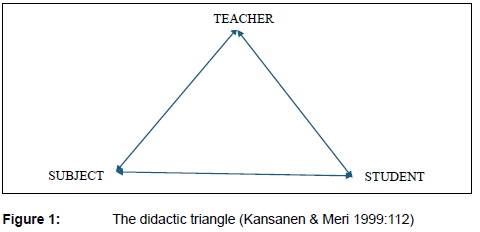
In the triangle, there are direct two-way links between the three components but there is no room for student-student interaction.
5. PROPOSED MODIFICATION: THE DIDACTIC PYRAMID
The didactic model, in its current form, has not sufficiently considered the prospects of peer tutoring in teaching and learning, which I explore for theological education. A modified version of the model would highlight this concept, in order to improve the learning experiences of theology students.
This modification suggests a purposeful integration of student-student interaction in teaching and learning, not only a teacher-student one. Bartolome (1994:11) argues that
[t]he actual strengths of [teaching] methods depend, first and foremost, on the degree to which they embrace a humanizing pedagogy that values the students' background knowledge, culture, and life experiences, and creates learning contexts where power is shared by students and teachers.
Therefore, the proposed didactic pyramid increases the degree of inclusion of students in the teaching and learning process and compels facilitators to recognise and integrate the role of peer interaction in their practice. Although scholars such as Naidoo (2021:76) propose students' participation in the theologising process in attempting to bridge theology and praxis, the proposal does not stipulate the extent of participation that is expected.
In the proposed didactic pyramid, the lecturer, who guides the teaching and learning process through a careful selection of the content and method, is placed at the top of the pyramid. At one of the apexes of the triangular base is the content standard or subject matter. At the other two apexes of the base of the pyramid are different students (for example "student A" and "student B", as used in the proposed model below) who interact with each other through a purposefully designed peer tutoring method. In this way, an additional form of interaction - student-student interaction - is consciously woven into the teaching-learning process. The other forms of interactions, which also existed in the didactic triangle, are those between the teacher and the students as well as their interaction with the subject matter. Thus, both students interact with the teacher, the subject matter, and each other toward the achievement of the set content. The proposed model is shown below:
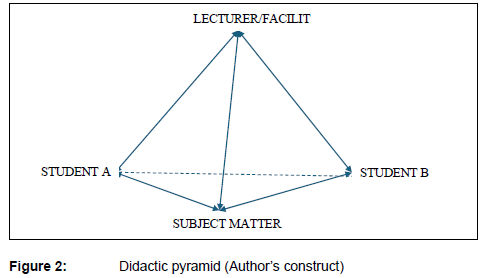
6. INCORPORATING PEER TUTORING IN THEOLOGICAL EDUCATION
The concept of peer tutoring has evolved from viewing peer tutors as substitute teachers who pass information received from a teacher to a peer; to
more able students helping less able students to learn in cooperative working pairs or small groups carefully organized by a professional teacher (Topping 1996:322).
This view is also held by Morano and Riccomini (2017:104) in their reference to peer tutoring as
the group of cooperative learning strategies where students are paired and one questions, prompts, or guides the other through a problem set or activity to help them learn or practice content.
In this article, peer tutoring is considered a learning strategy, integrated into the teacher's instructional time, in which teachers purposefully group students to share knowledge, skills, values, and experiences towards the attainment of set learning outcomes. It includes think-pair-share, a teaching strategy in which teachers task students in pairs to think through and share ideas, pause to allow time for such deliberations, and finally allow them to share with the class (Kaddoura 2013:4). It is a way of stimulating student-student interaction to influence learning outcomes. Peer tutoring can also involve groups larger than two.
Studies have shown the effectiveness of peer teaching in various educational settings. First, peer tutoring, leveraging the social interactionist view of cognitive development, provides prospects for a deeper understanding of concepts through questioning and speaking about issues (Topping 1996:323324). Furthermore, taking cues from the old saying, "to teach is to learn twice", peer tutors achieve more in their roles (Topping 1996:324). Other prospects include the attainment of competence, confidence, as well as communicative and collaborative skills on the part of tutors (Seo & Kim 2019:97; Comfort & McMahon 2014:168; Ali et al. 2015:61; Topping 1996:324).
In the following section, I discuss ways of incorporating peer tutoring in theological education in light of Freire's critical pedagogy.
7. FACILITATING DIALOGUE AND EGALITARIAN RELATIONSHIP
Aronowitz (2002:9) asserts that "no genuine learning can occur unless students are actively involved". This idea is reflected in peer tutoring, which aligns with Freire's concept of "facilitating dialogue and egalitarian relationships". Peer tutoring fosters an environment where learners are both teachers and students, debunking the traditional "banking" concept of education. This reciprocal exchange changes the dynamic from one-way knowledge transfer to multi-directional, redistributing power and deepening classroom democracy. Sinwell (2022:14-15) used students' pre-existing knowledge and experiences to encourage peer teaching, supporting the idea that students can engage in valuable counter-hegemonic work (Vally 2020:15; Sinwell 2022:15), promoting Freire's ideals of dialogue and egalitarian relationships.
Promoting peer teaching and egalitarian relationships in Ghanaian theological education can significantly contribute to decolonising the curriculum. Sarbah (2022:13) notes that, in developing appropriate curricula, theological institutions in Ghana face challenges such as dialogue and advocacy. From Freire's perspective of dialogue and egalitarian relationships and taking cues from Sinwell's (2022:14-15) practice, I argue that students' freedom of speech, when nurtured in peer discussions, can ultimately lead to a positive change in the course content and the methodologies used in executing them. By valuing and integrating the cultural and spiritual experiences of Ghanaian students through dialogue, theological institutions can move away from a Eurocentric model and offer a more relevant and impactful education. Peer teaching holds prospects for opening the way for students' dialogue and power redistribution.
Despite the emphasis on students' freedom of speech through peer discussions, it is worthy of note that Freire was also keen on establishing limits to freedom in his critical pedagogy (Shih 2018:65). Thus, students' dialogue aimed at improving education should be done within the confines of mutual respect for colleagues and staff and critical engagement.
8. CONSCIENTISATION AND CONTEXTUAL RELEVANCE
Freire's critical pedagogy emphasises conscientisation or critical consciousness (Shor 2002:31). People progressing in consciousness transition from "intransitive thought", where they feel powerless to change their situation, to "critical consciousness", where they think "holistically and critically about their conditions" and feel empowered to act (Shor 2002:31). Shor (2002:31) further categorises Freirean education qualities, highlighting the potential roles critically conscious learners can play in societal reorientation. This involves an understanding that societal conditions can be changed by individuals or groups, engaging in critical discussions about educational curricula, challenging internalised phenomena, and taking transformative initiatives (Shor 2002:31).
Freire's pedagogy helps "students identify the societal impact and purpose of certain forms of knowledge" (McLaren 2009:63). Critical consciousness enables learners to develop a critical awareness of their reality, balancing this awareness with memories as a crucial step toward changing their contexts (Sinwell 2022:8; McLaren & Da-Silva 2009:75). Peer teaching allows students to reflect on their beliefs in a freer learning atmosphere, fostering a deeper understanding of their social, cultural and historical realities and their impact on theological interpretations. This can inspire a critical examination of Westen influences and a revival of indigenous knowledge and tradition in the curriculum.
Akrong (2009:169) argues that colonial and missionary activities alienated Ghanaians from their culture, fostering a false consciousness of African identity and a mindset of inferiority and European dominance. This is evident in theological education, where content often reflects Western institutions with hardly any contextualisation (Sarbah 2022:2-3). Although Aronowitz (2002:11) argues that the purpose of Freire's critical self-consciousness is not to develop students' self-esteem, given earlier studies that demonstrate the prospects of peer teaching (Seo & Kim 2019:97; Comfort & McMahon 2014:168; Ali, Anwer & Jaffar 2015:61; Topping 1996:324), I believe that it can play an inherent role in students' development of self-esteem. This is developed through role reversal, regular positive reinforcement from peers and facilitators, a sense of belonging, collaborative learning, improved communication, deeper learning, and learning from mistakes. However, when they are given roles that are above their capacities, the influence of peer tutoring on their self-esteem can be counterproductive. This development supports Bartolome's (1994:6) opinion that popular approaches and strategies such as cooperative learning and reciprocal teaching should be used critically to produce positive results.
Freire's letter to literacy teachers in 1971 shows that critical pedagogy results when teachers and learners reflect on their contexts (Shor 2002:24). Thus, befitting answers to questions such as Who is appointed to teach which course? What teaching frameworks are used?, and What opportunities are created to engage non-Christian students? can provide opportunities for a changed face in evangelism and peaceful coexistence with people of other communities of faith (Sarbah 2022:14-17). Sarbah (2022:14-15) adds that this is because
the knowledge that theology students acquire from their study in contextualized traditional and non-traditional courses, places them in a good enough standing to eschew what could be described as a 'wholesale' condemnatory and unaccommodating traditional approach.
In addition, I believe that responses to these questions, much as they can influence the outcomes of theological education, do not suffice if not combined with an equally important question: What pedagogical approaches are used and to what extent are learners involved in the contextualisation process? If facilitators consciously involve learners in their reflections on what current issues need to be addressed, learners will wholly embrace interventional approaches and participate in their implementation. Student-student interaction affords deeper pre-intervention and review deliberations. In conclusion, Freire's concept of conscientisation offers a transformative approach to theological education in Ghana. By fostering critical consciousness, learners become empowered to challenge and reshape their social, cultural, and historical realities. Peer teaching enhances this process, by providing a collaborative environment for students to reflect on and discuss their beliefs, ultimately promoting the revival of indigenous knowledge and reducing the dominance of Western influences. Addressing questions of contextualisation and pedagogical strategies, as highlighted by Sarbah (2022:14), further supports the goal of creating a more relevant and impactful theological education that resonates with the local context and empowers students to participate in their learning journey.
9. PROBLEM-POSING THEOLOGISING
Freire proposed a problem-posing education as a substitute for the traditional banking model. In this approach, teachers use dialogue to explore solutions to society's problems, by posing questions that stimulate deep thinking and encouraging students to do the same (Shor 2002:25). In theological education, this method can be adapted as problem-posing theologising. Through problem-posing theologising, students and peer tutors engage in critical discussions about theological concepts and their applications to contemporary issues. This approach democratises the learning process and ensures that theological education is directly relevant to the local context, addressing issues such as social justice, cultural identity, and economic disparity.
In explaining his initial experience with Freirean approach, Sinwell (2022:5-11) describes himself as a problem-posing educator, who engages students' knowledge and experiences and harnesses the benefits of Freire's student-centred education. Sinwell (2022:10) notes the following in his student supervision experience:
It was both necessary for me to trust and genuinely seek to understand the perspective of the students, but also for them to feel empowered enough to put forth their unique voice. In line with Freire's alternative, democratic approach we were able to partner in a meaningful quest to co-produce knowledge rooted within the students' own interests, experiences and knowledge systems.
This approach could be replicated in classroom content presentations with similar benefits, when the lecturer takes the position of a facilitator, drawing from the experiences of students through student-student interactions. His initial reaction to students' desire to "explore dynamics of intersectionality" was hesitance and resistance but finally yielded as individual students persisted during post-presentation reflections (Sinwell 2022:10). This indicates that many students shared similar concerns: their voices were being marginalised and their initiatives stifled. I argue that, if they were involved in group consensus-building, they could have better shaped each other's thoughts and problematised their concerns to his understanding and appreciation earlier than he did. In such contexts, we have not only a "problem-posing educator", as mentioned by Freire (Sinwell 2022:9), but also problem-posing learners.
By adapting problem-posing theologising that emphasises peer teaching in Ghana, learners could be offered the opportunity to shape each other's thoughts and experiences with indigenous knowledge, aligning them with instructional objectives. This proposal ties in with Akrong's (2009:165) advocacy for pedagogical approaches that make the marginalised voices in theological education in Ghana heard.
10. PEER TEACHING CULTURAL CIRCLES
Freire's use of cultural circles - small dialogical groups where participants discuss themes relevant to their cultural realities or lived experiences - can be adapted to theological education in Ghana. Cultural circles are useful pedagogical tools in peer tutoring to decolonise theological education. These circles provide a space for students and tutors to discuss themes relevant to their lives, emphasising the indigenous components of their cultures. The facilitator guides and promotes critical reflection among students.
In the Ghanaian context, Sarbah (2022:2-3) notes that the teaching methods and educational frameworks that characterised the founding of theological education were modelled on Western traditions, often failing to incorporate indigenous educational practices or acknowledge the validity of local knowledge systems. The concept of "cultural circles" mimics the
traditional storytelling method of informal education among Ghanaians. In this approach, indigenous values and beliefs were wrapped with stories and shared by adults or among peers. The stories mostly revolved around a hero called Kwaku Ananse. This approach also found space in formal education classrooms mostly used for language development or recreation. Students told stories to their peers, ending with the Ghanaian Twi expression, "me Anansesεm a metoo yε yi, sε εyε dε o, sε εnyε dε o, ebi nko, na ebi mmra. Mede soa ..." (Whether this Ananse story I shared is nice or not, I am willing to receive from others. I hand over to another person). Someone in the group is then named, given ample time to organise his/her thoughts, share, and then invite another person to continue. Thus, a cyclical method of generating knowledge based on participants' experiences was used.
Similarly, using cultural circles in theological education allows participants to explore and integrate indigenous religious and cultural narratives into their theological education. This method respects and validates local knowledge and experiences, creating a more inclusive and relevant learning environment. By sharing diverse perspectives, students and peer tutors deepen their understanding of theology, making it more culturally resonant and applicable to their lives. This approach adds to earlier efforts to integrate local, cultural, social, and religious contexts into theological education (Sarbah 2022:14).
Establishing cultural circles, where facilitators guide students to engage in open egalitarian dialogue about theological concepts, encourages everyone to share their perspectives, experiences, and interpretations. In this instance, the local language is central to the transformation of society (Prah 2018:31) and capable of deepening theological insights (Bediako 2023:4). Studies at the Akrofi Christaller Institute in Ghana show that:
operating more intentionally in indigenous languages, people's mother tongues, their heart language, was crucial for Christian nurture in-depth, and that the mother-tongue Scriptures afforded fresh theological insights, especially through lines of connection with indigenous culture, that were key to personal and cultural transformation (Bediako 2023:4).
Thus, introducing cultural circles could encourage participants to express themselves freely and fully. Facilitating peer teaching, where students share their theological insights and learn from each other, encourages collaborative learning and critical thinking.
If it can be used purposefully, facilitators need to create safe spaces for open dialogue, ensuring that everyone gets the opportunity to share. The facilitator also guides the selection of the themes for discussion.
11. ADDRESSING OPPRESSION AND PROMOTING LIBERATION
In line with Freire's (1970) view, Sinwell (2022:2) defines education as
either a means by which to reinforce the existing structures of society or a tool with which to transform the status quo and to create a more democratic and inclusive place in which we can all live.
This definition finds expression in South Africa's "proud legacy of education for liberation" (Vally 2020:3). Education can thus be used to perpetuate oppression or promote liberation. Sinwell (2022:2) further suggests that, if education aims to
challenge systems of oppression, then social justice and the democratization of knowledge must be the guiding principles we employ to navigate our everyday teaching and learning practices both inside and outside the academy.
Freire's pedagogy is fundamentally concerned with liberation from oppression. Thus, in his letter to literacy teachers in Chile in 1971, Freire inspires them to be "liberating educators" (Shor 2002:24). Freire's idea of "self-liberation" (Aronowitz 2002:13) also imposes some responsibility on students, who are expected to take charge of their emancipation in whatever form it exists. However, social change should originate from the collective action of the masses, rather than from isolated individuals struggling to be heard in cultures that suppress their voices (Nyirenda 1996:10).
In the context of Ghanaian theological education, this involves recognising and challenging the colonial legacies that perpetuate oppression, and both facilitators and students standing up to the challenge and task of decolonisation. By addressing issues of oppression and liberation, theological education in Ghana can become a transformative force, equipping students with the critical tools to engage with, and dismantle oppressive systems. If Freire's co-intentionality and mutual search for knowledge is brought to the level of student-student interaction, theology students can identify oppressive structures in educational institutions that are remnants of colonialism. This includes Eurocentric curriculum, language barriers, hierarchical teaching models, a disconnect between academic training and practical ministry needs, as well as access and representation (Sarbah 2022:2-3; Quampah & Naidoo 2020:312; Williamson 1965:152-175; Akrong 2009:164-165). These issues, when discussed at peer levels, will produce objective ideas that could help transform theological institutions. This is partly because, during group discussions and presentations that bother hierarchical structures, students may find safety in numbers.
12. CHALLENGES AND MITIGATION STRATEGIES OF PEER TUTORING
The discussions above demonstrate how peer tutoring can be used as a transformation tool to improve participatory teaching and learning for the purpose of decolonising theological education in Ghana. In this section, I discuss the challenges and how they could be circumvented in their implementation.
In practical terms, this participatory vision can be realised through a structured process that allows learners to contribute to both content and presentation. A participatory planning phase at the beginning of a course can engage students in identifying context-specific theological or ministerial themes, which are then integrated into the syllabus as case studies or discussion units. Through such collaboration, learners help shape the content, while facilitators ensure theological coherence and academic standards. Students may also lead presentations on selected subthemes, influencing the mode of delivery within clearly defined learning outcomes. This approach maintains academic quality, while enabling structured learner participation in content contextualisation and presentation.
One of the challenges the proposition of this article could face is the unwillingness to change deeply ingrained Western theological orientations and institutional and societal core values such as observance of established hierarchical structures. This resistance could be met at the managerial, faculty, and student levels. For instance, in the cases in which institutional leadership is accountable to denominations and boards of trustees who protect church and institutional legacies (Sarbah 2022:10; Quampah 2020:315), such resistance is expected. In response, the stakeholders mentioned should be thoroughly briefed on the purpose and transformative benefits of the proposed change (Sarbah 2022:7). Particularly, institutional leadership should be educated on the necessity of evolving our educational practices to create a more inclusive and decolonised curriculum.
Another challenge that faculties could face is the initial hesitance to listen to the voices of students, as was observed in Sinwell's (2022:10) practice. Teachers have been so familiar with the colonial perspective of a yawning knowledge gap existing between them and students that they resist the call to adopt a Freirean pedagogical approach. As noted in the discussions above, teachers have been viewed as the repository of worthwhile knowledge and student as receivers, hoarders, and reproducers. However, studies show that critical pedagogy has been used with much success, demonstrating that it is possible to learn something very cardinal from students (Sinwell 2022:9). One way of going around this challenge is that teachers should honestly acknowledge that learners come to the class with a wealth of experiences that can promote or hinder the success of the lessons. Our own lives in aspiring to greater heights are testaments that the student is not a blank slate. If the agenda to decolonise theological education could be effectively pursued, there is a need to decolonise teachers first.
A third major possible setback to the proposition of this article is the pedagogical capacity of teachers. In Quampah and Naidoo's (2020:309) case study of the Pentecost Theological Seminary, a faculty member pointed out:
Because for years The Church of Pentecost thought that education was a bad thing, so we do not have many faculty [members], so when they are appointed to teach, there should be a definite programme for them to acquire at least a certificate in education ... to expose them to theories and practices of education.
Workshops and training sections should, therefore, be provided for facilitators on Freirean pedagogies.
Furthermore, because of Ghana's cultural and linguistic diversity, this proposal may be challenged particularly with the implementation of the cultural circles. To keep the interest and freedom of expression of peer tutors, the use of local dialects could be maintained and then translated when needed. In addition, facilitators can group learners according to cultural backgrounds to generate interest among them or leave them in mixed groups to foster intercultural dialogue, depending on students' characteristics and the facilitator's discretion. Participants should be trained to create a learning atmosphere of mutual respect.
Traditional assessment methods, which mostly emphasise rote learning, may not support the proposition of this article. To implement this, facilitators must develop assessment methods that value participation, reflection, and collaborative learning such as portfolios, reflective essays, group presentations, and peer assessment.
Shifting from a colonial, teacher-dependent approach to an egalitarian, student-centred method requires a mindset change for both lecturers and students. A redefinition of roles, from lecturers to facilitators, is crucial. In addition, classroom seating arrangements should be reconsidered to support group discussions and reduce hierarchical barriers.
Theology students also play a crucial role in adapting peer tutoring. They should be encouraged to collaborate effectively, understand feedback strategies, and respect the expertise of their teachers while contributing to a collective learning environment.
Finally, sustaining this programme can be a daunting task for institutions, especially if initial interest wanes or interested facilitators leave the job. Therefore, regularly evaluating the programme through professional learning communities, where practising facilitators meet regularly to reflect on their practice for mutual support and improvement, could be an antidote.
Despite the above possible challenges, the proposals in this article could be successfully implemented. This is partly because a new curriculum, aimed at decolonising theological education, was successfully developed and implemented in a similar context at the Akrofi Christaller Institute (ACI) in Ghana (2023:1-15). The lessons learned there are similarly required to decolonise theological education through enhanced methodological approaches. These include the willingness to initiate new things, identifying
persons in leadership who are open to innovation and are willing to depart from the beaten track of theological education that one has inherited,
sharing the new direction with like-hearted faculty, and the courage to engage with "traditional African culture and spirituality" (Bediako 2023:11-14).
13. CONCLUSION
Decolonising theological education in Ghana necessitates a paradigm shift from traditional hierarchical teaching models to more inclusive student-centred approaches. When viewed through Freire's critical pedagogy, the benefits of peer teaching do not appear to have been explored for this reason. This article does not aim to discredit the invaluable roles institutional leaders and teachers play in theological education. After all, peer tutoring can only achieve its purpose when it is "carefully organized by a professional teacher" (Topping 1996:322). Instead, it joins the ongoing academic discussion, seeking a response to the call to decolonise Africa's theological education through pedagogical approaches. Modifying the didactic triangle to include peer tutoring offers a noteworthy guideline to facilitators and a promising avenue for improving theological education.
By fostering collaborative learning, and emphasising the experiential knowledge of students, theological education can become more inclusive and responsive to the needs of the African context. This approach not only enhances academic learning, but also supports the personal, cultural, and ministerial formation of theology students.
This article agrees with Kasembeli's (2020:323) view regarding what knowledge is acceptable to decolonise education in Africa: "Pay attention to the embodied knowledge" of students, regarding them as "rightful knowledge that can be shared".
BIBLIOGRAPHY
Akrofi-Christaller Institute of Theology, Mission and Culture 2023. ACI student handbook. Akropong-Akuapem: Akrofi-Christaller Institute of Theology, Mission and Culture. [ Links ]
Akrong, A. 2009. The challenges of theological education in Ghana. Institute of African Studies Research Review 2009(sup-9):164-178. [ Links ]
Ali, N., Anwer, M. & Jaffar, A. 2015. Impact of peer tutoring on learning of students. Journal for Studies in Management and Planning 1(2):61-66. [ Links ]
Ambrose, S.A., Bridges, M.W., DiPietro, M., Lovett, M.C. & Norman, M.K. 2010. How learning works: Seven research-based principles for smart teaching. San Francisco, CA: John Wiley & Sons. [ Links ]
Aronowitz, S. 2002. Paulo Freire's radical democratic humanism. In P. McLaren & P. Leonard (eds) Paulo Freire: A critical encounter. (New York: Routledge), pp. 8-23. https://doi.org/10.4324/9780203420263_chapter_1 [ Links ]
Atta-Baffoe, V. 2008. Ministerial formation and theological education in Ghana: Prospects and challenges. Journal of Anglican Studies 6(1):41-48. https://doi.org/10.1177/1740355308091385 [ Links ]
Bartolome, L. 1994. Beyond the methods fetish: Toward a humanizing pedagogy. Harvard Educational Review 64(2):173-195. https://doi.org/10.17763/haer.64.2.58q5m5744t325730 [ Links ]
Bediako, G.M. 2023. Pioneering a theological curriculum for our time and place - The case of Akrofi-Christaller Institute of Theology, Mission and Culture. Religions 14(10):1-15. https://doi.org/10.3390/rel14101327 [ Links ]
Bediako, K. 2006. A new era in Christian history - African Christianity as representative Christianity: Some implications for theological education and scholarship. Journal of African Christian Thought 9(1):3-12. [ Links ]
Comfort, P. & McMahon, J. 2014. The effect of peer tutoring on academic achievement. Journal of Applied Research In Higher Education 6(1):168-175. https://doi.org/10.1108/JARHE-06-2012-0017 [ Links ]
Freire, P. 1970. Pedagogy of the oppressed. New York: Continuum. [ Links ]
Kaddoura, M. 2013. Think pair share: A teaching learning strategy to enhance students' critical thinking. Educational Research Quarterly 36(4):3-24. [ Links ]
Kansanen, P. & Meri, M. 1999. The didactic relation in the teaching-studying-learning process. Didaktik/ Fachdidaktik as Science(-s) of the Teaching Profession 2(1):107-116. [ Links ]
Kasembeli, S.N. 2020. The South African Student# Fallist Movements: Xenophobia and the impossibility of including the African "other". Journal of African Cultural Studies 32(3):316-331. https://doi.org/10.1080/13696815.2019.1694495 [ Links ]
Knoetze, H. 2023. Opportunities and challenges of theological education and missional formation in the 4IR: A paradigm shift. Transformation 40(3):202-211. https://doi.org/10.1177/02653788231163808 [ Links ]
Leonard, P. 2002. Critical pedagogy and state welfare: Intellectual encounters with Freire and Gramsci, 1974-86. In: P. McLaren & P. Leonard (eds) Paulo Freire: A critical encounter, (New York: Routledge), pp. 153-166. [ Links ]
McLaren, P. 2009. Critical pedagogy: A look at the major concepts. In: A. Darder, M. Baltodano & R. Torres (eds), The critical pedagogy reader (New York: Routledge and Falmer), pp. 61-83. [ Links ]
McLaren, P. & Da-Silva, T.T. 2002. Decentering pedagogy: Critical literacy, resistance and the politics of memory. In: P. McLaren & P. Leonard (eds) Paulo Freire: A critical encounter, (New York: Routledge), pp. 47-89. https://doi.org/10.4324/9780203420263_chapter_4 [ Links ]
Morano, S. & Riggomini, P.J. 2017. Re-examining the literature: The impact of peer tutoring on higher order learning. Preventing School Failure 61(2):104-115. https://doi.org/10.1080/1045988X.2016.1204593. [ Links ]
Naidoo, M. 2021. Integrative ministerial training: Methodological and pedagogical integration within the curriculum. Acta Theologica Supplementum 31:66-83. https://doi.org/10.18820/23099089/actat.Sup31.5 [ Links ]
Nyirenda, J.E. 1996. The relevance of Paulo Freire's contributions to education and development in present-day Africa. Africa Media Review 10 (1996):1-20. [ Links ]
Oliver, E. 2019. The triangle of effective education implemented for theology. HTS Teologiese Studies/Theological Studies 75(1), a5234. https://doi.org/10.4102/hts.v75i1.5234 [ Links ]
Pepin, B. 1999. Existing models of knowledge in teaching: Developing an understanding of the Anglo/American, the French and the German scene. In: B. Hudson, F. Buchberger, P. Kansanen & H. Seel (eds.) Didaktik/Fachdidaktik as science(-s) of the teaching profession? (Umeâ:TNTEE Publications), pp. 49-66. [ Links ]
Prah, K.K. 2018. The challenge of decolonizing education. Cape Town: Centre for Advanced Studies of African Society. [ Links ]
Quampah, D. & Naidoo, M. 2020. Pursuing the ideal of integration in Pentecostal theological education: A case study of Pentecost theological seminary, Ghana. Acta Theologica 40(2):300-320. https://doi.org/10.18820/23099089/actat.v40i2.16 [ Links ]
Sarbah, C.E. 2022. Contextualization of Christian theological formation in Ghana: Nature, challenges, and prospects. Journal for the Study of Religion 35(1):1-21. https://doi.org/10.17159/2413-3027/2022/v35n1a7 [ Links ]
Seo, E.H. & Kim, M.J. 2019. The effect of peer tutoring for college students: Who benefits more from peer tutoring, tutors or tutees? The New Educational Review 58:97-106. https://doi.org/10.15804/tner.19.58.4.07 [ Links ]
Shih, Y.H. 2018. Some critical thinking on Paulo Freire's critical pedagogy and its educational implications. International Education Studies 11(9):64-70. https://doi.org/10.5539/ies.v11n9p64 [ Links ]
Shor, I. 2002. Education is politics: Paulo Freire's critical pedagogy. In: P. McLaren and P. Leonard (eds.) Paulo Freire: A critical encounter, (New York: Routledge), pp. 24-35. [ Links ]
Sinwell, L. 2022. Teaching and learning Paulo Freire: South Africa's communities of struggle. Education as Change 26(1):1-19. https://doi.org/10.25159/1947-9417/9368 [ Links ]
Topping, K.J. 1996. The effectiveness of peer tutoring in further and higher education: A typology and review of the literature. Higher Education 32(3):321-345. https://doi.org/10.1007/BF00138870 [ Links ]
Vally, S. 2020. Between the vision of yesterday and the reality of today: Forging a pedagogy of possibility. Education as Change 24(1):1-24. https://doi.org/10.25159/1947-9417/6984 [ Links ]
Weber, S. 2017. Decolonising youth ministry models? Challenges and opportunities in Africa. HTS Teologiese Studies/Theological Studies 73(4), a4796. https://doi.org/10.4102/hts.v73i4.4796 [ Links ]
White, P. 2017. Decolonising Western missionaries' mission theology and practice in Ghanaian church history: A Pentecostal approach. In die Skrifllg 51(1), a2233. https://doi.org/10.4102/ids.v51i1.2233 [ Links ]
Williamson, S.G. 1965. Akan religion and the Christian faith. Accra: Ghana University Press. [ Links ]
Date received: 20 August 2024
Date accepted: 28 October 2025
Date published: 12 December 2025
