




Services on Demand
Journal

Article
 English (pdf)
 Article in xml format
 Article references
 Automatic translation
 Send this article by e-mail
Indicators
Related links
-
 Cited by Google
 -
 Similars in Google
Share

 Permalink
Studia Historiae Ecclesiasticae
On-line version ISSN 2412-4265Print version ISSN 1017-0499
Studia Hist. Ecc. vol.51 n.1 Pretoria 2025
https://doi.org/10.25159/2412-4265/17898
ARTICLE
Remaining Unspoken: Historicising Priscilla Ngoma's Contributions to the Emergence and Development of the Zimbabwe Assemblies of God Africa
Philip Musoni
University of KwaZulu-Natal, South Africa. musonip@ukzn.ac.za. https://orcid.org/0000-0002-4597-8526
ABSTRACT
This article reports on a study that aimed to examine the role of women in African Pentecostal Churches in Zimbabwe, with a particular focus on their often-unrecognised contributions. Prompted by the acknowledgment that women have been crucial in the establishment and expansion of these churches, the study utilised a historical narrative approach to chronicle Priscilla Ngoma's (1928-1998) influence on the growth of the Assemblies of God Africa (AOGA), which was founded by Archbishop Ezekiel Handinawangu Guti (1923-2023) on 12 May 1960. After Zimbabwe gained its independence on 18 April 1980, the church was renamed the Zimbabwe Assemblies of God Africa - Forward in Faith church (ZAOGA-FIF). The study findings indicated that Ngoma and other women were instrumental during the church' s early years. She was the first woman to contribute significantly to the development of church talents (Matarenda) and was the sole female among the original five executive directors of the church. However, the study uncovered that patriarchal frameworks and the church's literal Bible interpretation within the Zimbabwean Pentecostal Church overshadowed Ngoma's contributions. Such a literal understanding of certain biblical texts and the patriarchal setting among many Zimbabwean societies has fostered ZAOGA theology summarised by the church's rhetoric - "men must lead!", leaving the marginalisation of women largely uncontested. The article argues that this marginalisation has led to the overshadowing and the unrecognition of many ordained female pastors who have become a forgotten memory following their husbands' deaths. Based on interviews and an analysis of unpublished documents in the National Archives of Zimbabwe, the article concludes that, in spite of Ngoma's significant role in the founding and development of ZAOGA, not much has been written about her in the history of the organisation; hence, her ecclesiastical legacy may soon become a forgotten memory.
Keywords: Priscilla Ngoma; literal interpretation of the Bible; theology; patriarchy; women's contributions; Zimbabwe Assemblies of God Africa
Introduction
The Zimbabwe Assemblies of God Africa - Forward in Faith Church (ZAOGA-FIF), a prominent Pentecostal Church in the country, was established by Archbishop Ezekiel Handinawangu Guti (1923-2023) on 12 May 1960, beneath a gumtree in Bindura (Musoni 2024), near Chipindura Hill in Zimbabwe. Then known as the Assembies of God Africa (AOGA), the church was later named ZAOGA-FIF. Guti, a distinguished leader in African Pentecostalism, guided ZAOGA across more than 168 countries for 63 years until his death on 5 July 2023 (Musoni 2024). He was interred at the ZAOGA Bindura Old Church (Musoni 2024). ZAOGA has founded schools, colleges, a hospital, a university, and numerous church edifices, all through the "working of talents" (Matarenda) (Biri 2014; Chingarande 2021; Musoni 2021a).
Guti's path to the ministry began at the age of 15 in 1938, following a transformative encounter with the concept of eternal damnation, as preached by a missionary whom his mother, Dorcas, had encountered in Chipinge (Guti 2014). Guti regarded that message as a divine call to serve the Lord (Guti 2014). At that time, there were no churches in his rural hometown of Chipinge. In 1947, Guti relocated to the former Salisbury (now Harare) and encountered Enock Gwanzura, the then overseer of the Apostolic Faith Mission (AFM) in the former Rhodesia (now Zimbabwe). Guti acknowledged Gwanzura for guiding him towards becoming a Christian (Guti 2014). That same year, Guti was baptised by Gwanzura and joined the AFM (Maxwell 2006). His profound anointing and gifts of healing and prophecy (Maxwell 2006) led many to seek his spiritual guidance.
In 1949, Guti received a preaching certificate and began spreading the gospel in the suburbs of Harare under the auspices of the AFM. Misunderstandings within the church resulted in the revocation of Guti's preaching certificate in 1957. At that time, colonial regulations permitted only black individuals with preaching certificates to preach publicly, and these certificates were granted solely to members of missionary churches (Musoni 2024). Against this backdrop, Guti became affiliated with the Assemblies of God (AoG), a missionary church from South Africa, in 1959, Evangelist Nicholas Bhengu welcomed him and provided a certificate for preaching within the AoG (Musoni 2024). Bhengu's trust in Guti was so profound that he left Guti in charge of the church during his absences from Zimbabwe. This trust led to significant tension among other leaders who believed Guti was overly favoured with responsibilities. Discontented leaders eventually blackmailed Guti, culminating in his expulsion from the AoG (Erwin 1985). In the midst of these excommunications, Priscilla Ngoma (1928-1998) established a secret association devoted to praying for Guti's evangelism mission. This group chose to follow Guti once he became a member of the AoG. After Guti was later excommunicated by the AoG, this group chose to follow Guti and leave the church. This cohort became Guti's spiritual support base, with Ngoma as its leader. Accordingly, Guti's historical background is presented here to bolster the notion that his accomplishments were based on the moral and spiritual guidance he obtained from this cohort. Therefore, the article's objective is to document the ways in which Ngoma contributed to the success of Guti's ministry.
Methodology
The study utilised historical analysis to document Ngoma' s contributions to the expansion of ZAOGA-FIF in Zimbabwe. This approach allowed the researcher to reveal historical events by examining various sources such as texts, newspaper articles and interviews. To achieve this, the study participants were selected using purposive sampling. Only Ngoma's immediate relatives and coworkers were included in the sample for the study. The researcher additionally verified the information provided by her close family members and colleagues by searching the National Archives of Zimbabwe for newspapers to lessen bias. Through this methodology, the researcher aimed to contextualise Ngoma's role in the evolution and development of ZAOGA-FIF. To avoid harm, informed consent, voluntary participation, confidentiality and anonymity were some of the ethical considerations that were adhered to in the study. In addition, the participants were informed beforehand about the potential impact of the study to decide whether they wanted to participate or not (Dube, Nkomo and Khosa 2017). Moreover, participation was voluntary, and refusal did not have negative consequences on any potential participants. The participants' information was treated with utmost confidentiality regardless of whether they were close relatives of Ngoma or whether they were leaders in ZAOGA-FIF.
Theoretical Framework
In an attempt to shed some light on Ngoma's unspoken contributions to the development and expansion of ZAOGA-FIF, the researcher was informed by the social constructionism theory of Berger and Luckmann (1967). Social constructionism is a theoretical perspective that emphasises the role of social interactions, cultural contexts and language in shaping individual and collective understandings of reality (Berger and Luckmann 1967). Accordingly, social constructionism argues that gender is not an inherent biological characteristic but rather a socially constructed concept (Berger and Luckmann 1967). In the context of religion and gender, particularly in a patriarchal society, social constructionism highlights how religious beliefs, practices and institutions contribute to the creation and maintenance of gender norms and identities through socialisation processes and shared cultural meanings (Meet and Narayan 2017). Based on social constructionism theory, the researcher contends that men are almost always in charge in patriarchal environments and that women should only participate under a man's leadership, resulting in women being purposefully excluded from the spotlight. The researcher further contends that the suppression of Ngoma's contributions among other women within African Pentecostal Churches is a deliberate motif to discredit women as visionaries since these churches propagate the mantra - "men must lead". This worldview in which men are privileged and, thus, in positions of authority, is also established and maintained by African Pentecostal Churches' literal reading of certain biblical passages, according to Claassens (2012, 149).
Biography of Priscilla Ngoma (1928-1998)
Priscilla Ngoma, also known as Mai (Mrs) Ngoma, was born Priscilla Takawira on 2 April 1928, in Tongogara village, formerly Selukwe, now Shurugwi District. Raised in Shurugwi, she later moved to Harare in search of employment, where she met and married Ukama Mikitai Ngoma. The couple established a grocery store in Machipisa, Highfield, to support themselves. Ngoma was mother to seven children, one son and six daughters, and lived with her family in Highfield, Harare, until her death on 10 March 1998. She was interred at Warren Hills Cemetery on 13 March 1998. Ngoma's commitment to ZAOGA was significant. The study arose from the author' s interest in Ngoma's identity and her contributions to ZAOGA's growth. It aimed to explore two primary questions, namely:
1. What was Priscilla Ngoma's role in the formation and evolution of ZAOGA?
2. Why have her contributions been overlooked and seemingly forgotten?
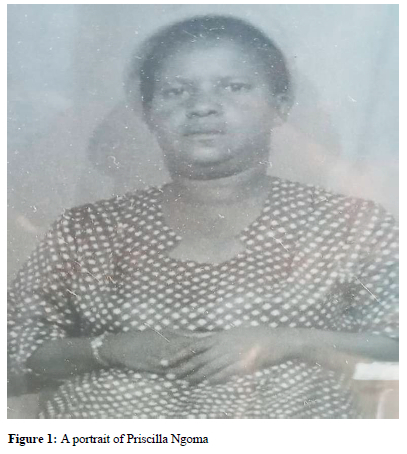
Figure 1 is a portrait of Priscilla Ngoma extracted from a newspaper in the National Archives of Zimbabwe.
Historicising Priscilla Ngoma's Contribution to ZAOGA
The article emphasises Priscilla Ngoma, also known as Mai Ngoma, as a central figure in the growth and spread of ZAOGA. Mai Ngoma' s contribution to ZAOGA was documented through interviews and the consultation of newspapers in the National Archives of Zimbabwe. Born in 1928 and deceased in 1998, Ngoma's legacy endures among her peers. Her significant contributions to ZAOGA' s inception and growth include:
• being instrumental in establishing the prayer band, which focused on interceding for Ezekiel Guti;
• acting as the church matriarch (Mai veChechi) for over 15 years;
• becoming the first treasurer of the church; and
• being pivotal in promoting entrepreneurship within the church.
The Formation of a Prayer Group to Support Evangelist Ezekiel Guti
In 1957, a prayer group was established to support Evangelist Guti. The group was established to pray for Guti's ministry while he was still a member of the AFM. The group continued to be Guti' s spiritual support even after his (first) wife left him due to her disapproval of his extensive preaching schedules. Thus, his commitment to the ministry led to the end of his 11-year marriage. Undocumented sources point to the fact that this prayer group was formed by Ngoma. Thus, the group, consisted of Priscilla Ngoma as its leader, Abel Sande, Joseph Choto, Raphael Kupara and others. Eventually, Guti learnt of the group's prayers for him and invited them to his house number 593 for prayer sessions (Personal interview, 23 March 2024). Guti often joined the group' s prayers, providing guidance on prayer subjects. From that point forward, praying for Guti became a consistent prayer topic within the church for the duration of his ministry.
The article posits that Ngoma's establishment of a prayer group marked her as a pivotal figure in the emergence and evolution of ZAOGA theology. Since its inception, ZAOGA has formed prayer groups dedicated to interceding for the church and its leadership. These prayer meetings have significantly influenced the church's theology and spirituality. It was observed that during Guti's pilgrimage to Bindura, Mai Ngoma and her team renamed their prayer group the Ezekiel Guti Evangelistic Association (EGEA) (Personal interview, 20 August 2024). The EGEA has become a widely recognised name in print media and electronic broadcasting, including on Ezekiel TV. Additionally, all emerging ZAOGA evangelists are adopting the EGEA designation to signify their affiliation with ZAOGA.
Priscilla Ngoma - the Mother of AOGA - Mai veChechi (Church Matriarch)
In 1960, following the formation of the church, there was a need for someone to manage women' s affairs in the church. Against this backdrop, Mai Ngoma took on the role of Mai veChechi (church matriarch). She served in this capacity for over 15 years. Even after Guti' s marriage to Eunor Sithole in 1972, Ngoma continued as Mai veChechi. The title Mai veChechi is akin to the "Director of Women" today. The Director of Women's responsibilities included organising women's prayer meetings; overseeing all women's events; providing leadership and guidance to the women's ministry; and ensuring that the ministry aligned with the church's vision and values. During her tenure, Mai veChechi travelled to each and every province to conduct training sessions and workshops, equipping women with practical skills, spiritual knowledge, and tools for personal growth (Personal interview, 10 April 2024). As Mai veChechi, Ngoma provided spiritual care to women, addressing their spiritual, emotional and practical needs through counselling, prayer and support during challenging times. Mai veChechi managed the women's Thursday meetings (China cheMadzimai) and supervised all church projects. She encouraged women's participation in community outreach and evangelism, until 1989 when Eunor Guti took over the office of Mai veChechi. It was during Eunor Guti's leadership that the ministry of women in the church was renamed "Go Quickly and Tell" (Guti 2014, 120).
The Church Treasurer
Early on in the ministry, the church lacked a back account into which to deposit church funds. In this capacity, Ngoma oversaw the church's financial affairs. Working with Rev. Choto, the first Secretary General, Ngoma, the church treasurer, would provide finances for Guti' s preaching schedule. She would make sure that money was available for every trip that was planned via the office of the Secretary General. Church funds had to be kept and disbursed by Ngoma. In her capacity as the church treasurer, she also oversaw Guti's upkeep.
The Historical Background of the AOGA
In chronicling Ngoma' s contributions, some accounts suggest that Mai Ngoma, along with her peers, established the Assemblies of God Africa (AOGA) and transformed the prayer band group to the EGEA, a ministry for Vaparidzi (preachers), featuring Mai Ngoma, Abel Sande, Joseph Choto, and Raphael Kupara as the preachers (Personal interview, 10 April 2024). Those who joined the prayer group became AOGA church members. According to this narrative, following the rebranding of the EGEA to signify preachers and the establishment of a church named AOGA, a letter was sent to Guti in Bindura, inviting him to lead the newly formed church. However, Katsvere (2014) contests this narrative, arguing that it is more credible to follow the tradition that Guti founded the church in Bindura, naming it the AOGA. Katsvere (2014) finds this account more convincing, particularly given that during that era, initiating a church in politically volatile areas like Highfields or Mbare, which were gearing up for the second Chimurenga (Zimbabwe's 1970s armed liberation struggle), was not feasible. Conversely, Bindura was considered "peaceful" and "remote", devoid of intense political climates, thus permitting the church's establishment (Katsvere 2014).
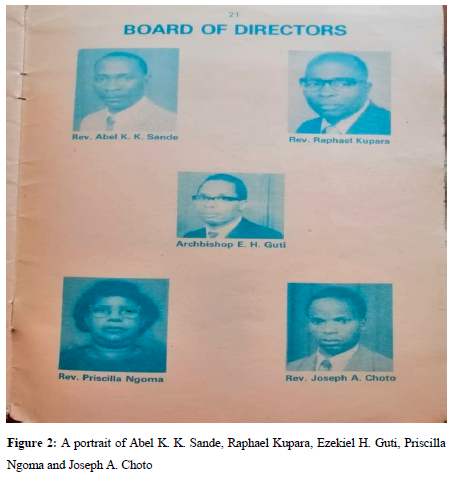
While differing perspectives exist between the two traditions, it is acknowledged that Mai Ngoma was the inaugural Chairperson of the prayer band group, which later became known as the EGEA. Katsvere (2014) agrees with the tradition that this group significantly contributed to the expansion and proliferation of the AOGA rather than its founding, attributed solely to Guti. In appreciation for the support of the prayer band group, Guti appointed the four principal members - Priscilla Ngoma, Abel K. K. Sande, Raphael Kupara, and Joseph Choto - as the co-directors, with himself serving as the chairperson, as illustrated in the 1977 portrait retrieved from a newspaper in the National Archives of Zimbabwe (see Figure 2).
Subsequently, the other three co-directors departed from the movement to establish their own ministries, while Ngoma stayed faithful to Guti. The study did not focus on uncovering the reasons for the three co-directors' departure and the founding of their independent ministries.
The Development of ZAOGA and the Significance of House Number 240
Upon establishing the Bindura branch, Guti sought to revitalise the original Highfields branch by tapping into the existing membership. The main obstacle for Guti and his followers was securing a suitable place for gatherings. Initially, the church convened at house numbers 240 and 593 (Guti 2014, 36), which were private homes, but as the number of attendees swelled, the venues became inadequate, leading to a shift to Tsungai Primary School and Nyandoro School (Guti 2014). In the colonial period of Rhodesia, acquiring land to construct a church was difficult, as only missionary-established churches were granted land for worship facilities. ZAOGA's history clearly indicates that house number 593 was Guti's home, but church history is silent about the occupants of house number 240. However, through interviews, the researcher gathered that house number 240 belonged to Ngoma. The interviews revealed that the same miracles that God worked during church services at house number 593 were also seen by the congregation that gathered at Ngoma's place. It can, therefore, be argued that a mere mention of house number 240 in the history of ZAOGA without acknowledging its owner, and the un recording of miracles that took place during worship at this place, was an intentional oversight that minimised women's roles in the movement's inception and growth.
Ngoma was considered to be a resourceful individual because, during the early days of the ministry in Zimbabwe, only Guti's and Ngoma's residences were used as places of worship. Ngoma was renowned for her steadfast faith and dedication to the growth of the Zimbabwean church. In the colonial era, when black congregations faced prohibitions, Ngoma, alongside her husband Mikitai Ngoma, courageously hosted services in their home. Her dedication led to her becoming the first ZAOGA woman ordained pastor. Subsequently, in 1967, the church secured a site in Highfield, which was later developed through the work of Matarenda.
Priscilla Ngoma and the History of the ZAOGA School of Talents
The concept of talents (Matarenda), as reported, originated from a vision that Guti (2014) received in the United States (US). However, Maxwell (2006, 215) contends that the origin of talents can be traced back to Guti's mother, Dorcas, whose hard work and creativity supported her family. Therefore, Maxwell (2006) believed that Guti's upbringing supported his American vision of working with one's hands. Talents is a programme offered to the believers of ZAOGA-FIF, teaching them to use their skills in order to become entrepreneurs and self-reliant (Guti 2015). The programme includes training on conducting market research to determine which products or commodities to sell; identifying the target customer base; and setting buying and selling prices (Guti 2015, 6).
Consequently, the practice of talents has profoundly influenced AOGA, now known as ZAOGA-FIF, in its theology and spirituality. Members are taught to eschew borrowing or purchasing properties on credit; instead, they are encouraged to use their talents to generate funds for such acquisitions (Musoni 2021b). Furthermore, ZAOGA adherents are instructed to reject the notion of "miracle money" and to progressively build their financial stability through their own efforts (Musoni 2021b, 175). During his studies in the US, Guti contended that a businessman offered to sponsor his church on the condition that Guti would work under him (Guti 2014). After seeking divine guidance, Guti reports that God promised, "If you humble yourself and obey me, I will be your money." (Guti 2024, 49). God then directed him to return to Africa to spread His word and to instruct people on giving and utilising their hands/talents (Guti 2014).
Biri (2014) states that Guti returned with a divine assurance that God would bless those offering their tithes and talents. Recognising that women constituted the majority in many African churches, Guti sought a female leader for the initiative. Most women were homemakers then, while men were the sole earners.
I said to a certain woman named Priscilla Ngoma, come, I want to teach you so that you may go and teach other women ... I laid hands upon her in the name of Jesus and said, Go and teach all the women about talents; they will obey you. (Guti 2014, 49).
Ngoma, formerly recognised as Mai veChechi, emerged as a figurehead for the eventual ZAOGA School of Entrepreneurship. As Eunor Guti was solidifying her position as Guti' s spouse, Ngoma maintained her role as the Director of Women, leading Matarenda initiatives with the close support of Eunor Guti, who later assumed the title of Mai veChechi in 1989 after many years of working closely with Ngoma. ZAOGA acquired properties, aiding those once impoverished through the school of talents. To this day, ZAOGA has erected numerous worship centres in Zimbabwe and internationally. The organisation has also purchased and constructed mission houses for full-time pastors worldwide, among other successful initiatives driven by talents. The legacy of Ngoma's work remains evident and continues to thrive within ZAOGA-FIF globally. Such was her charismatic influence that a song was created to celebrate her commitment to educating women in business. On significant days of talent, this song would resonate through the congregation:
Mai Ngoma vauya here vaone mujawo we madhora($)
(Is Mai Ngoma here to see the competition in giving) x2
Oooh, watanga mujawo uya, Watanga mujawo we madhora($)
(The competition has just started, the competition in giving) x2
Critics have observed that many African Indigenous/Pentecostal Church leaders only involve women to achieve specific goals and then exclude them from recognition for their contributions (Kasomo 2010). In support of this observation, Biri (2018, 79), argues that Ngoma, an early member of the movement, initiated the school of talents, yet, her role is minimally mentioned in ZAOGA's literature. Furthermore, one participant argued that acknowledging the women of ZAOGA without specifically mentioning Ngoma on page 5 in the acknowledgments section of the ZAOGA talent book, authored by Guti in 2015, was an intentional act to minimise Ngoma's contributions to the church' s school of entrepreneurship. A relative of Ngoma has expressed concerns that the historical records of ZAOGA referring to her merely as "a certain woman named Priscilla Ngoma" belittle her significant contributions to the emergence and development of the Zimbabwean Pentecostal Church. According to this family member, Ngoma's role was only second to Guti's in the church's hierarchy. It should not be minimised to "a certain woman named Priscilla Ngoma". Information from the participants confirmed that Ngoma was highly esteemed and instrumental in shaping ZAOGA's theology. The article suggests that Ngoma's efforts, along with those of other women, have been underrepresented, a situation attributed to a patriarchal society that often sees women only as beneficiaries rather than contributors (Manyonganise 2024).
Patriarchal Ideology in the Church: Shaping the Trivialisation of Priscilla Ngoma's Contributions to the Church
It is significant to acknowledge that, according to prior studies conducted by some theologians, African Pentecostal Churches appear to differ from other African Indigenous Churches (AICs) by integrating women into their leadership hierarchy. Mapuranga (2018) notes that Pentecostalism has introduced a new dynamic where women are recognised as leaders within the church. In contrast to missionaries' and AICs pastors' wives, who are not ordained as church leaders, Pentecostal pastors' wives receive the same opportunities as their husbands in ministry Mapuranga (2018, 11). This was corroborated by the testimony of many participants in the study. They indicated that in ZAOGA, the wife of a church elder is also considered an elder, and the wife of a pastor is likewise a pastor, implying that being the spouse of a church leader automatically confers a leadership role, complementing the husband's position (Personal interview, 11 July 2024).
This trend is evident in numerous church conference advertisements and posters/flyers, where women are featured alongside their husbands. In cases where the men are prophets, their wives are referred to as prophetesses, and if the husband is a Bishop, the wife holds the title of a Bishop or other leadership roles (Mapuranga 2018). Notable figures in Zimbabwe's Pentecostal ministry that exemplify this pattern of joint women's leadership with their husbands include:
• Prophet Emmanuel Makandiwa and Prophetess Ruth Makandiwa of United Family International Ministries;
• Prophet Uebert Angel and Prophetess Beverly Angel of Spirit Embassy Ministries;
• Apostle Langton Kanyati and Apostle Florence Kanyati of Grace Unlimited Ministries; and
• Archbishop Ezekiel Guti and Archbishop Eunor Guti.
The examples provided, albeit limited, effectively highlight that women enjoy equal opportunities as men in leadership positions within African Pentecostalism. This is demonstrated by the widespread practice among Pentecostal preachers, pastors and prophets of bestowing their titles upon their wives, as noted by Mapuranga (2018). Further, Mapuranga (2018, 139) contends that this signifies a significant progression in the recognition of women in ministry, surpassing that of traditional churches and other AICs. It is argued that Pentecostalism in Zimbabwe heralds a new era where women serve as leaders, functioning in the same administrative and spiritual roles as men, a departure from the background roles they held in many missionary churches. Mapuranga (2018, 142) also asserts that, in some instances, pastors' wives in Zimbabwean Pentecostalism have received significant opportunities to lead, rather than being seen simply as adjuncts to their husbands (Mapuranga 2018, 149). Notably, as the article has already pointed out, Ngoma was a pastor and a preacher, while her husband was merely an elder in the church. Her ordination was not due to her husband's position.
However, while this seems to be the new picture, the article asserts that women in Zimbabwean Pentecostalism remain subjected to patriarchal dominance. This dominance stems from the patriarchal nature of Zimbabwean traditional culture. Holding titles such as Pastor, Bishop or Apostle does not necessarily imply equality with men. Interviews conducted for the study have shown that these titles often lose their significance for women when their pastor husbands pass away. Only a few women, typically those related to church founders, continued to function under these titles after their husbands' demise.
Musvota (2021, 5) contends that while the original aim of Pentecostalism in the US was to overcome discrimination, its establishment in Zimbabwe was complicated by traditional culture. Within this culture, women held marginal roles in the church and society at large, rendering them undervalued, subservient and voiceless (Nadar 2009, 354). Durham (2016, cited in Musvota 2021, 5) points out that despite being the financial, spiritual and social pillars of Pentecostal Churches, women's contributions have been overlooked in the church's most significant decisions. Ngoma serves as a notable example. According to the researcher's sources, she was a major financial supporter of Guti in the initial phase of his ministry. Ngoma could provide this support as she and her husband operated a grocery store in Machipisa. Her entrepreneurial skills may have led Guti to select her as the sole individual qualified to educate other women how to use their hands for sustenance (Matarenda). Regrettably, her significant contributions to the expansion and evolution of this African Pentecostal Church are scarcely recorded.
Pentecostal Hermeneutics and Women's Marginalisation
The Pentecostal movement is characterised by ambivalence, tension and paradox (Gabaitse 2015). While worship and practice may appear to be democratic, research shows a status disparity between men and women, with the movement endorsing male dominance and women's subordination (Gabaitse 2015). The article argues that Zimbabwean Pentecostal Churches are not only patriarchal but also resistant to gender transformation. Joseph Guti (2017), who conducted research on women in Pentecostal Churches in Harare, asserts that the theology common in many Zimbabwean Pentecostal Churches sustains gender injustice and inequality by upholding male dominance.
Gabaitse (2015, 3) has noted that the leadership model in Pentecostal Churches is characterised as authoritarian and hierarchical, thereby endorsing male dominance and establishing hierarchical relationships with women and children at the lower end. These hierarchical dynamics are not only prevalent within the church but also promoted within the family structure. Thus, the article points out that the marginalisation of women occurs through the use and interpretation of certain biblical passages that seem to support male dominance and the subjugation of women to men (Gabaitse 2015, 4). Traits of female domesticity and subordination, which are fundamental aspects of patriarchy, are upheld and portrayed as biblical and divine by citing passages like Ephesians 5:22-6:4, which, without critical analysis, might appear to endorse patriarchal beliefs - such as the directive for wives to submit to their husbands as unto the Lord (NIV) (Maunganidze 2020). The article further contends that the promotion of female submission via texts like Ephesians 5:22 by Zimbabwean Pentecostal Churches does not challenge patriarchal privileges; instead, it enacts, perpetuates and sustains them (Mapuranga 2015).
Guti advocated for a theology that appeared to endorse the notion that "men must lead", which seems to perpetuate gender inequality. Thus, all pastors' wives undergo pastoral training to assist their husbands in ministry better. This suggests that the Zimbabwean Pentecostal Churches, like other Christian organisations, have not successfully challenged this ugly phenomenon that reinforces male dominance, preventing true equality between men and women.
Conclusion
The article reports on a study that sought to provide evidence of Priscilla Ngoma's unsaid contributions to the formation and growth of ZAOGA. As stated earlier, Ngoma played a significant role in: (1) founding the prayer band, which specialised in praying for Ezekiel Guti; (2) serving as the church matriarch (Mai veChechi) for more than 15 years; (3) serving as the church's first treasurer; and (4) leading the way in innovative church entrepreneurship. Nonetheless, it has been observed that the church's history hardly acknowledges her achievements. Ngoma's efforts are poorly recorded, with her name seldom being mentioned. The article has highlighted that this scant mentioning of Ngoma within the Zimbabwean Pentecostal Church has propagated a theology that does not promote gender equality. Women who are appointed to high positions seem to be merely ceremonial, lacking the authority to make decisions for the church. Thus, the study has concluded that the contributions of female leaders are overlooked and rarely acknowledged because of the predominance of patriarchal narrative and the literal interpretation of the Bible in the majority of Zimbabwean Pentecostal congregations.
References
Berger, P. L., and T. Luckmann. 1967. The Social Construction of Reality. Toronto: Penguin Press. [ Links ]
Biri, K. 2014. "Migration, Transnationalism and the Shaping of Zimbabwean Pentecostal Spirituality." African Diaspora 7 (2): 139-164. https://doi.org/10.1163/18725465-00701007 [ Links ]
Biri, K. 2018. "Health and Wealth in Zimbabwean Pentecostalism: The Case of the Zimbabwe Assemblies of God Africa (ZAOGA)." In Aspects of Pentecostal Christianity in Zimbabwe, edited by L. Togarasei, 12-34. New York: Springer. https://doi.org/10.1007/978-3-319-78565-3_6 [ Links ]
Chingarande, S., ed. 2021. Matarenda/Talents in Zimbabwean Pentecostalism: Empowerment, Gender and Development in an African Movement. The Netherlands: Brill. https://doi.org/10.1163/9789004446670 [ Links ]
Claassens, J. 2012. "Teaching Gender at Stellenbosch University." In Men in the Pulpit, Women in the Pew?, edited by H. J. Hendriks, E. Mouton, L. Hansen and E. le Roux, 131-146. Stellenbosch: SUN Press. [ Links ]
Dube, N., T. S. Nkomo, and P. Khosa. 2017. "Condom Usage Negotiation among Customarily Married Women in Katlehong, Johannesburg." Sage Open 7 (1). https://doi.org/10.1177/2158244016687345 [ Links ]
Durham, L. 2016. "The Debate over Female Leadership in Ministry." Accessed October 12, 2024. https://www.researchgate.net/publication/312167004 [ Links ]
Erwin, D. G. 1985. African Apostle: The Life of Ezekiel Guti. Toronto: Abe Books. [ Links ]
Gabaitse, R. M. 2015. "Pentecostal Hermeneutics and the Marginalisation of Women." Scriptura 114 (1): 1-12. https://doi.org/10.7833/114-0-1043 [ Links ]
Guti, E. 2014. History of ZAOGA Forward in Faith: The Book of Remembrance - How It Began and Where It Is Going. 5th ed. Harare: EGEA. [ Links ]
Guti, E. 2015. Talents/Matarenda: Go and Teach Them to Use Their Hands. Harare: EGEA. [ Links ]
Guti, J. 2017. "Pentecostalism and Exclusion of Women in Positions of Leadership: A Case of Pentecostal Churches in Harare, Zimbabwe." Master's thesis, University of Fort Hare. https://core.ac.uk/download/226773476.pdf [ Links ]
Kasomo, D. 2010. "The Role of Women in the Church in Africa." International Journal of Social Anthropology 2 (6): 126-139. http://www.academicjournals.org/ijs [ Links ]
Katsvere, T. 2014. "An Examination of the Zimbabwe Assemblies of God Africa Forward in Faith Church's Outreach Programs: A Case of Schools Projects and the Prison Ministry, 1974- 2014." Honour's thesis, University of Zimbabwe. [ Links ]
Manyonganise, M. 2024. "'When Faith Is Not Enough': Encounters between African Indigenous Religious Practices and Prophetic Pentecostal Movements in Zimbabwe." Religions 15 (1): 12. https://doi.org/10.3390/rel15010115 [ Links ]
Mapuranga, T. P. 2015. "Bargaining with Patriarchy? Women Pentecostal Leaders in Zimbabwe." Fieldwork in Religion 8 (1): 74-91. https://doi.org/10.1558/firn.v8i1.74 [ Links ]
Mapuranga, T. P. 2018. "Pastors, Preachers and Wives: A Critical Reflection on the Role of Pentecostalism in Women Empowerment in Zimbabwe." In Aspects of Pentecostal Christianity in Zimbabwe, edited by L. Togarasei, 139-150. Cham: Springer. https://doi.org/10.1007/978-3-319-78565-3_10 [ Links ]
Maunganidze, F. 2020. "Dealing with Gender-Related Challenges: A Perspective of Zimbabwean Women in the Practice of Law." Cogent Business and Management 7 (1). https://doi.org/10.1080/23311975.2020.1769806 [ Links ]
Maxwell, D. 2006. African Gifts of the Spirit: Pentecostalism and the Rise of a Zimbabwean Transnational Religious Movement. Ohio: Ohio University Press. [ Links ]
Meet, I., and L. Narayan. 2017. "Gender Norms and Gender Identity: Review of Alternative Perspectives." International Journal of English Research 3 (3): 85-88. [ Links ]
Musoni, P. 2021a. "Entrepreneurship, a University-Wide Course at Zimbabwe Ezekiel Guti University." In Matarenda/Talents in Zimbabwean Pentecostalism: Empowerment, Gender and Development in an African Movement, edited by S. D. Chingarande, J. Thondhlana, R. Madziva and A. H. Anderson, 198-209. The Netherlands: Brill. https://doi.org/10.1163/9789004446670_012 [ Links ]
Musoni, P. 2021b. "Older and Newer Zimbabwean Pentecostal Churches' Focus on the Prosperity Gospel: A Comparative Analysis." In Innovation and Competition in Zimbabwean Pentecostalism: Megachurches and the Marketization of Religion, edited by E. Chitando, 175-190. London: Bloomsbury. https://doi.org/10.5040/9781350176027.ch-012 [ Links ]
Musoni, P. 2024. "Burial Sites as Contested Memorial Terrain: Historicising Burial Places of African Indigenous Church Founders in Zimbabwe." Studia Historiae Ecclesiasticae 50 (1): 1-14. https://doi.org/10.25159/2412-4265/14410 [ Links ]
Musvota, C. 2021. "Rethinking Methods to Curb Gender Discrimination in Church Leadership: The Case of Pentecostal Churches in Zimbabwe." Studia Historiae Ecclesiasticae 47 (2): 1-16. https://doi.org/10.25159/2412-4265/8156 [ Links ]
Nadar, S. 2009. "On Being the Pentecostal Church: Pentecostal Women's Voices and Visions." Ecumenical Review 56 (3): 354-367. https://doi.org/10.1111/j.1758-6623.2004.tb00521.x [ Links ]
