



Services on Demand
Journal

Article
 English (pdf)
 Article in xml format
 Article references
 Automatic translation
 Send this article by e-mail
Indicators
Related links
-
 Cited by Google
 -
 Similars in Google
Share

 Permalink
Journal of the South African Veterinary Association
On-line version ISSN 2224-9435Print version ISSN 1019-9128
J. S. Afr. Vet. Assoc. vol.96 n.1 Pretoria 2025
https://doi.org/10.36303/JSAVA.683
SHORT COMMUNICATION
Quantification of Angora goat beta chain haemoglobin variants using the Sebia Capillarys 2 Flex-Piercing system
SDC ParsonsI, II; A VermeulenI; M HobsonIII; EH HooijbergIV
ISouth African Medical Research Council Centre for Tuberculosis Research, Division of Molecular Biology and Human Genetics, Faculty of Medicine and Health Sciences, Stellenbosch University, South Africa
IIDepartment of Anatomy and Physiology, Faculty of Veterinary Science, University of Pretoria, South Africa
IIIMohair SA, Camdeboo Veterinary Clinic, South Africa
IVDepartment of Companion Animal Clinical Studies, Faculty of Veterinary Science, University of Pretoria, South Africa
ABSTRACT
This study aimed to evaluate the utility of the Sebia Capillarys 2 Flex-Piercing (C2FP) system for the quantification of the major caprine beta chain haemoglobin (Hb) variants, i.e. foetal Hb, neonatal Hb, and adult Hb. Blood samples were collected from six Angora kids at one, 11, and 20 weeks after birth, and analysed using the C2FP instrument and Capillarys Hemoglobin(E) kit. Electropherograms displayed three major peaks which showed consistent changes in relative magnitude as kids aged. At one week old, a peak at position ~75 was identified as foetal Hb, while in older animals, peaks at ~150 and ~170 were identified as neonatal Hb and adult Hb, respectively. In conclusion, this study has confirmed the utility of the Sebia C2FP system for the simple, rapid, and standardised quantification of the major beta chain Hb variants of Angora goats.
Keywords: capillary electrophoresis, haemoglobin switching, neonatal.
Adult Angora goats display a remarkable red cell poikilocytosis, with individual animals exhibiting the phenomenon to a lesser or greater degree (Jain et al. 1980; Parsons et al. 2023). The condition has been likened to "sickling" of red cells of humans and deer, which is associated with specific beta chain haemoglobin (Hb) variants (Jain et al. 1980). Notably, Angora goats are born with rounded red cells, and poikilocytosis becomes progressively more pronounced during the first five months after birth (Parsons et al. 2023), a period during which, in goats, Hb expression switches sequentially and predictably between non-allelic beta chain variants, i.e. from foetal Hb, to neonatal Hb, and then adult isoforms (Huisman et al. 1969). In adult goats, experimental anaemia is associated with both the resolution of poikilocytosis and the upregulation of neonatal Hb expression, and a causal link between these phenomena has been postulated but not confirmed (Huisman et al. 1967; Jain et al. 1980).
A limitation to the further investigation of this hypothesis is the lack of standardised or validated indirect chromatographic or electrophoretic assays for the quantification of caprine Hb variants. Few published studies have confirmed the validity of these methods when compared to definitive Hb protein analysis, and noteworthy amongst these are studies that were undertaken in the 1960s using DEAE-Sephadex chromatography, which showed that the mobility of foetal Hb was distinct from that of the more similar neonatal and adult variants (Huisman et al. 1967; Huisman et al. 1969). Capillary electrophoresis (CE) has recently become widely used for routine identification of human Hbs (Riou et al. 2018) and this study aimed to investigate the utility of a commercial automated human Hb CE system, the Capillarys Hemoglobin(E) kit used with the Capillarys 2 Flex-Piercing (C2FP) instrument (Sebia, Lisses, France), for the quantification of the major non-allelic caprine beta chain Hb variants.
Six Angora goat kids were sampled at one, 11, and 20 weeks after birth (Parsons et al. 2023). On each occasion, 4 ml blood was collected into Vacutainer tubes containing dipotassium ethylenediaminetetraacetic acid (BD, Franklin Lakes, NJ, USA). Whole blood samples collected from kids in the first week after birth were stored at -80 °C before further processing, while all subsequent samples were kept at 4 °C and analysed within four days of collection (Ihedioha & Onwubuche 2007; Sebia 2013). Capillary electrophoresis was done at a commercial diagnostic laboratory using the Capillarys Hemoglobin(E) kit and a C2FP instrument and the relative quantification of individual haemoglobin fractions was performed automatically (Sebia 2013). Electropherograms generated by this instrument include an arbitrary scale on the x-axis, from 0 to 300, that represents the relative migration of Hb variants, and reference to this scale to identify human Hb variants is highly reproducible (Riou et al. 2018). Migration characteristics of individual Hbs were described with reference to this scale, and for the group of six kids, the relative abundance of each Hb variant at each time point was summarised using descriptive statistics.
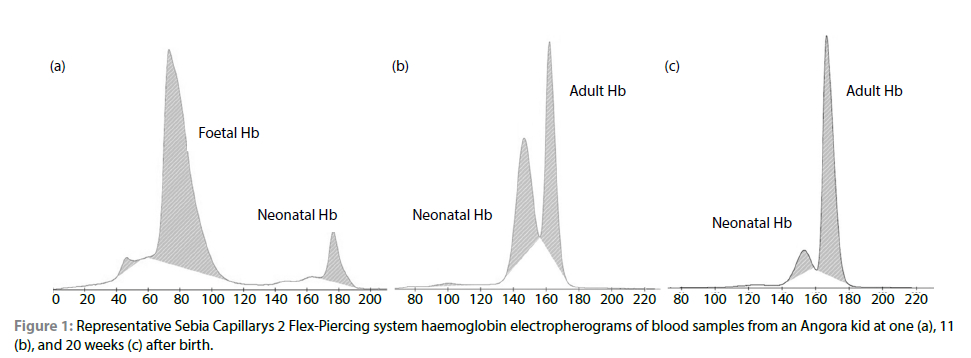
In the first week after birth, electropherograms displayed a major slowly migrating Hb fraction at position ~75 on the x-axis (Figure 1a). This fraction had a median relative abundance of 87% (8594%), was absent from electropherograms of the same animals at 11 and 20 weeks after birth and was identified as foetal Hb. Individual electropherograms displayed either one or two poorly defined minor peaks at positions ~35 and ~45 (e.g. Figure 1a). These may represent artifacts of freezing and thawing, as degraded Hb migrates more slowly than the parent molecule (Sebia 2013) and blood samples stored at -20 °C displayed an additional minor anodic fraction that was not present in freshly analysed samples (data not shown). A second major peak at position ~170 had a median relative abundance of 8% (4-12%) and was identified as neonatal Hb (Figure 1a).
At 11 and 20 weeks old, kids displayed two major peaks at positions ~150 and ~170 (Figures 1b and 1c). The more slowly migrating fraction decreased in relative abundance over time from a median of 36% at week 11 (17 to 45%) to 4% at week 20 (2-17%) and was identified as neonatal Hb. The faster fraction increased in relative abundance over this time from a median of 63% (54-83%) to 96% (83-98%) and was identified as adult Hb. The shift in the position of neonatal Hb from ~170 at one week old to ~150 at 20 weeks is not unexpected, as these values do not represent the absolute migration characteristics of neonatal Hb, but reflect the relative separation of this variant from the foetal and adult Hbs, respectively (Sebia 2013; Riou et al. 2018). Notably, the greater sequence similarity of the neonatal and adult Hbs is reflected in their more similar migration characteristics when compared to foetal Hb, as has been previously shown (Huisman et al. 1969).
A limitation of our study is that the analytical method used here has not been validated for Angora goats and that estimates of analytical imprecision and the effect of interferences are not known. A further limitation is that we have not validated the identity of the CE peaks by comparative analysis with a definitive assay, such as mass spectrometry. However, our analysis of biologically relevant blood samples confirms the utility of the C2FP system to distinguish between the major caprine beta chain Hb variants. The system allows for simple, rapid, and standardised analysis of whole blood samples and will aid in the further investigation of red cell poikilocytosis of Angora goats.
Acknowledgements
We thank Mr Francois Theron for kindly providing the study animals and Ms Melanie Stewart of Pathcare Haematology Laboratory, Goodwood, Cape Town, for performing the Hb electrophoresis. Financial support for this research was provided by the South African Medical Research Council (SAMRC) Centre for Tuberculosis Research, the Harry Crossley Foundation, and the South African National Research Foundation (Grant No. CSUR23042597354).
Conflict of interest
The authors declare no conflict of interest.
Ethical approval
Ethical approval for the study was obtained from the Stellenbosch University Animal Care and Use Committee (protocol ACU-2019-10760) and the Animal Ethics Committee of the University of Pretoria (REC 070-20).
ORCID
SDC Parsons https://orcid.org/0000-0002-9033-9686
EH Hooiiberg https://orcid.org/0000-0002-4367-799X
References
Huisman, T.H., Adams, H.R., Dimmock, M.O., et al., 1967, The structure of goat hemoglobins. I. Structural studies of the beta chains of the hemoglobins of normal and anemic goats, The Journal of Biological Chemistry 242(10), 2534-2541. https://doi.org/10.1016/S0021-9258(18)95996-X. [ Links ]
Huisman, T.H., Lewis, J.P., Blunt, M.H., et al., 1969, Hemoglobin C in newborn sheep and goats: a possible explanation for its function and biosynthesis, Pediatric Research 3(3), 189-198. https://doi.org/10.1203/00006450-196905000-00001. [ Links ]
Ihedioha, J.I., Onwubuche, R.C., 2007, Artifactual changes in PCV, hemoglobin concentration, and cell counts in bovine, caprine, and porcine blood stored at room and refrigerator temperatures, Veterinary Clinical Pathology 36(1), 60-63. https://doi.org/10.1111/j.1939-165X.2007.tb00183x [ Links ]
Jain, N.C., Kono, C.S., Myers, A., et al., 1980, Fusiform erythrocytes resembling sickle cells in angora goats: observations on osmotic and mechanical fragilities and reversal of cell shape during anaemia, Research in Veterinary Science 28(1), 25-35. https://doi.org/10.1016/S0034-5288(18)32767-X. [ Links ]
Parsons, S.D.C., Becks, D., Vermeulen, A., et al., 2023, Poikilocytosis of Angora goats is associated with erythrocyte density and reticulocytosis, Journal of the South African Veterinary Association 94(1), 42-53. https://doi.org/10.36303/JSAVA.547 [ Links ]
Riou, J., Szuberski, J., Godart, C., et al., 2018, Precision of CAPILLARYS 2 for the detection of hemoglobin variants based on their migration positions, American Journal of Clinical Pathology 149(2), 172-180. https://doi.org/10.1093/ajcp/aqx148. [ Links ]
Sebia, 2013, Capillarys Hemoglobin(E) using the Capillarys 2 flex-piercing instrument. Retrieved from: https://www.ilexmedical.com/files/Sebia%20inserts/CAPILLARYS_HEMOGLOBIN(E).pdf. [ Links ]
 Correspondence:
emma.hooijberg@up.ac.za