



Services on Demand
Journal

Article
 English (pdf)
 Article in xml format
 Article references
 Automatic translation
 Send this article by e-mail
Indicators
Related links
-
 Cited by Google
 -
 Similars in Google
Share

 Permalink
Acta Commercii
On-line version ISSN 1684-1999Print version ISSN 2413-1903
Acta Commer. vol.25 n.1 Johannesburg 2025
https://doi.org/10.4102/ac.v25i1.1405
ORIGINAL RESEARCH
Exploring the need for formal coaching programmes: Experiences of engineering graduates in a South African mining company
Hanifa Hoosen; Nelesh Dhanpat
Department of Industrial Psychology and People Management, College of Business and Economics, University of Johannesburg, Johannesburg, South Africa
ABSTRACT
ORIENTATION: Organisations face increasing pressure to support new graduates as they transition into professional roles. Formal coaching has emerged as a key strategy to bridge the gap between academic training and workplace demands, particularly in technical industries like mining.
RESEARCH PURPOSE: This study examines the role of coaching in assisting engineering graduates in a South African mining company to develop technical, interpersonal and leadership skills. It assesses graduates' perceptions and experiences and provides recommendations for optimising coaching programmes.
MOTIVATION FOR THE STUDY: Graduate transitions are challenging because of gaps between theory and practice. Understanding coaching's impact can inform better support structures to enhance graduates' confidence, skills and career success.
RESEARCH DESIGN, APPROACH, AND METHOD: A qualitative approach was used, with semi-structured interviews conducted with 12 purposively selected engineering graduates. Thematic analysis identified key themes related to coaching experiences and professional development.
MAIN FINDINGS: Based on the study, formal coaching significantly enhances graduate engineers' professional development by integrating technical expertise with leadership skills, while informal support networks provide complementary guidance essential for workplace transition and long-term career development.
PRACTICAL/MANAGERIAL IMPLICATIONS: Tailored coaching programmes should incorporate practical exercises, peer learning and continuous feedback to align with industry needs and enhance young engineering talent development.
CONTRIBUTION/VALUE-ADD: This study provides insights into formal coaching's role in early career transitions and offers practical recommendations for effective graduate coaching interventions in the mining industry.
Keywords: graduate coaching; workplace transition; engineering development; mining industry; leadership skills.
Introduction
In the current coaching literature, several definitions exist for coaching and business coaching, supported by diverse theoretical frameworks and methodologies (see Cox, Bachkirova & Clutterbuck 2014; Bachkirova, Spence & Drake 2016; Grant 2003; Lane & Corrie 2009; Van Nieuwerburgh 2014). These definitions provide valuable insights into the practice and application of coaching, yet much of the focus has been on the organisational and client outcomes of coaching rather than on the specific needs of early-career professionals. Although research on coaching is expanding (Cox et al. 2014; Stelter 2014), limited studies examine its tailored application for graduate development in technical fields, particularly in the South African mining industry. Organisational coaching research often emphasises its role in leadership and performance enhancement (Odendaal & Le Roux 2016; Passmore 2011), yet little attention is given to the challenges engineering graduates face in transitioning to professional roles. This study addresses that gap by exploring engineering graduates' perceptions and experiences, identifying their developmental needs and assessing how coaching can support them. By focusing on graduate programmes within a South African mining company, it provides evidence-based insights for designing coaching interventions (Van Diggelen et al. 2021) that enhance technical skills, workplace integration and career satisfaction.
The purpose of this study is to explore the perceptions and experiences of engineering graduates in a South African mining company to assess the need for formal coaching programmes and provide recommendations for their design and implementation. The objectives of the study in support of the research purpose are as follows: (1) to explore the perceptions and experiences of engineering graduates regarding the impact of coaching on their personal and professional development, (2) to identify the challenges encountered by engineering graduates in adapting to the workplace, (3) to assess the existing informal support systems utilised by engineering graduates and (4) to evaluate the perceived need for formal coaching programmes among engineering graduates and to provide evidence-based recommendations for the design and implementation of tailored coaching interventions.
Literature review
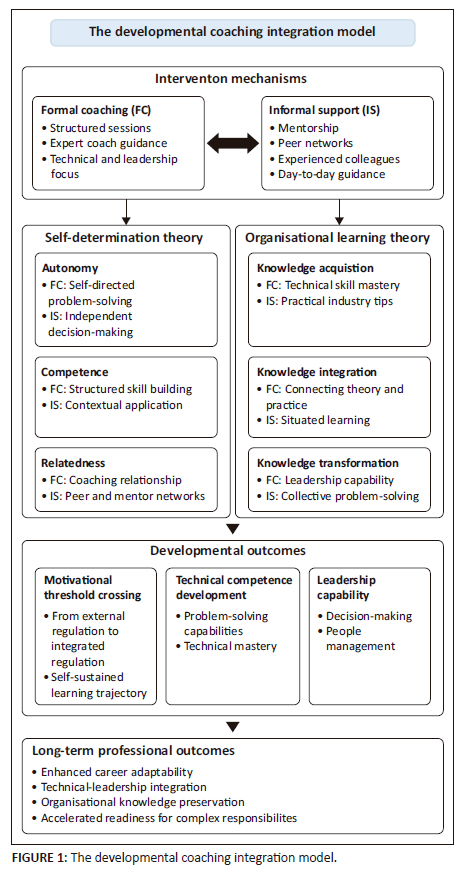
The study is underpinned by an integrated theoretical framework combining Self-Determination Theory (SDT) and Organisational Learning Theory to examine coaching needs of engineering graduates in the South African mining industry. SDT posits that intrinsic motivation and well-being rely on the fulfilment of three core psychological needs: autonomy, competence and relatedness (Ryan & Deci 2020). Coaching addresses these needs by fostering independent decision-making, enhancing skill development and nurturing meaningful professional relationships. For graduates, SDT highlights the importance of personalised coaching interventions that build confidence and support professional growth. Autonomy-supportive coaching environments, particularly for early-career professionals, are associated with higher levels of motivation and job satisfaction (Ryan & Deci 2005). Organisational learning theory focuses on how individuals and organisations acquire, share and apply knowledge to adapt to evolving environments (Garvin 1993). Coaching supports this process by facilitating knowledge transfer, encouraging collaboration, and aligning individual learning with organisational objectives (Lawrence et al. 2023). In industries such as mining, where rapid technological advancements and sustainability challenges require ongoing adaptation, coaching plays a vital role in equipping graduates with the skills necessary to succeed (Senge 2006). These theoretical frameworks are complementary and self-reinforcing when applied to coaching interventions. SDT's focus on intrinsic motivation creates the psychological foundation necessary for effective organisational learning to occur, while organisational learning processes provide structured mechanisms through which the autonomy, competence and relatedness needs identified by SDT can be systematically developed. The integration of these theories is particularly relevant for engineering graduates transitioning from academic to professional environments in technical fields like mining, where both psychological adaptation and knowledge acquisition are critical for success. This theoretical integration informs our proposed Developmental Coaching Integration Model (presented in Figure 1), which illustrates how formal coaching mechanisms and informal support structures work together to address both psychological needs (SDT) and knowledge development needs (Organisational Learning) of engineering graduates. This model provides a conceptual framework for understanding how coaching can be strategically designed to support graduate development in technical fields.
Coaching in organisational contexts
Coaching is widely used in organisations to enhance employee performance, leadership capabilities and alignment with organisational goals. The Worldwide Association of Business Coaches (WABC) defines coaching as a structured process aimed at improving client awareness and behaviour to achieve personal and business objectives (WABC 2017). It focuses on short-term, targeted interventions, distinguishing it from mentoring, which tends to involve long-term developmental relationships (Barner & Higgins 2007). In organisational settings, coaching addresses a wide range of issues, including leadership development, team dynamics and performance improvement. Research indicates that effective coaching improves workplace engagement and adaptability, leading to enhanced employee satisfaction and retention (De Haan et al. 2016; Passmore 2011). Cox et al. (2014) outline four core components of coaching, client, coach, relationship and context, which shape its effectiveness in organisational settings. These elements interact dynamically to influence outcomes.
Client
The coachee's goals, experiences and readiness for change are pivotal. Success depends on their commitment, openness to feedback and willingness to adopt new behaviours.
Coach
Effective coaches blend expertise, psychological insight and adaptability. Their approach varies by theoretical orientation and ability to tailor methods to individual needs.
Relationship
Trust, mutual respect and goal alignment define this partnership. Its quality is the strongest predictor of success, enabling a safe space for growth.
Context
Organisational culture, leadership support and resources either facilitate or constrain coaching outcomes, as coaching operates within broader systemic influences.
Graduate coaching
Graduate coaching specifically targets the needs of early-career professionals (Gama 2023), offering structured support to navigate the transition from academia to professional roles. It focuses on developing technical skills, interpersonal competencies and workplace adaptability. Studies have shown that coaching improves confidence (Kane, Yarker & Lewis 2021), enhances job performance (Ribeiro et al. 2021) and creates alignment between individual goals and organisational objectives (Blackman, Moscardo & Gray 2016; Fontes & Dello Russo 2019).
The South African mining industry presents unique challenges for graduate coaching because of its complex operational demands, socio-economic factors and emphasis on sustainability. Tailored coaching programmes in this industry address skills gaps, promote workplace integration and enhance retention rates. Research also suggests that coaching plays a significant role in building the resilience and adaptability required in dynamic industries (Hussey & Campbell-Meier 2021; Lawrence & Whyte 2017).
Coaching in the South African mining context
Engineering graduates entering the South African mining industry face significant challenges, including navigating diverse workplace cultures, meeting technical demands and balancing sustainability objectives. Formal coaching programmes provide targeted support to address these challenges, enhancing workplace integration, retention and performance. By aligning coaching interventions with both individual and organisational needs, mining companies can develop a more resilient and capable workforce (Coetzee & Engelbrecht 2019; Otu & Omeje 2021).
The literature demonstrates that formal coaching programmes are integral to employee development, offering structured support to improve technical, interpersonal and leadership skills. The integration of SDT and Organisational Learning frameworks highlights coaching's potential to bridge individual growth with organisational goals. In the South African mining industry, coaching is a developmental tool and a strategic necessity for building a skilled, adaptable and future-ready workforce.
Research methods and design
This study employs a qualitative, interpretive descriptive approach within an interpretivist paradigm, designed to explore the experiences of engineering graduates in a South African mining graduate programme. Qualitative research is particularly suited to understanding complex human behaviours and social phenomena, offering a naturalistic and in-depth examination of participants' lived experiences (Creswell & Creswell 2018). The methodology is explicitly exploratory and inductive, prioritising emergent insights from participant narratives rather than testing predefined hypotheses. By adopting this approach, the research captures the nuanced role of formal coaching in professional development based on participants' accounts.
Study population and sampling strategy
This study adopted a purposive sampling approach aligned with its interpretive qualitative research methodology. Twelve engineering graduates from a South African mining company were selected based on their ability to provide rich, context-specific insights into coaching experiences within the graduate development programme. This sampling strategy facilitated the exploration of diverse perspectives while maintaining focus on the central phenomenon under investigation (Patton & Cochran 2002; Saunders, Lewis & Thornhill 2003).
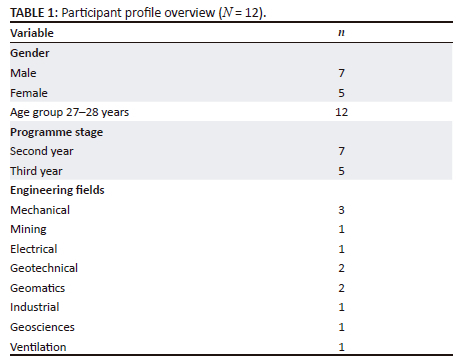
As shown in Table 1, the study comprised 12 participants with a balanced gender split and ages ranging from 24-28 years. Most participants (n = 7) were second-year students, with five students in their third year. The sample represented diverse engineering disciplines, providing broad coverage across the engineering field.
The diversity in gender representation and engineering disciplines was particularly relevant to this study as it allowed for exploration of how these attributes might shape coaching and perceptions and experiences within the mining industry, a traditionally male-dominated sector undergoing transformation. Similarly, including participants at different stages of their graduate programme (second and third years) provided insights into how coaching experiences evolve throughout professional development trajectories.
Data collection and research procedure
Semi-structured interviews served as the primary data collection method, allowing participants to articulate their experiences while enabling the researcher to probe for deeper insights. This approach facilitated an in-depth exploration of coaching in graduate development, ensuring findings remained closely tied to participants' narratives.
The research began with securing approval from the mining organisation's HR department, which served as gatekeeper. Eligible graduates were contacted individually with information about the study and invited to participate. Selection criteria ensured participants had meaningful experiences relevant to the research focus, including:
Having an engineering qualification relevant to the mining industry (NQF Level 8).
Being currently enrolled in the organisation's graduate development programme.
Having had exposure to formal coaching within their professional development context.
Interviews were conducted via Microsoft Teams, providing a confidential and convenient platform for in-depth discussions (Aurini, Heath & Howells 2021). To enhance trustworthiness, initial transcripts were shared with participants for validation (Candela 2019), and follow-up interviews were arranged where necessary to clarify perspectives and gather additional insights.
Data analysis
The study employed thematic analysis to identify, examine and report patterns within the qualitative data (Curry, Nembhard & Bradley 2009; Nowell et al. 2017). Selected for its flexibility and broad applicability (Braun & Clarke 2021), the analysis followed a systematic six-step framework outlined by Braun and Clarke (2021). Initially, the researchers immersed themselves in the data by repeatedly reading the interview transcripts to understand participants' responses in depth (Christou 2022). The data were organised into a table with columns for each question and rows for each of the 12 participants to facilitate the identification of initial impressions and key ideas (Dawadi 2020). In the subsequent phase, meaningful segments of text were systematically coded using concise labels that captured relevant aspects of the participants' realities (Christou 2022; Nowell et al. 2017). These initial codes served as the building blocks for the development of broader themes. The next stage involved grouping similar codes to form coherent themes that addressed the research questions (Braun & Clarke 2006, 2013). This iterative process required continuously revisiting the data to ensure the themes accurately reflected participants' experiences. Following this, each theme was rigorously reviewed and refined to verify its validity and distinctiveness, ensuring that the connections between codes were coherent and meaningful (Nowell et al. 2017; Terry & Hayfield 2020). In the penultimate stage, the themes were clearly defined and named, with detailed descriptions articulating their core ideas and relevance to the study's objectives (Braun & Clarke 2013; Maguire & Delahunt 2017). Finally, the findings were synthesised into a coherent narrative that linked the themes back to the research questions, with selected data excerpts used to substantiate and illustrate each theme (Braun & Clarke 2021; Curry et al. 2009). This structured approach not only provided a systematic method for analysing the data but also ensured that the analysis remained closely tied to the participants' narratives, thereby enhancing the depth and credibility of the study's findings.
Ethical considerations
The study strictly adhered to ethical protocols by obtaining informed consent, ensuring confidentiality and maintaining participant anonymity. Ethical clearance to conduct this study was obtained from the University of Johannesburg Department of Industrial Psychology and People Management (IPPM) Research Ethics Committee on 03 April 2024. The ethical clearance number is IPPM-2024-845(M). Employing an interpretive, inductive strategy, the researcher was able to capture the depth of engineering graduates' experiences in a mining company, yielding actionable insights for designing coaching programmes that align individual aspirations with organisational objectives. Semi-structured interviews were conducted via Microsoft Teams, each lasting approximately 45 min with follow-up sessions as needed. Transcripts were shared with participants for validation, thereby reinforcing the credibility and accuracy of the data and aligning with qualitative research best practices (Creswell & Poth 2018; Wiles 2012).
Strategies employed to ensure data quality and integrity
To ensure data quality and integrity, the study employed credibility, transferability, dependability and confirmability criteria (Schwandt, Lincoln & Guba 2007). Credibility was enhanced through prolonged engagement, persistent observation and triangulation, while transferability was supported by contextual descriptions for assessing applicability to similar contexts (Schwandt, Lincoln & Guba 2007). An audit trail ensured dependability through transparency, and confirmability was achieved through reflexivity and audit documentation to minimise researcher bias (Schwandt et al. 2007). Nowell et al. (2017) emphasise these trustworthiness criteria are particularly vital in thematic analysis to demonstrate rigour throughout the analytical process. Their framework guided our approach to systematically document decisions, team meetings and reflexive practices during coding and theme development, ensuring our thematic analysis maintained methodological integrity. Continuous reflexivity, along with open communication with participants, further reinforced the study's methodological rigour.
Discussion of findings
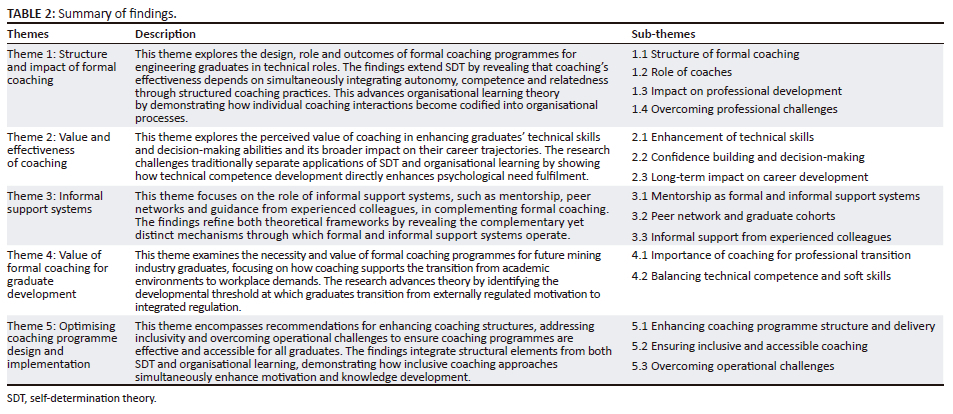
Table 2 provides a structured summary of the key themes and subthemes derived from the study's findings. It outlines the core areas of focus that emerged from the analysis of participants' experiences with formal coaching. Each theme and subtheme reflects aspects of the impact of coaching on the professional development of engineering graduates.
The study identified five themes: (1) the structure and impact of formal coaching (Theme 1), examining how structured coaching interventions influence professional growth; (2) the value and effectiveness of coaching (Theme 2), assessing its benefits and outcomes for participants; (3) the role of informal support systems (Theme 3), exploring how peer and mentor relationships complement formal coaching; (4) the value of formal coaching for graduate development (Theme 4), highlighting its significance in shaping early-career professionals and (5) optimising coaching programme design and implementation (Theme 5), offering evidence-based recommendations for developing effective coaching frameworks for early-career professionals.
Theme 1: Structure and impact of formal coaching
This theme explores the design, role and outcomes of formal coaching programmes for engineering graduates in technical roles. Our findings extend SDT by revealing that coaching's effectiveness depends not merely on addressing autonomy, competence and relatedness separately but on their simultaneous integration through structured coaching practices. This advances organisational learning theory by demonstrating how individual coaching interactions become codified into organisational processes, creating a feedback loop between personal development and institutional knowledge that existing literature has not fully explored.
Sub-theme 1.1: Structure of formal coaching
This sub-theme addresses how coaching was structured with regard to session frequency, focus areas and the format of these engagements.
The structure of formal coaching programmes varied across participants but shared commonalities such as regular, focused sessions on both technical and leadership development:
'… were held monthly and focused on leadership development, communication skills, and understanding business operations.' (P1, 26-years-old, Female, Mechanical Engineering)
'… focused on technical problem-solving, safety management, and coping with high-stress team situations.' (P2, 25-years-old, Male, Mining Engineering)
These findings are consistent with the work of Passmore (2015) and Cox et al. (2024), who posited that structured coaching promotes both individual performance and organisational outcomes (Kalkavan & Katrinli 2014; Lyons & Bandura 2022; Park, McLean & Yang 2021). This structure also aligns with organisational learning theory, which suggests that organisations learn through individual experiences and the codification of this knowledge into processes that improve overall performance (Athanasopoulou & Dopson 2018; Pinnington et al. 2022). This demonstrates that coaching was tailored to both leadership preparation and deepening technical proficiency, aligning with literature that values personalised, competency-focused coaching for young professionals (Grant 2020, Grant & Atad 2022; Ryan & Vansteenkiste 2023).
The participants explained the emphasis on leadership readiness and communication as critical components of the coaching, reflecting how coaching programmes aim to build technical and soft skills that, in leadership, ensure young professionals successfully navigate organisational complexities (Brown et al. 2021). Developing leadership abilities, especially for new graduates, prepares them to handle people management and business operations effectively, a view supported by literature that stresses leadership development as an essential component of career progression (Ciolli 2012; Fulmore, Olson & LaCoste 2022). The participants indicated a holistic approach to coaching, focusing on them as individuals and organisational requirements in terms of technical output:
'The sessions were quarterly reviews, and we focused on both a little technical and leadership development, and also about me as a person and how I related to people.' (P10, 26-years-old, Male, Geotechnical)
This suggests that the participants experienced coaching as not purely transactional or focused on work-specific goals but also about their personal development. This aligns with the idea that effective coaching addresses the individual's holistic growth (Brown et al. 2021; Korotov 2021), enabling a focus on emotional intelligence (Boyatzis 2018), self-awareness and relational skills, which are increasingly recognised as essential in leadership roles (Mbili 2020; Salminen-Tuomaala 2020). The inclusion of interpersonal elements in the coaching programme, as described by Participant 10, highlights the importance of relational dynamics in leadership (Carthy et al. 2022):
'The coaching sessions were set up to help graduates get ready for leadership roles. The sessions were held every once in two months, and I [it] was more focused on rock stability analysis and ground support design.' (P4, 27-years-old, Male, Geotechnical)
Participant 4's experience demonstrates the dual nature of formal coaching, which caters to both technical proficiency and leadership preparation. By combining these elements, the formal coaching experience helped ease the transition between technical expertise and leadership capabilities, ensuring that graduates are to take on more complex responsibilities as they progress in their careers. Well-rounded development equipped, including domain-specific knowledge and leadership skills, promotes adaptability and innovation (Augestad et al. 2020; Granchi et al. 2021; Hawkins 2021, 2022; Wolff et al. 2021).
Sub-theme 1.2: Role of coaches
The focus of this sub-theme is the coaches and how their professional backgrounds, expertise and coaching styles shaped the learning experience of graduates, as the participants perceived them. The participants shared:
'My coach helped me transition from being just a technical expert to someone who could get information and share information with other technical teams.' (P4, 27-years-old, Male, Geotechnical)
'My coach was like a trusted advisor who helped me see how everything fits together in mining operations. They showed me how to make choices under pressure, especially when things didn't go as planned.' (P2, 25-years-old, Male, Mining Engineering)
Coaches contributed to the development of communication, decision-making and technical skills among the graduates (Campbell & Mogashana 2024; Winkel et al. 2024). This practice assists professionals in transitioning from technical to leadership roles (De Haan, Gray & Bonneywell 2019; Yarborough 2018). This transition was mentioned by the participants, who described their coach as instrumental in helping them beyond their technical knowledge. One participant remarked that their coach helped them:
'… think beyond the technical details to see the bigger picture.' (P1, 26-years-old, Female, Mechanical Engineering)
A coach can facilitate broader thinking, enabling professionals to adopt a strategic mindset needed for leadership roles, corroborating the findings of other researchers (Kim 2014; Lawrence 2017).
Coaching improves decision-making during crises (Terblanche 2022, 2023). Participant 2 described their coach as a 'trusted advisor' guiding high-pressure decisions in mining operations. Coaches support the integration of technical and managerial responsibilities, balancing operational, relational (Athanasopoulou & Dopson 2018; Winkel 2024) and safety duties. Participants described coaches as a 'partner' who aided in managing workplace responsibilities, including people management, budget planning and safety aspects. This subtheme highlights coaching's critical role in enhancing decision-making and integrating technical tasks in high-pressure environments:
'My coach was a senior geotechnical engineer. I saw my coach as a partner who guided me through difficult challenges. They helped me balance technical with other workplace responsibilities, like HR, planning a budget, leading safety topics with my colleagues.' (P10, 26-years-old, Male, Geotechnical)
Coaches helped young professionals grow as both technical experts and leaders, helping them navigate real-life challenges, such as coordinating team efforts and challenging them to think systemically about their decisions:
'… think not just about today's tasks but about the long-term impact of [their] decisions.' (P7, 25-years-old, Female, Mechanical Engineering)
These findings show that coaching fosters long-term strategic thinking - a key leadership component (Saad, 2022) - and that a coach's organisational experience cultivates positive attitudes and behaviours (Carvalho, Araújo & Martins 2022). Coaching also develops essential leadership skills, including decision-making, communication and strategic thinking (Skiffington & Zeus 2002), enabling technical experts to evolve into versatile leaders (Boyatzis 2018; Carthy et al. 2022). This approach meets young professionals' need for autonomy by using a questioning style (Aziz & Jahan 2021).
Sub-theme 1.3: Impact on professional development
This sub-theme explored the broader impact that coaching had on graduates' professional development. Coaching influenced the professional development of graduates by refining their capabilities expected of them in future roles. Passmore and Fillery-Travis (2011) describe coaching as a development strategy that promotes professional growth, which was confirmed by some of the participants' experiences:
'Through coaching, I learnt how to lead a team, deal with pressure and make decisions that impacted the whole project. I think it boosted my confidence and made me better at solving problems independently.' (P1, 26-years-old, Female, Mechanical Engineering)
'Coaching really helped me grow quickly in my role, especially in leading small teams of contractors on-site.' (P2, 25-years-old, Male, Mining Engineering)
These observations substantiate the findings of Grant (2014) that coaching helps individuals improve self-awareness, adaptability and decision-making, which are qualities of leadership effectiveness (Anthony 2017; Brewer et al. 2022; Megheirkouni & Mejheirkouni 2020). The future of work demands that young professionals develop skills such as communication, problem-solving and adaptability, as these will be in high demand across industries (Madsen 2024). In addition to leadership growth, coaching also played a role in refining graduates' technical skills:
'Coaching allowed me to dive deeper into technical skills, especially in mineral exploration.' (P6, 26-years-old, Female, Geosciences)
Coaching facilitates the transfer of knowledge from experienced leaders to graduates, which benefits the graduates in their leadership and technical skills (Fulmore et al. 2022; Otu & Omeje 2021) and, at the same time, preserves institutional knowledge (Digirolamo & Tkach 2019). Self-Determination Theory (Ryan & Deci 2017) suggests that clients' increased confidence in their abilities through coaching makes them more proactive in pursuing their professional goals.
Sub-theme 1.4: Overcoming professional challenges
This sub-theme reviews how coaching helped graduates overcome workplace challenges, from managing teams in high-stress environments to solving complex technical problems.
The graduates' experiences revealed that coaching was a helpful resource for overcoming professional challenges. The participants noted how coaching enabled them to handle complex technical issues in high-pressure situations:
'It was my job to troubleshoot, and I applied what we covered with my coach on systematically assessing problems when dealing with a conveyor belt failure.' (P1, 26-years-old, Female, Mechanical Engineering)
'I told my coach about it, and he guided me on how to use data from the geotechnical data system to adjust drilling techniques.' (P2, 25-years-old, Male, Mining Engineering)
'I had our usual meeting with my coach, and we went over all the tools I could use to prepare myself to chair the meeting.' (P4, 27-years-old, Male, Geotechnical)
These narratives align with Solomon and Van Coller-Peter's (2019) findings that coaching equips young professionals with problem-solving skills while reinforcing systematic data analysis in technical fields. Observations indicate that coaching not only helps graduates overcome challenges but also enables them to assert authority and earn the trust of their teams:
'What I really wanted was for people to trust my judgement, and I think that they do now.' (P10, 26-years-old, Male, Geotechnical)
These findings align with Athanasopoulou and Dopson's (2018) and Tanskanen, Mäkelä and Viitala (2019) work showing that coaching enhances leadership performance and emotional intelligence. In our study, coaching fostered emotional resilience, enabling participants to overcome task anxiety and manage workplace stress by distinguishing between controllable and uncontrollable factors. Such benefits in psychological safety and emotional regulation in high-pressure settings resonate with Taylor et al. (2022) and support O'Connor and Lages (2019) assertion that these skills promote professional growth and confidence:
'When I spoke to my coach about it, he asked me to present one of my projects to him. Then I got feedback, and I could also see that it was also a case of nerves. So I started to first send my presentation to my manager, and when I got to the meeting, I would present the top five things that were going great or bad, and it started to get better.' (P6, 26-years-old, Female, Geosciences)
'It was pressure from all around, and it took two coaching sessions where we worked on the list of things I could control and the other things. Every time, I remember that scenario, and I think it helped a lot.' (P8, 24-years-old, Male, Ventilation Engineering)
By developing problem-solving skills, leadership capabilities and emotional resilience, coaching demonstrates its ability to help graduates navigate early career challenges, enabling them to manage high-pressure situations and complex tasks confidently.
Theme 2: Value and effectiveness of coaching
This theme explores the perceived value of coaching in enhancing graduates' technical skills and decision-making abilities and its broader impact on their career trajectories. Coaching has been identified as a key tool in developing technical competencies, building confidence and shaping professional decision-making processes. Our research challenges the traditionally separate applications of SDT and organisational learning by showing how technical competence development (typically viewed through an organisational learning lens) directly enhances psychological need fulfilment (the core of SDT). This theoretical advancement explains why coaching interventions focusing simultaneously on both dimensions yield stronger outcomes than approaches targeting either motivation or knowledge transfer independently.
Sub-theme 2.1: Enhancement of technical skills
This sub-theme explores how participants developed specific, practical competencies relevant to their field, through their relationship with formal coaching.
The participants' reports of their experiences illustrated how coaching aided them in the refinement of their technical skills with regard to applying these skills in their workplace, without being taught but guided instead:
'Coaching was good for my growth because it helped me see how to improve my technical skills, like fixing complex machinery. My coach didn't just give me answers but taught me how to think through problems.' (P1, 26-years-old, Female, Mechanical Engineering)
Coaching enables its beneficiaries to apply skills through critical thinking and thereby develop self-reliance (De Haan, Culpin & Curd 2011; Malling et al. 2020; Wefald, Hornung & Burkhart 2021). This was an experience that resonated with the participants, in that coaching supported their understanding of technical issues, such as underground ventilation and strengthened their problem-solving abilities (Ciolli 2012; Reid et al. 2020), effectively preparing them for the demands of complex technical environments:
'My coach helped me understand the technical details better and taught me how to solve problems on my own.' (P4, 27-years-old, Male, Geotechnical)
In addition to problem-solving, graduates were able to refine their skills in technical tasks such as data analysis and the use of advanced tools, which are skills required in industry that are not taught at university (Aljohani et al. 2022; Baldry 2016; Edayi 2016; Li 2022; Zakaria & Nair 2019):
'My coach showed me how to analyse drilling data better, which made me more confident in handling big mining projects.' (P2, 25-years-old, Male, Mining Engineering)
This is supported by Malling et al. (2020), who found that coaching interventions increased the ability of clients to address technical challenges. Participants shared that coaching improved their proficiency with technical tools such as geographic information systems:
'My coach would ask me why I was making the decisions… now I can use these tools better, which helped me improve my work.' (P12, 27-years-old, Male, Geomatics)
The positive impact of coaching on the technological capabilities of young professionals has been documented in highly technical disciplines such as medical technology (Blakewood & Elley 2022; Faber et al. 2021; Stray, Memon & Paruch 2020), and the experiences of the participants in this study support the importance of coaching in equipping young professionals with the technical competencies required for success in their fields.
Sub-theme 2.2: Confidence building and decision-making
This sub-theme examines how participants developed self-assurance and the ability to make informed, independent choices through their coaching experiences. Trust in the coach's workplace experience helped in building the confidence of graduates and positively shaped their decision-making skills, indicating a link between effective coaching and the ability of the client to navigate difficult situations. This finding has been supported by Grant and O'Connor (2019) and Passmore and Lai (2020) and Wang et al. (2021):
'The most helpful part of coaching was having someone experienced guide me through challenges.' (P1, 26-years-old, Female, Mechanical Engineering)
'It was improving my technical skills, like analysing core samples better. What I learnt at university did not prepare me for after graduation, but I now know how to apply what I learned better.' (P6, 26-years-old, Female, Geosciences)
The experiences of coaching in bridging the participants' confidence in decision-making from university to the workplace support the notion that coaching enriches graduates' ability in terms of competence and confidence to apply their knowledge in professional settings (Grant & O'Connor 2019; Solomon & Van Coller-Peter 2019).
The integration of leadership capabilities was another benefit of coaching that the participants experienced, which had a positive impact on their confidence in decision-making. This demonstrated the ability of coaching to serve leadership and technical problem-solving for beneficiaries:
'The best part of coaching was learning how to lead a team and handle technical issues at the same time. It gave me the confidence to make decisions.' (P4, 27-years-old, Male, Geotechnical)
'What I saw, for me, was problem-solving and dealing with technical issues, especially in underground mining.' (P8, 24-years-old, Male, Ventilation Engineering)
Coaching's holistic approach to developing both technical and soft skills enhances decision-making capabilities (Cidral, Berg & Paulino 2023; Fulmore et al. 2022; Reid et al. 2020) while creating a psychologically safe space for problem-solving without fear of failure. Traylor, Stahr and Salas (2020) demonstrate that coaching transforms resilience and practical problem-solving in high-pressure environments. Both graduate perceptions and existing literature confirm that coaching empowers individuals to navigate their professional roles with increased confidence.
Sub-theme 2.3: Long-term impact on career development
This sub-theme examines how coaching influences career trajectories, contributing to sustained growth and the ability to navigate complex professional landscapes over time, including how coaching shapes long-term career development.
Participants highlighted the value of coaching in helping them adapt to the complexities of mining:
'… helps you solve technical problems faster and gives you the confidence to handle big challenges independently.' (P1, 26-years-old, Female, Mechanical Engineering)
Coaching accelerates young professionals' readiness for complex work environments and strengthens their psychological contract, fostering longer organisational tenure (Jepsen & Dehlholm 2023; Solomon & Van Coller-Peter 2019). It bridges the gap between theory and practice, aligning with Grant's (2014) view that coaching connects academic learning to industry demands. By fostering critical thinking and self-reliance (Noah & Aziz 2020; Passmore & Fillery-Travis 2011), coaching provides long-term career benefits. It also integrates leadership and technical skills, enhancing career progression and preventing career-limiting mistakes (Boyatzis 2018; Carvalho et al. 2022; Fulmore et al. 2022; Lai & Palmer 2019; Valldeneu, Ferràs & Tarrats 2021; Weiss & Merrigan 2021). Coaching demonstrated some preventive benefits, such as helping graduates avoiding career-limiting mistakes:
'… connect your technical skills with leadership …' (P4, 27-years-old, Male, Geotechnical)
'… helps you avoid mistakes that you might make if you didn't have someone guiding you.' (P4, 27-years-old, Male, Geotechnical)
This insight is similarly reflected in Otu and Omeje's (2021) study, in which they posited that coaching reduces the risk of errors and supports more informed decision-making. The findings indicate that coaching is not just a short-term intervention but a sustained transformational tool that has long-term utility.
Theme 3: Informal support systems
Theme 3 focuses on the role of informal support systems, such as mentorship, peer networks and guidance from experienced colleagues, in complementing formal coaching. These informal relationships provide an additional layer of support beyond structured coaching sessions, offering practical day-to-day guidance that helps graduates navigate the complexities of their professional roles. The findings refine both theoretical frameworks by revealing the complementary yet distinct mechanisms through which formal and informal support systems operate. We contribute to organisational learning theory by identifying how informal networks create knowledge flows that formal systems cannot capture while extending SDT by demonstrating how relatedness needs are fulfilled differently through hierarchical (coach-client) versus peer relationships.
Sub-theme 3.1: Mentorship as formal and informal support systems
This theme explores mentorship as a formal and informal support mechanism that influences the professional development of graduates. While formal mentorship offers guidance in a more structured manner, informal mentorship usually develops organically, enabling mentees to learn from more accomplished colleagues:
Mentorship, in its various forms, provides guidance and emotional support during the early stages of career development. The participants highlighted the regulatory aspect of formal mentorship in the mechanical and electrical disciplines:
'It is a must that we must all get mentors and as an engineer in training, I have a GCC [Government Certificate of Competence, legislated by the Department of Minerals and Energy] mentor; he signs off on my log-book.' (P1, 26-years-old, Female, Mechanical Engineering)
Formal mentorship aligns with industry standards, guiding technical competence and professional growth (Alfonsi, Namubiru & Spaziani 2022; Deng, Gulseren & Turner 2022; Fong et al. 2021). Beyond structured support, mentorship also provides emotional guidance, as illustrated by one participant describing their mentor as a 'corporate mother' (Participant 2). This nurturing aspect fosters resilience and helps graduates navigate career challenges (Rehman et al. 2022). The combination of formal and informal mentorship ensures both technical and emotional support during career transitions. The flexibility of mentorship was evident in its adaptability to career changes, as seen in one participant's experience of switching from mining to geotechnical engineering and finding informal support from colleagues in the new discipline:
'I was first in mining engineering, then I switched to Geotechnical because I saw my progress was too slow. But the Geotechnical guys do help with check-ins.' (P5, 26-years-old, Female, Industrial Engineering)
Bolton-King (2022) found that informal support is needed to guide career transitions. The participants' access to both an internal mentor and external mentors indicates the value of having a diverse mentorship network, allowing for broader perspectives and career insights:
'I have two mentors, one in the company and another that I met at the SAIMM [Southern African Institute of Mining and Metallurgy] conference, and I also have access to the early talent advisor.' (P10, 26-years-old, Male, Geotechnical)
Diverse mentorship networks are needed for leadership development and contribute positively towards career satisfaction (Joo & Cruz 2024). Informal mentorship built trust in the young professionals interviewed in this study, allowing them to feel comfortable discussing workplace challenges, which improves workplace and relational dynamics (Jefford et al. 2021):
'I do trust the early talent advisor, and sometimes I tell her when I am struggling with my line manager, and she will advise me on what I can do differently.' (P11, 28-years-old, Male, Geomatics)
Mentorship, whether formal or informal, serves as a support system that contributes to early career professionals' technical growth, emotional resilience and career adaptability.
Sub-theme 3.2: Peer network and graduate cohorts
The significance of social connections and group dynamics in shaping the professional experiences of graduate students is explored through this sub-theme.
Some of the participants expressed:
'I also had a buddy who was in a year ahead of me in the programme, but I call him or send him an email when I need his advice more with my courses.' (P1, 26-years-old, Female, Mechanical Engineering)
'We have graduate days when we meet graduates from all over [Company], and then I sometimes take down their names if they are doing the same programme as me and I sometimes send them a message on Teams.' (P8, 24-years-old, Male, Ventilation Engineering)
'We have career development panels where we meet graduates who are in their first year or third year, on those days we will all talk and share things we are going through, and it helps because they are struggling with the same things that I am struggling with.' (P5, 26-years-old, Female, Industrial Engineering)
Graduate cohorts foster collaboration and a sense of belonging, with social learning forming 20% of organisational learning (Amenumey & Badu 2023; Sammet & Wolf 2022). Peer networks provided professional guidance and emotional support during workplace transitions, with graduates noting the value of a 'buddy' (Participant 1) for advice. Peer relationships offer relatable, experience-based insights, surpassing formal mentorship (Gregoric & Wilson 2015). Online platforms facilitate peer interaction, extending support networks beyond physical spaces (Macià & García 2016; Jennings 2013; Cree-Green et al. 2020). Group initiatives like career panels also foster shared learning and resilience, reducing isolation (Elliott, Mavriplis & Anis 2020):
'We have graduate learning days where we present our projects and can see what other graduates are doing.' (P9, 26-years-old, Female, Mechanical Engineering)
Peer networks, through both formal and informal avenues, provide much-needed guidance and social support (Boat, Miranda & Syvertsen 2022; Ellison Wohn & Greenhow 2014), which may contribute towards the retention of graduates. Peer networks are required for professional development and are significant in promoting emotional well-being and long-term career success.
Sub-theme 3.3: Informal support from experienced colleagues
This sub-theme examines how the participants received guidance and advice in a less formal, ad hoc manner from experienced professionals within their workplace.
Graduates benefitted from the day-to-day advice and encouragement from senior colleagues, which helped them better understand workplace dynamics and develop their practical skills. These relationships were influential in building confidenc and providing contextual understanding that is not captured in formal training or coaching sessions:
'The informal is more about quick tips from other engineers, and coaching helped me develop a deeper understanding of my role and how to lead others.' (P8, 24-years-old, Male, Ventilation Engineering)
'I do know a few people at my operation, and I know how to reach out when I am stuck. So far, it works for me if I need to make a quick call to somebody when I need to resolve the problem quickly.' (P12, 27-years-old, Male, Geomatics)
Intergenerational workforces experience challenges such as varied organisational attitudes (Solomon & Van Coller-Peter 2019), but they also present opportunities for learning, through more experienced workers' guiding new-joiners. Experienced workers' coaching younger professionals is formalised in some organisations, with great benefits (Park et al. 2021). This sub-theme, however, explores the informal support from experienced colleagues and its role in providing graduates with immediate transitional support. Participants noted how 'quick chats' (Participant 1) with colleagues helped in resolving issues such as machinery malfunctions or handling tasks efficiently and described how experienced workers shared 'shortcuts' (Participant 4) during shifts to ensure that they met production targets:
'Support from my colleagues was more about quick chats when things went wrong on the floor, like how to fix a machine quickly or handle a specific task.' (P1, 26-years-old, Female, Mechanical Engineering)
'Informal support came from experienced workers who would share their knowledge during shifts, but my manager always said that they will show you what they know, even the shortcuts.' (P4, 27-years-old, Male, Geotechnical)
Informal interactions, often centred around problem-solving and knowledge transfer, align with Billett and Noble's (2020) findings that workplace learning is enhanced by interpersonal exchanges, aiding faster adaptation to challenges. Participants highlighted the accessibility of experienced colleagues, illustrating the responsiveness of this informal network.
Theme 4: Value of formal coaching for graduate development
This theme examines the necessity and value of formal coaching programmes for future mining industry graduates, focusing on how coaching supports the transition from academic environments to workplace demands. Our research advances theory by identifying the developmental threshold at which graduates transition from externally regulated motivation to integrated regulation, a theoretical advancement to SDT that explains the timing and conditions under which coaching interventions are most impactful. This also extends organisational learning theory by demonstrating how coaching accelerates knowledge integration across organisational boundaries.
Sub-theme 4.1: Importance of coaching for professional transition
This sub-theme reviews the significance of coaching for future graduates, reflecting on how structured guidance eases the transition process and contributes to professional development of individuals entering early careers in the mining industry. Coaching prepares future graduates for the challenges of professional environments, as highlighted by the participants who described that it had improved their problem-solving skills and built their confidence. The participants noted that coaching helped them solve technical problems efficiently, which assisted them in handling challenges independently:
'Coaching helps you solve technical problems faster and gives you the confidence to handle big challenges on your own.' (P1, 26-years-old, Female, Mechanical Engineering)
'It teaches you how to connect your technical skills with leadership.' (P4, 27-years-old, Male, Geotechnical)
'It also teaches you how to manage people and projects, which is something that's hard to learn from just textbooks.' (P8, 24-years-old, Male, Ventilation Engineering)
The participants noted that coaching fostered critical thinking by encouraging exploration of new perspectives. Coaching positively impacts cognitive abilities (Corti & Gelati 2020; Howlett 2021; Yu et al. 2020) and reasoning skills for students transitioning from tertiary education to the workplace, enhancing adaptability and problem-solving (Bachkirova, Arthur & Reading 2020; Styron 2023; Van Der Baan et al. 2022). Beyond technical problem-solving, coaching also aids in developing leadership and management skills, which are challenging to gain through academic study alone (Wang et al. 2021, 2022).
The participants highlighted the way in which coaching had helped them connect technical competencies with leadership, preparing them for organisational changes and early leadership roles:
'Future graduates will learn how to deal with real-life situations in mining. It's one thing to know the theory, but coaching helps you apply that knowledge in the field, which is really important.' (P2, 25-years-old, Male, Mining Engineering)
'It does help you build confidence in your technical skills. It also prepares you for challenges that you might not expect when you first start working in the field.' (P6, 26-years-old, Female, Geosciences)
Coaching significantly aids in leadership effectiveness (Lai & Palmer 2019) and self-efficacy (Carvalho et al. 2022; Jepsen & Dehlholm 2023), equipping young professionals with the skills to manage dynamic workplaces (Styron 2023). Future graduates could benefit from concerted coaching to help bridge their experiences from academia to the workplace; however, coaches should ensure that graduates are set up for self-sustenance beyond the coaching interventions.
Sub-theme 4.2: Balancing technical competence and soft skills
This sub-theme explores the need for coaching programmes to give equal priority to both technical expertise and soft skills, such as communication, leadership and problem-solving.
The participants' feedback revealed that technical and non-technical skill sets must be developed together to enable young professionals to contribute meaningfully to their careers and organisational goals. Participants noted that coaching helped them think through technical challenges more effectively, highlighting the impact of structured feedback on job performance:
'My coach's feedback made me better at my job.' (P2, 25-years-old, Male, Mining Engineering)
Integrating technical and soft skills development is essential for enhancing early-career employees' performance, as many graduates lack the technical skills required to add value to the business (Kipper et al. 2021; Meyers 2017; Yong & Ling 2023). The participants shared that they learned to apply technical knowledge in practical settings, such as meeting production targets, emphasising the importance of experiential learning (Yong & Ling 2023). Goulart, Liboni and Cezarino (2022) highlighted how experiential learning improves workplace readiness, supporting the participants' focus on using coaching to apply technical skills in real-world contexts.
However, the participants also pointed out that coaching should focus not only on technical proficiencies. They noted the benefits of one-on-one coaching in integrating technical skills with interpersonal abilities and shared that those essential soft skills, such as communication and teamwork, were overlooked during their academic training but are now a requirement for workplace effectiveness:
'I know the importance of soft skills, like communication and teamwork, which we did not focus on at university. It would be great if coaching programmes had more focus on developing these soft skills because they make a big difference in how you work with others.' (P10, 26-years-old, Male, Geotechnical)
This sub-theme emphasises that regular feedback and opportunities for reflection allow young professionals to enrich their technical expertise while preparing them for future roles.
importance of soft skills
This theme encompasses recommendations for enhancing coaching structures, addressing inclusivity and overcoming operational challenges to ensure coaching programmes are effective and accessible for all graduates. Our findings integrate structural elements from both SDT and organisational learning, demonstrating how inclusive coaching approaches simultaneously enhance motivation and knowledge development. This advances coaching theory by explaining why programme elements that address diversity and inclusion contribute to both individual development and organisational adaptation.
Sub-theme 5.1: Enhancing coaching programme structure and delivery
This sub-theme addresses engineering graduates experiences of coaching approaches that address real workplace complexities. A recurring recommendation from participants was the need to introduce practical elements into coaching sessions to make them more relevant to the complex and dynamic workplace in which they operate:
'Sometimes, talking about problems isn't enough - you need to actually work through them with your coach.' (P1, 26-years-old, Female, Mechanical Engineering)
'Maybe more practical exercises during coaching sessions, like working through actual field problems. It would also help if coaches could give us more detailed feedback on our performance so we know exactly where we need to improve, maybe like an assessment or something.' (P6, 26-years-old, Female, Geosciences)
'More scenarios and simulations that relate to our daily work. It's important to practice what we learn in real-life situations. Also, getting feedback from our peers as well as our coaches could help us improve faster, Maybe an assessment before and an assessment after to see if we are doing okay.' (P10, 26-years-old, Male, Geotechnical)
The participants indicated that practical scenarios would allow them to practice in real-life contexts and reinforce their learning through action. The integration of follow-up sessions and progress assessments was also widely noted as a need by young professionals:
'I recommend including more hands-on practice in the coaching sessions. Sometimes, talking about problems isn't enough - you need to actually work through them with your coach. It would also help to have more follow-up sessions to track our progress.' (P1, 26-years-old, Female, Mechanical Engineering)
'It would be great if coaching programmes included more real-life case studies. When we see how others solved similar problems, it gives us ideas for how to handle our own challenges. Also, more group sessions with other graduates would help us learn from each other.' (P2, 25-years-old, Male, Mining Engineering)
The participants' feedback aligns with the findings of Lubbe and Svensson (2022), whose literature indicates that coaching strategies within real-life applications can enrich learning, with the ability to put into context the skills attained in coaching, making them more applicable to workplace challenges. Follow-up sessions ensure that continuous assessments and feedback loops take place, which promote sustained development and improve workplace performance (Carvalho et al. 2022; Hussey & Campbell-Meier 2021).
In addition to practical exercises, participants expressed a strong interest in incorporating peer-to-peer learning into coaching programmes:
'Sometimes, learning from others in the same situation is just as helpful as learning from the coach.' (P8, 24-years-old, Male, Ventilation Engineering)
Collaborative learning environments drive diverse perspectives, a view supported by Passmore and Fillery-Travis (2011), who observed that peer-driven learning promotes knowledge exchange and collective problem-solving. The participants expressed a need for coaching to include more leadership development, which would better prepare them for management roles:
'Coaching programmes could be more effective if they included more peer-to-peer sessions. Sometimes, learning from others in the same situation is just as helpful as learning from the coach. I also think more focus on leadership skills would help.' (P8, 24-years-old, Male, Ventilation Engineering)
Combining technical coaching with leadership development equips graduates with essential skills for managing teams and projects (Athanasopoulou & Dopson's 2018; Godfrey 2024; Hawkins 2022). The participants suggested that coaching programmes would be more effective if they included experiential learning, peer collaboration and leadership development, aligning closely with recent literature that highlights the importance of practical, interactive and leadership-focused coaching structures.
The need for a more interactive and engaging coaching structure was further emphasised, with focus on including group sessions, case studies and follow-up meetings so that participants could more effectively apply the knowledge gained:
'One thing that could be better is having more group coaching sessions, where we can share ideas with other graduates.' (P1, 26-years-old, Female, Mechanical Engineering)
'It could be improved by having more opportunities to discuss challenges with other graduates.' (P12, 27-years-old, Male, Geomatics)
The participants' views align with literature indicating that coaching programmes can foster a sense of community and support professional growth through collaborative environments (Lajola 2021; Solomon & Van Coller-Peter 2019; Van Der Baan et al. 2022). Group coaching provides a dynamic structure, allowing young professionals to benefit from diverse perspectives while receiving individual support from experienced coaches (Hawkins 2021). It is important to distinguish between team and group coaching: team coaching focuses on long-term goals beyond interventions, while group coaching centres on individual goals within a collaborative context (Grant 2020; Clutterbuck 2020; Fillery-Travis & Lane 2020; Lancer & Eatough 2020). In addition to the focus on peer learning, participants also stressed the importance of practical applications, such as case studies, to close the divide between theory and practice:
'I think it could be improved by having more case studies during the coaching.' (P10, 26-years-old, Male, Geotechnical)
Athanasopoulou and Dopson (2018) similarly found that experiential learning components, such as case studies, help young professionals to make the transition from university to industry by connecting theoretical insights with practical challenges. Participants indicated that structured follow-up sessions would be beneficial to track their progress and evaluate the practical application of skills learnt in coaching:
'It could be improved by having more follow-up sessions to see how we are applying what we learnt.' (P8, 24-years-old, Male, Ventilation Engineering)
In technical fields, timeous and regular feedback builds technical rigour, leading to high-performing organisations (Lockyer et al. 2020). Furthermore, feedback enhances skill retention and ensures ongoing professional development (Hussey & Campbell-Meier 2021). The integration of interactive, peer-driven learning, practical case studies and regular feedback would enhance the structure of coaching sessions, making them more collaborative, application based and supportive in nature.
Sub-theme 5.2: Ensuring inclusive and accessible coaching
This sub-theme focuses on ensuring equitable access to coaching and addressing diversity challenges. The participants expressed the desire for equitable access to coaching, with a need for it to be available as young professionals transition into the workplace and not reserved for a select few:
'Coaching must be compulsory for graduates to get in their first year.' (P3, 27-years-old, Male, Electrical Engineering)
'All managers must learn how to coach us so that they can bring out the best in us.' (P9, 26-years-old, Female, Mechanical Engineering)
'Coaching must not just be reserved for certain graduates.' (P7, 25-years-old, Female, Mechanical Engineering)
The participants articulated that all front-line leaders should play an active role in developing talent through coaching, which is a growing need in progressive organisations (Ibarra & Scoular 2019; Kalkavan & Katrinli 2014; Milner, McCarthy & Milner 2018; Thunnissen 2016) as learner-centred forms of employee development are adopted. Coaching should be an inclusive and a widely accessible tool to ensure equitable professional growth (Passmore & Fillery-Travis 2011).
The participants stressed the importance of practical application and regular feedback in coaching programmes, which can ensure consistent improvement:
'There must be opportunities to apply what we learn in real-time situations.' (P12, 27-years-old, Male, Geomatics)
The value of feedback and practical application are key drivers for improving performance and enhancing career development (Wolff et al. 2020). Lubbe and Svensson (2022) argued that, for coaching to be most effective, it should not be an exclusive resource but rather a universally available developmental tool for all early-career professionals.
A few participants expressed the need for coaching programmes to address diversity and inclusion, particularly to support women from minority groups, and ensure that all participants have access to relatable coaches. The underrepresentation of black women in leadership roles was expressed, with an emphasis on the importance of coaching initiatives in helping minority women to advance in the organisation:
'I've noticed that there aren't many Black women in leadership positions in our company. I think it's really important for coaching programmes to focus on supporting women, especially minority women, so that more of us can move into leadership roles.' (P1, 26-years-old, Female, Mechanical Engineering)
Personalised support systems are required to nurture diverse leaders, enabling them to navigate the barriers that underrepresented groups face in corporate environments (Solomon & Van Coller-Peter 2019). Ensuring coaching programmes are designed to offer specific support for minority groups helps address systemic challenges and creates pathways for more inclusive leadership development (Van Knippenberg & Van Ginkel 2022).
The availability of relatable coaches was another issue raised by participants:
'I asked … if I can find a female coach and they said they did not have any for my discipline.' (P1, 26-years-old, Female, Mechanical Engineering)
'It's hard to find somebody that I can relate to.' (P3, 27-years-old, Male, Electrical Engineering)
The participants highlighted the importance of offering diverse coaches who can provide relevant guidance and share experiences. In the South African context, where diversity in cultures, backgrounds and experiences is rich, addressing diversity and inclusion is crucial to ensure all individuals, regardless of race, gender or socio-economic background, receive necessary guidance and support. Gregory and Levy (2011) emphasised that identifying with one's coach enhances the quality of the coaching relationship, leading to career progression and job satisfaction, especially relevant in South Africa for historically underrepresented groups. Athanasopoulou and Dopson (2018) asserted that inclusive coaching is essential for motivating and developing diverse young professionals. Incorporating diversity in coaching benefits both minority and non-minority individuals, providing critical insights into diversity and inclusion. Maher and Hastings (2023) noted that exposure to inclusive coaching practices helps graduates develop a deeper understanding of diversity, enhancing their leadership capabilities. Additionally, promoting diverse and inclusive coaching environments fosters personal growth, broadens leadership perspectives and encourages collaboration and respect (Baron & Azizollah 2018; Passmore 2013; Shah 2022). By prioritising diversity and inclusion in coaching, organisations can prepare future leaders to thrive in a diverse, interconnected world, driving positive social and organisational change.
Sub-theme 5.3: Overcoming operational challenges
This sub-theme remains focused on addressing the workplace constraints and operational demands that impact coaching effectiveness. The participants highlighted significant challenges in balancing work pressures, who noted the difficulty of managing production pressures while trying to engage in study, describing it as a 'catch-22' situation in which neither aspect can be fully prioritised:
'In our programme, we have to study towards our certificate of competency and also do work. I wish I had more time to study, like 2 weeks off just to study, but production is more important.' (P12, 27-years-old, Male, Geomatics)
The tension between meeting work expectations and dedicating time to professional development indicates that there is a gap between the structured learning graduates expect and the reality of high-pressure, production-driven environments. Tran et al. (2022) and Korotov (2021) described this as transition shock, by which graduates struggle to adapt to the pace and demands of the workplace, especially when structured support systems are lacking. Similarly, Guo (2023) noted the need to align education with workplace support, which would ensure that graduates were better equipped to manage their professional and learning responsibilities during this transition phase.
Working in remote or isolated locations worsened these challenges by limiting opportunities for peer learning and support. Participants remarked on the difficulty of learning from colleagues in such environments:
'It's hard working in a remote place, but you have to make it work.' (P12, 27-years-old, Male, Geomatics)
Psychological safety and supportive team environments are needed for productivity and learning (Traylor et al. 2020) but are often missing in workplaces where the demand to deliver on production goals supersedes other priorities. Peer interactions and mentorship, which aid in developing problem-solving and technical skills, are also hindered by these operational demands. The participants shared that, while they learnt a lot from operators, some were hard on young graduates:
'Some operators are very hard on us as young graduates.' (P4, 27-years-old, Male, Geotechnical)
This lack of a supportive learning environment diminishes the potential benefits of experiential learning. Dhanpat et al. (2021) also highlighted the importance of peer interactions and a conducive work environment in creating positive engagement and learning. To fully exploit the effectiveness of coaching programmes, these operational challenges must be addressed by providing graduates with sufficient resources to balance their work and professional development needs. Amanda and Akpana (2023) emphasises that informal guidance from experienced colleagues creates a supportive environment, fostering the professional growth and development of new professionals.
Practical implications
The Developmental Coaching Integration Model (Figure 1) presents a comprehensive framework that combines formal coaching mechanisms with informal support structures, underpinned by Self-Determination Theory and Organisational Learning Theory. This model illustrates how these elements work together to facilitate professional development for newly graduated engineering professionals, within graduate programmes. The model demonstrates that effective developmental coaching relies on the integration of structured formal coaching sessions with informal support networks. This dual approach addresses both technical competencies and psychological needs, creating a holistic development pathway that leads to significant long-term professional outcomes. The findings show that formal coaching initiatives, when complemented by informal support systems such as mentorship and peer networks, significantly enhance graduates' transition from academic to professional environments.
Mining organisations implementing this integrated coaching model can expect several valuable outcomes specifically relevant to mining engineering graduates. Initially, structured coaching programmes that deliberately combine formal coaching on technical mining concepts with informal support mechanisms maximise development outcomes for graduate engineers. The model's emphasis on addressing autonomy through self-directed problem-solving, competence through structured skill building in mining operations and relatedness through mentorship networks supports graduates' progression from external motivation to self-sustained learning trajectories essential in dynamic mining environments. Technical competence development in areas such as mine planning, geotechnical engineering and mineral processing alongside leadership capability building should be equal priorities in coaching programmes, supporting mining graduates' holistic professional development. This is particularly important in the mining sector, where both specialised engineering knowledge and leadership capabilities are essential for project management and team supervision. By investing in such integrated coaching approaches, mining organisations can achieve valuable long-term outcomes including enhanced career adaptability across different mining operations, technical-leadership integration in complex extraction projects, organisational knowledge preservation of site-specific practices and accelerated readiness for complex responsibilities in high-risk mining environments.
Furthermore, this approach helps mining organisations build a flexible engineering workforce prepared to address critical industry skills shortages while contributing to operational stability and safety culture. The model suggests that mining companies recognising the complementary nature of formal coaching and informal support structures will see improved employee engagement in challenging remote sites, better retention of technical talent in competitive markets and stronger support for diversity goals by ensuring equitable access to development opportunities across all mining disciplines and operational areas.
Conclusion
The landscape of formal coaching for engineering graduates, particularly in high-demand industries like mining, is evolving. This study explored the experiences of young professionals transitioning from academia to the workplace, shedding light on coaching's role in bridging the gap between theoretical knowledge and practical application. The study offers practical guidance for organisations aiming to optimise coaching initiatives, contributing to the broader body of knowledge on coaching and leadership development.
Limitations and recommendations
This study provides valuable insights into the role of formal coaching in supporting engineering graduates' professional development; however, several limitations should be noted. The study was conducted within a single South African mining organisation, which limits the generalisability of its findings to other industries or sectors. A more diverse sample across various contexts could enhance the external validity of the results. Additionally, the research was cross-sectional, focusing on short-term impacts, and did not explore long-term outcomes, such as career progression or sustained leadership development. Future qualitative longitudinal studies, through the use of diaries, are recommended to examine the lasting benefits of coaching on graduates' careers.
The findings suggest opportunities for further research, particularly in industries that face similar challenges with skill shortages and workforce integration. Investigating coaching programmes in industries like manufacturing or fast-moving consumer goods could help identify transferable strategies. Studies incorporating larger and more diverse participant groups would provide a broader understanding of how coaching can address organisational and individual needs. Expanding the scope of research to include informal support systems such as mentorship and peer networks could also shed light on their complementary role in enhancing formal coaching outcomes.
Acknowledgements
This article is based on research originally conducted as part of Hanifa Hoosen's master's dissertation titled 'Exploring the need for formal coaching programmes: Experiences of engineering graduates in a South African mining company', submitted to the Department of Industrial Psychology and People Management, University of Johannesburg, 2024. The thesis was supervised by Nelesh Dhanpat.
Competing interests
The authors declare that they have no financial or personal relationships that may have inappropriately influenced them in writing this article.
Authors' contributions
H.H. was responsible for the conceptualisation and execution of the study, the writing and editing of the article. N.D. supervised the study, contributed to the data analysis, and the writing and editing of the article.
Funding information
This research received no specific grant from any funding agency in the public, commercial or not-for-profit sectors.
Data availability
The data that support the findings of this study are available from the corresponding author, N.D., on reasonable request.
Disclaimer
The views and opinions expressed in this article are those of the authors and are the product of professional research. They do not necessarily reflect the official policy or position of any affiliated institution, funder, agency, or that of the publisher. The authors are responsible for this article's results, findings, and content.
References
Alfonsi, L., Namubiru, M. & Spaziani, S., 2022, Meet your future: Experimental evidence on the labor market effects of mentors, Mimeo, Memphis, TN. [ Links ]
Aljohani, N.R., Aslam, A., Khadidos, A.O. & Hassan, S.U., 2022, 'Bridging the skill gap between the acquired university curriculum and the requirements of the job market: A data-driven analysis of scientific literature', Journal of Innovation & Knowledge 7(3), 100190. https://doi.org/10.1016/j.jik.2022.100190 [ Links ]
Amanda, W. & Akpana, E.A., 2023, 'Mentoring and employee productivity in organization', Scholarly Journal of Social Sciences Research 2(2), 11-23. [ Links ]
Amenumey, E.B. & Badu, Y.A., 2023, 'Leaders' experiences of integrated leadership development in higher education: Kolb's experiential learning theory and the 70:20:10 model', International Journal of African Higher Education 10(2), 113-137. https://doi.org/10.6017/ijahe.v10i2.17617 [ Links ]
Anthony, E.L., 2017, 'The impact of leadership coaching on leadership behaviors', Journal of Management Development 36(7), 930-939. https://doi.org/10.1108/JMD-06-2016-0092 [ Links ]
Athanasopoulou, A. & Dopson, S., 2018, 'A systematic review of executive coaching outcomes: Is it the journey or the destination that matters the most?', Leadership Quarterly 29(1), 70-88. https://doi.org/10.1016/j.leaqua.2017.12.004 [ Links ]
Augestad, K.M., Butt, K., Ignjatovic, D., Keller, D.S. & Kiran, R., 2020, 'Video-based coaching in surgical education: A systematic review and meta-analysis', Surgical Endoscopy 34, 521-535. https://doi.org/10.1007/s00464-019-07265-0 [ Links ]
Aurini, J.D., Heath, M. & Howells, S., 2021, The how-to of qualitative research: Strategies for designing, implementing, and writing up research, SAGE, Thousand Oaks, CA. [ Links ]
Aziz, M.F. & Jahan, F., 2021, ''Moderating role of organizational climate between leadership and employee innovative work behavior: An empirical investigation at national level', European Online Journal of Natural and Social Sciences 10(1), 153-163. [ Links ]
Bachkirova, T., Arthur, L. & Reading, E., 2020, 'Evaluating a coaching and mentoring program: Challenges and solutions', in J. Passmore & D. Tee (eds.), Coaching researched: A coaching psychology reader, pp. 361-378, Wiley, Hoboken, NJ. [ Links ]
Bachkirova, T., Spence, G. & Drake, D., 2016, The Sage handbook of coaching, Sage Publications, London. [ Links ]
Baldry, K., 2016, 'Graduate unemployment in South Africa: Social inequality reproduced', Journal of Education and Work 29(7), 788-812. https://doi.org/10.1080/13639080.2015.1066928 [ Links ]
Barner, R. & Higgins, J., 2007, 'Understanding implicit models that guide the coaching process', Journal of Management Development 26(2), 148-158. https://doi.org/10.1108/02621710710726053 [ Links ]
Baron, H. & Azizollah, H., 2018, 'Coaching and diversity', in S. Palmer & A. Whybrow (eds.), Handbook of coaching psychology, pp. 500-511, Routledge, London. [ Links ]
Billett, S. & Noble, C., 2020, 'Utilizing pedagogically rich work activities to promote professional learning', Éducation & Didactique 3, 137-150. https://doi.org/10.4000/educationdidactique.7943 [ Links ]
Blackman, A., Moscardo, G. & Gray, D.E., 2016, 'Challenges for the theory and practice of business coaching: A systematic review of empirical evidence', Human Resource Development Review 15(4), 459-486. https://doi.org/10.1177/1534484316673177 [ Links ]
Blakewood, D. & Elley, R.M., 2022, 'Accepting a hand up: Role models, technical coaches, and mentors', in R. Stavig & A. Stavig (eds.), Retaining women in engineering, pp. 139-152, CRC Press, Boca Raton, FL. [ Links ]
Boat, A.A., Miranda, A. & Syvertsen, A.K., 2022, 'Enhancing education and career pathways through peer and near-peer social capital', Journal of Youth and Adolescence 51(7), 1287-1304. https://doi.org/10.1007/s10964-021-01540-x [ Links ]
Bolton-King, R.S., 2022, 'Student mentoring to enhance graduates' employability potential', Science & Justice 62(6), 785-794. https://doi.org/10.1016/j.scijus.2022.04.010 [ Links ]
Boyatzis, R.E., 2018, 'The behavioral level of emotional intelligence and its measurement', Frontiers in Psychology 9, a1438. https://doi.org/10.3389/fpsyg.2018.01438 [ Links ]
Braun, V. & Clarke, V., 2006, 'Using thematic analysis in psychology', Qualitative Research in Psychology 3(2), 77-101. https://doi.org/10.1191/1478088706qp063oa [ Links ]
Braun, V. & Clarke, V., 2013, 'Data saturation in qualitative research: Theoretical underpinnings and practical strategies', Qualitative Research in Psychology 9(2), 177-192. [ Links ]
Braun, V. & Clarke, V., 2021, Thematic analysis: A practical guide, Sage, London. [ Links ]
Brewer, M., Van Kessel, G., Sanderson, B. & Carter, A., 2022, 'Enhancing student resilience by targeting staff resilience, attitudes and practices', Higher Education Research & Development 41(4), 1013-1027. https://doi.org/10.1080/07294360.2021.1877622 [ Links ]
Brown, R.P., Varghese, L., Sullivan, S. & Parsons, S., 2021, 'The impact of professional coaching on emerging leaders', International Journal of Evidence Based Coaching and Mentoring 19(2), 24-37. [ Links ]
Campbell, A.L. & Mogashana, D., 2024, 'Assessing the effectiveness of academic coaching interventions for student success in higher education: A systematic review', Innovations in Education and Teaching International, 1-23. https://doi.org/10.1080/14703297.2024.2417173 [ Links ]
Candela, A.G., 2019, 'Exploring the function of member checking', The Qualitative Report 24(3), 619-628. https://doi.org/10.46743/2160-3715/2019.3726 [ Links ]
Carthy, A., Chalmers, W., Guiry, E. & Owende, P., 2022, 'An analysis of the impact and efficacy of online emotional intelligence coaching as a support mechanism for university students', Frontiers in Education 7, 861564. https://doi.org/10.3389/feduc.2022.861564 [ Links ]
Carvalho, F., Araújo, F. & Martins, J., 2022, 'Leadership and coaching in organizations: Perspectives and challenges', Organizational Psychology 11(2), 92-112. [ Links ]
Christou, P.A., 2022, 'How to use thematic analysis in qualitative research', Journal of Qualitative Research in Tourism 3(2), 79-95. https://doi.org/10.4337/jqrt.2023.0006 [ Links ]
Cidral, W., Berg, C.H. & Paulino, M.L., 2023, 'Determinants of coaching success: A systematic review', International Journal of Productivity and Performance Management 72(3), 753-771. https://doi.org/10.1108/IJPPM-07-2020-0367 [ Links ]
Ciolli, N.A., 2012, 'Graduates' experience of a coaching intervention and its influence on Generation Y's job satisfaction', Doctoral dissertation, Stellenbosch University. [ Links ]
Clutterbuck, D., 2020, 'The challenges of coaching and mentoring in a digitally connected world', in R. Wegener, S. Ackermann, J. Amstutz, S. Deplazes, H. Künzli & A. Ryter (eds.), Coaching im digitalen Wandel, pp.19-29, Vandenhoeck & Ruprecht, Göttingen. [ Links ]
Coetzee, M. & Engelbrecht, L., 2019, 'How employability attributes mediate the link between knowledge workers' career adaptation concerns and their self-perceived employability', Psychological Reports 123(4), 1-22. https://doi.org/10.1177/0033294119844981 [ Links ]
Corti, L. & Gelati, C., 2020, 'Mindfulness and coaching to improve learning abilities in university students: A pilot study', International Journal of Environmental Research and Public Health 17(6), 1935. https://doi.org/10.3390/ijerph17061935 [ Links ]
Cox, E., Bachkirova, T. & Clutterbuck, D., 2014, The complete handbook of coaching, 2nd edn., Sage, London. [ Links ]
Cree-Green, M., Carreau, A.M., Davis, S.M., Frohnert, B.I., Kaar, J.L., Ma, N.S. et al, 2020, 'Peer mentoring for professional and personal growth in academic medicine', Journal of Investigative Medicine 68(6), 1128-1134. https://doi.org/10.1136/jim-2020-001391 [ Links ]
Creswell, J.W. & Creswell, J.D., 2018, Research design: Qualitative, quantitative, and mixed methods approaches, 5th edn., SAGE Publications, Thousand Oaks, CA. [ Links ]
Creswell, J.W., & Poth, C.N., 2018, Qualitative inquiry and research design: Choosing among five approaches, Sage, Thousand Oaks, CA. [ Links ]
Curry, L.A., Nembhard, I.M. & Bradley, E.H., 2009, 'Qualitative and mixed methods provide unique contributions to outcomes research', Circulation 119(10), 1442-1452. https://doi.org/10.1161/CIRCULATIONAHA.107.742775 [ Links ]
Dawadi, S., 2020, 'Thematic analysis approach: A step by step guide for ELT research practitioners', Journal of NELTA 25(1-2), 62-71. [ Links ]
De Haan, E., Culpin, V. & Curd, J., 2011, 'Executive coaching in practice: What determines helpfulness for clients of coaching?', Personnel Review 40(1), 24-44. https://doi.org/10.1108/00483481111095500 [ Links ]
De Haan, E., Grant, A.M., Burger, Y. & Eriksson, P.O., 2016, 'A large-scale study of executive and workplace coaching: The relative contributions of relationship, personality match, and self-efficacy', Consulting Psychology Journal: Practice and Research 68(3), 189-207. https://doi.org/10.1037/cpb0000075 [ Links ]
De Haan, E., Gray, D.E. & Bonneywell, S., 2019, 'Executive coaching outcome research in a field setting: A near-randomized controlled trial study in a global healthcare corporation', Academy of Management Learning & Education 18(4), 581-605. https://doi.org/10.5465/amle.2018.0158 [ Links ]
Deng, C., Gulseren, D.B. & Turner, N., 2022, 'How to match mentors and protégés for successful mentorship programs: A review of the evidence and recommendations for practitioners', Leadership & Organization Development Journal 43(3), 386-403. https://doi.org/10.1108/LODJ-01-2021-0032 [ Links ]
Dhanpat, N., Danguru, D.L., Fetile, O., Kekana, K., Mathetha, K.N., Nhlabathi, S.F. et al., 2021, 'Self-management strategies of graduate employees to enhance work engagement', SA Journal of Industrial Psychology 47(1), a1857. https://doi.org/10.4102/sajip.v47i0.1857 [ Links ]
Digirolamo, J.A. & Tkach, J.T., 2019, 'An exploration of managers and leaders using coaching skills', Consulting Psychology Journal: Practice and Research 71(3), 195-213. https://doi.org/10.1037/cpb0000138 [ Links ]
Edayi, J., 2016, 'Constraints to graduate employment in the city of Johannesburg, South Africa', Doctoral dissertation, University of Witwatersrand. [ Links ]
Elliott, C., Mavriplis, C. & Anis, H., 2020, 'An entrepreneurship education and peer mentoring program for women in STEM: Mentors' experiences and perceptions of entrepreneurial self-efficacy and intent', International Entrepreneurship and Management Journal 16(1), 43-67. https://doi.org/10.1007/s11365-019-00624-2 [ Links ]
Ellison, N.B., Wohn, D.Y. & Greenhow, C.M., 2014, 'Adolescents' visions of their future careers, educational plans, and life pathways: The role of bridging and bonding social capital experiences', Journal of Social and Personal Relationships 31(4), 516-534. https://doi.org/10.1177/0265407514523546 [ Links ]
Faber, I.R., Koopmann, T., Büsch, D. & Schorer, J., 2021, ‚Developing a tool to assess technical skills in talented youth table tennis players-A multi-method approach combining professional and scientific literature and coaches' perspectives', Sports Medicine-Open 7(1), 42-66. https://doi.org/10.1186/s40798-021-00327-5 [ Links ]
Fillery-Travis, A. & Lane, D.A., 2020, 'Does coaching work or are we asking the wrong question?', in E. Cox, T. Bachkirova & D. Clutterbuck (eds.), Coaching researched: A coaching psychology reader, pp. 47-63, Routledge, Oxfordshire. [ Links ]
Fong, T.S., Hassan, Z., Kasa, M., Balang, R.V. & Abdullah, S.M., 2021, 'Exploring mentoring skills to assist new nurses: Mentors' and mentees' perspectives', Journal HRMARS 11(14), 124-141. https://doi.org/10.6007/IJARBSS/v11-i14/8534 [ Links ]
Fontes, T. & Dello Russo, S., 2019, 'Coaching for sustainability: The impact of coaching on individuals and organizations', Journal of Business Research 96, 384-393. https://doi.org/10.1016/j.jbusres.2018.11.033 [ Links ]
Fulmore, J.A., Olson, J. & LaCoste, L., 2022, 'The long-term impact of coaching in an executive MBA program', Organization Management Journal 19(5), 200-213. https://doi.org/10.1108/OMJ-08-2021-1331 [ Links ]
Gama, N.H., 2023, 'Developing young graduates' professional identity through career coaching intervention', Master's thesis, University of Johannesburg. [ Links ]
Garvin, D.A., 1993, 'Building a learning organization', Harvard Business Review 71(4), 78-91. [ Links ]
Godfrey, P., 2024, 'Building a technical leadership model', Insight 27(3), 8-15. https://doi.org/10.1002/inst.12488 [ Links ]
Goulart, V.G., Liboni, L.B. & Cezarino, L.O., 2022, 'Balancing skills in the digital transformation era: The future of jobs and the role of higher education', Industry and Higher Education 36(2), 118-127. https://doi.org/10.1177/09504222211029796 [ Links ]
Granchi, N., Ting, Y.Y., Foley, K.P., Reid, J.L., Vreugdenburg, T.D., Trochsler, M.I. et al., 2021, 'Coaching to enhance qualified surgeons' non-technical skills: A systematic review', British Journal of Surgery 108(10), 1154-1161. https://doi.org/10.1093/bjs/znab283 [ Links ]
Grant, A. & O'Connor, S., 2019, 'A brief primer for those new to coaching research and evidence-based practice', Coaching Psychologist 15(1), 3-10. https://doi.org/10.53841/bpstcp.2019.15.1.3 [ Links ]
Grant, A.M., 2003, 'The impact of life coaching on goal attainment, metacognition and mental health', Social Behavior and Personality: An International Journal 31(3), 253-264. https://doi.org/10.2224/sbp.2003.31.3.253 [ Links ]
Grant, A.M., 2014, 'The efficacy of executive coaching in times of organizational change', Journal of Change Management 14(2), 258-280. https://doi.org/10.1080/14697017.2013.805159 [ Links ]
Grant, A.M., 2020, 'An integrated model of goal-focused coaching: An evidence-based framework for teaching and practice', in E. Cox, T. Bachkirova & D. Clutterbuck (eds.), Coaching researched: A coaching psychology reader, pp. 115-139, Routledge, Oxfordshire. [ Links ]
Grant, A.M. & Atad, O., 2022, 'Coaching for professional growth: A meta-analytic review', Coaching Psychologist 18(3), 45-62. https://doi.org/10.4324/9781003179733-5 [ Links ]
Gregoric, C. & Wilson, A., 2015, 'Informal peer mentoring in early career researchers: A complex adaptive systems (CAS) perspective', International Journal for Researcher Development 6(1), 40-56. https://doi.org/10.1108/IJRD-08-2014-0020 [ Links ]
Gregory, J.B. & Levy, P.E., 2011, 'It's not me, it's you: A multilevel examination of variables that impact employee coaching relationships', Consulting Psychology Journal: Practice and Research 63(2), 67-88. https://doi.org/10.1037/a0024152 [ Links ]
Guo, M., 2023, 'A study on the problems faced by graduates' employability and strategies for improvement', Scientific and Social Research 5(11), 65-69. https://doi.org/10.26689/ssr.v5i11.5614 [ Links ]
Hawkins, P., 2021, 'Systemic coaching: Delivering value beyond the individual', Coaching: An International Journal of Theory, Research and Practice 14(2), 97-117. [ Links ]
Hawkins, P., 2022, Creating a coaching culture: An evidence-based approach, Kogan Page, London. [ Links ]
Howlett, M.A., McWilliams, M.A., Rademacher, K., O'Neill, J.C., Maitland, T.L., Abels, K. et al., 2021, 'Investigating the effects of academic coaching on college students' metacognition', Innovative Higher Education 46, 189-204. https://doi.org/10.1007/s10755-020-09533-7 [ Links ]
Hussey, L. & Campbell-Meier, J., 2021, 'Are you mentoring or coaching? Definitions matter', Journal of Librarianship and Information Science 53(3), 510-521. https://doi.org/10.1177/0961000620966651 [ Links ]
Ibarra, H. & Scoular, A., 2019, 'The leader as coach', Harvard Business Review 97(6), 110-119. [ Links ]
Jefford, E., Nolan, S., Munn, J. & Ebert, L., 2021, 'What matters, what is valued and what is important in mentorship through the appreciative inquiry process of co-created knowledge', Nurse Education Today 99, 104791. https://doi.org/10.1016/j.nedt.2021.104791 [ Links ]
Jennings, C., 2013, 70:20:10 framework explained, viewed 20 October 2023, from https://www.702010forum.com/about-702010-publication. [ Links ]
Jepsen, K.S.K. & Dehlholm, M., 2023, 'Does managerial coaching empower employees? A psychoanalytical approach', Distinktion: Journal of Social Theory 24(1), 20-39. https://doi.org/10.1080/1600910X.2020.1832023 [ Links ]
Joo, M.K. & Cruz, K.S., 2024, 'Formal mentoring and protégés' leadership development: The roles of protégés' informal mentoring networks, political skill, and gender', Group & Organization Management 49(5), 1199-1243. https://doi.org/10.1177/10596011221150869 [ Links ]
Kalkavan, S. & Katrinli, A., 2014, 'The effects of managerial coaching behaviors on the employees' perception of job satisfaction, organisational commitment, and job performance: Case study on insurance industry in Turkey', Procedia-Social and Behavioral Sciences 150, 1137-1147. https://doi.org/10.1016/j.sbspro.2014.09.129 [ Links ]
Kane, A., Yarker, J. & Lewis, R., 2021, 'Measuring self-confidence in workplace settings: A conceptual and methodological review of measures of self-confidence, self-efficacy and self-esteem', International Coaching Psychology Review 16(1), 67-89. https://doi.org/10.53841/bpsicpr.2021.16.1.67 [ Links ]
Kim, S., 2014, 'Assessing the influence of managerial coaching on employee outcomes', Human Resource Development Quarterly 25(1), 59-85. https://doi.org/10.1002/hrdq.21175 [ Links ]
Kipper, L.M., Iepsen, S., Dal Forno, A.J., Frozza, R., Furstenau, L., Agnes, J. & Cossul, D., 2021, 'Scientific mapping to identify competencies required by industry 4.0', Technology in Society 64, 101454. https://doi.org/10.1016/j.techsoc.2020.101454 [ Links ]
Korotov, K., 2021, 'Leadership and coaching: Perspectives and practices', Organizational Dynamics 50(1), 44-51. [ Links ]
Lai, Y.L. & Palmer, S., 2019, 'Psychology in executive coaching: An integrated literature review', Journal of Work-Applied Management 11(2), 143-164. https://doi.org/10.1108/JWAM-06-2019-0017 [ Links ]
Lajola, J., 2021, 'Exploration into building of coaching relationship for millennial Finns in Finland: A social constructionist approach', Doctoral dissertation, University of Reading. [ Links ]
Lancer, N. & Eatough, V., 2020, 'One-to-one coaching as a catalyst for personal development: An interpretative phenomenological analysis of coaching undergraduates at a UK university', in J. Passmore, D. Tee & T. Kemp (eds.), Coaching researched: A coaching psychology reader, pp. 231-252, Routledge, Oxfordshire. [ Links ]
Lane, D.A. & Corrie, S., 2009, The modern scientist-practitioner: A guide to practice in psychology, Routledge, London. [ Links ]
Lawrence, E.T., Jones, J.P., Mujtaba, B.G. & Carter, S.L., 2023, 'A coaching co-design: Fostering change, innovation, and collaboration', Organization Development Journal 41(1), 38-53. [ Links ]
Lawrence, P., 2017, 'Managerial coaching-A literature review', International Journal of Evidence Based Coaching and Mentoring 15(2), 43-69. [ Links ]
Lawrence, P. & Whyte, A., 2017, 'What do managers value in coaching? Insights from managers and coaches', Coaching: An International Journal of Theory, Research and Practice 10(1), 38-61. https://doi.org/10.1080/17521882.2016.1186705 [ Links ]
Li, L., 2022, 'Reskilling and upskilling the future-ready workforce for industry 4.0 and beyond', Information Systems Frontiers 26, 1697-1712. https://doi.org/10.1007/s10796-022-10308-y [ Links ]
Lockyer, J., Armson, H., Könings, K.D., Lee-Krueger, R.C., Des Ordons, A.R., Ramani, S. et al., 2020, 'In-the-moment feedback and coaching: Improving R2C2 for a new context', Journal of Graduate Medical Education 12(1), 27-35. https://doi.org/10.4300/JGME-D-19-00508.1 [ Links ]
Lubbe, I. & Svensson, G., 2022, 'Work integrated learning (WIL) model-A win-win process between university, postgraduate business students and industry', The Independent Journal of Teaching and Learning 17(1), 39-59. https://doi.org/10.17159/wf6xdn34 [ Links ]
Lyons, P. & Bandura, R., 2022, 'Manager in coaching role and reciprocal learning', Journal of Workplace Learning 34(1), 27-40. https://doi.org/10.1108/JWL-04-2021-0037 [ Links ]
Macià, M. & García, I., 2016, 'Informal online communities and networks as a source of teacher professional development: A review', Teaching and Teacher Education 55, 291-307. https://doi.org/10.1016/j.tate.2016.01.021 [ Links ]
Madsen, J., 2024, 'What does 2024 hold for the future of work?', Infogr8, viewed 08 February 2024, from https://infogr8.com/2024-future-of-work-trends/. [ Links ]
Maguire, M. & Delahunt, B., 2017, 'Doing a thematic analysis: A practical, step-by-step guide for learning and teaching scholars', All Ireland Journal of Higher Education 9, 3351. [ Links ]
Maher, N. & Hastings, R., 2023, 'Coaching for gender diversity: A thematic analysis of approaches, frameworks, and their efficacy', Consulting Psychology Journal 75(2), 154-171. https://doi.org/10.1037/cpb0000253 [ Links ]
Malling, B., De Lasson, L., Just, E. & Stegeager, N., 2020, 'How group coaching contributes to organisational understanding among newly graduated doctors', BMC Medical Education 20, 1-8. https://doi.org/10.1186/s12909-020-02102-8 [ Links ]
Mbili, S., 2020, 'The effectiveness of coaching leaders' emotional intelligence in corporate South Africa', Master's dissertation, University of the Witwatersrand. [ Links ]
Megheirkouni, M. & Mejheirkouni, A., 2020, 'Leadership development trends and challenges in the twenty-first century: Rethinking the priorities', Journal of Management Development 39(1), 97-124. https://doi.org/10.1108/JMD-04-2019-0114 [ Links ]
Meyers, B., 2017, 'The development of employability skills through an experiential learning approach', Doctoral dissertation, Union University. [ Links ]
Milner, J., McCarthy, G. & Milner, T., 2018, 'Training for the coaching leader: How organizations can support managers', Journal of Management Development 37(2), 188-200. https://doi.org/10.1108/JMD-04-2017-0135 [ Links ]
Noah, J.B. & Aziz, A.B.A., 2020, 'A case study on the development of soft skills among TESL graduates in a university', Universal Journal of Educational Research 8(10), 4610-4617. https://doi.org/10.13189/ujer.2020.081029 [ Links ]
Nowell, L.S., Norris, J.M., White, D.E. & Moules, N.J., 2017, 'Thematic analysis: Striving to meet the trustworthiness criteria', International Journal of Qualitative Methods 16(1), 1-13. https://doi.org/10.1177/1609406917733847 [ Links ]
O'Connor, J. & Lages, A., 2019, Coaching the brain: Practical applications of neuroscience to coaching, Routledge, Oxfordshire. [ Links ]
Odendaal, A. & Le Roux, A., 2016, 'The evolving role of coaching in organisational development', South African Journal of Industrial Psychology 42(1), 1-10. [ Links ]
Otu, M.S. & Omeje, J.C., 2021, 'The effect of rational emotive career coaching on dysfunctional career beliefs in recent university graduates', Journal of Rational-Emotive & Cognitive-Behavior Therapy 39(1), 1-23. https://doi.org/10.1007/s10942-020-00383-y [ Links ]
Park, S., McLean, G.N. & Yang, B., 2021, 'Impact of managerial coaching skills on employee commitment: The role of personal learning', European Journal of Training and Development 45(8/9), 814-831. https://doi.org/10.1108/EJTD-07-2020-0122 [ Links ]
Passmore, J. (ed.), 2013, Diversity in coaching: Working with gender, culture, race and age, Kogan Page Publishers, London. [ Links ]
Passmore, J. & Fillery-Travis, A., 2011, 'A critical review of executive coaching research: A decade of progress and what's to come', Coaching: An International Journal of Theory, Research and Practice 4(2), 70-88. https://doi.org/10.1080/17521882.2011.596484 [ Links ]
Passmore, J. & Lai, Y.L., 2020, 'Coaching psychology: Exploring definitions and research contribution to practice', International Coaching Psychology Review 14(2), 69-83. https://doi.org/10.53841/bpsicpr.2019.14.2.69 [ Links ]
Passmore, J., 2011, 'Leadership coaching: Working with leaders to develop elite performance', International Journal of Coaching in Organizations 8(1), 1-13. https://doi.org/10.1108/hrmid.2011.04419aae.002 [ Links ]
Patton, M.Q. & Cochran, M., 2002, A guide to using qualitative research methodology, Médecins Sans Frontières, Paris. [ Links ]
Pinnington, A., Aldabbas, H., Mirshahi, F. & Pirie, T., 2022, 'Organisational development programmes and employees' career development: The moderating role of gender', Journal of Workplace Learning 34(5), 466-496. https://doi.org/10.1108/JWL-08-2021-0103 [ Links ]
Rehman, R., Khan, F., Kayani, N. & Ali, T.S., 2022, 'Reflection of mentors and mentees at initiation of faculty mentorship program at Aga Khan University: A perspective', Pakistan Journal of Medical Sciences 38(6), 1691. https://doi.org/10.12669/pjms.38.6.5454 [ Links ]
Reid, A., Cook, J., Viedge, C. & Scheepers, C.B., 2020, 'Developing management effectiveness: The nexus between teaching and coaching', The International Journal of Management Education 18(1), 100334. https://doi.org/10.1016/j.ijme.2019.100334 [ Links ]
Ribeiro, N., Nguyen, T., Duarte, A.P., Torres De Oliveira, R. & Faustino, C., 2021, 'How managerial coaching promotes employees' affective commitment and individual performance', International Journal of Productivity and Performance Management 70(8), 2163-2181. https://doi.org/10.1108/IJPPM-10-2018-0373 [ Links ]
Ryan, R.M., & Deci, E.L., 2005, 'On self-determination', in E.L. Deci & R.M. Ryan (eds.), Handbook of self-determination research, pp. 3-33, University of Rochester Press, Rochester. [ Links ]
Ryan, R.M. & Deci, E.L., 2017, Self-determination theory: Basic psychological needs in motivation, development, and wellness, Guilford Press, New York. [ Links ]
Ryan, R.M. & Deci, E.L., 2020, 'Intrinsic and extrinsic motivation from a self-determination theory perspective: Definitions, theory, practices, and future directions', Contemporary Educational Psychology 61, 101860. https://doi.org/10.1016/j.cedpsych.2020.101860 [ Links ]
Ryan, R.M. & Vansteenkiste, M., 2023, 'Self-determination theory', in R.M. Ryan & M. Vansteenkiste (eds.), The Oxford handbook of self-determination theory, pp. 3-30, Oxford University Press, London. [ Links ]
Salminen-Tuomaala, M.H., 2020, 'Developing emotional intelligence and situational awareness through simulation coaching', Clinical Nursing Studies 8(2), 13-20. https://doi.org/10.5430/cns.v8n2p13 [ Links ]
Sammet, J. & Wolf, J., 2022, 'The "Learning Revolution"', in J. Sammet & J. Wolf (eds.), From trainer to agile learning facilitator: How teaching and learning works in digital times, pp. 1-23, Springer, New York. [ Links ]
Saunders, M., Lewis, P. & Thornhill, A., 2003, Research methods for business students, Prentice Hall, Denver, CO. [ Links ]
Schwandt, T.A., Lincoln, Y.S. & Guba, E.G., 2007, 'Judging interpretations: But is it rigorous? Trustworthiness and authenticity in naturalistic evaluation', New Directions for Evaluation 114, 11-25. https://doi.org/10.1002/ev.223 [ Links ]
Senge, P.M., 2006, The fifth discipline: The art and practice of the learning organization, Random House Business Books, London. [ Links ]
Shah, S., 2022, Diversity, inclusion and belonging in coaching: A practical guide, Kogan Page Publishers, London. [ Links ]
Skiffington, S. & Zeus, P., 2002, The coaching at work toolkit, McGraw-Hill, New York. [ Links ]
Solomon, C. & Van Coller-Peter, S., 2019, 'How coaching aligns the psychological contract between the young millennial professional and the organisation', SA Journal of Human Resource Management 17(1), 1-11. https://doi.org/10.4102/sajhrm.v17i0.1146 [ Links ]
Stelter, R., 2014, 'Third-generation coaching: Reconstructing dialogues through collaborative practice', International Coaching Psychology Review 9(1), 51-64. https://doi.org/10.53841/bpsicpr.2014.9.1.51 [ Links ]
Stray, V., Memon, B. & Paruch, L., 2020, 'A systematic literature review on agile coaching and the role of the agile coach', in *Product-Focused Software Process Improvement: 21st International Conference, PROFES 2020, Turin, 25-27 November 2020, Proceedings 21*, pp. 3-19, Springer International Publishing. [ Links ]
Styron, K., 2023, 'Forward-looking practices to improve the soft skills of software engineers', Business Management Research and Applications: A Cross-Disciplinary Journal 2(1), 1-36. [ Links ]
Tanskanen, J., Mäkelä, L. & Viitala, R., 2019, 'Linking managerial coaching and leader-member exchange on work engagement and performance', Journal of Happiness Studies 20, 1217-1240. https://doi.org/10.1007/s10902-018-9996-9 [ Links ]
Taylor, H.F., McCorkle, L.S., Vestal, A.R. & Wood, C.L., 2022, '"I need you to show me": Coaching early childhood professionals', Early Childhood Education Journal 50(3), 503-513. https://doi.org/10.1007/s10643-021-01172-7 [ Links ]
Terblanche, N.H., 2022, 'Managers' responses to the initial stages of the COVID-19 pandemic: An executive coaching perspective', Personnel Review 51(5), 1534-1552. https://doi.org/10.1108/PR-07-2020-0540 [ Links ]
Terblanche, N.H., 2023, 'Coaching during a crisis: Organizational coaches' praxis adaptation during the initial stages of the Covid-19 pandemic', Human Resource Development Quarterly 34(3), 309-328. https://doi.org/10.1002/hrdq.21490 [ Links ]
Terry, G. & Hayfield, N., 2020, 'Reflexive thematic analysis', in P. Atkinson, S. Delamont, A. Cernat, J.W. Sakshaug & R.A. Williams (eds.), Handbook of qualitative research in education, pp. 430-441, Edward Elgar Publishing, Cheltenham. [ Links ]
Thunnissen, M., 2016, 'Talent management: For what, how and how well? An empirical exploration of talent management in practice', Employee Relations 38(1), 57-72. https://doi.org/10.1108/ER-08-2015-0159 [ Links ]
Tran, L.T., Ngo, N.T.H., Nguyen, H.T.M. & Le, T.T.T., 2022, 'Graduate employability development from university perspectives', in T.N. Tran & H.B. Nguyen (eds.), Employability in context: Labour market needs, skills gaps and graduate employability development in regional Vietnam, pp. 189-215, Springer, New York. [ Links ]
Traylor, A.M., Stahr, E. & Salas, E., 2020, 'Team coaching: Three questions and a look ahead: A systematic literature review', International Coaching Psychology Review 15(2), 54-68. https://doi.org/10.53841/bpsicpr.2020.15.2.54 [ Links ]
Valldeneu, M., Ferràs, X. & Tarrats, E., 2021, 'Effect of transformational behavior on millennial job satisfaction', Problems and Perspectives in Management 19(3), 421-429. https://doi.org/10.21511/ppm.19(3).2021.34 [ Links ]
Van der Baan, N., Gast, I., Gijselaers, W. & Beausaert, S., 2022, 'Coaching to prepare students for their school-to-work transition: Conceptualizing core coaching competences', Education & Training 64(3), 398-415. https://doi.org/10.1108/ET-11-2020-0341 [ Links ]
Van Diggelen, M.R., Doulougeri, K.I., Gomez-Puente, S.M., Bombaerts, G., Dirkx, K.J.H. & Kamp, R.J.A., 2021, 'Coaching in design-based learning: A grounded theory approach to create a theoretical model and practical propositions', International Journal of Technology and Design Education 31, 305-324. https://doi.org/10.1007/s10798-019-09549-x [ Links ]
Van Knippenberg, D. & Van Ginkel, W.P., 2022, 'A diversity mindset perspective on inclusive leadership', Group & Organization Management 47(4), 779-797. https://doi.org/10.1177/1059601121997229 [ Links ]
Van Nieuwerburgh, C., 2014, An introduction to coaching skills: A practical guide, Sage, London. [ Links ]
Wang, J., Gu, Y., Luo, Y., Huang, Y. & Liao, L., 2022, 'The mechanism of the influence of coaching leadership behavior on subordinate's sense of gain at work', Leadership & Organization Development Journal 43(4), 638-652. https://doi.org/10.1108/LODJ-07-2021-0342 [ Links ]
Wang, Q., Lai, Y.L., Xu, X. & McDowall, A., 2021, 'The effectiveness of workplace coaching: A meta-analysis of contemporary psychologically informed coaching approaches', Journal of Work-Applied Management 14(1), 77-101. https://doi.org/10.1108/JWAM-04-2021-0030 [ Links ]
Wefald, A.J., Hornung, M. & Burkhart, T., 2021, 'Coaching and mentoring in a capstone leadership development program', Journal of Leadership Education 20(3), 66-76. [ Links ]
Weiss, J.A. & Merrigan, M., 2021, 'Employee coachability: New insights to increase employee adaptability, performance, and promotability in organizations', International Journal of Evidence Based Coaching & Mentoring 19(1), 121-136. [ Links ]
Wiles, R., 2012, What are qualitative research ethics?, Bloomsbury Academic, London. [ Links ]
Winkel, A.F., Porter, B., Scheer, M.R., Triola, M., Pecoriello, J., Cheloff, A.Z. et al., 2024. 'Evaluating the impact of coaching through the transition to residency', Journal of General Internal Medicine 40, 10-16. https://doi.org/10.1007/s11606-024-08865-w [ Links ]
Wolff, M., Deiorio, N.M., Miller Juve, A., Richardson, J., Gazelle, G., Moore, M. et al., 2021, 'Beyond advising and mentoring: Competencies for coaching in medical education', Medical Teacher 43(10), 1210-1213. https://doi.org/10.1080/0142159X.2021.1947479 [ Links ]
Wolff, M., Stojan, J., Buckler, S., Cranford, J., Whitman, L., Gruppen, L. et al., 2020, 'Coaching to improve self-directed learning', The Clinical Teacher 17(4), 408-412. https://doi.org/10.1111/tct.13109 [ Links ]
Worldwide Association of Business Coaches (WABC), 2017, Definition of business coaching, viewed 15 March 2024, from https://wabccoaches.com/wabc-advantage/global-standards-and-ethics/wabc-business-coaching-definition/. [ Links ]
Yarborough, J.P., 2018, 'The role of coaching in leadership development', New Directions for Student Leadership 2018(158), 49-61. https://doi.org/10.1002/yd.20287 [ Links ]
Yong, B.P.P. & Ling, Y.L., 2023, 'Skills gap: The importance of soft skills in graduate employability as perceived by employers and graduates', Online Journal for TVET Practitioners 8(1), 25-42. https://doi.org/10.30880/ojtp.2023.08.01.003 [ Links ]
Yu, N., Collins, C.G., Cavanagh, M., White, K. & Fairbrother, G., 2020, 'Positive coaching with frontline managers: Enhancing their effectiveness and understanding why', in J. Passmore, D. Tee & T. Kemp (eds.), Coaching researched: A coaching psychology reader, pp. 269-283, Routledge, Oxfordshire. [ Links ]
Zakaria, N. & Nair, R., 2019, 'Enhancing the employability of graduates through an industry led initiative', Pertanika Journal of Social Sciences and Humanities 27(T1), 1-10. [ Links ]
 Correspondence:
Nelesh Dhanpat
neleshd@uj.ac.za
Received: 13 Feb. 2025
Accepted: 21 May 2025
Published: 23 July 2025