



Services on Demand
Journal

Article
 English (pdf)
 Article in xml format
 Article references
 Automatic translation
 Send this article by e-mail
Indicators
Related links
-
 Cited by Google
 -
 Similars in Google
Share

 Permalink
South African Journal of Higher Education
On-line version ISSN 1753-5913
S. Afr. J. High. Educ. vol.37 n.4 Stellenbosch Sep. 2023
https://doi.org/10.20853/37-4-5389
GENERAL ARTICLES
International collaboration for the advancement of entrepreneurship education: an activity theory approach
C. AmericaI; A. NeethlingII
IDepartment of Curriculum Studies, Stellenbosch University Stellenbosch, South Africa https://orcid.org/0002-7916-4440
IIFaculty of Economic and Management Sciences, Stellenbosch University Stellenbosch, South Africa https://orcid.org/0002-0340-4129
ABSTRACT
Despite the prevalence of entrepreneurship studies across various levels of the education sector, the gap between theory and practice in entrepreneurship education is an ongoing pedagogical challenge. This is no exception in teacher education specifically, with regard to how and what we teach to cultivate entrepreneurial awareness. This article illustrates how an international collaborative online entrepreneurship initiative addresses this theory-practice gap underpinned by Engeström's (2015) account of the transition from individual actions to collective activity. The research design is an interpretative, qualitative analysis based on the theoretical framework of activity theory, suggesting that motivation is necessary to spur on human behaviour and that motivation is prompted by objects (Engeström 1987; 1999). The collaborative interactions of the participants, who are South African student teachers, Dutch business management students, and a project facilitator, signify a flow of interactions that emerged from the activities within a system. Five key themes emerged: 1) technological intervention, 2) the impact on students 3) entrepreneurship framework, 4) system and stakeholders, 5) roles and tasks, and 6) instructional tools and pedagogy. This study suggests that even with dedicated teachers, a collaborative mentorship initiative can add value to increase entrepreneurial awareness. Furthermore, student teachers can play a valuable role in cultivating entrepreneurial thinking, but the development and synchronization of such initiatives requires proficient facilitation. This article further illustrates that efficient facilitation of local and international collaboration holds potential for the further expansion of entrepreneurship education within teacher education, which could then be cascaded to the school system.
Keywords: activity theory, collaborative learning, entrepreneurship education, instructional technologies, teamwork
INTRODUCTION
Entrepreneurship Education (EEd) has been well researched over the years, but a proper pedagogical fit to address the gap between theory and practice remains elusive. Because EEd remains a hot topic, there are increasing calls for strong intellectual and conceptual foundations (Fayolle 2013). An aspect of the growing interest is also the debates, myths, relevance, and "teachability dilemma" of EEd (Lautenschläger and Haase 2011, 151). Despite the apprehension about the teachability and integration of theory and practice in EEd, the advancement of entrepreneurship at various levels of the education system has been hailed as an integral and causal component of development, employment, economic growth, competitiveness, and technological innovation (Herrington, Kew, and Mwanga 2017; Jones and Iredale 2006; Kirkley 2017). Entrepreneurship has attracted attention particularly in the light of the increasing poverty, socio-economic challenges, and prevailing unemployment levels amongst young people (Waghid and Oliver 2017). Some argue for a custom-made entrepreneurship training programme in South African schools (Steenekamp, Van der Merwe, and Athayde 2011), and advocate for an entrepreneurial orientation from an early age (Kourilsky and Campbell 1984; Kirkley 2017). Others suggest that EEd is equally underdeveloped at school and tertiary education levels (Co and Mitchell 2006; Herrington et al. 2017; Kirkley 2017).
The theory-practice gap in EEd persists, despite ongoing introspection and deliberation about whether educators should feel compelled to nudge young people to become entrepreneurial. In this article we argue that creating an entrepreneurial mindset from a young age is akin to planting a seed, and that this cultivation need not necessarily be the (sole) responsibility of the teacher - it can be done in collaboration with other stakeholders. While the South African school curricula make provision for entrepreneurship in Economic and Management Sciences (EMS), Business Studies, and other initiatives, such as the E3 (entrepreneurship, employability, education) learning model (DBE 2010; 2011; 2021), there is not necessarily continuous practical integration with the theoretical knowledge. Moreover, the responsibility for fostering an entrepreneurial orientation should not only be reserved for those learners with business-related subjects at school (Kirkley 2017), further perpetuating the notion that EEd is "designed to capture those few talented individuals with a flair for entrepreneurial behaviour" (Holmes 2005, cited in Kirkley 2017, 19). Instead, it should have a broader appeal and the appropriate tools should be generated to extend its reach, specifically in the South African context, which is diverse, unequal, and multilingual. In respect of teacher education, Waghid (2019) suggests that more needs to be done to inculcate practical pedagogies specific to social entrepreneurship for South African business education curricula.
Although the need for EEd is acknowledged, the way that such interactive collaboration can be implemented is not established, nor is the role of the respective participants in this activity. Therefore, the aim of this article is to report on a study that reflected on the collaborative roles of stakeholders within a particular system, as well as on how collaboration can address the theory-practice gap for EEd development. Furthermore, insight into the flows of interactions amongst the stakeholders could provide guidelines for integrative collaborative endeavours in EEd. Our contention is that young people will benefit if educators lay the groundwork, particularly at school level where entrepreneurial inclination might develop in future.
This article is structured in five sections. First, an overview of the context of the study is given. Second, the literature on collaborative and technological intervention in EEd is reviewed. The third section describes the research methodology, which includes the conceptual framework, research design and methods applied. The discussion follows in the fourth section, and the final section consists of concluding comments.
CONTEXT
This article reports on a part of a larger study with a background in the international Young Entrepreneurship Project (YEP) that led to the development of the Student Teachers Entrepreneurship Project (STEP) - a collaborative project based in one university in South Africa. The YEP idea started in 2012, at a high school in Kenya aimed at setting up a collaboration between universities where Dutch students could be part of skills development training of high school learners on how to start up their own businesses (Jaspers 2022). The name YEP was formerly adopted when Jaspers approached an entrepreneurship lecturer at the Faculty of Economic and Management Sciences (EMS), Stellenbosch University, to set up a similar initiative in South Africa. YEP concludes each year in a pitching competition where winning Grade 10 teams can receive a monetary incentive to kick-start their business ideas. Jaspers explained that EEd in the Netherlands, especially in higher education, is more agile and practical, as can be seen in the vision of the University of Applied Science, Högeschool Utrecht, which relates to enabling, encouraging, equipping, and empowering students through practical projects for their professional career.
The YEP comprises of two phases. In phase one a teacher shares YEP marketing material with all Grade 10 learners, after which interested learners complete a registration and indemnity form, which they submit to their teacher. The YEP facilitator collaborates with a teacher from each participating school to ensure that a suitable location for training is secured, weekly sessions are scheduled and learning material is received. The teacher ensures that the learners are divided into groups (of five) and that they follow and implement the YEP programme, with the intention of selecting a team to represent the school at the pitching competition.
In phase two, the Dutch and South African business students (from the EMS faculty) act as mentors and refine the respective teams' business plans generated in phase one by using a checklist provided by Jaspers to ensure that each section of the business plan meets specific criteria.
Before Covid, the YEP was hosted by the EMS faculty during the university's winter break, where participating teams physically attended two weeks of mentorship by a pair of Stellenbosch and Dutch students, and it concluded with a pitching competition. With the onset of Covid-19 and its associated restrictions, the conventional in-person mentorship could not continue. With the new challenges of working in an online space, a teacher educator at the Education Faculty worked collaboratively on the project. The resultant Student Teachers' Entrepreneurship Project (STEP) shifted away from a predominant social impact project, as initially envisaged in the YEP, towards a reflective and activity-based orientation. The student teachers who were registered for the Postgraduate Certificate in Education (PGCE) Business Studies Teaching module formed part of phase one and supplied online resources to the YEP. For this Business Studies specialisation subject, the students had to have a BComm or equivalent (at NQF level 7) to enter PGCE (one-year full-time contact programme). They were part of STEP, which ran over 6 weeks at the beginning of the academic year. Weekly topics related to the business plan were assigned to the student teachers as outlined in the YEP booklet. In 2022, Jaspers formally briefed the student teachers through an in-person guest lecture about YEP and the impact of the collaboration for Dutch and SA students, learners, and teachers.
During the Covid period and part of phase two of YEP, the Dutch and South African business students were paired online, and the students met virtually with the learners over a period of two weeks. The first week was used to review, refine, and complete the business plan. Week two was spent on preparing the learners' slideshows and coaching them on refining their presentation techniques. Three schools with two registered teams each participated in this project. The pitching competition was held online and independent judges met the learners and their mentors in the virtual conference room. Each team pitched their business ideas, after which the judges posed questions and raised matters for further clarification. After the presentations, the judges deliberated in a separate virtual room on their assessment of the various presentations. Each judge presented an assessment, after which a prize was awarded to the top three presentations.
The YEP facilitator was a South African EMS Masters graduate who worked in a freelance capacity on the project. She was the contact person between the Dutch students, the EMS business students, student teachers, learners and the teachers. Besides managing the project, she was also co-evaluator of the lesson plans and videos of the student teachers and was part of selecting the online resources which should be shared with the participating schools.
This article only focuses on the reflections of student teachers, Dutch students, and the project facilitator. The other stakeholders fall outside the scope of this article.
LITERATURE REVIEW
South Africa's official unemployment rate stood at 34.5 per cent in the first quarter of 2022, a year-on-year increase of 1.9 percentage points, with the expanded unemployment rate for the same period recorded at 45.5 per cent (Statssa 2022, 26). Youth unemployment (for those between 15 and 24 years) of 63.9 per cent suggests many of the youths are unskilled or lack the ability to be self-sufficient (Statssa 2022, 30). Bosma et al. (2020) point out that the South African government acknowledges the importance of entrepreneurs and small businesses to achieve sustainable and inclusive economic growth, and suggest the need for urgent policy reforms to support this goal.
EEd focuses mainly on business start-ups, new business venture planning, launching, growing and managing a business, the development of skills, behaviours and knowledge needed while developing and running a business and in self-employment (Jones and Iredale 2010). The theory-practice gap for EEd remains a challenge, and even more so when new approaches to pedagogy and curricula are developed (Jones and Iredale 2010; Ruskovaara and Pihkala 2015). To deal with such content knowledge, 21st-century skills are required which include increasing use of technological and digital learning tools (Mapundu and Musara 2019). For example, the value of videos as instructional pedagogical use is supported because they are popular, flexible, can motivate students, and have the potential to present procedural and skills-based knowledge (Fayolle 2008; Fyfield 2022; Smith and Suzuki 2015; Abeysekera and Dawson 2015; De Koning et al. 2019; Henderson, Selwyn, and Aston 2017).
Teacher training is one of the most effective ways to develop and diversify EEd (Ruskovaara and Pihkala (2015). However, teacher training is also a challenge for EEd, given the scant literature related to teacher education and school contexts (Waghid 2019), minimal postgraduate theses output and limited coverage of EEd in education faculties. Teaching how to start a business from a general education viewpoint is quite elusive and needs "transfer of knowledge" to include elements from entrepreneurship in the core teaching (Ruskovaara 2014, 26). To include entrepreneurship within the field of teacher education is more complex than for example, teaching students in a business faculty about starting a business or joining the corporate sector upon qualification. In the field of education, negative and neoliberal connotations are often associated with the term entrepreneurship. The challenge for business teacher educators is that they do not teach students teachers to become entrepreneurs, but they teach EEd so that student teachers can cascade theory and practice down to school level.
Collaborative teamwork in EEd can shift students' mindsets of themselves and their own resources (Warhuus et al. 2017). Students could contribute to enriching collaborative work around their own ideas and those of others. Warhuus et al. (2017, 237) suggest a collaborative understanding of EEd by thinking in terms of "We" instead of "I". There are important stakeholders within this collaborative entrepreneurial ecosystem whom Bischoff, Volkmann, and Audretsch (2018, 25) describe as "all groups that are directly or indirectly affected by entrepreneurship education either through active involvement in the provision of education or by being recipients of education". Warhuus et al. (2017) suggest that team formation could be used actively as a pedagogical tool in course design and to anchor activities in theory and learning outcomes. In the same vein, Mapundu and Musura (2019) argue that the world of work demands collaboration, a reflexive entrepreneurial mindset, innovation, and constructive attitudes towards problem solving and critical thinking. Regarding language instruction within a student teacher context, Antoniadou (2011) reveals that a transatlantic collaborative exchange can foster a conceptual understanding of the pedagogical value of the use of technological tools.
METHODOLOGY
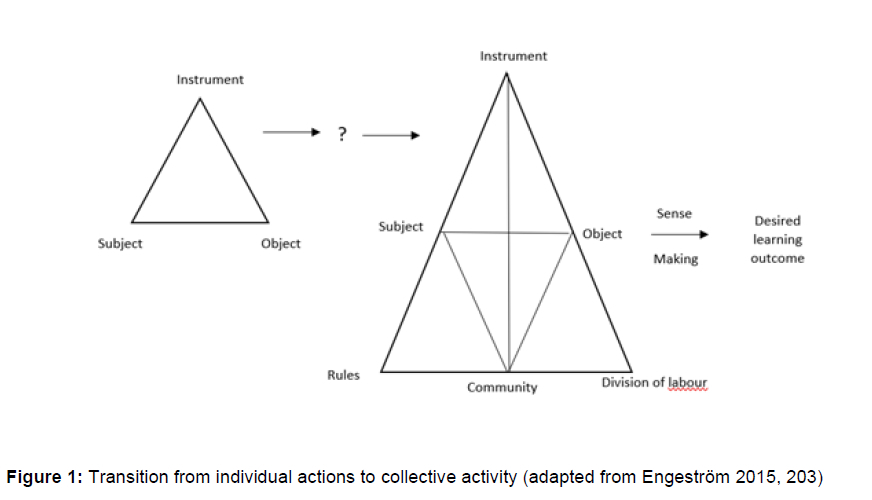
Activity theory (AT) has been extensively used as a framework to study innovations in many disciplines and settings (Karasavvidis 2009). However, as far as can be ascertained, there has been no application of AT in a Covid-19 setting within a hybrid and international collaborative offering for EEd that involves student teachers. The research design is therefore couched within AT as conceptual framework. The main unit of analysis in AT is the activity system, which is defined as: "Object oriented, collective, and culturally mediated human activity" (Engeström et al. 1999, 19). Drawing from Engeström's (2015, 203) transition from individual actions indicated on the left in Figure 1 to collective activity depicted on the right.
The concept of "Instrument" refers to the use of tools or signs which are underpinned by a motive. The "Subject" in an activity system is the individual or group whose viewpoint is adopted and "Object" refers to the raw material or problem space at which the activity is directed.
In the first triangle in Figure 1, the subject remains individual, and the object remains the same from the start to the end, which indicates no structural expansion of the corners of the triangle (Engeström 2015). Furthermore, there is also no extension of the subject (from individual to community coexisting within specific rules) and object interaction (such as stakeholders who have specific roles) are, where artifacts can be mediated which could lead to a sense-making process before the desired output is materialised. According to Engeström (2001), when the desired outcome is the realisation of a collective activity system, the following should be taken into consideration:
1) rules by which activities are executed. Explicit rules are, for example, policy requirements for the PGCE programme in terms of evaluation and assessment for STEP, and the rules within the school environment for the YEP. Implicit rules could be the social norms or conventions within the South African context which impact on effective EEd;
2) community refers to the subjects (student teachers, Dutch students, and the facilitator) and the tools used within the online space to mediate teaching and learning. The community in this project will be all the stakeholders of the YEP and STEP;
3) division of labour refers to the specific roles of the participants within the activity and how these roles are implemented, by means of collaboration, instructional tools and pedagogy, to reach the desired outcome.
The research design is an interpretive, qualitative approach of the analysis of data from three sets of participants: 27 South African student teachers (from 2021 and 2022), 6 Dutch business students and 1 project facilitator. The student teachers had to work in pairs, except for two groups who had three members because of late registration. Given the small size of the participants, the intention was not to generalise from the data, but to draw attention to the way that collaborative international relationships can be forged by using technology in EEd. The student teachers and Dutch students were given 21 and 16 open-ended online questions respectively, whereas the researchers conducted a semi-structured one-hour Teams interview with the facilitator. The questions for all three sets of respondents ranged from their interactions with the project and ultimately making recommendations for improvement. Another key issue was the degree to which they view the collaborative process of EEd as valuable, especially within an online space. The design of the online and interview questions was informed by Engeström's (2015) activity theory approach and Antoniadou's (2011, 236) activity system of the transatlantic exchange.
Ethical clearance was obtained from the host university. The responses by the Dutch students were sent via email, the student teachers' responses were uploaded on the institution's learning management system, called SunLearn. The facilitator's interview was recorded on Teams, transcribed, checked, and analysed. All the data were saved on a password-protected hard drive and backed up on a cloud, called OneDrive. Both researchers had access to the data.
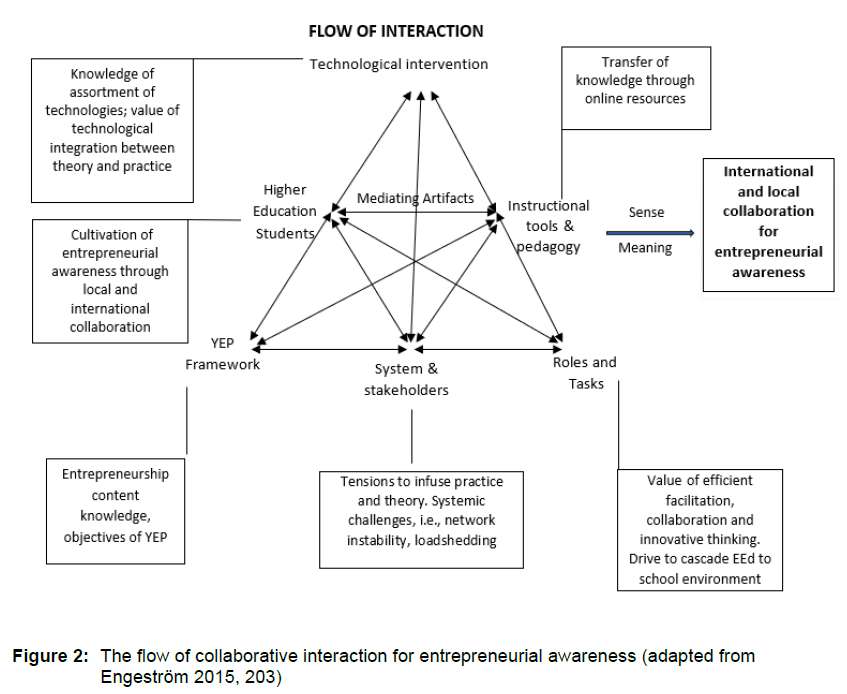
Thematic data analysis was done by using activity theory as a lens and coding the respondents as student teachers (ST), facilitator (F), and the Dutch students (DS). In using activity theory, themes developed to answer the research questions: a) How can interactive collaboration for EEd occur in the context of student teachers? and b) How are the various participants in this study influenced by the flow of interactions within the activities of cultivating entrepreneurial awareness? We identified a flow of interactions between the subject (three sets of participants), object (the interaction with the instructional tools and pedagogy) and the instruments (the technological tools which the students engaged with). Because of the collaborative nature of the interaction between these three entities, there was a natural expansion to how they interacted, e.g., with the EEd curriculum (rules), systemic factors and other stakeholders (community) and how they perceived their roles and tasks (division of labour). Given the expansion of collective activity, some tension is expected, such as systemic and technological disruptions, as indicated by Barab et al. (2002). These tensions, disruptions, virtual disturbance are important because they could lead to positive change and development (Engeström 2001) and as illustrated in the discussion below on the collaborative engagement with instructional tools that can lead to entrepreneurial awareness. In enhancing the reliability and integrity of our research, we ensured that cross-checks of the data were undertaken by the researchers, and that the data be securely archived.
FINDINGS AND DISCUSSION
In using activity theory as a conceptual framework, six themes emerged to answer the research questions related to how interactive collaboration for EEd occurs and how various participants are influenced by the flow of interactions within the activities of cultivating entrepreneurial awareness.
Using Figure 1 as a foundation, Figure 2 illustrates the flow of interactions within the six themes. These themes include technological intervention (Instrument), impact on higher education students (Subject), YEP framework (Rules), system and stakeholders (Community), roles and tasks (Division of Labour), and instructional tools and pedagogy (Object).
Technological intervention
The creation of online resources by using technological tools in this project was generally regarded as a strength. According to the facilitator, using these tools was necessary because of Covid-19 and the assistance YEP and STEP provided to the teachers, adding that "the more we can alleviate the workload from the teachers that would help a lot" (F). Furthermore, the facilitator is of the view that given the YEP new online strategy,
"these videos were actually the foundation of the whole project. Without them ... it would have been much harder to try to teach this material ... I think the videos are very, very useful for the YEP project ... they contributed a lot to the learners, increased understanding of what we do" (F).
The data suggest that using videos as pedagogical tools has merit. This finding is corroborated by Fyfield (2022), Smith and Suzuki (2015), Abeysekera and Dawson (2015), De Koning et al. (2019) and Henderson et al. (2015). However, as observed, it appears that tools can also hinder or disrupt the transformation process from achieving its desired outcomes. Some student teachers felt unsure and thrown in the deep end, specifically in terms of the technology itself, and said "to work with someone in an online environment I have never met before is a nerve-wracking idea" (ST19). Some had never created videos before, let alone for mandatory assessment purposes for the PGCE module and under strict time constraints. Comments such as:
"... sticking to the submission deadline on the institutions LMS was a difficult challenge ... tricky
... had problem when compressing the video too small .... Also, the issue with loadshedding ... " (ST4).
"... using the Wi-Fi at the campus or using the night data to get my work done. This sometimes meant that I would wake up at midnight to use the night data that was allocated to us by the university" (ST20).
It appears that the mediation of the tools created some tension for the student teachers, which relates to Antoniadou's (2011) point that obstacles inevitably emerge in every endeavour to promote transformation. Despite feeling overwhelmed, most of the student teachers regarded the assignment as valuable, making comments such as "I have learnt new skills from my partner
.... since the assignment, I have used such software in other group assignments in the online environment" (ST13).
In line with theory that indicates that instructional technologies can be varied and effective, DS5 states that "the whole idea was great ... we convinced them to use a website ... rather than an app". Overall, the outcome of the technological intervention in this collaboration proved to have value in narrowing the theory-practice gap, as also noted by Mapundu and Musura (2019) and Fyfield (2022), because of its potential to integrate skills-based knowledge with the application of instructional technology.
Impact on higher education students
The answer to the question of whether higher education students can play a role in cultivating entrepreneurship was evident as participants were receptive to taking on a responsibility which could add value in this process. The researchers' idea of their role in "planting a seed" resonated specifically with the facilitator, who stated:
"... if the objective is to plant the seed and we're talking about other inspirational or other materials that the education students can provide, I think anything ... to help get the seed planted" (F).
The Dutch students indicated that the collaboration added value "to the programme because it allows both sides of the world to interact and learn" (DS5). The Dutch students unanimously responded that they had built up very good relationships with the learners whom they referred to as "very polite individuals, no one was rude neither disrespectful during the whole process" (DS5) and some even reported to have had fun during the process. The student teachers' reflections on cascading the interconnectedness of theory and practice down to school level, highlighted the need to be part of this initiative:
"Overall, this was a very insightful assignment ... it was a practical experience; rather than just learning about theory of teaching, we could actually start and do and learn from doing. This shows us how the theory is blended with the practical" (ST8).
"... being able to learn and use new technical skills that I was not familiar with before ... I feel that I am confident to create future projects in this format" (ST20).
These comments are in line with Mapundu and Musara's (2019) stance that collaboration is about effective communication, groupwork and the sharing of ideas which could lead to a more fulfilled experience. In a mixed group of three, one student saw the diversity in a positive light by commenting
"our lesson plans and videos are a collaboration of three different minds coming together to produce one thing. The racial, gender, nationality and age diversity makes the content we have made unique views brought together ..." (ST27).
In contrast, the nature of the collaboration for this project created some tensions for a few student teachers. Barab et al. (2002) conceptualised tension as system dualities; some students were either for or against: groupwork versus individual work, or face-to-face versus online. One student teacher felt that a face-to-face environment would have been more conducive to engagement in such a creative assignment, stating that "I did not like working with a partner in an online environment whom I did not know on a project which required collaboration" (ST3). Most of the student teachers initially did not like to work in pairs with a stranger, but soon realised that "it was easier to work together on this project and to share different points of view" (ST2). One student commented that whilst she preferred working alone, she acknowledged that when "I enter the workforce ... teamwork is crucial" (ST21). Through STEP, they were compelled quite early in the course to consult the school curriculum for Business Studies, an exposure which they welcomed with comments like "I went through the entire grade outline in the CAPS document to determine how the topic builds on. This was a great way to familiarising me with the blueprint that needs to be taught" (ST21). Warhuus et al. (2016) remind us that team formation as a teaching tool can be actively used to cement content and pedagogical knowledge.
YEP framework and content knowledge
The YEP framework and objectives served as the rules according to which the activity is executed (Engeström 2001). Most of the participants viewed the YEP booklet applicable for Grade 10 irrespective of the learner's subject choice, which is line with the argument of Kirby (2007) that the cultivation of an entrepreneurial orientation should not be reserved only for those learners with business-related subjects. Most student teachers felt that the project should be extended to include topics such as creativity, digital literacy skills, SWOT analysis, sustainability, ethics, budgeting, compound interest and tax. One student teacher viewed the understanding of the concept "credit score" (not included in YEP) as important stating that "after being abroad for quite some time and not having proof of credit, it was a shock to learn that I had to make debt to get debt. What a confusing concept" (ST5). Student teachers also acknowledged that they had to do additional research to prepare lesson plans and videos, in addition to the YEP booklet, class notes, curriculum policy document, internet, and school textbooks. If one heeds the call by Steenekamp, Van der Merwe, and Athayde (2011) for a tailor-made entrepreneurship training programme in South African schools, then the student teachers highlighted the limitations of the YEP framework. In contrast, the facilitator reported that YEP objectives worked well for the student teachers:
"the YEP booklet ensured that there was no confusion, so content wise I think we worked with a solid plan and I think your students carried it through and they delivered very well ... they had to condense a lot of theory into a time frame of 10 to 15 minutes so that's not an easy task ... your students did a really good job here" (F).
Regarding the entry-level knowledge of the learners, the responses of the Dutch students were mixed, ranging from basic to very good knowledge of the topics:
"I was surprised by how much these high school students already know" (DS4),
"Their knowledge was very minimum based on my first impression. They didn't think their plan sufficiently enough, but it was expected because it was something new for them" (DS5).
One Dutch student also referred to the mismatch between being driven, which is a good characteristic to have as an entrepreneur, but lacking skills such as "selling and managing" (DS2). This mixed reaction about the prior knowledge of the Grade 10s could indicate that Grade 9 EMS at school level where entrepreneurship content is taught may not be applied equally across all South African schools. The GEM report acknowledges that there is a low score for EEd and training in primary and high schools in South Africa (Herrington et al. 2017).
System and stakeholders
This project had to take into consideration the community within which the participants operate, which is made up of a particular system with a range of stakeholders (Engeström 2001). Because of national and international collaboration, the variety of stakeholders presented a challenge to the facilitator, as she was the glue that held everything together and ensured that the flow of interactions was complementary. In addition, within the school system the teachers face time constraints because of their workload, which placed additional pressure on the facilitator. With the introduction of STEP, the facilitator was of the view that
"if we had not given complete lessons sets in one way or another, I doubt that they (schoolteachers) would have been able to participate in the course because they have so [much] extra work to do" (F).
Systemic tensions were quite evident in because of network instability, loadshedding and general technological challenges for the students and learners such as uploading the videos, adding voiceovers, access, limited data and bandwidth. Although technologically orientated tools for EEd can result in positive change as posited by Mapundu and Musara (2019), systemic technological disruptions, such as network instability and loadshedding could set back learning.
Some student teachers commented that "working with Teams and Zoom was challenging at first, but thereafter we used a variety of tools such as WhatsApp, Google docs, etc." (ST1). The ambivalence of student teachers as they entered the project was obvious as many had neither the experience in their undergraduate studies, nor the expectation of the PGCE to integrate theory and practice in such a creative, and collaborative yet structured project and programme.
Central to the activity system is culturally mediated human activity which coincides with an object (tools and images) and collaboration (Engeström et al. 1999). Another systemic challenge is that South Africa is a multilingual country with 11 official languages. Regarding the question of possible translation of the online resources into other languages, most participants agreed that "when we are being taught in a language we fully understand, our performance will improve" (ST1). For the facilitator this was a difficult question, since it would raise a real dilemma of reach vs depth of the project:
"do we make it a big-scale project where we reach a lot of learners, and afterwards they complete the project and that is it? Or do we stick to a small group and make sure that we take them further? That's really a complex question and I feel like translations ties into that" (F).
The Dutch students saw themselves as stakeholders, which is in congruence with the view of Bischoff et al. (2018), who see mentoring as one of the most common types of stakeholder involvement in EEd. Another Dutch student however, felt that she could have done more and referred to externalities beyond her control
"I think my team did great, they came 3rd place, but I believe I could have done more as a mentor. I think the time difference, not strong WiFi and I am currently busy with my internship has an effect on my mentorship skills" (DS6).
The above responses seem to reflect the finding in Bischoff et al. (2018) that little attention has been paid in theory and in practice to establishing structured approaches to managing stakeholder relationships in EEd in higher education institutions.
Roles and tasks
Engeström (2001) refers to the division of labour as the tasks and roles assigned to the members of the community. The Dutch students commented on the value of international collaboration and found the interaction and mentoring process valuable, suggesting that diverse teams are better at developing ideas and that they found the process "fascinating" (D5). They took their role as mentors seriously and reported an average of 15 hours to 40 hours of mentoring over two weeks, even though there was no strict time scheduling or structure. Their time spent on mentoring would include preparation time for the sessions, feedback, presentation, dealing with questions and preparing the leaners with presentation skills for pitching day. One Dutch student stated: "We engaged on WhatsApp almost every day; we emailed each other before and after the meeting ... each session was at different hours" (DS6). Based on the views of the Dutch students, there seemed to have been a reciprocal relationship because not only did the learners gain confidence during the process, but most of the Dutch students also gained a new perspective about their role in the world:
"... I met people from the other side of the world, and I had such a good relationship with the other (South African) mentor, which I am really thankful for. The students also inspired me to be motivated and work hard. Overall, I just loved it" (DS1).
"I really enjoyed this project and will join these kinds of projects more often ... as Bill Gates says, 'Everyone needs a coach'. After seeing the progress made with the kids, I realised I need a coach as well" (DS2).
Many of the student teachers already see themselves in their role as teachers with comments like "It would have been great to get a chance to actually present our lessons and work directly with the learners" (ST6).
The facilitator re-evaluated her role and stated that the mentors needed clearer structure in future when having to teach learners how to work and present online. She referred to issues such as "make sure that they position themselves in front of the camera ... make sure that the microphone picks up their voices ..." (F).
The above responses suggest that the participants' forms of involvement (roles), needs and relationships offer a systemic perspective on EEd, as proposed by Bischoff et al. (2018).
Instructional tools and pedagogy
The creation and the pedagogy applied in using online resources for instruction is the object which Engeström (2001) refers to as the problem space at which the activity is directed and which must be transformed with the help of tools. In creating these resources, student teachers received weekly feedback from the teacher educator and the facilitator. Once in the six-week period the students did not receive their feedback before their next submission because of unforeseen circumstances. Apart from this criticism about the delayed feedback, the general impression of students was that the feedback was useful and that the assessment rubric was sufficient in depth and breadth with detailed explanations. Similarly, apart from their apprehension at first in working online with a partner they did not know, some ended up reflecting on this collaboration as a highlight of the project; "the best highlight for me was the group meetings with my partner" (ST4), signifying the benefit of collaborative relationships that Bischoff et al. (2018) and Warhuus et al. (2017) refer to. The evidence of the success of the theory-practice blend was reflected by the facilitator who was impressed by the quality, relevance, originality and creativity of the online activities which the student teachers created. She further claimed that the timeframe and pacing of the project were for her "the sweet spot
... I thought the pace and the time frame was perfect. We gave them a week to work on each ... from a YEP facilitator perspective that worked really well" (F).
The Dutch students' impression of the learners' presentations was that they were "really good" (DS1), and that they "did an excellent job in such a little time" (DS3). They also commented on the boost in confidence on the part of the learners over the duration of the project:
"it definitely improved ... during pitching day I was blown away by how confident and well she did" (DS1),
"After everything we had been through together, I think that their confidence increased sharply" (DS3).
This improved confidence could indicate that the instructional tools and pedagogy which the mentors applied motivated the learners to do better, which Engeström (1987) referred to as the premise of activity theory: activity is initiated by a motive which spurs on an action. On the other hand, such action was curtailed by some of the Dutch students in performing their mentor role optimally by indicating that "compared to other presentations the level was lower" (DS2). Also having a group of six learners to mentor made it challenging to "go deeper into the material" online (DS2). Working within an online space, required a different skill set on the part of the mentors.
CONCLUSION
Given the limited literature on structured collaboration across faculty and international borders related to student teacher and school contexts for EEd, this study can add value in cultivating entrepreneurship awareness. The cross-faculty collaboration specifically, presents opportunities for expanding traditional pedagogies for EEd in higher education within the South African context, whereby learning could take place through a flow of interaction. By examining collaborative interaction, we extended the discussion to the influence of creating online resources as part the instructional tools and pedagogy adopted by local and international participants. The activity theory perspective gave credence to responding to the two crucial aspects of this research: firstly, how interactive collaboration for EEd can occur in the context of student teachers, and secondly, how the various participants in this study are influenced by the flow of interaction of the activities in cultivating entrepreneurial awareness. Regarding the first aspect, the overall finding is that student teachers viewed their contributions as valuable, albeit with initial apprehension at team level. The more they were exposed to the project, the more they moved away from the "I" to "We" (Warhuus et al. 2017) and started to perceive themselves as educators who can potentially make a difference in cultivating EEd at school level. They experienced the practical implementation of linking theory to practice by using instructional tools. This experience was insightful, gratifying, and valuable.
The second aspect responds to the collaborative interaction of the various stakeholders. From the analysis it was evident that loadshedding and network instability interrupted the flow of interaction. These power outages can have a negative effect on the integration of technology driven projects, specifically in under-resourced schools that cannot afford alternative sources of electricity.
Despite systemic disruptions, the findings underscore an expansion of learning which can occur through a collective activity system (Engeström 2015) and the transfer of knowledge (Ruskovaara 2014). Collaborative work also calls for deep reflection and making sense of the vision of the project, as the stakeholders transition from individual action to collective activity. This transition was evident in the manner the participants responded. Despite their apprehension at first, especially amongst the student teachers, many felt that the experience was valuable and that they learned new interpersonal and technological skills. The most common recommendation for improvement from the student teachers was that they wanted to teach the content and incorporate their online resources themselves. Another recommendation was that they be included in the mentoring process. This would then mean another layer of the project which would have time and logistical implications. Further research in diverse teacher or student teachers and collaborative school contexts in EEd is needed. The project demonstrates how the activity theory can be used to address the theory-practice gap in EEd through local and international collaboration.
The theoretical contribution is the thematic construction derived from the flow of transition from EEd learning to expansion, that is from individual action to collective activity. This article addresses the gap between theory and practice in EEd by proposing a pedagogical approach where collective activity is utilised to enhance EEd. Furthermore, the collaborative interactions and engagement between the subjects, object, and instrument, as envisioned by Engeström (1999; 2015), are expounded in response to the call for more to be done to inculcate practical pedagogies specific to social entrepreneurship (Waghid 2019). Insight into the activities and flow of interactions amongst the stakeholders enables higher education practitioners to develop appropriate guidelines for integrative collaborative endeavours in EEd. Furthermore, this article provides insight into the six flows of interaction amongst stakeholders to guide the integrative collaborative attempt by student teachers in the advancement and efficient facilitation of EEd in future.
ACKNOWLEDGEMENTS
1. Appreciation to Mr Paul Jaspers, University of Applied Science, Högeschool Utrecht, Netherlands for his involvement and providing the background information of YEP.
2. Appreciation to the Fund for Innovation and Research into Learning and Teaching, Stellenbosch University for the financial contribution to this project.
REFERENCES
Abeysekera, Lakmal, and Phillip Dawson. 2015. "Motivation and cognitive load in the flipped classroom: Definition, rationale and a call for research." Higher Education Research & Development 34(1): 1-14. https://doi.org/10.1080/07294360.2014.934336. [ Links ]
Antoniadou, Victoria. 2011. "Using Activity Theory to understand the contradictions in an online transatlantic collaboration between student-teachers of English as a Foreign language." ReCALL 23(3): 233-251. [ Links ]
Barab, Sasha A., Michael Barnett, Lisa Yamagata-Lynch, Kurt Squire, and Thomas Keating. 2002 "Using activity theory to understand the systemic tensions characterizing a technology-rich introductory astronomy course." Mind, Culture, and Activity 9(2): 76-107. [ Links ]
Bischoff, Kathrin, Christine K. Volkmann, and David B. Audretsch. 2018 "Stakeholder collaboration in entrepreneurship education: An analysis of the entrepreneurial ecosystems of European higher educational institutions." The Journal of Technology Transfer 43(1): 20-46. [ Links ]
Bosma, N., S. Hill, A. Ionescu-Somers, D. Kelley, J. Levie, and A. Tarnawa. 2020. 2019/2020 Global Report. The Global Entrepreneurship Research Association (GERA). Global Entrepreneurship Monitor (GEM). [ Links ]
Co, Mary Jesselyn and Mitchell Bruce. 2006. "Entrepreneurship education in South Africa: A nationwide survey." Education + Training 48(5): 348-359. https://doi.org/10.1108/00400910610677054. [ Links ]
DBE see Department of Basic Education.
Department of Basic Education. 2010. Curriculum and Assessment Policy Statement Grades 7-9 Economic and Management Sciences. Department of Basic Education, Pretoria. [ Links ]
Department of Basic Education. 2011. Curriculum and Assessment Policy Statement Grades 10-12 Business Studies. Department of Basic Education, Pretoria. [ Links ]
Department of Basic Education. 2021. E3 - Entrepreneurship, Employability, Education - Learning Model, Pedagogical Paradigms. Department of Basic Education, Pretoria. [ Links ]
De Koning, Björn B., Nadine Marcus, Birgit Brucker, and Paul Ayres. 2019. "Does observing hand actions in animations and static graphics differentially affect learning of hand-manipulative tasks?" Computers & Education 141, 103636. https://doi.org/10.1016/j.compedu.2019.103636. [ Links ]
Engeström, Yrjö. 1987. Learning by expanding: An activity-theoretical approach to developmental research. Helsinki: Orienta-Konsultit. [ Links ]
Engeström, Yrjö. 1999. "Activity theory and individual and social transformation." Perspectives on Activity Theory 19(38): 19-30. [ Links ]
Engeström, Yrjö. 2001. "Expansive learning at work: Toward an activity theoretical reconceptualization." Journal of Education and Work 14(1): 133-156. DOI: 10.1080/13639080020028747. [ Links ]
Engeström, Yrjö. 2015. Learning by expanding: An activity-theoretical approach to developmental research. 2nd Edition. Cambridge: Cambridge University Press. [ Links ]
Engeström, Yrjö, Reijo Miettinen, and Raija-Leena Punamäki-Gitai. (Ed.). 1999. Perspectives on Activity Theory. Cambridge University Press. 19-38 [ Links ]
Fayolle, Alain. 2008. "Entrepreneurship education at a crossroads: Towards a more mature teaching field." Journal of Enterprising Culture 16(04): 325-337. [ Links ]
Fayolle, Alain. 2013. "Personal views on the future of entrepreneurship education." Entrepreneurship & Regional Development 25(7-8): 692-701. http://dx.doi.org/10.1080/08985626.2013.821318. [ Links ]
Fyfield, Matthew. 2022. "YouTube in the secondary classroom: How teachers use instructional videos in mainstream classrooms." Technology, Pedagogy and Education 1(2): 185-197, DOI: 10.1080/1475939X.2021.1980429. [ Links ]
Henderson, Michael, Neil Selwyn, and Rachel Aston. 2015. "What works and why? Student perceptions of 'useful' digital technology in university teaching and learning." Studies in Higher Education 42(8): 1567-1579. https://doi.org/10.1080/03075079.2015.1007946. [ Links ]
Herrington, Mike, P. Kew, and A. Mwanga. 2017. "South Africa Report." https://www.gemconsortium.org/report/gem-south-africa-2016-2017-report. [ Links ]
Jaspers, Paul. 2022. Personal interview, 12 April 2022. Stellenbosch University. [ Links ]
Jones, Brian and Norma Iredale. 2006. "Developing an entrepreneurial life skills summer school." Innovations in Education and Teaching International 43(3): 233-244. [ Links ]
Jones, Brian and Norma Iredale. 2010. "Enterprise education as pedagogy." Education + training. https://doi.org/10.1108/00400911011017654. [ Links ]
Karasavvidis, Ilias. 2009. "Activity theory as a conceptual framework for understanding teacher approaches to information and communication technologies." Computers & Education 53(2): 436-444. [ Links ]
Kirby, David. 2007. "Changing the entrepreneurship education paradigm". In Handbook of research in entrepreneurship education - a general perspective, ed. Alain Fayolle 1: 21-45. Edward Elgar Publishing Limited, UK. [ Links ]
Kirkley, William W. 2017. "Cultivating entrepreneurial behaviour: Entrepreneurship education in secondary schools". Asia Pacific Journal of Innovation and Entrepreneurship11(1): 1737. DOI:10.1108/APJIE-04-2017-018. [ Links ]
Kourilsky, Marilyn and Michael Campbell. 1984. "Sex differences in a simulated classroom economy: Children's beliefs about entrepreneurship." Sex roles 10(1): 53-66. [ Links ]
Lautenschläger, Arndt and Heiko Haase. 2011. "The myth of entrepreneurship education: Seven arguments against teaching business creation at universities." Journal of Entrepreneurship Education 14: 147. [ Links ]
Mapundu, M. and M. Musara. 2019 "E-Portfolios as a tool to enhance student learning experience and entrepreneurial skills." South African Journal of Higher Education 33(6): 191-214. [ Links ]
Ruskovaara, Elena. 2014. "Entrepreneurship education in basic and upper secondary education-measurement and empirical evidence." https://lutpub.lut.fi/bitstream/handle/10024/101021/V%C3%A4ikk%C3%A4ri%20Ruskovaara%20A4.pdf?sequence=2. [ Links ]
Ruskovaara, Elena and Timo Pihkala. 2015. "Entrepreneurship education in schools: Empirical evidence on the teacher's role." The Journal of Educational Research 108(3): 236-249. [ Links ]
Smith, Jim G. and Sawako Suzuki. 2015. "Embedded blended learning within an Algebra classroom: A multimedia capture experiment." Journal of Computer Assisted Learning 31(2): 133-147. https://doi.org/10.1111/jcal.12083. [ Links ]
Statssa, 2022. "Quarterly labour force survey." Quarter 1:2022. https://www.statssa.gov.za/?page_id=1854&PPN=P0211&SCH=73289. [ Links ]
Steenekamp, André Gerard, S. P. van der Merwe, and Rosemary Athayde. 2011. "An investigation into youth entrepreneurship in selected South African secondary schools: An exploratory study." Southern African Business Review 15(3): 46-75. [ Links ]
Waghid, Zayd. 2019. "Examining the business education curricula in South Africa: Towards integrating social entrepreneurship." Education + Training 61(7/8): 940-962. https://doi.org/10.1108/ET-05-2018-0115. [ Links ]
Waghid, Zayd and Henry Oliver. 2017. "Cultivating social entrepreneurial capacities in students through film: Implications for social entrepreneurship education." Educational Research for Social Change 6(2): 76-100. [ Links ]
Warhuus, Jan P., Lene Tanggaard, Sarah Robinson, and Steffen Moltrup Erno. 2017. "From I to We: Collaboration in entrepreneurship education and learning?" Education + Training 59(3): 234-249. [ Links ]