



Services on Demand
Journal

Article
 English (pdf)
 Article in xml format
 Article references
 Automatic translation
 Send this article by e-mail
Indicators
Related links
-
 Cited by Google
 -
 Similars in Google
Share

 Permalink
Journal of Contemporary Management
On-line version ISSN 1815-7440
JCMAN vol.13 n.1 Meyerton 2016
RESEARCH ARTICLES
The influence of Lean thinking on organisational structure and behaviour in the discrete manufacturing industry
H De VriesI; Hm Van Der PollII, *
ISchool for Business Leadership, University of South Africa herbert.d.v.48.3.18@gmail.com
IISchool for Business Leadership, University of South Africa vdpolhm@unisa.ac.za
ABSTRACT
Following a Lean transformation specifically for discrete manufacturing, the organisational structure and behaviour will be profoundly affected. However, how and why this is so has remained unanswered until this research. Lean theory proposes that organisations should restructure along the value stream, however there is no certainty what this implies, and how it can be accomplished. The purpose was to determine new theory that will indicate how and why organisational structures and behaviours will change with Lean transformation. Two discrete manufacturing organisations in South Africa were purposively sampled.
A conceptual framework was utilised at the outset that indicated constructs for the research independent Lean variables and the dependent organisational structure and behaviour variables. Utilising a mixed methodology case study and quantitative multiple linear regression approach, hypotheses and propositions were developed.
The findings confirmed that a flat structure consisting of business units supporting manufacturing cells achieve effective Lean transformations for discrete manufacturing organisations. The components of an effective Lean structure were revealed, as open constructive leadership, an effective Lean champions unit, business units that support linked manufacturing cells led by cell leaders, who cultivate supportive behaviours through cross-functional teamwork and through self-directed work teams who run manufacturing cells or flow support functions.
Key phrases: discrete manufacturing.. Lean thinking; organisational behaviour: organisational structure
1. INTRODUCTION
Lean theory development stretches over four decades, from the Japanese organisation Toyota's turnaround (Ōhno 1988:17-44) in the 1970's and the subsequent study of the Toyota Production System (TPS) in 1990 (Womack & Jones 2007:15-47). This was followed by a clarification of the theory in 1996 (Womack & Jones 2003:15-28). Since inception Western organisations have attempted to emulate Toyota's manufacturing processes to transform their organisations. Although remarkable achievements of organisational transformations with marked organisational performance improvements have been cited (Lander 2007:173-184; Womack & Jones 2003:103-246), the success rates of Lean implementations remain in contention (Cooper 2011:164).
Approaches for Lean success comprise implementation frameworks (Quarterman 2007:14-19), Lean applications such as Heijunka (Jones 2006:29-35), value stream mapping (Lander 2007:528; Rother & Shook 2003:3-105), organisational behavioural issues (Pinheiro 2010:28; Sawhney & Chason 2005:77), management and leadership issues (Johnson 2009:10) and organisational culture (Gander 2009:105).
An extensive literature review spanning the period 2003 to 2015 revealed only two studies dealing directly with Lean implementation and organisational structure (Haug 2008; O'CarroIl 2004) and 14 studies dealing directly with Lean implementation and organisational behaviour.
In this context, the following sections discuss the literature reviewed followed by a discussion of the research problem, concept, questions, and methodology. The findings are discussed and future work suggestions conclude the article.
1.1 Literature review
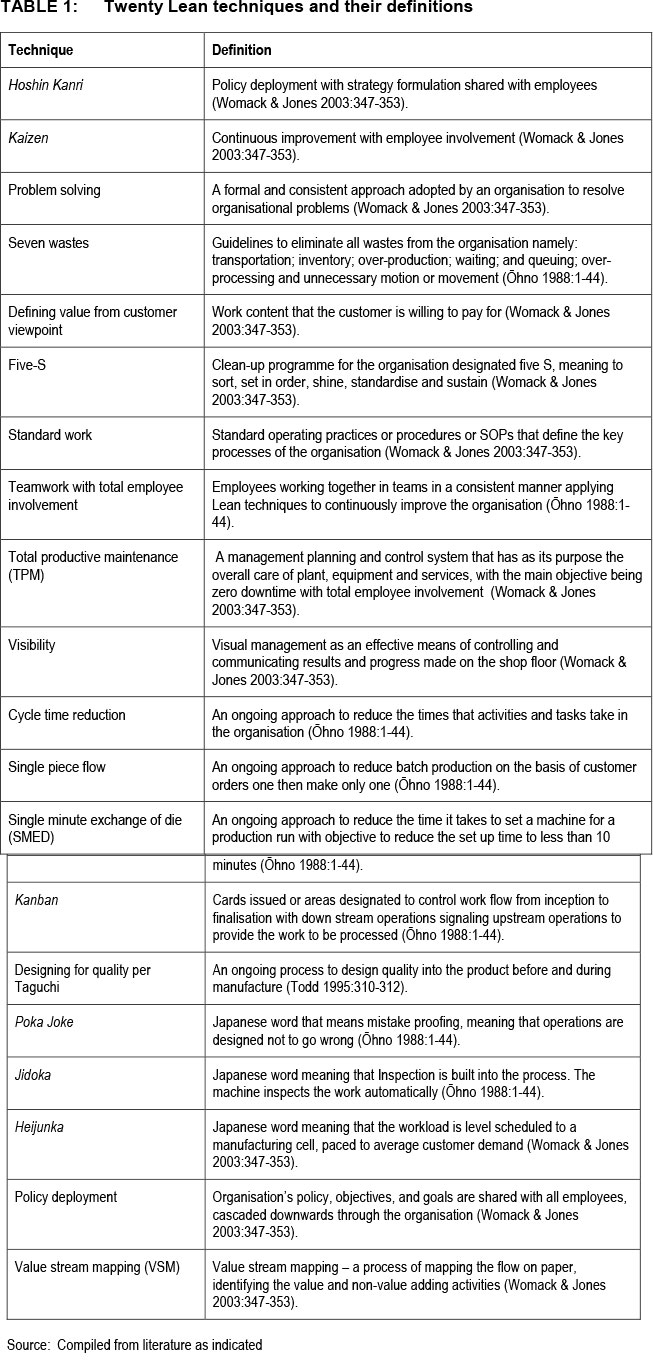
The literature review considers the extent of literature of how a Lean transformation, covering the Lean principles identified by Womack and Jones (2003:15-28) of specifying value, identifying the value stream, creating continuous flow, establishing pull and working to achieve perfection, will affect discrete manufacturing organisational structure and behaviour. For effective Lean transformations twenty Lean techniques have been identified for implementation, based on definitions (Ōhno 1988:1-44; 121-130; Quarterman 2007:14-19; Womack & Jones 2003:347-353). These techniques are defined in Table 1.
These techniques are utilised as independent variables in this research.
1.2 Lean thinking and organisational structure
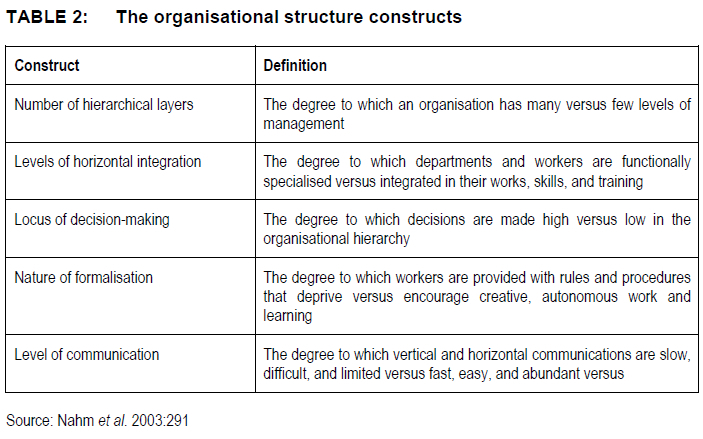
Linking Lean with organisational structure, Nahm, Vonderembse and Koufteros (2003:291), identified five constructs for the organisational structure, namely, the number of hierarchical layers; levels of horizontal integration; locus of decision-making; nature of formalisation and level of communication. This is presented in Table 2.
By analysing Haug's (2008:472) work and considering that Lean organisational structures should be developed along the value stream of the organisation, cellular format (in which the structure is aligned to manufacturing cells, being formally recognised as part of the organisational structure) is added to the constructs (defined characteristics that are measurable in quantitative research)
Organisational functionality is highlighted, characterised by disconnected processes that impede Lean (highly formal departmentalised structures by function that discourage cross functional interaction amongst employees) (Jones, Medien, Merlo, Robertson & Shepherdson 1999:16; Nahm et al. 2003:287; 301; O'Carroli 2004:76; Brown, Collins & McCombs 2006:3: Worley & Doolen 2006:243; Haug 2008:471; Hettler 2008:106), however limited literature may be available regarding a solution on how to restructure a discrete manufacturing organisation during Lean implementation.
Restructuring along the value stream appears to be the best option (Jones et al. 1999:16; Nahm et al. 2003:288; Brown et al. 2006:4; Worley & Doolen 2006:243; Hettler 2008:106; Haug 2008:472). However, how and why this should be done remains unanswered.
By analysing Haug's (2008:472) work and considering that Lean organisational structures should be developed along the value stream of the organisation, cellular format (in which the structure is aligned to manufacturing cells, being formally recognised as part of the organisational structure) is added to the constructs (defined characteristics that are measurable in quantitative research)
Organisational functionality is highlighted, characterised by disconnected processes that impede Lean (highly formal departmentalised structures by function that discourage cross functional interaction amongst employees) (Brown, Collins & McCombs 2006:3; Haug 2008:471; Hettler 2008:106); Jones, Medien, Merlo, Robertson & Shepherdson 1999:16; Nahm et al. 2003:287; 301; O'Carroll 2004:76; Worley & Doolen 2006:243; however limited literature may be available regarding a solution on how to restructure a discrete manufacturing organisation during Lean implementation. Restructuring along the value stream appears to be the best option (Brown et al. 2006:4; Jones et al. 1999:16; Haug 2008:472; Hettler 2008:106; Nahm et al. 2003:288; Worley & Doolen 2006:243). However, how and why this should be done remains unanswered.
1.3 Organisational behaviour and Lean thinking
Some specific organisational behaviours with Lean point to open, free flowing communications (direct involvement and engagement of employees) and affective commitment (i.e. employees becoming so motivated that they contribute actively with own ideas and actions to continuously improve the organisation) (Angelis, Conti, Cooper & Gill 2011: 572; Bhasin 2011:17; 997; Boyle, Scherrer-Rathje & Stuart 2011:587-283; Cameron-Strother 2009:67; Cooper 2011:113; Gagnon 2004:123; Harris 2007:8; Losonci, Demeter & Jenei 2011:31; Pinheiro 2010:37; Poppendieck 2002:7; Sawhney & Chason 2005:77; Shetty 2011:23; 27; Testani & Ramakrishnan 2011:3; Tress & Espinoza 2012:1-5; Worley & Doolen 2006:231) which feature prominently.
Empowerment is highlighted as a success factor of Lean by Poppendieck (2002:7) and Pinheiro (2010:11). Organisational culture was considered an aspect with Lean transformation by Jones et al. (1999:15); Sawhney and Chason (2005:92); and Gander (2009:105) indicated that the organisational culture will change with Lean resulting in management and employees becoming more team oriented and committed.
Cooper (2011:39) identified the following aspects as key to successful Lean implementations: highly capable leadership; communication channels with effective feedback; the development of collaborative relationships between management and employees who are well versed in the practice of change management; and understanding how to effect change of culture. He provides reasons for failure as the dismissive relationships between production and industrial engineering employees, and the senior manufacturing engineer undermining the director of operations and the lack of top management support.
Constructive leadership (i.e. a transformational leadership style which include "Humanistic and Encouraging" behaviours, where the leader is sensitive to the needs of others, and help others learn from their mistakes) features strongly in research by Worley and Doolen (2006:228), Johnson (2009:41) and Testani and Ramakrishnan (2011:3). Tress and Espinoza (2012:3) identified that attitudes change positively as Lean is implemented.
Analysis of the literature revealed eight possible constructs as dependent organisational behaviour variables, namely: awareness of a Lean vision, mission values, and organisational goals (Bhasin 2011:17, 997) communication of Lean methodology (Cooper 2011:39): acknowledge of process (Cooper 2011:39); commitment (Angelis et al. 2011:572; attitude (Tress & Espinoza 2012:3); and respect (Lander 2007:42).
2. RESEARCH PROBLEM
Major uncertainties exist surrounding the question of how discrete manufacturing organisations will be affected once a Lean transformational strategy has been adopted by such organisations. These organisations may be affected in terms of its organisational structure and behaviour; however, a gap exists in the theory.
2.1 Research concept
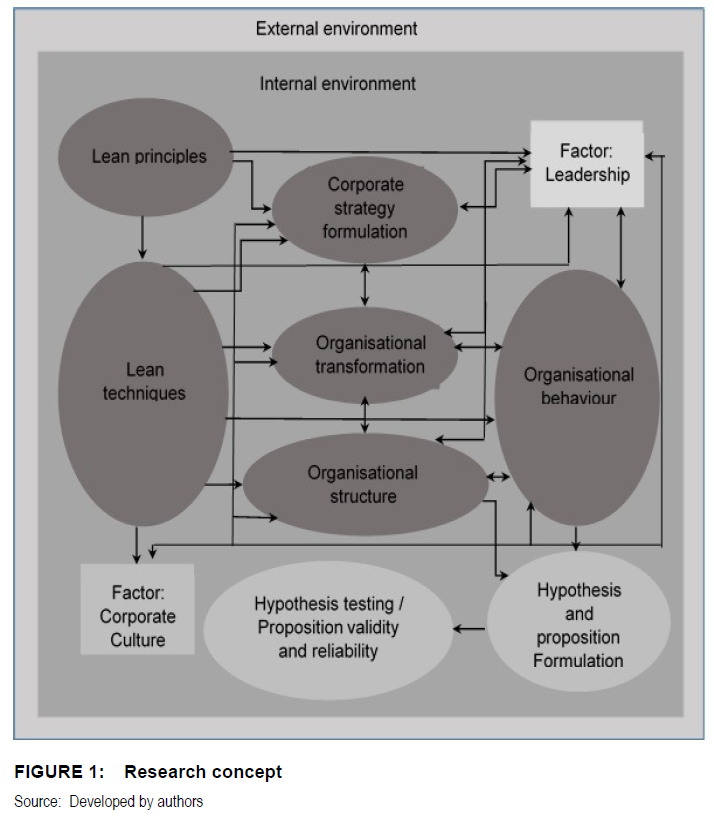
The research concept as illustrated in Figure 1 where derived from the problem area, the influencing factors, and variables identified from the literature. Figure 1 shows that Lean principles and techniques impact corporate strategy, the organisational transformation, and organisational structure and behaviour. The concept provides for hypotheses and propositions generation. Factors of leadership and corporate culture are accounted.
2.2 Research questions
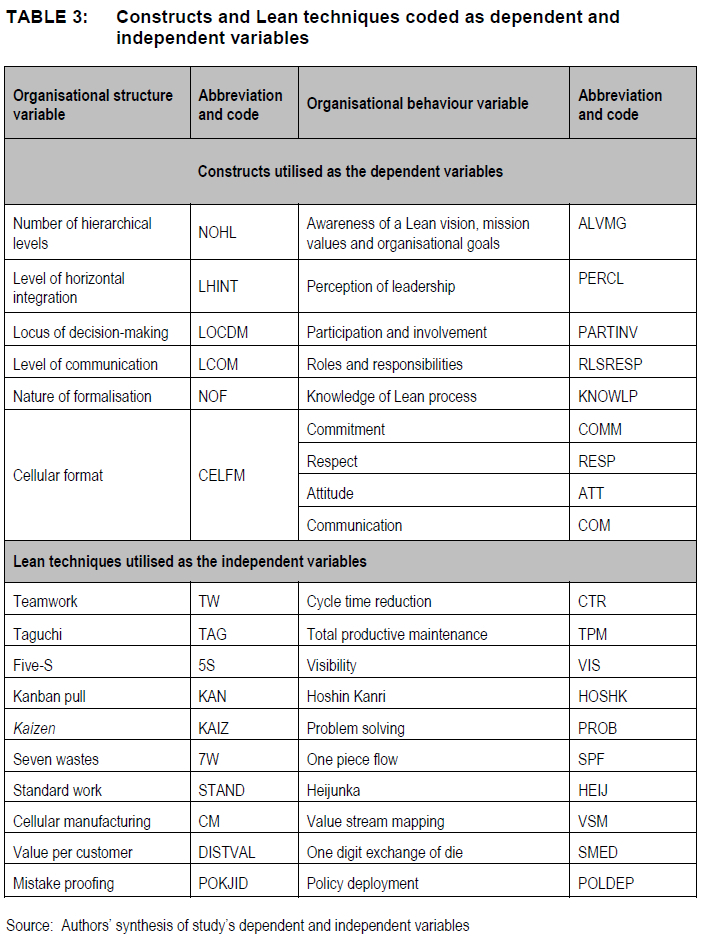
The research sub-questions are discussed in terms of the proposition generation in Table 3.
The main research questions pertaining specifically to discrete manufacturing organisations were: how and why are the organisational structure and behaviour significantly influenced by Lean implementation?
2.3 Research methodology
A purposively sampled, mixed method case study methodology was utilised in this research. Two discrete manufacturing organisations were selected.
One hundred and thirty-six individuals were interviewed from senior, middle, and operational management as well as non-management. Interviewees participated in both the qualitative case study research and the quantitative research. In utilising the mixed method methodology, a quantitative analysis was done along with the case study qualitative approach, as proposed by King, Keohane, and Verba (1994:3).
Three five point Likert-scale questionnaires were used to obtain the quantitative data from the participants. The interrelationships of Lean techniques as the independent variable influencing organisational structure and behaviour as the dependent variables were observed, and multiple linear regression analysis was utilised to determine the pertinent interrelationships.
Structured questionnaires for the same groups of participants based on the same variables were used for the qualitative research. Pattern matching methodology as in Yin (2014:60) was utilised to evaluate the propositions developed for the research.
The quantitative data is relevant only to the two selected cases and is not regarded as generalizable. Preparing for multiple linear regression Table 3 shows the developed dependent and independent variables.
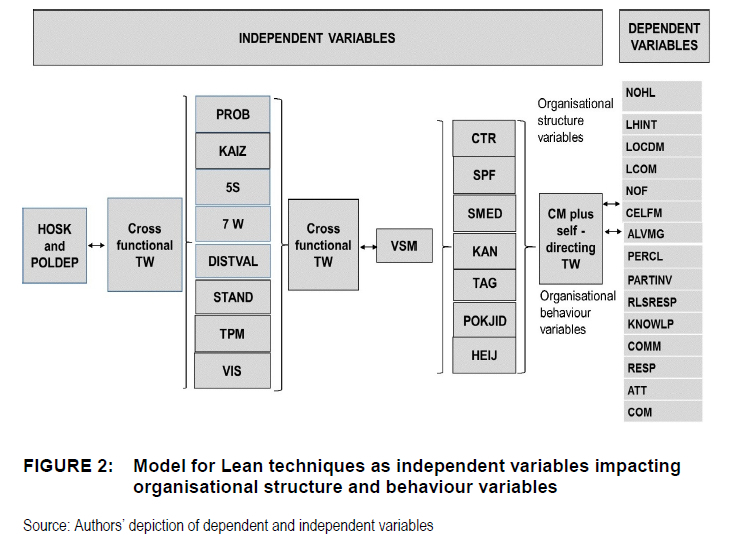
The coding in Table 3 was used with a multiple regression analyses utilising the model per Figure 2.
Figure 2 identifies the expected approach from left to right that organisations will follow with Lean implementation, commencing with goal setting, teamwork and progressing to full flow and pull through cellular manufacturing. Lean will impact the dependent variables such as number of hierarchical levels with other variables to be added in analysis.
The main hypothesis states that: The implementation of Lean thinking will transform the organisation and influence the organisational structure and behaviour.
The null hypothesis states that: The implementation of Lean thinking will not affect the organisational structure and behaviour.
The following are the sub-hypotheses, codes S for structure and B for behaviour:
■ HYPS1 the degree of horizontal integration will increase as progress is made with Lean implementation.
o HYPS 1.1 the degree of horizontal integration will improve with more complex Lean technique introductions such as Taguchi, cycle time reduction, value stream mapping, SMED, one piece flow, Kanban, cellular manufacturing, and Heijunka.
o HYPS 1.2 the higher the level of horizontal integration, the higher the level of teamwork and employee involvement.
■ HYPS2 the number of organisational levels will decrease as cross-functional teams work more actively and frequently to create a continuous flow into manufacturing cells.
o HYPS2.1 the number of organisational levels will decrease as employees become more involved, increasing their skills in Lean.
■ HYPS3 the locus of decision-making will decrease as more cross-functional teams achieve effective flow through SMED and cellular manufacturing;
■ HYPS4 the nature of formalisation will be towards detailed work instructions building to effective standard operating procedures but changed, updated and improved by empowered cross-functional teams.
■ HYPS5 the levels of communication will improve in speed and accuracy as Lean implementation progresses towards effective flow through cellular manufacturing.
■ HYPS6 the organisation will achieve a complete transformation to a cellular format with full Lean implementation, which will lead to flatter organisational structures.
■ HYPB1 the awareness of vision, values, mission, goals, and objectives will increase with more awareness and understanding of problem-solving, Kaizen, 5S, Hoshin Kami, and policy deployment.
■ HYPB2 employee participation will increase with more emphasis on flow creation through cycle time reduction, SMED, value stream mapping, one piece flow, Kanban and Heijunka;
■ HYPB3 communications will improve with frequency and clarity of Lean process.
■ HYPB4 leadership will be challenged as more Lean techniques are introduced.
■ HYPB5 roles and responsibilities will be clarified with the Lean implementations of standard work, waste elimination, 5S, Kaizen, problem-solving and even more with flow creation.
■ HYPB6 employees will feel more respected with team work and the participation in finding solutions to implement flow.
■ HYPB7 knowledge of Lean will improve with experience, training, and development of employees.
■ HYPB8 motivations measured in terms of attitudes will be challenged with Lean implementation but will improve with Lean successes.
■ HYPB9 Commitments will be challenged with Lean implementation but will improve with employee involvement, teamwork and Lean successes.
Utilising regression analysis yielded the R, R2 and die F statistic. The b coefficients of the independent variables provided the nature of the relationships.
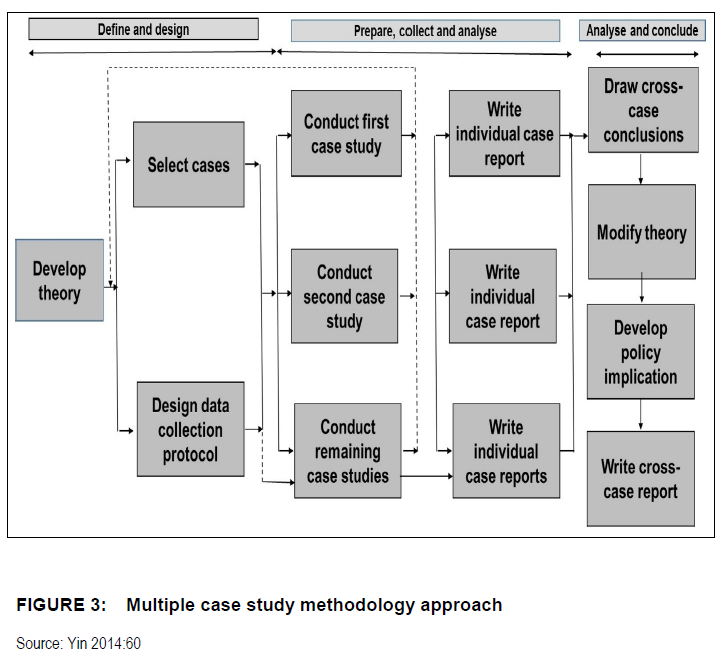
The qualitative dimension of the research methods followed Yin's (2014) model as explained in Figure 3.
Figure 3 shows the steps followed for multiple case study research, commencing with a pilot study, expanding into the second and third case study, and concluding with a cross-case report. Two cases were analysed in this research.
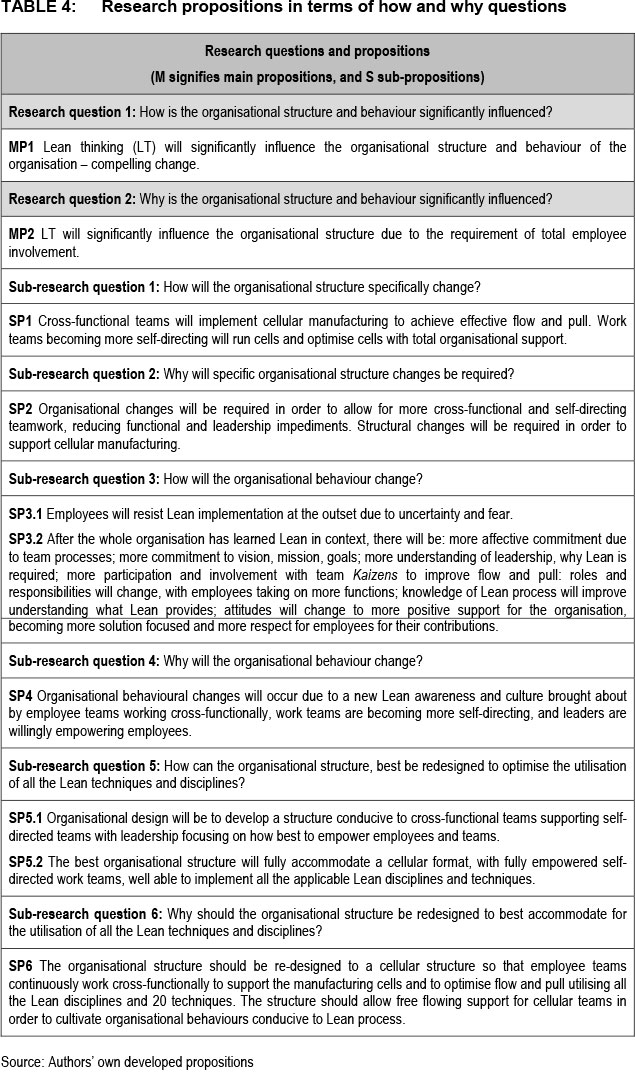
Based on the literature review and the model (Figure 2), the research propositions were developed in terms of the research questions (Table 4).
Table 4 provides the research propositions utilised to develop patterns from the qualitative case study.
2.4 Validity and reliability
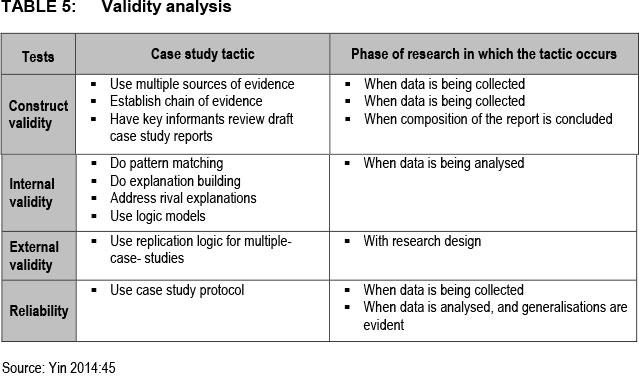
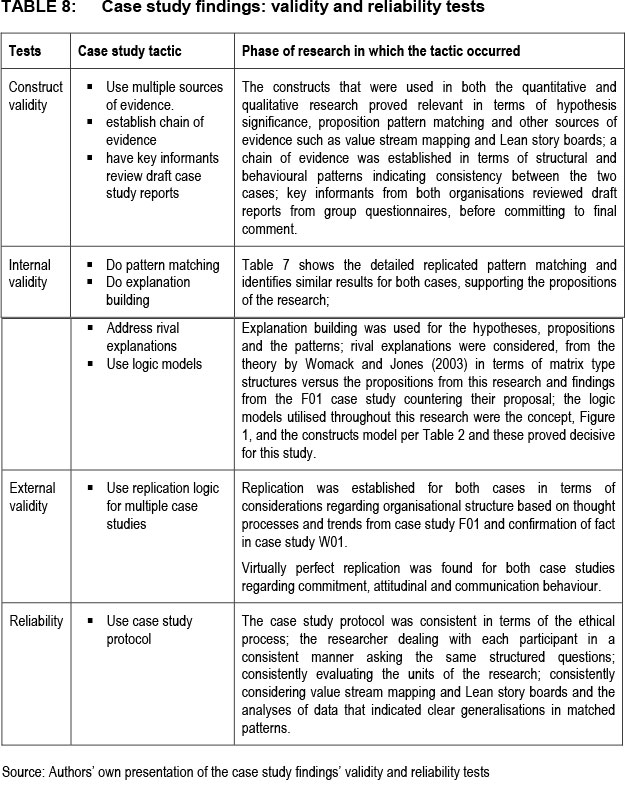
Yin's (2014) validity method was extensively utilised as summarised in Table 5. The table shows that validity for case studies consist of construct, internal and external validity testing. Reliability testing involves consistency in protocol which was detailed for this research.
Table 5 was employed to test the reliability and validity of the results and findings of the research.
3. FINDINGS AND IMPLICATIONS
The findings and implications are discussed in the following sections dealing with the quantitative multiple regression analyses and the qualitative multiple case study.
3.1 Quantitative analysis
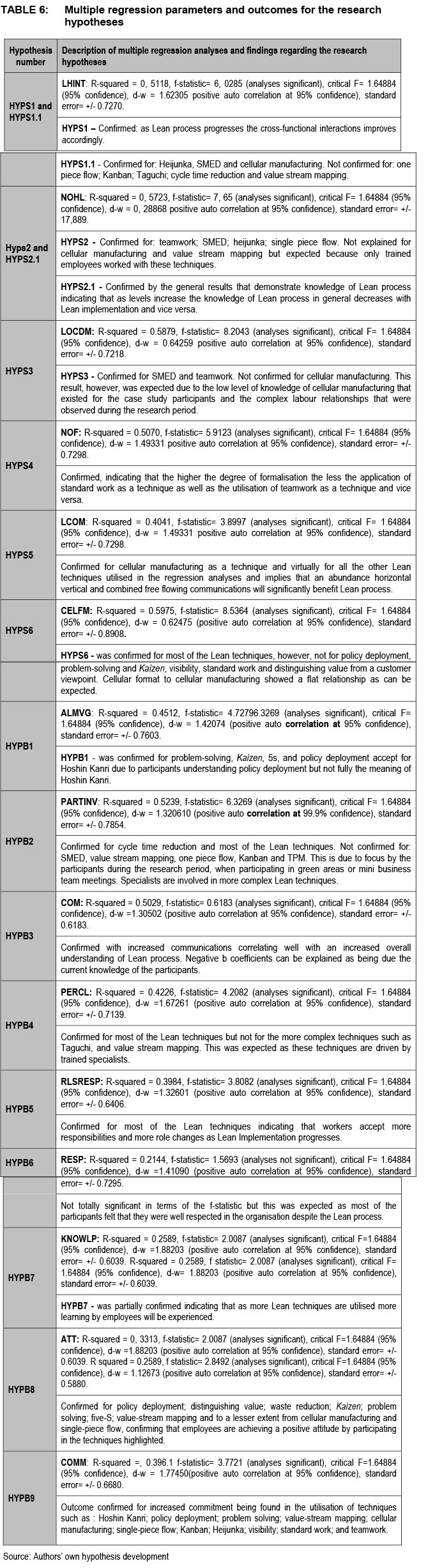
A multiple regression analysis was run for each of the dependent organisational structure and behavioural variables. The outcomes are analysed and discussed in terms of the identified hypotheses per Table 6.
The above analyses indicate significance for the hypotheses with explainable exceptions. The constructs were also utilised for the qualitative research and provided support for multiple case study construct validity required for the qualitative analyses.
3.2 Qualitative analysis
The two purposively selected cases are discussed next, followed by the qualitative process and analyses.
3.2.1 Case study F01
FOI is a pump engineering US listed organisation with 2,700 employees worldwide and about 150 in South Africa. Up to 2006, the company acted as traders of electric motors, pumps and spares in South Africa, but has since become a manufacturing organisation through purchasing a going concern that belonged to the South African engineering group.
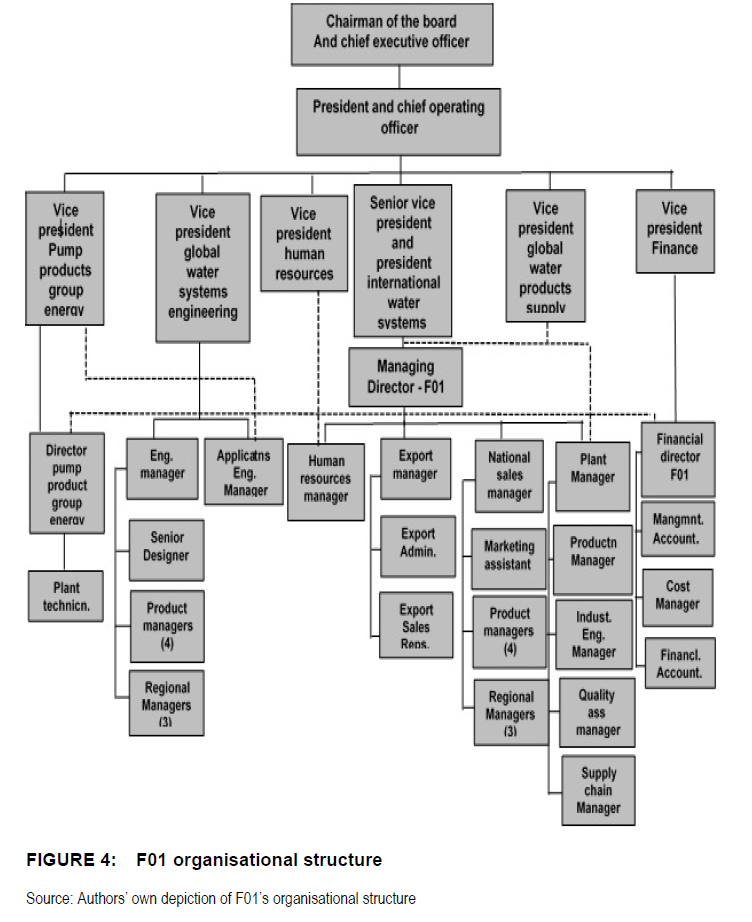
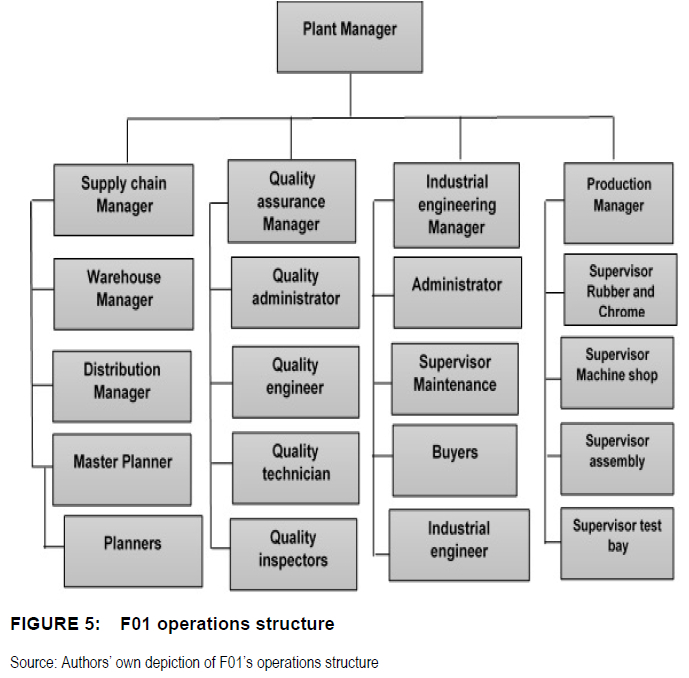
The current facility on the East Rand consists of three factories: a machine shop, rubber and chroming plants. Under the influence of the US management (parent company) (Plant manager F01 2014) F01) adopted a Lean transformational strategy, replacing the current managing director; plant, engineering, and export managers some two years ago with individuals whom have an appreciation for Lean thinking Since September 2012, the plant manager fulfilled a key role for driving the Lean initiative. The F01 organisation utilises a matrix structure for the worldwide organisation (Figure 4) with the detailed operations structure (Figure 5).
The above figures show the reporting relationships for F01 with dotted lines indicating matrix organisational structure relationships. After a substantial five-S campaign, the organisation is focused on establishing manufacturing cells for the total facility including warehouse and distribution. Substantial progress has been made with a rubber, rotor, and assembly cell.
Currently, employees have received training in Lean thinking up to supervisor level. Some employees from sales, export, engineering, warehouse and distribution, received Lean exposure by participating in cross-functional Kaizen teams, facilitated by the US Kaizen team consisting of Lean specialists from the parent organisation.
Figures 4 and 5 show the reporting relationships for F01 with dotted lines indicating matrix organisational structure relationships. After a substantial five-S campaign, the organisation is focused on establishing manufacturing cells for the total facility including warehouse and distribution. Substantial progress has been made with a rubber, rotor, and assembly cell.
Currently, employees have received training in Lean thinking up to supervisor level. Some employees from sales, export, engineering, warehouse and distribution, received Lean exposure by participating in cross-functional Kaizen teams, facilitated by the US Kaizen team consisting of Lean specialists from the parent organisation.
3.2.2 Case study W01
WOl is the largest aluminium extrusion organisation in Africa, owned by a large investment organisation listed on the JSE. The organisation has a large East Rand facility employing 1,100 and comprises an Aluminium extrusion, scrap, and binning plant; re-melt plant; powder coating plant and an anodising plant. Following major restructuring in 1998, the organisation adopted a Lean initiative in 2002 in the form of the 20 keys process (Kobayashi 1995: 213). Five-S was utilised to clean up the organisation, and all the employees were involved in the exercise.
The total organisation has been set up as a continuous flow line: the binning operation supplies the re-melt manufacturing cell which in turn supplies the extrusion manufacturing cells of four press extrusion lines. The extrusion operation supplies the anodising and powder coating manufacturing cells.
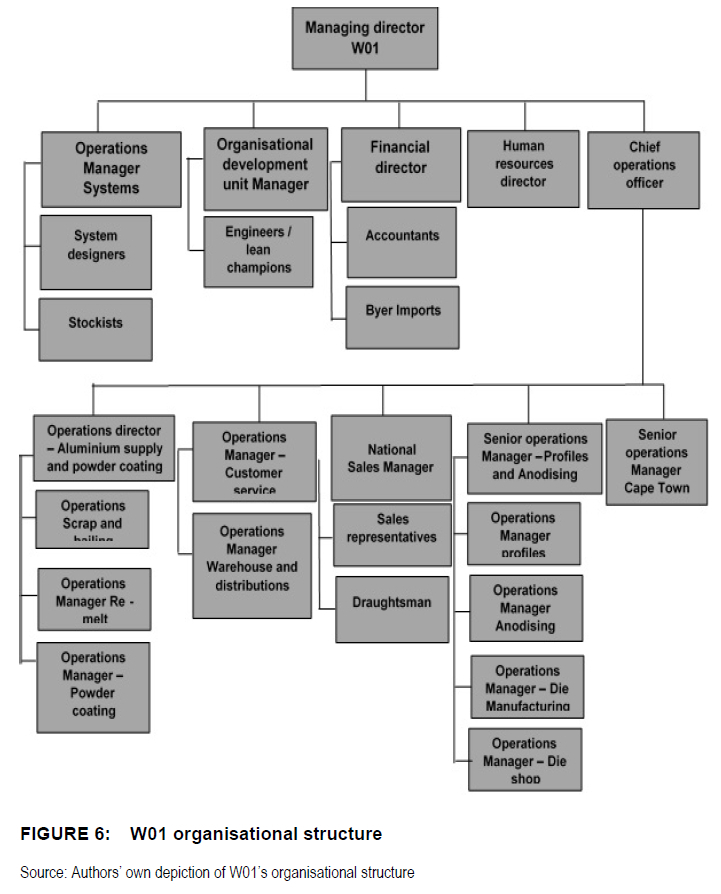
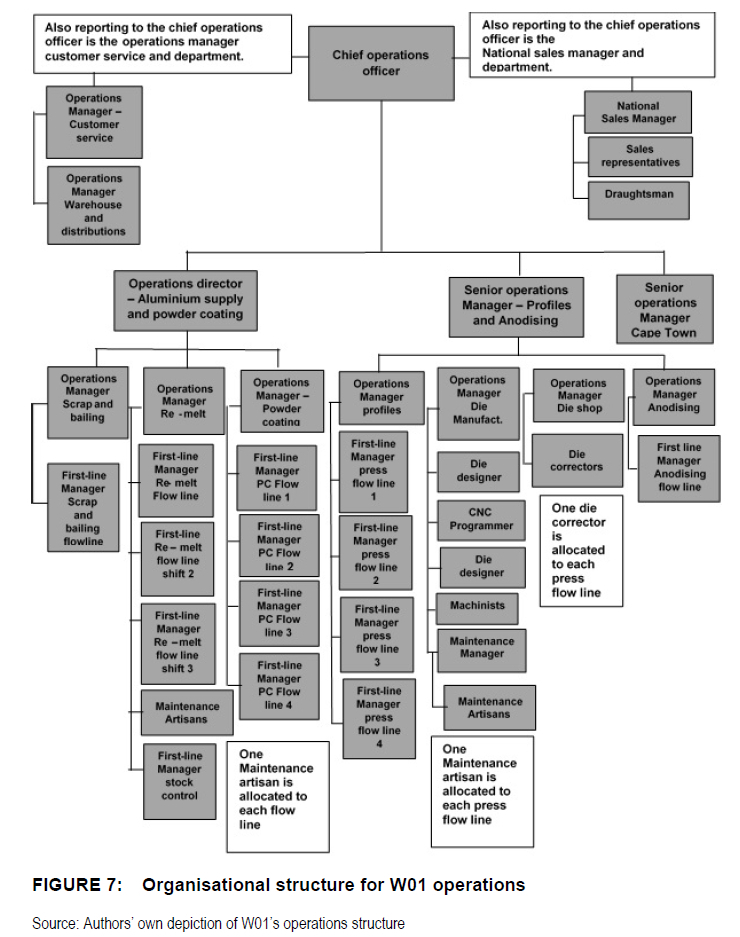
The finished products are despatched to the Gauteng stockist organisation that acquired two distribution organisations, one in 2007 and the other in 2011. The current W01 organisational structure is shown as the top management organisational structure (Figure 6) and operations structure (Figure 7).
Figure 7 demonstrates an effective Lean structure of first-line managers running mini business teams within a business unit with support functions of die correctors and maintenance specialists allocated directly to a particular cell. Support teams collect from the cell and move materials to downstream units' kanbans.
One hundred and thirty six detailed structured interviews provided the qualitative data, and two responses were obtained from focus group sessions with top managers.
Table 7 shows the pattern matching for the two organisations in terms of the relevant responses from the individual and focus group questionnaires as well as data gathered from plant visits, studying value stream maps and Lean story boards.
Table 7 indicates patterns supporting the propositions to a major degree and could be cross-linked for both the cases researched. The validity and reliability of the qualitative finding are discussed next.
3.2.3 Validity and reliability of the case study findings
As indicated in the research methodology section, the validity and reliability of the case study findings (Yin 2014: 45) are discussed in Table 8.
Table 8 provides validity and reliability for generalizable results in terms of the quantitative outcomes supporting the qualitative outcomes. New theory is established in the replication for discrete manufacturing structures and is summarised in the next section in the form of recommendations for Lean transformations. The next section concludes the article.
4. RECOMMENDATIONS AND FUTURE WORK
From this research future directions for optimised Lean structures have emerged for discrete manufacturing organisations. From these the following recommendations are that:
■ self-directed teams be established who would man manufacturing cells reporting to a unit manager who in turn would report to the chief executive;
■ sales, finance, maintenance, human resources and any other required service functions be permanently linked to a particular manufacturing cell to ensure a continuous flow of information and material to and from the cell;
■ a business unit, of lean specialists, be established, who would cross-functionally support manufacturing cell development through the setting of goals, priorities and facilitating action plans;
■ manufacturing cells be enabled to receive customer and supply orders directly processed through effective kanban and scheduling processes;
■ manufacturing cells feeding manufacturing cells be cross-functionally linked through effective cross-functional teamwork.
It is further recommended that:
■ The cultivation of Lean behaviours be stimulated through a Lean champion providing, education, training, coaching and learning of Lean practise to the lowest levels of the organisation utilising the system of first-line manufacturing cell managers that are thoroughly Lean skilled;
■ Behavioural changes be achieved through cross-functional teamwork, leading to the design of effective manufacturing cells by employees facilitated by team leaders;
■ Behavioural change continue with employees becoming more empowered and self-directing, continuously encouraged by open, and supportive and constructive leadership frequently visiting teams on the shop floor or in meeting areas;
■ Affective commitment be cultivated through effective daily green area type, team processes, inviting active participation and idea sharing;
■ Gain sharing be implemented with growth to enable the gauging by employees of organisational performance.
For future research literacy and language issues should be addressed and it is recommended that management embrace the adage "a picture paints a thousand words" for the development of employees in Lean transformations.
5. CONCLUSION
A new theory was developed that indicate how and why organisational structures and behaviours will change with Lean transformation. Major uncertainties existed surrounding the question of how discrete manufacturing organisations will be influenced once a Lean transformational strategy has been adopted by such organisations. The change will be realised through the establishment of self-directed teams; the permanent linking of service functions to a particular manufacturing cell to ensure a continuous flow of information and material to and from the cell; the establishment of a business unit of lean specialists; the enablement of manufacturing cells to receive customer and supply orders directly processed; and lastly cross-functionally linking manufacturing cells feeding manufacturing cells. Lean transformation implemented in discrete manufacturing organisations will change the way manufacturing takes place as well as the behaviour and the organisational structure which will lead to more profitable organisations.
REFERENCES
ANGELIS J, CONTI R, COOPER C & GILL C. 2011, Building a high-commitment Lean culture. Journal of Manufacturing Technology Management 22(5):569-586. [ Links ]
BHASIN S. 2011. Performance of organisations treating lean as an ideology. Business Process Management Journal 17(6):986-1011. [ Links ]
BOYLE TA, SCHERRER-RATHJE Μ & STUART I. 2011. Learning to be Lean: the influence of external information sources in Lean improvements. Journal of Manufacturing Technology Management 22(5):587-603. [ Links ]
BROWN CB, COLLINS TR & MCCOMBS EL. 2006, Transformation from Batch to Lean Manufacturing: the performance issues. Engineering Management Journal 18(2):3-13. [ Links ]
CAMERON-STROTHER AH. 2009. The causal relationship inherent in the alliance of Lean infrastructures, employee engagement, leadership impact, and team dynamics in modern manufacturing environments. Minneapolis, MN; Capella University, (PhD-thesis. [ Links ])
COOPER JJ. 2011. The integral role of organisational characteristics and their impact on lean implementation success. Carbondale.IL: Southern Illinois University. (PhD-thesis. [ Links ])
GAGNON MA. 2004. Investigating employee strategic alignment during a transformation to lean manufacturing. Philadelphia, PA: Pennsylvania State University. (PhD-thesis. [ Links ])
GANDER MJ. 2009. Managing people in a lean environment: the power of informal controls and effective management of company culture, Journal of Business Case Studies 5(6):105-110, [ Links ]
HARRIS CM. 2007. An extension of a three component model of organisational commitment to the area of commitment to organisational change in facilities implementing Lean Production. Anderson, IN: Anderson University.. (DBA-thesis. [ Links ])
HAUG P. 2008. Value stream management: empirical evidence on lean organizational structures. Baltimore, OH: Decisions Science Institute. (39th conference of annual meeting; 22 - 24 November 2008. [ Links ])
HETTLER N. 2008. Lean means business. Manufacturing Engineering 140(1):103-109. [ Links ]
JOHNSON JM. 2009. Leadership and organisational performance in a global, Fortune 500 Six Sigma operating company: a correlational research study. Minneapolis, MN: Capella University. (PhD-thesis. [ Links ])
JONES DT. 2006. Heijunka: levelling production. Manufacturing Engineering 137(2):29-36. [ Links ]
JONES C, MEDLEN N, MERLO C, ROBERTSON Μ & SHEPHERDSON J. 1999. The Lean enterprise. BT Technology Journal 17(4): 15-22. [ Links ]
KING G, KEOHANE RO & VERBA S. 1994, Designing Social inquiry: scientific inference in qualitative research. Princeton, NJ: Princeton University Press. [ Links ]
KOBAYASHI I.1995, 20 keys to workplace improvement. Portland, OR: Productivity Press. [ Links ]
LANDER E. 2007. Implementing Toyota-style systems in high variability environments. Ann Arbor, Ml: University of Michigan. (DEng-thesis. [ Links ])
LOSONCI D, DEMETER Κ & JENEI I. 2011. Factors influencing employee perceptions in lean transformations. International Journal of Production Economy 131 (1):30-43. [ Links ]
NAHM AY, VONDEREMBSE MA & KOUFTEROS XA. 2003. The impact of organisational structure on-time-based manufacturing and plant performance. Journal of Operations Management 21 (3):281-306. [ Links ]
O'CARROLL R. 2004. Designing organisations to survive in the global economy: an insider's account. The Irish Journal of Management 25(2):76-91. [ Links ]
ŌHNO Τ. 1988. Toyota production system: beyond large-scale production. Portland, OR: Productivity Press. [ Links ]
PINHEIRO RE. 2010. Organisational change and employee empowerment - a grounded theory study in lean manufacturing integration into a traditional factory environment. Minneapolis, MN: Capella University. (PhD-thesis. [ Links ])
PLANT MANAGER F01. 2014 Scheduled meeting with plant manager regarding the research at the F01 organisation held on 7 March 2014. [ Links ]
POPPENDIECK M. 2002. Principles of lean thinking. [Internet: www.gregoryneilassociates.com/articles/lean_ thinking.pdf; downloaded on 2014-08-12. [ Links ]]
QUARTERMAN L.2007. Implementing lean manufacturing. Management Service51(3):1A-19. [ Links ]
ROTHER Μ & SHOOK J. 2003. Learning to see: value-stream mapping to create value and eliminate muda. Cambridge, MA: Lean Enterprise Institute. [ Links ]
SAWHNEY R & CHASON S. 2005, Human behaviour based exploratory model for successful implementation of Lean enterprise in industry. Performance Improvement Quarterly 18(2):76-96. [ Links ]
SHETTY SK. 2011. A proposed new model to understand Lean implementation using employee perception. Huntsville, AL: University of Alabama, (PhD-thesis, [ Links ])
TESTANI MV& RAMAKRISHNAN S. 2011. Lean Transformation leadership model: leadership's role in creating lean culture. New York, NY: HE. (HE Annual Conference; 16 March 2011. [ Links ])
TODD J. 1995, World-class manufacturing, New York, NY: McGraw-Hill. [ Links ]
TRESS EP & ESPINOZA AB. 2012. The human side of Lean manufacturing: a successful model implementation. Orlando, FL: HE. (HE Annual Conference 19 May to 23 May 2012. [ Links ])
WORLEY JM & DOOLEN TL. 2006. The role of communication and management support in a Lean manufacturing implementation. Management Decisions 44(2):228-245. [ Links ]
WOMACK JP & JONES DT. 2003, Lean thinking: banish waste and create wealth in your corporation. New York, NY: Free Press. [ Links ]
WOMACK JP & JONES DT. 2007. The machine that changed the world. London, UK: Simon & Schuster. [ Links ]
YIN RK. 2014, Case study research: design and methods, 5th ed, Thousand Oaks, CA: Sage. [ Links ]
* corresponding author