



Services on Demand
Journal

Article
 English (pdf)
 Article in xml format
 Article references
 Automatic translation
 Send this article by e-mail
Indicators
Related links
-
 Cited by Google
 -
 Similars in Google
Share

 Permalink
Journal of Contemporary Management
On-line version ISSN 1815-7440
JCMAN vol.13 n.1 Meyerton 2016
RESEARCH ARTICLES
Compliance with occupational health and safety in the construction industry in a selected district
C FuleleI; FRK KadamaII, *
IDepartment of Management, North-West University, Mafikeng campus Caroline.Fulele@nwu.ac.za
IIDepartment of Management, North-West University, Mafikeng campus Frazer.Kadama@nwu.ac.za
ABSTRACT
The underlying study was necessitated by the realisation that whereas national statistics indicated an increasing trend in injuries and fatalities in the construction industry and consequently excessive claims from the workman's compensation fund, there were no records of registered manufacturers and on occupational health related accidents at the provincial offices of the Department of Labour in the North West (NW)) province of South Africa.
The study therefore undertook to establish whether manufacturers of cement-based intermediate goods in Ngaka Modiri Molema District (NMMD) complied with occupational health and safety (OHS) standards. A mixed method approach was adopted. Data were collected through semi-structured interviews with 50 respondents and through observation of the activities and the physical environments in workplaces.
The level of compliance was established to be below par due to factors that included: unwillingness by manufacturers to pay sufficient attention to health and safety; inability to employ well educated individuals; managers opting to employ individuals who out of desperation would work under unacceptable conditions; a good supply of individuals that were ready to compromise OHS standards for pittance; lack of effective enforcement of OHS standards by inspectors; and substance abuse. Recommendations for improvement of OHS standards were suggested.
Key phrases: accidents; cement-based intermediate goods; construction site; fatalities; injuries; occupational hazards; occupational health and safety; SMME
1. INTRODUCTION
1.1 Background to the study
The construction sector in developing countries plays an important role in job creation especially for unskilled labourers, as a resultant, it helps to reduce the high levels of unemployment and poverty {Biekpe 2011:3). The construction industry is cyclical in nature, however, basing on the 2014 market capitalisation of construction companies listed on the Johannesburg Stock Exchange (JSE) in conjunction with the National Development Plan's commitment to infuse R847 billion in the sector, one realises that there is strong investor confidence which presupposes future growth in South Africa's construction industry (SA Construction 2015:6).
It thus can be inferred that there is likely to be an increase in demand for raw materials, manufactured components and sub-assemblies such as premixed concrete, bricks, pavers, window frames and trusses used in the construction industry. These include the cement-based intermediate goods. This anticipated rise in demand for raw materials is a signal to small, medium and micro enterprises (SMME) not only to increase their production capacity in order to satisfy the expected increase in demand in the construction industry supply chain but also to improve on their production environment.
As SMME gear up to grab eminent opportunities in the construction industry, they need to heed caution that due to limited resources and poor enforcement of regulations in developing countries, attempts to increase productivity are usually associated with escalations in occupational health casualties (Agumba & Haupt 2013:328). They note that the construction industry in developing countries accounts for a large quota of the statistics on occupational accidents.
Borman, Clevenger, Lopez and Gilkey (2013:1) observe that whereas the construction industry in California does not adequately monitor and control OHS hazards, its injuries and fatality rates are surpassed only by the mining industry. According to Dadzie (2013:34), construction is a high-risk industry with a high occurrence of workplace fatalities, injuries and diseases. Evidently, they arise due to the use of heavy equipment, dangerous tools, and hazardous materials all of which increase the possibility for serious accidents and injuries.
South Africa has high mortality and injury rates arising from construction industry related accidents; for instance, from 2004 to 2008, there were 160 deaths and over 400 non-fatal injuries that arose from construction related accidents in South Africa (Construction Health & Safety in South Africa 2009:2). These statistics exclude non-reported cases. Considering the advanced level of mechanisation of the construction industry in South Africa, it would be reasonable to assume that the actual statistics of OHS related injuries and fatalities exceed the figures cited (Construction Health & Safety in South Africa 2009:2). This assumption is augmented by the observation that in developing countries, non-compliance with OHS is exacerbated by the paucity of resources, information and low levels of enforcement of OHS (Agumba and Haupt 2013:328).
Compliance with OHS in South Africa should therefore be an issue of serious concern for all stakeholders in the construction industry and the state regulatory system. As such, it is important that enterprises engaged in the construction industry scan their risk landscape and integrate risk management in performance management to become predictive in order to anticipate and plan for negative eventualities (SA Construction 2015:6).
In a study conducted in Ghana, Dadzie (2013: 39) notes that whereas the Ghanaian Labour Act of 2003 requires employers to provide personal protective equipment (PPE), training and safe working environments to employees at no cost to the employee, these provisions have not been followed and in many cases key amenities are not provided on site. Considering that many of the SMME in developing countries are classified either as micro enterprises or survivalists with annual turnovers of less than R300 000 {US $19 980), it is reasonable to assume they are financially constrained to the extent that they would not be in a position to provide PPE and safe working environments.
Due to time and financial constraints, Ngaka Modiri Molema District (NMMD) was selected, through convenience sampling, as the location of the study. It is one of the four district municipalities that comprise the North West (NW) province of South Africa. The district has a population of 842,699 which comprises 24% of the NW population (Statistics South Africa 2012). There are several SMME in NMMD engaged in various activities in the construction industry. This article focused on SMME involved in the manufacturing of cement-based intermediate goods used in the construction industry. Particular emphasis was placed on SMME that manufactured blocks, bricks, culverts and pavers i.e. moulding and casting in cement
In the preliminary to the underlying study, the researchers established that the inspectorate in the North West Department of Labour (DoL) offices in Mmabatho did not have a complete register of enterprises in NMMD engaged in manufacturing cement-based intermediate goods and did not have records of deaths and injuries arising from accidents at work in their area of jurisdiction.
1.2 Research problem
Considering that national statistics indicate an increasing trend in injuries and fatalities in the construction industry and consequently excessive claims from the workman's compensation fund, the lack of records on registered enterprises and on occupational health related accidents at the provincial offices of the Department of Labour becomes a matter of serious concern. The knowledge gap raises doubt as to whether the labour inspectorate enforces the prescripts in Act No 85 of 1993 and also whether the enterprises comply with the prescripts of the Act. It was therefore deemed necessary to conduct this study to determine the level of compliance with OHS in NMMD.
1.3 Research question
The primary research question addressed was - to what extent do enterprises that manufacture cement-based intermediate goods comply with OHS standards?
1.4 Objectives of the underlying study
The following objectives were adopted:
■ establish the factors that hinder SMME from complying with OHS;
■ assess the level of compliance of SMME with OHS;
■ recommend measures to improve the level of compliance with OHS by SMME.
1.5 Delimitations of the underlying study
The study was geographically delimited to the Ngaka Modiri Molema district of the North West province of South Africa. Participants included DoL inspectors, managers and employees of enterprises engaged in manufacturing cement-based intermediate goods. The study confined itself to matters related to OHS.
2. LITERATURE REVIEW
2.1 Theoretical foundation
The underlying study was founded on the contingency viewpoint which was developed in the mid-1960s. The contingency approach is a style of business management in which managers do not follow a single school of thought; they allow the situation to dictate managerial choices (Smit, Cronje, Brevis & Vrba 2011:41). It combines elements from the three major traditional schools of management thought, namely: the classical, behavioural, and scientific schools of management.
The classical management viewpoint stresses that management practices should be consistent with the requirements of the external environment which include laws and regulations that must be followed by organisations (Hellriegel, Jackson, Slocum, Staude, Amos, Klopper, Louw & Oosthuizen 2009:68). The behavioural school of thought avers that workers are not machines, but people with beliefs, feelings, and needs. It recognises the workplace to be diverse in nature with people from different backgrounds that require good working conditions in which to operate.
At the core of the behavioural school of thought is the need for the manager to be aware of employees' needs and rewarding them for good performance (Smit et al. 2011:34). Scientific management concerns itself with increased production by paying attention to individuals and the machinery and tools that they use. It avers that management practices should be based on proven facts and observation and not guesswork (Hellriegel et al. 2009:69).
Furthermore, Hellriegel et al. (2009:69) note that during the industrialisation era, administrative duties tended to distance managers from the physical production of goods. As such, there arose a need for operations specialist who could attend to human capital and productivity problems associated with industrialisation that threatened operating efficiency.
2.2 Obligations and responsibilities of stakeholders under Act No 85 of 1993
The objectives of Act No 85 of 1993 are to provide a safe and healthy work environment for all and to prevent avoidable injury, illness and loss of lives in workplaces. The purpose of Act No 85 of 1993 is to foster a safe and healthy work environment, and also protect co-workers, family members, employees, customers and many others who might be affected by the workplace environment. To achieve these objectives and purpose, Section 8 of Act No 85 of 1993 prescribes the following:
1. Employers must:
a) provide and sustain a safe working place with safe systems of work, plant and machinery;
b) identify the health and safety threats of the work processes used; and
c) provide information, instruction, training and supervision to ensure the health and safety of employees doing the work.
2. Employers are accountable for the safety and health of people who are not their employees, but who are affected by the employer's activities. This includes visitors to the workplace, such as contractors and delivery or service workers. This also includes members of the public who live near or pass near work activities of the employer
3. Employers have a responsibility to enlighten employees in a way that they understand, about the hazards of their work and the security measures in place to address those hazards.
4. Employers have responsibility to appoint health and safety representatives from amongst their employees to manage health and safety at the work place. This must be done through negotiation with workers and their unions.
5. Employers have the responsibility to organise health and safety committees, if there are two or more health and safety representatives at work. The employers must consult with the health and safety committees about procedures that are in place to ensure the health and safety of employees.
6. Employers must comply with health and safety regulations regarding specific dangers. These include regulations on safety, hazardous substances, installation of electrical machinery, construction noise and driven machinery.
7. Employers are obliged to;
a) record all cases in which workers require medical attention other than first aid;
b) investigate all incidents in which workers need medical attention other than first aid and record the results of the report;
c) report all incidents within seven days to the Department of Labour Provincial Director;
d) report if a person dies;
e) notify health and safety representatives and health and safety committee of incidents that happened.
8. Employers must not charge employees for items that are required for occupational health and safety.
2.3 Workers' responsibilities
Much as Act No 85 of 1993 grants workers the right to work in a safe and protected environment, it expects workers to abide by the following responsibilities:
■ be responsible for their health and safety and that of others; collaborate with the employer to implement occupational health and safety rules and regulations;
■ comply with lawful orders to enforce health and safety rules and timeously report unsafe and harmful situations to the health and safety representatives or the employer.
2.4 Implementation of health and safety rules by SMME
Scholars such as Champoux and Brun (2003:302) aver that many SMME not only lack resources to enforce occupational health and safety regulations but also the will to do so.
They argue that SMME have to cope with severe resource limitations in order to survive in highly competitive work environments to the extent that occupational health and safety issues are not accorded due credence. The situation is exacerbated by the increasing casualization of the construction industry workforce; which, as Wells and Jason (2010:107) observe, is increasingly comprised of casual labourers rather than permanent employees. Mostly, SMME employ cheap and temporary labour with a few permanent staff to perform supervisory duties. Formal employment contracts are rarely signed and employees are not usually made aware of their right to a decent workplace (Wells & Jason, 2010:107). Under such circumstances, little or no attention is paid to decent working conditions
Hasle and Limborg (2006:8) note that failure by SMME to enforce occupational health and safety rules is partly rooted in the fact that their managers and employees are lowly educated. As such, they have problems with interpreting written instructions and compiling lengthy documents especially when they are not in their home language. Furthermore, Hasle and Limborg (2006:8) aver that owners serve as dominant actors in relation to all activities where they are required to handle multiple tasks at the same time which negatively impacts on OHS.
2.5 Generational cohorts
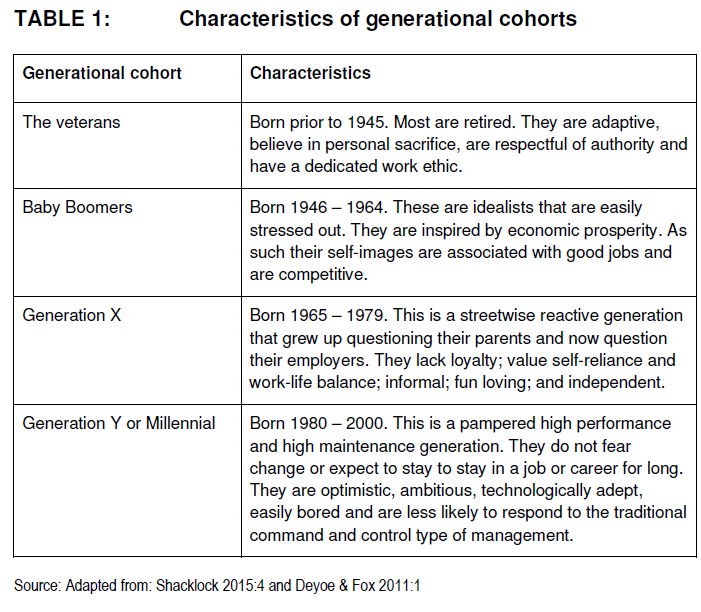
The literally world is abound with definitions of the concept generational cohort. Hung, Gu & Yim (2007:837) and Palese, Pantali & Saiani (2006:173) define generational cohort as a unit of contemporaries whose beliefs, values and preferences are influenced by their shared historic experiences. Lowe, Levitt, & Wilson (2008:44) identify four generational cohorts. Table 1 outlines the pertinent characteristics associated with the respective cohorts.
2.6 Wage subsidy
A wage subsidy is a payment advanced to employers as an incentive to encourage businesses to employ eligible job seekers. Wage subsidies can help employers to expand their businesses and employ new staff, which helps to boost the economy and create more jobs (Australia 2016:lnternet). The Employment Tax Incentive (ETI) Act No 26 of 2013 was enacted for the purpose of reducing the high levels of unemployment among youth. Act No 26 of 2013 was designed to encourage the private sector to employ the youth by providing tax incentives to employers where government would share employment cost.
According to Charalambous (2013:1), the ETI functions by reducing the pay as you earn amount payable for every qualifying employee hired. Wages received are not affected but the actual cost of hiring employees becomes lower thus making it affordable for firms to increase employment. ETI is be continuously assessed and it will be available up to the end of 2016 (National Treasury 2014).
3. RESEARCH METHOD
The research pertaining to this article adopted an exploratory design. It dealt with both qualitative and quantitative data i.e. it was a mixed method approach.
3.1 Population of the study
The population consisted of three categories:
■ Category I - local municipalities
■ Category II - owners of SMME's and
■ Category III - employees
The exact number of SMME owners and employees that were under investigation could not be established as the North West Department of Labour did not have statistics pertaining to registered SMME in the province.
3.2 Sample selection
Different sampling techniques were applied to select participants for each population category. In population Category I, convenience sampling was applied to select two out of five local municipalities in the district. The two were selected for the reason that they were easily accessible for the researchers and they have large numbers of SMME. Due to the lack of updated registers for SMME in the Department of Labour, the researchers did not have access to addresses of relevant SMME. As such, they resorted to snowball sampling to select SMME in population Category II.
The researchers moved around looking for relevant SMME. Whenever, they identified a relevant SMME, they would approach and request them to participate in the study. The researchers also obtained addresses of other relevant SMME from those that they had interacted with. Altogether, 10 SMME owners participated in the study. In population Category III, simple random sampling was applied to select 50% of employees of each SMME that participated in the study; in this way, 35 employees were selected to participate in the study. Altogether there were 45 respondents in the study.
3.3 Data collection
Data from owners and inspectors were collected through semi-structured interviews; while structured interviews were conducted to collect data from employees. Interview guides were developed for each of the four categories of participants in the study. The reliability of the instruments was determined by means of Cronbach alpha coefficient.
To ensure translation validity of the instruments, the researchers engaged the services of a Setswana expert from the Department of Setswana in the North-West University Mafikeng campus to translate the interview guides from English to Setswana. Furthermore, the interviews were conducted by a researcher who is competent in both spoken and written Setswana. Answers were captured in writing as the interviews progressed.
Interviews were conducted at the workplaces of the participants. There were no formal appointments arranged with SMME managers and their employees. The researchers were granted audience at the convenience of the interviewees. This meant that they at times would have to wait for the interviewees to finish their tasks.
While at the SMME premises, the researcher made time to observe and evaluate adherence to the following criteria: display summarised copies of the basic conditions of the employment act in English and Setswana; availability and standard of ablution facilities at the workplace; availability of first-aid kits on site; provision of PPE to workers; the conduct of employees while at work; and machinery equipped with guards for protecting operators from injury.
3.4 Data analysis
Data were analysed using the SPSS 21.0 software package. Data were analysed to determine relative frequencies of the responses given. Inferential statistics were applied to determine whether there was a correlation between different age groups and their views on OHS in their workplaces. Comparison of actual measures in place with expected interventions were applied to determine level of compliance with OHS standards by SMME engaged in manufacturing components for the construction industry in NMMD.
4. RESULTS
This article presents results on the findings from interviews with SMME owners, their employees and the on-site observations by the researchers. The majority (60%) of the SMME in the study had been in operation for periods of 16 to 20 years. Their employees were all male; 80% were single; 70% were below 41 years of age with a mean of 31; 85% were lowly educated (below Grade 8); and 56% had been employed for less than 24 months with their current employers. It also emerged that only 14% were registered with workman's compensation fund, 8% were not registered although were aware of it while 78% did not even know what the fund was intended for. None of the participants in the study were aware of the employment tax incentives.
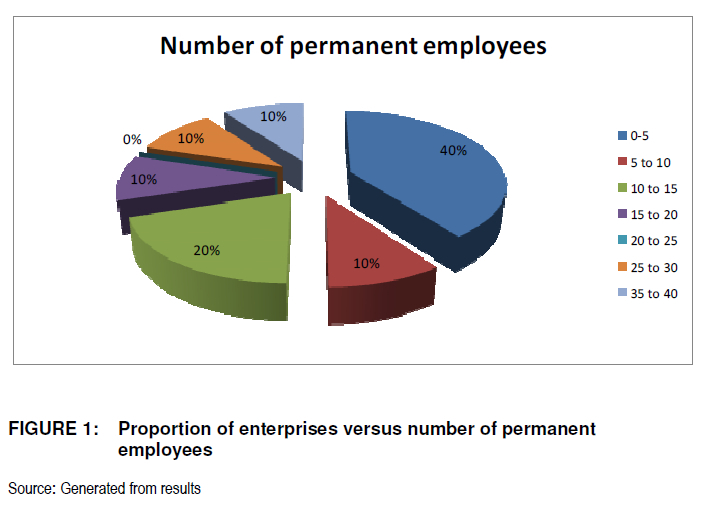
Employers were asked to indicate the number of permanent employees in their enterprises; the results are presented in Figure 1.
The above results indicate that the majority (50%) of enterprises employed less than six permanent staff.
Employers were asked to give reasons why they preferred to employ casual labourers rather than permanent staff; the following were the pertinent reasons given:
■ The stock from which they recruited lacked the discipline to maintain permanent jobs.
■ The wages were so low that employees could not afford deductions on their earnings for contribution to statutory requirements such as the workman's compensation fund, provident funds and the unemployment insurance fund.
■ The enterprises were financially constrained; as such, they could not afford to pay the employers' contributions towards employees' benefits.
■ Employees would at the slightest opportunity abandon their jobs in search of greener pastures.
Employers were asked whether it was lack of demand for their products that deterred them from employing more people on permanent basis. They all responded in the negative. They averred that due to stiff competition in the market, their profit margin was low; as such, they could not afford to pay the statutory cost associated with employing permanent staff.
When asked why they preferred to employ individuals who could not read and follow the instructions on machinery, they stated that it was because they could not afford the high salaries and benefits demanded by better educated individuals.
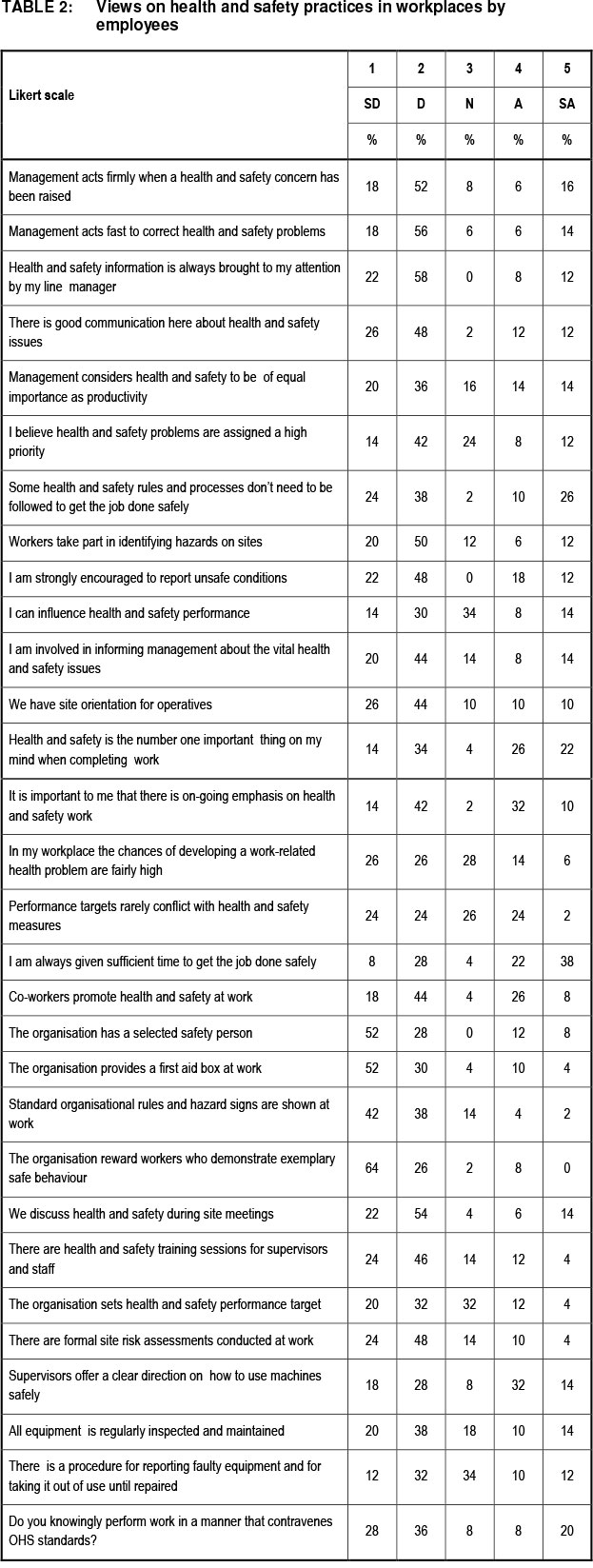
Ordinal data on the views of employees on the occupational health and safety standards in their organisations were captured using a Likert scale of 1 - 5 shown in Table 2. The expected responses were coded as follows: SD = strongly disagree, D = disagree, Ν = neutral, A = agree, SA = strongly agree.
During the visits to the SMME that participated in the study the researchers made the following observations:
■ The enterprises investigated operated in rural areas and the employees were of simplistic demeanour.
■ All enterprises provided ablution facilities for employees; however, all were in poor states of repair and were hygiene hazards.
■ Whereas it was a statutory requirement, only 10% of the enterprises visited displayed the summary of the basic conditions of work. In the few instances where it was displayed, only the English version was available.
■ None of the enterprises visited provided employees with full sets of personal protective equipment (PPE). In the majority of enterprises visited, the workers did not use PPE at all; some argued that it was cumbersome and it affected their efficiency.
None of the enterprises visited had trained personnel for attending to victims of occupational related accidents.
■ Only 10% of the enterprises visited had well stocked first aid boxes.
Only 10% of the enterprises visited displayed safety awareness signs and instructions for operating equipment and machinery.
■ In the majority of enterprises visited, the equipment and machinery appeared dilapidated and without guards to protect operators from injury.
In some of the enterprises visited, a good number of workers appeared to be under the influence of intoxicants during working hours.
4.1 Spearman's rank correlation between age category and views of workers on health and safety in their organisations
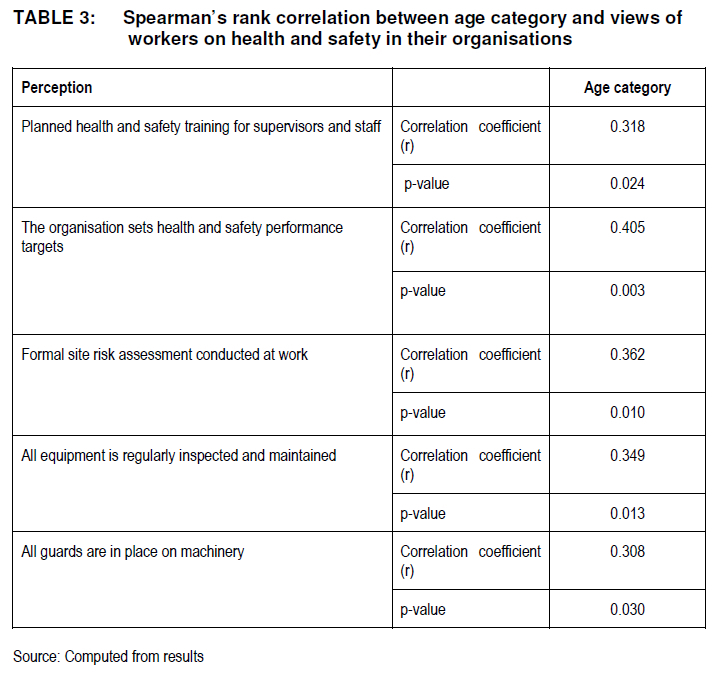
SPSS 21.0 software package was used to perform a correlation analysis and the results are shown in Table 3.
The p-values were below the 0.05 level of significance; this implies that the correlation between age category and views of workers on health and safety in their organisations was significant. Positive correlation coefficients (r = 0.318, 0.405, 0.362, 0.349 and 0.308) imply that older workers tended to agree with the perception listed in Table 1, whereas younger workers tend to disagree.
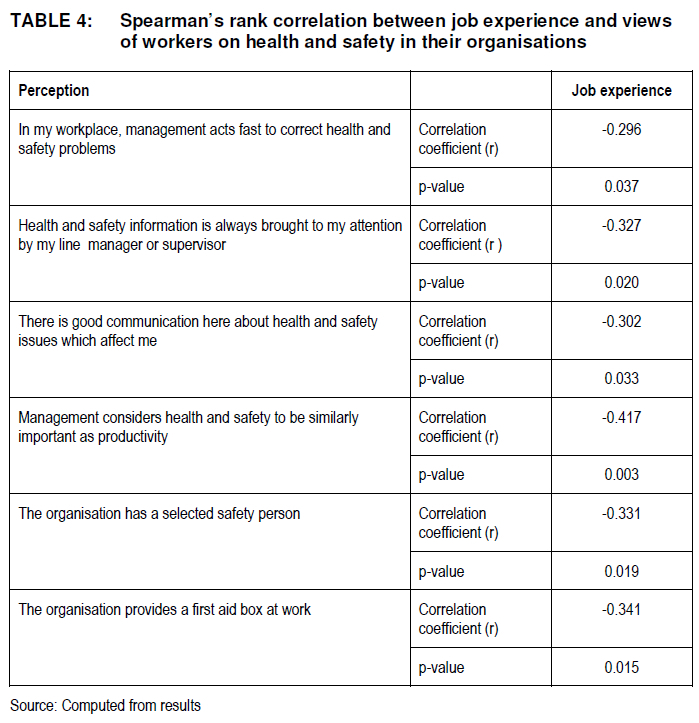
4.2 Spearman's rank correlation between job experience and views of workers on health and safety in their organisations
A correlation analysis was performed using SPSS 21.0 software package to determine the relationship between job experience and the views of workers' on health and safety issues in their organisations. The results are presented in Table 4.
The p-values were below the 0.05 level of significance; this implies that the correlation between job experience and views of workers on health and safety in their organisations was not significant. Negative correlation coefficients (r = -0.296, -0.327, -0.302, -0.417, -0.331 and -0.341) imply that more experienced workers tended to disagree with the perception listed in Table 1, whereas less experienced workers tended to agree.
5. DISCUSSION
The results indicate that level of compliance with OHS standards by enterprises in the study was below par. An analysis of the results in relation to the literature review suggests that failure to comply with international best practice by the enterprises in the study may, in part, be attributed to the factors discussed below.
The enterprises employed lowly educated workers who could neither comprehend complex instruction nor follow written instructions, especially those that were not written in their home language. Such, communication problems would make it difficult for them to follow instructions and to seek guidance when necessary; consequently increasing the possibility of accidents and injuries at work.
In the interviews conducted, it emerged that whereas the employers were aware of the repercussions associated with employing lowly educated individuals, they continued with the practice mainly for the reason that they could not afford the costs associated with well-educated employees such as high wages and contributions to provident funds, unemployment insurance and the workman's compensation fund. These findings align with Wells and Jason (2010:207)'s observation in section 2.4 that formal contracts are signed for a few supervisory staff and the rest are employed as cheap labour on a casual basis.
The majority (70%) of employees interviewed were young with a mean age of 31. From the literature reviewed in Section 2.5, they would be classified under Generation Y or millennium cohort; a generational cohort that is highly ambitious and is associated with sophistication. However, the researchers observed that the employees were from deprived backgrounds and did not ascribe to the characteristics associated with millennials. Under the circumstances, the employees turned out to be a frustrated lot that had given up on having decent lives. It is therefore not surprising that the analyses in Tables 3 and 4 indicated that the employees did not care about the conditions under which they operated. These findings are in agreement with the researchers' own observation that some employees seemed to be under the influence of intoxicants while at work. This could be part of the reasons why they: did not adhere to PPE regulations; tended to be reckless; were not bothered by OHS regulations; and were highly predisposed to accidents and injuries at work.
In the interviews with enterprise owners, it emerged that due to increased competition amongst suppliers of construction components, they are forced to minimise production costs in order to remain competitive. To attain this objective, measures implemented include paying minimal wages and lowering OHS standards. They thus have to recruit individuals from poor communities that are willing to work under poor working conditions and tend to prioritise wages over OHS. Such workers are: emotionally vulnerable; preoccupied with socio-economic problems; distracted while on duty; and as such, susceptible to accidents. These findings concur with the observations by Wells and Jason (2010:17) citied in section 2.4.
From experience, the researchers note that whereas there are no official statistics available, the number of enterprises engaged in production of cement-based intermediate goods in the district is quite high - ranging in hundreds. The study established that 40% of the enterprises surveyed employed five or less workers while 10% employed between six and 10 workers. These findings suggest that there are many small enterprises competing with each other to supply a finite number of small time customers. Due to their small sizes, the enterprises do not enjoy the benefits that accrue from economies of scale. The greater the quantity of a good produced, the lower the per-unit fixed cost because these costs are shared over a larger number of goods. Economics online (2016:lnternet) avers that large firms tend to be more efficient than small ones; however, if they become too large, they may be affected by diseconomies of scale.
6. RECOMMENDATIONS
In view of the above findings and discussion, the following recommendations are suggested: The Department of Labour should ensure that:
■ the inspectorate division in the district is adequately facilitated with regard to human and material resources;
■ it compiles and regularly updates a register of all enterprises operating in the district;
■ it organises workshops for employers and inspector to make them aware of how the employment tax incentives included in Act No 26 of 2013 would reduce the costs for one to employ suitably qualified individuals;
■ it lobbies for the extension of employment tax incentives to beyond 31/12/2016;
■ all employees that operate heavy machinery in their places of work need to have attained a level of education that would enable them to follow written instructions;
■ that all machine operators have certificates of competence in operating the type of machinery they work with from accredited consultants;
■ all full time employees in SMME are registered with the workman's compensation fund.
Furthermore, the numerous enterprises manufacturing similar products should be encouraged and facilitated to integrate through mergers or cooperatives in order to mitigate the existing unhealthy competition. Government agencies such as North West Development Cooperation and Small Enterprise Development Agency should actively participate in this endeavour.
It is imperative that owners and managers of the enterprise implement the following recommendations:
■ All facilities at the workplace should be safe, clean and hygienic.
■ There should be changing rooms and lockers for employees at each workplace.
■ Minimise the use of casual labourers.
■ All employees should be registered with the workman's compensation fund and the unemployment insurance fund.
■ Ensure that all employees are trained in health and safety issues.
■ Each enterprise should have a health and safety committee and have a workers' health and safety representative.
■ Employees must be provided with PPE and must use it while at work.
Each enterprise should have a copy of the OHS act on the premises and should make it available to employees whenever they want to refer to it.
Check for and confiscate alcohol and illegal drugs from employees as they enter workplaces.
■ All machine operators should be capable of reading and following instructions on equipment.
■ Ensure that all moving parts on machinery such as belts, pulleys and gears have protection guards.
■ All electrical cables and terminals must be insulated and proper plugs should be used at all times.
■ Each enterprise should have a fully equipped first-aid box. Report all injuries sustained at work to the Department of Labour.
7. LIMITATIONS
In the course of the underlying study the following limitations were encountered:
■ Lack of records on registered SMME in the district complicated the determination of population and sample sizes.
■ Failure to comply with appointments by the respondents because they were either busy at the time of the appointment or had forgotten. The researchers could not wait for them to finish what they were doing as this would have interfered with other appointments. As result, it became necessary for the researchers to re-schedule appointments which resulted in negative cost implications.
Altogether, the limitations were inconsequential; as such, they did not affect the reliability of the research.
8. CONCLUSION
From the findings of this article and the discussion that ensued the following conclusions were drawn:
■ Whereas an appropriate legislative framework and policies were in place, the Department of Labour lacked the wherewithal to enforce compliance with OHS standards within the manufacturers of cement-based intermediate goods in Ngaka Modiri Molema District Municipality.
■ The mushrooming of many small time manufacturers producing similar products has resulted in an unhealthy competition that forces manufacturers to lower prices to minimal levels. Consequently, they cannot hire suitably educated individuals on permanent basis and provide them with PPE which negatively impacts on compliance with OHS standards.
■ Due to stiff competition, enterprises in the study cannot sustain operations while complying with OHS standards. There is therefore a need to consolidate the enterprises into economically viable units.
■ There is a need to empower enterprises to employ suitably qualified workers in the manufacturing sector in order to minimise accidents and injuries at work.
REFERENCES
AGUMBA JN & HAUPT Τ, 2013, Exploratory factor analysis of health and safety management practices in small and medium enterprises in the South African construction industry, Cape Town: Association of Schools of Construction of Southern Africa (ASCSA). (7th conference of the Built Environment; 28-30 July). [ Links ]
AUSTRALIA. 2016, Department of employment: wage subsidy, [Internet: www.employment.gov.au/wage-subsidies; downloaded on 2016-01-28. [ Links ]]
BIEKPE N. 2011, The voices of SMME in the South African economy, Cape Town: Africa Growth Institute & University of Cape Town. [Internet: www.thedti.gov.za/sme_development/sumit/The%20voices%20of %20SMME%20in%20the%20South%20African%20Economy%20Prof%20Biekpe_1.pdf; downloaded on 2016-01-28. [ Links ]]
BORMAN K, CLEVENGER C, LOPEZ C & GILKEY D. 2013. Risk perception and culture differences of the Latinos across residential commercial and heavy civil construction, San Luis Obispo, CA: (49th annual international conference of the ASC; 9-13 April). [ Links ]
CHAMPOUX D & BRUN J. 2003, Occupational health and safety management in small size enterprises: an overview of the situation and avenues for intervention and research. Safety Science 41(4):301-318. [ Links ]
CONSTRUCTION HEALTH & SAFETY IN SOUTH AFRICA. 2009. Status and recommendations. [Internet: www.asocsa.org/documents/ConstructionHandSReport_June2009.pdf; downloaded on 2016-01-25, [ Links ]]
CHARALAMBOUS L. 2013. South African employment tax incentive signed into law, [Internet: www.tax-news,com/news/South_African_Employment_Tax_lncentive_Signed_lnto_Law_63115.html; downloaded on 2016-02-17, [ Links ]]
DADZIE J. 2013, Perspective of consultants on health and safety provisions in the labour act: a study into theory and practical's, Engineering Management Research 2(1):34-42. [ Links ]
DEYOE RH & FOX TL. 2011. Identifying strategies to minimize workplace conflicts, Journal of Behavioural Studies in Business'A: 1-17, [ Links ]
ECONOMICS ONLINE. 2016. The long run - increases in scale, [Internet: www.economicsonline,co,uk/usiness_economics/Economies_of_scale.html; downloaded on 2016-02-18, [ Links ]]
HASLE Ρ & LIMBORG HJ. 2006, A review of the literature on preventive occupational health and safety activities in small enterprises, industrial Health 44(1):6-12, [ Links ]
HELLRIEGEL D, JACKSON SE, SLOCUM J, STAUDE G, AMOS T, KLOPPER HB, LOUW L & OOSTHUIZENTFJ. 2009, Management, 3rd ed. Cape Town: Oxford University Press, [ Links ]
HUNG KH, GU FF & YIM CK. 2007, A social institutional approach to identifying generation cohorts in China with a comparison with American consumers, Journal of international Business Studies 38(5)836-853. [ Links ]
LOWE D, LEVITT KJ & WILSON T. 2008. Solutions for retaining Generation Y employees in the workplace, Business renaissance quarterly. 3(3): 43-57. [ Links ]
NATIONAL TREASURY REPUBLIC OF SOUTH AFRICA. 2014. How the employment tax incentive works for you, [Internet: www.c.ymcdn.com/sites/sait.site-m.com/resource/resmgr/2014_SARS/employment _Incentive_lea. pdf; downloaded on 2016-02-17, [ Links ]]
PALESE A, PANTALI G & SAIANI L. 2006. The management of a multigenerational nursing team with differing qualifications: a qualitative study, The Healthcare Manager 25(2):173-183, [ Links ]
SA CONSTRUCTION. 2015, Highlighting trends in the South African construction industry, SA Construction, 3rded. [Internet: http://www.pwc.co.za/en/assets/pdf/sa-construction-2015.pdf; downloaded 2016-01-28. [ Links ]]
SHACKLOCK K. 2015. The impact of generations working together: 2015 a significant year. Griffith Business School, Griffith University, Gold Coast campus Southport, Queensland, Australia. (MBA White paper. [ Links ])
SMIT PJ, CRONJE GJ, BREVIS Τ & VRBA MJ (eds). 2011. Management principles, a contemporary edition for Africa. 5th ed. Cape Town: Juta. [ Links ]
SOUTH AFRICA. 1993. Occupational Health and Safety Act, No 85 of 1993. Pretoria: Government Printer. [ Links ]
SOUTH AFRICA. 2013. The Employment Tax Incentive (ETI) Act, No 26 of 2013. Pretoria: Government Printer. [ Links ]
STATISTICS SOUTH AFRICA. 2012. Census 2011: municipal fact sheet, Pretoria: Government Printer, [ Links ]
WELLS J & JASON A. 2010. Employment relationships and organizing strategies in the informal construction sector. African Studies Quarterly 11 (2&3)107-124. [ Links ]
* Corresponding author