Services on Demand
Journal

Article
 English (pdf)
 Article in xml format
 Article references
 Automatic translation
 Send this article by e-mail
Indicators
Related links
-
 Cited by Google
 -
 Similars in Google
Share

 Permalink
Journal of Contemporary Management
On-line version ISSN 1815-7440
JCMAN vol.13 n.1 Meyerton 2016
RESEARCH ARTICLES
Drivers and barriers of green supply chain management implementation in the Mozambican manufacturing industry
W NiemannI, *; T KotzeII; F AdamoIII
IDepartment of Business Management, University of Pretoria wesley.niemann@up.ac.za
IIDepartment of Business Management, University of Pretoria theuns.kotze@up.ac.za
IIIDepartment of Business Management, University of Pretoria feizal2@hotmail.com
ABSTRACT
Environmental sustainability, greening business practices and initiatives have received increasing research attention. This is due to various pressures placed on organisations from different stakeholder groups. This study explores the drivers of and barriers to the implementation of green supply chain management in the Mozambican manufacturing industry.
A descriptive qualitative study was conducted in the form of semi-structured interviews with one senior manager in eight different organisations in the industry.
The study identified four drivers and eight barriers within the Mozambican context. The most important drivers are corporate social responsibility, internal organisational policies, and board and top management support. Culture, costs and government legislations were identified as the barriers with the greatest impact. The key factors that influence and prevent the adoption of green supply chain management practices are identified and prioritised. Corruption is identified as a barrier, but little if any existing research is available on it. Government legislations is also considered a barrier in the Mozambican manufacturing industry, whereas existing research indicate that governments are drivers. The study expands research on green supply chains in small emerging and developing countries as little research is available on the topic.
Key phrases: barriers; drivers; green supply chain management; manufacturing industry; Mozambique; qualitative exploration
1. INTRODUCTION
Researchers have focused increasingly on green supply chains over the past twenty years due to global environmental concerns. Green supply chain management (GSCM) aims to reduce waste and pollution by integrating environmental thinking into product design and end-of-life management (Rehman & Shrivastava 2011:345). The implementation of these chains is affected by drivers and barriers. Drivers are defined as the forces motivating organisations to implement green supply chains whereas barriers are those forces hampering its implementation (Jain & Sharma 2014:60). It is crucial to understand the various drivers and barriers involved in GSCM, particularly for manufacturing industries that aim to minimise waste and pollution (Bhool & Narwal 2013:242).
Organisations that engage in green supply chain practices benefit from cost reduction and increased profit, which makes these practices effective in developing sustainable competitive advantages (Routroy 2009:20). In collaboration with their supply chain partners, suppliers and customers, manufacturers can command a better strategic and competitive position if they implement environmental management in a cost-effective manner (Vachon & Klassen 2006:665). Collaborative organisational actions to lessen product and process environmental burdens can help reduce unnecessary wastes and improve supply chain efficiencies (Seuring & Muller 2008:1705).
Drivers that have made companies aware of the importance of GSCM include competition intensity, changing government policies and increasing customer awareness (Hsu, Tan, Zailani & Jayaraman 2013:663). The drivers mentioned are only a few important ones. Jain and Sharma (2014:54) identify 14 drivers for the adoption of GSCM, of which customer pressure, regulations and competition are the key drivers. Rao and Holt (2005:898) confirmed that a significant relationship exists between drivers, economic performance and competitiveness in the implementation of green supply chains from a sample of companies in South East Asia.
Kamolkittiwong and Phruksaphanrat (2015:864) conducted a more specific analysis of the drivers that motivate GSCM implementation in the electronics industry of Thailand. These authors argue that regulation is the most critical factor. Bhool and Narwal (2013:242) pointed out that the most important drivers affecting the implementation of green supply chains in Indian manufacturing industries are employee motivation, health, safety and regulation as the most important.
Although many previous studies have been conducted on the drivers and barriers of GSCM practices, there is still conflicting information. Previous studies with respect to defining drivers and barriers were conducted in different contexts, namely India, Thailand, South East Asia, the United States of America, Malaysia, Brazil, Sweden, South Africa and Nigeria.
African countries seem to be poorly represented in studies related to the field of GSCM. A study by Craggs (2013:Internet) determined the current state and maturity of green supply chains in South Africa's fast-moving consumer goods (FMCG) sector.
Mvubu and Naude (2016:271) identified the green supply chain management constraints that an FMCG factory in Durban faces and reported on the remedies that it has in place to overcome these constraints. Ojo, Mbohwa and Akinlabi (2013:315) conducted a review of the green supply chain management practices in construction industries in two cities, Lagos, Nigeria and Johannesburg, South Africa. These African studies are limited in scope and nature.
Furthermore, Brik, Mellahi and Rettab (2013:123) indicated that little research exists on GSCM practices in small emerging and developing countries. Mozambique is such a country and since the findings from previous studies in the various countries are different, there is a reason to believe that the conducting of similar research in Mozambique might yield different results and insights. It also presents an opportunity to highlight the differences and/or similarities in drivers and barriers between developing and developed countries based on the available literature and new evidence from this study. This extends the scope of available research and provides information within a context that appears to be largely unexplored until now.
Eight large companies in the manufacturing industry were included in the research. The purpose of the study was to clearly identify and increase the understanding of the drivers and barriers in the implementation of GSCM through an exploratory research of these Mozambican manufacturers.
The study was guided by the following research questions:
• What are the drivers that motivate the implementation of GSCM in the Mozambican manufacturing industry?
• What are the barriers that prevent the implementation of GSCM in Mozambican manufacturing industry?
• Which drivers and barriers have the greatest/least impact on the implementation of GSCM practices in the Mozambican manufacturing industry?
It is imperative to identify the drivers and barriers that could motivate and hinder the implementation of GSCM practices in the industry. The lack of empirical research within the African context, together with the rapid growth in the Mozambican manufacturing industry underlines the importance of this research.
The findings presented here will provide valuable insights to manufacturers who intend to transform their supply chains from conventional to greener ones. It will also extend the existing research into a new context and may be used in the future for comparison analysis. There is therefore both a practical and academic application for the research (Ghazilla, Sakundarini, Abdul-Rashid, Ayub, Olugu & Musa 2015:658).
Having explained the rationale behind the study, a literature review will now follow. The review introduces the concepts of GSCM and provides an overview of previous studies on the drivers and barriers related to the implementation of green supply chains.
The methodology describes the research design, sampling, data collection, data analysis, trustworthiness and ethical considerations. The findings are presented in a clear and chronological order to identify the drivers of and barriers to the implementation of GSCM practices. This article concludes with a summary of the major findings of the research, deals with managerial implications and limitations of the research and makes recommendations on future research.
2. LITERATURE REVIEW
This section of the article presents an overview of selected green supply chain management literature.
2.1 Green supply chain management
GSCM is the process of using environmentally friendly supply chain inputs and transforming these inputs into outputs that can be reclaimed and re-used at the end of their life cycles, thus creating a sustainable supply chain (Balaji, Velmurugan & Manikanda 2014:423). From a sustainability point of view, this will allow more resources to be preserved for future generations and at the same time protect our natural environment, resulting in a better and safer world. (Ahi & Searcy 2013:329).
The greening of supply chains can increase the competitive edge and economic performance of organisations (Rao & Holt 2005:915). "Manufacturing organisations engaged in green project partnership with their suppliers and customers can develop organisational capabilities that will be reflected not only in environmental performance but also in other performance dimensions such as cost and quality" (Vachon & Klassen 2006: 664).
It can result in cost reductions, improvement in operational efficiencies, greater flexibility, sales enhancement, customer value enhancement and societal image improvement (Routroy 2009:26). However, it is also proven that GSCM requires a high initial investment. This may include the adoption of advanced technologies, and hiring, motivating and training good quality employees (Luthra, Kumar, Kumar & Haleem 2011:239).
It is crucial to integrate environmental management concepts into the whole supply chain in order to reap the maximum benefit from greener supply chains and the competitive advantage it provides. Ultimately it increases profits and market share objectives (Seman, Zakuan, Jusoh, Shoki, Arif & Saman 2012:2).
It is clear that there are many benefits connected to the implementation of GSCM but numerous organisations still do not implement them (Jaggernath 2015:44). It is critical to assess the drivers of and barriers to the implementation of green supply chains and use this information to motivate organisations to implement these strategies.
2.2 Drivers of green supply chain management implementation
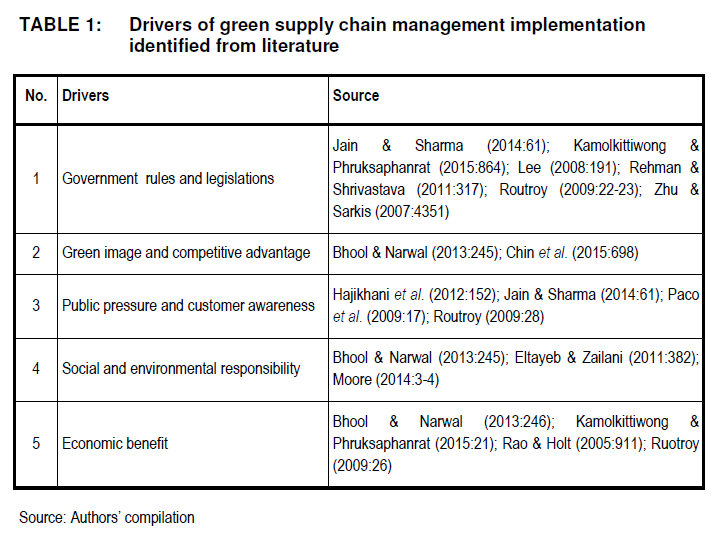
The main drivers identified in literature include the following:
2.2.1 Government rules and legislation
The Rule of Law is a system of government where a society adopts a set of good, just and fair laws on which the society and its government is then governed (Bhool & Narwal 2013:245). Government legislations set the rules of the game and organisations are obliged to follow regional, national and international regulations and simultaneously satisfy customer requirements (Luthra et al. 2011:234).
Regulatory pressures are argued to be one of the major drivers of the implementation of green supply chains (Rehman & Shrivastava 2011:317). Routroy (2009:22-23) states that government regulations can act as drivers in the implementation of green supply chains. Governments have the power to act as drivers in the implementation of green supply chains in three aspects (Routroy 2009:23):
• The government needs to engage in transparent environmental regulations;
• The government should promote green innovations in the most significant areas of GSCM;
• The government needs to engage in activities that educate ordinary citizens on the need for creating a green and cleaner environment.
Government rules and legislations act as drivers that encourage organisations to limit the use of non-renewable resources and to limit greenhouse gas emissions. Jaffe (in Chien & Shih 2007:386) states that environmental policies targeted directly at emissions are the most important single element of a cost-effective environmental policy strategy. Regulations increase the threats of fines for non-compliance among companies (Konar & Cohen in Agan, Acar & Borodin 2013:25). Bhool and Narwal (2013:245) also argue that regulations increase the costs of organisations that do not implement green practices through penalties and fines.
Global environmental requirements have shifted from pollution controls at manufacturing plants to the actual life cycle of the products. This increases the scope of involvement by governments to engage green supply chain initiatives. Lee (2008:191) points out that governments can encourage organisations through tax-cut incentives and infrastructure developments for environmentally friendly complexes. This illustrates the power governments can exert as drivers of the implementation of green supply chains.
2.2.2Green image and competitive advantage
Green image is a driver of GSCM that provides a "greening image" where a manufacturing product is to be used (Bhool & Narwal 2013:245). More importantly, green image refers to the positive recognition by customers of organisations that engage in manufacturing processes that are environmentally friendly. GSCM implementation can improve both the image and reputation of the organisation simultaneously (Chin, Tat & Sulaiman 2015:698). An organisation will not only gain a competitive advantage by attracting customers through the right green image, but also be eligible for benefits such as the facilitation of loans, a reduction in taxes and greater chances to obtain government tenders.
Based on the above it can be concluded that the projection of the right green image and the can lead to increased revenue and cost reductions, which will in turn increase the competitive advantage of an organisation.
2.2.3Public pressure and customer awareness and pressure
Doonan and Lanoie (in Hajikhani, Wahat & Idris 2012:252) argue that customer demand for green products and services is seen as one of the most significant drivers for green initiatives. Customers are becoming increasingly aware of the negative impact caused by certain businesses activities on the environment. The public and customers exert pressure on organisations to implement greener supply chains, ultimately reducing the harm these entities have on the environment.
Trowbridge (2001:124) states that end consumers request green products and/or the implementation of environmentally friendly practices. Paco, Raposo and Filho (2009:17) also mention that customers take the environment into consideration when making purchase decisions. Customers demand green products by asking for ISO 14001 certification (Agan et al. 2013:31). There is general agreement among these authors that customers act as drivers for organisations to adopt GSCM practices.
The media plays a vital role in informing and educating the public on environmental degradation, therefore customers concern themselves with environmental issues at an increasing rate (Hansen 2011:8). This may lead to the public buying less products they perceive to be environmentally harmful. Liu, Zhang, Wang, Chen & Shen (2013:32) argue that customers do not only need good quality products but require these products to be environment-friendly. This drives organisations to look at the implementation of GSCM practices and affects the entire manufacturing process from design to the end-of-life of the product.
2.2.4Social and environmental responsibility
"Social and environmental responsibility is that driver of GSCM which initiative to asses and take responsibility for the organisation's effect on the environment and impact on social welfare" (Bhool & Narwal 2013:245). In current markets, organisations feel socially and environmentally responsible and engage in corporate social responsibility (CSR). It is a set of voluntary policies, codes or guidelines, initiated and driven by the organisation (Broomhill 2007:6). Environmental issues are being looked at more seriously and CSR is an effective way to make an organisation stand out above its peers.
Corporations that want to enhance their image often publicise their environmental conservation activities to show their commitment to their stakeholders and the public (Agan et al. 2013:26). Rehman and Shrivastava (2011:320) state that organisations look at strategies such as CSR to enhance their reputation and brand image. The goal to differentiate and promote the organisation's image makes CSR a driver in the GSCM implementation
2.2.5Economic benefit
Economic benefit can be a driver of GSCM and represents the ability to reduce unit costs of manufactured goods or services rendered without affecting its intended use or reducing the product's quality (Bhool & Narwal 2013:246). It is important to consider that cost reductions should not be associated with reductions in the quality of products (Liu et al. 2013:32). The removal of non-value adding components of products can lead to cost reductions.
Economic benefit can further be obtained by using less energy, water and raw materials in the production process, which will not only preserve the environment but also lead to a reduction in production cost (Kamolkittiwong & Phruksaphanrat 2015:866).
The implementation of GSCM is commonly considered a win-win situation by reducing costs, improving operational efficiencies and improving the reputation of the organisation (Routroy 2009:26). Benefits such as cost savings, increased customer satisfaction, new market opportunities, improved corporate image and higher profits can all be achieved through the implementation of GSCM practices (Agan et al. 2013:26). Rao and Holt (2005:912) also state that implementing GSCM gives the potential to lead to competitiveness and economic performance.
Table 1 provides a summary of the barriers to GSCM implementation.
2.3 Barriers to green supply chain management implementation
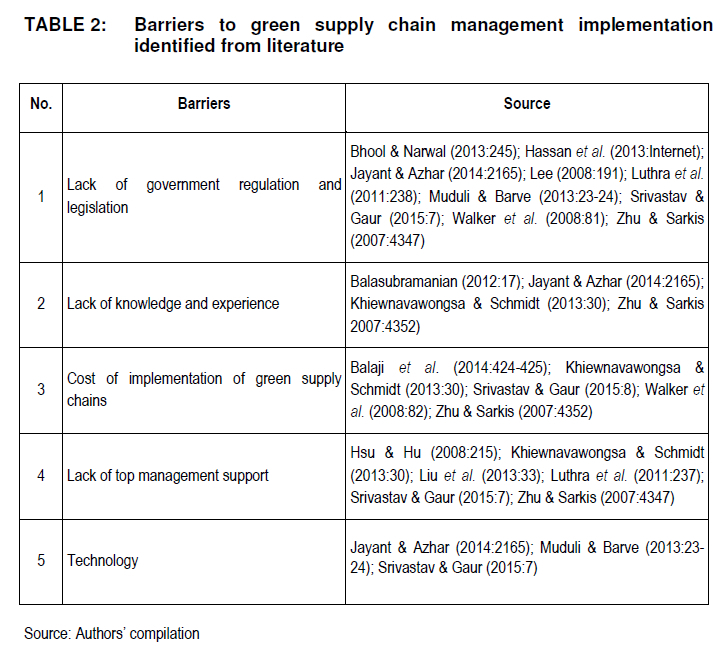
The main barriers identified in literature include the following:
2.3.1Lack of government regulations and support systems
"Government regulations can encourage or discourage the adoption of innovation as government set the environmental regulations for the industry" (Scupola in Luthra et al. 2011:238). The absence of regulations and support systems are barriers to the implementation of GSCM practices. If regulations are not present, organisations will not engage in green practices as it is not an obligation. When there are no regulations and support systems in place, there is no reason for organisations to engage in GSCM practices.
Jayant and Azhar (2014:2165) identify the lack of government support systems as the most dominant barrier to GSCM. Time consuming regulatory requirements, fees and levies also discourage organisations to engage GSCM practices. Limited institutional support provided by the government for new ideas to implement GSCM is another major barrier (Srivastav & Gaur 2015:7). Government regulations have the tendency to encourage organisations to remain set in their operational ways by supporting old practices (Al Khidir & Zailani 2009:249).
2.3.2Lack of knowledge and experience
The lack of knowledge of GSCM among supply chain stakeholders is seen as one of the greatest barriers to the implementation of GSCM. It involves a lack of experience and the feeling of 'too complex' to implement (Balasubramanian 2012:17). Green implementations involve advanced technology and specific knowledge and organisations without this knowledge require training (Khiewnavawongsa & Schmidt 2013:30). Ravi and Shankar (2005:1022) also emphasised that training and education are crucial requirements to achieve successful implementation of GSCM practices in any organisation. This training and education involve costs in terms of time and money (Khiewnavawongsa & Schmidt 2013:30).
2.3.3The cost of implementing green supply chains
The high initial cost required to implement various green methodologies such as green design, green manufacturing and green labelling of packaging (Balaji et al. 2014:424-425) act as a barrier to GSCM and impede organisations in the implementation of green supply chains. Organisations limit their visions to the short term and, therefore, do not see the long-term benefits of investing in the implementation of GSCM. This problem is aggravated when organisations have already limited budgets and have to prioritise expenses according to urgency rather than importance (Walker, Di Sisto & McBain 2008:80).
There are two types of costs involved in GSCM: direct and transaction costs (Luthra et al. 2011:239). Both type of costs are likely to constitute significant barriers to the adoption of GSCM (Al Khidir & Zailani 2009:249). It is also argued that GSCM requires high investment but has a low return on investment (Chaghooshi & Zereshki 2014:21). Technology advancement adoption, hiring qualified employees, and motivating and training employees to adopt GSCM practices require high initial investment (Srivastav & Gaur 2015:8). The fact that GSCM is seen as a process with long-term benefits acts as a great barrier, specifically for organisations looking to gain short-term benefits.
2.3.4Lack of top management support
Hsu & Hu (2008:205) agree that lack of top management support is among the most important barriers. Top management support is crucial for the success of GSCM implementation. Warfield (in Srivastav & Gaur 2015:7-8) argues that top management support is essential to facilitate organisations in the implementation of GSCM. It is their responsibility to promote employee empowerment, increased employee involvement, create a shift in organisational culture, and increase employee commitment, which can be achieved by offering rewards to motivate employees, and by increasing training and communication within the organisation.
It is an obvious barrier as all this would be impossible without top management support. Receiving support from higher level management helps facilitate the implementation of GSCM with greater ease (Khiewnavawongsa & Schmidt 2013:30). Srivastav and Gaur (2015:12) identify the lack of top level management commitment as the most important barrier due to its high driving power.
2.3.5Technology
Govindan, Kaliyan, Kannan and Haq (2014:560-561) classify technology as the first priority amongst barrier categories. Technology as a barrier to GSCM implementation is greatly influenced by a lack of new technology, materials and processes; a lack of effective environmental measures and the complexity to design reuse/recycle products. Technology as a barrier is further influenced by a lack of human resources and a lack of technical expertise.
Table 2 provides a summary of the barriers to GSCM implementation.
Balasubramanian (2012:24) applied a hierarchical framework to the barriers of GSCM implementation and found technology to be a third level barrier. These barriers cause a lack of understanding among stakeholders, a lack of sustainable practices in the vision and mission, and lastly a lack of GSCM initiatives. Efficient information and technology systems are of extreme importance for supporting GSCM during the various stages of the product life cycle. (Luthra et al. 2011:237).
3. METHODOLOGY
3.1 Research design
To empirically explore the drivers and barriers in the implementation of GSCM, the researchers adopted a basic/generic qualitative research strategy. Basic research is particularly suited when the researcher is interested in understanding the meaning a phenomenon has for those involved (Merriam 2009:22).
Basic research is driven by curiosity and a desire to expand existing knowledge (Kowalczyk 2015:Internet). It is the most adequate research method for this research as it is directed solely towards acquiring new knowledge (Jane 2006:199). In this research, an explorative study was conducted based on semi-structured interviews with participants from eight organisations to understand and explore the drivers and barriers in the implementation of GSCM practices.
3.2 Sampling
The unit of analysis for the study was manufacturers in the Mozambican manufacturing industry. The selection of organisations was done through means of purposive sampling. This sampling technique is commonly used in qualitative studies. It requires the researcher(s) to select subjects based on study purpose with each participant providing unique and rich information of value for the study (Suen, Huang & Lee 2014:105). The selection of participants was crucial. The selection criteria of interviewees had two requirements:
• Senior manager position in the organisation;
• If possible a senior manager in the supply chain, procurement or environmental department; and
The selection criteria ensured that participants had the relevant knowledge required to answer questions. The senior managers selected all had adequate knowledge and vision of their respective organisations. Eight organisations agreed to participate. One senior manager was interviewed within each organisation. Access to relevant persons in senior management positions within these companies were facilitated by the researchers' network. Organisation and participant names were kept anonymous to encourage participation. The organisations were selected based on being part of the largest manufacturing organisations with potentially the biggest environmental impact. All the organisations were based in Mozambique.
The final sample size was informed by a similar study conducted in a different context (Walker et al. 2008:75). Schou and Cardoso (2014:Internet) state that there are 24 large business organisations in Mozambique. The sample of 8 organisations constitute a third of this amount and is therefore deemed a feasible number to study.
3.3 Data collection
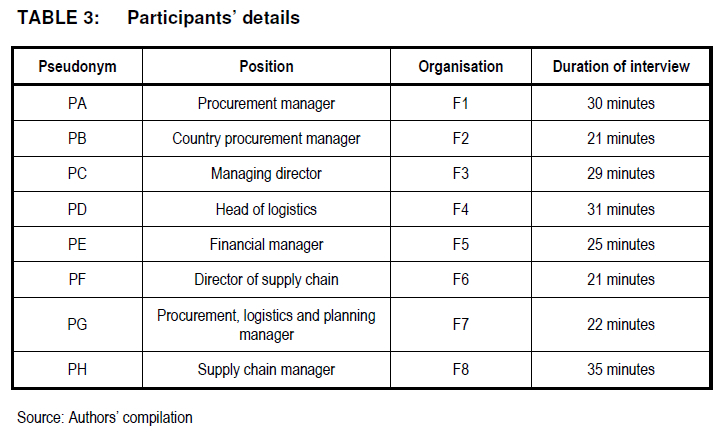
The main source of data in this study was eight semi-structured interviews conducted face-to-face with one senior manager representing each organisation as presented in Table 3.
Face-to-face interviews were used to allow analysis of social cues, such as voice intonation and body languages of interviewees. Face-to-face interviews also have the benefit of immediate responses making answers spontaneous without extended reflections (Opdenakker 2006:1).
The use of semi-structured interviews was judged to be the most appropriate method for this exploratory research because of the inexperience of the researchers and because it is allows for a narrow, focused approach. Interviews are more appropriate to obtain more in-depth information from individuals (Gounder 2014:41).
The participants were interviewed in their offices or meeting rooms at their respective places of work. This ensured that participants felt more comfortable and further allowed analyses of the surroundings and areas in which they worked. All interviews were conducted during September and October 2015.
A discussion guide was developed on the basis of the literature review and previous studies conducted. It was further refined by an experienced supply chain management academic allowing the discussion to be concise enough to obtain relevant information. A pilot test was conducted with one participant in order to assess the suitability of questions, time required to conduct the interview and opportunity to rephrase, add or remove questions.
Before an interview was conducted, the objective of the study was explained to the interviewee, the rights of the interviewee were highlighted, it was ensured that their participation was entirely voluntary and an informed consent was signed. Thereafter, the interview proceeded using the questions designed in the discussion guide. The interviews were audio-recorded and were concluded in an average of 27 minutes. The interview recordings were transcribed by the researcher and a commercial transcription service experienced in transcribing qualitative interview recordings. To verify the accuracy of the transcripts, each transcript was read whilst listening to the audio recording. Where necessary, the transcripts were amended to accurately reflect the actual recorded interview.
3.4 Data analysis
A thematic and content analysis was used in this research. Thematic analysis provides an interpretation of participants' meanings and content analysis is a direct representation of participant responses (Crowe, Inder & Porter 2015:616).
The transcripts were analysed following three steps suggested by Miles and Huberman (in Scholten & Schilder 2015:475): data reduction, data display and conclusion. Applicable text segments were labelled to summarise the meaning of the segment. A list of codes was then compiled and an analysis was done to identify and combine similar codes.
From the revised codes list, patterns were identified through related codes and the organised patterns formed themes that provided meaning to the data (Braun & Clarke 2012:63-65). The final themes were analysed and established through their applicability to the study's research questions.
3.5 Trustworthiness
The criteria of credibility, transferability, confirmability and dependability were used to ensure trustworthiness.
Confirmability refers to "ensuring the findings are a result of the experiences and ideas of the informants, rather than characteristics and preferences of the researcher" (Shenton 2004:72). Interviews were face-to-face and recorded to ensure all information was obtained and further scrutinized. The use of transcripts and analysis through Microsoft Word's comment function ensured all drivers and barriers were stated/expressed by participants. The sets of drivers and barriers were clearly stated by the participants.
Credibility seeks to ensure that the study measures or tests what is actually intended (Shenton 2004:64). Merriam (2009:213) states that credibility deals with the question of how research findings match reality. Interviews were conducted with senior managers. They had a good understanding of the operational activities of their respective organisations. The research was guided by an established supply chain management academic and a research methodology expert. Triangulation was ensured by making use of multiple sources of data, comparing and cross-checking data collected through observations with different participants (Merriam 2009:216). The data obtained from the eight different participants was compared and the where applicable links were established between them. Previous literature was also used to link findings with previous research.
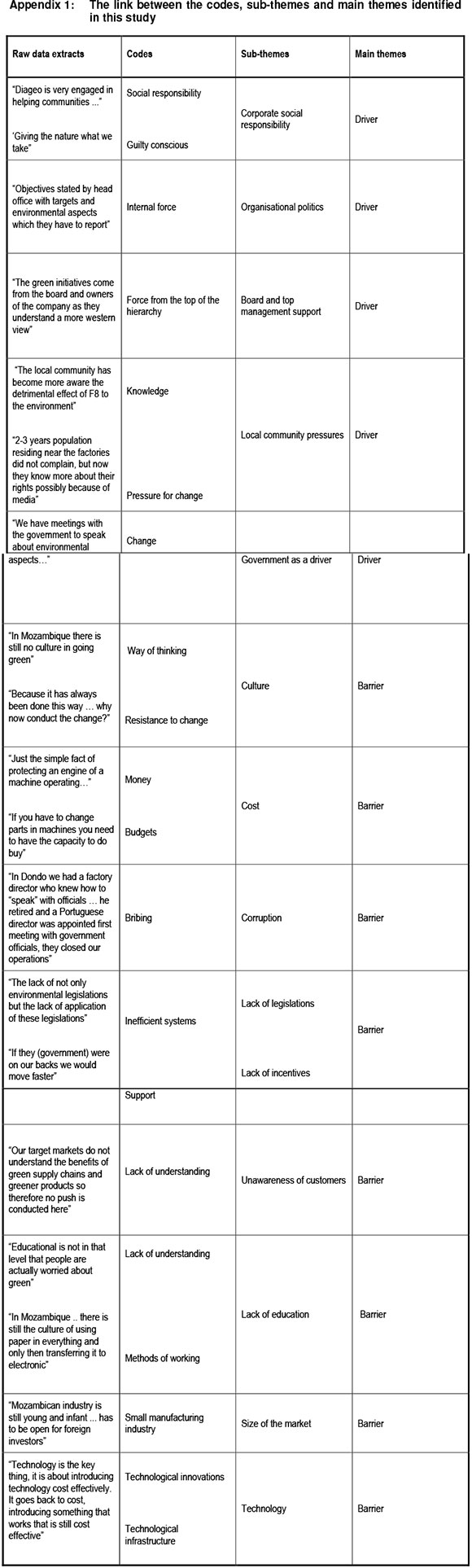
Transferability refers to the extent to which the findings of one study can be applied to other situations (Merriam 2009:223). Sufficient information is provided with regards to the participating organisations and participants. The number of organisations was clearly stated and the type of participants, including their positions at work, was also recorded. The restrictions and selection criteria were clearly established and stated. The data collection methods used were mentioned and explained. A table was developed to clearly illustrate how the quotes led to themes and can be found in Appendix 1.
Dependability refers to the extent to which research findings can be replicated (Shenton 2004:71). The research design is clearly stated on the methodology and reasons for this choice are also presented. The data collection was conducted through interviews and sufficient information is provided to replicate. Data was analysed using thematic analysis and a diagram has been provided to illustrate how the raw data was broken down into codes, sub-themes and main themes (Appendix 1).
3.6 Ethical considerations
The relevant research ethics committee at a South African university approved the study. All participants were requested to read and sign an informed consent form before being interviewed.
The consent form explained the aim and purpose of the study. The consent form clearly stated that participation in the study was entirely voluntary and that the participant could withdraw at any time.
The consent form provided clarity and assured interviewees that participation would be anonymous and that all information they conveyed would be treated as confidential. The same information was provided to the participants verbally before the start of each interview. Some clarifications were made at the end of each interview with regard to any doubts the participants had.
4. FINDINGS
4.1 Drivers in the implementation of green supply chain management
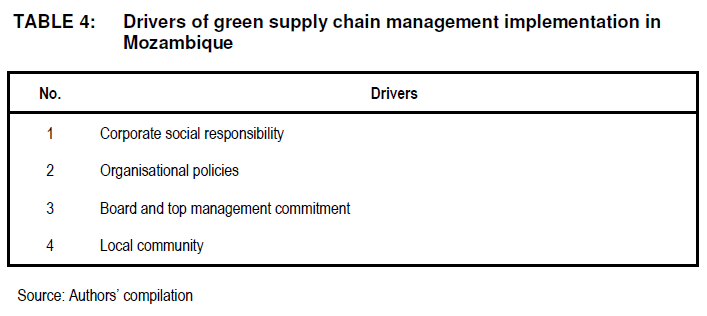
Table 4 represents an overview of the drivers identified in the Mozambican manufacturing industry.
4.1.1 Corporate social responsibility
Corporate social responsibility (CSR) refers to an organisation's impact on society and the need to deal responsibly with the impacts on each group of stakeholders (Van den Ende 2004:4).
Four of the eight respondents mentioned CSR as being a major driver. The participants admitted that their manufacturing processes harm the environment and were concerned with giving back to nature what has been taken. These four participants mentioned some GSCM practices such as the recycling and re-using of products.
It was clear that manufacturers in Mozambique have embedded corporate social responsibility into their culture and that it is a driving force to implement these practices. Interviewees constantly mentioned the organisation's commitment towards CSR. This is evident from the following quotes:
"Green supply chain is part of the nature of F2. We need to give back the nature what we take, like water, like the gas and everything. We are trained for GSCM" (F2, PB Country Procurement Manager).
"F7 is motivated and very engaged in helping communities, so social responsibility is the main driver" (F7, PG Procurement, Logistics & Planning Manager).
"Corporate social responsibility is part of the company" (F8, PH Procurement Manager).
These observations are in line with existing literature. In both cases organisations feel responsible for the damage they inflict on the environment (Bhool & Narwal 2013:245; F2, PB - Country Procurement Manager). The motivation behind this driver is different however.
Existing literature states that corporate social responsibility is considered a driver as these organisations want to improve their image, reputation or gain a competitive advantage. Our research suggests organisations engage on CSR due to it being part of the organisation, an internal requirement from headquarters, or personal motivation.
4.1.2Organisational policies
The manner in which organisations operate can also be seen as drivers. Three participants commented on this aspect and indicated that they follow not only local but also international rules and regulations. These policies were common in foreign owned manufacturers as their environmental goals are set by the head office. This is evident from the following quotation:
"We have got internal regulations coming from the F2 company that tells you what needs to be done to comply with green practices" (F2, PB Country Procurement manager).
Organisational policies were not mentioned in the literature review but it was stated that there is motivation from within the organisation that acts as a driver (Agan et al. 2013:26).
4.1.3Board and top management support
Top management support is especially useful for environmental practices such as GSCM (Luthra et al. 2011:239). Based on discussion with three interviewees, the organisations' board and top management in the manufacturing sector were committed to implement GSCM practices as they exert pressure on the companies to look at these practices. Consider the following quote of a participant:
"The initiatives of green comes from the board and owners of the company as they understand a more western, eastern and African view ... and have a broader frame of mind" (F1, PA Procurement Manager).
These observations are in line with existing literature but also contradict it to a certain extent. In the literature review it was recognized that the lack of top management support is seen as one of the most important barriers (Ojo, Mbowa & Akinlabi 2014:1976; Srivastav & Gaur 2015:12). But Kamolkittiwong and Phruksaphanrat (2015:866) challenges this idea by stating that top management is a driver and has a high importance role.
In Mozambique top management support is a driver for organisations as these tend to conduct GSCM practices due to internal board and top management pressures. Further research should be conducted to understand the reasons behind the same factor being a driver in some cases and a barrier in other. It should be asked if the discrepancies are linked to the extent that countries are developed.
4.1.4 Local community
Interviewees mentioned that local community pressures are a new, although less important driver in Mozambique. The local communities are becoming aware of their rights through the media. Local communities are now exerting pressure and constantly approach the government with regards to pollutions and waste. Interviewees emphasised the fact that no complaints and pressures from the local communities were made in the past and in recent times the same communities are forcing manufacturers to change the manner in which they operate and adopt more GSCM practices. One of the participants mentioned the following:
"2-3 years ago the local community did not complain about anything, recently with the information they obtain not only from newspapers but also televisions they get more aware and understand that they have rights and can be protected" (F3, PC Managing director).
Existing literature supports this view. Literature review argues that customers are becoming more aware of the negative impact organisations cause on the environment. This is in line with the findings as a participant highlighted the fact that local communities are now exerting pressure on manufacturers to change the way they operate.
4.2 Barriers in the implementation of green supply chain management
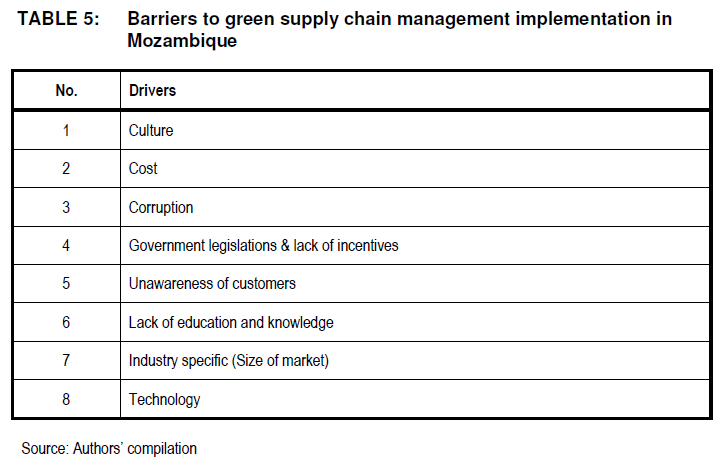
Table 5 provides a summary of the barriers identified in the manufacturing industry in Mozambique.
4.2.1 Culture
Schein (in Schmitz, Rebelo, Garcia & Tomas 2014:114) states that culture can be defined as "a pattern of shared basic assumptions that the group learned as it solved its problems of external adaptation and internal integration that has worked well enough to be considered valid and therefore to be taught to new members as the correct way to perceive, think and feel in relation to those problems"
If organisations want to successfully implement GSCM practices they will have to bring understanding to the people that will have to practically execute it. The participants frequently mentioned culture as one of their greatest barriers. The Mozambican mind-set does not favour GSCM and environmental concern is not embedded into their way of thinking. This is evident from the amount of rubble on the streets.
The following quotes from the interviews indicate that culture is a big barrier within Mozambican manufacturing organisations:
"Individuals prefer to get a freelancer that will charge them less but have trucks that are more harmful to the environment." (F4, PD Head of logistics and procurement department)
"Culture with regards to environment is so strong. If the individuals responsible for its implementation have a different culture due to their education and background it goes back to square 1" (F8, PH Previous Supply Chain Manager).
There is a lack of previous research with regards to local culture of the contexts that have been researched. The existing literature focuses on organisational culture only (Srivastav & Gaur 2015:7). Further research has to be conducted to investigate the role of different cultures in the implementation of GSCM practices.
422 Cost
All organisations incur costs and most, if not all, have the sole objective of reducing these to increase profits. Consumers desire lower costs in industries, straining the limited budget manufacturers have and reducing the interest on green investments (Walker et al. 2008:73).
Cost concerns were a major barrier in five out of the eight organisations investigated as these organisations were more focused on short-term benefits rather than the long-term benefits from engaging GSCM. The organisations were not willing to incur the initial cost required for greener practices. Although participants made it clear that they have implemented green practices based on the reduction of costs, the majority of these practices are the ones which require a low initial investment. One participant made it clear that cost is of major concern in the Mozambican manufacturing industry, and that they are always striving to reduce it. Engaging in GSCM is desirable but no one is willing to make the initial required investment. These observations can be noticed from two participants' quotes:
"GSCM practices involve costs acting as a great barrier as it requires follow ups, time and dedicated individuals. High initial investments ... It is something that costs money and sometimes companies are not ready to spend." (F4, PD Head of Procurement & Logistics)
"It is a price sensitive market and adding value to increase prices is not valuable. Investors looking for Africa for greater returns look at more short term benefits" (F1, PA Procurement manager).
These observations are in line with existing literature, which identified the high initial cost to implement GSCM practices such as green design, green manufacturing and green packaging as a barrier (Balaji et al. 2014:424-425). This was identified in the study as the participants emphasised the fact that the initial cost is the reason for not adopting these practises in totality. Further research could be conducted on the willingness of organisations to incur the costs of implementing GSCM and the reasons that motivate them.
4.2.3 Corruption
Corruption refers to acts in which the power of public office is used for personal gain in a manner that contravenes the rules of the game (Jain & Sharma 2014:73). This leads to pure waste and misallocation of resources (Aidt 2009:271,288).
Participants consider Mozambique to be a country ensnared by corruption and say that it is a major barrier. One out of the eight participants highlighted the role of corruption as an inhibitor of GSCM practices. The participant mentioned that even if legislation is in place for organisations to be more environmental friendly, the hurdle can be removed by simply bribing officials. This does not only demotivate manufacturers that are investing and engaging in greener practices but motivates dishonest and unethical manufacturers to gain advantage over their competitors.
"In Dondo we had a factory director that was Mozambican and he knew how to "speak (bribe)" with the officials. He resigned and they replaced him with a director from Portugal. The first conversation they had with him officials ordered to stop operations in the area as they were too polluting to the population residing there (local community). ... Not that the government is really worried with the business or the environment they always want to find a way to steal or open a gap for corruption" (F4, PD Logistic manager).
There is very few if any literature on corruption as a barrier to the implementation on GSCM. This presents an opportunity for further research on the effect of corruption in the implementation of GSCM practices, especially since it is an African reality.
4.2.4 Government - legislation and lack of incentives
The government may act as both a driver and barrier. It was noted by almost all the participants that a change in the view of the government towards environmental aspects is required. Seven participants mentioned the government as a driver in the implementation of green supply chain practices, although it is still at an infant stage. Routroy (2009:23) argues that governments should engage in activities to educate and promote GSCM practices. Participants mentioned that the government has recently set up meetings with manufacturers to discuss greener practices. This is a contributing factor for the increased awareness and importance of GSCM. The Mozambican government is making an effort to enforce a limited number of environmental laws.
"We have meetings and the government says please take into consideration, do things this way and give a certain period for completion, but it is still not in the compulsory phase" (F3, PC Chief Executive Officer).
This is in line with the literature review, as researchers suggest that governments exert a high driving power in the implementation of GSCM practices.
The current lack of government support means that government neither provides industry-friendly policies, nor give special benefits to those organisations implementing GSCM practices (Luthra et al. 2011:241). The interviewees frequently mentioned the lack of legislation and incentives to motivate organisations. Two participants mentioned that the government is slowly starting to acknowledge the need and importance of green supply chain practices. However, this is early days for the country and much work still lies ahead.
Six of the eight participants complained about the lack of incentives. These participants suggested that if incentives were put in place, the barrier would be converted into a driver. This lack of support is a great inhibitor and a couple of organisations are fighting for incentives to be put in place.
"We are fighting for incentives from governments to ensure us and our competitors engage in green supply chain initiatives. We have an association that is fighting for fiscal incentives to be awarded for businesses that implement them" (F3, PC Managing Director)
"Government needs to bring initiatives, support, rules and favourable conditions" (F2, PB Country Procurement Manager).
The research contradicts the findings from the literature review, as government is considered as being one of the greatest drivers in the implementation of GSCM practices. In the case of Mozambique the lack of government legislations and support that was mentioned as being one of the greatest barriers inhibiting GSCM implementation.
4.2.5 Customer ignorance
Customer ignorance means that customers do not understand green products and their benefits (Luthra et al. 2011:241). This is common in less developed countries and often attributed to a lack of education. Customer ignorance within the Mozambican culture acts as a great barrier. Organisations tend not to look at green supply chain practices as their customers do not demand it. There is no doubt that customers in Mozambique are more concerned with the cost of the products rather than their impact on the environment. GSCM practices generally result in higher costs and more expensive products, which Mozambican consumers are not willing to pay for. A lack of education about green supply chain practices exist in emerging and developing economies (Brik et al. 2013:126). Consider the following quotes from participants:
"Our target markets do not understand the benefits of green supply chains and greener products so therefore no push is conducted here" (F1, PA Procurement manager).
"People don't change and don't do if they don't see benefits" (F2, PB Country Procurement manager).
This contradicts the literature discussed. Customer awareness was identified in previous studies as a high driving power to implement GSCM practices (Jain & Sharma 2014:61; Rehman & Shrivastava 2011:332). It is however clearly visible from the interviews that that the ignorance of customers act as a barrier in Mozambique. A research gap exists on actions governments in developing economies could take to increase the education and awareness of customers on GSCM practices and their benefits.
4.2.6Lack of education/knowledge
There is a lack of education and required knowledge for the adoption of greener supply chain practices in Mozambique. The absence of industry consultants on green initiatives further worsens the problem:
"Education levels are not in that level that standard people are actually worried about green" (F2, PB, Country Procurement Manager).
"You won't see many studies on Mozambique on GSCM and how they can help or give advantages to your company. You won't even see companies who work in the consulting of such initiatives which on the west many consulting organisations actually come to you and suggest how you can meet green initiatives and best ways that can accommodate for your company" (F1, PA Procurement manager).
These observations are in line with the existing literature. It was identified in the literature review that the lack of knowledge is a great barrier in the implementation of GSCM. The lack of knowledge is a current barrier for Mozambican manufacturing organisations. Organisations and individuals do not understand GSCM practices and the benefits associated with these.
4.2.7Industry size
Industry size can act as a major obstacle. One of the participants emphasised the fact that the Mozambican manufacturing industry is still relatively small with only few large industries. It is priority for the government to attract manufacturers in order to stimulate the growth and development of the industry and the country itself. Unfortunately this leads the government to be less stringent on environmental aspects.
"Mozambique is still in its young and infant stage and heavy industries are not major like China and India so it can still manage and it has to be a bit open for foreign investors" (F1, PA Procurement manager).
"Mozambican governments want investments to be done and if they engage in more aspects of these (GSCM practices) they will make the markets less attractive" (F1, PA Procurement manager).
There is few if any literature with regards to industry size acting as a barrier. Mozambican manufacturing industry is still small and as the government attempts to attract foreign investors they tend to be more lenient on conservation rules and regulations. Future research on the relationship between industry sizes and implementation of GSCM practices could be conducted.
4.2.8 Technology
Technology is a key component for collaboration and reducing costs. Slow, ineffective and improper communication is due to the lack of technological infrastructure (Luthra et al. 2011:241). Mozambique does not have adequate technological infrastructure. The impression received from two interviewees was that technology is a barrier instead of a driver. Technology helps facilitate integration and cooperation in supply chains. It has been found that supply chain integration benefits operational and environmental management (Bhool & Narwal 2013:246). This collaboration is therefore non-existent due to the lack of technology present in the industry. This is evident from the following quote:
"Technology is the key thing, it is about introducing technology cost effectively. It goes back to cost, introducing something that works that is still cost effective" (F6, PF Supply Chain Director).
There is a link between the literature review and findings of the study. Mozambique is also prone to slow, ineffective and improper communication due to the lack of appropriate technological infrastructures. Existing literature state that technology systems are crucial for supporting GSCM. The absence of such systems acts as a barrier.
5. CONCLUSION
5.1 Summary of findings and theoretical implications
Organisations seem to have a combination of drivers and barriers when it comes to GSCM practices. A literature review was conducted to create a foundation and understanding of the study. It is noticeable that previous studies focused more on the identification of drivers than barriers. This could be because the studies were conducted in more developed countries and focused on the positive aspects of GSCM.
In this exploratory study, the drivers and barriers were clearly identified. Four drivers of and eight barriers to the implementation of GSCM were identified in the Mozambican manufacturing industry. The drivers identified in the study are corporate social responsibility, organisational policies, board and top management commitment and local community. More drivers were identified in the literature review. Based on the answers given by the respondents regarding what they considered to be the most important drivers, the ones that exert the greatest force are mainly internal to the organisation and includes corporate social responsibility, internal organisational policies and board and top management support.
The barriers identified are mainly external in nature and include culture, cost, corruption, government legislation and lack of incentives, customer ignorance, lack of education/knowledge, industry specific barriers (the industry size) and technology. More barriers were identified in the study compared to the literature review. According to the participants, the barriers that exert the greatest force are culture, cost and government legislation.
This research makes a unique contribution by integrating existing literature and identifying drivers of and barriers to the integration of GSCM practices in the Mozambican manufacturing context.
The findings contradict the literature review, in which the government is considered as one of the greatest drivers in the implementation of GSCM practices. In Mozambique it is the lack of government legislations and support that act as one of the greatest barriers inhibiting GSCM implementation.
The research shows that the importance of corporate social responsibility is present in the Mozambican manufacturing industry. This is in line with the literature review, which established that corporate social responsibility is a driver in the implementation of GSCM practices.
5.2 Managerial implications
The research identified four drivers and eight barriers to the implementation of GSCM practices in Mozambique. The results give managers the opportunity to understand the factors that drive and prevent their organisations from implementing GSCM practices.
In Mozambique the lack of government legislation and support act as one of the greatest barriers inhibiting GSCM implementation. Managers should exert pressure on the local governments to set up rules, legislations and support systems to encourage GSCM. The results also show that corruption is an active barrier in the Mozambican manufacturing industry. It was not identified as a barrier in the literature review. This is probably due to it being a very sensitive topic which participants are hesitant to speak about.
Managers supporting their organisations to go green in Mozambique have to be aware of this factor and be prepared to counter this by reporting corrupt individuals. They should actively fight against the closing of unethical deals and the use of bribes to bypass existing rules and regulations.
The research also found that top management support is a crucial driver. This shows managers the importance of their role in motivating and training employees. Top management should make employees aware of the benefits of implementing GSCM. The success of implementing GSCM relies ultimately on them.
5.3 Limitations and directions for future research
The study has three limitations.
Firstly, the sample size is fairly small and is limited to large manufacturers in the industry. The study results cannot be used to make a conclusive list of drivers and barriers in the implementation of green supply chain in Mozambican manufacturing organisations. Future research has to be conducted incorporating small and medium sized manufacturers, with a larger sample size. This can be done by conducting a survey.
Secondly, the results were based on interviews with single individuals in each organisation. This does not allow for the analysis of different views from within the organisation. Future research of the same nature needs to be conducted in a similar context to the Mozambican economic environment, which is a developing country. This would allow for an analysis of the relationship between the drivers and barriers in implementing supply chain management practices.
Thirdly, as pointed out there is a lack of government legislations and support that act as one of the greatest barriers inhibiting GSCM implementation. Further research could be conducted to investigate the reason for this. Research could be conducted on the differences of government roles in GSCM practices in developing and developed countries. Limited research has been conducted on GSCM in developing countries as most studies are focused on developed countries.
LIST OF REFERENCES
AGAN Y, ACAR MF & BORODIN A. 2013. Drivers of environmental processes and their impact on performance: a study of Turkish SMEs. Journal of Cleaner Production 51 (1 ):23-33. [ Links ]
AHI P & SEARCY C. 2013. A comparative literature analysis of definitions for green and sustainable supply chain management. Journal of Cleaner Production 52(1):329-341. [ Links ]
AIDT T. 2009. Corruption, institutions and economic development. Oxford Review of Economic Policy 25(2):271-291. [ Links ]
AL KHIDIR T & ZAILANI S. 2009. Going green in supply chain towards environmental sustainability. Global Journal of Environmental Research 3(3):246-251. [ Links ]
BALAJI M, VELMURUGAN V & MANIKANDA PK. 2014. Barriers in green supply chain management: an Indian foundry perspective. International Journal of Research in Engineering and Technology 3(7):423-429. [ Links ]
BALASUBRAMANIAN S. 2012. A hierarchical framework of barriers to green supply chain management in the construction sector. Journal of Sustainable Development 5(10):15-27. [ Links ]
BHOOL R & NARWAL MS. 2013. An analysis of drivers affecting the implementation of green supply chain management for the Indian manufacturing industries. International Journal of Research in Engineering and Technology 2(11):242-254. [ Links ]
BRIK AB, MELLAHI K & RETTAB B. 2013. Drivers of green supply chain in emerging economies. Thunderbird International Business Review 55(2):123-136. [ Links ]
BRAUN V & CLARKE V. 2012. 'Thematic analysis', in Cooper H (ed) APA handbook of research methods in psychology: Volume 2: Research designs. Washington, DC: American Psychological Association. pp. 57-71. [ Links ]
BROOMHILL R. 2007. Corporate social responsibility: key issues and debates. Don Dustan Foundation 1(1):1-60. [ Links ]
CHAGHOOSHI AJ & ZERESHKI N. 2014. Barrier analysis in GSCM implementation in auto component manufacturing in Iran. Global Journal of Management Studies and Researches 1(1):21-36. [ Links ]
CHIEN MK & SHIH LH. 2007. An empirical study on the implementation of green supply chain management practices in the electrical and electronic industry and their relation to organizational performances. International Journal of Environmental Science Technology 4(3):383-394. [ Links ]
CHIN T, TAT H & SULAIMAN Z. 2015. Green supply chain management environmental collaboration and sustainability performance. Procedia CIRP 26(1):695-699 [ Links ]
CRAGGS JA. 2013. Maturity assessment of green supply chain management in the South African FMCG industry. University of Pretoria. [Internet: http://hdl.handle.net/2263/21027; downloaded on 2016-10-18.] (Unpublished research script. [ Links ])
CROWE M, INDER M & PORTER R. 2015. Conducting qualitative research in mental health: thematic and content analysis. Australian and New Zealand Journal of Psychiatry 49(7):616-623. [ Links ]
ELTAYEB TK & ZAILANI SHM. 2011. Drivers on reverse logistics: evidence from Malaysian certified companies. International Journal Logistics System and Management 10(4):375-397. [ Links ]
GHAZILLA RAR, SAKUNDARINI N, ABDUL-RASHID SH, AYUB NS, OLUGU EU & MUSA NS. 2015. Drivers and barriers for green manufacturing practices in Malaysian SME'S: preliminary findings. Procedia CIRP 26(1):658-663. [ Links ]
GOUNDER D. 2014. Managing customer queries in outsourced telecommunication contact centres. Pretoria: University of South Africa. (Unpublished Masters dissertation. [ Links ])
GOVINDAN K, KALIYAN M, KANNAN D & HAQ AN. 2014. Barriers analysis for green supply chain management implementation in Indian industries using analytic hierarchy process. International Journal of Production Economics 147 (Part B):555-568. [ Links ]
HAJIKHANI M, WAHAT NWBA & IDRIS KB. 2012. Considering on green supply chain management drivers as a strategic organisational development approach; a Malaysian perspective. Australian Journal of Basic and Applied Sciences 6(8):146-165. [ Links ]
HANSEN A. 2011. Communication, media and environment: towards reconnecting research on the production, content and social implications of environmental communication. International Communication Gazette 73(1-2):7-25. [ Links ]
HASSAN M, EL BEHEIRY MM & HUSSEIN IN. 2013. Drivers and barriers facing adoption of green supply chain management in Egyptian food and beverage industry. [Internet: https://www.researchgate.net/publication/283572984_Drivers_and_Barriers_facing_adoption_of_Green_ Supply_Chain_Management_in_Egyptian_Food_and_Beverage_Industry; downloaded on 2016-09-20. [ Links ]]
HSU CC, TAN KC, ZAILANI SHM & JAYARAMAN V. 2013. Supply chain drivers that foster the development of green initiatives in an emerging economy. International Journal of Operations & Production Management 33(6):656-688. [ Links ]
HSU CW & HU AH. 2008. Green supply chain management in the electronic industry. International Journal of Environmental Science and Technology 5(2):205-216. [ Links ]
JAGGERNATH R. 2015. Green supply chain management. World Journal of Entrepreneurship, Management and Sustainable Development 11(1):37-47. [ Links ]
JAIN VK & SHARMA S. 2014. Drivers affecting the green supply chain management adaptation: a review. UP Journal of Operations Management 13(1):54-63. [ Links ]
JANE C. 2006. What's special about basic research? Journal of Science, Technology and Human Values 31 (2):199-220. [ Links ]
JAYANT A & AZHAR M. 2014. Analysis of the barriers for implementing green supply chain management (GSCM) practices: an interpretive structural modelling (ISM) approach. Procedia Engineering 97(1):2157-2166. [ Links ]
KAMOLKITTIWONG A & PHRUKSAPHANRAT B. 2015. An analysis of drivers affecting green supply chain management implementation in electronics industry in Thailand. Journal of Economics, Business and Management 3(9):864-869. [ Links ]
KHIEWNAVAWONGSA S & SCHMIDT EK. 2013. Barriers to green supply chain implementation in the electronics industry. Bangkok: IEEE. (2013 IEEE International Conference on Industrial Engineering and Engineering Management. [ Links ])
KOWALCZYK D. 2015. Basic research and applied research: definitions and differences. [Internet: www.study.com/academy/lesson/basic-research-and-applied-research-definitions-and-differences.html; downloaded on 2015-06-14. [ Links ]]
VAN DEN ENDE L. 2004. Corporate social responsibility in South Africa: fact or fiction. Johannesburg: Rand Afrikaans University. (Unpublished Masters dissertation. [ Links ])
LEE SY. 2008. Drivers for participation of small and medium sized suppliers in green supply chain initiatives. Supply Chain Management: An International Journal 13(3):185-198. [ Links ]
LIU R, ZHANG P, WANG X, CHEN Y & SHEN Z. 2013. Assessment of effects of best management practices on agricultural non-point source pollution in Xiangxi River watershed. Agricultural Water Management 117:9-18. [ Links ]
LUTHRA S, KUMAR V, KUMAR S & HALEEM A. 2011. Barrier to implement green supply chain management in automobile industry using interpretive structural modelling technique-an Indian perspective. Journal of Industrial Engineering and Management 4(2):231-257. [ Links ]
MERRIAM SB. 2009. Qualitative research a guide to design and implementation. 2nd ed. San Francisco, CA: Jossey-Bass. [ Links ]
MOORE C. 2014. Corporate social responsibility and creating shared value. Heiffer International 1-6. [ Links ]
MUDULI K & BARVE A. 2013. Developing a framework for the study of GSCM: criteria in Indian mining industries. Dubai. ICESD. (4th International Conference on Environmental Science and Development. [ Links ])
MVUBU M & NAUDE MJ. 2016. Green supply chain management constraints in the South African fast-moving consumer goods industry: a case study. Journal of Contemporary Management 13:271-297. [ Links ]
OJO E, MBOHWA C & AKINLABI E. 2013. An analysis of Green Supply Chain Management in South Africa and Nigeria: a comparative study. Johannesburg. (International Conference on Integrated Waste Management and Green Energy Engineering, 15-16 April, pp. 315-319. [ Links ])
OJO E, MBOWA C & AKINLABI ET. 2014. Barriers in implementing green supply chain management in construction industry. Bali, Indonesia: IEOM. (International Conference on Industrial Engineering and Operations Management. [ Links ])
OPDENAKKER R. 2006. Advantages and disadvantages of four interview techniques in qualitative research. Forum Qualitative Social Research 7(4):1-14. [ Links ]
PACO AMF, RAPOSO MLB & FILHO WL. 2009. Identifying the green consumer: a segmentation study. Journal of Targeting, Measurement and Analysis for Marketing 17(1):17-25. [ Links ]
RAO P & HOLT D. 2005. Do green supply chains lead to competitiveness and economic performance? International Journal of Operations and Production Management 25(9):898-916. [ Links ]
RAVI V & SHANKAR R. 2005. Analysis of interactions among the barriers of reverse logistics. International Journal of Technological Forecasting & Social Change 72(8):1011-1029. [ Links ]
REHMAN MA & SHRIVASTAVA RL. 2011. An innovative approach to evaluate green supply chain management drivers by using interpretive structural modelling. International Journal of Innovation and Technology 8(2):315-336. [ Links ]
ROUTROY S. 2009. Antecedents and drivers of green supply chain management implementation in a manufacturing environment. Journal of Supply Chain Management 6(1):20-35. [ Links ]
SCHMITZ S, REBELO T, GRACIA FJ & TOMÁS I. 2014. Learning culture and knowledge management processes: to what extent are they effectively related? Revista de Psicología del Trabajo y de las Organizaciones 30(3): 113-121. [ Links ]
SCHOLTEN K & SCHILDER S. 2015. The role of collaboration in supply chain resilience. Supply Chain Management: An International Journal 20(4):471-484. [ Links ]
SCHOU S & CARDOSO J. 2014. How many manufacturing firms are there in Mozambique? [Internet: www.wider.unu.edu/sites/default/files/wp2014-084.pdf; downloaded on 2015-06-14. [ Links ]]
SEMAN N, ZAKUAN N, JUSOH A, SHOKI M, ARIF M & SAMAN M. 2012. Green supply chain management: a review and research direction. International Journal of Managing Value and Supply Chains 3(1):1-18. [ Links ]
SEURING S & MULLER M. 2008. From a literature review to a conceptual framework for sustainable supply chain management. Journal of Cleaner Production 16(15):1699-1710. [ Links ]
SHENTON AK. 2004. Strategies for ensuring trustworthiness in qualitative research projects. Education for Information 22(1):63-75. [ Links ]
SRIVASTAV P & GAUR MK. 2015. Barriers to implement green supply chain management in small scale industry using interpretive structural modelling technique - a north Indian perspective. Journal of Advances in Engineering and Technology 2(2):6-13. [ Links ]
SUEN L, HUANG H & LEE H. 2014. A comparison of convenience sampling and purposive sampling. The Journal of Nursing 61(3):105-110. [ Links ]
TROWBRIDGE P. 2001. A case study of green supply chain management at advanced micro devices. Greener Management International 35 (Autumn):121-135. [ Links ]
VACHON S & KLASSEN RD. 2006. Green project partnership in the supply chain: the case of the package printing industry. Journal of Cleaner Production 14(6-7):661-671. [ Links ]
WALKER H, DI SISTO L & MCBAIN D. 2008. Drivers and barriers to environmental supply chain management practices: lessons from the public and private sectors. Journal of Purchasing and Supply Management 14(1):69-85. [ Links ]
ZHU Q & SARKIS J. 2007. The moderating effects of institutional pressures on emergent green supply chain practices and performance. International Journal of Production Research 45(18):4333-4355. [ Links ]
* corresponding author