



Services on Demand
Journal

Article
 English (pdf)
 Article in xml format
 Article references
 Automatic translation
 Send this article by e-mail
Indicators
Related links
-
 Cited by Google
 -
 Similars in Google
Share

 Permalink
Journal of Contemporary Management
On-line version ISSN 1815-7440
JCMAN vol.16 n.2 Meyerton 2019
https://doi.org/10.35683/jcm19041.0029
RESEARCH ARTICLES
Impact of Climate Change and Extreme Weather Conditions on wine growing within the Stellenbosch region
RT NaudeI; MJ NaudeII,*
IUniversity of South Africa, Department of Entrepreneurship, Supply Chain, Transport, Tourism and Logistics Management. Rodneytnaude@gmail.com; ORCID NUMBER: 0000-0003-4302-7505
IIUniversity of KwaZulu-Natal, School of Management, IT & Governance. naudem@ukzn.ac.za; ORCID NUMBER: 0000-0002-0475-9474
ABSTRACT
The main wine producing region of South Africa is particularly vulnerable to the impact of extreme weather events and climate change. Any shift in weather patterns impacts on grape quality and poses challenges for the process of turning grapes into wine, and may ultimately impact on the final quality of the wine that is produced.
This article explores the impact of extreme weather conditions and ultimately climate change on wine growing regions in South Africa and suggests ways of managing such change. Data was collected through semi-structured interviews with ten participants at five wine producing estates within the Stellenbosch region. Two key findings are that the extreme heat over a number of growing seasons has impacted on the length of the grape growing cycle and a prolonged drought has negatively impacted on the grape yield of the farmers.
Even though many studies have been conducted on the wine industry, little research has previously been conducted into the impact of climate change and extreme weather conditions on wine growing regions in South Africa. This research therefore fills a research gap. The article also makes a practical contribution by indicating how producers in the South African wine industry may take appropriate management steps to adjust to the impacts of climate change and extreme weather conditions.
Key phrases: Climate change; extreme weather conditions and wine industry
1. INTRODUCTION
This study takes cognisance of the importance of the impacts of extreme weather and climate change from a strategic standpoint. It focuses on the natural environment as a key stakeholder in the wine industry since the natural environment has an economic impact on the industry broadly, the individual producer and the actual product Haigh & Griffiths (2007:357). Galbreath (2014:89) notes that climate change is a key stakeholder and, because of its power, legitimacy and urgency, a response from businesses is required Haigh & Griffiths (2007:348). In other words, managers who do not commit resources to address the issue of climate change put their business at a competitive disadvantage and risk the withdrawal of support from other key stakeholders, such as customers, suppliers and the general public Galbreath (2014:89).
Climate change and extreme weather conditions have implications for all agricultural activity Hanjra & Qureshi (2010:367). Such changes are predicted to impact directly on South Africa's mean annual temperature & rainfall ranges, influencing pest and disease distribution, flowering & fruiting seasons, and ground water resources Kuhn (2017:5). Southern Africa is the second region in the world to be confronted by a debilitating water deficit Turton (2000) and, within the region, South Africa is one of the most water-scarce countries. It has an average annual rainfall of 500mm, which is 60% of the world average. The greater part of the interior and western part of the country is arid or semi-arid Ziervogel, Johnston, Matthew & Mukheibir (2009:6). Additionally, the country experiences rainfall that is extremely variable both geographically and over time.
While a third of South Africa receives sufficient rain for crop production, only a third of this area, or approximately 12% of the country, has fertile soil suitable for the production of rain-fed crops, and a mere 3% is considered as high-potential agricultural land. In this regard, South Africa falls far short of other countries. For example, 53% of India is considered as arable land. Of South African agricultural land only 69% is suitable for animal grazing. Predictions regarding climate change are that rainfall will be more infrequent but more intense and that this will shrink the country's arable land and increase agricultural unpredictability Goldblatt (2010:Internet). In addition to this, South Africa, as a country with limited resources and a high poverty level, has a very low level of coping capacity Fitchett, Grant & Hoogendoorn (2016:1).
More than 50% of South Africa's agricultural exports and about 20% of the national agricultural production is produced in the Western Cape area of South Africa. The country's main fruit and wine producing region of the Western Cape with its Mediterranean climate is particularly vulnerable to the impact of climate change, the consequent rises in temperature, and the resultant drought. This region is currently experiencing the worst drought since 1904 Western Cape (2018: Internet). For these reasons, climate change and extreme weather conditions in the region have a major impact on the country and its economy du Plessis & Schloms (2017:48).
There are only a few products which are sensitive to changes in the temperature affecting their production, of which wine is one Kuhn (2017:5). Any shift in climate and weather patterns (i.e. solar radiation, heat accumulation, temperature extremes, wind, and extreme weather events such as hail and drought) affect grape quality and pose challenges for the process of turning grapes into wine and ultimately impact on the final quality of wine that is produced Jones, White, Cooper & Storchmann (2005:320).
The South African wine industry is a key contributor to the South African economy, employing 290 000 people across the whole wine supply chain. South Africa produces 3,9% of the global wine Mordor Intelligence Business Report (2017) and is the eighth largest wine producer in the world International Association of Vine and Wine (OIV) (2018:Internet). In 2013, the various activities and value-add activities of the wine supply chain contributed over R36 billion or 1,2% of the GDP of South Africa South African Wine Industry Statistics (SAWIS) (2017:8).
In view of the importance of the South African wine industry, the aim of this study was to identify the impact of climate change and/or extreme weather conditions on wine growing regions in South Africa and to suggest ways of managing such change. Although research has been conducted on the impact of climate change and extreme weather events on global crop productivity (Hoffman 2011; Lobell & Gourdji 2012; Rosenzweig, Iglesias, Yang, Epstein & Chivian 2001) and on global wine production and wine quality (Fleming, Park & Marshall 2015; Goncharuk 2017; Hannah, Roehrdanz, Ikegami, Shepard, Shaw, Tabor, Zhi, Marquet and Hijmans 2013; Jones et al. 2005; Lorenzo, Taboada, Lorenzo & Ramos 2013), only one study was found which focused on the important impact that climate change has on the wine industry and this study was limited to Australia Galbreath (2014). Since no evidence could be found of previous research dealing with the influence of climate change and/or extreme weather conditions on the South African wine industry, this presents a research gap, in that this issue appears not to have been explored or seems to have been under-explored.
The study reported on in this article is significant in two aspects. Firstly, it makes a contribution by providing practical approaches to how the South African wine industry can adjust to climatic changes and extreme weather conditions; such approaches will assist the management of wine producing estates in the improved planning of agricultural and harvesting activities so that they will be able to prioritise better and manage their resources in a more efficient and effective way. Secondly, the findings and suggestions made in this article also contribute to the existing body of knowledge. Against this background, the purpose of this article is to: (1) identify the impact of climate change and extreme weather conditions on wine growing farms in South Africa; and (2) provide some practical solutions wine-producing estates can use to manage their resources in a more efficient and effective way.
2.1 LITERATURE REVIEW
2.1 Climate change and its impact on the global wine industry.
There exists a considerable management literature focusing on the negative impacts that businesses have on the natural environment. However, the emphasis has progressively moved towards a concern with the natural environment's impact on businesses Winn & Kirchgeorg (2005:234). One factor that has already impacted on the global wine industry and will continue to do so into the future is climate change Hussain, Chollete & Castaldi 2008:34; Mosedale, Abernethy, Smart, Wilson & Maclean (2016:3814). Climate change refers to a broad range of global phenomena created predominantly by burning fossil fuels, which adds heat-trapping gases to the Earth's atmosphere. These phenomena include the increased temperature trends described as global warming (NASA 2017:Internet). The consequences of unmitigated global warming are changing weather patterns, raised sea levels, and powerful weather events, including water shortages and drought Hanjra & Qureshi (2010:367), and it can also alter the presence and intensity of certain diseases and pests Jones et al. (2005:339). There are many individual weather and climate factors that can directly affect grape growth and wine quality. These include solar radiation, heat accumulation, temperature extremes, precipitation, wind, and extreme weather events such as hail Jones et al. (2005:320). It is clear, therefore, that any shift in climate and weather patterns will affect crop productivity Hanjra & Qureshi (2010:367).
Wine production is sensitive and impacted by changes in temperature (Mozell & Thatch 2014:81; Mosedale et al. 2016:3814). The majority of global wine producing areas have generally operated under relatively ideal conditions Jones et al. (2005:339), based on wine vintage quality and year-on-year variation (Jones & Davis 2000:250; Orduna 2010:1851). Over a number of years, observations of wine producing regions have shown that temperature changes have modified vine development and the fruit maturation pattern Molitor & Junk (2019). Dates for grapevine bud break, flowering, and fruit maturation are now earlier than in the past. In fact, in many European wine growing regions over the last 10 to 30 years, harvest dates have been advanced. In the wine producing areas of France and Germany, harvesting is taking place three weeks earlier than in the 18th, 19th and early 20th century (Garcia de Cortázar-Atauri, Duchêne, Destrac-Irvine, Barbeau, de Rességuier, Lacombe, Parker, Saurin & van Leeuwen 2016; Orduna 2010).
Heat also hastens ripening, producing grapes with bolder flavours and more sugar as well as wine with more alcohol, but it also brings with it complex changes to acidity, potassium, and pH levels (Jones et al. 2005:320; Orduna 2010:1850). All of this has an impact on the chemistry of the wine. The 2005 study by Jones et al. found that the average growing season temperature in 27 prime wine producing regions in various parts of the world had risen in the period 1950 to 1999 by, on average, over 1,26 degrees Celsius. The largest impact was in the wine-growing regions within the northern hemisphere, notably affecting the vineyards of Spain, Portugal, southern France, and parts of California and Washington State Jones et al. (2005:327). Jones et al. (2005:340) noted that further rises in temperature over and above those experienced historically could produce unbalanced wines with higher alcohol content, lower acidity, and compromised flavour profiles. Twelve wine regions already had optimum growing season temperatures, above which vintage ratings tend to decline, meaning that the wine quality could deteriorate if the temperatures in these regions further rise (Jones et al. 2005:340; Orduna 2010:1851).
Another impact of the temperature rise will be relative to the optimum geographic areas for grape production. The temperature range for growing grapes is about 10 degrees Celsius, and for some specific grapes types it is only 2 degrees. The National Academy of Sciences notes that the general shift of warmer temperatures towards the poles will result in the reshaping of the geographic distribution of wine production. This will have long-term negative impacts on the wine industry. These climate changes and its effects will impact on culture and tradition (Mozell & Thatch 2014:83; Zoecklein 2018:Internet).
In many European countries, including Spain, Portugal, France and Italy, wine production is controlled or governed by 'appellation' systems that link specific wines to their geographical locations. This is based on the concept of terroir (ascribing a wine's uniqueness to the soil, landscape and climate) and to the viticulture practices of the location where the wine is produced Cockram, Ospinal & Bordas (2016:Internet). In the longer term, as temperatures rise, it will become increasingly difficult to grow the correct grapes as previously designated for such a region. For example, it is projected that by 2049 Bordeaux, France, will have reached the upper temperature limits for growing red grape varieties and will be outside the ideal climate for its white grapes Jones et al (2005:341). This could mean the end of the production of Sauvignon Blanc wine in France Kuhn (2012:7).
As a result, the appellation system and the maps of the European appellation regions will need to undergo dramatic changes. Areas of Europe on the Mediterranean coastline, especially Italy, Greece and France, may become inhospitable to grape and wine production by 2050. In time to come, the definition of wines will need to change and the world wine-producing map will need to be redrawn Kuhn (2012:8). Higher temperatures mean higher alcohol levels, over-sunned aromatic ranges, and denser textures. This affects wine taste, texture, and aroma Galbreath (2014:90). For the global wine industry, the challenge is therefore not merely warmer temperatures but a rolling and continuous process of change Kuhn (2012:8).
Recognising the natural environment as a primary stakeholder in the wine industry allows the wine producer to study the impacts of extreme weather and climate change from the unique point of view of the individual wine farm, it encourages the wine producer to explore ways and look for opportunities to work with and manage the changes being brought about to nature in a mutually sustainable way, and finally it enables a greater understanding of the strategic landscape to be able to forecast how climatic trends will affect the particular farm and those of the wine producers competitors as well as the suppliers and customers.
2.2 Impact of climate change on the South African wine industry
While the temperature increases in the southern hemisphere will be less than in the northern hemisphere, a major effect of these temperature rises for the wine producers in this region will be a decline in rainfall Mozell & Thatch(2014:83). There have been a number of droughts in the Western Cape region over the last three decades, the worst of which has occurred in the last five years up to 2018. Major drought events have been associated with years of anomalously lower rainfall as well as anomalously higher temperatures (Araujo, Abiodun & Crespo 2016:10; Booysen 2017). The 2005 Jones et al. study indicated that the average South African wine grape growing season temperature stood at 17,1 degrees Celsius and that, in the period 1950 to 1999, this average growing season temperature had increased by 0,42 degrees Celsius. In the period 2000 to 2049, the South African growing season average temperature is projected to increase by 0,52 degrees Celsius Jones et al. (2005:341). Increased severity of drought and rises in temperature are predicted to be the major impacts of climate change on the agricultural sector in South Africa, particularly within the Western Cape, which is the major fruit and wine region Kuhn (2012:4).
While this might sound quite small from a geographical point of view, it is a serious problem for wine production. Wine making in some areas will become increasingly difficult and eventually impossible Mozell & Thatch (2014:83). Other regions will need to change varietals Galbreath (2014:97), and the change in varietals will mean that new flavours will come into the market. The unknown factor for the global wine industry is how the market, through the consumer, will react to the new varietals with new tastes and flavours Kuhn (2012:8).
3. RESEARCH METHODS
A case study approach was adopted as it required the study to focus on current events (Yin 2014:5). The target population for this study consisted of wine producers in the Stellenbosch wine area. The target population can be defined in terms of elements, geographical boundaries and time Sekaran & Bougie (2016:240). Stellenbosch is the largest wine producing area of South Africa, with 191 out of a total of 546 wine producers being located in this area. Broadly, Stellenbosch contains five main wine growing areas, namely, the Greater Simonsberg area, the Stellenbosch Berg area, the Helderberg area, the Stellenbosch Valley area and the Bottelary Hills Area (Wines of South Africa 2017:Internet).
3.1 Sampling design
For the purpose of selecting the wine producers, a non-probability convenience sample technique was used as the owner of one of the wine-producing cellars, the gatekeeper, assisted in getting access to wine producers in the area. Wagner, Kawulich and Garner (2012:135) define a gatekeeper as a person who enables a researcher to gain access to a business and/or participant in order to conduct the study. The sample size for this study was five wine producers, one from each Stellenbosch area as defined by the Wines of South Africa (WOSA) wine routes, with ten interviews conducted in total.
3.2 Participants
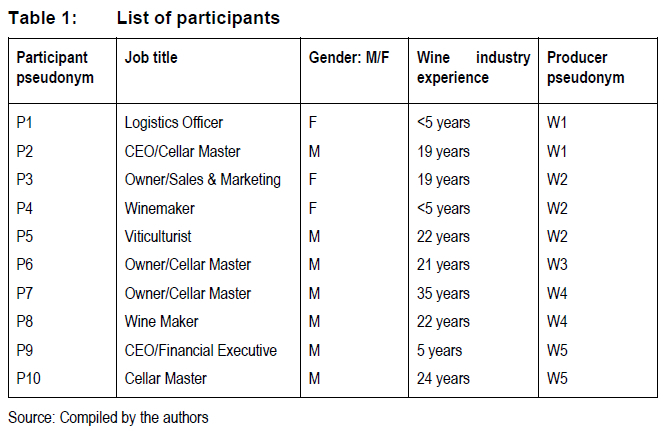
At each participating wine producer, the CEO and/or owner and the wine maker were approached to participate in this study. Table 1 presents the list of participants, their job titles, gender, experience in the wine industry and the participant pseudonym. As can be seen from Table 1, at wine producer W3, only the owner/cellar master was available to be interviewed due to work pressures at the operation. At wine producer W2, the owner, the viticulturist and the wine maker were all interviewed. A total of 10 interviews were conducted.
3.3 Research instrument
A semi-structured interview guide was used to collect the data. The interview guide consisted of open-ended questions. The main aim of the interviews was to extract qualitative data from the participants in order to determine the impact of climate change and extreme weather conditions on wine growing farms in South Africa.
In addition to the use of the interview guide, personal field notes were taken during the interviews, which were combined with direct observation. As noted by Sekaran & Bougie (2016:124), personal notes and observation by the researcher can serve as a further source of evidence in case study research and can assist in the data collection process in that they add richness and context to the interview. Direct observation by the researcher allows for the structured observation of the activities and the participants being studied as a form of corroboration of the data obtained from the participant Yin (2014:113).
3.4 Data Collection
Data was collected through in-depth semi-structured interviews using an interview guide with ten participants at five wine-producing estates located in different wine-growing areas within the Stellenbosch region and by means of personal field notes. Face-to-face semi-structured in-depth interviews were conducted as this enabled the researcher to probe and expand on particular answers given by the participants Wagner et al. (2012:135). Data collection at each of the participating wine estates took place over a number of hours on an agreed date and time during June 2018. The interviews were conducted by one of the authors of this study and were recorded, transcribed verbatim, and data cleaned for accuracy to ensure data trustworthiness.
3.5 Validity and reliability
During the course of the research, the components of Guba's model of trustworthiness, namely, credibility, dependability, transferability, and conformability, were maintained. Credibility was improved by the use of the interviewer's personal notes, which contained a brief checklist of observations and were checked against the transcribed interviews. The interviews were conducted by one of the authors, using a semi-structured interview guide. The interview guide was checked for content validity by a number of academics and pretested by the gatekeeper. The purpose of this review was to refine the questions in order to confirm that the participants would be able to answer them without any difficulty as well as allowing for assessment of the validity of the questions in order to ensure greater reliability of the data collected Saunders, Lewis & Thornhill (2016:723). The participants were given the opportunity to ask questions and seek clarity before responding. Therefore, consistency was maintained during the interviews, which contributed to the trustworthiness of the results of the study. In order to ensure conformability, the interviews were recorded using Listen 'n Write Freeware that was saved onto the laptop computer of one of the authors. The recordings were transcribed as MS Word documents, using this same software on playback mode. The transcribing process was carried out personally by one of the authors and the transcriptions were then checked against the voice recordings for accuracy, with any transcription errors being corrected.
3.6 Data analysis
The data was analysed using thematic analysis. Thematic analysis is a general approach to analysing qualitative data and involves identifying themes or patterns in the data Wagner et al. (2012:231). It is a "method for identifying, analysing, and reporting patterns (themes) within data" Braun & Clarke, (2006:79). The interviews were transcribed verbatim, and the recordings and transcripts were checked twice by the authors to ensure accuracy. From these transcriptions common themes and patterns were identified.
3.7 Ethical considerations
The authors complied with all ethical measures in their communication with the participants, in line with the formal application for ethical clearance at the research institution. The participants were all willing volunteers. They were assured of their privacy, anonymity and confidentiality and that they had the right to withdraw from the research project at any time.
4. RESULTS AND DISCUSSION OF THE FINDINGS
4.1 Overview of participating wine producers
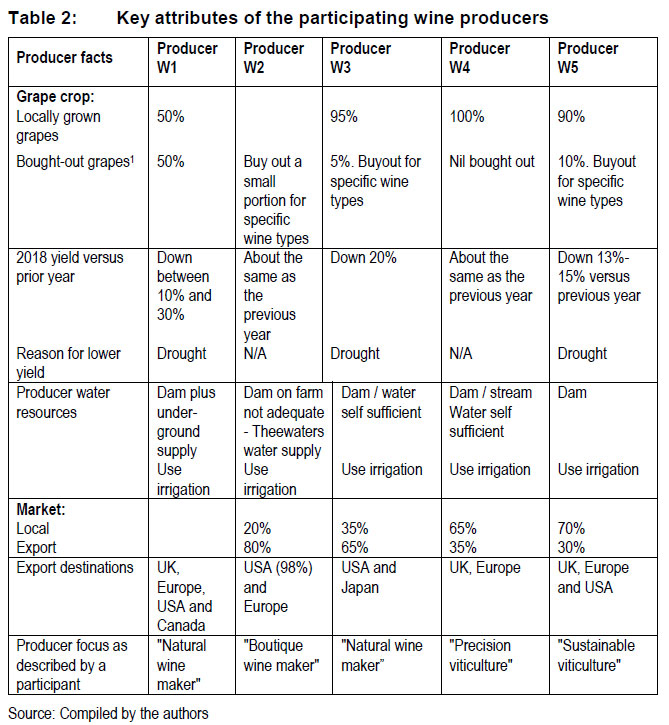
Table 2 presents an overview of the key attributes of the five wine producers who participated in this study. The table gives context to the study as all five of the wine producers rely on irrigation for a successful crop, with only one augmenting irrigation water supply from an external source to those on their farm, being the Theewaters dam. Further, all of the wine producers buy out some grapes from external suppliers, for specific production purposes and all of the producers export a portion of their annual wine production. An adequate water supply is fundamental to the producers' wine production and their future financial and business sustainability.
4.2 Climate change / extreme weather impacts
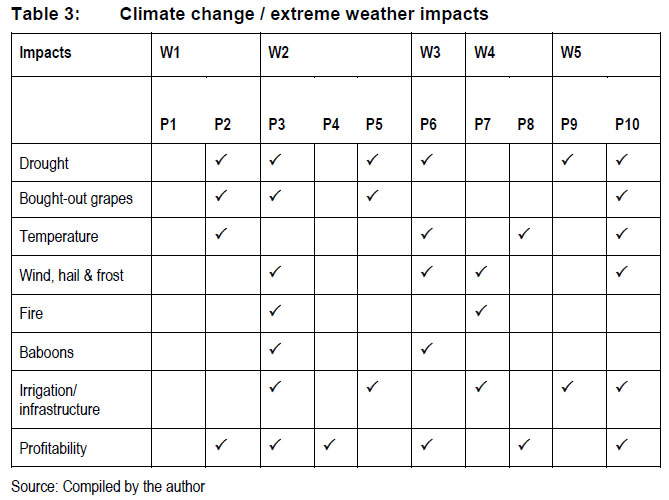
There are many individual weather and climate factors that can directly affect grape growth and wine quality. These include solar radiation, heat accumulation, temperature extremes, precipitation, wind, and extreme weather events such as hail Jones et al. (2005:320). The findings revealed the extreme weather and climate factors that affected South African wine producers include drought, extreme temperature and weather such as fire, wind and hail. The drought impacted on the grape yield of the farmers, and the extreme heat over an extended number of growing seasons impacted on the length of the grape growing cycle, the yield and pricing. See Table 3 for the results.
4.3 Drought
The Western Cape has experienced a series of severe droughts in the past few decades. Droughts reduce surety of water supply and can impose water stress on the grapevine Araujo et al. (2016:1-14). A representative from each of the five participating producers noted that the drought had impacted on the operations in some way, with the most significant impact being to reduce the crop yield. Depending on the grape cultivar involved, such yield reduction varied between 10 to 30%, with the three wine producers affected by yield reduction noting that the average negative impact on their yields was 20%.
"Ja we dropped about 13%. The Stellenbosch average this year is 30% (down). So they dropped a lot, but we just had enough water. So we made it through the season" (Participant 10).
"Look in 2018 we were down about 20% and that was certainly because of the drought. If we look at the average yield that we want to achieve in a given year, and you know that can fluctuate by 20%. Like in 2018 we were down 20%" (Participant 6).
Participant 7 noted that wine growing areas further removed from the coast and further inland have been affected more severely by the drought than the Stellenbosch region: "I mean, there are guys up in Swartland (an agricultural and grape growing area north of Cape Town), I mean they have had a significant crop reduction, this last year."
Three wine producers noted that, while the drought had impacted on the grape crop yield, the quality of the grape in the 2018 year was excellent. One suggested that the vines had to "work harder" in the difficult dry conditions, leading to a good vintage.
"Yeah, the grape vine, it's tough, it likes to stress, it likes the struggle. In fact, in 2015, the vines showed quite a bit of stress. And in 2016 as well. But in 2017 actually (the grapes) they were good" (Participant 6).
"The drought will impact it in terms of the volume. So for two reasons, with the drought, the berries are smaller, with retention of water and juice. But the berries have been much sweeter. This year the berries were smaller, the juice was less. So we did have a very good year and our quality of fruit was wonderful and I think 2018 is going to be a surreal vintage" (Participant 3).
"The quality is excellent. So 2017 and 2018 especially 2017 is going to be a very good vintage. 2016 less so, because it follows that great 2015 vintage, but the drought starts really impacting with the 2015 vintage" (Participant 10).
4.4 Bought-out grapes
Another aspect of the effect of the drought on the wine producers had to do with 'bought-out' grapes. Many wine producers 'buy-out' quantities of grapes, which are used together with their own grown grapes to produce their wines. On the sourcing side of the supply chain, the drought had impacted yields and created a shortage of the grapes that need to be purchased from third parties, and this has raised the prices. This had been further exacerbated by overseas customers buying out South African bulk wine. This comes about firstly because the South African prices are lower than those paid overseas for such bulk wine and secondly because of the lower value of the Rand versus the harder currencies. For these reasons the drought impacted on the South African wine makers who buy out a significant portion of their grapes. Four participants noted the impact on the prices on the bought-out grapes.
"I mean, the prices of grapes have gone up substantially and obviously people have got very, very scared. It is now 2018 and everybody said that 2018 would be 25% down. Everybody was going, I need to buy grapes because I am not going to get the quantity. And the prices went up because suddenly they could sell them for more. Grape prices have gone up" (Participant 3).
We could buy a year or two ago, R5 000 to R7 000 a tonne. Now we pay R14 000 to R18 000 per tonne" (Participant 5).
"I have seen the prices double already in the last six months" (Participant 10).
4.5 Temperature
Temperature is critical to grape growing because of its major influence on the ability to ripen grapes to optimum levels of sugar, acid, and flavour in order to maximise a given style of wine and its quality Jones et al. (2005).
"Even if you have enough water, if there is a lot of heat you have small berries, or you get raisin berries or whatever so there are physical losses too. You must also be careful with the heat because the more heat, more sugar. More sugar, the higher the alcohol" (Participant 10).
Temperatures during the growing season can affect grape quality and viability in the following ways:
• Temperature impacts on the vegetative growth and thus determines the start of the growing season (Jones et al. 2005).
• Higher temperatures during flowering and throughout the growth of the berries can cause: premature veraison (change of colour and start of the accumulation of sugars); high grape mortality through abscission (the natural detachment of parts of a plant, typically dead leaves and ripe fruit); enzyme inactivation (too much heat can cause the rate of an enzyme catalysed reaction to decrease because the enzyme or substrate becomes denatured and inactive); and partial or total failure of flavour ripening Jones et al. (2005).
• During the maturation stage, high daytime temperature ranges lead to the beneficial synthesis of grape tannins, sugars, and flavours Jones et al. (2005).
Four participants, with viticultural/vinicultural backgrounds of between 19 and 24 years, noted the impact that temperature has had on the growing and picking of grapes and on wine production processes.
"The temperatures have been higher (over a number of years), the chemistry of the grapes has been changing and the vineyards have been changing. The heat affects everything, it effects how we farm the vineyards, how we prune the vineyards, how we work the soil, when we work the soil, there are a whole range of decisions that we would make. We are picking earlier than we used to pick. I have been making wine for 19 years and we are certainly picking earlier now than we were 19 years ago, depending on the year, and the vineyard picking is anything between a week to three weeks earlier" (Participant 2).
"But overall in 10 years we've had a lot of very warm vintages. So yeah, global warming is an issue. We've had over the last 10 years earlier vintages, by as much as 2 weeks or more" (Participant 6)
Explaining the length of the fermentation process and the impact of the higher temperatures on this process, a participant stated:
"That can be 3 weeks on whites, 3 weeks to a month in worst case scenario and in reds you can get anything from 4 days to 10 days. Because of the warmer temperatures [being experienced], the fermenting they seem to race through quite quickly" (Participant 8).
The following was an answer to a question about the impact of global warming on the South African wine industry:
" I attended a conference on climate change in Bordeaux that was the first time they used the phrase 'global warming and climate change' and the models for the Southern Hemisphere and Southern Africa. There is a very clear pattern, certain areas are drier and warmer and others wetter. So the West Coast is at risk, the guys who farm off centre pivot. But in our industry, we need to get smarter about what we are planting and how we use water. During the last decade we have changed a lot of things" (Participant 10).
4.6 Wind, frost and hail
The participants noted the impact that wind can have on the vines and the grape crop. There are two aspects to this, one positive and one negative. The first role that wind can have on the vines is that the wind can do damage to flowers and to the vine shoots.
"You can have new leaves on the vine. It can be sprouting, and you might have horrific winds that come in. They can knock the flowers off the vine. That can reduce the proportion of fruit that we thought our planning had been for. We had horrible winds that dried everything out this past season" (Participant 3).
"We've had wind. It's a big factor here. It has damaged the buds and vines. We've had years when we have had severe wind damage" (Participant 6).
"So the wind is a problem now and again when the wind speeds get to a point where they break the shoots off at a very sensitive stage, when the shoots are 30 to 40 cms then the shoots are not well cemented to the main frame and they can be blown off quite easily" (Participant 10).
The second role that the wind can play is in disease protection, as explained by Participant 10: "But the wind does a lot more good than bad, because if you have air movement you can't have fungal infections. If you have air movement you have a mechanical cooling of the canopies, so they cool down a bit, so you reduce water consumption. By moving air over leaves you increase transpiration, so it's a bit like a radiator, its cooling down".
This lessening of the disease impact was confirmed by Participant 6: "Actually because of the wind we have fairly low disease pressure here."
A participant also noted that the wind can have a negative effect on the irrigation of the vines.
"Well the problem is that you do have those daily issues if you have wind and use drip irrigation. Its null and void, the reason being that the wind comes and washes the water away. And it's such a miniscule amount water, it's not a lot" (Participant 3).
Only one participant noted the incidence of frost in the Stellenbosch wine growing area, and the same participant noted the impact of hail on his operation. He noted that hail, with stones with a diameter of between 3 and 5cms, caused significant damage to grape crops across parts of Stellenbosch and Elgin regions. In one such storm in November 2017, his estate had experienced storm damage with a loss of several tonnes of fruit.
4.7 Fire
Fire affects the wine producers by burning the vines and also through smoke damage to the fruit. This is called 'smoke taint' and is the permeation of smoke into the grape berries, resulting in the eventual production of unpalatable juice or wine. The incidence of fire had increased in the Cape winelands due to the hot dry conditions, particularly during the drought period. Two participants identified fire as a risk. Thus, for example:
"I mean we live on a mountain side. A risk on our location is fire" (Participant 3).
This producer noted that they had experienced a significant fire in January 2016, a time of year when the surrounding foliage is driest and most vulnerable. This fire cost the estate 25% of their crop. This producer noted that the only protection was from fire breaks but that in the face of a significant fire with hot dry winds then the fire can "hop over the fire breaks" and damage the vines and the crops.
4.8 Baboons
Two participants noted the issue of the destructive impact of baboons, which are a protected species, on the vines and grapes. The producers both noted that, while electric fences were in place as a deterrent, the animals unfortunately were prepared to get an electric shock from the fence in order to get access to food from the vines. The baboons do damage to the grapes and vines in two ways. They steal grapes off the vine and also damage the vines when they rip the fruit from the vine.
"Yeah they tend to just grab a bunch and just pull the whole shoot off so its ruins your architecture of the vine that you have done. They pull the berries off then they pull the irrigation stuff down. They are very destructive" (Participant 6).
Both participants noted that the most practical way of handling the animals was to chase them away. Participant 6 stated that the only way his farm managed them was to employ a full-time baboon chaser who patrolled the perimeter of the farm on a quad bike.
Two participants noted that this issue of baboons causing damage had been exacerbated by the drought, which had severely impacted on the natural food sources of the wild animals.
"We on our farm have a troop of about 60 baboons nearby....The drought has impacted on the animals because the animals have not been able to have water. So the risk of managing them in itself is problematic. They are protected species, we need them because they belong primarily in the upper Jonkershoek area (a nearby nature reserve). So they come over and they seek the fruit which is both food and obviously a liquid" (Participant 3).
4.9 Irrigation/infrastructure
The majority of farms in the wine growing districts are able to mitigate the effects of drought through irrigation management (Araujo et al. 2016). This has been impacted by the recent drought that has been long lasting and severe.
"We use irrigation, but no-one plans for a once-in-a-300-year drought though. So what we've had is a bit outside of what we can actually plan for" (Participant 2).
All of the participants have dams and use irrigation to water their vines. In addition, two have other water resources, namely a stream (Participant 7) and an underground water supply (Participant 2). Many of the wine producers in the area also receive water from the nearby Theewaterskloof dam scheme.
All five the wine producers noted plans and actions to conserve and protect their water resources.
We do irrigate, and we have very strong underground resources. We mitigate our water risks by recycling all our sewage, all our runoff water. In the winery this year we used 25% of the water that we used two years ago, so we have 75% saving just by making a couple of simple changes in the way we work with water, through just by being aware and careful" (Participant 2).
While the participating producers noted the direct impact of the drought and heat on the crop yield, there were also secondary impacts. Thus, the drought resulted in less water being available from the Theewaterskloof dam scheme, which impacted on the producers' abilities and crops.
"For our guys that get the water from Theewaterskloof, these kinds of things ja. We have seen it for the past three years now that the water is less and that we have to plan much, much better. And with the little irrigation that we have, because they have been cutting down to 30% of the water we normally get, so that was critical to water on specific stages like the flowering stage. You had to give some water over there. And so you had to cut down do it very, very specifically" (Participant 5).
Issues that impact on effective irrigation, such as low water levels in the dams, affected the producer's ability to supply water to the vines, which further impacted on the grape yields. The problem with the "Theewaters scheme is that as the dam got lower and lower there was more and more silt. There was more and more waste from the fish. This got into the pipes. We are on the scheme, we pump up to our reservoir. Our reservoir filters a portion into our home that we pump directly into the drip irrigation. The silt blocks it. The risk you are taking is that you are using unfiltered water....So you have to watch, you have to walk the line because you don't know. Is the line dripping or is it just a pressure zone at the end?" (Participant 3).
The impacts of the drought went beyond affecting the vine and grape growing activities and also affected the operational activities of the estates as considerable quantities of water are used in the winery to keep the environment clean.
"The drought for us, our biggest problem was drinking water and winery water because we rely on a stream and we are not connected to any scheme or any municipal water or anything like that. So if our drinking water had dried up we would have been in serious trouble because you need a lot of water in a winery for cleaning etc." (Participant 7).
4.10 Profitability
All five of the participating wine producers are profitable and anticipate that they will continue to remain so (Participants 2, 3, 6, 7, and 9), but three noted concerns that profitability was decreasing. They confirmed that the sustainability of many of the South African wine producers was under threat due to overall financial pressure.
"I think return on investment [in the wine industry] or return on equity is marginal in SA. It's very low because you almost.... most of the wine farms you get your 15%, the other 85% survive basically. There is probably another 30% who just break even and are sometimes profitable, sometimes not, and so on" (Participant 9).
Three participants noted that input costs were increasing annually, in line with or above the South African inflation level; with selling prices under pressure and that this was placing pressure on profitability. Protecting the profitability of the operation was vital (Participants 6, 7 and 9). The drought and higher temperatures had impacted on grape yield, which further exacerbated the negative financial results of the operations.
A 15-20% drop in yield or volume, due to the drought, is extremely difficult for a wine producer to manage. The fixed-cost component of the wine producers' operation is significant, and therefore the loss of yield results in an increase in the unit cost of a bottle of wine. A simple calculation indicates that, even if year-on-year costs remained the same (ignoring inflationary cost increases), a 15% reduction in volume works out to a 17% unit-cost increase. To compensate for this, knowing that the producer will sell 15% less bottles of wine, the producer would need to increase the unit selling price by at least 17% to make the same profit as he did in the previous year. This will not be achievable as the consumer will be unwilling to pay significantly more for a bottle of wine than in the previous year.
5. PRACTICAL SOLUTIONS FOR WINE PRODUCING ESTATES
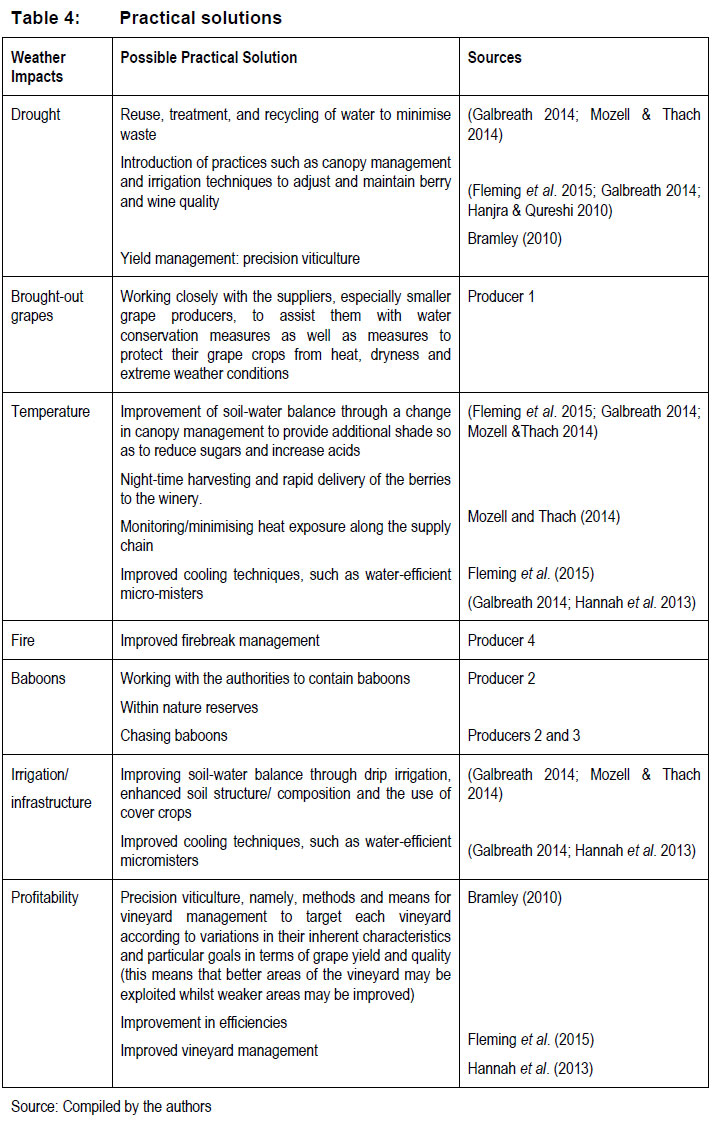
Climate change and extreme weather conditions have direct and at times severe implications for vineyard management and wineries (Mozell & Thach 2014). Thus, if the wine industry wants to remain profitable, they will have to adjust to these changes. Table 4 presents some of the practical solutions wine-producing estates can use for mitigation and adaption in order to manage their resources in a more efficient and effective way, as outlined in the literature and by producers.
To conclude this section, it should also be noted that, in order to mitigate against global warming, wine industries should consider reducing their overall carbon use Mozell & Thach (2014:86). In the Cape region of South Africa, wine producers and conservationists have joined together in the Biodiversity and Wine Initiative. They are examining new management practices to reduce the environmental footprint of vineyards Hannah et al. (2013).
6. CONCLUSION
The purpose of this study was to identify the impact of climate change and/or extreme weather conditions on wine growing regions in South Africa and to suggest ways of managing such change. This study seeks to make a contribution by indicating how the South African wine industry should adjust to climatic changes and extreme weather conditions. Such approaches will assist the management of the wine producing estates in the improved planning of agricultural and harvesting activities so that they will be able to prioritise better and manage their resources in a more efficient and effective way. For example, wine farmers may need to make adjustments to their growing and harvesting timetable and, to some degree, to their production processes in order to accommodate climatic changes.
As this study was limited to five wine estates within five areas of the Stellenbosch region, these findings may not be representative of the entire wine-producing region of Stellenbosch or of other Western Cape wine-producing areas. It is also possible that not all factors have been identified. It is therefore suggested that a further study be conducted to include all the wine producers in South Africa to determine to what extent climate change and extreme weather condition have impacted on the grape yield, the length of the grape growing cycle, and pricing and profitability and also to determine what approaches they have in place to manage these impacts.
Whilst some practical solutions have been provided, the study also recommends that wine producers introduce practices such as canopy management, irrigation techniques and precision viticulture to adjust and maintain yield, berry and wine quality.
There is a dearth of published research that describes the impact of climate change and extreme weather conditions on wine growing regions in South Africa. This research therefore fills a research gap, making a practical contribution by indicating how South African wine producers can take appropriate management steps to adjust to the impact of climate change and extreme weather conditions.
REFERENCES
ARAUJO JO, ABIODUN BJ & CRESPO O. 2016. Impacts of drought on grape yields in Western Cape, South Africa. Theoretical and Applied Climatology 123(1-2):117-130. [ Links ]
BOOYSEN J. 2017. Makers of wine hit by drought. Cape Times. (10 February). [Internet:https://www.pressreader.com/south-africa/cape-times/20170210/282200830665488; downloaded on 28 December 2018. [ Links ]]
BRAMLEY RGV. 2010. Precision viticulture: Managing vineyard variability for improved quality outcomes. In Reynolds AG. Ed. Managing Wine Quality: Viticulture and Wine Quality. Cambridge, UK: Woodhead Publishing (pp 445-480. [ Links ])
BRAUN, V & CLARKE V. 2006. Using thematic analysis in psychology. Qualitative Research in Psychology 3(2):77-101. [ Links ]
COCKRAM G, OSPINAL M & BORDAS R. 2016. The European Influence on the global wine industry. Universidad Carlos III Madrid. [Internet:http://madi.uc3m.es/en/international-research-en/markets-and-industries-en/the-european-influence-on-the-global-wine-industry; downloaded on 16 June 2017]. [ Links ]
DU PLESSIS JA & SCHLOMS B. 2017. An investigation into the evidence of seasonal rainfall pattern shifts in the Western Cape, South Africa. Journal of the South African Institution of Civil Engineering 59(4):47-55. [ Links ]
FLEMING A, PARK SE & MARSHALL NA. 2015. Enhancing adaptation outcomes for transformation: climate change in the Australian wine industry. Journal of Wine Research 26(2):99-114. [ Links ]
FITCHETT JM, GRANT B & HOOGENDOORN G. 2016. Climate change threats to two low lying South African coastal towns: Risks and perceptions. South African Journal of Science 112(5/6):1-9 [ Links ]
GALBREATH, J. 2014. Climate change response: Evidence from the Margaret River Wine Region in Australia. Business Strategy and the Environment, 23:89-104. [ Links ]
GARCIA DE CORTÁZAR-ATAURI I, DUCHÊNE E, DESTRAC-IRVINE A, BARBEAU G, DE RESSÉGUIER L, LACOMBE T, PARKER AK, SAURIN N & VAN LEEUWEN C. 2017. Grapevine phenology in France: from past observations to future evolutions in the context of climate change. OENO One 51(2). (DOI:https://doi.org/10.20870/oeno-one.2017.51.2.1622; downloaded on 15 July 2019. [ Links ]]
GOLDBLATT A. 2010. Agriculture: Facts & trends South Africa. WWF South Africa. [Online: http://awsassets.wwf.org.za/downloads/facts_brochure_mockup_04_b.pdf, downloaded on 15 July 2019. [ Links ]]
GONCHARUK AG. 2017. Exploring the factors of efficiency in German and Ukrainian wineries. Journal of Wine Research 28(4):294-312. [ Links ]
HAIGH N & GRIFFITHS A. 2007. The Natural Environment as a Primary Stakeholder: the Case of Climate Change. Business Strategy and the Environment 18:347-359. [ Links ]
HANJRA MA & ME QURESHI. 2010. Global water crisis and future food security in an era of climate change. Food Policy 35:365-377. [ Links ]
HANNAH L, ROEHRDANZ PR, IKEGAMI M, SHEPARD AV, SHAW MR, TABOR T, ZHI L, MARQUET PA & HIJMANS RJ. 2013. Climate change, wine, and conservation. Proceedings of the National Academy of Sciences 110(17):6907-6912. [ Links ]
HOFFMAN AJ. 2011. Talking past each other? Cultural framing of sceptical and convinced logics in the climate change debate. Organization & Environment 24(1):3-33. [ Links ]
HUSSAIN M, CHOLLETE S & CASTALDI RM. 2008. An analysis of globalization forces in the wine industry: implications and recommendations for wineries. Journal of Global Marketing 21(1):33-47. [ Links ]
INTERNATIONAL ASSOCIATION OF VINE AND WINE (OIV). 2018. State of the vitiviniculture world market. [Online:http://www.oiv.int/public/medias/5958/oiv-state-of-the-vitiviniculture-world-market-april-2018.pdf, downloaded on 6 September 2018. [ Links ]]
JONES GV & DAVIS RE. 2000. Climate influences on grapevine phenology, grape composition, and wine production and quality for Bordeaux, France. American Journal of Enology and Viticulture 51:249-261. [ Links ]
JONES GV, WHITE MA, COOPER OR & STORCHMANN K. 2005. Climate change and global wine quality. Climate Change 73(3):319-343. [ Links ]
KUHN M. 2012. Future scenarios for the South African wine industry: impact of climate change. VinIntell 12. SAWIS, Paarl, South Africa. (May 2012. [ Links ])
KUHN M. 2017. Mergers and acquisitions activity in the wine industry: the bigger picture of supply and demand, globalisation and competition. VinIntell 31. SAWIS, Paarl, South Africa. (March 2017. [ Links ])
LOBELL DB & GOURDJI SM. 2012. The influence of climate change on global crop productivity. Plant Physiology Preview 160:1686-1697. [ Links ]
LORENZO MN, TABOADA JJ, LORENZO JF & RAMOS AM. 2013. Influence of climate on grape production and wine quality in the Rías Baixas, north-western Spain. Regional Environ Change 13(4):887-896. [ Links ]
MOLITOR D & JUNK J. 2019. Climate change is implicating a two-fold impact on air temperature increase in the ripening period under the conditions of the Luxembourgish grapegrowing region. OENO ONE 53(3). (DOI: https://doi.org/10.20870/oeno-one.2019.53.3.2329; downloaded on 15 July 2019. [ Links ]]
MORDOR INTELLIGENCE BUSINESS REPORT. 2017. Global wine market: growth, trends and forecasts (2017-2022). [Internet:https://www.mordorintelligence.com/industry-reports/wine-market; downloaded on 05 May 2017. [ Links ]]
MOSEDALE JR, ABERNETHY KE, SMART RE, WILSON RJ & MACLEAN IMD. 2016. Climate change impacts and adaptive strategies: lessons from the grapevine. Global Change Biology 22(11): 3814-3828. [ Links ]
MOZELL MR & THACH L. 2014. The impact of climate change on the global wine industry: challenges and solutions. Wine Economics and Policy 3(2):81-89. [ Links ]
NASA. 2017. What's in a name? Weather, global warming and climate change. [Internet:https://climate.nasa.gov/resources/global-warming; downloaded on 29 June 2017. [ Links ]]
ORDUNA RM. 2010. Climate Change associated effects on grape and wine quality and production. Food Research International 43(7): 1844-1855. [ Links ]
ROSENZWEIG C, IGLESIAS A, YANG XB, EPSTEIN PR & CHIVIAN E. 2001. Climate change and extreme weather events. Global Change and Human Health 2(2):90:104. [ Links ]
SAUNDERS M, LEWIS P & THORNHILL A. 2016. Research Methods for Business Students. 7th edition. Harlow, UK: Prentice Hall. [ Links ]
SEKARAN U & BOUGIE R. 2016. Research methods for business. 7th edition. New York: John Wiley. [ Links ]
SOUTH AFRICAN WINE INDUSTRY STATISTICS (SAWIS). 2017. SA Wine Industry Statistics NR 42. South African Wine Industry Statistics (SAWIS). [Internet:http://www.sawis.co.za/info/download/Book_2017_statistics_year_english_final.pdf; downloaded on 06 September 2018. [ Links ]]
TURTON AR. 2000. Precipitation, People, Pipelines and Power in Southern Africa: Towards a 'Virtual Water'-based Political Ecology Discourse. In Stott P & Sullivan S. Eds. Political Ecology: Science, Myth and Power. London: Arnold & New York: Oxford University Press. [ Links ]
WAGNER C, KAWULICH B & GARNER M. 2012. Doing social research: A global context. London, UK: McGraw-Hill. [ Links ]
WESTERN CAPE. 2018. What is climate change? [Internet:https://www.westerncape.gov.za/general-publication/climate-change; downloaded on 18 October 2018. [ Links ]]
WINES OF SOUTH AFRICA. 2017. Three centuries of Cape wine. [Internet:http://www.wosa.co.za/The-Industry/History/Three-Centuries-of-Cape-wine; downloaded on 28 December 2018. [ Links ]]
WINN MI & KIRCHGEORG M. 2005. The siesta is over: A rude awakening from sustainability myopia. Research in Corporate Sustainability: Strategic Capabilities and Competitiveness 3:232-258. [ Links ]
YIN RK. 2014. Case study research: Design and methods. 5th edition. London, UK: Sage. [ Links ]
ZIERVOGEL G, JOHNSTON, PJ, MATTHEW, M & MUKHEIBIR, P. 2009. Using climate information for supporting climate chance adaptation in water resource management in South Africa. Climate Change 1-18. (DOI 10.1007/s10584-009-9771-3. [ Links ])
ZOECKLEIN B. 2018. How Climate Change Affects Winegrowing. Wine and Vines (February 2018). [Internet:https://winesvinesanalytics.com/features/article/195134/How-Climate-Change-Affects-Winegrowing downloaded on 13 July 2019. [ Links ]]
* corresponding author