



Services on Demand
Journal

Article
 English (pdf)
 Article in xml format
 Article references
 Automatic translation
 Send this article by e-mail
Indicators
Related links
-
 Cited by Google
 -
 Similars in Google
Share

 Permalink
Journal of Contemporary Management
On-line version ISSN 1815-7440
JCMAN vol.16 n.2 Meyerton 2019
https://doi.org/10.35683/jcm19060.48
RESEARCH ARTICLES
The Effects of Leadership Style on Job Satisfaction in the Logistics Industry in the Gauteng Province
T TsepetsiI; PA JoubertII; M DhurupIII; C MafiniIV,*
IVaal University of Technology, Faculty of Management Sciences. tshepop@vut.ac.za; ORCID NUMBER: https://orcid.org/0000-0002-8264-9000
IIVaal University of Technology, Faculty of Management Sciences. pierrej@vut.ac.za; ORCID NUMBER: https://orcid.org/0000-0002-8445-0329
IIIVaal University of Technology, Faculty of Management Sciences. manilalld@vut.ac.za; ORCID NUMBER: https://orcid.org/0000-0002-8845-3527
IVVaal University of Technology, Faculty of Management Sciences. chengedzaim@vut.ac.za; ORCID NUMBER: https://orcid.org/0000-0002-9426-0975
ABSTRACT
Logistics as a business function continues to gain preeminence in driving the South African economy by facilitating the movement of goods and people. Numerous challenges are experienced by businesses operating in the logistics industry, which limit their performance. Leadership aspects of logistics have become an important determinant of the performance of this activity. The study examined the relationship between leadership styles and job satisfaction in the logistics industry in the Gauteng province. Two hundred and one (201) logistics professionals were surveyed using a structured questionnaire consisting of the Multifactor Leadership Questionnaire and the Satisfaction with Job Facets Questionnaire. The collected data were analysed using descriptive statistics, Pearson correlations and regression analysis. Transformational leadership was moderately and positively correlated to job satisfaction. Transactional and passive-avoidant leadership were both negatively correlated to job satisfaction. In the regression analysis, only transformational leadership predicted job satisfaction. Hence, within the logistics industry, job satisfaction can be improved through positive adjustments of transformational leadership as well as by minimising the degree of both transactional and passive-avoidant leadership.
Key phrases: Job satisfaction; transactional leadership; transformational leadership and passive-avoidant leadership
1. INTRODUCTION AND BACKGROUND
Over the years, South Africa's business environment has evolved through a number of phases. The country's exposure to globalisation has compelled local leadership to consider challenges that are encountered in businesses. One of these challenges lies within the intense global rivalry for increased market share, not only within South Africa but also in international markets, through increased sales and improved profit margins (Dludla 2017). The environment in which businesses compete has migrated to the world stage. The globalisation of the world economy means that competition has become international and only world-class organisations will satisfy customer needs (Geldenhuys & Veldsman 2011; Monga 2003; Stuart 2018). The changing nature of competition, the challenge of global economics, the need to respond quickly to competitive pressures and the widespread availability of information, coupled with many other challenges, have forced organisations to reassess their managerial and leadership styles (McMahon, Barkhuizen & Schutte 2014). This implies that major changes in business practices, methodologies and leadership competence are necessary to survive and compete effectively in this new environment.
Due to a shortage of talent within top management of most organisations, there is a recurring insufficient leadership competency in South Africa (Smit & Carstens 2003; Terblanche, Albertyn & Van Coller-Peter 2018). It is apparent that leadership remains a major challenge facing various organisations in South Africa (Mallaby, Price & Hofmeyr 2017). Among the negative consequences of a shortage of competent leadership are a lack of skilled labour, hostile labour relations, employees who do not identify with organisational objectives and a high employee turnover rate (Smit & Carstens 2003:45; Terblanche et al. 2018). Employee commitment and loyalty towards the organisation depend on good leadership, communication, recognition and training (Hao & Yazdanifard 2015). Literature on organisational behaviour suggests that job dissatisfaction leading to labour turnover is a hidden cost for most organisations and is usually associated with poor leadership (Abou-Moghli 2015; Stacey, Paul & Alice 2011).
This article aims to examine the relationship between leadership style and job satisfaction in the logistics industry in the Gauteng Province of South Africa. According to Bhoola and Kambi-Shambi (2011), interviews held between business leaders from Southern Africa and logistics organisations cited leadership and capacity limitations as some of the reasons why Africa cannot get logistics to work. These challenges are linked to the failure by most logistics organisations in South Africa to place sufficient emphasis on the growth and development of personnel (Landman 2014). This is illustrated by the difficulties that organisations in South Africa have in retaining specialised logistics personnel such as demand planners, transport managers, drivers, engineers and other professionals (Export Africa 2018; Heyns & Luke 2012; Savage, Jenkins & Fransman 2015). Such limitations have resulted in operational inefficiencies across the logistics chain, resulting in a situation where the return on investments was not being realised (Export Africa 2018). Since logistics revolves around a series of networks consisting of interdependent operations facilitating movement of products from one point to the other, developing logistics personnel is indeed crucial to an organisation's survival (Fawcett, Ellram & Ogden 2014). Insufficient literature on leadership and job satisfaction studies have been conducted within the logistics industry in African contexts, and therefore the focus will be on discussing job satisfaction literature generally within an organisational context.
The logistics industry is just as important as other sectors, particularly when considering the crucial role logistics plays in enhancing the economy of South Africa. At the micro level, improving the performance of the logistics function has always been an important goal for most organisations, based on the influence of logistics on the success of each enterprise (Wittmann 2010). At the macro level, the economy of South Africa would implode if specialised business logistics activities such as procurement, warehousing and transportation are ineffective since the movement of products, services and people is dependent on them (Stone 2011:13; Essays UK 2018). In view of this, investigating the nexus between leadership and job satisfaction of employees in the logistics industry is important in developing an understanding of its contribution to the overall success of both organisations as well as the entire South African economy. Moreover, with the growing importance of logistics activities within organisations and their impact on performance, it is necessary to investigate areas that influence this performance.
Although there is still no universal answer to the question of which leadership style is the most efficient, research so far has revealed that leadership style is the cause, not the consequence of an organisation's performance. This renders it logical to expect a linkage between leadership practices and employee attitudes such as job satisfaction (Stander & Rothmann 2009). Additionally, empirical research covering the relationship between leadership, job satisfaction and organisational commitment within the logistics industry in South Africa is lacking. This study is intended to address this gap.
This article is structured as follows: the next section offers a synoptic review of the literature on the logistics industry within South Africa as well as the constructs under consideration in this study. This is succeeded by a presentation of the conceptual framework, followed by the formulation of hypotheses. Thereafter, the research methodology is discussed, succeeded by the presentation of the research results. The closing sections of the article consist of the conclusions and managerial implications as well as the limitations and suggestions for future research.
2. LITERATURE REVIEW
Following in this section will be a discussion of the literature.
2.1 Logistics in South Africa
Logistics is that function within an organisation responsible for the movement of raw materials, goods and services to where they are needed at the required time (Strydom 2008). South Africa is perceived as having one of the most modern and extensive logistics and transport infrastructures in Africa (PricewaterhouseCoopers 2018). Over the years the increase in international trade relations between South Africa and other countries has posed a serious challenge in the form of the shortage of skilled logisticians and transportation professionals, which limits the logistics-related performance of most organisations (Export Africa 2018; Raath 2005). Also, the world is characterised by radical change which exerts more pressure on South African logistics organisations to cope with increasing international competition, powerful information technology, political transformation and customers who are becoming sophisticated and more demanding (Werner 2011). Another major logistical challenge facing most South African organisations is that their international suppliers are situated far away, which exerts pressure on the logistics efficiencies of some organisations, making it more challenging and extremely expensive (Waugh & Luke 2011).
Although the logistics industry in South Africa continues to apply pressure on logistics professionals to meet the needs of consumers daily, most organisations pressure them to keep logistics costs as low as possible (Wittmann 2010). The enhancing of logistics performance in African economies is considered to be a crucial start towards creating a more productive, service-oriented and efficient solutions to most logistical problems (Bhoola & Kambi-Shambi 2011). Leadership is perceived to be the key factor in determining whether South African logistics businesses will be able to capitalise on the opportunities that evolve from these problems and the changes they invoke.
2.2 Leadership
The subject of leadership has always been a very interesting topic for many leadership scholars. According to Robbins, Judge, Odendaal and Roodt (2009), leadership can be defined as the ability to influence a group towards the achievement of a vision or set of goals. Effective leadership is required in the business environment, which is mostly unpredictable, dynamic and complex (Kotter 1990). Drucker (1974) highlights that organisational leaders are involved in the management of their organisations, by participating in the setting of objectives, organising, motivating, communicating with, measuring performance and developing people. Effective leaders possess qualities that enable them to understand which leadership style to apply in a specific situation (Men 2014; Silverthorne 2001). The leadership style chosen by the leader is likely to be dependent on the nature of the task to be performed and the needs of the subordinates. Effective use of leadership style is critically an important characteristic for an individual to succeed in leadership positions within organisations (Muterera, Hemsworth, Baregheh & Garcia-Rivera 2015; San Lam & O'Higgins 2012).
Leadership style represents a fundamental aspect of leadership and refers to the manner in which decisions are made in the organisation (Yousef 1998). According to Goleman (2000), different leadership styles used by individual leaders appear to have a direct and unique impact on the working atmosphere of an organisation, division, or team, and in turn, on its financial performance. There is no consensus that a style of leadership will result in the most effective form of organisational behaviour since different styles are needed for different situations, and each leader must understand when to exhibit a particular approach (Rad & Yarmohammadian 2006). As such, a leader may have knowledge and skills to act effectively in one situation but may completely fail in another situation. The present study directs its focus to three leadership styles identified in the Multifactor Leadership Questionnaire (MLQ) (Bass & Avolio 1990). These are transformational, transactional and passive avoidance leadership styles. The MLQ is an important instrument that has been validated across numerous categories of organisations as well as cultures and can be used to distinguish between capable and incapable leaders at all organisational levels (Walumbwa, Orwa, Wang & Lawler 2005).
2.3 Job Satisfaction
Job satisfaction is considered to be one of the most researched constructs in business science and organisational behaviour (Spagnoli, Caetano & Santos 2011). It is defined as a positive feeling about one's job resulting from an evaluation of its characteristics (Robbins & Judge 2007). It has to do with an individual's perception and evaluation of his or her job, which is influenced by the person's unique circumstances such as needs, values and expectations (Latif, Ahmad, Qasim, Mushtaq, Ferdoos & Naeem 2015; Olasupo 2011). A person with a high level of satisfaction holds positive feelings towards the job, whereas a person with a low level of job satisfaction holds negative feelings towards the job (Baron & Greenberg 2003:148; Spagnoli et al. 2011; Spector 1997). Job satisfaction is one of the key factors in organisational dynamics and is generally considered to be a primary dependent variable in terms of which the effectiveness of an organisation's human resources is evaluated (Rai & Sinha 2002; Yudiawan, Setiawan, Irawanto & Rofiq 2017). Factors that influence job satisfaction are the work itself, promotional opportunities, the abilities of the supervisors to provide emotional and technical support, the extent to which fellow workers are supportive, working conditions and the equitability of remuneration (Luthans 2011; Robbins & Judge 2007; Okediji, Etuk & Nnedum 2011).
Job satisfaction is important in organisational dynamics for various reasons. Firstly, job satisfaction is perceived to be significantly interesting to researchers trying to determine the relationship between job satisfaction and other organisational variables such as employee productivity, absenteeism and retention (Allen & Wilburn 2002; Furnham 2005). Secondly, job satisfaction is perceived as having a major influence on employee work outcomes since it is considered to be a multidisciplinary and everlasting relevant construct covering all professions, work, jobs and contexts (Parvin & Kabir 2011; Rad & Yarmohammadian 2006; Sellgren, Ekvall & Tomson 2006:352;). Thirdly, job satisfaction may be helpful in guiding managers who are solely interested in organisational outcomes, such as the influence of job satisfaction on employee commitment (Ferguson, Ashcroft & Hassell 2011; Judge, Thoresen, Bono & Patton 2001). This shows that managers have an important role to play in determining how employees feel about their jobs
2.4 Leadership and Job Satisfaction
The relationship between leadership style and job satisfaction in different organisations has received extensive research attention from different researchers (Asghar & Oino 2018; Loke 2001; Mester, Visser, Roodt & Kellerman 2003; Ojokuku, Odetayo & Sajuyigbe 2012; Ottu & Nkenchor 2010; Randeree & Chaudhry 2012; Walumbwa et al. 2005). Most of these studies concluded reveals that different leadership styles influence the job satisfaction of subordinates. Rad and Yarmohammadian (2006) view leadership as an important predictor of job satisfaction. Satisfaction with a leader could play a mediating role between leadership behaviour and voluntary organisational turnover intentions (Wells & Peachey 2011).
Leaders who practice people-oriented leadership styles show concern for subordinates' wellbeing and personal needs (Saleem 2015; Yiing & Ahmad 2009). Several studies (Burg-Brown 2016; Miller & Monge 1986; Nidadhavolu 2018) concluded that a participative leadership style inculcates a positive attitude in employees, enhances productivity and stimulates higher levels of employee job satisfaction. When leaders demonstrate high levels of consideration and supportive behaviour, their subordinates tend to experience higher levels of job satisfaction (Liphadzi, Aigbavboa & Thwala 2015; Zahari & Shurbagi 2012). Other studies (Hussain & Hassan 2016; Ladebo 2008; Minavand, Mokhtari, Zakerian & Pahlevan 2013) indicate that the quality of the relationship between an employee and a supervisor can be a source of motivation for employees to achieve higher performances and therefore develop positive attitudes. Employees will feel obliged to reciprocate whenever supervisors treat them fairly, value their contributions and their well-being, and when they receive their managers' support (Dawley, Andrews & Bucklew 2008).
3. CONCEPTUAL FRAMEWORK AND HYPOTHESES FORMULATION
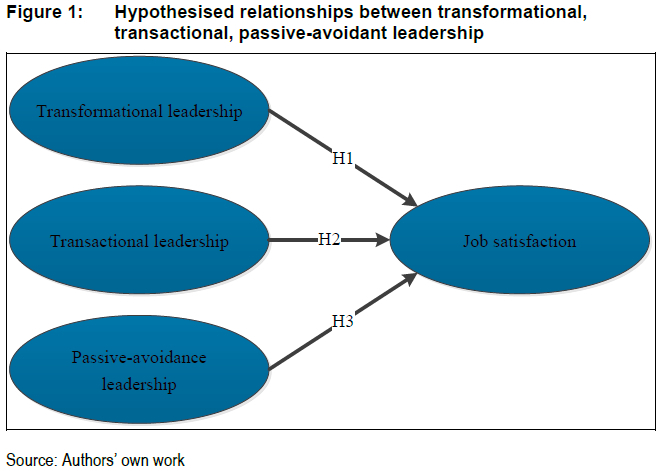
This study is based on the conceptual framework indicated in Figure 1, which identifies transformational, transactional and passive-avoidant leadership styles as the predictor variable, leading to job satisfaction, of which the outcome is variable.
3.1 Transformational leadership style and job satisfaction
Transformational leadership is defined as the ability to respond to individual followers' differences and needs, and then empower each individual to align their objectives with those of the organisation (Dennis & Meola 2009). Transformational leaders are perceived to be instrumental in helping followers to achieve remarkable levels of performance (Denhardt & Campbell 2006). The followers feel trust, admiration, loyalty and respect towards the leader, and are motivated to do more than they originally were expected to do (Strydom 2008). The four dimensions of transformational leadership include idealised influence, inspirational motivation, intellectual stimulation and individual consideration (Bass, Jung, Avolio & Berson 2003)
Castro, Perinan and Bueno (2008) are of the view that transformational leadership style has a significant influence on the work attitudes and behaviour of the followers. A study conducted by Walumbwa et al. (2005) revealed a positive significant relationship between transformational leadership and job satisfaction. The results of several studies (Herman & Chiu 2014; Nguni, Sleegers & Denessen 2006; Top, Akdere & Tarcan 2015) indicated that transformational leadership style had the greatest influence on variables such as employee commitment, organisational citizenship behaviour and job satisfaction. Other studies (Al-Hussami 2008; Andrews, Richard, Robinson, Celano & Hallaron 2012; Castro et al. 2008) also reported a positive relationship between transformational leadership and job satisfaction. These results lead to the following hypotheses:
Ho1: There is no relationship between transformational leadership and job satisfaction in the logistics industry.
Ha1: There is a positive relationship between transformational leadership and employee job satisfaction in the logistics industry.
3.2 Transactional leadership style and job satisfaction
Kuhnert and Lewis (1987) characterised transactional leaders as those types of leaders that provide followers with something they need in exchange for something a leader expects them to achieve. It is characterised by creating exchange relations between the leaders and their followers, in which leaders create a strong expectation from their followers with clear indications of what they will receive in return for meeting the expectations (Barbuto 2005:27). A study conducted by Andrews et al. (2012) reveals that while satisfaction with leadership was predicted by transformational attributes and outcomes, the transactional leadership focusing on contingent reward was highly correlated with satisfaction and leadership. Ohunakin, Adeniji and Akintayo (2016) revealed in their study that transactional leadership behaviour is a significant predictor of job satisfaction. A previous study by Akhigbe, Ajienka and Oloda (2014) indicates that there is a positive and significant relationship between all the dimensions of transactional leadership style and employee satisfaction except passive management by exemption. Other scholars (Burns 2010; Nikezic, Puric & Puric 2012) also suggest that transactional leadership behaviours may lead to greater job satisfaction. The following hypotheses are therefore put forward:
Ho2: There is no relationship between transactional leadership and job satisfaction in the logistics industry.
Ha2: There is a positive relationship between transactional leadership and job satisfaction in the logistics industry.
3.3 Passive-avoidant leadership style and job satisfaction
The passive-avoidance leadership style refers to the existence of indifference or a lack of leadership (Xirasagar 2008). Leaders who prefer a passive-avoidance leadership style, according to Limsila and Ogunlana (2008), are perceived as avoidant leaders who may either not intervene in the work affairs of subordinates or may completely avoid responsibilities as superiors. Passive-avoidance style is associated with dissatisfaction, unproductiveness and ineffectiveness (Barbuto 2005). A study conducted by Andrews et al. (2012) reported a negative correlation between passive-avoidant leadership style and job satisfaction. Morelo, Cuadrado, Navas and Morales (2007) indicated a highly negative correlation between passive-avoidant leadership and employee satisfaction. Still, other studies (Voon, Lo, Ngui & Ayob, 2011; Rizi, Azadi, Farsani & Aroufzad 2013; Kebede & Demeke 2017) suggest that passive-avoidant leadership is inversely related to job satisfaction. Hence, this study proposes the following hypothesis:
Ho3: There is no relationship between passive-avoidant leadership and job satisfaction in the logistics industry.
Ha3: There is a negative relationship between passive-avoidant leadership and employee job satisfaction in the logistics industry.
4. RESEARCH METHOD
4.1 Research Design
This study followed a descriptive survey design. This design involves the collection of relevant data by including pre-formulated questions in a pre-determined order on a structured questionnaire (Fox & Bayat 2007). The nature of the topic for this study determines that it leans more towards a descriptive study with characteristics of an exploratory or causal design. The objective of the descriptive study is to deliver a description or to explain aspects related to phenomena regarding individual, organisational, industrial and other perspectives in which the researcher shows interest (Zikmund, Babin, Carr & Griffin 2013). The objective of the exploratory study is to provide insights into and an understanding of the problem confronting the researcher, whereas causal research is used to obtain evidence of cause-and-effect relationships among variable (Malhotra 2010). In order to achieve the objectives of this study, quantitative research was employed.
4.2 Sampling Design
In this study, the target population consisted of (n=621) employees working in 33 logistics organisations in the Southern Gauteng region. A current online Yellow Pages was used to obtain the sample frame for the study due to the absence of a single database containing a list of logistics organisations. A sample frame was drawn up consisting of 33 logistics firms based in the Southern Gauteng region. These were verified through telephone calls in order to establish that they were still in operation. Convenience sampling, in which respondents that were readily accessible to the researcher were considered for the study (Shiu, Hair, Bush & Ortinau 2009) was then applied in selecting the actual respondents. Out of the 33 logistics organisations identified on the sample frame, 10 companies based in the Southern Gauteng region were willing to participate in the study.
The final sample consisted of (n=201) professional employees working within the logistics industry. Initially, 400 questionnaires were distributed and 227 questionnaires were returned. Out of these, 26 unusable questionnaires were discarded, culminating in a final sample of 201 respondents. This represented a response rate of 50.3%. The respondents worked in departments such as procurement, transportation, warehousing, planning and customer services, amongst others. To qualify as a respondent, one had to be employed in the participating firm for at least two years and currently occupy a logistics-related position.
4.3 Measurement instrument
Previously validated scales were used as measurement instruments in this study. These included two scales, namely the Multifactor Leadership Questionnaire (MLQ) developed by Bass and Avolio (1990) and the Satisfaction with Job Facets Questionnaire developed by Andrews and Withey (1976). The MLQ questionnaire was designed for both employees and supervisors and consisted of 45 statements about the following leadership styles: transformational, transactional and passive-avoidant leadership styles. Items representing transformational leadership included idealised influence, inspirational motivation, individualised consideration and intellectual stimulation. Transactional leadership style is represented by items called contingent rewards and management-by-exception. Passive avoidant leadership is characterised by management by exception-passive and laissez-faire as components thereof. In this study, subordinates completed the rating version of the same questionnaire. Subordinates were requested to answer the MLQ by rating how frequently their supervisors have displayed the behaviour described, using a five-point Likert-type scale (0= Not at all; 1= Once in a while; 2= Sometimes; 3= Fairly often; 4= Frequently if not always).
The Facets of Job Satisfaction Questionnaire was used to indicate how satisfied or dissatisfied respondents were with their jobs by asking the respondents to rate themselves on 20 questions using a 5-point scale varying from 1 (very dissatisfied) to 5 (very satisfied).
4.4 Reliability analysis
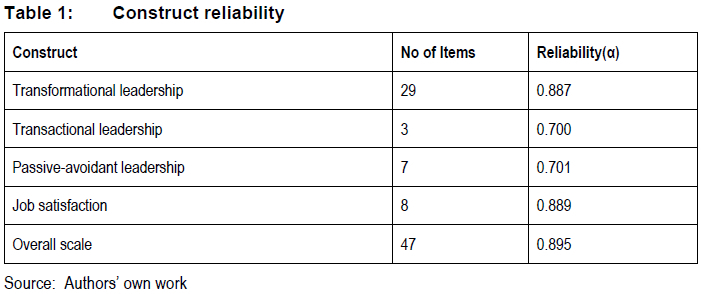
Scale reliabilities were measured using the Cronbach Alpha coefficient. The results of the reliability tests are reported in Table 1.
The minimum acceptable Cronbach alpha value to accept that a measurement scale is reliable is 0.7 (Blunch 2008). The results of the study show that all constructs, transformational leadership (α =0.887), transactional leadership (α =0.700) passive-avoidant (α= 0.701) attained Cronbach alpha values that were at least 0.7, which means that they met the minimum prescribed threshold for construct reliability.
4.5 Validity
To ascertain face validity, the questionnaire was reviewed by four members of the faculty at a university of technology, whose lines of expertise fall within human resource management. The panel of experts made several recommendations on the technical aspects (for example, wording) with the aim of improving the face validity of the questionnaire.
To establish content validity, a pilot test was conducted in November 2015 using a convenient sample of 50 respondents. After analysis of the pilot data, a decision was made to modify the questionnaire with the aim of improving its content validity. Changes were made to the wording of some of the questions to eliminate ambiguity and address the lack of clarity and the number of questions. The final questionnaire was more accurate and appropriate in capturing the perceptions of respondents regarding the influence of leadership styles on job satisfaction within a logistics environment.
Construct validity was assessed through the use of correlation analysis. The results of the correlation analysis show that there was a positive association between job satisfaction and transformational leadership and negative associations between job satisfaction and two constructs, which are transactional leadership and passive-avoidant. This confirms that there was satisfactory construct validity in the measurement scales. Predictive validity was measured using regression analysis. The results of the regression analysis show that transformational leadership was statistically significant in predicting job satisfaction, which confirms that predictive validity was satisfactory in the study
4.6 Data Collection and Analysis
Data were collected between March and September 2016. The survey questionnaire was distributed using a combination of emails and personal contact. Several ethical considerations were followed during the collection of data. Firstly, respondents were not given incentives for participating in the study. Secondly, all respondents signed a consent form confirming that their participation in the study was voluntary. Also, the identities of respondents were kept in strict confidence throughout the study, which protected them from any possible victimisation. Finally, every respondent was informed that they could withdraw from the study at any point if they felt the need to do so.
The collected data were first analysed using descriptive statistics such as frequencies and mean scores. Thereafter, inferential statistics such as Pearson correlations and regression analysis were applied in testing the hypotheses proposed. The Statistical Analysis for the Social Sciences (SPSS version 24.0) was used to analyse the data.
5. RESEARCH RESULTS
In this section the research results are discussed and analysed.
5.1 Demographic Profile of Respondents
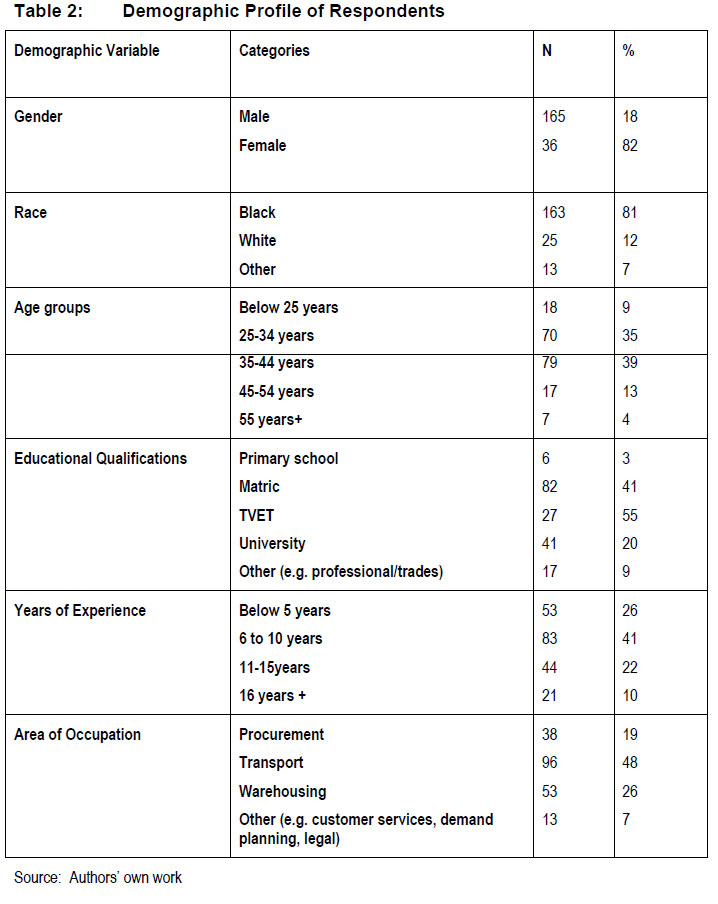
The demographic profile of respondents is shown in Table 2.
An analysis of Table 2 indicates that the proportion of males (n=165; 82%) was higher than that of females (n=36; 18%). Further analysis shows that there were more black respondents in the survey, (n=163; 81%), followed by white respondents (n=25; 12%) and respondents from other ethnic groups (n=13; 7%). The results for the ages of respondents show that the largest group of respondents were aged between 35 to 44 years (n=79; 39%), followed by those who were aged between 25 to 34 years (n=70; 35%). The study further reveals that respondents with matric/grade 12 education (n=82; 41%) were the highest number, followed by holders of qualifications obtained at technical and vocational training (TVET) colleges (n=55; 27%). Respondents with work experience between five to 10 years (n=83; 41%) were the highest number, followed by those with less than five years of work experience (n=53; 26%). In terms of area of occupation, the results indicated that respondents who worked in transport sections (n=96; 48%), were the highest number, followed by those who work in warehouse sections (n=53; 26%), those who work in the procurement section (n=38; 19%)
and those who work in other sections such as customer services, demand planning and the legal affairs (n=13; 7%).
5.2 Correlations
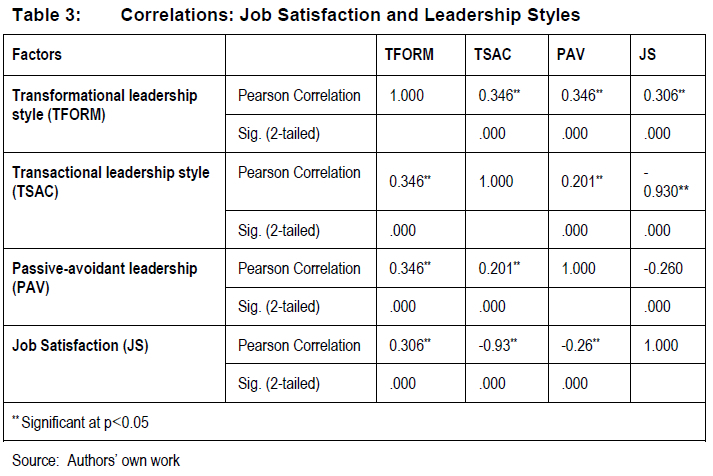
The strength of the association between the constructs was measured using Pearson correlation analysis, since the collected data were normally distributed. The results are reported in Table 3.
As shown in the inter-factor correlations in Table 3, there was a moderate positive correlation (r=0.346; p<0.05) between transformational and transactional leadership styles. The results also indicate a similar moderate positive correlation (r=0.346; p<0.05) between transformational and passive-avoidant leadership styles. Another moderate positive correlation (r=0.201; p<0.05) was observed between transactional and passive-avoidant leadership styles. Moreover, there was a moderate positive correlation (r=0.306; p<0.05) between transformational leadership and job satisfaction. This positive association denotes that job satisfaction increases when the intensity of transformational leadership practices increases.
Further analyses indicated a strong negative association (r=-0.93; p<0.05) between transactional leadership and job satisfaction. This result signifies that job satisfaction decreases extensively when transactional leadership increases, and vice versa. Besides, there was a weak negative association (r=-0.26; p<0.05) between passive-avoidant leadership and job satisfaction. This result demonstrates that passive-avoidant leadership decreases marginally with increasing levels of job satisfaction.
5.3 Regression analysis
Linear regression analysis was performed in order to establish the predictive relationships between the various leadership styles and job satisfaction. The regression equation was formulated as follows:
JS= β0 + β1(Transformational Leadership) + β2 (Transactional Leadership) + β3 (Passive-avoidant Leadership)
Where:
JS is job satisfaction,
β0 is the constant or intercept, and
β1-3 are the coefficients of the independent variables.
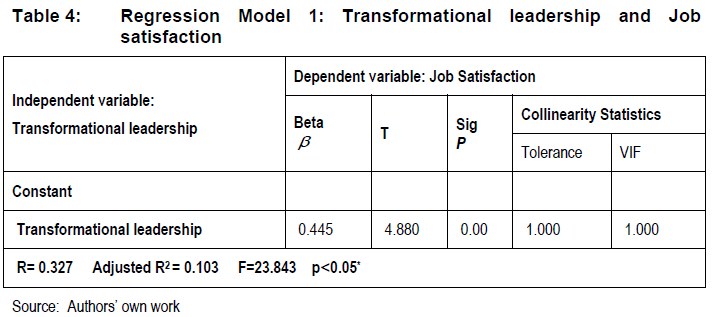
Since there were three separate independent variables, three regression models were run. In regression model 1, transformational leadership was entered as the independent variable and job satisfaction was entered as the dependent variable. These results are reported in Table 4.
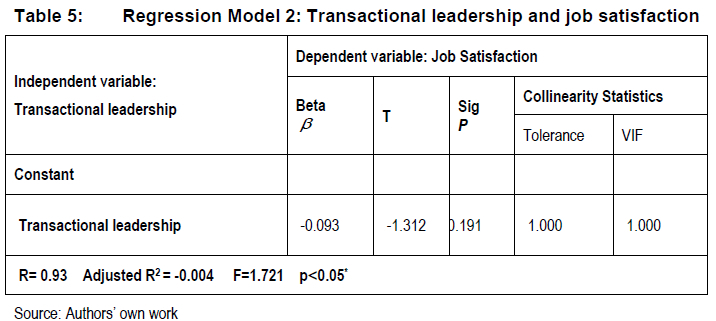
In model 2, the transactional leadership type was entered into the regression model as the independent variable and job satisfaction was entered in the model as the dependent variable. These results are reported in Table 5.
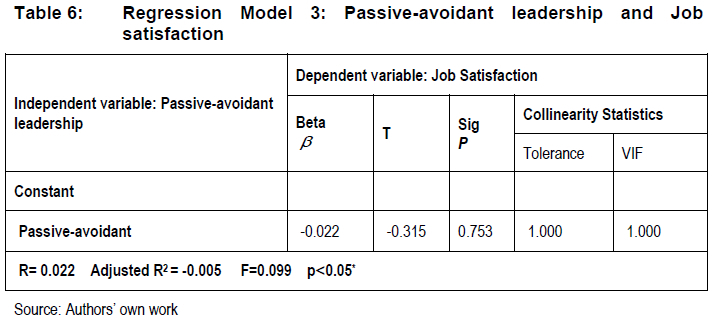
In regression model 3 passive-avoidant leadership was entered as the independent variable and job satisfaction as the dependent variable. These results are reported in Table 6.
6. DISCUSSION
The study tested hypotheses for relationships between job satisfaction and three leadership factors, namely transformational, transactional and passive avoidant leadership. The three relationships were tested using regression analysis, and the results are discussed in this section.
6.1 Transformational Leadership and Job Satisfaction
The results show statistical significance (p=0.000; p<0.05; t=4.880 with the Δ R2 = 0.103) which indicates that transformational leadership accounts for approximately 10% of the variance in job satisfaction. In terms of the beta weights, transformational leadership (β=0.445) yielded a positive contribution towards the prediction of job satisfaction. These results are consistent with a study conducted by (Castro et al. 2008; Nguni et al. 2006; Andrews et al. 2012; Walumbwa et al. 2005). For these reasons, the hypothesis (Ha1) that there is a positive relationship between transformational leadership style and employee job satisfaction is accepted. This indicates that there is a greater propensity for employees to exhibit greater levels of job satisfaction in the logistics industry when managers exhibit transformational leadership behaviours.
6.2 Transactional Leadership and Job Satisfaction
Transactional leadership was statistically insignificant (p=0.191; p<0.05; t=1.312; Δ R2 = 0.004), in predicting job satisfaction. Furthermore, transactional leadership accounted for approximately 0.004% of the variance in job satisfaction, which is almost negligible. In terms of the beta weights, transactional leadership (β=0.093) impacted negatively on job satisfaction. The hypothesis (Ha2) that there is a positive relationship between transactional leadership style and employee job satisfaction is therefore rejected. Consistently, previous studies conducted by Nguni et al. (2006) and Al-Hussami (2008) also affirm that transactional leadership behaviour is not a significant predictor of job satisfaction.
6.3 Passive-avoidant leadership and Job satisfaction
As revealed in Table 6, no statistical significance was observed (p=0.743; p<0.05; t=-0.315; Δ R2 = 0.005), which indicates that passive-avoidant leadership accounts for approximately 0.005% of the variance in job satisfaction, which is almost inconsequential. In terms of the beta weights, passive-avoidant leadership was statistically insignificant in predicting job satisfaction since the beta value (β=-0.022) is very small and negative. This result depicts an almost negligible negative influence on the passive-avoidant leadership on job satisfaction. The hypothesis (Ha3) that there is a negative relationship between the passive-avoidant leadership style and employee job satisfaction is therefore accepted.
These results are consistent with those of a study conducted by Andrews et al. (2012:1107), who reported a negative relationship between passive-avoidant (laissez-faire) leadership style and job satisfaction. Morelo et al. (2007) indicated a highly negative relationship between laissez-faire leadership and employee satisfaction. These results are in line with previously acknowledged views that passive-avoidant leaders believe in transferring their leadership powers to the subordinates, which compromises the leader's active role (Frooman, Mendelson & Murphy 2012) With that lack of leadership dominating in the organisation the natural result is for the typical employee to feel dejected and demotivated. This pattern was validated within the logistics industry as realised in the current study.
Upon comparing the beta values of the predictor variables, it is observed that transformational leadership had the highest beta score, indicating that it exerts the highest influence on job satisfaction. This result is perhaps attributed to the well-acknowledged impact of transformational leadership on followers. Transformational leaders tend to motivate their followers to perform beyond expectations by raising followers' confidence levels and providing support for developing to higher levels (Ling, Simseck, Lubatkin & Veiga 2008). Trust and meaningful relationships are developed between the leader and followers, and the latter feel motivated to exert added efforts in their responsibilities (Strydom 2008). It is even acknowledged that transformational leadership is arguably the most effective style in many organisations and scenarios (Ling et al. 2008; Tafvelin 2013). It is not surprising then that transformational leadership emerged as the most significant predictor of job satisfaction within the logistics industry, as observed in this study.
7. CONCLUSIONS AND MANAGERIAL IMPLICATIONS
The study aimed to examine the relationship between leadership styles and job satisfaction in the logistics industry in the Southern Gauteng region. In the correlation analysis, positive associations emerged between the transformational leadership, the other two styles as well as with job satisfaction. There was a strong positive correlation between transactional and passive avoidance leadership styles. Transactional leadership was strongly and negatively correlated with job satisfaction, while a weak negative correlation existed between passive-avoidant leadership and job satisfaction. Prediction between the three leadership styles and job satisfaction was tested using regression analysis. It was observed that only transformational leadership predicted job satisfaction. Thus, the study concludes that transformational leaders have a significant influence on the work attitudes and behaviour of the followers in the logistics industry.
The study has theoretical and practical implications. Theoretically, the study provides an impression of the relationship between transformational, transactional and passive-avoidance leadership styles and job satisfaction in the logistics industry. This information is an important addition of literature to current and future researchers on organisational leadership in the logistics industry. Practically, the study is significant, given the rising importance of logistics to both individual organisations and the national economy. Investigating the relationship between leadership and the job satisfaction of employees in the logistics industry is important in developing an understanding of its contribution to the overall success of both organisations as well as the entire South African economy. The study suggests that within the logistics industry, the job satisfaction of logistics professionals can be improved through positive adjustments to transformational leadership and by minimising the degree of both transactional as well as passive-avoidant leadership. Hence, if higher job satisfaction is attained, employees in the logistics industry will be able to perform better, leading to the improved performance of their organisations and the larger South African economy.
Based on the results a number of suggestions are put forward to guide supervisors/managers in logistics' organisations in understanding the influence of the above-mentioned leadership styles on job satisfaction. Since the results of the study showed a positive relationship between transformational leadership and job satisfaction, it is necessary to improve transformational leadership to increase job satisfaction. Managers are encouraged to be mentors or coaches more than bosses and should assign and delegate work based on the talents and interests of the subordinates but also challenge their comfort zones. Managers should endeavour to become role models who will not ask subordinates to perform tasks that the leaders themselves are unable to perform. They should be committed to the organisation's vision and inspire the subordinates to accept new ideas and embrace work-related challenges. To motivate subordinates to perform optimally, managers should express their passion, besides communicating with confidence and optimism.
Since the results of the study found a weak negative relationship between passive-avoidance leadership style and job satisfaction, it is important for managers/supervisors to avoid the use of this leadership style at all costs as this style exerts an adverse influence upon followers' satisfaction with leadership.
8. LIMITATIONS AND IMPLICATIONS FOR FUTURE RESEARCH
Results from this study offer several implications for future research in the area of leadership and job satisfaction. Since the study used a quantitative research design, future research on these constructs can make use of a mixed method approach to obtain more comprehensive results. The sample used in the study was relatively small and was drawn exclusively from logistics companies located in the southern part of Gauteng province. The purpose of the study was not to generalise the findings outside the sample but to understand the phenomenon in the context of the logistics industry in that region. This fact notwithstanding, future research is required to incorporate a wider range of other leadership styles and examine their influence on job satisfaction from other logistics companies throughout South Africa. Also, future studies should include employees from other departments.
REFERENCES
ABOU-MOGHLI A. 2015. The role of organizational support in improving employees' performance. International Business Research 8(2):198-203. (DOI:https://doi.org/10.5539/ibr.v8n2p198. [ Links ])
AKHIGBE OJ, AJIENKA MF & OLODA OF. 2014. Transactional leadership style and employee satisfaction in Nigerian banking sector. European Journal of Business and Management 6(26):14-23. [ Links ]
ALLEN DR & WILBURN M. 2002. Linking customer satisfaction and employee satisfaction to the bottom line. Milwaukee: American Society Quality Press. [ Links ]
AL-HUSSAMI MRN. 2008. A study of nurses' job satisfaction: the relationship to organisational commitment, perceived organisational support, transactional leadership, transformational leadership, and level of education. European Journal of Scientific Research 22(2):286-295. [ Links ]
ANDREWS DR, RICHARD DCS, ROBINSON P, CELANO P & HALLARON J. 2012. The influence of staff nurse perception of leadership style on satisfaction with leadership. International Journal of Nursing Studies 49(9):1103-1111. (DOI:10.1016/j.ijnurstu.2012.03.007. [ Links ])
ANDREWS FM & WITHEY SB. 1976. Social Indicators of well-being: Americans perceptions of life quality, New York: Plenum Press. [ Links ]
ASGHAR S & OINO I. 2018. Leadership styles and job satisfaction. Market Forces 15(1):1-14. [ Links ]
BARON RA & GREENBERG J. 2003. Organizational behaviour in organizations: understanding and managing the human side of work. Canada: Prentice Hall. [ Links ]
BASS BM & AVOLIO BJ. 1990. Developing trans-formational leadership 1992 and beyond. Journal of European Industrial Training 14:21-27. (DOI:https://doi.org/10.1108/03090599010135122. [ Links ])
BASS MB, JUNG DI, AVOLIO BJ & BERSON Y. 2003. Predicting unit performance by assessing transformational and transactional leadership. Journal of Applied Psychology 88(2):207-218. (DOI:https://doi.org/10.1037/0021-9010.88.2.207. [ Links ])
BHOOLA Y & KAMBI-SHAMBI L. 2011. Making African logistics move. Civil Engineering 19(8):65-68. [ Links ]
BARBUTO JE. 2005, Motivation and transactional, charismatic and transformational leadership: a test of antecedents. Journal of Leadership and Organisational Studies 11(4):26-40. [ Links ]
BLUNCH NJ. 2008. Introduction to structural equation modelling using SPSS and AMOS, New Delhi: Sage Publications. [ Links ]
BURG-BROWN SA. 2016. The relationship between leadership styles and organizational performance moderated by employee job satisfaction in United States' government 82 agencies, [Internet:https://pqdtopen.proquest.com/doc/1854168268.html?FMT=ABS; downloaded on 13 February 2019. [ Links ]]
BURNS JM. 2010. Leadership. New York City, NY: Harp Perennial. [ Links ]
CASTRO CB, PERINAN MMV & BUENO JCC. 2008. Transformational leadership followers' attitudes: the mediating role of psychological empowerment. The International Journal of Human Resources Management 19(10):1842-1863. (DOI: http://dx.doi.org/10.1080/09585190802324601. [ Links ])
DAWLEY DD, ANDREWS MC & BUCKLEW NS. 2008. Mentoring supervisor support and perceived organisational support: what matters most? Journal of Leadership and Organisation Development 29(3):235-247. (DOI:http://dx.doi.org/10.1108/01437730810861290. [ Links ])
DENNIS DJ & MEOLA DD. 2009. Preparing for leadership. New York: American Management Associations. [ Links ]
DENHARDT JV & CAMPBELL KB. 2006. The role of democratic values in transformational leadership. Journal of Administration and Society 38(5):556-572. (DOI:10.1177/0095399706289714. [ Links ])
DLUDLA S. 2017. SA ranked 61st in WEF Global Competitiveness Index IOL News, September 27. [Internet:https://wwwiol.co.za/news/politics/sa-ranked-61st-in-wef-global-competitiveness-index-11374664; downloaded on 13 February 2019. [ Links ]]
DRUCKER PF. 1974. Management: Tasks, responsibilities, practices. New York: Harper & Row. [ Links ]
ESSAYS UK. 2018. Logistics of South African economy. [Internet:https://www.ukessayscom/essays/economics/logistics-on-south-african-economy-economics-essayphp?vref=1; downloaded on 13 February 2019. [ Links ]]
EXPORT AFRICA. 2018. Logistics profitability lags due to skills shortage. [Internet:http://export-africa.co.za/2018/01/17/logistics-profitability-lags-due-skills-shortage/; downloaded on 13 February 2019. [ Links ]]
FAWCETT SE, ELLRAM LM & OGDEN JA. 2014 Supply chain management: From vision to implementation Essex: Pearson. [ Links ]
FERGUSON J, ASHCROFT D & HASSELL K. 2011. Qualitative insights into job satisfaction and dissatisfaction with management among community and hospital pharmacists. Journal of Research in Social and Administrative Pharmacy 7: 306-316. (DOI: https://doi.org/10.1016/j.sapharm.2010.06.001. [ Links ])
FOX W & BAYAT MS. 2007. A guide to managing research. Cape Town: Juta Academic. [ Links ]
FROOMAN J, MENDELSON MB & MURPHY JK. 2012. Transformational and passive avoidant leadership as determinants of absenteeism. Leadership & Organization Development Journal 33(5):447-463. (DOI:10.1108/01437731211241247. [ Links ])
FURNHAM A. 2005. The psychology of behavior at work: the individual in the organisation. New York: Psychology Press Taylor & Francis Group. [ Links ]
GELDENHUYS CA & VELDSMAN TH. 2011. A change navigation-based scenario planning process within a developing world context from an Afro-centric leadership perspective. South African Journal of Human Resource Management 9(1):1-17. (DOI:https://doi.org/10.4102/sajhrm.v9i1.265. [ Links ])
GOLEMAN D. 2000. Leadership that gets results. Harvard Business Review 78(2):78-90. [ Links ]
HAO MJ & YAZDANIFARD R. 2015. How effective leadership can facilitate change in organizations through improvement and innovation. Global Journal of Management and Business Research 15(9):1-7. [ Links ]
HERMAN H & CHIU WC. 2014. Transformational leadership and job performance: A social identity perspective. Journal of Business Research 67(1):2827-2835. (DOI:https://doi.org/10.1016/j.jbusres.2012.07.018. [ Links ])
HEYNS G & LUKE R. 2012. Skills requirements in the supply chain industry in South Africa. Journal of Transport and Supply Chain Management 6(1):107-125. (DOI:https://doi.org/10.4102/jtscm.v6i1.34. [ Links ])
HUSSAIN M & HASSAN H. 2016. The leadership styles dilemma in the business world. International Journal of Organizational Leadership 5(4):411-425. (DOI:10.33844/ijol.2016.60305. [ Links ])
JUDGE TA, THORESEN CJ, BONO JE & PATTON GK. 2001. The job satisfaction-job performance relationship: A qualitative and quantitative review. Psychological Bulletin 127(3):376-407. (DOI:https://psycnet.apa.org/doi/10.1037/0033-2909.127.3.376. [ Links ])
KEBEDE AM & DEMEKE GW. 2017. The influence of leadership styles on employee job satisfaction in Ethiopian public universities. Contemporary Management Research 13(3):165-176. (DOI:10.7903/cmr.17668. [ Links ])
KOTTER JP. 1990. A force for change: How leadership differs from management. New York: Free Press. [ Links ]
KUHNERT KW & LEWIS P. 1987. Transactional and transformational leadership: A constructive/developmental analysis. Academy of Management Review 12(4):648-657. (DOI:10.2307/258070. [ Links ])
LADEBO OJ. 2008. Perceived supervisory support and organisational citizenship behaviours: Is job satisfaction a mediator? South African Journal of Psychology 38(3): 479-488. (DOI:https://doi.org/10.1177%2F008124630803800303. [ Links ])
LANDMAN M. 2014. Supply chain management concerned about skills shortage. [Internet:https://www.bizcommunity.com/Article/196/389/120516html; downloaded on 13 February 2019. [ Links ]]
LATIF MS, AHMAD M, QASIM M, MUSHTAQ M, FERDOOS A & NAEEM H. 2015. Impact of employee job satisfaction on organizational performance. European Journal of Business and Management 7:166-171. [ Links ]
LIMSILA K & OGUNLANA SO. 2008. Performance and leadership outcome correlates of leadership style and subordinate commitment. Journal of Engineering Construction and Architectural Management 15(2):164-184. (DOI:https://doi.org/10.1108/09699980810852682. [ Links ])
LING Y, SIMSEK Z, LUBATKIN MH & VEIGA JF. 2008. The impact of transformational CEOs on the performance of small- to medium-sized firms: Does organizational context matter? Journal of Applied Psychology 93(4): 923-934. (DOI:https://www.researchgate.net/journal/0021-9010_Journal_of_Applied_Psychology. [ Links ])
LIPHADZI M, AIGBAVBOA C & THWALA W. 2015. Relationship between leadership styles and project success in the South Africa construction industry. Procedia Engineering 12(3):284-290. (DOI: https://doi.org/10.1016/j.proeng.2015.10.091. [ Links ])
LOKE JCF. 2001. Leadership behaviours: Effects on job satisfaction productivity and organizational commitment. Journal of Nursing Management 91:191-204. (DOI:https://doi.org/10.1046/j.1365-2834.2001.00231.x. [ Links ])
LUTHANS F. 2011. Organizational behavior: An evidence-based approach. 12th ed. New York: McGraw-Hill/Irwin. [ Links ]
MALHOTRA NK. 2010. Marketing research: An applied orientation global edition. London: Pearson Education. [ Links ]
MALLABY SJ, PRICE G & HOFMEYR K. 2017. The transition to general management in South Africa. South African Journal of Human Resource Management/SA Tydskrif vir Menslikehulpbronbestuur 15(0):a846. (DOI:https://doi.org/10.4102/sajhrm.v15i0.846. [ Links ])
MCMAHON G, BARKHUIZEN N & SCHUTTE N. 2014. The impact of globalisation on South African businesses: Some leadership thoughts. Mediterranean Journal of Social Sciences 5(9): 215-220. (DOI:http://dx.doi.org/10.5901/mjss.2014.v5n9p215. [ Links ])
MILLER KI & MONGE PR. 1986. Participation satisfaction and productivity: A meta-analytic review. Journal of Management Academy 29(4):727-753. [ Links ]
MINAVAND H, MOKHTARI SE, ZAKERIAN H & PAHLEVAN S. 2013. The impact of project managers' leadership style on employee job satisfaction, performance and turnover. IOSR Journal of Business and Management 11(6):43-49. [ Links ]
MEN LR. 2014. Why leadership matters to internal communication: linking transformational leadership symmetrical communication and employee outcomes. Journal of Public Relations Research 26:256-279. (DOI:https://doi.org/10.1080/1062726X.2014.908719. [ Links ])
MESTER C, VISSER D, ROODT G & KELLERMAN R. 2003. Leadership style and its relation to employee attitudes and behaviour. South African Journal of Industrial Psychology 29(2):72-82. (DOI:https://doi.org/10.4102/sajip.v29i2.100. [ Links ])
MONGA ML. 2003. Leadership: What we have and what we need. Indian Journal of Industrial Relations 39(2):183-193. [ Links ]
MOLERO F, CUADRADO I, NAVAS M & MORALES JF. 2007. Relations and effects of transformational leadership: A comparative analysis with traditional leadership styles. The Spanish Journal of Psychology 10(2):358-368. [ Links ]
MUTERERA J, HEMSWORTH D, BAREGHEH A & GARCIA-RIVERA BR. 2015. The leader- follower dyad: The link between leader and follower perceptions of transformational leadership and its impact on job satisfaction and organizational performance. International Public Management Journal 1:1-32. (DOI:https://doi.org/10.1080/10967494.2015.1106993. [ Links ])
NIDADHAVOLU A. 2018. Impact of leadership styles on employee job satisfaction and organizational commitment - a study in the construction sector in India. Western Kentucky University. [Internet:https://digitalcommons.wku.edu/theses/2090; downloaded on 14 February 2019]. (Master's theses and Specialist Projects. Paper 2090. [ Links ])
NIKEZIC SP, PURIC S & PURIC J. 2012. Transactional and transformational leadership: Development through changes. International Journal for Quality Research 6:1-15. [ Links ]
NGUNI S SLEEGERS P & DENESSEN E. 2006. Transformational and transactional leadership effects on teachers' job satisfaction, organisational commitment and organisational citizenship behaviour in primary schools: The Tanzanian case. Journal of Research Policy and Practice 17(2):145-177. (DOI:https://doi.org/10.1080/09243450600565746. [ Links ])
OHUNAKIN O, ADENIJI AA & AKINTAYO ID. 2016. Transactional leadership style and employee job satisfaction among universities guest houses in south-west Nigeria. (3rd International Conference on African Development Issues. (CU-ICADI 2016, pp 368-371. [ Links ])
OJOKUKU R, ODETAYO T & SAJUYIGBE A. 2012. Impact of leadership style on organizational performance: A case study of Nigerian banks. American Journal of Business and Management 1(4):202-207. (DOI:https://doi.org/10.11634/216796061706212. [ Links ])
OKEDIJI AA, ETUK AS & NNEDUM OAU. 2011. Influence of perceived co-worker involvement and supervisory support on job satisfaction. IFE Psychology 19(2):28-42. (DOI:http://dx.doi.org/10.4314/ifep.v19i2.69505. [ Links ])
OLASUPO MO. 2011. Relationship between organisational culture leadership style and job satisfaction in a Nigerian manufacturing organisation. Journal of Life Psychology 19(10):159-176. (DOI: [ Links ]
OTTU IFA & NKENCHOR CT. 2010. Gender and leadership style as socio-demographic indicators of job satisfaction at Akwa Ibom Civil State Civil Service. Journal of Gender and Behaviour 8(2): 2996-3016. (DOI:http://dx.doi.org/10.4314/gab.v8i2.61929. [ Links ])
PARVIN MM & KABIR MN. 2011. Factors affecting employee job satisfaction of pharmaceutical sector. Australian Journal of Business and Management Research 1(9):113-123. [ Links ]
PRICEWATERHOUSECOOPERS. 2018. South Africa: Best performer in Africa for trade facilitation logistics. [Internet:http://https://www.pwc.com/gx/en/transportation-logistics/publications/africa-infrastructure-investment/assets/south-africa.pdf; downloaded on 03 September 2019. [ Links ]]
RAATH L. 2005. Chartered Institute of Logistics and Transport South Africa (CILTSA): Multimodal. Transport World Africa (1)1-:5. [ Links ]
RAD AMM & YARMOHAMMADIAN MH. 2006. A study of the relationship between managers leadership styles and employees job satisfaction. Journal of Leadership in Health Services 19(2):11-28. (DOI:https://doi.org/10.1108/13660750610665008. [ Links ])
RAI S & SINHA AK. 2002. Job delight: beyond job satisfaction. Indian Journal of Industrial Relations 37(4):554-571. [ Links ]
RANDEREE K & CHAUDHRY AG. 2002. Leadership style satisfaction and commitment. Journal of Engineering Construction and Architectural Management 19(1):61-85. (DOI:https://doi.org/10.1108/09699981211192571. [ Links ])
RIZI RM, AZADI A, FARSANI ME & AROUFZAD S. 2013. Relationship between leadership styles and job satisfaction among physical education organizations employees. European Journal of Sports and Exercise Science 2(1): 7-11. [ Links ]
ROBBINS SP & JUDGE TA. 2007. Organisational behaviour. Pearson Prentice Hall: New Jersey. [ Links ]
ROBBINS SP, JUDGE TA, ODENDAAL A & ROODT G. 2009. Organisational behaviour: Global and South African perspectives. Cape Town: Pearson Education South [ Links ]
SALEEM H. 2015. The impact of leadership styles on job satisfaction and mediating role of perceived organizational politics. Procedia-Social and Behavioral Sciences 172:563-569. (DOI:https://doi.org/10.1016/j.sbspro.2015.01.403. [ Links ])
SAN LAM C & O'HIGGINS E. 2012. Enhancing employee outcomes: The interrelated influences of managers' emotional intelligence and leadership style. Journal of Leadership and Organisational Development 33(2):149-174. (DOI:https://doi.org/10.1108/01437731211203465. [ Links ])
SAVAGE CJ, JENKINS AK & FRANSMAN L. 2015. Understanding the effect of skilled labour resource shortages on supply chain sustainability: a review of the logistics skills gap in Southern Africa. University of Derby UK. (20th LRN Annual Conference and PhD Workshop 2015; 9th to 11th September 2015). (pp 1-10. [ Links ])
SELLGREN S, EKVALL G & TOMSON G. 2006. Leadership styles in nursing management: preferred and percieved. Journal of Nursing Management 14:348-355. (DOI:https://doi.org/10.1111/j.1365-2934.2006.00624.x. [ Links ])
SHIU S, HAIR J, BUSH R & ORTINAU D. 2009. Marketing research. London: McGraw-Hill [ Links ]
SILVERTHORNE C. 2001. A test of the path-goal leadership theory in Taiwan. Journal of Leadership & Organisation Development 22(4):151-158. (DOI:https://doi.org/10.1108/01437730110395042. [ Links ])
SMIT H & CARSTENS L. 2003. The influence of leadership role competencies on organisation change outcome in the manufacturing industry in South Africa. South African Journal of Human Resource Management 1(2):45-52. (DOI: [ Links ]
SPAGNOLI P, CAETANO A & SANTOS SC. 2011. Satisfaction with job aspects: Do patterns change over time? Journal of Business Research 65(5):609-616. (DOI:https://doi.org/10.1016/j.jbusres.2011.02.048. [ Links ])
SPECTOR PE. 1997. Job satisfaction: Application, assessment, causes and consequences. Thousand Oaks, CA, Sage Publications, Inc. [ Links ]
STACEY MC, PAUL JT & ALICE C. 2011. Trust and distrust in safety leadership: Mirror reflections? Safety Science 49(8):1208-1214. (DOI:https://doi.org/10.1016/j.ssci.2011.04.002. [ Links ])
STANDER MW & ROTHMANN S. 2009. The relationship between leadership job satisfaction and organisational commitment. South African Journal of Human Resources Management 7(3):7-13. (DOI:https://doi.org/10.4102/sajhrm.v6i3.145. [ Links ])
STRYDOM J. 2008. Principles of Business Management. Cape Town: Oxford University Press. [ Links ]
STONE T. 2011. Without trucks, South Africa stops. Transport World Africa 9(3):13-14. [ Links ]
STUART J. 2018. Openness to trade makes SA vulnerable to global shifts. Business Day February 28. [Internet:https://www.businesslive.co.za/bd/opinion/2018-02-28-leakage-and-swing-to-a-service-economy-take-their-toll-on-south-africa/; downloaded on 13 February 2019. [ Links ]]
TAFVELIN S. 2013. The transformational leadership process antecedents, mechanisms and outcomes in the social services. Faculty of Social Sciences, Umeá University, Sweden. [http://www.diva-portal.org/smash/record.jsf?pid=diva2%3A640843&dswid=-3563; downloaded on 20 February 2019]. (Doctoral thesis. [ Links ])
TERBLANCHE NHD, ALBERTYN RM & VAN COLLER-PETER S. 2018. Developing leaders by supporting their transitions into senior positions. South African Journal of Business Management 49(1):1-12. (DOI: https://doi.org/10.4102/sajbm.v49i1.12. [ Links ])
TOP M, AKDERE M & TARCAN M. 2015. Examining transformational leadership job satisfaction organizational commitment and organizational trust in Turkish hospitals: Public servants versus private sector employees. The International Journal of Human Resource Management 26(9):1259-1282. (DOI:https://doi.org/10.1080/09585192.2014.939987. [ Links ])
VOON ML, LO MC, NGUI KS & AYOB NB. 2011. The influence of leadership styles on employee job satisfaction in public sector organizations in Malaysia. International Journal of Business Management and Social Sciences 2(1):24-32. [ Links ]
YIING LH & AHMAD KZB . 2009. The moderating effects of organizational culture on the relationships between leadership behaviour and organizational commitment and between organizational commitment and job satisfaction and performance. Journal of Leadership & Organisational Development 30(1):53-86. (DOI:https://doi.org/10.1108/01437730910927106. [ Links ])
YOUSEF DA. 1998. Correlates of perceived leadership style in a culturally mixed environment. Journal of Leadership and Organisational Development 19(5):275-284. (DOI:https://doi.org/10.1108/01437739810234341. [ Links ])
YUDIAWAN M, SETIAWAN M, IRAWANTO D & ROFIQ A. 2017. The influences of leadership styles organizational communication and job satisfaction towards employees job performance in doing construction jobs: A study on three construction companies in Jakarta. Russian Journal of Agricultural and Socio Economic Sciences 65(5):168-180. (DOI:https://doi.org/10.18551/rjoas.2017-05.23. [ Links ])
WALUMBWA FO, ORWA B, WANG P & LAWLER JJ. 2005. Transformational leadership organisational commitment and job satisfaction: a comparative study of Kenyan and US financial firms. Human Resource Development Quarterly 16(2):235-256. (DOI:https://doi.org/10.1002/hrdq.1135. [ Links ])
WAUGH B & LUKE R. 2011. Logistics outsourcing by manufacturers in South Africa. Journal of Transport and Supply Chain Management 5(1):337-360. (DOI:https://doi.org/10.4102/jtscm.v5i1.81. [ Links ])
WELLS JE. & PEACHEY JW. 2011 Turnover intentions: do leadership behaviours and satisfaction with the leader matter? Journal Team Performance Management 17(1):23-40. (DOI:https://doi.org/10.1108/13527591111114693. [ Links ])
WERNER A. 2011. Organisational behaviour: a contemporary South African perspective. 3rd ed. Pretoria: Van Schaik. [ Links ]
WITTMANN H. 2010. Total costs of logistics in South Africa need to be reduced. CSIR Science Scope 5(1):4-5. (DOI:https://hdl.handle.net/10520/EJC29719. [ Links ])
XIRASAGAR S. 2008. Transformational, transactional and laissez-faire leadership among physician executives. Journal of Heath Organisation and Management 22(8):383-394. (DOI:https://doi.org/10.1108/14777260810916579. [ Links ])
ZAHARI IB & SHURBAGI AMA. 2012. The effect of organizational culture and the relationship between transformational leadership and job satisfaction in petroleum sector of Libya. International Business Research 5(9):89-97. (DOI:10.5539/ibr.v5n9p89. [ Links ])
ZIKMUND WG, BABIN BJ, CARR JC & GRIFFIN M. 2013. Business Research Methods. 9th ed. Mason OH: South-Western. [ Links ]
* corresponding author