



Services on Demand
Journal

Article
 English (pdf)
 Article in xml format
 Article references
 Automatic translation
 Send this article by e-mail
Indicators
Related links
-
 Cited by Google
 -
 Similars in Google
Share

 Permalink
Journal of Contemporary Management
On-line version ISSN 1815-7440
JCMAN vol.16 n.2 Meyerton 2019
https://doi.org/10.35683/jcm19059.49
RESEARCH ARTICLES
Service quality expectations of online grocery consumers in Gauteng, South Africa
BS BrinkI; GJ HeynsII, *; PJ KilbournIII
IUniversity of Johannesburg, Institute of Transport and Logistics Studies (Africa) sarette.brink@imcdsa.co.za. ORCID NUMBER: https://orcid.org/0000-0002-1508-2382
IIUniversity of Johannesburg, Institute of Transport and Logistics Studies (Africa). gjheyns@uj.ac.za; ORCID NUMBER: https://orcid.org/0000-0003-0881-6525
IIIUniversity of Johannesburg, Institute of Transport and Logistics Studies (Africa). pkilbourn@uj.ac.za; ORCID NUMBER: https://orcid.org/0000-0002-7599-0251
ABSTRACT
The remarkable global growth in the online retail market has resulted in many challenges for online grocery retailers. The emerging South African online grocery market is faced with unique last-mile logistical challenges. This article identifies the main service quality expectations of South African online grocery consumers and provides online grocery retailers with an improved understanding of their consumers' service requirements and enables them to formulate and implement effective last-mile logistics strategies. This research utilises a quantitative research design and used primary data, obtained through self-administered online questionnaires. The research shows that attended home/work delivery was rated the consumers' most preferred last-mile delivery option and that the delivery option does affect consumers' final decision to purchase groceries online. Respondents clearly indicated delivery costs as the most important factor when selecting a delivery service. Although the research findings indicate that South African consumers are still not very confident about buying groceries online, the various factors identified provide opportunities for retailers to exploit possible market opportunities to build consumers' confidence whilst increasing their market share.
Key phrases: e-grocery retailers; last-mile logistics; online grocery shopping and service quality
1. INTRODUCTION
The increasing worldwide growth of the e-commerce market for long-lasting consumer products and grocery goods has resulted in an increased demand for direct-to-consumer (D2C) deliveries accompanied by increased consumer expectations for fast, free delivery (Datex 2017). The substantial growth in e-commerce sales in all the main markets has caused traditional retailers to adopt multi-channel (MC) and omni-channel (OC) strategies to sell their products and to deliver on customers' particular needs (Marchet, Melacini, Perotti, Rasini & Tappia 2018). Initially, multi-channel strategies were developed to address the logistics challenge caused by e-commerce, which included different, uncoordinated distribution channels to reach different market segments (Galipoglu, Kotzab, Teller, Hüseyinoglu & Pöppelbuß 2018). Omni-channel retailing, developed from multi-channel distribution, integrates activities across channels (Ailawadi & Farris 2017), which allows customers to move with relative ease between channels (e.g. online store & brick-and-mortar store) within a single transaction (Kazancoglu & Aydin 2018; Melacini Perotti, Rasini & Tappia 2018) while indicating their delivery preference (Weber & Badenhorst-Weiss 2018).
The logistical challenges are notably more complex for grocery retailing than for non-food products, because of multiple temperature zones, orders containing several items, and the perishable nature of products increases waste and fast delivery requirements (Wollenburg, H ü bner, Kuhn & Trautrims 2018). Online grocery retailers are facing many challenges in this market segment including the last-mile delivery of the supply chain (Weber-Snyman & Badenhorst-Weiss 2016). The last-mile of delivery refers to the last portion of delivery process (Liberatore & Miller 2016). All of these challenges add cost, time and inconvenience to an already marginal activity. Last-mile logistics is often perceived to be the most costly and ineffective segment of the supply chain (Gevaers, Van de Voorde & Vanelslander 2014) owing to the following factors:
• There is an increased rate in failed deliveries as a result of recipients not being at home to receive deliveries. This results in additional operational and transport costs, while many goods can be left unattended at a consumer's preferred delivery location, perishable grocery items may require more specialised handling, such as temperature control or refrigerated transportation. The receiving of perishable grocery items falls into the attended delivery category and often result in failed deliveries, a major cause of increased costs incurred by the online grocery retailer (Melacini et al. 2018). To remain profitable, the attempt by retailers to recover these operational costs by means of increased delivery fees (Datex 2017).
• Same-day delivery results in increased delivery costs and increases the complexity of efficient route planning Hübner, Kuhn & Wollenburg (2016). A low consumer density in some areas further increases additional transport costs and delivery lead times.
The Internet has enabled consumers' to purchase and retailers to offer their products or services online. Electronic commerce or e-commerce is a method used by consumers' that involves browsing the Internet for consumer goods, grocery items, services or business information, with the intention of purchasing and paying for items online (Khan, Liang & Shahzad 2014). E-commerce is being implemented and used in many types of business sectors including the grocery retail sector. Wang (2015) states that with the fast growth of online shopping, consumers' need for assortment and on-time delivery has also increased. In fact, B2C e-commerce has led to a higher requirement for logistics services. Wresch and Fraser (2011) indicate that developing countries are struggling as a result of inefficient logistical networks, including both distribution services and transport infrastructure, which are considered extremely important factors for the growth of e-commerce.
A recent Nielsen (2018) global survey revealed that around 26% of digital consumers purchased fresh groceries online, indicating an increase of 15% between 2016 and 2018. To provide a perspective on conditions conducive for grocery e-commerce, South Korea (a developed country) reported the highest grocery e-commerce market share at 8.3 percent in 2018 and it is perceived to be at the forefront of grocery e-commerce (Garcia 2018). Compared to South Korea, where 95 percent of the population has Internet access, only 54 percent of South Africa's population has Internet access (Hootsuite & We Are Social 2019). Looking at the above, it is evident that providing an online delivery service to consumers entails high operational and infrastructure costs that need to be recovered in the delivery fees charged to consumers.
There are numerous reasons why consumers may make use of online grocery shopping, including not having the necessary transport to get to a retail store, being physically disabled, not having the time to visit a retail store, or taking care of minors. Nielsen (2015) research indicates that there is a definite future market growth opportunity for South African retailers; however, there are also numerous challenges that these retailers face to ensure the efficient supply of the last-mile. These challenges include, but are not limited to, order picking challenges, order fulfilment and inventory strategy challenges, last-mile delivery strategies and cost, reverse logistics and quality of the delivery service (Weber-Snyman & Badenhorst-Weiss 2016). This article will provide an overview of the findings from researching the last-mile logistics concept, particularly focussing on the online grocery sector in Gauteng, South Africa.
2. LITERATURE REVIEW
In this review, five main last-mile logistics challenges are focussed on: order picking, order fulfilment and inventory strategies, last-mile delivery strategies, reverse logistics, and the quality of the delivery service. Some global grocery retailers have separate storage facilities which are 100 per cent dedicated to fulfilling online orders only. Order picking is the first step in ensuring that a customer's order is fulfilled.
2.1 Order picking
Inventory management involves the management of stock keeping units in such a manner that the online retailer is able to fulfil online orders in anticipation of consumer demand (Kim & Lennon 2011). Sensory and substitution issues may be grouped under the challenges of order picking faced by online grocery retailers and consumers'. Substitution in an out-of-stock situation poses a challenge for the reason that the order picker does not know the customer's level of product quality expectations. The consumers' capability to make substitution decisions is reduced in online grocery shopping (Oliver 2015). Order picking techniques can range from physical in-store picking to fully automated picking processes. Over time ineffective picking processes have improved remarkably as a result of automated replenishment methods, improved order preparation methods, and optimal vehicle utilisation (De Vuijst, Kesteloo & Hoogenberg 2014).
Sensory issues refer to the quality of products that it is difficult for consumers' to assess online, particularly for perishable food items that require refrigerated storage. Groceries are items that are perceptible by touch and of perishable nature, which increases the difficulty of assessment online, particularly for items that are not enclosed in product packaging (Boyer, Frohlich & Hult 2004). This has become a common factor in online grocery shopping as consumers are generally uncertain about the retailer's ability to select the best quality on their behalf Hübner et al. (2016). The procurement of grocery items involves physical interaction with the product, implying that consumers prefer to inspect the condition of items before they purchase, and it is therefore evident that a major shortcoming of grocery ecommerce business structures is that they limit the sensory observations of a product (Kempiak & Fox 2002).
2.2 Order fulfilment and inventory strategies
A key competitive element of an online grocery store includes the methods used for order fulfilment (Ellis 2003). The types of products and services offered (which are also closely related to the methods used for order fulfilment) and the geographical markets the retailer operates in, differentiates major players in the online grocery sector (Hays, Keskinocak & De Lopez 2004). Online grocery retailers can supply from distribution centres (DC), existing stores, partner with traditional grocers, or have the option to make a pick-up service available (Wang 2016). According to Rai, Verlinde, Macharis, Schoutteet and Vanhaverbeke (2018) omni-channel retailers employ varied strategies to achieve fulfilment, however food retailers tend to structure fulfilment and last-mile activities in-house, whilst non-food retailers are inclined to collaborate with logistics service providers (LSPs).
2.3 Last-mile delivery strategies
Last-mile delivery in this research does not only include physical delivery, but also delivery information and options, shipping and handling charges, and order tracking. During the last decade, many countries have experienced a significant increase in online sales, stimulating demand mainly for attended home delivery services, with the aim of including alternative delivery services such as automated parcel stations and pick-up points (Morganti, Seidel, Blanquart, Dablanc & Lenz 2014). According to Rai et al. (2018) the main last-mile transport tactics are customer collection and home delivery. In anticipation of reducing last-mile delivery costs, retailers are investigating many alternative options to home delivery including: click and collect and consumers taking receipt of goods at their most preferred location, both entailing the use of temperature monitored locker systems used by companies like Waitrose in the U.K. and Coles in Australia (De Vuijst, Kesteloo & Hoogenberg 2014). Makro South Africa has central pick-up locations for their non-perishable goods. Attended home delivery and being able to retain customer loyalty remains the biggest challenge for online grocery retailers (Banerjee & Siemens 2015).
A further challenge that makes online grocery shopping unique is the need to meet cold chain distribution requirements. Esper, Jensen, Turnipseed and Burton (2003) revealed that consumers' are more willing to buy groceries online if they have control over the type of delivery service, which poses a greater challenge to fulfil cold chain distribution requirements. Taking this into consideration, cold chain distribution requirements are especially difficult in online grocery retailing since the basket of items may require different storage temperatures to be delivered in one consolidated delivery to the customer (Weber-Snyman & Badenhorst-Weiss 2016).
The growth of grocery e-commerce has shifted the retailer's awareness to shipping fees charged. The fees charged for delivery become a challenge for the online grocery retailer owing to the high capital investment in equipment and resources that need to be recovered. Freight charges, also referred to as shipping and handling fees, are based on different structures: flat-rate shipping; unconditional free shipping; and threshold-based free shipping (Nguyen, De Leeuw & Dullaert 2018). Lewis (2006) suggests that order size incentives stimulate sales and higher shipping charges reduce store traffic, which holds a benefit for both the consumer and the retailer. Although shipping charges are high for online grocery delivery, Baheti and Kaushal (2015) indicate that the customers perceive discounts and specials offered in online grocery shopping as a value-added benefit and it is evident that the majority of customers would not mind paying a fee for online grocery deliveries.
Consumers have the ability to track the status of their orders placed by means of an online track and trace system. Tracking and tracing systems create trust since consumers perceive online grocery purchases to be a substantial risk as they cannot see a product physically before buying (Nguyen et al. 2018). Ganapathi (2015) states that it is crucial for online retailers to ensure they provide a fast and effective delivery service to their consumers. One way of achieving this is for online retailers to keep sufficient stock keeping units and to provide a tracking and tracing system that would hold benefits for both retailers and consumers', keeping both parties informed of the delivery status of goods.
2.4 Reverse logistics
It is important for retailers to be aware that the return of unwanted or faulty goods is nearly as important as distributing them in the first place (Watson 2015). One of the major challenges faced by online grocery retailers in the food industry relates to the return of products, as a result of the perishable nature of food products which have expiry dates and require quick and effective distribution operations (Vlachos 2014). The unique characteristics and perishable nature of certain grocery products and the difficulty of tracking non-barcoded products makes reverse logistics very difficult (Weber & Badenhorst-Weiss 2018). The return of products in an online food supply chain is even more complex as it is just not profitable for the online grocery retailers to incur additional costs to collecting food items which cannot be reused (Weber-Snyman & Badenhorst-Weiss 2016).
2.5 Quality of the delivery service
Customers expect high-quality service delivery and become irritated and dissatisfied when they have to wait for lengthy periods of time before they are served (Okyere, Annan & Anning 2015). Hence, quality service delivery is of the uttermost importance to every online grocery retailer and consumer. Over the years, various models have been developed to measure quality of service delivery including: SERVQUAL, a multi-dimensional service quality assessment scale applied to a variety of industries (Parasuraman, Zeithaml & Berry 1985); the E-SERVQUAL model, an adaptation of the original model to measure customers' perceptions of e-service (Zeithaml, Parasuraman & Malhotra 2002); various physical distribution service quality (PDSQ) models, which includes dimensions such as delivery quality, product availability, order condition, status of order information and delivery timeliness (Emerson & Grimm 1996; Mentzer, Gomes & Krapfel 1989; Mentzer, Flint & Hult 2001), Bienstock, Mentzer and Bird (1997); an e-PDSQ framework, which is focussed on B2C models in e-commerce (Xing & Grant 2006) and the PDSQ model which, specifically focus on services quality provided by logistics service providers (LSPs) (Xing, Grant, Mckinnon & Fernie 2011).
3. RESEARCH DESIGN AND METHODOLOGY
The main aim of the research discussed in this article is to measure the service quality perceptions of South African online grocery consumers and to determine their most preferred choice of last-mile delivery options. In relation to these research objectives, the following hypothesis have been formulated:
H1: Preferences differ amongst online grocery customers in terms of last mile delivery strategies
H2: Preferences differ amongst online grocery customers in terms of reverse logistics strategies
H3: Preferences differ amongst online grocery customers in terms of expected service quality levels
This research utilises a quantitative research design. The research instrument was developed based on the electronic physical distribution service quality (e-PDSQ) framework in order to evaluate consumers' online grocery last-mile delivery preferences. The e-PDSQ framework was developed for the online distribution sector and has been used in this study to evaluate the service level expectations of online grocery consumers (Blecker, Kersten & Ringle 2013; Xing & Grant 2006).
The research instrument used consists of a self-administered online questionnaire comprising of 33 closed-ended, quantifiable questions that had been pre-tested to comply with validity and reliability requirements. A chain-referral sampling technique (or snowball sampling) was used to distribute the research instrument via various social media platforms, namely Facebook, LinkedIn, WhatsApp and emails. The target population included South African consumers who do their grocery shopping in Gauteng, South Africa.
The time horizon for this study was cross-sectional with data collected at one point in time from each respondent willing to complete the survey over a period of time (June - July 2018). The data collection campaign resulted in 167 usable responses. Although the sample size might be seen as a limitation of the study the authors are of the opinion that the results provide a significant contribution in describing the challenges faced in online grocery shopping in Gauteng, South Africa. The survey data was analysed using SPSS for Windows version 24.
4. DISCUSSION OF RESEARCH RESULTS
4.1 Demographics
The results indicated that the majority (78.9%) of the respondents were female and only 21.1 percent were male. This corresponds to the research of Yetter and Capaccioli (2010) that suggest that more female participants are willing to participate in online surveys than males. The age of respondents varied between 18 and 64 years, of which 32.9 percent of respondents were between 25 - 34 years, 24 percent between 35 - 44 years, and only 7.8 percent between 18 - 24 years. The Nielsen (2015) global online grocery shopping report revealed that Millennials (age group 21 - 34) and Generation Z (age group 15 - 20) were the most avid online grocery shoppers. No persons under the age of 18 year old were included in this study and the majority of the respondents were in the age groups 25 - 34. The results indicate that the majority of the respondents (76.4%) had a tertiary qualification. Lubis and Utara (2018) completed a study by analysing customers' preferences for online shopping and revealed that there is a tendency for higher online shopping opportunities with higher levels of education, although this influence on online shopping is not significant.
4.2 Online shopping usage
The results indicate that there is a much higher usage of online shopping for consumer goods other than grocery items than there is for grocery items. According to the Cambridge Dictionary (2018), a grocery item is any food item that you buy in a grocery shop or supermarket. A total of 85 percent of respondents indicated that they have previously or are currently making use of online shopping for consumer goods other than groceries, whereas only 28 percent indicated that they are or have previously made use of online grocery shopping.
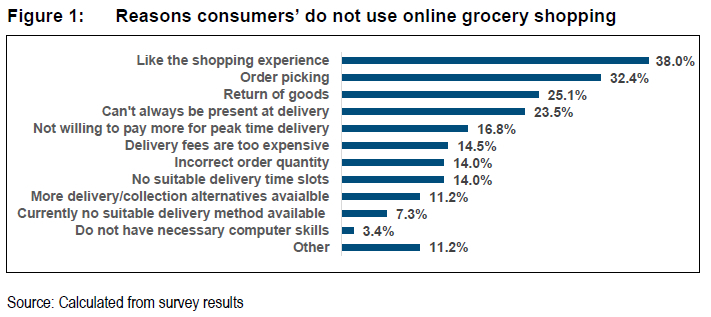
Respondents were asked to rate their confidence level of buying groceries online on a scale from 1 - 10 (1 = not confident at all and 10 = very confident). The results (M=5.91, SD=2.754) indicate that consumers were not yet very confident about doing online grocery shopping. It was established that most consumers still like the physical shopping experience and getting out of the house. Reasons for consumers' low confidence level in buying groceries online included: order picking, where the consumer is still not confident that the picker will select the correct quality of perishable goods; the inconvenience of a return of goods; the consumer cannot always be present at delivery and has no alternative to receiving the goods unattended; consumers are not willing to pay more for peak-time delivery time slots (e.g. after 16:00 in the afternoon); delivery fees are too expensive; there are no delivery time slots that suit the consumers' daily schedule; the consumer is not confident that they will receive the correct order quantity; the consumer would like there to be more delivery or collection alternatives available. A few respondents indicated that there is currently not a delivery method available that suits all consumers' needs (e.g. insulated coolers where delivery can be done at any location); and very few consumers' felt that they do not have the necessary computer skills (also refer to Figure 1).
4.3 Preferred delivery time slots, order placement and lead times
In this research, 52.7 percent of respondents indicated that they would prefer to place their online order on a store app and 47.3 percent would prefer to make use of the company's website. Owing to technological growth and the increased usage of cell phones, it is evident that a store app is more user friendly for consumers' placing online orders. This also makes it more convenient as orders can be placed from any location.
The most preferred delivery time slot was between 4 - 6 pm (32.3%), while 27.7 percent preferred delivery after 6 pm. These two delivery time slots showed a combined percentage of 60 percent. The third most preferred delivery time slot was between 2 - 4 pm (17.4%). See Figure 1 for reasons consumers do not use online grocery shopping.
When asked to indicate how far they were prepared to drive to collect an order if the option of click and collect was chosen, the majority of respondents (64.1%) were prepared to travel between 1 - 5 km to collect their orders and 27.6 percent were prepared to travel between 5 - 10 km to collect their orders. Consumers were generally not very willing to travel further than 10 km to collect orders, with only 8.3 percent willing to do so.
The results further indicated that the majority of the respondents (57.7%) expect same-day delivery (within various hour lead times) and many consumers' (36.5%) are in favour of next day delivery. It is noted that a few respondents preferred 2 days and longer lead times (6.5%), possibly owing to the perishable nature of some groceries and on-demand requirements of consumers. Although their research was not specifically focussed on grocery shopping alone, Effective Measure (2017) revealed that 34 percent of respondents wanted same-day delivery. This research indicated that grocery items have a higher demand for same day delivery, which may be due to the perishable nature of grocery items.
4.4 Preferred delivery mode choice and rates charged
The results from the survey clearly indicate that attended delivery is the preferred delivery option for online grocery purchases for most of the participants, with 76.6 percent of consumers indicating that they must be present upon final receipt, while 23.4 percent indicated that there is no need to be present upon final receipt.
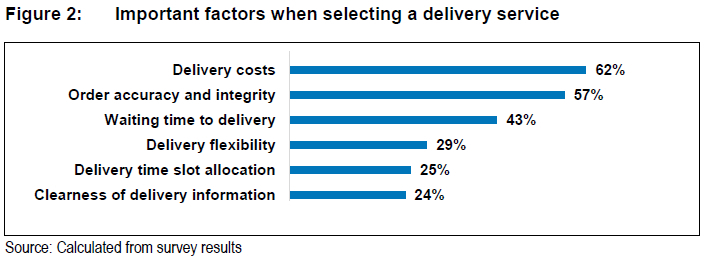
To establish which factors influence last-mile delivery choice for online grocery purchases, respondents were asked to choose all factors they considered to be important when selecting a delivery service. Respondents indicated delivery costs (61.8%) as the most important factor, followed by order accuracy (57.3%) and waiting time to delivery (43.3%) as the second and third most important factors respectively. The importance of other delivery service characteristics, specifically delivery flexibility, time slot allocation and clearness of delivery information all fluctuated below 30 percent. These results are depicted in Figure 2.
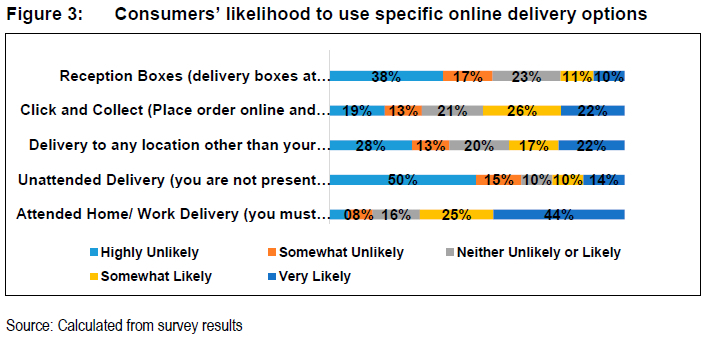
Respondents were also asked to rate, on a five-point Likert-type scale (anchored by 1= highly unlikely and 5=very likely), their likelihood of using different types of delivery modes. As indicated in Figure 3, that attended home/work delivery is rated the highest likelihood of usage (M = 3.93, SD = 1.227). Consumers are still reluctant to use unattended delivery services (M = 2.24, SD = 1.46) with 49.7 percent of consumers indicating that it is highly unlikely that they will use this delivery mode. This supports the above findings where 76.6 percent of respondents indicated that they must be present upon final receipt.
At present, deliveries in insulated coolers are not available in South Africa (Pick & Pay 2019; Woolworths 2019). This option was included in this research to establish the consumers' likelihood of using this option of delivery should it become available. For this delivery option it was evident that consumers were still unsure whether they would use this service (M = 2.93, SD = 1.523) as 28 percent indicated that it is highly unlikely they would use this delivery mode and 22.4 percent indicated it is very likely that they would use this delivery mode. The likelihood of using click and collect (M = 3.19, SD = 1.406) was much higher than the likelihood of using reception boxes (M = 2.38, SD = 1.368). Reception boxes are being used in South Africa as a delivery mode (DSV 2019; Makro 2019). However, this option does not currently facilitate the storage of perishable goods. More than 38 percent of respondents indicated that it is highly unlikely that they would use reception boxes as a delivery mode. See Figure 3 for specific online delivery options.
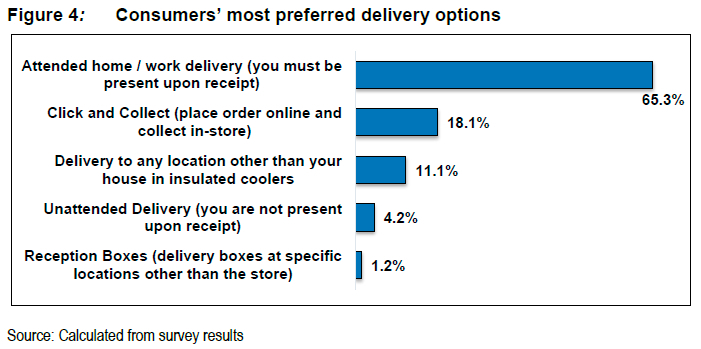
Respondents were also given the option to select their most preferred delivery choice given that the mode was available. Again, consumers indicated that their most preferred delivery mode was attended home / work delivery (65.3%). Click and collect (18.1%) was the second most preferred delivery choice with delivery to any location other than the consumers' house in insulated coolers (11.1%) was the third. Reception boxes and unattended delivery options received very low ratings and were therefore perceived as undesirable delivery options. These results are depicted in Figure 4.
The majority of respondents (89.7%) indicated that the delivery / collection mode available will affect their final decision to purchase groceries online. This clearly shows that there is a relationship between last-mile logistics alternatives and the consumers' decision to purchase groceries online. Most respondents (76.7%) indicated that they are willing to pay a delivery fee. They indicated that they would expect free delivery based on specific factors, which included order above a specific value (71.5%), frequency of placing online orders (16%) and a further 12.5 percent of the respondents expect free delivery irrespective of the above-mentioned factors. Research by Effective Measure (2017) on online shopping in South Africa indicated that 63 percent of respondents did not pay a delivery fee for their last purchase made. A report released by Jordin (2018) entitled "Future of Retail", indicated that almost 80 percent of consumers' would shop more online if they received free shipping.
4.5 Handling of out-of-stock situations
Respondents were asked how they prefer the retailer to handle an out-of-stock situation and whether they would like a substitute product. The majority of the respondents (67.4%) indicated that they would prefer a refund, while 32.6 percent indicated that they would prefer a substitute product. Respondents were also asked their most preferred method of communication should the product they ordered be unavailable (i.e. out of stock) and be substituted. The results indicated the most preferred method of communication is an alternative selection available upon placement of the order on website or mobile app (37.8%). This option was followed by an SMS with alternative selections (24.4%) and a telephone call advising on alternatives available (22.2%). The least preferred communication method selected was an e-mail with alternative selections (15.6%).
4.6 Consumers' perceptions of reverse logistics
Reverse logistics is a big obstacle, for both retailers and consumers in online shopping due to its high incidence (i.e. 30-40% of outward volumes) (Richards 2018). The majority of consumers (95.7%) indicated that they would like to have a selection of choices when it comes to the ripeness or condition of perishable goods (e.g. a ripeness chart for fruit). It was clearly evident by looking at the expectations of service quality variables of respondents that return channels options / easy return was regarded as being extremely important when conducting online grocery shopping. The majority of the respondents (81%) feel that it is the retailer's responsibility to handle the reverse logistics, and specifically prefer that the retailer collects goods from the initial delivery location (47.8%) or that the retailer collects goods at the consumers' most convenient location and time agreed upon (33.3%). Only a small percentage of the respondents are of the opinion that the consumer is responsible for the return logistics, with consumers preferring to return the goods to their closest branch (12.3%) or to return goods to the original point of collection (6.5%).
4.7 Consumers' service quality expectations
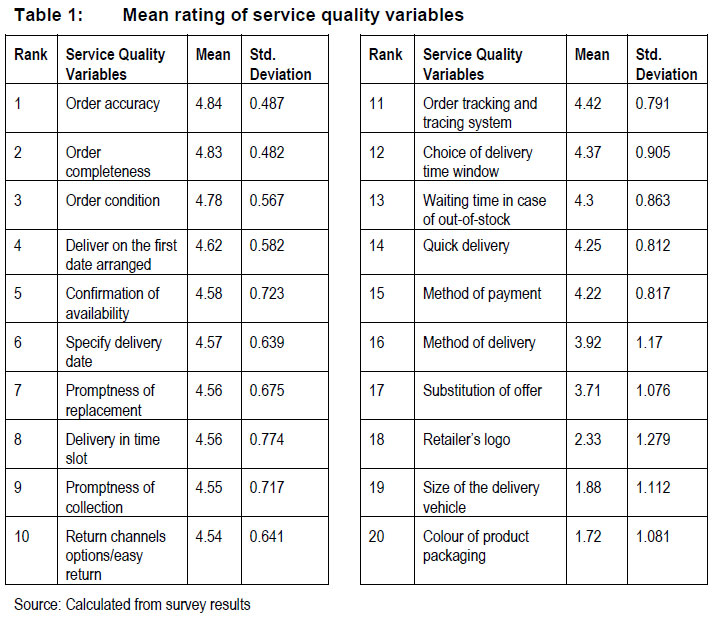
Service quality variables are becoming increasingly important to ensure customer satisfaction. Consumers were specifically requested to rate the importance of their service quality expectations of online grocery shopping on a five-point Likert-type scale (1= not important and 5 = extremely important). Table 1 depicts the importance rating of various service quality variables. The reliability of the measurement scale was assessed to determine the internal consistency. Internal consistency was evaluated for the service quality variables, indicating an overall Cronbach's α value of 0.794 which indicates that the survey is acceptable (Field, 2013).
The three most extremely important factors that were rated above 80 percent included order accuracy (M = 4.84, SD = 0.487), order completeness (M = 4.83, SD = 0.482) and order condition (M = 4.78, SD = 0.567). In comparison to the above, service quality variables such as retailer's logo (M = 2.33, SD = 1.279), size of the delivery vehicle (M = 1.88, SD = 1.112) and colour of product packaging (M = 1.72, SD = 1.081) were rated as not being important at all. It is evident that factors pertaining to the actual order (order accuracy, order completeness and order condition) were much more important than the delivery factors (method of delivery, order tracking and tracing system, delivery time slot, quick delivery and promptness of replacement). Results suggest that the method of delivery will affect the consumers' final decision to purchase groceries online.
To establish if there is any service quality "categories", the correlation ratings of the individual variables were considered. The incidence of clusters of large correlation coefficients suggests that the specific variables gauge the same underlying dimension of latent structure (Field 2013). A factor analysis was performed to reduce the large number of variables to a more manageable size, as well as understand the latent structure of the variables. According to Pallant (2016), the purpose of factor analysis is to take a substantial set of variables and look for a way to reduce or summarize the data using a smaller set of characteristics or elements. In this research exploratory factor analysis has been used. Exploratory factor analysis is frequently used in the initial stages of analysis to collect statistics concerning the interrelationships between a set of variables (Pallant, 2016). Pallant (2016) further indicates that there are two primary subject matters to consider when establishing if a specific set of data meet the requirements for factor analysis: the relationship among the variables and the sample size. Literature indicate that the adequacy of the sample size for factor analysis vary considerably and are typically described in two ways, viz. the minimum number of cases or a subjects-to-variables (STV) ratio (Beavers, Lounsbury, Richards, Huck, Skolits & Esquivel 2013). Some of the sample size recommendations include: At least 5 cases for each item (Tabachnick & Fidell 2013); at least 50 cases, preferably larger than 100 cases and a STV ratio of no less than 5 (Hair, Black, Babin, & Anderson 2010) and at least 200 cases (MacCullum, Widaman, Zhang & Hong 1999).
Guadagnoli and Velicer (1988) suggested that if the data set has various high factor loading scores (>0.8), then a reduced sample size (n>150) should be adequate.
Data was verified to establish suitability for factor analysis. Pallant (2016) asserts that the Kaiser-Meyer-Olkin Measure of Sampling Adequacy (KMO) value is 0.6 or higher and that the Bartlett's Test of Sphericity value is significant (i.e. the Sig. value should be 0.05 or smaller). The results indicate that the KMO value is 0.761, and the Bartlett's Test of Sphericity is significant (p=0.000). The correlation matrix revealed many correlation coefficients of 0.3 and higher, indicating that the data is suitable for factor analysis.
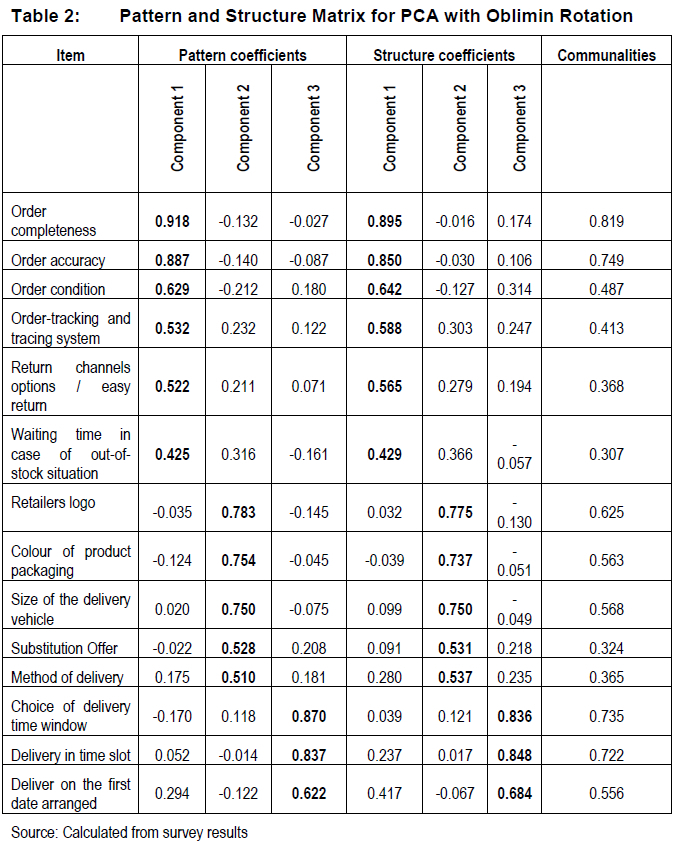
The Principle Components analysis revealed the presence of five components with eigenvalues exceeding 1, which explains 25.9%, 12.9%, 8.7%, 6% and 5.4% of the variance respectively. After an inspection of the screeplot and performing a Parallel Analysis, which revealed only three components with eigenvalues exceeding the corresponding criterion values for a randomly generated data matrix of the same size. The three factor solution initially explained 47.5% of the variance. To refine the scale, items with low communality values (i.e. less than 0.3) were removed from the scale. To assist in the analysis of the three components, an oblimin rotation was performed. The exploratory factor analyses were completed through an iterative process whereby significant cross-loading and variables with relatively large proportions of low correlations were removed. The factor analysis on the reduced data set resulted in the extraction of three factors, which explains 54.3% of the total variance, a KMO measure of 0.742 and with no significant cross-loadings. This is shown in Table 2 below. Based on this research the important underlining service quality variables when conducting online grocery shopping are broadly clustered into three related groups (factors), viz. order fulfilment, tangibles and delivery timeframe. These results do not indicate an absolute list of service quality variables for online grocery shopping, but indicate the respondents perceived awareness of the important service attributes which are closely correlated. These findings are strongly aligned with the various international studies cited previously.
5. CONCLUSION
The findings of this study provide online grocery retailers in South Africa with a better understanding of consumers' online grocery needs and service quality expectations. According to the opinions of the respondents and the findings of this research, online grocery shopping is still in the early growth stages of becoming a profitable business model. Only a few respondents are currently using or have previously used online grocery shopping. Many factors for this low confidence level were identified, such as order picking where the consumer is still not confident that the picker will select the correct quality of perishable goods; the return of goods may become an inconvenience; and the consumer cannot always be present at delivery and has no alternative to receiving the goods unattended. All of these factors provide an opportunity for retailers to exploit possible market opportunities that could assist in building the consumers' confidence and at the same time increase market share. From this research it was evident that attended home/work delivery was rated the consumers' most preferred last-mile delivery mode, and that the delivery mode does affect consumers' final decision to purchase groceries online. Respondents clearly indicated delivery costs as the most important factor when selecting a delivery service. Consumers' have high service level expectations in relation to their willingness to pay for the delivery service. Being able to meet high service level expectations at minimal costs poses a great challenge for the service provider to fulfil these requirements. As an incentive for increase online orders, retailers should consider to offer free deliveries for orders above a specific value.
The findings of this study are valuable for many reasons. Firstly, the research is the first South African study conducted specifically on online grocery shopping from a consumer perspective that can be compared to studies completed in foreign countries. Secondly, this study presents valuable information to any grocery retailer that aims to increase their market share by having a better understanding of online grocery consumer needs and expectations. These results can assist to provide direction in the formulation of grocery retailers' business strategy. In some instances, the results from this research study and results from other research studies support each other. Lastly, this study has made a significant contribution to the body of knowledge in describing the service quality expectations of online grocery consumers and the challenges faced in online grocery shopping in Gauteng, South Africa.
6. MANAGERIAL IMPLICATIONS
The results indicated that the convenience aspect of online grocery shopping is very important. Retailers need to focus on promoting the use of online grocery shopping by highlighting the advantages of saving time as well as quick service delivery. The retailer's website should be user friendly and should include selections such as an option to choose the preferred ripeness of perishable goods.
Online grocery retailers should pay attention to good customer service quality. There should be a good, responsive problem resolution system in place. They must provide on their websites the security and privacy policies; money-back guarantee information and return of exchange policy information. The online website also needs to offer interactive help as well as contact information such as telephone numbers or email addresses. To attract consumers online retailers should offer a cost-saving incentive for either the size of the online shopping basket or for the frequency of placing online orders, as this research indicated that the cost of delivery is a remarkable factor that affects the consumers' decision to purchase groceries online. It has been found that order accuracy, order completeness and order condition have been the most important service quality variables for consumers buying groceries online. For online grocery retailers the ability to provide a highly dependable service as well as a range of high-quality products is crucial for success. These aspects have a marked effect on customers' overall perceived value; therefore, they should be considered when formalising strategy. It was established that a relationship does exist between last-mile logistics alternatives and the consumers' decision to purchase groceries online. Consumers' most preferred delivery mode was attended home / work delivery. It is of crucial importance that the grocery retailer focusses on investing in the correct last mile delivery mode to avoid investing in modes that would not yield optimal profits. If the retailer decides to implement the option of click and collect, it should be kept in mind that consumers are not willing to drive more than 10 km to collect an order; therefore, consideration needs to be given to the distance between the point of collection and the target market.
Most consumers prefer same-day delivery and delivery after 4 pm. Retailers need to keep consumers' most preferred delivery lead time and time slots preferences in mind when scheduling and investing in delivery fleets.
7. RESEARCH LIMITATIONS
The research was limited to consumers who have access to the Internet and those online grocery shoppers who do their grocery shopping in Gauteng, South Africa. This study focussed on establishing consumers' service level expectations and does not focus on the costs involved in such implementations should any retailer decide to proceed with implementation. The sample size might be seen as a limitation of the research as the number of responses did not fulfil the initially envisaged sample size. Although an increased sample size would probably enhance the reliability of the study and permit the findings to be extrapolated, results provide a significant contribution in describing the challenges faced in online grocery shopping in Gauteng, South Africa.
8. RECOMMENDATIONS FOR FUTURE RESEARCH
Online grocery retailers need a large customer base to make the services provided profitable. Determining methods to grow customer demand for online grocery services could be a fascinating topic for future research. Generally, a rate is imposed for online delivery services. The target market is those who look for a different method of shopping for groceries. In this research a factor such as income level was not considered, which could have had a big impact on the price sensitivity of different customers. It is recommended that future research includes such a factor to attract price-sensitive shoppers. This study was focussed on consumers' most preferred last-mile delivery mode of choice as well as the accompanied service level expectations, and therefore did not investigate how profitability could be maximised by running an online grocery store. Future research may wish to investigate methods that can be implemented to maximise profitability from an operational perspective. The study focussed on Gauteng, South Africa only and it would be valuable to test the framework in other geographical markets as well. Retailers that can deliver customers' desired expectations effectively could have the competitive advantage to increase their market share.
REFERENCES
AILAWADI KL & FARRIS PW. 2017. Managing multi- and omni-channel distribution: metrics and research directions. Journal of Retailing 93(1):120-135. (DOI:https://doi.org/10.1016/j.jretai.2016.12.003. [ Links ])
BAHETI V & KAUSHAL LA. 2015. The analysis of consumers' attitudes towards online grocery shopping - A case study in Indian context. The International Journal Research Publications 5(7):36-48. [Internet:https:///www.researchgate.net/publication/283352978_The_analysis_of_consumers'_attitudes_towards_online_grocery_shopping_-_A_case_study_in_Indian_context; downloaded on 11 November 2019. [ Links ]]
BANERJEE A & SIEMENS F. 2015. Logistics of E-Groceries.de. In Kersten W, Blecker T & Ringle CM. E. Eds. Innovations and Strategies for Logistics and Supply Chains. Hamburg. (pp 91-116.) [Internet:https://pdfs.semanticscholar.org/5798/af7abd4d9af8956281adde4acb152f4d4011.pdf; downloaded on 11 November 2019. [ Links ]]
BEAVERS AS, LOUNSBURY JW, RICHARDS JK, HUCK SW, SKOLITS GJ & ESQUIVEL SL. 2013. Practical Considerations for Using Exploratory Factor Analysis in Educational Research. Practical Assessment, Research & Evaluation 18(6):1-13 [Internet:https://eric.ed.gov/?id=EJ1005139; downloaded on 11 November 2019. [ Links ]]
BIENSTOCK CC, MENTZER JT, & BIRD MM. 1997. Measuring physical distribution quality. Journal of the Academy of Marketing Science 25(1):31-44. (DOI:https://doi.org/10.1007/BF02894507. [ Links ])
BLECKER T, KERSTEN W & RINGLE CM. 2013. Pioneering Solutions in Supply Chain Performance Management: Concepts, Technologies and Applications. 1st ed. Lohmar: Books on Demand. [ Links ]
BOYER KK, FROHLICH MT & HULT GTM. 2004. Extending the Supply Chain: How Cutting-edge Companies Bridge the Critical Last-mile Into Customers' Homes. New York: Amacom [ Links ]
CAMBRIDGE DICTIONARY. 2018. Cambridge Dictionary. [Internet:https://dictionary.cambridge.org; downloaded on 11 September 2018. [ Links ]]
DATEX. 2017. The Changing Dynamics of Last-mile Delivery and Logistics. [Internet:https://www.datexcorp.com; downloaded on 18 November 2017. [ Links ]]
DE VUIJST C, KESTELOO M & HOOGENBERG M. 2014. Click and Cash & How to profit in online grocery shopping. Amsterdam: PwC. [ Links ]
DSV. 2019. DSV Locker. [Internet: https://www.locker.za.dsv.com/; downloaded on 02 August 2019. [ Links ]]
EFFECTIVE MEASURE. 2017. E-Commerce Industry Report. South Africa: Effective Measure. [ Links ]
ELLIS C. 2003. Lessons from Online Groceries. MIT Sloan Management Review 44(2):8. [ Links ]
FIELD A. 2013. Discovering statistics using SPSS, 4th Edition. London: Sage. [ Links ]
GARCIA K. 2018. Online Grocery Shopping Is Reaching a Tipping Point. [Internet:https://www.emarketer.com/content/online-grocery-shopping-is-reaching-a-tipping-point; downloaded on 02 August 2019. [ Links ]]
GUADAGNOLI E & VELICER WF. 1988. Relation of Sample Size to the Stability of Component Patterns. Psychological Bulletin 103(2):265-275. (DOI:10.1037//0033-2909.103.2.265. [ Links ])
EMERSON CJ & GRIMM CM. 1996. Logistics and marketing components of customer service: an emperical test of the Mentzer, Gomes and Krapfel model. International Journal of Physical Distribution and Logistics Management 26(8):29-42. (DOI:https://doi.org/10.1108/09600039610128258. [ Links ])
ESPER TL, JENSEN TD, TURNIPSEED FL & BURTON S. 2003. The last-mile: An examination of effects of online retail delivery strategies on consumers. Journal of Business Logistics 24(2):177-203. (DOI:http://dx.doi.org/10.1002/j.2158-1592.2003.tb00051.x. [ Links ])
GALIPOGLU E, KOTZAB H, TELLER C, HüSEYINOGLU I & PöPPELBUß J. 2018. Omni-channel retailing research - state of the art and intellectual foundation. International Journal of Physical Distribution & Logistics Management 48(4):365-390. (DOI:https://doi.org/10.1108/IJPDLM-10-2016-0292. [ Links ])
GANAPATHI R. 2015. A Study of Factors affecting online shopping behaviour of consumers' in Chennai. Journal of Management Research and Analysis 2(2):123-126. (DOI:https://doi.org/10.13140/RG.2.2.14183.96167. [ Links ])
GEVAERS R, VAN DE VOORDE,E & VANELSLANDER T. 2014. Cost modelling and simulation of last-mile characteristics in an innovative B2C supply chain environment with implications on urban areas and cities. Procedia-Social and Behavioural Sciences125:39-411. (DOI:https://doi.org/10.1016/j.sbspro.2014.01.1483. [ Links ])
HAIR JF, BLACK WC, BABIN BJ & ANDERSON RE. 2010. Multivariate Data Analysis, 7th Edition. Upper Saddle River, New Jersey: Pearson Prentice Hall. [ Links ]
HAYS T, KESKINOCAK P & DE LOPEZ VM. 2004. Applications of Supply Chain Management and ECommerce Research Industry. Netherlands: KluwerAcademic. [ Links ]
HOOTSUITE & WE ARE SOCIAL. 2019. Digital 2019 Global Digital Overview. [Internet:https://datareportal.com/reports/digital-2019-global-digital-overview; downloaded 02 August 2019. [ Links ]]
HÜBNER A, KUHN H & WOLLENBURG J. 2016. Last-mile fulfilment and distribution in omni-channel grocery retailing: A strategic planning framework. International Journal of Retail & Distribution Management 44(3):228-247. (DOI:10.1108/IJRDM-11-2014-0154. [ Links ])
JORDIN E. 2018. The future of retail 2018. United States: Walker Sands Communications. [ Links ]
KAZANCOGLU I & AYDIN H. 2018.An investigation of consumers'purchase intentions towards omni-channel shopping: A qualitative exploratory study. International Journal of Retail & Distribution Management 46(10):959-976. (DOI:10.1108/IJRDM-04-2018-0074. [ Links ])
KEMPIAK M & FOX MA. 2002. Online Grocery Shopping: Consumer Motives, Concerns and Business Models. First Monday 7(9). [Internet:https://journals.uic.edu/ojs/index.php/fm/article/view/987/908; downloaded on 02 August 2019]. (DOI:http://dx.doi.org/10.5210/fm.v7i9.987. [ Links ])
KHAN SA, LIANG Y & SHAHZAD S. 2014. Adoption of Electronic Supply Chain Management and E-Commerce by Small and Medium Enterprises and Their Performance: A Survey of SMEs in Pakistan. American Journal of Industrial and Business Management 4(9):443-441. (DOI:10.4236/ajibm.2014.49051. [ Links ])
KIM M & LENNON SJ. 2011. Consumer Response to Online Apparel Stockouts. Psychology & Marketing 28(2):115-144. (DOI: https://doi.org/10.1002/mar.20383. [ Links ])
LEWIS M. 2006. The effect of shipping fees on customer acquisition, customer retention, and purchase quantities. Journal of Retailing 82(1):13-23. (DOI:https://doi.org/10.1016/j.jretai.2005.11.005. [ Links ])
LIBERATORE MJ & MILLER T. 2016. Outbound Logistics Performance and Profitability: Taxonomy of Manufacturing and Service Organisations. Business and Economics Journal 7(2):1-9. (dOI:10.4172/2151-6219.1000221. [ Links ])
LUBIS A N & UTARA US. 2018. Evaluating Customers Preferences of Online Shopping: Demograhic Factors and Online Shop Application Issue. Academy of Strategic Management Journal 17(2):1-13. [Internet: https://www.abacademies.org/articles/evaluating-the-customer-preferences-of-online-shopping-demographic-factors-and-online-shop-application-issue-7066.html; downloaded on 11 November 2019. [ Links ]]
MAKRO. 2019. Makro's Pick-Up Locker Collection Service. [Internet:https://www.makro.co.za/customer-service/lockers; downloaded on 02 August 2019. [ Links ]]
MARCHET G, MELACINI M, PEROTTI S, RASINI M & TAPPIA E. 2018. Business logistics models in omni-channel:a classification framework and empirical analysis. International Journal of Physical Distribution & Logistics Management 48(4):439-464. (DOI:https://doi.org/10.1108/IJPDLM-09-2016-0273. [ Links ])
MACCULLUM RC, WIDAMAN KF, ZHANG S & HONG S. 1999. Sample Size in Factor Analysis. Psychological Methods 4(1):84-99. (DOI:10.1037/1082-989X.4.1.84. [ Links ])
MELACINI M, PEROTTI S, RASINI M & TAPPIA E. 2018. E-fulfilment and distribution in omni-channel retailing:a systematic literature review. International Journal of Physical Distribution & Logistics Management 48(4):391-414. (DOI:https://doi.org/10.1108/IJPDLM-02-2017-0101. [ Links ])
MENTZER JT, FLINT DJ & HULT TM. 2001. Logistics Service Quality as a Segment-Customized Process. Journal of Marketing 65(4):82-104. (DOI:10.1509/jmkg.65.4.82.18390. [ Links ])
MENTZER JT, GOMES R & KRAPFEL RE. 1989. Physical Distribution Service: A Fundamental Marketing Concept. Journal of the Academy of Marketing Science 17(1):53-62. (DOI:https://doi.org/10.1007/BF02726354. [ Links ])
MORGANTI E, SEIDEL S, BLANQUART C, DABLANC L & LENZ B. 2014. The impact of e-commerce on final deliveries: alternative parcel delivery services in France and Germany. Transportation Research Procedia 4:178190. (DOI:https://doi.org/10.1016/j.trpro.2014.11.014. [ Links ])
NGUYEN DH, DE LEEUW S & DULLAERT WEH. 2018. Consumers' Behaviour and Order Fulfillment in Online Retailing: A Systematic Review. International Journal of Management Reviews 20:255-276. (DOI:https://doi.org/10.1111/ijmr.12129. [ Links ])
NIELSEN. 2015. The future of grocery.s.l. The Nielsen Company. [ Links ]
NIELSEN. 2018. Connected commerce. The Nielsen Company. [ Links ]
OKYERE S, ANNAN J & ANNING KS. 2015. Evaluating the Effect of Lead Time on Quality Service Delivery in the Banking Industry in Kumasi Metropolis of Ghana. Journal of Arts & Humanities 4(7):29-44. (DOI:http://dx.doi.org/10.18533/journal.v4i7.760. [ Links ])
OLIVER D. 2015. FoodDIVE. [Internet:http://www.fooddive.com; downloaded on 23 July 2017. [ Links ]]
PALLANT J. 2016. SPSS survival manual, 6th Edition. New York: McGraw Hill Education. [ Links ]
PARASURAMAN A, ZEITHAML VA & BERRY LL. 1985. A Conceptual Model of Service Quality and its Implications for Future Research. Journal of Marketing 49(1):41-50. (DOI: 10.2307/1251430. [ Links ])
PICK & PAY. 2019. Welcome. Ready to shop? [Internet:https://www.pnp.co.za/; downloaded on 02 August 2019. [ Links ]]
RAI HB, VERLINDE S, MACHARIS C, SCHOUTTEET P & VANHAVERBEKE L. 2018. Logistics outsourcing in omnichannel retail. International Journal of Physical Distribution & Logistics Management 49(3):267-286. (DOI:10.1108/IJPDLM-02-2018-0092. [ Links ])
RICHARDS G. 2018. Warehouse Management. 3rd Edition. London: Kogan Page. [ Links ]
TABACHNICK BG & FIDELL LS. 2013. Using multivariate statistics. 6th Edition. Boston: Pearson Education. [ Links ]
VLACHOS IP. 2014. Reverse Food Logistics during the Product Life Cycle. International Journal of Integrated Supply Chain Management 9(1/2):49-83. (DOI:10.1504/IJISM.2014.064356. [ Links ])
WANG L. 2015. Research on the Impact of E-commerce to Logistics Economy: An Empirical Analysis based on Zhengzhou Airport Logistics. International Journal of Security and Its Applications 9(10):275-286. (DOI:https://doi.org/10.14257/ijsia.2015.9.10.25. [ Links ])
WANG J. 2016. An analysis of online grocery last-mile delivery models. Pensylvania:The Pensylvania State University. (MBA thesis. [ Links ])
WATSON N. 2015. This is why reverse logistics is so crucial for your online shop. [Internet:http://www.ventureburn.com; downloaded on 02 August 2017. [ Links ]]
WEBER-SNYMAN AN & BADENHORST-WEISS JA. 2016. Challenges in last-mile logistics of e-grocery retailers: A developing country perspective. IPSERA (25th International Purchasing and Supply, Education and Research Association; 20-23 Mar. [ Links ])
WEBER AN & BADENHORST-WEISS JA. 2018. The last-mile logistical challenges of an omnichannel grocery retailer: A South African perspective. Journal of Transport and Supply Chain Management 12(0):a398. (DOI:10.4102/jtscm.v12i0.398. [ Links ])
WOLLENBURG J, HÜBNER A, KUHN H & TRAUTRIMS A. 2018. From bricks-and-mortar to bricks-and-clicks: logistics networks in omni-channel grocery retailing. International Journal of Physical Distribution & Logistics Management 48(4):415-438. (DOI:https://doi.org/10.1108/IJPDLM-10-2016-0290. [ Links ])
WOOLWORTHS. 2019. Delivery options. [Internet:https://www.woolworths.co.za/help/faqs/cfaq000069; downloaded on 02 August 2019. [ Links ]]
WRESCH W & FRASER S. 2011. Persistent Barriers to E-Commerce in Developing Countries. Journal of Global Information Management 3(19):30-44. (DOI:http://dx.doi.org/10.4018/jgim.2011070102. [ Links ])
XING Y & GRANT DB. 2006. Developing a framework for physical distribution service quality of multi-channel and "pure-player" internet retailers. International Journal of Retail and Distribution Management 34(4/5):279-289. (DOI:https://doi.org/10.1108/09590550610660233. [ Links ])
XING Y, GRANT DB, McKINNON A & FERNIE J. 2011. The interface between retailers and logistics service providers in the online market. European Journal of Marketing 45(3):334-357. (DOI:http://dx.doi.org/10.1108/03090561111107221. [ Links ])
YETTER G & CAPACCIOLI K. 2010. Differences in responses to web and paper surveys among school professionals. Behavior Research Methods 42(1):266-272. (DOI:https://doi.org/10.3758/BRM.42.1.266. [ Links ])
ZEITHAML VA, PARASURAMAN A & MALHOTRA A. 2002. Service quality delivery through websites: a critical review of extant knowledge. Journal of the Academy of Marketing Science 30(4):362-375. (DOI:10.1177/009207002236911. [ Links ])
* corresponding author