



Services on Demand
Journal

Article
 English (pdf)
 Article in xml format
 Article references
 Automatic translation
 Send this article by e-mail
Indicators
Related links
-
 Cited by Google
 -
 Similars in Google
Share

 Permalink
Journal of Contemporary Management
On-line version ISSN 1815-7440
JCMAN vol.16 n.2 Meyerton 2019
https://doi.org/10.35683/jcm19043.50
RESEARCH ARTICLES
Factors influencing IT-Business Strategie Alignment in the Context of Business Process Reengineering
I PadayacheeI; RM ShanoII
IUniversity of KwaZulu-Natal. padayacheei@ukzn.ac.za; ORCID NUMBER: https://orcid.org/0000-0002-6838-7622
IIUniversity of KwaZulu-Natal. onash65@gmail.com
ABSTRACT
The alignment of IT strategy and business strategy is an ongoing topic of interest for many researchers. In the same vein, there is a continuing research interest by practitioners in the field of Business Process Re-engineering (BPR). BPR is commonly understood as a radical rethinking and redesign of business processes. The existing literature considers these two topics separately in the context of developed countries. This study taps into this gap by investigating how IT-business alignment can be achieved within BPR by considering the influential factors that drive this alignment in large organisations in Lesotho. A qualitative approach was adopted to fulfill the objective of the study. The research design used for the study was a case study approach and three large organisations in Lesotho constituted the three cases for the study. Interviews were used as the primary data collection technique.The study empirically focussed on placing IT-business strategic alignment within the context of BPR. The study revealed that alignment factors should be considered during a BPR project and that IT-business alignment plays a pivotal role in the success or failure of a BPR project. In addition, business process change management was identified as an additional alignment factor influencing IT-business alignment. Future studies can also assess whether business processes change management can facilitate alignment between IT and the business.
Key phrases: Alignment Factors; Business Process Reengineering; Business strategy; IT strategy and IT-business strategic alignment
1. INTRODUCTION
Organisations today are facing a rapidly changing business environment where the design and implementation of sound business processes are central to improving business performance and flexibility (Altinkemer, Ozcelik & Ozdemir 2011). This has led to a renewed interest in Business Process Re-engineering (BPR), as managers view BPR as key to set their business processes for competitive advantage. This interest was fuelled by new and increasing innovations in information technology that have made it possible for organisations to amend their business models, as well as to revise and/or develop their Information Technology (IT) strategies. Organisational business processes are undergoing necessary restructuring in a changing business environment, which suggest that both business and IT strategies within organisations are continuously shifting. According to Ravishankar, Pan and Leidner (2011), alignment can be conceptualised as a dynamic process. To explore the continuous developing global operations in the technologically agile business environment of today, the current study seeks to determine the factors influencing alignment of IT strategies with business strategies, in the restructuring of business processes.
In the 1990s, Hammer popularised the transformative role of IT in BPR. While the inconsistencies of BPR and IT-business strategic alignment may be linked to several factors, the Oracle (2013) white paper attributes the difficulty in aligning IT and business strategies to the increased rate of change when it comes to business and technological innovations. Strnadl (2006) contends that IT alone is not enough for an organisation to achieve efficiency and competitiveness but added that corporate IT functions should be tightly coupled to the organisation's processes and the organisation's information needs. A study conducted by Daghfous and Barkhi (2009) substantiates this point, by indicating the need for organisations to proactively incorporate IT into their services and strategies, in order to realise profitability and success. At an organisational level, Karim, Somers and Bhattacherjee (2007) explain that IT will only have a positive impact on an organisation, if it matches the business processes. Cox, Marchington and Suter (2009) add that critical to the business success, is asserting that organisational IT provides support for the organisation's business strategy. The corporate IT function must be tightly coupled to enterprise processes and the organisation's information needs (Strnadl 2006). According to Altinkemer et al. (2011), the business value of IT implies that the impact of IT on firm performance is dependent on the coordinated execution of closely aligned organisational changes.
Previous studies have indicated that BPR must begin to apply the capabilities of IT. Al-Mashari and Zairi (2000) indicated that, at the core of a successful BPR implementation is the ability to recognise the role of IT in BPR. This is the key, as a proper fit between technology and business processes must be established and upheld (Barjis 2008). Subsequently a successful BPR project needs constant assurance of the fit between business processes, the environment and the technology (Trkman 2010). The findings of a study conducted by Ringim, Razalli, Hasnan (2012), revealed that strategic alignment and IT investment were among the BPR critical factors influencing organisation performance. Luftman (2014) proposed that IT business alignment should be a business process management task (BPM) that primarily addresses both the strategy and the technology dimension of BPM.
Related studies' focus has been on maintaining alignment (Henderson & Venkatraman 1999), improving alignment (Luftman 2000), measuring IT-business alignment (Sledgianowski, Luftman & Reilly 2006), IT-business alignment maturity (Chen 2010; van Hout 2012) and strategic alignment maturity (Luftman 2014). To bridge this gap, the current study focuses on the attainment of IT-business strategic alignment in a BPR project. The key research question addressed in this article is the role of factors with respect to IT-Business strategic alignment within the context of business process reengineering in large organisations in Lesotho.
2. LITERATURE REVIEW
This section presents a comprehensive review of the relevant literature to understand the main concepts, models, factors and issues relating to IT-Business Strategic alignment and BPR.
2.1 Business Process Reengineering (BPR)
The changing economic environment has led to an increasing interest in improving organisational business processes to enhance performance (Altinkemer et al. 2011; Ranganathan & Dhaliwal 2001). Strnadl (2006) define a business process as a complete, dynamically coordinated set of activities or logically related tasks that must be performed to deliver value to customers, or to fulfil other strategic goals. One of the fields dealing with these advances in organisational business processes is BPR. Al-Hashem and Yaseen (2015) argue that business transformation strategies such as BPR contribute to achieving strategic alignment maturity.
Altinkemer et al. (2011) and Hasnan, Ringim and Razalli (2017) define BPR as the redesign of processes, typically using information technology (IT), to gain significant improvements in key areas of performance such as service, quality, cost, and speed. BPR initiatives usually aim to integrate separate functional tasks into complete cross-functional processes.
According to Kuhil (2013), BPR-led change comprises a planned endeavour to achieve dramatic improvements in performance, a radical departure from existing mode(s) of practice and the application of information technology.
Since the advancement of BPR, researchers and practitioners have proposed and employed different processes to implement BPR. These processes are adapted differently in different methodologies.
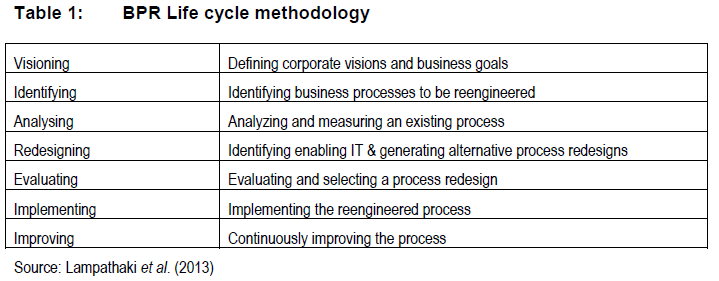
After reviewing a number of frameworks, namely Process Reengineering Life Cycle (PRLC) Methodology, Integrated BPR Methodology, Object-Oriented Business Engineering Methodology, McKinsey BPR methodology and Accenture BPR methodology, Lampathaki, Koussouris and Psarras (2013) constituted a BPR Life cycle methodology that incorporates all the different phases common to all the frameworks evaluated in their study. These are visioning, identifying, analysing, redesigning, evaluating, implementing and improving. A definition of each of the phases is provided in Table 1.
While the BPR Life cycle methodology as proposed by Lampathaki et al. (2013) is representative of all the different phases in the BPR process, they neglected to consider the role played by factors influencing IT-Business alignment in a BPR project. In a study conducted by Hokoma and Mabrouk (2016) on BPR in the Libyan banking section, it was reported that the surveyed organisations emphasised the role of critical success factors for implementing BPR successfully.
2.2 IT and Business strategy
The business world is constantly changing thus creating challenges when building a comprehensive business. According to Austin, Applegate and Soule (2008), this challenge can be addressed if executives accurately define and execute business strategy. Austin et al. (2008) explains that the starting point for developing a strategy is with understanding the forces that shape the industry competition. Within an organisation, there are functional strategies that are there to drive an organisation. According to Schwalbe (2010), an organisation's business strategy outlines the company's long-term objectives and how it will be differentiated from its competitors. Alfadhel, Liu and Oderanti (2019), argue that fast changes in customer services, technologies, and product life cycles makes organisations reliant on information system services to improve business efficiency.
IT has over the years shifted from a support function to being a strategic component within organisations. According to Buchta, Eul and Schulte-Croonenberg (2010), an IT strategy is the business enabler, in terms of undertaking innovative IT projects that build an organisation's sustainable competitive advantage, which will in the long term, increase the organisation's value. Reksoatmodjo, Hartono, Djunaedi and Utomo (2012) define IT strategy as encompassing all choices that place companies in the global IT market. De Haes & Van Grembergen (2008) argue that IT has come to play a crucial role in the support, sustainability and growth of organisations and therefore there is a bigger focus on managing IT projects. It is important that IT projects deliver good value for the organisation, and to accomplish this, the projects need to be coupled with the business side of the organisation.
2.3 IT-business strategy alignment
Hussain, King and Cragg (2002) argued that alignment originated from an organisations' realisation that they were developing information systems that did not support their business strategies. They reported that the development projects were prioritised according to their technical imperatives and not their business necessities, which contributed to a low return on IT investment. Cuenca, de Dios Milla and Boza (2015) argued that companies must prioritize technology projects in line with their business plans. Seman and Salim (2013) define business-IT alignment as a state where both business executives and IT executives are committed to realising the mission, objectives, and planning for both business and IT. According to Coltman, Tallon, Sharma and Queiroz (2015), executing digital business strategy depends on the ability of organisations to leverage IT through business processes, in which case two-way alignment becomes a key mechanism through which IT creates value.
According to Luftman, Papp and Brier (1999), alignment focuses on activities done by management to attain solid goals across the organisation. Luftman, Lyytinen and Zvi (2017) define alignment activities as IT-business and business-IT behaviour that assist in coordinating and harmonizing the business and the IT areas to add business value. A company is said to have reached alignment, when its current and emerging business strategy is enabled, supported and unrestrained by technology (Pearlson & Saunders 2012). As such, alignment should address both effectiveness and efficiency (Luftman 2000).
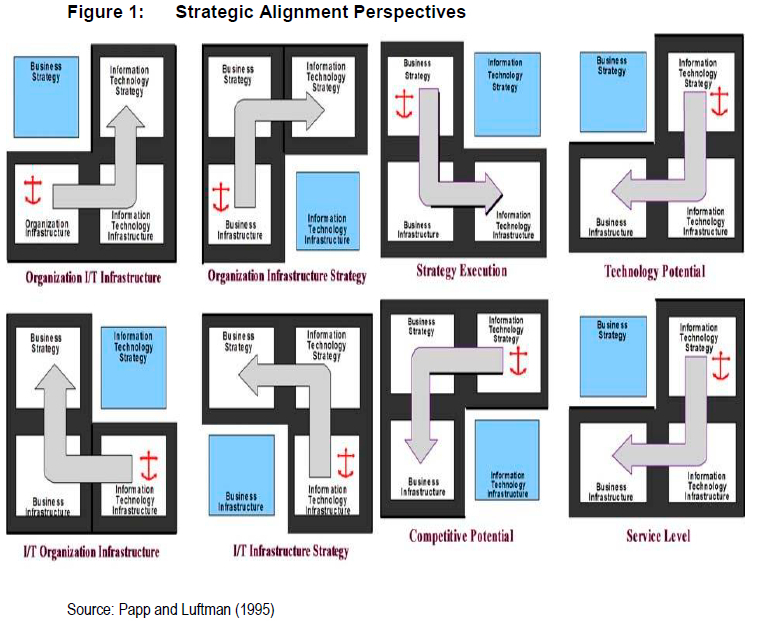
In defining alignment, Papp and Luftman (1995) use a fusion method to interpret alignment. This method depicted in Figure 1 has eight different perspectives, namely strategy execution, technology potential, organisational IT infrastructure, organisational infrastructure strategy, competitive potential, service level, IT organisational infrastructure and the IT infrastructural strategy perspective. These demonstrate how alignment addresses effectiveness and efficiency when there is a strategic fit between business strategy, infrastructure and IT. Papp and Luftman (1995) state that alignment is paramount to achieving increased profitability from IT. The fusion perspectives follow the synchronised assessment of the strategic fit and the functional integration addresses how IT-business alignment is achieved. It employs the following components: the anchor, pivot and area of impact.
The anchor is the strongest area of the business, the pivot the weak area whilst the area of impact is the area that is affected through the changes made in the pivot area through realignment (Coleman & Papp 2006; Henderson & Venkatraman 1990; Luftman, Lewis & Oldach 1993). In the literature on IT strategy, it has been suggested that understanding the full potential of IT involves aligning some or all of four business and IT components -business strategy, IT strategy, business infrastructure and processes, and IT infrastructure and processes. IT-business strategic alignment thus speaks to the proper fit between two or more of these components to synchronise management of the business and IT (Reksoatmodjo et al. 2012). Gerow, Thatcher and Grover (2015) described four distinct cross-domain combinations of strategy and infrastructure namely, strategy execution, technology potential, competitive potential, and service level. Cross-domain alignment refers to bridging of higher-level external oriented strategies to internal oriented infrastructure and processes, which relates to how the business strategy aligns with the IT infrastructure and processes (Gerow et al. 2015). Strategy execution, for example in Figure 1 is where the business strategy affects the IT infrastructure (business strategy-to-IT infrastructure cross-domain alignment) but is restrained by the business infrastructure (business alignment).
The fusion method represents one way in which IT business alignment may be achieved. Another way of assessing IT business strategic alignment is to examine the influence of alignment factors on IT business strategy alignment, which is discussed in the next section.
2.4 IT-Business Alignment Factors
Alignment requires strong support from senior management, good working relationships, strong leadership, appropriate prioritisation, trust, and effective communication, as well as a thorough understanding of the organisation. Seman and Salim (2013) claim that the issue of non-alignment can be addressed by identifying factors that influence IT-business strategic alignment. Seman and Salim (2013) cite that past research findings reveal that successful alignment focuses on managing specific alignment dimensions by investigating factors that facilitate this.
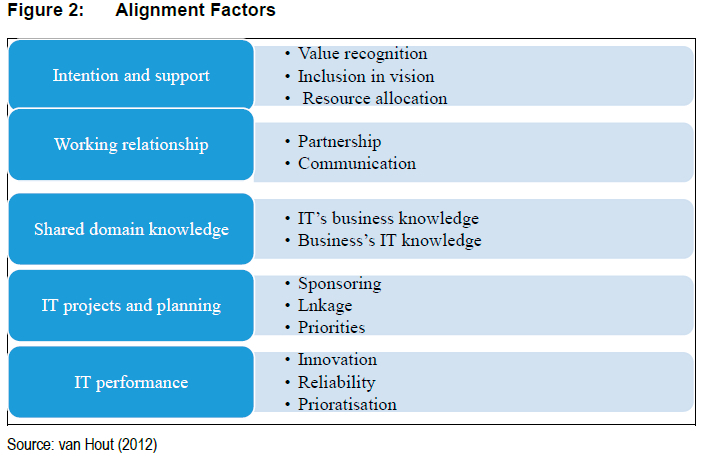
Van Hout (2012) conducted a literature study on alignment factors and proposed five categories of alignment factors as depicted in Figure 2. A description of each category as proposed by van Hout (2012) is presented in the following sub-sections.
2.4.1 Intention and support
This category refers to the commitment of top management to use IT strategically and the support they provide to assure this level of use. This is done to ensure the creation and sustainability of strategic alignment. Measures used to assess how committed and supportive top management towards strategic use of IT are value recognition, inclusion in vision and resource allocation.
2.4.2 Working relationship
This factor category emphasises the relationship between business and IT as it looks at the partnership and communication between these sectors. Hence, an emphasis is on the communication between different departments but more so on business and IT executives. This should be followed by the cooperation of IT and business in strategy formulation and project prioritisation. To ensure that there is a working relationship between IT and business executives, partnership and communication measures are employed.
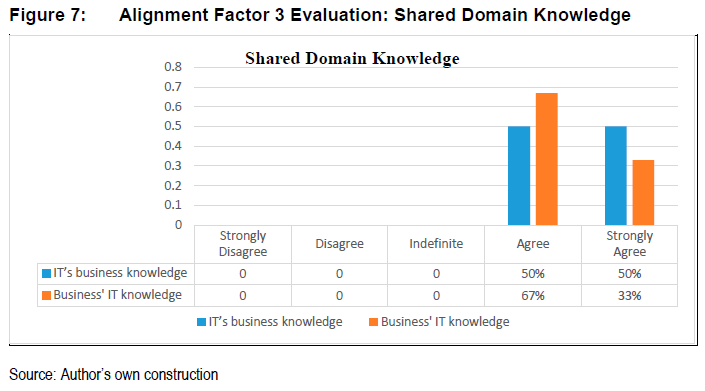
2.4.3 Shared Domain Knowledge
This factor acknowledges how well the business knows IT and how well does IT know the business. It simply says that when both functions have appropriate knowledge of each other, their objectivity will positively benefit the company. There are two measures used to assess this namely, IT's business knowledge and business's IT knowledge.
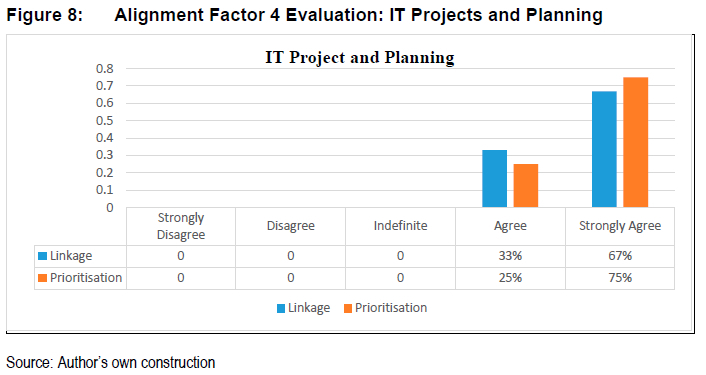
2.4.4 IT Projects and Planning
This concerns the link IT projects and planning have with the business strategies and plans. On the project prioritisation concern, the integration of technology should enable the creation of an organisation's competitive edge. To assure this, sponsoring, linkage and prioritisation measures are applied.
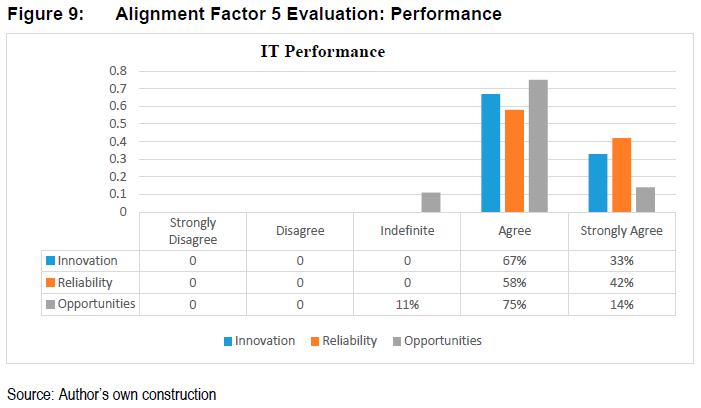
2.4.5 IT Performance
This factor focuses solely on IT. It considers an IT department's performance with regards to competitive position and IT perception by the business and structures to stimulate performance. This implies that IT staff must be kept abreast of the latest IT trends, be innovative and exploit the existing, as well as the new technologies available to them. In this regard, IT should also steer the organisation's competitive edge. The three (3) measures used to assure IT performance are innovation, reliability and opportunities.
2.5 Conceptual Model
Several business information technology alignment (BITA) models have supported the theory base on alignment, with each model focussing on different concepts/aspects of alignment and emphasising different perspectives of alignment (El-Mekawy, Rusu & Perjons, 2015).
From the early days, models of strategic alignment that have been prominent are the MIT90s model Scott Morton (1991) and the strategic alignment model (SAM), (Avison, Jones, Powell & Wilson 2004; Henderson & Venkatraman 1990).
A distinction that Henderson and Venkatraman (1990), drew between the MIT90s model and SAM is that SAM considers both the IT internal and external perspectives, whilst the MIT90s focuses only on the internal areas of the organisations that need be aligned. Externally SAM reflects on the IT strategy and internally on the IT infrastructure and processes. Consequently, SAM elevates the applicability of the IT function within organisations as its role translates from solely being a support function, to transforming the business policy (Avison et al. 2004).
In a similar study, Mithas and Rust (2016) used the modified constructs of SAM in an adapted framework to demonstrate which antecedents are influential towards achieving strategic alignment. They tested the internal and external factors. The following internal factors were evaluated namely, shared domain knowledge, relationship management, and prior Information System (IS) success. The external factors evaluated were market uncertainty, technological uncertainty and regulatory uncertainty (Mithas & Rust 2016). The findings of the study conducted by Mithas and Rust (2016) showed that environmental uncertainty, shared domain knowledge, relationship management and prior IS success all have a positive influence on strategic alignment. Henderson and Venkatraman (1999) used SAM to evaluate its internal and external factors impact on IT-business alignment. The internal factors of SAM are described as the administrative components that drive the organisation strategy and these are skills, processes and infrastructure while the external factors described an organisation competitive positioning. Similarly, all the components of SAM were found to be influential towards achieving IT business alignment in this study. SAM was further applied by Farnaz, Khashayar, Kaveha and Mohsen (2015) as a framework for a study focused on aligning strategy with business processes. They extended the use of SAM by considering the alignment perspective in SAM and focused on a strategy execution perspective. They argue that business processes are an important factor in aligning IT with strategy.
SAM is adopted in this study for its extensive theory base in the IT strategic research. SAM is useful to assess the IS strategy alignment and becomes a support for a collaborative process between the business strategy, business organisation, IS infrastructure, and IT strategy, at two different abstraction levels of the alignment: functional and strategic (Aversano, Grasso & Tortorella 2012).
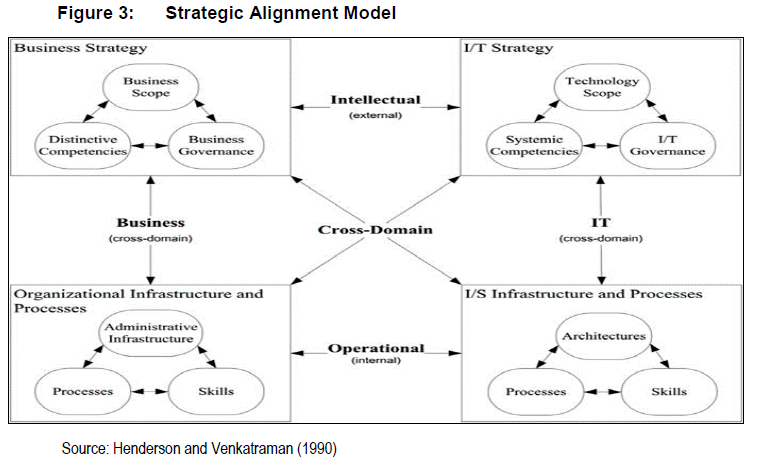
The SAM framework as adopted from Henderson and Venkatraman (1990) is built on four quadrants, each consisting of three (3) components as shown in Figure 3. These twelve constructs of SAM are great tools in defining alignment (Coleman & Papp, 2006). The next section gives a short analysis of the SAM framework as interpreted by Henderson and Venkatraman (1990), Coleman and Papp (2006). Through the analysis of SAM, it will be demonstrated how it is relevant to the study.
The model's four quadrants are business strategy, information technology strategy, organisational infrastructure and information technology infrastructure. Two linkages map these quadrants to each other. The first link is the strategic fit, which is a vertical link that explains the need for organisations to determine their market position (Coleman & Papp 2006). The strategic fit refers to a situation where formal planning involves business strategy and IT strategy that complement each other. Factors identified to have potential to influence the strategic fit alignment include sharing of domain knowledge and business-IT planning integration (Seman & Salim 2013). It also derives how strategy is used to determine the business infrastructure. The second linkage and paramount to the study, is the functional integration. It is directly related to IT-business alignment and as such, addresses the main research question of the study. According to Coleman and Papp (2006), this link assures that technology is on par with the business processes as the business changes to be responsive to the changing environment. It also describes how well a business can position itself in the market, by leveraging the use of IT. According to Henderson and Venkatraman (1996) and Coleman and Papp (2006), competitive advantage and value maximisation of IT are dependent on this link. See Figure 3 for explanation.
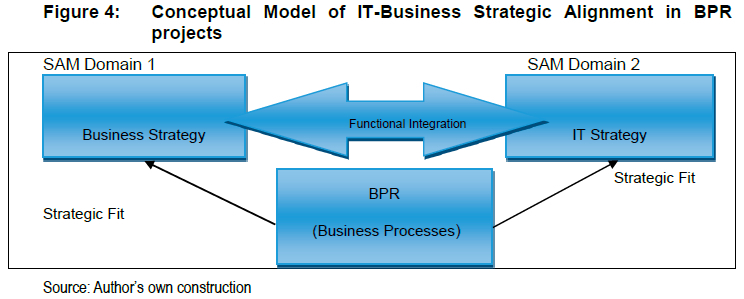
As the study views alignment from a higher level, which is at the strategic level, the SAM model is thus applied from a functional integration perspective. This is alignment between the business strategy and IT strategy. In the same light, the remaining constructs of SAM also come into effect from a BPR stance whereby processes mainly are under review. In this respect, the strategic links assist with linking the BPR to both the IT strategy and the business strategy constructs. This Conceptual Model is depicted in Figure 4.
3. RESEARCH METHODOLOGY
This section covers the research design, paradigm, population and sampling, data collection and data analysis techniques adopted for the study.
This study used a case study approach underpinned by an interpretive philosophy, where three cases were examined for IT-business alignment. Case research or case study research, is a method where a phenomenon is studied over time within its natural setting in one or a few sites (Bhattacherjee 2012). Walsham (1995) argues that a case study is the main vehicle for research in the interpretive tradition. According to Yin (1994), a case study is a great tool for investigating a contemporary phenomenon within its real-life context. The findings of systematic literature review studies undertaken by Sposito, Neto and Barreto (2016) and Rusu & Jonathan (2017), in the field of business-IT alignment reported that case study was the most used and most preferred research method. Three organisations constituted three (3) cases for the study.
A qualitative approach was adopted to fulfil the objective of the study. In a systematic literature review conducted by Muñoz and Avila (2019), it was reported that a qualitative approach was the most commonly used method for IT-business alignment studies. The qualitative approach was adopted because insufficient research has been done to address the phenomenon under study within a BPR context. By employing the qualitative approach, this study builds on the theory of IT-business strategic alignment and applies it within a BPR context. Further, the exploratory nature of this study justifies the adoption of qualitative approach.
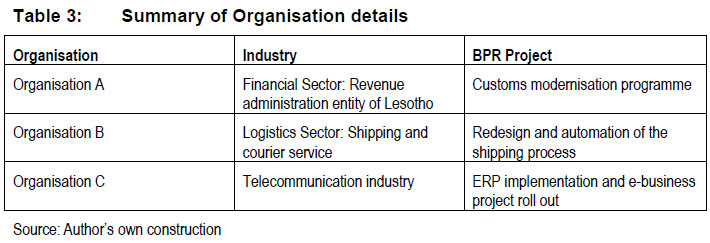
The study was conducted in three different organisations located in Maseru, which is the capital city and the business hub of Lesotho. Maseru hosts both the country's largest organisations and largely all their headquarters as well. These three large organisations operate in different industries and have in the past and of recent years, implemented medium to large scale BPR projects. Organisation A operates in the financial industry, organisation B in the logistics industry and organisation C in the telecommunications industry.
All the three organisations are narrowly dispersed from each other at the hub of the central business district. Being at the heart of the central business district, these organisations are exposed to a competitive business environment of growing entrants to their respective markets and to the world of ever-changing technology, politics and the economy. They have adequate access to the internet and a stable infrastructure. The industries that they operate in and their clientele necessitate a global mindset.
For gathering data, a non-probability, purposive sampling technique was used in selecting the staff members who worked on the BPR projects and on the strategy services. Robson (2002) states that for case study-based research, the population is usually small and therefore non-probability, purposive sampling methods based on subjective judgment and purposive sampling are appropriate to answer the research question and meet the objective of the study (Robson 2002).
The criteria for selecting the interviewees from the three organisations were experience, involvement and seniority in the BPR implementation and strategic alignment fields respectively.
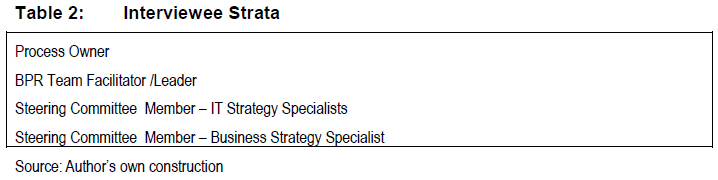
The strata from which interviewees were selected, is summarised in Table 2 and shows the composition of diverse professionals, namely the BPR team facilitator, IT strategy specialist, business strategy specialist and the process owner.
The data collection technique employed was structured interviews. The interview schedule was structured comprising key questions that guided the interview process. The structured interview schedule was designed around the alignment factors proposed by van Hout (2012). The interviews were one-to-one between the researcher and the participants. The sessions were held at the premises of the participating company. Textual data was captured by taking notes and recording the interview sessions.
Thematic analysis and quasi-statistics were used to analyse the primary data gathered from the interviews, which addressed the role of factors in IT-business strategy alignment within the context of BPR. According to Vaismoradi, Jones, Turudeen and Snelgrove (2016) thematic analysis follows a systematic process of coding and the creation of themes to understand meaning and description of the social context. The use of of quasi-statistics in qualitative research is a practice where descriptive statistics are extracted from qualitative data to provide an effect size interpretation of data (Tashakkori & Teddlie, 1998). Fleury (1993) argues that that the qualitative meaning should be preserved in the interpretation. The current study quantitised data by classifying the responses of the interview questions using a 5-point Likert scale, namely strongly disagree, disagree, neutral, agree and strongly agree. The findings were interpreted in terms of the extent of agreement or disagreement per category followed by a discussion of the themes and supporting data extracts in the context of BPR. This strategy was adopted to provide useful insights on the value and narrative on the phenomenon investigated.
4. RESULTS AND ANALYSIS
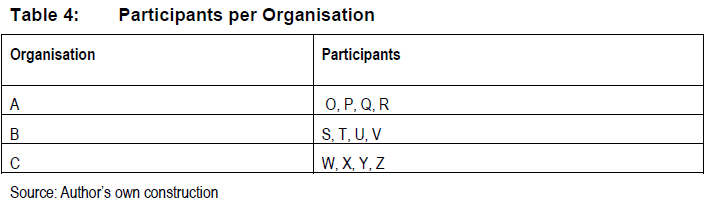
A synopsis of the case studies is presented, followed by a presentation of case study findings. Thematic analysis was used to analyse the primary data collected on the role of IT-business alignment factors within BPR. To determine the role of IT-business alignment factors in BPR, the interview schedule adopted the five alignment factors from the van Hout (2012) study where each alignment factor was assessed using a unique measurement scale. In cases of direct quoting, the interviewees are referred to as participants (O-Z). Four interviews were conducted per organisation.
4.1 A Synopsis of the Case Studies
A summary of the industrial sectors pertaining to the chosen organisations, as well as the target BPR projects forming the foci of the empirical study is presented in Table 3:
4.2 Case Study Findings
This section presents the demographic results followed by the thematic results on the role of alignment factors in IT and the business strategy within the context of BPR.
4.2.1 Demographic Results
The demographic data presented in this section include the business process reengineering (BPR) role/job title, gender, and the number of years of involvement in a BPR project. The criteria used to select participants for the study were experience in IT and business strategy, involvement in BPR and seniority of position. The number of participants selected per organisation and the coding used for identification is illustrated in Table 4.
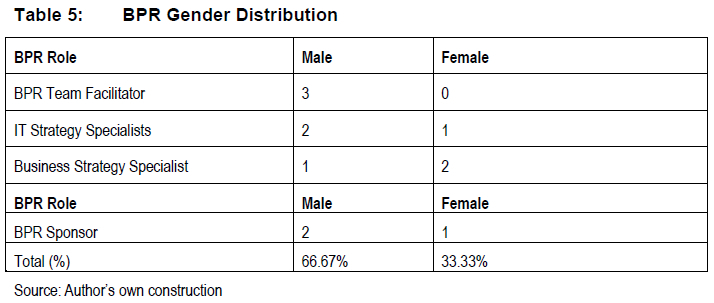
The gender distribution summarised in Table 5 shows that 66.67% of the respondents were males and 33.33% were females.
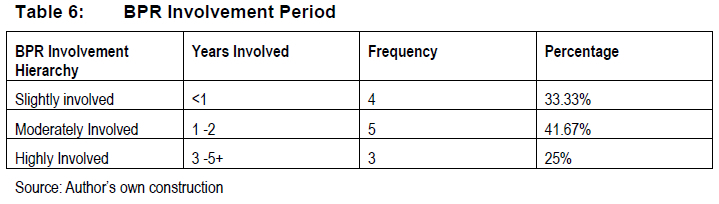
Table 6 shows that only 25% of the participants have been involved in a BPR project for more than three years and a large percentage of 41.67% had been in the BPR project for a period spanning between one year and two years and 33.33% of the participants had only been involved in the project for less than a year.
4.2.2 Results of Thematic Analysis: Roles of Alignment Factors in IT-Business Strategic Alignment in a BPR Project
This section presents results on interviews and addresses the study's objective aimed at determining the role of alignment factors with respect to IT-Business strategic alignment within the context of BPR in large organisations in Lesotho. The section addresses this objective by assessing the five alignment factors and their measures within a BPR context.
Alignment Factor 1 Evaluation: Intention and Support
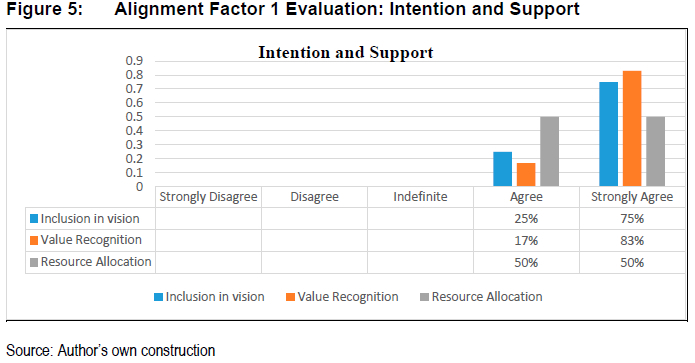
Three themes, namely inclusion in vision, value recognition and resource allocation, depicted in Figure 5 were supported when analysing how intention and support were placed in the context of BPR projects under evaluation.
A discussion of the findings depicted in Figure 5 follows.
Inclusion in vision
This makes IT the prime strategic component of an organisation's goal setting.
In organisation A, the BPR project saw the IT department expanded over the years from a support function, to where it is today, as a strategic function. Participant Q made a remark that the IT department transformation was necessary for the uptake of the modernisation project. In organisation B, participant T expressed that IT is always a central component in their vision. This participant emphasised this point as follows:
"Our IT department is always abreast of technology trends and to be number one in our field we try to pioneer and incorporate these trends in order to enhance our customer experience and to build new business models. We are currently having our eye on trends like internet of things, robotics and automation, big data and cloud logistics."
In organisation C, the participants indicated that management communicated clearly the role IT was to play in the e-business/ERP project. Participant X made the following comment:
"Expectation at the completion of the project were well articulated, we knew what we had to do and how IT was to come into play."
Value recognition
Value recognition considers the articulation of the value of IT in an organisation (van Hout 2012). As per the findings illustrated in Figure 5, participants were of the impression that management saw value in IT in the implementation of the BPR project.
Participant O, in organisation A made the following remark:
"In our organisation, our IT department move from just being a support function to be an integral element of the organisation so much that I doubt any of our business units will be functional without it."
In support of both inclusion in vision and value recognition, Morrison, Ghose, Dam, Hinge and Hoesch-Klohe (2012) state that an organisation's IT strategy will be aligned to business strategy, if there is an understanding of how IT and IT applications will contribute to the business goals in the present day and in the future. They further add that to achieve IT-business alignment, an organisation should recognise the value IT adds to it, as this would assist in giving a clear IT strategic road map.
Resource allocation
The findings show that IT resources were moderately allocated to BPR projects. The findings indicate that organisation B made a huge investment in IT resources to make sure that the roll out of the ESS project was a success. Respondent S expressed this by stating that organisation B infiltrated and grew the IT landscape in its network by ensuring that every country had the e-commerce tools, standardised infrastructure and IT network capacity. In this case, management saw the value of IT in achieving its mandate and their commitment and support to the project had been firm. It was in organisation C, participants indicated that there was a budget constraint and IT resources were to a large extent compromised.
In this regard, Morrison et al. (2012) maintain that a shared focus on budgeting and on distributing scarce resources, time and money will contribute hugely towards achieving IT-business alignment in the organisation. The findings of a study conducted by Goksoy, Ozsoy and Vayvay (2012) revealed that top management commitment and support, as well planning and resources was perceived as success factors of reengineering.
Alignment Factor 2 Evaluation: Working Relationship
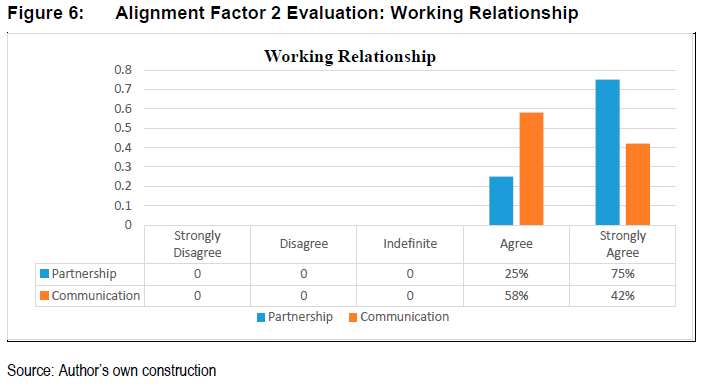
To evaluate how working relationships were established, the partnership and communication themes were measured and analysed. See Figure 6.
A discussion of the findings depicted in Figure 6 follows.
Partnership
The IT manager's involvement in business strategy planning is what facilitated partnership in all the organisations. Organisation B indicated that with all the projects that the organisation engages in, internal relationships and inter-functional collaboration are enforced. The participants elaborated that the success of the ESS project was owed largely to how well the IT and the business worked closely together, from the initiation of the project, to seeing it through and in monitoring it. Another contributing factor that the participants raised was that the ESS project was much an IT need, as it was a business need. The IT unit perception was that the ESS project met its objectives and that of its business unit alike. Participant S expressed the following view on the partnership theme:
"The success of our project is owed largely to how well the IT and the business worked closely together from the initiation of the project to seeing it through and then again this could just have been because this project was much an IT need as it was a business need, but IT and business here work well together."
Communication
Findings revealed that there was generally good communication between the IT department and the business department.
The results revealed existence of a firm communication between the business and IT in organisation A. The communication has been both formal and informal. Channels that facilitated effective communication were forums and presentations. According to participants in organisation A, this has resulted in quick feedback and collective decision making on the way forward, to mitigate unforeseen glitches. Participant P made the following statement:
"In many occasions the IT and business executives were present and active. This improved the team morale and steered the team towards working for one goal."
Participants from organisation B regularly referred to their "AS ONE'' philosophy that brings everyone together, to work together and achieve the set goals.
The findings from Organisation C revealed that although the IT manager was involved in business strategy planning, the perception about communication was that it was rather one way, with the business unit requisitions from the IT unit. The only platform that facilitated interactive sessions, were formal meetings that were held only periodically.
Morrison et al. (2012) suggest that a credible working relationship will forge a successful alignment, between IT and business. This alignment is achievable by innovative solution delivery, reliable daily operations and responsive service recovery management. Goksoy et al. (2012) reported that communication and teamwork were perceived to be the dominant success factors of reengineering. The study conducted by Luftman et al. (2017) reported that the communication activities such as understanding of business by IT and understanding of IT by business form an integral part of the IT-Business alignment.
Alignment Factor 3 Evaluation: Shared Domain Knowledge
Shared domain knowledge was analysed and measured in respect of themes on IT sector's knowledge of the business and the business sector's IT knowledge. See Figure 7.
A discussion of the findings depicted in Figure 7 follows:
IT sector's knowledge of the business
The results indicated that the IT sector's knowledge of the business was adequate. In organisation A, prior to the implementation of the customs modernisation programme, extensive training was organised and attended to by both the business and the IT units. The training was both internal and external. Workshops were conducted internally and areas of focus were on system usage. The respondents all felt that there was an adequate understanding of the organisation at large.
Business sector's IT knowledge
The findings above show that business personnel had a limited knowledge of IT.
In organisation C, the trend of communication indicated in section 4.2.2.2 contributed to the findings of the limited knowledge that business had of IT. Respondent X was overseeing the whole project in Organisation C and he expressed that the business sector needed to collaborate with IT on huge projects, which implied the need for inter-departmental knowledge.
His argument was that good communication in the first instance would help with interdepartmental knowledge and help to achieve the project deadlines as well as foster quick responses to unforeseen setbacks.
Goksoy et al. (2012) reported that information sharing was an important success factor in business process reengineering. Wu, Straub and Liang (2015) argued that more communication between IT and business executives can lead to a shared understanding and knowledge, thereby strengthening IT support of business strategies.
Alignment Factor 4 Evaluation: IT Projects and Planning
IT Projects and Planning was analysed and measured concerning two themes, namely linkage and prioritisation. See Figure 8.
A discussion of the findings depicted in Figure 8 follows.
Linkage and Prioritisation
The results indicate that prioritising IT projects and linking them to business strategies took primacy in the BPR projects.
The participants stated the following:
"The business needs were first identified and IT plans were made in consideration to the business need."
"Our BPR project was paramount towards achieving the organisation's goals; it thus took precedence to all other IT projects."
Ohlsson, Han, Hultin and Rosengren (2016) reported that the Chief information Officer (CIO) coordinates planning and decision making of information and communication technology (ICT) projects with a strategic focus of aligning ICT for business value realization.
Alignment Factor 5 Evaluation: IT Performance
IT performance was analysed and measured on three themes, namely innovation, reliability and opportunities. See Figure 9.
A discussion of the findings depicted in Figure 9 follows.
Innovations
Previous findings discussed in section 4.2.2.3 indicate that the IT sector reacted to business needs. Findings revealed that although the IT unit is autonomous with respect to solutions it provides for the business, their flexibility and innovations are limited to the business needs.
Reliability
The findings reveal that Organisation B focused strategy has set well-defined IT priorities and adequate IT resources for the realisation of its mandate.
Opportunities
To achieve the "grow focus" strand there has been a drive for centralisation of IT capabilities to drive standardised business processes, a uniform database and a stable platform to ensure that the organisation remains competitive in its business environment. Respondent S indicated that the ESS project is a subsidiary of a larger scale IT initiative to drive improvements in innovation and real time information, productivity and quality service.
In a study conducted by Goksoy et al. (2012), IT and innovation were ranked as extremely important success factors in business process reengineering. Hasnan, Ringim and Razalli (2017) claim that BPR enables organisations to equip themselves with modern technologies, business solutions and innovations.
4.2.3 Business Process Change Management
The findings revealed that business process change management is an additional alignment factor that needs consideration. In more than one interview and in different organisations, references were made to aspects of business process change management. According to Fahad (2016) business process change management involves the following four phases: making a proposition to stakeholders and participants, understanding why change is necessary and what it will achieve, evaluating business process's impact on performance and implementing change. In the interview, participants made clear references to making propositions to stakeholders and participants and to understanding why change is necessary and what it will achieve. Other reasons cited for success in business process reengineering implementations were customer orientation and change management (Goksoy et al. 2012).
Organisation A indicated that successful meetings with high-level government officials were conducted to obtain buy-in and approvals regarding certain aspects of the project. Organisation A had to communicate change management to clearing agencies and train them regarding the ASYCUDA system. In organisation B, customers were asked about their service experience and for their suggestions on what can be improved prior to the actual implementation of the BPR, and in organisation C, it was important for the organisation to make sure that their systems communicated with that of their suppliers. Participants indicated that without having considered all other sectors that affected their operations, their project would not have been entirely successful. The proposed additional alignment factor and measuring variable is shown in Table 7.
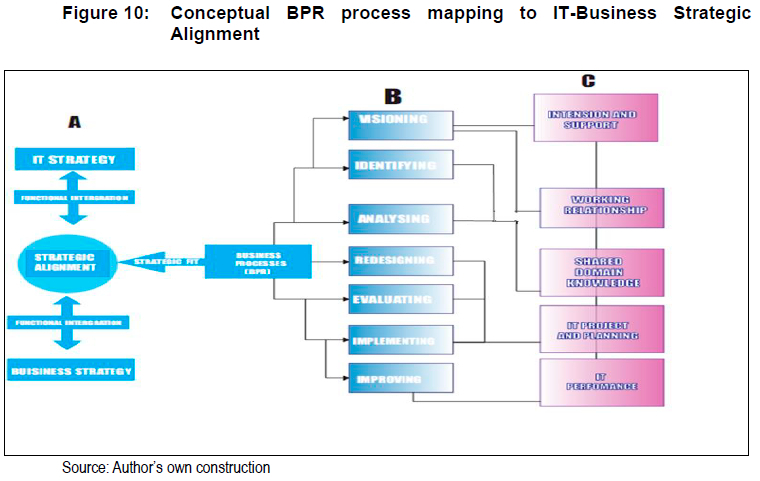
4.3 Conceptual process map in IT-Business strategic alignment in BPR
Figure 10 illustrates the conceptual process map for IT-business strategic alignment in BPR as per the study findings. The conceptual process map is the outcome of the case study findings. It is made up of three pillars namely, A, B and C. See Figure 10.
Pillar A illustrates the IT-business strategic alignment concept of the study. To incorporate this concept in the study, the SAM framework was adopted from the literature review. The business strategy and IT-strategy constructs of the SAM framework were examined in the study, in addition to the functional integration links. The functional integration demonstrated the harmony between business strategy and IT strategy to arrive at a point whereby an organisation has attained strategic alignment. Strategic fit acted as a link between strategic alignment and BPR.
Pillar B illustrates the BPR framework selected from the literature review.
Pillar C illustrates the alignment factors, also emerging from the literature study. The alignment factor variables were also evaluated in the three organisations by means of interviews.
The process map demonstrates the interrelationship between the BPR phases and the alignment factors. This relationship is clarified by the application of the relevant alignment factor to the correlating BPR phase(s).
From the analyses and measurements conducted, interrelationships emerged and assisted in the construct of the conceptual process map.
At visioning phase of the BPR methodology, corporate visions and business goals are defined. By incorporating the intention and support alignment factor during this phase, it can be assured that IT has been strategically placed in the vision and business goals of the organisation. By achieving this at an early stage, the value of IT is clearly communicated and understood, and the necessary IT resources are timely and efficiently allocated to the BPR project.
Working relationship is another alignment factor that should be included at the visioning phase. This takes into consideration the communication between IT and the business and primarily, at the executive level. In organisation B, it was highlighted that the success of their project was owed largely to the working relationship between the IT and the business units from the initial stages of the project. When the working relationship is achieved, the cooperation of IT and business can be realised during the strategy formulation.
At the "identify, evaluate and implement" phases of the BPR methodology, existing business processes are defined and measured. Shared domain knowledge is basically saying how well does the IT function know the business function and conversely, how well does the business function know the IT function. When IT and business have appropriate knowledge of each other, their objectives will be in accord. This expresses the notion that when IT and business have appropriate knowledge of each other, their objective will be in accord with identifying and analysing processes to reengineer.
At the redesign phase, IT projects planning will assist in the integration of technology that will enable the creation of an organisation's competitive edge. This suggests cautiously selecting an IT platform at the redesign phase. Lampathaki et al. (2013) states that the "evaluate" phases of a process redesign, a new process is assessed and selected. IT projects and planning will guide this process by linking an appropriate process redesign to the business strategy and the plans. In a similar manner, IT projects and planning through pulling all resources in terms of sponsorship, will assure the implementation of the BPR project.
At the Improve phase, it is important that IT performance be incorporated during this phase. The 'Improve phase' involves continuous improvement of the BPR process. According to Garvin (1995), this requires performance management and the IT performance through innovation and exploitation of new and existing technologies, for the redesigned process to continue delivering enhanced performance.
5. DISCUSSION OF FINDINGS
All three organisations had essentially progressed from seeing IT as a support tool, to strategically placing it within their organisation. At the centre of the redesigned business processes was IT. The inference from the findings is that the redesigned business processes recognised both the business strategy and IT strategy. This allowed for the alignment of the redesigned business processes to both the business strategy and IT strategy.
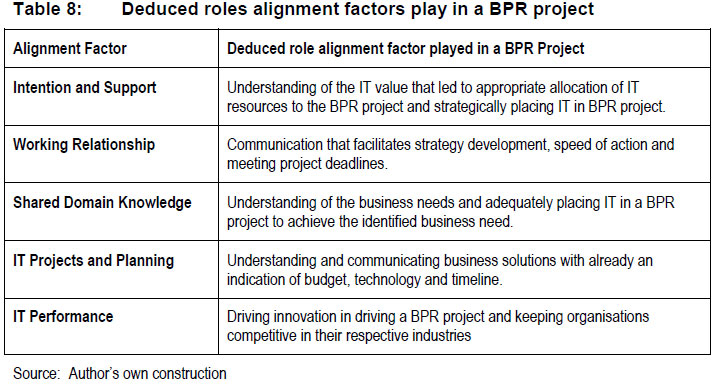
The findings have illustrated the roles alignment factors played towards achieving IT-business strategic alignment. Guided by van Hout (2012) study on alignment factors, the study measured different alignment factors' variables in each BPR project. Table 8 shows alignment factors and the deduced roles they played in the investigated BPR projects. It should be noted that the alignment factors mentioned below were not explicitly stipulated, rather the interview questions allowed respondents to identify areas and practices that implicated alignment factors. See Table 8.
The study revealed that all alignment factors should be considered in an organisation during a BPR project and the BPR team can best facilitate this. The responsibility of a BPR team in this regard, will be to facilitate communication between those two entities, to assume commitment and to foster support through means of allocating necessary resources. To add to this, the BPR team will further have to ascertain that the business needs are an integral part of the IT projects.
The study further discovered an additional factor besides the five alignment factors investigated that is also key to the success of a BPR project and in aligning the IT strategy to the business strategy in a BPR project. This element is the involvement of the organisation's stakeholders under business process change management. This element entails identifying customer needs and making them part of the change requirement. In addition, making external parties directly and/or indirectly involved with the organisation to be a part of the change management.
6. CONCLUSION
The research set out to determine factors pertaining to the attainment of IT-business strategic alignment within the context of BPR. The research findings assisted in understanding the mapping of different alignment factors to different phases of the BPR methodology. The research analyses determined different roles played by alignment factors at different phases of a BPR project and from this understanding a conceptual process map for IT-business strategic alignment in BPR context was developed, which is depicted in Figure 10 in section 4.3. The conceptual process map is valuable to the BPR team who are required to carry out the different phases of the BPR project by taking cognisance of the various alignment factors and mapping the alignment factors to the relevant stages.
The research findings and analyses indicate that alignment factors are an imperative element in a BPR process for both its success and for the attainment and sustainability of IT-business strategic alignment. Lastly, the study has further identified that business process change management can be added as a factor to the five alignment factors adopted by the study. The study's findings have indicated that stakeholders play a significant role in shaping an organisation's strategy.
This study contributed to the body of knowledge in the IS research field in the development of a conceptual process map for IT-business strategic alignment within a BPR context and makes a further contribution to practice. Process owners, project managers, strategists in both the management and informatics fields will find this study to be of value as it provides a clear process map on how IT and business misalignment can be avoided and conversely how alignment can be achieved and maintained within their respective organization and industries.
Some of the limitations faced was identifying a list of organisations that have undertaken or are currently undertaking BPR projects and getting these organisations to agree to undertake the study. This resulted in the study being limited to a small sample size. Despite this limitation, the study yielded rich data and insights from interviewees through the design of a structured interview schedule.
Future studies can investigate the stakeholders' requirements as an additional success factor towards IT-business strategic alignment in a BPR context. Future studies can also assess whether business processes change management can facilitate alignment between IT and the business.
REFERENCES
ALFADHEL SA, LIU S & ODERANTI FO. 2019. Business and Information System Alignment Theories Built on eGovernment Service Practice: A Holistic Literature Review. In Application of Decision Science in Business and Management. InTechOpen. (DOI:10.5772/intechopen.88755. [ Links ])
AL-HASHEM A & YASEEN SG. 2015. Business Transformation and its Effects Upon Strategic Alignment Maturity Level. [Internet:http://www.zuj.edu.jo/wp-content/staff-research/economic/dr.saad-yaseen/3.pdf; downloaded on 20 October 2019. [ Links ]]
AL-MASHARI M & ZAIRI M. 2000. Creating a Fit between BPR and IT Infrastructure: A Proposed Framework for Effective Implementation. The International Journal of Flexible Manufacturing Systems 12:253-274. [ Links ]
AUSTIN RD, APPLEGATE LM & SOULE D. 2008. Corporate Information Strategy and Management: Text and Cases. 8th edition. New York: McGraw-Hill, Inc. [ Links ]
ALTINKEMER K, OZCELIK Y & OZDEMIR ZD. 2011. Productivity and Performance Effects of Business Process Reengineering: A Firm-Level Analysis. Journal of Management Information Systems 27(4):129-162. (DOI:10.2753/MIS0742-1222270405. [ Links ])
AVERSANO L, GRASSO C & TORTORELLA M. 2012. A literature review of Business/IT Alignment Strategies. Procedia Technology 5:462-474. (DOI:https://doi.org/10.1016/j.protcy.2012.09.051. [ Links ])
BARJIS J. 2008. The importance of business process modelling in software systems design. Science of Computer Programming 71(1):73-87. (DOI:https://doi.org/10.1016/j.scico.2008.01.002. [ Links ])
AVISON D, JONES J, POWELL P & WILSON D. 2004. Using and validating the strategic alignment model. Journal of Strategic Information Systems 13:223-246. (DOI:https://doi.org/10.1016/j.jsis.2004.08.002. [ Links ])
BHATTACHERJEE A. 2012. Social Science Research: Principles, Methods, and Practices. Textbooks Collection. Book 3. [Internet:http://scholarcommons.usf.edu/oa_textbooks/3; downloaded on 20 June 2015. [ Links ]]
BUCHTA D, EUL M & SCHULTE-CROONENBERG H. 2010. Strategic IT Management: Increase Value, Control Performance, Reduce Costs. Wiesbaden, Germany: Willem and Adam. [ Links ]
CHEN L. 2010. Business IT alignment maturity of companies in China. Information and Management 47:9-16. [ Links ]
COLEMAN P & PAPP R. 2006. Strategic Alignment: Analysis of Perspectives. (Southern Association for Information Systems Conference (SAIS). [Internet:http://aisel.aisnet.org/sais2006/42; downloaded on 01 November 2013. [ Links ]]
COLTMAN T, TALLON P, SHARMA R & QUEIROZ M. 2015. Strategic IT alignment: twenty-five years on. Journal of Information Technology 30:91-100. (DOI:https://link.springer.com/article/10.1057%2Fjit.2014.35. [ Links ])
COX A, MARCHINGTON M & SUTER J. 2009.Employee involvement and participation: developing the concept of institutional embeddedness using WERS2004. The International Journal of Human Resource Management 20(10):2150-2168. (DOI:https://doi.org/10.1080/09585190903178104. [ Links ])
CUENCA L, DE DIOS MILLA J & BOZA A. 2015. Business and IT alignment in companies of Valencian Community in Spain. Direccion y Organizacion 55: 38-43. [ Links ]
DAGHFOUS A & BARKHI R. 2009. The strategic management of information technology in UAE hotels: An exploratory study of TQM, SCM, and CRM implementations. Technovation 29(9):588-595. [Internet:https://doi.org/10.1016/j.technovation.2009.05.007; downloaded on 25 February 2013. [ Links ]]
DE HAES S & VAN GREMBERGEN W. 2008. Analysing the relationship between IT Governance and Business/IT Alignment Maturity. (41st Hawaii International Conference on System Sciences). (DOI:10.1109/HICSS.2008.66. [ Links ])
EL-MEKAWY M, RUSU L & PERJONS E. 2015. An evaluation framework for comparing business IT alignment models: A tool for supporting collaborative learning in organizations. Computers in Human Behaviour 51:12291247. (DOI:https://doi.org/10.1016/j.chb.2014.12.016. [ Links ])
FAHAD M. 2016. BPCMont: Business Process Change Management Oncology. DISPLab. [Internet:https://www.disp-lab.fr/; downloaded on 22 October 2015]. (Universite' Lumlere Lyon2, France. [ Links ])
FARNAZ F, KHASHAYAR M, KAVEHA G & MOHSEN A. 2015. Microgrid investment under uncertainty: A real option using closed form contingent analysis. Annals of Operations Research 235(1):259-276. (DOI:https://doi.org/10.1007/s10479-015-1929-y. [ Links ])
FLEURY J. 1993. Preserving qualitative meaning in instrument development. Journal of Nursing Health 1(2):103-105. [Internet:https://www.ncbi.nlm.nih.gov/pubmed/7850496; downloaded on 15 November 2013. [ Links ]]
GARVIN DA. 1995. Leveraging Processes for strategic advantage. A roundtable with Xerox's Allaire, USAA's Herres, SmithKline Beecham's Leschly, and Pepsi's Weatherup. Long Range Planning 28(6):126-126. [Internet:https://hbr.org/1995/09/leveraging-processes-for-strategic-advantage; downloaded on 10 November 2013. [ Links ]]
GEROW JE, THATCHER JB & GROVER V. 2015. Six types of IT-business strategic alignment: an investigation of the constructs and their measurement. European Journal of Information Systems 24:465-491. (DOI:https://doi.org/10.1057/ejis.2014.6. [ Links ])
GOKSOY A, OZSOY B & VAYVAY O. 2012. Business Process Reengineering: Strategic Tool for Managing Organizational Change an Application in a Multinational Company. International Journal of Business and Management 7(2): 89-112. (DOI:https://doi.org/10.5539/ijbm.v7n2p89. [ Links ])
HAMMER M. 1990. Reengineering Work: Don't Automate, Obliterate. Harvard Business Review (July-August): 2-8. [ Links ]
HASNAN N, RINGIM KJ & RAZALLI MR. 2017. Information Technology (IT) Capability and Business Process Reengineering (BPR) Implementation: Evidence from Malaysian Islamic Banks. International Journal of Business and Management 1 (2):70-77. (e-ISSN: 2590-3721.) (DOI:http://www.ijbmjournal.com/uploads/2/6/8/1/26810285/001-ijbm-01-06.pdf. [ Links ])
HENDERSON J & VENKATRAMAN N. 1990. Strategic Alignment: A Model for Organizational Transformation via Information Technology. Working Paper 3223-90, Cambridge, MA: Sloan School of Management, Massachusetts Institute of Technology. [ Links ]
HENDERSON J & VENKATRAMAN N. 1996. Aligning Business and IT Strategies. In JN Luftman. Ed. Competing in the Information Age. New York: Oxford University Press. [ Links ]
HENDERSON J & VENKATRAMAN N. 1999. Strategic alignment: Leveraging information technology for transforming organizations. IBM Systems Journal 38(2/3):472-484. [ Links ]
HOKOMA R & MABROUK A. 2016. Business Process Re-engineering, and its Possible Applications for Improving the Libyan Banking Sector. The International Journal of Engineering and Information Technology (IJEIT) 2(2):80-84. (ISSN 2410-4256). [Internet:www.ijeit.misuratau.edu.ly; downloaded on 06 June 2019. [ Links ]]
HUSSAIN H, KING M & CRAGG DP. 2002. IT Alignment in small firms. European Journal of Information Systems 11(2): 108-127. (DOI:10.1057/palgrave.ejis.3000422. [ Links ])
KARIM J, SOMERS TM & BHATTACHERJEE A. 2007. The impact of ERP implementation on business process outcomes: A Factor-based study. Journal of Management Information Systems 24(1):101-134. (DOI:https://doi.org/10.2753/MIS0742-1222240103. [ Links ])
KUHIL AM. 2013. Business Process Reengineering and Organizational Performance: A Case of Ethiopian Public Banking Sector. Pretoria: University of South Africa, Pretoria. [Internet:http://hdl.handle.net/10500/13265; downloaded on 05 May 2015. [ Links ]]
LAMPATHAKI F, KOUSSOURIS S & PSARRAS DJ. 2013. Business Process Reengineering: BPR Lifecycle. Decision Support Systems Laboratory. (NTUA. [ Links ])
LUFTMAN J. 2000. Assessing business-IT alignment maturity. Communications of the AIS 4(14):1-51. [Internet:http://aisel.aisnet.org/cais/vol4/iss1/14; downloaded on 22 January 2015. [ Links ]]
LUFTMAN J, LYYTINEN K & ZVI TB. 2017. Enhancing the measurement of information technology (IT) business alignment and its influence on company performance. Journal of Information Technology 32(1): 26-46. (DOI:https://doi.org/10.1057%2Fjit.2015.23. [ Links ])
LUFTMAN J, PAPP R & BRIER T. 1999. Enablers and Inhibitors of business-IT alignment. Communications of the AIS 1(11):1-32. [Internet: https://aisel.aisnet.org/cais/vol1/iss1/11; downloaded on 27 March 2014.] (DOI:10.17705/1CAIS.00111. [ Links ])
LUFTMAN J, LEWIS P & OLDACH S. 1993. Transforming the Enterprise: The Alignment of Business and Information Technology Strategies. IBM Systems Journal 32(1):198-221. (DOI:https://doi.org/10.1147/sj.321.0198. [ Links ])
LUFTMAN JN. 2014. Strategic alignment maturity. In vom Brocke J & Rosemann M. Eds. Handbook on business process management. Volume 2. 2nd ed. Springer, Heidelberg. (pp. 5-44. [ Links ])
MITHAS S & RUST RT. 2016. How Information Technology Strategy and Investments Influence Firm Performance: Conjecture and Empirical Evidence. MIS Quarterly 40(1):223-245. (DOI:http://dx.doi.org/10.25300/MISQ/2016/40.1.10. [ Links ])
MORRISON ED, GHOSE AK, DAM HK, HINGE KG & HOESCH-KLOHE K. 2012. Strategic Alignment of Business Processes: In Pallis G, Jmaiel M, Charfi A, Graupner S, Karabulut Y, Guinea S, Rosenberg F, Sheng M, Pautasso C & Ben Mokhtar S. Eds. Service-Oriented Computing - ICSOC 2011 Workshops. ICSOC 2011. Lecture Notes in Computer Science 7221. (Springer. [ Links ])
MUÑOZ L & AVILA O. 2019. Business and Information Technology Alignment Measurement - A Recent Literature Review. In Abramowicz W & Paschke A. Eds. Business Information Systems Workshops. BIS 2018. Lecture Notes in Business Information Processing 339. Springer, Cham. Reproduced with permission of Springer, Cham. [ Links ]
OHLSSON J, HAN S, HULTIN M & ROSENGREN B. 2016. How to Achieve Sustainable Business IT Alignment-Designing a Circular Organizational Structure at SAAB. Hawaii. (49th Hawaii International Conference on Information Systems Proceedings) (5116-5125, IEEE. [ Links ])
ORACLE. 2013. IT Strategies from Oracle. People, Process, Portfolio. [Internet:https://www.oracle.com/technetwork/topics/entarch/itso-catalog-186193.pdf; downloaded on 20 September 2015. [ Links ]]
PAPP R & LUFTMAN J. 1995. Business and IT Strategic Alignment: New Perspectives and Assessments. (Proceedings of the Association for Information Systems. Pittsburgh, PA. (Inaugural Americas Conference on Information Systems.) (August 25-27. [ Links ])
PEARLSON KE & SAUNDERS CS. 2012. Managing and Using Information Systems. USA: John Wiley & Sons, Inc. [ Links ]
RANGANATHAN C & DHALIWAL JS. 2001. A survey of business process reengineering Practices in Singapore. Information & Management 39(2):125-134. (DOI:https://doi.org/10.1016/S0378-7206(01)00087-8. [ Links ])
RAVISHANKAR MN, PAN SL & LEIDNER DE. 2011. Examining the strategic alignment and implementation success of a KMS: a subculture-based multilevel analysis. Information Systems Research 22(1):39-59. (DOI:https://doi.org/10.1287/isre.1080.0214. [ Links ])
REKSOATMODJO W, HARTONO J, DJUNAEDI A & UTOMO H. 2012. Exploratory Study on Alignment Between IT and Business Strategies. Gadjah Mada International Journal of Business 14(2):139-162. (DOI:https://doi.org/10.22146/gamaijb.5441. [ Links ])
RINGIM KJ, RAZALLI MR & HASNAN N. 2012. Critical Success Factors for Business Process Management for Small and Medium Banks in Nigeria. Business and Management Review 2(1):83-91. [Internet:http://www.businessjournalz.org/bmr; downloaded on 06 June 2019. [ Links ]]
ROBSON C. 2002. Real World Research: A resource for Social Scientists and Practitioner Researchers. Blackwell, United Kingdom: Oxford. [ Links ]
SCHWALBE K. 2010. Information Technology Project Management. 6th edition. Boston. MA: Course Technology/Cengage Learning. (ISSN 1111221758, 9781111221751. [ Links ])
SCOTT MORTON MS.1991 The Corporation of the 1990s. New York: Oxford University press. [ Links ]
SEMAN EAA & SALIM JA. 2013. Model for Business-IT Alignment in Malaysian Public Universities. (4th International Conference on Electrical Engineering and Informatics. ICEEI 2013 Science Direct). Procedia Technology 11(2013J:1135-1141. (DOI: https://doi.org/10.1016/j.protcy.2013.12.305. [ Links ])
SLEDGIANOWSKI D, LUFTMAN J & REILLY RR. 2006. Development and Validation of an Instrument to measure Maturity of IT Business Strategic Alignment mechanisms. Information Resources Management 19(3):18-33. (DOI: http://dx.doi.org/10.4018/irmj.2006070102. [ Links ])
SPOSITO M, NETO A & BARRETO R. 2016. Business-IT alignment research field: a systematic literature review. (18th International Conference on Enterprise Information Systems). (pp 549-558). (DOI:10.5220/0005832005490558. [ Links ])
STRNADL CF. 2006. Aligning business and it: The process-driven architecture model. Information Systems Management 23(4): 67-77. (DOI:https://doi.org/10.1201/1078.10580530/4.6352.23.4.20060901/95115.9. [ Links ])
RUSU L & JONATHAN GM. 2017. IT Alignment in Public Organizations: A Systematic Literature Review In Information Technology Governance in Public Organizations: Theory and Practice / [ed] Lazar Rusu, Gianluigi Viscusi, Cham, Switzerland: Springer, 2017, No 0. (pp 27-57. [ Links ])
TASHAKKORI A & TEDDLIE C. 1998. Mixed methodology: Combining Qualitative and Quantitative Approaches. Applied Social Research Methods Series 46. Thousand Oaks, CA, US: Sage Publications, Inc. [ Links ]
TRKMAN P. 2010. The critical success factors of business process management. International Journal of Information Management 30(2):125-134. (DOI:https://doi.org/10.1016/j.ijinfomgt.2009.07.003. [ Links ])
VAISMORADI M, JONES J, TURUDEEN H & SNELGROVE S. 2016. Theme development in qualitative content analysis and thematic analysis. Journal of Nursing Education and Practice 6(5):100-110. (DOI:https://doi.org/10.5430/jnep.v6n5p100. [ Links ])
VAN HOUT EL. 2012. Measuring Strategic Business-It Alignment on the Construction and Validation of a Measurement Model For Strategic Business-It Alignment. Eindhoven: University of Technology, Netherlands. (Master's thesis. [ Links ])
WALSHAM G. 1995. Interpretative case studies in IS Research: nature and method. European Journal of Information Systems 4:74-81. (DOI:https://doi.org/10.1057/ejis.1995.9. [ Links ])
WU S PJ, STRAUB DW & LIANG TP. 2015. How information technology governance mechanisms and strategic alignment influence organizational performance: Insights from a matched survey of business and IT managers. Management Information Systems Quarterly 39(2): 497-518. (DOI:http://dx.doi.org/10.25300/MISQ/2015/39.2.10. [ Links ])
YIN RK. 1994. Case study research: Design and Methods fourth edition. Applied Social Research Methods Series. London: Sage. [ Links ]