



Services on Demand
Journal

Article
 English (pdf)
 Article in xml format
 Article references
 Automatic translation
 Send this article by e-mail
Indicators
Related links
-
 Cited by Google
 -
 Similars in Google
Share

 Permalink
Journal of Contemporary Management
On-line version ISSN 1815-7440
JCMAN vol.21 n.1 Meyerton 2024
https://doi.org/10.35683/jcman1050.255
RESEARCH ARTICLES
Validating a theoretical model for digital collaborative consumption in emerging markets: Insights for contemporary managers
Tinayeshe ShumbaI, *; Fanny SarucheraII
ISchool of Business Sciences, Witwatersrand University, South Africa. Email: tinashumba2000@gmail.com. ORCID: https://orcid.org/0000-0002-6818-6935
IISchool of Business Sciences, Witwatersrand University, South Africa. Email: fanny.saruchera@wits.ac.za. ORCID: http://orcid.org/0000-0002-2139-1966
ABSTRACT
PURPOSE OF THE STUDY: Consumers in emerging markets face escalating challenges in online transactions, which range from double payments, inaccessible call centres, mix-up of orders and delivery of products to the wrong address. Despite the growing severity of these issues, a viable solution is elusive. This study addressed this gap by (1) identifying crucial factors influencing Digital Collaborative Consumption (DCC) and (2) formulating a model validating the intent to engage in the DCC business model within an emerging market, with a particular focus on the South African context.
DESIGN/METHODOLOGY/APPROACH: This study validated its research questions and hypotheses using a quantitative research design. Data was collected from consumers using generic applications for online food orders. Participants received a self-administered survey via the Qualtrics link, yielding 827 valid responses. The analysis utilised Structural Equation Modelling in M-plus (version 7) and Statistical Package for the Social Sciences (version 27).
FINDINGS: Empirical testing of posited hypotheses revealed significant support for the predicted relationships. The empirically validated DCC model identified economic benefits, social benefits, and security assurance as influential predictors of consumption in the emerging market.
RECOMMENDATIONS/VALUE: Contemporary managers are advised to tailor their products and services, emphasising the creation of local brands, which garner more attention than international counterparts. Marketers, managers, and policymakers should leverage the DCC business model to effectively plan, predict, and manage present and future demand.
MANAGERIAL IMPLICATIONS: Contemporary managers can enhance service delivery and influence online consumption by strategically adopting the DCC business model. Building online communities of loyal consumers who propagate positive word of mouth is crucial for effective engagement in the digital collaborative consumption landscape.
JEL CLASSIFICATION: M3
Keywords: Attitudes; digital collaborative consumption; emerging markets; economic benefits; security assurance; social benefits
1. INTRODUCTION
Research in marketing often focuses on marketplace exchanges where consumers gain temporary access to resources such as taxis, accommodation, furniture, tool rental, and experiences, e.g., wilderness hikes and ocean fishing charters, without transferring ownership. These exchanges have a long history, dating back more than 2,000 years. Recent advances in communication and information technology have encouraged considerable innovation in business models focusing on such exchanges, including fast-growing firms such as Airbnb, Uber, and Bolt. Also, collaboration of consumers and firms in emerging markets (EMs) has grown due to many factors, which include flexibility in product delivery to the customer, two-way feedback on service and product quality from customers and service providers, consumer-customised product delivery, monitoring service quality, providing instant customer evaluations and advances in convenience and accountability. In the context of this study, this business model is considered to be a "digital collaborative economy". To state plainly, the collaborative economy can include all business models offering digital collaborative consumption of products for a fee.
Having introduced the concept of digital collaborative consumption (DCC), it is vital to note that the meaning of this concept in marketing has evolved. With a long research history, backdating to the 1970s, digital collaborative consumption relates to "events in which one or more persons consume economic goods or services in the process of engaging in joint activities with one or more others" (Felson & Spaeth, 1978:164), emphasising joint activities in consumption, e.g., beer drinking with a buddy, not the distribution and acquisition of a resource. Similarly, Botsman and Rogers (2010) refine the construct, defining it as "...the traditional sharing, bartering, lending, trading, renting, gifting and swapping" (p. xv), but not differentiating between marketplace gifting and sharing. As an extension, Belk (2014) distinguishes between collaboration and sharing, noting that both types of exchanges are increasing, and further describes digital collaborative consumption as the coordination of acquiring, distributing, and using products and services. These do not exclude monetary and non-monetary exchanges, e.g., bartering, trading and swapping, where there is no transfer of ownership.
According to Belk (2014, 2018), sharing is as old as humankind and necessary for survival. Researchers such as Everatt and Solanki (2008) note that sharing is pervasive in South Africa and highest among the low socio-economic classes. Sharing in DCC refers to the short-term rental of cars, homes, rooms and rides (Belk, 2018). In an earlier study, Belk (2014) describes sharing commercial ventures as "pseudo-sharing", e.g., food delivery, car and accommodation rentals. However, as a criticism of Belk's definition, Ni (2021) notes the exclusion of the concept of gifting and donating and the inclusion of high-value purchases of preowned products, e.g., houses and antiques.
From a contrasting view, the term DCC refers to a variety of non-ownership forms of consumption activities, such as "collaborative consumption" (Agarwal & Steinmetz, 2022) and "access-based consumption" (Eckhardt & Bardhi, 2016). Eckhardt and Bardhi (2016:881) define "access-based consumption as transactions that may be market mediated in which no transfer of ownership takes place". Drawing from these previous definitions, the current study redefines digital collaborative consumption as a transaction in which ownership of a product or service does not take place during consumption. In this regard, the user gets some rights to use the asset or service and share it with others to fulfil their needs. In developing countries such as China and Brazil, the DCC business model is spreading rapidly (Ni, 2021). In South Africa, the food delivery industry is characterised by virtual peer-to-peer marketplace exchanges. Still, little is known about the impact on the community and the opportunities which the business model can bring.
The development and rapid spread of smartphones and reduced data costs suggest that the DCC business model may potentially address typical low capital formation and high employment in emerging markets. The platform is largely oriented towards smartphone users (Ganapati & Reddick, 2018). Benoit et al. (2017) describe a platform provider as an actor that supplies goods and services using an online marketplace. Platform providers facilitate transactions in the digital collaborative economy (Ganapati & Reddick, 2018). The primary role of the platform provider is to link the parties involved in the transaction. DCC economy exchanges take various forms. Dyadic exchanges occur between two parties, i.e., the company providing the goods or services and the consumer. Sharing, bartering, and trading are examples of dyadic exchanges. Triadic exchanges involve the consumer, platform, and service provider (Benoit et al., 2017).
In the food delivery industry, DCC has proven to enhance customer satisfaction and generate positive e-word of mouth (De Cicco et al., 2020; Saha et al., 2022). Recognising the growing preference for DCC, many companies have responded by expanding new channels and digital touchpoints to enhance the overall customer experience (Reinartz et al., 2019).
The acceptance of such innovative touchpoints is a new norm, and the DCC platform is no exception. Innovation has turned out to be a key factor in diversifying the delivery service in an emerging marketplace. The business model is initiated and implemented by companies and consumers, e.g., business-to-business (b2b), business-to-consumer (b2c) and consumer-to-consumer (c2c) (de Oliveira et al., 2022). Regarding the food delivery industry, Uber was the first company to position itself on a business-to-consumer model (de Oliveira et al., 2022; Pollio, 2019). DCC is a person-to-person consumption activity based on giving or sharing access to goods and services through a digital platform (Hamari et al., 2016). Sharing is as old as humanity, while digital collaborative consumption was born during the internet era (Belk, 2014). DCC allows private holders of resources, e.g., cars, to make them available to others. The novelty component of DCC has the possibility of sharing resources with strangers Munzel et al. (2019), thereby enabling the development of trust. The business model allows platform providers to monetise business operations through mediation technologies, networks and assets (Pollio, 2019).
The benefits of the DCC business model are economic, environmental, and social (Sastre-Centeno & Inglada-Galiana, 2018). Benoit et al. (2017) note that economic benefits are realised through access capacity and cost-benefit ratio improvement. Environmental benefits stem from the efficient allocation of resources (de Oliveira et al., 2022). In addition, Sastre-Centeno and Inglada-Galiana (2018) observe the creation of social bonds among consumers as a benefit of engaging in online buying platforms. The purpose of this study is therefore, twofold: first, to identify critical factors that impact DCC and second, to develop a model elucidating the intentions to participate in the DCC business model in an emerging market. Having introduced the purpose of the study, the subsequent section presents the background to the subject of the study.
1.1 Background to the study
Digital collaborative consumption has improved efficiency in the marketplace through lower transaction costs, reduced information symmetry, matching demand and supply, enhanced production efficiency, and the creation of millions of jobs in the new sector. For example, Didi in China has 13 million drivers connected to their platform (Zhang & Chen, 2019). DCC exists in virtual space and can be rolled out quickly, leapfrogging the inefficiencies of traditional infrastructure constraints. Zhang and Chen (2019) argue that DCC shaped the market structure through the disintermediation of distribution in the supply chain, where products and services are linked with consumers and suppliers. DCC promotes economic rebalancing through digital applications that promote service industries' development, alike entertainment, education, health, accommodation and transport. Online buying often highlights service quality shortcomings, economic inefficiencies and other service deficits that can be disruptive and negatively impact traditional business models. This is an important practical concern for industry and government policymakers. In contrast, DCC offers an incredible opportunity for rapid advancements and positive social and economic benefits. It may threaten investments in less efficient technologies, e.g., Airbnb vs traditional hotels, Mr D vs traditional restaurants. This section provides the background of the study, and the ensuing section reviews the literature pertaining to the subject under investigation.
2. LITERATURE REVIEW
Scholars have used different terms to describe a business model, e.g., "collaboration consumption" (Benoit et al., 2017; Lang & Armstrong, 2018), "sharing economy" Belk (2014), "access-based consumption" Bardhi and Eckhardt (2012) and "commercial sharing system" (Lamberton & Rose, 2012). In the context of this study, a business model is termed digital collaborative consumption. Previous research focused on examining different forms of DCC (Eckhardt & Bardhi, 2016; Lindblom et al., 2018; Wittkowski et al., 2013) and from different perspectives, such as the social exchange perspective (Wang et al., 2019). It is noteworthy to highlight that consumer-to-consumer trading is classified as DCC (Lindblom et al., 2018), whilst Wittkowski et al. (2013) describes rental services as DCC, even though there is no change of ownership between the parties. Benoit et al. (2017) propose a framework to differentiate various forms of exchange in the DCC business model and some motivations; however, this framework fails to provide an in-depth understanding of the remaining forms of exchange.
The food market in emerging markets is valued at 2.7 billion dollars, and research has shown that it will reach 4.9 billion by 2026, achieving a compound annual growth rate of 7.9% (Thomas & Deshmukhi, 2019). The South African food market has a mix of local and multinational restaurants. The food delivery industry has chicken, burgers, pizza, and processed meat topping the market and having high demand. However, customers have complaints about fast food delivery services. Some of the complaints include online applications running double payments, call centres not easily accessible, drivers mixing up orders and delivering food to wrong addresses, difficulty in using ordering apps and challenges in recovering the login details (Fremstad, 2014; Veen et al., 2020). These challenges affect the adoption of online buying systems, hence the need for contemporary managers to use the DCC platform, which addresses such challenges. Drawing from the discussion thus far, this study attempts to address the drivers of digital collaborative consumption in the food delivery industry in emerging markets. The goal of DCC is to increase its footprint in urban areas, create employment, improve service delivery and improve revenue for the firms. Unfortunately, these goals are impacted when consumers reject new technology. The subsequent section presents the theoretical points of departure for the current study.
2.1 Theory Development
Several models have been developed and proposed to investigate how consumers' intention to use technology affects the adoption of the new technology. The models include the Theory of Planned Behaviour (TPB) (Ajzen, 1991), the Technology Acceptance Model (TAM) (Davis, 1986) and the Unified theory of acceptance and use of Technology (UTAUT) (Venkatesh et al., 2003), which were proposed and used by previous researchers. TAM is the most cited theory and has been used most often, while the Extended Technology Acceptance model has been used to test the consumption behaviour of consumers using technology. On the other hand, Pynoo et al. (2012) note a significant direct relation between perceived usefulness (PU) and behavioural intention (BI). However, contrasting different results were found by other researchers. The TAM allows researchers to test direct and mediated effects when measuring the behavioural intention of consumers.
2.1.1 Technology Acceptance Model
To understand the drivers of DCC in the South African market, the Technology Acceptance Model (TAM) was adopted from the Theory of Reasoned Action (TRA) by Fishbein and Ajzen (1975) and was designed for modelling user acceptance of technology (Davis, 1989). TAM explains the user's intentions and usage of information technology, where technology acceptance determinants are perceived usefulness, perceived ease of use and attitudes (Venkatesh et al., 2003; Venkatesh et al., 2012). TAM helps to analyse relations in the model where DCC is being predicted indirectly by attitudes, namely social benefits, economic benefits and security assurance and moderators by perceived usefulness of the system.
2.1.2 Extended Technology Acceptance Model (ETAM)
The highly influential Extended Technology Acceptance Model (ETAM) has been examined from several viewpoints, and researchers have drawn on ETAM to capture the special conditions of emerging markets. This study brings together variables and relations not previously studied in emerging markets. ETAM helps consumers to enjoy using new business models, e.g., buying goods from the comfort of their homes. The Extended Technology Acceptance model has been differently adapted to suit the specific requirements of specific contexts in different studies (Mailizar & Fan, 2020; Yeo et al., 2017; Saruchera & Phiri, 2016; Saruchera et al., 2014;). Perceived usefulness is the latent construct that helped to determine consumers' acceptance of DCC platforms when buying online (Jung et al., 2021). Perceived usefulness reflects a consumer's salient belief in using technology and helps to improve the performance of DCC platforms (Lee et al., 2018). Perceived ease of use is defined by (Davis, 1989: 320) as "the degree to which a person believes that using a particular information system would enhance his or her performance". The famous seminal researcher Davis (1989) presents an extended TAM model with more elements to account for individual decision-making.
Ajibade (2018) argues that the Technology Acceptance model is more appropriate for personal use than institutional use as it lacks focus on the impact of policies, management and workplace factors. Perceived Usefulness (PU) and Perceived Ease of Use (PEOU) are direct antecedents of predicting the DCC business model. However, this study uses PU to moderate the relationship and explain the acceptance of a new business model in an emerging market. In the current study, the external factors adapted to extend the TAM are economic benefits, social benefits, and security assurance; there is a lack of empirical research investigating the drivers and deterrents of DCC in South Africa's food delivery industry.
The Technology Acceptance model is the most widely used model to predict users' acceptance of new technology as it allows the extension of the model by adding external factors. The core of the extended technology model remains the same, with changes made to extended variables discussed in the theory as part of perceived usefulness. Using the Extended Technology Acceptance Model as the overarching theory and employing structural equation modelling help to understand user consumption behaviour. In this regard, this study aims to identify critical factors that impact digital collaborative consumption and to develop a model that explains the intentions to participate in the DCC business model.
3. THE ETAM VARIABLES AND HYPOTHESES DEVELOPMENT
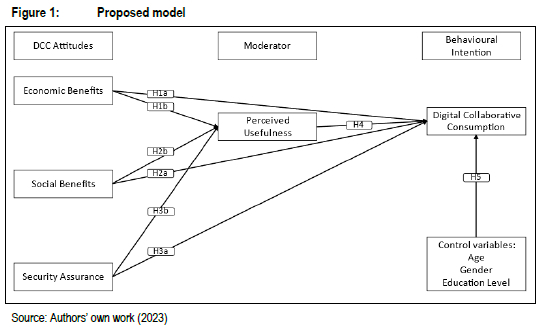
This study formulates hypotheses to test the relationship between the latent variables in the model. The constructs hypothesised are economic benefits, social benefits, and security assurance as the predictors, with DCC as the predicted variable. The model is moderated by perceived usefulness. Figure 1 depicts the theoretical model, which synthesises the relations between the latent variables and their hypotheses. Control variables are gender, age and education, respectively, which test the effect on DCC.
3.1 Economic benefits
The seminal work of Hars and Ou (2001) reports financial gains as expected rewards for participating in open-source software. Kim and Yoon (2021) note that DCC enables efficient use and allocation of resources. Earlier work of Kim et al. (2015) found many benefits to consumers who participate in DCC, including enjoying lowering travelling costs. The business model enables consumers' reciprocity engagement, which creates relationships between consumers and DCC platform providers. The relationship leads to opportunities to utilise underutilised resources, thereby creating additional household income. Similarly, customer loyalty and buyer seller relationships are strengthened and act as economic benefits to the firms and consumers (Makasi & Saruchera, 2014). Further, Chuah et al. (2021) cite economic benefits and found cost-saving and financial benefits as the main reasons for engaging in the DCC business model. Based on this discussion, the following hypotheses are proposed:
H0: Economic benefits do not affect digital collaborative consumption.
H1a: Economic benefits positively influence digital collaborative consumption.
H1b: Economic benefits positively influence perceived usefulness.
3.2 Social benefits
Social interaction between service providers and customers is a benefit of participating in the DCC Business model (Barari et al., 2022). Benoit et al. (2017) and Huang and Kuo (2020) find social interaction enjoyable when it comes to interaction with service providers such as Uber Eats drivers. In addition, current research has shown that social benefits are associated with consumer intention to use apps when buying food online (Kaur et al., 2022; Ray et al., 2019; Shumba & Saruchera, 2023). DCC creates social benefits by enabling job opportunities in emerging markets, creating social bonds, and providing a more comprehensive selection of service providers, which lowers prices charged by competing service providers (Sastre-Centeno & Inglada-Galiana, 2018). Based on the above assertions, this study proposes the following:
H0: Social benefits do not influence digital collaborative consumption.
H2a: Social benefits positively influence digital collaborative consumption.
H2b: Social benefits positively influence perceived usefulness.
3.3 Security assurance
The term assurance refers to employees' knowledge, courtesy and the ability to convey trust and confidence (Parasuraman et al., 1985). In the DCC Business model, assurance could mean winning customer trust during the online buying process. Koay et al. (2022) evaluate quality assurance based on how fast the delivery man can deliver the ordered food, whether the correct food ordered is delivered in the right quantities and whether fees are charged reasonably. Security assurance is defined as the level of confidence that the security requirements of an information technology system are met (Pantazopoulos et al., 2018). Security, privacy, and safety are critical considerations that instil essential trust in customers when making online purchases. A study on security assurance highlights a tenuous correlation between brand reputation and website design (Bart et al., 2005). In this study, security assurance significantly impacts DCC (Data Confidentiality and Integrity). The following hypotheses are proposed:
H0: Security assurance does not affect digital collaborative consumption.
H3a: Security assurance affects digital collaborative consumption positively.
H3b: Security assurance affects perceived usefulness.
3.4 Perceived usefulness
Perceived usefulness is the degree to which a person believes that a system of a particular system would enhance job performance (Davis, 1989). When describing PU from the customer's viewpoint, it means how customer performance is improved by using technology. Davis (1989) claims that user attitude determines whether the user accepts or rejects the new system, i.e., the DCC buying platform. Post-usage usefulness affects the relationship between attitudes and continuance intention (Yeo et al., 2017). To state plainly, perceived usefulness is described as how much easier it would be to use an online platform when making a purchase. Motivation scholars note that perceived usefulness is an example of extrinsic motivation (Kim & Yoon, 2021). Perceived usefulness promotes consumers' intention to use online food delivery services, which is promoted by the availability of high-quality information (Kang & Namkung, 2019). DCC platforms provide up-to-date information on consumption trends, e.g., restaurant list prices and menu information. Effective use of digital DCC generic apps requires service providers to produce accurate and reliable information like operations hours, delivery service areas and times. This study proposes the following hypothesis:
H0: Perceived usefulness has no impact on digital collaborative consumption.
H4: Perceived usefulness has a positive impact on digital collaborative consumption.
3.5 Covariates
This study sought information on socio-demographic variables: age, gender and educational background. Burgess and Harris (1998) report South Africa to be one of the countries with a high level of diversity, as witnessed by many ethnic groups. Socio-demographic variables are used to segment the consumer market in marketing research. This study reported socio-demographic variables as control variables to control their effect in the research context (Burgess & Steenkamp, 2006; Steenkamp & Maydeu-Olivares, 2021). This study posits the following hypothesis:
H0: Covariates have no impact on digital collaborative consumption.
H5: Covariates have a positive impact on digital collaborative consumption.
3.6 Behavioural intention
Behavioural intention is the cognitive representation of an individual's readiness to perform in a certain way (Gani et al., 2021). The theory of Reasoned Action assumes that when an individual intention to perform a behaviour is strong, the probability of the behaviour being performed is also high (Ajzen, 1991). In DCC market transactions, behavioural intention becomes the factor that determines the rate at which technology is used. Consumer behavioural intention in the use of technology has been analysed by several scholars in various contexts (Cheng, 2019; Park, 2009). It is on this basis that this study seeks to identify critical factors that impact the DCC Business model in emerging markets to continue using technology when buying products and services.
4. METHODOLOGY
This study sought to establish the impact of DCC and develop a model to explain the intention of consumers and corporate managers to participate in the DCC Business model, and this was done through a quantitative study. Data was collected from customers who ordered food from Mr Delivery, Uber Eats, Bolt and Orderin. The selected firms were considered because they have footprints in all nine provinces of South Africa. Qualtrics survey software was used to collect data, by sharing the link among the DCC consumers from the public.
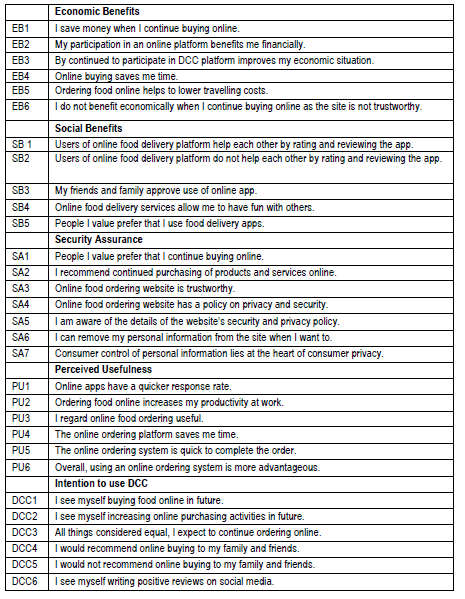
The purposive sampling method was used as only consumers who buy food online from the identified service providers were included in this study. A total of 827 valid responses were obtained and formed part of this study. The questionnaire (Appendix A) was developed using existing scales from previous studies, taking into account this study's research objectives (Malhotra, 2015). A questionnaire is a formalised set of questions used to obtain respondents' information (Malhotra, 2006). The questionnaire employed psychometric measurements (Nunnally, 1978). Each construct was measured with four to seven items on a five-point Likert scale ranging from 1 = Strongly Disagree to 5 = Strongly Agree, where 3 = Neutral. Scaling techniques varied in the questionnaire to allow for the greatest variety of statistical analyses (Malhotra, 2006). Churchill et al. (1996) and DeVellis et al. (2003) proposed a step-by-step psychometric procedure to be employed when designing questionnaires, and the researchers followed them. The technology acceptance model was instrumental in guiding the researcher on the choice of latent variables and has been widely used in consumer behaviour research.
4.1 Demographic variables
Ailawadi et al. (2001) follows a method consistent with marketing activities to narrate psycho-demographics to consumer behaviour. The customers who participated in this study were from different socio-economic backgrounds. This study referred to socio-demographic variables as covariates. Table 1 summarises the background information of the participants.
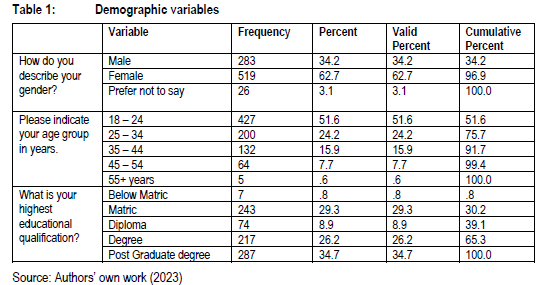
This study shows that most respondents were females, with over 60%, whilst a very small number of respondents decided not to disclose their gender. The age group of young adults between 18 - 24 years accounted for 52% of dominating. An analysis of the modal age group indicates that they have just joined the workforce and do not have many expenses; hence, they prefer to order food online. The educational background of South African consumers shows they are educated, which helps them to cope with changes in technology. Less than a percentage of participants do not have matric, with the rest having some level of education. Steenkamp and Maydeu-Olivares (2021) report that profiling socio-demographic variables in consumer studies is very important as they are observable and accessible. The covariates help to segment the consumer market and offer products and services relevant to the correct segment.
5. DATA ANALYSIS
5.1 Reliability
The measurement scale was assessed by examining its reliability and validity. Reliability measures the internal consistency of the latent internal indicator as indicated in Table 2. The researchers used Cronbach's alpha to measure the reliability of the variables. According to Fornell and Larcker (1981), the reliability coefficient assesses the consistency of the entire scale with a lower limit of 0.7. The covariance among the items had a Cronbach's alpha of 0.793. The Cronbach alpha coefficient based on standardised items had a value of 0.801, employing the correlations among the items. The alpha based on standardised items is based on the assumption that all items have equal variances. The two Cronbach's alpha coefficient values obtained satisfy the recommended reliability criterion, as they indicate an overall internal consistency among the 28 items. The researchers accepted the reliability of the data, which paved the way for further analysis.

5.2 Descriptive statistics
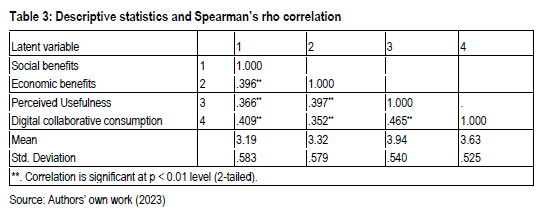
Descriptive statistical analysis involves assessing scores from each construct by evaluating averages, standard deviations, and correlations among all latent variables. The Spearman's rho correlation results summarise statistical significance at p <0.01 level for the latent variables: economic benefits, social benefits, and security assurance. Perceived usefulness serves as a moderator variable, while DCC functions as the behavioural intention variable, both demonstrating statistical significance. Table 3 summarises the descriptive statistics and Spearman's rho correlation.
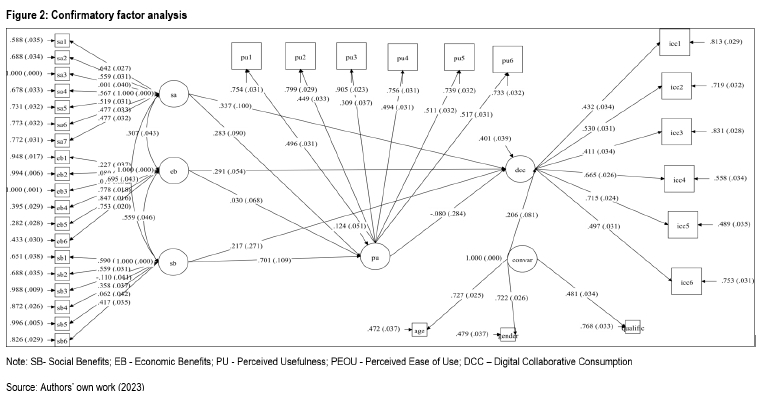
The DCC model relations were tested using Structural Equation Modelling (SEM). Hair et al. (2020) view SEM as a multivariate technique significant for analysing causal models. In this study, by simultaneously examining a series of relationships between variables, the researchers used SEM technique to test the conceptual model indicated in Figure 2. To apply the SEM model, confirmatory factor analysis (CFA) was used to certify that latent variables were indeed represented by the items showing factor loading, which are within the range of acceptable range. Hair Jr et al. (2010) recommend that loadings of ±0.50 or higher are considered significant.
The CFA model, summarised in Figure 2, shows an adequate fit between all the items and the corresponding latent variables. Hair et al. (2010) and Minami et al. (2021) recommend a condition that a minimum of five responses for each estimated parameter are acceptable, and this condition was not violated. The sample for the multivariate analysis was above the minimum threshold of 200 participants, as suggested by Hair et al. (2020), and this condition was met as this study used 824 participants. Gerbing and Anderson (1985) recommended that the threshold for SEM be approximately 150 respondents for a model with three or more latent variables. The sample of this study satisfied the stricter criteria relevant to this variance-based SEM. The goodness of fit measures were reported for the model. According to Hair Jr et al. (2020), Standardised Root Mean Square Residual (SRMR) assesses goodness of good fit and a value below 0.08 is generally considered a good fit. The results from this study showed that SRMR = 0.076, which is within the set criterion. The model is considered a good fit. The final model helped the researchers to compare attitudes' impact on behavioural intention, which is the DCC.
5.3 Structural model
The three predictors for the model, i.e., social benefits, economic benefits and security assurance, were used to predict behavioural intentions. Perceived usefulness was the mediator of the model. This study's criterion, i.e., the dependent variable for this study, was DCC. The model accounted for 29.2% of the variance in perceived usefulness. R-squared (R2) measures the amount of variance in the dependent variable that the predictors, i.e., independent variables, account for when taken as a group. ANOVA test if R2 is significantly greater than zero. The overall regression model was significant F (3.824) = 113.481, p <0.01; R2 = 0.50 for the moderator. For DCC as the criterion variable, the overall regression was significant F (7.820) = 62.794, p < 0.01; R2 = 0.50, indicating that South African consumers prefer buying online. The results of the model are summarised in Table 4, where structural model results, including path estimates and t-statistics, are indicated. The impact of economic benefits on perceived usefulness showed a weak positive effect, whilst the same variable had a strong impact on DCC (H1b: β = 0.268, t = 7.902, p < 0.01; supported) and a weak significant impact on DCC (H1b: β = 0.080, t = 2.349, p < 0.05; supported). Strong significant effect for both direct and indirect effects of social benefits and DCC was realised (H2a: β = 0.231, t = 6.756, p < 0.01; supported) and perceived usefulness (H2b: β = 0.193, t = 5.543, p < 0.01; supported). The same trend applies to security assurance as the results were significant for both direct and indirect effects on DCC (H3a: β = 0.289; t = 8.601, p < 0.01; supported) and perceived usefulness (H3b: B = 0.231, t = 7.045, p < 0.01; supported). Finally, the mediator had a strong positive significant effect on the criterion, DCC (H4: β = 0.289, t = 8.601, p < 0.01; supported). The effect of control variables, i.e., age, gender, and educational qualifications, on digital collaborative consumption was not significant. However, their inclusion assists marketers in understanding different segments in the marketplace, which is useful for targeting and positioning.
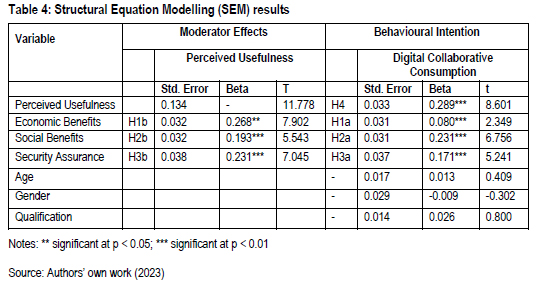
The overall values of the model, i.e., economic benefits (H1a), social benefits (H2a,b), security assurance (H3a,b) and Perceived usefulness (H4), have a strong direct and indirect significant relationship with DCC. Economic benefits (H1b) had a weak significant relationship with perceived usefulness. The covariates had no relationship at all.
5.4 Path model
Path analysis, like the confirmatory factor analysis, is frequently used in models in estimating structural equation modelling (SEM) framework Geiser (2020). Path analysis, described as a multivariate regression model, simultaneously considers multiple predictors, i.e., independent and criterion, i.e., dependent variables. The model tested the standardised total, total direct, specific indirect and direct effects on DCC. This study correlated exogenous variables and carried out path analysis at both manifest and latent levels of the model.
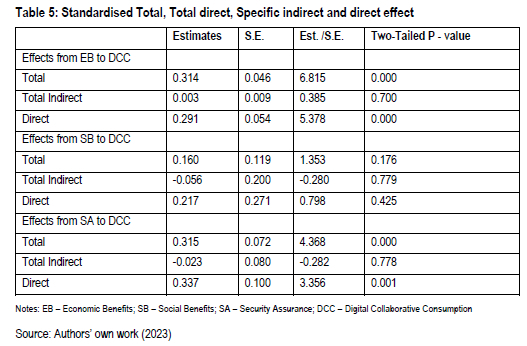
The results of the path analysis presented in Table 5 show standardised Total, Total direct, and indirect effects. The standardised covariance, i.e., correlations (r), are restricted to a standardised range of (-1 < r < 1) (Geiser, 2020). The standardised error for total and direct effect from economic benefits to DCC is 0.046 (z = 6.815) and 0.054 (z = 5.378), respectively. Therefore, the total and direct effect is significant (p < 0.000). Total indirect effects from economic benefits, social benefits and security assurance to DCC had insignificant results. The standardised error for total and direct effect from security assurance to DCC was 0.072 (z = 4.368) and 0.100 (z = 3.356), respectively. The total indirect effects of security assurance on DCC were insignificant. The effects of social benefits on DCC were all insignificant in terms of total, indirect, and direct effects. With reference to parameter estimates, all freely estimated factor loadings were significantly different from zero. As noted in this study, there is a gap between the attitudes of consumers and their behavioural intentions. The coefficient between attitudes variables in the model and DCC are relatively small compared to other studies.
6. DISCUSSIONS
This study is divided into two folds: first, to identify critical factors that impact DCC, and second, to develop a model to explain the intention to participate in the DCC business model in an emerging market. Table 4 compares the relationship of variables through structural equation modelling, path estimates and t-tests. The predictors, namely, economic benefits (H1a,b), social benefits (H2a,b) and security assurance (H3a,b), are significant predictors of the DCC business model. There are few studies which examine the DCC relationship in developed countries. For example, Moeller and Wittkowski (2010) and Akbar et al. (2016) conducted their study in Germany, Han et al. (2022) conducted their study in Las Vegas, USA, and Lindblom et al. (2018) conducted their study in Finland. The current study found similarities in the South African market. Economic benefits had strong, significant behavioural intention towards DCC and a weak relationship towards the attitudes denoted by perceived usefulness.
Hamari et al. (2016) argue that discrepancies in the model can be caused by economic realisations where the DCC initiatives might not always be economical. This is because the DCC Business model can be economical in monetary terms but not economical in other aspects. Social benefit, as expected, influences perceived usefulness and behavioural intention. This study found that social benefits influence sharing activities, which are not limited to the buying process, as suggested by Barnes and Mattsson (2017), who note that social sharing activities span beyond local communities. In the same vein, Tussyadiah (2015) found social benefits to be key determinants of DCC in the sharing economy. Barnes and Mattsson (2017) also made some recommendations for the firms. In this regard, website developers should build cohesive communities of online customers that have an affinity to share.
The deterrents of DCC were product liability and difficulties experienced by service providers, who failed to exercise due diligence for their customers. Catulli and Reed (2017) find credit regulation to be a deterring factor as laws governing credits to consumers are regulated differently in different countries. The mediating role of perceived usefulness between the three predictors was analysed using Mplus (version 7). This study reports that perceived usefulness (H4) has a strong effect on DCC, and researchers conclude that the variable is a strong determinant of behavioural intention. The results confirmed the previous work of Zehrer et al. (2011), who found perceived usefulness as a driver of DCC. Security assurance was found to be having a strong effect on perceived usefulness and DCC. This study notes that DCC services employ various security tools on their websites to ensure compliance with security standards. Ray et al. (2011) identified tools that corporate managers can use to improve security assurance, which include intrusion detection, firewalls and encrypted transmission. This study notes security assurance (H3a,b) as a strong determinant of perceived usefulness, which, in turn, increases trust in the DCC Business model. Security assurance can be employed at all firm levels, including the top, middle, and lower levels. In this regard, the system should not allow consumers to refuse to take responsibility after a transaction. Contemporary managers have a responsibility to ensure website design is improved and choose the right interface that is attractive and effective.
7. CONCLUSIONS
The objectives of this study were, first, to identify critical factors that impact DCC and, second, to develop a model to explain the intentions to participate in the DCC. The significance of this study is in its focus on the consumers and the contemporary managers in an emerging market and how their needs are met. This study found unique advantages for consumers who use the DCC Business model. The main advantages are cost savings and reducing pollution caused by cars whilst driving. The payment process allows the use of virtual cards, which improves the security of customers' accounts and personal information. The firms' ability to make refunds for wrong or poorly prepared orders is one of the unique advantages which make the business model attractive in emerging markets. In addition, the business model allows consumers to track their orders from preparation to delivery and calculate the estimated time. Another unique benefit is the ability of firms to deliver food during load-shedding as the DCC service providers use Private Virtual Networks (VPN), which enables continuous and better network connection. This study notes that consumers prefer an online buying system that is secure, safe, and easy to navigate.
The DCC Business model provides various advantages to firms, notably through enhanced customer loyalty. This distinct benefit is substantiated by an upswing in transactions, positive word-of-mouth from satisfied clients, heightened trust levels, and increased confidence among loyal consumers. Viewed broadly, DCC firms gain a competitive edge over brick-and-mortar businesses as the system enables consumers to shop and place orders around the clock. Payments are verified before any products and services are provided to the customer. The DCC business model empowers contemporary managers to employ metrics to segment their customers, calculate their lifetime value, and enhance service delivery.
From the general perspective, product liability is a common deterrent where firms fail to exercise due diligence with their customers. Credit regulations are a general concern as different jurisdictions have different laws governing goods online and on credit. With reference to the current study, the specific deterrents of DCC raised by consumers are often getting wrong orders, unavailability of services in rural and peri-urban areas, lack of trust in online platforms and taking a long time to receive orders purchased. The DCC service providers often charge a premium for online orders compared to buying in a physical store, and that affects online consumption. Unstable networks and load-shedding contributed to poor processing of orders and also caused consumers to abandon DCC platforms.
In addition to demographic considerations, this study revealed intriguing insights into the age dynamics of DCC participation, with young adults in their twenties dominating the landscape. At the same time, the elderly exhibited discomfort in online purchasing. Notably, age did not emerge as a significant factor, emphasising the importance of appealing to diverse age groups. Furthermore, gender differences did not significantly impact DCC consumption, suggesting that contemporary managers can employ unified promotional messages to target both genders effectively. Educational background emerged as a crucial factor, with more educated consumers actively participating in DCC platforms. This underscores the necessity for contemporary managers to adopt segmented marketing strategies tailored to the unique needs and behaviours of distinct consumer segments. Recognising the distinct consumption behaviours of the educated and uneducated segments presents an opportunity for managers to create demand for a variety of products within the DCC platforms.
In summary, economic and social benefits emerged as pivotal factors driving DCC participation, complemented by the importance of security assurance and perceived usefulness in fostering trust among online consumers. This study's findings also highlight a preference among South African consumers for local brands, with Mr Delivery outperforming global counterparts like Uber Eats, emphasising the significance of understanding and catering to local preferences. Contemporary managers, armed with these insights, are well-positioned to navigate the intricacies of the DCC landscape, effectively meeting the diverse needs of their target audience while capitalising on the unique opportunities presented by segmented markets.
8. CONTRIBUTIONS AND IMPLICATIONS
The model significantly contributed to the emergent literature on DCC, which is new in consumer behaviour. The model unifies different conceptual components in the overarching Extended Technology Acceptance model and creates a new model to explain consumption behaviour in DCC. To the best of researchers' knowledge, it is the first model to test latent variables in an emerging market environment. When buying, real consumers who use DCC platforms were used for data collection as they completed the online self-administered survey questionnaire. Figure 3 indicates the unique key contributions to the consumer behaviour literature. This study discovers the role of perceived usefulness as carrying forward different benefits to determine behavioural intention, i.e., intention to participate in the DCC business model in emerging markets.
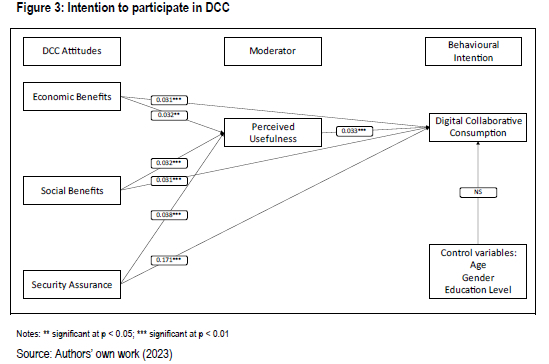
The three predictors of the business model, economic benefits, social benefits and security assurance, are significant predictors of the moderator, perceived usefulness and the criterion. The empirical evidence indicates a weak positive relationship between economic benefits and perceived usefulness; however, all the other predictors are very significant. The control variables are not significant, but they are important in segmenting the consumer marketplace. This study puts a duty of implementing security measures on the DCC platform to the contemporary managers to enable ease of interaction of customers and service providers through the new technology. The model indicates a strong effect between the direct and mediated variables, hence the need to invest in the DCC Business model. This study concludes that economic benefits, social benefits, security assurance, and perceived usefulness are key driving factors for DCC. The deterrents of the business model are trust issues and platform security, where consumers are afraid to share personal information on DCC platforms.
Contemporary managers are poised at the forefront of leveraging the Digital Collaborative Consumption (DCC) Business model to cultivate vibrant online communities characterised by loyal consumers who actively propagate positive word of mouth in the digital realm. To fortify this organic promotional strategy, businesses under the purview of these managers should strategically employ cost-effective marketing techniques, such as social media marketing, sponsorships, and collaborations with local radio stations. These methods not only ensure efficient resource allocation but also tap into the powerful influence of grassroots marketing, amplifying the brand's resonance within the target market.
In the age of digital connectivity, contemporary managers should recognise the pivotal role of social media platforms in amplifying their brand message. Encouraging loyal online community members to recommend the DCC business model within their networks becomes a potent tool for increasing product awareness and expanding market share. This approach aligns with the contemporary consumer's inclination to trust recommendations from their social circles, creating a ripple effect that extends the reach and impact of the business.
In the context of cybersecurity, contemporary managers should adopt a proactive stance, continually investing in the enhancement of platform security. This not only safeguards customer information but also fosters trust among clients. Mitigating the risk of data breaches and ensuring a seamless payment experience is a critical facet of retaining customer loyalty. Specifically, DCC platform providers should engineer systems capable of rectifying double payments automatically, reinforcing the reliability and user-friendliness of their platforms. In essence, contemporary managers, armed with a strategic blend of community building, targeted marketing, and robust cybersecurity measures, can navigate the dynamic landscape of the DCC business model with resilience and innovation, securing a competitive edge in the evolving digital marketplace.
This study recommends the introduction of password changes, double verification of payments, emailing of proof of purchase, and online security policies as key initiatives that contemporary managers should implement. From a general perspective, the issuance of third-party certificates to improve the security of DCC platforms is encouraged. Researchers also recommend different security measures, which include authentication, non-repudiation, privacy, confidentiality and data integrity control measures. The researchers recommend that contemporary managers should consider the needs of the consumers in the community in which they operate and offer high-quality products and services. Consumers should be encouraged to use virtual cards when purchasing online as they are more secure than debit and credit cards.
9. LIMITATIONS AND FURTHER STUDY
The researchers believe the findings offer a good ground for future research on DCC. This study's data was collected from one country; hence, there is a need to collect data from different countries to validate the model. The relationship between economic benefits, social benefits, security assurance and perceived usefulness should be further investigated before a general conclusion is drawn on their effectiveness in predicting DCC. This study's findings need to be verified in future research, which could examine the key factors that drive DCC in different contexts. The research focused on DCC among consumers in one sector of the industry, so there is a need to expand to other sectors of the economy. Future studies should focus on small businesses in remote areas and find ways of ensuring such businesses form part of the bigger DCC business model. The researchers recommend expanding this study and including other online business transactions to test the model on a big scale. Testing the model in a different context might help to unearth new determinants of DCC, which improves the business model. Control variables included in the model were few and not significant. This study recommends the inclusion of more control variables in future studies as they present potential value in segmentation and targeting markets, which enables contemporary managers to position their products and services effectively.
REFERENCES
Agarwal, N., & Steinmetz, R. 2022. Sharing economy: A systematic literature review. Emerging Issues and Trends in Innovation and Technology Management, 76(6):125-142. [https://doi.org/10.1142/9789811247729 0006]. [ Links ]
Ajibade, P. 2018. Technology Acceptance Model Limitations and Criticisms: Exploring the Practical Applications and Use in Technology-related Studies, Mixed-method, and Qualitative Research. Library Philosophy and Practice, 9(1):1-13. [Internet: https://core.ac.uk/download/pdf/189486068.pdf downloaded on 20 October 2022]. [ Links ]
Ailawadi, K.L., Neslin, S.A., & Gedenk, K. 2001. Pursuing the value-conscious consumer: store brands versus national brand promotions. Journal of Marketing, 65(1):71-89. [https://doi.org/10.1509/imkg.65.1.71.181322]. [ Links ]
Ajzen, I. 1991. The theory of planned behaviour. Organisational Behaviour and Human Decision Processes, 50(2): 179-211. [https://doi.org/10.1016/0749-5978(91)90020-T]. [ Links ]
Akbar, P., Mai, R., & Hoffmann, S. 2016. When do materialistic consumers join commercial sharing systems? Journal of Business Research, 69(10):4215-4224. [https://doi.org/10.1016/Ubusres.2016.03.003]. [ Links ]
Barari, M., Paul, J., Ross, M., Thaichon, S., & Surachartkumtonkun, J. 2022. Relationships among actors within the sharing economy: Meta-analytics review. International Journal of Hospitality Management, 703(1):1-11. [https://doi.oro/10.1016/Uihm.2022.103215]. [ Links ]
Bardhi, F., & Eckhardt, G.M. 2012. Access-based consumption: The case of car sharing. Journal of Consumer Research, 39(4), 881-898. [https://doi.org/10.1086/666376]. [ Links ]
Barnes, S.J., & Mattsson, J. 2017. Understanding collaborative consumption: Test of a theoretical model. Technological Forecasting and Social Change, 778(1):281-292. [https://doi.org/10.1016/i.techfore.2017.02.029]. [ Links ]
Bart, Y., Shankar, V., Sultan, F., & Urban, G.L. 2005. Are the drivers and roles of online trust the same for all websites and consumers? A large-scale exploratory empirical study. Journal of Marketing, 69(4): 133-152. [https://doi.org/10.1509/jmkg.2005.69.4.133]. [ Links ]
Belk, R. 2014. You are what you can access: Sharing and collaborative consumption online. Journal of business research, 67(8):1595-1600. [https://doi.org/10.1016/j.jbusres.2013.10.001]. [ Links ]
Belk, R. 2018. Foreword: The Sharing Economy. In P. A. Albinsson and B. Y. Perera (eds).The Rise of the Sharing Economy: Exploring the Challenges and Opportunities of Collaborative Consumption. Santa Barbara, CA: Praeger. pp. 9-12. [ Links ]
Benoit, S., Baker, T.L., Bolton, R.N., Gruber, T., & Kandampully, J. 2017. A triadic framework for collaborative consumption (CC): Motives, activities and resources & capabilities of actors. Journal of Business Research, 79(7219-227. [https://doi.org/10.1016/j.jbusres.2017.05.004]. [ Links ]
Botsman, R., & Rogers, R. 2010. What's mine is yours. The rise of collaborative consumption. 1st ed. New York: Harpers Collins Publishers. [ Links ]
Burgess, S.M., & Harris, M. 1998. Values, optimum stimulation levels and brand loyalty: New scales in new populations. South African Journal of Business Management, 29(4):142-157. [ Links ]
Burgess, S.M., & Steenkamp, J.B.E. 2006. Marketing renaissance: How research in emerging markets advances marketing science and practice. International Journal of Research in Marketing, 23(4):337-356. [https://doi.org/10.1016/j.ijresmar.2006.08.001]. [ Links ]
Catulli, M., & Reed, N. 2017. A personal construct psychology-based investigation into a product service system for renting pushchairs to consumers. Business Strategy and the Environment, 26(5):656-671. [https://doi.org/10.1002/bse.1944]. [ Links ]
Cheng, E.W. 2019. Choosing between the theory of planned behaviour (TPB) and the technology acceptance model (TAM). Educational Technology Research and Development, 67(1):21-37. [https://doi.org/10.1007/s11423-018-9598-6]. [ Links ]
Chuah, S.H.W., Tseng, M.L., Wu, K.J., & Cheng, C.F. 2021. Factors influencing the adoption of sharing economy in B2B context in China: Findings from PLS-SEM and fsQCA. Resources, Conservation and Recycling, 175(1):1-16. [https://doi.org/10.1016/j.resconrec.2021.105892]. [ Links ]
Churchill, G.A., Brown, T. J., & Suter, T. A. 1996. Basic marketing research. 5th ed. Orlando, FL: Dryden Press. [ Links ]
Davis, F.D. 1989. Perceived usefulness, perceived ease of use, and user acceptance of information technology. MIS Quarferly,13(3):319-340. [https://doi.org/10.2307/249008]. [ Links ]
Davis, F.D. 1993. User acceptance of information technology: system characteristics, user perceptions and behavioural impacts. International Journal of Man-Machine Studies, 38(3):475-487. [https://doi.org/10.1006/imms.1993.1022]. [ Links ]
De Cicco, R., Silva, S.C.L.da C.e., & Alparone, F.R. 2020. "It's on its way": Chatbots applied for online food delivery services, social or task-oriented interaction style? Journal of Foodservice Business Research, 24(2):140-164. [https://doi.org/10.1080/15378020.2020.1826268]. [ Links ]
de Oliveira, V.M., da Costa-Nascimento, D.V., de Sousa Teodósio, A. d. S., & Correia, S. É. N. 2022. Collaborative consumption as sustainable consumption: The effects of Uber's platform in the context of Brazilian cities. Cleaner and Responsible Consumption, 5(1):1-10. [https://doi.org/10.1016/j.clrc.2022.100064]. [ Links ]
DeVellis, R.F., Lewis, M.A., & Sterba, K.R. 2003. Interpersonal emotional processes in adjustment to chronic illness. In J. Suls & K.A. Wallston (Eds.), Social foundations of health and illness (pp. 256 -287). Malden, MA: Blackwell. [https://doi.org/10.1002/9780470753552.ch_10]. [ Links ]
Eckhardt, G.M., & Bardhi, F. 2016. The relationship between access practices and economic systems. Journal of the Association for Consumer Research, 1(2):210-225. [https://doi.org/10.1086/684684]. [ Links ]
Everatt, D., & Solanki, G. 2008. A nation of givers? Results from a national survey of social giving. In Habib, A and Maharaj, B. (eds). Giving and Solidarity. Capetown: HSRC Press. [ Links ]
Felson, M., & Spaeth, J.L. 1978. Community structure and collaborative consumption: A routine activity approach. American Behavioural Scientist, 21(4),614-624. [https://doi.org/10.1177/000276427802100411]. [ Links ]
Fornell, C., & Larcker, D F. 1981. Structural equation models with unobservable variables and measurement error: Algebra and statistics. Los Angeles, CA: Sage Publications. [https://doi.org/10.2307/3150980] [ Links ]
Fishbein, M., & Ajzen, I. 1975. Belief, attitude, intention, and behaviour: An introduction to theory and research. Reading, MA: Addison-Wesley. [ Links ]
Fremstad, A. 2014. Gains from sharing: sticky norms, endogenous preferences, and the economics of shareable goods. Economics Working Paper 168. University of Massachusetts, Amherst. [ Links ]
Ganapati, S., & Reddick, C.G. 2018. Prospects and challenges of sharing economy for the public sector. Government Information Quarterly, 35(1), 77 - 87. [https://doi.org/10.1016/j.giq.2018.01.001] [ Links ]
Gani, M.O., Faroque, A.R., Muzareba, A. M., Amin, S., & Rahman, M. (2021). An integrated model to decipher online food delivery app adoption behaviour in the COVID-19 pandemic. Journal of Food Service Business Research, 26(2):123-163. [https://doi.org/10.1080/15378020.2021.2006040] [ Links ]
Geiser, C. 2020. Longitudinal structural equation modelling with Mplus: A latent state-trait perspective. New York: Guilford Publications. [ Links ]
Gerbing, D.W., & Anderson, J.C. 1985. The effects of sampling error and model characteristics on parameter estimation for maximum likelihood confirmatory factor analysis. Multivariate Behavioral Research, 20(3):255-271. [https://doi.org/10.1207/s15327906mbr2003_2]. [ Links ]
Hair, J.F., Howard, M.C., & Nitzl, C. 2020. Assessing measurement model quality in PLS-SEM using confirmatory composite analysis. Journal of Business Research, 109(1 ):101-110. [https://doi.org/10.1016/j.jbusres.2019.11.069]. [ Links ]
Hair Jr, J.F., Black, W.C., Babin, B. J., Anderson, R. E., & Tatham, R. L. 2010. SEM: An introduction. Multivariate data analysis, 7th ed. New Jersy: Pearson Education. [ Links ]
Hamari, J., Sjöklint, M., & Ukkonen, A. 2016. The sharing economy: Why people participate in collaborative consumption. Journal of the Association for Information Science and Technology, 67(9):2047-2059. [https://doi.org/10.1002/asi.23552]. [ Links ]
Han, W., Raab, C., Belarmino, A., & Tang, J. 2022. Are online meal delivery platforms part of the sharing economy? Journal of Foodservice Business Research, 25(3):253-276. [https://doi.org/10.1080/15378020.2021.1941712]. [ Links ]
Hars, A., & Ou, S. 2001. Working for free? Motivations of participating in open source projects. International Journal of Electronic Commerce, 6(3):25-39. [https://doi.org/10.1080/10864415.2002.11044241]. [ Links ]
Huang, S.L., & Kuo, S.Y. 2020. Understanding why people share in the sharing economy. Online Information Review, 44(4):805-825. [https://doi.org/10.1108/OIR-03-2017-0073]. [ Links ]
Jung, J., Park, E., Moon, J., & Lee, W. S. 2021. Exploration of Sharing Accommodation Platform Airbnb Using an Extended Technology Acceptance Model. Sustainability, 13(3):1-16. [https://doi.org/10.3390/su13031185]. [ Links ]
Kang, J.W., & Namkung, Y. 2019. The information quality and source credibility matter in customers' evaluation toward food O2O commerce. International Journal of Hospitality Management, 78(1):189-198. [https://doi.org/10.1016/j.ijhm.2018.10.011]. [ Links ]
Kaur, S., Jaswal, N., & Singh, H. 2022. Blockchain Technology: Principles, Applications, and Advantages of Blockchain Technology in the Digital Era. IN Applications, Challenges, and Opportunities of Blockchain Technology in Banking and Insurance (pp. 204-212). IGI Global. [https://doi.org/10.4018/978-1-6684-4133-6.ch012]. [ Links ]
Kim, E., & Yoon, S. 2021. Social capital, user motivation, and collaborative consumption of online platform services. Journal of Retailing and Consumer Services, 62(1):1-9. [https://doi.org/10.1016/j.jretconser.2021.102651]. [ Links ]
Kim, J., Yoon, Y., & Zo, H. 2015. Why people participate in the sharing economy: A social exchange perspective. Singapore: PACIS. (Pacific Asia Conference on Information Systems; 24 June). [ Links ],
Koay, K.Y., Cheah, C.W., & Chang, Y.X. 2022. A model of online food delivery service quality, customer satisfaction and customer loyalty: a combination of PLS-SEM and NCA approaches. British Food Journal, 1(1), 1-18. [https://doi.org/10.1108/BFJ-10-2021-1169]. [ Links ]
Lamberton, C.P., & Rose, R.L. 2012. When is ours better than mine? A framework for understanding and altering participation in commercial sharing systems. Journal of Marketing, 76(4):109-125. [https://doi.org/10.1509/jm.10.0368]. [ Links ]
Lang, C., & Armstrong, C.M.J. 2018. Collaborative consumption: The influence of fashion leadership, need for uniqueness, and materialism on female consumers' adoption of clothing renting and swapping. Sustainable Production and Consumption, 13(1):37-47. [https://doi.org/10.1016/j.spc.2017.11.005]. [ Links ]
Lee, Z.W., Chan, T.K., Balaji, M., & Chong, A.Y.L. 2018. Why people participate in the sharing economy: an empirical investigation of Uber. Internet Research, 28(3):829-850. [https://doi.org/10.1108/IntR-01-2017-0037]. [ Links ]
Lindblom, A., Lindblom, T., & Wechtler, H. 2018. Collaborative consumption as C2C trading: Analyzing the effects of materialism and price consciousness. Journal of Retailing and Consumer Services, 44(1):244-252. [https://doi.org/10.1016/j.jretconser.2018.07.016]. [ Links ]
Mailizar, M. & Fan, L. 2020. Indonesian Teachers' Knowledge of ICT and the Use of ICT in Secondary Mathematics Teaching. Eurasia Journal of Mathematics, Science and Technology Education: 16(1):1-13. [ Links ]
Malhotra, N. 2015. An Empirical Analysis of "Tort Tales" How Cultural Memes Influence Attitudes on Tort Reform. Journal of Law and Courts, 3(1):149-166. [https://doi.org/10.1086/679018]. [ Links ]
Malhotra, N.K. 2006. Questionnaire design and scale development. In Grover, R. and Vriens, M. (eds). The handbook of marketing research: Uses, misuses, and future advances. London: Sage Publications. Pp. 83-94. [https://doi.org/10.1086/679018]. [ Links ]
Makasi, A., & Saruchera, F. 2014. The impact of operational customer relationship management on customer loyalty. Mediterranean Journal of Social Sciences, 5(23):291-301. rhttps://doi.org/10.5901/miss.2014.v5n23p291]. [ Links ]
Minami, A.L., Ramos, C., & Bortoluzzo, A.B. 2021. Sharing economy versus collaborative consumption: What drives consumers in the new forms of exchange? Journal of Business Research, 128(1):124-137. [https://doi.org/10.1016/j.jbusres.2021.01.035]. [ Links ]
Moeller, S., & Wittkowski, K. 2010. The burdens of ownership: reasons for preferring renting. Managing Service Quality: An International Journal, 20(2):176-191. [https://doi.org/10.1108/09604521011027598]. [ Links ]
Munzel, K., Piscicelli, L., Boon, W., & Frenken, K. 2019. Different business models-different users? Uncovering the motives and characteristics of business-to-consumer and peer-to-peer carsharing adopters in The Netherlands. Transportation Research Part D: Transport and Environment, 73(1):276-306. [https://doi.org/10.1016/j.trd.2019.07.001]. [ Links ]
Ni, S. 2021. Collaborative consumption in China: An empirical investigation of its antecedents and consequences. Journal of Retailing and Consumer Services, 62(1):102632-102651. [ https://doi.org/10.1016/j.jretconser.2021.102632]. [ Links ]
Nunnally, J. 1975. Psychometric theory - 25 years ago and now. Educational Researcher, 4(10):7 - 21. [https://doi.org/10.3102/0013189X004010007]. [ Links ]
Pantazopoulos, P., Haddad, S., Lambrinoudakis, C., Kalloniatis, C., Maliatsos, K., Kanatas, A., Varádi, A., Gay, M., & Amditis, A. 2018. Towards a security assurance framework for connected vehicles. 2018 IEEE 19th International Symposium on" A World of Wireless, Mobile and Multimedia Networks"(WoWMoM), [https://doi.org/10.1109/WoWMoM.2018.8449811]. [ Links ]
Parasuraman, A., Zeithaml, V.A., & Berry, L.L. 1985. A conceptual model of service quality and its implications for future research. Journal of Marketing, 49(4):41-50. [https://doi.org/10.1177/002224298504900403]. [ Links ]
Park, S.Y. 2009. An analysis of the technology acceptance model in understanding university students' behavioural intention to use e-learning. Journal of Educational Technology & Society, 12(3):150-162. [https://doi.org/10.48550/arXiv.2302.02176]. [ Links ]
Pollio, A. 2019. Forefronts of the sharing economy: Uber in Cape Town. International Journal of Urban and Regional Research, 43(4):760-775. [https://doi.org/10.1111/1468-2427.12788]. [ Links ]
Pynoo, B., Tondeur, J., Van Braak, J., Duyck, W., Sijnave, B., & Duyck, P. 2012. Teachers' acceptance and use of an educational portal. Computers & Education, 58(4):1308-1317. [https://doi.org/10.1016/j.compedu.2011.12.026]. [ Links ]
Ray, A., Dhir, A., Bala, P.K., & Kaur, P. 2019. Why do people use food delivery apps (FDA)? A uses and gratification theory perspective. Journal of Retailing and Consumer Services, 51(1):221-230. [https://doi.org/10.1016/j.jretconser.2019.05.025]. [ Links ]
Ray, S., Ow, T., & Kim, S.S. 2011. Security assurance: How online service providers can influence security control perceptions and gain trust. Decision Sciences, 42(2):391-412. [https://doi.org/10.111540-5915.2011.00316.x]. [ Links ]
Reinartz, W., Wiegand, N., & Imschloss, M. 2019. The impact of digital transformation on the retailing value chain. International Journal of Research in Marketing, 36(3):350-366. [https://doi.org/10.1016/j.ijresmar.2018.12.002]. [ Links ]
Saha, S.K., Duarte, P., Silva, S.C., & Zhuang, G. 2022. The Role of Online Experience in the Relationship Between Service Convenience and Future Purchase Intentions. Journal of Internet Commerce, 34(8):1-28. [https://doi.org/10.1080/15332861.2022.2045767]. [ Links ]
Sastre-Centeno, J.M., & Inglada-Galiana, M.E. 2018. The collaborative economy: a new economic model. CIRIEC-Spain, Journal of Public, Social and Cooperative Economy 94(1):219-250. [https://doi.org/10.7203/CIRIEC-E.94.12109]. [ Links ]
Saruchera, F., & Phiri, M.A. 2016. Technological innovations performance and public-private partnerships. Corporate Ownership & Control, 13(4):549-557. [ Links ]
Saruchera, F., Tukuta, M., Ndoda, G.R., & Sikwila, M.N. 2014. Driving industry growth through academic excellence: A study on the strategic contribution of university-industry knowledge transfer in revamping manufacturing SMEs in developing economies. Mediterranean Journal of Social Sciences, 5(14):252-270. [ Links ]
Shumba, T. 2023. Digital Collaborative Consumption in an Emerging Market: South African food delivery services. Johannesburg: University of the Witwatersrand. (PhD-Thesis). [https://doi.org/10.31920/1750-4562/2023/v18n4a20]. [ Links ]
Shumba, T., & Saruchera, F. 2023. Determinants of Digital Collaborative Consumption in the South African Food Delivery Industry. African Journal of Business & Economic Research, 18(4):415-436. [https://doi.org/10.31920/1750-4562/2023/v18n4a20]. [ Links ]
Steenkamp, J.B E., & Maydeu-Olivares, A. 2021. An updated paradigm for evaluating measurement invariance incorporating common method variance and its assessment. Journal of the Academy of Marketing Science, 49(1):5-29. [https://doi.org/10.1007/s11747-020-00745-z]. [ Links ]
Thomas, A., & Deshmukhi, R. 2019. South African fast food market: Opportunity analysis and industry forecast 2019-2026. [Internet: https://www.alliedmarketresearch.com/south-africa-fast-food-market; downloaded on 10 January 2023]. [ Links ]
Tussyadiah, I.P. 2015. An exploratory study on drivers and deterrents of collaborative consumption in travel. Lugano: (Proceedings of the international conference in Information and Communication Technologies in Tourism; 3-6 February. pp 817-830). [https://doi.org/10.1007/978-3-319-14343-959]. [ Links ]
Veen, A., Barratt, T., & Goods, C. 2020. Platform-capital's 'app-etite'for control: A labour process analysis of food-delivery work in Australia. Work, Employment and Society, 34(3):388-406. [ Links ]
Venkatesh, V., Morris, M.G., Davis, G.B., & Davis, F.D. 2003. User acceptance of information technology: Toward a unified view. MIS Quarterly, 27(3):425-478. [https://doi.org/10.2307/30036540]. [ Links ]
Venkatesh, V., Thong, J.Y.L., & Xu, X. 2012. Consumer acceptance and use of information technology: Extending the unified theory of acceptance and use of technology. MIS Quarterly, 36(1):157-178. [https://doi.org/10.2307/41410412]. [ Links ]
Wang, Y., Xiang, D., Yang, Z., & Ma, S.S. 2019. Unravelling customer sustainable consumption behaviours in sharing economy: A socio-economic approach based on social exchange theory. Journal of Cleaner Production, 208,(1): 869-879. [https://doi.org/10.1016/j.jclepro.2018.10.139]. [ Links ]
Wittkowski, K., Moeller, S., & Wirtz, J. 2013. Firms' intentions to use nonownership services. Journal of Service Research, 16(2), 171-185. [https://doi.org/10.1177/1094670512471997]. [ Links ]
Yeo, V.C.S., Goh, S.K., & Rezaei, S. 2017. Consumer experiences, attitude and behavioural intention toward online food delivery (OFD) services. Journal of Retailing and Consumer Services, 35(1):150-162. [https://doi.org/10.1016/j.jretconser.2016.12.013]. [ Links ]
Zehrer, A., Crotts, J.C., & Magnini, V.P. 2011. The perceived usefulness of blog postings: An extension of the expectancy-disconfirmation paradigm. Tourism Management, 32(1):106-113. [https://doi.org/10.1016/j.tourman.2010.06.013]. [ Links ]
Zhang, M.L., & Chen, M.S. 2019. China's digital economy: Opportunities and risks. Washington, DC: International Monetary Fund. [https://doi.org/10.1080/10971475.2019.1617928]. [ Links ]
* Corresponding author
APPENDIX A: MEASUREMENT INSTRUMENT