




Services on Demand
Journal

Article
 English (pdf)
 Article in xml format
 Article references
 Automatic translation
 Send this article by e-mail
Indicators
Related links
-
 Cited by Google
 -
 Similars in Google
Share

 Permalink
Journal of Contemporary Management
On-line version ISSN 1815-7440
JCMAN vol.22 n.1 Meyerton 2025
https://doi.org/10.35683/jcman1136.297
RESEARCH ARTICLES
Conflicting work-family lives as drivers of work tension and turnover intention in a construction company in southern Gauteng
Patrick Qena RadebeI, ; Bekezela NcubeII
IDepartment of Business Management, Central University of Technology, South Africa. Email: radebep@cut.ac.za. ORCID: https://orcid.org/0009-0008-7236-2752
IIDepartment of Human Resources Management, Vaal University of Technology, South Africa. Email: bekezelaf@vut.ac.za. ORCID: https://orcid.org/0009-0003-7954-451X
ABSTRACT
PURPOSE OF THE STUDY: The primary objective was to probe the predictive association between work-family conflict, family-work conflict, work tension, and turnover intention among construction employees at a construction company. Effective management of these work-family lives could improve the work-life balance for construction employees, resulting in lower levels of work tension and turnover intention.
DESIGN/METHODOLOGY/APPROACH: A descriptive research design and a quantitative research approach were utilised. Participants were selected using the non-probability convenience sampling technique. Only 285 questionnaires were completed and retrieved, representing a return rate of 71.25%. Data were analysed using SPSS and AMOS version 28. Data analysis was executed through descriptive statistics, such as frequencies for biographical information. SEM was invoked to assess the fitness of the measurement and structural models, after which the path analysis was performed.
FINDINGS: The SEM demonstrated acceptable fitness for the measurement and structural models. Path analysis further confirmed a predictive relationship between work-family conflict and work tension, family-work conflict and work tension, work-family conflict and turnover intention, and work tension and turnover intention.
RECOMMENDATIONS/VALUE: Efforts at harmonising work-family conflict and family-work conflict should be robustly implemented because empirical evidence demonstrates these are the root causes of work tension and turnover intention among construction employees in this construction company.
MANAGERIAL IMPLICATIONS: This study's findings call for innovative management philosophies and practices to ensure timely project completion with less strain on workers. These management practices include equitable workload distribution, offering competitive salaries and incentives, flexible work arrangements, job sharing, counselling, remote working, and creative efforts by the human resource unit to create time and opportunity for construction workers to attend to their family demands. Projects nearer to workers' homes should be a priority when employees are assigned to projects.
JEL CLASSIFICATION: O15
Keywords: Family-work conflict; spillover theory; turnover intention work-family conflict; work tension.
1. INTRODUCTION
The work-life balance of employees, characterised by work-family or family-work conflict, has gained considerable attention among researchers recently (Rashmi & Kataria, 2022). In the construction industry, workers are often subjected to excessive workloads, abnormal work schedules, long work hours, tight project deadlines, and a six-day working week (Turner & Mariani, 2016), interfering with the employee's family life. Previously, work-family conflict and family-work conflict were conceptualised as a unidimensional construct. However, in recent studies, it has been considered to constitute two distinct facets: work-family conflict and family-work conflict (Pujol-Cols, 2021). Work-family conflict (WFC) occurs when the role pressure from work interferes with family duties (Molina, 2021), whereas family-work conflict (FWC) is a function of the family roles that interferes with the performance of work duties (Lim et al., 2021).
The third variable in the study is work tension, which George and Zakkariya (2015) describe as a worker's feeling of personal dysfunction due to the perceived conditions or activities in the workplace. These authors consider work tension to be constituting those psychological and physiological reactions experienced by workers due to undesirable factors in the work environment. Dodanwala et al. (2023) submit that role conflict and ambiguity are sources of work tension.
The last variable is turnover intention, which is a manifestation of the probability that an individual will leave his/her job (Wong & Cheng, 2020). It is a highly studied variable because of the consequences that it has in organisations, such as lower productivity and loss of an appropriately skilled workforce (Shaukat & Yousaf, 2017). In addition, organisations incur employee turnover costs such as replacement costs (recruitment and selection) and training costs (Rahim & Cosby, 2016), and workers who intend to leave their jobs often render poor service (Gebregziabher et al., 2020).
FWC and WFC affect the health and well-being of a worker, leading to problems such as decreased life satisfaction, absenteeism, and lower job satisfaction (Mansour & Tremblay, 2016). Additionally, work-related tension affects employees' health and often results in problems such as reduced productivity, absenteeism, and high turnover (Simone et al., 2016).
Indeed, employee turnover has been identified as a significant problem in the construction sector worldwide (Chih et al., 2016). Recent evidence suggests that a significant attributable factor for the turnover among construction workers is WFC (Zhang & Bowen, 2021). This relates to the demanding nature of the industry, characterised by a culture of long working hours. Countless hours of unpaid overtime are also likely to interfere with family life (Zhang & Bowen, 2021). It is not surprising that the South African Federation of Civil Engineering Contractors (SAFCEC, 2009) proposed the reduction of working hours of work from 45 hours to 40 hours and an increase in annual leave because workers were often operating in environments far away from their families (SAFCEC, 2009). The Federation further advanced the implementation of family responsibility leave and an extension of four months' maternity leave for women in the sector (SAFCEC, 2009).
Prior researchers have examined the attitudinal consequences of WFC/FWC, such as locus of control, self-esteem, and self-confidence (Peltokorpi & Michel, 2021). Other researchers have focused on the antecedents of WFC, such as workload, social support, and supervisor support (Mansour & Tremblay, 2016). In addition, a number of researchers have also investigated the behavioural consequences, such as WFC/FWC, including burnout among frontline workers (Wang et al., 2021) and burnout among women in the banking sector (Farradinna & Halim, 2016). It is the case that many previous studies on WFC/FWC were conducted in developed countries such as the USA (Kusnierz et al., 2022). Few studies, however, have focused on the effects of WFC and FWC in South Africa. Most extant studies tend to focus on WFC rather than FWC (Karabay et al., 2016). However, no comprehensive study on the relationship between WFC, FWC, WT, and turnover intention has ever been conducted in the construction sector in southern Gauteng. In this regard, the present study endeavours to address the research gap by investigating the relationship between WFC, FWC, work tension, and turnover intention among construction workers at a construction company in southern Gauteng.
2. LITERATURE REVIEW
In this section, the related literature on work-family conflict, family-work conflict, work tension and turnover intention is reviewed.
2.1 Work-family conflict
WFC refers to work influence on family (WIF) (Ugwu, 2017). It is also referred to as the challenges that employees face when juggling work and family roles (Borgmann et al., 2019). The concentration on the execution of work duties, sometimes over a protracted period, encroaches on time or the necessary attention required to perform family responsibilities, thus having negative repercussions on family life (Molina, 2021). Ugwu (2017:89) defines WFC as "a form of inter-role conflict in which role pressures from work become incompatible with roles from the family domain." This definition explains that WFC is the phenomenon whereby an employees' work role's demands roll over to their family roles (Molina, 2021), thus making participation in their family roles strenuous. The definition further illustrates that work and family are interdependent domains, with emotions, attitudes, and behaviours generated in one domain spilling over and affecting the experiences in the other (Asiedu et al., 2018).
Research has demonstrated a positive relationship between WFC and other variables such as turnover intentions, leaving work early, low job satisfaction, depression, anxiety disorders, mood disorders, physical health complaints, and hypertension (Gozukara & Colakoglu, 2016).
2.2 Family-work conflict
FWC is also referred to as family influence on work and is described as a form of inter-role conflict in which the time devoted to family roles interferes with the execution of work roles (Ugwu, 2017; Ngek, 2018). Ugwu (2017) further attests that FWC constitutes a form of inter-role conflict in which the pressure from family interferes with sound performance at work.For example, family responsibilities such as taking care of the elderly, young children, and family members with special needs tend to interfere with workers' attention and performance at work, thereby causing family-work conflict (Ajala, 2017). In addition, Yucel and Chung (2023) assert that a lack of support from a spouse/partner, family responsibilities, the presence of a baby in the family, and having many children in a family tend to trigger family-work conflict.
FWC affects an employee's well-being and marital satisfaction, leading to decreased job satisfaction, absenteeism, lateness, and poor work performance (Musa et al., 2021).
2.3 Work tension
Increased attention required by work and subsequent work tension can be related to several negative consequences that include, but are not limited to, high turnover and absenteeism rates in organisations (Uzondu et al., 2017). Work tension is considered the psychological strain that emanates from discomfort in the work environment (McAllister et al., 2018). Put differently, work tension entails the frustration and anxiety that relate to certain aspects of a job, such as excessive workload, inability to perform complex tasks, or failure to complete assigned tasks within a scheduled time (Yasarathne et al., 2018; Riaz et al., 2019). Uzondu et al. (2017) argue that work tension is symptomatic of the stress that employees experience in the workplace. This view is supported by Maryati et al. (2020:278), who elaborate that work tension is the "psychological manifestation of felt stress that tends to increase the feelings of distress, discomfort, and uncertainty, and hampers an employee from fulfilling his/her work demands."
Research demonstrates that work tension can be caused by role conflict, role ambiguity, job insecurity/threats of job loss (Unguren & Arslan, 2021). Other sources of work tension that have been identified in the literature include heavy workloads, lack of proper resources (Turner & Mariani, 2016), unconducive working conditions, low job autonomy, poor relationships with colleagues or superiors, and lack of promotion (Bhui et al., 2016).
Work tension negatively affects employees and may lead to low morale, poor organisational commitment, lack of commitment to the job, and poor employee performance (Tetteh et al., 2020).
2.4 Turnover intention
The notion of turnover intention has attracted attention from a number of researchers because of its undesirable consequences for organisations (Lin & Liu, 2017). These adverse effects of turnover intention include a reduced level of production, attention to the bottom line, the loss of a skilled workforce and the replacement costs of such workforce (Shaukat & Yousaf, 2017). Turnover intention is a phenomenon that occurs before the actual process of leaving a job takes place (Lagerlund et al., 2015). It is dubbed "a conscious and deliberate wilfulness by an employee to leave the organisation within the foreseeable future" (Zafar et al., 2022:617). They regard turnover intention as a contemplation by the employee to leave the organisation permanently and seek alternative job opportunities.
Lagerlund et al. (2015) contend that turnover intention takes place over a three-stage process: psychological, cognitive, and behavioural. The psychological stage comprises negative psychological responses conjured up by negative aspects associated with the organisation. Put differently, unfavourable working conditions evoke adverse emotional and attitudinal reactions, which include, among others, frustration and dissatisfaction with the workplace. According to Hussain et al. (2020), the cognitive stage is the cognitive process involving the mental decision to leave, which is followed by the behavioural stage, which is expressed through withdrawal behaviour characterised by absenteeism, late coming, withdrawal from the current job, and actions oriented towards seeking alternative future job opportunities (Haque, 2023). Several factors, such as hazardous working conditions, may trigger the intention to permanently terminate one's organisational membership (Chih et al., 2016).
3. THEORETICAL FRAMEWORK
Two critical theories were utilised in clarifying the constructs in the study, namely the spillover theory and the conservation of resources theory.
3.1 Spillover theory
The spillover theory underpins the study as one of the most salient theories for understanding work-family conflict/family-work conflict and work tension (WT). The spillover theory asserts that work and family domains are so inextricably intertwined that circumstances in one domain significantly influence the functioning of the other domain (Turner & Lingard, 2015). Employees' feelings, attitudes, and behaviours as family members could spill over to the work domain where they are employed (Adisa et al., 2016). Research demonstrates that positive moods and emotions generated at work or family have a great potential to be transferred to the work or family domain (Mitchell et al., 2015). For example, happiness will likely be transferred to the family at home if an employee had a good day at work. Ismail and Gali (2017) support this view that attitudes and emotions generated in any domain could have a tremendous influence on the other domain in either a positive or negative way. Positive spillover occurs when positive events from one's role (work/family) may spill over and facilitate positive/negative functioning in the other role (family/work) (Nastasa et al., 2021).
3.2 Conservation of resources theory
The conservation of resources theory (COR) is a commonly used theory utilised to deepen understanding of how employees react when confronted with several adverse circumstances at work. It is a resource-oriented model that presupposes that employees actively seek "to acquire, maintain and protect their valued resources" (Hobfoll,1989:513). These resources could encapsulate objects, personal characteristics, conditions, and energies (Park & Jang, 2017). They can be tangible, like owning a company car, or intangible, like acquired competencies (Guesalaga & Kapelian, 2015). In the context of this study, work tension may occur when resources that employees should be using are under threat or lost. Furthermore, failure to gain the expected outcome after investing one's resources could trigger work tension (Cooper & Quick, 2017; Li et al., 2021). The COR includes the following as typical examples of resource-depleting occasions: inadequate equipment or tools of trade for executing tasks, fear of impending restructuring in the company, lack of return following an investment in resources, failure to reconcile conflicting job demands and family role expectations (Laird et al., 2015; Park & Jang, 2017; Merino et al., 2019).
Several studies have demonstrated that when employees lose resources at work, they are more likely to experience work tension (Halbesleben et al., 2014; Robinson et al., 2016). COR theory further posits that when employees lose or fail to protect resources, they are likely to feel vulnerable and consequently develop turnover intentions (Lin & Liu, 2017). The COR confirms that work tension depletes employees' psychological and social capital, thus contributing to high turnover intentions (Robinson et al., 2016).
4. CONCEPTUAL FRAMEWORK
The conceptual framework depicted in Figure 1 proposes the relationship between WFC, FWC, WT, and turnover intention. In this conceptual framework, WFC and FWC are predictor variables, and WT is both the predictor and dependent variable. Turnover intention is the dependent variable. In light of the conceptual framework illustrated in Figure 1, the following hypotheses were posited for the present study:
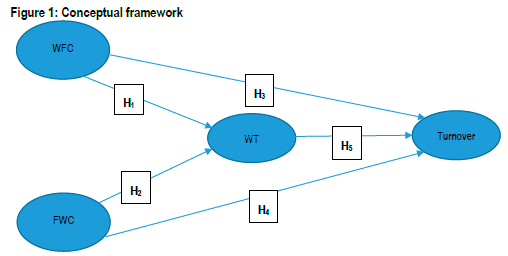
H1: WFC exerts a significant effect on WT among construction employees.
H2: FWC has a significant impact on WT among construction employees.
H3: WFC has a significant contribution to the incidence of turnover intention among construction employees.
H4: FWC has a significant effect on turnover intention among construction employees.
H5: There is a relationship between WT and the occurrence of turnover intention among construction employees.
5. METHODOLOGY
5.1 Target population and sampling frame
The target population of this study consisted of all Sedtrade employees, namely general workers, supervisors, managers, support staff, and office staff employed permanently with more than one year of service and temporary/contract employees with no less than one year of service. The target population was 2,000 employees (N=2,000) of all races, ethnicities, and nationalities.
The sampling frame was drawn from the construction company employees' human resource department database. Before conducting the survey, permission to conduct the study was sought and granted.
5.2 Sampling technique and sampling size
Given that construction workers frequently migrated depending on the location of their projects and could not be easily and quickly reached or accessed, this study used non-probability convenience sampling to choose a sample. Only those construction workers within reach during the study were selected as research participants. The use of non-probability convenience sampling was appropriate under such conditions to ensure that the administration of the survey instrument and retrieval of responses from those who were willing to participate could be present at any time. The convenience sampling method was suitable for the current study because of the ease of access and availability of the sampled elements, its cost-effectiveness, and its ability to save time (Sharma, 2018). The caveats for this sampling technique were that its findings could not be generalised to the total population and the bias in reporting that could occur, depending on the project's phase and the circumstances construction workers could have encountered during a particular project phase. As stated in the following paragraph, a larger sample was used to mitigate the consequences of not generalising the findings to the target population. Furthermore, data was collected at various project phases to avoid biased reporting from complex challenges faced in one phase and different, easily accessible project locations. Responses were garnered from construction employees in various projects underway in the company to avoid single-project participant feedback, which could bring bias in responses. Single-project participant feedback was avoided because participants could express personal experiences or project challenges, or difficulties in a single project.
According to Leedy and Ormrod (2015), if a population is 1,500, 20% of the population must be sampled. The target population in this study was 2,000 (N=2,000), and based on Leedy and Ormrod's recommendation, a sample size of 400 (n=400) was deemed sufficient. In comparable investigations, sample sizes of 413 (n=413) (Karabay et al., 2016), 400 (n=400) (Arzu et al., 2022), and 400 (n=400) (Ignou, 2022) were used. The researcher personally distributed and retrieved questionnaires from all sampled employees at a construction company in southern Gauteng.
5.3 Data collection
A structured questionnaire was used to collect data from respondents because it was considered objective and less costly, and participants tended to respond rapidly. The measurement instrument was a cross-sectional survey comprising five sections. Section A concerned respondents' demographic information such as age, gender, qualification, marital status, and occupation. Section B utilised a questionnaire on WFC adopted from Netemeyer et al. (1996). Section C was a FWC questionnaire adopted from Netemeyer et al. (1996), whereas Section D was adopted from Cook et al. (1981). The questionnaire on turnover intention in Section E was adopted from Layne et al. (2004).
Sections B, C, D, and E used a five-point Likert scale, ranging from "strongly disagree" (1) to "strongly agree" (5). The Likert scale was preferred because responses could be statistically standardised, compared, and analysed (Alabi & Jelili, 2023). The response rate for completed and returned questionnaires was 71.25%. Sharma (2016) recommends that a response rate of 50% is adequate for statistical analysis and reporting, while 60% is considered good, and 70% is regarded as very good.
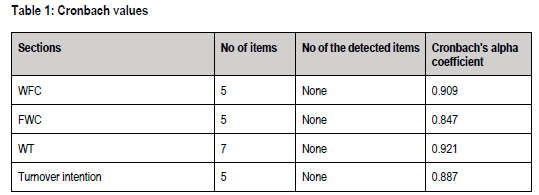
For the main study, the reliabilities in Table 1 were beyond the acceptable threshold of 0.7 (Trundell et al., 2020), implying that the instrument was reliable.
5.4 Data analysis
Data collected from participants was captured onto an Excel spreadsheet and then analysed using the Statistical Package for Social Sciences (SPSS) Amos, version 28.0. The data analysis was performed through descriptive and inferential statistics. Descriptive statistics were used mainly to calculate frequencies for data relating to the biographical properties of participants. In contrast, structural equation modelling (SEM) was employed to assess the measurement model fit using confirmatory factor analysis (CFA). Further, the structural model fit was measured, and path analysis was performed to examine the regression between the constructs in the research model.
6. RESULTS AND DISCUSSION
6.1 Analysis of biographical characteristics
The descriptive statistical analysis was used to reduce the large set of data in the questionnaire. Demographic information, that is, gender, marital status, age category, race, highest qualification, years of service, current job status, and current position, is presented as percentages and charts in this section. The biographical information is captured in Table 2.
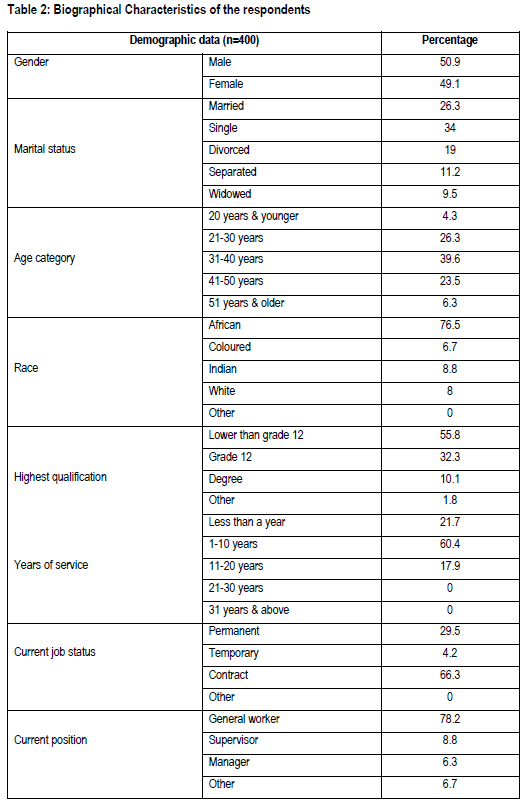
Male respondents (50.9%; n=145) were slightly higher than females, who constituted 49.1% (n=140) of the sample. Regarding marital status, 26.3% (n=75) of respondents were married, and 34% (n=97) were single. Divorced participants constituted 19% (n=54) of respondents, while separated respondents represented 11.2% (n=32) of the sampled population. Respondents who were widowed comprised 9.5% (n=27) of the sample. The age of respondents in the study ranged from below 20 to above 51 years. Employees between 31 and 40 years of age constituted the largest group of respondents, taking up 39.6% (n=113) of the sampled group, followed by those who were 21 to 30 years of age, constituting 26.3% (n=75). Respondents between the ages of 41 and 50 represented 23.5% of the sampled respondents (n=67), while those between the ages of 51 and above constituted 6.3% (n=18). The smallest age group of sampled employees were those employees who were 20 years and younger, which represented only 4.3% of sampled respondents (n=12), with the exclusion of persons below the age of 15, taking into cognisance that the Basic Conditions of Employment Act disallows entities to employ children below the age of 15.
Most of the sampled respondents were Africans, representing 76.5% (n=218) of the sample. Indians constituted 8.8% (n=25) of the sample, followed by their White counterparts, who made up 8.0% (n=23). Coloureds represented the sample's smallest percentage (6.7%; n=19).
About half (55.8%; n=159) of the sampled employees had lower than grade 12 qualification, followed by 32.3% (n=92) of the respondents who have attained a grade 12 certificate. Respondents who had acquired degrees made up only 10.1% (n=29) of the sample, while the minority, 1.8% (n=5) of the respondents, held other qualifications. A significant number of sampled employees had lower than grade 12 qualifications, which could be attributed to some roles in the construction sector that are practical in nature and require more on-the-job training than academic qualifications.
Regarding years of service, a significant number of respondents (60.4%; n=172) had been in the organisation for 1-10 years, followed by the category of employees with less than a year of service, comprising 21.7% (n=62). The remaining 17.9% (n=51) were employees who had served the organisation for 11-20 years.
Many respondents were employed on a contract basis, making up 66.3% (n=189) of the sample, followed by permanent employees, who constituted 29.5% (n=84) of the sampled respondents. The remaining 4.2% (n=12) were temporarily employed, and no employees held other jobs.
Pertaining to the current position in the company, most employees were general workers, taking up 78.2% (n=223) of the sample, while supervisors constituted 8.8% (n=25). Only 6.7% (n=19) of positions in the sample were occupied by other categories, and the remaining 6.3% (n=18) were held by management.
6.2 Confirmatory factor analysis
To evaluate whether the constructs in the conceptual framework or research model were unidimensional, a confirmatory factor analysis (CFA) was performed. This model, also called the CFA or measurement model, comprised the following constructs: work-family conflict (WFC), family-work conflict (FWC), work tension (WT), and turnover intention (ITL). The values of the measurement model are reflected in Table 3. In this Table, pertinent model indices are specified and classified, and the thresholds of good fit and acceptable values are indicated.
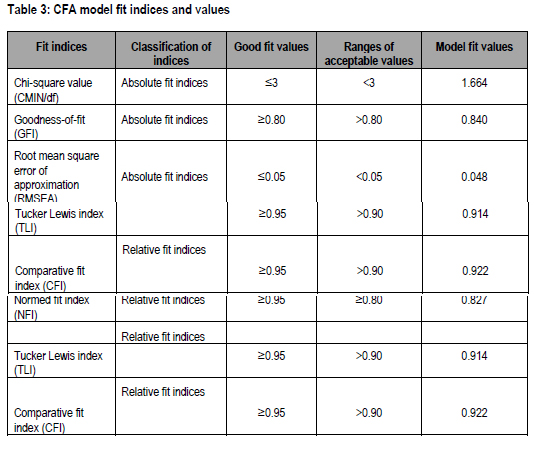
CFA was applied to confirm the fitness of the measurement model using a combination of model indices, namely absolute fit indices and relative fit indices. The absolute fit indices included the Goodness-of-Fit Index (GFI), the Root Mean Square Error of approximation (RMSEA), and the Chi-square value (CMIN/DF). The relative fit indices encompassed the Normed fit index (NFI), the Tucker-Lewis Index (TLI), and the Comparative fit index (CFI).
RMSEA measures the discordance between the observed covariance matrix per degree of freedom and the hypothesised covariance matrix in the model (Cangur & Ercan, 2015), and its acceptable fit values are between 0.05 to 0.08, whereas the good fit values should be equal to or less than 0.05 (Mateo et al., 2021). The RMSEA value of the measurement model of the study was 0.057, indicating an acceptable model fit.
GFI is an absolute fit calculated by dividing the squared weighted total of the variances of measurement and estimation (Yaslioglu & Toplu-Yaslioglu, 2020). GFI values higher than 0.80 demonstrate an acceptable fit, and those greater than 0.95 signal a good fit (Ayfer & Seyda, 2021). The proposed measurement model in the study yielded a GFI value of 0.836, thus confirming an acceptable fit of the model.
CMIN/DF, symbolised as X2, is utilised to establish correlations among variables (Turhan, 2020). Put differently, CMIN/DF measures the extent to which observed data correlates with the hypothesised model (Lefcheck, 2016), with CMIN/DF values less than 2 (X2<2) reflecting a well-fitting model; less than 3 (X2<3) showing an acceptable model fit; less than 4 (X2<4) denoting a moderate model fit; and those less than 5 (X2>5) indicative of an unacceptable model fit (Westland, 2019). Chi-square was 1.925 in the current study , signalling an acceptable model fit once again.
TLI, also known as Non-Normed Fit Index (NNFI), measures the "improvement in fit relative to a baseline model" (Morgan et al., 2015). A TLI value of 0.95 and above demonstrates a good fit (Yaslioglu & Toplu-Yaslioglu, 2020), and values closer to 0.90 indicate an acceptable fit (Pettinger et al., 2022). The TLI value recorded in this study was 0.90, thus confirming an acceptable fit of the model.
The CFI determines the amelioration in fit standard from the baseline model to the proposed model (Taasoobshirazi & Wang, 2016) with CFI values that range from 0.95, reflecting a good fit (Cangur & Ercan, 2015), and those in proximity to 0.90 indicating an acceptable data fit (Topa et al., 2020). The CFI value computed in this study was 0.893, highlighting an acceptable model fit.
NFI, also considered a Bentler-Bonett Normed fit index (Alsughayir, 2021), gauges the compatibility level of the proposed research model with empirical data, utilising a baseline model (Ghofar & Islam, 2015). Goretzko et al. (2024) propose that good fit NFI values are those higher than 0.90, and Fang et al. (2022) advance that values from 0.80 specify an acceptable fit. The NFI measurement produced a value of 0.804, and the model could thus be characterised as an acceptable fit model.
The values of the CFA model fit for the study are in the column Model fit values of Table 3 Overall, the values in this column demonstrate that the values of the measurement model ranged from good fit to acceptable fit. These values are CMIN/df = 1.664; GFI = 0.840; RMSEA = 0.048; RMR = 0.089; NFI = 0.827; and TLI = 0.914. These model fit indices' values confirm that the conceptual model constructs are indeed distinct from each other.
6.3 Loading matrix
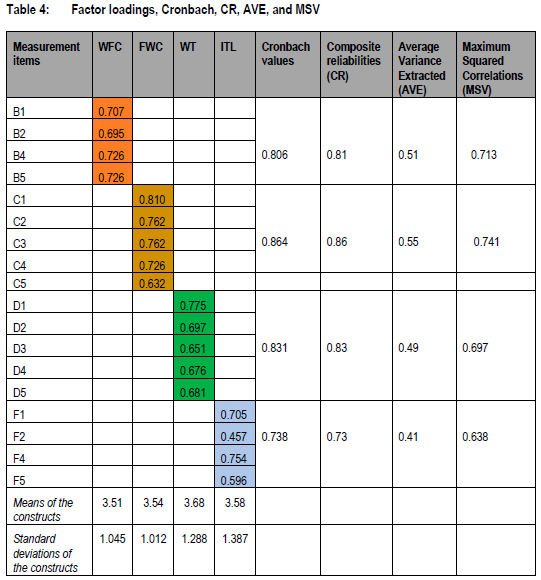
Using CFA, factor loadings were computed, resulting in the loading matrix in Table 4. Reflected in Table 4 are factors with their attendant loadings, Cronbach alpha values, composite reliability (CR), average variance extracted (AVE), and maximum squared correlations (MSV). Factors with loadings below the threshold of 0.50 were discarded (Mustapha & Bolaji, 2015), and these comprised B3 for WFC, D6, and D7 for WT, and F3 for ITL. Removing these below threshold loadings generated values that ranged as follows: WFC - from 0.695 to 0.726; FWC - from 0.632 to 0.810; WT - from 0.651 to 0.775; and ITL - from 0.457 to 0.754.
6.4 Reliability and validity analyses of the constructs
6.4.1 Reliability analysis
Before the predictive analysis of the relationship between constructs could be performed, it was imperative to conduct reliability and validity analyses of the constructs. Reliability was examined using Cronbach's alpha and composite reliabilities. In Table 3, Cronbach alpha reliability values for the constructs were WFC-0.806, FWC-0.864, WT-0.831, and ITL- 0.738. All these values were above the acceptable threshold level of 0.70 (Ursachi et al., 2015).
The constructs' composite reliability (CR) values were as follows: WFC-0.81, FWC-0.86, WT-0.83, and ITL-0.73. These values indicate internal consistency because they reached the acceptable CR threshold of 0.70 (Shrestha, 2021).
6.4.2 Validity analysis
A constructs validity analysis was performed using average variance extracted (AVE) and maximum squared correlations (MSV). The average variance extracted (AVE) is used to assess convergent validity. The AVE values for all constructs ranged from 0.41 to 0.55, which were satisfactory as the values were all above 0.40 (Yusoff et al., 2020). Shrestha (2021) advises that if the AVE value is less than 0.50 and the Cronbach and composite reliability values are above 0.60, the convergent validity of the construct is still satisfactory. As indicated earlier, the composite reliabilities of the constructs were above the threshold of 0.70 (Table 3) (Hamid et al., 2017).
Discriminant validity was established utilising the maximum squared correlations (MSV). The MSV is the square root of the AVE for each construct (Alhaddad, 2015). The computation of MSV yielded the following values: WFC-0.713, FWC-0.741, WT-0.697, and ITL-0.638. The construct correlation values ranged from .434 to 696 (Table 3). All the MSV values were higher than the construct correlations, clearly indicating the discriminant validity of the constructs (Rather & Camilleri, 2019).
6.5 Analysis of mean and standard deviation scores
6.5.1 Simple descriptive analysis
The descriptive results were reduced and presented in mean scores and standard deviations. WFC had a mean score of 3.51 (M=3.51), indicating that construction workers somewhat agreed that their job obligations interfered with their family life. The total standard deviation score for WFC was 1.045 (SD = 1.045), indicating an adequate spread of responses around the mean. This mean score also indicated that the quantity of time construction workers devoted to job activities made it difficult for them to meet their family responsibilities. The data also revealed that construction workers partially agreed that their work generated stress, making adjusting their plans for family events challenging. These findings are consistent with the spillover theory, which holds that the work and family spheres are inextricably linked (Sundaresan, 2014). According to Ongaki (2019), the predominance of WFC among employees in organisations leads to low organisational commitment. In contrast, a low degree of WFC enhances employees' work efficiency. To mitigate the negative implications of WFC, businesses must implement flexible work practices such as a compressed workweek, job sharing, telecommuting, part-time, and flexitime work (Beigi et al., 2018).
The mean score of FWC was 3.54 (M=3.54), and the standard deviation for the same construct was 1.012 (SD=1.112), demonstrating a suitable range of responses around the mean. The mean score showed that construction workers partially agreed that family obligations interfered with their work-related activities. The construction workers admitted that their personal life affected their ability to arrive home on time, complete daily chores, and work beyond hours. This demonstrates that construction workers must put off accomplishing things at work due to demands on their time at home. The findings support the spillover theory, which states that experiences in one area affect practices in the other realm (Sundaresan, 2014). According to Karabay et al. (2016), providing proper support to employees' family difficulties can significantly reduce the degree of FWC, resulting in a more productive workforce.
WT obtained a mean score of 3.68 (M=3.68). The standard deviation for WT was 1.288 (SD=1.288), which can be regarded as a very acceptable spread of responses around the mean. The mean score verified that construction workers partially agreed that they were under too much stress due to their responsibilities and felt uneasy and fidgety before meetings. Respondents also agreed they were distracted by work-related matters at home, with these keeping them up at night. Construction workers were subjected to high levels of stress, which had a direct impact on their physical and mental well-being. Also, the construction workers indicated that their health would likely improve with a different job. The COR embraces this finding, which states that employees tend to develop intentions to leave the employing organisation due to the prevalence of disharmony between their professional and personal lives (Zheng & Wu, 2018). The conflicting demands deplete the resources or energy of construction employees to reconcile the conflicting demands of the two domains, and eventually, they experience a high degree of WT (Robinson et al., 2016).
Simone et al. (2016) believe that the prevalence of WT in an organisation could have a severe influence on persons' health, resulting in productivity losses, absenteeism, and employee attrition. To alleviate high levels of WT, businesses should provide conducive working environments that encourage excellent health or well-being, where employees' problems are considered and addressed promptly (Kurniawaty et al., 2019).
The data revealed that the overall mean score for turnover intention was 3.58 (M=3.58), with an overall standard deviation of 1.387 (SD=1.387), indicating an appropriate range of responses around the mean. This finding highlighted that construction employees partially agreed that they frequently considered quitting the construction company. The result also signified that construction employees were considering departing the construction company in the next year or as soon as they found another job. This viewpoint is supported by the conservation of resources theory, which states that high job expectations, including WFC and FWC, exhaust employees' energies and harm their well-being, leading to turnover intentions (Harun et al., 2022).
6.5.2 Structural model fit assessment
SEM was utilised to measure the extent to which the conceptual or theoretical model fit the data. Various absolute fit indices were used to achieve this objective: Goodness-of-fit (GFI), Chi-square test, and Root mean square error of approximation (RMSEA). The relative fit indices that were used included the Tucker-Lewis index (TLI), the Norm fit index (NFI), and the Comparative fit index (CFI). The function of each index was explained in section 6.2. The scores of the structural model fit indices are reflected in Table 5.
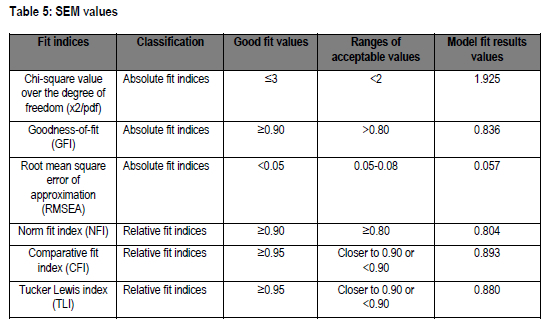
As with the measurement fit model, the fit indices were specified and classified with their concordant good and acceptable fit values. The values for the indices were: (x2/df) = 1.925; GFI = 0.836; RMSEA = 0.057; NFI = 0.804; CFI = 0.893; TLI = 0.880. These values are a poignant confirmation of the structural fit of the model.
6.5.3 Path analysis
After assessing the structural model fit, path analysis was applied to generate path coefficients indicative of the constructs' predictive relationship to enable the postulated hypotheses' acceptance or rejection. The path analysis values for the structural model are captured in Table 6. In the following paragraphs, the results of the path analysis relating to each hypothesis posited earlier in this paper are analysed, interpreted, and their relation to extant literature is indicated.
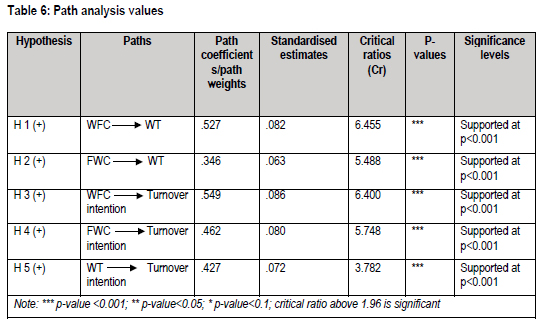
The first proposed hypothesis was that "WFC exerts a significant effect on WT among construction employees" (H1). WFC positively impacted WT (path coefficient =.527; p < 0.001; Cr = 6.455), indicating a considerable contribution to WT among construction workers. The hypothesis was accepted. By implication, strenuous work demands gave construction workers little job control over how work should be done and within which time frames. These work demands encroached on the quality time construction workers should have spent with their families, and the lack of quality time with family resulted in work tension in their workplaces (Vickovic & Morrow, 2020). This finding resonates with the spillover theory that specifies that the negative work circumstances flow into the home space to impact the expected family roles of the construction workers negatively, and these unmet role expectations roll back to create WT in the workplace (Presti et al., 2020). This finding is consistent with Turner and Mariani's (2016) study, which found that excessive working hours, work overload, and inadequate time spent with family are direct causes of work anxiety among construction personnel. Vickovic and Morrow (2020) found that employees with little job control cannot fulfil their home commitments, resulting in work tension.
The second proposed hypothesis was that "FWC has a significant impact on WT among construction employees" (H2). The study found that FWC significantly impacted the prevalence of WT among construction workers (path coefficient=.346; p<0.001; Cr = 5.488), supporting the hypothesis. The finding demonstrated that construction employees had family obligations that tended to interfere with their work demands, thus eliciting WT. The prior study by Hatam et al. (2016) found that employees who face difficult family life situations may struggle to meet their work needs, thus engendering failure to execute tasks in both the work and family domains. According to Lambert et al. (2022), the failure to harmonise the conflicting needs of home and job leads to work strain. This view is succinctly expressed by the spillover theory that asserts that complex or challenging family role demands spill over to the workplace to heighten the work tension of the construction workers (Ismail & Gali, 2017). A prior study revealed that employees who face difficult family life situations may struggle to meet their work needs, failing to execute tasks in both domains (Hatam et al., 2016). According to Lambert et al. (2022), failure to harmonise the conflicting needs of home and job leads to work strain.
The third hypothesis stated that "WFC has a significant contribution to the incidence of turnover intention among construction employees" (H3). The results relating to this hypothesis revealed that WFC influences the incidence of turnover intention among construction workers (path coefficient=.549; p<0.001; Cr = 6.400). On considering this data, the hypothesis was maintained. In this case, too, the spillover theory supports this finding to the extent that the negative workplace circumstances that hampered the execution of family roles (FWC) caused the spillage of turnover intentions throughout the workplace (Adisa et al., 2016). This finding was confirmed by earlier research, which revealed that employees' conflicting work and family roles tended to lead to turnover intentions (Chen et al., 2015). On the other hand, the authors argue that employees' capacity to balance work and family responsibilities promotes harmony, lowers stress levels, and increases employee retention. Other research has discovered that FWC can lead to low happiness with a marriage and a job and decreased work performance, all of which increase the intention to quit (Vickovic & Morrow, 2020; Gull et al., 2023).
The fourth hypothesis proposed was that "FWC has a significant effect on turnover intention among construction employees" (H4). The path analysis results for this hypothesis suggested that FWC constituted a direct source of turnover intention among construction workers (path coefficient=.462, p<0.001; Cr = 5.748). Based on this observation, the hypothesis was confirmed. This empirical finding is again supported by the spillover theory, which purports that family circumstances that constrain the productive performance of work duties tend to spill over into the workplace and negatively affect the turnover intentions of construction employees (Hussong et al., 2022). These results find expression in the research that suggests that devoting more time to family obligations diverts the time required to execute family tasks, resulting in higher employee turnover intention (Liu et al., 2020; Gull et al., 2023). Other research revealed that FWC may give rise to lower happiness levels with a marriage and a job as well as reduced work performance, all of which may induce one's intention to quit (Vickovic & Morrow, 2020; Gull et al., 2023). On the other hand, employees' intention to leave was reduced by their ability to balance work and family obligations (Rhee et al., 2020).
The fifth hypothesis was "There is a relationship between WT and the occurrence of turnover intention among construction employees" (H5). The findings confirmed the higher incidence of WT among construction workers as a prelude to turnover intention (path coefficient=.462; p<0.001; Cr = 3.782). Empirical data demonstrated the direct association between work-tension and turnover intention (Dodanwala & Santoso, 2022). COR corroborates this finding and suggests that work-related stress or tension, created by FWC and WFC, reduces the resources available to construction employees and drains the available energies to deal with work-tension issues, thus triggering job search behaviours and turnover intentions as ways to manage or resolve the issues (Li et al., 2021). Other scholars believe that work-related stress can contribute to job search behaviours and turnover intentions (Li et al., 2021). Furthermore, Salama et al. (2022) argue that individuals who encounter extreme work-related stress at their companies tend to suffer from both psychological and physical illnesses, reducing their attachment to work and, thus, having a high turnover intention. These authors suggest that work stress, regular changes in the working environment, a lack of feedback about performance, insufficient resources to complete duties, and perceived inadequate compensation are the foundations of work tension, leading to higher levels of employee turnover intention.
7. CONCLUSION
The indices of CFA confirmed that the constructs in the research or conceptual framework were distinct, and the indices ranged from an acceptable to a perfect model fit. Similarly, the structural measurement model indices highlighted an acceptable or a perfect fit model. The performance of the path analysis led to the acceptance of the posited hypotheses: WFC and FWC contributed to the occurrence of WT and turnover intention among construction workers at Sedtrade, and WT had a statistically significant influence on turnover intention among construction workers at Sedtrade. Based on these findings, the proposed research model in this study was accepted.
8. RECOMMENDATIONS AND MANAGERIAL IMPLICATIONS
The following recommendations are offered in light of the data that indicate the presence and connection between FWC, WFC, work tension, and turnover intention among construction workers. The key to resolving the competing roles of the work and family domains is to offer flexible work schedules. Given that construction projects have set completion dates, providing flexibility may allow workers to fulfil their family responsibilities, such as going to their kids' school functions. To accommodate family obligations, construction workers might also be allowed to choose an earlier start time or even a four-day workweek. Another choice would be to take on reduced responsibilities or follow company policy about shift swapping, enabling construction workers to attend to their pressing family needs.
Those with small children may benefit from on-site childcare or childcare subsidies, particularly if these facilities are on or near the job site. This assures them that their kids are getting the care they need while they're at work.
Another practical suggestion is to establish employee assistance programs (EAPs) to continuously provide resources or counselling to help construction workers manage work-related stress brought on by the competing demands of their jobs and their family obligations.
Mental health and wellness programs that offer stress management courses or on-site recreational facilities could be provided to address work tension related to work-family conflict.
Nothing compares to supervisor assistance, characterised by candid discussions about difficulties, establishing reasonable due dates for completing project tasks, or even considering suggestions for project work arrangements. Furthermore, family needs could be openly discussed without bias. This method reduces, if not eliminates, tension, annoyance, miscommunications, and needless last-minute changes to weekends and longer workdays. Initiatives based on sound work-life rules, with managers leading by example in taking time off for family responsibilities, could be successful. These managers' excellent behaviour will prove that striking a balance between work and family obligations is not something to be discouraged, but necessary to develop a productive workforce and improve its well-being.
The research findings serve as a presentiment for management and supervisors in the construction sector who should ensure an equitable distribution of workload where human efforts equal the tasks, where equal work is of equal value. The assignment of tasks is issued for completion within a humanly reasonable time. Such management practices should also include breaks between projects. Assigning workers to projects within closer proximity to home could be another management option.
Conflict of interest: The authors declare no conflict of interest with respect to the research, authorship and publication of the article.
Data availability: The raw data used for this article are stored in an Excel spreadsheet and are available on request.
Ethical clearance and informed consent statement: The researchers obtained permission from the company prior to data collection and informed consent from all the participants in this study.
Funding: The authors did not receive any financial support for research, authorship and publication of the article.
Prior publication: This article represents a substantial reworking (more than 50%) of Bekezela Ncube, Masters thesis, submitted, entitled 'Work-family conflict, family-work conflict, work tension, burnout and turnover intention relationships at a construction company in southern Gauteng', at the Department of Human Resource Management, Management Sciences, Vaal University of Technology, Vanderbijlpark, with Professor P. Q. Radebe (supervisor) and The late Professor M. Dhurup (co-supervisor).
https://digiresearch.vut.ac.za/items/b91a8eab-05e7-4870-b942-3d00e34bedac
REFERENCES
Adisa, T.A., Osabutey, E.L.C. & Gbadamosi, G. 2016. Understanding the causes and consequences of work-family conflict: An exploratory study of Nigerian employees. Employee Relations, 38(5):770-788. [http://doi.org/10.1108/ER-11-2015-0211]. [ Links ]
Ajala, E.M. 2017. Work-family-conflict and family-work-conflict as correlates of job performance among working mothers: Implications for industrial social workers. African Journal of Social Work, 7(1):52-62. [ Links ]
Alabi, A.T. & Jelili, M.O. 2023. Clarifying Likert scale misconceptions for improved application in urban studies. Quality and Quantity, 57:1337-1350. [https://doi.org/10.1007/s11135-022-01415-8]. [ Links ]
Alhaddad, A. 2015. Perceived quality, brand image, and brand trust as determinants of brand loyalty. Journal of Research in Business and Management, 3(4):01-08. [ Links ]
Alsughayir, A. 2021. The effect of emotional intelligence on organizational commitment: Understanding the mediating role of job satisfaction. Management Science Letters, 11:1309-1316. [https://doi/10.5267/j.msl.2020.11.008]. [ Links ]
Arzu M., Hanif R., Shah M. & Fiyaz A. 2022. Interception of energies: spillover effects of work family conflict and enrichment affecting work life balance across dual earner couples. Life and Science, 3(3):110-114. [https://doi.org/10.37185/LnS.1.1.215]. [ Links ]
Asiedu, E.E.A., Annor, F. Amponsah-Tawiah & Dartey-Baah, K. 2018. Juggling family and professional caring: Role demands, work-family conflict and burnout among registered nurses in Ghana. Nursing Open, 5:611-620. [https://doi.org/10.1002/nop2.178]. [ Links ]
Ayfer, B.C. & Seyda, O. 2021. Psychometric properties of the perceived diabetes self-management scale in Turkish patient with type 2 diabetes. International Journal of Caring Sciences, 14(1):213-224. [ Links ]
Beigi, M., Shirmohammadi, M. & Stewart, J. 2018. Flexible work arrangements and work-family conflict: A meta synthesis of qualitative studies among academics. Human Resource Development Review, 17(3): 314-336.[https://doi.org/10.1177/1534484318787628]. [ Links ]
Bhui, K., Dinos, S., Miecznikowska, M.G., Jongh, B. & Stansfeld, S. 2016. Perceptions of work stress causes and effective interventions in employees working in public, private and non-governmental organisations: a qualitative study. British Journal of Psychology/ Bulletin, 40:318-325. [https://doi.org/10.1192/pb.bp.115.050823]. [ Links ]
Borgmann, L.S., Kroll, L.E., Muters, S., Rattay, P. & Lampert, T. 2019. Work-family conflict, self-reported general health and work-family reconciliation policies in Europe: Results from the European Working Conditions Survey 2015. SSM - Population Health, 9(100465):1-10. [https://doi.org/10.1016/j.ssmph.2019.100465]. [ Links ]
Cangur, S. & Ercan, I. 2015. Comparison of model fit indices used in structural equation modeling under multivariate normality. Journal of Modern Applied Statistical Methods, 14(1):152-167. [https://doi.org/10.22237/jmasm/1430453580]. [ Links ]
Chen, I.H., Brown, R., Bowers, B.J. & Chang, W.-Y. 2015. Work-to-family conflict as a mediator of the relationship between job satisfaction and turnover intention. Journal of Advanced Nursing, 71(10):2350-2363. [https://doi.org/10.1111/jan.12706]. [ Links ]
Chih, Y.Y., Kiazad, K., Zhou, L., Capezio, A., Li, M. & Restubog, S.L.D. 2016. Investigating employee turnover in the construction industry: A psychological contract perspective. Journal of Construction Engineering and Management,42(6):1 -9. [https://doi.org/10.1061/(ASCE)CO.1943-7862.0001101]. [ Links ]
Cook, J.D., Hepworth, S.J., Wall, T.D. & Warr, P. B. 1981. The experience of work: a compendium of 249 measures and their use. London: Academic Press.[Internet: https://lccn.loc.gov/81066680; accessed/downloaded on 19/07/2017]. [ Links ]
Cooper, C.L. & Quick, J.C. 2017. The handbook of stress and health: A guide to research and practice. Oxford: Wiley Blackwell. [ Links ]
Dodanwala, T.C. & Santoso, D.S. 2022. The mediating role of job stress on the relationship between job satisfaction facets and turnover intention of the construction professionals. Engineering Construction and Architectural Management, 29 (4):1777-1796. [https://doi.org/10.1108/ECAM-12-2020-1048]. [ Links ]
Dodanwala, T.C., Santoso, D.S. & Yukongdi, V. 2023. Examining work role stressors, job satisfaction, job stress, and turnover intention of Sri Lanka's construction industry. International Journal of Construction Management, 23(15):2583-2592. [https://doi.org/10.1080/15623599.2022.2080931]. [ Links ]
Fang, H.F., Susanti, H.D., Dlamini, L.P., Miao, N-F. & Chung, M.H. 2022. Validity and reliability of the spiritual care competency scale for oncology nurses in Taiwan. BMC Palliative Care, 21(16):1-11. [https://doi.org/10.1186/s12904-022-00903-w]. [ Links ]
Farradinna, S. & Halim, F.W. 2016. The consequences of work-family conflict, burnout and organizational commitment among women in Indonesia. Procedia - Social and Behavioral Sciences, 219:241-247. [https://doi.org/10.1016/Lsbspro.2016.05.012]. [ Links ]
Gebregziabher, D., Berhanie, E., Berihu, H., Belstie, A. & Teklay, G. 2020. The relationship between job satisfaction and turnover intention among nurses in Axum comprehensive and specialized hospital Tigray, Ethiopia. BMC Nursing, 19(79):1-8. [https://doi.org/10.1186/s12912-020-00468-0]. [ Links ]
George, E. & Zakkariya K.A. 2015. Job-related stress and job satisfaction: a comparative study among bank employees. Journal of Management Development, 34(3):316-329. [https://doi.org/10.1108/JMD-07-2013-0097]. [ Links ]
Ghofar, A. & Islam, S.M.N. 2015. Corporate Governance and Contingency Theory: A structural equation modeling approach and accounting risk implications. Cham: Springer. [https://doi.org/10.1007/978-3-319-10996-1]. [ Links ]
Goretzko, D., Siemund, K. & Sterner, P. 2024. Evaluating model fit of measurement models in confirmatory factor analysis. Educational and Psychological Measurement, 84(1):123-144. [https://doi.org/10.1177/00131644231163813]. [ Links ]
Gozukara, I. & Colakoglu, N. 2016. The mediating effect of work-family conflict on the relationship between job autonomy and job satisfaction. Procedia-Social and Behavioral Sciences, 229:253-266. [https://doi.org/10.1016/j.sbspro.2016.07.136]. [ Links ]
Guesalaga, R. & Kapelianis, D. 2015. When do salespeople pursue and win deals? A two-stage model of sales opportunity outcomes. Journal of Business and Industrial Marketing, 30(7):817-829. [https://doi.org/10.1108/JBIM-06-2014-0120]. [ Links ]
Gull, N., Asghar, M., Bashir, M., Liu, X. & Xiong, Z. 2023. Does a family-supportive supervisor reduce the effect of work-family conflict on emotional exhaustion and turnover intentions? A moderated mediation model. International Journal of Conflict Management, 34(2):253-272.[https://doi.org/10.1108/IJCMA-03-2022-0046]. [ Links ]
Halbesleben, J.R.B., Neveu, J-P. & Underdahl, S.C.P. & Westman, M. 2014. Getting to the "COR": Understanding the role of resources in conservation of resources theory. Journal of Management, 40(5):1334-1364. [https://doi.org/10.1177/0149206314527130]. [ Links ]
Hamid, M.R.A.B., Sami, W. & Mohmad Sidek, M.H. 2017. Discriminant validity assessment: Use of Fornell and Larcker criterion versus HTMT criterion. Journal of Physics: Conference Series, 890(012163):1-5. [https://doi.org/:10.1088/1742-6596/890/1/012163]. [ Links ]
Haque, A.2023. The effect of presenteeism among Bangladeshi employees. International Journal of Productivity and Performance Management, (72) 4:873-894. [https://doi.org/10.1108/IJPPM-06-2020-0305]. [ Links ]
Harun, I., Mahmood, R. & Som, H.M. 2022. Role stressors and turnover intention among doctors in Malaysian public hospitals: work-family conflict and work engagement as mediators. PSU Research Review, 6(1):1-16. [https://doi.org/10.1108/PRR-08-2020-0025]. [ Links ]
Hatam, N., Jalali, M.T., Askarian, M. & Kharazmi, E. 2016. Relationship between family-work and work-family conflict with organisational commitment and desertion intention among nurses and paramedical staff at hospitals. International Journal of Community Based Nursing and Midwifery, 4 (2):107-118. [ Links ]
Hobfoll, S.E. 1989. Conservation of resources: A new attempt at conceptualising stress. American Psychologist, 44(3):513-524. [ Links ]
Hussain, K., Abbas, Z., Gulzar, S., Jibril, A.B. & Hussain, A. 2020. Examining the impact of abusive supervision on employees' psychological wellbeing and turnover intention: The mediating role of intrinsic motivation. Cogent Business and Management, (7)1:1-21. [https://doi.org/10.1080/23311975.2020.1818998]. [ Links ]
Hussong, A.M., Midgette, A.J., Richards, A.N., Petrie, R.C., Coffman, J.L. & Thomas, T.E. 2022. COVID-19 Life events spill-over on family functioning and adolescent adjustment. Journal of Early Adolescence, 42(3):359-388. [https://doi.org/10.1177/02724316211036744]. [ Links ]
Ignou, D.R.S.S.S. 2022. Work-life balance and mental health: remote working a challenge for workforce in India during Covid-19. Journal of General Management Research, 9(1):56-69. [ Links ]
Ismail, H.N. & Gali, N. 2017. Relationships among performance appraisal satisfaction, work-family conflict and job stress. Journal of Management and Organisation, 23(3):356-372. [https://doi.org/10.1017/jmo.2016.15]. [ Links ]
Karabay, M.E., Akyuz, B. & Eici, M. 2016. Effects of family-work conflict, locus of control, self-confidence and extraversion personality on employee work stress. Social and Behavioral Sciences, 235:269-280. [https://doi.org/10.1016/j.sbspro.2016.11.030]. [ Links ]
Kurniawaty, K., Ramly, M. & Ramlawati, R. 2019. The effect of work environment, stress, and job satisfaction on employee turnover intention. Management Science Letters, 9:877-886. [https://dx.doi.org/10.5267/j.msl2019.3.001]. [ Links ]
Kusnierz, C., Rogowska, A.M., Chilicka, K., Pavlova, I. & Ochnik, D. 2022. Associations of work-family conflict with family-specific, work-specific, and well-being-related variables in a sample of Polish and Ukrainian adults during the second wave of the COVID-19 Pandemic: a cross-sectional study. International Journal of Environmental Research and Public Health, 19(10954):1-20. [https://doi.org/10.3390/ijerph191710954]. [ Links ]
Lagerlund, M., Sharp, L., Lindqvist, R., Runesdotter, S. & Tishelman, C. 2015. Intention to leave the workplace among nurses working with cancer patients in acute care hospitals in Sweden. European Journal of Oncology Nursing, 19(6):629-637. [https://doi.org/10.1016/j.ejon.2015.03.011]. [ Links ]
Laird, M.D., Harvey, P. & Lancaster, J. 2015. Accountability, entitlement, tenure, and satisfaction in generation Y. Journal of Managerial Psychology, 30 (1):87-100. [https://doi.org/10.1108/JMP-08-2014-0227]. [ Links ]
Lambert, E.G., Keena, L.D., Morrow, W.J., Vickovic, S.G., Haynes, S.H., May, D. & Leone, M.C. 2022. Effects of work-family conflict on southern correctional staff burnout. Criminal Justice and Behavior, 49(1):117-138. [https://doi.org/10.1177/00938548211026354]. [ Links ]
Layne, C.M., Hohenshil, T.H. & Singh, K. 2004. The relationship of occupational stress, psychological strain, and coping resources to the turnover intentions of rehabilitation counselors. Rehabilitation Counseling Bulletin, 48(1):19-30. [https://doi.org/10.1177/00343552040480010301]. [ Links ]
Leedy, P.D. & Ormrod, J.E. 2015. Practical research: Planning and design. 11th ed. London: Pearson. [ Links ]
Lefcheck, J.S. 2016. Application Piecewise SEM: Piecewise structural equation modeling in R for ecology, evolution, and systematics. Methods in Ecology and Evolution, 7:573-579. [https://doi.org/10.1111/2041-210X.12512]. [ Links ]
Li, J., Liu, H., Van Der Heijden, B. & Guo, Z. 2021. The role of filial piety in the relationships between work stress, job satisfaction, and turnover intention: a moderated mediation model. International Journal of Environmental Research and Public Health, 18(714):1-14. [https://doi.org/10.3390/ijerph18020714]. [ Links ]
Lim, T.L., Omar, R., Ho, T.C.F. & Tee, P.K. 2021. The roles of work-family conflict and family-work conflict linking job satisfaction and turnover intention of academic staff. Australian Journal of Career Development, 30(3):177-188. [https://doi.org/10.1177/10384162211068584]. [ Links ]
Lin, C.P. & Liu, M.L. 2017. Examining the effects of corporate social responsibility and ethical leadership on turnover intention. Personnel Review, 46(3):526-550. [https://doi.org/10.1108/PR-11-2015-0293]. [ Links ]
Liu, B., Wang, Q., Wu, G., Zheng, J. & Li, L. 2020. How family-supportive supervisor affects Chinese construction workers' work-family conflict and turnover intention: Investigating the moderating role of work and family identity salience. Construction Management and Economics, 38(9):807-823. [https://doi.org/10.1080/01446193.2020.1748892]. [ Links ]
Mansour, S. & Tremblay, D.G. 2016. Workload, generic and work-family specific social supports and job stress: Mediating role of work-family and family-work conflict. International Journal of Contemporary Hospitality Management, 28(8):1778-1804. [https://doi.org/10.1108/IJCHM-11-2014-0607]. [ Links ]
Maryati, S., Wakos, A., Saputri, N.D.M. & Listya, A. 2020. The role of non-financial performance and job-tension. Advances in Economics, Business and Management Research, 142:277-281. [https://doi.org/10.2991/aebmr.k.200520.047]. [ Links ]
Mateo Rodríguez, I., Knox, E.C.L., Oliver Hernández, C., Daponte Codina, A. & The Estar Group. 2021. Psychometric properties of the work ability index in health centre workers in Spain. International Journal of Environmental Research and Public Health, (18)12988:1-10. [https://doi.org/10.3390/ijerph182412988]. [ Links ]
Mcallister, C.P., Mackey, J.D. & Perrewé, P.L. 2018. The role of self-regulation in the relationship between abusive supervision and job tension. Journal of Organisational Behavior, 39:416-428. [https://doi.org/10.1002/job.2240]. [ Links ]
Merino, M. D., Privado, J., & Arnaiz, R. 2019. Is there any relationship between unemployment in young graduates and psychological resources? An empirical research from the conservation of resources theory. Journal of Work and Organizational Psychology, 35:1 -8. [https://doi.org/10.5093/jwop2019a1]. [ Links ]
Mitchell, M.E., Eby, L.T. & Lorys, A. 2015. Feeling work at home: A transactional model of women and men's negative affective spillover from work to family. Springer International Publishing Switzerland 2015 M.J. Mills (ed), Gender and the work-family experience, 121-140. [https://doi.org/10.1007/978-3-319-08891-4_7]. [ Links ]
Molina, J.A. 2021. The work-family conflict: evidence from the recent decade and lines of future research. Journal of Family and Economic Issues, 42 (1): S4-S10. [https://doi.org/10.1007/s10834-020-09700-0]. [ Links ]
Morgan, G.B., Hodge, K.J., Wells, K.E. & Watkins, M.W.2015. Are fit indices biased in favour of bi-factor models in cognitive ability research? A comparison of fit in correlated factors, higher-order, and bi-factor models via Monte. Journal of Intelligence, 3(1):2-20. [https://doi.org/10.3390/jintelligence3010002]. [ Links ]
Musa, S., Paga, H.M. & Yusuf, H. 2021. Job satisfaction and work-family conflict as predictors of job absenteeism among senior secondary school teachers in Yobe state, Nigeria. International Journal of Research in Education and Sustainable Development, 1(8):10-19. [https://doi.org/10.46654]. [ Links ]
Mustapha, B. & Bolaji, B.Y. 2015. Measuring lecturers commitment scales: A second order confirmatory factor analysis (CFA). International Journal of Education and Research, 3(3):505-516. [ Links ]
Nastasa, M., Golu, F., Buruiana, D. & Oprea, B. 2021. Teachers' work-home interaction and satisfaction with life: The moderating role of core self-evaluations. Educational Psychology, 41(6):806-820. [https://doi.org/10.1080/01443410.2020.1852182]. [ Links ]
Netemeyer, R. G., Boles, J.S. & Mcmurrian, R. 1996. Development and validation of work-family conflict and family-work conflict scales. Journal of Applied Psychology, 81(4):400-410. [https://doi.org/10.1037/00219010.81.4.400]. [ Links ]
Ngek, B.N. 2018. Family-work conflict and performance of women-owned enterprises: the role of social capital in developing countries-implications for South Africa and beyond. Journal of International Women's Studies, 19(6):326-343. [https://vc.bridgew.edu/jiws/vol19/iss6/21]. [ Links ]
Ongaki, J. 2019. An examination of the relationship between flexible work arrangements, work-family conflict, organizational commitment, and job performance. Management, 23(2):169-187. [https://doi.org/10.2478/manment-2019-0025]. [ Links ]
Park, R. & Jang, S.J. 2017. Family role overload's relationship with stress and satisfaction. Journal of Managerial Psychology, 32(1):61-74. [https://doi.org/10.1108/JMP-01-2016-0020]. [ Links ]
Peltokorpi, V. & Michel, J. 2021. The moderating effect of core self-evaluations between the relationships of work-family conflict and voluntary turnover, job promotions and physical health. Stress and Health, 37:162-174. [https://doi.org/10.1002/smi.2982]. [ Links ]
Pettinger, R., Gupta, B.B., Roja, A. & Cozmiuc, D. 2022. Handbook of research on digital transformation management and tools. Chicago: IGI Global. [https://doi.org/10.4018/978-1-7998-9764-4]. [ Links ]
Presti, A.L., Molino, M., Emanuel, F., Landolfi, A. & Ghislieri, C. 2020. Work-family organizational support as a predictor of work-family conflict, enrichment, and balance: Crossover and spillover effects in dual-income Couples. Europe's Journal of Psychology, 16(1):62-81. [https://doi.org/10.5964/ejop.v16i1.1931]. [ Links ]
Pujol-Cols, L. 2021. Development and validation of the Spanish work-family conflict scale (SP-WFCS): Evidence from two independent samples in Argentina. Current Psychology, 40:4189-4204. [https://doi.org/10.1007/s12144-019-00544-y]. [ Links ]
Rahim, A. & Cosby, D.M. 2016. A model of workplace incivility, job burnout, turnover intentions and job performance. Journal of Management Development, 35(10):1255-1265 [https://doi.org/10.1108/JMD-09-2015-0138]. [ Links ]
Rashmi, K. & Kataria, A. 2022. Work-life balance: a systematic literature review and bibliometric analysis. International Journal of Sociology and Social Policy, 42 (11/12):1028-1065. [https://doi.org/10.1108/IJSSP-06-2021-0145]. [ Links ]
Rather, R.A. & Camilleri, M.A. 2019. The customers' brand identification with luxury hotels: A social identity perspective. In Harrison, T. & Brennan, M. (Eds), 2019 AMS World Marketing Congress. University of Edinburgh, Scotland (July 2019). Academy of Marketing Science. [https://doi.org/10.1007/978-3-030-42545-6141]. [ Links ]
Rhee, M-K., Park, S.K. & Lee, C-K. 2020. Pathways from workplace flexibility to turnover intention: Role of work-family conflict, family-work conflict, and job satisfaction. International Journal of Social Welfare, 29: 51-61. [https://doi.org/10.1111/ijsw.12382]. [ Links ]
Riaz, S., Xu, Y. & Hussain, S. 2019. Workplace ostracism and knowledge hiding: The mediating role of job tension. Sustainability, 11:1-16. [https://doi.org/10.3390/su11205547]. [ Links ]
Robinson, L.D., Magee, C., & Caputi, P. 2016. Burnout and the work-family interface: A two-wave study of sole and partnered working mothers. Career Development International, 21(1):31-44. [https://doi.org/10.1108/CDI-06-2015-0085]. [ Links ]
SAFCEC. 2009. Report of the employment conditions commission to the minister of labour on the civil engineering sector, South Africa. [Internet: www.labour.gov.za/DOL/downloads/legislation/.../Report%20CIVIL%202009.doc Downloaded/Accessed on 10/072017]. [ Links ]
Salama, W., Abdou, A.H., Mohamed, S.A.K. & Shehata, H.S. 2022. Impact of work stress and job burnout on turnover intentions among hotel employees. International Journal of Environmental Research and Public Health, 19(9724):1-20. [https://doi.org/10.3390/ijerph19159724]. [ Links ]
Sharma, B. 2016. A focus on reliability in developmental research through Cronbach's Alpha among medical, dental and paramedical professionals. Asian Pacific Journal of Health Sciences, 3(4):271-278. [https://doi.org/10.21276/apjhs.2016.3.4.43]. [ Links ]
Sharma, S.K. 2018. Nursing research and statistics 3rd ed. New Delhi: Elsevier. [ Links ]
Shaukat, R. & Yousaf, A. 2017. Examining the linkages between relationship conflict, performance and turnover intentions role of job burnout as a mediator. International Journal of Conflict Management, 28(1)4-23. [https://doi.org/10.1108/IJCMA-08-2015-0051]. [ Links ]
Shrestha, N. 2021. Factor analysis as a tool for survey analysis. American Journal of Applied Mathematics and Statistics, 9(1):4-11. [https://doi.org/10.12691/ajams-9-1-2]. [ Links ]
Simone, S.D., Cicotto, G., Pinna, R. & Giustiniano, L. 2016. Engaging public servants: public service motivation, work engagement and work-related stress. Management Decision, 54(7):1569-1594. [https://doi.org/10.1108/MD-02-2016-0072]. [ Links ]
Sundaresan, S. 2014. Work-life balance - implications for working women. International Journal of Sustainable Development, 07(07):93-102. [https://ssrn.com/abstract=2505439]. [ Links ]
Taasoobshirazi, G. & Wang, S. 2016. The performance of the SRMR, RMSEA, CFI, AND TLI: An examination of sample size, path size, and degrees of freedom. Journal of Applied Quantitative Methods, 11(3):31-40. [ Links ]
Tetteh, S., Wu, C., Opata, C.H., Agyapong, G.N.Y.A., Amoako, R. & Osei-Kusi, F. 2020. Perceived organisational support, job stress, and turnover intention: The moderation of affective commitments. Journal of Psychology in Africa, 30(1):9-16. [https://doi.org/10.1080/14330237.2020.1722365]. [ Links ]
Topa, G., Earl, J. & James, J.B. 2020. Psychological mechanisms that affect economic decisions to work longer. Frontiers Media SA. [https://doi.org/10.3389/fpsyg.2019.03003]. [ Links ]
Trundell, D., Scouiller, S.L., Gorni, K. & Seabrook, T. 2020. Validity and reliability of the 32-item motor function measure in 2- to 5-year-olds with neuromuscular disorders and 2- to 25-year-olds with spinal muscular atrophy. Neurol Ther, 9:575-584. [https://doi.org/10.1007/s40120-020-00206-3]. [ Links ]
Turhan, N.S. 2020. Karl Pearson's chi-square tests. Academic Journal, 15(9):575-580. [https://doi.org/10.5897/ERR2019.3817]. [ Links ]
Turner M. & Mariani A. 2016. Managing the work-family interface: experience of construction project managers. International Journal of Managing Projects in Business, 9 (2):243-258. [https://doi.org/10.1108/IJMPB-07-2015-0057]. [ Links ]
Turner, M. & Lingard, H. 2015. Identification of demand and resource typologies within a systems framework. Thirty-first annual conference, 7-9: 499-508. [ Links ]
Ugwu C.J. 2017. Relationship of work-family conflict, family-work conflict and psychological distress among female bank employees in Port Harcourt Metropolis, Rivers State, Nigeria. European Journal of Psychological Research, 4(1):88-95. [ Links ]
Unguren, E. & Arslan, S. 2021. The effect of role ambiguity and role conflict on job performance in the hotel industry: the mediating effect of job satisfaction. Tourism and Management Studies, 17(1):45-58. [https://doi.org/10.18089/tms.2021.170104]. [ Links ]
Uzondu, C.N., Nwonyi, S.K. & Ugwumgbor, E.T. 2017. Abusive supervision, work tension and overload as predictors of counterproductive work behavior. International Journal of Health and Psychology Research, 5 (3):37-48. [ Links ]
Vickovic, S.G. & Morrow, W.J. 2020. Examining the influence of work-family conflict on job stress, job satisfaction, and organizational commitment among correctional officers. Criminal Justice Review, 45(1):5-25. [https://doi.org/10.1177/0734016819863099]. [ Links ]
Wang, I.A., Tsai, H.Y., Lee, M.H. & Ko, R.C. 2021. The effect of work-family conflict on emotional exhaustion and job performance among service workers: the cross-level moderating effects of organizational reward and caring. The International Journal of Human Resource Management, (32:14):3112-3133. [https://doi.org/10.1080/09585192.2019.1651373]. [ Links ]
Westland, J.C. 2019. Structural equation models from paths to networks. 2nd ed. Chicago: Springer. [https://doi.org/10.1007/978-3-030-12508-0]. [ Links ]
Wong, K.F.E. & Cheng, C. 2020. The turnover intention-behaviour link: a culture-moderated meta-analysis. Journal of Management Studies, 57(6):1174-1216. [https://doi.org/10.1111/joms.12520]. [ Links ]
Yasarathne, K.H.V.P., Nishanthi, H.M. & Mendis, M.V.S. 2018. The impact of job tension on job satisfaction: A study on executive level employees of the Apparel Industry in Anuradhapura District of Sri Lanka. Kelaniya Journal of Human Resource Management, 13 (01):10-20. [https://doi.org/10.4038/kjhrm.v13i1.46]. [ Links ]
Yaslioglu, M. M., & Toplu-Yaslioglu, D. 2020. How and when to use which fit indices? A practical and critical review of the methodology. Istanbul Management Journal, 88:1-20. [https://doi.org/10.26650/imj.2020.88.0001]. [ Links ]
Yucel, D. & Chung, H. 2023. Working from home, work-family conflict, and the role of gender and gender role attitudes. Community, Work and Family, 26(2):190-221. [https://doi.org/10.1080/13668803.2021.1993138]. [ Links ]
Yusoff, A.S.M., Peng, F.S., Razak, F.Z.A. & Mustafa, W.A. 2020. Discriminant Validity Assessment of Religious Teacher Acceptance: The Use of HTMT Criterion. Journal of Physics: Conference Series,1529 042045:1-8. [https://doi.org/10.1088/1742-6596/1529/042045]. [ Links ]
Zafar, R., Abid, G., Rehmat, M., Ali, M., Hassan, Q. & Asif, M.F. 2022. So hard to say goodbye: Impact of punitive supervision on turnover intention. Total Quality Management and Business Excellence, 33(5-6): 614-636. [https://doi.org/10.1080/14783363.2021.1882844]. [ Links ]
Zhang, R.P. & Bowen, P. 2021. Work-family conflict (WFC) - Examining a model of the work-family interface of construction professionals. Safety Science, 144:1-12. [https://doi.org/10.1016/j.ssci.2021.105469]. [ Links ]
Zheng, J. & Wu, G. 2018. Work-family conflict, perceived organizational support and professional commitment: A mediation mechanism for Chinese project professionals. International Journal of Environmental Research and Public Health, 15(344):1-23. [https://doi.org/10.3390/ijerph15020344]. [ Links ]
* Corresponding author
